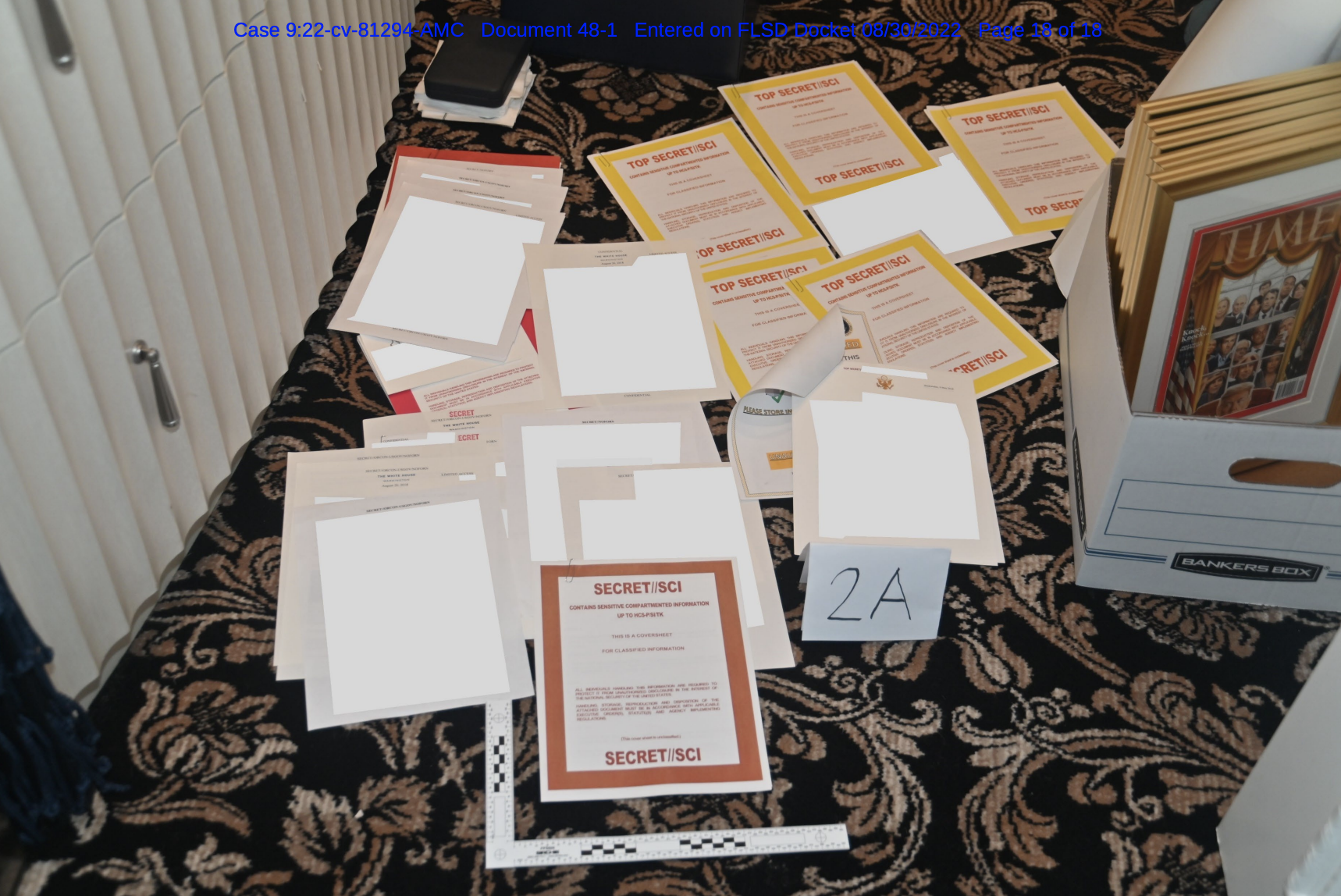
Aileen Cannon Liberates Details of Trump and Melania’s Mar-a-Lago Bedrooms

I don’t like Trump at all.

I don’t like Melania much either.

But call me crazy, I don’t think this kind of detail of a former President’s private suite should be available to the masses and aspiring spies, not even those of former Presidents accused of stealing hundreds of classified documents.

Ah well, kudos to Melania, who got an extra 112 square feet in the bargain.

A more pertinent part of newly unredacted material in the August 2022 search warrant affidavit is that DOJ asked for CCTV footage from outside of Pine Hall, as well as the hallway outside the storage closet where Trump had all his stolen documents stashed, as I’ve long surmised. If such video exists, they didn’t get it in their first request (there remains a redaction regarding the response they did get).

Update: According to NPR, Judge Cannon has some disclosure issues of her own, having failed to disclose two junkets she took to Montana.

Judge Aileen Cannon of the Southern District of Florida is presiding over former President Donald Trump’s criminal trial for allegedly mishandling classified documents. Cannon, herself a Trump appointee, attended two seminars at a luxury resort in Montana, but the privately funded seminar disclosures for both events were not posted online until NPR began making inquiries. Clerk of court Angela Noble told NPR in an email that the absence of the disclosures was due to technical issues and that “Any omissions to the website are completely inadvertent.”

Share this entry

The Evolving Media Strategy of Lev Parnas

In advance of revisiting my work on the many ways Bill Barr intervened to protect — and participated in — Trump and Rudy Giuliani’s Ukraine capers, I want to first examine Lev Parnas’ recent media efforts, to include his House testimony and his recent book. After years of insinuating Barr had a role in Rudy’s capers, Parnas’ expanded story situates Barr more centrally in events, so I want to point out some gaps in his story and questions the fuller story raises.

Make of them what you will.

The limits of firsthand experience

First, note that Parnas’ book is not all based on firsthand experience. He has a co-author, Hells Angels chronicler Jerry Langton. That, plus sourcing choices about the book, make it difficult, at times, to understand where Parnas’ first-hand witness ends and where research begins.

One notable example is where Parnas and Langton tell an incomplete story about the Russian investigation. The purpose of the explanation is, at least in part, to explain why Parnas adopted Trump’s claims about the Russian investigation but no longer does; it is one of many attempts to disavow past beliefs.

Here’s one example of the uneven treatment that results.

Once the allegations of Russian interference became part of the national consciousness, Trump began to repeatedly and falsely claim that he had never done business in Russia, despite his many tweets to the contrary and the fact that his 2013 Miss Universe Pageant in Russia had been broadcast worldwide by NBC, Telemundo and Channel One, showing Trump sitting right beside Azerbaijani oligarch Aras Agalarov in the front row of the audience. Trump even told CBS News: “I have nothing to do with Russia. Nothing to do. I never met Putin. I have nothing to do with Russia whatsoever.” His lawyer, Michael Cohen, said that Trump called him right after that claim to check up on the status of Trump Tower Moscow.

Days later, the FBI would begin its own investigation into links between Russia and the Trump campaign.

Trump addressed the accusations again the same day at a news conference, saying: “Russia, if you’re listening, I hope you’re able to find the 30,000 emails that are missing.” Not only did that indicate that he was indeed looking for dirt on Hillary, but he was widely accused of “urging a foreign adversary to conduct cyberespionage” on another American, which is a serious crime.

The passage puts Trump’s Russia “are you listening” quip at the beginning of the Russian investigation, albeit with a focus on Michael Cohen’s comments, with no acknowledgment of whether it relies on Cohen’s public comments, court records, or on personal comments from Cohen, with whom Parnas has developed a personal relationship.

But the construction suggests a temporal tie between the presser and the investigation.

There’s no mention of George Papadopoulos here, and therefore of a Coffee Boy who ran his mouth to a stranger. It hides the genesis of the investigation. One effect of that is that Parnas absolves himself of addressing a lot of the bullshit about the origin of the investigation offered by Republicans, bullshit that he was party to. Parnas focuses more on Barr’s bullshit about the Russian investigation than that of his one-time allies.

This lack of clarity on sourcing leaves the provenance of more interesting descriptions about events to which Parnas was not a witness, but of which he might have inside information, uncertain. For example, is this an obscure public reference, or something Parnas learned from his right wing buddies?

Meanwhile, [Jeff] Sessions had been asking staffers for disparaging information against Comey and told them that he expected to see at least one anti-Comey article in major media every day.

Similarly, in critically describing John Solomon’s false claims about Yuriy Lutsenko, Parnas provides a claim that Lutsenko had grown close to Paul Manafort.

Solomon then portrays Lutsenko as an anti-corruption hero, as he had been instructed. Although along with letting Kilimnik sneak away, Lutsenko had been fired, dismissed, suspended, jailed (he was pardoned, officially for health reasons) and gotten chummy with Manafort.

This is a really important detail I had not known: but where does it come from? Parnas does not say. And it matters.

Everyone’s mob past

One thing Parnas does attribute to firsthand knowledge, however, is familiarity with the mob (in both senses of the word). Indeed, he offers himself up as a native of the same Brooklyn (and Queens) world that Michael Cohen, Felix Sater, Rudy Giuliani, and Donald Trump all arose from and unashamedly suggests growing up in such a place means you have mob ties.

Parnas lays all this out in matter-of-fact terms.

Parnas describes the mob ties of his ex-wife.

The girl that I was dating (who I would later marry and have a daughter, Zarina, with) had an uncle named Arkady Seifer. He was a very important man in our community. Seifer had been in prison four times and was connected to the Franchese, the Colombo and the Genovese families — among others. And everybody knew exactly how he made his money — the gas tax.

Seifer and I became quite close very quickly and I found myself referring to the old gangster as my uncle. After I gained his confidence and trust, Seifer let me in on his gas scam.

He describes how he came to call neighborhood boss Butch Montevecchi his uncle.

I translated what he said into English for a neighborhood boss, Ernest “Butch” Montevecchi. At the time, everybody knew Butch. He was strikingly handsome with dark hair and green eyes. He ran Brooklyn’s Sheepshead Bay, and Little Odessa, for the Italians. Later, he’d become so close to me and my family that he served as something of a surrogate father for me, and I started to call him my uncle.

He describes how, during the collapse of the Soviet Union, Parnas used his legally sound US citizenship as a means to ferry stuff into the collapsing Russian empire.

All of the clients were over-the-top excited that I could actually go back to whichever old Soviet republic they had come from. Not only could I import products and perhaps make them rich, but I could also get in touch with friends and relatives they hadn’t heard from in decades.

All of them had gifts for me to give to their loved ones overseas. I limited the haul to two suitcases, not only because I couldn’t carry any more, I didn’t want to arouse too much suspicion. They rapidly filled up with things like jeans, watches and other Western items that would be status symbols over there.

[snip]

Some of the people ultimately became my partners because we saw that it was obvious that our individual skills and contacts could benefit all of us. The people who had entrusted me to visit their contacts came from a variety of places, and an itinerary for me was quickly put together. First, I’d go to Moscow and St. Petersburg (officially Petrograd, but nobody ever called it that). Then it was on to Ukraine, where I’d stop at Odessa (now Odesa) and Kiev (now Kyiv). Finally, I would go to Kazakhstan and Uzbekistan. I was fluent in Russian, so I was confident that I’d be understood in all of those places.

Parnas described how this business venture put him in the service of a number of mobsters and oligarchs, including some he helped enter the US. Buy the book!

That story continues seamlessly to Parnas’ gradual insinuation in Trump world, in which the owner of Lique had a role.

Later on that week, I was talking with my friend, Alex Podolnyy, on his boat. It was moored behind his restaurant, Lique. It was nighttime and I was smoking a joint on deck. Before long, I was approached by two excited-looking, well-dressed men who were Alex’s friends. They introduced themselves as Ted and Robert and joined me on the boat. They seemed friendly and they knew Alex, so I didn’t mind sharing a joint with them.

As I’ve noted, SDNY’s affidavit for Parnas’ Instagram inexplicably excluded a picture of Parnas and Ivana Trump at Lique from the scope of their review.
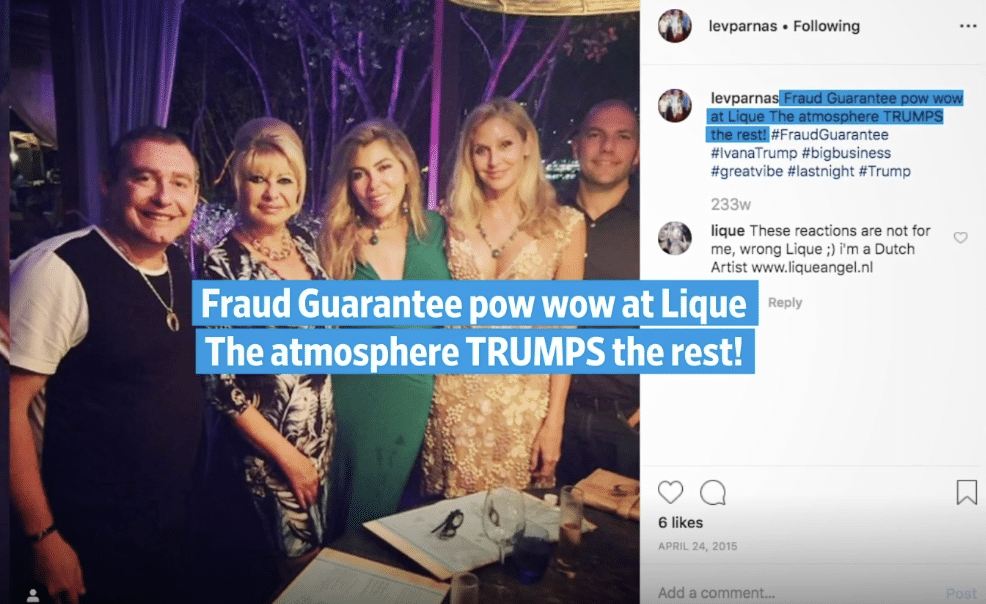
And from there, Parnas got access through Brian Ballard. Over a long passage, he tells the story of how he pitched former head of Ukrainian’s Fiscal Service, Roman Nasirov (who awaits trial on corruption charges), to Brian Ballard and then got Nasirov and another foreigner into the Inauguration.

Later that day, I set up a meeting for Ballard and Nasirov. The Ukrainians were eager. When Ukrainian President Petro Poroshenko found out that Nasirov had an opening into Trump’s future administration with Ballard through me, he pressed Nasirov to make it happen. At the time, Ukraine had almost no relationship with the U.S. and even that was in danger of being erased as the Ukrainians were seen as being pro-Hillary. I explained the situation to Ballard. I told him that it wasn’t the president who was in favor of Hillary, just some loud members of his administration. Besides, Ukraine was a sovereign nation and they needed to have some relationship with the U.S. If they hire you, I told Ballard, they could get it done.

[snip]

The first person in the new power structure I sought out was prominent lobbyist Brian Ballard. Right after the win, I set up a meeting with Ballard — and his right-hand-man, Lukis. Although we talked on the phone, I preferred face-to-face meetings and would always see Ballard when he was in Florida.

Ballard was no dummy, he wanted to talk with me about what I knew and where I had contacts. Ballard wanted what I had, so it didn’t take much to make a deal. I would put Ballard in touch with the right people for 20 percent of any deals he made with them.

Although there was some thrill associated with making such high-level deals, I was really in it for the money. I had just had my big fallout with Hudson Holdings and had filed the lawsuit, so I needed to get paid. I knew just where to go.

Nasirov was a major player in the Ukrainian government and eager to talk with Ballard in order to improve Ukraine’s relationship with Washington. Because Ukraine’s support of Obama and Clinton had greatly offended the new crop of Republicans, he was almost desperate to get on Trump’s good side.

So I arranged to meet Nasirov at one of Igor’s Kyiv nightclubs, Buddha Bar. I flew there on December 1, 2016 to spend a week in Ukraine. When I arrived at Buddha Bar, Igor told me that the first floor was closed for a private party, so I’d have to meet Nasirov upstairs.

These descriptions make for great color. And I don’t doubt Parnas’ claims that everyone else he was dealing with was wowed if not working with the mob.

But the descriptions are notable for two other reasons. They address some — but not all — of details publicly released from his investigation.

But then the descriptions stop.

For example, Nasirov is mentioned just five more times in the book after this long introduction. Parnas explains how, just after Trump encouraged his efforts to dig up dirt with Rudy, Nasirov gave him the introduction to Viktor Shokin.

It was in that kind of weather that I landed in Kyiv to find Shokin. It wouldn’t take long for him to turn up. Everybody who was anybody in Kyiv knew me or at least knew of me. If I put the word out that I wanted to see Shokin, it would get to him.

It didn’t take long, I got a call from Nasirov. Of course he knew Shokin, he told me, they were old friends. He’d be more than happy to take me to see him. Shokin had a place just outside Kyiv.

Then there’s acknowledgment that Nasirov ran against Zelenskyy (and Poroshenko) in 2019. And that’s it. He’s the guy who hooked Parnas — and through him, Rudy — up with Shokin, but Parnas never returns to that relationship. That’s important because, as a letter that Parnas’ attorney failed to properly redact revealed, Nasirov was identified as a subject of the investigation into Parnas.

One person who is never mentioned is Alexander Levin who, like Nasirov, shows up in the warrants targeting Parnas, whose name was exposed in that same Joseph Bondy letter after Rudy phones were seized. As Savage Librarian first noted, a person of the same name and roughly the same vintage was charged in 2021 and will soon stand trial for money laundering in association with a series of safe deposit thefts across Europe; this motion in limine provides a glimpse into his background.

And the mobsters? Most of them are replaced in the story by Rudy Giuliani, as if never the twain shall meet.

Parnas never describes when his association with a bunch of sketchy types ended, if they did. That’s especially notable given Parnas’ description of the men he met at Otisville (the same prison at which Michael Cohen did time).

Once I was introduced into the camp’s general population, I was surprised at how many of the guys I already knew. There were friends of friends, old acquaintances and guys I did business with. There were even some people from the old neighborhood — Jews, Italians and Russians. In fact, they had been watching the news and knew I was coming, so they put together a welcome-to-prison gift package to make my life a little easier. They bought me the things that they had found essential behind bars — toothpaste, slippers, a comfortable sweat suit and other useful items they had bought from the commissary.

Suffice it to say Parnas never makes it clear if — and if so when — he broke from the mobbed up old neighborhood or whether they had a role in his work for Donald Trump’s lawyer.

Igor

Which brings us to Parnas’ treatment of his co-defendant Igor Fruman, who is not from Brooklyn, but instead from South Florida, where all this went down.

As Parnas describes it, they were mutual acquaintances through Jewish charities until Igor reached out because of Parnas’ access to Trump.

I knew Igor Fruman through common friends. Born in Belarus, his family emigrated to Detroit when the USSR was shedding even more Jews, Igor was six years older than me and had moved to South Florida, where the Russian, Ukrainian and Belorussian communities were tight. Still, he spent most of his time in Ukraine where he made his money.

I knew about Igor from various Jewish charities we were both involved in and mutual friends, but we weren’t really friends at the time. Igor became interested in me because of the pictures I was posting of myself with Trump on social media and because I was hosting events for Russians for Trump. Igor wanted to get deals done in the petroleum industry and thought I could help.

He owned two popular nightclubs in Kyiv, Mafia Rave and the more upscale Buddha Bar. Both places were very popular with well-heeled men from both the West and East. They mingled at Buddha Bar, got to know each other and made deals, often huge deals.

Parnas claims that Igor’s famous recordings of a few meetings with Trump — including a later one where Parnas offered up, in 2018, that Marie Yovanovitch was disloyal to Trump — were a surprise to him as well.

When I first started going to these events, I was all eyes and ears. All I wanted to do was learn. And to make contacts. My brain was recording everything so that I could sift through it all for what was valuable. I remember it all vividly, but I don’t have to — it was all recorded.

Although we weren’t officially allowed to take pictures or video, Igor surreptitiously caught it all on his phone without anyone realizing it. Even me.

All he had to do was keep the phone out of sight. Because of that, all his videos contain long shots of things like the backs of chairs, ceilings and water glasses. It was far more important to him to record what was said and who was there rather than it was to make it look any good. Back in Ukraine, he’d play the videos to important people in his bars. To the people there, Igor was just a nightclub owner. So, when he said that he was spending time with Donald Trump and Rudy Giuliani, nobody believed him. But with the videos, he could prove that he had access to the very top. It made for good business.

[snip]

So, I was very excited to head to dinner at the Trump International.

Again, Igor managed to catch it all for posterity despite the usual warnings about using cameras or recording devices.

Playing to the audience, I mention that a lot of European countries are back-stabbing us. I knew he’d love that. The crowd falls silent and seems to be very interested in what I have to say. I discreetly mumble something about the U.S. taking over, then tell Trump that the biggest problem I saw for Ukrainian-American relations is the ambassador.

As Parnas describes it, the tie to Nasirov went through Igor’s mobbed up Ukrainian clubs.

I knew someone who might want to become an investor. It was Ukrainian politician Roman Nasirov, who I knew from Igor’s nightclubs. He was then Chairman of the State Fiscal Service of Ukraine (something like Secretary of the Treasury), and was considered the third-most powerful man in the Ukrainian government.

The tie Yuriy Lutsenko, who just happened to show up in New York after they reached out to Shokin for dirt on the Bidens, went through Igor.

And that’s when a gift dropped right into our laps. At the end of January 2019, about a week or so after we spoke with Shokin, I learned from Igor that one of his friends — Gyunduz Mamedov, the Prosecutor General of Crimea — was in New York on personal business with the current top prosecutor in Ukraine, Yuriy Lutsenko, and Glib Zagoriy, a member of the Ukrainian parliament and a pharmaceutical tycoon.

Igor was also friends with Andrii Artemenko, who in turn set them up with Andrii Derkach and Andrii Telizhenko.

In September, I got a call from Andrii Artemenko, who was a friend of Igor’s. He told me that he had some guys with real, hard evidence that would prove all of our theories once and for all. Naturally, I was intrigued. But once he told me that the guys were Derkach and Telizhenko, I told him that we were cool, I’d pass. Not long after, Giuliani text me and asked: “Who’s this Artemenko?” He had, of course, known Artemenko, but had a habit of forgetting names, especially Eastern European ones.

I told him not to deal with Artemenko, he was peddling Russian disinformation. In fact, I gave him other names of guys who were doing the same thing. Of course, I later learned that he was enthusiastically dealing with Artemenko, as well as Derkach and Telizhenko.

Parnas tells two stories about how they got set up with Dmitry Firtash, one in Paris, seemingly arranged by Firtash because of his legal plight.

He probably first called Manafort, but he was already out of the picture. By the time Firtash needed him, he was already serving time. So Firtash had instead retained American lawyers Lanny Davis and Dan Webb.

On a trip to Paris, Rudy and I had a meeting with a Ukrainian we knew from one of the bars my business partner Igor Fruman owned in Kyiv. Igor considered him a close friend, but he hadn’t seen him in a long time. Unbeknownst to us, he was Firtash’s right-hand man.

He introduced us to Firtash. We wanted to talk to Firtash because we knew that he was connected to Mykola Zlochevsky, owner of Burisma Holdings, Ukraine’s biggest oil and gas company. He told us that he had heard things about Hunter Biden, Joe Biden’s son, bad things. Things we might be interested in. He recommended that we talk to Firtash about it. He wasn’t the first person we talked to, but we believed that he had a great deal of pull with the Ukrainian government. We believed that he could get us what we wanted — a Ukrainian investigation of the Bidens.

He describes the second one to have taken place in Madrid (this may be wrong; it may be the same meeting), where they went after Paris (though they met Kholodnytskyi in Paris first).

After our meeting with Kholodnytskyi, we happened to run into another friend of Igor’s at our hotel in Madrid. Everyone knew him as Little Dimitri because he worked for Firtash and we didn’t want to confuse the two. We spoke about why we were there and how important it was for us to get any compromising information on Joe Biden. He told us that the guy we wanted to talk to was Firtash and that he could introduce us. He didn’t need to explain to us who Firtash was.

Parnas was definitely the one trying to network his way through Trump’s world, but at least as Parnas depicts it, the key Ukrainian relationships — first Nasirov, then Shokin, then Lutsenko, then Firtash, and through Artemenko, Derkach and Telizhenko — all went through Igor. Parnas’ explanation of the foreign donations from Andrey Muraviev also blames Igor for intermixing those funds with other funds.

If SDNY learned that (there’s no hint they did, or if they did, that they believed Parnas), you’d think they would have focused more closely on Fruman than on Parnas.

Instead, the investigation treated Parnas as the brainchild of all the crime.

A continued unpersuasive explanation for his Marie Yovanovitch attacks

Against this backdrop, Parnas’ explanations for taking out Yovanovitch are wildly unpersuasive.

In his congressional testimony, Parnas claimed that he was “smeared” by a plot to get rid of Marie Yovanovitch.

When I was arrested, I was initially accused of being involved in a plot to remove Marie Yovanovitch, the U.S. Ambassador to Ukraine whom Trump had fired in April 2019. I was smeared by this false information, and also untrue claims that I was fleeing the country.

As my case continued, the Department of Justice decided they had no interest in Ukraine, sanitizing their marquee claims about Ambassador Yovanovich from my indictment. Instead, I was prosecuted for federal campaign finance and unrelated fraud charges.

In his book, Parnas would call what were primarily FARA charges “espionage” charges and vastly exaggerate the sentencing exposure either FARA or 18 USC 951 would bring.

By my read, this is a misstatement of what happened (one potentially necessitated by Parnas’ claim that SDNY was part of Bill Barr’s attempt to silence him and Igor or at least neutralize the threat the posed to Trump and Barr personally). By my read, the inclusion and then exclusion of the FARA charges had everything to do with the attempts to include Rudy in those charges and Barr’s tampering in that effort. There are probably a number of reasons why SDNY ultimately couldn’t pursue those charges: the corruption of Rudy’s phones, the provable role Trump had in this process, lasting damage Barr did, and Victoria Toensing’s attorney-client privilege with Dmitry Firtash.

But SDNY’s declination in no way debunks the claim that Parnas was involved in a plot to oust Yovanovitch. In his book he explicitly calls his attacks on Yovanovitch “slander.”

Nobody at the embassy knew what the game was. Yovanovitch was too professional to have said disrespectful things about the President, certainly not that he was going to be impeached. But I had been the source of a constant flow of slander against her. It was a big playground game. We’d go visit important people in Ukraine and tell them how bad Yovanovitch was. That would be followed by a visit by someone from the State Department who would tell the same people that we were lying. I would then double back and talk to the same people again, assuring them that Yovanovitch was anti-Trump and could be dangerous for Ukraine. Then the embassy staff would visit those same people again, telling them that we were nobodies who didn’t know what we were talking about. I had more time, so I usually got in the last word.

Parnas’ attempts to deny that there was a plot are important because, in Parnas’ telling, why he came to oppose Yovanovitch is inconsistent. As he describes telling Anderson Cooper in 2020, as he tried to avenge his arrest by cooperating in impeachment, he was reflecting the views of Republicans.

We discussed the Yovanovitch situation. He asked me if I had a problem with her. I told him I didn’t know her personally, but since the Trump people hated her so virulently, I came to the opinion that she had to go.

That’s, of course, nonsense. When Parnas targeted her in 2018, almost no Republicans would have heard of her.

He attributes the animus he expressed in 2018, which likely led Republicans to start examining Yovanovitch more closely,  to the opinion of “Ukraine’s wealthy and those who planned to be,” people Parnas implicitly describes to be aiming to cozy up to “power brokers in Russia.”

She was unpopular with Ukraine’s wealthy and those who planned to be.

They were well aware that any serious investigations would easily expose them and their alignment, if not outright fealty, to the power brokers in Russia, not their own country (including more than a few elected politicians). With my many connections in various fields, there was a consensus about Yovanovitch — she had to go. And, when they found out I was American, they couldn’t wait to tell me about how bad Yovanovitch was for Ukraine, without giving too many specifics, of course.

She was unpopular with Ukraine’s wealthy and those who planned to be. They were well aware that any serious investigations would easily expose them and their alignment, if not outright fealty, to the power brokers in Russia, not their own country (including more than a few elected politicians). With my many connections in various fields, there was a consensus about Yovanovitch — she had to go. And, when they found out I was American, they couldn’t wait to tell me about how bad Yovanovitch was for Ukraine, without giving too many specifics, of course.

The rest of the book describes a progression: Shokin blamed Yovanovitch for denying him a US visa whence he could plot against the Bidens, which led Rudy to blame Yovanovitch, which led Trump and his failson and John Solomon and everyone else to pile on.

But the actual people behind that original animus are never named, possibly because tying that animus to the mobsters and oligarchs with whom Parnas networked would substantiate a plot, just a different plot, than the one SDNY laid out.

Relatedly, Parnas suggests that Pete Sessions was already working on replacing Yovanovitch when Parnas repeated this story to him and donated that money that, Parnas claims, Igor had mixed in with their other funds. Parnas was just the mule for a letter to Trump.

In short, the campaign against Yovanovitch is presented as always-already in progress, even though there’s no evidence that it started in the US before that Parnas comment in 2018.

A different approach to Dmitry Firtash’s equities

This post is meant to set up one on Barr. We get there via Dmitry Firtash.

Parnas manages to focus more closely on Bill Barr’s role in all of this by expanding, from earlier instances, on how he describes the Firtash relationship.

When he wrote James Comer last year, he probed for a subpoena that would provide a way to breach any privilege claim.

Thereafter, as I became an interpreter between Firtash’s new legal team and Firtash, most of the conversations in which I participated were potentially privileged; however, I believe this information may be made available to the House Oversight Committee through a Congressional subpoena.

He didn’t get that subpoena.

When invited to testify without subpoena, Parnas made no mention of Firtash in his prepared congressional testimony. But in the hearing, Ro Khanna cued Parnas to describe his second-hand understanding that Barr was willing to trade campaign help for lenience from DOJ.

Ro Khanna: Did Bill Barr know that you were involved in getting this dirt?

Parnas: Absolutely. Bill, Bill Barr was informed of our investigation from the day he took office.

Khanna: Did you ever have a conversation with Bill Barr being lenient towards Dmitry, in Bill Barr’s role as Attorney General?

Parnas: I personally did not but I was witness to Victoria Toensing and Joe DiGenova, having a conversation with Bill Barr about Dmitry Firtash.

Khanna: What did they say to Bill Barr?

Parnas: Basically, they were telling him that the charges were false, and that he needs to drop the charges and, basically, end the case.

Khanna: And why did they tell him to drop the charges on this Russian [sic] oligarch?

Parnas: Because Dmitry Firtash was going to help us getting dirt on the Bidens, or whatever else the Trump campaign needed.

Khanna: So my understanding is you have the Trump campaign telling you to talk to a Russian [sic] oligarch to get dirt, on the President of the United States for political reasons, and then someone from the Trump campaign is talking to the Attorney General to drop the charges because this foreign national is helping get dirt on a political candidate?

Parnas: Absolutely.

Khanna: Did Bill Barr indicate any willingness to drop the charges?

Parnas: After the meeting that Victoria Toensing and Joe DiGenova had with DOJ, they came back and informed me that “we’re going to Vienna” because, to tell Dmitry Firtash everything is going to be okay.

While Parnas’ focus on Firtash at the hearing had the appearance of accident, Firtash is a central focus of Parnas’ book. The first pages of Parnas’ book describe meeting — alone, apparently — with Firtash, in what would be the penultimate visit to finalize a quid pro quo.

As my car approached its destination, I watched as a black — no doubt armored — Mercedes SUV with opaque black windows blocked the one-way street behind me. Closer to the massive iron gates in front of the property, another big black SUV blocked the road ahead.

It didn’t unsettle me at all, I’d been through the same routine on the previous trips I had made to this house and others like it. I also knew that the guys protecting Dmytro Firtash seriously outgunned anyone who might want to hurt him. And he was on our side.

As we turned down the only open lane toward the main building, we drove past a legion of security guards in black with dark sunglasses and AK-47s. Nothing out of the ordinary.

The chapter then maps out how, at a hush hush meeting at John Dowd’s in Chatham, MA, as news of the Perfect Phone Call started to break, Trump’s team promised to protect Parnas.

A black SUV with security took me to Chatham, Massachusetts, on the “elbow” of Cape Cod. Firtash paid for all of it. There was a conference call set up by Trump’s legal team at Dowd’s beach house. Dowd told me that the reason we met on Cape Cod was to keep the media away from me.

[snip]

In Dowd’s home office, he set up a conference call with Giuliani, Jay Sekulow (another of Trump’s attorneys), Toensing and diGenova. There might have been other lawyers, but I didn’t hear any. Dowd laid out the plan, and it was simple: stonewall. He instructed us all not to say anything to Congress and not to worry about subpoenas because we’d only get letters requesting our appearance, which we could ignore. Trump, he said, would tell them to go fuck themselves and everybody else was to follow suit. [my emphasis]

So, even as Congress was investigating, Parnas continued to pursue the quid pro quo with Firtash. Parnas went from this meeting back to DC to tie up loose ends for the big Fox News reveal.

On October 6 (two days before the beginning of Yom Kippur), I flew to Washington to discuss the trip to Vienna with Giuliani and Toensing.

Giuliani told me that he wanted to meet Shokin and that it might also be a great idea to bring Fox News personality and ardent Trump supporter Sean Hannity to interview him.

That was a key part of the plan. Team Trump had not been very successful at getting our message into what Trump called “fake news” and the “lame stream media,” so we depended on Fox News and like-minded outlets for any publicity. Not only would millions of Americans see the interview, but it being on Fox News would lend us an air of credibility among many people.

Just before we left for Vienna, I received a phone call from Firtash warning me that Shokin had become anxious about the interview, and was threatening to back out.

I called Shokin. He answered, but he was tense, even panicky. He told me that he was sure “they” were going to kill him. He was absolutely convinced that he would be poisoned, just like Viktor Yushchenko, who had angered Putin while running for the Ukrainian presidency. There was no way, he said, that he would get on a plane no matter what.

Firtash told me not to worry. He’d see to it personally that Shokin was flown to Vienna safely and would be present for a live interview with Fox’s Hannity.

Part of the deal was that we’d also get Shokin’s sealed testimony to the Viennese court and the hard drive from the laptop Hunter Biden used when he was working in Ukraine. It was supposed to have come from Alexander Gorbunenko, who was CFO of Burisma when Hunter worked there. If there was any evidence of him doing anything illegal in Ukraine, we were sure we’d find it there.

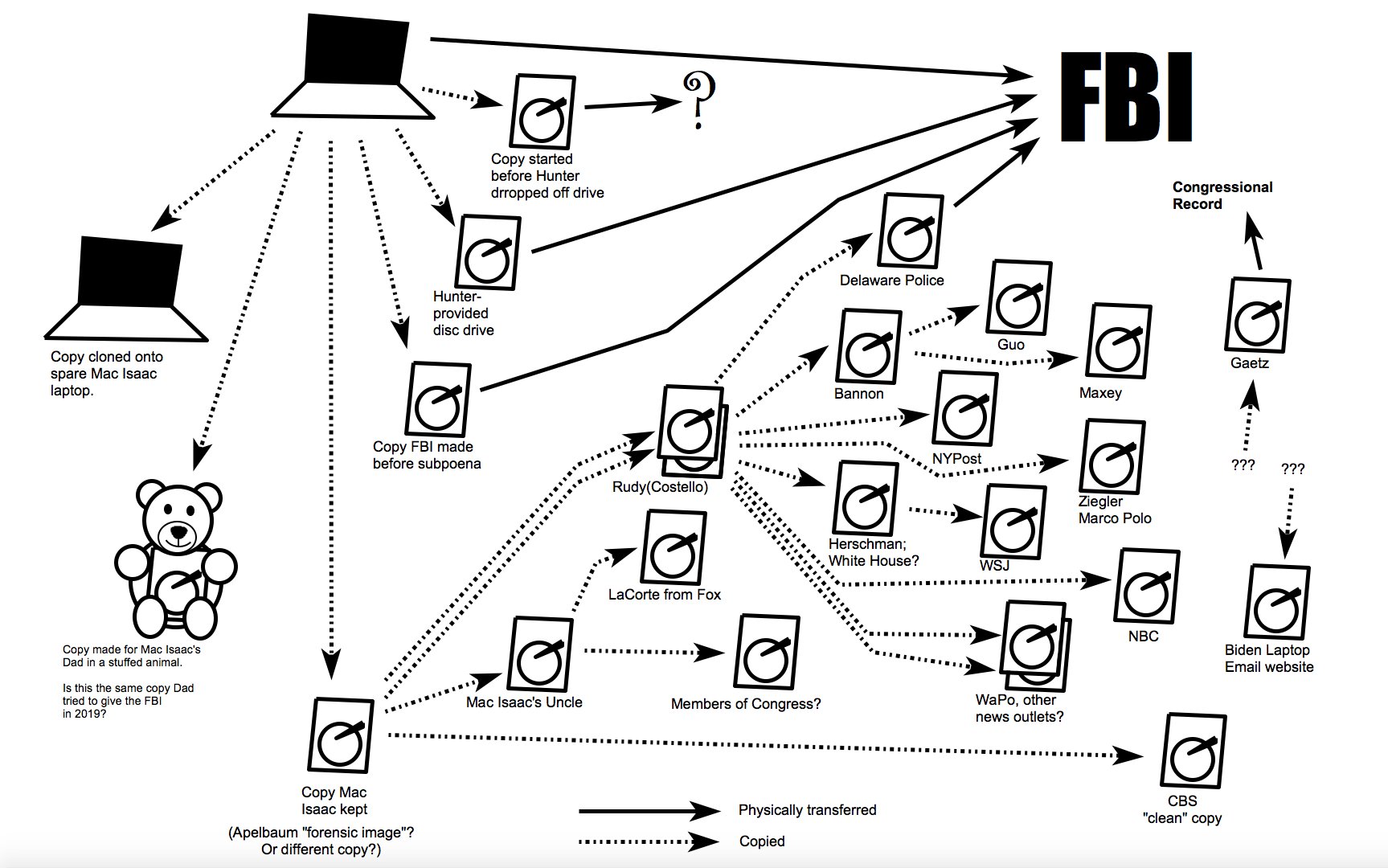
This is the Lev Parnas post, not the Bill Barr post. We can discuss the potential significance of this — the inconsistency between John Paul Mac Isaac’s timeline and the FBI’s, Will Levi writing Barr that a laptop was on its way to him immediately after IRS got a warrant for the laptop ascribed to Hunter, the reported closure of the Mykola Zlochevsky investigation and the use of it to elicit Alexander Smirnov’s false bribery allegation, the limitations imposed on SDNY’s ongoing investigation into Rudy’s influence campaign, the Brady side channel, including Brady’s inquiries into investigations in Chicago, where the Firtash investigation was — in the Bill Barr post.

I’ve got cautions about Parnas’ credibility, and SDNY repeatedly said he was lying about all this (and Parnas sustains some of what SDNY surely treated as lies — for example about Yovanovitch — in this book). But Barr’s a liar too, he affirmatively prevented SDNY from learning some of this, and his own actions are consistent with what Parnas claims.

It’s about motive.

Parnas’ motive has always been transparent. For all his claims to be cured of membership in the Trump cult, that would never have happened if Rudy and Trump and John Dowd hadn’t reneged on their promise to protect him.

I was led into a room where Dowd was sitting behind a table and Downing was standing beside him. Immediately, I started asking questions. I wanted to know why I was still behind bars while Igor was free. I wanted to know what Trump was going to do for me.

Suddenly, Dowd slammed his fist down on the table and shouted at me: “Who do you think you fucking are? Trump is President and he will do whatever he damn well wants to do!”

But in a book that engages in a lot of casual mob-talk, I want to know about the evolving treatment of Firtash.

Firtash had a real attorney-client relationship with Victoria Toensing, however corrupt (Lanny Davis is no better). And for years, Parnas respected that (in part, presumably, because it kept SDNY away from this material, though the statute of limitations on these activities have not quite expired).

I’m all in favor of hearing this story. But what does Firtash feel about it?

 

Share this entry

Joseph Ziegler Allegedly Chased Doctored Laptop Evidence

Following the news that Fox News has complied with one of Hunter Biden’s demands by taking down a six-part fictionalized series on Joe Biden’s son, Sarah Fitzpatrick, one of the journalists who first reported on Hunter Biden’s threats to sue Fox news yesterday, has a new scoop out.

A retired Secret Service agent implicated in the most clearcut laptop related fabrication, Robert Savage, is suing the NYPost, reporters who claimed that he had helped run cover-ups for Hunter Biden in LA, and the US affiliate of the Daily Mail. (NYP, Associated Newspapers)

A former Secret Service agent sued two news organizations for defamation Tuesday and accused them of publishing stories based on fabricated text messages that he says falsely linked him to Hunter Biden.

Robert Savage, a 25-year veteran of the U.S. Secret Service and the Special Agent in Charge of the agency’s Los Angeles Field Office from 2015-2017, filed the lawsuits in New York against the New York Post and two of its reporters, and the owner and publisher of the Daily Mail.

Savage alleged that the reporters and publications recklessly disregarded information that the text messages, which came from a laptop that purportedly belonged to Hunter Biden, were fabricated. Despite that, they published articles and tweets in 2021 and 2023 that suggested Savage communicated with and met and met with Biden in Los Angeles.

“Rob has not and has never met Hunter Biden, does not know Hunter Biden, has no connection with Hunter Biden, and has never corresponded with Hunter Biden,” Savage’s attorney, Mark Goidell, told NBC News.

The lawsuit itself is not the big part of the story: It’s that someone presenting as Joseph Ziegler questioned Savage about the incident.

In March 2022, Savage was visited at his home by an FBI agent and an IRS agent who said they wanted to ask him questions about his association with Hunter Biden and the laptop. Savage was also served with a grand jury subpoena from the U.S. Attorneys Office in Delaware, which later charged him with tax and gun charges.

NBC News obtained security footage of the interaction, copies of the business cards left by the agents and a copy of the subpoena.

The IRS agent identified himself as Joseph Ziegler, who testified as a whistleblower to a House committee investigating Hunter Biden in 2023. Ziegler alleged that the Department of Justice prosecutors limited his investigation of Hunter Biden, a charge that DOJ officiales denied. Ziegler’s attorney declined to comment.

Goidell said that the law enforcement agencies appear to have ended their investigations of the alleged text exchanges between Savage and Biden.

It has long been known that there was fabricated data on at least some versions of the hard drives created from the laptop. But it has been unclear whether those fabrications existed on the copy shared with the FBI.

If Joseph Ziegler really did visit Savage, it means one of two things: Either there is fabricated data on the FBI laptop and investigators have known that since 2022, or that Ziegler allowed himself to be tainted by the publicly released claims about the laptop, complete with fabricated data.

Remember, in August last year, when David Weiss’ purportedly sheep-dipped prosecutors told Abbe Lowell they were going to pursue felony charges against Hunter Biden, they confidently bragged that they had backstop for all the data on the laptop. They said that four months before they first obtained a warrant to access the laptop for evidence relating to gun crimes.

Their confidence turned out to be misplaced; in filings before Judge Noreika that persuaded her they had plenty of evidence against Hunter Biden, they relied on evidence that appears only to be available from the laptop.

And Savage’s lawsuit strongly suggests that prosecutors are sitting on evidence that they know the laptop is unreliable.

Update: This post has been updated, among other things, with links to the lawsuits.

Share this entry

Fox News and the Joint Tortfeasors

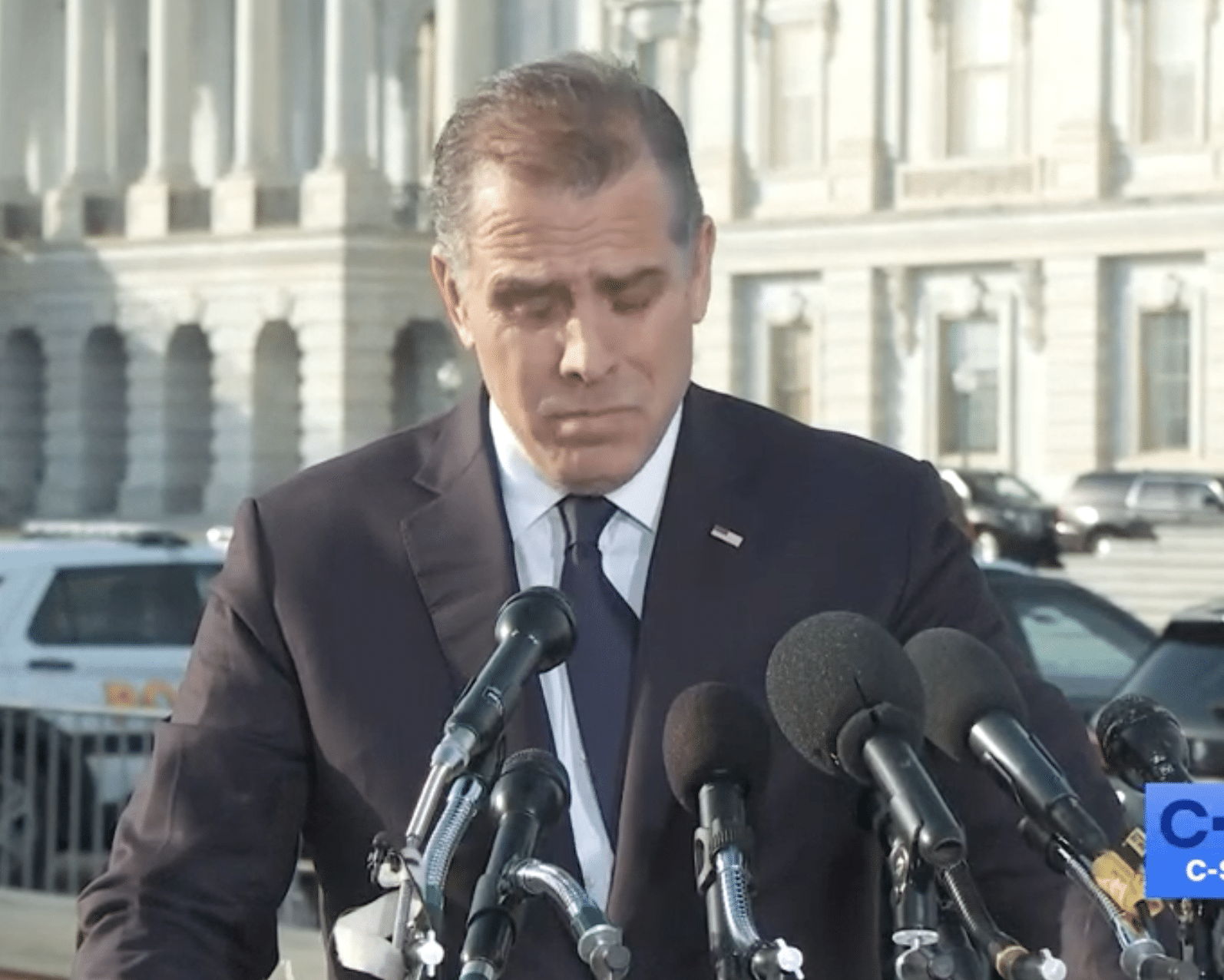
As CNN and NBC have reported, Hunter Biden is threatening to sue Fox News.

The threatened complaints do not amount to a broad defamation claim. Rather, the letter sent by Geragos attorney Tina Glandian makes the following complaint:

  • Both before and after the Alexander Smirnov lawsuit, Fox News claimed that he and his father had accepted a bribe, recently doubling down on Smirnov’s claim.
  • For a fictionalized series called The Trial of Hunter Biden, Fox commercially exploited Hunter’s image.
  • For the same series, Fox News used revenge porn.
  • For the same series, Fox News violated Hunter’s copyright.

I’ve already seen lots of opinion about how wise or unwise this is, most ignoring the narrowness of the defamation claim. The entire claim about the fictionalized series is that Fox presented it as fiction, and therefore cannot be said to be reporting on the news.

Still, I’m agnostic, at this point, about the wisdom of this.

I’m interested, however, in another detail. It’s not just Fox News that Geragos is threatening to sue. They’re threatening to sue other tortfeasors — the people with whom Fox News worked to harm Hunter Biden. Here’s what the protective demand looks like.

As we anticipate that litigation against FOX, as well as its joint tortfeasors is imminent, we hereby formally demand that FOX and its predecessors, successors, parents, subsidiaries, divisions, affiliates, employees, hosts, anchors, commentators, columnists, reporters, journalists, officers, directors, partners, attorneys, accountants, and agents, including but not limited to Jesse Watters, Sean Hannity, Jeanine Pirro, Dana Perino, Miranda Devine, Laura Ingraham, and Maria Bartiromo, preserve all documents potentially relevant to the allegations in this letter including any documents which relate to the allegations in this letter in the broadest sense dating back to at least January 1, 2019. To be clear, such documents include but are not limited to all communications related to (i) strategy meetings at BLT Steak in Washington, D.C. and/or “BLT Team” meetings or communications; (ii) Skype interviews between Ukrainian officials and a Congressman Devin Nunes senior staff member; (iii) the meeting in a FOX News conference room in New York City on October 8, 2019 between and among Lev Parnas, Rudy Giuliani, John Solomon, Joseph diGenova, and/or Victoria Toensing; (iv) the procurement, use, and publication of images of Mr. Biden including the use of intimate images purporting to depict him; (v) the “Salacious Pics Package” and/or “Salacious Pics Package_EDITED” folder allegedly on the laptop obtained by Mr. Mac Isaac; (vi) the planned interview of former Ukrainian prosecutor Viktor Shokin by Sean Hannity in Vienna, Austria in or around late October 2023; and (vii) Fox Nation’s six-part “mock trial” entitled “The Trial of Hunter Biden; (viii) the indictment returned against Alexander Smirnov on or about February 14, 2024.

This preservation demand includes internal communications regarding the foregoing subjects between and among FOX employees, hosts, anchors, commentators, columnists, reporters, journalists, officers, directors, partners, attorneys, accountants, and agents, as well as FOX’s communications with third parties including but not limited to John Paul Mac Isaac, Colonel Steve Mac Isaac, Rudy Giuliani, Robert Costello, Guo Wengui (and/or Ho Wan Kowk and/or Miles Guo), GTV, Vish Burra, Jack Maxey, Vincent Kaufman, John Solomon, Steve Bannon, Tim Murtaugh, and Igor Fruman, Lev Parnas, Dmitry Firtash, then-Congressman Devin Nunes, Senator Ron Johnson, Joseph diGenova, Victoria Toensing, Derek J. Harvey, then U.S. Attorney General William Barr, and other U.S. Department of Justice officials. [my emphasis]

There are a lot of other tortfeasors included in this list.

This discovery overlaps with what Hunter has already gotten from John Paul Mac Isaac (to say nothing if Robert Robinson allows Hunter’s countersuit to go forward), as well as the lawsuit of Rudy and Robert Costello.

But it fills in some of the most important bits — bits that have little to do with the two alleged complaints, per se, but bits that would be relevant in any dispute about whether Fox knew its claims of bribery were not just false, but a deliberate fabrication.

This discovery demand also asks for communications with a number of people, like Devin Nunes and Derek Harvey, who would be untouchable via direct suit. And if Hunter managed to get discovery at all — a very big if — it might threaten to expose ties between Sean Hannity, Dmitry Firtash, and Bill Barr, among others.

Update: The six-part fictional series is in the process of being deleted (click through for links).

Fox News appears to be taking Hunter Biden’s lawsuit threat quite seriously.

The network has quietly pulled down its six-part “mock trial” series from its digital streaming service Fox Nation after lawyers for the presidential scion warned the network of their intention to sue for defamation.

Besides quietly taking down The Trial of Hunter Biden from its streamer, the network also deleted a promotional video promising Fox News viewers an “inside look” at the “mock trial,” which was presided over by former reality-TV star Judge Joe Brown.

This would dramatically limit the surface area that Hunter would have for lawsuit as, without the fictional narrative, only the post-Smirnov claims of bribery would be actionable.

Share this entry

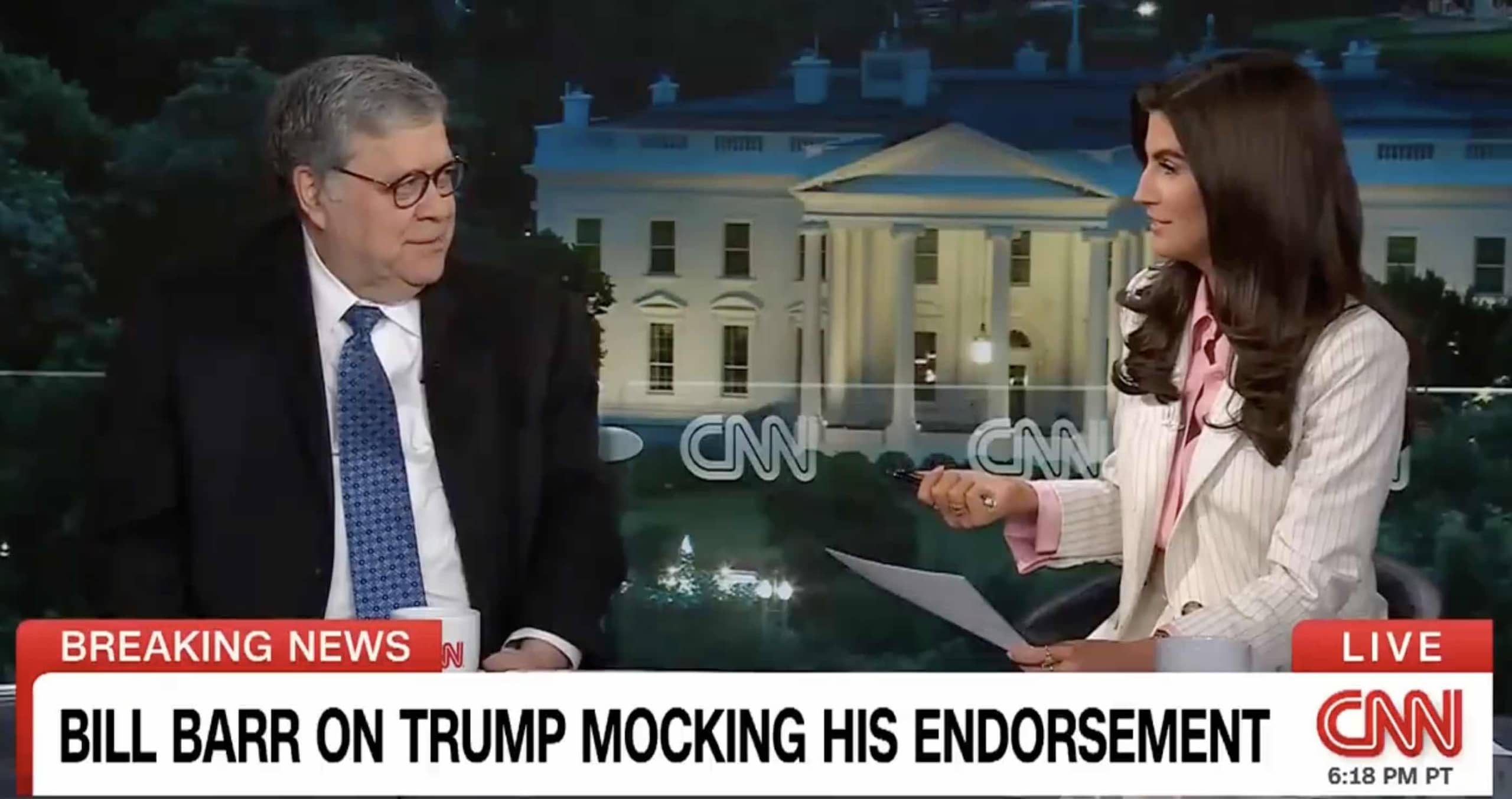
Kaitlan Collins Ignores Bill Barr’s Role in the Effort that Framed Joe Biden

Kaitlan Collins did an interview with Bill Barr the other day, offering him a platform to make weakly-rebutted claims that Democrats were worse than a man who attempted to overthrow democracy.

The interview provided a remarkable opportunity to question Barr about his role in an important scandal that has become public since his last interview with Collins: the Scott Brady side channel to ingest dirt on Hunter Biden, a side channel that FBI informant Alexander Smirnov used to frame Joe Biden with false allegations of bribery. Not only didn’t Collins even ask Barr about his role in setting up that opportunity, but she allowed Barr to lie to her face, falsely claiming that Trump never demanded that Barr intervene in particular investigations.

Days after one such instance documented in Barr’s memoir, when Trump called Barr to yell about Hunter Biden, DOJ ordered prosecutors investigating Joe Biden’s son to pursue Smirnov’s allegations.

Since Barr’s last appearance, we’ve learned more about the Brady side channel

Not long before Bill Barr’s last appearance on Kaitlan Collins’ show last August, he made a little noticed intervention in the House inquiry attempting to substantiate something against Joe Biden.

On June 7, 2023 — the same day David Weiss and Hunter Biden’s lawyers settled on language that should have resolved all criminal investigations of him — in an on-the-record interview with Margot Cleveland, Barr accused Jamie Raskin of lying about what members of Congress had been told about an FD-1023 informant report, now known to be a fabricated report from Alexander Smirnov.

Barr told Cleveland that the investigation into the FD-1023 — an investigation that the Smirnov indictment identifies as a bribery assessment — wasn’t shut down in August 2020 but instead was forwarded to David Weiss to investigate further.

“It’s not true. It wasn’t closed down,” William Barr told The Federalist on Tuesday in response to Democrat Rep. Jamie Raskin’s claim that the former attorney general and his “handpicked prosecutor” had ended an investigation into a confidential human source’s allegation that Joe Biden had agreed to a $5 million bribe. “On the contrary,” Barr stressed, “it was sent to Delaware for further investigation.”

An anonymous source for the same article (often, reporters will give a source anonymity in an article where they are otherwise quoted) had knowledge that the lead to Smirnov didn’t come directly from Rudy Giuliani.

Not so, according to an individual familiar with the investigation who told The Federalist that the CHS and the FD-1023 summary of his statement were both “unrelated to Rudy Giuliani” and “not derived” from any information Giuliani provided.

Barr’s comments led House Republicans to pursue the FD-1023 even more aggressively. They pointed to it as yet another (subsequently debunked) claim that David Weiss had blown the investigation into Hunter Biden. This was the smoking gun that was going to take down Joe Biden and his kid!

That effort appears to have contributed to Weiss’ decision to renege on Hunter Biden’s plea deal.

On July 10 — just weeks after David Weiss’ office assured Chris Clark, on June 19, that there was no ongoing investigation into Joe Biden’s kid — Weiss told Lindsey Graham that there was an ongoing investigation into the FD-1023 he had been ordered to investigate 32 months earlier.

Then, on July 23, just days before Hunter Biden’s plea hearing was scheduled, Chuck Grassley released a leaked copy of the FD-1023 itself.

Three days later, in Hunter Biden’s plea hearing, when Maryellen Noreika asked Leo Wise about the scope of the immunity offered to Hunter Biden, he stated there was an ongoing investigation, one in which FARA charges might still be on the table; that claim directly conflicted with the assurances offered to Hunter’s attorney on June 19.

THE COURT: All right. So there are references to foreign companies, for example, in the facts section. Could the government bring a charge under the Foreign Agents Registration Act?

MR. WISE: Yes.

THE COURT: I’m trying to figure out if there is a meeting of the minds here and I’m not sure that this provision isn’t part of the Plea Agreement and so that’s why I’m asking.

MR. CLARK: Your Honor, the Plea Agreement —

THE COURT: I need you to answer my question if you can. Is there a meeting of the minds on that one?

MR. CLARK: As stated by the government just now, I don’t agree with what the government said.

THE COURT: So I mean, these are contracts. To be enforceable, there has to be a meeting of the minds. So what do we do now?

MR. WISE: Then there is no deal.

As Judge Noreika described in an opinion rejecting Hunter Biden’s claim that David Weiss had reneged on this deal, prosecutors “appeared to revoke the deal” at that moment. In the wake of the release of the FD-1023 and Barr’s claims that Weiss had been ordered to pursue that lead, David Weiss “revoked” the deal in order to chase allegations that might substantiate a FARA charge. In spite of the fact that Judge Noreika described that Wise appeared to revoke a signed deal, in spite of the fact that she had an uncontested claim before her from Chris Clark that Weiss’ office had told him on June 19 there was no ongoing investigation, Noreika did not conclude that Weiss had reneged on the terms of a deal.

On August 29, investigators working with newly-minted Special Counsel David Weiss interviewed Smirnov’s handler. They learned that Smirnov’s travel records were entirely inconsistent with the claims Smirnov had made. They should also have learned that a photo Smirnov shared with his handler in May 2020 was a long-debunked hoax first spread by Tucker Carlson in the same time period that Rudy Giuliani launched his 2020 disinformation campaign against Joe Biden.

Nevertheless, on August 29, the same day they should have realized they were chasing disinformation, Weiss’ prosecutors told Abbe Lowell they were chasing felonies against Joe Biden’s kid.

As they were doing so, more evidence about the side channel became public. On September 27, Gary Shapley released an email corroborating one thing Barr told Cleveland: DOJ had sent that lead over to David Weiss for further investigation. Pittsburgh AUSAs briefed Weiss’ team on October 23, 2020, just days before the election.

Two days later, on September 29, Weiss’ investigators interviewed Smirnov, only to find him beginning to change parts of his story while claiming to know of another disinformation campaign, involving high level Russian spies, targeting Joe Biden in 2024. At this point, it wasn’t just a hoax. It might be a Russian-backed hoax.

It should have been clear years earlier, but by that point, it was clear that Smirnov, someone who belatedly informed his FBI handler about ties with Russian spies, had exploited the Brady side channel set up to ingest dirt Rudy Giuliani solicited overseas, including from known Russian spies, to frame Joe Biden.

On October 23, Brady provided far more details about that side channel in testimony to Congress, testimony that was available almost immediately (but which few mainstream outlets chose to read).

Barr came up, by name, 33 times, such as when Brady described updating the Attorney General on his efforts, in person, twice. Or when describing not what Brady’s actual instructions from Barr were, but what Barr had publicly said his instructions were (the logging of the assessment as a bribery assessment discredits Brady’s claims about his task). Or when Brady got caught falsely claiming the effort wasn’t secret until Lindsey Graham blew the secret after Trump was acquitted for demanding such bribery allegations from Ukraine. Or when questioned about whether Barr was included among the people who “Would feel more comfortable if [Brady] participated,” in an interview of Rudy personally, “so we get a sense of what’s coming out of it.” Or when trying to explain why he reached out to the FBI’s Legat in Ukraine to ask for help from Ukraine’s Prosecutor General. Or when Brady offered several of his never-plausible explanations of something that remains among the most important questions about this scheme: how his team came to focus on a single line in an informant report about Mykola Zlochevsky and, from that, decide they had to interview Smirnov directly.

Q According to public statements by Attorney General Barr, your office in vetting the information provided by the CHS for the FD-1023, you went back and developed more information that apparently had been overlooked by the FBI.

Is that an accurate statement?

A I can’t say “overlooked.” I don’t know that I agree with that characterization because I don’t know what — again, because this was referenced in a previous CHS report, I don’t know what the focus of that investigation was. So it might have been ancillary information that wasn’t directly related to what they were looking at in 2017. But it had not been developed. It’s fair to say that it had not been looked into or developed any further.

[snip]

Chairman Jordan. Okay. January 3rd, 2020. And then what I am understanding is, right, throughout the winter and spring, you’re asking the FBI for information they have regarding Ukraine and Hunter Biden, you’re requesting that you get information they may have?

Mr. Brady. We’re trying to identify investigative leads, and from the information we had received from the public, including information about Hunter Biden and Burisma, and then asking the FBI — and we were also tasked with coordinating this is public from Attorney General, Attorney General Barr, how to coordinate also with intelligence services. And so we were interfacing with them relating to that tasking. It wasn’t everything that they had because certainly Delaware with the grand jury investigation would have had a lot of information relating since it began in 2019.

Bill Barr was, according to the guy he tasked with it, Scott Brady, all over this side channel. Even Bill Barr claims he knew the circumstances of how Brady sought out an informant used in an investigation that had only weeks earlier been shut down by DOJ to shift the focus, away from Zlochevsky’s suspected bribes, and onto the man he might have bribed, Joe Biden.

Bill Barr set up a side channel, during an impeachment of Donald Trump for demanding that Ukraine investigate the Bidens for corruption, that tried to find basis to investigate the Bidens for corruption.

Nothing about Brady’s pursuit of Alexander Smirnov — digging to find a one-line mention of Joe Biden’s kid and from that demanding to interview the informant — matches the public explanation of the side channel: accepting and vetting information from the public, first and foremost from Trump’s personal lawyer. These are all things that Kaitlan Collins had a unique opportunity to query Barr on. Bill Barr claims to know that the Smirnov tip didn’t come from Rudy. How does he know that? Where did it come from? How did Brady and Barr come to decide to interview the FBI informant who happened to be floating false claims of bribery based on already debunked hoaxes? Were Brady and Barr witting participants in the effort to frame Joe Biden, one made in 2020 and renewed for the 2024 campaign, or did they just get used? If they got used, do they owe Biden an apology?

That would have been a laudable use of CNN’s exclusive interview with the former Attorney General.

Bill Barr lies to Kaitlan Collins’ face

Collins did none of that. Instead, among the other lies Barr told (a few of which CNN’s panel debunked after Barr left), she let Barr tell this lie — that Trump never pressured him directly, but instead only pressured Barr by tweet — uncorrected.

Did Trump expect his A.G. to go easy on his friends?

BARR: I don’t know. I don’t know what he expected.

COLLINS: What was your experience?

BARR: My experience was by the time I came in, he did not — he did not push me to do one thing or another, on these criminal cases. Now, he tweeted, and made his public views on things known. But he never talked to me about them directly.

COLLINS: So, he did not have you in his pocket, you would argue?

BARR: It’s not a question of arguing. I did what I thought was right.

COLLINS: And you never felt any direct pressure from him, on what investigations the DOJ was carrying out.

BARR: No. He did not directly pressure me. Yes, as I say, he was out there tweeting and doing things that were embarrassing, and made it hard for me to run the department.

COLLINS: That sounds like pressure. [my emphasis]

Barr’s own memoir describes Trump pressuring him directly, just days before Richard Donoghue, acting as PADAG, ordered David Weiss’ team to accept a briefing from Scott Brady.

In mid-October I received a call from the President, which was the last time I spoke to him prior to the election. It was a very short con-versation. The call came soon after Rudy Giuliani succeeded in making public information about Hunter Biden’s laptop. I had walked over to my desk to take the call. These calls had become rare, so Will Levi stood nearby waiting expectantly to see what it was about. After brief pleasantry about his being out on the campaign trail, the President said, “You know this stuff from Hunter Biden’s laptop?”

I cut the President off sharply. “Mr. President, I can’t talk about that, and I am not going to.”

President Trump hesitated, then continued in a plaintive tone, “You know, if that was one of my kids—”

I cut him off again, raising my voice, “Dammit, Mr. President, I am not going to talk to you about Hunter Biden. Period!”

He was silent for a moment, then quickly got off the line.

I looked up at Will, whose eyes were as big as saucers. “You yelled at the President?” he asked, confirming the obvious. I nodded. He shook his head in disbelief.

Barr’s memoir is largely transparent CYA, especially for his efforts to protect Rudy’s information operations (descriptions of which in the memoir do not match public records), so this may simply be an attempt to spin damning notes Levi took of the call. But it undoubtedly counts as direct pressure from Trump regarding the Hunter Biden investigation.

Plus, Trump’s pressure on DOJ to investigate Hunter Biden was not a one-off. According to contemporaneous notes from Donoghue, Trump harangued Jeffrey Rosen and Donoghue about the Hunter investigation in the December 27, 2020 call otherwise focused on demanding DOJ support for his false election claims, the call where Trump first floated replacing him with Jeffrey Clark.

Rather than hard questions about Barr’s role in an effort that framed Joe Biden, then, this false claim went uncorrected.

Bill Barr is not a hypocrite; he fully backs criminalizing Democrats

The aftermath of all this was stunning.

Some of the panelists Anderson Cooper had on after the interview fact checked some of Barr’s false claims. Both Cooper and Carl Bernstein noted, for example, that crime has gone down under Biden.

But they nevertheless fawned over what they claimed was Barr’s moral compass.

Bernstein, citing a speech in which Barr used a right wing view of religion to attack progressives, hailed the former Attorney General as “a real moralist;” Cooper agreed.

Bernstein described that Barr was “dedicated to the rule of law” but exhibited hypocrisy for choosing Trump over someone who abides by it.

It’s a kind of hypocrisy. Attorney General, dedicated to the rule of law, and then he talks about how Trump has no dedication to the rule of law.

Karen Friedman Agnifilo claimed that Barr’s loyalty to the far right was a newfound thing, one that replaced care for law and order.

[H]e’s really not thinking about things that really mattered to him before, like law and order.

This is not a new thing! Barr cares about authority — the kind of authority that sends federal agents across the country to police protests blocks removed from federal property. But Barr sees the law just as Trump does, as a means for partisan gain, a tool to use to defeat his hated “progressives.”

Bill Barr interfered in the Lev Parnas investigation to prevent it from incorporating Rudy’s solicitation of known Russian spies for campaign dirt, then set up a way that Rudy could share that dirt in a way that might get funneled into the investigation into Joe Biden’s kid. That effort ended up framing Joe Biden. And CNN doesn’t seem to care, or perhaps even know that.

CNN has largely circumscribed the effort to frame Joe Biden

Ultimately, Kaitlan Collins is not entirely to blame that she let Bill Barr lie to her face rather than grilling him about his role in framing Trump’s opponent.

I think she actually makes more of an effort to be personally informed than a number of her peers. But she’s always reliant on the prep that CNN’s own reporters do. And on this story, they’ve been remarkably incurious about the role that Barr’s decision to set up a way to ingest Rudy’s dirt led to the framing of Joe Biden.

For example, here’s how CNN described the process months after these details were first available, in the wake of Smirnov’s arrest.

In June 2020, the Pittsburgh-based US attorney at the time, Scott Brady, was tasked by Justice Department officials with helping to review information from the public “that may be relevant to matters relating to Ukraine.” As part of their review, FBI Pittsburgh opened an assessment into the document that memorialized Smirnov’s 2017 discussion with Burisma executives.

It is at this point, prosecutors allege, that Smirnov first made the explosive allegations about the Bidens. Smirnov told the FBI that Burisma executives admitted to him in 2015 and 2016 that they hired Hunter Biden to “protect us, through his dad, from all kinds of problems,” and that they had paid $5 million to each Biden.

The FBI asked Smirnov to hand over documents to determine whether the information he provided was accurate. Prosecutors say that two months later, the FBI members and DOJ leadership concurred that their assessment of Smirnov’s claims be closed.

But, according to his own private testimony last year to the House Judiciary Committee, Scott Brady claimed he was “able to corroborate certain information that was represented by the CHS and is memorialized in this 1023,” including through some travel records that Smirnov had provided.

Prosecutors now say that Smirnov’s travel records are going to be used as evidence against him in his criminal case, proving that he lied about his meetings with Burisma executives.

Brady said he believed that there was a “sufficient indicia of credibility” into aspects of the 1023, and briefed Weiss on the document, according to the interview transcript. Brady said he asked the FBI to give the document to Weiss’ office.

Weiss apparently kept that investigation open through July 2023, when the FBI approached his team about “allegations related to” Smirnov’s claims. By then, Smirnov’s allegations, though not publicly attributed to him, were thrust into the political spotlight by Republicans who relentlessly promoted his Biden bribery story. [my emphasis]

CNN pitches this as a problem inherent to using informants, and not a problem created when the Attorney General sets up a dedicated side channel to search for dirt on the son of his boss’ rival.

Barr, Seth DuCharme, and Richard Donoghue are systematically excluded from this description, first by use of the passive voice to describe who tasked Brady, and then claiming that Brady asked to brief Weiss rather than that part of his tasking was making recommendations. It ignores how Jeffrey Rosen’s office intervened to force this information onto David Weiss. And it ignores Barr’s public dispute — which conflicts with the Smirnov indictment — that everyone concurred in the decision to close the investigation.

And by ignoring Barr’s intervention, it ignores Barr’s role in stoking the focus on the Smirnov allegation last year.

Likewise, while it describes Brady’s claims to have used travel records to vet Smirnov’s claims one paragraph before describing that prosecutors claim travel records prove Smirnov lies, CNN doesn’t lay out the significance of that conflict. Days after this story, Jerry Nadler referred Brady’s representations to (at least) DOJ IG for investigation.

And CNN simply punts on the problem with this whole story: that Weiss was ordered to investigate Smirnov’s tip in 2020, and then after pressure from Republicans (including Barr), reneged on a plea deal and obtained Special Counsel status so he could investigate it again. It ignores how that makes Weiss a witness in the effort to frame Biden, one whose conflicts prevent him from asking the questions that Collins didn’t either: How did Brady find Smirnov and did anyone know he was spreading obvious disinformation?

CNN’s coverage of Hunter Biden’s claims of how it affected the plea deal likewise misses the 2020 orders to share the tip.

The most newsworthy thing Bill Barr has done since Collins’ last interview with him was help someone claiming high level ties with Russian spies frame Joe Biden. But CNN, including Collins, has no interest in that. They even let him lie, uncorrected, about a directly relevant point!

Rather than explore whether Barr wittingly helped to frame Joe Biden or simply got used by a guy now claiming high level ties to Russian spies, CNN instead chose to portray Barr as a man of law and order who simply sold out purported values out of partisan gain.

And that’s why it was so easy for Barr to use CNN to spin his false claim about caring about the rule of law.

Share this entry

Brett Kavanaugh Thinks that Jack Smith Is as Crazy as Ken Starr Was

There was a subtle moment in yesterday’s SCOTUS hearing on Trump’s absolute immunity claim.

Former Whitewater prosecutor Brett Kavanaugh asked Michael Dreeben whether DOJ had weighed in on this prosecution.

Did the President weigh in? he asked. The Attorney General?

JUSTICE KAVANAUGH: As you’ve indicated, this case has huge implications for the presidency, for the future of the presidency, for the future of the country, in my view. You’ve referred to the Department a few times as having supported the position. Who in the Department? Is it the president, the attorney general?

MR. DREEBEN: The Solicitor General of the United States. Part of the way in which the special counsel functions is as a component of the Department of Justice.

The regulations envision that we reach out and consult. And on a question of this magnitude, that involves equities that are far beyond this prosecution, as the questions of the Court have —

JUSTICE KAVANAUGH: So it’s the solicitor general?

MR. DREEBEN: Yes.

Having been told that Jack Smith consulted with a Senate-confirmed DOJ official on these tough issues, Kavanaugh immediately launched into a screed about Morrison v. Olson, the circuit court decision that upheld the Independent Counsel statute.

JUSTICE KAVANAUGH: Okay. Second, like Justice Gorsuch, I’m not focused on the here and now of this case. I’m very concerned about the future. And I think one of the Court’s biggest mistakes was Morrison versus Olson.

MR. DREEBEN: Mm-hmm.

JUSTICE KAVANAUGH: I think that was a terrible decision for the presidency and for the country. And not because there were bad people who were independent counsels, but President Reagan’s administration, President Bush’s administration, President Clinton’s administration were really hampered —

MR. DREEBEN: Yes.

JUSTICE KAVANAUGH: — in their view —

MR. DREEBEN: Mm-hmm.

JUSTICE KAVANAUGH: — all three, by the independent counsel structure. And what I’m worried about here is that that was kind of let’s relax Article II a bit for the needs of the moment. And I’m worried about the similar kind of situation applying here. That was a prosecutor investigating a president in each of those circumstances. And someone picked from the opposite party, the current president and — usually —

MR. DREEBEN: Mm-hmm.

JUSTICE KAVANAUGH: — was how it worked. And Justice Scalia wrote that the — the fairness of a process must be adjudged on the basis of what it permits to happen —

Kavanaugh slipped here, and described the horror of “Presidents,” not former Presidents, routinely being subject to investigation going forward.

MR. DREEBEN: Mm-hmm.

JUSTICE KAVANAUGH: — not what it produced in a particular case. You’ve emphasized many times regularity, the Department of Justice. And he said: And I think this applied to the independent counsel system, and it could apply if presidents are routinely subject to investigation going forward. “One thing is certain, however. It involves investigating and perhaps prosecuting a particular individual. Can one imagine a less equitable manner of fulfilling the executive responsibility to investigate and prosecute? What would the reaction be if, in an area not covered by this statute, the Justice Department posted a public notice inviting applicants to assist in an investigation and possible prosecution of a certain prominent person? Does this not invite what Justice Jackson described as picking the man and then searching the law books or putting investigators to work to pin some offense on him? To be sure, the investigation must relate to the area of criminal offense” specified by the statute, “but that has often been and nothing prevents it from being very broad.” I paraphrased at the end because it was referring to the judges.

MR. DREEBEN: Mm-hmm. Yes.

JUSTICE KAVANAUGH: That’s the concern going forward, is that the — the system will — when former presidents are subject to prosecution and the history of Morrison versus Olson tells us it’s not going to stop. It’s going to — it’s going to cycle back and be used against the current president or the next president or — and the next president and the next president after that. All that, I want you to try to allay that concern. Why is this not Morrison v. Olson redux if we agree with you? [my emphasis]

Kavanaugh pretended, as he and others did throughout, that he wasn’t really suggesting this was a case of Morrison v. Olson redux; he was just talking hypothetically about the future.

JUSTICE KAVANAUGH: Right. No, I was just saying this is kind of the mirror image of that, is one way someone could perceive it, but I take your point about the different structural protections internally. And like Justice Scalia said, let me — I do not mean to suggest anything of the sort in the present case. I’m not talking about the present case. So I’m talking about the future.

This intervention came long after Kavanaugh suggested that charging Trump with defrauding the US for submitting fake election certificates and charging Trump with obstructing the vote certification after first charging hundreds of others with the same statute amounted to “creative” lawyering.

JUSTICE KAVANAUGH: Okay. For other official acts that the president may take that are not within that exclusive power, assume for the sake of argument this question that there’s not blanket immunity for those official acts but that to preserve the separation of powers, to provide fair notice, to make sure Congress has thought about this, that Congress has to speak clearly to criminalize official acts of the president by a specific reference. That seems to be what the OLC opinions suggest — I know you have a little bit of a disagreement with that — and what this Court’s cases also suggest.

JUSTICE KAVANAUGH: Well, it’s — isn’t — it’s a serious constitutional question whether a statute can be applied to the president’s official acts. So wouldn’t you always interpret the statute not to apply to the president, even under your formulation, unless Congress had spoken with some clarity?

MR. DREEBEN: I don’t think — I don’t think across the board that a serious constitutional question exists on applying any criminal statute to the president.

JUSTICE KAVANAUGH: The problem is the vague statute, you know, obstruction and 371, conspiracy to defraud the United States, can be used against a lot of presidential activities historically with a — a creative prosecutor who wants to go after a president.

But Kavanaugh returned to his insinuation that it was a stretch to prosecute a political candidate for submitting false certificates to Congress and the Archives under 18 USC 371 after his purported complaint about Morrison v. Olson.

Second, another point, you said talking about the criminal statutes, it’s very easy to characterize presidential actions as false or misleading under vague statutes. So President Lyndon Johnson, statements about the Vietnam War —

MR. DREEBEN: Mm-hmm.

JUSTICE KAVANAUGH: — say something’s false, turns out to be false that he says about the Vietnam War, 371 prosecution —

MR. DREEBEN: So —

JUSTICE KAVANAUGH: — after he leaves office?

None of this intervention made any sense; it wouldn’t even have made sense if offered by someone who hadn’t criminalized an abusive, yet consensual, blowjob for years.

After all, contrary to the demands of many, Merrick Garland didn’t appoint a Special Counsel until Trump declared himself a candidate. By that point, hundreds of people had already been charged under 18 USC 1512(c)(2) and DOJ was at least four months into Executive Privilege fights over testimony from Mike Pence’s aides and Trump’s White House counsel. Jack Smith was appointed nine months after Lisa Monaco publicly confirmed that DOJ was investigating the fake electors and six months after overt subpoenas focused on the scheme came out (to say nothing of the treatment of Rudy Giuliani’s phones starting a year earlier).

This is not a Morrison v. Olson issue.

Rather, Kavanaugh is using his well-established hatred for Morrison v. Olson to complain that Trump was investigated at all — and that, after such time that a conflict arose, Garland appointed a non-partisan figure to head the already mature investigation.

It was one of many examples yesterday where the aggrieved white men on the court vomited up false claims made by Trump.

Kavanaugh made no mention of the appointment of Robert Hur — not just a Republican but a Trump appointee who had deprived Andy McCabe of due process — to investigate Joe Biden for precisely the same crime for which Trump was charged. That’ll become pertinent at such time as Donald Trump’s claim to Jack Smith’s appointment gets to SCOTUS. After all, in that case, Trump will have been similarly treated as Joe Biden. In that case, Hur’s distinction between Biden’s actions and Trump’s should (but probably won’t) reassure the right wing Justices that Trump was not selectively prosecuted.

Speaking of things Kavanaugh didn’t mention, his false complaint — and which Clarence Thomas raised as well — comes at a curious time.

Because of Aileen Cannon’s dawdling, Trump’s challenge to Jack Smith’s appointment won’t get to SCOTUS for months, if ever.

But Hunter Biden, whose challenge to David Weiss’ appointment takes the same novel form as Trump’s — an appropriations clause challenge — may be before the Third Circuit as soon as next week. In a passage of Abbe Lowell’s response to Weiss’ demand that the Third Circuit give Lowell, an observant Jew, three days including Passover to establish jurisdiction for his interlocutory appeal, Lowell scolded Weiss for presuming to know the basis of his appeals.

The Special Counsel boasts that it prepared its motion in “two days” (Mot.Exped.3), but the legal errors that permeate its motion to dismiss only underscore why more time is needed to adequately research and thoughtfully brief the jurisdictional issues for this Court. The Special Counsel ignores numerous bases for jurisdiction (e.g., 28 U.S.C. §§ 1291 (collateral order doctrine), 1292(a)(1) (denial of Appropriations Clause injunction), and 1651 (mandamus)) over this appeal, and the legal claims it does make are flatly wrong, compare Mot.6 (falsely claiming “all Circuit Courts” reject reviewing denials of motions to enforce plea agreements as collateral orders), with United States v. Morales, 465 F. App’x 734, 736 (9th Cir. 2012) (“We also have jurisdiction over interlocutory appeals of orders denying a motion to dismiss an indictment on the ground that it was filed in breach of a plea agreement.”)

In addition to mandamus (suggesting they may either attack Judge Noreika’s immunity decision directly or ask the Third Circuit to order Delaware’s Probation Department to approve the diversion agreement that would give Hunter Biden immunity), Lowell also invoked an Appropriations clause injunction — basically an argument that Weiss is spending money he should not be.

Normally, this would never work and it’s unlikely to work here.

But even on the SCO challenge, there are a number of problems in addition to Lowell’s original complaint: that Weiss was appointed in violation of the rules requiring someone outside of DOJ to fill the role.

For example Weiss keeps claiming to be both US Attorney and Special Counsel at the same time (most obviously in claiming that tolling agreements signed as US Attorney were still valid as Special Counsel), or the newly evident fact that Weiss asked for Special Counsel status so that he could revisit a lead he was ordered to investigate — in the wake of Trump’s complaints to Bill Barr that Hunter Biden wasn’t being investigated diligently enough — back in 2020, a lead that incorporated Joe as well as Hunter Biden, a lead that uncovered an attempt to frame Joe Biden, an attempt to frame Joe Biden to which Weiss is a witness.

The oddities of Weiss’ investigation of Joe Biden’s son may even offer another claim that the right wing Justices claim to want to review. Jack Smith claims to have found only two or three charges with which Kavanaugh, who insists (former) Presidents can only be charged under statutes that formally apply to Presidents, would leave available to charge a President. But there’s one he missed: 26 USC 7217, which specifically prohibits the President from ordering up a tax investigation into someone, which Lowell invoked in his selective and vindictive prosecution claim. Lowell has not yet proven that Trump directly ordered tax officials, as opposed to Bill Barr and other top DOJ officials, to investigate Hunter Biden for tax crimes. But there’s a lot of circumstantial evidence that Trump pushed such an investigation. Certainly, statutes of limitation on Trump’s documented 2020 intrusions on the Hunter Biden investigation have not yet expired.

The Hunter Biden investigation has all the trappings of a politicized investigation that Kavanaugh claims to worry about — and with the Alexander Smirnov lead, it included Joe Biden, the Morisson v. Olson problem he claims to loathe.

That’s a made to order opportunity for Brett Kavanaugh to restrict such Special Counsel investigations.

Except, of course, it involves Democrats.

Share this entry

King John Would Like a Word with Justice Alito

The Magna Carta Monument, Runnymede England

I am annoyed by folks who claim to love history and are blind to it. I am disgusted by folks who claim to love history, are willfully blind to it, and in their willful blindness try to use their power to inflict damage on others.

Why yes, I *did* listen to the oral arguments at SCOTUS today. Why do you ask?

sigh

Here’s an exchange between Justice Alito and Michael Dreeben, speaking for the government:

JUSTICE ALITO: Mr. Dreeben, you dispute the proposition that a former president has some form of immunity.

MR. DREEBEN: Mm-hmm.

JUSTICE ALITO: But, as I understand your argument, you do recognize that a former president has a form of special protection, namely, that statutes that are applicable to everybody must be interpreted differently under some circumstances when they are applied to a former president.

Isn’t that true?

MR. DREEBEN: It is true because, Justice Alito, of the general principle that courts construe statutes to avoid serious constitutional questions. And that has been the longstanding practice of the Office of Legal Counsel in the Department of Justice.

JUSTICE ALITO: All right. So this is more, I think, than just a — a quarrel about terminology, whether what the former president gets is some form of immunity or some form of special protection because it involves this difference which I’m sure you’re very well aware of.

If it’s just a form of special protection, in other words, statutes will be interpreted differently as applied to a former president, then that is something that has to be litigated at trial. The — the former president can make a motion to dismiss and may cite OLC opinions, and the district court may say: Well, that’s fine, I’m not bound by OLC and I interpret it differently, so let’s go to trial.

And then there has to be a trial, and that may involve great expense and it may take up a lot of time, and during the trial, the — the former president may be unable to engage in other activities that the former president would want to engage in. And then the outcome is dependent on the jury, the instructions to the jury and how the jury returns a verdict, and then it has to be taken up on appeal.

So the protection is greatly diluted if you take the form — if it takes the form that you have proposed. Now why is that better?

MR. DREEBEN: It’s better because it’s more balanced. The — the blanket immunity that Petitioner is arguing for just means that criminal prosecution is off the table, unless he says that impeachment and conviction have occurred.

Oh, the horrors of forcing a former president to defend himself in a trial! So sayeth Justice Alito, he who cites a 17th century English witchburner of a jurist (who also invented the marital rape exception), in order to justify denying women bodily autonomy.

If Justice Alito is fond of citing old English judicial writings, let me walk him back another 4 centuries and introduce him to John, by the grace of God King of England, Lord of Ireland, Duke of Normandy and Aquitaine, and Count of Anjou.

Once upon a time — long before a bunch of rabble-rousing colonial insurrectionists said that “Governments are instituted among Men, deriving their just powers from the consent of the governed, –That whenever any Form of Government becomes destructive of these ends, it is the Right of the People to alter or to abolish it, and to institute new Government, laying its foundation on such principles and organizing its powers in such form, as to them shall seem most likely to effect their Safety and Happiness.” — there was a little dustup between John, by the grace of God King of England etc., and a bunch of his barons, as well as various bishops and archbishops. The barons and clergy, distressed at what seemed to them to be very ill treatment at the hand of their king, expressed their frustrations in a manner that could not be ignored.

In June 1215, John and the barons negotiated an agreement. In it, after an introduction and 60 separate clauses in which King John agreed to various reforms and promised to make specific restitution in various particular cases that were demanded by his barons, the 1215 version of the Magna Carta ends like this:

* (61) SINCE WE [ed: John] HAVE GRANTED ALL THESE THINGS for God, for the better ordering of our kingdom, and to allay the discord that has arisen between us and our barons, and since we desire that they shall be enjoyed in their entirety, with lasting strength, for ever, we give and grant to the barons the following security:

The barons shall elect twenty-five of their number to keep, and cause to be observed with all their might, the peace and liberties granted and confirmed to them by this charter.

If we, our chief justice, our officials, or any of our servants offend in any respect against any man, or transgress any of the articles of the peace or of this security, and the offence is made known to four of the said twenty-five barons, they shall come to us – or in our absence from the kingdom to the chief justice – to declare it and claim immediate redress. If we, or in our absence abroad the chief justice, make no redress within forty days, reckoning from the day on which the offence was declared to us or to him, the four barons shall refer the matter to the rest of the twenty-five barons, who may distrain upon and assail us in every way possible, with the support of the whole community of the land, by seizing our castles, lands, possessions, or anything else saving only our own person and those of the queen and our children, until they have secured such redress as they have determined upon. Having secured the redress, they may then resume their normal obedience to us.

Any man who so desires may take an oath to obey the commands of the twenty-five barons for the achievement of these ends, and to join with them in assailing us to the utmost of his power. We give public and free permission to take this oath to any man who so desires, and at no time will we prohibit any man from taking it. Indeed, we will compel any of our subjects who are unwilling to take it to swear it at our command.

If one of the twenty-five barons dies or leaves the country, or is prevented in any other way from discharging his duties, the rest of them shall choose another baron in his place, at their discretion, who shall be duly sworn in as they were.

In the event of disagreement among the twenty-five barons on any matter referred to them for decision, the verdict of the majority present shall have the same validity as a unanimous verdict of the whole twenty-five, whether these were all present or some of those summoned were unwilling or unable to appear.

The twenty-five barons shall swear to obey all the above articles faithfully, and shall cause them to be obeyed by others to the best of their power.

We will not seek to procure from anyone, either by our own efforts or those of a third party, anything by which any part of these concessions or liberties might be revoked or diminished. Should such a thing be procured, it shall be null and void and we will at no time make use of it, either ourselves or through a third party.

* (62) We have remitted and pardoned fully to all men any ill-will, hurt, or grudges that have arisen between us and our subjects, whether clergy or laymen, since the beginning of the dispute. We have in addition remitted fully, and for our own part have also pardoned, to all clergy and laymen any offences committed as a result of the said dispute between Easter in the sixteenth year of our reign (i.e. 1215) and the restoration of peace.

In addition we have caused letters patent to be made for the barons, bearing witness to this security and to the concessions set out above, over the seals of Stephen archbishop of Canterbury, Henry archbishop of Dublin, the other bishops named above, and Master Pandulf.

* (63) IT IS ACCORDINGLY OUR WISH AND COMMAND that the English Church shall be free, and that men in our kingdom shall have and keep all these liberties, rights, and concessions, well and peaceably in their fullness and entirety for them and their heirs, of us and our heirs, in all things and all places for ever.

Both we and the barons have sworn that all this shall be observed in good faith and without deceit. Witness the abovementioned people and many others.

Given by our hand in the meadow that is called Runnymede, between Windsor and Staines, on the fifteenth day of June in the seventeenth year of our reign (i.e. 1215: the new regnal year began on 28 May).

Note the third paragraph, that begins “If we, our chief justice, . . .” In that paragraph, King John, by the grace of God King of England etc., is agreeing that he and his administration are not immune from accountability.

John and the barons agreed on a process for adjudicating disputes. They agreed on a panel that could both bring charges and judge them.  They agreed on how the panel should be chosen, and how the panel should select new members at the death of old ones. They agreed on how many members of the panel needed to agree in order for a judgment to be final. They agreed on a time frame for restitution. Most importantly, should John be found to have violated the terms of this document and yet refuse restitution, John, by the grace of God King of England etc., agreed that his castles and lands could be seized under order of the panel to make restitution for what he had done, or his officials had done on his behalf.

To be fair, the Magna Carta was changed and altered in the years and centuries that followed. But the original text of the original version makes it clear that even the King of England, Lord of Ireland, Duke of Normandy and Aquitaine, and Count of Anjou does not enjoy absolute immunity.

Trump may wish to be a monarch with absolute immunity and not a president.

Alito may wish to treat him as a monarch with absolute immunity and not a president.

But in a meadow at Runnymede, between Windsor and Staines, John, by the grace of God King of England, Lord of Ireland, Duke of Normandy and Aquitaine, and Count of Anjou, said no. That’s not how even a divinely appointed monarch is to be treated.

Share this entry

Sam Alito Says that Donald Trump Is a Maligned Ham Sandwich

I’m not, now, as full of despair as I was at one point in the SCOTUS hearing on Presidential immunity. (Here’s my live thread.) I believe that a majority of the court will rule that for private conduct — adopting the Blassingame rule that a President acting as candidate acts in a private role — a former President can be prosecuted.

But whooboy, Sam Alito really really believes everything Trump has said about this being a witch hunt. He repeatedly said that the protections that we assume ensure rule of law in the US — DOJ guidelines on prosecutions, the role of a grand jury, the role of a judge — are not enough in the case of Donald Trump. Sam Alito believes that Donald Trump should not have to be inconvenienced by a trial while he could be doing something else. Sam Alito also believes that January 6 was a mostly peaceful protest.

Alito even suggested that a President would be more likely to engage in violence after a closely contested election if he knew he might be prosecuted for it than not.

It was fairly insane.

Meanwhile, while I think there’s a majority (though Steve Vladeck is not as convinced) — with at least all the women in a majority — to let this case proceed at least on the private acts alleged in the indictment (with the huge caveat that Trump’s demands of Pence would not be considered a private act!), it’s clear that Neil Gorsuch doesn’t see how 18 USC 1512(c)(2) could be applied to Trump because we don’t know what corrupt purpose is, even though, of all the January 6 defendants, his corrupt purpose — his effort to obtain a improper private benefit — is most clearcut.

But there’s a whole lot of garbage that will come out of this decision, including immunity for core actions, like pardons and appointments, that could clearly be part of a bribe.

Notably, both Clarence Thomas and Brett Kavanaugh appear to be gunning for Special Counsels (though possibly only with respect to Presidents, not the sons of Presidents).

Michael Dreeben backtracked and backtracked far enough to preserve a case. But it’s not sure what else there will be.

Share this entry

The Phone Contacts between the “Total Moron” and the PAC Head

According to Person 16 — who has the potty mouth and performed candor we’ve come to expect from Eric Herschmann — Person 5 is a “total moron” — an opinion about Boris Epshteyn that Herschmann has expressed elsewhere.

“I certainly am not relying on any legal analysis from either of you or Boris who — to be clear — I think is an idiot,” Mr. Herschmann wrote in a different email. “When I questioned Boris’s legal experience to work on challenging a presidential election since he appeared to have none — challenges that resulted in multiple court failures — he boasted that he was ‘just having fun,’ while also taking selfies and posting pictures online of his escapades.”

Mr. Corcoran at one point sought to get on the phone with Mr. Herschmann to discuss his testimony, instead of simply sending the written directions, which alarmed Mr. Herschmann, given that Mr. Herschmann was a witness, the emails show.

In language that mirrored the federal statute against witness tampering, Mr. Herschmann told Mr. Corcoran that Mr. Epshteyn, himself under subpoena in Georgia, “should not in any way be involved in trying to influence, delay or prevent my testimony.”

“He is not in a position or qualified to opine on any of these issues,” Mr. Herschmann said.

At that same November 2, 2022 interview, Person 16 went on to tell Jack Smith’s investigators how Person 5 ingratiated himself to Trump after the former President left the White House.

Post January 2021, [Person 5] constantly sent FPOTUS what [he] had uncovered on the election fraud and maneuvered [his] way into FPOTUS’ circle. [Person 16] was unaware of an actual [redacted] for [Person 5], stating it was [Person 5] who would instruct media to report [on him] as [redacted].

I long laughed at the the way that journalist after journalist credited Ephsteyn with playing a role in Trump’s legal defense even while Ephsteyn was billing Trump’s PAC for strategy consulting, not law.

For the entirety of the time that Epshteyn was quarterbacking Trump’s response to the stolen documents probe, someone in his immediate vicinity has been telling reporters that he was playing a legal function, all the while billing Trump for the same old strategic consulting his firm, Georgetown Advisory, normally provides (though the two payments the campaign made to Epshteyn after Trump formalized his candidacy, totalling $30,000, were filed under “communications and legal consulting”).

NYT has, in various stories including Maggie in the byline, described Epshteyn’s role in the stolen documents case as “an in-house counsel who helps coordinate Mr. Trump’s legal efforts,” “in-house counsel for the former president who has become one of his most trusted advisers,” and “who has played a central role in coordinating lawyers on several of the investigations involving Mr. Trump.” Another even describes that Epshteyn “act[ed] as [a] lawyer [] for the Trump campaign.” The other day, Maggie described his role instead as “broader strategic consulting.”

All the time that NYT was describing Epshteyn as playing a legal role — and NYT is in no way alone in this — he was telling the Feds he wasn’t playing a legal function, he was instead playing a strategic consulting one. Many if not most of these stories also post-date the time, in September, when the FBI seized Epshteyn’s phone, which would give him a really good reason to try to claim to be a lawyer and not a political consultant.

According to Person 16, he “believed [Person 5] was now trying to create [redacted] to cover [him] for previous activities. [Person 16] believed [Person 49’s] records may reflect recent [redacted] that did not reflect what actually transpired.”

It was around the time of this interview, in November 2022, when Ephsteyn did start billing for legal services, even while the press was credulously reporting that he had always been serving in a legal role. That happened in the aftermath of Ephsteyn’s phone being seized, in September 2022.

Person 16 also thought that “total moron” Person 5 might have shifted the concern about witness tampering from the January 6 investigation[s] to the stolen document one.

[Person 16] could not recall where the information that the concern about witness tampering was related to the document investigation and not the January 6th Committee. [Person 16] commented that sounded like something [Person 5] would do.

That interview was in November 2022.

In January 2023, according to an exhibit submitted in support of a discovery request for records on all correspondence and/or communications regarding counsel, Jack Smith’s office asked the FBI to pull together the toll records between Person 49 — who may be Susie Wiles, the head of America First PAC — and both Person 5 and Stanley Woodward.

The contacts between Person 49 and Woodward are not that interesting — just four phone calls in fall 2022, when Woodward started representing Kash Patel.

The contacts between Person 5 (whom I suspect is Ephsteyn) and Person 49 (whom I suspect is Wiles) are more interesting.

The contacts started on April 20, 2021, when Person 5 called Person 49, with sustained contact for a few months and then a lapse.

The contacts resumed in September and October 2021 (when the January 6 Committee was ratcheting up).

There were four phone calls in one week in November 2021, and two longer calls in December 2021.

And then nothing, until when Ephsteyn started ingratiating himself in Trump’s orbit after the documents issue went public in February 2022. From that point forward they were “in contact almost daily.”

Of course, these SMS texts might not be that useful. The paragraph of the superseding stolen documents indictment that describes Wiles vetting Carlos De Oliveira’s loyalty before arranging legal representation of him describes that Nauta confirmed his now co-defendant’s loyalty on a Signal chat, not an SMS text.

Just over two weeks after the FBI discovered classified documents in the Storage Room and TRUMP’s office, on August 26, 2022, NAUTA called Trump Employee 5 and said words to the effect of, “someone just wants to make sure Carlos is good.” In response, Trump Employee 5 told NAUTA that DE OLIVEIRA was loyal and that DE OLIVEIRA would not do anything to affect his relationship with TRUMP. That same day, at NAUTA’s request, Trump Employee 5 confirmed in a Signal chat group with NAUTA and the PAC Representative that DE OLIVEIRA was loyal. That same day, TRUMP called DE OLIVEIRA and told DE OLIVEIRA that TRUMP would get DE OLIVEIRA an attorney. [my emphasis]

Among the exhibits included in this request for discovery is a fragment of an interview with Person 49 denying unequivocally that she had done such vetting (as well as an earlier interview in which she said Person 16 was at the forefront of finding lawyers). If this is Wiles, she denied conducting loyalty checks before agreeing to find legal representation for people.

Mind you, that’s not the only place Wiles shows up in the superseding indictment.

In August or September 2021, when he was no longer president, TRUMP met in his office at the Bedminster Club with a representative of his political action committee (the “PAC Representative”). During the meeting, TRUMP commented that an ongoing military operation in Country B was not going well. TRUMP showed the PAC Representative a classified map of Country B and told the PAC Representative that he should not be showing the map to the PAC Representative and to not get too close. The PAC Representative did not have a security clearance or any need-t0-know classified information about the military operation.

That was around the time when Person 49 resumed phone contact with Person 5 again.

This ABC piece talks about what a big deal it is that Wiles might have to testify at trial in the height of a campaign she’s leading (though Aileen Cannon seems dead set on preventing that from happening).

And this post describes how Wiles likely showed up in another Trump-related indictment as the Florida campaign official who interacted — unwittingly — with Yevgeniy Prigozhin’s trolls.

Share this entry