Three Things: So Much Stupid

[NB: check the byline, thanks. /~Rayne]

There’s a lot of stupid going on right now. Here’s an open thread to talk about it. Let me start off with three examples.

~ 3 ~

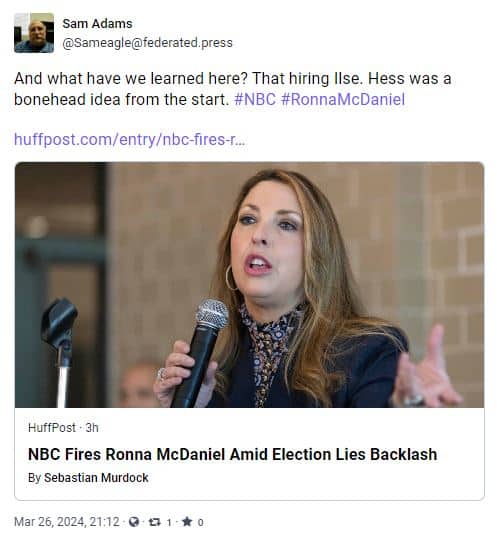
Ding dong, the witch is dead — Ronna McDaniel has been terminated less than a week after she signed a contract with NBC.

Even her agency dropped her.

I like journalist Sam Adam’s take:

Story at HuffPo: https://www.huffpost.com/entry/nbc-fires-ronna-mcdaniel-election-lies_n_6602d903e4b06a4403a3e80a

NBCUniversal News Group Chairman Cesar Conde accepted the blame for McDaniel’s hiring though he noted it was a collective decision by “collective recommendation by some members of our leadership team” to hire the unindicted January 6 co-conspirator.

It’d be nice if folks who support democracy and a free press checked their investment portfolios for Comcast (Nasdaq:CMCSA) including their mutual fund holdings’ portfolios — and then sent letters to Investor Relations asking for accountability at Comcast and NBC for this stupid hiring decision which damaged NBC.

~ 2 ~

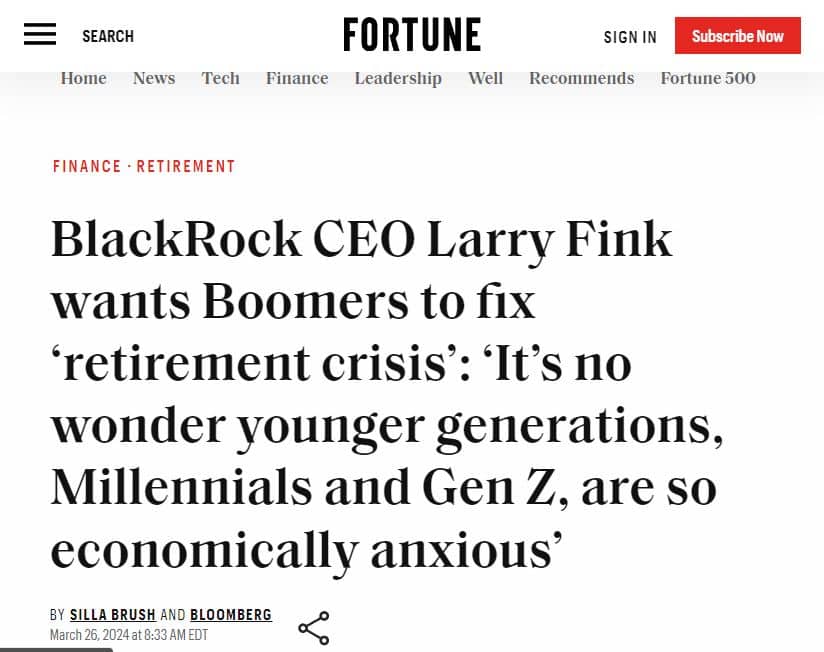
BlackRock CEO is fucking clueless about Millennials and Gen Z, spewing this crap:

You know what’s causing these two demographic groups so much economic anxiety? The two things which cost them the most: tuition debt and housing.

They can’t save for a house if they have tuition debt hanging over them. President Biden has steadily chipped away at this but it isn’t enough.

They can’t buy a house because there’s too little housing available which in turn drives up pricing. Sure, mortgages are pricey right now but if there’s not enough housing, mortgages aren’t the bigger problem.

Rental housing is also overpriced and getting worse; it’s been unaffordable for persons working a full-time minimum wage job for years thanks to continued corporate pressure to resist raising minimum wages at state and federal level for decades. This has begun to change but Millennials are digging their way out of a deep hole to amass savings.

One of the biggest contributors to rising rental housing costs is the commodification of housing as a tradeable asset in the form of real estate investment trusts (REITs). Investors treat REITs as if they should increase in value and payouts like other tradeable stocks.

Gee, guess what BlackRock’s funds include?

Fink also hasn’t gotten the memo that there is a growing wave of disability as a result of the COVID pandemic. People will need to retire earlier, not later, and his bullshit refusal to accept wealthier persons must pay more into Social Security is not going to help.

Side note: I can’t recommend using Fortune magazine at this time. The link to this story follows but be warned: Fortune changed its privacy policy and you will be forced to accept that policy in order to read the fucking privacy policy. Absolutely unacceptable dark pattern.

Source: https://fortune.com/2024/03/26/blackrock-ceo-larry-fink-boomers-fix-retirement-crisis-millennials-gen-z-economically-anxious/

~ 1 ~

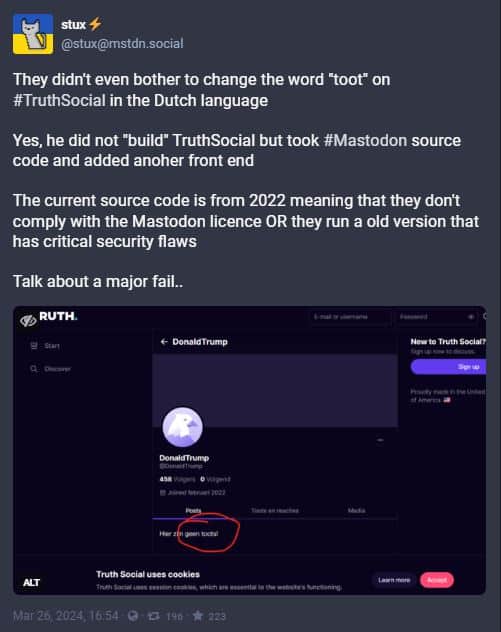
Trump’s POS social media platform appears to have lifted older Mastodon source code and slapped on a new frontend, without having addressed vulnerabilities in the older source code or handled the open source licensing correctly.

source: https://mstdn.social/@stux/112163975507522652

This massive stupidity is what the new Trump Media & Technology group is based on — the stock for which began trading today.

I’m going to have to buy popcorn futures for this.

~ 0 ~

Once again, this is an open thread. Bring all the stray stupid here along with topics not covered by other posts.

Share this entry

Alexander Smirnov Shared an Already-Debunked Fox News Hoax with His FBI Handler

There’s a mistake that many people covering the Alexander Smirnov case make. This is one example, but similar examples appear everywhere (including in claims made by Democrats in Congress yesterday).

Parnas noted the recent indictment of former FBI informant Alexander Smirnov, who is accused of providing false intelligence about the president and his son during the 2020 presidential campaign. Prosecutors said the information Smirnov shared about the Bidens came from “officials associated with Russian intelligence” and that he was peddling “new lies that impact U.S. elections after meeting with Russian intelligence officials in November.”

The error is in claiming that prosecutors have said that the false claims Smirnov made in 2020 came from Russian intelligence.

Prosecutors have said that Smirnov attributed claims made last September in his FBI interview to Russian spies. That’s the claim that the Russians recorded calls that Hunter Biden made from a hotel in Kyiv.

51. The Defendant also shared a new story with investigators. He wanted them to look into whether Businessperson 1 was recorded in a hotel in Kiev called the Premier Palace. The Defendant told investigators that the entire Premier Palace Hotel is “wired” and under the control of the Russians. The Defendant claimed that Businessperson 1 went to the hotel many times and that he had seen video footage of Businessperson 1 entering the Premier Palace Hotel.

52. The Defendant suggested that investigators check to see if Businessperson 1 made telephone calls from the Premier Palace Hotel since those calls would have been recorded by the Russians. The Defendant claimed to have obtained this information a month earlier by calling a high-level official in a foreign country. The Defendant also claimed to have learned this information from four different Russian officials. [my emphasis]

The reference in the detention memo to Russian spooks, relied on by NBC to substantiate the claim, appears to be a reference to this story, one Smirnov told in 2023. David Weiss appears to be sure that Russian spooks really did tell Smirnov this; he used it to justify detention.

Thus, Smirnov’s efforts to spread misinformation about a candidate of one of the two
major parties in the United States continues. The Court should consider this conduct as well
when evaluating his personal history and characteristics. What this shows is that the
misinformation he is spreading is not confined to 2020. He is actively peddling new lies that
could impact U.S. elections after meeting with Russian intelligence officials in November.

I’m not entirely convinced Smirnov’s Russian spook buddies did tell him this.

After all, prosecutors laid out why it cannot be true that Russia really got recordings of Hunter in the hotel. Hunter has never been to Kyiv, much less this hotel.

If Russian spies actually told Smirnov this, it would either be false, intended to deceive Smirnov, or based on a deep fake.

But I also think it’s possible that, during the September interview, Smirnov started to realize that the FBI had caught him lying, and so invented the story — based on what I understand to be a widely-understood assumption about the Premier Palace — to appear to be useful to the FBI. When you’re a snitch, you’re generally safe doing whatever so long as you remain useful. So Smirnov may have just tried to protect himself by inventing something useful.

As I tried to show here, there’s actually some reason to believe he subsequently created a reporting trail retroactively on this, as if he hadn’t ever made this claim to his handler before his FBI interview and so had to report it prospectively to the handler to cover the claim he made to the FBI. The timeline shows that Smirnov attributed something to four Russian spies in September 2023, but then told his handler he learned it as if it were new in December 2023.

I don’t believe any court filings have yet attributed Smirnov’s false claim in 2020 to Russian spooks.

Indeed, he didn’t have the ties to Russian spies in 2020 he claims to have now. While Smirnov appears to have had ties to Russian Official 5 in 2020 — the guy he flipped for a different, probably Israeli, intelligence service in 2002 but didn’t tell his handler about until 2019 — and through him, Russian Official 6, many of his more senior ties to Russian spooks appear to post-date 2020.

A far more relevant tie in 2020 is his professed tie to Viktor Shokin, going back to 2016.

50. The Defendant told investigators that he had asked the then-Ukrainian President to arrange a meeting between himself and the then-Ukrainian Prosecutor General to talk about Burisma. The Defendant told investigators that this meeting occurred before the then-Ukrainian Prosecutor General resigned, which was early 2016. The Defendant also told investigators this meeting occurred before his meeting with Burisma Official 1 in the coffee shop in a German speaking country. The Defendant told investigators that after he met with the thenUkrainian Prosecutor General, he met with the then-Ukrainian President. The Defendant did not provide any of this information to the Handler in 2020.

Still, one way or another, I don’t believe any court filing tells us who got Smirnov to lie in 2020. It’s one reason I keep insisting that learning how Scott Brady came to look for him may be the most important investigative question, not least because David Weiss has an enormous disincentive to chase that down.

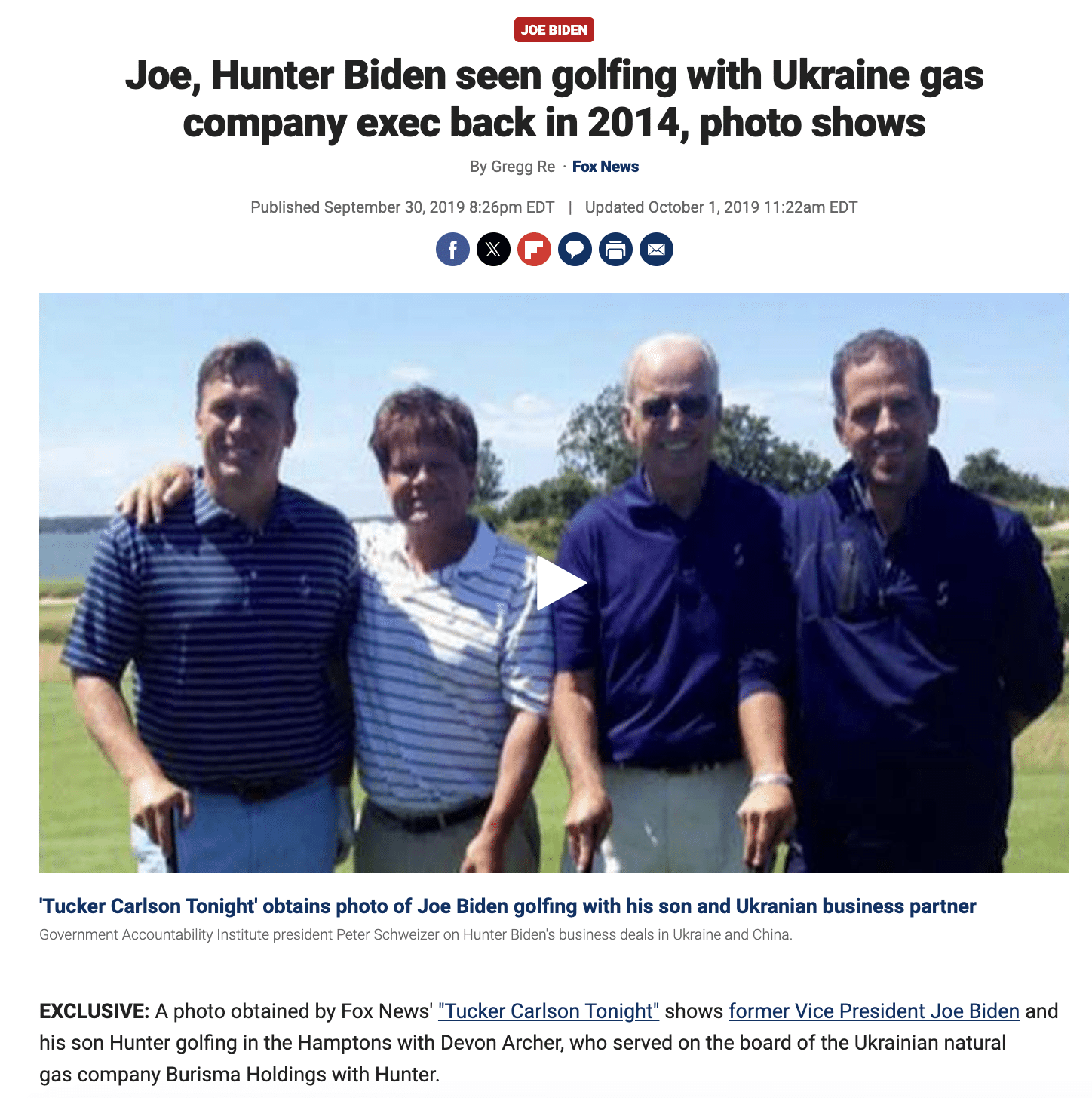
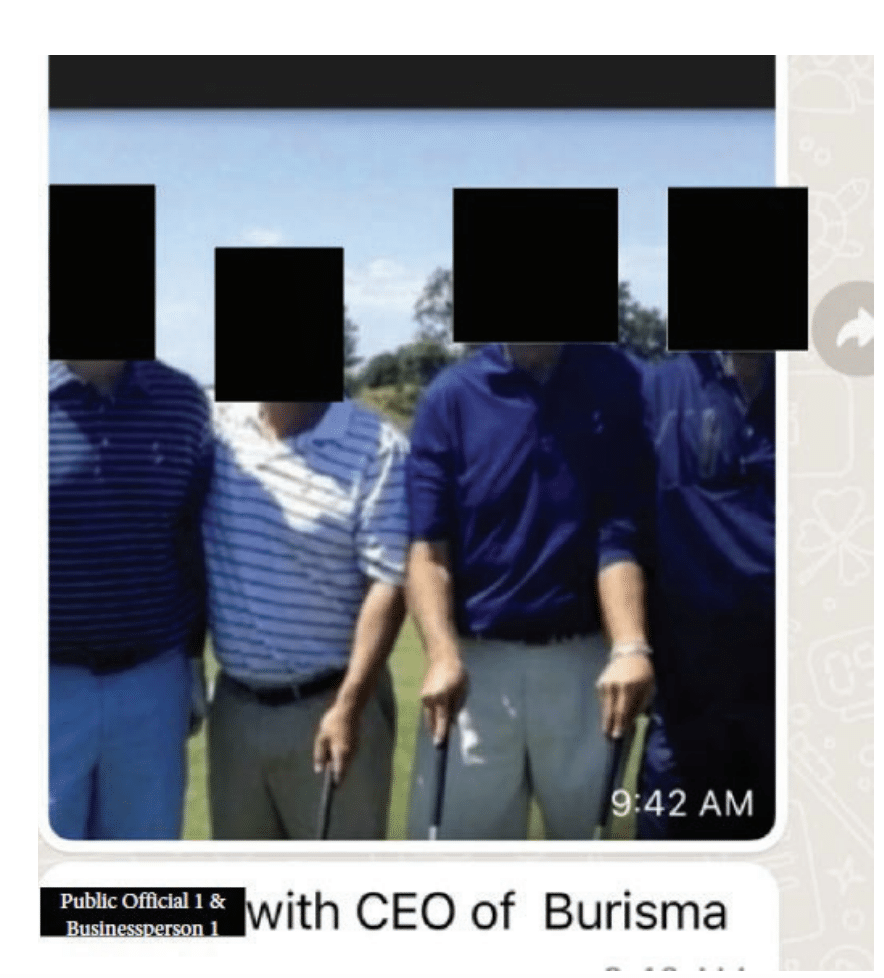
All the more so given the backstory to this photo, which appears in the indictment. After Smirnov promised his handler that he would prove Joe Biden had received a bribe, Smirnov told his handler this picture showed Joe and Hunter Biden with Mykola Zlochevsky.


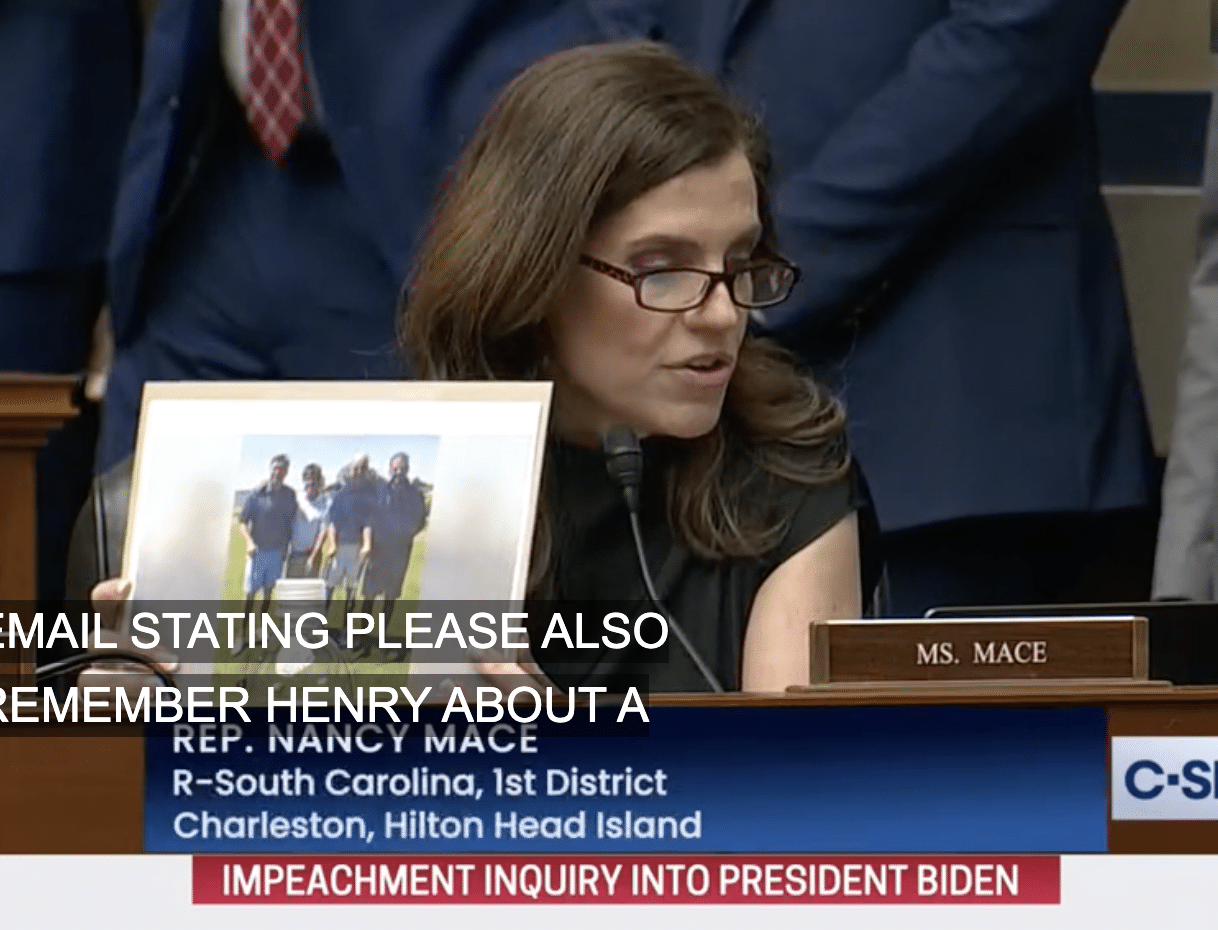
Nancy Mace used the same photo in yesterday’s hearing in an attempt to corroborate serial fraudster Jason Galanis‘ story.

It’s actually not, at all, clear where the picture came from — I’m not even aware that it came from “the laptop.”

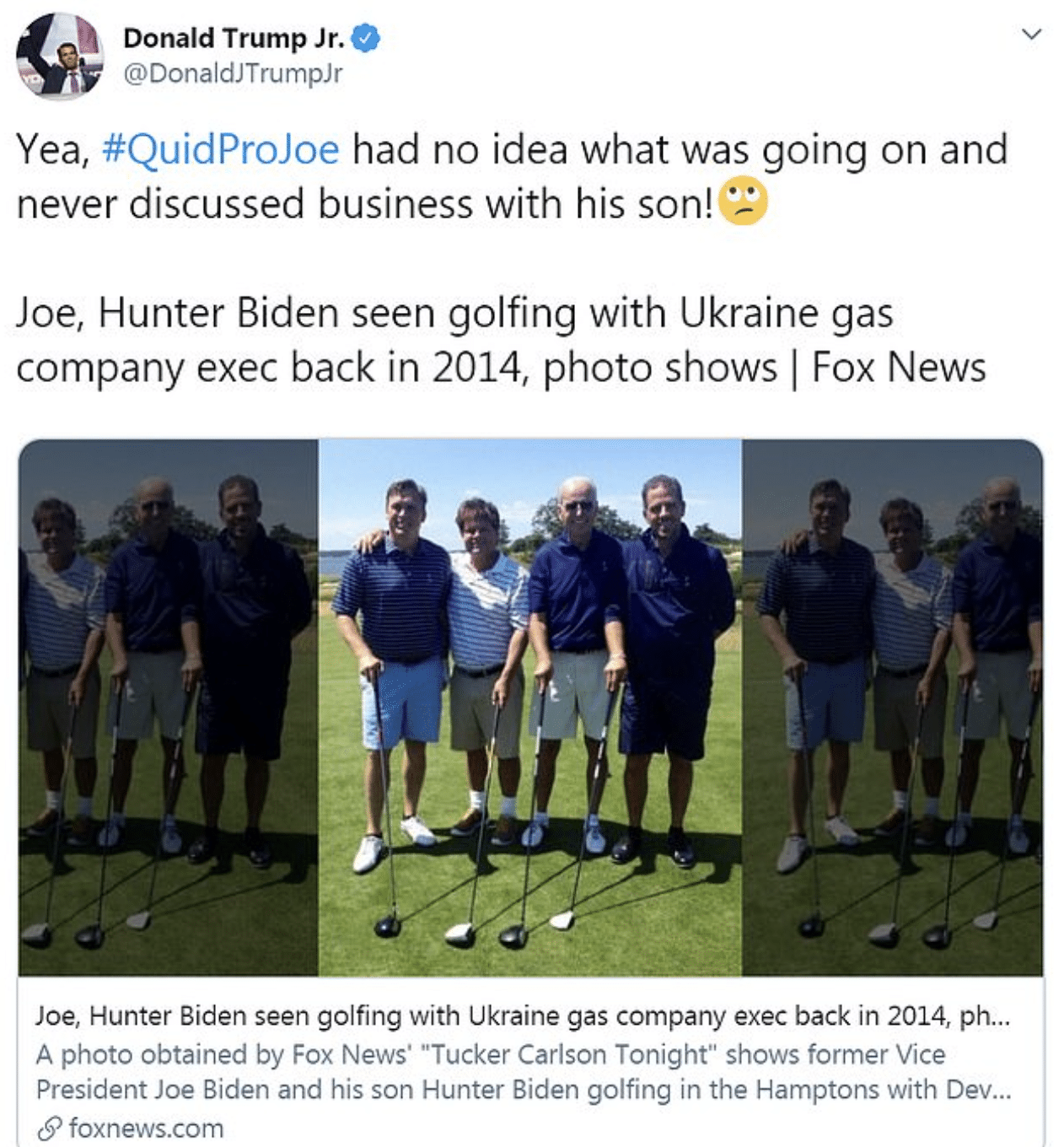
But it was first published by Tucker Carlson, then adopted by Fox News, as part of Rudy’s propaganda campaign in 2019, as impeachment began to roll out.

Don Jr posted it.

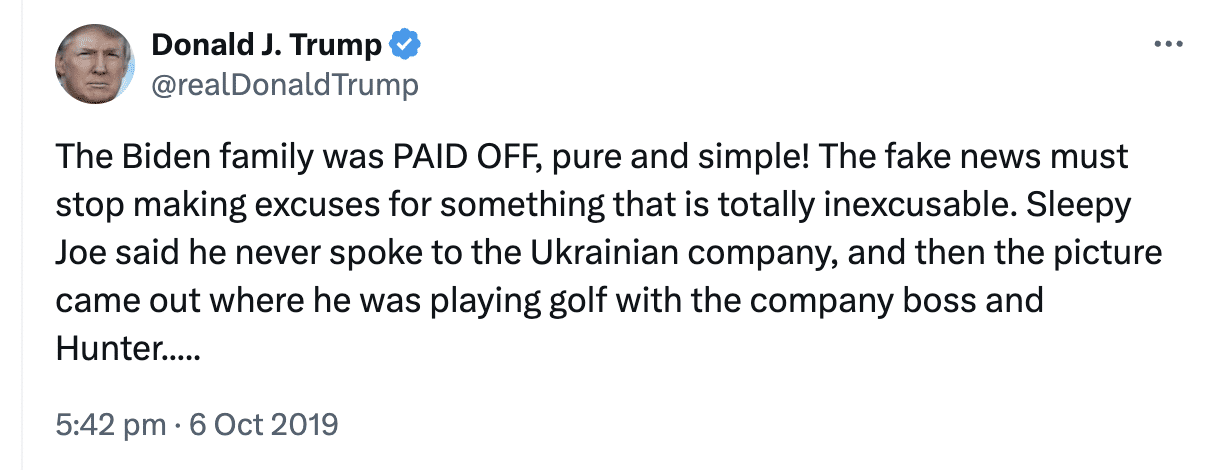
Then Trump referenced it on Xitter.

The claim was debunked repeatedly: by PolitiFact on October 8, by CNN, and then by USAT after it went even more viral after the release of “the laptop” in 2020 (and therefore after Smirnov’s claims).

And yet, even though this photo had gone viral in 2019, in conjunction with Trump’s impeachment rebuttal, Smirnov made the same claim again in May 2020.

And his handler either didn’t realize or didn’t care that Smirnov was recycling a widely debunked lie, nor is there any evidence the handler pointed out to Scott Brady that it discredited Smirnov’s other claims.

Sedition Hunters will tell you that the FBI is nowhere near as good at using facial recognition as they are (which may not be a bad thing). But the notion that an informant would share such a widely disseminated photo and no one at the FBI would figure out it had been used by Trump and his backers as part of a false propaganda campaign the year before?!?!

Really???

I’ll repeat again: the investigation into this attempt to frame Joe Biden needs to be removed from David Weiss’ purview and put in the hands of someone who’ll review how the FBI let itself get fooled by a widely disseminated piece of propaganda, and why the Attorney General ensured that such embarrassing propaganda got funneled to an ongoing investigation into Joe Biden’s kid.

Because this is just embarrassing.

Alexander Smirnov may have gotten the false claim he made in 2020 from Russian spies. He may have gotten it from Viktor Shokin.

Or maybe he just got it by watching Fox News.

Update: Noted that the USAT rebuttal came after Smirnov’s claims; the others came before.

Share this entry

Lev Parnas Alleges Bill Barr Offered Dmitry Firtash Legal Relief if He “Played Ball”

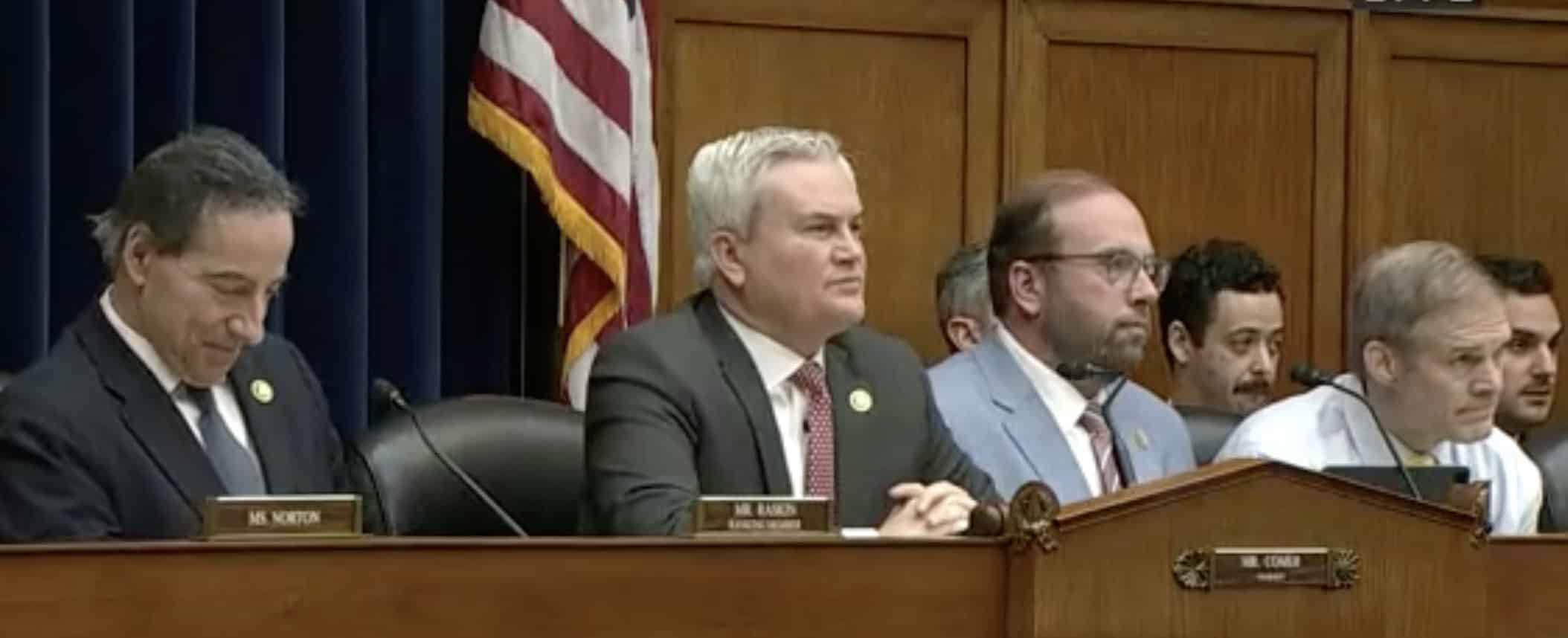
Watching the latest James Comer hearing — in which two convicted fraudsters and someone who claims everything the FBI said he told them is false — is like sticking hot needles in my eyes.

To be fair, Tony Bobulinski has successfully filibustered Democratic questions. Though when Alexandra Ocasio Cortez asked him if he witnessed Joe Biden committing a crime, Bobulinski said that by meeting with Bobulinski, Biden was committing a crime.

Hopefully, Democrats will force Bobulinski to retract all the hearsay he has been peddling.

The only new claims in the hearing came from Lev Parnas.

He described some of what happened between Victoria Toensing and Bill Barr in 2019.

Ro Khanna: Did Bill Barr know that you were involved in getting this dirt?

Parnas: Absolutely. Bill, Bill Barr was informed of our investigation from the day he took office.

Khanna: Did you ever have a conversation with Bill Barr being lenient towards Dmitry, in Bill Barr’s role as Attorney General?

Parnas: I personally did not but I was witness to Victoria Toensing and Joe DiGenova, having a conversation with Bill Barr about Dmitry Firtash.

Khanna: What did they say to Bill Barr?

Parnas: Basically, they were telling him that the charges were false, and that he needs to drop the charges and, basically, end the case.

Khanna: And why did they tell him to drop the charges on this Russian [sic] oligarch?

Parnas: Because Dmitry Firtash was going to help us getting dirt on the Bidens, or whatever else the Trump campaign needed.

Khanna: So my understanding is you have the Trump campaign telling you to talk to a Russian [sic] oligarch to get dirt, on the President of the United States for political reasons, and then someone from the Trump campaign is talking to the Attorney General to drop the charges because this foreign national is helping get dirt on a political candidate?

Parnas: Absolutely.

He claimed that after Toensing had met with Barr, Rudy told him that Firtash would be okay if he played ball.

Parnas also claimed that his attorney reached out to Scott Brady in 2020, but got no response.

Remember that Brady looked into investigations into all the oligarchs from whom Rudy had been soliciting dirt in 2020, including Firtash, as well as Igor Kolomoisky. A reported investigation into Mykola Zlochevsky had been shut down by then — around the same time as Barr’s Chief of Staff sent him a text, the day after FBI obtained a warrant for Hunter Biden’s laptop, telling him a laptop was on the way.

Parnas repeated his past claims that Barr had him, and only him, arrested to shut him up. He also said that bank documents John Solomon shared with him had come from the FBI.

Update: Fixed honorary Irish spelling of AOC’s name.

Share this entry

David Weiss Does Not Contest He Reneged on Hunter Biden’s Plea Agreement to Chase Russian Lies

David Weiss has now had five opportunities to contest former Hunter Biden attorney Chris Clark’s declaration that on June 6, Weiss personally discussed language to provide Hunter immunity from further prosecution, and after that language was incorporated into the plea deal, on June 19, Weiss’ First AUSA told Clark that there was no ongoing investigation into the President’s son.

I requested to speak directly with U.S. Attorney Weiss, whom I was told was the person deciding the issues of the Agreement. Later that afternoon, on June 6, 2023, I spoke directly with U.S. Attorney Weiss. During that call, I conveyed to U.S. Attorney Weiss that the Agreement’s immunity provision must ensure Mr. Biden that there would be finality and closure of this investigation, as I had conveyed repeatedly to AUSA Wolf during our negotiations. I further conveyed to U.S. Attorney Weiss that this provision was a deal-breaker. I noted that U.S. Attorney Weiss had changed the deal several times heretofore, and that I simply could not have this issue be yet another one which Mr. Biden had to compromise. The U.S. Attorney asked me what the problem was with the proposed language, and I explained that the immunity provision must protect Mr. Biden from any future prosecution by a new U.S. Attorney in a different administration. The U.S. Attorney considered the proposal and stated that he would get back to me promptly.

Later that same evening on June 6, 2023, at or around 5:47 PM EST, AUSA Wolf emailed me proposed language for the immunity provision that read: “How about this- The United States agrees not to criminally prosecute Biden, outside of the terms of this Agreement, for any federal crimes encompassed by the attached Statement of Facts (Attachment A) and the Statement of Facts attached as Exhibit 1 to the Memorandum of Plea Agreement filed this same day.” (Emphasis in original.)

[snip]

Shortly after that email, I had another phone call with AUSA Hanson, during which AUSA Hanson requested that the language of Mr. Biden’s press statement be slightly revised. She proposed saying that the investigation would be “resolved” rather than “concluded.” I then asked her directly whether there was any other open or pending investigation of Mr. Biden overseen by the Delaware U.S. Attorney’s Office, and she responded there was not another open or pending investigation.

David Weiss is silent about proof that he reneged on immunity agreement made in June

Weiss has filed five responses to Hunter Biden claims that address how Weiss reneged on this agreement to immunize the President’s son from any further prosecution:

None of them contest those two claims from Chris Clark: That David Weiss was personally involved on June 6 before Lesley Wolf sent language immunizing Hunter for everything “encompassed” by the plea and diversion, and that Shannon Hanson assured Clark on June 19 there were no ongoing investigations.

Instead, these filings simply shift focus temporally. The responses to the selective and vindictive claim focus on earlier negotiations to falsely suggest that David Weiss did not personally buy off on language sent out on June 6.

For example, in an email to defense counsel dated May 18, 2023, about “a potential nontrial resolution,” Document 60-6 at p. 2, the AUSA stated, “As I said during our call, the below list is preliminary in nature and subject to change. We have not discussed or obtained approval for these terms, but are presenting them in an attempt to advance our discussions about a potential non-trial resolution . . .” The following week, in an email to defense counsel dated May 23, 2023, Document 60-9 at p. 3, the AUSA stated, “As we indicated in our emails and discussions we did not have approval for a pre-trial diversion agreement. As you know, that authority rests with the US Attorney who ultimately did not approve continued discussions for diversion related to the tax charges.” In response to this email, defense counsel wrote, “Ok. My client has asked that I speak to you further. Are you able to speak? I may have some slight flexibility.” Far from an agreement or an agency determination that these charges should not be brought, as the defense suggests in their briefing, these discussions merely indicate the parties were engaged in plea discussions at the line prosecutor level and the AUSA repeatedly disclosed that such discussions were subject to review and approval by the U.S. Attorney. [emphasis original]

The response to the IRS agent claim argues that because Gary Shapley and Joseph Ziegler had “ceased to have any role in the investigation” when the actual charging decisions were made in September and December, their media campaign could not have caused the earlier decision to renege on the plea deal and endorse precisely their charging decisions.

Here, the defendant does not argue that Shapley and Ziegler used any law enforcement technique that resulted in the charges currently before the court. In fact, the conduct he complains of occurred after Shapley and Ziegler ceased to have any role in the investigation.

Never mind that the claim conflicts with a Joseph Ziegler affidavit, which claims that, “As seen in these emails, we have continued to assist and turnover the Hunter Biden casefile to the new team,” and the related emails showing him still handing off documents on September 1 (though given document metadata, Ziegler continued to access and release to Congress records after that). What matters are not the charging decisions made in September and December but the earlier decision to renege on the plea deal.

What matters is that when Leo Wise stated, on July 26, that prosecutors could bring FARA charges against Hunter Biden, he was reneging on the terms of the signed plea deal.

What matters is that when David Weiss told Lindsey Graham on July 11 that Alexander Smirnov’s FD-1023 was part of an ongoing investigation, he signaled that he had decided to renege on the plea deal even before the plea hearing to chase the claim that the President of the United States had received a bribe, and that decision had nothing to do with Maryellen Noreika’s concerns about the structure of the diversion agreement.

Indeed, Abbe Lowell submitted proof that that was the intent all along, to renege on the plea deal. Weiss had submitted a heavily redacted copy of a letter Chris Clark wrote in response to Weiss’ proposed way to address Judge Noreika’s concerns, claiming that it showed that prosecutors did not, as Lowell had claimed, immediately demand a felony plea. Weiss was right, to a point. At that point Weiss was not demanding felony pleas. In his selective and vindictive reply, a declaration, and a timeline submitted yesterday, Lowell explained that Weiss started demanding felony pleas later than that, on August 29.

After the exchange cited by DOJ where Biden rejected its counterproposals, DOJ informed Biden the deal was off and made clear it would accept or charge felonies during a meeting with Biden’s counsel on August 29, 2023.

But those same papers and the unredacted copy of Clark’s response letter in question showed what happened instead: David Weiss’ first response to the concerns Judge Noreika expressed at the plea colloquy — partly how the diversion agreement worked with the plea, but also Wise’s claim that he could charge Hunter with FARA even though Hanson had said that would not happen a month earlier — was to eliminate any judicial protection and remove the immunity language entirely.

Second, the Government has proposed, without explanation, completely deleting the immunity provision in Paragraph 15 of the Diversion Agreement. We decline to amend the parties’ existing agreement on immunity. We will rely on this provision, as contained in the bilateral agreement that was signed and entered into between the parties.

The same letter showed that Hunter’s team believed the diversion remained in effect.

[W]e are fully prepared to continue proceeding with the terms of the Diversion Agreement, as executed. If the Court should determine that the breach provision in Paragraph 14 of the Diversion Agreement should be amended, then we would be fine with that, and at such time we would entertain making formal, written modifications pursuant to Paragraph 19. Otherwise the parties remain bound to the terms of the agreement that was signed and entered into.

This “offer” Weiss made, then, amounted to torching the signed plea deal and diversion agreement entirely.

This is the background to — as Lowell described — Weiss’ demand that Hunter either accept that useless deal immediately, before — minutes later — Weiss rolled out his Special Counsel authority.

8/9/23: DOJ responds to Biden’s counsel’s August 7 letter, and argues that neither the PA nor DA are in effect, and neither side is bound. In that letter, DOJ withdraws the PA and the DA it offered Biden on July 31, 2023, and withdraws the PA and the DA presented to the Court on July 26, 2023.

DOJ notifies Biden’s counsel that it intends to move to dismiss the tax information without prejudice and pursue charges in another district where venue lies, and requests Biden’s counsel’s position by no later than August 11, 2023.

8/10/23: Biden’s counsel emails AUSA Wise to inform him they are discussing DOJ’s August 9 letter and the options with Mr. Biden. Biden’s counsel asks if they may respond to DOJ’s requested position by Monday (August 14) instead of by Friday (August 11). Alternatively, Biden’s counsel proposes having a conference with the Court.

8/11/23: At Noon (12:00 pm), AUSA Wise replies to Mr. Clark’s email that the United States declines to extend the time in which it asked for Biden’s position on the motions identified in its August 9 letter, and further declines to have a conference with the Court.

Approximately five minutes later, at 12:05 pm EST, before Biden’s counsel could even respond to DOJ or discuss it with Mr. Biden, DOJ moves to dismiss the criminal tax Information without prejudice against Biden, so that tax charges can be brought in another district.

David Weiss replaced Lesley Wolf, and by doing so, has tried to get away with letting Leo Wise and Derek Hines to renege on the terms of a plea deal he himself signed, as if his signature wasn’t on the deal.

And he did so, it is now clear, to chase a Russian information operation. David Weiss got his ass handed to him by Russian spies and to hide his embarrassment, he’s trying to claim that he didn’t renege on a signed plea.

Neither Weiss nor Lowell has yet addressed Smirnov directly

For reasons I don’t understand, Lowell has not filed any motion specifically addressing the role of Alexander Smirnov in all this, in either Delaware or Los Angeles. As a result, the sum total of discussion about the role of the Smirnov claim in Hunter’s prosecution consists of the following:

First, in Lowell’s Reply Motion to Compel in Delaware, he noted that he had asked for things pertinent to the Scott Brady side channel, and the treatment of the Smirnov allegations made that discovery all the more important.

The fact that Special Counsel Weiss, beginning in July 2023, then elected to chase the goose making these unsubstantiated claims— after several DOJ and FBI officials agreed the matter should be closed—is all the more justification for granting Mr. Biden’s request for these DOJ materials.

In response, Weiss tried to anticipate mention of Smirnov in Lowell’s Reply. imagining that because Weiss is prosecuting Smirnov, it debunks the claim Hunter made in his deposition that Congressional Republicans were duped by a Russian disinformation campaign.

He claimed, “Smirnov, who has made you dupes in carrying out a Russian disinformation campaign waged against my father, has been indicted for his lies.”12 While the defendant testified to Congress that the Special Counsel had undermined the impeachment inquiry conducted by House Republicans, to this Court he argues instead that the Special Counsel is working at the behest of House Republicans. Motion at 13. Which is it? Indeed, the defendant has no evidence to support his shapeshifting claims because the Special Counsel continues to pursue the fair, evenhanded administration of the federal criminal laws.

That same day, in Delaware, Lowell cited the newly-released Scott Brady transcript to argue that Weiss, by continuing to prosecute Hunter, is doing just what Russia wanted with the Smirnov operation: to gin up a prosecution of Hunter.

From the filings in Smirnov and other disclosures, it turns out that a Russian intelligence operation has the same goal of spreading disinformation to influence the U.S. presidential election in Russia’s favor.

[snip]

Mr. Wise explained that Smirnov’s “disinformation story” is part of a Russian intelligence operation “aimed at denigrating President Biden” and “supporting former President Trump.”

[snip]

This case illustrates the very continuing harm identified by the Special Counsel. The Special Counsel tells us Russian intelligence sought to influence the U.S. presidential election by using allegations against Hunter Biden to hurt President Biden’s reelection. 3 And what did the now-Special Counsel do? The Office abandoned the Agreement it signed and filed felony gun and tax charges against Mr. Biden in two jurisdictions, which public records and DOJ policy indicate are not brought against people with similar facts as Mr. Biden. In these actions, the Special Counsel has done exactly what the Russian intelligence operation desired by initiating prosecutions against Mr. Biden.

In yesterday’s filing in Los Angeles, however, Lowell was still pretty circumspect about Smirnov.

In the section describing how Weiss had reneged on a signed deal, he attributed Weiss’ decision to renege on the deal to his pursuit of the Smirnov allegations. Then, in the section on Congress’ usurpation of prosecutorial function, Lowell laid out how stupid it is for Weiss to claim the charges against Smirnov, over three years after Weiss first got this referral, is proof that Weiss didn’t bow to pressure from Congress.

DOJ also chooses this part of its brief to argue its indictment of Alexander Smirnov suggests it is not a puppet of the GOP (perhaps DOJ’s whole inspiration for bringing that indictment). (Id.) Biden never suggested DOJ is a puppet of the GOP, but that DOJ has caved to political pressure several times in ways that specifically violate Biden’s rights. And DOJ indicting someone who falsely accused Biden of serious crimes does not prove it is treating him fairly. Instead, it calls into question why DOJ reopened long debunked allegations by Smirnov in July 2023 (as it was reneging on its agreements with Biden) when, having gone down that rabbit hole, DOJ was then forced to defend its actions by charging Smirnov with offenses it could have bought years earlier.

Lowell doesn’t make several details of the timeline explicit.

First, on the same day that Weiss sent Lindsey Graham that letter stating that the FD-1023 was part of an ongoing investigation, July 11, Shannon Hanson described that “the team,” on which she did not include herself at that point, was in a secure location. As I’ve noted, there was no reason for “the team” to be in a SCIF in preparation for the plea deal. There’s nothing classified about it. It’s evidence that, before Wise reneged on the scope of the plea deal on July 26, “the team” had already decided to chase the Smirnov allegation.

My hunch is that we’ll learn that whatever Weiss told Merrick Garland about needing Special Counsel status (note, he bypassed Brad Weinsheimer to get it), he did not represent the plea negotiations as the current record suggests they happened. My hunch is that Weiss may have claimed Hunter was being a good deal more intransigent then simply demanding that a plea be worth the toilet paper it was written on in the first place.

But to get Special Counsel status, Weiss likely claimed he was going to investigate Joe Biden.

While it’s true that Garland assured Weiss he could get Special Counsel status whenever he asked, investigating the President is the only thing that presents the kind of conflict that would require full Special Counsel status. And, as I’ve noted, Weiss grounds his authority to prosecute Smirnov in the language in the Special Counsel appointment permitting him to investigate anything that comes out of the investigation authorized with the appointment itself, which must, then, have included Joe Biden as well as his son.

Lowell made this point in his Notice of Authority submitted in Delaware.

The connection between the reopening of the Smirnov allegations and the then-U.S. Attorney’s Office’s total rejection of the Agreement it made has, at the least, the appearance of catering to the shouts of extremist Republicans to scuttle the deal and keep an investigation into Mr. Biden alive.

But he has not done so in Los Angeles.

On August 29, prosecutors expressed overconfidence about their investigation

Lowell has declined to do so even though the timeline he lays out — how, on August 29, prosecutors demanded felony pleas — intersects closely with the Smirnov one. Lowell’s declaration describes that at 11AM on August 29 — in what appears the first meeting after Weiss got Special Counsel status and after Judge Noreika dismissed the tax indictment — Leo Wise fully retracted all offers that had been discussed to that point.

3. On August 29, 2023 at approximately 11:00 AM, I (along with my law partner, Christopher Man) met with Assistant United States Attorneys Leo Wise and Derek Hines at the U.S. Attorney’s Office in Wilmington, Delaware. The meeting lasted approximately one hour. Our position was that the Diversion Agreement was in effect, and we sought to work with the government to effectuate the substance of the proposed Plea Agreement by addressing the procedural concerns the Delaware court raised on July 26, 2023.

4. During that meeting, Mr. Wise stated, in sum and substance, that DOJ was no longer willing at this point in time to (i) carry out the misdemeanor tax agreement it had made; (ii) commit to a “no jail” recommendation for Mr. Biden that it also had made; and (iii) maintain the parties’ agreed-to immunity provision. While Mr. Wise said he was only in a “listening mode,” the only type of charge even mentioned at the meeting were felonies, which are exactly what the Office filed about two weeks later in the District of Delaware.

At that same meeting, Lowell requested that he get an exact copy of the laptop.

The defendant’s counsel met with government counsel in Wilmington on August 29, 2023, and made a specific request for an exact forensic copy of the laptop and external hard drive. His defense counsel reiterated this request in an email dated September 25, 2023, in which defense counsel stated “we want to ensure the data we receive is an identical copy as you have it and that the data will retain its native forensic properties (e.g., time and date stamps, file paths, operative system characteristics, user profile information, etc.)” and that the “data loaded on the hard drive is complete and identical in every shape and manner to that obtained by the FBI when it acquired possession” of the laptop and hard drive. The government accommodated this request.

And prosecutors also claimed (erroneously, it now appears) that they had clean sources for everything otherwise found on the laptop.

As to the meeting between Mr. Biden’s counsel and prosecutors in Wilmington on August 29, 2023 (Opp. at 19), Mr. Biden notes that prosecutors indicated, during that meeting, that they possess “independent sources” for any material on the laptop device that would be helpful to the prosecution’s case, presumably referring to material subpoenaed from third parties, such as Apple, Inc. or various cellphone carriers. For this reason, it was curious to Mr. Biden’s counsel when reviewing the prosecution’s response that it elected to cite to and quote from messages and photos contained on the device it possessed (lacking any Bates stamps) rather than from those “independent sources” included in the discovery produced to the defense.

That same day prosecutors mistakenly claimed they wouldn’t have to rely on the laptop to prosecute Hunter Biden, also on August 29, Smirnov’s handler described that he and Smirnov reviewed the allegations against President Biden after the FD-1023 leaked and Smirnov stood by his claims.

43. On August 29, 2023, FBI investigators spoke with the Handler in reference to the 2020 1023. During that conversation, the Handler indicated that he and the Defendant had reviewed the 2020 1023 following its public release by members of Congress in July 2023, and the Defendant reaffirmed the accuracy of the statements contained in it.

Did representations from Smirnov’s handler contribute to prosecutors’ hubris in imagining they had all the evidence they needed against the President’s son? Did they initially pursue particularly draconian charges against Hunter in hopes they could get him to flip against his father?

At some point — the indictment doesn’t reveal whether the handler only came clean about Smirnov’s lies in the following weeks — Smirnov’s handler provided the messages and travel records that made it clear Smirnov was lying.

44. The Handler provided investigators with messages he had with the Defendant, including the ones described above. Additionally, the Handler identified and reviewed with the Defendant travel records associated with both Associate 2 and the Defendant. The travel records were inconsistent with what the Defendant had previously told the Handler that was memorialized in the 2020 1023. The Defendant also provided email communications with both Associate 2 and Burisma personnel beginning in 2017 to the Handler, which the Handler reviewed with the Defendant and shared with FBI investigators.

On the day Weiss discovered Smirnov was lying, he should have called up Merrick Garland, told him he had to recuse from both the Smirnov investigation and — because of the apparent role of the Smirnov 1023 in his decision to renege on the plea agreement — even the Hunter Biden one. On that day, Weiss became a witness to a potential criminal conspiracy.

Weiss’ false claims about discovery into the side channel

Weiss did not do that.

Instead, at least in the months before the Smirnov indictment, he prevaricated over discovery.

On November 7, over a month after the FBI interviewed Smirnov and confirmed his lies, David Weiss told the House Judiciary Committee Chief Counsel Steve Castor that the side channel would only show up in his eventual report.

Q Brady told us that he had such trouble getting ahold of you and your office, that he had to go through the PADAG, and basically the PADAG had to intervene and instruct your office to take a meeting with him.

A Is that a question?

Q Yes. Why wouldn’t you meet with Mr. Brady?

A I’m not at liberty to discuss that at this time. I look forward to the opportunity to addressing this in the special counsel’s report at the appropriate time.

Weiss committed that Brady’s role in this would only appear in the final report after a number of details of Brady’s claims to have vetted the Smirnov claim — which Jerry Nadler referred to both Michael Horowitz and Merrick Garland for potentially criminal investigation — had been publicly aired.

Then, on November 15, Lowell asked for discovery that would cover the side channel and also permission to subpoena those, like Bill Barr, who continued to engage in discussions of the side channel as private citizens, without protection of prosecutorial immunity.

The response to the latter, written in December by then newly promoted “Principal Senior Assistant Special Counsel” Leo Wise, repeats Weiss’ silence about his decision to renege on the plea deal. Given the accumulating evidence that Weiss reneged on the plea deal in order to chase the Smirnov allegation, such silence is deafening.

It blows off the request for a subpoena to Bill Barr — who made public representations about the side channel the day after Weiss agreed to immunize Hunter against further investigation, the agreement on which Weiss reneged — by emphasizing that as former Attorney General, Barr could have no influence on Weiss’ actions.

Defendant asks the Court to enter an order directing subpoenas, which seek broadly worded categories of documents across seven years, to former President Donald J. Trump, former Attorney General William P. Barr, and two other former officials in the U.S. Department of Justice. Defendant contends that the requested material “goes to the heart of his pre-trial and trial defense that this is, possibly, a vindictive or selective prosecution that arose out of an incessant pressure campaign that began in the last administration, in violation of Mr. Biden’s constitutional rights.” ECF 58, at 14. It is worth noting from the outset that defendant misunderstands the difference between pretrial arguments to dismiss an indictment and trial defenses. It is black-letter law that claims of vindictive and selective prosecution are not trial defenses and may only be brought and litigated pretrial. They are not defenses and, therefore, are never argued to trial juries.

In any event, both vindictive- and selective-prosecution claims turn on the actual intent of the specific decisionmaker in a defendant’s case: here, the Special Counsel. But not only does defendant’s motion fail to identify any actual evidence of bias, vindictiveness, or discriminatory intent on the Special Counsel’s part, his arguments ignore an inconvenient truth: No charges were brought against defendant during the prior administration when the subpoena recipients actually held office in the Executive Branch.

And in response to the request for a subpoena to Richard Donoghue, the response noted that Donoghue ordered that, “the Delaware investigation receive the information from the Pittsburgh team, which was being closed out.”

Against this backdrop, the gaps in defendant’s motion become glaring: absent is any credible argument that (a) one of the subpoena recipients, rather than the Special Counsel, made the decision to prosecute the defendant and that the Special Counsel merely followed an order, or (b) that the Special Counsel himself has treated similarly situated individuals differently or decided to prosecute for discriminatory purposes. In fact, throughout the defendant’s entire constructed narrative, he barely refers to the actions or motives of the then-U.S. Attorney, nowSpecial Counsel, much less makes Armstrong’s “credible showing” of disparate treatment, discriminatory intent, or retaliatory motive on his part. Nor has defendant addressed the impact of the sitting Attorney General’s subsequent determination that, “to ensure a full and thorough investigation” of these matters, it was necessary to confer the additional jurisdiction and independence outlined in 28 C.F.R. § 600.04–600.10. See Order No. 5730-2023.

Defendant’s attempts to manufacture discriminatory treatment or intent on behalf of the U.S. Attorney fall apart under the most minimal scrutiny. First, defendant obliquely references that “IRS files reveal that [Richard Donoghue] further coordinated with the Pittsburgh Office and with the prosecution team in Delaware, including issuing certain guidance steps regarding overt steps in the investigation.” ECF 58, at 2-3 & n.3. Looking behind the defendant’s ambiguously phrased allegation reveals the actual “overt steps” involved: (1) the U.S. Attorney making an independent assessment of the probable cause underlying a warrant and (2) a direction by Mr. Donoghue that the Delaware investigation receive the information from the Pittsburgh team, which was being closed out. See ECF 58, at 3 n.3 (citing memorandum of conference call). Assessing the validity of a warrant and merely receiving information from other investigating entities does nothing to show any disparate treatment or animus. Next, defendant alleges that “certain investigative decisions were made as a result of guidance provided by, among others, the Deputy Attorney General’s office.” ECF 58, at 3 n.4. In fact, the source cited revealed that the guidance was simply not to conduct any “proactive interviews” yet. Likewise, defendant’s last attempt to create a link involved guidance not to make any “external requests (outside of government),” which followed the long-standing Department of Justice policy to avoid overt investigative steps that might interfere with ongoing elections. See ECF 58, at 3 n.5; cf., e.g., Federal Prosecution of Election Offenses 40 (2d ed. 1980). In other words, the most defendant claims is that the Deputy Attorney General’s office was aware of and involved in some specific investigatory decisions in the most banal fashion possible—by waiting to take specific investigative steps at certain times out of caution.

None of these contacts or events provides any evidence involving either the disparate treatment of similarly situated individuals or a discriminatory intent behind the U.S. Attorney’s prosecutorial decision. [my emphasis]

The existence of the side channel alone is testament to disparate treatment of Hunter Biden. Importantly, Donoghue is a fact witness about what Weiss did in 2020.

The response to Lowell’s request for discovery on the side channel, a request that explicitly applied to the diversion agreement as well, was even more non-responsive. It simply ignores Bill Barr’s role entirely.

It’s the response to the subpoena that looks particularly damning, though.

As I’ve noted, there are some key gaps in the Smirnov indictment. First, in describing who set up the side channel in the first place, Weiss claimed Deputy Attorney General Jeffrey Rosen set it up, when Brady testified that Barr was personally involved (as Barr’s public comments make clear).

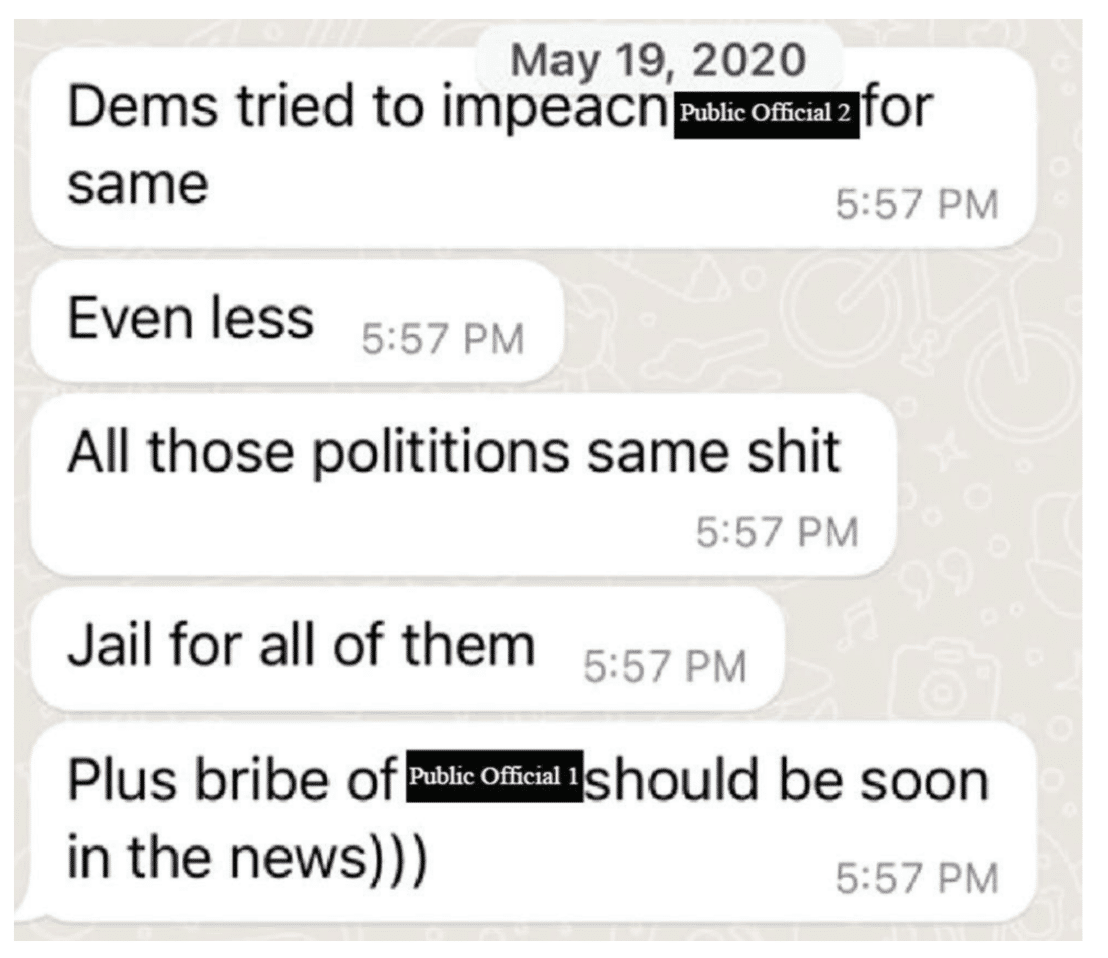
22. In June 2020, the Handler reached out to the Defendant concerning the 2017 1023. This was done at the request of the FBI’s Pittsburgh Field Office (hereafter “FBI Pittsburgh”). In the first half of 2020, the United States Attorney’s Office for the Western District of Pennsylvania (hereafter “USAO WDPA”) had been tasked by the Deputy Attorney General of the United States to assist in the “receipt, processing, and preliminary analysis of new information provided by the public that may be relevant to matters relating to Ukraine.” As part of that process, FBI Pittsburgh opened an assessment, 58A-PG-3250958, and in the course of that assessment identified the 2017 1023 in FBI holdings and shared it with USAO WDPA. USAO WDPA then asked FBI Pittsburgh to reach out to the Handler to ask for any further information about the reference in his 2017 1023 that stated, “During this call, there was a brief, non-relevant discussion about former [Public Official 1]’s son, [Businessperson 1], who is currently on the Board of Directors for Burisma Holdings [No Further Information]”

The silence about Barr’s role is particularly telling given persistent misrepresentations of Hunter Biden’s discovery asks about Barr.

More tellingly, the indictment doesn’t confess that Donoghue ordered Weiss to look at the FD-1023 in 2020, days after Trump called up Bill Barr and screamed at him for not investigating Hunter Biden more aggressively.

40. By August 2020, FBI Pittsburgh concluded that all reasonable steps had been completed regarding the Defendant’s allegations and that their assessment, 58A-PG-3250958, should be closed. On August 12, 2020, FBI Pittsburgh was informed that the then-FBI Deputy Director and then-Principal Associate Deputy Attorney General of the United States concurred that it should be closed.

Leo Wise’s description of this process at Smirnov’s first detention hearing was even more dishonest.

[T]he FBI in Pittsburgh took some limited investigative steps, but their steps were limited by the fact that they were only conducting an assessment, which under FBI policies is not an investigation. And it prevents, for instance, the use of compulsory process like grand jury subpoenas or the compulsion of testimony. So based on that limited review, the FBI closed its assessment in August.

Weiss has a problem.

He was ordered to investigate this in 2020, and did nothing, possibly because Lesley Wolf knew the entire side channel project was corrupt. But if that’s why Weiss did nothing in 2020, it makes his decision to renege on a plea deal to go chase this lead inexcusable.

He ignores his earlier receipt of this tip in the indictment to create the illusion that he investigated the FD-1023 for the first time starting in July.

But in the opposition for subpoenas in December, Leo Wise acknowledged that Donoghue issued that order in 2020.

Weiss is saying one thing in the Smirnov prosecution and saying something else in an effort to hide Smirnov discovery from Hunter Biden.

And he’s saying those conflicting things after telling Congress that Brady’s role in this would show up only in his closing report, and not in follow-up indictments for false claims to Congress.

Realistically, the investigation into how Smirnov allegedly framed Joe Biden should go in at least three directions: First, into Russia and Ukraine (and possiblyIsrael)’s specific role in his alleged lies, such as whether Andrii Derkach had ties to Smirnov in 2020. As part of that, the FBI will need to investigate why Smirnov didn’t disclose his earlier ties to Russian Official 5 to his handler, whom he flipped for a third country in 2002, until 2019.

The investigation needs to figure out how Scott Brady came to look for Smirnov’s earlier FD-1023 in the first place, because his claimed explanation makes no sense. It’s possible that arose from some mutual tie between Smirnov and Rudy Giuliani and could implicate Rudy personally. At the first Smirnov detention hearing, Wise at least mentioned Rudy Giuliani’s role in all this, suggesting Weiss’ team might fancy they’re pursuing that angle, at least. But they have no business doing so, because that implicates Weiss’ contacts with Brady. Again, he is a direct witness.

But just as importantly, the investigation needs to examine why Brady claimed the tip had been vetted in 2020, and why Brady created the impression with Congress that Smirnov’s travel records matched his claims, rather than debunked them. The investigation needs to examine whether Barr, or the indictment, is telling the truth about what Weiss was supposed to do with the lead in 2020. Neither Brady nor Barr are immunized as prosecutors anymore. And there’s no reason their attempts to influence the criminal investigation into Joe Biden’s son in advance of an election should evade scrutiny.

That goes right to the heart of why Weiss reneged on the plea deal. It goes to all the discovery and subpoenas that Weiss has already refused, claiming that it had no bearing on diversion or a vindictive prosecution claim. It goes to Weiss’ wildly unsound decision to remain on the case after he became a witness in it.

As it turns out, it has everything to do with Hunter’s diversion and vindictive prosecution claims.

Share this entry

Judge Scott McAfee Orders Fani Willis to Get Rid of Nathan Wade

Judge Scott McAfee just ruled that either Fani Willis and her office have to step down from the Trump prosecution, or Nathan Wade must go.

Ultimately, dismissal of the indictment is not the appropriate remedy to adequately dissipate the financial cloud of impropriety and potential untruthfulness found here. See Olsen v. State, 302 Ga. 288, 294 (2017) (“Dismissal of an indictment is an extreme sanction, used only sparingly as a remedy for unlawful government conduct.”) (quoting State v. Lampl, 296 Ga. 892, 896 (2015)). There has not been a showing that the Defendants’ due process rights have been violated or that the issues involved prejudiced the Defendants in any way. Nor is disqualification of a constitutional officer necessary when a less drastic and sufficiently remedial option is available. The Court therefore concludes that the prosecution of this case cannot proceed until the State selects one of two options. The District Attorney may choose to step aside, along with the whole of her office, and refer the prosecution to the Prosecuting Attorneys’ Council for reassignment. See O.C.G.A. § 15-18-5. Alternatively, SADA Wade can withdraw, allowing the District Attorney, the Defendants, and the public to move forward without his presence or remuneration distracting from and potentially compromising the merits of this case.

He ruled that their relationship did not create an actual conflict of interest, but did create an appearance of one.

Whether this case ends in convictions, acquittals, or something in between, the result should be one that instills confidence in the process. A reasonable observer unburdened by partisan blinders should believe the law was impartially applied, that those accused of crimes had a fair opportunity to present their defenses, and that any verdict was based on our criminal justice system’s best efforts at ascertaining the truth. Any distractions that detract from these goals, if remedial under the law, should be proportionally addressed. After consideration of the record established on these motions, the Court finds the allegations and evidence legally insufficient to support a finding of an actual conflict of interest. However, the appearance of impropriety remains and must be handled as previously outlined before the prosecution can proceed.

The prosecution will go forward.

He also suggested he would entertain gagging Willis from any further public comment about the case, based on her comments at an Atlanta Church after the allegations were made public.

Here’s the link, via Anna Bower.

Update: Wade has now resigned from the case.

Share this entry

A Third Tie between Trump World and Alexander Smirnov

Before I point to a report on third known link between Alexander Smirnov — the FBI informant whose allegedly false claims about Joe Biden were laundered through a process Bill Barr set up for Rudy Giuliani in 2020 — and Donald Trump, let me lay out several details that are important to assessing the import of such ties.

  • Smirnov was admonished on the limits of permission to engage in Otherwise Illegal Activities on at least five occasions, including on August 7, 2020. That’s what the FBI does before they pre-approve you committing a crime because they want to learn about the other people committing crimes involved. For any given sketchy business someone reports Smirnov to have engaged in, there’s a distinct possibility he was engaging in it because the FBI was interested in the other people engaged in the business.
  • Smirnov’s ties to Russian spies go through at least one other intelligence service — probably Israel. But, at least for the last six months, he has been hanging out on the megayachts of Russian Oligarchs, almost certainly in Dubai, where, according to him, he was part of a plan to end the Ukraine war and elect Donald Trump.
  • One unanswered question that will be key to understanding how Smirnov attempted to frame Joe Biden is to identify how MAGAt US Attorney for Pittsburgh Scott Brady came to chase an otherwise unremarkable earlier Smirnov informant report mentioning Hunter Biden in passing. Given that Brady’s project catered to Rudy, any link involving Rudy as well would be significant.
  • But we may not discover that unless something dramatic happens, because David Weiss has no business overseeing this investigation, as he’s a direct witness to the involvement of Brady and Bill Barr. Indeed, as Hunter Biden attorney Abbe Lowell recently pointed out, Weiss has misrepresented his involvement in the Smirnov lead, going back to 2020, and by chasing this lead and extending the prosecution of Hunter Biden, he is effectively doing Russia’s bidding.

We already know of two ties between Trump world and Smirnov. His cousin, Linor Shefer, has ties to Trump through a Miami Real Estate developer.

Shefer, a 38-year-old Israeli-American, was a former contestant on the Israeli version of reality show Big Brother, and in 2014 won the Moscow beauty pageant ‘Miss Jewish Star’.

According to her LinkedIn page, she has been an ‘Inhouse Consultant’ for Dezer Development in Miami, Florida since 2022.

Dezer partnered with Trump’s organization to develop the $600 million Trump Grande Ocean Resort and Residences and $900 million Trump Towers. The company is run by Gil Dezer, and founded by his Israeli-American billionaire father Michael, who is a Trump donor.

And Smirnov has ties to Sam Kislin, who not only has long-standing ties to Rudy and Trump, but who came under some scrutiny during the 2019 impeachment.

Around 2021, on the beach at a private club in Boca Raton, Smirnov pitched Kislin on founding a company together that would market electric-car batteries and capture federal subsidies, Kislin said.

Smirnov told him he also could use his FBI ties to help him unfreeze more than $21 million in infrastructure bonds that belonged to Kislin but which Ukrainian authorities deemed had been issued illegally, embroiling Kislin in a corruption probe, Kislin said.

Kislin had for years been seeking to unfreeze the funds, traveling to Ukraine and meeting with officials there. His travel there coincided with efforts by Giuliani and his associates to push the Ukrainian government to investigate Biden, and in 2019, Kislin was subpoenaed by House impeachment investigators who were looking into those efforts. Kislin’s lawyer said he didn’t have relevant information, and he didn’t ultimately testify.

Smirnov set his fee for recovering Kislin’s $21 million at $1 million, according to Kislin, who said he paid Smirnov $224,000—partially as an advance and partially as an investment in the car-battery company, incorporated in Nevada in May 2021 as Quantum Force.

After a little over a year, Quantum Force dissolved and registered by the same name in a different state—this time without Smirnov listed in the corporate records.

When a solution to Kislin’s problem in Ukraine failed to materialize, Kislin said he deduced that Smirnov had taken him for a ride.

The Guardian points to a third — one through another of the sketchy businesses with which Smirnov worked, which includes a Middle East real estate tie:

Back in 2020, Smirnov was paid $600,000 by a company called Economic Transformation Technologies (ETT), prosecutors said. That same year, Smirnov began lying to the FBI about the Bidens, according to the indictment.

ETT’s CEO is the American Christopher Condon, who is also one of three shareholders in ETT Investment Holding Limited in London. Other shareholders in the UK include Pakistani American investor Shahal Khan and Farooq Arjomand, a former chairman and current board member of Damac Properties in Dubai who is also listed as an adviser on ETT’s American website.

[snip]

The exact business model of Texas-based ETT is murky. Its mission statement reads in part: “ETT set up the chess board to bring in top notch executives from those sectors to help implement its vision of love and social impact to improve the quality of human existence through the application of ‘new age’ technologies.”

The current CEO, Condon, is a California man who has been involved in several civil lawsuits, including a civil Rico case in 2010 that he won on appeal. Condon’s official biography says he is “a former professional tennis player, financial advisor, and currently is an entrepreneur focused on social-impact projects, public-private partnerships, and creating smart communities that benefit both individuals and governments”.

Condon, Arjomand and Khan registered ETT Investment Holding Limited in the UK on 6 March 2020. Khan, an investor who purchased the Plaza Hotel in 2018, and Arjomand have ties to Donald Trump through Trump associates and Damac, a major Middle East developer that has partnered with Trump for a decade. Arjomand, Khan and Condon owned 34%, 33% and 33% of ETT Investment Holding Limited respectively, according to UK business filings. No other information on the UK company is readily available.

The WSJ story — the same one that focused on Kislin — already laid out some sketchy aspects of Smirnov’s ties to ETT, and states that the relationship began in 2019.

Smirnov helped another company—Texas-based Economic Transformation Technologies, a software platform focused on “sovereign economic performance”—solicit investors starting around 2019, former associates said.

Smirnov was aware of concerns among investors and employees about some of the company’s practices, one of the associates said. The company was failing to pay some of its bills and several of its employees despite spending lavishly on travel and maintaining its exorbitant rent in the Dallas Cowboys headquarters, former associates and investors said.

Still, Smirnov brought in investors to meet with the company’s chairman, Christopher Condon, and other company executives—among them Kislin, who didn’t ultimately invest. Condon described Smirnov to associates as a “Russian friend of ours” who was skilled at fundraising, a former associate said.

It described that Condon knew of Smirnov’s FBI ties.

Smirnov’s FBI connections often came up in conversation as he hawked his services. Condon, the ETT chairman, also told people that Smirnov had “friends” in the FBI and described him as his protector who could help shield him from investigations, former associates said. Condon’s lawyer said Condon didn’t know the extent of Smirnov’s FBI involvement, and Condon denied describing Smirnov as a protector.

There are a lot more details of the Trump ties of Khan and Arjomand in the Guardian piece. What’s not included in there is the date in 2020 that ETT paid Smirnov. Particularly given Condon’s other sketchy ties, if that payment was anywhere close to August 2020, when we know Smirnov was given permission to engage in otherwise illegal activity, it may be his business ties were done with the knowledge and permission of the FBI.

Of course, the people with whom he engaged in OIA could well have a link to Scott Brady’s discovery of Smirnov. That’s why it is so problematic that Weiss, a witness, is leading this investigation.

In a status hearing for Hunter Biden yesterday (at which his gun trial was tentatively scheduled for the first two weeks of June), prosecutor Derek Hines suggested the Smirnov trial is still set to go starting on April 23, in spite of a recent CIPA filing. Also yesterday, Judge Otis Wright denied Smirnov’s bid to be released to San Francisco to receive glaucoma care.

Update: Fixed spelling of Shefer’s first name.

Update: CBS has a story describing a past complaint that Smirnov is a fraudster and a liar. Again, it’s hard to distinguish, without knowing more, whether for the FBI, that was the point.

Smirnov surfaced as a key secret witness in a sweeping racketeering case in California in 2015. In that case, the Justice Department brought charges against 33 defendants with ties to Armenian organized crime groups. Among the charges were money laundering, health care fraud and even a murder-for-hire.

Smirnov’s information contributed to the case against a married couple, Tigran Sarkisyan and his wife Hripsime Khachatryan, charged with conspiring with others to use fake identities to collect tax reimbursements from the federal government. The couple eventually pleaded guilty to a single count of racketeering in May 2017. In a 2018 sentencing memorandum, the couple’s lawyers flatly accused Smirnov of deceit.

“The [Confidential Human Source] was known to the United States as a liar and fraudster,” the sentencing brief states.

A footnote in the document states that the government was provided with the notes of their private investigator’s interview with a close associate of Smirnov who repeatedly called him a “liar.”

[snip]

Benincasa believes federal prosecutors realized they had a problem. According to Benincasa, the prosecutors had originally indicated they would be seeking a 10-year sentence as part of any plea deal. But after the lawsuit was filed, the government softened its position. Benincasa said he believes prosecutors wanted to avoid seeing Smirnov deposed in the civil case and possibly have his identity as an informant exposed. In the end prosecutors asked for 21 months, an unusually sharp reduction from the original 10 years that Benincasa says they were seeking. The judge ultimately sentenced the couple to 15 months.

Share this entry

The “Waiting for Mueller” Mistake and the Right Wing Bubble

Simon Rosenberg didn’t panic about a 2022 Red Wave. As analysts everywhere were wailing that the Sky Was Falling, he was quietly confident.

Keep that in mind as you listen to this conversation he had with Greg Sargent. I have about the same cautious optimism as Rosenberg (I was less confident than he was in 2022) on this year’s election, but he’s a pro who works from fundamentals, not just last week’s poll results.

Among other things, he talks about how any of six big negatives for Trump could blow the election for him:

  1. He raped E. Jean Carroll in a department store dressing room
  2. He oversaw one of the largest frauds in America history and that he and Rudy Giuliani through all their various misdeeds own over $700M dollars
  3. He stole American secrets, lied to the FBI about it, and shared these secrets with other people
  4. He led an insurrection against the United States
  5. He and his family have corruptly taken billions from foreign governments
  6. He is singularly responsible for ending Roe and stripping the rights and freedoms away from more than half the population

I would add two more: First, Trump routinely defrauds MAGAt supporters. Over the last week, he turned the RNC into a means to do so on a grander scale. Republicans need to hear that they’re being taken to the cleaner by Trump — and by Steve Bannon, whose trial for doing so will also serve as backdrop to this election season.

More tellingly, Rosenberg addressed this detail when he described how Biden’s two big negatives have resolved (my biggest complaint about this interview is it didn’t address Gaza, the unmentioned third), not when he addressed Trump’s scandals.

The Biden crime family story, we just learned in the last few weeks, was a Russian op that was being laundered by the Republican party that blew up in their face.

Rosenberg treated the manufactured “Biden crime family” that was actually a Russian op laundered by the GOP as a resolved Biden negative after he made this point, the most important in the interview, in my opinion.

We have to learn the lesson from waiting for Mueller. Waiting for Mueller was a mistake by the Democratic Party. It prevented us from prosecuting the case against Trump and his illicit relationship with the Russian government that was out there all for us to see. Right? The Russians played a major role in his election in 2016. This is not in dispute in any way. And so I think now what we need to do is not wait for Jack Smith or wait for Merrick Garland. We need to use what’s in front of us and prosecute this in ways that we know is going to do enormous harm.

No superhero will come tell any one of these stories for Democrats. Trump’s opponents have to tell the story of Trump’s corruption. They cannot wait for Mueller. Or Jack Smith.

One of many reasons I’m so focused on the Hunter Biden story is that it is actually what proves the continuity of that story of Russian influence that Democrats failed to tell. Trump asks for Russian help in 2016 and gets it. As part of a campaign in which Rudy Giuliani solicited Russian spies for dirt on Hunter Biden, Trump withheld security support from Ukraine to get the same. Even after that, Trump’s DOJ created a way to launder the dirt Rudy collected from known Russian spies to use in the 2020 election. That campaign created the shiny object that has created the “Biden crime family” narrative. Like Russia’s role in the 2016 election, none of this is in dispute. It’s just not known.

You cannot wait for Robert Mueller or Jack Smith to tell this narrative. But for four months this entire story — this arc — has passed largely unnoticed, even as Trump took steps to deliver Ukraine’s bleeding corpse to his liege, Vladimir Putin.

Those who want to defeat Trump — and honestly, Republicans like Liz Cheney and Amanda Carpenter have been doing a better job of this than most Democrats — have to make sure this story gets told.

This is what I’ve been trying to say over and over and over. The reason why the moderate press hasn’t been telling the story of Trump’s role in the insurrection, of his ties to militia members and his direct inspiration for the most brutal assaults on cops on January 6 is because all their TV lawyers have been whinging instead about their own misunderstanding of the January 6 investigation. They haven’t been telling the story of what we know.

They have been complaining that Merrick Garland hasn’t compromised the investigation to tell them them more, turning Garland into their villain, not Trump.

In the few minutes after I posted these comments on Twitter, commenters have:

  • Complained that the full Mueller Report hasn’t been released, when really they’ve simply been too lazy to understand that the most damning bits have been released.
  • Bitched that Merrick Garland hired Rob Hur, rather than bitching about Rob Hur telling a narrative even after his own investigation had debunked it.
  • Complained about a delay in the January 6 investigation that didn’t happen.

Kaitlan Collins’ interview with Brian Butler, a former Trump employee whose testimony badly incriminated his one-time best friend, Carlos De Oliveira, has been drowned out by all the complaints.

The story barely made a blip. It’s not just the NYT that buries important Trump stories under complaints about Biden, it’s Democratic supporters.

Rosenberg went on to describe how Democrats need to improve this. He noted that the Right Wing noise machine provides them a great advantage on this front, one that Biden will have to spend to combat.

We have to recognize, Greg, that the information environment in the United States is really broken right now and that the power of the Right Wing noise machine to bully and intimidate mainstream media into being complicit in advancing some of their narratives is something that needs a campaign that has half a billion dollars in it to be able to draw even on. What we’ve learned is there is a structural imbalance in the information game between the two parties, that the Republicans have a significant advantage over us in a day-to-day information war.

This is true. But the insularity of the Right Wing noise machine can be made into a weakness for Republicans, even before spending the money. Because right wingers so rarely try to perform for a mainstream audience, as soon as they do — whether it is rising star Katie Britt or Kentucky redneck James Comer — they look like lying morons.

And in the face of that Right Wing noise, Democrats need to be disciplined.

The Biden campaign’s going to have to be wildly disciplined. They can’t chase the daily story. They’re going to have to pick the two or three things they know from research are the things that are a rubicon with the electorate.

[snip]

It’s going to be incumbent upon them to not allow the Trumpian mania and madness sort of push them around every day. They’re going to need to develop an offensive strategy both on what we’re selling and on what we’re indicting him with.

Rosenberg laid out the six bullets; I added two more. Trump will try to distract from that with daily outrages, with spectacle.

Trump — abetted by social media — will try to distract from that argument by demeaning all ability to make, or understand, coherent arguments.

I’m less sanguine than Rosenberg that even discipline is enough to overcome Trump’s circus. Therein lies the challenge.

But he’s right that those who want to defeat Trump have to make that case themselves. Neither Jack Smith, nor the NYT, will save you.

Share this entry

Tucking In Alexander Smirnov: Abbe Lowell Accuses David Weiss of Doing Russia’s Bidding

I was working on a complex post about a comment David Weiss’ prosecutors made in their response to Hunter Biden’s selective and vindictive prosecution claim in Los Angeles — bizarrely suggesting that because right wing claims had been debunked by David Weiss’ further investigation of Alexander Smirnov, it was proof that they were operating in good faith (while still adhering to claims about Joe Biden’s role in this investigation that are thoroughly debunked by the common sense implication that Biden was targeted by this investigation).

Tucked into a reply brief in Delaware, the defendant claimed that the Special Counsel’s investigation and recent indictment in the case of United States v. Alexander Smirnov “infected this case.” D. Del Dkt. 89 at p. 6. Anticipating he may make this claim in his reply here, the government notes the following. Ironically, in his recent congressional testimony before two House Committees, the defendant cited the indictment brought by the Special Counsel in the case of U.S. v. Alexander Smirnov as evidence that the Special Counsel had undermined the investigation by Republicans. He claimed, “Smirnov, who has made you dupes in carrying out a Russian disinformation campaign waged against my father, has been indicted for his lies.”12 While the defendant testified to Congress that the Special Counsel had undermined the impeachment inquiry conducted by House Republicans, to this Court he argues instead that the Special Counsel is working at the behest of House Republicans. Motion at 13. Which is it? Indeed, the defendant has no evidence to support his shapeshifting claims because the Special Counsel continues to pursue the fair, evenhanded administration of the federal criminal laws.

It was an utterly obnoxious comment, not least because prosecutors have not provided discovery relating to this — including, about David Weiss’ own role in the review of claims in 2020. These men enthusiastically chased Russian disinformation and now they’re trying to be snide about it.

I need not have bothered. In advance of a Delaware status hearing Wednesday, Abbe Lowell just filed what he fashions as a notice of additional authority — invoking the Scott Brady transcript — describing that even though David Weiss claimed to start investigating Alexander Smirnov’s allegation in July, he had already been briefed on Smirnov in 2020, but nevertheless chose to chase Russian disinformation again in July when House Republicans wailed loudly.

Although the Special Counsel claims that its investigation of Smirnov’s fantastical claims about Mr. Biden and President Biden receiving millions of dollars in bribes began in July 2023, Mr. Weiss and his team became aware of Smirnov’s claims years earlier. In October 2020, the FBI and then-U.S. Attorney Scott Brady (W.D.P.A.) passed Smirnov’s allegations to then-U.S. Attorney Weiss, and the Delaware U.S. Attorney’s Office was briefed on the claims contained in the now infamous FD-1023 alleging a fabricated foreign bribery scheme involving Mr. Biden and his father.1 Again, the FBI and DOJ had closed this investigation in August 2020 because they found Smirnov’s allegations baseless, and Mr. Weiss apparently agreed because he took no action based on them for over three years.

Then, in May 2023, it is uncontradicted that extremist Republicans in the House of Representatives pushed for the FBI (even threatening to hold its Director in contempt of Congress) to release the FD-1023 in an effort to publicly air these sensational allegations against Mr. Biden and President Biden, despite those allegations being baseless. Against its wishes, the FBI relented in July 2023. 2 With extremist Republicans and right-wing press outlets reviving interest in Smirnov’s claims, the Special Counsel apparently reopened its investigation days or weeks later. By the end of that month (July), the then-U.S. Attorney’s Office, instead of addressing with Mr. Biden’s counsel the specific questions this Court asked on July 26, instead abruptly backed away from a Plea Agreement that it signed and proposed to this Court and reneged on the Diversion Agreement. The connection between the reopening of the Smirnov allegations and the then-U.S. Attorney’s Office’s total rejection of the Agreement it made has, at the least, the appearance of catering to the shouts of extremist Republicans to scuttle the deal and keep an investigation into Mr. Biden alive.

Effectively, Lowell argues, Weiss’ decision to reopen the case against Hunter amounts to doing Russia’s bidding.

From the filings in Smirnov and other disclosures, it turns out that a Russian intelligence operation has the same goal of spreading disinformation to influence the U.S. presidential election in Russia’s favor. At a subsequent detention hearing in Smirnov’s case, Mr. Wise explained that Smirnov “met with Russian intelligence agencies on multiple occasions, and the U.S. intelligence community has concluded that Russian intelligence interfered in the 2020 election and continues to interfere in our elections by spreading misinformation.” United States v. Smirnov, No. 2:24- MJ-00166-DJA (D. Nev. Feb. 20, 2024) (Ex. 1 at 20). Mr. Wise explained that Smirnov’s “disinformation story” is part of a Russian intelligence operation “aimed at denigrating President Biden” and “supporting former President Trump.” Id. at 20–21, 33. Russia’s support of President Trump makes sense, as President Trump has praised the dictatorship of President Putin repeatedly and he continues to favor Russia over U.S. allies. See, e.g., Kate Sullivan, Trump Says He Would Encourage Russia To ‘Do Whatever The Hell They Want’ To Any NATO Country That Doesn’t Pay Enough, CNN (Feb. 11, 2024). The Special Counsel told the Nevada Court: “The effects of Smirnov’s false statements and fabricated information continue to be felt to this day.” Smirnov, DE 15 at 8 (Ex. 2 at 8); see also Govt’s Memo. in Support of App. for Review of Bail Order, United States v. Smirnov, No. 2:24-cr-00091-ODW, DE 11 (C.D. Cal. Feb. 21, 2024) (Ex. 3).

This case illustrates the very continuing harm identified by the Special Counsel. The Special Counsel tells us Russian intelligence sought to influence the U.S. presidential election by using allegations against Hunter Biden to hurt President Biden’s reelection. 3 And what did the now-Special Counsel do? The Office abandoned the Agreement it signed and filed felony gun and tax charges against Mr. Biden in two jurisdictions, which public records and DOJ policy indicate are not brought against people with similar facts as Mr. Biden. In these actions, the Special Counsel has done exactly what the Russian intelligence operation desired by initiating prosecutions against Mr. Biden.

Read the whole thing — along with other additional authority posted, a Third Circuit case holding that prosecutors have to deliver on their promises.

Whatever else these two filings do, they’ll force Weiss to explain his wildly conflicted role in this case.

Share this entry

David Weiss Is Smoking Roger Stone’s Witness-Tampering Gun

On Friday, David Weiss submitted most of his responses to Hunter Biden’s Motions to Dismiss in the Los Angeles tax case (he should submit a response to Hunter’s claim that the disgruntled IRS agents’ media tour amounted to a gross violation of his due process today; see links for everything here).

Expect a few posts going through them in the next few days.

Start with another embarrassingly false claim Weiss made in response to Hunter Biden’s vindictive prosecution claim that is worse, in some ways, than claiming that Keith Ablow’s picture of sawdust was instead a picture Hunter Biden had taken of cocaine.

It has to do with Roger Stone.

In an effort to claim that Hunter Biden deserves to be criminally prosecuted for tax crimes when Roger Stone was permitted a civil settlement, David Weiss falsely claimed something distinguishes Hunter — that he wrote a memoir about his alleged crime and Stone did not — when in fact, the memoir Stone did reissue during the period he was defrauding the IRS was more closely connected to Stone’s other, more damaging crimes, than Hunter’s memoir was.

If a memoir justifies a tax indictment, then Stone, not Hunter, should be the one facing prison right now.

David Weiss waives response about the import of threats to his family

There are two ways the Los Angeles vindictive prosecution discussion in Weiss’ twin prosecutions of Hunter Biden differs from the one in Delaware, at least so far. Most obviously, it’s a tax case, not a gun case, so Hunter’s attorney Abbe Lowell is making a different argument about how unusual it is for DOJ to charge someone who, like Hunter, late filed his tax returns before he knew of a criminal investigation and then, later, paid those taxes, with penalties.

That’s one difference.

A more subtle one is that Lowell, in his motion to dismiss, made explicit something he had not before: at the time David Weiss reneged on a signed diversion and plea deal, the Special Counsel feared for the safety of his family.

As a result, Mr. Weiss reported he and others in his office faced death threats and feared for the “safety” of his team and family.22

In his response, Weiss didn’t acknowledge, at all, that his own fears for the safety of his family have been made a part of the official record.

Instead, he continued to claim there’s no logical explanation for how the pressure ginned up by Trump and Republicans in Congress led him to renege on a signed plea deal. Weiss continued to claim that any connection is fictional.

[T]o state an obvious fact that the defendant continues to ignore, former President Trump is not the President of the United States. The defendant fails to explain how President Biden or the Attorney General, to whom the Special Counsel reports, or the Special Counsel himself, or his team of prosecutors, are acting at the direction of former President Trump or Congressional Republicans, or how this current Executive Branch approved allegedly discriminatory charges against the President’s son at the direction of former President Trump and Congressional Republicans. The defendant’s fictious narrative cannot overcome these two inescapable facts.

[snip]

Second, to state the obvious, former President Trump is not the President. The defendant’s father is the President. The defendant fails to establish how President Biden or the Attorney General, to whom the Special Counsel reports, or the Special Counsel himself, or his team of prosecutors, are being improperly pressured by former President Trump or Congressional Republicans, such that the Executive Branch approved allegedly selective and vindictive charges to be brought against the President’s son in violation of the law. [my emphasis]

The centrality of Weiss’ claims that President Biden has a role in all this — leftover from the period when the Alexander Smirnov prong of the investigation remained secret — is all the more ridiculous now that it’s public that, after Weiss reneged on the plea deal, he chased Russian disinformation framing Joe Biden.

But is also utterly false that Lowell offered no explanation for how pressure from Trump led Weiss to renege on that plea deal. Once you include Weiss’ own stated fear for his family in the face of threats ginned up by Trump and Congress, what Weiss himself called intimidation, Lowell has established how pressure from Trump and Congress might have led Weiss to capitulate to that pressure. The fear of stochastic terrorism is all you need.

Which brings us to Roger Stone.

Abbe Lowell raises Roger Stone as a tax cheat who got a civil resolution

As noted, the Los Angeles indictment against Hunter is a tax case. And in a selective and vindictive prosecution claim, you need to explain the norm to be able to prove you’re being treated differently. To be sure, this filing is even less focused on selective prosecution, as opposed to vindictive prosecution, than the gun case, meaning such arguments are a small part of the argument. But Weiss has been unduly focused on selective prosecution from even before Hunter first made the claim, presumably because it’s easier to prove that the Hunter Biden case is different than anything DOJ has seen before than to rebut the evidence that Donald Trump and Bill Barr tried to frame Hunter and David Weiss is a witness to that effort.

So the selective prosecution argument, in which defendants have to argue that people just like them have not been charged before, was a minor part of this filing.

But it explains why Roger Stone ended up in a footnote of the filing — as Chris Clark promised they would do over a year ago.

56 The government does not generally bring criminal charges for failing to file or pay taxes, especially if the individual paid the taxes, interest, and penalty afterwards, as Mr. Biden did in October 2021. According to the IRS Data Book for 2021, 2,600,000 taxpayer returns were not timely filed. Many, if not the vast majority, of those cases were resolved with civil resolutions, even in the most high-profile cases. For example, in United States v. Shaughnessy, a DC law partner and his wife failed to file and pay their taxes for 11 years with nearly $7.2 million owed. DOJ ultimately resolved this civilly with tax, penalties and interest only. See Joint Motion for Entry of Consent Judgment, No. 22-cv-02811-CRC (D.D.C. 2023), DE 9. In United States v. Stone, where former Trump adviser Roger Stone and his wife owed nearly $2 million in unpaid taxes for 4 years, DOJ again resolved the matter civilly. No. 21-cv-60825-RAR (S.D. Fla. 2022), DE 64.

Here’s how Weiss, treating this as the guts of Lowell’s selective prosecution claim and therefore distracting from the rest of it, responded to that footnote:

The defendant compares himself to only two individuals: Robert Shaughnessy and Roger Stone, both of whom resolved their tax cases civilly for failing to pay taxes. Shaughnessy failed to file and pay his taxes, but he was not alleged to have committed tax evasion. By contrast, the defendant chose to file false returns years later, failed to pay when those returns were filed, and lied to his accountants repeatedly, claiming personal expenses as business expenses. Stone failed to pay his taxes but did timely file his returns, unlike the defendant. Neither Shaughnessy nor Stone illegally purchased a firearm and lied on background check paperwork. And neither of them wrote a memoir in which they made countless statements proving their crimes and drawing further attention to their criminal conduct. These two individuals are not suitable comparators, and since the defendant fails to identify anyone else, his claim fails. 5

Roger Stone’s tax fraud is different from Hunter Biden’s and that’s why Hunter’s selective and vindictive prosecution claim must fail, David Weiss says.

Weiss distinguishes Donald Trump’s rat-fucker from Joe Biden’s kid in three ways (note, Weiss doesn’t address that DOJ claimed Stone hid his business income, just as Hunter allegedly did):

  • Stone didn’t pay his taxes, but did file timely returns
  • Stone didn’t buy a gun while addicted (as far as we know — though there are pictures of Stone with guns and some of his associates have alleged that Stone had addiction problems in this period)
  • Stone didn’t — Weiss claims — write a memoir “proving [his] crimes and drawing further attention to [his] criminal conduct”

It’s that last bullet that is garbage bullshit, sawdust-as-cocaine levels of stupid.

But let’s take them in order.

David Weiss uses gimmicks to limit extent that addiction can undermine the tax case

Regarding the first bullet, using the failure to file taxes in the LA case to distinguish Hunter from Stone is problematic for several reasons. First, Lowell is arguing that what changed between the plea agreement, which charged only failure to pay, and the tax indictment, which charged a mix of failure to file and failure to pay, was political pressure (and, now, threats that made Weiss worry about his family’s safety).

Notably, Weiss avoids claiming that Stone didn’t evade taxes, probably because the complaint against him alleges that Stone hid his income from the IRS in an alter ego, Drake Ventures, a kind of tax evasion for which Weiss has charged Hunter Biden, but for which Stone was not criminally charged. “By depositing and transferring” over $1 million paid to Stone in 2018 and 2019, “into the Drake Ventures’ accounts instead of their personal accounts, the Stones evaded and frustrated the IRS’s collection efforts,” the complaint alleges (my emphasis). Right there, in the complaint, DOJ claimed that Stone evaded IRS collection efforts, but Stone was not criminally charged.

To get to claiming that Hunter willfully failed to file his taxes charges during the years of his addiction, Weiss relies on a bunch of gimmicks that are at the core of his indictment against Hunter Biden. In Weiss’ responses to Lowell’s technical complaints about the indictment — which I wrote up here — he explained each of those technical complaints away using a gimmick designed to allow him to ratchet up the charges on Hunter while also mitigating the risk that Hunter’s addiction will make it harder to prove the tax case to a jury.

For example, in addition to claiming he could charge Hunter for the 2016 tax year because the President’s son signed tolling agreements with two entities — the Delaware US Attorney’s Office and DOJ Tax Division — that are not involved in this prosecution, Special Counsel Weiss claims that Hunter’s failure to pay his 2016 taxes occurred in 2020, when Hunter was sober, rather than 2016, when he misplaced a finalized tax submission.

Similarly, it’s not so much that Weiss charged Hunter twice for failing to pay his 2017 and 2018 taxes, which Lowell argued made the charges duplicitous, Weiss claims; it’s that Weiss intends to give the jury a choice for which year they want to convict Hunter on those charges — whether he failed to pay when he missed filing deadlines in 2018 and 2019 or he failed to do so when he ultimately filed in 2020, when he was sober.

It doesn’t matter that Hunter didn’t live in California for some of the tax years for which Weiss charged him in California, Weiss says, because Hunter lived in CA when he ultimately did file his taxes in 2020, without paying them. Weiss has used gimmick after gimmick to eliminate problems posed by both Hunter’s addiction and the fact that he filed his taxes before he learned of the criminal investigation into him, on top of the gimmick that he claims Hunter could afford to pay his tax burden in 2020 because Kevin Morris paid for some of his other expenses.

Effectively, to get around the willfulness problem posed by Hunter’s addiction, Weiss has shifted the date of Hunter’s crimes to 2020. But once you’ve done that, Hunter and Stone did the same thing: fail to pay taxes and also hide their income from 2018 (and 2019, in Stone’s case).

The gimmicks are just the kind of normal prosecutorial dickishness we’ve come accustomed to from this Baltimore crowd. But once you understand the effect of the gimmicks — to displace Hunter’s alleged crimes to 2020, when he submitted tax returns for four years at once — then Hunter and Stone are similarly situated, albeit with Stone accused of “evading” taxes in two calendar years, not one.

Weiss says a gun that was never fired is a worse related crime than witness tampering that was

But Weiss has a bigger problem with his effort to dismiss Stone as a comparator. He pulls two things out of his arse to present as distinguishers between Hunter Biden and Stone without (apparently) first doing the least little due diligence to check whether those things he pulled out of his arse have any basis in reality, much less to make sure they don’t actually prove him wrong.

David Weiss says that Hunter Biden is different from Roger Stone because he unlawfully owned a gun for 11 days in 2018. But the gun charge has no tie to the tax charge. Not even Weiss makes that claim!

Indeed, it’s the reverse: investigators decided not to charge gun crimes in 2018, before the tax investigation started. Prosecutors only reconsidered that because of the tax investigation — and (Lowell has alleged with no response from Weiss) because Republican politicians made Weiss afraid for the safety of his family. The only tie between the gun charges and the tax charges would be exculpatory in the tax case — Hunter’s addiction. Weiss’ prosecutors admitted the inverse relationship in Hunter’s initial appearance in Los Angeles. ‘[A]rguably,” Leo Wise said to Judge Mark Scarsi on January 11, “information in that case that is inculpatory in this case, may be arguably, exculpatory in that case.” The things prosecutors will use to prove Hunter was an addict in 2018 undermine prosecutors’ case that Hunter’s failure to file tax returns for 2017 and 2018 was willful.

By contrast, the government did claim that Roger Stone’s tax avoidance tied directly to his other crimes, crimes for which a jury had already found him guilty when DOJ filed the tax complaint in 2021.

The complaint against Stone described how he engaged in fraud to shelter his money because he was indicted.

40. In May 2017, the Stones entered into an installment agreement with the IRS that required them to pay $19,485 each month toward their unpaid taxes. They made these payments each month from a Drake Ventures’ Wells Fargo account.

41. Roger Stone was indicted on January 24, 2019, and the indictment was unsealed on January 25, 2019.

42. After Roger Stone’s indictment, the Stones created the Bertran Trust and used funds that they owned via their alter ego, Drake Ventures, to purchase the Stone Residence in the name of the Bertran Trust.

[snip]

52. The Stones intended to defraud the United States by maintaining their assets in Drake Ventures’ accounts, which they completely controlled, and using these assets to purchase the Stone Residence in the name of the Bertran Trust.

53. The Stones’ purchase of the Stone Residence using funds they held in the Drake Ventures’ Wells Fargo account is marked by numerous badges of fraud. They include:

a. The Stones were in substantial debt to the United States at the time of the transfer, rendering them insolvent at the time of the transfer and unable to pay their debt to the United States;

b. The Stones faced the threat of litigation. Roger Stone had just been indicted;

c. The Stones anticipated that the United States would resort to enforced collection of their unpaid tax liabilities once they defaulted on their monthly installment payments to the IRS; [my emphasis]

It seems DOJ believed that Stone sought to shelter his wealth in a Florida residence that would be beyond the reach of any criminal forfeiture, just like his buddy Paul Manafort did.

And this is why it matters that David Weiss continues to bury his confession to Congress that, when he reneged on the plea deal, he was afraid for the safety of his family.

The crimes for which Stone was indicted — the prosecution which DOJ explicitly tied to Roger Stone’s efforts to defraud the government — involved real threats, not the hypothetical threat of an addict owning a gun.

Roger Stone was convicted for trying to intimidate Randy Credico against testifying to Congress and Robert Mueller. Credico has described that his first contact with the FBI in 2018 was actually a Duty to Warn meeting associated with the plotting of Stone’s militia buddies, not a witness interview.

And Judge Amy Berman Jackson applied a sentencing enhancement for the threat Stone — again, with his militia buddies — made against her personally.

The defendant engaged in threatening and intimidating conduct towards the Court, and later, participants in the National Security and Office of Special Counsel investigations that could and did impede the administration of justice.

Before the Proud Boys launched an attack on the Capitol to prevent the peaceful transfer of power, before Stone allegedly threatened to assassinate one or another Democratic Congressman as well as Leo Wise and Derek Hines’ colleague and Stone prosecutor, Aaron Zelinsky, Enrique Tarrio helped Stone threaten his judge.

That’s the weapon Roger Stone was found guilty of wielding: stochastic terrorism that posed a risk to justice. Just like Donald Trump attacked David Weiss before Weiss got threats that led him to worry about the safety of his family.

And yet, having systematically ignored the threats that Donald Trump and other Republicans ginned up against his family, David Weiss is arguing that Hunter Biden owning a gun unrelated to failing to pay taxes is more incriminating than DOJ’s claims in the tax complaint that Stone’s adjudged witness intimidation tied directly to Stone’s efforts to defraud the IRS.

One is connected to the charged crime. One is not. One led to threats against a key witness and a judge. One did not.

But David Weiss, still refusing to acknowledge his testimony that he feared for the safety of his family, claims the one unconnected to the alleged tax crimes explains his decision to charge the tax crimes. Weiss’ claims about Stone don’t help his case, they show that a criminal case against Stone had more merit than this one.

David Weiss claims Hunter’s memoir is great evidence and then proves it is not

Crazier still, David Weiss is claiming that Hunter Biden wrote a memoir “proving [his] crimes and drawing further attention to [his] criminal conduct” of being an addict (neither the gun for which he is charged nor his failure to pay his taxes appear in the memoir) but Roger Stone did not.

To raise the stakes of this (embarrassingly false) claim, Weiss dedicates three paragraphs laying out how Hunter’s memoir helps to prove the gun case that, prosecutors have admitted, is inversely related to the tax case.

Then, after announcing his awareness of a federal investigation in late 2020, the following year (2021) he chose to author, sell, and promote his memoir, Beautiful Things, and to release an audiobook in a lucrative deal that heightened his prominence and drew further attention to his crimes. 1

1 As outlined in the Indictment, the defendant made statements and admissions in the book relevant to the charges against him.

B. The Defendant Also Chose to Commit Serious Gun Crimes

The defendant’s crimes were not limited to tax violations. In 2018, he chose to purchase a gun, he chose to lie on background check paperwork by stating he was not addicted to drugs, and he certified that his answers on the paperwork were true, when in fact, he had lied about his addiction. See generally United States v. Robert Hunter Biden, Indictment, Dkt. 40 (D. Del). When he later chose to publish his memoir, he included countless admissions about his drug use in 2018 when he possessed the gun.

Again, prosecutors have described that these cases are inversely related. If you prove that Hunter was an addict, as Weiss says the memoir helps him do, you also make it harder to prove that the failure to file for 2017 and 2018 was willful.

Here’s how Weiss treats Hunter’s memoir in the equivalent filing in the gun crimes case.

After the defendant publicly announced his awareness of a federal investigation of him in late 2020, see ECF 63 at 5, the following year (2021) he chose to author, sell and promote his memoir, Beautiful Things, and to release an audiobook in a lucrative book deal. Relevant to the charges in this matter, the defendant made expansive admissions about his extensive and persistent drug use, including throughout the year 2018 when he purchased the gun. For example, the defendant admitted that he was experiencing “full blown addiction” to crack cocaine and by the fall of 2018 he had gotten to the point that:

It was me and a crack pipe in a Super 8, not knowing which the fuck way was up. All my energy revolved around smoking drugs and making arrangements to buy drugs—feeding the beast. To facilitate it, I resurrected the same sleep schedule I’d kept in L.A.: never. There was hardly any mistaking me now for a so-called respectable citizen. Crack is a great leveler.

Hunter Biden, Beautiful Things (2021) at 203, 208

In the Delaware case, Weiss is arguing something different than he is in the LA case, that is about how much evidence (Weiss claims) there is to prove the gun case. As I noted, that’s actually counterproductive in the selective prosecution response, because it proves that the evidence Weiss claims to think is so damning was available in 2021, before he decided to divert the gun crime in 2023, before he came to fear for the safety of his family and then reneged on that diversion agreement.

Oh. And also? Weiss again botches the evidence. The passage cited above about a crack pipe in a Super 8 on page 208 describes the aftermath, in February 2019, of the Ketamine treatment Hunter got from Roger Stone buddy Keith Ablow that — Hunter’s memoir describes — made things worse.

The therapy’s results were disastrous. I was in no way ready to process the feelings it unloosed or prompted by reliving past physical and emotional traumas. So I backslid. I did exactly what I’d come to Massachusetts to stop doing. I’d stay clean for a week, break away from the center to meet a connection I found in Rhode Island, smoke up, then return.

[snip]

Finally, the therapist in Newburyport said there was little point in our continuing.

“Hunter,” he told me, with all the exasperated, empathetic sincerity he could muster, “this is not working.”

I headed back toward Delaware, in no shape to face anyone or anything. To ensure that I wouldn’t have to do either, I took an exit at New Haven. For the next three or four weeks, I lived in a series of low-budget, low-expectations motels up and down Interstate 95, between New Haven and Bridgeport.

I exchanged L.A.’s $400-a-night bungalows and their endless parade of blingy degenerates for the underbelly of Connecticut’s $59-a-night motel rooms and the dealers, hookers, and hard-core addicts—like me—who favored them. I no longer had one foot in polite society and one foot out. I avoided polite society altogether. I hardly went anywhere now, except to buy. It was me and a crack pipe in a Super 8, not knowing which the fuck way was up. [my emphasis]

This is in no way a description of the state of Hunter’s addiction in “fall of 2018,” when he bought a gun. It’s a description of the state of Hunter’s addiction in February 2019, after treatment from Ablow exacerbated the addiction. To make things worse, Hunter gets the timing of the 2019 follow-up treatment wrong in the book, saying it happened in February when it started in January. This passage is utterly worthless to prove the gun crime, and instead helps to prove that memoirs, especially those written by recovering addicts, are prone to narrative embellishment and error.

To sum up how dumb it is to use the memoir to rebut a selective prosecution claim at all: First, the existence of a 2021 memoir doesn’t help Weiss’ selective prosecution rebuttal in either case, because that evidence was available before Weiss decided to resolve both cases without jail time in June 2023 and so only raises more questions about why he reneged on that deal. The memoir actually isn’t all that helpful to prove the status of Hunter’s addiction in October 2018, because Hunter doesn’t provide as much detail of that as he did of his exploits in Los Angeles, from earlier in the year. Worse still, relying on a passage describing events in February 2019, after Ketamine treatment led Hunter to backslide, and claiming it describes the status of Hunter’s addiction in fall 2018 is only going to prove you never bothered to check your evidence before you indicted on gun crimes. And, finally, Weiss’ prosecutors have admitted there’s an inverse relationship between these two cases! Proving that Hunter was addicted in this period will only make it harder to prove that his non-payment in 2017 and 2018 was willful and may even provide basis to argue that Hunter didn’t willfully lie to his accountant in 2020, but rather couldn’t remember what happened in 2018. The fact that Hunter gets dates wrong in the memoir will actually help that case.

It’s all such a nutty argument, using this memoir as a distinguisher in the tax case.

Roger Stone’s memoir was far more closely connected to his crimes and tax evasion than Hunter’s was

Nuttier still, given the fact — fact! — that Roger Stone did too write a memoir about his crimes!

The claim that Stone didn’t write a memoir about his crimes is as transparently, embarrassingly false as David Weiss’ claim that a photo of a photo of sawdust was instead a picture of Hunter Biden’s cocaine.

Not only did Stone write a memoir about his claimed actions in the 2016 election, he reissued it in paperback, with a lengthy introduction in which he codified the cover story that would prove to be false at trial later that year. As noted in this post, that introduction made a number of claims that were part of Stone’s cover story, including:

  • Describes learning he was under investigation on January 20, 2017
  • Discounts his May 2016 interactions with “Henry Greenberg” — a Russian offering dirt on Hillary Clinton — by claiming Greenberg was acting as an FBI informant
  • Attributes any foreknowledge of WikiLeaks’ release to Randy Credico and not Jerome Corsi or their yet unidentified far more damning source while disclaiming any real foreknowledge
  • Gives Manafort pollster, Tony Fabrizio, credit for the decision to focus on Michigan, Wisconsin, and Pennsylvania in the last days of the election
  • Blames Jeff Sessions for recusing from the Russian investigation
  • Harps on the Steele dossier
  • Dubiously claims that in January 2017, he didn’t know how central Mueller’s focus would be on him
  • Suggests any charges would be illegitimate
  • Complains about his financial plight
  • Falsely claims the many stories about his associates’ testimony comes from Mueller and not he himself
  • Repeats his Randy Credico cover story and discounts his lies to HPSCI by claiming his lawyers only found his texts to Credico after the fact
  • Suggests Hillary had ties to Russia
  • Notes that Trump became a subject of the investigation after he fired Jim Comey [my emphasis]

Those two bolded bits are the core of the case that would be charged in January 2019 and convicted in November 2019. This introduction is part of the same cover-up, one that attempts to profit off his cover-up and protection of Donald Trump.

He reissued it, in part, for financial reasons, including an effort to pay collaborators in the 2016 story that were likely also trial witnesses. That paperback came out in precisely the period in 2019 during which, the tax claim against Stone alleged, he was shifting money to defraud the government because he had been indicted. Stone planned a media blitz that clashed with the gag imposed on him — imposed on him, again, because he and his militia buddies were posting pictures of Judge ABJ with a crosshairs on it.

We know all this because Roger Stone almost went to jail for it. This post describes that conflict.

On February 21, 2019, Amy Berman Jackson gagged Stone in response to the Instagram post targeting her, describing that his incitement might lead “others with extreme views and violent inclinations” to take action.

Let me be clear, at the time of his post he was permitted to criticize the special counsel, the designation of the cases related, and the previous decisions of the judge to whom the case had been assigned. But I am not reassured by the defense suggestion that Mr. Stone is just all talk and no action and this was just a big mistake.

What concerns me is the fact that he chose to use his public platform, and chose to express himself in a manner that can incite others who may feel less constrained. The approach he chose posed a very real risk that others with extreme views and violent inclinations would be inflamed. You don’t have to read the paper beyond today to know that that’s a possibility.

And these were, let there be no mistake, deliberate choices. I do not find any of the evolving and contradictory explanations credible. Mr. Stone could not even keep his story straight on the stand, much less from one day to another. There is some inconsistency in his telling me on the one hand that these public communications are an existential endeavor, essential not only to his income but his very identity, and then, on the other hand, telling us, It wasn’t me.

On March 1, Stone’s attorneys filed a “notice” arguing that the book should not be covered by her gag. On March 4, they submitted a filing saying, oops! it is too late. On March 5, ABJ denied Stone’s request that the book be excluded from the gag and ordered more briefing. On March 11, Stone submitted a bunch of documentation showing (among other things) that at least one of his attorneys was centrally involved in the book publication.

The Bertran Trust was not only an effort to keep money away from the IRS.

It was an attempt to keep the proceeds of a book that violated the gag order imposed to avoid more incitement. It was an attempt to profit off continuing to protect Donald Trump.

And David Weiss, after relying on a Hunter Biden memoir that might help prove the gun case but actually hurts his tax case, claims that memoir doesn’t exist.

And that’s before you consider the book introduction that Stone wrote for Keith Ablow, the guy whose therapy — Hunter’s memoir describes — made his addiction worse, the guy in whose cottage Hunter was staying when his life was packaged up to be sent to David Weiss to use in prosecution.

After looking at Keith Ablow’s sawdust picture and claiming it was Hunter’s cocaine, Weiss has now looked at Ablow buddy Roger Stone and claimed that a memoir that is more closely connected with his tax dodging and dangerous crimes and instead claimed that memoir simply doesn’t exist.

And that is the basis Weiss gives for charging Hunter Biden with tax crimes.

Timeline

October 30, 2018: ABC reports that Stone hired Bruce Rogow in September, a First Amendment specialist who has done extensive work with Trump Organization.

October 31, 2018: Date Corsi stops making any pretense of cooperating with Mueller inquiry.

November 6, 2018: Democrats win the House in mid-term elections.

November 7, 2018: Trump fires Jeff Sessions, appoints Big Dick Toilet Salesman Matt Whitaker Acting Attorney General.

November 8, 2018: Prosecutors first tell Manafort they’ll find he breached plea deal.

November 12, 2018: Date Corsi starts blowing up his “cooperation” publicly.

November 14, 2018: Date of plea deal offered by Mueller to Corsi.

November 15, 2018: Mike Campbell pitches Stone on a paperback — in part to ‘retake the narrative — including a draft of the new introduction.

November 18, 2018: Jerome Corsi writes up his cover story for how he figured out John Podesta’s emails would be released.

November 20, 2018: After much equivocation, Trump finally turns in his written responses to Mueller.

November 21, 2018: Dean Notte reaches out to Grant Smith suggesting a resolution to all the back and forth on their joint venture, settling the past relationship in conjunction with a new paperback.

November 22, 2018: Corsi writes up collapse of his claim to cooperate.

November 23, 2018: Date Mueller offers Corsi a plea deal.

November 26, 2018: Jerome Corsi publicly rejects plea deal from Mueller and leaks the draft statement of offense providing new details on his communications with Stone.

November 26, 2018: Mueller deems Paul Manafort to be in breach of his plea agreement because he lied to the FBI and prosecutors while ostensibly cooperating.

November 27, 2018: Initial reports on contents of Jerome Corsi’s book, including allegations that Stone delayed release of John Podesta emails to blunt the impact of the Access Hollywood video.

November 29, 2018: Michael Cohen pleads guilty in Mueller related cooperation deal.

December 2, 2018: Roger Stone claims in ABC appearance he’d never testify against Trump and that he has not asked for a pardon.

December 3, 2018: Trump hails Stone’s promise not to cooperate against him.

December 9, 2018: Stone replies to Campbell saying that because he never made money on Making of the President, he has no interest.

December 13, 2018: Tony Lyons and Grant Smith negotiate a deal under which Sky Horse would buy Stone out of his hardcover deal with short turnaround, then expect to finalize a paperbook by mid January. This is how Stone gets removed from the joint venture — in an effort to minimize his risk.

December 14, 2018: Mueller formally requests Roger Stone’s transcript from House Intelligence Committee.

December 17, 2018: Smith, saying he and Stone have discussed the deal at length, sends back a proposal for how it could work. This is where he asks for payment the next day, to pay someone off for work on the original book.

For some reason, in the ensuing back-and-forth, Smith presses to delay decision on the title until January.

December 19, 2018: It takes two days to get an agreement signed and Stone’s payment wired.

December 20, 2018: HPSCI votes to release Stone’s transcript to Mueller.

January 1, 2019: Stone includes Keith Ablow on his annual best dressed list.

January 8, 2019: Paul Manafort’s redaction fail alerts co-conspirators that Mueller knows he shared polling data with Konstantin Kilimnik.

January 13, 2019: Stone drafts new introduction, which he notes is “substantially longer and better than the draft sent to me by your folks.” He asks about the title again.

January 14, 2019: Stone sends the draft to Smith and Lyons. It is 3386 words long. Lyons responds, suggesting as title, “The Myth of Collusion; The Inside Story of How I REALLY Helped Trump Win.” Lyons also notes Stone can share the book with Senators.

Stone responds suggesting that he could live with, “The Myth of Collusion; The Inside Story of How Donald Trump really won,” noting, “I really can’t be seen taking credit for HIS victory.”

By end of day, Skyhorse’s Mike Campbell responds with his edits.

January 15, 2019: The next morning, Smith responds with his edits, reminding that Stone has to give final approval. Stone does so before lunch. Skyhorse moves to working on the cover. Late that day Campbell sends book jacket copy emphasizing Mueller’s “witch hunt.”

January 16, 2019: Tony Lyons starts planning for the promotional tour, asking Stone whether he can be in NYC for a March 5 release. They email back and forth about which cover to use.

January 18, 2019: By end of day Friday, Skyhorse is wiring Stone payment for the new introduction.

January 24, 2019: Mike Campbell tells Stone the paperback “is printing soon,” and asks what address he should send Stone’s copies to. WaPo reports that Mueller is investigating whether Jerome Corsi’s “severance payments” from InfoWars were an effort to have him sustain Stone’s story. It also reports that Corsi’s stepson, Andrew Stettner, appeared before the grand jury. That same day, the grand jury indicts Stone, but not Corsi.

January 25, 2019, 6:00 AM: Arrest of Roger Stone.

January 25, 2019, 2:10 PM: Starting the afternoon after Stone got arrested, Tony Lyons starts working with Smith on some limited post-arrest publicity. He says Hannity is interested in having Stone Monday, January 28 “Will he do it?” Smith replies hours later on the same day his client was arrested warning, “I need to talk to them before.”

January 26, 2019: Lyons asks Smith if Stone is willing to do a CNN appearance Monday morning, teasing, “I guess he could put them on the spot about how they really go to this house with the FBI.”

January 27, 2019: Smith responds to the CNN invitation, “Roger is fully booked.” When Lyons asks for a list of those “fully booked” bookings, Smith only refers to the Hannity appearance on the 28th, and notes that Kristin Davis is handling the schedule. Davis notes he’s also doing Laura Ingraham.

January 28, 2019: The Stones pay $19,485 to IRS.

January 28, 2019: The plans for Hannity continue on Monday, with Smith again asking for the Hannity folks to speak to him “to confirm the details.” In that thread, Davis and Lyons talk about how amazing it would be to support “another New York Times Bestseller” for Stone.

February 15, 2019: After two weeks — during which Stone was indicted, made several appearances before judges, and had his attorneys submit their first argument against a gag — Stone responded to Campbell’s January 24 email providing his address, and then asking “what is the plan for launch?” (a topic which had already been broached with Lyons on January 16). Campbell describes the 300-400 media outlets who got a review copy, then describes the 8 journalists who expressed an interest in it. Stone warns Campbell, “recognize that the judge may issue a gag order any day now” and admits “I also have to be wary of media outlets I want to interview me but don’t really want to talk about the book.”

February 18, 2019: Release of ebook version of Stone’s reissued book.

February 21, 2019: After Stone released an Instagram post implicitly threatening her, Amy Berman Jackson imposes a gag on Stone based on public safety considerations.

February 25, 2019: The Stones transfer $70,000 from Drake to Attorney account.

February 28, 2019: The Stones transfer $70,000 from Drake to Attorney account. The Stones pay $19,485 to IRS.

March 1, 2019: Ostensible official release date of paperback of Stone’s book. Stone submits “clarification” claiming that the book publication does not violate the gag.

March 4, 2019: Stone submits filing saying it is too late to hold the book.

March 5, 2019: The Stones establish Bertran Trust.

March 5, 2019: ABJ denies Stone’s request to exclude the book from the gag and orders further briefing.

March 11, 2019: Stone response to ABJ order, including exhibits showing that at least one of his attorneys knew of the imminent book release at the gag hearing.

March 22, 2019: The Stones purchase condo using $140,000 transfered from Drake Ventures account.

March 27, 2019: The Certificate of Trust recorded in Broward.

March 28, 2019: The Stones fail to make IRS payment, leading to default.

May 24, 2019: The Stones open three bank accounts in name of Bertran Trust.

June 2, 2020: Roger Stone writes forward to Keith Ablow book celebrating Trump.

Share this entry