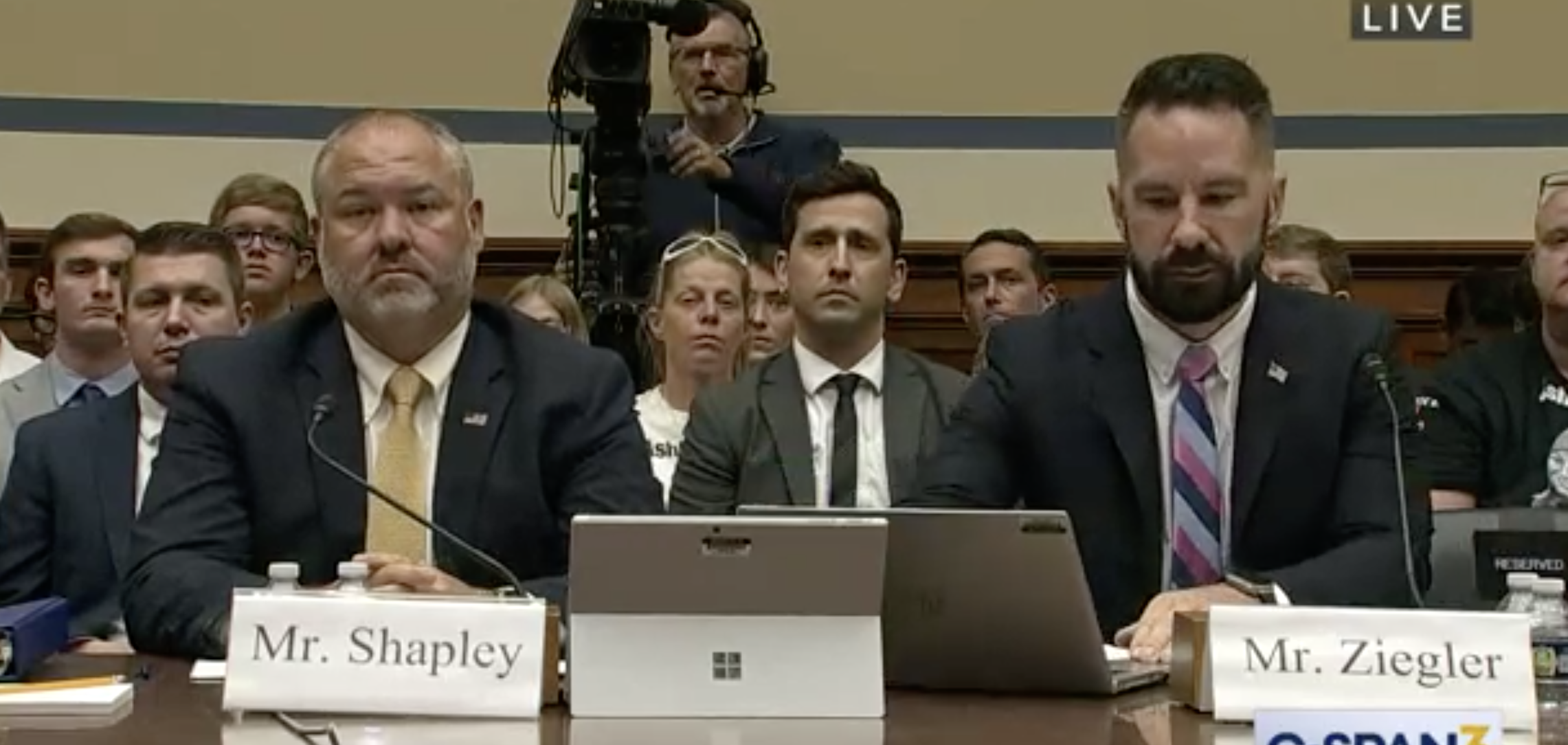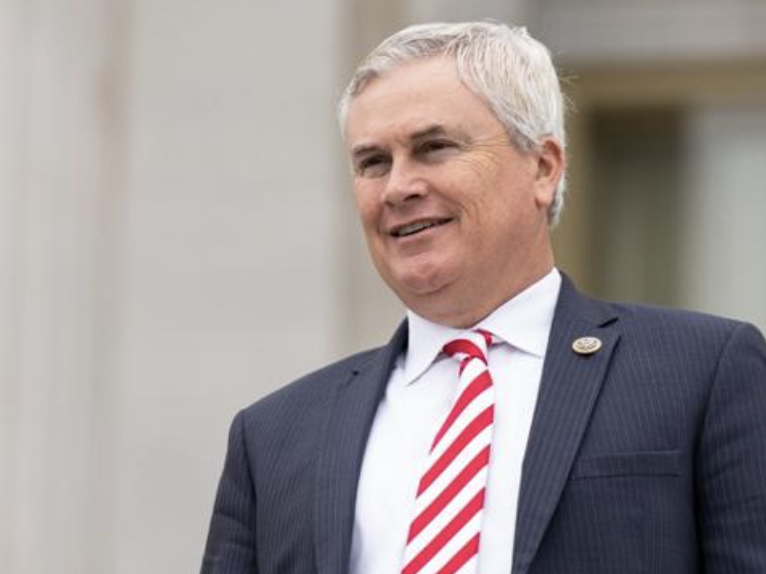
How James Comer’s Counsel, James Mandolfo, Conducts an Investigation

Amid the excitement yesterday, the Oversight Committee released the transcript of the now-retired FBI Agent who would have interviewed Hunter Biden if a bunch of things had gone differently on December 8, 2020.

Because I appear to be the only one who read the Gary Shapley and Joseph Ziegler interviews closely, I wanted to make sure to describe this one — to describe how James Comer’s counsel, James Mandolfo, simply ended the interview when the witness started describing how the rules about lawyers, sensitive persons, and elections — the same rules that Republicans claimed to care about with Carter Page — would have required the FBI to adopt less intrusive methods than they might otherwise have done.

As to the topic that the Oversight Committee cared about, the agent admitted he was upset that the Biden Transition Team learned of the interview in advance (though as he described, he only heard that from Gary Shapley). He also revealed that he and Shapley had another person to interview that day.

A We waited a period of time.    You know, I will add, it was frustrating, and I know supervisor number two was very frustrated, and I understood that frustration, but I also ‐‐ we had other ‐‐ another interview to conduct.    So after a certain period of time, and I don’t exactly recall how long, we transitioned to make an attempt to interview another ‐‐ or a witness as part of the investigation.

Shapley didn’t describe that detail. When being questioned by Democrats, the agent described that he simply moved on after this, and said he personally had not witnessed any politicization.

When Mandolfo asked for more background on Shapley’s claim that the FBI agent had asked, in May 2022, why the IRS weren’t asking for a Special Counsel, the agent’s attorney advised him not to answer on deliberative privilege basis.

The agent retired just a month after that, after the normal 20-year career at the FBI.

When the Democrats questioned the witness, though, he provided answers that were less helpful to James Comer’s conspiracy theories. He described how careful the FBI has to be when investigating attorneys and that such an investigation might require using least intrusive investigative methods. He described addition approvals required for Sensitive Investigative Matters. He described the care required during an election.

Effectively, he described that the FBI applied the rules required by the FBI’s investigative manual, the same ones that protected Donald Trump’s during the 2016 election.

Things got weirder when the Democratic staffers asked about the leaks. They appeared to be doing the same thing, basically getting this witness to explain why the things Shapley and Ziegler complained about all had ready explanations. And ultimately, the FBI agent did concede that if leaks got really bad it might make sense to reassign a team.

But when asked if he had ever been part of an investigation from which there were leaks, he denied it.

Q Generally speaking, do you think it could be problematic for agents’ views in 4 any ongoing investigation to be publicly reported or released to news sources?

A Yes.

Q And it could create problems potentially for the integrity of an investigation?

A Yes.

Q In your career, have you ever worked on an investigation in which there were leaks?    And you don’t need to be specific, just yes or no.

Mr. Zink [the Agent’s attorney]. Leaks to the press?

[Dem staffer]: To the press.

[Retired FBI Agent] Sorry. My pause is I’m thinking back through my career.

[Dem staffer] No, that’s fine.

[Retired FBI Agent] Not that I recall.

Wrong answer!!

The Hunter Biden investigation had several major leaks, starting in 2020, and continuing through the period when he retired (he was also part of the Duke Cunningham investigation, though I don’t recall major leaks from that).

Having not recalled that this investigation had serial major leaks, his answer about what he would do if he learned of one was still weirder.

[Retired FBI Agent] Not being part of one previously, I’d ‐‐ I, you know, believe it would 10 go to our Internal Investigations Section.    Whether there was ‐‐ now, if you’re asking if it  was an unsubstantiated allegation versus something I did believe happened, you know, then maybe potential removal of ‐‐ of, you know, the agent in question from the case to protect the integrity of the investigation.    You know, I’d want those steps to be taken.

[Dem staffer to Dem staffer] do you have any other questions before we stop?

[Dem staffer] So the question my colleague was asking you is there’s ‐‐ there’s an ongoing investigation. There’s a concern that there is a leak coming from someone on the investigative team, but ‐‐

Mr. Zink.    You mean generally or ‐‐

[Dem staffer] Generally.

Mr. Zink. Okay.

[Dem staffer] and ‐‐ but there is no clear answer as to who on the investigative team it is.    Would it be reasonable for management to consider removing the entire investigative team in order to protect the integrity of the investigation?

Ultimately the agent, who claimed he would have told his supervisor if there were a leak as there had been on this case which he didn’t acknowledge had been riddled by leaks, conceded that you might ultimately remove people from the team.

The discussion then turned to details about the investigation when someone — possibly the agent himself — asked to go off the record.

And that was it.

Mandolfo came back and ended the interview.

Mr. Zink. Just want to confirm with counsel for majority and minority that the terms “target,” “subject,” and “witness” as they were used in today’s questioning modify and relate to the FBI and Department’s investigation, not the grand jury’s investigation. Just confirming that.

Mr. Mandolfo. Yes. And just based upon the narrow scope and agreement that was formed amongst counsel and the parties that this would be limited to a very limited set of facts, we are now going to conclude with speaking with [Retired FBI Agent] at this time.

It’s not clear whether Mandolfo ended the interview because the retired agent realized he had violated grand jury rules (thus the clarification from his lawyer), whether he realized answering the question about other agencies would do so, or whether the discussion of leaks had been so unhelpful that Mandolfo had to stop.

But the tactic was a fairly telling indicator of what would happen if there were a substantive review of the investigation into Hunter Biden.

Perhaps we’ll now see some of that in discovery.
Share this entry

In Hunter Biden Case, Abbe Lowell Enters His Appearance

In Hunter Biden’s filing responding to David Weiss’ motion to vacate Judge Maryellen Noreika’s order for more briefing on the form of the plea deal, Abbe Lowell signed the response, pending his entry of appearance.

His appearance is as significant as what appears inside the response filing.

Chris Clark, who had been leading Hunter Biden’s team for years, is a very good lawyer and had been quite accommodating with the prosecution, even deferring on issues of discovery in the plea hearing he might not have otherwise, given the things the IRS Agents had disclosed about undue influence and Sixth Amendment problems with the case between the filing of the deal and the plea hearing. Lawyers often will do that to maintain cordiality to help craft a plea deal.

Abbe Lowell — who led Jared Kushner through the Mueller investigation unscathed, and got Robert Menendez acquitted, and got the Tom Barrack aide charged alongside him in a FARA case acquitted — is something else entirely.

I fully expect Weiss to do some outrageous things with his new Special Counsel status. Prosecutors always have a lot of tools, and Merrick Garland unwisely just gave Weiss more tools, including the impunity to engage in abuses like John Durham did.

But Lowell’s appearance and this filing — which asserts that the government “renege[d] on the previously agreed-upon Plea Agreement” — both implicitly and explicitly signal that Hunter’s team will take a far more confrontational view with prosecutors going forward.

As part of that, the Hunter filing makes clear they intend to hold Weiss to the already-signed diversion agreement on the gun charge. Hunter’s team filed it, per Noreika’s order — signed by both the prosecution and defense — on August 2.

The Defendant’s understanding of the scope of immunity agreed to by the United States was and is based on the express written terms of the Diversion Agreement. His understanding of the scope of immunity agreed to by the United States is also corroborated by prosecutors’ contemporaneous written and oral communications during the plea negotiations.

Fourth, the Defendant intends to abide by the terms of the Diversion Agreement that was executed at the July 26 hearing by the Defendant, his counsel, and the United States, and concurs with the statements the Government made during the July 26 hearing,1 and which the Government then acknowledged in its filings agreeing to the public disclosure of the Plea and Diversion Agreements2 —that the parties have a valid and binding bilateral Diversion Agreement.

1 The Government stated in open court that the Diversion Agreement was a “bilateral agreement between the parties” that “stand[s] alone” from the Plea Agreement, and that it was “in effect” and “binding.” (Hr’g Tr. 46:9–14) (Government: “Your Honor, I believe that this is a bilateral agreement between the parties that the parties view in their best interest.”); id. at 91:6–8 (Government: “Your Honor, the Diversion Agreement is a contract between the parties so it’s in effect until it’s either breached or a determination [sic], period.”); id. at 41:12–15 (“Your Honor, the United States[’] position is that the agreements stand alone by their own terms … ”); id. at 89:12–14 (Government: “[T]he statement by counsel is obviously as Your Honor acknowledged a modification of this provision, and that we believe is binding.”).

2 (D.I. 24 in No. 23-mj-00274-MN); (D.I. 20 in No. 23-cr-00061-MN) (stating that the Diversion Agreement was a “contract[] between the Government and a defendant” and that Government assented to public filing because “the Government and the Defendant expressly agreed that this diversion agreement would be public”).

If Noreika upholds the diversion, it not only avoids a felony on the gun charge itself, but a false statement charge that prosecutors told Noreika they waived filing as well. It would take one piece of leverage Weiss had off the table.

If she upholds the diversion, that leaves the tax and any FARA (or related) charges, and potentially an attempt to go after Hunter’s benefactor, Kevin Morris (though once DOJ charges Hunter, he will have the ability to start a legal defense fund that will be opaque to regulators).

As the filing notes and as Lowell noted in a relentless Face the Nation appearance yesterday: The prosecutors were the ones who approached Hunter’s team — in May, the same month the IRS removed Gary Shapley’s entire IRS team from the case — to make a deal to avoid trial. [my emphasis]

First, in May 2023, the Defendant, through counsel, accepted the prosecutors’ invitation to engage in settlement discussions that the Defendant and counsel understood would fully resolve the Government’s sprawling five-year investigation.

Second, as is customary in negotiated resolutions, prosecutors (and not the Defendant or his counsel) proposed and largely dictated the form and content of the Plea and Diversion Agreements. This is true with respect to the form in which the documents were presented to the Court (i.e., as two separate and independent agreements), as well as the express language of paragraph 15 of the Diversion Agreement (the so-called immunity provision). Throughout the settlement process the Defendant and his counsel negotiated fairly and in good faith with the prosecutors.

Third, consistent with their terms, the Defendant signed both agreements, was willing to waive certain rights, and to accept responsibility for his past mistakes. As was required as part of the Plea Agreement, he was prepared to plead guilty to the two misdemeanor tax charges in open court and he truthfully answered Your Honor’s questions, including those regarding his understanding of the promises that had been made to him by the prosecutors in exchange for a guilty plea. The Defendant’s understanding of the scope of immunity agreed to by the United States was and is based on the express written terms of the Diversion Agreement. His understanding of the scope of immunity agreed to by the United States is also corroborated by prosecutors’ contemporaneous written and oral communications during the plea negotiations. [my emphasis]

Part of that is just bluster. As Lowell noted on FTN, obviously Hunter wanted to avoid trial, too. The reasons why Hunter would want to avoid trial, though, are all obvious.

But the press has shown zero curiosity about why Weiss’ team would have wanted to avoid a trial, even after Joseph Ziegler explained some of what that was.

And when asked whether there will be trial, Lowell reminded that now there’ll be discovery and motions and maybe the prosecutors will decide they want to avoid a prosecution in the end too.

MARGARET BRENNAN: The US Attorney said, due to this impasse, a trial is in order. Is a trial going to happen? Can you avoid one?

LOWELL: Well, the answer to the second question is you can but let me answer the first question. When you do not have a resolution and somebody pleads not guilty, as Hunter did, then two things happen. A judge put together a scheduling order, the end of which would be a trial. There’d be discovery and motions, etc. So that’s why that statement was made.

MARGARET BRENNAN: So it’s not inevitable?

LOWELL: It’s not inevitable. And I think what–

MARGARET BRENNAN: And you’re trying to avoid one?

LOWELL: Yes, we were trying to avoid one all along. And so were the prosecutors who came forward to us, and we’re the ones to say, “can there be a resolution short of a prosecution?” So they wanted it and maybe they still do want it. [my emphasis]

Even as noting that a prosecution would entail discovery and motions, Lowell noted that the only explanation for DOJ reneging on the plea agreement was if something besides the facts and the law had infected the process.

MARGARET BRENNAN: So let’s start with why this plea deal hit the impasse.

LOWELL: So if you were in court or read about what happened on July the 26th, you have to ask yourself, as you just asked me, “why?” And there are only a few possibilities. Remember, it were the prosecutors who came forward and asked if there was a resolution possible. They’re in charge of figuring out the form, the document, and the language. They did that. And so the possibilities are only, one, they wrote something and weren’t clear what they meant. Two, they knew what they meant, and misstated it to counsel. Or third, they changed their view as they were standing in court in Delaware. So to answer that question, I’ll ask you a question. And everybody else who’s paying attention, what group of experienced defense lawyers would allow their client to plead guilty to a misdemeanor on a Monday, keeping in mind that they knew that there could be a felony charge on a Wednesday? That wouldn’t happen.

[snip]

LOWELL: –Because I know we were a little rushed. So to answer your question squarely. People should keep in mind that while Mr. Weiss’ title changed last week, he’s the same person he’s been for the last five years. He’s a Republican U.S. attorney appointed by a Republican president and attorney general, who had career prosecutors working this case for five years, looking at every transaction that Hunter was involved in. So whether it was tax or the gun, or possible any other charge, if anything changes from his conclusion, which was two tax misdemeanors, and a diverted gun charge. The question should be asked: what infected the process that was not the facts and the law?

MARGARET BRENNAN: Or new evidence? I mean, are you confident your client won’t face new criminal charges?

LOWELL: I’m confident that if this prosecutor does what has been done for the last five years, look at the facts, the evidence and the law, then the only conclusion can be what the conclusion was on July 26. It’s new evidence, there’s no new evidence to be found. Some of these transactions are years old. They’ve had people in the Grand Jury, they’ve had data that was provided to them. I don’t know the possibility exists after this kind of painstaking investigation for them to be “oh, my gosh, there’s a new piece of evidence which changes.” The only thing that will change is the scrutiny on some of the charges, for example, the gun charge.

Already, Ziegler, who did nothing as he obtained one after another piece of evidence that people were hijacking Hunter Biden’s digital identity, revealed that there is documentation of undue influence on this prosecution in the case file. And now Lowell is suggesting that the only explanation for any change in Weiss’ posture from May would reflect similar undue political influence on the case.

And that’s the kind of thing that might make motions and discovery more painful for Weiss than the press currently understands.

Share this entry

Merrick Garland Makes David Weiss a Special Counsel

Merrick Garland just announced that after David Weiss requested it on Tuesday, he made Weiss a Special Counsel.

Given the way Garland let John Durham wildly abuse his authority, the way that Weiss tried to sand-bag Hunter Biden, and given Weiss’ permission of really problematic actions during the Trump Administration, I have grave concerns about this.

That said, it will make it harder for James Comer to continue holding dick pics hearings.

Update: Weiss has filed in Delaware to dismiss the tax charges there so they can be brought in a different district (presumably California and DC, though that suggests he’s going to try to file things past their statutes of limitation). This may mean DOJ has to release all the things that Gary Shapley and Joseph Ziegler revealed were in the file, including Weiss’ own disinterest in validating “the laptop.”

Share this entry

On January 19, 2022, SCOTUS Upheld Judge Tanya Chutkan’s Decision Rejecting Trump’s Executive Privilege Claims

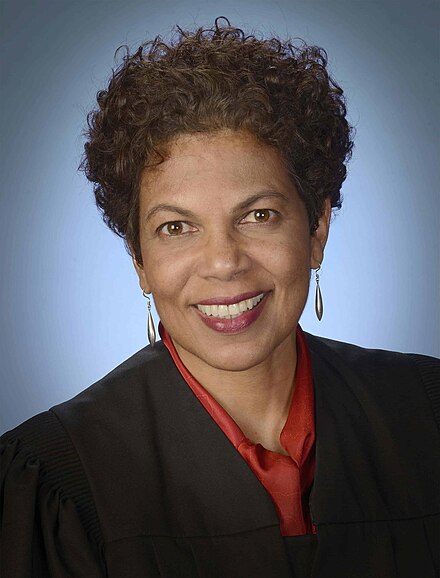
On November 9, 2021, Judge Tanya Chutkan — the judge who randomly got assigned to Trump’s January 6 prosecution — rejected Trump’s request to enjoin the Archives from turning over documents to the January 6 Committee.

Chutkan held that because the incumbent President had waived Executive Privilege and the January 6 Committee had a legislative interest in preventing another attack on the peaceful transfer of power, she had no reason to second guess the political branches of government about the import of the investigation.

The legislative and executive branches believe the balance of equities and public interest are well served by the Select Committee’s inquiry. The court will not second guess the two branches of government that have historically negotiated their own solutions to congressional requests for presidential documents. See Mazars, 140 S. Ct. 2029-31.

Defendants contend that discovering and coming to terms with the causes underlying the January 6 attack is a matter of unsurpassed public importance because such information relates to our core democratic institutions and the public’s confidence in them. NARA Br. at 41. The court agrees. As the Supreme Court has explained, “the American people’s ability to reconstruct and come to terms” with their history must not be “truncated by an analysis of Presidential privilege that focuses only on the needs of the present.” Nixon v. GSA, 433 U.S. at 452-53. The desire to restore public confidence in our political process, through information, education, and remedial legislation, is of substantial public interest. See id.

Plaintiff argues that the public interest favors enjoining production of the records because the executive branch’s interests are best served by confidentiality and Defendants are not harmed by delaying or enjoining the production. Neither argument holds water. First, the incumbent President has already spoken to the compelling public interest in ensuring that the Select Committee has access to the information necessary to complete its investigation. And second, the court will not give such short shrift to the consequences of “halt[ing] the functions of a coordinate branch.” Eastland, 421 U.S. at 511 n.17. Binding precedent counsels that judicially imposed delays on the conduct of legislative business are often contrary to the public interest. See id.; see also Exxon Corp. v. F.T.C., 589 F.2d 582, 589 (D.C. Cir. 1978) (describing Eastland as emphasizing “the necessity for courts to refrain from interfering with or delaying the investigatory functions of Congress”).

Accordingly, the court holds that the public interest lies in permitting—not enjoining— the combined will of the legislative and executive branches to study the events that led to and occurred on January 6, and to consider legislation to prevent such events from ever occurring again.

On December 9, 2021, the DC Circuit upheld Chutkan’s ruling. Patricia Millett repeated Chutkan’s argument that the agreement of Congress and the Executive provided no basis for the courts to intervene. But she also described that even by a heightened standard — even if Trump were withholding these documents while still President — the need for the documents would overcome his privilege claim.

While former President Trump can press an executive privilege claim, the privilege is a qualified one, as he agrees. See Nixon v. GSA, 433 U.S. at 446; United States v. Nixon, 418 U.S. at 707; Appellant Opening Br. 35. Even a claim of executive privilege by a sitting President can be overcome by a sufficient showing of need. See United States v. Nixon, 418 U.S. at 713; In re Sealed Case, 121 F.3d at 292. The right of a former President certainly enjoys no greater weight than that of the incumbent.

In cases concerning a claim of executive privilege, the bottom-line question has been whether a sufficient showing of need for disclosure has been made so that the claim of presidential privilege “must yield[.]” Nixon v. GSA, 433 U.S. at 454; see United States v. Nixon, 418 U.S. at 706, 713. 12

In this case, President Biden, as the head of the Executive Branch, has specifically found that Congress has demonstrated a compelling need for these very documents and that disclosure is in the best interests of the Nation. Congress, which has engaged in a course of negotiation and accommodation with the President over these documents, agrees. So the tests that courts have historically used to police document disputes between the Political Branches seem a poor fit when the Executive and Congress together have already determined that the “demonstrated and specific” need for disclosure that former President Trump would require, Appellant Opening Br. 35, has been met. A court would be hard-pressed under these circumstances to tell the President that he has miscalculated the interests of the United States, and to start an interbranch conflict that the President and Congress have averted.

But we need not conclusively resolve whether and to what extent a court could second guess the sitting President’s judgment that it is not in the interests of the United States to invoke privilege. Under any of the tests advocated by former President Trump, the profound interests in disclosure advanced by President Biden and the January 6th Committee far exceed his generalized concerns for Executive Branch confidentiality.

[snip]

Keep in mind that the “presumptive privilege” for presidential communications “must be considered in light of our historic commitment to the rule of law.” United States v. Nixon, 418 U.S. at 708. In United States v. Nixon, the particular component of the rule of law that overcame a sitting President’s assertion of executive privilege was the “right to every [person]’s evidence” in a criminal proceeding. Id. at 709 (quoting Branzburg v. Hayes, 408 U.S. 665, 688 (1972)). Allowing executive privilege to prevail over that principle would have “gravely impair[ed] the basic function of the courts.” Id. at 712.

An equally essential aspect of the rule of law is the peaceful transition of power, and the constitutional role prescribed for Congress by the Twelfth Amendment in verifying the electoral college vote. To allow the privilege of a no-longer-sitting President to prevail over Congress’s need to investigate a violent attack on its home and its constitutional operations would “gravely impair the basic function of the” legislature. United States v. Nixon, 418 U.S. at 712.

On January 19, 2022, the Supreme Court upheld Chutkan’s ruling. With only Clarence Thomas dissenting, Justice Kavanaugh noted that the DC Circuit’s ruling that Trump’s appeal would have failed even under more stringent standards made any review of this decision unnecessary.

The Court of Appeals concluded that the privilege claim at issue here would not succeed even under the Nixon and Senate Select Committee tests. Therefore, as this Court’s order today makes clear, the Court of Appeals’ broader statements questioning whether a former President may successfully invoke the Presidential communications privilege if the current President does not support the claim were dicta and should not be considered binding precedent going forward.

I have written repeatedly about how Merrick Garland set up a framework in July 2021 by which Congress’ investigative requests would provide an opportunity for President Biden to waive Executive Privilege without violating DOJ’s contacts policy. That is, in July 2021, Garland solved a tricky problem with investigating the former President: how to obtain privilege waivers while keeping the existing President entirely walled off from the criminal investigation.

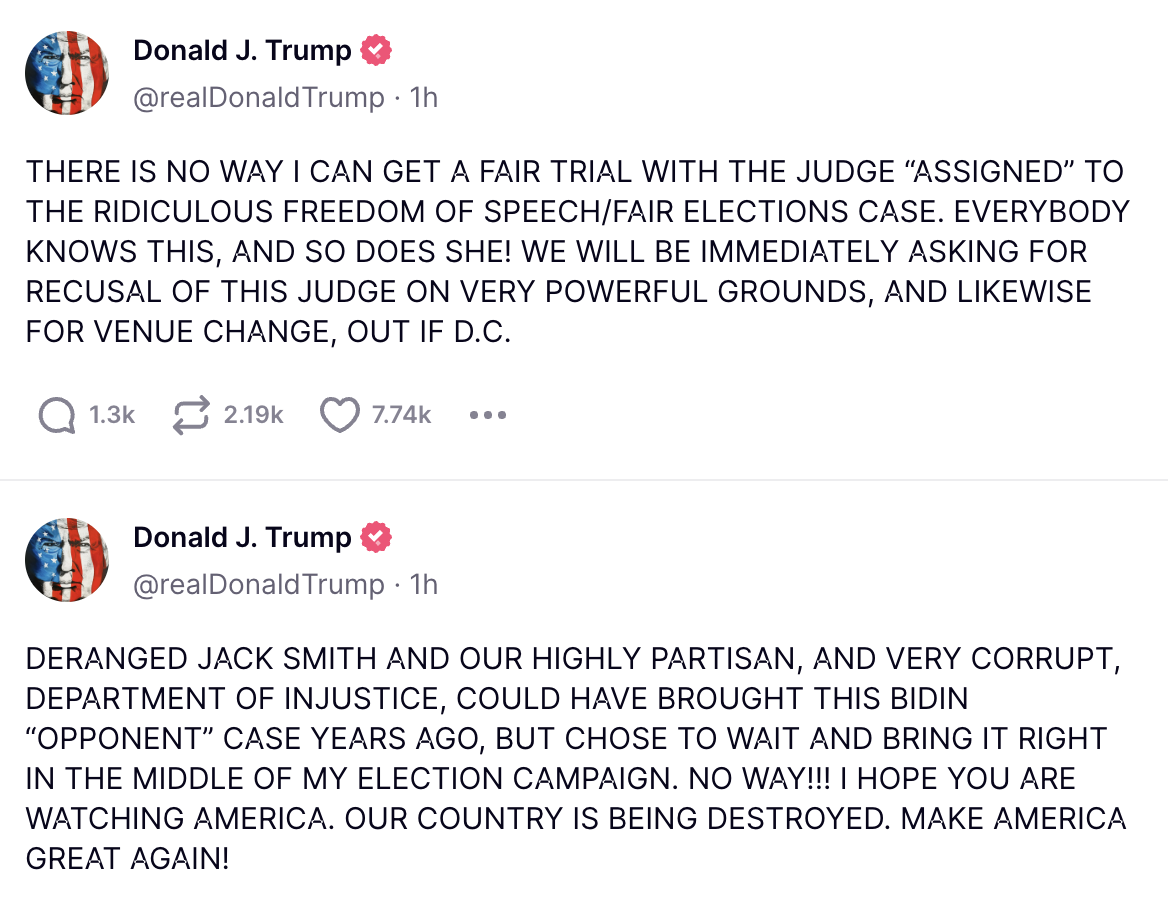
But this legal background, in which, with just one dissent, SCOTUS upheld a Tanya Chutkan opinion pertaining to an investigation into Donald Trump, will prove critically important in the days ahead, for two reasons that go to the screeds the former President is engaging in on his failed social media platform.

Along with making a venue complaint that has failed the dozens of times other January 6 defendants have made it (here’s a Roger Parloff post from before the Riley Williams and Oath Keepers trials showed that juries will rule against the government on precisely the same charges), Trump is preparing to claim that Judge Chutkan is biased and must be recused.

And Trump has been claiming that DOJ could have brought this case years ago, before the election season.

As to the first point, on a topic directly pertinent to this investigation, eight Justices have already upheld Judge Chutkan. Three Trump appointees, with Justice Kavanaugh writing the decision, have already ruled with Judge Chutkan.

That will make it harder to claim her prior central involvement in the January 6 investigation presents a conflict.

More importantly, that Judge Chutkan decision in November 2021 led to a SCOTUS decision, on January 19, 2022, upholding the DC Circuit’s opinion that the peaceful transfer of power is a sufficiently important basis to overcome an Executive Privilege claim, even if only for a congressional investigation, which litigation in the stolen documents case noted was a significantly lower standard than a criminal investigation.

Yet, even in spite of that decision on January 19, 2022, Donald Trump continued to make Executive Privilege claims that delayed DOJ’s investigation. He did so to stall DOJ’s interviews with Mike Pence’s advisors in summer 2022. He did so to stall DOJ’s interviews of Trump’s White House Counsel later that summer. He did so to stall DOJ’s interviews with other top aides in January 2023. And he did so to stall Mike Pence’s testimony.

Donald Trump continued to stall DOJ’s investigation using Executive Privilege claims for 463 days after a Justice that he himself had appointed had already rejected such claims. At the very least, these frivolous Executive Privilege invocations were critically responsible for any delay from July 2022, when Greg Jacob and Marc Short first refused to answer some questions because of Trump’s privilege claims, until April 2023, when Mike Pence testified — nine months.

Nine months, Trump kept making Executive Privilege claims that it was clear SCOTUS wouldn’t uphold.

Indeed, Trump’s frivolous Executive Privilege claims are responsible for even more of any delay than his own Special Master demand in the stolen documents investigation caused — in that case, three months.

Donald Trump is complaining that he wasn’t charged for his attempt to overthrow the peaceful transfer of power in 2020 until during his campaign to regain the presidency.

But he is personally responsible for much of that delay.

Share this entry

Protection Racket: Donald Trump Thinks He’s More Special Than Steve Bannon

As you no doubt know, Trump and his January 6 prosecutors had a bit of a spat about the protective order governing evidence in the case.

The timeline goes like this:

August 2, 9:55PM: A Jack Smith prosecutor — given the initials, probably Thomas Windom — sends John Lauro a proposed protective order, “largely track[ing] the existing protective order in SDFL.”

“Evening of August 3 and early afternoon of August 4:” DOJ reaches out twice more.

Friday, August 4, 1:09PM: Trump’s latest defense attorney sends their own proposed protective order.

Friday, August 4, 2:39PM: A prosecutor (probably Windom) responds saying that Trump’s proposed order doesn’t make sense, notes that DOJ is again proposing the same order as adopted (by Aileen Cannon) in SDFL.

Friday, August 4, 2:45PM: Someone responds saying they adopted their proposal “form [sic] similar orders used in the district.”

Friday, August 4, 6:06PM: An AUSA responds, noting that Trump’s proposed order “would leave large amounts of material completely unprotected in a way not contemplated by standard orders in” DC.

Friday, August 4, 6:39PM: Someone responds saying they should brief it to Magistrate Judge Upadhyaya, whom they do not name, and ask that DOJ note “that we have did not have adequate time to confer.”

Friday, August 4: Trump tweets out video attacking the prosecutors prosecuting him and Joe Biden.

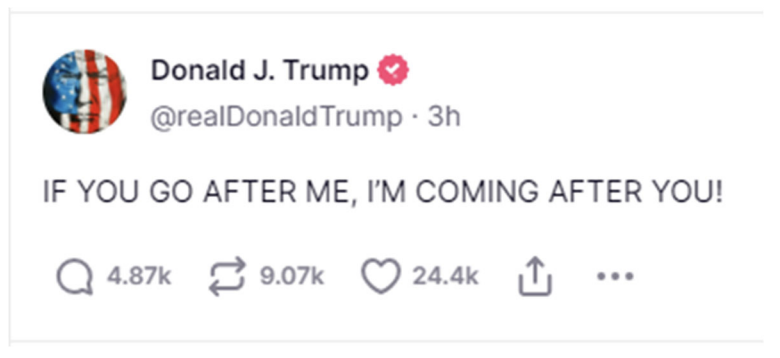
Friday, August 4: Trump tweets, “IF YOU GO AFTER ME, I’M COMING AFTER YOU!”

Friday, August 4, at least 3 hours after Trump’s tweet: DOJ files for a protective order, noting that Trump plans to just spill out grand jury information. The proposed motion is closely modeled on the Steve Bannon one.

Saturday August 5: Judge Chutkan orders Trump to respond by 5PM Monday

MINUTE ORDER as to DONALD J. TRUMP: It is hereby ORDERED that by 5:00 PM on August 7, 2023, Defendant shall file a response to the government’s 10 Motion for Protective Order, stating Defendant’s position on the Motion. If Defendant disagrees with any portion of the government’s proposed Protective Order, ECF No. 10-1, his response shall include a revised version of that Protective Order with any modifications in redline

Saturday, August 5: Trump attorney John Lauro moves for reconsideration, claiming — while misrepresenting the timeline — that the government had not conferred with him about the protective order.

Saturday August 5: DOJ responds noting that Trump is holding things up and noting that Lauro left out other efforts to consult.

In emails not appended to the defendant’s extension motion, the Government followed up on the evening of August 3 and early afternoon of August 4. Thereafter, defense counsel finally responded by sending an entirely different protective order.

Saturday, August 5: Judge Chutkan denies Lauro’s motion, ordering him to comply by 5PM on Monday.

MINUTE ORDER as to DONALD J. TRUMP: Defendant’s 11 Motion for Extension of Time is hereby DENIED. Defendant may continue to confer with the government regarding its proposed protective order before or after the August 7, 2023 5:00 PM deadline for his response. The court will determine whether to schedule a hearing to discuss the proposed protective order after reviewing Defendant’s response and, if included, his revised proposed protective order with modifications in redline.

But what has been missed is this: The protective order the government proposed last Friday is the protective order Judge Carl Nichols, the former Clarence Thomas clerk appointed by Trump, issued for the Steve Bannon contempt case.

Here’s that order, which Chutkan has ordered Trump to modify.

Here’s the order Trump appointee Carl Nichols adopted in 2021 for a similarly situated defendant. They’re not identical: the one the government proposed includes more detail about what should be treated as sensitive. But otherwise, they’re the same.

What this boils down to is that Trump — after issuing threats targeting prosecutors and judges — thinks he’s more special than Steve Bannon.

And Judge Chutkan isn’t buying that bullshit.

Update: In Trump’s response, he didn’t include the protective order he wants. He included a great deal of other shit, including the docket from SDFL. But this is a protective order adopted in DC District that separates out sensitive material; it’s from the Russian troll farm case.

Share this entry

Protective Order: Who Is the Victim of Trump’s 18 USC 241 Charge?

Yesterday, one day after Magistrate Judge Moxila Upadhyaya warned Trump not to engage in witness tampering, he posted first a video claiming that the prosecutors who are prosecuting him — none of whom Joe Biden appointed — were Biden’s accomplices in an attempt to win the election. He followed that with a tweet threatening, “IF YOU GO AFTER ME, I’M COMING AFTER YOU!”

Shortly thereafter, two prosecutors who were career prosecutors in the Trump Administration before they came to report to Merrick Garland, Molly Gaston and Thomas Windom, filed a motion for a protective order. While the ostensible goal of the motion was to accelerate the process of sharing discovery in a way that won’t end up in a tweet somewhere, they did use it to alert Judge Tanya Chutkan of Trump’s tweet.

The Government’s proposed order is consistent with other such orders commonly used in this District and is not overly restrictive. It allows the defendant prompt and effective use of discovery materials in connection with his defense, including by showing discovery materials to witnesses who also agree to abide by the order’s terms. All the proposed order seeks to prevent is the improper dissemination or use of discovery materials, including to the public. Such a restriction is particularly important in this case because the defendant has previously issued public statements on social media regarding witnesses, judges, attorneys, and others associated with legal matters pending against him. And in recent days, regarding this case, the defendant has issued multiple posts—either specifically or by implication—including the following, which the defendant posted just hours ago:

If the defendant were to begin issuing public posts using details—or, for example, grand jury transcripts—obtained in discovery here, it could have a harmful chilling effect on witnesses or adversely affect the fair administration of justice in this case. See Gentile v. State Bar of Nevada, 501 U.S. 1030, 1070 (1991) (“The outcome of a criminal trial is to be decided by impartial jurors, who know as little as possible of the case, based on material admitted into evidence before them in a court proceeding. Extrajudicial comments on, or discussion of, evidence which might never be admitted at trial . . . obviously threaten to undermine this basic tenet.”). [my emphasis]

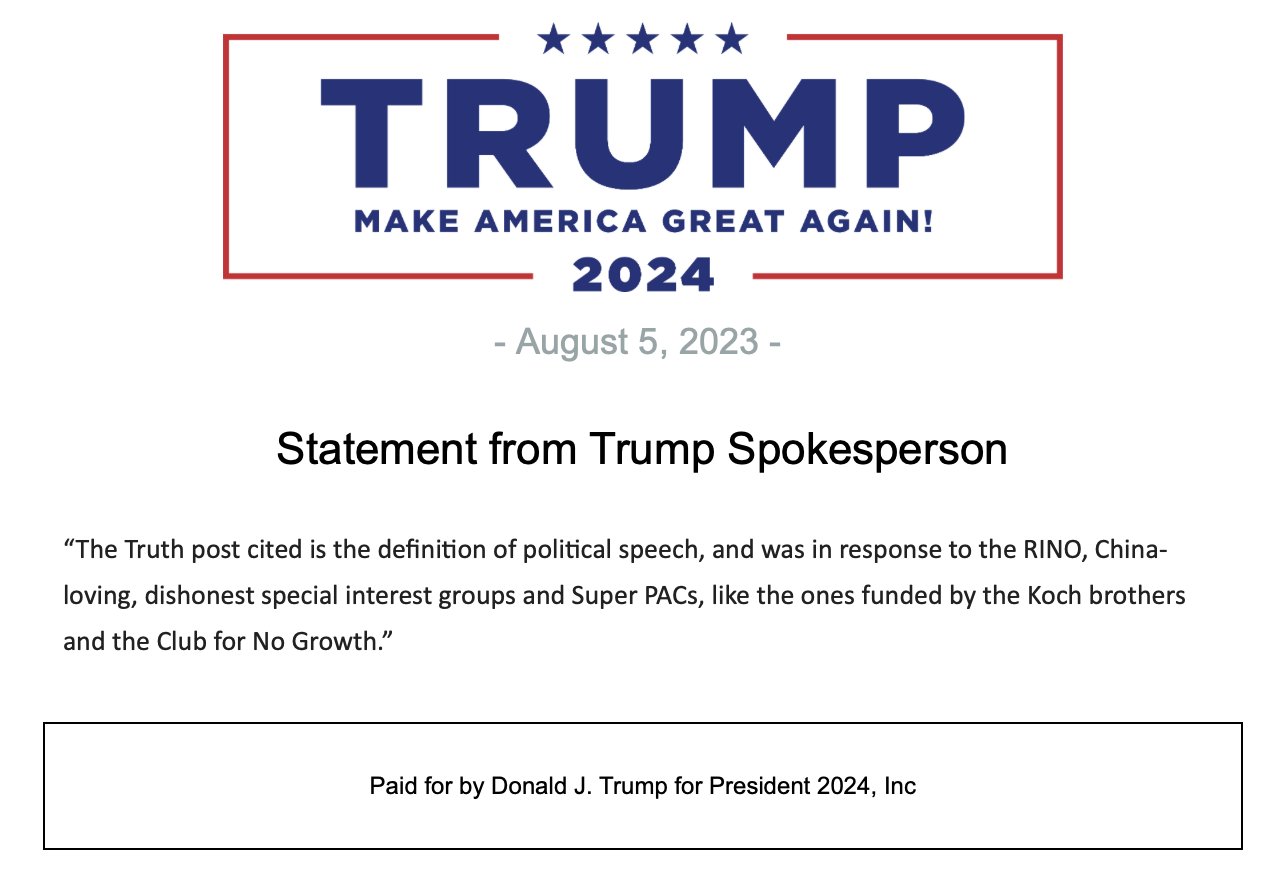
As I predicted, Trump quickly claimed the threat was about RINOs — even the Koch Brothers! — not the prosecutors prosecuting him.

Contrary to the claims of Trump and dozens of lawyers who haven’t read the indictment, it’s really not about his First Amendment right to lie, which is undoubtedly why he’s staging an early attempt to make this about his ongoing First Amendment right to lie.

Whatever. As I’m writing this I keep thinking about the line from the indictment describing that Trump tweeted his implicit threat against Mike Pence during the riot at a moment his advisors left him alone in his Dining Room: “after advisors had left the Defendant alone in his dining room, the Defendant issued a Tweet intended to further delay and obstruct the certification.”

The actual substance of the debate over the protective order will be genuinely interesting. Trump is running for office and he is entitled to attack Biden — albeit not physically. The motion described that prosecutors had proposed a recent protective order issued by Carl Nichols, a Trump appointee.

It’s likely that Judge Chutkan will call a hearing to deal with extrajudicial statements, while the lawyers fight about the protective order.

The whole predictable attack made me think, though, about Joe Biden’s role in all this. While the implicit threat against Jack Smith certainly threatens, “the fair administration of justice in this case,” the other prosecutors are not parties here. And there were no known witnesses included in Trump’s attack. Contrary to what Trump said, Biden has had no role in all this (in fact he should enjoin Trump from claiming prosecutors he didn’t appoint are his “accomplices”).

Depending on how DOJ conceives the 18 USC 241 charges, he could be Trump’s victim.

DOJ didn’t really lay that out in the indictment — whose votes Trump attempted to leave uncounted. Probably, as a Michigan mail-in voter (and in the county where Trump actually lost the election!), I’m among those people. I assume Rayne and bmaz are too.

But is Biden the victim here, too?

It won’t affect the resolution of this particular spat. But it does raise interesting questions about the structure of any gag going forward.

Update: Chutkan is not ordering Trump to explain his tweet.

MINUTE ORDER as to DONALD J. TRUMP: It is hereby ORDERED that by 5:00 PM on August 7, 2023, Defendant shall file a response to the government’s [10] Motion for Protective Order, stating Defendant’s position on the Motion. If Defendant disagrees with any portion of the government’s proposed Protective Order, ECF No. 10-1, his response shall include a revised version of that Protective Order with any modifications in redline. 

Share this entry

The $40 Million, Er, the Unlimited Slush Fund Man

Something weird happened in the last few days.

On Sunday, Trump whisperer Josh Dawsey scooped that campaign finance filings that would be submitted yesterday would show that Trump’s PAC, Save America, had spent more than $40M on legal fees in the first half of 2023.

Save America, the former president’s PAC, is expected to disclose about $40.2 million in legal spending in a filing expected Monday, said the people familiar with the filing, who like others interviewed spoke on the condition of anonymity to discuss information that has not been made public.

That total is more than any other expense the PAC has incurred during Trump’s 2024 presidential campaign and, according to federal filings from earlier this month, more than Trump’s campaign raised in the second quarter of 2023.It will bring the PAC’s post-presidential legal spending to about $56 million, as Trump faces a federal indictment in Florida, state charges in New York, and the prospect of additional criminal indictments in Washington and Fulton County, Ga.

Shortly after, Trump whisperer Maggie Haberman matched that scoop and added another, that Trump had gotten a $60M “refund” from his own SuperPAC.

The political action committee that former President Donald J. Trump is using to pay his legal bills faced such staggering costs this year that it requested a refund on a $60 million contribution it made to another group supporting the Republican front-runner, according to two people familiar with the matter.

[snip]

But the refund was sought as the political action committee, Save America, spent more than $40 million in legal fees incurred by Mr. Trump and witnesses in various legal cases related to him this year alone, according to another person familiar with the matter.

The numbers will be part of the Save America Federal Election Commission filing that is expected to be made public late on Monday.

That $40 million was in addition to $16 million that Save America spent in the previous two years on legal fees.

Dawsey’s version explained to readers that Save America’s fundraising was part of Jack Smith’s criminal investigation.

The PAC’s own fundraising and creation is under investigation, The Post has reported, though the group has not been accused of wrongdoing. Much of the money it is using to pay for legal bills was raised on false claims that the 2020 election was stolen.

Maggie’s version laid out that Trump had raised the money by promising that he’d spend it to address alleged voter fraud, without disclosing that those false claims may be a crime, much less state clearly that the claims were false.

The PAC was the entity in which Mr. Trump had parked the more than $100 million raised when he sought small-dollar donations after losing the 2020 election. Mr. Trump claimed he needed the support to fight widespread fraud in the race. Officials, including some with his campaign, turned up no evidence of widespread fraud.

And then yesterday’s disclosures came out and, per the Daily Beast, the key claim, that Trump had spent over $40M of his PAC’s funds on legal fees, was wrong. It was exactly half that.

Early news reports of former President Donald Trump’s astronomical $40.2 million in legal expenses now appear to have been off by about $20.1 million, or exactly half, according to a new Federal Election Commission filing.

Perhaps more notable, however, is the financial state of his former flagship leadership PAC, “Save America,” which covered those fees. Once a fundraising juggernaut, Save America ended June with just $3.7 million in the bank—a $100 million drop from its $103 million stash just one year ago—as the legal threats are only increasing in scope and severity.

The highly anticipated filing shows about $20.1 million in legal costs, with another roughly $1.5 million in additional legal reimbursements.

The early news reports—sourced from “people familiar with the filing”—and the disclosure itself don’t provide enough data to show where the error lay. However, the seemingly neat halfway split could suggest an accounting mistake—or, alternatively, possibly unreliable or intentionally misleading sourcing. Those fees do appear to extend to an array of law firms—indicating financial support for a long list of possible witnesses in several cases—as well as to Trump’s own stable of attorneys.

The more interesting detail — involving the campaign of a guy whose corporate person was convicted of tax fraud last year and goes on trial for civil fraud in October — is that he between all of Trump’s committees, he had to correct a bunch of past reports.

Trump’s full operation also filed more than two dozen corrected reports across several committees on Monday, going back as far as January 2021.

The former President should have more reliable accounting than George Santos.

Meanwhile, the incorrect reporting from Sunday — which alerted MAGAts and rich Republicans who believe they’re stuck with Trump that his burn rate on legal fees is eating up any campaign funds — came days after Trump rolled out a legal defense fund. As Sollenberger notes, as a 527, it will allow for a whole bunch of slush. Campaign manager Susie Wiles, who is (at least) a witness in the stolen documents case and also in the thick of the alleged illegal use of PAC funds has a role in managing the fund.

And yet experts said the shadiest, most notable part of the legal defense fund was not that it would pay for lawyers for potential witnesses against Trump. That part isn’t all that new. The Trump team reportedly worked hand-in-hand with CPAC chair Matt Schlapp’s “First Amendment Fund” earlier this year to provide legal help to Jan. 6 committee subpoena targets, and Trump’s “Save America” leadership PAC also bankrolled handpicked attorneys for Jan. 6 witnesses.

Instead, experts pointed to the group’s unique tax status opening an array of new fundraising opportunities for Trump as the most unsettling element—including for unlimited donations from individuals and corporations.

I can’t help but remember that DOJ shut down the investigation into the suspected $10 million donation in September 2016 from an Egyptian bank that was key to Trump remaining in the case.

Someone with knowledge of Trump’s filings preempted bad news about his terrible burn rate — but did so inaccurately (and in a way that has yet to be corrected, or explained). But it happened at a time when Trump is planning on using his criminal exposure to launch an entirely new kind of fundraising.

Trump’s campaign finance looks a lot like his corporate finance. And his criminal exposure is now part of what he’s selling.

Share this entry

David Weiss Is Wrecking the Right Wing Story (and Likely Sandbagging Hunter Biden)

I confess I love William Shipley — AKA Shipwreckedcrew, or Wreck, for short — the prosecutor turned defense attorney for seeming zillions of Jan6ers.

Don’t get me wrong: in my opinion, he’s an utter whack and a douchebag.

But — and I mean this in good faith — because he’s batshit but also a real lawyer, it makes him the sweet spot among attorneys that Jan6ers will hire and (sometimes at least) retain, but who will give them decent and at times excellent legal representation. There are a lot of batshit grifters who are little more than parasites on Jan6 defendants. And while I want these mobsters to face justice, I also want them to have competent legal representation along the way. Many of them do not. So while I may find Wreck awful personally, I am grateful he is providing competent representation for the kind of Jan6ers who wouldn’t accept representation from superb public defenders that many Jan6ers believe are communists or pedophiles or whatever other conspiracy theory they vomit up.

I also love Wreck because it drives him insane that, even though my graduate degree is a mere PhD, my observations often are more accurate than his. My favorite is probably the time I correctly predicted that John Durham might successfully breach Fusion’s privilege but not be able to use any of those documents at trial (Durham used one to set an unsuccessful perjury trap anyway). When I do stuff like that Wreck waggles his legal experience around and sics his trolls on me and it’s funny every … single … time.

This may be another of those times. Because Wreck is about to make my case that David Weiss tried something noxious in the abandoned Hunter Biden plea the other day.

You see, I agree with what Popehat had to say about the failed Hunter Biden plea the other day. Judge Maryellen Noreika sussed out that there was a key structural problem with the deal and refused to approve it without some more consideration of whether her role in it is even constitutional.

Friends and neighbors, that is shitty drafting. And if you’re Hunter Biden’s lawyer and telling your client that he can’t be prosecuted for crimes related to those income sources because of that language, that’s reckless advice and bad lawyering. It’s a failure by both attorneys. If Judge Noreika spotted that issue, called it out, and asked for an explanation, then good for her — she’s doing her job, which is to make sure the defendant understands the deal they are accepting.

That said, I’m pretty sure it’s a Frankenstein of a deal, in part, for reasons neither side wants to address until it’s done (Politico posted a transcript of the hearing here). Hunter, probably because he was at real risk for felony tax crimes before the government bolloxed the case so badly. His lawyer, Chris Clark, possibly because Abbe Lowell is on the scene and may be pushing a much more confrontational approach to this investigation. And the government because — on top of the things in the emails that prosecutors thought might blow the entire caseother statutes of limitation are expiring, SCOTUS might soon rule the one felony against Hunter unconstitutional. It turns out, too, that for the contested year (the one Joseph Ziegler said was so damning), both sides agree that Hunter’s accountants overstated his income on his taxes, which makes it hard to argue that Hunter’s treatment of some personal expenses as business expenses was an intent to lie to the IRS.

When asked whether there was any precedent to support what Hunter’s lawyers and the government were trying to do, AUSA Leo Wise, who was brought in to replace the team that was too tainted to prosecute this case, admitted, “No, Your Honor. This was crafted to suit the facts and circumstances.”

In other words, because both sides had fucked up so badly, this agreement is a way to move forward. Or would have been if Judge Noreika hadn’t appropriately refused to be part of a plea that might not be constitutional.

But the Frankenstein plea was written on the back of a remarkable statement of facts, a statement of facts that could have been written by Peter Schweizer, which was completely untethered from the narrow crimes in the two deals. It was so untethered from the elements of the offense involved in the crimes in the plea that Judge Noreika had to direct Wise to explain how it actually met the essential elements of the offense.

I have grave concerns about the ploy that prosecutors may have been attempting — may have succeeded in doing — with that statement of facts.

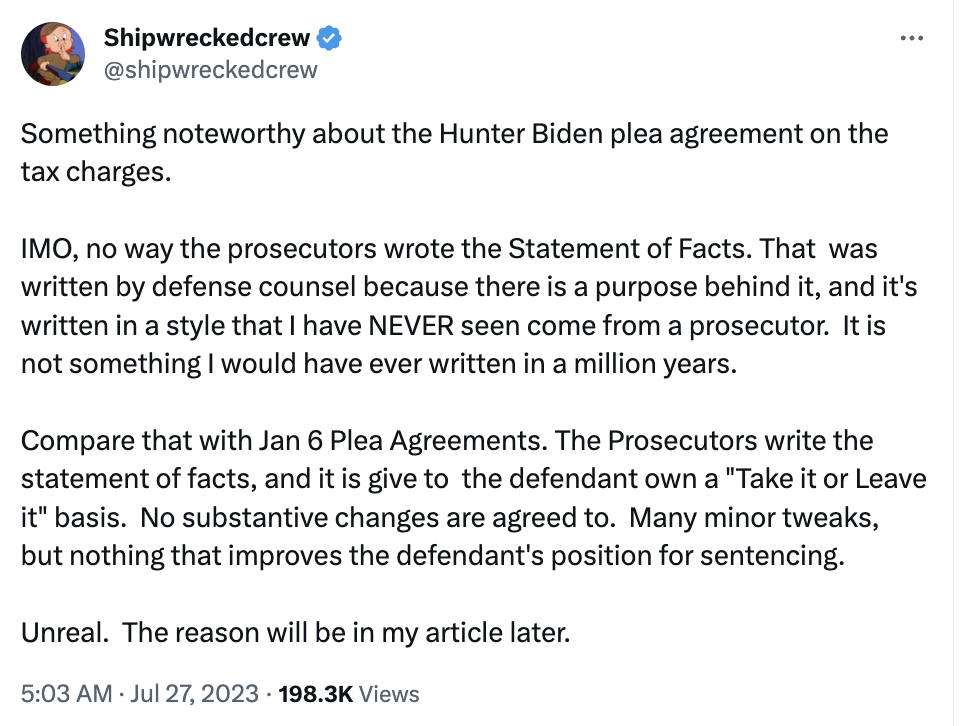
And the statement of facts is where I get to have fun with Wreck again. He agrees with me it is totally unusual. But he’s sure that that’s because the defense attorneys — who he’s sure wrote it — are trying to get away with a fast one.

“There is a purpose behind it,” Wreck said, “and it’s written in a style that I have NEVER seen come from a prosecutor.”

Only, he’s wrong about who wrote it and so undoubtedly wrong about the purpose behind it.

Hunter Biden’s lawyers didn’t write it. At one point, Chris Clark said that explicitly: “Your Honor, we didn’t write this.” Several times, Hunter or Clark struggled to explain what they believed the government meant by something in the statement of facts, in one instance when they had to address that it was totally unclear what income Hunter earned.

Mr. Clark: My understanding, Your Honor, is that sentence picks up the work described in the last couple of sentences, not just the work for Boise Schiller.

The Court: Well, Mr. Biden actually knows.

The Defendant: Yeah, exactly, Your Honor. I believe what the government intended for that sentence was that it was the total income, not just as it relates to my capacity for Boise Schiller.

When asked why the statement of facts said his addiction problems were well-documented, Hunter responded,

Well, I believe the government is referring to a book that I wrote about my struggles with addiction in that period of my life. And quite possibly other news outlets and interviews and things that have been done.

That phrase — well-documented — had absolutely no place in a document like this, certainly without citations. Indeed, how well-documented his addiction is irrelevant to both the tax crimes and the gun diversion.

Yet no one cleaned it up before this attempted plea.

Perhaps the most remarkable exchange happened when Judge Noreika asked Hunter what the statement of facts meant when it said that his tax liability should not have come as a surprise. He seemed totally unfamiliar with the passage, and when asked, Hunter said that it was a surprise.

THE COURT: All right. On the next page, at the end of the second paragraph, starting four lines from the bottom in the middle of the line, the paragraph talks about your tax liability. And it says the end of year liability should not have come as a surprise. Do you see that?

THE DEFENDANT: I’m sorry, I’m just trying —

THE COURT: That’s okay. Take your time.

THE DEFENDANT: Yes, I see that here.

THE COURT: It says it should not have come as a surprise. It wasn’t a surprise, is that right?

THE DEFENDANT: Yes, Your Honor.

THE COURT: And you knew —

THE DEFENDANT: Well, I don’t — I didn’t write this, Your Honor, so the characterization —

MR. CLARK: Can we elaborate the time there, Your Honor?

THE COURT: Yes.

MR. CLARK: So essentially there was a tax treatment that was undertaken in that year, and it changed the tax treatment at the very end of the year for a particular asset. And so I think the point is, and I didn’t write this either, there was substantial influx of income during that year. There was an issue with this last minute tax treatment change, and so there were expressions at times of surprise at that. I think the government’s point is you knew you made a lot of money, it shouldn’t have come as a surprise.

THE COURT: My only concern is when I read this as a lawyer, it shouldn’t have come as a surprise, that doesn’t preclude Mr. Biden from saying yes, it did.

MR. CLARK: Your Honor’s characterization is exactly right.

THE COURT: You’re saying it actually was a surprise?

MR. CLARK: In that year.

THE COURT: You guys are okay with that?

MR. WISE: Yes, Your Honor.

Hunter Biden was under oath for this colloquy (as all plea colloquies are), trying to explain why a document he didn’t write was riddled with ambiguous language and unsubstantiated claims.

And here’s the concern: When Hunter’s lawyers agreed to this, they believed that FARA charges were off the table. But about half the way through this hearing, Wise made it clear they were not.

THE COURT: All right. So there are references 6 to foreign companies, for example, in the facts section. Could the government bring a charge under the Foreign Agents Registration Act?

MR. WISE: Yes.

THE COURT: I’m trying to figure out if there is a meeting of the minds here and I’m not sure that this provision isn’t part of the Plea Agreement and so that’s why I’m asking.

MR. CLARK: Your Honor, the Plea Agreement —

THE COURT: I need you to answer my question if you can. Is there a meeting of the minds on that one?

MR. CLARK: As stated by the government just  now, I don’t agree with what the government said.

THE COURT: So I mean, these are contracts. To be enforceable, there has to be a meeting of the minds. So what do we do now?

MR. WISE: Then there is no deal.

I can’t speak to whether any FARA charges against Hunter are meritorious or not and if they are, without taint, by all means prosecute him. The admitted facts about Burisma and CEFC, while far smaller than laid out by Republicans (including, potentially, by Joseph Ziegler and Gary Shapley under oath), are interesting as much for the kind of information operation we saw being alleged in the Gal Luft prosecution as they are for the possibility they support a FARA prosecution (which is one of two things — the other being the loan that Hunter got from Kevin Morris to pay off his taxes in the first place — for which the statute of limitations would not have expired).

But that’s as much an information operation as it is a FARA violation.

It’s my opinion that this plea deal was crafted to give DOJ a way out of grave problems that exist in their existing case file — problems that Ziegler described in testimony — while kicking off a FARA investigation with sworn admissions made based on, at best, misunderstandings — and possibly outright misrepresentations — of the scope of the deal.

It’s my opinion that this statement of facts was intended to get Hunter to admit under oath to facts underlying FARA violations that DOJ otherwise couldn’t use because the way they got this evidence has been so tainted by Trump’s political influence and hacked computers and other poisonous tree they’d never get it admitted in court.

DOJ already admitted — to Joseph Ziegler at least — that they couldn’t prosecute any of this because of some kind of taint. And it sure looks like this “plea deal” is an attempt to sheepdip the entire prosecution to get Hunter Biden to clean the taint himself.

Share this entry

Cover-Up: Joseph Ziegler Provided a Different Explanation Why Hunter Biden Wasn’t Charged

You will read a lot of insane reporting about the GOP attempt to prevent the President’s son from pleading guilty in a federal court today.

Virtually all of it will misrepresent the testimony of the so-called IRS whistleblowers who claim that Hunter Biden got a plush deal. That coverage will misrepresent where any potential misconduct may lie.

Here’s what those misrepresentations look like, in this case from NYT:

The committee has heard testimony from two Internal Revenue Service investigators who claim to be whistle-blowers and have told the panel that the younger Mr. Biden received preferential treatment from the Justice Department. Mr. Smith’s brief asked the judge to consider the testimony in deciding whether to approve the agreement.

[snip]

The judge overseeing the case, Maryellen Noreika, agreed to seal the filing, but not before The New York Times was able to obtain a copy. The brief argued that the plea deal was “tainted,” citing the testimony of the two I.R.S. officials.

“The situation here is not that the Justice Department exercised charging or plea negotiation discretion, but the presence of credible allegations that the investigation, charging decisions and plea negotiations were tainted by improper conduct at various levels of the government,” wrote Theodore A. Kittila, a lawyer who filed the brief on behalf of Mr. Smith.

[snip]

Republicans have more recently tried to make a case that Hunter Biden’s plea deal was marked by favorable treatment from the Justice Department in his father’s administration. That assertion has been rejected by Attorney General Merrick B. Garland and by the prosecutor who has overseen the case, David C. Weiss, the U.S. attorney in Delaware, a Trump appointee.

It’s true that the so-called whisleblowers complained about things they weren’t able to do — most of which occurred while Bill Barr was Attorney General.

But that’s not the only thing the so-called whistleblowers testified to.

Joseph Ziegler testified that when he asked why Hunter wasn’t being charged, he was told that prosecutors had found emails that led them to worry they couldn’t charge the case at all.

So we found out through talking with our SAC that the attorneys had found — we were always asking for updates on charging. When are we going to charge? When are we going to charge? We were told that the prosecutors had found some emails that concerned them if they could actually charge the case. That’s what they said to us.

He even explained what some of those emails might be: documentation of Sixth Amendment problems with the case and evidence of Trump’s improper influence on it.

Around the same time in 2019, I had emails being sent to me and the Hunter — and the prosecutors on the case, the Hunter Biden prosecutors, from my IRS supervisor. So this was Matt Kutz still.

From what I was told by various people in my agency, my IRS supervisor, Matt Kutz, created memos which he put in the investigative files regarding the investigation potentially violating the subject’s Sixth Amendment rights. He also referred to Donald Trump’s tweets at the time.

I recall that at one point I had to go around my supervisor and ask his boss, ASAC George Murphy, to tell him to stop sending me and the Hunter Biden prosecution team these emails and that I was searching media articles on a weekly basis and was aware of everything being written in the media regarding the case.

There’s documentation in the case file that some part of the investigation — potentially something Ziegler himself did! — created what are probably Confrontation Clause problems for the case generally.

But that may not be the only thing.

Gary Shapley testified that he was distanced and then removed from the case after prosecutors had to ask him to turn over his own emails for discovery review a second time, after he had blown off a request seven months earlier.

Shapley was first asked to turn over his emails about the case in March 2022. But even though he was the one who had prepped to interview Hunter Biden himself, he did not comply.

It is common practice for DOJ to ask for the case agents’ communications in discovery, as they might have to testify in court. However, it’s much more unusual to ask for management communications, because it is simply not discoverable.

In March of 2022, DOJ requested of the IRS and FBI all management-level emails and documents on this case. I didn’t produce my emails, but I provided them with my sensitive case reports and memorandums that included contemporaneous documentation of DOJ’s continued unethical conduct. [my emphasis]

Then, in October 2022, prosecutors asked again. As Shapley himself described, he was angry that he was being asked for emails that might show exculpatory or impeachment information.

They also renewed the request for all my emails on the case, saying they needed to ensure they were aware of any exculpatory or impeachment effort in the case. But their extraordinary request looked to us just like a fishing expedition to know what we’d been saying about their unethical handling of the case.

[snip]

[T]his was the culmination of an October 24th communication from Delaware U.S. Attorney’s Office and — well, it was really Lesley Wolf and Mark Daly who called the case agent, [redacted], on the telephone and said, hey, we need — we need Shapley’s emails and his — these sensitive case reports that he’s authored back to May.

And they didn’t ask for discovery for anybody else. They didn’t ask for, from the — mind you, the agents had provided discovery March-April timeframe, so there was 6 months or so of additional discovery, and they’re not asking for that, right? They’re only asking for mine.

So [redacted] sends me an email with Wolf and Daly on it that says, hey, you know, they asked for this, you got to talk to Shapley. I respond, hey, yeah, I’m available 9:15, let’s chat. And she sends that, she forwards my email to Shawn Weede, number [two] — a senior level at Delaware U.S. Attorney’s Office.

And then he contacts me about this discovery, and he’s kind of putting a lot of pressure on me. So even Weiss called up, the deputy chief, to complain about timing of the emails that got turned over from me at that request. [my emphasis]

A month or so later, Shapley made the extraordinary request for the FBI agent reviewing emails to share anything he found in advance. As I’ve noted, Shapley asked for the kind of special treatment he claims Hunter Biden got.

This is what the NYT won’t tell you: That the testimony of both Ziegler and Shapley provides an entirely different explanation for why Hunter Biden wasn’t charged with felonies. And that explanation may have to do with their own conduct, not Hunter Biden’s.

Share this entry

Something Happened To Our Planet

Something happened to our planet, and it was us. The upshot is that it is getting insane. People yammer about how hot it is currently in Phoenix. It has always been thus, but it no longer cools off at night. The high temperatures are not the problem so much as the the overall heating. Including that the cool off at night no longer happens.

Climate change and heat sinking.

But, together, they really do matter. A lot. Both can be minimized if humans are not stupid. Do not count on that happening. Because humans are stupid.

But the kids today, and their kids, will make the future. They can make a difference in their own schools and communities. Starting now.

This is  book for kids. But a really helpful, and useful, one.

Many, if not most, of the people that frequent here won’t be around in fifty years to see how it all goes, but you can school up those next generations. This book can help. It is a great starting point.

As an adviso, the author is a friend and relative of mine. But I would not recommend it if I did not truly believe in her and her work.

Share this entry