
Donald Trump Is Getting a Pass for His Catastrophic Trade War
WSJ had a heavily-produced story on Sunday, “Why Everyone Got Trump’s Tariffs Wrong,” purporting to assess the claims that Trump and economists had made … at some point about his tariffs.
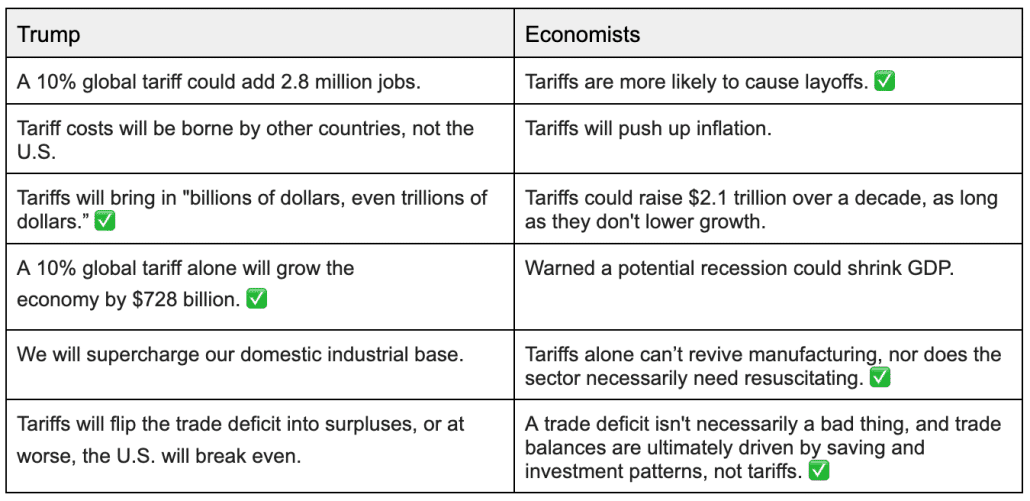
This table includes the six allegedly competing claims WSJ assesses; I’ve added a check marking whichever side WSJ claimed was really right.
For most of six paired predictions, WSJ makes a show of adjudicating who was right, giving Trump credit on two predictions and less ostentatiously confirming economists’ predictions on three.
For example, WSJ provides this table purporting to show that both Trump and the economists were wrong about inflation (with steeper tables showing the spike in coffee and appliances); for some reason, WSJ indexes this to January 1, 2024 prices, not 2025 (and some of the tables at WSJ’s source show steeper spikes).
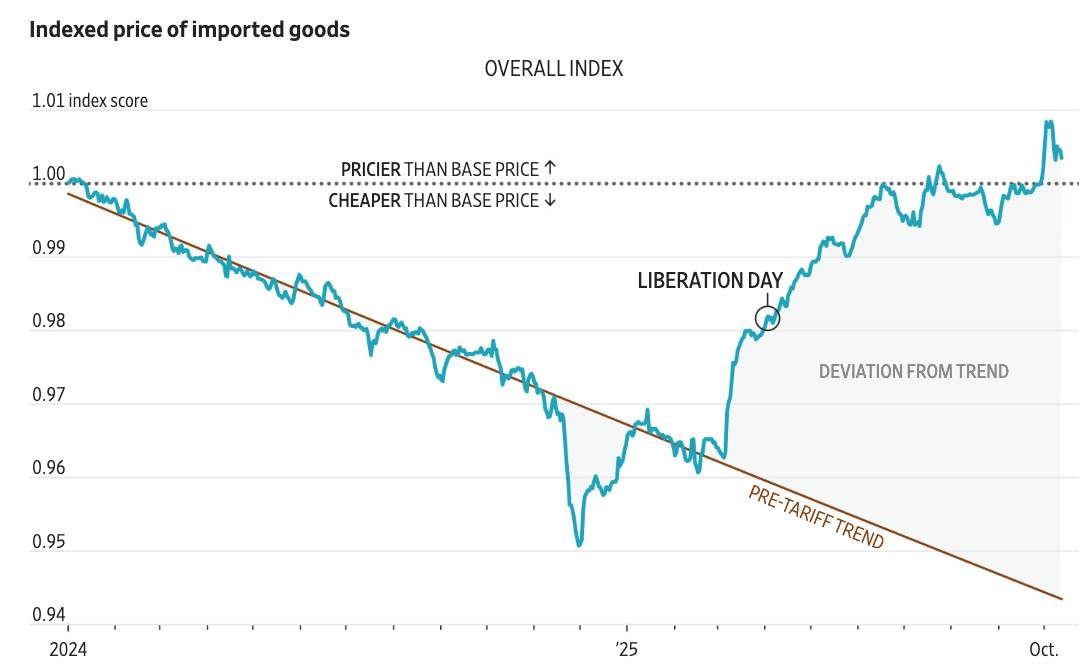
WSJ judges that economists were wrong this way:
Tariffs swiftly hit Americans’ wallets as major retailers from Macy’s to Best Buy raised prices in response to the duties.
“The magnitude and speed at which these prices are coming to us is somewhat unprecedented in history,” Walmart Chief Financial Officer John David Rainey told The Wall Street Journal in May.
But the worst inflation fears haven’t come to pass. Inflation has for months hovered around 3%—higher than the Federal Reserve’s 2% target, though still lower than many economists’ expectations.
But starting in the very next paragraph, WSJ explains why inflation wasn’t as bad as predicted: first, because Trump reversed the worst tariffs. Then, because companies are still trying to figure out what the fuck his tariff policy will be, especially after the Supreme Court gets done with it, and so haven’t passed on all of the tariffs, which they will eventually do.
Another factor at play: Trump’s repeated policy shifts on tariffs.
Many companies have said they want to see where tariffs will ultimately settle before introducing more price changes. The still-undecided Supreme Court case on Trump’s authority to impose tariffs gives them another reason to wait a bit longer.
Economists predict higher prices as companies draw down on their pre-tariffed inventory and renegotiate contracts with retailers and distributors.
If no new tariffs are announced, the Fed estimates the current ones will take nine months to work their way through the economy. That could push inflation from goods down in the back half of 2026. But “we haven’t been able to predict this with any precision,” said Fed Chairman Jerome Powell. “No one is.”
The rest of the article has similar equivocations. WSJ returns to Trump’s decision to reverse many of the tariffs when discussing the GDP growth (and notes that AI has kept the GDP afloat, without also noting that it’s likely in a bubble that is beginning to crash).
Trump has also walked back and delayed many of his threatened duties.
WSJ’s discussion of Trump’s failure to bring manufacturing back returns to changing policy.
Big projects will likely take years to materialize, if they happen at all, as government policies could shift again in that time.
And the flux makes this assessment impossible. Two days ago, for example, WSJ hailed September’s good job’s report.
The U.S. added 119,000 jobs in September, far more than economists had expected. But the figure was an outlier from previous months, in which job growth had lagged. As of September, the unemployment rate reached 4.4%, the highest in four years.
But that got revised downward today and — Justin Wolfers describes in reading today’s report — in reality there may be zero or negative job growth since Trump tried to impose his big tariffs, which if that proves true, would vindicate the economists.
WSJ gives Trump credit for predicting some revenue growth even while noting he wildly exaggerated how much growth there might be, but then admits that not only will much of the revenue go away if SCOTUS throws out the tariffs, but Trump would have to pay some portion — potentially as much as half — of the tariffs back.
Future collections hang on the Supreme Court’s decision on Trump’s authority to impose the tariffs, expected in coming days.
If the court strikes down tariffs imposed under the International Emergency Economic Powers Act, monthly revenue collected would fall by more than half. More than $100 billion already collected might also need to be refunded.
And WSJ also notes that a lot of the data it would need to measure all this is delayed (it doesn’t address Trump’s efforts to tamper with the data).
Perhaps the most salient assessment in the story is the last line: “As long as Trump continues to surprise the market with tariffs, trade will remain volatile,” which is both a platitude and an observation that you can’t assess many of these claims using regular measures, because the tariffs are not (or not just) about creating a precondition to shift trade flows.
Trump’s tariffs aren’t just tariffs. They are week-to-week business uncertainty.
They are also, just as importantly, about giving Trump a tool to attempt to leverage power, something captured in a different WSJ story, this interview with Meredith McGraw, in which Trump offers word salad to explain why tariffs are so cool.
When asked if he has alternative ways to use tariffs, the president said there are other laws but they are not as “nimble, not as quick.” He added, “I can do other things, but it’s not as fast. It’s not as good for national security.”
Trump also argued that tariffs gave him leverage in negotiations with other countries.
“I just used tariffs 10 minutes ago, just before you came, to settle the new inflammation that took place with Thailand and Cambodia,” Trump said. “And I told them, ‘If you have the war, not only am I going to break the trade deal we have, but I’m going to put tariffs on your country.’” He added, “Nobody can do that but me.”
“Nobody can do that but me,” Trump said of an authority that SCOTUS is likely to say he cannot lawfully do.
Worse, Trump equates being able to coerce other countries nimbly with national security. But it is anything but.
Consider how inconsistent Trump’s logic is. In the same week that Trump approved the sale of Nvidia chips to China (which chips China promptly said they would limit use), chips that remained, that very day, illegal to ship to China, the White House halted negotiations on similar kinds of technology with the UK because the Brits would not bow to Trump’s demands on food and tech standards. Trump wants to send chips to China instead of (just) shitty chicken, but he won’t send chips to the UK unless they accept US shitty chicken and Nazi Xitter posts.
None of it makes sense.
And this misrepresentation of how Trump is using tariffs — treating as sincere his false claims about how he claims he is using them — is just part of the reason why the reporting on Trump’s catastrophic tariffs has been so shitty.
To be sure, there has been persistent reporting on how badly his tariffs have devastated farm markets, especially soybeans but now shifting to wheat. There have been stories on how China has gotten pretty much what it has wanted. But there has been less coverage of how Trump’s stupid ass trade war — and China’s preparation for it since Trump’s last Administration — has created the opportunity for China to leverage its rare earth dominance and soybean consumption to bring Trump to heel.
Trump thought America was the irreplaceable market, and attempted to leverage access to it accordingly. But as he has discovered how little of all that he understands, it has backfired, giving China leverage it otherwise didn’t have.
And, if we can believe Vanity Fair’s profile of Susie Wiles, half of Trump’s advisors knew it wouldn’t work in real time.
“So much thinking out loud is what I would call it,” said Wiles of Trump’s chaotic tariff rollout. “There was a huge disagreement over whether [tariffs were] a good idea.” Trump’s advisers were sharply divided, some believing tariffs were a panacea and others predicting disaster. Wiles told them to get with Trump’s program. “I said, ‘This is where we’re going to end up. So figure out how you can work into what he’s already thinking.’ Well, they couldn’t get there.”
Wiles recruited Vance to help tap the brakes. “We told Donald Trump, ‘Hey, let’s not talk about tariffs today. Let’s wait until we have the team in complete unity and then we’ll do it,’ ” she said. But Trump barreled ahead, announcing sweeping “reciprocal” tariffs, from 10 to 100 percent—which triggered panic in the bond market and a sell-off of stocks. Trump paused his policy for 90 days, but by that time the president’s helter-skelter levies had given rise to the TACO chant: “Trump Always Chickens Out.”
Wiles believed a middle ground on tariffs would ultimately succeed, she said, “but it’s been more painful than I expected.”
All this is so painful not just because tariffs are a stupid policy and the way in which Trump implemented them is even stupid. It is painful because Trump has no fucking ability to discern what is good for America, and he doesn’t much care if he fucks up and destroys entire markets as a result.
And coverage of Trump’s destruction of the soybean market has not yet called out the systematic lies Republicans tell claiming Trump’s grant of $12 billion to struggling farmers is only an attempt (again) to reverse the damage he did, which will not come close to making farmers whole. Right wingers are, across the board, hailing Trump’s payoff and blaming the damage Trump did on Joe Biden … and almost no one is calling out the projection and lies.
Trump’s tariffs are a failure not just as tariffs, in fulfilling their purported purpose. But because Trump knows so little about the markets he’s trying to alter, he’s simply making the US vulnerable.
Update: Paul Krugman has more on what we learned from yesterday’s job numbers.
[T]he data show a weak labor market. Employment isn’t falling off a cliff, but job growth has been weak and hasn’t kept pace with the number of people seeking work. The headline unemployment rate in November was 4.6 percent, up from an average of 4 percent in 2024. That number is close to triggering the Sahm Rule, an economic rule of thumb devised by Claudia Sahm, a former economist at the Board of Governors of the Federal Reserve, that has historically been highly successful at identifying the early stages of a recession.
We can’t do a strict application of the Sahm Rule yet because Sahm’s method is based on the average unemployment rate over the past three months. Unfortunately, the shutdown prevented the Bureau of Labor Statistics from collecting key data in October. But if we do an interpolation of October’s unemployment rate by averaging over September’s rate of 4.4% and November’s rate of 4.6%, we can estimate that October’s unemployment rate was 4.5%. And those 3 months of unemployment numbers bring us within a whisker of the unemployment rise that, according to the Sahm Rule, signals that a recession is on the horizon.
The state of the economy looks even worse if we take a wider view of the labor market.
[snip]
Normally, when a president experiences a troubled economy during his first year he dispatches his
flying monkeysminions to declare that it’s all his predecessor’s fault. And some Trump officials, like Scott Bessent, are indeed trying to play the blame game. But this standard political tactic is unlikely to work for this president.First, the economy that Trump inherited when he took office was in much better shape than today’s economy, with lower unemployment combined with faster job growth, and inflation trending down.
Second, Trump’s radical policy changes – huge (illegal) tariffs, mass deportations, big tax cuts (for the rich), benefit cuts (for the poor and middle class), mass layoffs of federal workers, disinvesting in huge green energy projects and aid to farmers — have been clearly damaging to everything besides crypto and AI. It strains credulity – even for the Trump faithful – to claim that we are still in Joe Biden’s economy.


I agree.
Why has Wall Street bought into his madness?
Will we see a tanking in 2026. I think so.
What happens when the whole country is hit with a crash? In the past, a bail out would occur. This time they are too stupid to bail anyone out.
We are in for a financial suicide ride.
“The speed of technological advancement isn’t nearly as important as short term quarterly gains.”
Quark, Deep Space Nine
On Wall Street, meeting incentive goals are all that matters. Deregulation and tax cuts leading to massive bubbles and/or recessions are prioritized for the short-term incentive bonuses.
And also the short selling…..
#tu
I’m not surprised WSJ went easy on Convict-1. It’s in their DNA as business types and it’s probably what was allowed to get past the even more toady editorial board.
With that said, the money isn’t lying so Convict-1 stopped all mention of the money problems. Stuff like the jobs report at least has the private sector analogue in ADP’s report, but it’s pretty clear thumbs are being placed upon scales all over the place to hide bad news.
As for vulnerability, it’s a key point raised by EW not seen many other places, because if the US is a basket case we are less likely to stop Vlad and Xi’s next adventures. Convict-1 and his circle are OK with selling out the USA as long as we proles pay the price.
The WSJ editorial page has long been known as a bastion of right-wing thinking. The WSJ news pages, OTOH, have long been known for their high quality.
I remember, some number of years ago, reading a George Will op-ed about EVs that came down to the claim that 7 < 1 (every 7% reduction in $ paid for gas led to a 1% increase in driving, so actual gas consumption might well go up! In the case of EVs, though, that reduction was due to less gas being consumed.) A few years before that, I read op-eds on the left-hand and right-hand sides of the op-ed page: left side excoriating China for its protectionist tariff policy because free markets are better; right side proposing strong protectionist tariffs because they would strengthen U.S. manufacturing.
Just don’t pay attention to them, is my advice.
WSJ editorial page, home of the Laffer Curve. Even yet.
“None of it makes sense” when I consider his rantings about Rob Reiner, he sounds like an insane person
He needs a devoted caretaker to tend to his mystery medical problems. Someone like Annie Bates from Misery would do nicely.
Annie Bates? Kathy Bates played the character “Annie Wilkes” in Misery.
As long as she wields the sledgehammer, names are inconsequential.
Yes, I meant Annie Wilkes.
Everybody is ‘health-washing’ a sick old man, as if he could possibly be responsible for what he says or does. And worst of all, as if he could learn from this episode and improve. It’s cruel.
I don’t know much about it, but don’t those in the grip of senility and dementia often revert to childhood?
Something resembling childhood, I hear. (In his case, he was already stuck at about 7 years, mentally.) I don’t have personal knowledge, because dementia doesn’t run in my family, on either side.
He’s President of the United States, he’s responsible for his actions, full stop. If he can’t do the job its his obligation to step down, or failing that, the obligation of his VP and cabinet to declare that he’s unfit under the 25th amendment and kick his ass out.
Of course none of that is going to happen, instead the United States will continue to be run by an insane narcissist and his cadre of incompetent toadies and enablers, who will continue doing immense damage to its national interests. Twenty years from now–perhaps ten–nobody outside the US will still imagine it to be a great power. The collapse will be undeniable.
(I really wish this were not the case, but the past year is the clearest possible demonstration that having competent leaders who care about the country and not just themselves, actually matters)
He doesn’t much care if he fucks up and destroys the *lives* of those who supported him. Right now Trump is distracted from tariffs by Pete Hegseth’s enhanced cruelty campaign, a policy of murder-at-a-distance that gives the “post-sex” president the arousal of power.
The problem (as any addict knows) is that every high has to top the previous one. For someone with Trump’s threshold and diminishing mental capacity, only all-out war will eventually suffice.
Convict-1 announced an address tomorrow at 9 PM EST. My bet is either he will adit to a war on Venezuela or that the Epstein files can’t be released that day due to an active investigation. It won’t be a resignation or any admission about his medical status (much less Epstein). WHatever it is, it won’t be good news.
Matthew 6:11 updated for the Trump administration:
Give us this day our daily horror
When Trump talks about how much he loves the Bible, my first thought has always been that he’s never read Matthew.
The good shepherd would die for his sheep…
ICE used Proverbs 28:1 in a recruitment ad: The wicked flee though no one pursues,
but the righteous are as bold as a lion.
But I like the last verse: When the wicked rise to power, people go into hiding;
but when the wicked perish, the righteous thrive.
From the image of a crowned Trump piloting a fighter jet shitting on Americans, the golden gilded oval office , tariffs, the ballroom, blowing up boats… Delusions of Grandeur
The “Arc de Trump” he wants in the circle in front of the entrance to Arlington.
(I want it made of styrofoam, and coated with gesso so it can be gold-leafed or gold-painted and impress the heck out of his failing mind. Then we can cut it up and send it to a hazmat destruction place.)
I’m rereading “Flags of Our Fathers” (my father’s war). The Iwo Jima memorial, not far from the cirlcle just East of Arlington Cemetery (my parents’ gravesite), was built from the same cardboard cutout patriotic fervor fueling Trump’s candy-assed fever dreams. I recommend everyone find a copy of Jim Bradley’s book (his father was a Navy medic and one of the men on the flag-raising) and discover what true patriotism, courageousness and sacrifice looks like. Then, just imagine how this current “administration” would fare if those souls were still around.
I’ve read the papers of my great-grandfather and his older brother. Civil War, up close and really personal. (And was astonished, at one point. to meet “bug out” in the same context we’d see it in, say, Nam. Really, there wasn’t a lot that has changed. Pup tents, rubber ponchos, coffee with sugar even when they had n other food.)
Many years (nay, decades) ago when I was in grad school, a political economist professor of mine pointed out that any economic policy choice is going to have winners and losers. The trick is to make sure that the winners have names (i.e. know that the policy is helping them personally) and the losers are anonymous (can’t tie their pain back to your policy). That way the media can find people who are helped and show the smiling faces of “real Americans”, but the losers are only represented in the media by economists who no one trusts.
But for one thing, Trump’s tariff strategy, which involves paying off farmers who know the tariffs screwed them over AND cutting rebate checks signed by Donald J. Trump) was, by that measure, brilliant. Most people see inflation as more of the same old, same old. The long term damage to the world economy is invisible to normal people.
The one really stupid mistake that Trump made with tariffs was removing the de minimis exemption. Essentially every single person who has to pay those tariffs knows exactly how much it cost them and that they got zero benefit for it. It feels like Trump just reached into their pocket and helped himself to a big wad of their cash. We really need to talk about this more. Everyone knows someone who has been affected by this. Not everyone knows that they know someone affected. Ask around, especially in non-political gatherings, if anyone has been affected. If you’ve been affected, tell your story. If not, tell the story of someone you know, somebody like the people in the group you’re talking to. Create some social proof. Give people permission to be mad at Trump, not for any “political” reason, but because he ripped off your brother Bob who used to have a business importing collectible model railroad trains but had $700 of merch that he had already paid for get stuck in Europe and had to pay a $3000 extra to get it delivered (it’s not just the tariffs, the shippers are going to charge you customs brokerage fees, warehousing fees, etc.)
Wait, don’t tell that story. That’s my brother Bob. You get your own story. But get out there and get that conversation started.
I got a package from Britain a few weeks back. It cost me half as much for shipping as for the contents.
“Trump’s tariff strategy, which involves paying off farmers who know the tariffs screwed them over…”
Follow that money. It overwhelmingly benefits large corporations that control food production. The largest farms benefit the most. Bailout money that makes it to traditional family farms is passed through to their seed, fertilizer and equipment suppliers. And following years of consolidation, there are only a few giant suppliers left. Through Trump’s bailouts the taxpayers ensure corporate agriculture is bailed out with minimal benefit to family farmers.
What’s maddening is that many of those struggling farmers voted for this.
“Wait, don’t tell that story. That’s my brother Bob. You get your own story. But get out there and get that conversation started.”
I have a brother Bob. He’s too busy lying to himself about being a “job creator” to bother with any second guessing here.
BTW I extracted that confession from him by explaining to him how regressive sales taxes are, and asking him if he pays sales tax on his construction materials here in Florida (which he passes on to his customers, of course, who also pay sales taxes).
Yeah, but it’s Florida, so y’all don’t pay state income tax, right?
And I bet your “brother Bob” still grouses about paying federal tax.
That is correct, which is why I could never understand how the State of Florida could fiscally function, without some kind of income tax.
Then I learned that the contractor for our new mosquito control facility has not only the escalating costs of construction materials to manage, but also how to pay sales tax on those materials.
So that’s how it works? It’s double dipping all the way up and all the way down.
Many years ago we had a county sheriff who had his name painted into the seal on the department’s vehicles. He had to pay to have his name painted out.
The Sec. of Treasury is not elected. We need a law to prohibit any current chief executive from adding his name to ANYTHING that is owned by or comes from the government. Although USDA disbursements are done by electronic transfer, he shouldn’t be allowed to somehow put his name on those transfers either.
It should be crystal clear at this point that Trump’s version of statecraft is simply his version of buisness, everything is negotiations that lead to a deal, and you use whatever leverage you have in negotiations. Tariffs are leverage, nothing more, a way to apply pressure. Whether Trump believes the foreign source pays the tariff or not, he believes it puts pressure on them to make a deal. In economic terms his moves make less than no sense, but he neither knows nor cares about “economics”.
“None of it makes any sense”. Exactly. Just like angling for the Nobel Peace prize while blowing unarmed civilians to pieces in the Caribbean and Eastern Pacific Ocean with U.S. military assets. Mr. Art of the Deal, a book he did not write, has no idea what he is doing in the business world and his long string of business failures and scams is testament to that point. By the way, have you received your gold-painted Trump sneakers yet? Any sentient person with high school reading skills can see that the power to levy tariffs is reserved to Congress under Article I of the Constitution, so this whole Trump tariff madness is unlawful in the first place! So, none of this makes any sense because Trump doesn’t make any sense.
It should be noted that while tariffs aren’t a good tool for exerting pressure on other countries, presidents DID have a much better tool: USAID. Imagine if someone told Trump he could just bribe other countries to do what he wants in the form of foreign aid. Even he could understand why that’s better than tariffs.
One of the big problems Trump has is that the handlers in his first term were replaced by enablers who just want to make toddler Trump happy. They don’t know how the government works but just want to keep the tantrums to a minimum which includes never telling him he’s wrong.
“Even he could understand why that’s better than tariffs.”
To quote a now-entirely-too-famous reality TV star, “You’re WRONG!”*
*For reference, see the Hilary debates.
Nobody except me thinks Trump will announce that he is sending a $2000 check to all legal citizens, from money on the ‘tariff shelf’.
Only if they could figure out how to get his *face* (not just his name) on it. No joke: he wanted to be on the hundred-dollar bill, but living persons aren’t allowed.
Yeah but there’s a new Trump silver dollar coin that’s actually in the works:
https://www.cnn.com/2025/10/03/business/trump-coin-treasurer-250-anniversary
According to law, it can’t be minted until 2 years after his death (hope he’s working on that)…
I suspect it will be cancelled sometime in those two years.
Yup, everywhere Trump is being ‘health-washed’, as if he has some control over his utterances, and his ‘sundowning’. As if he might grow from all this criticism.
I was reading an OECD report on Italy’s economy yesterday, and what struck me is a statement that the economic growth outlook in the upcoming year is partially dependent upon how well Italy executes its plan to reduce and replace trade with the US. Think about that. That’s what literally all our trading partners are doing, trying to reduce trade dependency on the US in any way possible, because the US is an unreliable trading partner, and one who has no interest in win-win outcomes. That is the real truth of idiot trump’s trade policies.
Europe thought it would be difficult to reduce their dependency on Russian energy when Russia invaded Ukraine, I remember reading about how people could potentially freeze to death that first winter. Europe figured it out faster than anyone thought, and found other sources. They can do the same with us, if they put their minds to it. And they will be better off for doing that. There is NO good reason to do business with the US now.
I can’t help but wonder if the silver lining of idiot trump is that he ends up making the whole world stronger – just not US…
Among all the changes in economic numbers, the one that seems to me to be the most important, long-term, is that while China exports to the US are down, China exports are up.
It turns out 96% of the world population is a bigger opportunity than 4%. Who knew?