
We Don’t Know How Stephen Miller Fails
There have been a slew of profiles or useful commentary on Stephen Miller this year:
- January 16, 2025: NYT describes how he built power (with a focus on his cultivation of Mark Zuckerberg)
- March 10, 2025: David Klion reviews Jean Guerrero’s 2021 biography, Hatemonger, with an eye on understanding Stephen Miller’s Jewish background
- May 9, 2025: NYT considers Stephen Miller’s (thus far, at least, abandoned) attack on habeas corpus
- May 30, 2025: NYT traces Stephen Miller’s Salvadoran operation to his obsession with the Alien Enemies Act
- June 14, 2025: Guardian considers how the invasion of Los Angeles might be viewed as revenge
- June 20, 2025: WSJ describes how thoroughly Miller guides Trump’s White House
- June 25, 2025: ProPublica talks about Miller’s attempt to centralize investigations into organized crime
- July 7, 2025: Jason Zengerle compares Miller’s failures in the first term with his successes in this one, while considering what might halt that success
- September 15, 2025: Bulwark discusses Miller’s plan to exploit Charlie Kirk’s killing
- October 9, 2025: John Harwood argues Miller is uniquely fascist
- November 28, 2025: Andrew Egger and Catherine Rampell discuss his latest devious plans to strip work permits
- December 15, 2025: Greg Sargent reviews his xenophobic plans
- December 18, 2025: WaPo describes how he started with a plan to attack Mexico but instead murderboated Venezuelans
There are more I’m still searching for; I’ll add them when I find links.
There has also been great reporting on what happened to the Venezuelan men sent to CECOT, including multiple ProPublica articles, this Frontline documentary, the 60 Minutes episode Bari Weiss killed, and this Tim Miller interview.
There has even been reporting on the weird relations the Trump administration has pursued with Venezuela, first sending Ric Grenell to negotiate and then moving an entire fleet to murderboat Venezuela into submission. The Atlantic’s version of the latter describes that, “Stephen Miller views the air strikes as an opportunity to paint immigrants as a dangerous menace” — murder as propaganda tactic.
There were reports when the Venezuelan men were sent home in July as part of a prisoner swap for ten Americans.
But in spite of the sustained focus on Stephen Miller, the CECOT operation, and Trump’s turn to Venezuela, I’m aware of no story that explains how — much less why — the Administration shifted from staging stunts in the Oval Office with Nayib Bukele and claiming Trump is helpless to do anything about the men he sent to torture, to instead sending them all to Venezuela as part of a purported prisoner swap.
To be sure, there’s a sense of what could explain the move.
Maybe Trump’s team just used the Salvadoran concentration camp to pressure Nicolás Maduro to accept its own deportees. Maybe the sustained focus on the prison — to say nothing of coverage of witnesses who tied Bukele to MS-13 — created problems for the Salvadoran strongman. Maybe the attention on Kilmar Abrego and his release raised pressure to release the others. Maybe one or two of the Americans stuck in Venezuela were that valuable to the Administration to make the swap worthwhile (aside from the ex-Marine triple murderer freed as a result of the swap, there has been far less focus on the Americans who were released than on the Venezuelans the US sent away). Maybe after John Sauer was confirmed in early April and he reviewed the paperwork — to say nothing of SCOTUS’ intervention on Easter weekend to prevent another AEA deportation operation — Miller was informed that his AEA deportations would be unsustainable even with a court packed to support Trump.
All of those are possible. None have been substantiated in reliable reporting.
And as a result, we don’t know what it looks like when one of Stephen Miller’s most extreme experiments with fascism fails. Aside from the public reporting on tensions between Grenell and Marco Rubio, there’s no discussion of whether Stephen Miller also lost out in a political dispute and if so how, or whether he was just placated by the opportunity to serially murderboat Latinos as a consolation prize.
Even the Administration is hiding how this went down. When the government told its story, as part of Judge Boasberg’s since re-halted contempt inquiry, of how it blew off Boasberg’s order to return the flights to El Salvador back in March, they did not include Stephen Miller in that story.
1. At approximately 6:45 PM on March 15, 2025, the Court orally directed counsel for the Government to inform his clients of the Court’s oral directives at the hearing, including statements directing that any removed class members “need to be returned to the United States.” By that point, two flights carrying individuals designated under the Alien Enemies Act (AEA) had already departed from the United States and were outside United States territory and airspace.
2. At approximately 7:25 PM, the Court memorialized its temporary restraining order in a written order, as the Court had indicated at the hearing it would do. The written order enjoined Defendants “from removing” class members pursuant to the AEA. The written order, unlike the oral directives, said nothing about returning class members who had already been removed.
3. Deputy Assistant Attorney General Drew Ensign promptly conveyed both this Court’s oral directives and its written order to the Department of Homeland Security (DHS), through its Office of General Counsel, and to the leadership of the Department of Justice (DOJ).
4. Deputy Attorney General Todd Blanche and Principal Associate Deputy Attorney General Emil Bove provided DHS with legal advice regarding the Court’s order as to flights that had left the United States before the order issued, through DHS Acting General Counsel Joseph Mazzara. Mr. Mazzara then conveyed that legal advice, as well as his own legal advice, to Secretary of Homeland Security, Kristi Noem. See 6 U.S.C. § 113(a)(1)(J). After receiving that legal advice, Secretary Noem directed that the AEA detainees who had been removed from the United States before the Court’s order could be transferred to the custody of El Salvador. As explained below, that decision was lawful and was consistent with a reasonable interpretation of the Court’s order.
5. Although the substance of the legal advice given to DHS and Secretary Noem is privileged, the Government has repeatedly explained in its briefs—both in this Court and on appeal—why its actions did not violate the Court’s order, much less constitute contempt. Specifically, the Court’s written order did not purport to require the return of detainees who had already been removed, and the earlier oral directive was not a binding injunction, especially after the written order.
It all happened without any involvement from Stephen Miller, if you can believe that.
There’s certainly reason to believe that if Erez Reuveni told his side of the story (testimony that was also thwarted by the DC Circuit’s renewed stay of the contempt proceeding), these redacted bits might disclose the role of the White House in the decision.
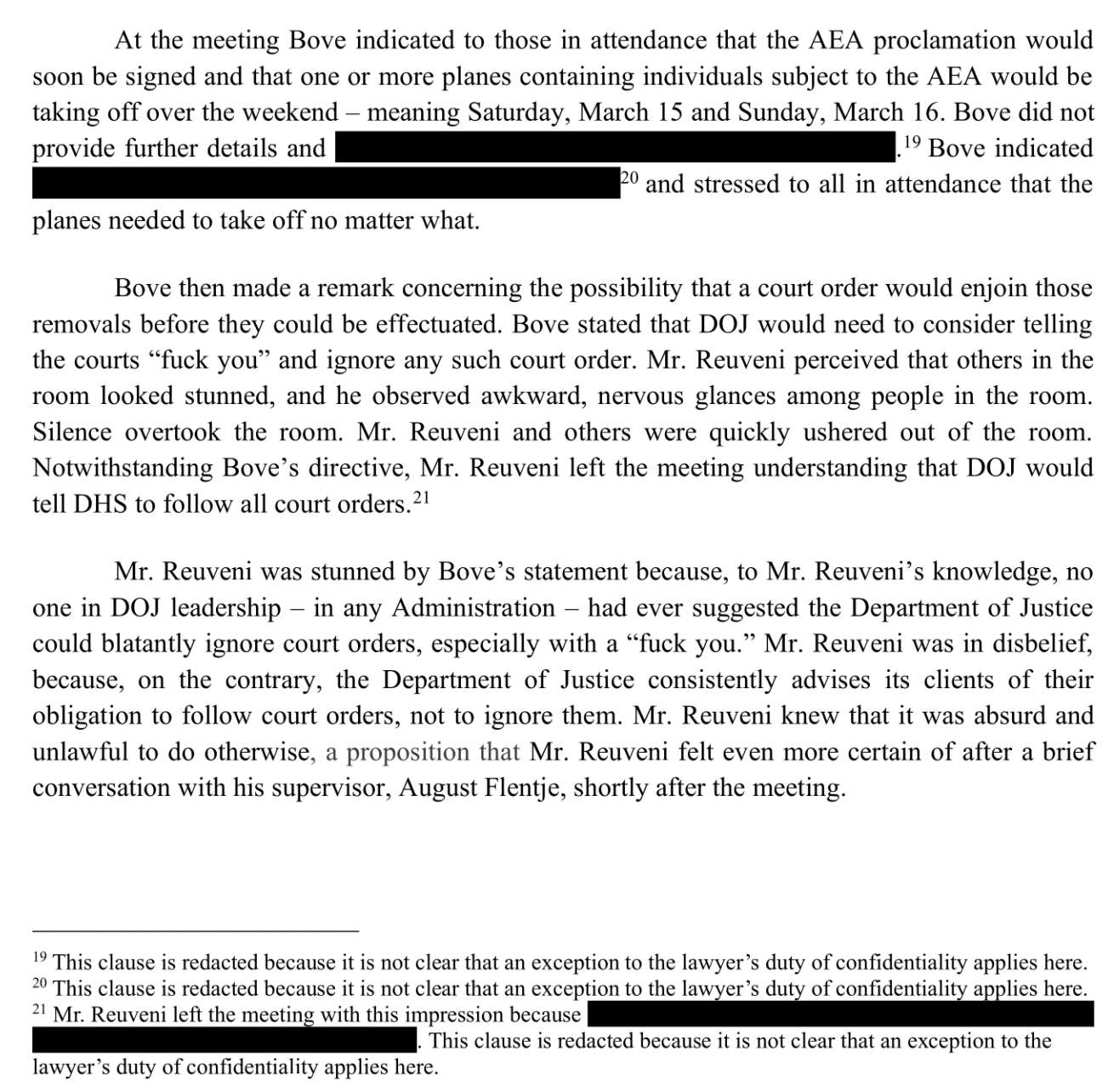
But in spite of all the profiles describing — credibly, to be sure — that Miller is really the one running most policy out of the White House, the government has gone to some lengths to avoid confirming that in legal contexts, perhaps for all the legal problems that would arise if Trump had to explain how he’s not the one who signed the Alien Enemies Act.
Vanity Fair’s profile of Susie Wiles described — and seemingly quoted her as agreeing — the deportation effort as a failure.
In mid-March, after Trump invoked the Alien Enemies Act, Immigration and Customs Enforcement agents (ICE) shackled and herded 238 immigrants onto transport planes and flew them to a notoriously brutal Salvadoran prison. According to Trump, the men were members of Tren de Aragua, a violent Venezuelan gang, but the evidence was sketchy (often based on tattoos alone). Most had committed no serious crimes; one, Kilmar Abrego Garcia, was deported by mistake, the Trump administration admitted.
“I will concede that we’ve got to look harder at our process for deportation,” Wiles told me at the time.
When we spoke again in April, in cities across the country, masked ICE agents were snatching people off the street, throwing them in vans, and zip-tying and frog-marching them into makeshift deportation camps. Many were US citizens or entitled to be here. (ProPublica documented 170 cases in the first nine months of 2025 of US citizens being caught up in ICE’s dragnet.)
“If somebody is a known gang member who has a criminal past, and you’re sure, and you can demonstrate it, it’s probably fine to send them to El Salvador or whatever,” Wiles told me. “But if there is a question, I think our process has to lean toward a double-check.” But as the usa.gov site itself notes, “In some cases, a noncitizen is subject to expedited removal without being able to attend a hearing in immigration court.”
But there’s no hint that the Administration as a whole shares the opinion attributed to Wiles, and Miller’s other abusive deportations have continued with no pause.
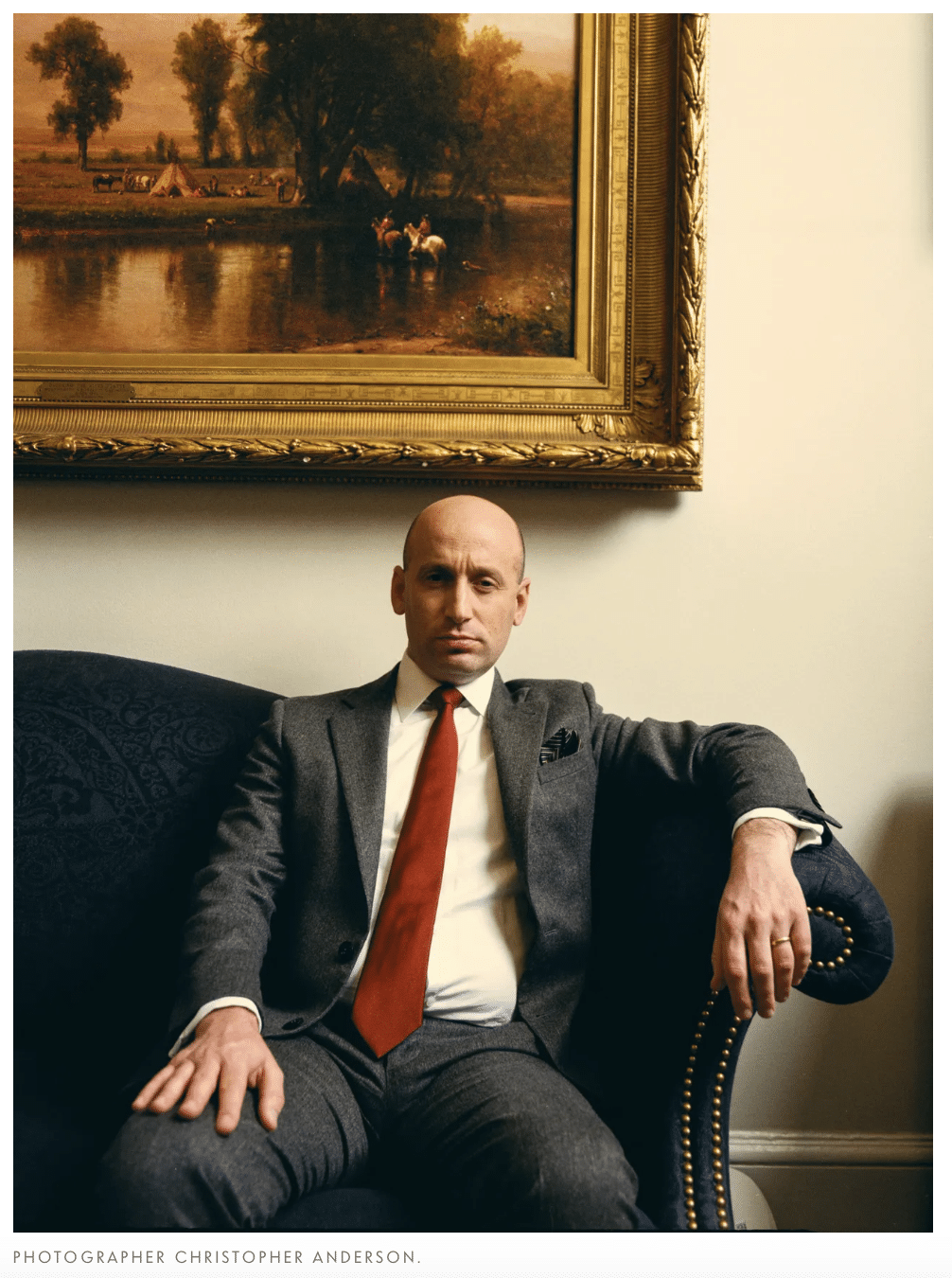
Photographer Christopher Anderson’s two descriptions of taking that photograph of Miller, which Vanity Fair sandwiched right in the middle of the El Salvador discussion, may be one of the few pieces of journalism describing Miller’s vulnerabilities.
What is the encounter you remember most?
For me the most interesting encounter for the day was with Stephen Miller. I find him to be a really interesting character on many levels, both at this moment in time and just what he represents and how he carries himself. He’s not someone who’s been photographed a lot in this way. So he was clearly a little bit nervous about sitting for a portrait, and he asked a lot of questions. “Why are you doing this? Why are you shooting film as opposed to shooting digital? Why do you know what that thing does? And how does it look? How am I? How do I look sitting here? Does it look like I’m slouching?” And at one point, I said to him, “you know, the people may say a lot of things about you, but slouching is not one of the things they will accuse you of.” And at the end of the session he comes up to me to say goodbye, and he says, “You know, you have a lot of power in the discretion you use to be kind to people,” meaning kind to people in my pictures. And I looked at him, and I said, “Yeah, you know, you do too.” It was interesting to me, his reaction. But just being in that place is in itself a fascinating experience, to be kind of within the halls of that kind of power, but yet to see it that it is a little bit [like] the Wizard of Oz behind the curtain. The place is small and shabby and you see paint marks on the wall, the wiring is done in a shabby way, and the desks can be messy, and it’s—I guess it’s a little bit like looking at middle management at a lot of companies.
[snip]
Is there anything the readers haven’t yet noticed in your pictures?
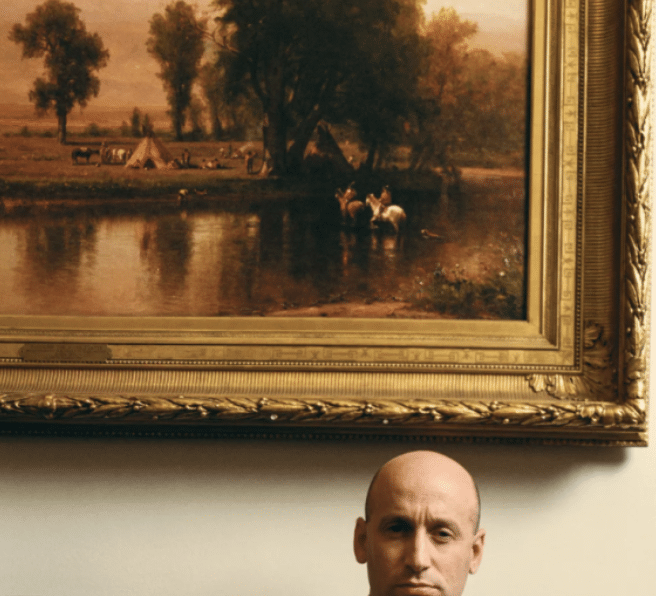
There’s the one Easter egg that I hoped people might see, and maybe they are starting to see a little bit, is that I had Stephen Miller sit underneath one of the oil paintings in the Roosevelt Room that is a beautiful depiction of Native Americans crossing a river on horseback to return to their teepee village home. It was one of those things that—I found it to be kind of interesting and maybe incongruous, that I thought might be picked up on. Go look, go look for it.
But while a bunch of the Miller profiles talk about how powerful he is (most have sources protected by further anonymity describing how much some portion of Republicans in Congress hate him), few to none talk about what a Miller setback in this administration looks like.
I’ve been thinking about that as part of my year-end inventory of what we’ve learned this year.
To halt Trump’s worst abuses, Stephen Miller must be made toxic — which is not hard to do, at least not if people are granted anonymity. The costs his bigotry causes — the dollar signs, the trade-offs the monomaniacal implementing of his bigotry entails, the human cost of prioritizing bigotry over saving children from sexual assault — must be made visible.
But it would also become necessary to understand what confluence of events could lead Miller to experience a policy setback. Preferably not just one setback, but all of them, a collapse of his near-monopoly on the President’s ear and therefore on policy.
Contrary to his well-curated press, Stephen Miller is not omnipotent. His slovenly execution makes him even more vulnerable. He hates when his physical tics are visible; he probably also hates that his paunch appears in that same photo.
His long-planned bid to use the Alien Enemies Act to deport men based off soccer tattoos to be indefinitely tortured failed.
And we don’t know how or why it failed.
Update: This NYT story fills in some of the circumstances surrounding these events — describing a team that makes shit up on the fly, excludes experts, and then changes their mind months later. At its core is a flipflop (or perhaps cynical manipulation of Cuban-American legislators) on Chevron’s license to export oil from Venezuela.
It began when Cuban American lawmakers pressed Mr. Trump early this year to end Chevron’s Biden-era confidential license. After Mr. Trump and Mr. Rubio announced in late February that they would do so, Mr. Maduro stopped accepting deportation flights of Venezuelans. Mr. Maduro had agreed to them on Jan. 31 with Richard Grenell, a special envoy for Mr. Trump.
Chevron’s chief executive, Mike Wirth, lobbied the administration for a license extension, speaking to Mr. Trump several times over the coming months.
The Cuban American lawmakers got wind that the license could be extended, and they threatened to withhold their votes for Mr. Trump’s signature legislation, “the One Big Beautiful Bill.”
At the Oval Office meeting in late May, Mr. Trump told Mr. Rubio and Mr. Miller that he needed to get the bill passed. But he said he had heard about the downsides of ending the license, including that Chinese companies would take over Chevron’s stakes, said an official.
The president demanded options. That was when Mr. Miller offered to help. He had been nurturing his ideas for mass deportations and boat strikes.
Mr. Trump did not renew Chevron’s license when it expired on May 27. His domestic policy bill passed Congress five weeks later.
The president held a series of White House meetings on whether to strike at Venezuela. At one in the early summer that included Mr. Rubio, Mr. Miller and Mr. Grenell, Mr. Rubio argued that Mr. Maduro was a drug kingpin, a characterization that appeared to stick with Mr. Trump, an official said.
In late July, Mr. Trump reversed course on Chevron’s license. He ordered the Treasury Department to issue one with revised terms. That happened around the time Mr. Maduro freed 10 American prisoners in exchange for the more than 250 Venezuelans that the Trump administration had sent to CECOT, the Salvadoran prison. And Mr. Trump had been swayed by Mr. Wirth’s argument that Chevron was a bulwark against China.
But behind the scenes, Mr. Trump set a course for confrontation. On July 25, he signed a secret order telling the Pentagon to take action against drug-trafficking groups, putting in motion the targeting of Venezuelans.


Miller may have to go work out with the manly man Vance.
Running on the beach with the Navy Seals…
The whole administration is a cruel joke on America.
Are you talking about the paunch? I think he looks proud of it. As if it’s an authoritarian achievement.
Too many lunches with Demented Don.
Also not enough exercise and a lack of self-respect.
If I woke up looking like that, I’d be hitting the gym on the reg.
The baldness he can’t help, but it only exacerbates his milquetoastyness.
His entire raison d’etre is a testament to his self-loathing.
As venal as she is, I still pity his wife.
Do NOT pity Katie Miller. She is at least as cruel as he is. She’s just been given fewer opportunities to express it.
Ugh. Imagine sleeping with that ugly hateful wretch just to gain access and power. No pity earned or deserved.
Reading through the Government’s response quoted above, I am struck by the people who are named. Each and every one of them has a line, not staff, position. That is, they have the power to take certain actions, within the scope of their positions.
Miller, on the other hand, holds a staff position – deputy WH chief of staff for policy. That’s an important position, to be sure, but it is only important insofar as he can persuade others to do things. Miller gives advice, he provides direction, and he influences a lot of people who hold the power to make things happen. But he does not have independent power of his own.
It is not only easier but expected that someone in a staff position would not be named in a court filing like this, when the Government is trying to respond to Boasberg’s desire to know who was told what, and what those folks did — what specific actions they took — in response.
One of the tricky things is that Miller does have direct power. They just hide it.
Just as an example, in the Bovino deposition(s), he went to great lengths to claim the orders he got from the White House — very specifically with regards to assaulting protestors in Chicago — was privileged.
It’s all very Cheneyesque but without any artistry.
One of the links I’m still searching for above is a Bart Gellman column on Cheney that compared him with Miller and Vought.
Miller has power — lots of it — but not authority.
His power with folks outside the WH is simple: “Do what I tell you, or I’ll mention your disloyalty to The Boss, and your power will disappear.”
I’m not sure I agree.
But that’s one reason I’m making this larger point. We actually have zero reliable reporting on the how of Miller’s power. And enough else has changed we can’t assume that bureaucratic titles mean what they used to.
Miller’s participation in the bizarre Hegseth Signal chat that included journalist Jeffrey Goldberg is one example of the “how”. Miller conveyed to the group what he portrayed as the President’s directives, and the group responded by saluting.
Whether Miller was telling the truth that this was the President’s directions, or simply clothing his own policy directives by attributing them to Trump is an open question. He is using his power, but using (or borrowing) the authority of POTUS to get folks to obey.
Agree about the Signal chat being demonstrative.
But still am not sure that is power exercised by speaking for Trump.
For example, what if Trump is as incompetent as he appears, and has been since the Butler shooting.
If so then a lot of Miller’s power is about managing Trump — keeping him visibly functioning so as to sanction Miller’s own orders, and in turn everyone else knows they have to sustain that fiction Miller creates for their own power?
I agree, and it sounds a lot like First Lady Edith Wilson. She (like every FLOTUS) had zilch for authority, but plenty of power as long as everyone went along with the fiction that Woodrow didn’t have a stroke.
She was the gatekeeper of what made it in front of Woodrow, and what got handled by others (including, when it came to various matters, herself). How far she pushed the line of executing his wishes vs pushing her own views into policy is a matter of debate among historians.
I have no doubt that Miller is trampling that line. Evidence to support that claim, however, is hard to come by.
Stephen Miller, like JD Eyeliner, has all the authority that Donald Trump can legally delegate to him.
reply to EW at 11:19:
What about the Butler shooting could have rendered Trump incompetent? At most he was barely grazed by shrapnel. Are you suggesting that shock, concussive or psychic, triggered a decline?
Something like that is definitely possible — we witnessed that with my Mother-in-Law this summer (who was approximately the same age).
A relatively benign injury triggered a sudden cascading mental decline into dementia as the body put all of its reserves into healing, and none into maintaining mental acuity.
No idea if that is going on with Trump, but it is certainly *possible*.
Well, there is also that bitch Karma.
Yes, shock.
He was a mess for some time after that. And also after that, Miller started taking on a bigger (overt) role in the campaign, and things got a lot more fascist.
I think Anderson’s comment about the Wizard of Oz is so telling. Miller is the ultimate fake behind the curtain, whirling and screaming to make things appear other than they are. The pressure, especially for such a seemingly second- or third-rate mind, must be enormous—unless his psychopathy keeps him from feeling it?
That’s one reason I included this version of that story instead of what Anderson said to the WaPo. His interviews on this shoot are such a commentary about the theater of power. So it’s interesting that he understood how to portray Miller, both in image and word, as vulnerable.
Did Miller even glance at that painting? Anderson’s move there was plenty clear. For Miller to miss it seems to speak of extraordinary hubris.
“Miller hates when his physical tics are visible; he probably also hates that his paunch appears in that same photo.”
How would Miller portray Miller? Adding to the speculation into Miller’s psyche and his own perceived vulnerabilities regarding his appearance … Stephen Miller showed up on Face the Nation in 2018 with painted-on fake hair. Absurdity borne of desperation; weakness.
Miller’s early balding and growing paunch; Hitler’s Kallmann’s syndrome (there’s interesting new DNA research); Bovino’s stature (as short as 5’4”); Women too numerous to list (Mar a Lago Face); RFK, Jr’s body (steroids?). How much does an apparent deep-seated emptiness explain the awfulness that we have seen?
He’s owning that paunch. Just look at him. Like Jared Kushner, Miller has always been an old mean man in a young one’s body.
One thing that Jean Guerrero traces in her book is how he always had his tic of licking while he speaks.
I think his tic of shruggling right is getting more pronounced, though.
Hitler’s DNA reveals Nazi leader likely had syndrome that can affect …
Nov 13, 2025 Researchers behind the “Hitler’s DNA” documentary say the Nazi dictator likely had Kallmann Syndrome, a rare genetic condition which can cause undescended testicles and a micropenis.
https://www.cbsnews.com/news/adolf-hitler-dna-reveals-nazi-likely-kallmann-syndrome-genitals-micropenis/
Miller fails when the rest of the world figures out the rhythm of his actions, and the blowback hits Trump. He’s been crafty enough not to have put his figurative signature on any specific policy to own it, so it’s very hard so say a particular action is his own failure.
Again, not sure I agree. In a follow-up I will comment briefly on Miller’s order that 3,000 people get snatched a day.
The policy demand is a failure — they’ve never been close.
The policy has created a great many other problems, including that they’re not snatching the actually dangerous people and businesses are struggling bc they’re short workers.
But thus far no one has tried to pin the cascading problems the order created onto Miller.
They can’t pin it on Miller, because the lie that any of this is actually generated by a’policy’ (concept or otherwise) coming from Trump would dissolve. There is no way in hell that Trump comes up with any of these ideas on his own.
We know he doesn’t read, so someone has their hand up his butt, manipulating what he is doing and saying. If that man had an original thought his head would split in two.
Hard to imagine a policy set back that topples Miller. Unless the whole house of cards collapses as the result of some major calamity.
It is also possible that something else, less direct, topples him.
Stephen Miller reminds me of Gen. William Westmorland during the Vietnam War; Wetmoreland’s boss Robert McNamara (a Harvard B-School bean counter that the Kennedys called ‘The Computer’) ran the military, like he did Ford, based on numbers. First problem: numbers objectify the casualties. Second problem: massacres like the one at My Lai (according to Seymour Hersh) were not uncommon in Vietnam as McNamara was judging Westmoreland’s command on numbers–body count, kill numbers, and kill ratios. And, Westmoreland knew perfectly well that his road to promotion was to exceed his quotas by any means possible including killing innocents.
Westmoreland is a lot like Stephen Himmler, er, excuse me, Stephen Miller: Miller, by announcing deportation quotas early, has now been forced to use excessive force, unlawful searches, etc. to round up innocents and show he is hitting his promised deportation targets.
If history is any judge, this won’t topple Miller. Westmoreland was subsequently promoted regardless of his allowing and/or encouraging the slaughter of women, old men so he could call them dead enemy combatants.
I suspect (and dread) that Miller may first pass through a Westmoreland-like promotion before any justice is done.
[Welcome back to emptywheel. Please use the SAME USERNAME and email address each time you comment so that community members get to know you. You attempted to publish this comment as “FBP Binker” triggering auto-moderation; it has been edited to reflect your established username. Please check your browser’s cache and autofill; future comments may not publish if username does not match. /~Rayne]
I just wanted to ‘mod this comment up.’ It’s a really intelligent take on the whole thing, in that what’s happening is all based on numeric goals, not anything like a plan on how to make whatever improvements are imagined. It’s very much ‘this is how many pounds of shit we want to dump on people.’
‘You will be judged by the number of pounds of shit which are dumped, not by how many flowers grow.’
Is Miller doing his Westmoreland thing on those boats in the Caribbean? Hard for me to believe he’s played no part in imagining that one up.
Equally hard for me to believe: Pete Hegseth came up with it on his own.
Good NYT story today on that. Unlocked: https://www.nytimes.com/2025/12/27/us/politics/venezuela-trump-maduro-oil-boat-strikes-immigration.html?unlocked_article_code=1._08.proB.MZUJHpB-HcRd&smid=em-share
[Thanks for updating your username to meet the 8-letter minimum. Please be sure to use the same username and email address each time you comment so that community members get to know you. /~Rayne]
Agree. Neither Trump nor Hegseth know much about what they’re doing, let alone the details of how and through whom to accomplish it. Miller, Vought and perhaps Wiles do, though Miller can’t hold a candle to the bright light of master bureaucrat, Dick Cheney.
Agreed. Most, maybe all, of them don’t know what they are doing.
It’s enough for them (and Trump) to count how many times they do it.
Trump’s moral profligacy and his mental gormlessness feed his many inherent logical fallacies. Basic among his fallacious beliefs is that:
QUANTITY = QUALITY
[Think how Trump frequently emphasizes QUANTITY: the non-existent extra floors in NYC Trump Tower, the exaggerated inauguration crowd size during his first inauguration, the oversized new East Wing, drug prices dropping 600%, tariffs revenues of TRILLIONS OF DOLLARS, the inducement of $18 trillion of new international trade investments, etc.)
Thus Miller and Hegseth live in this power milieu that values quantity as if it were quality.
And Miller seems quite fine with that: it allows him to ‘cleanse’ even more people he dislikes. Hegseth the same—he can sink more ships, kill more people–and the boss seems to like it better.
The Trump Administration is a morass of malevolent tabulation.
They may not know very much at all, but they can count.
I’ve been bothered by the strange familiarity of Miller’s face for a while now, but staring at Anderson’s glowering portrait of him, it struck me: Fearless Leader from The Rocky and Bullwinkle Show.
He just needs a scar, a monocle, and a cigarette holder. There’s a certain similarity in his methods, as well—working behind the scenes, ordering incompetents like Gregoris Bovinonov on a cross-country chase to snatch and imprison his perceived enemies.
Lol. On the same note, we think he is a desendant of Col Klink from Hogan’s Heros.
I live within the disputed territory of Mohawk ( and 5 other nations) and I feel obligated to speak out on their behalf. Andersons photo and the images of the first people made me think of Miller as the head of the big turtle island. On her back the Tepee and the Wigwam….. that’s right.
Miller is a Wigwam. Miller is a Tepee.
He’s too tents!!!
Mans got to calm down.
Padump da tat tat tat (cymbals).
John Heilmann (Impolitic podcast) and Christopher Anderson, photographer, are long time friends and colleagues. In a very recent get together, they speak in great detail about the recent Vanity Faire photo shoot. I advise all to listen to the Podcast and hear about the many people they cover in their conversation. Yes, Miller was a bit anxious how he was going to be portrayed.
I forgot to mention that the comedian/observer Josh Johnson during his current “Flowers” tour (Sacramento, CA) spends an entire show talking about the photo shoot. Josh frames it in a hilarious way which it does deserve. KBS
Jean Guerrero’s Hatemonger biography of Miller was from 2020, it was available before the 2020 election. Really amazing reporting to get tons of details from throughout his life. I definitely recommend.
Here is an adapted excerpt:
https://www.politico.com/news/magazine/2020/08/01/stephen-miller-david-horowitz-mentor-389933
“The Man Who Made Stephen Miller
Almost 20 years ago, anti-immigration activist David Horowitz cultivated an angry high school student. Now his ideas are coming to life in the Trump administration.”
And a 2020 WaPo review:
https://archive.is/wH5ME
Miller seemed to have a natural talent for what he does, with strong influence from his parents. But a significant amount of his trajectory and tactics have to come from the man who had literally just written the book on political warfare, who guided and nurtured Miller’s talents and effectiveness.
https://www.amazon.com/Art-Political-Other-Radical-Pursuits/dp/1433266776
Would Stephen Miller have made it to this level of power without David Horowitz and his Freedom Center: A School For Political Warfare and how might it have helped him harness power?
Just perusing the tax filings for that non-profit, there’s a few things that stand out to me:
* Ben Shapiro launched his career there
* Shapiro’s dad has been on the board
* Robert Shillman, who has funded Laura Loomer, was on the board for several years and funded projects there
[Note: Loomer and Shapiro are at the center of the MAGA Civil War.
Also Note: Loomer also has an inexplicable power that influences NSC terminations and as Emptywheel has noted Trump seemed too intimidated to call her out by name, ie “gals”]
* The annual retreats, which Miller attended
* From 2012-2017, the org hired a “former Captain of the Israel Defense Forces and onetime Foreign Policy Advisor to Prime Minister Binyamin Netanyahu” as Director of their Israel Security Project.
[Note: those years overlap the rise of the alt-right and it being co-opted to put Trump into office, while Miller directed Breitbart how to appeal to the alt right and Breitbart reminded people it was founded by Netanyahu]
https://web.archive.org/web/20210110185353/https://www.breitbart.com/the-media/2015/11/17/breitbart-news-network-born-in-the-usa-conceived-in-israel/
https://www.npr.org/2019/11/26/783047584/leaked-emails-fuel-calls-for-stephen-miller-to-leave-white-house
https://projects.propublica.org/nonprofits/organizations/954194642
No.
Also of note, I’ve thought a lot about the fact that Miller lost both Horowitz and Charlie Kirk this year. Of course he only tried to make a thing out of Kirk’s death.
I’m curious on your thoughts of how Horowitz would impact Miller.
Speaking of Kirk and how much the Trump admin misses him, the word is that Kirk was in the long term succession plans, for VP then President. Per a TPUSA board member.
https://web.archive.org/web/20251228210856/https://www.dailymail.co.uk/news/article-15367447/maga-charlie-kirk-jd-vance-assassination-president-oval-office.html
reply to zscore:
I too have recommended the excellent book Hatemonger here many times. It seemed clear to me that without both Horowitz and Larry Elder mentoring him, Miller would have become something (or nothing) else.
Most of the talk about Charlie Kirk now overvalues his influence. Kirk was a gadfly at his best, and one more lackey most of the time. Plus there’s the fact that Miller does not value anyone; he’s a pure psychopath for whom other humans are instruments.
December 2018: Black spray-on hair
I’m a little late to the party here. However, I have an explanation for this:
The purpose of the Trump administration is to create a totalitarian government in this country. I’m following the systems thinking perspective that the purpose of a system is what it does. The only unifying theme of the Trump administration is moving the country towards totalitarianism. That’s the policy outcome that matters. Every “policy” is a means to that end. The destruction of the civil service, the corruption, the racism, the attacks on civic life (law firms, universities, the press, and the political opposition), tariffs, destroying part of the White House, all the way down to renaming the Kennedy Center; all of it is to create an inexorable, irreversible momentum.
From this perspective, the shift mentioned in the quote above is simple to explain. The purpose of sending people to CECOT was never about the individuals who were sent. It was an attempt to create the notion that the administration could send people to a foreign concentration camp, and no one could do anything about it. When it became clear that the administration wasn’t going to be able to send anyone else there, the overriding imperative was to ensure that no other part of the U.S. government could every get any of those folks back here. The prisoner swap was necessary to maintain the fiction that the administration was in control of the situation and that it was all “foreign policy” controlled by the unitary executive.
I think it’s a mistake to think about the Trump (Miller-Vought) administration in terms of policy wins and losses. Every time they engage in corrupt, illegal, or unconstitutional actions without consequences, they are winning. Every “loss” is a win for them as long as they are still in power.
Yes. This IS what it boils down to, if not for the dementing Trump then for those who are counting on a future among the power elite of this country–and since they are burning bridges with IRL Europe–as opposed to mythical “European civilization”–they had better hope for a place in this country’s elite.
‘I think it’s a mistake to think about the Trump (Miller-Vought) administration in terms of policy wins and losses. Every time they engage in corrupt, illegal, or unconstitutional actions without consequences, they are winning. Every “loss” is a win for them as long as they are still in power.’
You’re not the only people thinking that. One take is that it’s all about ‘status’:
https://www.theguardian.com/commentisfree/2025/dec/23/donald-trump-vladimir-putin-europe-russia-us
‘So, too, Trump wants to disrupt a social order that regards him and his worldview with contempt. The US president and his officials get respect from dictators and kings (although perhaps not from the ones whose respect they most want – Putin and Xi Jinping), but they know that the leaders of many other democratic countries look down their noses at them.’
That fits with Trump being the toddler who never grew up and thinks it’s still all about him.
I don’t think he’d know a ‘policy’ if it slapped him around the face while he was having his beehive lacquered together.