After Trump spent a year destroying government, there have been several attempts in recent days to tell the story of what Trump took away with his assault on government. This is a story we need to tell, and tell far better, in the new year if we want to hold Trump accountable and not just reverse the damage he did, but use his destruction as a way to rebuild better.
Consider this WaPo story, “The year Trump broke the federal government.”
It tells the stories of hundreds of Federal workers, including those who left and those who stayed through the DOGE and Russ Vought massacres. It is great! But it also only mirrors the full story (and potentially buried in a holiday weekend).
It very poignantly captures the cruelty of Trump’s firings, such as this anecdote about a woman killing herself just after Elon Musk’s Five Things emails started.
In Virginia, the family of Centers for Medicare and Medicaid Services worker Caitlin Cross-Barnet checked her into a mental health facility. She was struggling with despair after a difficult hysterectomy, and because she felt Trump was unraveling the government. In daily calls to her husband, she asked about changes to the federal workforce. Six days after the “What did you do” email, she killed herself.
While it describes many benefits shuttered, it doesn’t describe what happened to the people affected by these losses.
What happened, for example, when those working a suicide prevention line could no longer offer their clients privacy?
Veterans who called to confess thoughts of suicide could hear people speaking in the background.
What happened when LGBTQ+ veterans stopped showing up for counseling appointments?
The psychologist’s LGBTQ+ patients stopped showing up to their appointments.
What is the impact of rising rates of mental illnesses among service members, now left neglected in the wake of another firing?
Another morning gone with no chance to turn to his studies of rising rates of mental illness among service members. Or his proposals, languishing for almost a year now, on how the government could drive those down.
What happened when the government fired a bunch of people focusing on educational access for Native Americans (even while moving health experts to Indian Health Services)?
Her job was helping administer grants to support Native American students. Then she remembered. She’d once served as president of an affinity group for Native Americans and Alaskans at the department.
You might ask what happened to the people Erica Hagen might be harmed in advance of her firing.
She thought about all the frozen programs she had helped oversee: One treating and preventing HIV. Another educating children in rural areas. A third reducing plastic in the oceans.
What happened to those who might benefit from sustainable energy programs that got cut?
At the Energy Department, one worker prepared memos arguing that his projects would cut costs for American homes and businesses. Someone decided to cancel many anyway. So he, like other employees, began deleting: Any mention of “carbon.” “Sustainability.” The word “green.”
What about FDA inspections that didn’t happen? Who got sick?
A Food and Drug Administration staffer couldn’t purchase dry ice or environmental swabs, nor pay the highway tolls that safety inspectors incurred driving for work.
One I’m self-interested in, as a former Great Lakes resident, what happened when they cut the carp program?
In the Midwest, union leader Colin Smalley watched his Army Corps of Engineers unit dwindle. Among the departed: An employee so knowledgeable about rock blasting that the government brought him back the first time he tried to retire. A staffer who was spearheading a novel project to stun invasive carp with electric shocks. How, Smalley asked his wife, could they ever replace someone who knew how to electrify rivers?
The story describes how Trump’s cuts delayed efforts to prepare Colorado for fire season — ostensibly something Trump cares about. But did it exacerbate fires or did we get lucky?
In a Colorado branch of the Forest Service, one man was designated purchaser for the entire office. Anyone who wanted to buy horse fodder or irrigation pipes had to wait until the man returned from weeks-long firefighting trips. The new system meant staff were a week late buying chainsaw fuel, delaying the thinning of flammable forest brush. “In 15 years, I have never seen us so unprepared for fire season,” the local fire management officer told staff at a meeting, according to one worker in attendance.
The nation’s parks and forests are rotting from neglect. What does that look like?
In Lander, Wyoming, three Forest Service retirees noticed fences tilting over, docks slipping into lakes, mountain roads caving inward from water pressure.
Like the USAID cuts, this is story that is already getting told elsewhere; it is a story that is generating a lot of localized anger.
This great video from Molly Jong-Fast, which includes a bunch of great regulators — like Lina Khan, Alvaro Bedoya, Doha Mekki, and Elizabeth Wilkins — who got fired addresses many of these impact questions.
I’m a big fan of all these people and Khan (who’ll have a platform working for Mayor Mamdani) can explain the import of regulation to anyone. All of these fired experts are exceptional at explaining how overturning regulation harms people, like construction workers or taxi drivers or renters or chicken farmers.
But imagine a video that started from one or another harm that mentioned repeatedly — such as the harms, including encouraging suicide, caused by bots and AI. That’s a story that would resonate with mothers, as opposed to primarily Democrats who want to strategize how to reverse Trump’s destruction.
To be sure: at 39:00, Wilkins talks about how important story telling is. She describes that we need to explain all this in terms of villains. “Tell the story of who is the bad guy in this story, who is the hero of this story.” But we also need to invite every American into the story, because they’ve lost something from Trump’s assault on government.
One (very) simple example really resonated with me, at least. In a piece explaining the value of NCAR to Americans in advance of Trump’s assault on it, It’s just a list of eight things that are not (as Russ Vought targeted) “climate alarmism.”
In accessibly wonky terms, it translates some of the things NCAR does — like making flights safer — into things people care about.
As a child, I remember hearing news stories about commercial airplanes crashing due to wind shear. Microbursts, which are localized downburst of sinking air associated with thunderstorms, were often the culprit. The Low-Level Wind Shear Alert System developed by NCAR researchers has helped to virtually eliminate microburst-related wind shear crashes. Such advances, along with Terminal Doppler Radar, are examples of the R&D machine at work for our benefit even as you may not realize it as your plane takes off or lands safely. Additionally, many of the computer algorithms used to alert pilots and airline managers about turbulence were developed at NCAR. Likewise, NCAR’s aircraft icing products have been a staple in the aviation industry and distributed by NOAA’s Aviation Weather Center.
Regular fliers are already outraged by the continued enshittification of air travel, including Crash Sean Duffy’s reversal of consumer protection rules imposed by Pete Buttigieg.
Here’s one aspect, turbulence, that Trump is actively planning to make worse.
Again, I think all of these are really good stories. I’m just looking ahead — not to elections, or even to what Khan will do as a key aide to the Mayor of New York — but to ways we can better tell stories about what Trump took away, about what Trump stole from the American people, so we can hold him accountable.
Share this entry
https://www.emptywheel.net/wp-content/uploads/2025/12/Screenshot-2025-12-22-at-13.50.49.png842968emptywheelhttps://www.emptywheel.net/wp-content/uploads/2016/07/Logo-Web.pngemptywheel2025-12-22 10:49:022025-12-22 10:49:02The Storytelling We Need to Rebuild Belief in Government
Throughout this year, I have argued there are four ways to fight fascism — and doing so through the guise of the Democratic Party (especially DC Democrats) is not yet the best way to do so.
I argued these were the four ways to peacefully fight Donald Trump’s authoritarianism:
The Erica Chenoweth rule, which says that if you can get 3.5% of a population in the streets, it often leads to regime change.
Beginning to peel off four people in the Senate or eight or nine people in the House.
Rescuing Republicans from a predictable catastrophe like Democrats did in 2008 and 2020.
Waiting until 2026, winning at least one house of Congress, and beginning to rein in Trump that way.
Since for many of you, today will be the last normal day of the year, and unless Trump sets off a predictable catastrophe, today will also be the last Nicole Sandler show we do, I wanted to check in on how we’re doing on these four issues.
The 3.5% rule
Start with people in the streets.
If 6.5 million people attended October’s No Kings rallies (some estimates go as high as 7 million), it would amount to about 1.8% of the US population. That would make them the biggest protests in American history, but still just halfway to that 3.5% mark, and not directly in response to a particular outrage. The organizing and openness of those protests was a huge accomplishment and, at the very least, taught a lot of people who had never protested before how to do so.
But it wasn’t enough to oust Trump.
A more interesting measure of people in the streets, however, is Chicago (and other anti-ICE/CBP protests). I have no idea what population of Chicago took part in mobilizing to oppose Stephen Miller’s goons. But there are aspects of that mobilization — perhaps most importantly the way media coverage arose from citizen witness to local media to independent media to mainstream outlets — that provided real lessons in how to thrive in a disastrous media environment.
One point I keep making about this kind of opposition: it does not have to be, and arguably is far more successful if it is not, coincident with the Democratic party. Some of the most powerful moments in Chicago’s opposition came when right wingers in conservative suburbs joined in — holy hell those people were assholes!!
Whatever else Stephen Miller’s terrible dragnets have done, they have renewed civil society in most places the invasions happened.
Peeling off defectors
Both Axios and Politico took a break from Dems in Disarray or ragebait stories this week to instead focus on Hakeem Jeffries, both focusing on Jeffries’ success at getting four “moderate” Republicans to vote for his discharge position extending ObamaCare subsidies for three years.
Time and again this year, Democrats under Minority Leader Hakeem Jeffries have maneuvered to successfully undercut the GOP agenda and put its leaders on the back foot. From a daily drumbeat on health care to the long-running saga over the late sex offender Jeffrey Epstein to a new focus on the rising cost of living, they believe they’re succeeding by making the party in power talk about Democratic priorities, not its own.
Their success was underscored this week when four House Republicans joined a Jeffries-led effort to force a vote on expiring Obamacare insurance subsidies — a major embarrassment for the GOP speaker.
“Our message to Mike Johnson is clear — you can run, but you cannot hide,” Jeffries said as he took a victory lap on the House steps Thursday.
And as Politico notes, it started (actually, two months earlier than they credit) with the Jeffrey Epstein effort.
Indeed, since Tom Massie and Ro Khanna, with Jeffries’ cooperation, chased Mike Johnson away a week earlier in July for fear of Epstein votes, Johnson has largely vacated his majority.
There have been limited instances where Republicans have defected on other issues. Just before the SCOTUS hearing on Trump’s illegal tariffs, for example, a handful of Republicans defected to pass resolutions against Trump tariffs.
Where things may get more interesting in the new year — on top of what is sure to be a frantic effort to fix the healthcare crisis Republicans are causing — is on Russia. The NDAA Trump signed yesterday included a number of restrictions on European and Ukrainian funding and troop alignment, measures that directly conflict with Trump’s National Security Strategy.
In a break with Trump, whose fellow Republicans hold majorities in both the House and Senate, this year’s NDAA includes several provisions to boost security in Europe, despite Trump early this month releasing a national security strategy seen as friendly to Russia and a reassessment of the US relationship with Europe.
The fiscal 2026 NDAA provides $800m for Ukraine – $400m in each of the next two years – as part of the Ukraine Security Assistance Initiative, which pays US companies for weapons for Ukraine’s military.
It also authorizes the Baltic Security Initiative and provides $175m to support Latvia, Lithuania and Estonia’s defense. And it limits the Department of Defense’s ability to drop the number of US forces in Europe to fewer than 76,000 and bars the US European commander from giving up the title of Nato supreme commander.
To be sure, thus far, Congress has done nothing to police Trump when he spends money in ways they tell him not to. But these restrictions (along with a few things to make Whiskey Pete Hegseth behave) might set up a conflict early in the year.
Remember: recruiting defectors actually takes efforts to reach out to them, often the opposite of what people think they want.
And while all that is not enough defectors to stop Trump, Marjorie Taylor Greene may set off a stampede for the exit. And that could make it easier for Jeffries, at least, to continue to pants Mike Johnson.
Predictable catastrophe
Democrats have done a good job of seeding the ground to get credit for rescuing the country from Trump-caused catastrophes in healthcare and the economy — and both will exacerbate the other in days ahead.
I’m less sanguine that Democrats have prepared to rescue the country (and claim credit) for other likely Trump catastrophes, like a collapsing AI bubble or epidemic. Laying the ground for both is really critical, in the former case bc AI bros plan to spend big in 2026 in the same way crypto bros did in 2024, and in the former case, because bigots are trying to blame rising measles (and, now, whooping cough) on migrants rather than assholes like RFK Jr.
2026
Democrats are doing surprisingly well to position themselves for 2026, both because they’re overperforming by numbers that suggest they will do well (including in elections, like TN-07, with midyear-levels of turnout), and because they’re matching Republican redistricting efforts (and Stephen Miller’s goon squads mean the redistricting in Texas may not turn out like Trump wants).
Even as this year’s election results have left many in the party encouraged they can mount a massive blue wave, next year’s battleground is a far cry from 2018 — with fewer Republican-held seats for Democrats to easily target.
Democrats don’t need to win as many seats this time around, netting just three seats rather than two dozen to claim a majority. But the hill to reach a comfortable majority like the 235 seats they held after the last blue wave has grown much steeper, driven by multiple rounds of gerrymandering — including ongoing redistricting in several states that threatens to erode the battlefield even further.
The result is that Democrats could post a bigger national swing than in 2018 and still end up with a slimmer majority than they had after that year.
Where Democrats are doing better is in promising consequences if and when they do get a majority.
I’m more interested in Democrats promising those capitulating to Trump — whether it be law firms or Paramount — that there’ll be consequences in 2027 than I am in discussions about impeachment (except for people like RFK Jr, such discussions will work against other Democratic efforts, IMO).
Such efforts, in my opinion, are one way to do more to lay out Trump’s accountability for predictable disasters.
All in all, opponents of fascism have more momentum than they had when caught flat-footed in January. But there’s still a lot of work to do.
Share this entry
https://www.emptywheel.net/wp-content/uploads/2025/10/Frogs-1.jpg7501000emptywheelhttps://www.emptywheel.net/wp-content/uploads/2016/07/Logo-Web.pngemptywheel2025-12-19 10:43:482025-12-19 11:45:12Four Ways to Fight Fascism: Checking In
The right wing response to the Vanity Fair profile of Susie Wiles (one, two) reveals a lot about the structure of Trump’s power.
While there’s nothing surprising in the profile, Chris Whipple caught Wiles admitting to failures those of outside the White House bubble all recognize, or making laughably false claims to cover them up. And while mostly the response to the profile has been a typical beltway feeding frenzy, much of the focus has been on those expressions of truth or false claims, including how some of them — Wiles’ claims that Trump was targeting Letitia James, her confession that Trump is seeking regime change in Venezuela, Trump’s awareness that Putin wants all of Ukraine — could have lasting legal and political repercussions.
Not so the right wing, though. Theirs has been a two-fold response: first, declaring not that the profile got anything wrong, much less made up any of the abundant direct quotes, but instead that they remain loyal to Susie Wiles. After everyone had performed their expression of loyalty, the right wing turned to complaining that photographer Christopher Anderson captured Trump’s aides’ ugliness and warts.
Behind those expressions of loyalty and vanity complaints, however, the profile includes a string of confessions that Trump, that Susie Wiles, that they all have failed.
Circling the motherfucking wagons
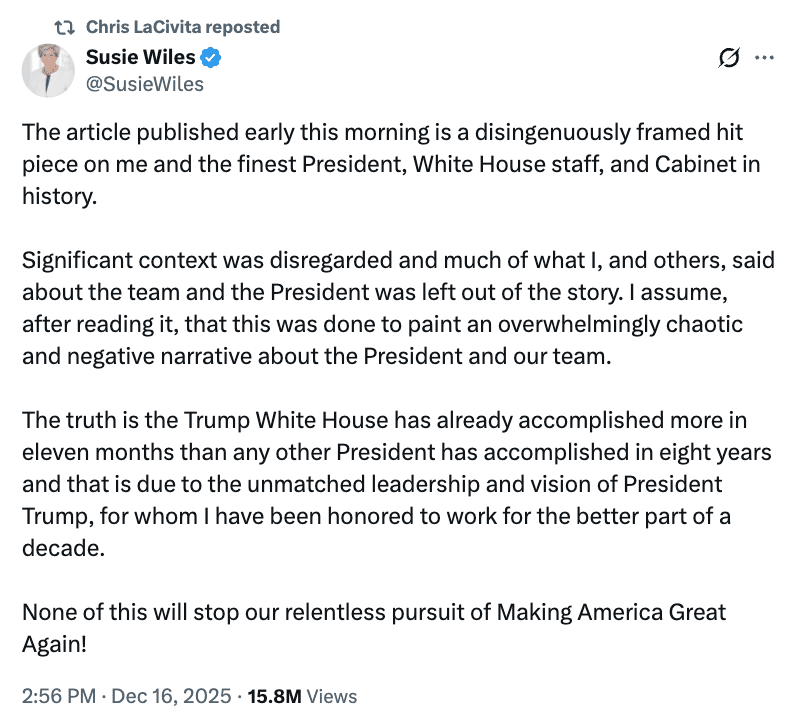
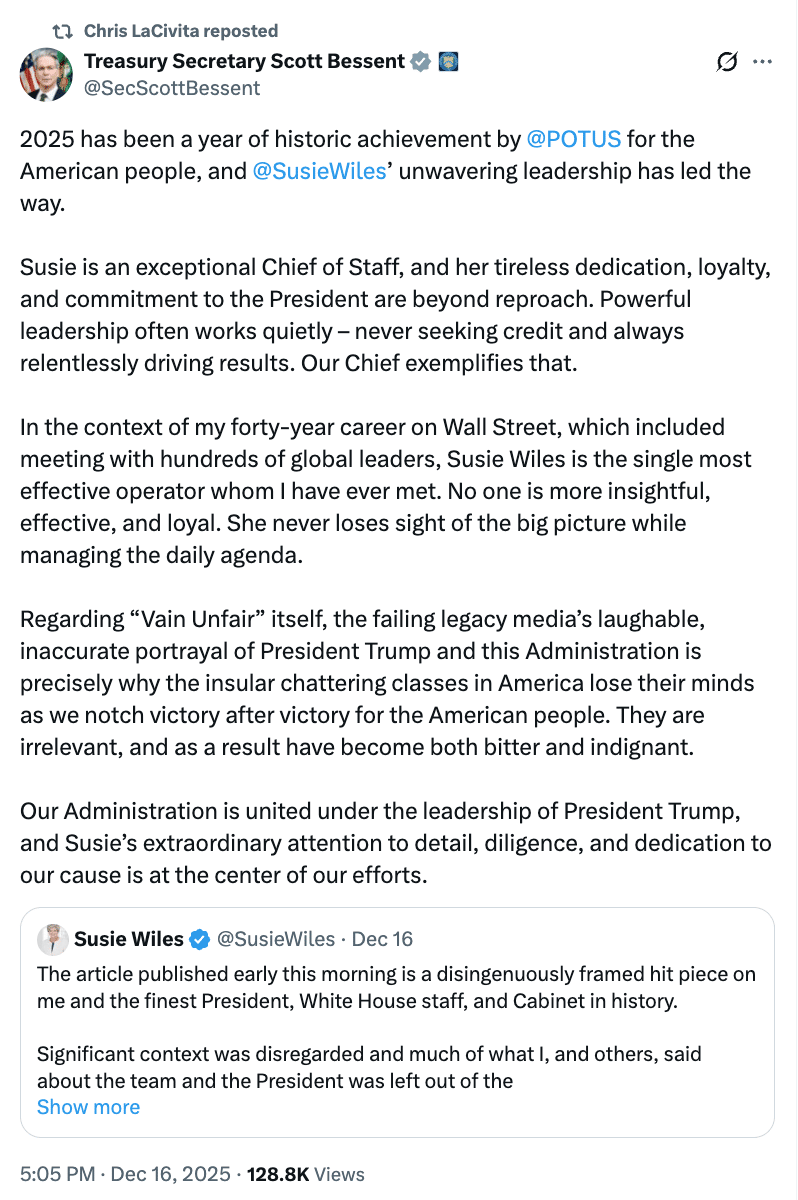
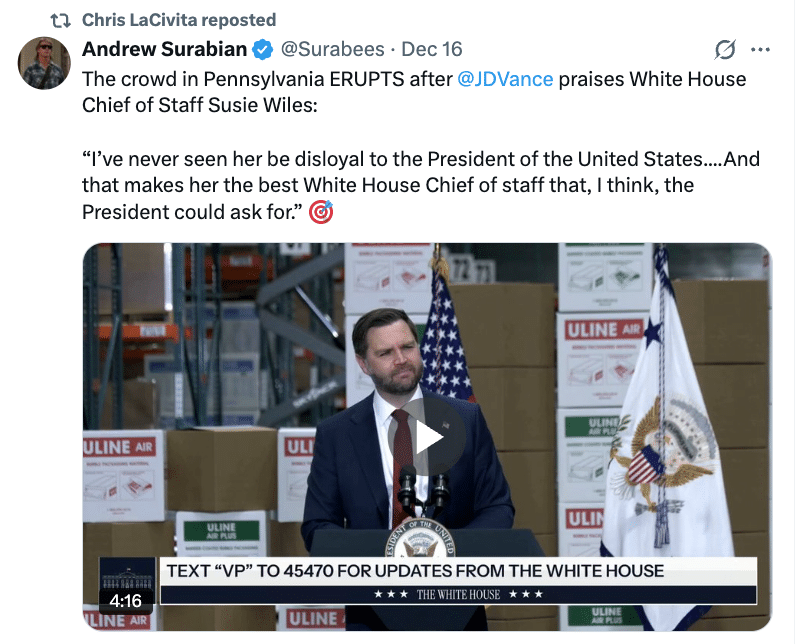
The immediate response was a performance of loyalty. First Wiles claimed in a (for her) very rare tweet that the profile had taken things out of context and ignored positive things she said. Then one after another Trump loyalist RTed that tweet and testified to how great she is and how loyal they are to her or she is to Trump.
The loyalty oaths were particularly amusing to watch through Chris LaCivita’s eyes. First he RTed Wiles’ tweet.
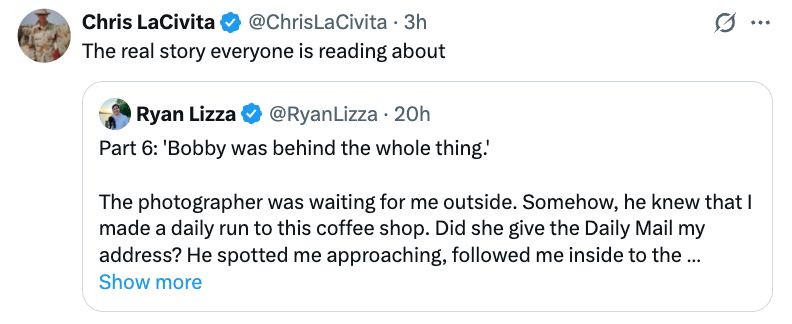
Then he tried to distract with yesterday’s scandal.
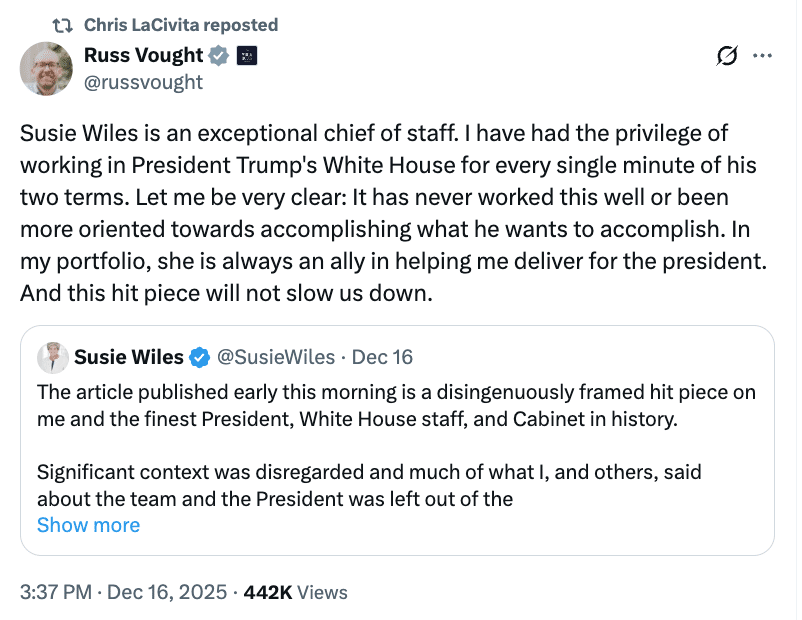
Then he posted one…
After another declaration of loyalty to Wiles. This Don Jr tweet — “When others cowered, she stood strong” is quite long and amusing in the original.
Scott Bessent’s claim of inaccuracy is especially notable given how Wiles described half of Trump’s advisors to be opposed to Trump’s tariffs (as I’ll show below).
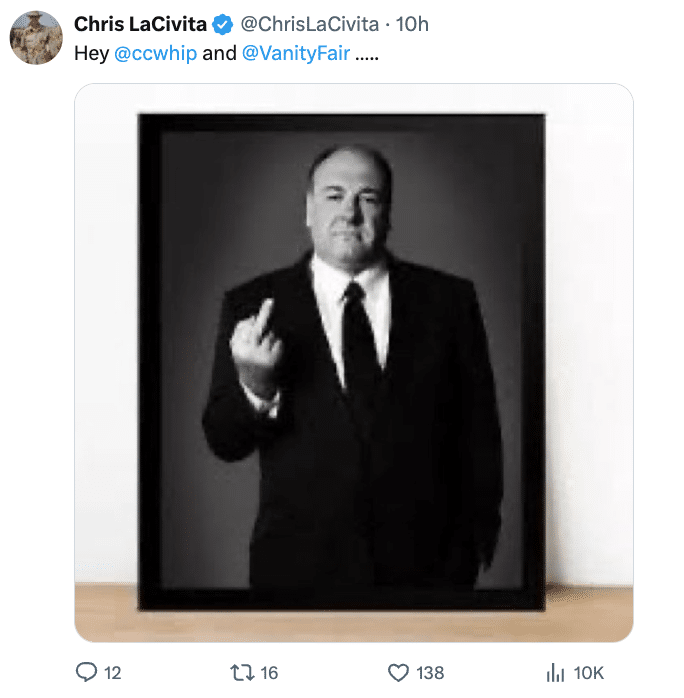
LaCivita thought dumb boomerang memes would be persuasive.
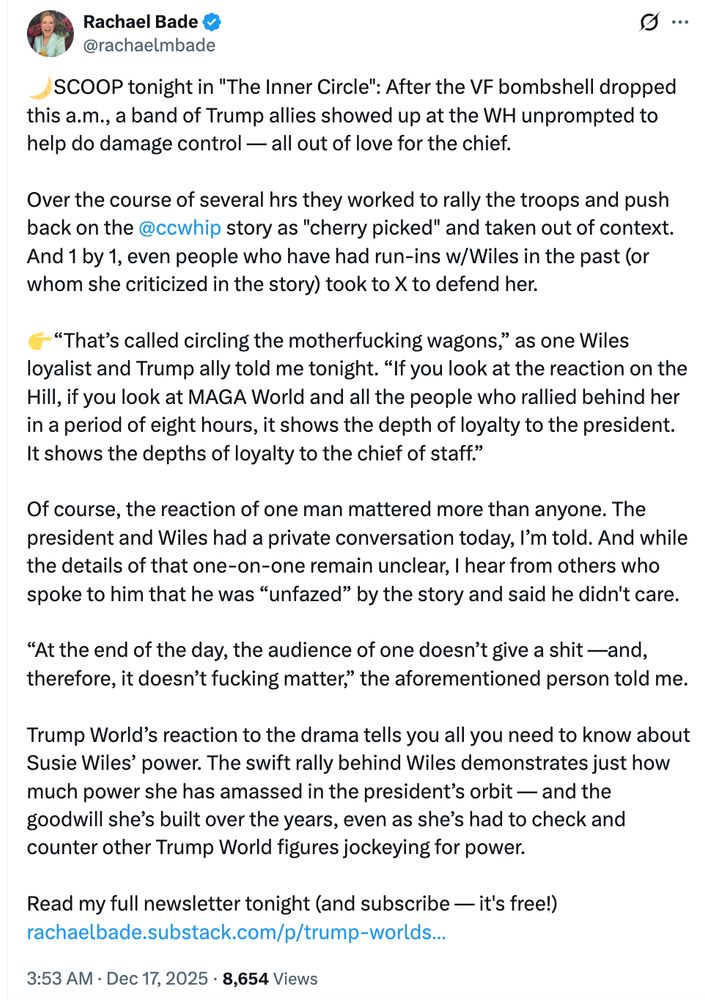
Rachael Bade really did claim it was a big scoop to describe a “Wiles loyalist and Trump ally” explaining what was visible on Xitter for all to see as “circling the motherfucking wagons.”
Sure. It’s clear that’s what you were doing. But honestly, a good many people who read the profiles weren’t seeking to split the White House, they were seeking to understand what Trump’s low-key Chief of Staff does or thinks.
The loyalty that prevents you from seeing the failures she confessed doesn’t prevent us from seeing them.
Karoline Leavitt’s nasty gender-affirming care
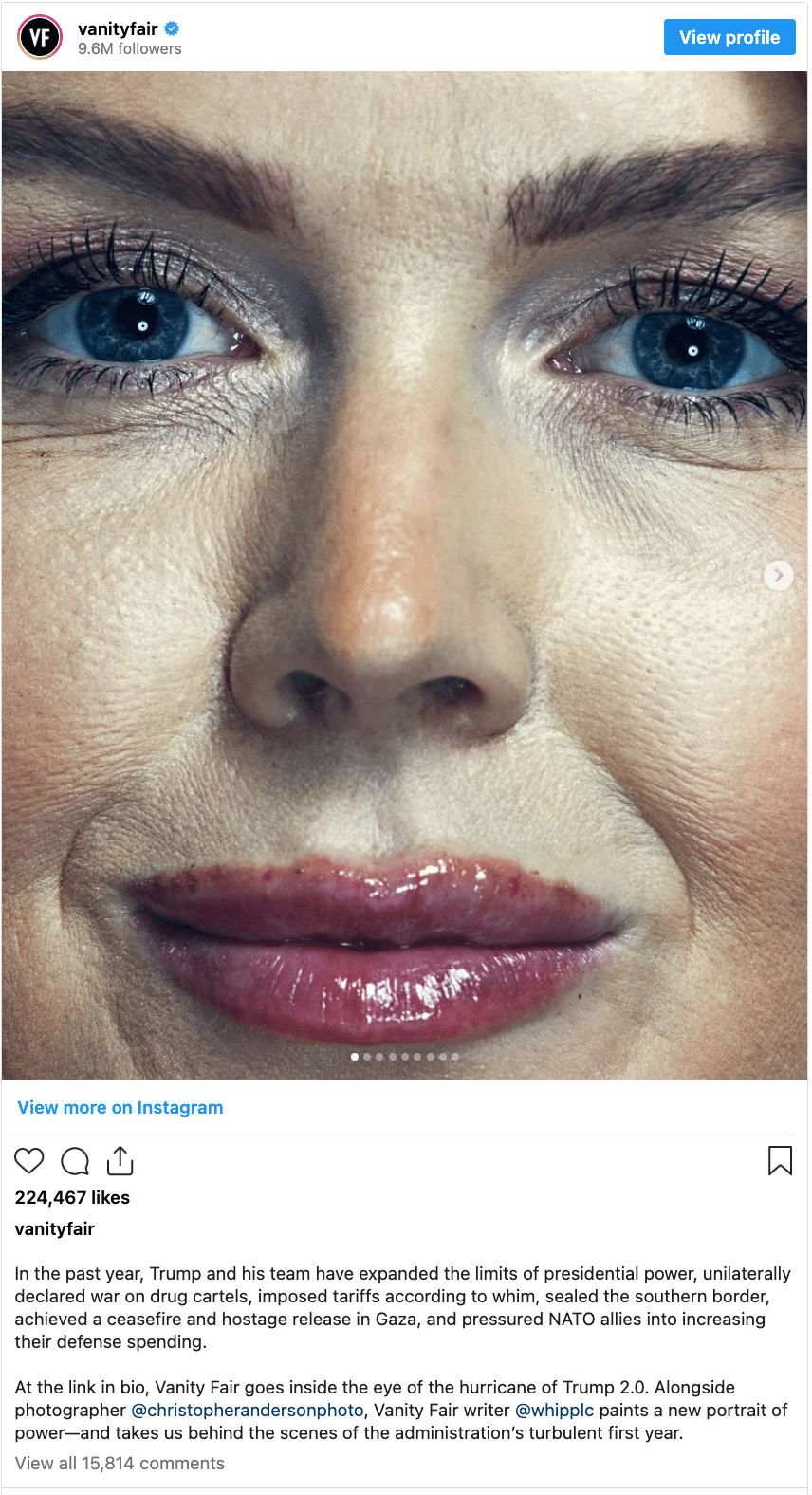
Then people started complaining about the photography, particular a picture that revealed the slop on Karoline Leavitt’s face and the injection marks in her lips.
WaPo did a great interview with the photographer, Christopher Anderson, where he explained his view of photojournalism and truth.
I want to talk to you about the portraits that you did for Vanity Fair. As I assume you have heard, they’ve caused a bit of a splash on social media. Can you tell me how you conceived of them?
I conceived of it many years ago. I did a whole book of American politics called “Stump” (2014), where I did all close-ups. It was my attempt to circumnavigate the stage-managed image of politics and cut through the image that the public relations team wants to be presented, and get at something that feels more revealing about the theater of politics. It’s something I’ve been doing for a long time. I have done it to all sides of the political spectrum, not just Republicans. It’s part of how I think about portraiture in a lot of ways: close, intimate, revealing.
[snip]
The images are really arresting. What is your response to people who say that these images are unfair? There’s been a lot of attention about Karoline Leavitt’s lips and [what appear to be] injection sites.
I didn’t put the injection sites on her. People seem to be shocked that I didn’t use Photoshop to retouch out blemishes and her injection marks. I find it shocking that someone would expect me to retouch out those things.
[snip]
Were they coming camera-ready, or was there a hair-and-makeup team?
Most of them came camera-ready or with their own hair-and-makeup team. Karoline Leavitt has her own personal groomer that was there.
I mean, we don’t know if Karoline Leavitt still has that groomer today now that the photos are published.
Well, what can I say? That’s the makeup that she puts on, those are the injections she gave herself. If they show up in a photo, what do you want me to say? I don’t know if it says something about the world we live in, the age of Photoshop, the age of AI filters on your Instagram, but the fact that the internet is freaking out because they’re seeing real photos and not retouched ones says something to me.
Click through for the great quote about Stephen Miller’s plea for kindness.
The self-deceptions and truths from within the bubble
Accordingly, that means no one has disputed Wiles’ admission that Trump’s policies have largely failed.
Here’s how Whipple summarized Trump’s term so far, close to the beginning of part one:
It’s been a busy year. Trump and his team have expanded the limits of presidential power, unilaterally declared war on drug cartels, imposed tariffs according to whim, sealed the southern border, achieved a ceasefire and hostage release in Gaza, and pressured NATO allies into increasing their defense spending.
At the same time, Trump has waged war on his political enemies; pardoned the January 6 rioters, firing nearly everyone involved in their investigation and prosecution; sued media companies into multimillion-dollar settlements; indicted multiple government officials he perceives as his foes; and pressured universities to toe his line. He’s redefined the way presidents behave—verbally abusing women, minorities, and almost anyone who offends him. Charlie Kirk’s assassination in September turbocharged Trump’s campaign of revenge and retribution. Critics have compared this moment to a Reichstag fire, a modern version of Hitler’s exploitation of the torching of Berlin’s parliament.
How he tells this story — though Wiles’ own assessments of Trump’s success or failure — is more interesting. The following, save the last one, are presented in the order Whipple addresses them in the profile.
End the congressional filibuster and remove Nicolás Maduro from power. [A November portrayal; results still TBD]
The agenda was twofold: ending the congressional filibuster and forcing Venezuelan president Nicolás Maduro from power.
Pardon just those who were January 6 “happenstancers.” [Wiles lies to cover up her failure to achieve this goal]
Wiles explained: “In every case, of the ones he was looking at, in every case, they had already served more time than the sentencing guidelines would have suggested. So given that, I sort of got on board.” (According to court records, many of the January 6 rioters pardoned by Trump had received sentences that were lighter than the guidelines.) “There have been a couple of times where I’ve been outvoted,” Wiles said. “And if there’s a tie, he wins.”
Preserve parts of USAID. [Complete failure, but one Marco Rubio is lying about]
Musk forged ahead—all throttle, no brake. “Elon’s attitude is you have to get it done fast. If you’re an incrementalist, you just won’t get your rocket to the moon,” Wiles said. “And so with that attitude, you’re going to break some china. But no rational person could think the USAID process was a good one. Nobody.”
[snip]
Did Rubio have any regrets about the untold number of lives that PEPFAR’s evisceration might cost? “No. First of all, whoever says that, it’s just not being accurate,” he told me. “We are not eviscerating PEPFAR.
Stephen Miller’s deportation policies. [In Wiles’ estimation, a failure]
Not long after the El Salvador deportation fiasco, in Louisiana, ICE agents arrested and deported two mothers, along with their children, ages seven, four, and two, to Honduras. The children were US citizens and the four-year-old was being treated for stage 4 cancer. Wiles couldn’t explain it.
“It could be an overzealous Border Patrol agent, I don’t know,” she said of the case, in which both mothers had reportedly been arrested after voluntarily attending routine immigration meetings. “I can’t understand how you make that mistake, but somebody did.”
Tariffs. [Wiles failed to prevent Trump’s worst instincts and the results have been worse than she imagined]
Wiles believed a middle ground on tariffs would ultimately succeed, she said, “but it’s been more painful than I expected.”
Invading blue cities. [Wiles says Trump won’t do this to stay in power]
Will the president use the military to suppress or even prevent voting during the midterms and beyond?
“I say it is categorically false, will not happen, it’s just wrongheaded,” she snapped.
November’s election. [Wiles knew they were in trouble, but even so was overoptimistic]
Wiles thought the GOP had a chance of electing the governor in New Jersey, but she knew they were in for a tough night.
The Epstein files. [Trump and Kash, both lying about what was in the files but that’s okay because MAGAts aren’t obsessed with Epstein]
For years, Kash has been saying, ‘Got to release the files, got to release the files.’ And he’s been saying that with a view of what he thought was in these files that turns out not to be right.”
[snip]
Wiles said. “It’s the Joe Rogan listeners. It’s the people that are sort of new to our world. It’s not the MAGA base.”
Murderboats and frivolous wars. [Pure self-deception]
“Not that he wanted to kill people necessarily, but stopping the killing wasn’t his first thought. It’s his first and last thought now.”
[snip]
“He wants to keep on blowing boats up until Maduro cries uncle. And people way smarter than me on that say that he will.”
Russian peace efforts. [Wiles says they’re lying about Russia wanting peace]
Trump’s team was divided on whether Putin’s goal was anything less than a complete Russian takeover of Ukraine. “The experts think that if he could get the rest of Donetsk, then he would be happy,” Wiles told me in August. But privately, Trump wasn’t buying it—he didn’t believe Putin wanted peace. “Donald Trump thinks he wants the whole country,” Wiles told me.
In October I asked Rubio if that was true. “There are offers on the table right now to basically stop this war at its current lines of contact, okay?” he said. “Which include substantial parts of Ukrainian territory, including Crimea, which they’ve controlled since 2014. And the Russians continue to turn it down. And so…you do start to wonder, well, maybe what this guy wants is the entire country.” (In Wiles’s office is a photograph of Trump and Putin standing together, signed by Trump: “TO SUSIE YOU ARE THE GREATEST! DONALD.”)
Trump would only spend 90 days on retribution. [Wiles is in denial]
“Yes, I do,” she’d replied. “We have a loose agreement that the score settling will end before the first 90 days are over.”
In late August, I asked Wiles: “Remember when you said to me months ago that Trump promised to end the revenge and retribution tour after 90 days?”
“I don’t think he’s on a retribution tour,” she said.
Trump’s biggest accomplishments: Peace and the Big Ugly
“I think the country is beginning to see that he’s proud to be an agent of peace. I think that surprises people. Doesn’t surprise me, but it doesn’t fit with the Donald Trump people think they know. I think this legislation [the so-called One Big Beautiful Bill], which funded the entire domestic agenda, is a huge accomplishment. And even though it isn’t popular in total, the component parts of it are. And that will be a very big deal in the midterms.”
That is, like the Epstein scandal more generally, Wiles either invents bubble-wrapped fictions about Trump’s own success, or concedes she, or Trump, has failed.
But Trump’s aides — the people complicit in this failure — don’t care.
They’re just going to circle the motherfucking wagons and demand loyalty.
Share this entry
https://www.emptywheel.net/wp-content/uploads/2025/12/Screenshot-2025-12-18-at-12.16.08-PM.png656658emptywheelhttps://www.emptywheel.net/wp-content/uploads/2016/07/Logo-Web.pngemptywheel2025-12-18 08:59:092025-12-18 09:07:46Susie’s Assessment: Failure after Failure
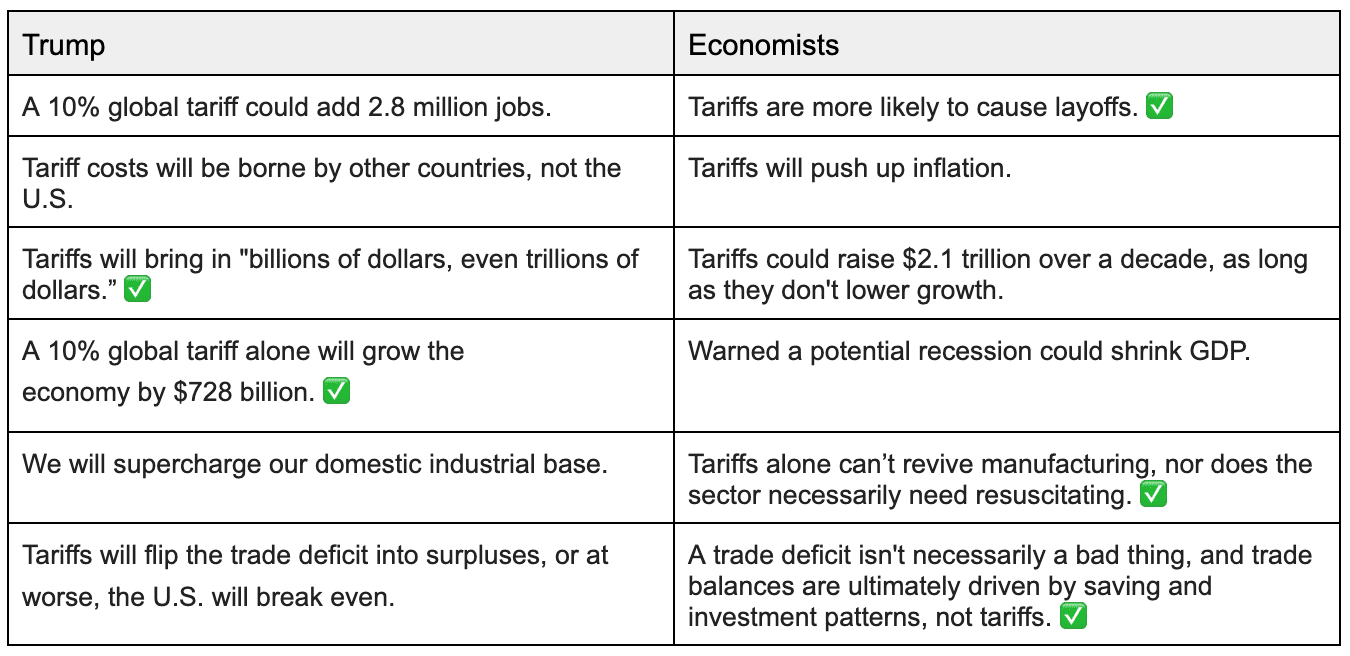
WSJ had a heavily-produced story on Sunday, “Why Everyone Got Trump’s Tariffs Wrong,” purporting to assess the claims that Trump and economists had made … at some point about his tariffs.
This table includes the six allegedly competing claims WSJ assesses; I’ve added a check marking whichever side WSJ claimed was really right.
For most of six paired predictions, WSJ makes a show of adjudicating who was right, giving Trump credit on two predictions and less ostentatiously confirming economists’ predictions on three.
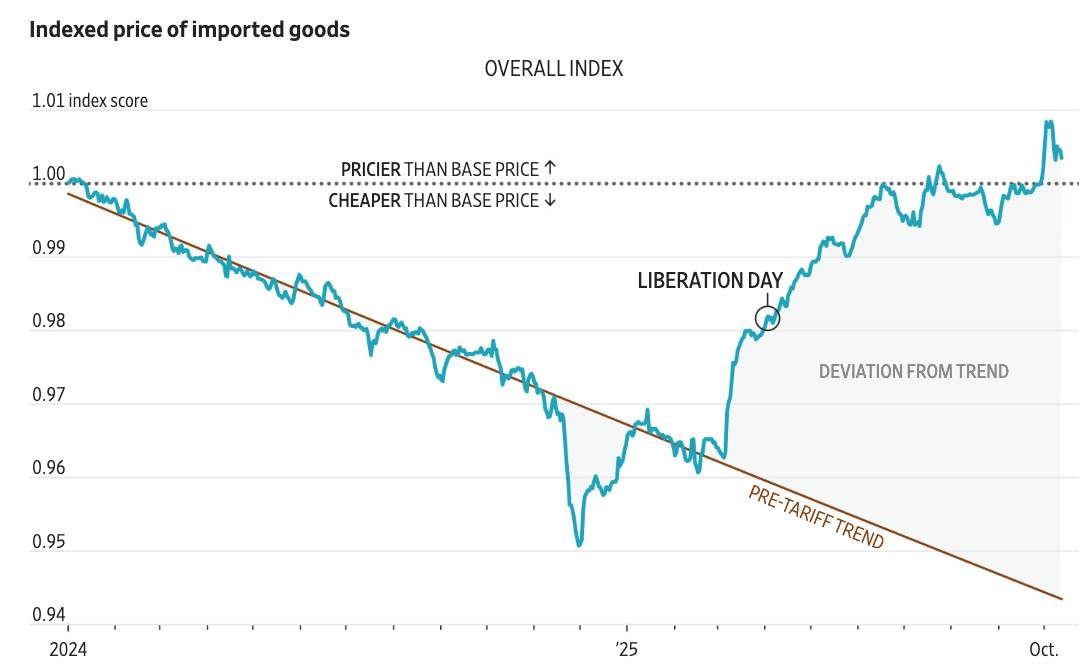
For example, WSJ provides this table purporting to show that both Trump and the economists were wrong about inflation (with steeper tables showing the spike in coffee and appliances); for some reason, WSJ indexes this to January 1, 2024 prices, not 2025 (and some of the tables at WSJ’s source show steeper spikes).
WSJ judges that economists were wrong this way:
Tariffs swiftly hit Americans’ wallets as major retailers from Macy’s to Best Buy raised prices in response to the duties.
“The magnitude and speed at which these prices are coming to us is somewhat unprecedented in history,” Walmart Chief Financial Officer John David Rainey told The Wall Street Journal in May.
But the worst inflation fears haven’t come to pass. Inflation has for months hovered around 3%—higher than the Federal Reserve’s 2% target, though still lower than many economists’ expectations.
But starting in the very next paragraph, WSJ explains why inflation wasn’t as bad as predicted: first, because Trump reversed the worst tariffs. Then, because companies are still trying to figure out what the fuck his tariff policy will be, especially after the Supreme Court gets done with it, and so haven’t passed on all of the tariffs, which they will eventually do.
Another factor at play: Trump’s repeated policy shifts on tariffs.
Many companies have said they want to see where tariffs will ultimately settle before introducing more price changes. The still-undecided Supreme Court case on Trump’s authority to impose tariffs gives them another reason to wait a bit longer.
Economists predict higher prices as companies draw down on their pre-tariffed inventory and renegotiate contracts with retailers and distributors.
If no new tariffs are announced, the Fed estimates the current ones will take nine months to work their way through the economy. That could push inflation from goods down in the back half of 2026. But “we haven’t been able to predict this with any precision,” said Fed Chairman Jerome Powell. “No one is.”
The rest of the article has similar equivocations. WSJ returns to Trump’s decision to reverse many of the tariffs when discussing the GDP growth (and notes that AI has kept the GDP afloat, without also noting that it’s likely in a bubble that is beginning to crash).
Trump has also walked back and delayed many of his threatened duties.
WSJ’s discussion of Trump’s failure to bring manufacturing back returns to changing policy.
Big projects will likely take years to materialize, if they happen at all, as government policies could shift again in that time.
And the flux makes this assessment impossible. Two days ago, for example, WSJ hailed September’s good job’s report.
The U.S. added 119,000 jobs in September, far more than economists had expected. But the figure was an outlier from previous months, in which job growth had lagged. As of September, the unemployment rate reached 4.4%, the highest in four years.
But that got revised downward today and — Justin Wolfers describes in reading today’s report — in reality there may be zero or negative job growth since Trump tried to impose his big tariffs, which if that proves true, would vindicate the economists.
WSJ gives Trump credit for predicting some revenue growth even while noting he wildly exaggerated how much growth there might be, but then admits that not only will much of the revenue go away if SCOTUS throws out the tariffs, but Trump would have to pay some portion — potentially as much as half — of the tariffs back.
Future collections hang on the Supreme Court’s decision on Trump’s authority to impose the tariffs, expected in coming days.
If the court strikes down tariffs imposed under the International Emergency Economic Powers Act, monthly revenue collected would fall by more than half. More than $100 billion already collected might also need to be refunded.
And WSJ also notes that a lot of the data it would need to measure all this is delayed (it doesn’t address Trump’s efforts to tamper with the data).
Perhaps the most salient assessment in the story is the last line: “As long as Trump continues to surprise the market with tariffs, trade will remain volatile,” which is both a platitude and an observation that you can’t assess many of these claims using regular measures, because the tariffs are not (or not just) about creating a precondition to shift trade flows.
Trump’s tariffs aren’t just tariffs. They are week-to-week business uncertainty.
They are also, just as importantly, about giving Trump a tool to attempt to leverage power, something captured in a different WSJ story, this interview with Meredith McGraw, in which Trump offers word salad to explain why tariffs are so cool.
When asked if he has alternative ways to use tariffs, the president said there are other laws but they are not as “nimble, not as quick.” He added, “I can do other things, but it’s not as fast. It’s not as good for national security.”
Trump also argued that tariffs gave him leverage in negotiations with other countries.
“I just used tariffs 10 minutes ago, just before you came, to settle the new inflammation that took place with Thailand and Cambodia,” Trump said. “And I told them, ‘If you have the war, not only am I going to break the trade deal we have, but I’m going to put tariffs on your country.’” He added, “Nobody can do that but me.”
“Nobody can do that but me,” Trump said of an authority that SCOTUS is likely to say he cannot lawfully do.
Worse, Trump equates being able to coerce other countries nimbly with national security. But it is anything but.
Consider how inconsistent Trump’s logic is. In the same week that Trump approved the sale of Nvidia chips to China (which chips China promptly said they would limit use), chips that remained, that very day, illegal to ship to China, the White House halted negotiations on similar kinds of technology with the UK because the Brits would not bow to Trump’s demands on food and tech standards. Trump wants to send chips to China instead of (just) shitty chicken, but he won’t send chips to the UK unless they accept US shitty chicken and Nazi Xitter posts.
None of it makes sense.
And this misrepresentation of how Trump is using tariffs — treating as sincere his false claims about how he claims he is using them — is just part of the reason why the reporting on Trump’s catastrophic tariffs has been so shitty.
To be sure, there has been persistent reporting on how badly his tariffs have devastated farm markets, especially soybeans but now shifting to wheat. There have been stories on how China has gotten pretty much what it has wanted. But there has been less coverage of how Trump’s stupid ass trade war — and China’s preparation for it since Trump’s last Administration — has created the opportunity for China to leverage its rare earth dominance and soybean consumption to bring Trump to heel.
Trump thought America was the irreplaceable market, and attempted to leverage access to it accordingly. But as he has discovered how little of all that he understands, it has backfired, giving China leverage it otherwise didn’t have.
And, if we can believe Vanity Fair’s profile of Susie Wiles, half of Trump’s advisors knew it wouldn’t work in real time.
“So much thinking out loud is what I would call it,” said Wiles of Trump’s chaotic tariff rollout. “There was a huge disagreement over whether [tariffs were] a good idea.” Trump’s advisers were sharply divided, some believing tariffs were a panacea and others predicting disaster. Wiles told them to get with Trump’s program. “I said, ‘This is where we’re going to end up. So figure out how you can work into what he’s already thinking.’ Well, they couldn’t get there.”
Wiles recruited Vance to help tap the brakes. “We told Donald Trump, ‘Hey, let’s not talk about tariffs today. Let’s wait until we have the team in complete unity and then we’ll do it,’ ” she said. But Trump barreled ahead, announcing sweeping “reciprocal” tariffs, from 10 to 100 percent—which triggered panic in the bond market and a sell-off of stocks. Trump paused his policy for 90 days, but by that time the president’s helter-skelter levies had given rise to the TACO chant: “Trump Always Chickens Out.”
Wiles believed a middle ground on tariffs would ultimately succeed, she said, “but it’s been more painful than I expected.”
All this is so painful not just because tariffs are a stupid policy and the way in which Trump implemented them is even stupid. It is painful because Trump has no fucking ability to discern what is good for America, and he doesn’t much care if he fucks up and destroys entire markets as a result.
And coverage of Trump’s destruction of the soybean market has not yet called out the systematic lies Republicans tell claiming Trump’s grant of $12 billion to struggling farmers is only an attempt (again) to reverse the damage he did, which will not come close to making farmers whole. Right wingers are, across the board, hailing Trump’s payoff and blaming the damage Trump did on Joe Biden … and almost no one is calling out the projection and lies.
Trump’s tariffs are a failure not just as tariffs, in fulfilling their purported purpose. But because Trump knows so little about the markets he’s trying to alter, he’s simply making the US vulnerable.
Update: Paul Krugman has more on what we learned from yesterday’s job numbers.
[T]he data show a weak labor market. Employment isn’t falling off a cliff, but job growth has been weak and hasn’t kept pace with the number of people seeking work. The headline unemployment rate in November was 4.6 percent, up from an average of 4 percent in 2024. That number is close to triggering the Sahm Rule, an economic rule of thumb devised by Claudia Sahm, a former economist at the Board of Governors of the Federal Reserve, that has historically been highly successful at identifying the early stages of a recession.
We can’t do a strict application of the Sahm Rule yet because Sahm’s method is based on the average unemployment rate over the past three months. Unfortunately, the shutdown prevented the Bureau of Labor Statistics from collecting key data in October. But if we do an interpolation of October’s unemployment rate by averaging over September’s rate of 4.4% and November’s rate of 4.6%, we can estimate that October’s unemployment rate was 4.5%. And those 3 months of unemployment numbers bring us within a whisker of the unemployment rise that, according to the Sahm Rule, signals that a recession is on the horizon.
The state of the economy looks even worse if we take a wider view of the labor market.
[snip]
Normally, when a president experiences a troubled economy during his first year he dispatches his flying monkeys minions to declare that it’s all his predecessor’s fault. And some Trump officials, like Scott Bessent, are indeed trying to play the blame game. But this standard political tactic is unlikely to work for this president.
First, the economy that Trump inherited when he took office was in much better shape than today’s economy, with lower unemployment combined with faster job growth, and inflation trending down.
Second, Trump’s radical policy changes – huge (illegal) tariffs, mass deportations, big tax cuts (for the rich), benefit cuts (for the poor and middle class), mass layoffs of federal workers, disinvesting in huge green energy projects and aid to farmers — have been clearly damaging to everything besides crypto and AI. It strains credulity – even for the Trump faithful – to claim that we are still in Joe Biden’s economy.
Share this entry
https://www.emptywheel.net/wp-content/uploads/2025/12/Screenshot-2025-12-16-at-1.54.50-PM.png6561350emptywheelhttps://www.emptywheel.net/wp-content/uploads/2016/07/Logo-Web.pngemptywheel2025-12-16 14:33:052025-12-17 08:47:23Donald Trump Is Getting a Pass for His Catastrophic Trade War
Three things happened in the last week that have befuddled a lot of observers, but which might best be understood as the kinds of developments we’ll see increasingly as the power structure around Trump grows fragile and fluid:
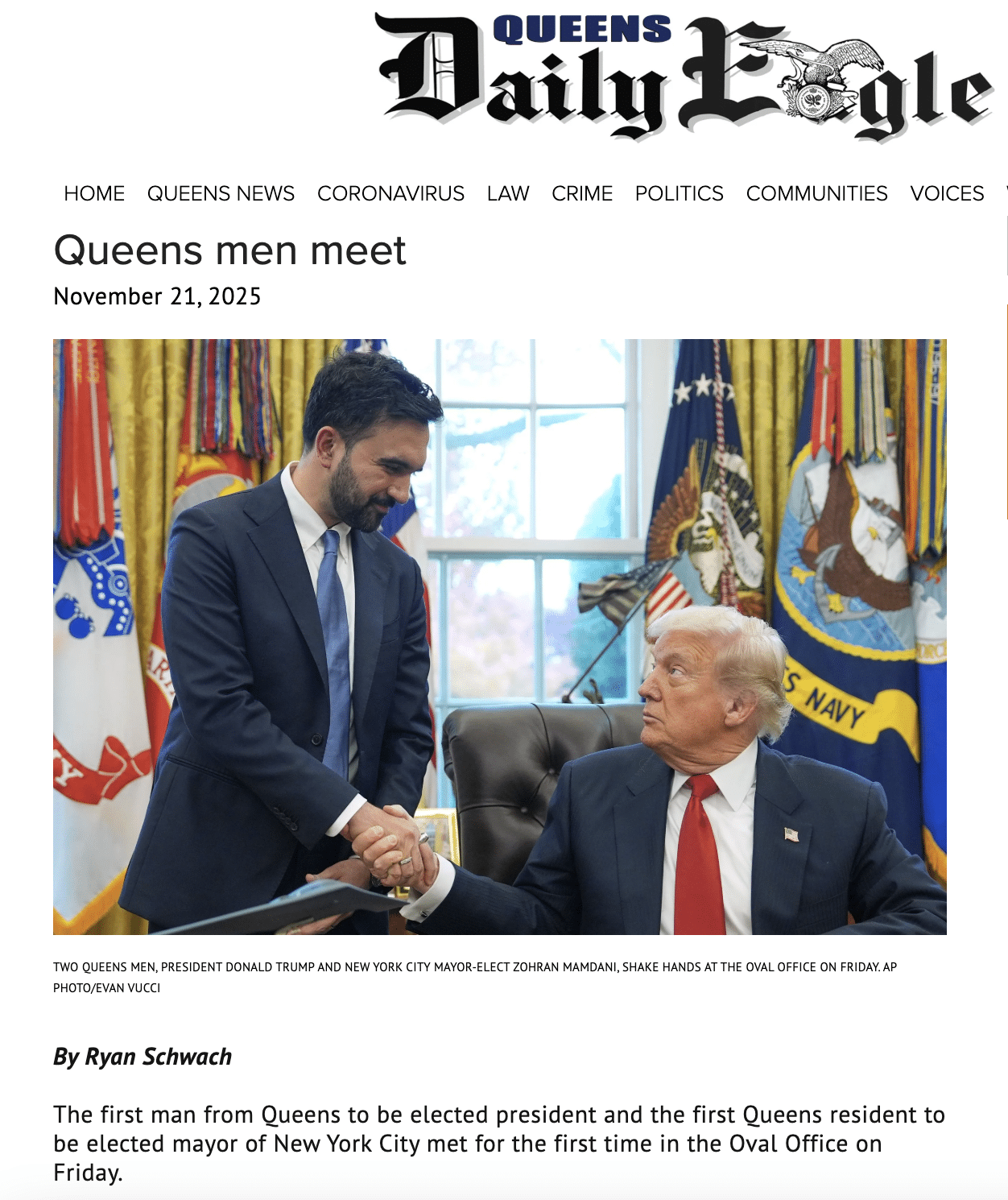
A positively giddy Trump welcomed Zohran Mamdani to the White House
“The White House” rolled out yet another plan to sell out Ukraine to Russia
Marjorie Taylor Greene announced she will quit in early January
All of these, in my opinion, arose out of and reflect Trump’s increasing political weakness, his separate mental and physical decline, and the fight for power that results.
Mamdani speaks of Trump voters, groceries, and building
Much of the focus on the Trump-Mamdani meeting was on what Trump did, such as his interruption before Mamdani had to answer whether he believed Trump was a fascist, rather than on what Mamdani said. But if you look closely at what Mamdani said — which was often simply a restatement of his campaign pitch — he managed to say them in such a way that Trump parroted them as his own.
Mamdani’s first comment did so — as did his relentlessly disciplined campaign did — in terms of affordability; Mamdani mentioned “groceries,” the awkward shorthand Trump’s handlers have had him use to address affordability.
Mr. Trump: You know, we had some interesting conversation, and some of his ideas really are the same ideas that I have. A big thing on cost. The new word is “affordability.” Another word, it’s just groceries. It’s sort of an old-fashioned word, but it’s very accurate. They are coming down. They are coming down.
Mamdani repeatedly spoke in terms of Trump’s voters (again, a line directly from his campaign).
Trump had no idea that Mamdani targeted Trump voters, and as the coalition that elected him last year abandons him in the polls, Trump took notice when Mamdani explained that.
When I spoke to New Yorkers who had voted for the president last November on Hillside Avenue and Fordham Road, I asked them why. I heard, again and again, two major reasons. One was that they want an end to forever wars — they wanted an end to the taxpayers’ dollars we had funding violations of human rights, and they wanted to address the cost-of-living crisis. And I appreciated the chance to discuss both of those things.
Mr. Trump: He said a lot of my voters actually voted for him.
Mr. Mamdani: One in 10.
Mr. Trump: And I’m OK with that.
[snip]
Reporter: First of all, for the mayor-elect: You’re both from different parts of the political perspective. You’re both populist, though, and I just wonder to what extent the president’s campaign styles — his techniques, his social media use — inspired any part of your campaign?
Mr. Mamdani: Well, I actually told the president that, you know, so much of the focus of our campaign has been on the cost-of-living crisis, and when we asked those New Yorkers who had voted for the president — when we saw an increase in his numbers in New York City, that came back to the same issue. Cost of living. Cost of living. Cost of living.
And they spoke about the cost of groceries, the cost of rent, the cost of Con Ed, the cost of child care.
Mamdani seems to have reminded Trump that Trump got a historic number of votes last year (the voters Mamdani kicked off his campaign by canvassing) by running on affordability.
Reporter: Mr. President, you said you grew up in New York City. Mr. Mamdani, does New York City love President Trump?
Mr. Mamdani: New York City loves a future that is affordable. And I can tell you that there were more New Yorkers who voted for President Trump in the most recent presidential election because of that focus on cost of living, and I’m looking forward to working together to deliver on that affordability agenda.
President Trump: Got a lot. I got a lot of votes. One more, go ahead. One or two more. Go ahead.
Mamdani’s focus on Trump voters became a way to dodge very contentious questions.
Mr. Mamdani: I appreciate all efforts toward peace, and I shared with President Trump, when I spoke to Trump voters on Hillside Avenue — including one of whom was a pharmacist that spoke about how President Trump’s father actually went to that pharmacy not too far from Jamaica Estates — that people were tired of seeing our tax dollars fund endless wars.
By the end, Trump spoke of the way he himself (thinks he) picked up Bernie voters.
Mr. Trump: We agree on a lot more than I would have thought. I think he’s — I want him to do a great job, and we’ll help him do great job. You know, he may have different views, but in many ways, you know — we were discussing, when Bernie Sanders was out of the race, I picked up a lot of his votes, and people had no idea, because he was strong on not getting ripped off in trade and lots of the things that I practiced, and been very successful on.
Tariffs, a lot of things. Bernie Sanders and I agreed on much more than people thought, and when he was put out of the race — I think quite unfairly, if you want to know the truth — many of the Bernie Sanders voters voted for me, and I felt very comfortable frankly seeing that and saying that. And you know, it just turned out to be a statistical truth.
Perhaps the most fascinating reflection came when Trump appeared to parrot Mamdani’s shift of discussions about ICE into a question about crime, whence Trump immediately addressed building.
Mr. Trump: What we did is, we discussed crime. More than ICE, per se, we discussed crime. And he doesn’t want to see crime, and I don’t want to see crime, and I have very little doubt that we’re not going to get along on that issue. And he wants to — and he said some things that were very interesting, very interesting, as to housing construction, and he wants to see houses go up. He wants to see a lot of houses created, a lot of apartments built, et cetera. You know, we actually — people would be shocked, but I want to see the same thing.
Trump repeated that progression later, and specifically said Mamdani told him things Trump had not seen in coverage.
He wants to see no crime. He wants to see housing being built. He wants to see rents coming down, all the things that I agree with. We may disagree on how we get there. The rent coming down — I think one of the things I really gleaned very, very much today, he would like to see them come down ideally by building a lot of additional housing. That’s the ultimate way. He agrees with that, and so do I.
But, if I read the newspapers, and the stories — I don’t hear that. But I heard him say it today. I think that’s a very positive step. Now, I don’t expect — I expect to be helping him, not hurting him. A big help, because I want New York City to be great.
Look, I love New York City. It’s where I come from.
None of Mamdani’s success should be that surprising. He’s a rock star in whose aura Trump would like to bathe.
Mamdani simply managed Trump the same way everyone does: by getting alone in a room with him and making him adopt your ideas as his own.
Kirill Dmitriev continues to cultivate the people alone in the room with Trump
Which brings us to the latest Ukrainian “piece” plan, a 28-point plan to force Ukraine to capitulate to Russia on threat of losing US intelligence and arms (though Cristo Grozev believes there are two bullets that Russia did not release publicly).
Phillips OBrien announced, hopefully prematurely, that this was the long-awaited denouement of Trump’s long con of pretending he cares about Ukraine.
Instead, what actually happened on November 21 was that the Trump Administration came for Ukraine—as they always intended to do. The Secretary of the Army, Dan Driscoll, a very close associate of VP JD Vance, went to Kyiv and tried to bully the Ukrainians into accepting Trump’s 28 Point Plan to neuter Ukraine. Driscoll formally presented the plan to divide Ukraine now, and end it later, and the reality of what Ukraine and Europe was facing finally sunk in. Here was how the Atlantic story on the meeting began.
Dan Driscoll kept everyone waiting. The United States secretary of the Army had been due to arrive earlier today at the U.S. ambassador’s residence in Kyiv to speak with diplomats from NATO member states. The guests were eager to hear about the 28-point peace plan Driscoll had delivered on behalf of the Trump administration to Ukrainian President Volodymyr Zelensky. But what they heard when Driscoll finally got there left some of the Europeans infuriated. “I feel nauseous,” one diplomat told us afterward. “It’s like the world is shattering around us, and we are watching it in real time.”
The most depressing thing from the above story was that the diplomat was surprised at what the administration was doing; or I should say that the unnamed diplomat had fallen for the Trump Administration’s long con. The long con was that they would ever do anything meaningful to hurt Putin and help Ukraine, that somehow they were honest brokers in this war. They never were. They have always wanted Putin to get the best deal possible and they have always wanted to severely weaken Ukraine. Whatever steps the administration took to seem to help Ukraine were performative; steps that were designed to make it look like they would be tough on Putin, but in the end never were more mirage-like than anything else.
Michael Weiss catalogs all the signs that the deal was, instead, Kirill Dmitriev successfully manipulating the press.
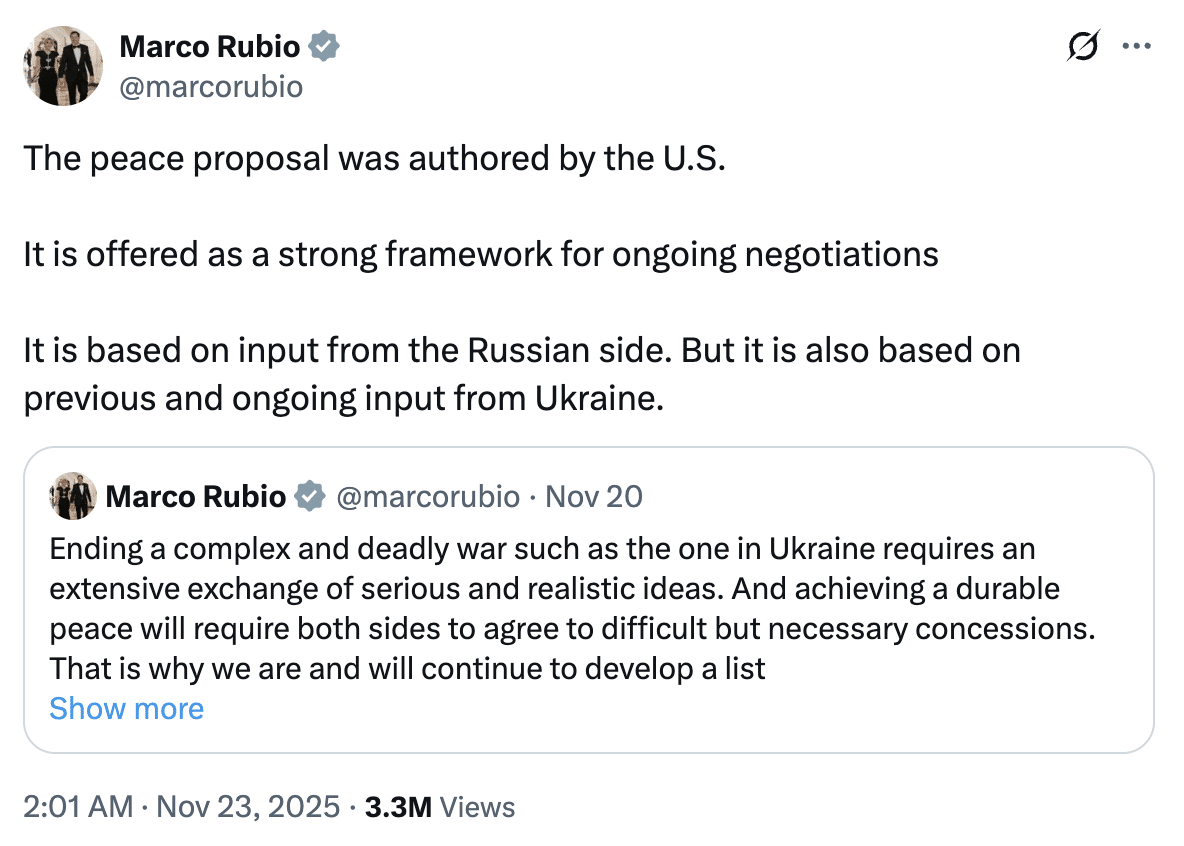
What struck me as odd about this whole affair was that for such a multi-authored, monthlong project, no one from the American side was willing to go on the record to talk about it. Everything was on-background comment — except for Dmitriev, who was only too happy to gibber. Moreover, the State Department was silent; all journalist inquiries directed at Foggy Bottom were not even redirected to the White House, which is highly abnormal on matters of foreign policy sensitivity. Then, late Wednesday night, Rubio, under his personal account, tweeted this: “Ending a complex and deadly war such as the one in Ukraine requires an extensive exchange of serious and realistic ideas. And achieving a durable peace will require both sides to agree to difficult but necessary concessions. That is why we are and will continue to develop a list of potential ideas for ending this war based on input from both sides of this conflict.”
To anyone on nodding terms with diplomatese, this sounded like the whirr of the backpedal, Rubio’s way of trying to downplay expectations created by Dmitriev and Axios and the resulting press frenzy. An “extensive exchange of serious and realistic ideas” was not, after all, a signed, sealed, and delivered plan of action, which Politico’s Dasha Burns had described (citing a “senior White House official”) as a “fait accompli,” cobbled together without the input or consent of Brussels. “We don’t really care about the Europeans,” said that same senior White House official, even though the EU and NATO will have an outsize say in determining the future of Ukraine and Europe, from sanctions relief to security assistance.
[snip]
Was Trump really acquainted with the deal in all its details? What did his “support” for Witkoff amount to? Recall that the preliminaries for the doomed Anchorage summit consisted of Witkoff misinterpreting what the Russians were offering (easy enough to do when you rely on an SVR translator) and making it seem as if they’d conceded things they hadn’t. This caused some dyspepsia in the Oval, and Trump later “jokingly” dismissed Witkoff’s ability to parlay with the Russians.
Could this be happening again? And could it be even worse now that Trump (distracted with his imploding MAGA coalition at home, a flush-worthy approval rating, a battering at the polls on Nov. 4, and bloodlust for the domestic opposition) is too busy to care about the finer points of his big, beautiful peace deal for Ukraine? “Sure, Steve, sounds great, keep going” sounded like what amounted to the Trump seal of approval here, but we don’t know because no one bothered to ask this question (or, at least, no one managed to have it answered).
[snip]
Politiconow clarified that “a number of people who would have normally been informed of such a plan at the White House and State Department were also not consulted about Witkoff’s renewed push,” with one U.S. official saying there was “zero interagency coordination.” You don’t say.
Reuters (including Erin Banco revisiting her past reporting on Dmitriev’s efforts to do precisely this in Seychelles in 2017) describes some of the machinations in Miami that went into this production.
U.S. officials and lawmakers are increasingly concerned about a meeting last month in which representatives of the Trump administration met with Kirill Dmitriev, a Russian envoy who is under U.S. sanctions, to draft a plan to end the war in Ukraine, according to multiple sources familiar with the matter.
The meeting took place in Miami at the end of October and included special envoy Steve Witkoff, President Donald Trump’s son-in-law Jared Kushner and Dmitriev, who leads the Russian Direct Investment Fund (RDIF), one of Russia’s largest sovereign wealth funds.
The most telling development, however, are competing and quickly evolving stories from Senator Mike Rounds (who would lead opposition to such a plan in the Senate) and Marco Rubio about whether this is a US plan.
Rubio reassured Senators mobilizing opposition to this development that it wasn’t a done deal, but then backtracked to avoid losing his place in the room.
Foreign nations now have to deal with rival factions of the U.S. government who keep major policy initiatives secret from each other and some of which work with foreign powers as the succession battle for 2028 begins, is how one diplomat put it.
One thing that’s happening is that Marco Rubio has survived in the Trump White House as long as he has because he is very good at mirroring, usually passively so. He says, and his State Department says, what his State Department babysitters say, people like Darren Beattie and Christopher Landau. But Rubio has generally remained in the room even at key times, and particularly with Ukraine, has thus far managed to prevent the worst from happening.
Importantly, though, Dmitriev’s tremendous success at manipulating the other people in the room with Trump comes at a time when Tom Massie and Marjorie Taylor Greene — neither big backers of Ukraine — showed how to beat Trump: by bypassing Mike Johnson to force a politically difficult vote, and to do so with enough success to force the Senate’s hand.
Brian Fitzpatrick and Don Bacon, both staunch backers of Ukraine in the House, have initiated an effort to replicate that approach.
There are the numbers right now to pass sanctions against Russia: at least 218 in the House and a filibuster-proof majority in the Senate. Those numbers just happen to be similar to the same numbers as it would take to impeach Trump.
Which is to say, the very thing that made it possible for Dmitriev to recruit (ahem) the people in the room with Trump — the flux in the White House now — is also the thing that makes him more vulnerable than he was a month ago.
Exit Marjorie Taylor Greene, for now
There’s a lot about MTG’s departure I’m not much interested in: making Trump the primary actor, making Marge the victim, debating whether she’ll be friend or foe, focusing more on the timing as it relates to getting her pension than as it relates to the healthcare crisis Republicans will soon own.
MTG is far smarter than people give her credit for and she’s very adept at using the tools of right wing politics.
In recent months the good old boys in Georgia and even Trump’s top aides refused to let her run for state-wide office in Georgia, believing she could risk an increasingly purple state.
That was part of, but only part of, the background to her willingness to take a leadership position on Epstein. She does genuinely care about the issue and/or she does recognize its salience among populists.
The part of MTG’s statement that generated the most attention (which appears in ¶¶33 and 34 of her statement) — her prediction Republicans will lose the House and have to stave off a Trump impeachment…
I have too much self respect and dignity, love my family way too much, and do not want my sweet district to have to endure a hurtful and hateful primary against me by the President we all fought for, only to fight and win my election while Republicans will likely lose the midterms. And in turn, be expected to defend the President against impeachment after he hatefully dumped tens of millions of dollars against me and tried to destroy me.
It’s all so absurd and completely unserious. I refuse to be a ‘battered wife’ hoping it all goes away and gets better.
… Comes long after (¶¶4-12) a series of paragraphs that could be spoken by a racist Zohran Mamdani, and with all the charisma and political acumen he has.
No matter which way the political pendulum swings, Republican or Democrat, nothing ever gets better for the common American man or woman.
The debt goes higher.
Corporate and global interests remain Washington’s sweethearts.
American jobs continue to be replaced whether it’s by illegal labor or legal labor by visas or just shipped overseas.
Small businesses continue to be swallowed by big corporations.
Americans’ hard earned tax dollars always fund foreign wars, foreign aid, and foreign interests.
The spending power of the dollar continues to decline.
The average American family can no longer survive on a single bread winner’s income as both parents must work in order to simply survive.
And today, many in my children’s generation feel hopeless for their future and don’t think they will ever realize the American dream, which breaks my heart.
MTG is taking her significant campaign cash and selling high, and promising to be there to buy low after whatever upcoming catastrophe happens.
When the common American people finally realize and understand that the Political Industrial Complex of both parties is ripping this country apart, that not one elected leader like me is able to stop Washington’s machine from gradually destroying our country, and instead the reality is that they, common Americans, The People, possess the real power over Washington, then I’ll be here by their side to rebuild it.
Until then I’m going back to the people I love, to live life to the fullest as I always have, and look forward to a new path ahead.
She rode Trump’s coattails until she decided the coattails weren’t worth the effort anymore.
Share this entry
https://www.emptywheel.net/wp-content/uploads/2025/11/Screenshot-2025-11-23-at-09.14.59.png14901252emptywheelhttps://www.emptywheel.net/wp-content/uploads/2016/07/Logo-Web.pngemptywheel2025-11-23 06:48:242025-11-24 07:26:47“Groceries,” and Other Secrets of Managing Donald Trump
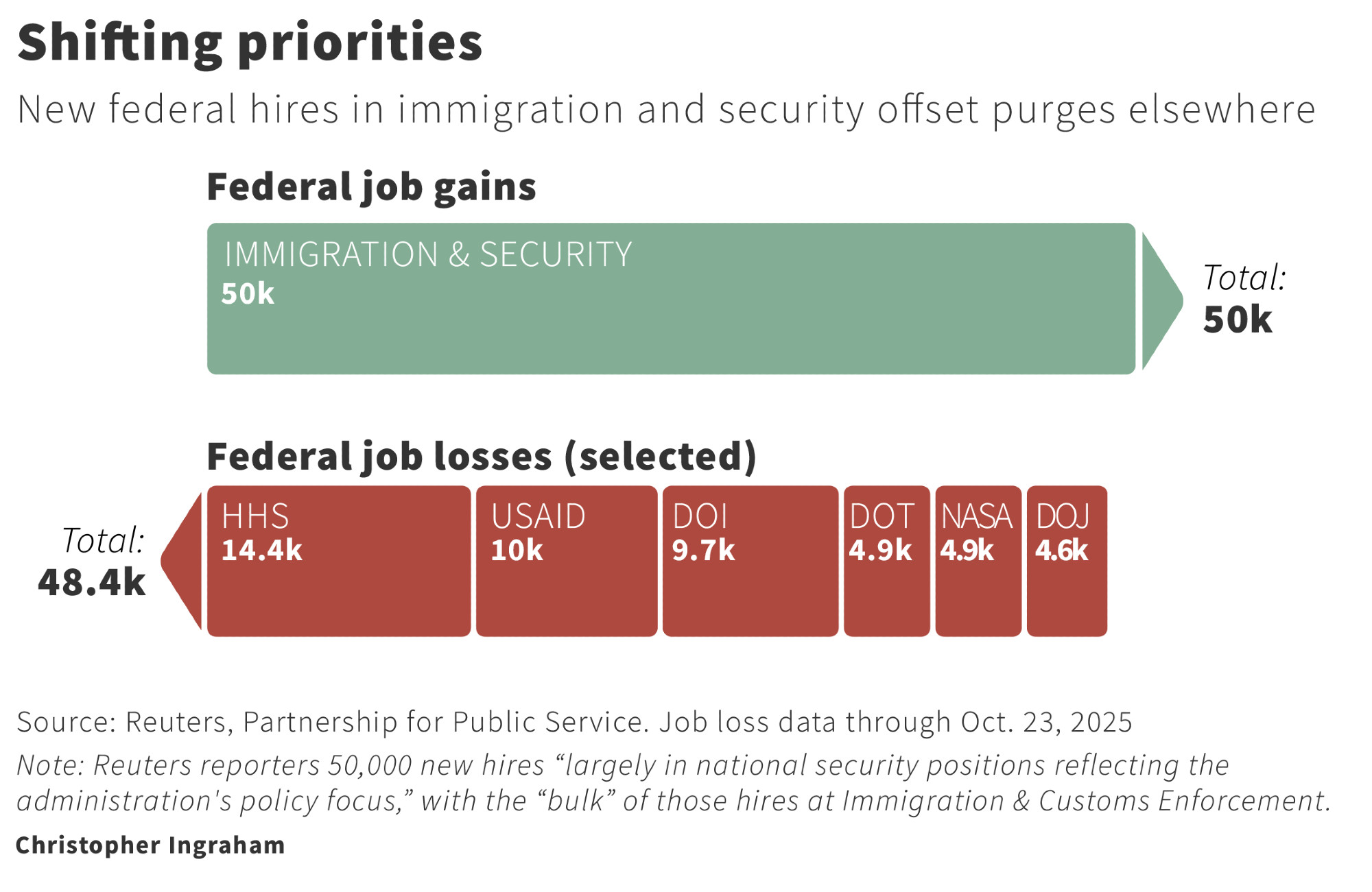
HuffPo had a story describing how Trump has hired 50,000 new people while firing a bunch more in the parts of government that make your lives better,
The U.S. government has hired 50,000 employees since President Donald Trump took office, his top personnel official said, with the new staff largely in national security positions reflecting the administration’s policy focus.
The bulk of the new hires, reported first by Reuters, work at Immigration and Customs Enforcement, said Scott Kupor, the federal government’s human resources director, in an interview on Thursday night.
The staff changes are part of Trump’s campaign to recast the government while sharply cutting other federal jobs.
“It’s about reshaping the workforce to focus on the priorities that we think are most important,” Kupor said.
The administration brought on the new employees while freezing hiring and laying off workers in other parts of the government, such as the Internal Revenue Service and the Department of Health and Human Services.
The administration expects to shed about 300,000 workers this year, Kupor said in August.
Meanwhile, the Daily Beast has yet another story about the continued shitshow of the effort to expand Kristi Noem’s goon squad, this time with the price tag associated with getting people to do such morally repugnant work.
DHS insiders said the money on offer has lured back former executive-level leaders from HSI and Enforcement and Removal Operations (ERO)—with some of them taking home north of $250,000 for office-based shiftwork, per multiple sources who spoke to the Beast.
According to those familiar with the packages, the most senior HSI rehires return as GS-13s on the federal pay scale. With locality pay in high-cost areas—such as parts of Texas, California, and New York—adding 35 percent or more to a basic salary, agents can earn up to $137,000 in the majority of the country. This rises to $171,268 in more expensive parts of the country, such as San Jose and San Francisco.
Law Enforcement Availability Pay (LEAP) adds a further 25 percent for being available for substantial unscheduled duty beyond 40 hours. Add in ongoing federal pensions worth around $8,000–$9,000 a month, and some rehires can land well in excess of a quarter of a million annually, sources said.
But it still retains support of a big chunk of the population, probably because Trump officials routinely blame their own failures to address American problems on migrants, when as often as not, Trump’s response to immigration is the source of the problem.
America can’t have nice things, like cures for cancer and welcoming public schools, because Republicans in Congress took the money used to pay for those things and gave it to Stephen Miller to use to invade America’s neighborhoods.
We need to start making that more obvious.
Share this entry
https://www.emptywheel.net/wp-content/uploads/2025/11/Ingraham-Shift.jpg13012000emptywheelhttps://www.emptywheel.net/wp-content/uploads/2016/07/Logo-Web.pngemptywheel2025-11-18 13:13:132025-11-18 13:13:13The United States Can’t Afford the Opportunity Cost of Stephen Miller’s Bigotry
By now you’ve read the news the shut down ended thanks to a few House Democrats caving and crossing the aisle to vote with the GOP.
These are the problem children:
Marie Gluesenkamp Perez (WA-03) – running for re-election, district rated R+2
Jared Golden (ME-02) – NOT running for re-election
Adam Gray (CA-13) – running for re-election, toss-up district
Don Davis (NC-01) – running for re-election, district rated R+1
Henry Cuellar (TX-28) – running for re-election, district rated R+2
Tom Suozzi (NY-03) – running for re-election, toss-up district
Some are the usual suspects, like Golden and Cuellar and Suozzi.
All of these races are gettable by a Democrat firmly left of these boneheads given the current dissatisfaction with the Trump administration and his party of enablers. As Charles Gaba pointed out, “Dems have overperformed an avg of 15 pts across 55 Special Elections so far, winning 36 of them including *flipping* 6 GOP seats!” Democrats running on affordability have done very well.
Golden apparently can read the weather and is bailing out. But the rest of these reps need to be primaried — even Cuellar who has been primaried in the past and survived. Suozzi must think affordability is a NYC thing and doesn’t affect his district.
Gluesenkamp Perez is particularly annoying because of her bullshit party bashing about the shutdown. She posted this on the Nazi bar site:
Tonight, I voted to end this partisan car crash of a shutdown. Nobody likes paying even more money to insurance companies – and the fight to stop runaway health insurance premiums won’t be won by holding hungry Americans hostage. Americans can’t afford for their Representatives to get so caught up in landing a partisan win that they abandon their obligation to come together to solve the urgent problems that our nation faces.
The last several weeks have been a case study in why most Americans can’t stand Congress. None of my friends who rely on SNAP would want to trade their dinner for an ambiguous D.C. beltway “messaging victory” and I’m glad this ugly scene is in the rearview mirror.
Now, it’s time for Congress to get back to work and build an economy where people aren’t yanked around by partisan interests, where we understand national health doesn’t come from insurance coverage – and reestablish a truly deliberative democracy. I’ll work with whoever is necessary to reach those goals – and I don’t give a damn which side of the aisle they sit on.
8:28 PM · Nov 12, 2025
Emphasis mine.
Bet she wouldn’t turn down money from the DCCC for her re-election campaign. Biting the hand, much?
Apparently Gluesenkamp Perez is pretty dense as are these other Dems. What leverage does the Democratic Party have now to negotiate a reinstatement of healthcare subsidies? Because if she knows of any, she can’t be arsed to offer it.
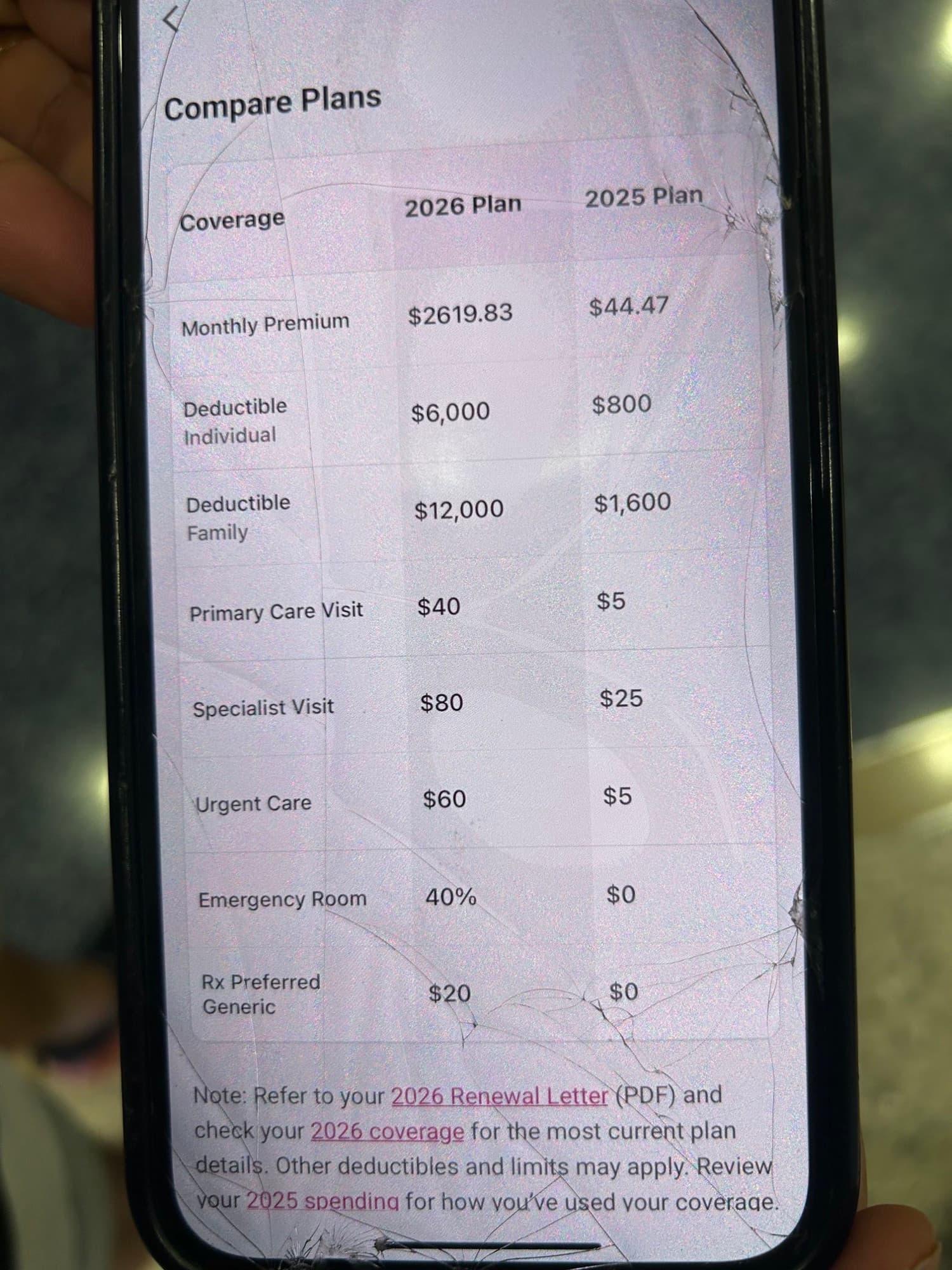
Here’s a snapshot of the problem, offered in a joking manner:
AltText for image above: Screenshot of healthcare plans without the ACA subsidies. 2025 plan was $45, 2026 plan will be $2,620. The deductible will increase from $800 to $6,000, primary care visits increase from $5 to $40, ER costs go from $0 to 40% co-insurance
The poster may offer this in a lighthearted fashion but the looming threat is real: a sizeable number of Americans will have to choose between paying for rent/mortgage/food and healthcare insurance. For many of these folks this will be a matter of life or death.
Trying to protect more than 20 million Americans who rely on the ACA marketplace and healthcare subsidies isn’t a partisan stunt for “messaging victory.” It’s about saving the lives of Americans who will otherwise be unable to afford healthcare insurance.
Assuming the GOP will act in good faith to address this country’s problematic for-profit healthcare system is insanely naive or ignorant. I assume Gluesenkamp Perez stuck her head in the sand every time Trump said he wanted to kill ACA, and missed Sen. John McCain’s going against his party and Trump in 2017 to vote to protect the ACA.
John McCain is dead. There’s no maverick to save Gluesenkamp Perez’s butt when her constituents lose their homes to pay for their healthcare because she didn’t want to appear to be too partisan.
Share this entry
https://www.emptywheel.net/wp-content/uploads/2018/09/Crazy_ElijahODonell-Unsplash_06SEP2018_mod.jpg9971499Raynehttps://www.emptywheel.net/wp-content/uploads/2016/07/Logo-Web.pngRayne2025-11-13 13:07:512025-11-13 12:21:36House Dems’ Problem Children Who Ended the Shutdown