Back before everyone checked out for the holidays, I did an inventory of the progress we’ve made in four ways to fight fascism (in comments ApacheTrout reminded I should have the courts in there too).
I wrote it intending to kick off the new year with a post of things we can do, or do better. Here we are!
But first, let me explain where I’m coming from. Much of what follows builds on my belief that we’ve been fighting Donald Trump wrong.
Polarization is his superpower. It’s how he has gotten out of every single one of his political jams in the past: by turning his own scandal into a polarizing pivot, thereby turning his own failures and crimes into a matter of tribalism. Once he has done that, he invents some new bullshit story (usually stoking grievance), and getting right wingers to believe it because of that polarization.
This is why I’m such an asshole about the way people serve as data mules for Trump’s tweets: because those damn things are little polarization machines, which always serve to make him the center of attention around which society is re-polarized.
The way to combat someone whose superpower is polarization is not to exacerbate that polarization. It is to use his own tools — grievance and conspiracism — against him.
Back in May, before the Epstein files had created a full-blown crisis for the Trump Administration, Phil Bump and Mike Rothschild wrote about how conspiracism can undermine someone with power (which I added to here).
Think of how important conspiracism and grievance were to (at least per the Robert Draper profile) Marjorie Taylor Greene’s turn against Trump:
Simplifying and ignoring her potential political ambitions, Trump became the thing everyone suspected was being hidden in the Epstein files, and that led to cognitive dissonance that led MTG to revisit a lot of her other differences with Trump.
So some of my logic, below, is simply to focus on the things that are likely to get Trump supporters or sympathizers to feel betrayed by him including by holding people close to him accountable for shitty things we are pretty sure are going to occur. It includes:
One more point about this. This post is not a To Do list for the DNC (though some people on Bluesky will undoubtedly treat it as such). It’s a To Do list for myself, most of all, but one that others can borrow if they find it useful. Many of these things are attentional activities that are about repetition and focus as much as congressional oversight or electoral politics.
These are meant to be stories we can tell, regardless of what someone in Congress or some candidate in Iowa does.
Remember that Marc Caputo column — it was published on December 23 — stating that the Epstein releases could last a whole ‘nother week? On the day that would mark that week, December 30, Devlin Barrett published a story saying that, “The document review” of what is now believed to be 5.2 million documents “is expected to take until at least Jan. 20, according to a person familiar with the matter.” Even if they could finish it by January 20 (they won’t), that’ll just be the first go-around. DOJ has not done what they need to do to document the redactions, so there’ll be demands from Congress for them to do that (with obvious areas — including DOJ names and some deliberative documents specifically included in the law, where they’re in violation), they’ll need to repeat the entire process over again, Congress will begin to bring more legal pressure, and all the while survivors will be pointing out things they missed.
A week, Marc Caputo reported, as if that were credible!
This will go on for some time. This will go on for a very long time.
Still, while the Epstein scandal has been absolutely instrumental in loosing Trump’s grip on things, people are naive in thinking that will be enough. “My friends will get hurt,” Trump predicted, but what does it really mean for Trump’s power that Les Wexner has been implicated in the Epstein scandal as a co-conspirator? What is the use of creating right wing cognitive dissonance about Les Wexner, when Wexner is not the oligarch currently helping Trump destroy the country?
In my opinion, the Epstein scandal is a tool. It undercuts Trump’s ability to grab and redirect attention. It can create moments of cognitive dissonance, as it did for MTG. It is a way to turn Trump’s conspiracism and populism against him and may make other related narrative lines more salient. And if there’s a surprise disclosure — perhaps about Melania’s origin story — all the better. But as you keep the focus on Epstein, remember that there needs to be a direction beyond Epstein as well, a direction which incorporates the oligarchs who are still key players in Trump’s network of power.
The Broligarchs who’ve been a key part of Trump’s power are one way to do that (and that’s before we’ve really gotten into Steve Bannon and Peter Thiel’s ties to Epstein).
Tesla Takedown was one of the most successful campaigns of 2025. At a time when Tesla faced cheaper competitors worldwide, the protests incurred a cost on Musk for his DOGE depredations.
Elon was installed in the White House in significant part by fellow South African “alien invader” David Sacks, who is even more conspiratorial and even more pro-Russian than Musk. Sacks was installed in the White House as a Special Government Employee (who, Elizabeth Warren suggests, has overstayed his welcome) to force a bunch of policy decisions that suck for America but ensure that Broligarchs won’t pay any consequences for their rash business deals. When one or both of crypto and AI crash (this is a really good story on how and why AI will burst), he’ll be there to ensure the government bails them out, as he did after playing a role in the failure of Silicon Valley Bank.
And even as Trump sheds support based on his mockery of affordability, even as MTG split with Trump over that and his support for crypto, Sacks is trying to brand Democrats as being more populist than even Zohran Mamdani is.
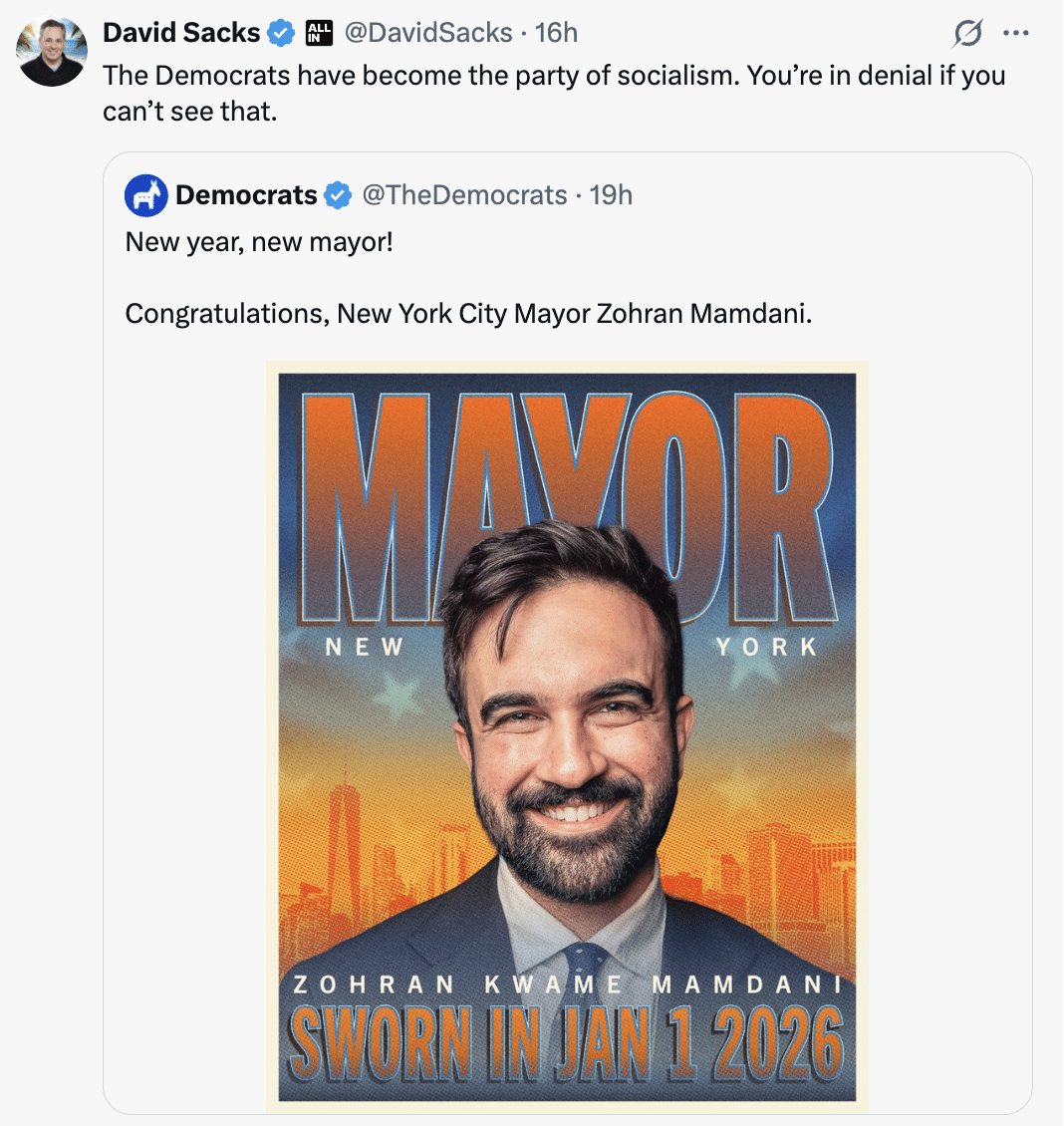
Fine. You want Democrats to be the party attending to the needs of working people? You’ve just made the GOP the party of “alien invader” billionaires who got tax cuts as millions lost their health care.
This happened even as AI has become a political liability. It has happened as local groups successfully stave off new data centers. It has happened as more instances of AI-inflamed suicide, murder, and porn — including porn exploiting children — appear. And it happens before the aforementioned crash.
Sacks and the other Broligarchs are going to do something for which they’ll try to dodge accountability. Now is the time to make sure his name comes up as people look for culprits.
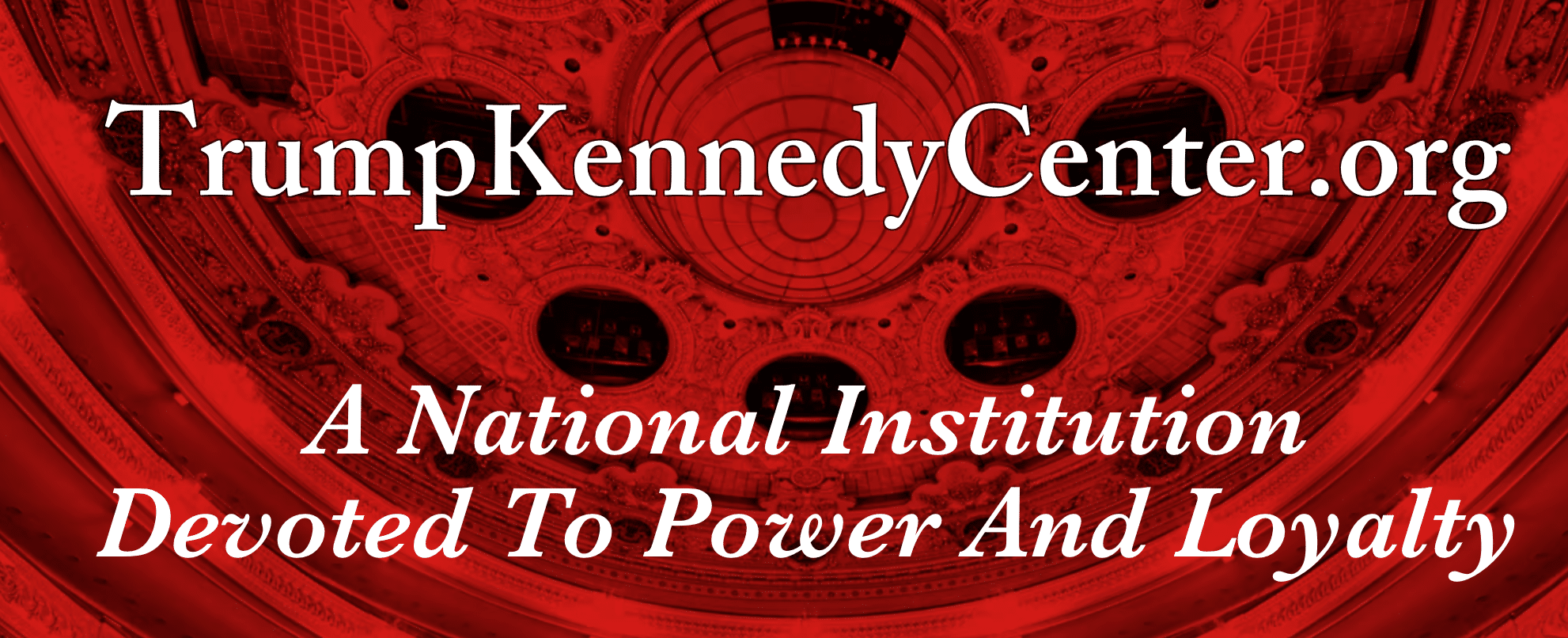
Another thing that will lead people to defect is to realize that Trump is a loser. He has done things — like the takeover of the Kennedy Center — that makes it easy to demonstrate he’s a loser in tangible fashion. Better still, every time Trump attaches his name to something, it provides an opportunity to hijack that brand, as comedian Toby Morton auspiciously managed to do by anticipating Trump’s most venal instincts and buying the domain.
The same is true of his businesses. Trump and his entire family is getting rich off the presidency 2.0. But his businesses are built as cons, sometimes Ponzi schemes. The idea is to leverage the loyalty of MAGAts to get them to invest in something, run up its value, only to collapse, leaving the most vulnerable screwed. In the past, at least, the cult effect was such that even MAGAts bilked by Trump associates, as with Steve Bannon’s Build the Wall graft, were reluctant to turn on the fraudsters; that may change. But at the very least, the volatile nature of Trump’s frauds makes it easy to show that as a businessman, he’s a loser.
While there has been good reporting on Trump’s corruption — see, for example, NYT’s nifty visualization from New Year’s Eve — there has not been a systematic effort to take on his corruption.
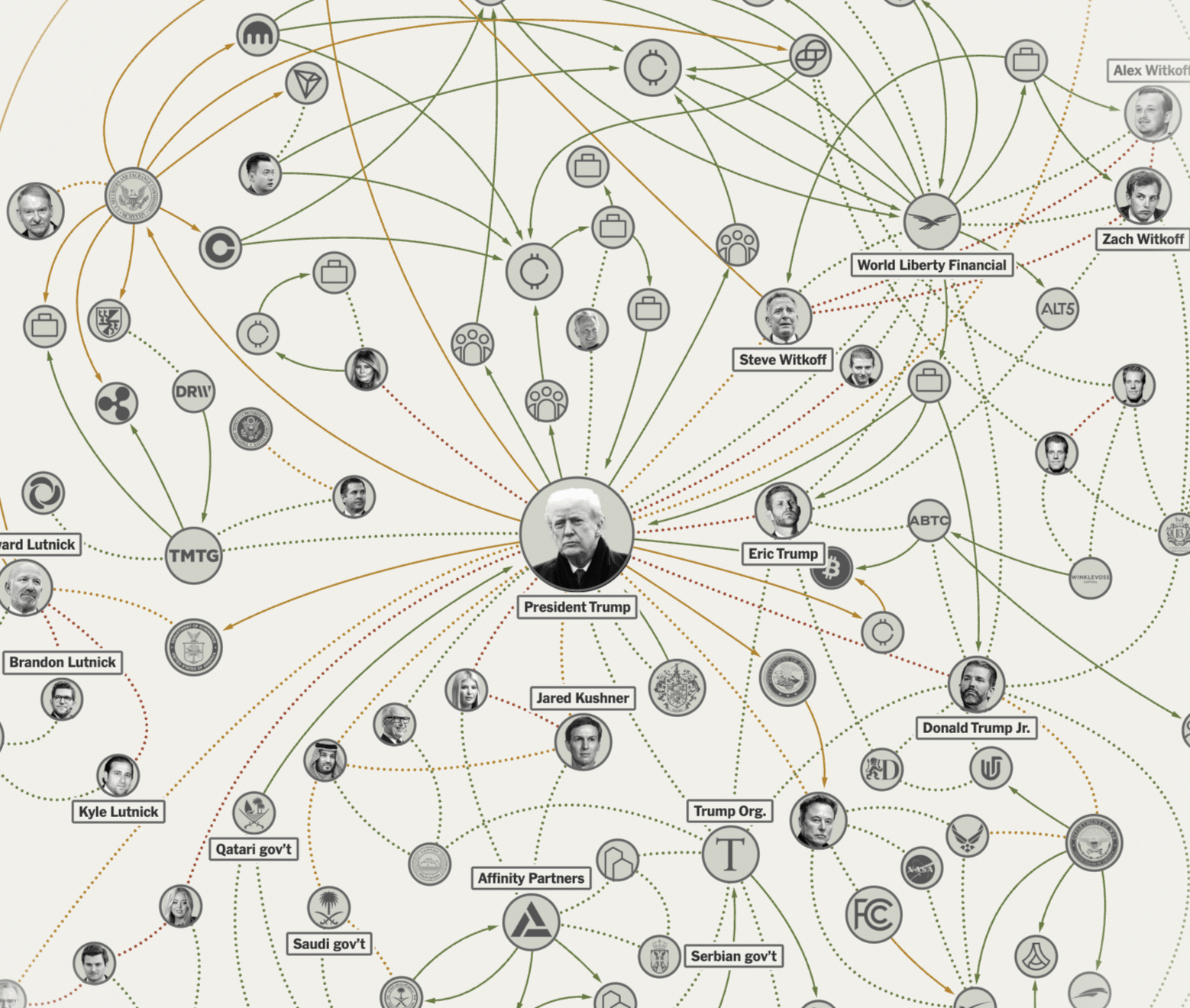
Nevertheless, possibly because of the Epstein scandal, a majority of the country does think Trump is corrupt.
That may actually not be in a bad place to be as we move into 2026. That’s because Democrats can make Republican inaction in the face of Trump’s corruption a campaign issue (and then, if it leads to a Democratic sweep in midterms, the electoral buy-in will be in place to do a lot of oversight and defunding of Trump’s corruption).
Trump’s pardons are similar. There’s actually a solid stream of reporting on how corrupt they are, without yet any political direction to it. Democrats running against Republican incumbents — especially in the Senate — should state as presumed that it is the job of Senators to respond to the kind of naked corruption Trump is engaged in.
Where activists can magnify the good reporting on both Trump’s corruption and his pardons is to focus on the victims. This is actually showing up in the reporting on both topics. WaPo focused on the victims of Trevor Milton who might have gotten restitution had Trump not pardoned him. LAT similarly focused on the victims fucked over by Trump’s pardon of David Gentile.
Rosenberg, a retired wholesale produce distributor living in Nevada, has supported Trump since he entered politics, but the president’s decision in November to commute the sentence of former private equity executive David Gentile has left him angry and confused.
“I just feel I’ve been betrayed,” Rosenberg, 68, said. “I don’t know why he would do this, unless there was some sort of gain somewhere, or some favor being called in. I am very disappointed. I kind of put him above this kind of thing.”
Trump’s decision to release Gentile from prison less than two weeks into his seven-year sentence has drawn scrutiny from securities attorneys and a U.S. senator — all of whom say the White House’s explanation for the act of clemency is not adding up. It’s also drawn the ire of his victims.
“I think it is disgusting,” said CarolAnn Tutera, 70, who invested more than $400,000 with Gentile’s company, GPB Capital. Gentile, she added, “basically pulled a Bernie Madoff and swindled people out of their money, and then he gets to go home to his wife and kids.”
This superb Bloomberg story on the extent to which the Juan Orlando Hernández pardon unraveled years of work starts with a murder arranged by the network.
Five minutes later, González was circling a roundabout when a gray van braked in front of him. At the same time, a green SUV crowded his rear bumper. A motorcycle carrying two men emerged on his left. A man on the back of the bike fired six shots through the driver-side window. González’s head slumped toward his shoulder, and he tilted forward, held upright by the seatbelt. He died instantly.
More than a dozen men streamed out of the two vehicles that had sandwiched his Nissan. They scrambled to collect the spent shell casings on the ground, then scattered other casings across the pavement—decoys to complicate ballistics tracing. They jumped back into their vehicles, circled the roundabout and took the same road Julián had just driven down.
When they approached the Slaughterhouse, the gates opened to let them in, then closed behind them.
Every one of these pardons has a victim — and that’s before you get into the people newly victimized by people who’ve been pardoned by Trump, which NYT covered in November and others are tracking as well.
A New Jersey fraudster who was pardoned by President Trump in 2021 was sentenced to 37 years in prison this month for running a $44 million Ponzi scheme, one of a growing number of people granted clemency by Mr. Trump only to be charged with new crimes.
The man, Eliyahu Weinstein, was pardoned by Mr. Trump in 2021 and was re-indicted by the U.S. attorney’s office in New Jersey three years later. He was accused of swindling investors who thought their money was being used to buy surgical masks, baby formula and first-aid kits bound for Ukraine, and a jury convicted him in April of several crimes, including conspiracy to commit securities and wire fraud.
[snip]
Some of those pardoned for their role in the Jan. 6, 2021, riot at the U.S. Capitol have quickly drawn new attention from law enforcement. The group Citizens for Responsibility and Ethics in Washington said in June that at least 10 of the more than 1,500 who were pardoned had been rearrested and charged, and the number has only grown since then.Earlier this month, a man who was pardoned after having participated in the Jan. 6 attack was charged with sex crimes against two children. Another man whose original sentence Mr. Trump commuted in 2021 was recently sentenced to 27 months in prison after convictions on physical and sexual assault, among other crimes.
These stories provide an important way to explain the costs of Trump’s corruption.
And while we’re talking about telling these stories: We must never ever cede the ground of crime to Stephen Miller’s attempt to brand immigrants as criminals.
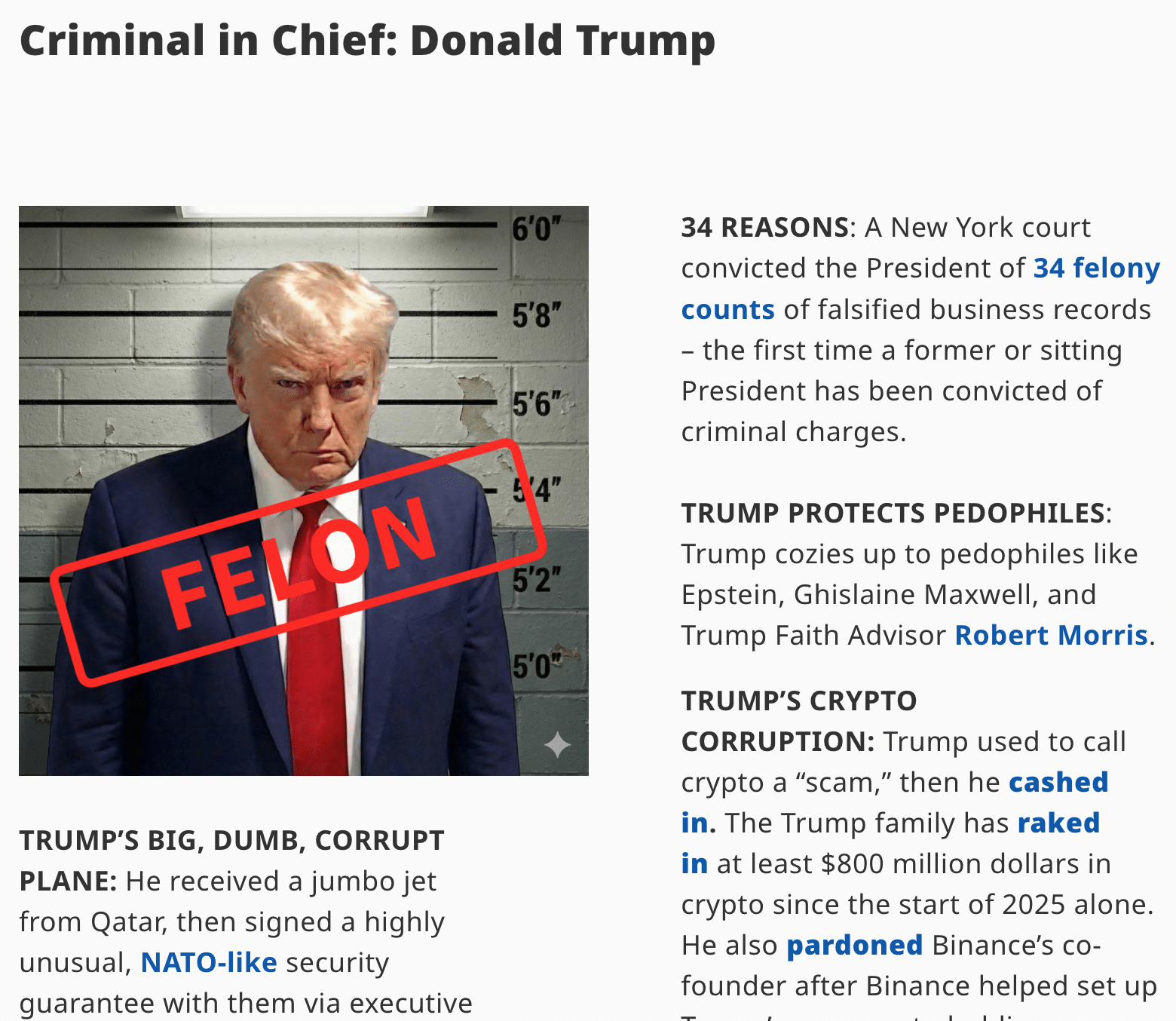
Trump — a felon who freed hundreds of cop assailants on his first day on the job — has an entire infrastructure devoted to trying to spin brown people as criminal. Every time that infrastructure goes into action, including with the effort to brand Somalis in Minnesota as inherently fraudulent when Trump himself is a serial fraudster, we need to repeat, relentlessly, that Trump is a serial criminal who coddles other criminals.
This is something Gavin Newsom just started doing, with an entire website devoted to cataloging Trump’s crime and that of his pardon recipients.
Do not let a conversation about crime go by without focusing on how much of it Trump does.
Crime, in Trump’s era, is a rich white man’s thing. And while it will take a lot of work to adjust a lot of racist priors, until people start seeing Trump as a criminal it will be far too easy for them to make excuses for him.
I focused on Stephen Miller — and the import of making his failures clear — last week.
The import of shifting how we speak of Miller’s considerable power is clear. That’s true because he frankly has done huge damage, even to Trump’s goals, and well more so to average Americans. He’s someone that people, including Republicans, can scapegoat for Trump’s failures (and they’ll be right). And if we don’t make sure that happens, then he’ll scapegoat brown people.
Again, are Somali day care workers or billionaires systematically defrauding average people the problem? One easy to way to drown out Miller’s case that it’s the former is to make it clear how much he personally has harmed average Americans.
Relatedly, particularly as the huge injection of funding Republicans approved last year starts landing at DHS, it will become increasingly necessary to tie the goon squads in the streets to the loss of benefits elsewhere.
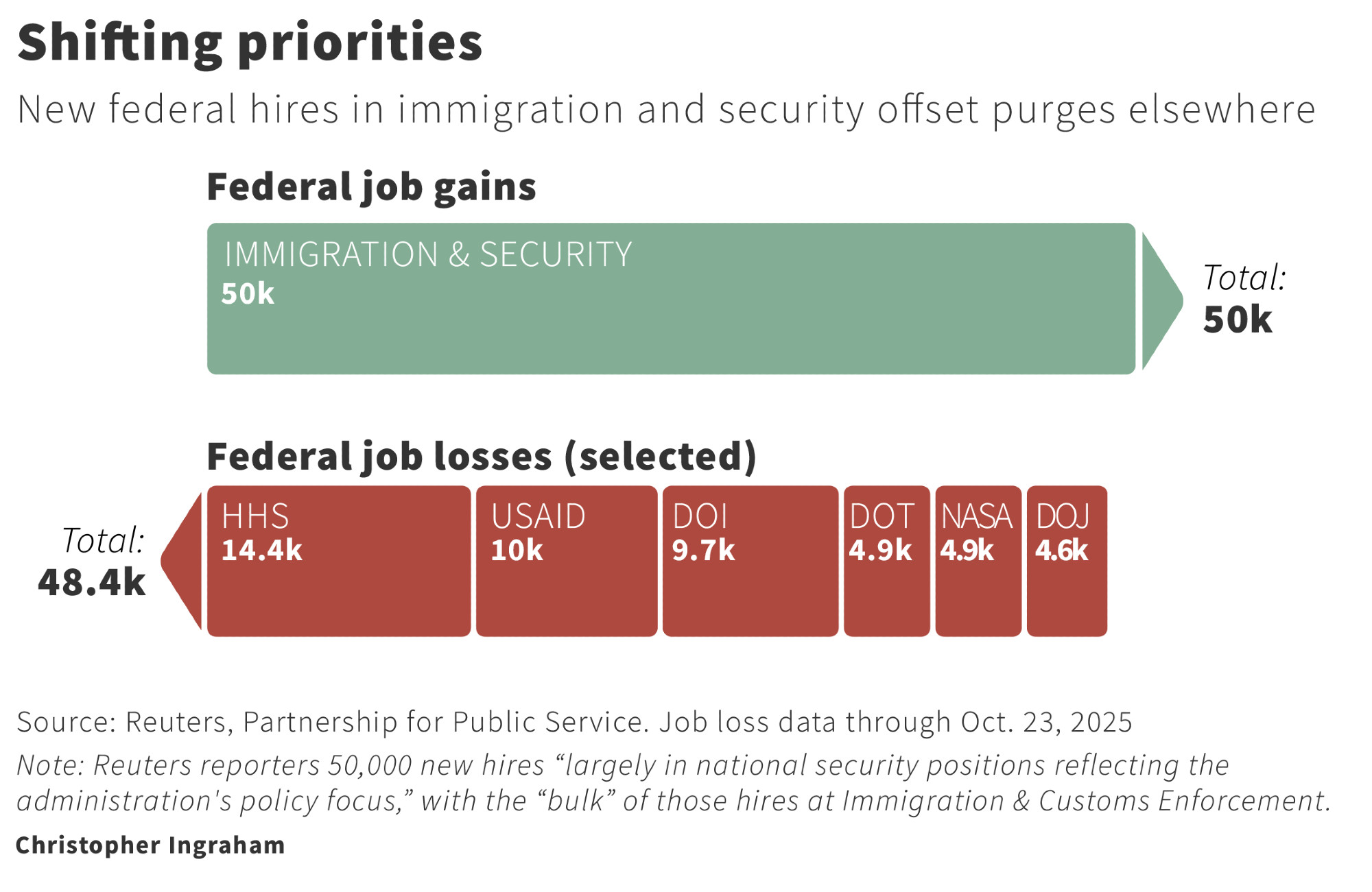
We need to make it clear that this is a direct trade. 50,000 ICE goons in, 300,000 other government employees out, including people who cure cancer, help learning disabled kids get through school, protect our National Parks, ensure your Social Security comes on time, and care for veterans.
Christopher Ingraham did a handy graphic to show the trade-off.
Stephen Miller’s dragnet is unpopular in the abstract and wildly unpopular in the lived sense, even — if meekly — among local Republican leaders.
But it still retains support of a big chunk of the population, probably because Trump officials routinely blame their own failures to address American problems on migrants, when as often as not, Trump’s response to immigration is the source of the problem.
America can’t have nice things, like cures for cancer and welcoming public schools, because Republicans in Congress took the money used to pay for those things and gave it to Stephen Miller to use to invade America’s neighborhoods.
Right wingers like Jonah Goldberg and David French have expressed alarm by an old promo for a 60 Minutes piece (the piece itself was from October) that an influencer reposted yesterday, describing dozens of times when the government lied in court filings.
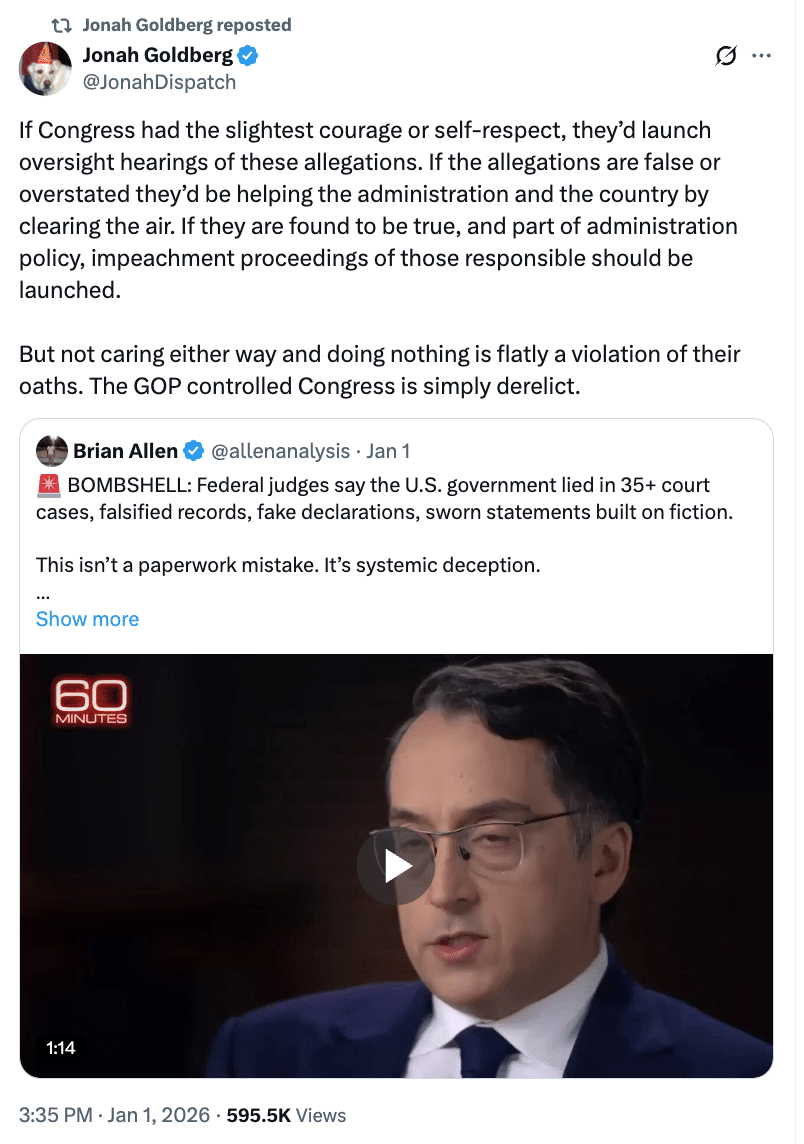
Judges have caught Trump’s DOJ in several major lies since then. In Chicago, Judge Sara Ellis wrote a 233-page opinion documenting the many lies DHS has told about their Chicago invasion.
And in December, judges in both Kilmar Abrego’s case caught the government obfuscating. In the criminal case, on December 30, Judge Waverly Crenshaw unsealed a December 3 opinion describing how Nashville’s US Attorney lied about how centrally involved Todd Blanche’s office was in demanding Abrego face trial.
The central question after Abrego established a prima facie case of vindictiveness is what information in the government’s control sheds light on its new decision to prosecute Abrego, after removing him from the United States without criminal charges. These documents show that McGuire did not act alone and to the extent McGuire had input on the decision to prosecute, he shared it with Singh and others. (Doc. No. 178-1). Specifically, the government’s documents may contradict its prior representations that the decision to prosecute was made locally and that there were no outside influences. For example, Singh contacted McGuire on April 27, 2025, to discuss Abrego’s case. (See Doc. No. 229 at Abrego-Garcia000001). On April 30, 2025, Singh asked McGuire what the potential charges against Abrego would be, whether the charging document would reference Abrego’s alleged MS-13 affiliation, and asked for a phone call before any charges were filed. (Id. at Abrego-Garcia000007–000008). In a separate email on April 30, 2025, Singh made clear that Abrego’s criminal prosecution was a “top priority” for the Deputy Attorney General’s office (Blanche). (Id. at Abrego-Garcia000037). He then told McGuire to “sketch out a draft complaint for the 1324 charge [making it unlawful to bring in and harbor certain aliens].” (Id.). On May 15th, McGuire emailed his staff that “DAG (Blanche) and PDAG would like Garcia charged sooner rather than later.” (Id. at Abrego-Garcia000060).
And as I’ve already noted, Judge Paula Xinis cataloged the many deliberately ignorant declarations DOJ filed about whether DHS had deportation plans for Abrego when she ruled that he must be released.
Respondents showcased Cantú’s ignorance about the content of his Declaration pertaining to Costa Rica. As the pointed questions of Respondents’ counsel made clear, Cantú’s lack of knowledge was planned and purposeful.
Counsel: So paragraph 4, final sentence [of the Cantú Declaration], do you see where it says the word—the words “certain understandings”?
Cantú: I found it. Yes, I do. I see it.
Counsel: What are the certain understandings referenced in the last sentence?
Cantú: I don’t know . . .
Counsel: What are the “contingencies” referenced in the last sentence?
Cantú: I do not know . . .
Counsel: What are the “interim developments” referenced in paragraph 5?
Cantú: I don’t know.
ECF No. 107 at 26:8–27:12 (counsel for Respondents, Jonathan Guynn (“Guynn”), questioning Cantú). See also id. at 53:8–9 (Guynn, at sidebar with Court, stating “I’ll just say I told you this was exactly what was going to happen,” regarding the witness’ ignorance on Costa Rica as a viable country of removal).
Ultimately, Respondents’ calculated effort to take Costa Rica “off the table” backfired. Within 24 hours, Costa Rica, through Minister Zamora Cordero, communicated to multiple news sources that its offer to grant Abrego Garcia residence and refugee status is, and always has been, firm, unwavering, and unconditional.
It’s a problem that, after huge scoldings like these, right wing critics of Trump don’t understand how much Trump’s people lie — not least because the Supreme Court still credits the most outlandish claims Trump makes, even after they’ve been thoroughly debunked by lower court judges.
Many of these lies are coming from the same people: Stephen Miller, Todd Blanche’s office, DHS spox Tricia McLaughlin, and Greg Bovino.
It is remarkable that so many of these people have been caught lying to courts (or publicly, about people before courts). But it needs to become common knowledge for everyone, so every time Tricia says something, they start from the assumption she’s lying, because she almost always is.
There comes a time when the credibility of systematic liars not named Trump collapse entirely such that every utterance they make discredits the claims they try to sell. Tricia McLaughlin, at least, is close those levels of propaganda, and Stephen Miller is not far behind.
Within days of his inauguration last year, Trump signed an EO — adding to one he signed in 2019 — claiming to oppose antisemitism. There has been some discussion about the bad faith of this EO and a DOJ lawyer implementing it, Michael Velchik, once wrote a paper from Hitler’s perspective. While it is explicitly targeted at universities (and has been a key tool to attempt to takeover universities), it nevertheless claimed to oppose antisemitism everywhere.
It shall be the policy of the United States to combat anti-Semitism vigorously, using all available and appropriate legal tools, to prosecute, remove, or otherwise hold to account the perpetrators of unlawful anti-Semitic harassment and violence.
This is the kind of statement of principle that can form the basis of political pressure — particularly as the MAGAt movement splinters around the overt antisemitism of people like Nick Fuentes and Candace Owen, and as political opportunists like Ted Cruz attempt to exploit that splinter.
We’re going to have to fight this battle in any case. As part of the revocation of everything Eric Adams did after he was indicted for bribery yesterday, Zohran Mamdani revoked an EO that gave Israel preferential treatment, which Israel is using to stoke division; yet Mamdani preserved the office Adams opened to combat antisemitism.
We need to call out the dripping antisemitism of Trump’s team, from top (at least JD Vance, who refuses to disavow Fuentes) to bottom.
There are two key Trump aides who should be targeted. Most notably, Paul Ingrassia, who had to withdraw his nomination to be Special Counsel after Politico exposed texts in which he confessed to a Nazi streak been installed at GSA instead. In addition, Kingsley Wilson became DOD spokesperson in spite of Neo-Nazi comments. NPR has done good work unpacking these ties.
Republicans plan on exporting fascism via US tech platforms.
That’s not new. I’ve been talking about Elon’s plans to use Xitter as a machine for fascism for some time.
But since then, Trump’s minions worked it into the National Security Strategy.
And, in the wake of the EU’s sanctions against Elon Musk for — basically — lying about why I have a blue check, Marco Rubio stripped the visas of five people, including US Green Card holder Imran Ahmed, a long time adversary of Elon’s.
But there are several developments that suggest it is time to renew efforts to defend disinformation research, not least the White House’s absurd effort to attack real journalism, what is sure to be a snowballing failure on Bari Weiss’ part to make propaganda popular, and the meltdown the head of DOJ’s Civil Rights division, Harmeet Dhillon, had over the holidays about right wing “misinformation” targeting Pam Bondi.
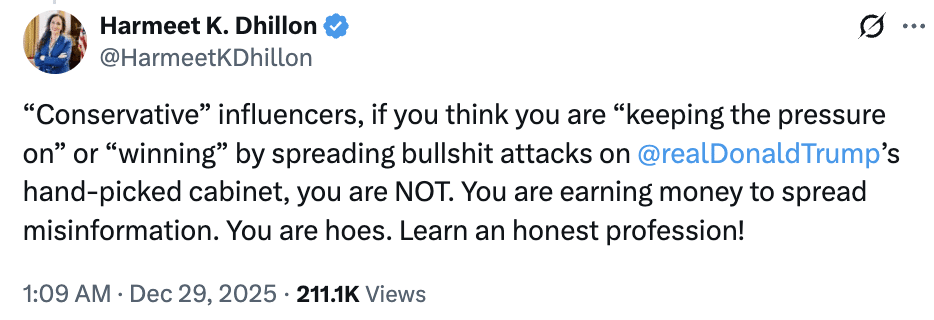
The right wingers are doing what they themselves established is unlawful. And that presents both political and legal opportunities to demonize their propaganda.
Which in turn cycles back to the increasing problem of AI propaganda, including Grok’s flagrant willingness to nudify children in recent days.
Some people write short resolutions. I guess I write 4,000-word To Do lists. Join me in my efforts!

Robert Draper did a 1,000-word piece describing the Four Takeaways of his much longer magazine profile describing Marjorie Taylor Greene’s Break With Trump. It focuses on four steps in the process, which he presents out of chronological order:
I don’t doubt that Draper thinks of the transformation he describes as dominated — bullets one and four — by MTG living by her faith, but the word “Christian” only appears in the 8,100-word profile six times.
And word frequency is just one tell that Draper may be indulging MTG’s own retroactive reconstruction of it.
The profile is based on interviews that took place earlier this month, though as Draper recounts, he has been covering MTG closely since 2021 and met with her repeatedly before this month. The Kirk memorial with which Draper began both his profile and his Four Takeaways occurred on September 21. He describes MTG’s perception of the difference between Erika’s forgiveness and Trump’s doubling down as the moment when, “the stress fracture that had been steadily widening between Greene and her political godfather became an irrevocable break.”
But his stress fracture comment introduces a paragraph listing five policy splits with Trump, most of which predate the Kirk memorial, the most important of which — her support for releasing all the Epstein files — predates the memorial by several weeks and gets its own paragraph here and a more focused treatment later.
Much later, the profile describes that well before the Epstein break came the realization that Trump does not return loyalty (including a campaign disloyalty similar to the one that drove Elise Stefanik’s later break), followed by Trump’s targeted harassment when MTG opposed his cryptocurrency graft.
She considered running against Senator Jon Ossoff but announced in May that she had decided not to.
Greene’s stated reasoning at the time was that “the Senate is where good ideas go to die.” But the week after her announcement, The Wall Street Journal reported that Trump had shared with her a survey from his pollster, Tony Fabrizio, projecting that Ossoff would beat her by 18 points. Later, Trump would claim in a Truth Social post that their split “seemed to all begin” when he sent her the poll — suggesting, in effect, that Greene was pouting over his lack of support: “All I see ‘Wacky’ Marjorie do is COMPLAIN, COMPLAIN, COMPLAIN!” Greene insisted to me, “It wasn’t about a Fabrizio poll.” She added: “I never had a single conversation with the president about it. Instead, he told me all the time, ‘You should run for governor — you’d win.’”
Still, Greene told me, it began to dawn on her that when it came to the president, loyalty is “a one-way street — and it ends like that whenever it suits him.” Being disabused of the idea that subservience would be rewarded appeared to have a liberating effect on her.
In June, Greene did an about-face on the president’s One Big Beautiful Bill after conceding that she voted for it without realizing that it contained a provision that would prevent states from enforcing restrictions on artificial intelligence for a period of 10 years. If the Senate did not strike the moratorium from the bill, Greene publicly warned, “when the O.B.B.B. comes back to the House for approval after Senate changes, I will not vote for it with this in it.” On July 1, the Senate voted to sever the provision from the bill, which Trump signed into law three days later.
Greene broke again from Trump on July 17, arguing on X that his cryptocurrency bill could permit a future president to “TURN OFF YOUR BANK ACCOUNT AND STOP YOUR ABILITY TO BUY AND SELL!!!!!” This time, Trump made his displeasure known to her — and to her peers.
That same day, Greene and roughly a dozen other House Republicans who also had reservations about the bill were summoned to the Oval Office. In Greene’s recollection, Trump focused his wrath on her. “When you have a group of kids,” she said, “you pick the one that is the most well behaved, that always does everything right, and you beat the living shit out of them. Because then the rest of them are like: ‘Oh, man, holy shit. If Dad does that to her, what would he do to me?’” A White House spokeswoman disputes that the meeting was contentious. “Not surprising to me at all,” Greene replied when I informed her of this. “They have major problems, and it’s only starting to build.”
That all preceded the date when MTG signed the Epstein discharge petition, which Tom Massie initiated in July, the day before Trump told her that his friends would get hurt if she exposed their names.
After the hearing, Greene held a news conference at which she threatened to identify some of the men who had abused the women. (Greene says that she didn’t know those names herself but that she could have gotten them from the victims.) Trump called Greene to voice his displeasure. Greene was in her Capitol Hill office, and according to a staff member, everyone in the suite of rooms could hear him yelling at her as she listened to him on speakerphone. Greene says she expressed her perplexity over his intransigence. According to Greene, Trump replied, “My friends will get hurt.”
When she urged Trump to invite some of Epstein’s female victims to the Oval Office, she says, he angrily informed her that they had done nothing to merit the honor. It would be the last conversation Greene and Trump would ever have.
Along the way, Draper inserts something between the Epstein break and the Kirk epiphany and the ultimate break: the 8-week recess, during which MTG stewed as she heard complaints about affordability from her constituents.
But there was one more important ingredient.
As noted, Draper describes the evolving relationship he had with MTG. He first flew down to Rome, GA, in 2022, and honored MTG’s confidences, which built trust. She blew off a meeting for drinks during last year’s convention because Trump was giving her pride of place at the Convention, but shortly thereafter met with a NYT team and scoffed at their claim Trump would pursue retribution. Draper persisted with someone who adhered to the axiom that real news was fake for years.
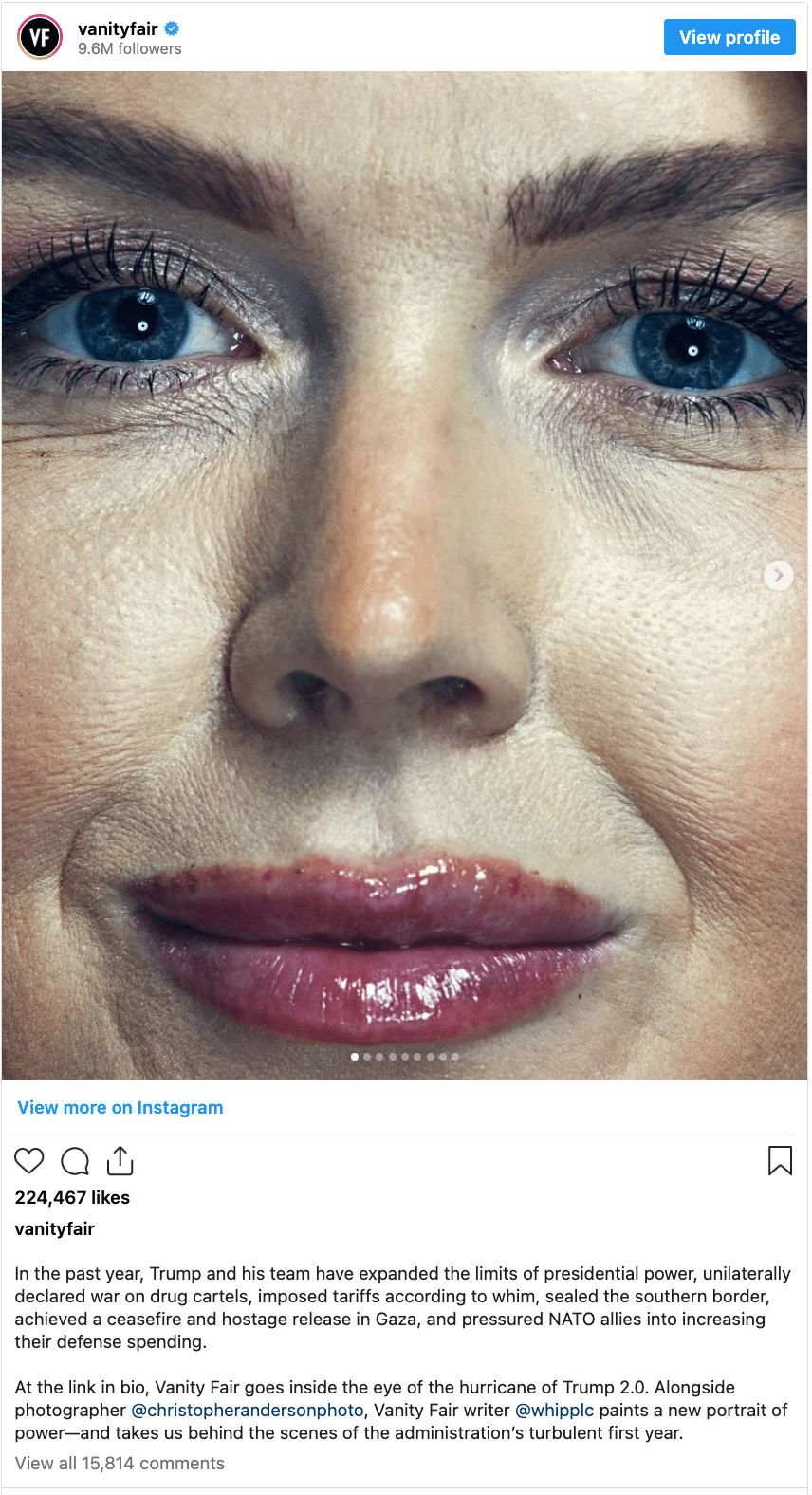
There are a lot of lefties who hate this profile: They feel it goes easy on her (and given the Christian reconstruction, I’d agree). They see it as a willingness to let MTG rebrand herself, even while it foregrounds her transphobia. They hate the glam photo of her, which nevertheless provides helpful context to MTG’s claim she always opposed the plastic femininity of Mar-a-Lago (and provides a useful contrast with the still fresh Karoline Leavitt portrait).
In particular, she told me recently: “I never liked the MAGA Mar-a-Lago sexualization. I believe how women in leadership present themselves sends a message to younger women.” She continued: “I have two daughters, and I’ve always been uncomfortable with how those women puff up their lips and enlarge their breasts. I’ve never spoken about it publicly, but I’ve been planning to.”
I would add that Draper still treats Trump as the actor — Trump banished MTG, rather than she stood her ground in face of his demands.
It has been tempting for some observers to predict that the meteoric crash and burn of the MAGA movement’s loudest champion signals the beginning of the end for its leader as well. But it is Greene who is exiting the stage, while Trump continues to dominate it, as he did through impeachments and indictments and other controversies that no other politician would have survived.
Still, Draper hedges his bets. Maybe she will be a harbinger.
But because it represents an evolution for Greene, she may yet again prove to be a harbinger of a sea change in the movement she once helped lead.
By far the most fascinating part of the profile to me is how Draper traces MTG’s cognitive dissonance. In 2022 — and still today — MTG is certain there’s no way Joe Biden could have won the election in 2020.
One autumn evening in 2022, I ventured to ask just how she thought the 2020 election was stolen. Did she really think that a grand conspiracy, perhaps masterminded by the Obamas and the C.I.A., had secretly rigged the results?
“Robert,” she replied with a searching look, “do you really think Joe Biden got 81 million votes without even campaigning?”
“Yes,” I said. “They counted all the votes. That was the final tally. Why wouldn’t I believe it?” The look she then gave me, which I will never forget, was one of bottomless pity.
But the contrast between the earnest stories of the survivors followed by hearing Trump complain that naming those who abused Epstein’s girls would hurt his friends broke through a belief created by the bubble of Fox News.
The reason for her lack of concern, as Greene explained it to me, might seem improbable to anyone who is unfamiliar with how the mainstream press and the right-wing media cover the same story differently — or not at all. “The story to me,” she said, “was that I’d seen pictures of Epstein with all these people. And Trump is just one of several. And then, for me, I’d seen that Bill Clinton is on the flight logs for his plane like 20-something times. So, for people like me, it wasn’t suspicious. And then we’d heard the general stories of how Epstein used to be a member of Mar-a-Lago, but Trump kicked him out. Why would I think he’s done anything wrong, right?”
For Greene, the decades that Epstein spent eluding justice for exploiting and sexually assaulting countless girls and young women while amassing a fortune, and the seeming efforts by the government to cover up the injustice, “represents everything wrong with Washington,” she told me. This September, Greene spoke with several of Epstein’s victims for the first time in a closed-door House Oversight Committee meeting. She knew that the women had paid their own way to come to Washington. She saw some of them trembling and crying as they spoke. Their accounts struck her as entirely believable. Greene herself had never been sexually abused, but she knew women who had. In her own small way, Greene later told me, she could understand what it was like for a woman to stand up to a powerful man.
One of the most important parts of MTG’s split from Trump has been an evolving relationship with the media, especially Fox News, and therefore, the truth, but with Draper always there persisting. That is, MTG had to work through the cognitive dissonance of learning that Trump really did have ties to Jeffrey Epstein’s sex trafficking, that he really was trying to cover it up, before she got to the point of retconning it all inside a faith narrative. Her own banishment from Fox News may have helped work through the cognitive dissonance.
I talk a lot about one of the ways you fight fascism is to peel off members of Congress, four in the Senate or eight in the House. I’ve laid out repeatedly how central the Epstein scandal was to that process.
Whether you like the Draper profile or not, whether or not MTG’s split from Trump will be a harbinger of more (like Stefanik’s) to come, what this profile does do is show what it took for one diehard MAGAt to go through it: political betrayal, real policy differences, retaliation, and then cognitive dissonance regarding Epstein, the Kirk epiphany, until finally responding to his terrorism in a dramatically different way than almost every other Republican, whether MAGAt or not.
There’s a process.
Something hilarious happened this week.
On Tuesday, Trump’s White House got Marc Caputo to write a credulous column platforming their laughable claims that they’re not responsible for how chaotic the release of the Epstein files has been, that the whole Epstein thing is just unfair to poor Donald Trump. Caputo’s column — the dutiful repetition of even ridiculous claims — is a read of Trump’s own perception of the challenge before him.
But before Caputo got to Trump’s flimsy excuses and the more damning detail — that the White House had taken over DOJ’s Xitter account — he started with his headline scoop: He allowed his sources to claim that the pain of this release will last one more week (that is, a week from Tuesday).
Only one more week.
Scoop: Trump administration expects Epstein files release could last another week
The Trump administration estimates it has about one week to go — and as many as 700,000 more pages to review — before it finishes releasing all the Jeffrey Epstein files.
[snip]
- This will end soon,” another official said. “The conspiracy theories won’t.”
Imagine putting that prediction in writing!
The prediction lasted less than a day.
Even at the time, CNN was reporting that SDFL’s US Attorney’s Office has just solicited “volunteers” to work over the holiday to make this a one-week story.
The Justice Department’s leadership asked career prosecutors in Florida to volunteer over the “next several days” to help redact the Epstein files, in the latest Trump administration push toward releasing the hundreds of thousands of photos, internal memos and other evidence around the late convicted sex offender Jeffrey Epstein.
A supervising prosecutor in the Southern District of Florida’s US Attorney’s Office emailed the entire district office on Tuesday — two days before Christmas — announcing an “emergency request from the [Deputy Attorney General’s] office the SDFL must assist with,” according to a copy of the email reviewed by CNN. “We need AUSAs to do remote document review and redactions related to the Epstein files,” the email said.
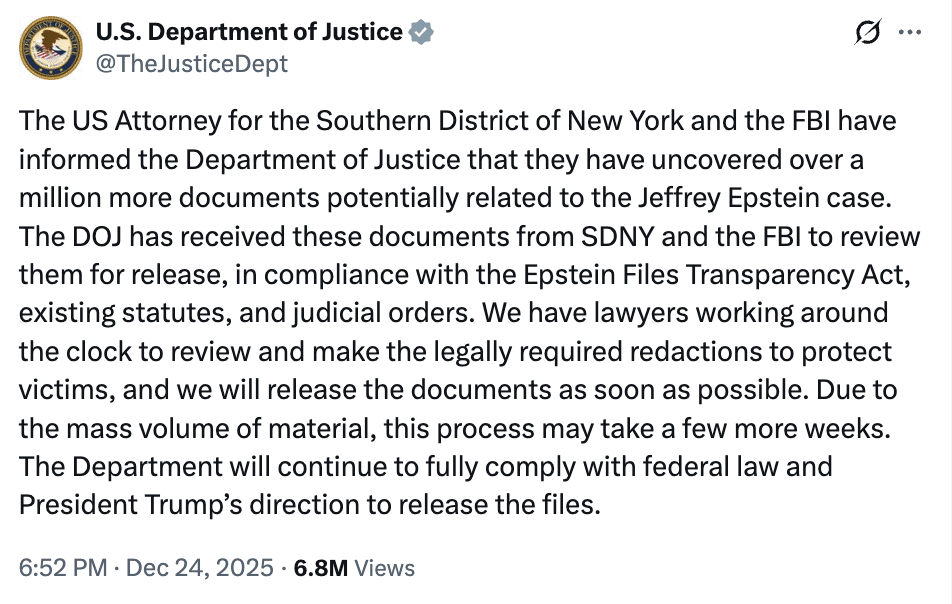
Then, DOJ explained why they needed the volunteers: they (claim they) just discovered a million more pages.
This thing won’t be done in a week or even a month. And the people smoking Caputo need to understand that’s partly due to Todd Blanche’s incompetence, and partly due to the stuff that is a cover-up.
You’re likely to disagree with this opinion, because conventional wisdom on the left holds that the chaos of the Jeffrey Epstein releases to date reflects an attempted cover-up. But the chaos we’re seeing in the Jeffrey Epstein release is not (yet), primarily, a cover-up — though DOJ is flouting the law in ways that will create further scandal that may be entirely unrelated to protecting Donald Trump.
What you’re seeing is incompetence — frankly, the same incompetence we’ve seen from day one on Trump’s efforts to corral the Epstein conspiracy theories which his followers thrive.
Consider the things that have been identified as evidence of an imagined cover-up:
These actually could be readily explainable (and, indeed, all three fit one of the five rules on how to read Epstein files that Ankush Khardori offered on the day of the release — understand what kind of files you’re reading, and the biases people harbor or lies people will tell). For example, if DOJ had released the files with an inventory of the kinds of things the release would include, and the known reliability issues with various kinds of documents, then people might have been prepared to treat the claims made in civil suits with some skepticism. If DOJ had released the alleged Epstein letter with FBI’s own analysis of it, it would have persuaded people that the letter is a fake, if it is.
But DOJ did not do that.
Instead, Todd Blanche sat for a softball interview with Kristen Welker in which he did the following:
The key answer here was Blanche’s claim that DOJ needs to redact for reasons other than protecting victims.
KRISTEN WELKER:
Well, you’re talking about protecting the victims. The law directed the Justice Department to “release internal DOJ communications including emails, memos, meeting notes concerning decisions to charge, not charge, investigate or decline to investigate Epstein or his associates.” That’s the crux of what many of the victims or the survivors say they want to see. Why wasn’t that information prioritized in the first release, Mr. Blanche?
DEPUTY ATTORNEY GENERAL TODD BLANCHE:
Well, first of all it was. And there are numerous documents released on Friday that address what you just quoted from, from the statute that address internal communications within the Department of Justice and internal communications between law enforcement and the Department of Justice. But it’s for the same reason. Because many of those internal communications talk about victims. Many of those internal back and forths between prosecutors and law enforcement talk about victims and their stories. And that has to be redacted. And by the way, everybody expects us to redact that. So the same complaints that we’re hearing yesterday and even this morning from Democrats and from others screaming loudly from a hill about lack of production on Friday, imagine if we had released tons of information around victims? That would be the true crime. That would be the true wrong. And if anybody out there, I heard Congressman Raskin, the Democrat on the House Oversight Committee, releasing statements accusing Attorney General Bondi, Director Patel and myself of not doing our jobs. If they have an issue with me protecting victims, they know how to get a hold of me. But we’re not going to stop doing it.
[snip]
KRISTEN WELKER:
Okay. Let’s delve more deeply into the redactions. Is any information about President Trump redacted in any of the files that have or will be released?
DEPUTY ATTORNEY GENERAL TODD BLANCHE:
No. Not unless it’s supposed to be redacted under the law, which means victim information or any sort of privilege like attorney-client privilege. But I have no reason to believe that the lawyers that are working on this case were talking about President Trump. Because he had nothing to do with the Epstein files. He had nothing to do with the horrific crimes that Mr. Epstein committed. And so I don’t expect there will be anything redacted. But the short answer is we are not redacting information around President Trump, around any other individual involved with Mr. Epstein. And that narrative, which is not based on fact at all, is completely false. [my emphasis]
There aer several problems for Todd Blanche’s claim that there are other reasons that DOJ can redact information — he mentions attorney-client privilege, but that could quickly expand to executive privilege (indeed, elsewhere in the interview he asserts he’ll never share his communications with Trump) or deliberative. The files are also being released with every DOJ identity redacted, including Audrey Strauss and Geoffrey Berman. That may have the temporary advantage, for DOJ, of hiding who was complicit in the sweetheart deal in 2007 and which real champions of the victims, like Maurene Comey, Trump fired right in this middle of this realease.
The problem for Blanche is that judges have already ruled (in unsealing grand jury materials) that the transparency law supersedes other protections.
The Act requires disclosure of Epstein grand jury materials by requiring disclosure of “all unclassified records, documents, communications, and investigative materials.” Id. “All” is crystal clear and should be afforded its “ordinary, common-sense meaning.” … (where Congress was aware of a category and did not exclude the category from the statute, that category is covered).
And so Congress will go to Richard Berman and argue that by withholding privileged or deliberative documents or even prosecutors’ names, DOJ is not complying with the law, and they’ll have precedent on their side.
Shit, Trump will be lucky if this only goes on for another month and not twelve.
The question Welker did not ask but should have is why DOJ is stuck doing this at the last minute if the FBI conducted an even bigger review of the files back in March. Why is DOJ in a mad rush to protect survivors now? Why wasn’t DOJ protecting survivors in March?
And the answer to that question is that, obviously, that earlier review was focused not on victims but on a political calculation: would the release of pictures of Bill Clinton in a public hotel pool in Brunei (which is what got released last week) outweigh the damage of files implicating Trump and his friends (starting with Les Wexner who was named as a potential co-conspirator in some documents already released), and that the conclusion of that earlier review, in July, was that this could not be weaponized like everything else, and so Trump and Todd Blanche personally attempted to pressure Congress to prevent this release at all costs but failed, which is why they’re stuck doing a second last minute review after the earlier one in March.
And eventually, all that — including whatever lists they made in March that Blanche probably hopes to shield under claims of privilege — should be ripe for release under the law. The incompetence of this first release will lead to iterative later releases.
Which brings us to the excuses Caputo platformed. As he describes, everyone is just exasperated, because how dare people take top Trump supporters like Charlie Kirk and Jack Posobiec and Benny Johnson and Kash Patel and Dan Bongino seriously when they focus on these files?
Behind the scenes: There’s a palpable sense of exasperation and annoyance in the administration about all of the headlines pertaining to Trump and Epstein and the inability to explain everything and just get the disclosure done.
- “It’s a combination of extreme frustration at everything: at what Congress did, at our response to it, and a concern that it won’t go away,” an official said.
- “There’s also a little bit of indignation at the media — that this wasn’t even a story for years and years. And now, not only is it a story, but the top of many news pages on a given day.”
How dare Trump’s trolls make this a huge story?!?!?!?!
This remains the problem with Blanche’s actions and everyone else’s. They’re misunderstanding that this is the scandal they rode in on.
They can’t just rely on past tools — like weaponization, like focusing on Clinton (as Trump attempted in his most recent wail about Epstein).
Because the Epstein scandal exists not because of anything Jamie Raskin or Ro Khanna did. The Epstein scandal exists because the conspiracism of it is the core of Trump’s power. Epstein conspiracy theories were always non-falsifiable (which I wrote about here and here and a bunch of other places).
And by attempting to bulldoze Congress on the big issues — on DOJ’s own prerogatives — Todd Blanche is only going to make things worse by creating new scandals.
President Trump arrived late to a healthcare announcement yesterday and didn’t take any questions.
Starting around the same time, DOJ launched some of the most complexly executed Friday Night News dumps going.
The big attraction was the release of the first batch of the Epstein files. The limited release violates the law, which required all files to be released yesterday.
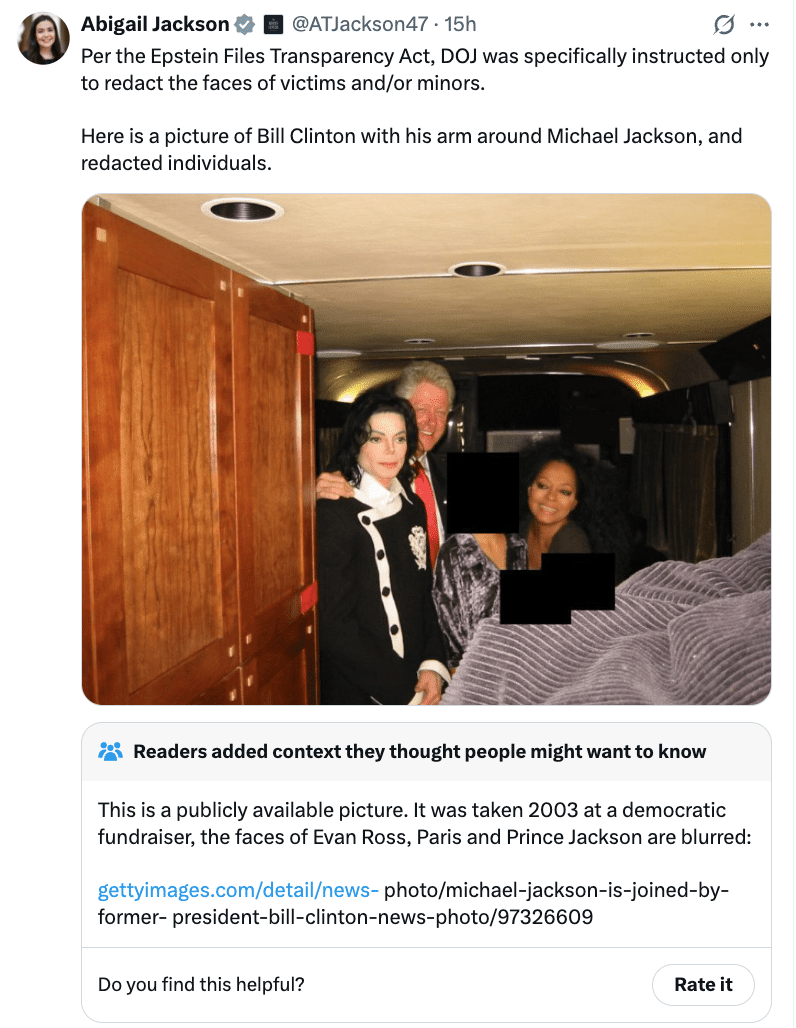
Instead, there were a whole bunch of Bill Clinton photos, the document reflecting Maria Farmer’s complaint from 1996, that went ignored for years, and redacted grand jury transcripts that clearly violate the law. [Update: They have now released the SDNY ones.] The government did not release the proposed indictment and prosecution memo for the indictment that should have been filed in 2007; that may be sealed as deliberative.
Todd Blanche’s wildly dishonest letter (particularly with regards to his claimed concern for victims, after being admonished repeatedly by judges for failing to take that responsibility seriously and a last minute bid that promised but failed to put Pam Bondi on the phone) explaining the release emphasizes how Bondi took over a hundred national security attorneys off their job hunting hackers and spies to conduct a second review; it does not mention the even bigger review the FBI accomplished in March.
The review team consisted of more than 200 Department attorneys working to determine whether materials were responsive under the Act and. if so, whether redactions or withholding was required, The review had multiple levels. First, 187 attorneys from the Department’sNational Security Division (NSD) conducted a review of all items produced to JMD for responsiveness and any redactions under the Act. Second, a quality-control team of 25 attorneys conducted a second-level review to ensure that victim personally identifying information wasproperly redacted and that materials that should not be redacted were not marked for redaction.The second-level review team consisted of attorneys from the Department’s Office of Privacy and Civil Liberties (OPCL) and Office of Information Policy (OIP)—these attorneys are experts in privacy rights and reviewing large volumes of discovery. After the second-level review team completed its quality review, responsive materials were uploaded onto the website for public production as required under the Act. See Sec. 2(a). Finally, Assistant United States Attorneys from the Southern District of New York reviewed the responsive materials to confirm appropriate redactions so that the United States Attorney for the Southern District of New York could certify that victim identifying information was appropriately protected.
That John Eisenberg’s department was in charge of a second pass on these documents is of some interest; there’s no specific competence Nat Sec attorneys would have, but Eisenberg has helped Trump cover stuff up in the past, most notably the transcript of his perfect phone call with Volodymyr Zelenskyy.
Thus far the limited hangout has shifted the focus onto Clinton and away from Trump, but as Kyle Cheney lays out, it risks creating a WikiLeaks effect, in which a focus remains on Epstein for weeks or even months.
Deputy Attorney General Todd Blanche confirmed Friday that the documents would be released on a rolling basis through the holidays — and possibly beyond. And, in court papers filed shortly after Friday’s partial release, the Justice Department emphasized that more files are still undergoing a review and redaction process to protect victims and new Trump-ordered investigations before they can be released.
The daily drip is a remarkable result for President Donald Trump, who has urged his allies to move past the Epstein files — prompting jeers from Democrats who say he’s trying to conceal details about his own longtime relationship with Epstein. Trump has maintained for years that he and Epstein had a falling out years ago, and no evidence has suggested that Trump took part in Epstein’s trafficking operation. Trump advocated for the release of the files only after Republicans in Congress rebuffed his initial pleas to keep them concealed.
[snip]
Trump is no stranger to the political power of intermittent disclosures of derogatory information. In 2016, Trump led the charge to capitalize on the hack-and-leak operation that led to daily publications of the campaign emails of Hillary Clinton and her top allies. The steady drumbeat of embarrassing releases — amplified by Trump and a ravenous press corps — helped sink Clinton’s campaign in its final weeks.
And that’s before the political and legal response to this limited hangout. Some victims are already expressing disappointment — most notably, by the redaction of grand jury material and names they know they shared, as well as the draft indictment from Florida.
Tom Massie and Ro Khanna, while originally giving DOJ the benefit of the doubt, are now contemplating measures they can take — potentially including contempt or impeachment — to enforce this law.
After Fox News was the first to report that the names of some politically exposed persons would be redacted, DOJ’s favorite transcriptionist Brooke Singman told a different story.
And Administration officials are getting burned by Elon’s fascism machine for their dishonesty.
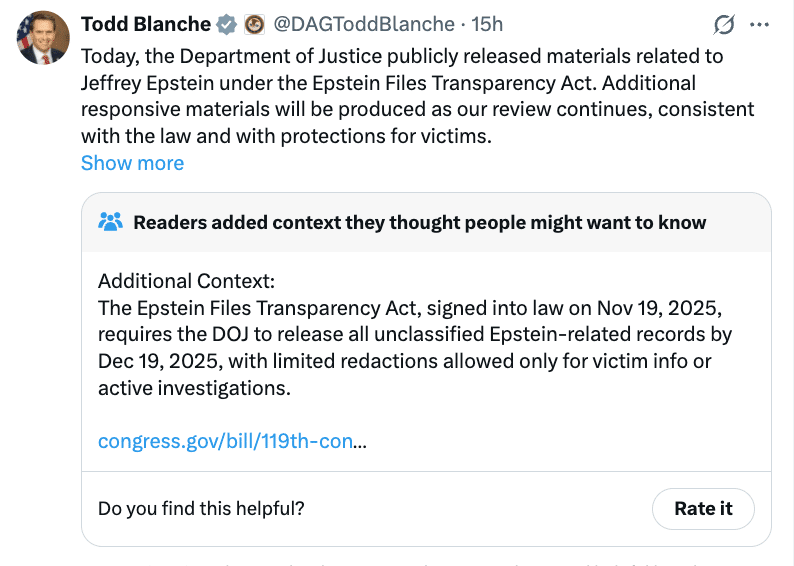
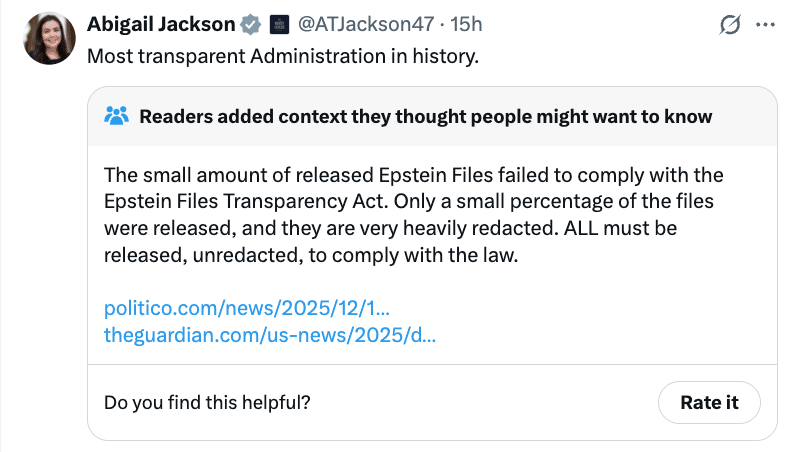
Once again, Trump’s top flunkies may be overestimating their ability to contain their scandal.
Meanwhile, efforts by those same flunkies to punish Kilmar Abrego continue to impose costs.
There have been parallel proceedings with Abrego in the last month. Just over a week ago in his immigration docket, Judge Paula Xinis ordered Kilmar Abrego to be released from ICE custody for the first time since March, and then issued another order enjoining DHS from taking him back into custody at a check-in the next day. Effectively, Xinis found the government had been playing games for months, making claims they had plans to ship Abrego to one or another African country instead of Costa Rica, which had agreed to take him. Those games were, in effect, admission they had no order of removal for him, and so could no longer detain him.
[B]ecause Respondents have no statutory authority to remove Abrego Garcia to a third country absent a removal order, his removal cannot be considered reasonably foreseeable, imminent, or consistent with due process. Although Respondents may eventually get it right, they have not as of today. Thus, Abrego Garcia’s detention for the stated purpose of third country removal cannot continue.
But even as that great drama was happening, something potentially more dramatic was transpiring in Abrego’s criminal docket.
Back on December 4, Judge Waverly Crenshaw, who had been receiving, ex parte, potential evidence he ordered the government turn over in response to Abrego’s vindictive prosecution claim, canceled a hearing and kicked off a fight over disclosures with DOJ. Four days later he had a hearing with the government as part of their bid for partial reconsideration, but then provided a limited set of exhibits to Kilmar’s attorneys.
Then yesterday, in addition to a request that Judge Crenshaw gag Greg Bovino — who keeps lying about Abrego — Abrego’s team submitted filings in support of the bid to dismiss the indictment. One discloses that Todd Blanche’s office was pushed by people within Blanche’s office, including Aakash Singh, who is centrally involved in Blanche’s other abuse of DOJ resources, including by targeting George Soros.
Months ago now, this Court recognized that Deputy Attorney General Todd Blanche’s “remarkable” admission that this case was brought because “a judge in Maryland…questioned” the government’s decision to deport Mr. Abrego and “accus[ed] us of doing something wrong”1 may “come close to establishing actual vindictiveness.” (Dkt. 138 at 7-8). The only thing the Court found missing from the record was evidence “tying [Mr. Blanche’s statements] to actual decisionmakers.” (Id. at 8). Not anymore. Previously, the Court rightly wondered who placed this case on Mr. McGuire’s desk and what their motivations were. (Dkt. 185 at 2). We now know: it was Mr. Blanche and his office, the Office of the Deputy Attorney General, or “ODAG.” On April 30, 2025, just three days after Mr. McGuire personally took on this case, one of Mr. Blanche’s chief aides, Associate Deputy Attorney General Aakash Singh, told Mr. McGuire that this case was a [redacted]2 (Abrego-Garcia000007). That same day, Mr. Singh asked Mr. McGuire: [redacted] (Abrego-Garcia000008). Mr. McGuire responded with a timing update, saying he wanted to about a strategic question, and assuring Mr. Singh [redacted] and [redacted] (Abrego-Garcia000008). These communications and others show, as the Court put it, that [redacted] and [redacted] (Dkt. 241 at 5, 7). The “remarkable” statements “com[ing] close” to establishing vindictiveness (Dkt. 138 at 7-8) came from the same place— ODAG—as the instructions to Mr. McGuire to charge this case. The only “independent” decision (Dkt. 199 at 1) Mr. McGuire made was whether to acquiesce in ODAG’s directive to charge this case, or risk forfeiting his job as Acting U.S. Attorney—and perhaps his employment with the Department of Justice—for refusing to do the political bidding of an Executive Branch that is avowedly using prosecutorial power for “score settling.”3
2 The Court’s December 3 opinion (Dkt. 241) remains sealed, and the discovery produced to the defense in connection with Mr. Abrego’s motion to dismiss for vindictive and selective prosecution was provided pursuant to a protective order requiring that “[a]ny filing of discovery materials must be done under seal pending further orders of this Court” (Dkt. 77 at 2). Although the defense does not believe that any of these materials should be sealed for the reasons stated in Mr. Abrego’s memorandum of law regarding sealing (Dkt. 264), the defense is publicly filing a redacted version of this brief out of an abundance of caution pending further orders of the Court.
3 See Chris Whipple, Susie Wiles Talks Epstein Files, Pete Hegseth’s War Tactics, Retribution, and More (Part 2 of 2), Vanity Fair (Dec. 16, 2025), https://www.vanityfair.com/news/story/trump-susie-wiles-interview-exclusive-part-2.
While the specific content of this discovery remains redacted, the gist of it is clear: Blanche’s office ordered Tennessee prosecutors to file charges against Abrego in retaliation for his assertion of his due process rights.
We know similar documents exist in other cases — most notably, that of LaMonica McIver, Jim Comey, and Letitia James — but no one else has succeeded in getting their hands on the proof.
Speaking of which, the news you heard about yesterday is that DOJ filed its notice of appeal in both the Jim Comey and Letitia James’ dismissals.
The move comes after DOJ tried to indict James again in Norfolk on December 4 and then tried again in Alexandria on December 11, after which the grand jury made a point of making the failure (and the new terms of the indictment, which Molly Roberts lays out here) clear; Politico first disclosed the Alexandria filings here.
But I think the more interesting development — filed close to the time of the notice of appeals (the notices landed in my email box around 5:44-46PM ET on the last Friday before Christmas and the emergency motion landed in my email box around 5:17PM) — was yet another emergency motion in the Dan Richman case, something DOJ (under Lindsey the Insurance Lawyer’s name) keeps doing. After Judge Colleen Kollar-Kotelly issued her ruling that sort of said DOJ had to return Dan Richman’s stuff and move the remaining copy to EDVA, DOJ filed an emergency motion asking for clarification and an extension and (in a footnote) reconsideration. After Kollar-Kotelly granted the extension and some clarification (while grumbling about the tardiness and largely blowing off the motion for reconsideration), DOJ asked for another extension. Then DOJ filed a motion just informing Kollar-Kotelly they were going to do something else, the judge issued a long docket order noting (in part) that DOJ had violated their assurances they wouldn’t make any copies of this material, then ordering Richman to explain whether he was cool with this material ending up someplace still in DOJ custody rather than EDVA.
In its December 12, 2025, Order, the Court ordered the Government to “return to Petitioner Richman all copies of the covered materials, except for the single copy that the Court [] allowed to be deposited, under seal, with the U.S. District Court for the Eastern District of Virginia.” See Dkt. No. 20. The Court ordered the Government to certify compliance with its Order by 4:00 p.m. ET on December 15, 2025. Id. The Court further ordered that, until the Government certified compliance with its December 12 Order, the Government was “not to… share, disseminate, or disclose the covered materials to any person, without first seeking and obtaining leave of this Court.” See Order, Dkt. No. 20 at 2 (incorporating the terms of Order, Dkt. No. 10).
On December 15 (the Government’s original deadline to certify compliance with the Court’s December 12 Order), the Government requested a seven-day extension of its deadline to certify compliance with the Court’s December 12 Order. Dkt. No. 22. Petitioner Richman consented to this extension. Id. And the Government represented that it would “continue to comply with its obligation… not to access or share the covered materials without leave of the Court.” Id. at 11 (citing Order, Dkt. No. 10 and Order, Dkt. No. 20). So the Court granted the Government’s request for extension, thereby continuing the Government’s deadline to certify compliance with the Court’s December 12 Order to 4:00 p.m. ET on December 22. Order, Dkt. No. 26.
As of this date, the Government has not certified compliance with the Court’s December 12 Order. Accordingly, the Government is still under a Court order that prohibits it from accessing Petitioner Richman’s covered materials or sharing, disseminating, or disclosing Petitioner Richman’s covered materials to any person without first seeking and obtaining leave of this Court. See Dkt. No. 10; Dkt. No. 20; Dkt. No. 22; Dkt. No. 26. As the Government admits, the Government provided this copy of Petitioner Richman’s materials to the CISO “after the Government filed its emergency motion,” Gov’t’s Mot., Dkt. No. 31 at 1, fn. 1, in which the Government represented that it would “continue to comply with its obligation… not to access or share the covered materials without leave of the Court.” Dkt. No. 22 at 11.
In last night’s motion for emergency clarification (which had all the clarity of something written after a Christmas happy hour), DOJ explained that they couldn’t deposit the materials (which according to Kollar-Kotelly’s orders, would no longer have the single up-classified memo that Richman first shared his entire computer so FBI could get eight years ago) because there was no Classified Information Security Officer in the courthouse serving DOD, CIA, and ODNI. So they raised new complaints — basically, yet another motion for reconsideration. After having claimed, last week, that they had just a single copy of Richman’s data, they noted that actually they had it in a bunch of places, then pretended to be confused about storage devices.
d. The Court further clarified its order on December 16, 2025, stating that the Court “has not ordered the Government to delete or destroy any evidence.” ECF No. 27 at 2. But the Court has also instructed the Government that it may not “retain[] any additional copies of the covered materials.” ECF No. 20 at 2. The government has copies of the information in its systems and on electronic media. It is not clear how the government can avoid “retaining” the materials without deleting them.
e. The Court has not yet otherwise explained whether the Government must provide to Richman the original evidence “obtained in the Arctic Haze investigation (i.e., hard and/or flash drives and discs currently in the custody of the FBI,” ECF No. 22 at 9, some subset thereof (e.g., not including classified information), whether the Government must provide Richman the covered materials in some other fashion, and what else the Government must do (or not do) to comply with the December 12, 2025 order.
After they confessed, last week, that neither the discontinued e-Discovery software nor the now-retired and possibly impaired FBI agent could reconstruct what happened with Richman’s data five years ago, they insisted they were really keeping track of the data, Pinky Promise.
f. Notwithstanding the passage of time, changes in personnel, and the limits of institutional memory, the Government emphasizes that the materials at issue have at all times remained subject to the Department of Justice’s standard evidence-preservation, record-retention, and chain of custody protocols. The Government is not aware of any destruction, alteration or loss of original evidence seized pursuant to valid court-authorized warrants. Any uncertainty reflected in the Government’s present responses regarding the existence or accessibility of certain filtered or derivative working files does not undermine the integrity, completeness, or continued preservation of the original materials lawfully obtained and retained. The Government’s responses are offered to assist the Court in tailoring any appropriate relief under Rule 41(g) in a manner consistent with its equitable purpose, while preserving the Government’s lawful interests and constitutional responsibilities with respect to evidence obtained pursuant to valid warrants and subject to independent preservation obligations.
Every single thing about the treatment of Richman’s data defies this claim, which is why he had a Fourth Amendment injury to be redressed in the first place.
Nevertheless, in this their second motion fashioned as a motion for clarification, they they propose, can’t we just keep all the data and Pinky Promise not to do anything with it?
g. Rather than require the government to “return” or otherwise divest its systems of the information, the government respectfully suggests that the more appropriate remedy would simply be to direct the government to continue not to access the information in its possession without obtaining a new search warrant. It is not clear what Fourth Amendment interest would be served by ordering the “return” of copies of information (other than classified information) that is already in the movant’s possession, and that the government continues to possess, at least in the custody of a court (or the Department of Justice’s Litigation Security group, as may be appropriate given the presence of classified information). And the Court’s order properly recognizes that it is appropriate for the government to retain the ability to access the materials for future investigative purposes if a search warrant is obtained. ECF No. 20 at 1. Forcing transfer of evidentiary custody from the Executive Branch to the Judiciary would depart from the traditional operation of Rule 41(g), which is remedial rather than supervisory, and would raise substantial separation-of-powers concerns. The government respectfully suggests that the best way to do that is to allow the executive branch of government to maintain the information in its possession, rather than forcing transfer of evidence to (and participation in the chain of custody by) a court. See, e.g., United States v. Bein, 214 F.3d 408, 415 (3d Cir. 2000) (applying then-Rule 41(e) and noting that it provided for “one specific remedy—the return of property”); see also Peloro v. United States, 488 F.3d 163, 177 (7th Cir. 2007) (same regarding now-Rule 41(g)).
Having violated their promise not to make copies without permission once already, they Pinky Promised, again, they wouldn’t do so.
b. The Government shall continue not to access or share the covered materials without leave of the Court. See ECF No. 10 at 4; ECF No. 20 at 2.
And then they offered a horseshit excuse to ask for a two week extension beyond the time Kollar-Kotelly responds to their latest demands (partly arising from their own stalling of this matter into Christmas season) — that is, not a two week extension from yesterday, which would bring them to January 2, but instead two weeks from some date after December 22, which was at the time Richman’s next deadline.
a. Because it is yet not clear to the Government precisely what property must be provided to Richman by December 22, 2025 at 4:00 PM (and what other actions the Government must or must not take to certify compliance with the December 12, 2025 order as modified), the Government respectfully requests that it be provided an additional fourteen days (because of potential technological limitations in copying voluminous digital data and potential personnel constraints resulting from the upcoming Christmas holiday) from the date of the Court’s final order clarifying the December 6, 2025 order to certify compliance. 1
1 An extension of the compliance deadline is merited by the extraordinary time pressure to which the Government has been subjected and the necessity of determining, with clarity, what the Government must do to comply with the December 12, 2025 order as clarified and modified. See Fed. R. Civ. P. 60(b)(6); see also ECF No. 22 at 6–7 (summarizing applicable legal principles). [my emphasis]
They asked, effectively, to stall compliance for a month.
As a reminder, the grand jury teed up before Aileen Cannon convenes on January 12.
Kollar-Kotelly’s response (which landed in my email box at 7:06, so definitely after prime Christmas happy hour time) was … weird. In addition to granting the government part of the extension they requested (until December 29), she all of a sudden asked Richman what happened after he voluntarily let the FBI image his computer so they could ensure there was no classified information in it.
At present, in this second request, the Court would benefit from additional detail from Petitioner Richman regarding the Government’s imaging of Petitioner Richman’s personal computer hard drive in 2017. In 2017, Petitioner Richman consented to have the Government seize his personal computer hard drive, make a copy (an “image”) of his personal computer hard drive, and search his personal computer hard drive for the limited purpose of identifying and deleting a small subset of specified material. The Court is requesting information as to whether the hard drive that Petitioner Richman consented to have imaged by the Government was ever returned to Petitioner Richman, and, if so, whether any of the specified material had been removed from the hard drive that was returned.
Now maybe she’s asking this question simply to refute DOJ’s claim that any material independently held has to be held by a CISO.
The answer to this question is publicly available in the 80-page IG Report on this topic.
On June 13, 2017, FBI agents went to Richman’s home in New York to remove his desktop computer. On June 22, 2017, FBI agents returned the desktop computer to Richman at his home in New York after taking steps to permanently remove the Memos from it. While at Richman’s residence on June 22, 2017, the FBI agents also assisted Richman in deleting the text message with the photographs of Memo 4 from his cell phone.
It’s not clear why they ever kept the image in the first place (remember, they didn’t obtain a warrant to access it until well over two years later).
But I worry that Kollar-Kotelly is getting distracted from the clear recklessness — including DOJ’s most recent defiance of her order and their own Pinky Promises — for which Richman is due a remedy by the distinction between his physical property (the hard drive he got back eight years ago) and his digital property (the image of that hard drive, his Columbia emails, his iCloud, his iPhone, and iPad). The most serious abuse of his Fourth Amendment rights involved his phone, which DOJ only ever had in digital form, regardless of what kind of storage device they stored that content on (which we know to be a Blu-ray disc).
And meanwhile, everything about the government’s actions suggest they’re going to string Kollar-Kotelly along until they can get a warrant from the judge, Cannon, who once said Trump had to be given boxes and boxes of highly classified documents back because they also contained a single letter written by Trump’s personal physician and another letter published in Mueller materials.
They are just dicking around, at this point.
There’s a lot of shit going down in documents signed (as this emergency motion is) with Todd Blanche’s name. He still seems to believe he can juggle his way through politicizing the Department of Justice with some carefully executed Friday Night document dumps.

Throughout this year, I have argued there are four ways to fight fascism — and doing so through the guise of the Democratic Party (especially DC Democrats) is not yet the best way to do so.
I argued these were the four ways to peacefully fight Donald Trump’s authoritarianism:
Since for many of you, today will be the last normal day of the year, and unless Trump sets off a predictable catastrophe, today will also be the last Nicole Sandler show we do, I wanted to check in on how we’re doing on these four issues.
Start with people in the streets.
If 6.5 million people attended October’s No Kings rallies (some estimates go as high as 7 million), it would amount to about 1.8% of the US population. That would make them the biggest protests in American history, but still just halfway to that 3.5% mark, and not directly in response to a particular outrage. The organizing and openness of those protests was a huge accomplishment and, at the very least, taught a lot of people who had never protested before how to do so.
But it wasn’t enough to oust Trump.
A more interesting measure of people in the streets, however, is Chicago (and other anti-ICE/CBP protests). I have no idea what population of Chicago took part in mobilizing to oppose Stephen Miller’s goons. But there are aspects of that mobilization — perhaps most importantly the way media coverage arose from citizen witness to local media to independent media to mainstream outlets — that provided real lessons in how to thrive in a disastrous media environment.
One point I keep making about this kind of opposition: it does not have to be, and arguably is far more successful if it is not, coincident with the Democratic party. Some of the most powerful moments in Chicago’s opposition came when right wingers in conservative suburbs joined in — holy hell those people were assholes!!
Whatever else Stephen Miller’s terrible dragnets have done, they have renewed civil society in most places the invasions happened.
Both Axios and Politico took a break from Dems in Disarray or ragebait stories this week to instead focus on Hakeem Jeffries, both focusing on Jeffries’ success at getting four “moderate” Republicans to vote for his discharge position extending ObamaCare subsidies for three years.
Time and again this year, Democrats under Minority Leader Hakeem Jeffries have maneuvered to successfully undercut the GOP agenda and put its leaders on the back foot. From a daily drumbeat on health care to the long-running saga over the late sex offender Jeffrey Epstein to a new focus on the rising cost of living, they believe they’re succeeding by making the party in power talk about Democratic priorities, not its own.
Their success was underscored this week when four House Republicans joined a Jeffries-led effort to force a vote on expiring Obamacare insurance subsidies — a major embarrassment for the GOP speaker.
“Our message to Mike Johnson is clear — you can run, but you cannot hide,” Jeffries said as he took a victory lap on the House steps Thursday.
And as Politico notes, it started (actually, two months earlier than they credit) with the Jeffrey Epstein effort.
Indeed, since Tom Massie and Ro Khanna, with Jeffries’ cooperation, chased Mike Johnson away a week earlier in July for fear of Epstein votes, Johnson has largely vacated his majority.
There have been limited instances where Republicans have defected on other issues. Just before the SCOTUS hearing on Trump’s illegal tariffs, for example, a handful of Republicans defected to pass resolutions against Trump tariffs.
Where things may get more interesting in the new year — on top of what is sure to be a frantic effort to fix the healthcare crisis Republicans are causing — is on Russia. The NDAA Trump signed yesterday included a number of restrictions on European and Ukrainian funding and troop alignment, measures that directly conflict with Trump’s National Security Strategy.
In a break with Trump, whose fellow Republicans hold majorities in both the House and Senate, this year’s NDAA includes several provisions to boost security in Europe, despite Trump early this month releasing a national security strategy seen as friendly to Russia and a reassessment of the US relationship with Europe.
The fiscal 2026 NDAA provides $800m for Ukraine – $400m in each of the next two years – as part of the Ukraine Security Assistance Initiative, which pays US companies for weapons for Ukraine’s military.
It also authorizes the Baltic Security Initiative and provides $175m to support Latvia, Lithuania and Estonia’s defense. And it limits the Department of Defense’s ability to drop the number of US forces in Europe to fewer than 76,000 and bars the US European commander from giving up the title of Nato supreme commander.
To be sure, thus far, Congress has done nothing to police Trump when he spends money in ways they tell him not to. But these restrictions (along with a few things to make Whiskey Pete Hegseth behave) might set up a conflict early in the year.
Remember: recruiting defectors actually takes efforts to reach out to them, often the opposite of what people think they want.
And while all that is not enough defectors to stop Trump, Marjorie Taylor Greene may set off a stampede for the exit. And that could make it easier for Jeffries, at least, to continue to pants Mike Johnson.
Democrats have done a good job of seeding the ground to get credit for rescuing the country from Trump-caused catastrophes in healthcare and the economy — and both will exacerbate the other in days ahead.
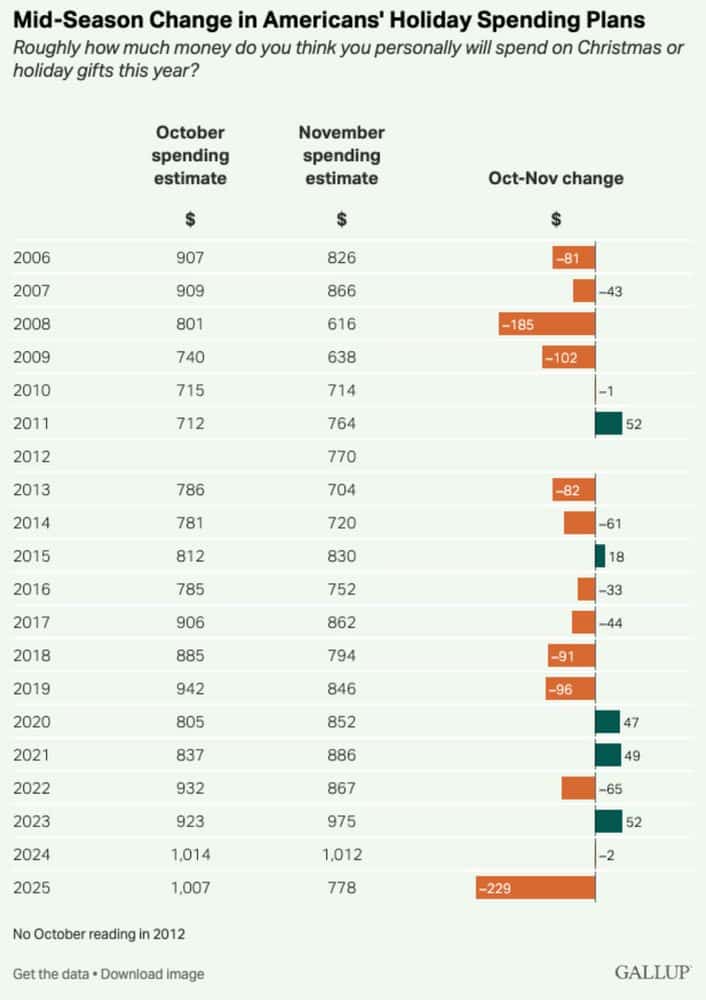
I’m less sanguine that Democrats have prepared to rescue the country (and claim credit) for other likely Trump catastrophes, like a collapsing AI bubble or epidemic. Laying the ground for both is really critical, in the former case bc AI bros plan to spend big in 2026 in the same way crypto bros did in 2024, and in the former case, because bigots are trying to blame rising measles (and, now, whooping cough) on migrants rather than assholes like RFK Jr.
Democrats are doing surprisingly well to position themselves for 2026, both because they’re overperforming by numbers that suggest they will do well (including in elections, like TN-07, with midyear-levels of turnout), and because they’re matching Republican redistricting efforts (and Stephen Miller’s goon squads mean the redistricting in Texas may not turn out like Trump wants).
But it will be harder to achieve a true Blue Wave than in 2018.
Even as this year’s election results have left many in the party encouraged they can mount a massive blue wave, next year’s battleground is a far cry from 2018 — with fewer Republican-held seats for Democrats to easily target.
Democrats don’t need to win as many seats this time around, netting just three seats rather than two dozen to claim a majority. But the hill to reach a comfortable majority like the 235 seats they held after the last blue wave has grown much steeper, driven by multiple rounds of gerrymandering — including ongoing redistricting in several states that threatens to erode the battlefield even further.
The result is that Democrats could post a bigger national swing than in 2018 and still end up with a slimmer majority than they had after that year.
Where Democrats are doing better is in promising consequences if and when they do get a majority.
I’m more interested in Democrats promising those capitulating to Trump — whether it be law firms or Paramount — that there’ll be consequences in 2027 than I am in discussions about impeachment (except for people like RFK Jr, such discussions will work against other Democratic efforts, IMO).
Such efforts, in my opinion, are one way to do more to lay out Trump’s accountability for predictable disasters.
All in all, opponents of fascism have more momentum than they had when caught flat-footed in January. But there’s still a lot of work to do.

The right wing response to the Vanity Fair profile of Susie Wiles (one, two) reveals a lot about the structure of Trump’s power.
While there’s nothing surprising in the profile, Chris Whipple caught Wiles admitting to failures those of outside the White House bubble all recognize, or making laughably false claims to cover them up. And while mostly the response to the profile has been a typical beltway feeding frenzy, much of the focus has been on those expressions of truth or false claims, including how some of them — Wiles’ claims that Trump was targeting Letitia James, her confession that Trump is seeking regime change in Venezuela, Trump’s awareness that Putin wants all of Ukraine — could have lasting legal and political repercussions.
Not so the right wing, though. Theirs has been a two-fold response: first, declaring not that the profile got anything wrong, much less made up any of the abundant direct quotes, but instead that they remain loyal to Susie Wiles. After everyone had performed their expression of loyalty, the right wing turned to complaining that photographer Christopher Anderson captured Trump’s aides’ ugliness and warts.
Behind those expressions of loyalty and vanity complaints, however, the profile includes a string of confessions that Trump, that Susie Wiles, that they all have failed.
The immediate response was a performance of loyalty. First Wiles claimed in a (for her) very rare tweet that the profile had taken things out of context and ignored positive things she said. Then one after another Trump loyalist RTed that tweet and testified to how great she is and how loyal they are to her or she is to Trump.
The loyalty oaths were particularly amusing to watch through Chris LaCivita’s eyes. First he RTed Wiles’ tweet.
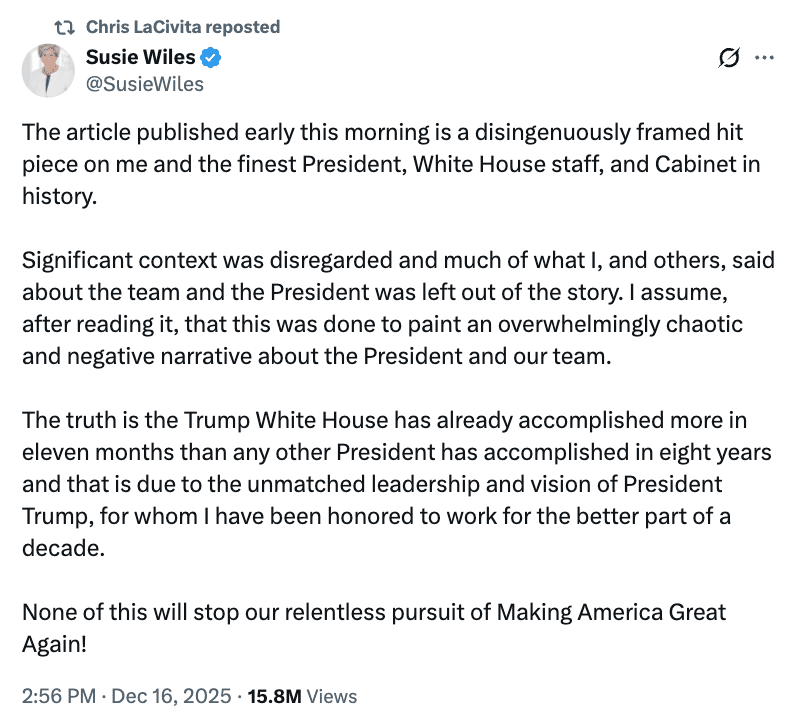
Then he tried to distract with yesterday’s scandal.
Then he posted one…
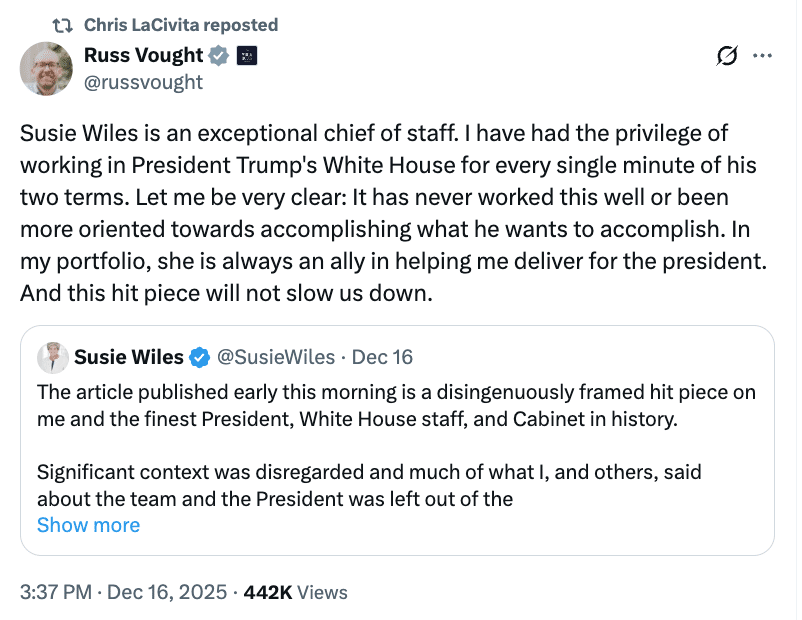
After another declaration of loyalty to Wiles. This Don Jr tweet — “When others cowered, she stood strong” is quite long and amusing in the original.

Scott Bessent’s claim of inaccuracy is especially notable given how Wiles described half of Trump’s advisors to be opposed to Trump’s tariffs (as I’ll show below).
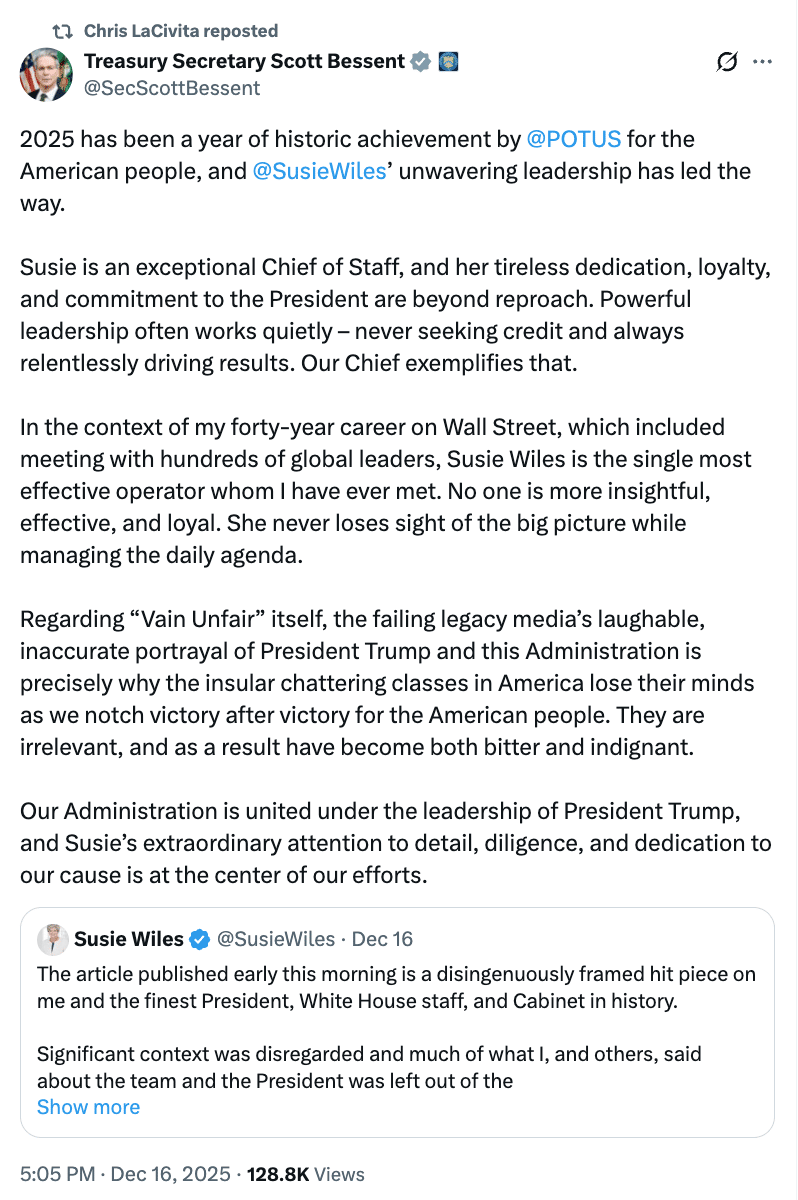
LaCivita thought dumb boomerang memes would be persuasive.

More celebration of blind loyalty.
Failures hailing her role in their failure.

All leading up to this tweet, from the lady who used to pretend to be objective but now works with the former Trump spox who tried to hide behind the shrubbery, once.
Rachael Bade really did claim it was a big scoop to describe a “Wiles loyalist and Trump ally” explaining what was visible on Xitter for all to see as “circling the motherfucking wagons.”
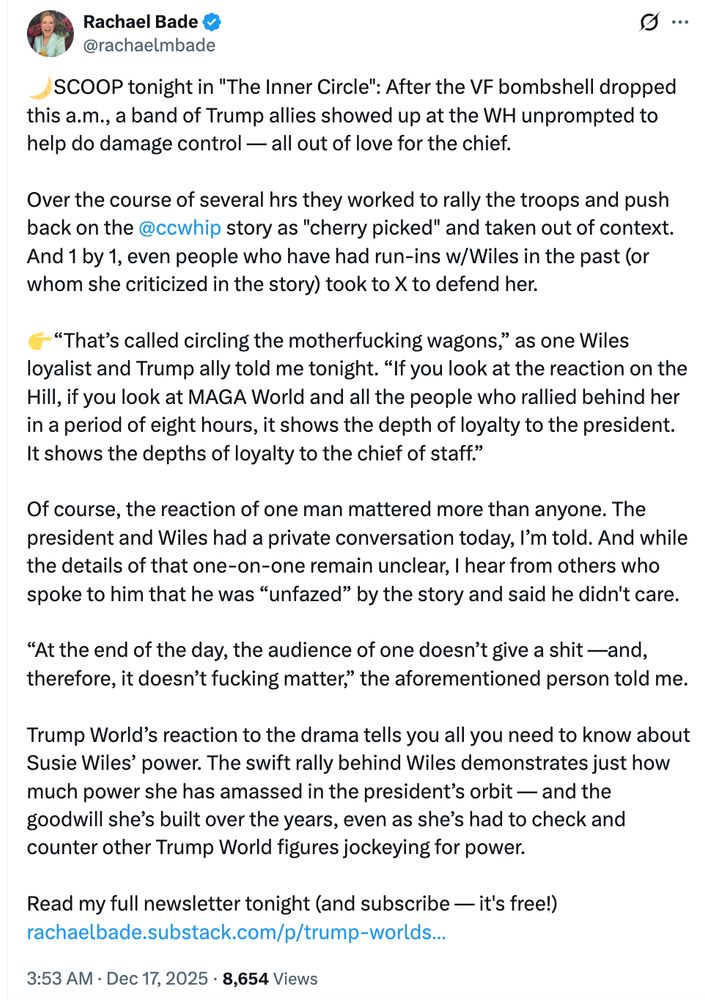
Sure. It’s clear that’s what you were doing. But honestly, a good many people who read the profiles weren’t seeking to split the White House, they were seeking to understand what Trump’s low-key Chief of Staff does or thinks.
The loyalty that prevents you from seeing the failures she confessed doesn’t prevent us from seeing them.
Then people started complaining about the photography, particular a picture that revealed the slop on Karoline Leavitt’s face and the injection marks in her lips.
WaPo did a great interview with the photographer, Christopher Anderson, where he explained his view of photojournalism and truth.
I want to talk to you about the portraits that you did for Vanity Fair. As I assume you have heard, they’ve caused a bit of a splash on social media. Can you tell me how you conceived of them?
I conceived of it many years ago. I did a whole book of American politics called “Stump” (2014), where I did all close-ups. It was my attempt to circumnavigate the stage-managed image of politics and cut through the image that the public relations team wants to be presented, and get at something that feels more revealing about the theater of politics. It’s something I’ve been doing for a long time. I have done it to all sides of the political spectrum, not just Republicans. It’s part of how I think about portraiture in a lot of ways: close, intimate, revealing.
[snip]
The images are really arresting. What is your response to people who say that these images are unfair? There’s been a lot of attention about Karoline Leavitt’s lips and [what appear to be] injection sites.
I didn’t put the injection sites on her. People seem to be shocked that I didn’t use Photoshop to retouch out blemishes and her injection marks. I find it shocking that someone would expect me to retouch out those things.
[snip]
Were they coming camera-ready, or was there a hair-and-makeup team?
Most of them came camera-ready or with their own hair-and-makeup team. Karoline Leavitt has her own personal groomer that was there.
I mean, we don’t know if Karoline Leavitt still has that groomer today now that the photos are published.
Well, what can I say? That’s the makeup that she puts on, those are the injections she gave herself. If they show up in a photo, what do you want me to say? I don’t know if it says something about the world we live in, the age of Photoshop, the age of AI filters on your Instagram, but the fact that the internet is freaking out because they’re seeing real photos and not retouched ones says something to me.
Click through for the great quote about Stephen Miller’s plea for kindness.
But none of this pushback — none of it — claims that lifelong chronicler of Chiefs of Staff Chris Whipple ever made up a quote.
Accordingly, that means no one has disputed Wiles’ admission that Trump’s policies have largely failed.
Here’s how Whipple summarized Trump’s term so far, close to the beginning of part one:
It’s been a busy year. Trump and his team have expanded the limits of presidential power, unilaterally declared war on drug cartels, imposed tariffs according to whim, sealed the southern border, achieved a ceasefire and hostage release in Gaza, and pressured NATO allies into increasing their defense spending.
At the same time, Trump has waged war on his political enemies; pardoned the January 6 rioters, firing nearly everyone involved in their investigation and prosecution; sued media companies into multimillion-dollar settlements; indicted multiple government officials he perceives as his foes; and pressured universities to toe his line. He’s redefined the way presidents behave—verbally abusing women, minorities, and almost anyone who offends him. Charlie Kirk’s assassination in September turbocharged Trump’s campaign of revenge and retribution. Critics have compared this moment to a Reichstag fire, a modern version of Hitler’s exploitation of the torching of Berlin’s parliament.
How he tells this story — though Wiles’ own assessments of Trump’s success or failure — is more interesting. The following, save the last one, are presented in the order Whipple addresses them in the profile.
End the congressional filibuster and remove Nicolás Maduro from power. [A November portrayal; results still TBD]
The agenda was twofold: ending the congressional filibuster and forcing Venezuelan president Nicolás Maduro from power.
Pardon just those who were January 6 “happenstancers.” [Wiles lies to cover up her failure to achieve this goal]
Wiles explained: “In every case, of the ones he was looking at, in every case, they had already served more time than the sentencing guidelines would have suggested. So given that, I sort of got on board.” (According to court records, many of the January 6 rioters pardoned by Trump had received sentences that were lighter than the guidelines.) “There have been a couple of times where I’ve been outvoted,” Wiles said. “And if there’s a tie, he wins.”
Preserve parts of USAID. [Complete failure, but one Marco Rubio is lying about]
Musk forged ahead—all throttle, no brake. “Elon’s attitude is you have to get it done fast. If you’re an incrementalist, you just won’t get your rocket to the moon,” Wiles said. “And so with that attitude, you’re going to break some china. But no rational person could think the USAID process was a good one. Nobody.”
[snip]
Did Rubio have any regrets about the untold number of lives that PEPFAR’s evisceration might cost? “No. First of all, whoever says that, it’s just not being accurate,” he told me. “We are not eviscerating PEPFAR.
Stephen Miller’s deportation policies. [In Wiles’ estimation, a failure]
Not long after the El Salvador deportation fiasco, in Louisiana, ICE agents arrested and deported two mothers, along with their children, ages seven, four, and two, to Honduras. The children were US citizens and the four-year-old was being treated for stage 4 cancer. Wiles couldn’t explain it.
“It could be an overzealous Border Patrol agent, I don’t know,” she said of the case, in which both mothers had reportedly been arrested after voluntarily attending routine immigration meetings. “I can’t understand how you make that mistake, but somebody did.”
Tariffs. [Wiles failed to prevent Trump’s worst instincts and the results have been worse than she imagined]
Wiles believed a middle ground on tariffs would ultimately succeed, she said, “but it’s been more painful than I expected.”
Invading blue cities. [Wiles says Trump won’t do this to stay in power]
Will the president use the military to suppress or even prevent voting during the midterms and beyond?
“I say it is categorically false, will not happen, it’s just wrongheaded,” she snapped.
November’s election. [Wiles knew they were in trouble, but even so was overoptimistic]
Wiles thought the GOP had a chance of electing the governor in New Jersey, but she knew they were in for a tough night.
The Epstein files. [Trump and Kash, both lying about what was in the files but that’s okay because MAGAts aren’t obsessed with Epstein]
For years, Kash has been saying, ‘Got to release the files, got to release the files.’ And he’s been saying that with a view of what he thought was in these files that turns out not to be right.”
[snip]
Wiles said. “It’s the Joe Rogan listeners. It’s the people that are sort of new to our world. It’s not the MAGA base.”
Murderboats and frivolous wars. [Pure self-deception]
“Not that he wanted to kill people necessarily, but stopping the killing wasn’t his first thought. It’s his first and last thought now.”
[snip]
“He wants to keep on blowing boats up until Maduro cries uncle. And people way smarter than me on that say that he will.”
Russian peace efforts. [Wiles says they’re lying about Russia wanting peace]
Trump’s team was divided on whether Putin’s goal was anything less than a complete Russian takeover of Ukraine. “The experts think that if he could get the rest of Donetsk, then he would be happy,” Wiles told me in August. But privately, Trump wasn’t buying it—he didn’t believe Putin wanted peace. “Donald Trump thinks he wants the whole country,” Wiles told me.
In October I asked Rubio if that was true. “There are offers on the table right now to basically stop this war at its current lines of contact, okay?” he said. “Which include substantial parts of Ukrainian territory, including Crimea, which they’ve controlled since 2014. And the Russians continue to turn it down. And so…you do start to wonder, well, maybe what this guy wants is the entire country.” (In Wiles’s office is a photograph of Trump and Putin standing together, signed by Trump: “TO SUSIE YOU ARE THE GREATEST! DONALD.”)
Trump would only spend 90 days on retribution. [Wiles is in denial]
“Yes, I do,” she’d replied. “We have a loose agreement that the score settling will end before the first 90 days are over.”
In late August, I asked Wiles: “Remember when you said to me months ago that Trump promised to end the revenge and retribution tour after 90 days?”
“I don’t think he’s on a retribution tour,” she said.
Trump’s biggest accomplishments: Peace and the Big Ugly
“I think the country is beginning to see that he’s proud to be an agent of peace. I think that surprises people. Doesn’t surprise me, but it doesn’t fit with the Donald Trump people think they know. I think this legislation [the so-called One Big Beautiful Bill], which funded the entire domestic agenda, is a huge accomplishment. And even though it isn’t popular in total, the component parts of it are. And that will be a very big deal in the midterms.”
That is, like the Epstein scandal more generally, Wiles either invents bubble-wrapped fictions about Trump’s own success, or concedes she, or Trump, has failed.
But Trump’s aides — the people complicit in this failure — don’t care.
They’re just going to circle the motherfucking wagons and demand loyalty.
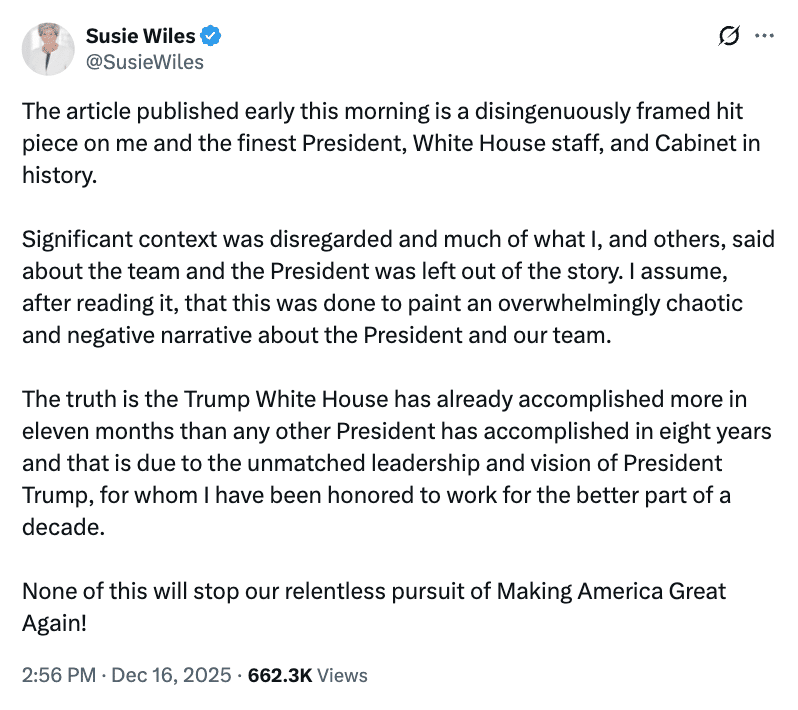
One of the longest part of Vanity Fair’s two-part (one, two) interview with Susie Wiles focuses on Jeffrey Epstein. It goes like this:
¶1: Chris Whipple’s explanation of why it’s important.
¶2: Wiles’ admission she underestimated the import of it.
¶3: A review of Pam Bondi’s binder fiasco, with Wiles commenting on Bondi’s fuck-up.
¶4: A report on how many FBI agents reviewed the files, with Wiles’ claim they weren’t just searching for Trump.
¶5: Wiles’ claim there was nothing bad on Trump in the files, just him and Epstein being “young, single playboys.”
¶6: Wiles debunking Trump’s false claims about Clinton’s ties to Epstein.
¶7: Wiles describing that Kash Patel and Dan Bongino really understood Epstein, except Kash was wrong.
¶8: Wiles’ failure to offer an explanation for Todd Blanche’s interview with Ghislaine Maxwell.
¶9: Wiles’ claim that Trump was pissed Ghislaine got moved.
¶10: Wiles’ claim that the birthday letter to Epstein is not from Trump.
¶11 – ¶12: Wiles’ claim that Trump would sit for a deposition in his WSJ lawsuit if necessary.
¶13: Whipple explaining the threat of the Epstein files again, then quoting Wiles on who cares about it.
¶14: Someone at the White House who might be JD Vance explaining who cares about it.
¶15: A specific mention of Vance, with further explanation of those who care about Epstein.
Elsewhere, Wiles credits herself with a great read of electoral outcomes (even while describing her own prediction that Jack Ciattarelli might beat Mikie Sherill last month): She was certain they would win last year, she didn’t think November would be that bad, they’re going to win midterms.
Her confidence (even if feigned) is why I’m so interested in Wiles’ description of the relative knowledge about Epstein. As noted, she admitted to Whipple that she didn’t understand how important this scandal could be, deferring knowledge on such issues to Kash Patel, Dan Bongino, and JD Vance — two of whom she describes as conspiracy theorists.
Wiles told me she underestimated the potency of the scandal: “Whether he was an American CIA asset, a Mossad asset, whether all these rich, important men went to that nasty island and did unforgivable things to young girls,” she said, “I mean, I kind of knew it, but it’s never anything I paid a bit of attention to.”
[snip]
The people that really appreciated what a big deal this is are Kash [Patel] and [FBI deputy director] Dan Bongino,” she said. “Because they lived in that world. And the vice president, who’s been a conspiracy theorist for a decade…. For years, Kash has been saying, ‘Got to release the files, got to release the files.’ And he’s been saying that with a view of what he thought was in these files that turns out not to be right.” [brackets original]
But then six paragraphs after describing that longtime Trump loyalist Kash Patel was totally into [a false belief] about the Epstein files, first Wiles and then someone who might be JD Vance (who is mentioned in the following paragraph) describe their understanding of who cares about this: “people that are sort of new to our world.”
The Epstein files debacle poses a dire political threat to Trump and the future of the GOP. “The people that are inordinately interested in Epstein are the new members of the Trump coalition, the people that I think about all the time—because I want to make sure that they are not Trump voters, they’re Republican voters,” Wiles said. “It’s the Joe Rogan listeners. It’s the people that are sort of new to our world. It’s not the MAGA base.”
A senior White House official described the mindset of an overlapping bloc of voters who are angered by both Trump’s handling of the Epstein files and the war in Gaza. It’s as much as 5 percent of the vote and includes “union members, the podcast crowd, the young people, the young Black males. They are interested in Epstein. And they are the people that are disturbed that we are as cozy with Israel as we are.”
Susie Wiles, who has been around Trump since he was first elected, claims “the people that are inordinately interested in Epstein” are “not the MAGA base”!!!
And then that anonymous White House official who might be JD Vance (whom Wiles explains is a conspiracy theorist) describes that the “young Black males” are the ones who care about Epstein.
To be fair, it is the case that the MAGAt base voters who do care deeply about this — people like Charlie Kirk, Benny Johnson, and Jack Posobiec — quickly fell in line when Trump demanded they stop talking about Epstein in July.
But like Kash and Bongino themselves, these are the people who made Epstein specifically and conspiracy theories about pedophiles more generally some of the central glue of Trump’s coalition.
As I wrote for TPM’s anniversary series, the superpower of reclaiming attention which Trump has honed with these same far right trolls has always been developed in parallel with the use of conspiracy theories about pedophilia — from Posobiec’s Pizzagate, to QAnon, to Epstein — to keep that attention.
On July 8, something happened to Donald Trump that I’ve not seen happen in the entire decade he has dominated presidential politics. As his base clamored for more disclosures about sex trafficker Jeffrey Epstein, his superpower — his ability to grab and redirect attention — briefly failed him. “Are you still talking about Jeffrey Epstein?” he whined when a journalist asked about the Justice Department’s decision to abort any further disclosure of documents related to the case. “This guy’s been talked about for years.”
[snip]
Two things had disrupted Trump’s superpower. First, after Trump’s top DOJ appointees — Attorney General Pam Bondi, FBI Director Kash Patel, and his deputy Dan Bongino – had fueled, then disappointed, MAGA’s demand for Epstein disclosures, the failure to fulfill their promises fed the conspiracy itself. By thwarting the conspiracists’ demands, Bondi, especially, created rifts and distrust in Trump’s own base.
Conspiracy theories about Epstein were always non-falsifiable; the mob will never be satisfied. But Bondi made that dynamic worse.
More important for understanding what happened in July: the very same online trolls who’ve been critical partners in Trump’s success managing attention were precisely the same people who had spun those conspiracy theories. There is a direct through-line from a relatively small set of social media accounts that helped Trump win the 2016 election to PizzaGate and, after that, QAnon. QAnoners played a key role in Trump’s 2021 insurrection attempt, and its adherents remain a substantial portion of Trump’s base. Since 2016, pro-Trump trolls’ exploitation of social media algorithms to redirect political news coverage — whether from legacy media or newer outlets — has disrupted traditional news cycles.
And while some of what Wiles says about Epstein — her claim Trump was pissed Ghislaine got moved, her feigned certainty that the birthday letter is not from Trump — is clearly bullshit, Wiles and the anonymous person who might be JD nevertheless offered a very specific, and very inaccurate, description of which Trump voters care about Epstein.
Maybe they’re telling this tale because it’s the same thing they told House members in a bid to kill the Massie-Khanna discharge petition. Maybe they’re telling this tale because everyone Wiles thinks knows about Epstein is a conspiracy theorist and the guy who really knows is just a former young playboy.
But even though Trump got Kirk and Benny and Posobiec to give up their sustained demand for Epstein materials, it remains the case that Trump has never fully recovered from the fiasco in July. First Mike Johnson had to flee a week early in July or risk embarrassing votes, then Bondi’s desperate bid — using the White House situation room — to convince Lauren Boebert to defect from the discharge petition backfired, then the Epstein fiasco ultimately led Marjorie Taylor Greene to break with Trump more substantially.
And tomorrow, DOJ will be forced to hand over the Epstein files themselves.
For five months, Epstein has remained at least a low-level burn undermining Trump’s ability to manage the public’s focus and his own policy goals. The Epstein thing was the first thing that led Republicans to defect, and now they’re defecting left and right.
And yet Wiles (and her anonymous friend who might be conspiracy theorist JD Vance) professes to believe the only people who care about Epstein are the young Black voters that Trump just won over last year?
That’s either a fantastic lie. Or a confession that explains far more about why Trump has bolloxed Epstein so badly.
Update: On Xitter, Liz Wheeler (no known relation), one of the recipients of Bondi’s binder, focuses on the same passages I did — blaming Wiles for misinforming Trump about how important this is to MAGAts. But she doesn’t note what I do: that Wiles, at least, is still unclear how important it is.
It now makes total sense as to why President Trump has—at times—dismissed the Epstein scandal and even called it a “hoax.” Over the summer, Trump said he did not understand why many of his supporters were so fixated on Epstein.
Well, now why know why he said that—it would seem Susie Wiles was the one misinforming Trump about the MAGA base’s concerns.
We care about the Epstein files because we want transparency, we want the elites held accountable, and we want JUSTICE for the Epstein victims.
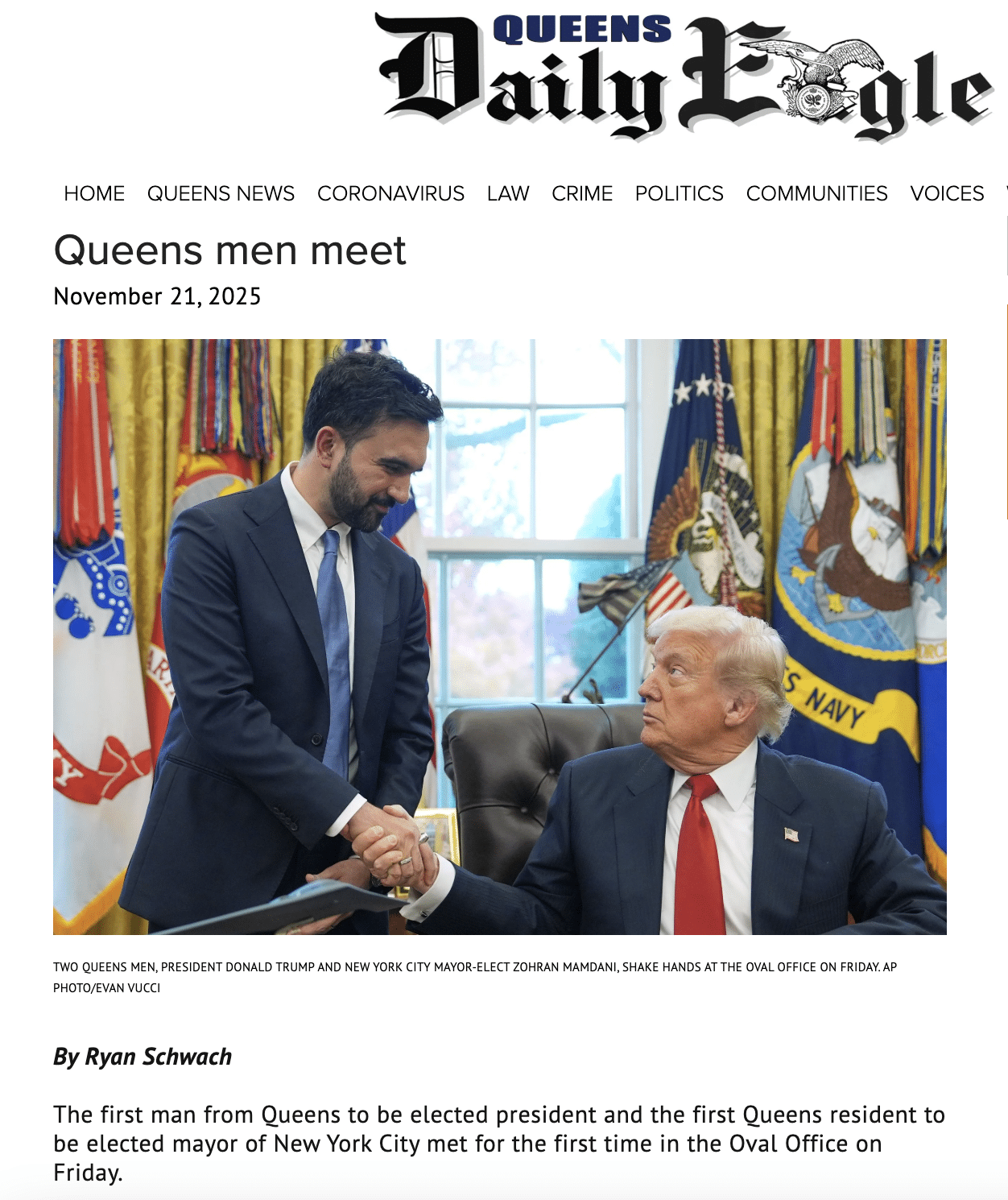
Three things happened in the last week that have befuddled a lot of observers, but which might best be understood as the kinds of developments we’ll see increasingly as the power structure around Trump grows fragile and fluid:
All of these, in my opinion, arose out of and reflect Trump’s increasing political weakness, his separate mental and physical decline, and the fight for power that results.
Much of the focus on the Trump-Mamdani meeting was on what Trump did, such as his interruption before Mamdani had to answer whether he believed Trump was a fascist, rather than on what Mamdani said. But if you look closely at what Mamdani said — which was often simply a restatement of his campaign pitch — he managed to say them in such a way that Trump parroted them as his own.
Both men centered their statements on their shared love of New York City, which is real and has been underplayed.
Mamdani’s first comment did so — as did his relentlessly disciplined campaign did — in terms of affordability; Mamdani mentioned “groceries,” the awkward shorthand Trump’s handlers have had him use to address affordability.
Mr. Trump: You know, we had some interesting conversation, and some of his ideas really are the same ideas that I have. A big thing on cost. The new word is “affordability.” Another word, it’s just groceries. It’s sort of an old-fashioned word, but it’s very accurate. They are coming down. They are coming down.
Mamdani repeatedly spoke in terms of Trump’s voters (again, a line directly from his campaign).
Trump had no idea that Mamdani targeted Trump voters, and as the coalition that elected him last year abandons him in the polls, Trump took notice when Mamdani explained that.
When I spoke to New Yorkers who had voted for the president last November on Hillside Avenue and Fordham Road, I asked them why. I heard, again and again, two major reasons. One was that they want an end to forever wars — they wanted an end to the taxpayers’ dollars we had funding violations of human rights, and they wanted to address the cost-of-living crisis. And I appreciated the chance to discuss both of those things.
Mr. Trump: He said a lot of my voters actually voted for him.
Mr. Mamdani: One in 10.
Mr. Trump: And I’m OK with that.
[snip]
Reporter: First of all, for the mayor-elect: You’re both from different parts of the political perspective. You’re both populist, though, and I just wonder to what extent the president’s campaign styles — his techniques, his social media use — inspired any part of your campaign?
Mr. Mamdani: Well, I actually told the president that, you know, so much of the focus of our campaign has been on the cost-of-living crisis, and when we asked those New Yorkers who had voted for the president — when we saw an increase in his numbers in New York City, that came back to the same issue. Cost of living. Cost of living. Cost of living.
And they spoke about the cost of groceries, the cost of rent, the cost of Con Ed, the cost of child care.
Mamdani seems to have reminded Trump that Trump got a historic number of votes last year (the voters Mamdani kicked off his campaign by canvassing) by running on affordability.
Reporter: Mr. President, you said you grew up in New York City. Mr. Mamdani, does New York City love President Trump?
Mr. Mamdani: New York City loves a future that is affordable. And I can tell you that there were more New Yorkers who voted for President Trump in the most recent presidential election because of that focus on cost of living, and I’m looking forward to working together to deliver on that affordability agenda.
President Trump: Got a lot. I got a lot of votes. One more, go ahead. One or two more. Go ahead.
Mamdani’s focus on Trump voters became a way to dodge very contentious questions.
Mr. Mamdani: I appreciate all efforts toward peace, and I shared with President Trump, when I spoke to Trump voters on Hillside Avenue — including one of whom was a pharmacist that spoke about how President Trump’s father actually went to that pharmacy not too far from Jamaica Estates — that people were tired of seeing our tax dollars fund endless wars.
By the end, Trump spoke of the way he himself (thinks he) picked up Bernie voters.
Mr. Trump: We agree on a lot more than I would have thought. I think he’s — I want him to do a great job, and we’ll help him do great job. You know, he may have different views, but in many ways, you know — we were discussing, when Bernie Sanders was out of the race, I picked up a lot of his votes, and people had no idea, because he was strong on not getting ripped off in trade and lots of the things that I practiced, and been very successful on.
Tariffs, a lot of things. Bernie Sanders and I agreed on much more than people thought, and when he was put out of the race — I think quite unfairly, if you want to know the truth — many of the Bernie Sanders voters voted for me, and I felt very comfortable frankly seeing that and saying that. And you know, it just turned out to be a statistical truth.
Perhaps the most fascinating reflection came when Trump appeared to parrot Mamdani’s shift of discussions about ICE into a question about crime, whence Trump immediately addressed building.
Mr. Trump: What we did is, we discussed crime. More than ICE, per se, we discussed crime. And he doesn’t want to see crime, and I don’t want to see crime, and I have very little doubt that we’re not going to get along on that issue. And he wants to — and he said some things that were very interesting, very interesting, as to housing construction, and he wants to see houses go up. He wants to see a lot of houses created, a lot of apartments built, et cetera. You know, we actually — people would be shocked, but I want to see the same thing.
Trump repeated that progression later, and specifically said Mamdani told him things Trump had not seen in coverage.
He wants to see no crime. He wants to see housing being built. He wants to see rents coming down, all the things that I agree with. We may disagree on how we get there. The rent coming down — I think one of the things I really gleaned very, very much today, he would like to see them come down ideally by building a lot of additional housing. That’s the ultimate way. He agrees with that, and so do I.
But, if I read the newspapers, and the stories — I don’t hear that. But I heard him say it today. I think that’s a very positive step. Now, I don’t expect — I expect to be helping him, not hurting him. A big help, because I want New York City to be great.
Look, I love New York City. It’s where I come from.
None of Mamdani’s success should be that surprising. He’s a rock star in whose aura Trump would like to bathe.
Mamdani simply managed Trump the same way everyone does: by getting alone in a room with him and making him adopt your ideas as his own.
Which brings us to the latest Ukrainian “piece” plan, a 28-point plan to force Ukraine to capitulate to Russia on threat of losing US intelligence and arms (though Cristo Grozev believes there are two bullets that Russia did not release publicly).
Phillips OBrien announced, hopefully prematurely, that this was the long-awaited denouement of Trump’s long con of pretending he cares about Ukraine.
Instead, what actually happened on November 21 was that the Trump Administration came for Ukraine—as they always intended to do. The Secretary of the Army, Dan Driscoll, a very close associate of VP JD Vance, went to Kyiv and tried to bully the Ukrainians into accepting Trump’s 28 Point Plan to neuter Ukraine. Driscoll formally presented the plan to divide Ukraine now, and end it later, and the reality of what Ukraine and Europe was facing finally sunk in. Here was how the Atlantic story on the meeting began.
Dan Driscoll kept everyone waiting. The United States secretary of the Army had been due to arrive earlier today at the U.S. ambassador’s residence in Kyiv to speak with diplomats from NATO member states. The guests were eager to hear about the 28-point peace plan Driscoll had delivered on behalf of the Trump administration to Ukrainian President Volodymyr Zelensky. But what they heard when Driscoll finally got there left some of the Europeans infuriated. “I feel nauseous,” one diplomat told us afterward. “It’s like the world is shattering around us, and we are watching it in real time.”
The most depressing thing from the above story was that the diplomat was surprised at what the administration was doing; or I should say that the unnamed diplomat had fallen for the Trump Administration’s long con. The long con was that they would ever do anything meaningful to hurt Putin and help Ukraine, that somehow they were honest brokers in this war. They never were. They have always wanted Putin to get the best deal possible and they have always wanted to severely weaken Ukraine. Whatever steps the administration took to seem to help Ukraine were performative; steps that were designed to make it look like they would be tough on Putin, but in the end never were more mirage-like than anything else.
Michael Weiss catalogs all the signs that the deal was, instead, Kirill Dmitriev successfully manipulating the press.
What struck me as odd about this whole affair was that for such a multi-authored, monthlong project, no one from the American side was willing to go on the record to talk about it. Everything was on-background comment — except for Dmitriev, who was only too happy to gibber. Moreover, the State Department was silent; all journalist inquiries directed at Foggy Bottom were not even redirected to the White House, which is highly abnormal on matters of foreign policy sensitivity. Then, late Wednesday night, Rubio, under his personal account, tweeted this: “Ending a complex and deadly war such as the one in Ukraine requires an extensive exchange of serious and realistic ideas. And achieving a durable peace will require both sides to agree to difficult but necessary concessions. That is why we are and will continue to develop a list of potential ideas for ending this war based on input from both sides of this conflict.”
To anyone on nodding terms with diplomatese, this sounded like the whirr of the backpedal, Rubio’s way of trying to downplay expectations created by Dmitriev and Axios and the resulting press frenzy. An “extensive exchange of serious and realistic ideas” was not, after all, a signed, sealed, and delivered plan of action, which Politico’s Dasha Burns had described (citing a “senior White House official”) as a “fait accompli,” cobbled together without the input or consent of Brussels. “We don’t really care about the Europeans,” said that same senior White House official, even though the EU and NATO will have an outsize say in determining the future of Ukraine and Europe, from sanctions relief to security assistance.
[snip]
Was Trump really acquainted with the deal in all its details? What did his “support” for Witkoff amount to? Recall that the preliminaries for the doomed Anchorage summit consisted of Witkoff misinterpreting what the Russians were offering (easy enough to do when you rely on an SVR translator) and making it seem as if they’d conceded things they hadn’t. This caused some dyspepsia in the Oval, and Trump later “jokingly” dismissed Witkoff’s ability to parlay with the Russians.
Could this be happening again? And could it be even worse now that Trump (distracted with his imploding MAGA coalition at home, a flush-worthy approval rating, a battering at the polls on Nov. 4, and bloodlust for the domestic opposition) is too busy to care about the finer points of his big, beautiful peace deal for Ukraine? “Sure, Steve, sounds great, keep going” sounded like what amounted to the Trump seal of approval here, but we don’t know because no one bothered to ask this question (or, at least, no one managed to have it answered).
[snip]
Politico now clarified that “a number of people who would have normally been informed of such a plan at the White House and State Department were also not consulted about Witkoff’s renewed push,” with one U.S. official saying there was “zero interagency coordination.” You don’t say.
Reuters (including Erin Banco revisiting her past reporting on Dmitriev’s efforts to do precisely this in Seychelles in 2017) describes some of the machinations in Miami that went into this production.
U.S. officials and lawmakers are increasingly concerned about a meeting last month in which representatives of the Trump administration met with Kirill Dmitriev, a Russian envoy who is under U.S. sanctions, to draft a plan to end the war in Ukraine, according to multiple sources familiar with the matter.
The meeting took place in Miami at the end of October and included special envoy Steve Witkoff, President Donald Trump’s son-in-law Jared Kushner and Dmitriev, who leads the Russian Direct Investment Fund (RDIF), one of Russia’s largest sovereign wealth funds.
The most telling development, however, are competing and quickly evolving stories from Senator Mike Rounds (who would lead opposition to such a plan in the Senate) and Marco Rubio about whether this is a US plan.
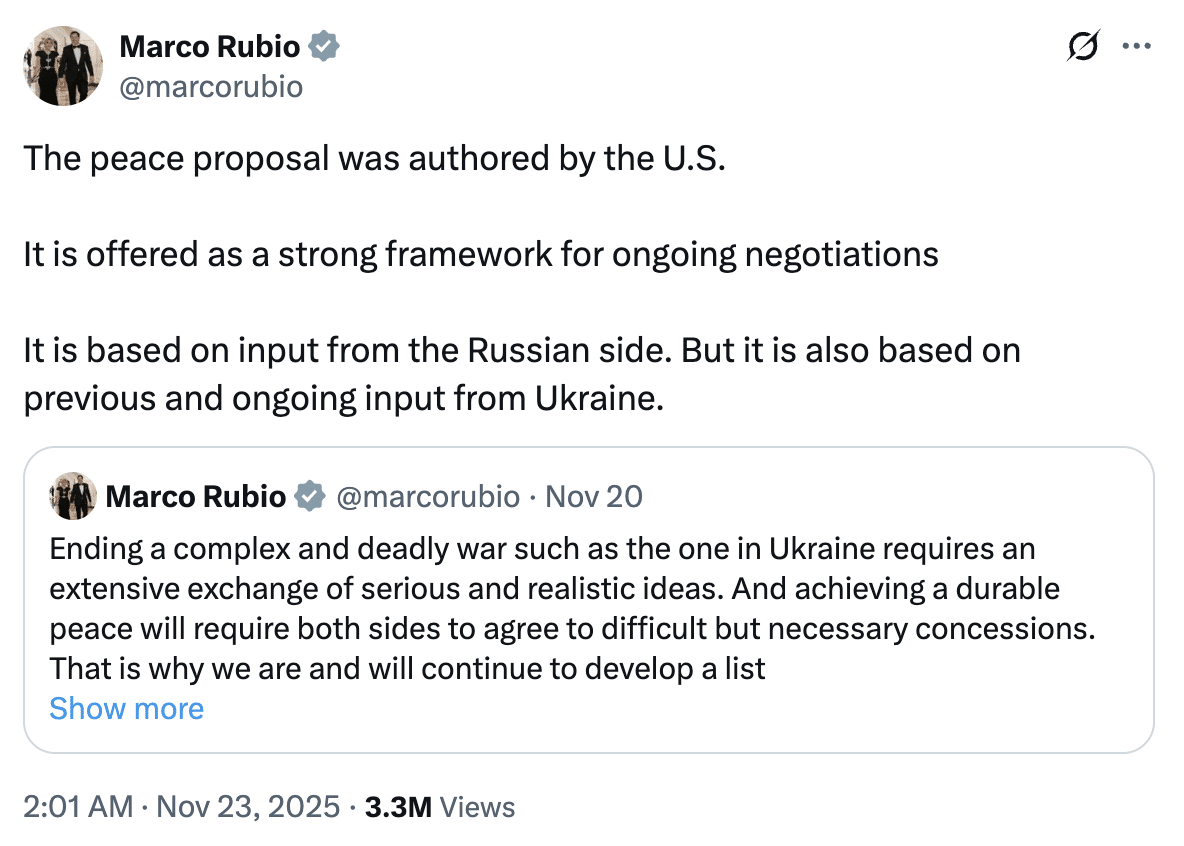
Rubio reassured Senators mobilizing opposition to this development that it wasn’t a done deal, but then backtracked to avoid losing his place in the room.
As Yaroslav Trofimoev quipped,
Foreign nations now have to deal with rival factions of the U.S. government who keep major policy initiatives secret from each other and some of which work with foreign powers as the succession battle for 2028 begins, is how one diplomat put it.
One thing that’s happening is that Marco Rubio has survived in the Trump White House as long as he has because he is very good at mirroring, usually passively so. He says, and his State Department says, what his State Department babysitters say, people like Darren Beattie and Christopher Landau. But Rubio has generally remained in the room even at key times, and particularly with Ukraine, has thus far managed to prevent the worst from happening.
Importantly, though, Dmitriev’s tremendous success at manipulating the other people in the room with Trump comes at a time when Tom Massie and Marjorie Taylor Greene — neither big backers of Ukraine — showed how to beat Trump: by bypassing Mike Johnson to force a politically difficult vote, and to do so with enough success to force the Senate’s hand.
Brian Fitzpatrick and Don Bacon, both staunch backers of Ukraine in the House, have initiated an effort to replicate that approach.
There are the numbers right now to pass sanctions against Russia: at least 218 in the House and a filibuster-proof majority in the Senate. Those numbers just happen to be similar to the same numbers as it would take to impeach Trump.
Which is to say, the very thing that made it possible for Dmitriev to recruit (ahem) the people in the room with Trump — the flux in the White House now — is also the thing that makes him more vulnerable than he was a month ago.

There’s a lot about MTG’s departure I’m not much interested in: making Trump the primary actor, making Marge the victim, debating whether she’ll be friend or foe, focusing more on the timing as it relates to getting her pension than as it relates to the healthcare crisis Republicans will soon own.
MTG is far smarter than people give her credit for and she’s very adept at using the tools of right wing politics.
In recent months the good old boys in Georgia and even Trump’s top aides refused to let her run for state-wide office in Georgia, believing she could risk an increasingly purple state.
That was part of, but only part of, the background to her willingness to take a leadership position on Epstein. She does genuinely care about the issue and/or she does recognize its salience among populists.
The part of MTG’s statement that generated the most attention (which appears in ¶¶33 and 34 of her statement) — her prediction Republicans will lose the House and have to stave off a Trump impeachment…
I have too much self respect and dignity, love my family way too much, and do not want my sweet district to have to endure a hurtful and hateful primary against me by the President we all fought for, only to fight and win my election while Republicans will likely lose the midterms. And in turn, be expected to defend the President against impeachment after he hatefully dumped tens of millions of dollars against me and tried to destroy me.
It’s all so absurd and completely unserious. I refuse to be a ‘battered wife’ hoping it all goes away and gets better.
… Comes long after (¶¶4-12) a series of paragraphs that could be spoken by a racist Zohran Mamdani, and with all the charisma and political acumen he has.
No matter which way the political pendulum swings, Republican or Democrat, nothing ever gets better for the common American man or woman.
The debt goes higher.
Corporate and global interests remain Washington’s sweethearts.
American jobs continue to be replaced whether it’s by illegal labor or legal labor by visas or just shipped overseas.
Small businesses continue to be swallowed by big corporations.
Americans’ hard earned tax dollars always fund foreign wars, foreign aid, and foreign interests.
The spending power of the dollar continues to decline.
The average American family can no longer survive on a single bread winner’s income as both parents must work in order to simply survive.
And today, many in my children’s generation feel hopeless for their future and don’t think they will ever realize the American dream, which breaks my heart.
MTG is taking her significant campaign cash and selling high, and promising to be there to buy low after whatever upcoming catastrophe happens.
When the common American people finally realize and understand that the Political Industrial Complex of both parties is ripping this country apart, that not one elected leader like me is able to stop Washington’s machine from gradually destroying our country, and instead the reality is that they, common Americans, The People, possess the real power over Washington, then I’ll be here by their side to rebuild it.
Until then I’m going back to the people I love, to live life to the fullest as I always have, and look forward to a new path ahead.
She rode Trump’s coattails until she decided the coattails weren’t worth the effort anymore.