Transpartisan Arguments the Government Won’t Want to Succeed

Justin Amash, Paul Broun, Tulsi Gabbard, Morgan Griffith, Rush Holt, Walter Jones, Barbara Lee, Zoe Lofgren, Thomas Massie, Tom McClintock, Eleanor Holmes Norton, Beto O’Rourke, Steve Pearce, Matt Salmon, Mark Sanford, Ted Yoho.

Well, that’s got to be a group of people the Powers That Be don’t want to see joining together?

Captain Tulsi Gabbard, Physics PhD Rush Holt, Appalachian Trail Hiker Mark Sanford, and Paleocon Walter Jones. With my libertarian Congressman, Justin Amash apparently leading the bunch.

All on a court motion together, calling for the court to release the FISC opinion explaining why the government’s Section 702 collection was unconstitutional because without it they can’t do their job. Which includes, in part, informing the American people.

As important, whatever information Members of Congress learn about secret FISC opinions and orders, they are unable publicly to discuss or debate them because any disclosure is still subject to secrecy requirements.

[snip]

In light of recent disclosures regarding the existence of a “classified intelligence program,” related to the “business records” section of FISA, the Director of National Intelligence has acknowledged that “it is important for the American people to understand” the limits of the program and the principles behind it.

[snip]

Notwithstanding the compelling public interest in an open debate about the scope and propriety of government surveillance programs authorized under FISA, even the amici — Members of the U.S. Congress — cannot meaningfully participate in that public debate so long as this Court’s relevant decisions and interpretations of law remain secret. They cannot engage in public discussion on the floor of the Senate and the House about the government’s surveillance programs. And they cannot engage in dialogue with their constituents on these pressing matters of public importance.

[snip]

Informed, public debate is central to Congress’s role as a coequal branch of the federal government. The Constitution acknowledges the unique importance of open debate to Congress’s role in the Speech or Debate Clause. Debate in Congress serves no only the institution’s internal goal of creating sound public policy. Courts have recognized a second crucial purpose of informed, public debate in Congress: to inform the American people about the issues affecting their government.

Now, I think they may overestimate the degree to which this opinion pertains to the Section 215 collection (indeed, if it pertains to Internet metadata collection, it pertains to Section 214 of PATRIOT instead). [Update, 9/13/13: I’m mistaken here–it was exclusively Section 215.]

And I think their Speech or Debate argument has confused people about whether these members of Congress have seen what’s in the opinion. Holt used to be on the House Intelligence Committee, but no longer is, so I assume none of the Members on this brief know what the opinion is. In any case, the House has much more restrictive rules about who can access intelligence secrets than the Senate.

But I am rather fond of the argument that Congress can’t do its job with all the secrecy the Executive is operating under.
Share this entry

Alberto Gonzales and Internet Data Mining

I was going to leave this speculation well enough alone. But George W Bush decided to interrupt his dog painting to defend Obama’s surveillance dragnet.

Bush also defended the surveillance program, which began during his administration after 9/11, saying the programs guarantee civil liberties are protected.

“I put the program in place to protect the country and one of the certainties is civil liberties were guaranteed,” Bush said.

So here goes.

In his book, Jack Goldsmith describes Alberto Gonzales siding against David Addington in a debate just once, only to have George Bush override the then White House Counsel.

Addington’s hard-line nonaccommodation stance always prevailed when the lawyers met to discuss legal policy issues in Alberto Gonzales’ office. During these meetings, Gonzales himself would sit quietly in his wing chair, occasionally asking questions but mostly listening as the querulous Addington did battle with whomever was seeking to “go soft.” It was Gonzales’ responsibility to determine what to advise the president after the lawyers had kicked the legal policy matters around. But I only knew him to disagree with Addington once, on an issue I cannot discuss, and on that issue the president overruled Gonzales and sided with the Addington position. [my emphasis]

The issue Goldsmith could not discuss could be torture or prisoner transfers or something entirely unknown, but the data mining at the heart of the hospital confrontation is clearly one candidate.

There’s no overt evidence Gonzales tried to do the right thing on the illegal surveillance program. After all, even after Bush agreed to put the program right on March 12, 2004, Gonzales still objected to Goldsmith and Jim Comey’s first advice on the program. After Goldsmith laid out his initial advice on March 15, Gonzales wrote a memo saying,

Your memorandum appears to have been based on a misunderstanding of the President’s expectations regarding the conduct of the Department of Justice. While the President was, and remains, interested in any thoughts the Department of Justice may have on alternative ways to achieve effectively the goals of the activities authorized by the Presidential Authorization of March 11, 2004, the President has addressed definitively for the Executive Branch in the Presidential Authorization the interpretation of the law.

This led Comey to write up his resignation letter on March 16. “[A]lthough I believe this has been one of [DOJ’s] finest hours, we have been unable to right that wrong.” Three days later, Bush modified his March 11 Authorization, directing NSA to stop collecting Internet metadata within a week.

Of course, three months later, the Administration resumed collection of Internet metadata using the FISC PR/TT order. That was within days of Goldsmith’s departure, though he had announced his departure a month earlier and Comey, obviously, stuck around for over a year longer.

So still no evidence the Internet data mining was the issue on which Gonzales tried to stand up to Addington.

But let’s jump ahead to the circumstances of Alberto Gonzales’ resignation in August 2007. At the time, his sudden and confusing resignation was attributed to the multiple scandals embroiling him — chiefly the US Attorney firing scandal, but also Gonzales’ Clapper-like lies about the illegal wiretap program before the Senate a month earlier. But for some reason, Gonzales did not benefit from the kind of sinecure every other former Bush official — even James Comey, who went to Lockheed — enjoyed upon departure, which you would have thought he’d get after lying to protect the President.

Then, a year after Gonzales’ departure, we learned that in the weeks before he resigned, White House Counsel Fred Fielding had narced him out for storing a bunch of Top Secret CYA documents in a briefcase in his closet. Read more

Share this entry

James Clapper’s Double Super Secret Correction

Screen shot 2013-07-01 at 9.21.55 AMIf the Director of National Intelligence corrects a lie but nobody hears it, does it make a sound?

Greg Miller returns focus to James Clapper and Keith Alexander and President Obama’s lies that underscore why, at least for some of his leaks, Edward Snowden must count as a whistleblower. He reveals two new details about why Clapper is not headed for prison.

First, Clapper claims his staffers acknowledged to Wyden (presumably not in writing) his error after the Senator demanded a correction.

Sen. Ron Wyden (D-Ore.), who had asked Clapper the question about information collection on Americans, said in a recent statement that the director had failed to clarify the remark promptly despite being asked to do so. Clapper disputed that in his note to the committee, saying his “staff acknowledged the error to Senator Wyden’s staff soon after the hearing.”

And then, more than two weeks after Snowden proved Clapper to be a liar (and 10 days after Wyden called for hearings for the Intelligence Committee to correct their disinformation), Clapper sent the Senate Intelligence Committee a letter apologizing for his “clearly erroneous” comment.

Acknowledging the “heated controversy” over his remark, Clapper sent a letter to the Senate Intelligence Committee on June 21 saying that he had misunderstood the question he had been asked.

“I have thought long and hard to re-create what went through my mind at the time,” Clapper said in the previously undisclosed letter. “My response was clearly erroneous — for which I apologize.” [my emphasis]

Miller also reveals that Clapper presented yet another explanation for why his lie wasn’t really a lie.

He made a new attempt to explain the exchange in his June 21 correspondence, which included a hand-written note to Wyden saying that an attached letter was addressed to the committee chairman but that he “wanted [Wyden] to see this first.”

Clapper said he thought Wyden was referring to NSA surveillance of e-mail traffic involving overseas targets, not the separate program in which the agency is authorized to collect records of Americans’ phone calls that include the numbers and duration of calls but not individuals’ names or the contents of their calls.

Referring to his appearances before Congress over several decades, Clapper concluded by saying that “mistakes will happen, and when I make one, I correct it.”

Note, this particular lie retreats to Administration claims that they no longer collect Internet metadata, at least no via Section 702 collection, at least as far as they’lll tell us.

Of course, that’s only been true (if it is in fact true) since 2011, for what that’s worth.

One thing Miller is missing in this otherwise laudable article is one more detail from Wyden: that he gave Clapper notice he was going to ask the question.

Clapper got the question for the test before taking it, and he still — he says — misunderstood it.

But of course that’s not what happened. The way Clapper has made false statements in public and then “acknowledged errors” in secret is all part of the game by which Clapper mostly sort of tells the truth to Congress, but continues to lie to the American people.

In other news, it has now been almost a week since, caught in another lie, the NSA took down their “Section 702 Protections” document, without replacing them with an accurate description of what  protections, if any, Americans have under Section 702.

Perhaps NSA has finally decided to start telling the truth?

Share this entry

The 2009 Draft NSA IG Report Makes No Mention of One Illegal Practice

The 2009 Draft NSA IG Report released by the Guardian last week — and related reporting from Barton Gellman — seem to clarify and confirm what I’ve long maintained (12/19/057/29/07; 7/30/07): that one part of the illegal wiretap program that Jack Goldsmith and Jim Comey found “illegal” in 2004 was data-mining of Americans.

Eight days later on 19 March 2004, the President rescinded the authority to collect bulk Internet metadata and gave NSA one week to stop collection and block access to previously collected bulk Internet metadata. NSA did so on 26 March 2004. To close the resulting collection gap, DoJ and NSA immediately began efforts to recreate this authority in what became the PR/TT order.

Mind you, this bulk collection resumed after Colleen Kollar-Kotelly signed an order permitting NSA to collect the same data under a Pen Register/Trap & Trace order on July 14, 2004.

The FISC signed the first PR/TT order on 14 July 2004. ALthough NSA lost access to the bulk metadata from 26 March 2004 until the order was signed, the order essentially gave NSA the same authority to collect bulk Internet metadata that it had under the PSP, except that it specified the datalinks from which NSA could collect, and it limited the number of people that could access the data.

Indeed, we know the program was expanded again in 2007, to get 2 degrees of separation deep into US person Internet data. The Obama Administration claims it ended this in 2011, though there are also indications it simply got moved under a new shell.

Mystery solved, Scoob!

Not so fast.

It appears the bulk Internet metadata collection and mining is just one of two practices that Goldsmith and Comey forced Bush to at least temporarily halt in 2004. But the second one is not mentioned at all in the NSA IG Report.

I first noted that Bush made two modifications to the program in this post, where I noted that 6 pages (11-17) of Jack Goldsmith’s May 6, 2004 OLC opinion on the program described plural modifications made in March and one other month in 2004 (I correctly surmised that they had actually shifted parts of the program under parts of the PATRIOT Act, and that they had narrowed the scope somewhat, though over-optimistically didn’t realize that still included warrantless collection of known domestic content).

But there’s actually a far better authority than Goldsmith’s heavily redacted opinion that confirms Bush made two modifications to the program in this period.

Dick Cheney.

When his office disclosed to Patrick Leahy in 2007 what documents it had regarding authorizations for the illegal wiretap program, it listed two modifications to the program: the one on March 19 described in detail in the NSA IG Report, plus one on April 2.

[Cheney Counsel Shannen] Coffin’s letter indicates that Bush signed memos amending the program on March 19 and April 2 of that year.

But there’s no hint of a second modification in the NSA IG Report.

That could mean several things. It could mean the April 2 modification didn’t involve the NSA at all (and so might appear in a one of the other Agency IG Reports at the time — say, DNI — or might have been completed by an Agency, like some other part of DOD, that didn’t complete an IG Report). It could mean that part of the program was eliminated entirely on April 2, 2004. Or it could mean that in an effort to downplay illegality of the program, the IG simply didn’t want to talk about the worst prior practice eliminated in the wake of the hospital confrontation.

Goldsmith’s opinion does seem to indicate, however, that the modification pertained to an issue similar to the bulk metadata collection. He introduces that section, describing both modifications, by saying “it is necessary to understand some background concerning how the NSA accomplishes the collection activity authorized under” the program.

That may still pertain to the kind of data mining they were doing with the Internet metadata. After all, the fix of moving Internet metadata collection under the PR/TT order only eliminated the legal problem that the telecoms were basically permitting the government to steal Microsoft and Yahoo Internet content from their equipment. There still may have been a legal problem with the kind of data mining they were doing (perhaps arising out of Congress’ efforts in that year’s NDAA to prohibit funding for Total Information Awareness).

Whatever it is, one thing is clear. Even with the release of the unredacted Draft NSA IG Report, we still aren’t seeing all the details on what made the program so legally problematic.

Maybe it’s something the Senate Judiciary Committee might ask Jim Comey during his FBI Director confirmation hearing?

Share this entry

What Happened to that Third Branch Oversight?

Judge Colleen Kollar-Kotelly is pissed.

After spending 2002 to 2006 as Chief Judge of the FISA Court struggling to keep parts of the American legal system walled off from a rogue surveillance program, she read the classified account the NSA’s Inspector General wrote of her efforts. And while that report does say Kollar-Kotelly was the only one who managed to sneak a peek at a Presidential Authorization authorizing the illegal program, she doesn’t believe it reflects the several efforts she made to reel in the program.

“In my view, that draft report contains major omissions, and some inaccuracies, regarding the actions I took as Presiding Judge of the FISC and my interactions with Executive Branch officials,” Kollar-Kotelly said in a statement to The Post.

[snip]

Kollar-Kotelly disputed the NSA report’s suggestion of a fairly high level of coordination between the court and the NSA and Justice in 2004 to re-create certain authorities under the Foreign Intelligence Surveillance Act, the 1978 law that created the court in response to abuses of domestic surveillance in the 1960s and 1970s.

“That is incorrect,” she said. “I participated in a process of adjudication, not ‘coordination’ with the executive branch. The discussions I had with executive branch officials were in most respects typical of how I and other district court judges entertain applications for criminal wiretaps under Title III, where issues are discussed ex parte.”

The WaPo story reporting on her objections makes no mention of the role one FISC law clerk — who got briefed into the program before any of the other FISC judges — played in this process, something I’m pretty curious about.

It does, however, recall two incidents where Kollar-Kotelly took measures to crack down on the illegal program, which Carol Leonnig reported back in 2006.

Both [Kollar-Kotelly and her predecessor Royce Lamberth] expressed concern to senior officials that the president’s program, if ever made public and challenged in court, ran a significant risk of being declared unconstitutional, according to sources familiar with their actions. Yet the judges believed they did not have the authority to rule on the president’s power to order the eavesdropping, government sources said, and focused instead on protecting the integrity of the FISA process.

[snip]

In 2004, [DOJ Office of Intelligence Policy and Review Counsel James] Baker warned Kollar-Kotelly he had a problem with [a “federal screening system that the judges had insisted upon to shield the court from tainted information”]. He had concluded that the NSA was not providing him with a complete and updated list of the people it had monitored, so Justice could not definitively know — and could not alert the court — if it was seeking FISA warrants for people already spied on, government officials said.

Kollar-Kotelly complained to then-Attorney General John D. Ashcroft, and her concerns led to a temporary suspension of the program. The judge required that high-level Justice officials certify the information was complete — or face possible perjury charges.

In 2005, Baker learned that at least one government application for a FISA warrant probably contained NSA information that was not made clear to the judges, the government officials said. Some administration officials explained to Kollar-Kotelly that a low-level Defense Department employee unfamiliar with court disclosure procedures had made a mistake.

Though the NSA IG Report mentions violations that occurred before 2003, it makes no mention of these violations.

What good is an IG Report that gives no idea of how often and persistent violations are?

That said, today’s WaPo story provides this as the solution to our distorted view of the FISA Court’s role in rubber-stamping this massive dragnet.

A former senior Justice Department official, who spoke on the condition of anonymity because of the subject’s sensitivity, said he believes the government should consider releasing declassified summaries of relevant opinions.

“I think it would help” quell the “furor” raised by the recent disclosures, he said. “In this current environment, you may have to lean forward a little more in declassifying stuff than you otherwise would. You might be able to prepare reasonable summaries that would be helpful to the American people.”

Back in 2006, Leonnig noted that the judges didn’t believe they had the authority to intervene to stop the dragnet. So what good does a ruling — even two as broad and stunning as the ones that used Pen Registers and Business Records to collect the contact records of all Americans — do to depict the role the Court is in?

The Administration keeps pointing to this narrowly authorized court as real court review. But that’s not what it is. And until we have a better sense of how that manifested in the past (and continues to — I’ll bet you a quarter that they’ve moved the Internet data mining to some area outside of court purview), we’re not going to understand how to provide real oversight to this dragnet.

We’d be far better off having the FISC provide its own history of these surveillance programs.

Share this entry

On the Refusal to Exercise Oversight over Vast Surveillance Programs, Episode 117

The Joint IG Report on the illegal wiretap program left out all discussion of what happened to the Internet and (to a lesser extent) phone metadata collection that got moved into Pen Register/Trap&Trace and Section 215 collection, respectively, as described by the NSA Draft IG Report (see page 39 ff).

The transition of certain PSP-authorized activities to FISC orders is described in detail in Section 5 of the classified report and Chapter Five of the DOJ OIG Report. Further details regarding this transition are classified and therefore cannot be addressed in this unclassified report.

But the report did make it clear that Glenn Fine, then DOJ’s Inspector General, had recommended DOJ and other Intelligence Committee agencies track whether these programs were useful in their new form.

As noted above, certain activities that were originally authorized as part of the PSP have subsequently been authorized under orders issued by the FISC. The DOJ OIG believes that DOJ and other IC agencies should continue to assess the value of information derived from such activities to the government’s counterterrorism efforts.

[snip]

Finally, the collection activities pursued under the PSP, and under FISA following the PSP’s transition to that authority, involved unprecedented collection activities. We believe the retention and use by IC organizations of information collected under the PSP and FISA should be carefully monitored.

The Joint IG Report came out in July 2009. The debate over extending the PATRIOT Act started in earnest in September 2009.

Yet not only wasn’t that review baked into the extension, but when Patrick Leahy tried to include additional oversight that would include, among other things,

  • Mandate further audits of some of these provisions, such as the use of pen registers
  • Give the Court oversight over the minimization procedures for the use of Section 215 and pen register and trap and trace devices
  • Require that Section 215 and pen registers only be granted if authorities can show that the requested information has ties to terrorism

Dianne Feinstein got Leahy to take much of that out in a substitute bill, and then Jeff Sessions, seemingly working on behalf of the Administration, gutted things further in the Senate markup. It was fairly clear then that the IC — if not the Administration personally — wanted to make sure this oversight did not get added to the PATRIOT Act.

And it didn’t.

The next year, Glenn Fine — who, of course, was the guy who recommended increased oversight in the first place — said he’d do the reviews anyway.

We intend to initiate another review examining the FBI’s use of NSLs and Section 215 orders for business records. Among other issues, our review will assess the FBI’s progress in responding to the OIG’s recommendations in the prior reports. In addition, we intend to examine the number of NSLs issued by the FBI from 2007 through 2009, and we will closely examine the automated system to generate and track NSLs that the FBI implemented to address the deficiencies identified in the OIG reports.

In addition, our review will cover the FBI’s use of Section 215 orders for business records. It will examine the number of Section 215 applications filed from 2007 through 2009, how the FBI is using the tool today, and describe any reported improper or illegal uses of the authority. Our review will also examine the progress the FBI has made in addressing recommendations contained our prior reports that the FBI draft and implement minimization procedures specifically for information collected under Section 215 authority.

We also intend to conduct a programmatic review of the FBI’s use of its pen register and trap and trace authority under the FISA. That part of the review will examine issues such as how the FBI uses the authority to collect information, what the FBI does with the information it collects, and whether there have been any improper or illegal uses of the authority either reported by the FBI or identified by the OIG. [my emphasis]

Writing in 2010, when both metadata collection programs were still ongoing under these authorities, this basically laid out a plan to review all the secret metadata collection hidden inside these authorities.

Fine wrote that in June; in November of that year, he announced his resignation, saying he wanted to pursue new professional challenges.

Read more

Share this entry

Yahoo, the Law-Abiding Free Email Provider

[NSA presentation, PRISM collection dates, via Washington Post]The FISA Court has officially agreed to declassify that Yahoo was the company that challenged a Protect Amendment Act order in 2007.

Once this PRISM slide was published, it was always pretty likely that Yahoo — or maybe Google — was the company in question. Yahoo started complying around the time the FISC decision was reached; Google joined in after the FISCR decision was unsealed.

Which leaves … Microsoft, which started cooperating before the law and then the FISA Court forced it to (though collection may not have begun until after PAA passed and, as Rayne has pointed out, Microsoft’s code was being exploited by the government for entirely different purposes in precisely that timeframe).

Now might be a good time to review what happened with the 7 companies the government asked to participate in an illegal wiretap program based solely on the President’s say-so. Per the 2009 NSA Draft IG Report, the companies are:

  • Telecoms A, B, and C (probably AT&T, Verizon, and — definitely– MCI, respectively, since they were the 3 telecoms working onsite at FBI’s direct access office under another program). These companies were approached by people from NSA’s Special Source Operations unit as soon as the program was approved, and they agreed to participate “voluntarily.” In 2003, MCI got cold feet and demanded a letter from John Ashcroft stating that the request was lawful, in which he “directed” them to comply with NSA’s requests.
  • Telecom E (Qwest). It was approached by SSO personnel in 2002, purportedly for collections related to the Olympics. After some discussion, Qwest’s General Counsel decided to not support the operation.
  • Internet Provider D (probably Microsoft). This company was approached by “NSA legal and operational personnel” (not SSO) in September 2002. In response, this company provided “minimal” support, spanning roughly from October 9, 2002 through just after September 11, 2003. No person at this company was ever cleared to store letters from the NSA.
  • Internet Provider F (probably Yahoo). This company was approached in October 2002 by NSA legal and operational personnel. In response to NSA’s request, Internet Provider F asked for a letter from Attorney General Ashcroft certifying the legality of the program. While in December 2002, NSA’s Commercial Technologies Group through Internet Provider F was participating, NSA’s GC says they did not because of corporate liability concerns.
  • Private Sector Company G. This company was approached in April 2003 by NSA legal and operational personnel. This company’s GC said he or she wanted to consult outside counsel. NSA chose to drop the request. I have no idea what company this would be (CISCO?); any thoughts?

Here’s what these companies provided:

Screen shot 2013-06-29 at 3.33.46 PM

This table tells us a great deal about the program–and also the legal problems behind it.

Internet provider D — the one of two that cooperated — only did so for 7 months in 2003, and only provided Internet content (probably primarily Hotmail emails), not metadata.

Which left the government to get the other Internet data off of AT&T and Verizon’s switches (we know C is MCI because February 2005 is when Verizon bought it, which explains why it started handing over Internet content and metadata then). As the IG Report explains,

A, B, and C provided access to the content of Al Qaeda and Al Qaeda-affiliate email from communication links they owned and operated.

[snip]

The last category of private sector assistance was access to Internet Protocol (IP) metadata associated with communications of al Qaeda (and affiliates) from data links owned or operated by COMPANIES A, B, and C.

In other words, Microsoft and Yahoo, the biggest free email providers, were not crazy about providing content (though one, probably Microsoft, did for a period). And they were completely unwilling to provide IP metadata.

So the government just went to AT&T and Verizon’s switches and took it there.

Read more

Share this entry

The 14% Domestic Phone Content Collection under the Illegal Wiretap Program

Screen shot 2013-06-29 at 7.04.51 AMThere’s something funny about the claims the NSC Draft IG Report makes.

On page 8, the report notes:

Domestic Collection. The wording of the first authorization could have been interpreted to allow domestic content collection where both communicants were located in the U.S. or were U.S. persons. General Hayden recalled that when the Counsel to the Vice President pointed this out, General Hayden told him that NSA would not collect domestic communications because 1) NSA was a foreign intelligence agency, 2) NSA infrastructure did not support domestic collection, and 3) his personal standard was so high that there would be no problem getting a FISC order for the domestic collection.

Starting in February 21, 2006, DOJ pushed to get a FISC order for PSP collection, in spite of NSA’s numerous reservations. As an interim solution, they changed the definition of “facility” from that of a specific number of email address “to encompass the gateway or cable head that foreign targets use for communications. Minimization and probable cause standards would then be applied.” After months of trying to finesse this, FISC signed two orders to accomplish this:

The Foreign Content Order

The Domestic Content Order

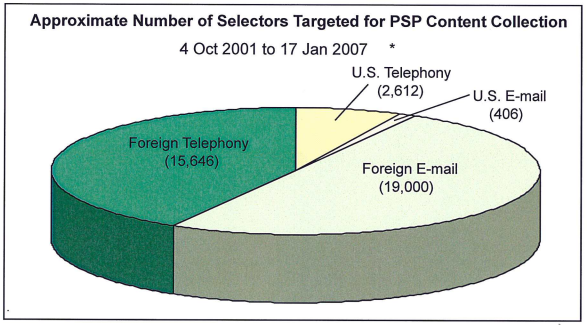
Remember, domestic content, to the NSA, is content in which both participants are in the US (though at this point NSA may have been distinguishing between citizens and non-citizens). And when they moved to a FISC order, they had a specific order for domestic content. And, as the chart on page 16 shows, 14% of the telephony content was domestic (it was only 2% for Internet, though its number for that collection, 19,000, sure looks awfully round).

Now, apparently, by 2007 when they went to a FISC order, there wasn’t that much domestic collection left.

The Domestic Content Order did not create a similar loss in collection [as the 73% loss on the Foreign Content side] because so few numbers were tasked at that time. It did, however, slow operations because of the documentation required, and it took considerably longer to task under the order than under the PSP. Over time, the scope of the Domestic Content Order gradually decreased to a single selector tasked for collection in January 2009. In January 2009, at NSA’s request, assumed responsibility for the Domestic Content Order and became the declarant before the FISC.

This says they still had these gateway facilities in place 17 months after PAA passed (and NSA likely dumped it off onto FBI at that point to clean up in anticipation of Obama taking over).

The original authorization might seem to authorize domestic collection. And when they shifted to FISC rather than Presidential authorization, it continued to include domestic collection, though not so much, apparently, as when the program started.


Share this entry

How David Addington Hid the Document Implicating George Bush in Illegal Wiretapping

On December 16 and December 20, 2005, respectively — just days after the NYT revealed its existence — EPIC and ACLU FOIAed DOJ for documents relating to George Bush’s (really, Dick Cheney’s) illegal wiretap program (National Security Archive also FOIAed, though more narrowly). Among other documents, they requested, “any presidential order(s) authorizing the NSA to engage in warrantless electronic surveillance.” Yet in spite of the fact that the ACLU was eventually able to get DOJ to cough up some of the OLC memos that provided a legal rationale for the program, no presidential order was ever turned over. I don’t believe (though could be mistaken) it was even disclosed in declarations submitted by Steven Bradbury in the suit.

There’s a very good (and, sadly, legal) reason for that. According to the 2009 NSC draft IG report the Guardian released yesterday, it’s not clear DOJ ever had the Authorization. The White House is exempt from FOIA, and it’s likely that NSA could have withheld the contents of the Director’s safe from any FOIA, which is where the hard copy of the Authorization was kept.

It’s worth looking more closely at how David Addington guarded the Authorization, because it provides a lesson in how a President can evade all accountability for unleashing vast powers against Americans, and how the National Security establishment will willingly participate in such a scheme without ensuring what they’re doing is really legal.

The IG report describes the initial Authorization this way:

On 4 October 2001, President George W. Bush issued a memorandum entitled “AUTHORIZATION FOR SPECIFIED ELECTRONIC ACTIVITIES DURING A LIMITED PERIOD TO DETECT AND PREVENT ACTS OF TERRORISM WITHIN THE UNITED STATES.” The memorandum was based on the President’s determination that after the 11 September 2001 terrorist attacks in the United States, an extraordinary emergency existed for national defense purposes.

[snip]

The authorization specified that the NSA could acquire the content and associated metadata of telephony and Internet communications for which there was probable cause to believe that one of the communicants was in Afghanistan or that one communicant was engaged in or preparing for acts of international terrorism. In addition, NSA was authorized to acquire telephone and Internet metadata for communications with at least one communicant outside the United States or for which no communicant was known to be a citizen of the United States. NSA was allowed to retain, process, analyze and disseminate intelligence from the communications acquired under the authority.

And while the NSA IG report doesn’t say it, the Joint IG Report on the program (into which this NSA report was integrated) reveals these details:

Each of the Presidential Authorizations included a finding to the effect that an extraordinary emergency continued to exist, and that the circumstances “constitute an urgent and compelling governmental interest” justifying the activities being authorized without a court order.

Each Presidential authorization also included a requirement to maintain the secrecy of the activities carried out under the program.

David Addington’s illegal program

While the Joint report obscures all these details, the NSA IG report makes clear that Dick Cheney and David Addington were the braintrust behind the program.

The Counsel to the Vice President used [a description of SIGINT collection gaps provided by Michael Hayden] to draft the Presidential authorization that established the PSP.

Neither President Bush nor White House Counsel Alberto Gonzales wrote this Authorization. David Addington did. Read more

Share this entry

Working Thread, NSA IG Report

This will be a working threat on the March 24, 2009 Draft NSA IG Report on PSP. Page numbers below are hardcopy pages.

P1: The Authorization on October 4 has never been mentioned in any FOIAs (there was an OLC memo that was).

P1: The track change suggests the author of this either didn’t know who got delegated the October 4, 2001 authority, or wasn’t sure what that person’s title stood for.

P2: The January 17, 2007 end date to this report, while legally mandated, seems convenient. Go back to check FOIA to see if it was jimmied in the legislative process.

P3: “The Counsel to the Vice President used this information to draft the Presidential authorization that established the PSP.” Welp, David Addington always did want to blow up FISA.

Read more

Share this entry