Today, the Senate Judiciary Committee stalled the vote on Kash Patel’s nomination another week.
A bunch of Republicans are wailing that Democrats are afraid of something.
But it’s clear Chuck Grassley is.
A week ago, he released a bunch of documents he read in Kash Patel’s confirmation hearing. They show that DOJ first opened a grand jury to investigate the fake electors plot on January 31, 2022. But FBI delayed two months, from February 12, 2022, at which point they had a draft opening Electronic Communication, to April 13, when they finally approved it. (I’ve included those dates in this timeline.)
The documentation shows that on both the FBI and DOJ side, top executives approved the investigation, as required by DIOG.
Grassley claims blah blah blah it’s not clear what about politicization, based on his debunked claims about Tim Thibault (claims that Jim Jordan’s committee debunked).
Remember: Tim Thibault is one of the three FBI Agents who opened an investigation targeting Hillary Clinton and the Clinton Foundation during the 2016 election cycle, based substantially on Peter Schweizer’s book. That’s the guy the right wingers have spun up as a raging lefty. That’s the guy who was involved in stalling the investigation of Trump for two months.
But the reason Chuck Grassley is sharing this is … mostly hot air, to justify Pam Bondi’s witch hunts.
And also to justify refusing to find out what Kash Patel is covering up about his 2022 grand jury testimony. Chuck Grassley appears to be using his own misrepresentations of Tim Thibault’s role in all this to refuse to support any inquiry into Kash’s grand jury testimony, apparently claiming that the entire Jack Smith investigation — both prongs of which were predicated long before he was hired — was thereby tainted. In a letter following up on that, Sheldon Whitehouse, Cory Booker, and Adam Schiff (but no one else, up to and including Dick Durbin) urge Grassley to reconsider his refusal to demand Kash’s grand jury testimony.
We write to object to Kash Patel’s continued refusal to provide members of the Senate Judiciary Committee information essential to our consideration of his nomination to be Director of the Federal Bureau of Investigation. Mr. Patel has repeatedly refused to discuss the testimony he provided to a federal grand jury investigating Donald Trump’s unlawful retention of classified documents, as well as his invocation of his Fifth Amendment privilege against self-incrimination. We regret that you have rejected our efforts to inquire into the first-ever invocation of Fifth Amendment protection by a nominee seeking to lead the FBI.
Democrats are trying to figure out what Kash Patel believed, in October 2022, that he had criminal exposure in an Espionage Act investigation.
And Chuck Grassley wants to use the fact that the FBI stalled the January 6 investigation into Donald Trump for two months as an excuse to refuse that.
Share this entry
https://www.emptywheel.net/wp-content/uploads/2025/01/Kash.jpg462682emptywheelhttps://www.emptywheel.net/wp-content/uploads/2016/07/Logo-Web.pngemptywheel2025-02-06 14:38:432025-02-06 15:00:36Republicans Continue to Cover Up Why Kash Patel Pled the Fifth
There are a number of outlets tracking every legal challenge to Trump and Elon Musk’s power grabs. For example, JustSecurity has this litigation tracker, including the multiple suits (one, two, three, four, five, six, seven) that attempt to stop Elon’s invasion. Some may well succeed in enjoining Elon’s actions — but they’ll lead to a confrontation over who will enforce the orders.
Two lawsuits filed yesterday by FBI agents may be better vehicles both legally and in generating stories that might lead to pushback from Republicans. The first represents nine Jane and John Doe FBI personnel, fashions itself as a class action, and demands a jury trial; it has been assigned to Biden appointee Jia Cobb. It makes claims under the First Amendment, Fifth Amendment (and Fifth Amendment Privacy), and Privacy Act. It provides these details about how much the government spends to obtain the expertise of FBI agents.
13. FBI agents are chosen through a highly selective process, and are carefully screened for aptitude and trustworthiness.
14. FBI agents go through more than four months of intensive training at the FBI academy before beginning their duties, and attend numerous training sessions throughout their careers to adapt to new technologies and emerging threats.
15. Many FBI agents are multi-lingual and routinely interface with intelligence agencies from allied nations.
16. The training FBI agents receive is comprehensive, and in some instances, extremely expensive.
17. On information and belief, Plaintiffs assert that each agent of the FBI receives more than 3 million dollars-worth of training in a twenty (20) year career.
18. FBI agents also develop specific expertise from their assignments and field duties, much of which cannot be replicated solely by training.
The second represents seven Jane and John Doe FBI personnel, and the FBI Agent’s Association, which represents most active duty Agents; it has been assigned to the Trump appointee who presided over the Proud Boy leaders’ trial, Tim Kelly. Mark Zaid, a highly experienced lawyer in this field, is leading this suit. [Update: This case has been reassigned to Judge Cobb.]
This FBIAA suit makes two claims under the Privacy Act, a First Amendment, two Due Process claims, and this mandamus claim.
64. The provisions of 28 U.S.C. § 1361 provide a statutory basis for jurisdiction in cases seeking relief in the nature of mandamus against federal officers, employees, and agencies, and they provide for an independent cause of action in the absence of any other available remedies.
65. Defendants’ actions, as set forth above, constitute unlawful, intimidating, and threatening behavior towards Plaintiffs in response to Plaintiffs’ lawful actions of executing lawful search and arrest warrants and participating in lawful investigations of crimes committed by January 6 perpetrators.
66. Defendants do not have discretion to redefine the truth of January 6, 2021. Nor do Defendants have any discretion to recast the lawful actions taken by the FBI and the previous leaders within the Department of Justice as illegal, let alone any discretion to retaliate and disclose names.
67. Defendants have no discretion when it comes to ensuring the safety of the American people from extremist violence, let alone the safety of their own employees.
68. If no other remedy is available through which the unlawful termination orders may be rescinded, then Plaintiffs are entitled to relief in the nature of mandamus compelling Defendants to recognize Plaintiff to rescind the unlawful termination orders.
Both tell stories about Trump’s personal involvement in January 6 and describe a fear that lists of FBI Agents who worked on the January 6 cases will be used by those they investigated for retribution. The second also cites multiple cases of Jan6ers — including Enrique Tarrio, over whose prosecution Judge Kelly presided — promising retribution. [Update: As noted, this case has been reassigned to Judge Cobb.]
The second suit — the FBIAA one — substantiates its description of the events of January 6 far better, relying on opinions written by the judges who’ll preside over this case, as in these two citations to the DC Circuit opinion in the January 6 Committee’s lawsuit to access Archives documents.
13. The events of January 6, 2021, and the activities leading up to the violence that ensued on the U.S. Capitol on that day, have been well documented by courts in this circuit. Specifically, “[o]n January 6, 2021, a mob professing support for then-President Trump violently attacked the United States Capitol in an effort to prevent a Joint Session of Congress from certifying the electoral college votes designating Joseph R. Biden the 46th President of the United States. The rampage left multiple people dead, injured more than 140 people, and inflicted millions of dollars in damage to the Capitol. Then-Vice President Pence, Senators, and Representatives were all forced to halt their constitutional duties and flee the House and Senate chambers for safety.” Trump v. Thompson, 20 F.4th 10, at 15-16 (D.C. Cir. 2021).
[snip]
19. “The events of January 6, 2021 marked the most significant assault on the Capitol since the War of 1812. The building was desecrated, blood was shed, and several individuals lost their lives. Approximately 140 law enforcement officers were injured, and one officer who had been attacked died the next day. In the aftermath, workers labored to sweep up broken glass, wipe away blood, and clean feces off the walls. Portions of the building’s historic architecture were damaged or destroyed.” Thompson, 20 F.4th at 19.
That’s not the only way the FBIAA suit foregrounds the way judges have approved of the January 6 investigation. It also describes how everything happened with the involvement of judges and much of the legal process for that went through DC.
21. Investigative efforts were centralized out of the District of Columbia federal district (“DDC”). Functionally, this meant that FBI agents swore out arrest warrant affidavits in front of DDC magistrate judges. Upon receipt and review of the sworn affidavit, DDC magistrate judges approved the FBI’s arrest warrant applications and provided a signed, lawful arrest warrant to the arresting FBI agent or FBI task force officer (local law enforcement detailed to the FBI) for execution.
22. In some instances, individuals were arrested pursuant to a grand jury indictment. In these cases, FBI agents testified in front of a federal grand jury under Fed. R. Crim P. 6. If the grand jury found probable cause based on the evidence presented, a supervising court would then issue a lawful arrest warrant for execution
23. Many of the perpetrators of the January 6 riots fled Washington, D.C., immediately after the carnage. Because of this, the FBI had to coordinate efforts across the country in order to amass evidence. This frequently entailed applying for search warrants under Fed. R. Crim. P. 41 in the district where the evidence was to be located. Again, the FBI applied for warrants via sworn affidavits presented to neutral and detached magistrate judges. In the context of search warrants for physical property (e.g., phones, clothes, stolen property), these lawful warrants were issued by a multitude of magistrate judges outside of DDC.
Every DC Judge has affirmed the import of these cases and the danger of the January 6 attack (though some have questioned the prosecution of so many trespassers). They’re all likely facing the same threats that these FBI agents are.
And they are being asked to preside over suits that pit the FBI agents who carried out this investigation against a DOJ led by Trump’s defense attorneys (including Pam Bondi, who was confirmed with the help of John Fetterman but no other Democrats yesterday).
The Mandamus requested by the FBIAA suit is a big ask — the Privacy Act violations in both suits are more likely to work. But the judges in question are likely to agree that, “Defendants do not have discretion to redefine the truth of January 6, 2021.”
According to Ken Dilanian, the FBI did turn over a list of the people involved in the January 6 investigation, though provided employee ID numbers in lieu of names.
Share this entry
https://www.emptywheel.net/wp-content/uploads/2017/11/Screen-Shot-2017-11-27-at-11.07.29-AM.png590610emptywheelhttps://www.emptywheel.net/wp-content/uploads/2016/07/Logo-Web.pngemptywheel2025-02-05 06:34:152025-02-05 09:56:09Telling the Story of January 6 to the Judges Who Know It Best: The Two FBI Lawsuits
Emil Bove, the Trump defense attorney who is serving as the Acting Deputy Attorney General until Trump installs another of his defense attorneys in the post, is preparing to purge up to 6,000 FBI Agents who participated in the investigation into the crime scene on January 6.
Emil Bove, Trump’s former defense lawyer, who is now acting deputy attorney general and in charge of the Justice Department, ordered the removal of at least six top FBI career executives. Bove also requested the names of all FBI agents who worked on January 6th cases.
[snip]
Over the weekend, in a blizzard of activity (helpful reporting can be found here, and here, and here), FBI officials moved to resist the attempted coup.
Though he had carried out the order to decapitate the bureau’s top executives the day before, on Friday acting FBI Director Brian Driscoll reportedly refused to agree to fire certain agents involved with January 6th cases, and was trying to block a mass purge of such agents. In a message to staff Saturday, Driscoll reminded FBI agents of their rights to “due process and review in accordance with existing policy and law,” and emphasized “That process and our intent to follow it have not changed.”
The FBI Agents Association sent a memo to employees over the weekend to remind them of their civil service protections. The memo urged them not to resign or to offer to resign, and recommended that agents respond to one question in the survey they’ve been instructed to answer: “I have been told I am ‘required to respond’ to this survey, without being afforded appropriate time to research my answers, speak with others, speak with counsel or other representation.”
And in a remarkable letter, obtained by The Bulwark, the president of the Society of Former FBI Agents—a group that seeks to stay out of politics—said the following:
The obvious disruption to FBI operations cannot be overstated with the forced retirement of the Director, Deputy Director, and now all five Executive Assistant Directors. Add in the immediate removal of a number of SACs [Special Agents in Charge] and the requests for lists of investigative personnel assigned to specific investigations and you know from your experience that extreme disruption is occurring to the FBI—at a time when the terrorist threat around the world has never been greater.
Then on Sunday the top agent at the FBI’s New York field office, James Dennehy, wrote in an email to his staff: “Today, we find ourselves in the middle of a battle of our own, as good people are being walked out of the F.B.I. and others are being targeted because they did their jobs in accordance with the law and F.B.I. policy. . . . Time for me to dig in.”
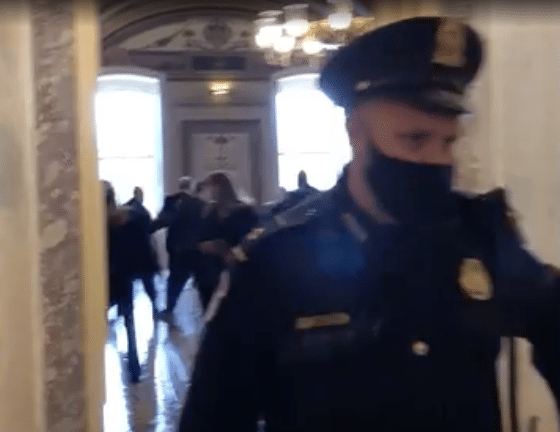
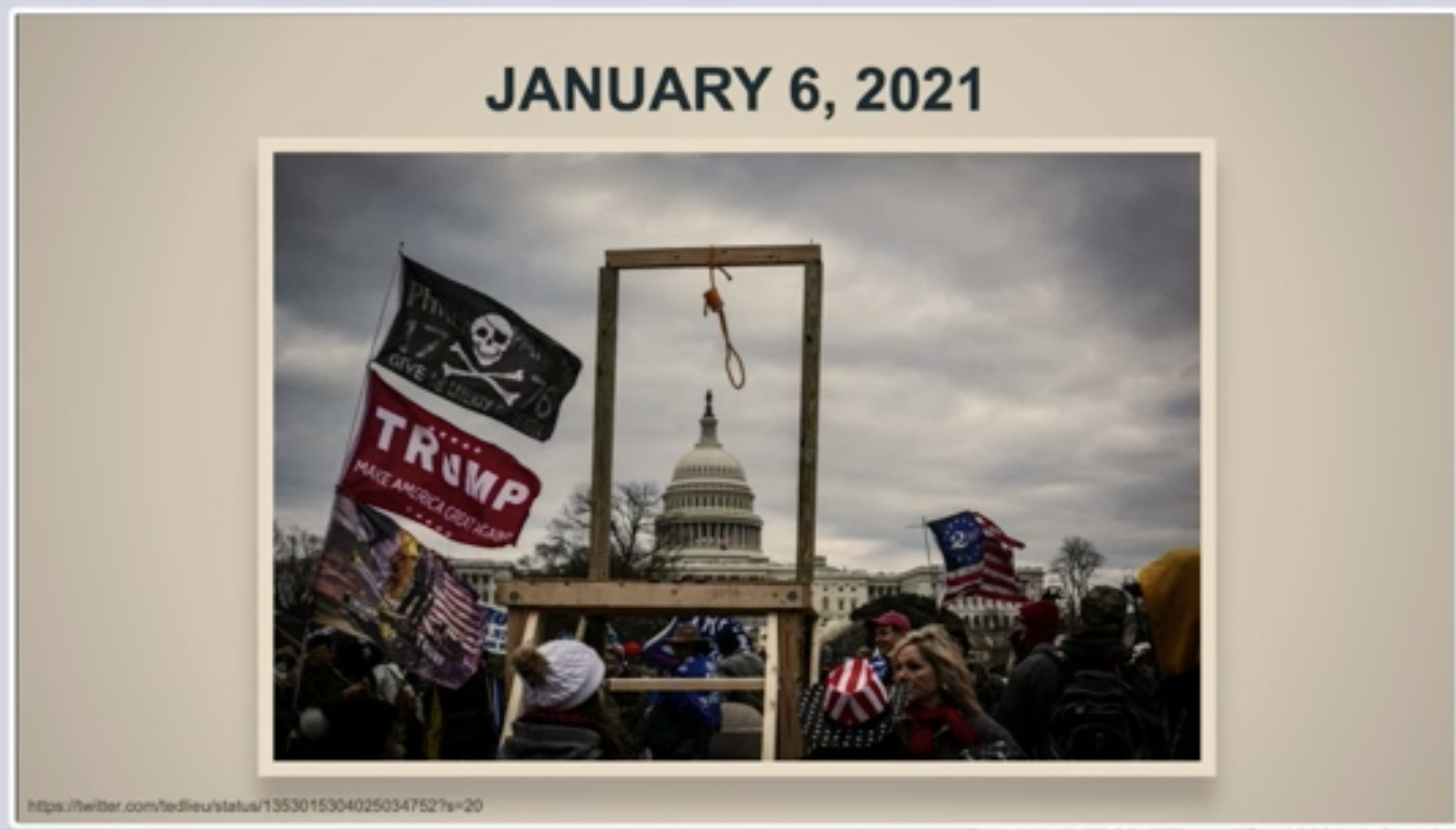
What no one is saying in their coverage, however, is that Trump — through Bove — is effectively trying to remove thousands of FBI Agents because they treated a violent attack on the Capitol, one that put Members of Congress at real risk (as the video of Chuck Grassley fleeing, which Kyle Cheney first discovered, shows).
This mob wasn’t just coming after Mike Pence and Nancy Pelosi (and AOC) by name. They were also coming after Mitch McConnell by name. As I’ve shown, Ryan Nichols was calling to drag every member of Congress who certified Joe Biden’s win, which includes Grassley, Lindsey Graham, and John Cornyn.
Trump is trying to make it a firing offense for the FBI to investigate people — including some adjudged terrorists — who attacked a co-equal branch of government.
And thus far, Senators who could stop it have done nothing.
Purging these agents will not just devastate the FBI workforce, throwing away decades of expertise. But it will also send a message that Trump can sic a mob on Congress with no response from law enforcement.
Share this entry
https://www.emptywheel.net/wp-content/uploads/2025/02/Screenshot-2025-02-03-at-14.33.15.png432560emptywheelhttps://www.emptywheel.net/wp-content/uploads/2016/07/Logo-Web.pngemptywheel2025-02-03 09:46:472025-02-03 09:46:47Trump Preparing to Fire FBI Agents Who Treated a Violent Attack on Congress as a Crime
According to WSJ, Meta has agreed to pay $25 million to lose the frivolous lawsuit Trump launched after Facebook exercised its prerogative under the First Amendment not to platform Trump’s insurrection anymore in 2021.
Meta Platforms has agreed to pay roughly $25 million to settle a 2021 lawsuit that President Trump brought against the company and its CEO after the social-media platform suspended his accounts following the attack on the U.S. Capitol that year, according to people familiar with the agreement.
Of that, $22 million will go toward a fund for Trump’s presidential library, with the rest going to legal fees and the other plaintiffs who signed on to the case. Meta won’t admit wrongdoing, the people said. Trump signed the settlement agreement Wednesday in the Oval Office.
A Meta spokesman confirmed the settlement.
[snip]
Trump’s Facebook and Instagram accounts were suspended in 2021 because of posts he made around Jan. 6, 2021, when a mob stormed the Capitol building. In the days leading up to the attack and on Jan. 6, he repeatedly used the platforms to make false claims that he won the 2020 election and alleged widespread election fraud that was denied by the administration’s top election-security experts and attorneys.
Zuckerberg, at the time, said the risks of the president’s using the social-media platforms during that period “are simply too great” and then paused the president’s accounts for two weeks. The pause was subsequently lengthened.
Most people — including Elizabeth Warren, in the WSJ story — are focusing on how this is effectively a bribe, a $22 million donation (on top of the earlier $1 million one) trading for regulatory favors. It is. Trump continues to engage in unprecedented corruption in plain sight.
But it is more than that. The concession of the settlement implies that Facebook should not have banned Trump for using their platform to incite an insurrection, though it admits no wrong-doing.
I have repeatedly argued that if Twitter, along with Facebook, had not shut down Trump’s account after January 6, there was a good chance that Joe Biden would never have been inaugurated.
Mark Zuckerberg’s capitulation makes it far less likely Meta will do the same thing — take action against Trump’s account to prevent him from stoking ongoing violence — again. It makes it virtually certain that Meta will not police inciteful content involving Trump without buy-in from the top, from Zuck.
And that, along with Meta’s earlier capitulations to Stephen Miller to rejigger its algorithms to allow transphobic and other dehumanizing speech — which experts predicted would lead to the kind of violence Facebook fostered in Myanmar — means that when Trump next uses these platforms to incite violence, he’s far less likely to be shut down.
Heck, John Roberts has even provided guidelines to Trump on how to ensure such incitement will be an official act and therefore immune from any future prosecution. Trump simply needs to involve his top aides — someone like Stephen Miller — in crafting a post, and Trump will be able to say that John Roberts told him that Trump never goes to prison for it.
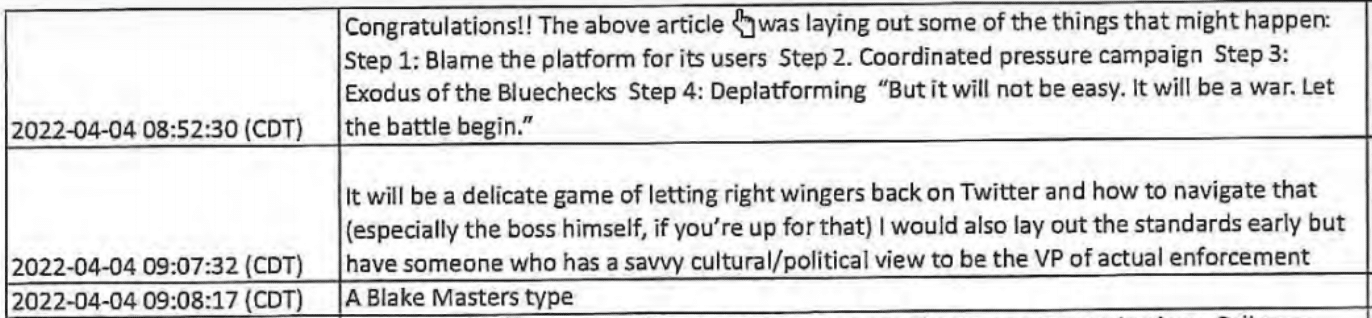
Stephen Miller has, for some time, been laser focused on re-weaponizing social media. He is suspected to be the one who pitched Musk on bringing “the boss himself, if you’re up for that!” back onto Xitter.
Then, last summer, Miller attempted to intervene in Trump’s document case when Jack Smith asked Aileen Cannon to prevent Trump from falsely claiming the FBI tried to assassinate him because it issued routine use of force guidelines for the search of Mar-a-Lago. Miller argued that Trump’s false claims on social media about the FBI — earlier ones of which had already led to a violent attack on the FBI — were not incitement and constituted important speech for the election.
The only possible constitutional exception to free speech the government has identified is incitement. But it cannot rely on that exception to justify infringing President Trump’s rights. President Trump has not engaged in speech that “prepare[s] a group for violent action [or] steel[s] it to such action.” Brandenburg, 395 U.S. at 448. It cannot be said that by merely criticizing—or, even as some may argue, mischaracterizing—the government’s actions and intentions in executing a search warrant at his residence, President Trump is advocating for violence or lawlessness, let alone inciting imminent action. The government’s own exhibits prove the point. See generally ECF Nos. 592-1, 592-2. 592-3, 592-5. The government presents no evidence that President Trump advocated a violent attack or other lawless action against the Department of Justice, the FBI, President Biden, this Court, any witness, or any other person. Much less has the government proved a call to arms or any request, demand, instruction, or implication that supporters should violate any law.
And all this is happening after Trump pulled the security detail from several people — most notably Anthony Fauci and Mark Milley — who’ve long been targeted, the latter by Iranian terrorists as well as Trump’s people. Indeed, one of the attacks Smith focused on in his successful DC bid for a gag was Trump’s attack suggesting Milley should be executed.
This is not just about eliciting a bribe for regulatory favors. It is not just about winning an argument about actions taken four years ago to halt an insurrection in process.
The entire lawsuit is about an ongoing chilling effect. And Zuck’s capitulation is a capitulation to that chill, a soft commitment that the next time Trump uses social media to launch his mob against vulnerable targets like trans people or legal Haitian immigrants, against co-equal branches of government in Congress or the courts, or against his select targets like Milley, Meta will do nothing to slow the mob.
For years, Stephen Miller has been perfecting the use of social media to sow fascism. And he just cowed one of the richest men in the world to make it a more effective tool for fascism.
Share this entry
https://www.emptywheel.net/wp-content/uploads/2021/02/Screen-Shot-2021-02-10-at-9.37.01-PM.png9741708emptywheelhttps://www.emptywheel.net/wp-content/uploads/2016/07/Logo-Web.pngemptywheel2025-01-30 07:48:192025-01-30 07:48:19Mark Zuckerberg Agrees to Turn Meta [Back] into a Pogrom Machine
I expect Kash Patel will be confirmed; I even expect that Democrats on the Senate Judiciary Committee will be utterly feckless in Kash’s confirmation hearing tomorrow.
Nevertheless I wanted to summarize his disqualifications.
Kash got where he is by substituting the Steele dossier for the real Russian investigation, which was instrumental in Trump’s success at minimizing the damage of one after another Trump associate lying about what really happened in 2016.
Kash gets a lot of credit for the Nunes Memo, with many right wingers claiming that the Horowitz Report vindicated it.
It didn’t. As I showed, both the Nunes Memo and the Schiff Memo got things right and got things wrong; mostly they just spoke past each other, which was fundamentally based on that substitution of the Steele dossier for the real Russian investigation.
Nevertheless, one of Kash’s lasting gripes (against Robert Hur) has to do with efforts to limit how much Kash was releasing at the time.
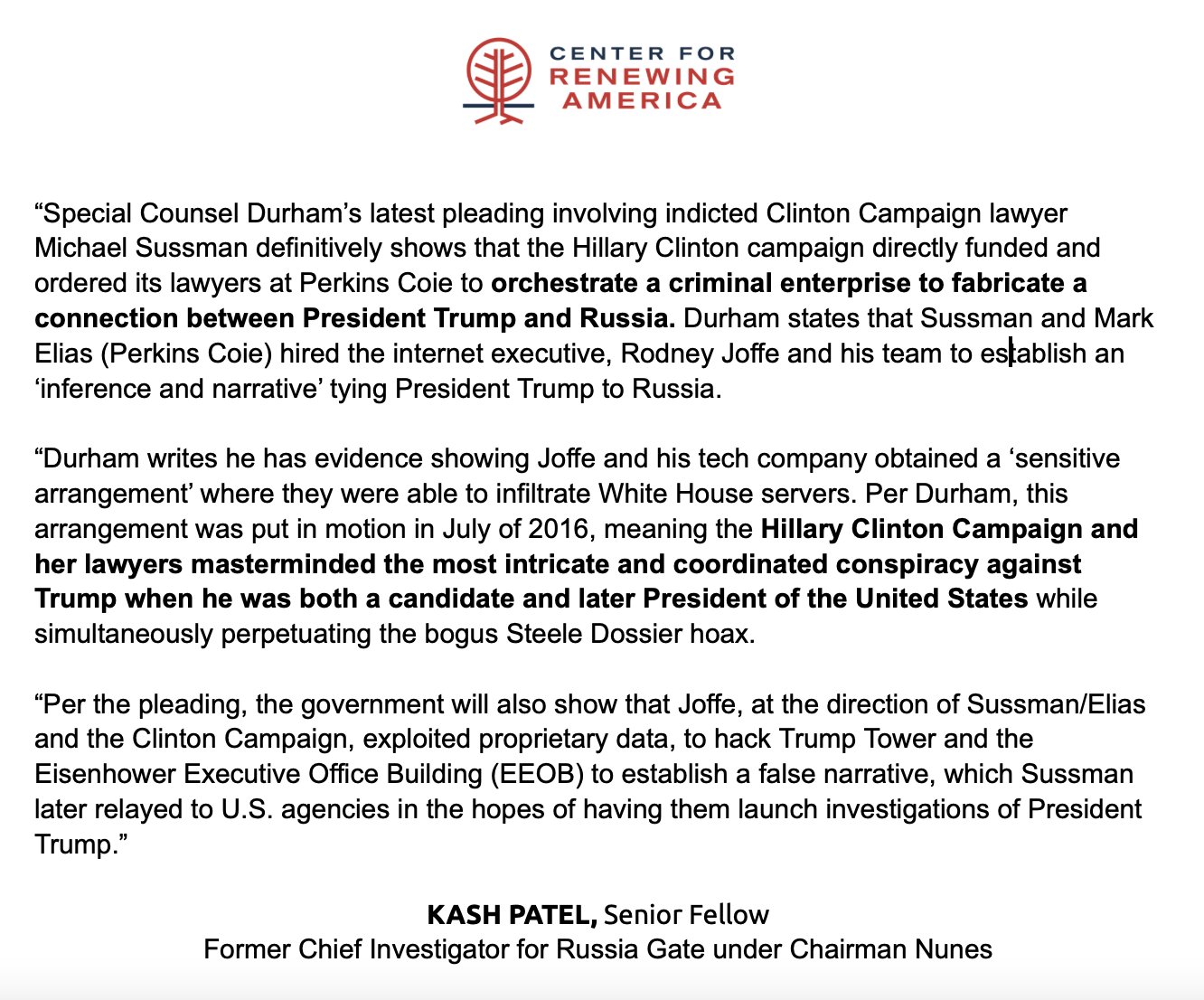
Kash did more than that as a House staffer, though. He continued to chase his conspiracy theories as Congress turned to criminalizing Hillary Clinton. He’s actually the staffer who asked the question that set up Michael Sussmann for a failed prosecution years later. He set up what would later become the Durham investigation — a four year effort to criminalize being victimized by a hostile nation-state.
And then, after Durham filed a wildly misleading court filing misrepresenting the discovery by some Georgia Tech researchers that someone was using a YotaPhone inside the Executive Office of the Presidency during the Obama term, Kash sent out a letter outright lying about the claims.
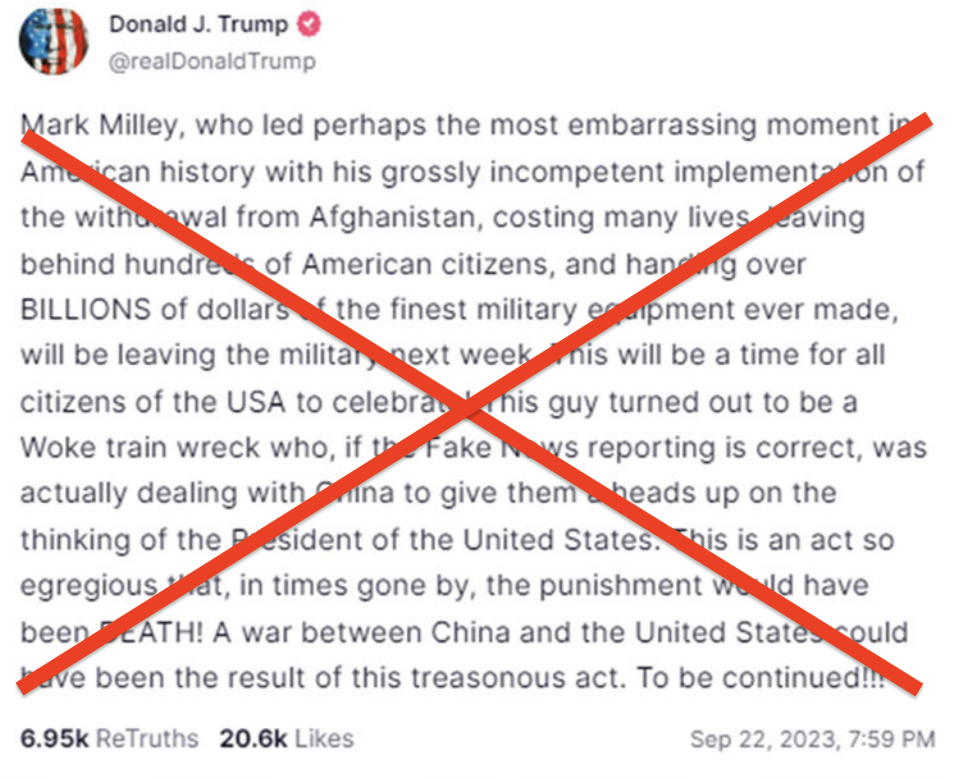
The whole thing is riddled with lies, but ultimately it amounts to a conflation of the Obama-era discovery with the discovery of the ties between a marketing server, Alfa Bank, and a Spectrum Health server. Kash’s letter was the final step before Trump jumped on the lies and called for Sussmann’s execution. Kash is a key cog in the way Trump has elicited threats against others.
Kash also paid a lot of former FBI agents who were disgruntled about having to investigate Trump supporters.
And when news of the discovery that boxes of documents that Trump had returned had classified documents in them, Kash invented a claim that Trump had declassified all those documents.
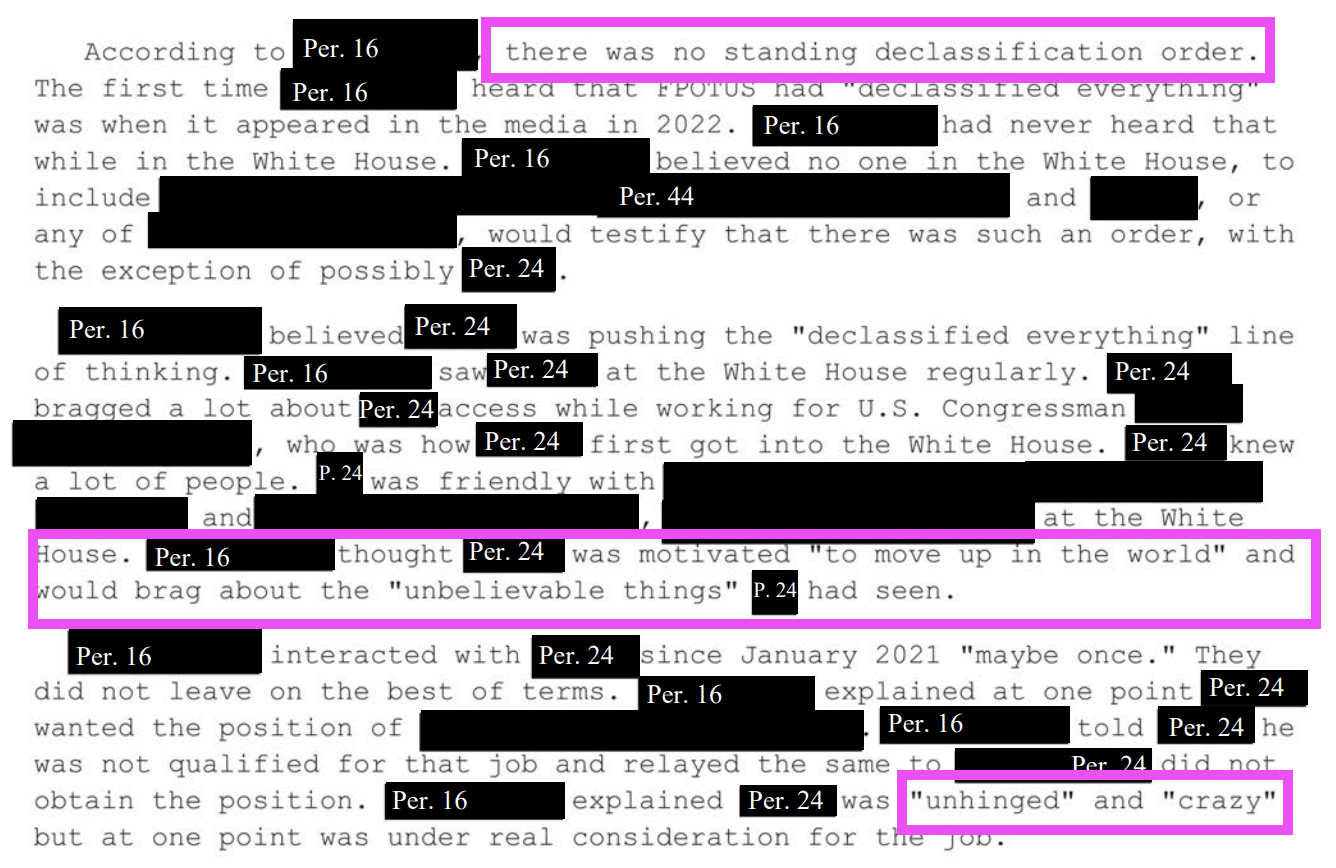
At least one Jack Smith witness — someone with the potty mouth of Eric Herschmann — disputes any claim there was a standing order to declassify documents. That witness described someone “unhinged” and “crazy” who first got access to the White House through the Member of Congress he worked for, who started the “declassified everything” claim when it first started appearing in the media, which is when Kash Patel made the claim.
Jack Smith described what happened next. When investigators subpoenaed Kash to test his claims that Trump had this standing order, Kash tried to delay compliance indefinitely by hiring a lawyer already busy defending a January 6 seditionist. When the aspiring FBI Director did first testify, Kash pled the Fifth repeatedly.
On Monday, September 19, 2022, the FBI personally served witness Kashyap “Kash” Patel with a grand jury subpoena, commanding him to appear on September 29, 2022. Prior to engaging with counsel, Patel contacted government counsel on Friday, September 23, 2022, to request a two-week extension. The government agreed to that extension and set his appearance for October 13, 2022. Thereafter, [Stan] Woodward contacted government counsel on September 27, 2022, explaining that he had just begun a lengthy jury trial–United States v. Rhodes et a., No. 22-cr-15 (D.D.C.)–but that Patel had retained him. On September 30, 2022, Woodward request an addition indefinite extension of Patel’s grand jury appearance until some point after the Rhodes trial concluded. (Ultimately, the verdict in the trial was not returned until November 29, 2022, approximately six weeks after Patel’s already-postponed appearance date of October 13, 2022.) The government was unwilling to consent to the indefinite extension that Woodward sought. Woodward, for his part, declined various alternatives offered by the government, including scheduling Patel’s grand jury appearance for Friday afternoons, when the Rhodes trial was not sitting, and a voluntary interview by prosecutors and agents over a weekend.
On October 7, 2022, Patel (through Woodward) filed a motion to quash his grand jury appearance, arguing that requiring Patel to appeal pursuant to the grand jury’s subpoena would violate his constitutional rights by depriving him of his counsel of choice, i.e., Woodward, who was occupied with a jury trial elsewhere in the courthouse. The Court denied the motion to quash on October 11, 2022, see In re Grand Jury No. 22-03 Subpoena 63-13, No. 22-gj-41, Minute Order (Oct. 11, 2022), and required Patel to appear as scheduled on October 13. See id. (“Mr Patel requests a delay of some unspecified time period in his testimony because his counsel, Stanley Woodward, will be engaged in the United States v. Rhodes trial, Case No. 22-cr-15, scheduled to last several weeks, with no promises as to when his counsel will still have time available. Mr. Patel retained Mr. Woodward on the attorney’s first day of jury selection in Rhodes when such circumstance made fully apparent that counsel would be unavailable during Mr. Patel’s scheduled grand jury testimony. In addition, the government has already demonstrated flexibility in meeting Patel’s scheduling needs . . . . Testifying before a grand jury is not a game of find-or-seek-a-better-time or catch-me-if-you-can, and a witness cannot indefinitely delay a proceeding based on his counsel’s convenience. . . .”).
Patel appeared before the grand jury on October 13, 2022, where he repeatedly declined to answer questions on the basis of the rights afforded to him by the Fifth Amendment. Thereafter, the government moved to compel Patel’s testimony. The Court granted the government’s motion to compel, contingent on the government offering statutory immunity. [my emphasis]
Aileen Cannon has buried any description of what Kash said when compelled to testify. This nomination should be held until any discussion of Patel in the Jack Smith report is released (but thus far Dick Durbin has shown no interest in doing so; DOJ just dropped their appeal).
But it should never be passed, because Kash is a menace. In his repeated efforts to falsely claim that January 6 defendants were treated any worse than any other mostly-violent pretrial detainees during the COVID period, he suggested that the people detained for assaulting cops were being mistreated.
As I have shown (and Bulwark did before me) Kash’s cheerleading for January 6 defendants amounts to arguing that someone accused of assaulting cops who grabs a gun when his probation officers show up should not then be jailed, nor should someone who directly threatened members of Congress, called on a mob to grab their weapons, and then assaulted cops.
Kash Patel will do and say anything to protect Trump and his flunkies — up to and including risking the safety of members of Congress.
Such a person would not serve as Director of FBI. He would serve as a means to turn government against Trump’s adversaries.
Share this entry
https://www.emptywheel.net/wp-content/uploads/2025/01/Unhinged.png8681336emptywheelhttps://www.emptywheel.net/wp-content/uploads/2016/07/Logo-Web.pngemptywheel2025-01-29 11:29:322025-01-29 11:33:34A Summary of Kash Patel’s Disqualifications to Lead FBI
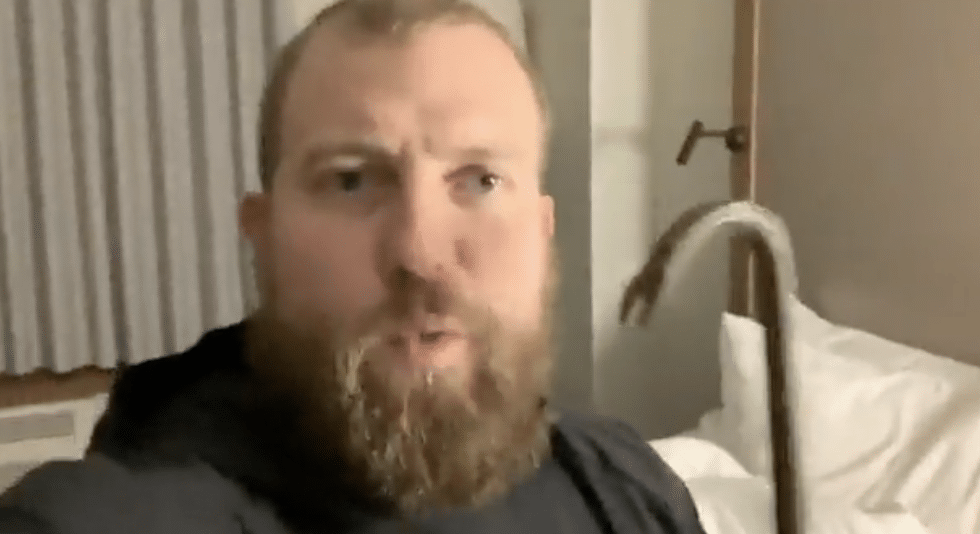
When Kash Patel boosted the J6 Choir claiming the video of those housed in DC Jail in March 2023 was proof of a two-tier system of justice, he was suggesting that someone who brought a crowbar — which he called a “weapon” — to the Capitol while promising to drag members of Congress through the streets, then assaulted cops protecting Congress, should not be detained while awaiting trial for assaulting cops.
That’s the significance of Ryan Nichols’ inclusion in the footnote Jack Smith put in his report, listing the identities of some of the J6 Choir members Trump had endorsed.
Nichols was in jail because of the threats he posed to members of Congress.
I’m hearing that Pence just caved. I’m hearing reports that Pence caved. I’m telling you if Pence caved, we’re gonna drag motherfuckers through the streets. You fucking politicians are going to get fucking drug through the streets. Because we’re not going to have our fucking shit stolen. We’re not going to have our election or our country stolen. If we find out you politicians voted for it, we’re going to drag your fucking ass through the streets. Because it’s the second fucking revolution and we’re fucking done. I’m telling you right now, Ryan Nichols said it. If you voted for fucking treason, we’re going to drag your fucking ass through the streets. So let us find out, let the patriots find out that you fucking treasoned this country. We’re gonna drag your fucking ass through the street. You think we’re here for no reason? You think we patriots are here for no reason? You think we came just to fucking watch you run over us? No. You want to take it from us, motherfucker we’ll take it back from you.
And even then, he didn’t remain in prison for the period before he pled guilty.
Nichols challenged his treatment in the DC jail, complaining about the seizure of his discovery and claiming that his incarceration was exacerbating his known PTSD diagnosis. He was further involved in an altercation in September 2022, after which he was segregated, then moved to another facility. He had repeated diagnosis issues with his health care. So in November 2022, Judge Thomas Hogan released Nichols from custody, and he remained out until he pled guilty on November 7, 2023.
But ultimately, Reagan appointee Royce Lamberth sentenced Nichols to what would have been three more years in prison — a total of 63 months and (because Nichols refused to cooperate with Probation on his finances) a record $200,000 fine, one the pardon will presumably wipe away entirely.
Nichols blamed his untreated PTSD for his actions. But Nichols’ sentencing memo revealed a 2019 arrest for assault causing bodily harm that resulted in diversion, one that belies his defense attorney claim he had never been violent before January 6. And prosecutors’ sentencing memo raised all the conspiracy claims Nichols made — many of the same claims that Kash Patel has made about him and others — raising some question about his remorse for his actions.
In addition, although Nichols “agreed with the conduct described in the Statement of Offense” in his presentence interview, PSR ¶ 50, in a post circulated after the plea hearing, members of Nichols’ defense team refers to him as a “political prisoner.” Exhibit J (Substack blog post authored by defense team law clerk present at counsel table for the plea hearing titled “Ryan Nichols: Political Prisoner Of His Own Country”); see also Exhibit K (GiveSendGo page titled “Free My Patriot Prisoner” with messages attributed to Nichols, his wife, and his father prior to the defendant’s plea). Even prior to Nichols entering his plea, his attorney was tweeting statements that directly contradicted the statement of offense in this case. See Exhibit M (October 30, 2023, twitter post from Nichols’ lead counsel).12 These statements threaten “public trust in the rule of law and the criminal justice system [, which] is paramount in the context of January 6 cases.” United States v. Nester, 22-cr-183 (TSC), ECF No. 113 at 6 (internal citation omitted). While the government does not attribute counsel’s statements to the defendant himself (nor does it base its recommendation on such bombastic rhetoric), this Court must appropriately assess whether the defendant has independently accepted responsibility for his criminal conduct. Pleading guilty is not simply the same as accepting the consequences and showcasing remorse under these trying and unique circumstances.
12 The government also notes that, in the months leading up to his plea, Nichols was claiming in public court filings that, in effect, “shadowy teams of plainclothes government agents orchestrated the attack [on the Capitol], leaving a far larger number of innocent Americans to take the fall.” ECF 266 (Order Denying Defendant’s Motion for Disclosure) at 13; see also ECF 244 (Motion for Disclosure), 245 (Supp. Motion for Disclosure), and ECF 251 (Reply to Government’s Opposition to Motion for Disclosure)
The sentence Judge Lamberth imposed in May 2022, 63 months, was about 75% of the government ask of 83 months. While Nichols had a lot of heartfelt things to say about his actions, Judge Lamberth noted that Jan6ers had repeatedly reneged on their statements of remorse, which the recent statements laid out in the government sentencing motion addressed.
Importantly, Nichols himself noted that the solitary confinement to which he was subjected was a COVID protocol, not anything specifically targeting Jan6ers.
I spent months in solitary confinement for 23 to 32-plus hours at a time due to COVID protocols, only allowed out for one hour to shower or make a phone call just to be locked in that 10-by-7-foot cell for another 23 to 32-plus hours at a time. Mental torture is an understatement. I heard grown men screaming and crying out for their mothers, me included. Many nights, I cried myself to sleep. With no court dates, no discovery, and no ending in sight, I felt hopeless and my mental health spiraled out of control. Eventually, I decided that, maybe, I needed to seek professional help. I put in a mental health request, and two weeks later I was back on Zoloft. Though this certainly helped control my mind and get my emotional imbalance in alignment, the solitary confinement was still overwhelming.
And he expressed empathy with the incarceration of people of color.
Your Honor, I know, after almost two-and-a-half years of incarceration, how terrible jail and prison is. The entire atmosphere is violent, dark, and unforgiving. For the majority of my life, I’ve heard, but never been able to empathize with, people of color when they testified to the harsh environment and treatment within the jail and the prison system. Make no mistake, I am now a witness to their testimony. Being in jail and prison is a living hell of eternal separation from the light. Sometimes it feels like not even God himself can penetrate those walls.
Nichols’ PTSD and other maladies did make incarceration onerous. The DC jail treated him just as shitty as it treats everyone else. And he was released because of it.
But that’s not a proof of a two-tier system of justice. That’s proof that America’s prisons suck, and that Jan6ers had more success in using that to get released than others.
Ultimately, though, Patel is claiming that one can get in your truck with guns in the back, drive to DC, threaten to drag people like Lindsey Graham and Chuck Grassley through the streets because they certified Joe Biden’s win, spray cops with toxic chemicals, and then call on the mob to grab more weapons to break into the Capitol, and not be assigned to pre-trial detention. That’s what Nichols did: He directly threatened Senators, both Republicans and Democrats. The notion that Nichols was improperly detained suggests one can assault cops after threatening the members of Congress they’re protecting with impunity.
And that’s what the aspiring FBI Director has said: that people can threaten to assault the very people who are rushing to confirm him with impunity.
Share this entry
https://www.emptywheel.net/wp-content/uploads/2025/01/Screenshot-2025-01-28-at-12.10.45.png534980emptywheelhttps://www.emptywheel.net/wp-content/uploads/2016/07/Logo-Web.pngemptywheel2025-01-28 11:19:042025-01-28 11:19:04Confirming Kash Patel Will Get Senators “Drug through the Streets”
The press continues to largely ignore the work that Jack Smith did, including the footnote in his report where he noted Trump’s support for the Jan6 choir by listing the detention memos for a number of them.
As he did in his 4:17 p.m. and 6:01 p.m. Tweets on January 6, Mr. Trump has provided additional evidence of his intent by continuing to support and ally himself with the people who attacked the Capitol. He has called them “patriots” 135 and “hostaoes ” 136 reminisced about b ‘ January 6 as a “beautiful day,” 137 and championed the “January 6 Choir,” 138 a group of January 6 defendants who, because of their dangerousness, are detained at the District of Columbia jail. 139
139 See United States v. Nichols, No. 21-mj-29, ECF No. 9 (E.D. Tex. Jan. 25, 2021) (ordering pretrial detention in prosecution of defendant who later became a member of the “January 6 choir”); United States v. Nichols, No. 2 l-cr117, ECF No. 75 (D.D.C. Dec. 23, 2021) (denying defendant’s motion for pretrial release); id, ECF No. 307 at 27 n. IO, 35-36 (D.D.C. Apr. 30, 2024) (government sentencing memorandum referencing defendant’s involvement in “January 6 choir”); see also United States v. Mink, No. 21-mj-105, ECF No. 19 (W.D. Pa. Jan. 29, 2021) (in prosecution of defendant who later became a member of the “January 6 choir,” ordering defendant’s pretrial detention); United States v. 1vfink, No. 21-cr-25, ECF No. 45 (D.D.C. Dec. 13, 2021) (court order denying defendant’s motion to revoke pretrial detention); United States v. Sandlin, No. 21-mj-110, ECF No. 8 (D. Nev. Feb. 3, 2021) (ordering pretrial detention in prosecution of defendant who later became a member of the “January 6 choir”); United States v. Sandlin, No. 2 l-cr-88, ECF No. 31 (D.D.C. Apr. 13, 2021) (denying defendant’s motion for release on bond); id., ECF Nos. 44, 44-1 (D.D.C. Aug. 31, 2021) (mandate return following denial of defendant’s appeal of pretrial detention order); United States v. Shively, No. 21-cr-151, ECF No. 42 (D.D.C. May 9, 2022) (in prosecution of defendant who later became a member of the “January 6 choir,” revoking conditions of release and ordering pretrial detention); United States v. Khater, No. 21-cr-222, ECF No. 25 (D.D.C. May 12, 2021) (in prosecution of defendant who later became a member of the “January 6 choir,” denying defendant’s motion for release from custody); United States v. McGrew, No. 21-cr-398, ECF No. 40 (D.D.C. Nov. 2, 2021) (order of detention pending trial in prosecution of defendant who later became a member of the “January 6 choir”).
Bulwark is one laudable exception. In advance of his confirmation hearing, they did a post using the footnote to focus on Kash Patel’s role in boosting the video. They quote Patel saying, over and over, that the video represents how he boosted the video to “destroy the two-tier system of justice” seemingly applied to Jan6ers.
PATEL DISCUSSED HIS KEY ROLE in producing and promoting the J6 Prison Choir during a March 10, 2023 appearance on Steve Bannon’s War Room podcast. Patel announced that he was “exclusively” releasing for “the first time ever” the video for the choir’s song “Justice for All.”
“We all know the plight of the Jan. 6 prisoners and their families and how due process has been destroyed for so many of them,” Patel told Bannon. He then explained how he and others helped produce the song.
“We also know, or some of us know, that they sing, the Jan. 6 prisoners themselves sing, the national anthem every night for 700 straight plus nights from the jail themselves,” Patel said. He and others thought it “would be cool” if “we captured that audio” and mixed it with “the greatest president, President Donald J. Trump,” reciting the Pledge of Allegiance. “Then we went to a studio and recorded it, mastered it, and digitized it, and put it out as a song,” Patel added.
[snip]
As he went on to promote the song in the weeks that followed, Patel portrayed the J6 Prison Choir as victims of the U.S. justice system. “[‘Justice for All’] was a collaboration between like-minded Americans who wanted to keep the focus on helping to destroy the two-tier system of justice that is rotting America,” Gateway Pundit quoted Patel as saying in a March 21, 2023 post. Patel added that the “net profits” would be used “to financially assist as many Jan. 6 families as we can, and all families of nonviolent offenders will be considered.” (This raises a question: Given that the choir’s members included violent offenders, did any of them, or their families, receive any of the proceeds?)
That said, they relied only on press releases to describe those included in Jack Smith’s footnotes, not the dockets themselves (or better yet, video). I want to focus on a few of the cases to show what the aspiring FBI Director thinks constitutes a two-tier system of justice.
I want to start with one of the least obnoxious people who was in the DC Jail in March 2023, Barton Shively (CourtListener docket). A former Marine, he was originally arrested on January 19, 2021 for assaulting two cops; he would eventually plead guilty to striking one officer’s “hand, head and shoulder areas,” and grabbing another and yelling at him.
But like most others accused of assaulting cops with his own hands (as opposed to a weapon), he wasn’t jailed right away. He was released to home detention, and several times got revisions to his release condition (for example) to make sure he could continue to work and, in May 2022, so he could get treatment for newly diagnosed Hodgkins.
That changed in May 2022, when probation officers showed up and found him with a shotgun and a sword.
On or about May 4, 2022, U.S. probation officers from the Middle District of Pennsylvania conducted an unannounced home visit and found a shotgun, ammunition, knives, and a sword in the defendant’s residence. See Image 10 below. Significantly, the “butt” of that shotgun had a cloth sleeve which stated, “THREE PERCENTERS.”5 Given the nature and seriousness of the violations of his release conditions and his displayed lack of candor, both D.C. Pretrial Service Agency and the U.S. Probation Office for the Middle District of Pennsylvania, inter alia, requested the defendant be removed from all pretrial supervision programs. Based on that report, this Court ordered that a show-cause hearing be scheduled for May 9, 2022. On May 9, 2022, after a hearing regarding the violations, this Court ultimately revoked his Release Conditions and detained Shively until sentencing in this matter. See Court’s Order ECF #42.
At his detention hearing, the probation officers claimed that Shively “reached for a shotgun, prompting one USPO to draw his weapon.”
That’s what led him to be jailed: not the original assault on the cops, but that he allegedly grabbed for a gun when probation officers found he had one that his release conditions prohibited him from even having.
That’s what Kash Patel claims is a two-tier system of justice, that after a guy accused of assault allegedly grabbed for a gun when his probation officers found it, he was detained.
Importantly, on intake, Judge Kollar-Kotelly made sure he would be assessed for the best medical treatment, for which his attorney later expressed appreciation for the “Court’s mindfulness of his medical situation.”
Shively remained in the DC Jail in March 2023 because his attorney asked for — and ultimately got — Kollar-Kotelly to recuse from the case because she had learned, ex parte, of an altercation at the jail in 2022, which led to a delay in his sentencing from February to June 2023.
In the end, in June 2023, Judge Jia Cobb sentenced Shively to 18 months for the assault, less than the 27 months even his attorney suggested.
Apparently, the aspiring FBI Director thinks that men out on pre-trial release should be able to grab a gun they’re prohibited from having when federal probation officers arrive and not get detained.
Share this entry
https://www.emptywheel.net/wp-content/uploads/2025/01/Screenshot-2025-01-27-at-2.36.23 PM.png1172940emptywheelhttps://www.emptywheel.net/wp-content/uploads/2016/07/Logo-Web.pngemptywheel2025-01-27 12:25:392025-01-27 12:50:35Kash Patel Thinks Assault Defendants Should Be Able to Grab for Guns When Probation Officers Arrive
Mike Johnson had a wild run yesterday. Having once called for “any individual who committed violence” on January 6 to be “prosecuted to the fullest extent of the law,” Johnson seemed to agree with JD Vance that violent attackers should not get pardons.
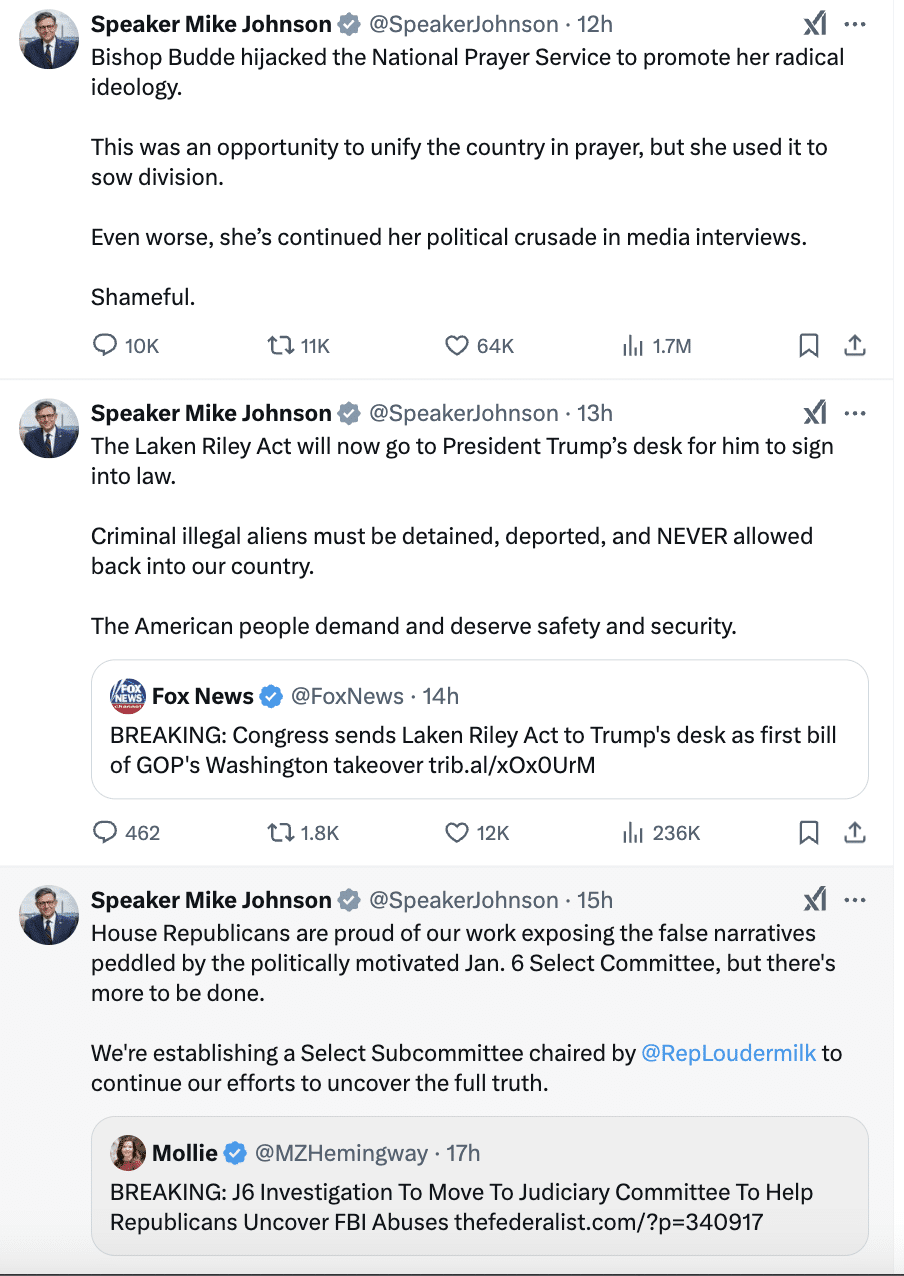
Over the course of the day, Johnson set up a Committee to keep investigating January 6, boasted about Americans “deserving safety and security” — a wildly inconsistent stance with releasing a bunch of violent criminals, and then accusing Bishop Budde of “sow[ing] division” because she spoke of mercy.
Meanwhile, as this was all going on, Mike Johnson (who as Speaker plays a role in overseeing the Capitol Police) let a terrorist prowl the Capitol.
Stewart Rhodes was in Longworth Office Building lobbying that Jeremy Brown — who, because he also got prosecuted for having unlawful weapons and classified documents in his Florida home, was not released yesterday — get a further pardon so he can be released (it’s unclear how a member of Congress would make this happen, but maybe Yale Law grad Stewie doesn’t understand the legal posture of Brown’s case).
Rhodes was spotted in the Dunkin’ Donuts inside Longworth House Office Building, which is accessible to the public, with a group of people. He said he did not go into the actual Capitol building.
Rhodes said he was advocating for the release of Jeremy Brown, another Oath Keeper who is in prison on federal weapons charges stemming from an investigation into his alleged involvement in the riot.
Rhodes said Brown was not included in Trump’s sweeping pardon of nearly 1,600 people arrested in connection to the rampage and that he went to the Capitol with Brown’s family members. He said that no members of Congress invited him to the Capitol specifically.
“We’re advocating members of Congress, advocating that he be given a pardon also,” Rhodes told reporters.
Rhodes is one of the fourteen people whose sentence Trump commuted, but did not pardon. And he was not only convicted by a jury of sedition and obstructing the vote certification, but Judge Amit Mehta applied a 6-level terrorism enhancement at sentencing.
As Kathryn Rakoczy successfully argued at sentencing, Rhodes had organized an armed force across the river, and regretted not deploying it that day.
I think organizing an armed force across the river that was prepared to come in comes pretty close to being pretty much like advocating for actions that could cause the loss of life. The repeated uses of how we need to have a bloody Civil War comes pretty close. And it is incredibly hard to forget the chilling words of Mr. Rhodes on January 10th that suggests that on January 6th, he was playing a little bit of the long game, but that were the President not to do something about calling up the Oath Keepers and literally starting a civil war, that his view was, “Actually, I should have called in the QRF on the 6th.” And I think when you’re thinking about whether this was terrorism, which we believe it was, all of those factors suggest that something around the level of a six-level adjustment feels right.
This is terrorism. It’s not blowing up a building directly or directing someone else to blow up a building. But certainly in light of the threat of harm and the historic significance of attempting to stop the certification of an election for the first time in U.S. history, those facts together we do think provide a factual basis that supports an increase of roughly six levels.
As Mehta laid out when applying the enhancement, the goal of all this was to influence the conduct of government by coercion.
As I said yesterday, I think as a matter of law, the conduct of conviction of seditious conspiracy meets the description foursquare of what that element — excuse me, what that enhancement requires a showing of, which is an offense other than the one that is enumerated in the Guideline, but the motive was to intimidate or coerce a civilian — I’m sorry, rather than — sorry.
The motive was to — calculated to influence or affect the conduct of government by intimidation or coercion, which were to retaliate against government conduct. Certainly that first clause applies squarely to the conduct of conviction.
And based upon the facts as I found them yesterday and have incorporated them today, Mr. Rhodes and his compatriots’ objective was to affect the conduct of government, specifically Congress, and to do so through intimidation and coercion by means of force, both through the stockpiling of weapons in the event that they needed to be brought across the river — there was an agreement as to that — and then, of course, the actual use of force by others who went into the building and applied that force against police officers who were doing their duty that day.
Trump did not, as he did with Enrique Tarrio, pardon Rhodes. Rather, he left the judgement against Rhodes in place; he simply said, effectively, that three years and a week was a sufficient sentence for a guy who plotted an armed attack on the government.
At least one staffer tried to tell Stewie that it was disrespectful to return to the scene of the crime.
He obfuscated, as he always does.
But the legal fact remains. He has not been pardoned of his sedition conviction and terrorism enhancement. Donald Trump chose to leave the judgment in place (for now, though Rhodes is reportedly still pressing Trump for a full pardon).
And Mike Johnson let him wander around the Capitol, all while claiming discussion of “mercy” was divisive.
Update: Judge Mehta has now barred Rhodes and the other Oath Keepers whose sentences were only commuted from the Capitol.
Share this entry
https://www.emptywheel.net/wp-content/uploads/2022/01/Stewie.jpeg480420emptywheelhttps://www.emptywheel.net/wp-content/uploads/2016/07/Logo-Web.pngemptywheel2025-01-23 09:26:032025-01-24 10:50:32Mike Johnson Let a Terrorist Roam the Capitol Yesterday
In an interview with Marc Elias the other day, Dan Goldman made a number of alarming claims. He said that before the release of Jack Smith’s January 6 report, “we didn’t really know about … the extensive litigation that the Special Counsel had to go through just to get this evidence.” That is, Goldman admitted that he missed the unsealing, in October, of the very documents Jack Smith cited to describe that process (which I wrote about at the time). Goldman missed the opportunity to make a stink about this before the election.
Goldman also wondered “if Elon Musk and X, while he has owned it, has ever not cooperated in the same way [as they did in response to a warrant for Trump’s Twitter account] in a different case.” We know the answer to that: according to an opinion Chief Judge Boasberg unsealed (and first spotted by Kyle Cheney, who played a key role in liberating the Executive Privilege dispute), from January to March of last year, Xitter refused to turn over mere subscriber records in what sounds like a leak investigation.
Much later in the interview (after 19:00), Goldman said,
Volume Two of the report is going to provide a lot more information that we don’t know. The litigation in the January 6 case, including the memo outlining all of the evidence, has been so extensive that, as we see from Volume One, there really isn’t that much that we didn’t know. There was also an entire Congressional Committee that did this investigation. This has been exhaustively investigated. And yes they did get more evidence because they had grand jury power. They got more witnesses to speak than the January 6 Committee did. But we’ve known about that.
We know very little about what the back-and-forth was with the National Archives, the FBI, Donald Trump and his team, others. And one of the things that has jumped out at me in that case is that in one of the filings, the Department of Justice, Special Counsel, said, that there evidence includes why Donald Trump retained the information illegally, and what he was planning to do with it. [my emphasis]
From there, Goldman went on to call for Merrick Garland to dismiss the case, which I’m not sure Garland can do without some judge going along (which was the hold up in the Mike Flynn case).
Now, as I have laid out, Jack Smith eschewed the opportunity to make new information available in Volume One of the report. For example, he didn’t explain why an investigation into Trump’s fundraising and spending ended without charges. Based on what we’ve seen in Volume One, I doubt we’d get the kinds of details Robert Hur provided in his 388-page report, describing every document that wasn’t charged and why not. I doubt we’d learn why the FBI believed there was a tie between a grant of clemency for Roger Stone and a document, classified Secret, about Emmanuel Macron, both found in Donald Trump’s own desk drawer. I doubt we’d learn why Trump compiled low-level classified information into a document with messages from a book author, a religious leader, and a pollster.
And I doubt we’d learn what Trump was planning to do with those classified documents.
I want to see the report. But I doubt it’ll include what Goldman hopes it will.
But it is also the case that we have already gotten a great deal of additional information about the investigation.
It’s not the case, for example, that “we know very little about what the back-and-forth was with the National Archives, the FBI, Donald Trump and his team, others.” This filing describes that process at length, relying on both dozens of documents that Trump himself liberated and 302s from those involved, including a key White House Office of Records Management official and Mark Meadows. This section describes Meadows’ involvement, which (along with actions taken by a former Trump White House Counsel, probably Pat Philbin) led to the involvement of Biden White House Counsel Jonathan Su, the basis of Trump’s bogus claim that Biden’s White House pushed the investigation into Trump.
A succession of Trump PRA representatives corresponded with NARA without ever resolving any of NARA’s concerns about the boxes of Presidential records that had been identified as missing in January 2021. By the end of June 2021, NARA had still received no update on the boxes, despite repeated inquiries, and it informed the PRA representatives that the Archivist had directed NARA personnel to seek assistance from the Department of Justice (“DOJ”), “which is the necessary recourse when we are unable to obtain the return of improperly removed government records that belong in our custody.” Exhibit B at USA-00383980; see 44 U.S.C. § 2905(a) (providing for the Archivist to request the Attorney General to institute an action for the recovery of records). That message precipitated the involvement of Trump’s former White House Chief of Staff, who engaged the Archivist directly at the end of July. See Exhibit 4 Additional weeks passed with no results, and by the end of August 2021, NARA still had received nothing from Trump or his PRA representatives. Id. Independently, the House of Representatives had requested Presidential records from NARA, further heightening the urgency of NARA obtaining access to the missing boxes. Id. On August 30, the Archivist notified Trump’s former Chief of Staff that he would assume the boxes had been destroyed and would be obligated to report that fact to Congress, DOJ, and the White House. Id. The former Chief of Staff promptly requested a phone call with the Archivist. Id.
[snip]
Fall passes with little progress in retrieving the missing records. In September 2021, one of Trump’s PRA representatives expressed puzzlement over the suggestion that there were 24 boxes missing, asserting that only 12 boxes had been found in Florida. Exhibit 7 at USA00383682, USA-00383684. In an effort to resolve “the dispute over whether there are 12 or 24 boxes,” NARA officials discussed with Su the possibility of convening a meeting with two of Trump’s PRA representatives—the former Chief of Staff and the former Deputy White House Counsel—and “possibly” Trump’s former White House Staff Secretary. Id. at USA-00383682. On October 19, 2021, a call took place among WHORM Official 1, another WHORM employee, Trump’s former Chief of Staff, the former Deputy White House Counsel, and Su about the continued failure to produce Presidential records, but the call did not lead to a resolution. See Exhibit A at USA-00815672. Again, there was no complaint from either of Trump’s PRA representatives about Su’s participation in the call. Later in October, the former Chief of Staff traveled to the Mar-a-Lago Club to meet with Trump for another reason, but while there brought up the missing records to Trump and offered to help look for or review any that were there. Exhibit C at USA-00820510. Trump, however, was not interested in any assistance. Id. On November 21, 2021, another former member of Trump’s Administration traveled to Mar-a-Lago to speak with him about the boxes. Exhibit D at USA-00818227–USA-00818228. That individual warned Trump that he faced possible criminal exposure if he failed to return his records to NARA. Id
[my emphasis, links added]
Exhibit D, cited to support a description of a former Trump official who warned that Trump faced criminal exposure, links to this complete 302, from someone whose potty mouth resembles Eric Herschmann. It describes a bunch of things:
How on November 21, 2021, he warned Trump to give the documents back: “Don’t give them a noble reason to indict you, because they will.”
How a “total moron” who resembles Boris Epshteyn insinuated himself with Trump with claims of voter fraud and subsequently tried to use something, perhaps claims fed to credulous reporters that he was serving a legal function, to cover for his past activities ( a document Trump himself liberated shows call records between this person resembling Epshteyn and a person resembling Chief of Staff designate Susie Wiles).
A February 2022 call in which someone resembling Tom Fitton told Trump he didn’t have to send documents back because of Fitton’s “Clinton Socks” ruling,
A prediction that Walt Nauta would be pardoned if he were charged with lying to the FBI.
But it also describes an extended description of someone “unhinged” and “crazy” who first got access to the White House through the Member of Congress he worked for, who started the “declassified everything” claim when it first started appearing in the media, which is when Kash Patel made the claim.
Another dispute — about whether Jay Bratt threatened to retaliate against Stanley Woodward if he didn’t get Walt Nauta to cooperate — includes a long discussion about Kash’s testimony. It revealed how Kash tried to delay compliance with a grand jury subpoena indefinitely by hiring a lawyer already busy defending a January 6 seditionist, and when Kash did first testify, the aspiring FBI Director pled the Fifth repeatedly.
On Monday, September 19, 2022, the FBI personally served witness Kashyap “Kash” Patel with a grand jury subpoena, commanding him to appear on September 29, 2022. Prior to engaging with counsel, Patel contacted government counsel on Friday, September 23, 2022, to request a two-week extension. The government agreed to that extension and set his appearance for October 13, 2022. Thereafter, [Stan] Woodward contacted government counsel on September 27, 2022, explaining that he had just begun a lengthy jury trial–United States v. Rhodes et a., No. 22-cr-15 (D.D.C.)–but that Patel had retained him. On September 30, 2022, Woodward request an addition indefinite extension of Patel’s grand jury appearance until some point after the Rhodes trial concluded. (Ultimately, the verdict in the trial was not returned until November 29, 2022, approximately six weeks after Patel’s already-postponed appearance date of October 13, 2022.) The government was unwilling to consent to the indefinite extension that Woodward sought. Woodward, for his part, declined various alternatives offered by the government, including scheduling Patel’s grand jury appearance for Friday afternoons, when the Rhodes trial was not sitting, and a voluntary interview by prosecutors and agents over a weekend.
On October 7, 2022, Patel (through Woodward) filed a motion to quash his grand jury appearance, arguing that requiring Patel to appeal pursuant to the grand jury’s subpoena would violate his constitutional rights by depriving him of his counsel of choice, i.e., Woodward, who was occupied with a jury trial elsewhere in the courthouse. The Court denied the motion to quash on October 11, 2022, see In re Grand Jury No. 22-03 Subpoena 63-13, No. 22-gj-41, Minute Order (Oct. 11, 2022), and required Patel to appear as scheduled on October 13. See id. (“Mr Patel requests a delay of some unspecified time period in his testimony because his counsel, Stanley Woodward, will be engaged in the United States v. Rhodes trial, Case No. 22-cr-15, scheduled to last several weeks, with no promises as to when his counsel will still have time available. Mr. Patel retained Mr. Woodward on the attorney’s first day of jury selection in Rhodes when such circumstance made fully apparent that counsel would be unavailable during Mr. Patel’s scheduled grand jury testimony. In addition, the government has already demonstrated flexibility in meeting Patel’s scheduling needs . . . . Testifying before a grand jury is not a game of find-or-seek-a-better-time or catch-me-if-you-can, and a witness cannot indefinitely delay a proceeding based on his counsel’s convenience. . . .”).
Patel appeared before the grand jury on October 13, 2022, where he repeatedly declined to answer questions on the basis of the rights afforded to him by the Fifth Amendment. Thereafter, the government moved to compel Patel’s testimony. The Court granted the government’s motion to compel, contingent on the government offering statutory immunity. [my emphasis]
This is the same kind of extended discussion of the delays that Trump and his flunkies created that Goldman claimed, incorrectly, first became available in Volume One of Smith’s report. And it (plus details of Tim Parlatore’s efforts to stall ongoing searches) has been public since April.
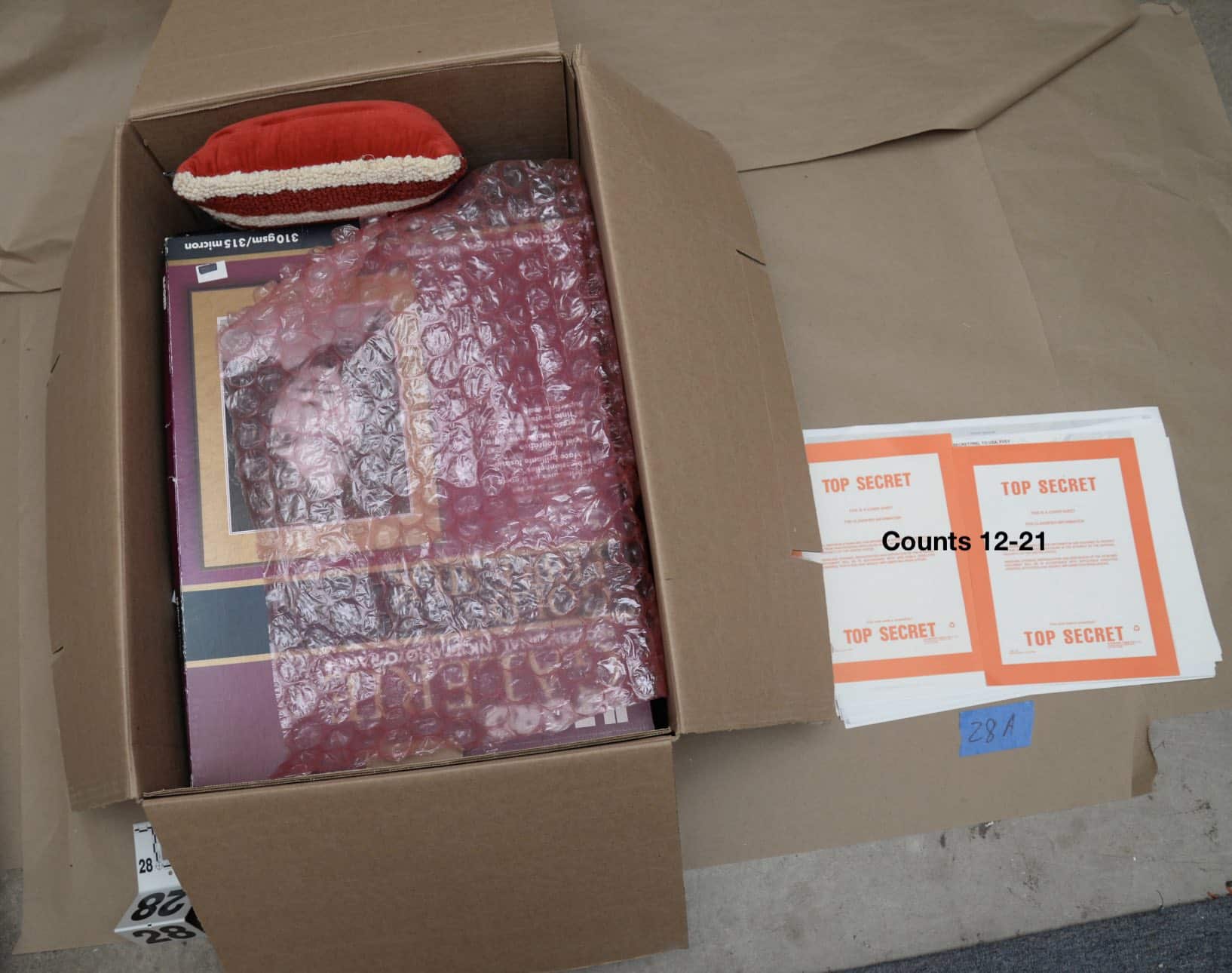
Other disputes provided a bunch more information, including pictures, of where and how Trump stored the documents he withheld, including one of this box, in which Trump was storing a document classified Formerly Restricted (that is, a document pertaining to nuclear weapons), along with nine other documents, underneath a Christmas pillow and some bubble wrap (I annotated the photo to show that the documents charged in Counts 12 through 21 were found in it).
Here are discussions of what was hidden under the bubble wrap.
A passage in the 193-page 302 transcript from Chamberlain Harris (focusing on how she scanned documents including sensitive White House schedules) describes that the door to the storage closet had only the kind of lock you’d find in a residential bathroom — a pinhole they’d open with a tiny flat screwdriver.
Person 10 [Harris]: They used to unlock it for me, because you could lock it from the inside.
Mr. Thakur: Okay. This is obviously after a lock was placed there, they would unlock it for you?
Person 10: No, this was before.
Mr. Thakur: Okay. So are you talking about a lock to another door, or?
Person 10: It’s a door with a pinhole in it.
Mr. Thakur: A door with a pinhole?
Person 10: Like, I don’t know, a circle doorknob?
SA 41: Kind of like what you would find on residential door inside of a home? So it might have a lock like that one on one side of it then other side, rather than an actual place for a key, it’s sort of like a —
Person 10: Yeah.
SA 41: — very tiny screwdriver?
Person 10: Um-hmm.
SA 51: I see. But that was only on the inside of the door. So you — reasonably couldn’t lock it from the outside unless they used that little pin to reengage the lock from the outside?
In other words, there’s far, far more that got released as part of litigation in the documents case than the January 6 case.
And Dan Goldman, whose job it is to oversee such investigations, seemingly knows about none of that: Not the description of how the aspiring FBI Director stalled the investigation. Not the document claiming that the “declassify everything” claim Kash first made was a lie. And not the description of the back-and-forth with NARA that Goldman says he wants.
It’s all there in the docket. And has been (for the most part) since April.
If you want to know how Democrats failed to make more of a political case against Trump during the election, you can start with the fact that Dan Goldman — one of the Democrats’ most forceful voices on rule of law, a former TV personality, and a member of the House Judiciary Committee — knows almost nothing about what was made public in either of the federal cases against Donald Trump and as a result did little to make a big deal of that before the election.
Share this entry
https://www.emptywheel.net/wp-content/uploads/2025/01/Unhinged.png8681336emptywheelhttps://www.emptywheel.net/wp-content/uploads/2016/07/Logo-Web.pngemptywheel2025-01-19 10:24:142025-01-19 14:08:55Found! Dozens of Damning Documents about Trump’s Hoarding of Classified Documents!