Posts

The Graymail Cometh

I’ve written extensively about how Kash Patel and John Durham chased a particular intelligence report — one we now know to have been based on Russian fabrications — for four years.

Kash, John Ratcliffe, Durham, his lead investigator Jack Eckenrode (who leads this investigation), Bill Barr — all of them! — believed that because the FBI received a single intelligence report repeating a Russian claim that Hillary planned to hold Trump accountable for his ties to Russia, it was proof that Hillary had intentionally fabricated the Steele dossier (disinformation into which was probably injected by Paul Manafort buddy Oleg Deripaska) and the Alfa Bank anomalies.

The case against Jim Comey renews that goose chase, perhaps (because Durham concluded it was likely fabricated) criminally so.

In his bid to obtain the grand jury transcripts submitted yesterday, Comey laid out how important it was for him to see how Lindsey Halligan instructed the jury on this matter, especially given that the grand jury rejected the charge specifically pertaining to that intelligence, but Loaner AUSAs plan to use it to prove Count Two of the existing indictment. As part of that discussion, he lays out how obscene it was to even charge him for not remembering something simply because Kash and Ratcliffe had developed an obsession over it.

Note, I have generally referred to that intelligence report as the “Clinton Plan,” which is how Durham referred to it, though without the scare quotes making clear that Durham himself fabricated parts of this theory. Comey, in his filings, uses the FBI term for all such referrals, CIOL (Counterintelligence Operational Lead).

Comey’s description starts with a detail I should have known, but did not: When Comey was asked, three times during the September 30, 2020 hearing, about the “Clinton Plan” CIOL, he had not been shown it.

On September 30, 2020, Mr. Comey testified before the Senate Judiciary Committee about the Crossfire Hurricane counterintelligence investigation into alleged links between President Trump’s 2016 campaign and the Russian government. See Oversight of the Crossfire Hurricane Investigation: Day 3, Hearing Before the U.S. Senate Committee on the Judiciary, 116th Cong. (Sept. 30, 2020), http://bit.ly/4o2ekHb. The night before, he was sent a copy of the Ratcliffe Letter, described above, which purported to summarize the September 7, 2016 CIOL in one sentence. Mr. Comey was not provided an opportunity to review the September 7, 2016 CIOL at issue prior to his testimony.

Ratcliffe had sent Lindsey Graham a misleading letter about it the night before the hearing, but he didn’t release the memo itself (which was itself redacted in a misleading way, and then shared with the Federalist) for another week. I first posted about it on October 11 of that year.

Nevertheless, Lindsey Graham highlighted it in the hearing and then Josh Hawley followed up. The focus on the referral was an ambush, probably intended to support the Durham investigation. And that’s what Kash is trying to criminalize, because doing so sustains his batshit insane theory that Hillary was treated better than Trump in the 2016 election when two criminal investigations into her dominated and the investigation into Trump’s aides remained secret.

To make things worse, Trump is trying to criminalize something which there’s no evidence Comey ever saw (Comey lays this out without even mentioning that Durham couldn’t find any proof that anyone else had seen it, either).

There is no evidence whatsoever that Mr. Comey received the CIOL at issue, much less that he reviewed it. The materials in discovery make clear that every day, numerous CIOLs come to the FBI addressed to the Director—from a variety of federal agencies in a variety of formats—and are routed to employees other than the Director. Because the Midyear Exam investigation had been closed for more than two months, there is no reason to believe that any CIOL related to Ms. Clinton would have been sent to Mr. Comey (and the government has produced no proof that it was). There is no electronic trail showing that Mr. Comey received the CIOL at issue. There is no paper trail showing that he received it. And there is no witness who says that Mr. Comey either received it or discussed it with him. Full stop.

This total lack of evidence is extremely troubling in light of credible press reporting that not only does a declination memorandum exist in this case,11 but it made clear that with respect to the CIOL in particular, a prior investigation found that Mr. Comey’s statement could not support a false-statement charge because there was insufficient evidence Mr. Comey had ever seen the CIOL.12 Ms. Halligan was also reported to have been advised by career prosecutors in that declination memorandum that “seeking the charges would violate DOJ policy, raise serious ethics issues, and risk being rejected by the grand jury.” Id. 13

11 The government’s refusal to answer basic questions about the existence of this declination memorandum and decision to hide behind a flimsy claim of privilege to stonewall the Court’s inquiries, see ECF No. 207, should be taken as confirmation that such a memorandum exists. See ECF No. 174 at 21.

12Katherine Faulders, et al., Ex-special counsel John Durham undercut case against James Comey in interview with prosecutors: Sources, ABC News (Oct. 6, 2025), https://perma.cc/M2JC-CQGQ.

13 Katherine Faulders, et al., Prosecutors’ memo to new US attorney found no probable cause to charge James Comey: Sources (Sept. 25, 2025), https://perma.cc/8KT5-LHAG.

As noted, this was a key part of Comey’s bid to get the grand jury transcripts, something that goes to the heart of the problem with simply cut-and-pasting the two true billed charges into a new indictment.

But as part of his (far less interesting) reply motion for a Bill of Particulars, he also includes all the discovery requests he has submitted (October 2, October 29, November 12, November 19). They hint at another way this prosecution might go away (and Comey’s post-exoneration retaliation might flourish), on top of the 14 ways we’ve already talked about: with discovery requests with which prosecutors will really not want to comply, or cannot, either because of bulk, classification, or destruction.

In the latter category, for example, Comey reveals an October 12 FBI 302 describing that DC USAO destroyed records relating to journalists when the Arctic Haze investigation was closed.

An FBI 302 Report, dated October 12, 2025, reports that “the District of Columbia United States Attorneys Office [was] ‘freaking out’ when the [Arctic Haze] case was declined for prosecution and in the process of being closed, with an Assistant United States Attorney telling [the lead agent in the Arctic Haze investigation] to ensure that any grand jury materials relating to members of the media were destroyed.” See FD-302 Report Serial 110 at -26505.

Lindsey’s Loaner AUSAs say that’s not true.

In an email on November 20, 2025 at 10:29 AM ET, the government represented that the 302 was inaccurate and the records had not, in fact, been destroyed. Mr. Comey reserves his rights with respect to the government’s potential spoliation of exculpatory evidence and will further investigate the government’s claim.

Comey also, just Wednesday, asked for the complete case file for the Arctic Haze, Durham, and this investigation (why he doesn’t have the latter two months after indictment I don’t know).

The Arctic Haze case file will lay out not just how Bill Barr focused exclusively on Comey (which I noted here) as opposed to others who might have been trying to damage him, but would name the Republican(s) who would have been the focus if he had not done so.

The Durham case file would explain why Andrew DeFilippis left DOJ quickly and quietly in the middle of the investigation. It would show that Durham lied in his report about how many FBI sources he had asked about the “Clinton Plan” CIOL, partly in an attempt to hide how clear it was that no one had seen this. It might show which Ukrainian Russian agents Durham and Barr and Jack Eckenrode consulted during the investigation and whether they also consulted Oleg Deripaska. It would either reveal the nature of the tip about Trump corruption that Italy gave to Durham or make clear that Durham hadn’t actually chased it down.

Importantly, it would also include all the evidence that shows Durham and Durham’s lead investigator turned Kash’s senior advisor, Jack Eckenrode, saw confirming that he had been chasing Russian disinformation for years, even while failing to establish any proof that FBI had actually received it. That evidence would be important to lay out how the continued pursuit of this by Kash and Eckenrode is a crime, at least according to Durham’s logic.

Holy hell I’d love to see the full Durham case file.

But the request that might really sink this prosecution, if 14 other things don’t first, is Jim Comey’s request for (1) all the CIOLs he received between January 1, 2016 (when the first SVR reports pertinent to the Clinton email investigation came in) and September 30, 2016, (2) all the intelligence he received pertaining to the Clinton email investigation or Crossfire Hurricane in that same period, and (3) all communications he received for a narrower period, July 1, 2016 to September 30, 2016.

If the government intends to present evidence as part of its case in chief at trial regarding the CIOL dated September 7, 2016 that Mr. Comey was questioned about in the September 30, 2020 Senate Judiciary Committee hearing, Mr. Comey is entitled to any and all documents that would rebut the inference that this CIOL was memorable to him as of September 30, 2020. Therefore, to the extent Count Two (or any other aspect of the government’s case in chief) is premised on the September 7, 2016 CIOL, in addition to the standard Rule 16 discovery that we are entitled to receive promptly, we are entitled to receive the following categories of documents pursuant to Rule 16 and Brady and its progeny, all of which are material to Mr. Comey’s ability to defend this case in pretrial motion practice and/or at trial:

(1) Any and all documents reflecting Mr. Comey’s receipt or review of CIOLs concerning the Midyear Exam investigation, Hillary Clinton, or the Crossfire Hurricane investigation between January 1, 2016 and September 30, 2016, including but not limited to:

(a) The CIOLs themselves; and

(b) Documentation reflecting Mr. Comey’s receipt or review thereof;

(2) Any and all documents reflecting Mr. Comey’s receipt or review of classified information concerning the Midyear Exam investigation, Hillary Clinton, or the Crossfire Hurricane investigation between January 1, 2016 and September 30, 2016;

(3) Any and all documents reflecting discussion involving Mr. Comey of CIOLs concerning the Midyear Exam investigation, Hillary Clinton, or the Crossfire Hurricane investigation between January 1, 2016 and September 30, 2016;

(4) Any and all documents reflecting discussion involving Mr. Comey of classified information concerning the Midyear Exam investigation, Hillary Clinton, or the Crossfire Hurricane investigation between January 1, 2016 and September 30, 2016; and

(5) Any and all communications or documents received by Mr. Comey in his capacity as Director of the FBI between July 1, 2016 and September 30, 2016. “Communications” as used in this subrequest five includes, but is not limited to:

(a) Emails;

(b) Phone calls;

(c) Text messages;

(d) Records of oral communications;

(e) Meeting invitations and calendar entries; and

(f) Hard copies of written communications delivered to Mr. Comey or his staff.

This is, on one hand, totally justifiable, because it would show just how unremarkable the CIOL that the current FBI Director has obsessed about for six years is as compared to everything else that Comey saw in that period. It would show why it made sense that, in 2020, when sandbagged by a misleading letter, it was unsurprising that the “Clinton Plan” CIOL would not ring a bell, as Comey responded in the hearing.

On the other hand, it is classic graymail, the very defense strategy used by Scooter Libby a hundred (well, just twenty) years ago: a request for documents so sensitive and so voluminous that prosecutors would have an exceedingly difficult time complying.

Libby’s request was more frivolous than this one. He asked for PDBs, among the most sensitive intelligence documents out there, covering the period when he was targeting Valerie Plame through the period when he lied to Patrick Fitzgerald about doing so. Fitzgerald managed not just to get the discovery to Libby, but to get substitutions approved so Libby’s team could walk through how insignificant exposing a CIA officer was to him, given the issues he was dealing with at the time.

By comparison, Comey’s is totally reasonable, given what prosecutors are preparing to argue, that he should have remembered, in September 2020, either the CIOL he didn’t receive or a briefing, possibly from John Brennan, that mentioned it in passing weeks later.

But Comey’s request will be just as difficult to comply with (and will also flip the logic of the dumb burn bag investigation back onto investigators). Plus, Kash Patel won’t want to comply with this, because it would involve giving Jim Comey a ton of information about how real and pressing the Russian attack was in 2016, the one Kash’s entire career is built on diminishing.

It seems that Lindsey’s Loaner AUSAs are already trying to dodge this request. The most recent discovery letter, sent Tuesday, reveals that prosecutors are struggling to come with even the number of CIOLs Comey saw.

With respect to defense Category Twelve, which we understand from our November 12, 2025 meet and confer that you are working to provide relevant numbers with respect to, we seek to review the underlying CIOLs for 2016 in their entirety, and reserve our right to seek declassification of those CIOLs.

Tough shit, this letter says. We not only want the number, we want to see them, all of them, and we may demand you declassify them.

In October, ABC reported that one of the things in the declination memo — one of the reasons why career prosecutors said they could not charge this — was the difficulty in even identifying the number of things they’d have to show Comey.

Prosecutors further expressed concerns about the department’s ability to take the case to trial quickly due to problems identifying all the relevant materials that would need to be handed over to Comey’s lawyers, sources said.

This is what that concern looks like in real life.

And if Lindsey’s unlawful appointment or Trump’s clear malice or Lindsey’s suspected misconduct in the grand jury or her failure to actually get an indictment or Miles Starr’s breach of Comey’s privilege or their unwarranted searches or Ted Cruz’ prevarications and stupid questions or the destruction of exculpatory evidence or something else doesn’t make this prosecution go away beforehand, Lindsey’s Loaner AUSAs may one day give up.

Update: In a new filing, Comey asks for a delay of his deadline for identifying what classified information he’ll need to defend himself. Among the problems is DOJ has still not declassified the CIOL John Ratcliffe partly declassified 5 years ago.

First, the government must produce the classified discovery at issue. On October 29, 2025, and November 19, 2025, the defense made discovery and Brady requests to the government that called for the production of additional classified information and the declassification of certain materials. See ECF No. 204-2 (Requests Eleven and Twelve) and 204-4 (Request Fourteen). With respect to the defense’s requests, the government reported today, November 21, 2025, that they had requested authorization for the defense to have access to certain counterintelligence operational leads (“CIOLs”), but that they were held at high classification levels. Needless to say, to the extent Count Two relates to a CIOL, and Mr. Comey’s purported memory of a CIOL, it is necessary for the defense to review the CIOL and any other relevant CIOLs. That has not happened.

Discovery requests

Category One: Lindsey Halligan’s unlawful appointment (expanded to include WDVA)

Category Two: Lack of probable cause (expanded to include more prosecutors)

Category Three: Presentation to grand jury

Category Four: Vindictive prosecution (expanded to include comparators)

Category Five: Trump’s hostility to Jim Comey

Category Six: Prejudicial statements from Trump

Category Seven: Prior inconsistent statements from Andy McCabe

Category Eight: Other Rule 16 and Brady

[There’s no identifiable Category Nine]

Category Ten: Potential sources identified in leak investigations

Category Eleven: Privilege taint

Category Twelve: All CIOLs and communications

Category Thirteen: All evidence destroyed in Arctic Haze investigation

Category Fourteen: Full case files for Arctic Haze, Durham investigation, Jim Comey


Share this entry

Kash Patel’s Taint

In advance of today’s hearing (at 10AM ET) on Jim Comey’s vindictive prosecution claim, I want to lay out two aspects of the Comey prosecution that likely doom it, and may doom the larger fever dream of a grand conspiracy case.

Both arise out of the way that Lindsey Halligan was prepped not by prosecutors, but by FBI agents working on the “Director’s Task Force” we know to be led by Jack Eckenrode, the guy who chased Russian disinformation for years based off Kash Patel’s misleading packaging of classified documents back in 2020.

This post will argue that likely all of them, possibly up to and including Kash himself, have tainted themselves by snooping in Jim Comey’s privileged communications. A follow-up will lay out the increasing evidence that Jim Comey’s grand jury presentment is a crime scene.

On September 12, FBI agents working on the Director’s Task Force were prepping for EDVA’s September 16 interview with Dan Richman, then led by Erik Siebert. They were searching the full Cellebrite extraction from Richman’s phone, and stumbled on communications Richman conducted using a pseudonym. They didn’t use those communications for the Richman interview, almost certainly because that interview would have been focused on actual suspected crimes rather than the fever dreams of conspiracists. But after that interview led prosecutors to conclude there was no crime that could be charged, Trump removed Siebert, leading Pam Bondi to appoint overt partisan Maggie Cleary, on September 20 (Cleary becomes important for the follow-up). But that wasn’t good enough. Then Trump publicly demanded Bondi install Lindsey Halligan, which Bondi did on September 22. That week, Cleary reportedly heeded prosecutors’ view the case could not — should not — be charged.

But Lindsey the Insurance Lawyer instead prepped with FBI agents working on the Director’s Task Force. Importantly, because DOJ wouldn’t provide Lindsey the Insurance Lawyer with outside help, those FBI agents prepped Lindsey, who knew nothing about how to prosecute a case, themselves.

DOJ headquarters declined to provide lawyers to assist Halligan, and FBI agents and lawyers working to prepare her were denied their request for a para-legal professional to assist in the presentation, according to two people familiar with the matter.

[snip]

Last Tuesday [September 23], Halligan began a crash course to prepare. Justice officials told her that the deputy attorney general’s office didn’t have lawyers to help her, and that it was against federal rules of criminal procedure for one of the attorneys from Justice headquarters to be in the grand jury room, one source familiar with the discussions said.

There’s a natural tension between FBI agents and prosecutors. The former get really invested in their targets, leading them to believe their case is stronger than it is. The latter, traditionally, have focused on how to sustain DOJ’s prior near-perfect record of convictions, all while keeping their bar licenses, and so they focus on what will be admissible and credible at trial, not their emotional belief they’ve caught a baddy.

Just as one example of how this pressure works, Jack Eckenrode — the head of this effort! — may well be the guy who tried to force Patrick Fitzgerald to indict Karl Rove two decades ago by telling journalists Rove was going to be indicted. Someone wanted Rove indicted (so did I!), but Fitz presumably believed that Robert Luskin had nudged Rove through serial admissions successfully enough to avoid perjuring himself too badly, and also that Rove would be useful at Scooter Libby’s trial, which he was.

But with the FBI agents prepping Lindsey the Insurance Lawyer, that moderating influence of a prosecutor didn’t exist. It was Lindsey the Insurance Lawyer, being led by the nose by hyper-partisan FBI guys performing for their hyper-partisan boss hunting the baddy that Kash had targeted even before getting the job.

And that’s important, because when Special Agent Spenser Warren describes “team” in this affidavit about the breach of Jim Comey’s privileged texts, it likely includes Lindsey the Insurance Lawyer.

On the morning of September 25, 2025, the team was preparing for an indictment of James Comey, to occur later that afternoon. SA Warren provided case agent SA Miles Starr and an FBI Office of General Counsel (OGC) attorney a limited overview of the text message communications to and from “Michael Garcia” (now understood to be Daniel Richman). SA Warren advised SA Starr and the FBI OGC attorney that some of the messages appeared to reference potential future legal representation. The FBI OGC attorney immediately advised that any of the text message communications referencing potential future legal representation should not be part of the indictment preparation. SA Warren provided the indictment preparation team a two-page document containing limited text message content only from May 11, 2017, predating the reference to potential future legal representation.

Take a step back though. This conversation should never have happened! That’s because the imagined crime these FBI agents were presenting was that Comey had lied when he told Ted Cruz he had never told anyone at FBI to act as an anonymous source. These texts post-dated Richman’s departure from the FBI by over three months. Even if they hadn’t accessed these texts illegally, they don’t help you prove your case (unless you neglect to tell grand jurors and judges when Richman left FBI, as this prosecution team persists in doing).

But because there was no grown-up in the room, they accessed the texts.

There are three pieces of evidence that the entire group — Miles Starr, Eckenrode, but also Lindsey Halligan, and with her, her Loaner AUSAs — all were tainted by the privileged communications, and along with it the grand jury.

First, Warren described that he shielded Starr from the taint of the privileged comms by isolating two pages of texts, “only from May 11, 2017, predating the reference to potential future legal representation.” But Lindsey the Insurance Lawyer likely presented eight pages of those texts, marked as Government Exhibit 10, on the fourth page of which Richman says, “just got goahead,” like he had just spoken to Comey, and the fifth through eighth pages of which post-date May 11 entirely. Someone went back into evidence they had been told included privileged texts and got an extra six pages of evidence.

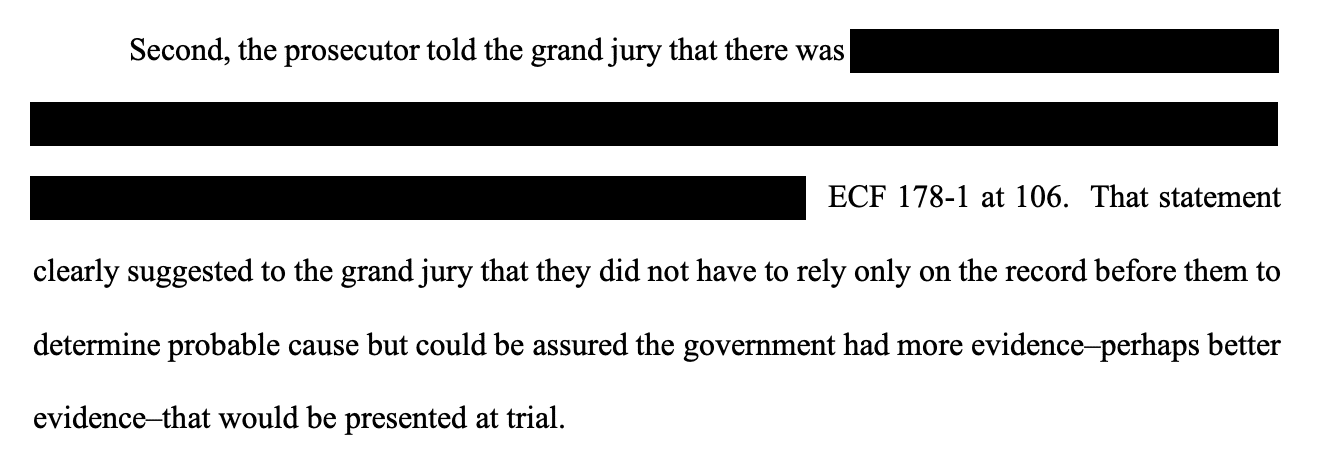
And if Lindsey was already presenting texts well beyond the time that Comey retained Richman, that makes it more likely that when Lindsey the Insurance Lawyer told the grand jury there was better evidence they would get for trial, she was thinking of the other side of Richman’s communications, the communications between Comey and Richman.

But if that’s what she was thinking, the only way she would say that would be if she knew of the privileged comms — the comms an FBI lawyer specifically advised not to include in grand jury prep. That doesn’t mean she looked at them. It means she knew they were there and intended to go get them. When Miles Starr or whoever went back to get 8 pages of texts, he likely searched only the ones that included Mike Schmidt, thereby avoiding seeing any communications between Comey and Richman, but he did so because he knew those privileged communications were there.

Classic taint.

Also note, in the transcript, this comment appeared just one page after the other misinstruction on the law that (per Judge William Fitzpatrick) Lindsey gave, suggesting that Comey would have to take the stand. I’m sure the FBI agents who prepped her have the fever dream that they’ll see Comey on the stand, but no prosecutor would even silently imagine she could get a well-lawyered defendant to take the stand, much less blurt it out in front of a grand jury.

The other piece of evidence that Lindsey the Insurance Lawyer was tainted by that privileged communication is the way that, even before sharing any of this discovery with Comey, she and the Loaner AUSAs set out to breach Comey’s privilege. They filed a motion to do so as one of their first filings (perhaps not coincidentally on the day Maggie Cleary was fired). And then, a week later, when they tried to rush Michael Nachmanoff into granting that motion, they invented a new theory of crime to get access to these communications: that Jim Comey lawyered up with Dan Richman and Pat Fitzgerald (and David Kelley) on May 11, 2017 in order to leak classified memos showing Donald Trump’s corruption.

Additionally, based on publicly disclosed information, the defendant used current lead defense counsel to improperly disclose classified information.

[snip]

This fact raises a question of conflict and disqualification for current lead defense counsel. Some of the communications in the potentially protected material are from the same time as the focus of the DOJ OIG report. Before litigating any issue of conflict or disqualification, the parties should have access to all relevant and non-privileged information. The sooner that the potentially protected information is reviewed and filtered, the sooner the parties can make any appropriate filings with the Court.

The imagined crime here is a leak of classified information, not a lie in response to a question from Ted Cruz, and so irrelevant to this prosecution.

In real time, Comey dismissed this claim as the bullshit fever dream it was: Comey was an Original Classification Authority and didn’t believe anything in his memos was classified, and the specific memo shared with Mike Schmidt had no classified information in it by any measure.

But consider how abusive the claim looks now. To get these texts, FBI agents working on the Director’s Task Force had gone back into material seized from Richman obtained more than five years earlier, they did so without a fresh warrant specific to either this prosecution or the fever dreams the FBI agents are really pursuing, rather than accessing the stuff that excluded the stuff Richman had said was privileged, they accessed the raw data and ostensibly did so for communications that could not have been responsive to their intended purpose (that is, to find out what, if anything, Richman shared anonymously while still at the FBI). And their interim claim they invoked to breach privilege, that this was a conspiracy to leak classified information, had nothing to do with this case, or even the larger fever dream conspiracy — the one they’re pursuing in Florida — that this was a conspiracy to be mean to Donald Trump.

A classic fishing expedition.

Betcha some money the Loaner AUSAs are delaying here so someone can try to get a warrant in Florida invoking a crime-fraud exception based on the well-known crime of being mean to Donald Trump.

Indeed, in Loaner AUSA Gabriel Diaz’ emergency motion for a delay (authored, as so many of these abusive filings are, by James Hayes), he doesn’t even argue this is about taint. He’s arguing (in a sentence fragment) only about whether Miles Starr read the actual texts in question, not whether he went back and searched for their counterpart texts to put together an 8-page exhibit for Lindsey to use.

Indeed, the government believes the Magistrate Judge may have misinterpreted some facts he found when issuing the latest order to release the grand jury materials to the defendant. For instance, whether the defendant has any standing to challenge the Richman materials, the full context of the statements made by the prosecutor to the grand jury, that Agent-3 was exposed to potentially privileged material, and that two indictments were presented to the grand jury.

Much of what the prosecutors have done since that day is a frantic bid to get those privileged texts, texts that could in no way serve to help prove this case as charged.

It’s sunny (and very cold by Irish standards), so I’m going to go take a walk before I map out the team — like James Hayes and OGC lawyer Gabriel Cohen — that’s lurking behind the foolish Loaner AUSAs fronting for all of this. But there’s a very good chance all of them are driven by taint, the taint of a fishing expedition into Jim Comey’s privileged communications.

This prosecution appears to have become more focused on finding some way out of that taint than on actually winning this particular prosecution against Kash Patel’s nemesis.

Cast of characters

Lindsey the Insurance Lawyer

Tyler Lemons: On loan from EDNC

Gabriel Diaz: On loan from EDNC

James Hayes: Litigation Attorney at Main Justice, he is listed as author of the following:

Gabriel Cohen: Metadata lists him as OGC, possibly in Detroit, he is the author of:

Henry Whitaker: The former Solicitor General of Florida and currently Pam Bondi’s counselor, he is the signed author of:

Kathleen Stoughton: An AUSA in South Carolina with solid appellate experience, she is listed as author of:

Michael Shedd: A newish AUSA in South Carolin, he is listed as author of:

lheim: Metadata lists as author of:

Share this entry

Bill Barr Helped Lindsey Halligan Fuck Up the Comey Prosecution

As I noted, William Fitzpatrick ordered the government to turn over the grand jury materials to Jim Comey by 3PM today.

In spite of all the ways that Lindsey the Insurance Lawyer fucked up, she’s actually only responsible for three of the problems.

Others stem from conduct under Bill Barr, when these materials were first seized with warrants targeting Dan Richman.

Thus far, prosecutors have only named one investigation for which DOJ obtained these warrants: The Arctic Haze investigation into whether Richman — and through him, Jim Comey — leaked information about materials stolen from SVR in 2016; that investigation was closed without charge in 2021.

In 2017, the U.S. Attorney’s Office for the District of Columbia (“USAO-DDC”) initiated an investigation, referred to by the Federal Bureau of Investigation (“FBI”) as Arctic Haze. ECF 71 at 2. This investigation concerned an allegation of unauthorized disclosure of classified information to a New York Times reporter, which appeared in an April 22, 2017 article titled “Comey Tried to Shield the FBI from Politics. Then He Shaped an Election.” Id. The investigation focused on the article’s inclusion of classified information related to one of the factors that influenced Mr. Comey’s decision, as then-FBI director, to unilaterally announce the closure of the FBI’s investigation into then-Presidential Candidate Hillary Clinton’s handling of classified material while she was serving as Secretary of State. Id. Daniel Richman, a Columbia Law School professor, personal friend of Mr. Comey, and former Special Government Employee at the FBI during Mr. Comey’s tenure as FBI Director, was quoted by name in the article and was the subject of USAO-DDC’s investigation. Id.

But there must be a second investigation, because the warrants extend beyond the time of the Arctic Haze story and they include a crime, 18 USC 641, unrelated to it.

The Richman Warrants authorized agents to search for and seize information created or stored between March 1, 2016 and May 30, 2017 that constituted evidence of violations of 18 U.S.C. § 641 (Theft and Conversion of Stolen Government Property) and 18 U.S.C. § 793 (Unlawful Gathering or Transmission of National Defense Information).

As I said in my video today, the 18 USC 641 would correspond with an attempt to criminalize sharing memos recording Trump’s misconduct.

But even that can’t be all.

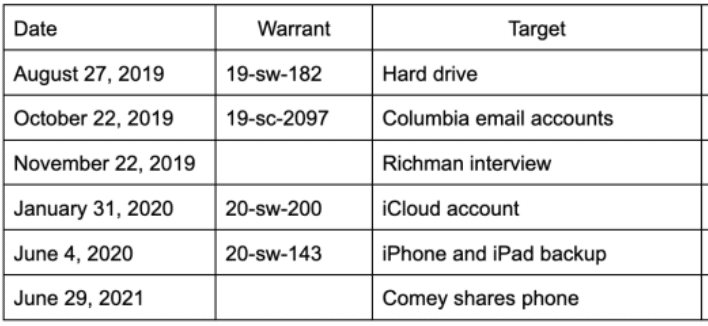
As a letter drafted by Richman’s attorney in April 2020 noted, DOJ twice extended the range of the seizure beyond the period authorized by the warrant.

According to an April 29, 2020 letter from Mr. Richman’s then-attorney to the government–produced to the Court ex parte by the defense–the Department of Justice informed Mr. Richman that the data it obtained from his iCloud account extended to August 13, 2019, well outside the scope of the warrant and well past the date on which Mr. Richman was retained as Mr. Comey’s attorney. ECF 181-6 at 20. The same letter further states that the Department of Justice informed Mr. Richman that it had seized data from Mr. Richman’s hard drive that extended to June 10, 2017–again well into the period during which Mr. Richman represented Mr. Comey–despite the warrant (19-sw-182) imposing a temporal limit of April 30, 2017. Id.

In August 2019, the government obtained all of May and part of June 2017 beyond the warrant — which happened to include the scope of the Comey memos and go right through his testimony to Mueller and public testimony before the Senate Intelligence Committee. The approved scope of the warrants thereafter all extended to May 30, past the time Comey released his memos and Rod Rosenstein appointed a Special Counsel. Then, in January 2020, DOJ obtained iCloud content from two and a half years beyond the scope of the known warrant, through August 2019.

There’s likely good reason DOJ did that: to feed the Durham investigation, which had shifted to chasing the Clinton Plan conspiracy theory by early 2020.

The government never asked Comey to review those materials for privilege even though, as Fitzpatrick noted, three of the warrants extended beyond the time he retained Richman.

[T]he government never engaged Mr. Comey in this process even though it knew that Mr. Richman represented Mr. Comey as his attorney as of May 9, 2017, and three of the four Richman Warrants authorized the government to search Mr. Richman’s devices through May 30, 2017, 21 days after an attorney-client relationship had been formed.

[snip]

[I]n 2019 and 2020, the government made a conscious decision to exclude Mr. Comey from the filter process, even though Mr. Comey, as the client, is the privilege holder, not Mr. Richman.

Fitzpatrick excused Tyler Lemons and Gabriel Wolf, as well as EDVA, for the slovenly way the earlier searches were done: they all happened long before any of those AUSAs were involved in the case.

4 To be clear, the two assistant United States attorneys currently assigned to this case entered their appearances post-indictment and were not a part of the Arctic Haze investigative team.

7 It is important to note that the USAO-EDVA prosecutors were not involved in the 2019 and 2020 searches of the Richman materials and may have reasonably assumed the agents in 2019 and 2020 seized and preserved only those materials responsive to the warrants.

But there is someone who likely does span the slovenly earlier treatment and that of the last two months: Jack Eckenrode. Indeed, Eckenrode may even have worked for Durham (hunting Jim Baker for a different leak investigation) before Barr assigned Durham to chase Russian disinformation for four years. But those secondary investigations would have fed right into Durham.

That makes this description of the decision to have what is presumed to be Miles Starr testify before the grand jury more suspect.

The government presented this case to the grand jury on September 25, 2025. ECF 1. The same day, prior to the grand jury presentment, Agent-2 alerted the lead case agent (hereinafter referred to as Agent-3 [Miles Starr]) and an attorney with the FBI’s Office of General Counsel that “evidence obtained in the Government’s investigation of James Comey may constitute attorney-client privileged or attorney-client confidential information. It is also possible that [the agents] may have obtained evidence that constitutes attorney work-product information.”8 ECF 89-5. Agent-2 gave Agent-3 and the FBI attorney “a limited overview of the [privileged] communications.” ECF 172- 2.9 Agent-3, rather than remove himself from the investigative team until the taint issue was resolved, proceeded into the grand jury undeterred and testified in support of the pending indictment. ECF 179. In fact, Agent-3 was the only witness to testify before the grand jury in support of the pending indictment. Id. The government’s decision to allow an agent who was exposed to potentially privileged information to testify before a grand jury is highly irregular and a radical departure from past DOJ practice.

8 This is the language used by an FBI attorney to characterize their September 25, 2025 phone conversation with Agent-3. A second agent, possibly Agent-2, was also on the call but that that person’s identity has been shielded from the Court. ECF 89-5. [citing the filing that mentioned the two lead case agents]

9 The government provided no further detail about what, in its view, constitutes a “limited overview.” [my emphasis]

The two lead case agents mentioned in Comey’s most extensive discussion of what happened are reported to be Starr and Eckenrode, the latter rehired after failing to substantiate this conspiracy theory the first time.

And remember: one of the people who appears as author of a document but who did not notice an appearance is a second Gabriel, Gabriel Cohen, who registers an OGC email address. He authored Lindsey Halligan’s ill-fated declaration. Perhaps he’s the FBI lawyer who thought it’d be cool to have a tainted witness present to the grand jury.

Fitzpatrick plays coy about why no one thought to ask for a filter protocol until October 13 (perhaps not coincidentally, the day Maggie Cleary was fired).

For reasons that remain unclear, the government waited 31 days from September 12, 2025, the date the FBI began reviewing the materials, and 18 days from September 25, 2025, the date the FBI informed its Office of General Counsel about having been exposed to potentially privileged materials, before seeking court approval of a filter protocol on October 13, 2025.

One possible reason: They weren’t going to ask for a filter review at all until the Loaner AUSAs came in and put their bar licenses at risk.

They stumbled on something they thought would feed their grand conspiracy and tried to run with it.

Perhaps they anticipated that the least scrutiny of this conduct would reveal layers upon layers of misconduct.

Share this entry

Tyler Lemons Caught Jack Eckenrode Committing a Capstone Crime

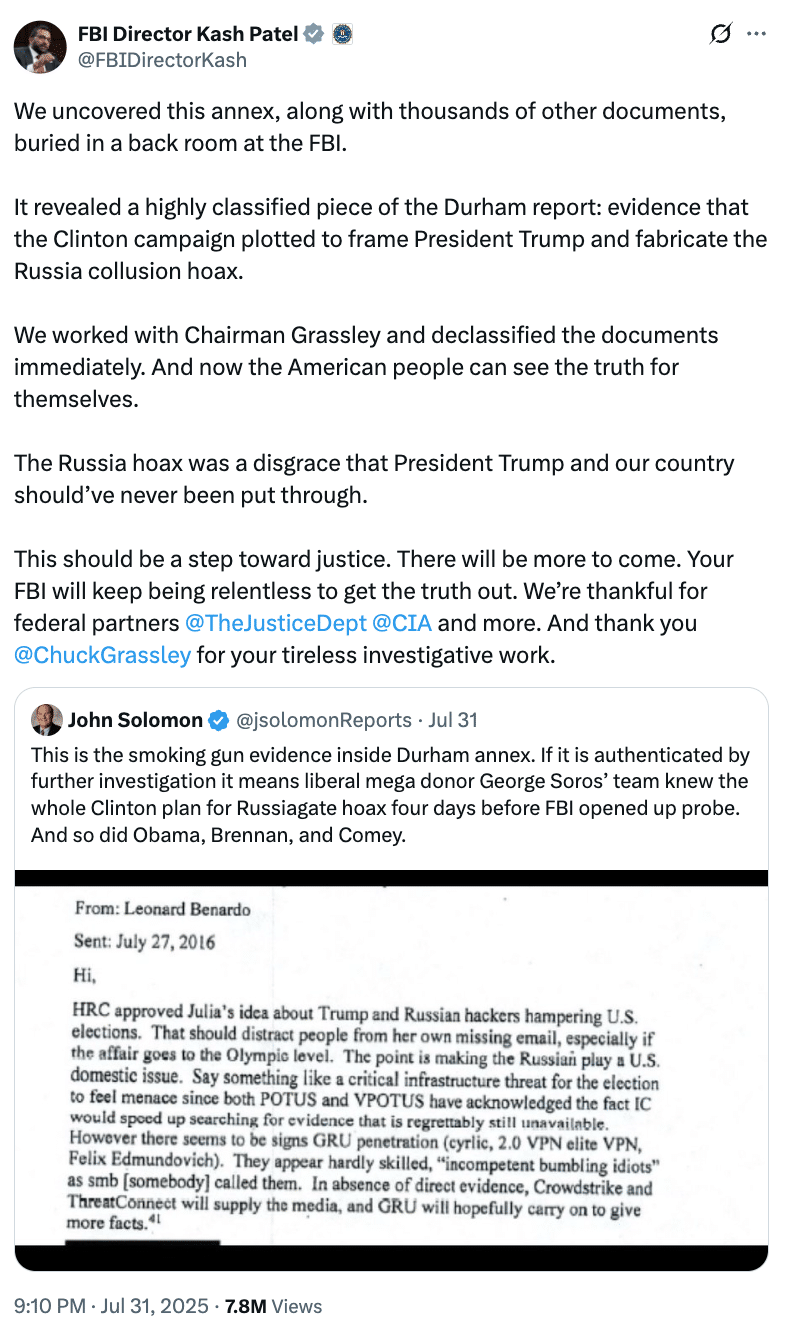
Back in July, in the wake of Trump’s struggles to distract from his own Epstein cover-up and as if in response to Tulsi Gabbard’s wild rants about the Intelligence Community Assessment, the FBI Director posted this tweet, RTing an inflammatory tweet from a propagandist who has been central to Kash’s disinformation about the Russian investigation.

Buried in a back room at the FBI, Kash claimed, was what John Solomon called “the smoking gun evidence … [i]f it is authenticated.”

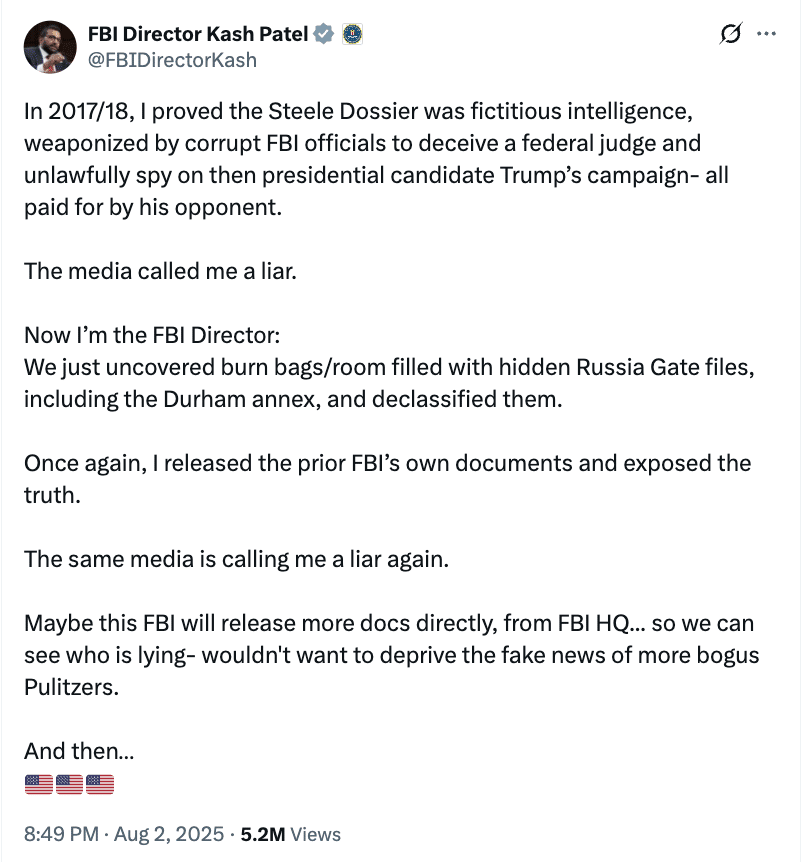
Days later, Kash referenced these files again, explicitly tying his campaign to supplant the Steele dossier for the actual Russian investigation with his role, as FBI Director, now focusing on “uncovered burn bags/room filled with hidden Russia Gate files, including the Durham annex.”

It took just a matter of days for me and Charlie Savage to figure out that four years earlier, John Durham had not just not authenticated John Solomon’s “smoking gun,” but he had in fact concluded that the very email Solomon called a smoking gun was instead, “a composite of several emails.”

That is — a fabrication.

After the release of the Durham annex revealed that Kash — and John Durham and John Durham’s lead investigator Jack Eckenrode, along with John Ratcliffe — had been chasing Russian disinformation, Kash got even more desperate, clinging to Sean Davis propaganda in an attempt to rebut a plain reading of the Durham annex.

The FBI Director just endorsed the ignorant ravings of a long-discredited propagandist, Sean Davis, attempting to debunk the NYT’s factual reporting that the letters on which the entire conspiracy the frothy right has been chasing for years “were probably manufactured.”

Kash needs Davis to be right, because if he’s not, it exposes Kash as someone too stupid to understand he has been chasing Russian disinformation for years. Kash needs Davis to be right, because Kash just declassified this annex thinking it would help his boss distract from the Epstein scandal that him himself stoked, when in fact it shows that Russian spies have been laughing their ass off at everyone involved for nine years (which I’ll come back to).

The truth is, Kash has been chasing documents as self-evidently problematic as the Steele dossier all that time.

He has proven an easy mark.

That’s what we saw in real time. We also saw in the classified annex both that Durham, along with his chief investigator, Jack Eckenrode, tried to hide the evidence that they had been chasing Russian disinformation for years — indeed, continued to chase Russian disinformation for two years after obtaining confirmation they were doing that. Then Tulsi Gabbard and Chuck Grassley tried to hide that Durham had tried to hide that.

It became clear that John Durham and his lead investigator Jack Eckenrode had committed the very crime that Durham claimed he was investigating when he chased Russian disinformation for four years, which he described this way:

(i) knew the Clinton campaign intended to falsely accuse its opponent with specific information or allegations, (ii) intentionally disregarded a particular civil right of a particular person (such as the right to be free of unreasonable searches or seizures), and (iii) then intentionally aided that effort by taking investigative steps based on those allegations while knowing that they were false.

From the moment John Durham and his lead investigator Jack Eckenrode persisted in falsely accusing Hillary of framing Donald Trump and used that false accusation to take investigative steps like obtaining warrants, they were (in their model) conspiring against rights under 18 USC 241.

18 USC 241 happens to be the crime that the frothers claim they are pursuing against Comey and everyone else right now.

About a month after Kash first rejoiced about the opportunity to commit the crime Durham had chased, we learned that Jack Eckenrode — shockingly!! — had been invited back to commit the same crime some more. NYT since updated on how, little more than a month after Todd Gilbert was confirmed as US Attorney in WDVA and asked to oversee this investigation, he left under pressure.

That’s background to these two exhibits that prosecutors included in the government’s response to Comey’s vindictive prosecution motion.

Start with the opening memo for an investigation into whether someone deliberately put a bunch of documents in burn bags but … didn’t burn them, the precipitating event that Kash boasted about on July 31. In fact, those burn bags were discovered in April, and they were discovered in FBI Headquarters, not WDVA, where Kash and Bondi stashed the investigation. And the likely explanation for the documents is that senior FBI people were clearing out their offices to make way for … Kash Patel.

On or about April 15, 2025, the Director’s Advisory Team was informed of the unusual discovery of highly classified and sensitive documents found inside five “burn bags” located in Room 9582, a certified Sensitive Compartmented Information Facility (SCIF) at the FBI Headquarters building in Washington, DC.

A cursory inventory of the 9582 SCIF revealed the existence of classified documents, including documents believed to be official records, inside “burn bags” which appeared to have been placed in the SCIF around the timeframe of the 2025 presidential inauguration – Friday, January 17, 2025 through Wednesday, January 22, 2025. A brief review of the contents of the “burn bags” revealed that some of the documents left behind may have come from a collection of records held by certain unidentified senior government officials at FBI Headquarters.

What really set Kash off, it seems clear, is that — seemingly amid a bunch of files relating to the Special Counsel investigations that happened during the Biden Administration — was the document at the heart of Durham’s criminal investigation building on Russian disinformation, a document potentially referring to the fabrications Russian spies made.

Among the records found were many related to the FBI’s Mar-a-Lago search, the January 06 capitol breach, the Crossfire Hurricane investigation, as well as a copy of the Classified Appendix to the John Durham Special Counsel investigation. Moreover, an additional record discovered as part of this management review process was an original referral by the Central Intelligence Agency (CIA) to former FBI Director James Comey, known as a Counterintelligence Operational Lead (CIOL). This CIOL, believed to have been missing for several years, was dated September 07, 2016 and contained certain intelligence related to the 2016 U.S. presidential election campaign. The CIOL was found in a storage closet adjacent to the Director’s office and was subsequently transported to the 9582 SCIF. Former Director Comey previously testified before the Senate Judiciary Committee that he was unfamiliar with this CIOL as well as its related intelligence. [my emphasis]

Now, there are already several flashing lights here. 🚨🚨🚨 [Sorry Rayne!]

You cannot have Jack Eckenrode anywhere near the criminal investigation into a document he chased for years. He has more incentive to hide the Durham annex showing that he committed the very crime he was investigating than Comey (or anyone close to him) has to hide the CIOL. In any case, this still seems to fall well short of proof that the FBI actually received it. This opening memo describes that the people who are supposed to catalog such things did not, and if they found it after the fact, it would raise real questions if Eckenrode planted it.

Worse still, the opening memo for this investigation misrepresents Comey’s testimony from the hearing.

Lindsey: Do you recall getting an inquiry from the CI, excuse me, the intelligence community in September, 2016, about a concern that the Clinton campaign was going to create a scandal regarding Trump and Russia? Mr. Comey: I do not.

Senator Graham: You don’t remember getting a investigatory lead from the intelligence community, hang on a second … Let me find my document here.

Speaker 3: There it is.

Senator Graham: September the Seventh, 2016, the US intelligence officials forwarded an investigative referral to FBI Director James Comey and Assistant Director of Counterintelligence Peter Strzok regarding US presidential candidate Hillary Clinton’s approval of a plan concerning US presidential candidate Donald Trump and Russian hackers hampering US elections as a means of distracting the public from her use of a private email server. You don’t remember getting that or being talk, that doesn’t …

Mr. Comey: That doesn’t ring any bells with me.

[snip]

Senator Graham: Did you have a duty to look at any allegations regarding Clinton in Russia?

Mr. Comey: I don’t know what you mean. Senator Graham: Well, you say you had a duty to look at allegations about the Trump campaign being involved with the Russians. You’ve got a letter now from Radcliffe saying that there was a, they intercepted information about an effort in July where Hillary Clinton approved an effort to link Trump to Russia or the mob. Did you have an investigation look and see if whether that was true?

Mr. Comey: I can’t answer that. I’ve read Mr. Radcliffe’s letter, which frankly I have trouble understanding.

That’s true, in part, because Graham misrepresented what the CIOL was. As it explains, the memo only served to provide the kinds of information that the CIA was finding in SVR documents obtained from the Dutch. It was not a request for the FBI to conduct an investigation, but right wingers have treated it as such for years.

The redaction in the pertinent paragraph, which seems to be a reference to Guccifer 2.0, likely obscures the entire meaning of the paragraph, to say nothing of the redaction of the other paragraphs. More importantly, there was no discussion at the hearing of what Comey would have understood this to belong to: the larger set of SVR documents that the FBI had deemed objectively false much earlier in the year.

In other words, that reference in the opening document shows that this entire investigation was predicated on a false claim about Comey — it represents Eckenrode’s false belief about Comey, not the actual transcript (remember, Loaner AUSA Tyler Lemons hid this transcript as an exhibit in his response to Comey’s selective prosecution bid).

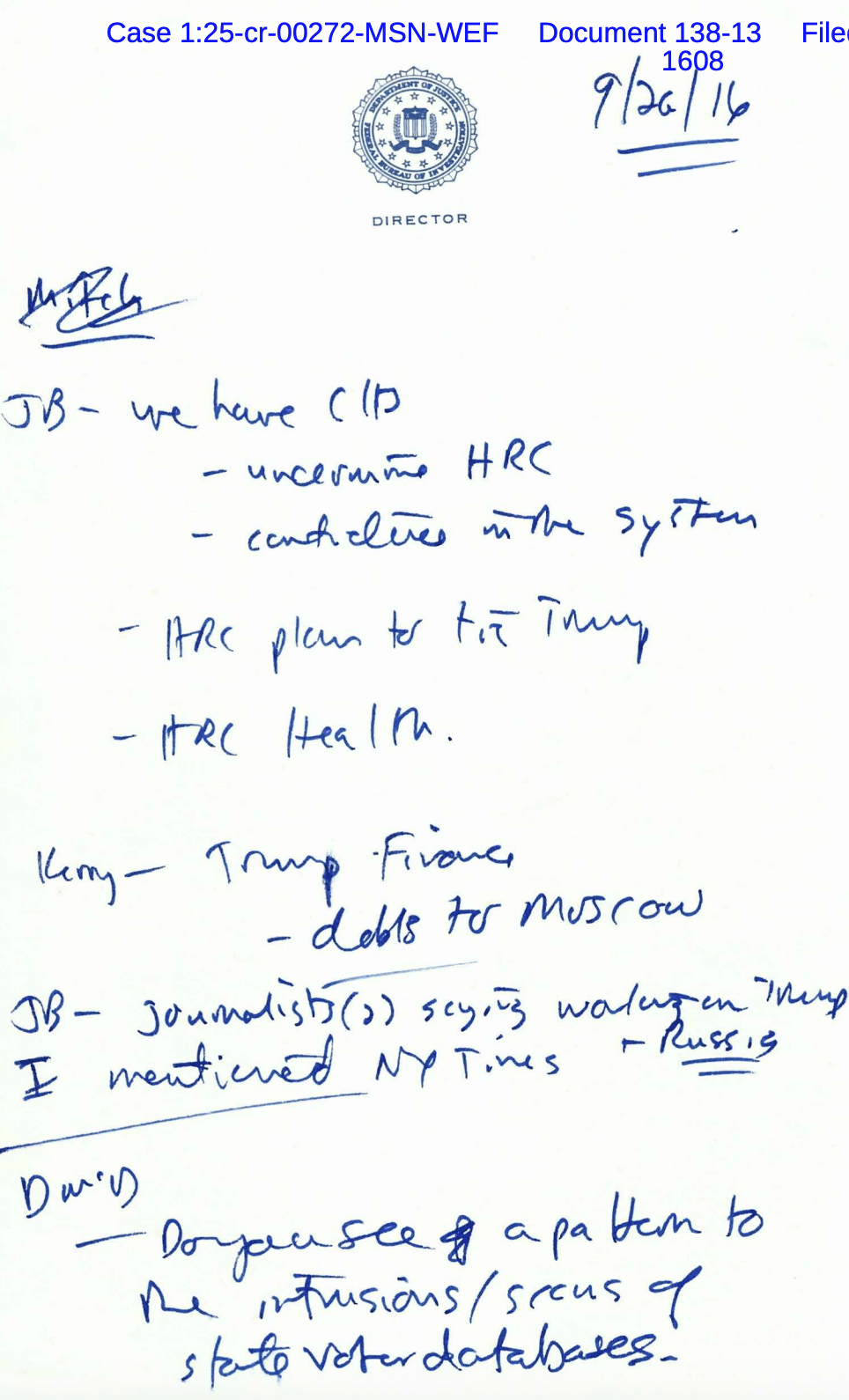
And the Jim Comey notes that Lemons insinuates undercut Comey’s claims about receiving the CIOL on September 7, 2016 only serve to underscore this point.

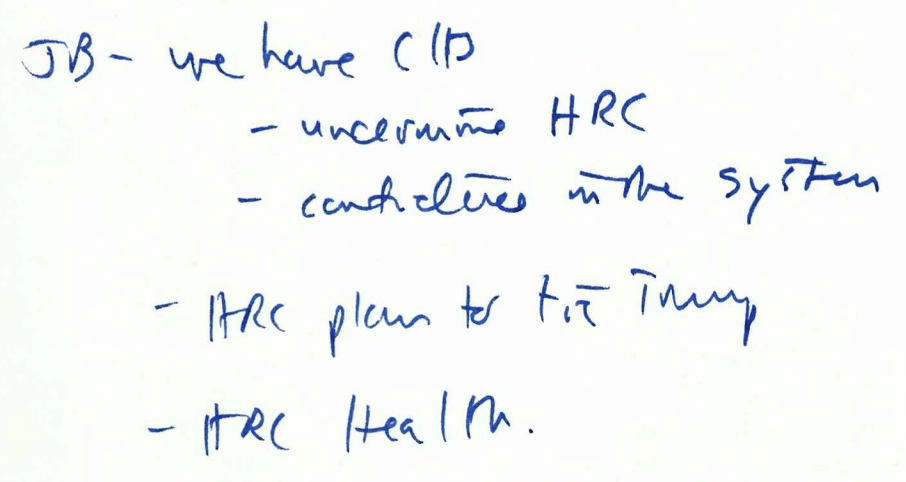
The discovery of the handwritten notes is relevant considering the defendant’s prior testimony on September 30, 2020. Of note, during that hearing, the defendant was questioned by Senator Graham of South Carolina and Senator Hawley of Missouri. See Gov. Ex. 14. The questions focused on whether the defendant remembered “being taught” of “U.S. presidential candidate Hillary Clinton’s approval of a plan concerning U.S. presidential candidate Donald Trump and Russian hackers hampering U.S. elections as a means of distracting the public from her use of a private email server.” See id. The defendant responded by stating that “it doesn’t ring any bells with me” and “I don’t know what that refers to” and “I don’t remember receiving anything that is described in that letter.” See id. at 1 and 5. Despite this testimony, the defendant’s handwritten notes dated September 26, 2016, read: “HRC plan to tie Trump.” See Gov. Ex. 13 (Defendant’s handwritten notes).

These notes are more consistent with the SVR files being disinformation, rather than the truth right wingers have adopted it as.

More importantly, there’s no reason for Comey to be briefed (possibly by John Brennan) on a topic on September 26 if he received information about it 19 days earlier.

That is, these notes appear to be Comey writing down the reference, understanding it to be part of an attack on Hillary, weeks after Republicans want to catch him receiving a memo.

The part about prosecutors and FBI agents reading these notes in the least sensical way possible is not a crime.

What is a crime, though, is using Russian disinformation you know to be Russian disinformation (and Comey appears to have believed was disinformation) to obtain a criminal indictment.

And it appears that Lindsey Halligan tried to do that — but got no-billed.

Further, according to the transcript from the hearing on Wednesday, Comey’s team read Tyler Lemons’ response to Comey’s vindictive prosecution claim the same way I did:

As for the 18 USC 1505 charge, prosecutors will need to prove that Comey told lies that were intentional that impeded that investigation. Because of the scope of the hearing (and therefore the investigation), they can’t argue the two Hillary stories are material. Comey was aware of the scope of the hearing and Hillary wasn’t part of it.

There’s no way they can argue that Comey should have admitted asking Richman to serve as an anonymous source for the May 2017 story impeded the Senate investigation, because he had admitted that years earlier!!

That leaves just the Lindsey Graham question, which was specifically about whether Comey remembered the CIA referral, dated September 7, that Kash Patel had recently released in redacted — and therefore likely hopelessly misleading — form. As the transcript Lemons buries in an exhibit makes clear, the question — the one the grand jury no-billed — was not whether Comey was briefed; it was whether he recalls getting the document itself (Lindsey misstates what this document even was).

On Wednesday, Pat Fitzgerald expressed serious concern that “the government is expanding its case, we believe, to include the conduct that was no true billed in Count One as part of its proof of Count Two.”

And on top of that, Your Honor, I think there’s another motion coming from us, in light of some disclosures that were made Monday, where we think that the government is expanding its case, we believe, to include the conduct that was no true billed in Count One as part of its proof of Count Two, which raises serious issues for us. So we’ll do everything we can, but to do all that while getting Mr. Comey access to materials…

As I’ve said, this is the founding document of their conspiracy theories.

On Wednesday, Lemons didn’t raise an objection when Magistrate Judge William Fitzpatrick first said he was going to order DOJ to turn over grand jury transcripts, suggesting Lemons may have no fear Miles Starr presented privileged information to the jury.

By the end of day yesterday, he did have an objection. Michael Nachmanoff has bumped the whole grand jury question back to Fitzpatrick, so I expect Patrick Fitz (sorry, bad joke!) will get to test this theory shortly.

But that — relying on a no-billed charge for the obstruction charge — is not the only problem with chasing the Clinton Plan disinformation that John Durham debunked.

The far graver problem is it means Miles Starr is a witness to, if not a co-conspirator to, Jack Eckenrode (and FBI Director Kash Patel) committing a crime, precisely the crime they’re chasing.

Four years ago, Jack Eckenrode concluded this stuff was a Russian fabrication, the very thing they claim about the Steele dossier.

And then, Jack Eckenrode got an indictment for it anyway.

Share this entry

The Halloween Special Attorney’s Loaner AUSAs’ Loaner AUSA Forgot to Describe Jim Comey’s Imaginary Crime

Lindsey Halligan’s Loaner AUSAs have submitted their responses to Jim Comey’s initial motions, which I’ve laid out below.

The Tl;dr of the response to the observation that Lindsey was not lawfully appointed (DOJ submitted the same motion in both Comey and Tish James’ case) is that Lindsey was lawfully appointed even though two judges had said she wouldn’t be by the time she was appointed, and if not, then the indictments are still valid because Pam Bondi retroactively appointed Halligan to be a very Special Attorney on Halloween.

No.

Really.

The response to the vindictive and selective prosecution spends a lot of time saying that Lindsey didn’t vindictively prosecute Trump, and Donald Trump’s animus to Jim Comey wasn’t about his First Amendment speech, but about Trump’s claim that Comey leaked information, when the filing doesn’t actually show that Comey did that at all.

Not only that, the filing makes clear the problems with DOJ’s case that Comey lied about authorizing Dan Richman to share information.

None of the times Richman served as a source fit the criteria of Ted Cruz’ question (that is, from when Richman was at FBI, speaking about the Clinton investigation, anonymously, with Jim Comey’s involvement ahead of time).  The closest was for this flowchart regarding Jim Comey’s decision to announce he had reopened the investigation into Hillary’s emails — the act that cost Hillary the election.

The next day, Mr. Richman sent the defendant an email regarding an op-ed he had been asked to write for The New York Times about the defendant’s letter. Gov. Ex. 5 (Oct. 30, 2016 emails). Mr. Richman stated that he was “not inclined” to “write something,” but that he would “do it” if the defendant thought it would “help things to explain that [the defendant] owed cong absolute candor,” and that the defendant’s “credibility w cong w[ould] be particularly important in the coming years of threatened cong investigations.” See id. The defendant responded: “No need. At this point it would [be] shouting into the wind. Some day they will figure it out. And as [Individual 1 and Individual 2] point out, my decision will be one a president elect Clinton will be very grateful for (although that wasn’t why I did it).” See id. The defendant appears to have reconsidered that view shortly thereafter. On November 1, 2016, he emailed Mr. Richman, stating:

When I read the times coverage involving [Reporter 1], I am left with the sense that they don’t understand the significance of my having spoke about the case in July. It changes the entire analysis. Perhaps you can make him smarter.

Let’s imagine the Times had a policy against writing new articles close to elections if the articles might influence the election. Consistent with that policy they would avoid writing this week if sources told them that the FBI was looking at Huma Abedin’s emails.

But let’s imagine that they wrote a very high profile piece in July that sources lead them to now conclude was materially inaccurate. Would they correct it or stay silent because they have a policy to avoid action near elections?

I suspect they would quickly conclude that either course is an “action” and the choices are either reporting or concealing but there is no longer a “neutral” option because of the reporting in July. I also suspect they would resolve very quickly to choose the action of disclosing because to remain silent is to actively mislead, which has a wide range of very bad consequences.

Why is this so hard for them to grasp? All the stuff about how we were allegedly careful not to take actions on cases involving other allegations about which we have never spoken is irrelevant. I love our practice of being inactive near elections. But inactivity was not an option here. The choices were act to reveal or act to conceal.

See Gov. Ex. 6 (Nov. 1–2, 2016 emails) (emphases added).

Mr. Richman responded the next day, stating: “This is precisely the case I made to them and thought they understood. I was quite wrong. Indeed I went further and said mindless allegiance to the policy (and recognition that more evidence could come in) would have counseled silence in july to let hrc twist in the wind.” See id. Mr. Richman emailed the defendant shortly thereafter, writing, “Just got the point home to [Reporter 1]. Probably was rougher than u would have been.” See id.

The defendant emailed Mr. Richman shortly thereafter, entitling the message “Pretty good” and sending a link to a New York Times piece regarding the defendant’s purported options in late October 2016 concerning the Clinton email investigation (Midyear Exam). See Gov. Ex. 7 (Nov. 2, 2016 email chain); Matt Apuzzo and Sergio Peçanha, These Are the Bad (and Worse) Options James Comey Faced, N.Y. Times (Nov. 2, 2016). 4 The defendant wrote: “Someone showed some logic. I would paint the cons more darkly but not bad.” See Gov. Ex. 7 (emphasis added). Mr. Richman responded: “See I *can* teach.” See id. The defendant replied: “Well done my friend. Who knew this would. E so uh fun.”5 See id. (emphasis added).

But the conversation between Richman and Comey is about logistics, not Hillary. Moreover, since it’s a flowchart, it’s not like Richman could be an anonymous source (and the conversation took place in context of doing an overt op-ed).

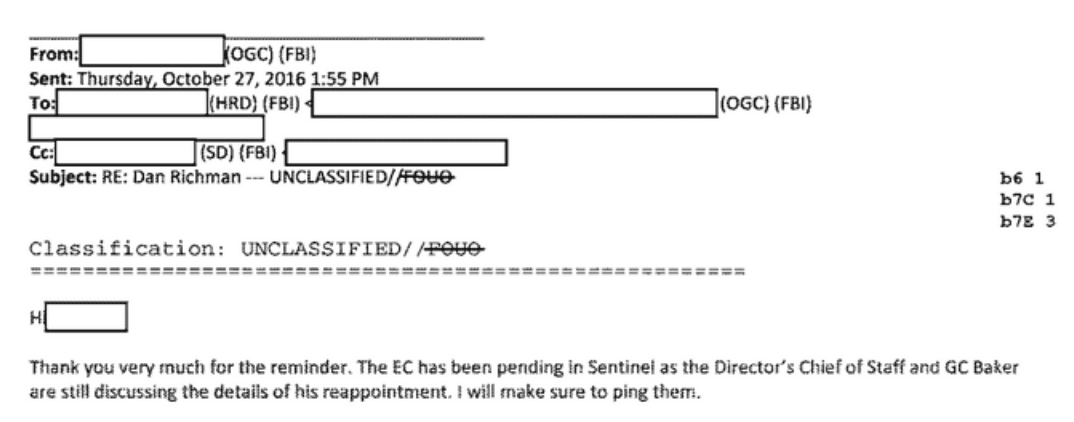
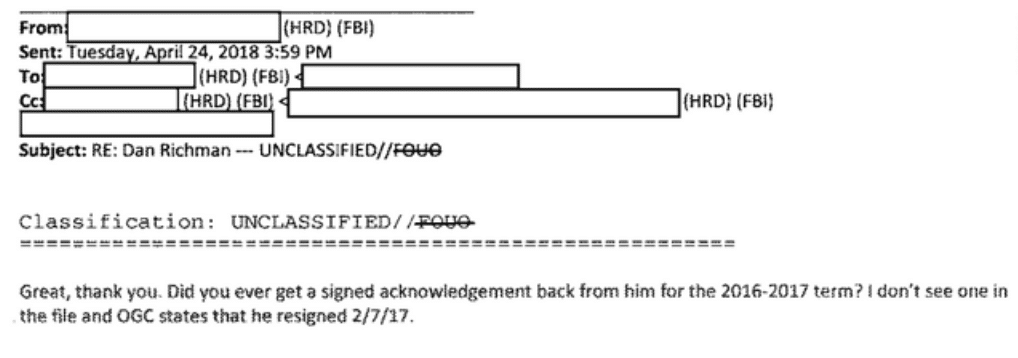
Additionally, it’s not even clear whether Richman was formally at FBI on that date. His “reappointment,” which had expired in June 2016, was pending as of October 27.

The other examples regarding Hillary postdate the date — February 7, 2017 — Richman left FBI (in the first case, only by four days, but not in a way that reflected Comey’s foreknowledge).

The Loaner AUSAs obscure that this happened after Richman left by not mentioning the date.

For example, in February 2017, Richman emailed Individual 3, a then-government official who had served in high-ranking positions at the FBI and DOJ. Mr. Richman wrote: “Hi [Individual 3] – my pal at the NYT, [Reporter 1] is (along with [Reporter 2], [Reporter 3], and (gag me) [Reporter 4]) is doing a huge piece on the HRC emails. He’s had a ton of background conversations with players and non-players (like me). [Reporter 1] very much would like to talk to you exclusively on background as he tries to understand[] Jim’s decision making to the extent possible. [Reporter 1] asked me to reach out to you. Hence this email. Would you be willing to chat with him?” See Gov. Ex. 9 (Feb. 11, 2017 email chain) (emphasis added). Individual 3 replied in the affirmative and stated that he would “reach out” to the reporter. See id.

The memos’ attempt to prove Comey lied about having received this memo is even sillier.

It claims that an investigative team that included Jack Eckenrode found the memo that Jack Eckenrode could never prove that FBI received as part of the Durham investigation in the storage unit in WDVA FBI Headquarters.

Among the records found were many related to the FBI’s Mar-a-Lago search, the January 06 capitol breach, the Crossfire Hurricane investigation, as well as a copy of the Classified Appendix to the John Durham Special Counsel investigation. Moreover, an additional record discovered as part of this management review process was an original referral by the Central Intelligence Agency (CIA) to former FBI Director James Comey, known as a Counterintelligence Operational Lead (CIOL). This CIOL, believed to have been missing for several years, was dated September 07, 2016 and contained certain intelligence related to the 2016 U.S. presidential election campaign. The CIOL was found in a storage closet adjacent to the Director’s office and was subsequently transported to the 9582 SCIF. Former Director Comey previously testified before the Senate Judiciary Committee that he was unfamiliar with this CIOL as well as its related intelligence.

On top of the wildly inappropriate notion of putting the guy who conducted a witch hunt in charge of validating when evidence supporting his witch hunt happened, this memo doesn’t describe when the memo was moved (and therefore whether it ended up in the FBI Director’s closet under Wray’s tenure), and it sounds like the original from the CIA, still doing nothing to prove it was ever sent to the FBI.

Crazier still, the filing presents Jim Comey’s notes recording (probably) John Brennan briefing Comey on something that might be the content of the CIOL or might be something else entirely … 19 days after FBI allegedly received the CIOL, on September 26, 2016.

In other words, they make a better affirmative case that Comey didn’t receive the CIOL on September 7 than that he did, because if the Brennan briefing on September 26 is about the same topic, why would Brennan have to brief Comey? And we know Brennan believed this was about hacking Hillary, not about a nefarious plot Hillary had.

The Loaner AUSAs obscure that Lindsey’s question was not about that information, but about the CIOL dated September 7, this way:

The discovery of the handwritten notes is relevant considering the defendant’s prior testimony on September 30, 2020. Of note, during that hearing, the defendant was questioned by Senator Graham of South Carolina and Senator Hawley of Missouri. See Gov. Ex. 14. The questions focused on whether the defendant remembered “being taught” of “U.S. presidential candidate Hillary Clinton’s approval of a plan concerning U.S. presidential candidate Donald Trump and Russian hackers hampering U.S. elections as a means of distracting the public from her use of a private email server.” See id. The defendant responded by stating that “it doesn’t ring any bells with me” and “I don’t know what that refers to” and “I don’t remember receiving anything that is described in that letter.” See id. at 1 and 5. Despite this testimony, the defendant’s handwritten notes dated September 26, 2016, read: “HRC plan to tie Trump.” See Gov. Ex. 13 (Defendant’s handwritten notes).

The actual vindictive and selective prosecution language — the entire filing is attributed to a Loaner AUSA from South Carolina, Kathleen Stoughton, who I guess is on loan to the Loaner AUSAs who signed it — is fine.

If you ignore that the Attorney General of the United States believes she can salvage Lindsey’s appointment and this prosecution by making her into a pumpkin on Halloween Day.

Update: I’ve corrected where the burn bags were found. They were found in FBI HQ in DC, which makes the predication of an investigation in WDVA even weirder.

Links

Response unlawful appointment

Response vindictive and selective

Share this entry

Donald Trump’s [Miles] Starr Chamber

When the government first asked, on October 13, to use a filter review to access content seized from Dan Richman five years ago, it described that Jim Comey, “prefers to challenge the underlying search warrant first before any review takes place.”

But in his response yesterday, Comey didn’t do that.

Rather, after a heavily-redacted discussion of the problems with DOJ’s past and prospective access to the content, he proposed that Judge Michael Nachmanoff should deny the government’s filter request without prejudice, allowing DOJ to reconsider its bid for a filter protocol after they’ve first answered a set of questions.

For the foregoing reasons, the Court should deny the government’s motion to implement its proposed filter protocol without prejudice, and direct the government to disclose the following information to allow both the Court and the defense to assess the appropriateness of the protocol:

1. The legal authority for the contemplated review.

2. Whether any quarantined materials have been accessed by, shared with, or provided to the case team (and, if so, which materials were reviewed by which personnel on which day), and whether any such materials have been produced in discovery.

3. The protocol used during the prior filter review, including search parameters, segregation measures, privilege determinations, and associated logs or correspondence.

4. Whether the government intends to search raw returns or only the set already filtered in the prior review. See In re Search Warrant Issued June 13, 2019, 942 F.3d 159, 181 (4th Cir. 2019), as amended (Oct. 31, 2019) (holding that “the magistrate judge erred” by approving a filter protocol “without first ascertaining” the materials to be reviewed).

5. Whether non-lawyers will conduct any portion of the Filter Review. See ECF No. 38-1 ¶ 2 n.2 (“The Filter Team is comprised of Two Assistant United States Attorneys, and their support staff”) (emphasis added); see In re Search Warrant Issued June 13, 2019, 942 F.3d at 177 (criticizing the use of non-lawyers to designate documents as nonprivileged).

One might explain the reason why he’s doing this in one or two ways.

The first is a procedural reason. The warrants and original filter protocol themselves were probably reasonably sound for the purpose to which they were put: investigating whether Richman leaked classified information. The heavily redacted bit describes four different warrants and the loaner AUSAs’ original filing described content seized from “an image of a computer hard drive, an iCloud download, the backup of an iPhone, and the backup of an iPad.” There are five sealed exhibits to the filing (none cited in unredacted form), of which four are presumably the warrants and one may pertain to the original protocol, though there is something identified in footnote 4 that “was not produced,” not even after Comey’s team asked about it on October 23. While the seized material included a great deal of material, including material pertaining to Richman’s clients other than Comey and “sensitive and private materials belonging to his students,” the original filter protocol withheld, “private materials related to his students, as well as privileged materials, [from] the case team.”

But, contrary to the approach used with (for example) Michael Cohen as well as what we’ve been able to publicly review of warrants implicating Rudy Giuliani, in which prosecutors obtained new warrants every time the scope or target of an investigation changed, the government appears not to have obtained new warrants to search this material for a different crime, the alleged lie Comey told in 2020.

[I]t appears that the government has not obtained any search warrants in connection with the instant matter, including any warrant authorizing a search of the Arctic Haze materials for evidence of the two offenses with which Mr. Comey is charged.

Comey cites several precedents, one in the Fourth Circuit, that would require a new warrant.

He points to other reasons, too, why the government would need to obtain new warrants: because these warrants are not only stale, but they predate the alleged crime here, testimony from October 2020.

The government now proposes to use those warrants to search for evidence of different crimes that arose from a proceeding that occurred after USAO-DDC obtained the Arctic Haze warrants.

Comey also objects because some part of this was sealed by another court, which by date and location would probably have been an order from Beryl Howell when she was Chief Judge in DC.

The government has no lawful basis to review materials obtained more than five years ago, in a closed investigation that ended without any charges, pursuant to stale warrants for separate offenses, including materials that remain under seal by another court. [my emphasis]

Comey maintains that he can challenge the use of these warrants here.

The Fourth Amendment plainly prohibits the government from doing exactly what it seeks to do here: the Arctic Haze warrants were obtained more than five years ago in a separate and now-closed criminal investigation and authorized the seizure of evidence of separate offenses. Yet the government seeks to turn those warrants into general warrants to continue to rummage through materials belonging to Mr. Comey’s lawyer in an effort to seize evidence of separate alleged crimes. The Court should not authorize the government to conduct an unlawful review.

[snip]

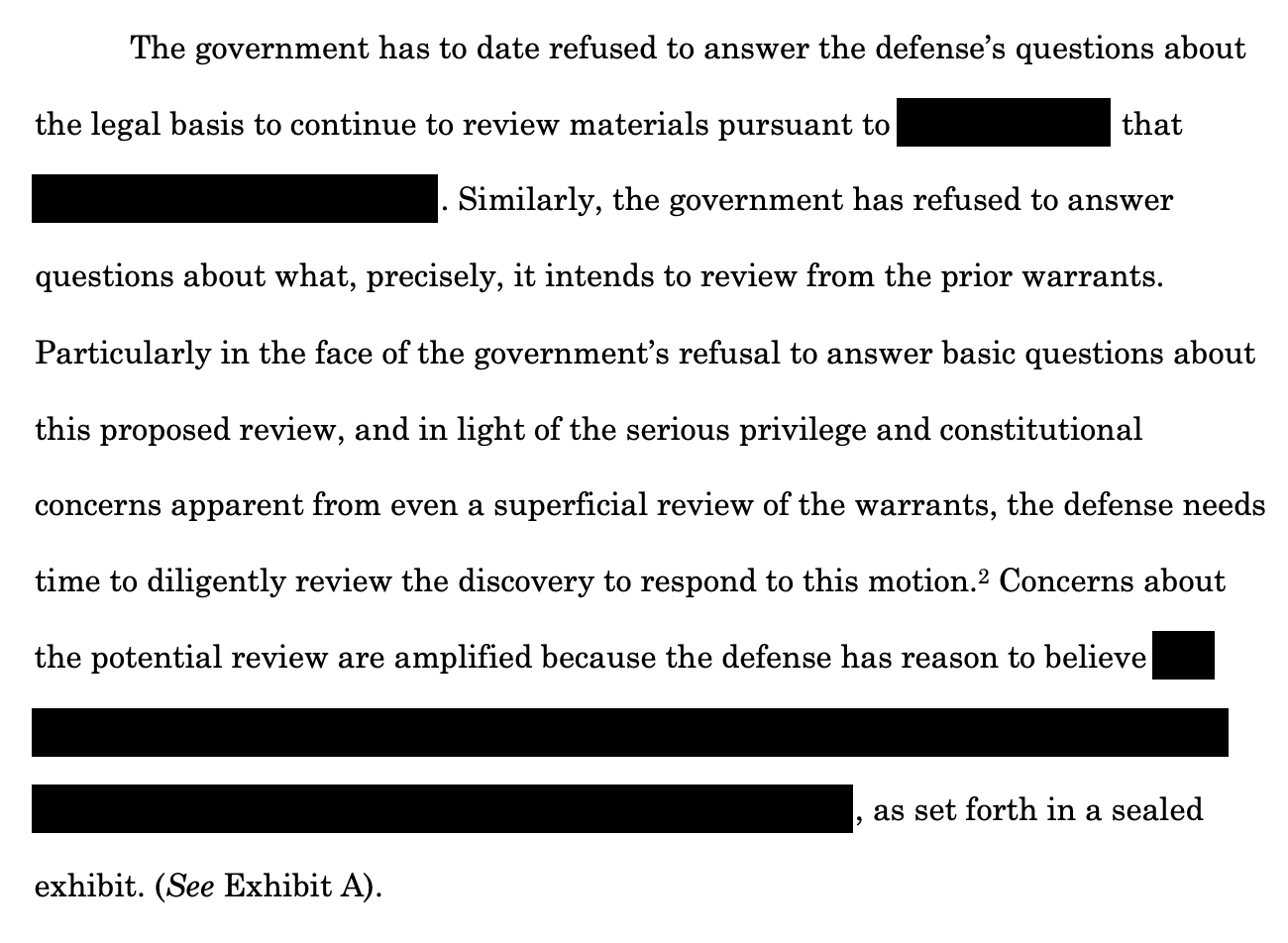
Mr. Comey reserves his right to move to suppress these warrants, to the extent the government continues to use them in this manner. See, e.g., United States v. Place, 462 U.S. 696, 709–10 (1983) (a seizure lawful at its inception can nevertheless violate the Fourth Amendment based on agents’ subsequent conduct); DeMassa v. Nunez, 770 F.2d 1505, 1508 (9th Cir. 1985) (“an attorney’s clients have a legitimate expectation of privacy in their client files”). Until the government answers the questions the defense has previously raised about these warrants, which to date have remained unanswered and which are detailed at the end of this submission, the defense will not be in a position to file an appropriately targeted suppression motion.

But even the language here notes at one problem: Normally you challenge a Fourth Amendment violation by suppressing evidence for use at trial. Here, Comey is trying to do more. He’s trying to prevent investigators from even accessing it. And so, instead, he’s asking the judge to force prosecutors to answer some basic questions in the guise of allowing him to suppress the warrants.

Until the government answers the questions the defense has previously raised about these warrants, which to date have remained unanswered and which are detailed at the end of this submission, the defense will not be in a position to file an appropriately targeted suppression motion.

Which brings us to the second possible reason for responding this way: question 2. Who already accessed privileged material, when did they do so, and has the government turned over that material in discovery? The answer to that question, especially, would force investigators to confess if they’ve already snuck a peek into what is in the privileged communication.

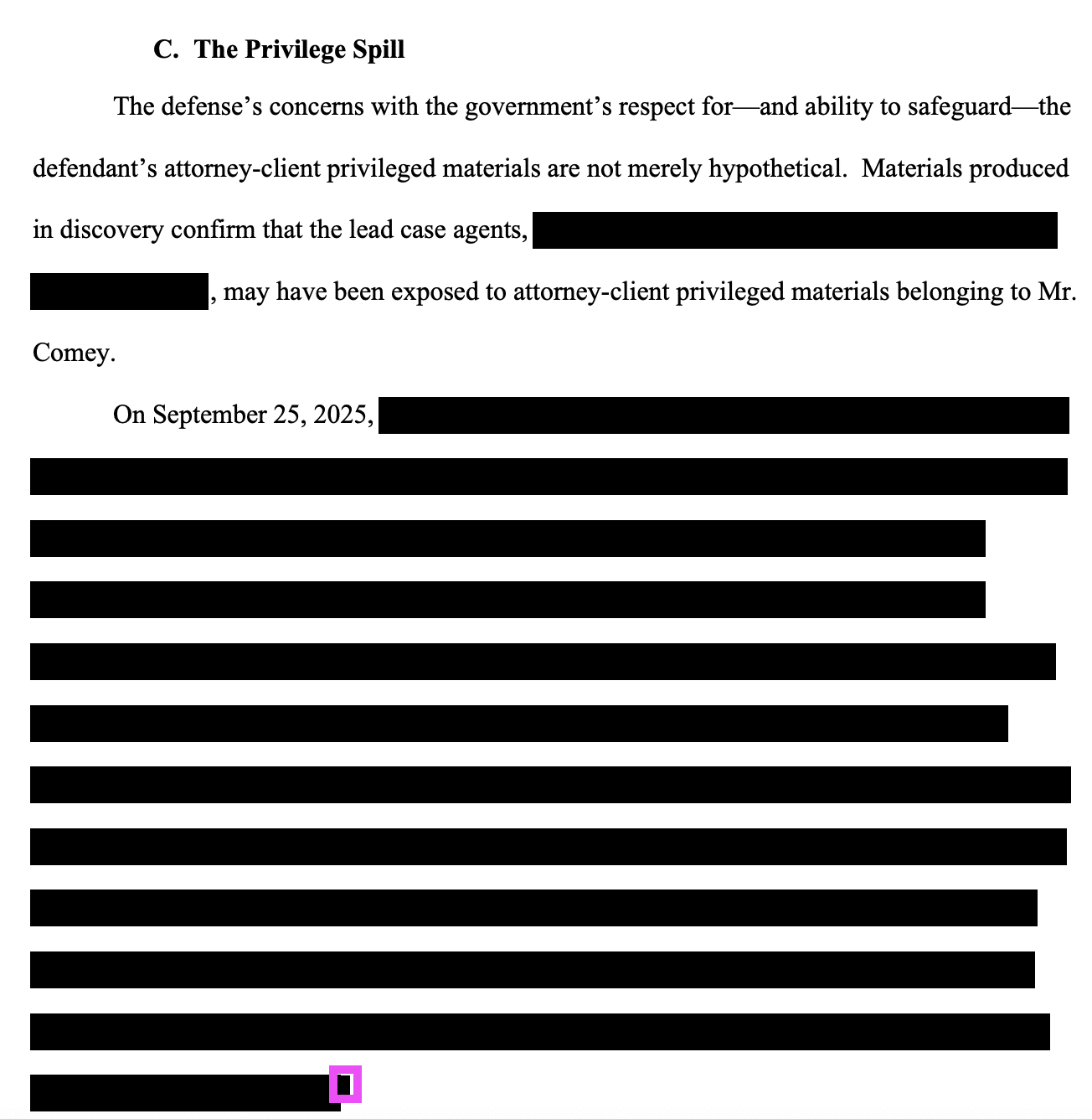
The “spill” that Comey suspects happened may have happened recently: on the day Lindsey Halligan obtained the indictment.

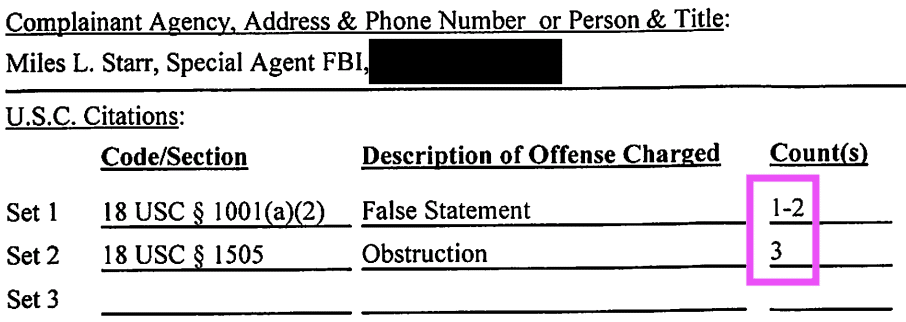
That footnote, marked in pink, cites the Criminal Case Cover Sheet, which, in spite of being labeled as “REDACTED,” is not, and so among other things, reveals the name of one of two FBI agents on the case, Miles Starr (the other being Jack Eckenrode, who investigated Scooter Libby but then left the team, and who joined John Durham in chasing Russian disinformation for four years).

I’ve redacted Starr’s phone number. You’re welcome, Miles.

But the Sheet also includes an error: it lists three counts, including the one, pertaining to Comey’s answer to Lindsey Graham’s question about a CIA referral (one that FBI may never have received) that Kash Patel and John Ratcliffe ret-conned into a “Clinton Plan” on which to hang the Durham investigation. That’s the one the grand jury no-billed.

While none of that explains when and how Starr and Eckenrode snuck a peek of privileged information, it might explain why.

Kash and Eckenrode are still chasing the theory behind the dropped charge, that Jim Comey purportedly knew Hillary Clinton had a plan (one fabricated by Russia and then embellished by Eckenrode and Durham to claim Hillary wanted to frame Trump) to emphasize Donald Trump’s ties with Russia. That’s the logic of the larger conspiracy theory that Eckenrode has been hired to chase. It was and remains Russian disinformation, but that didn’t stop Eckenrode the last time he tried this.

Indeed, because DC USAO obtained warrants in 2019 and 2020, there may be communications between Comey and his attorneys about the John Durham investigation, about Eckenrode’s past witch hunt, which would explain why Comey is so interested in the scope of proposed review, which the loaner AUSAs still haven’t told Comey.

Because Kash and Eckenrode are chasing that conspiracy theory, this is a much bigger issue than just the case before Nachmanoff. As I laid out in my post predicting that John Durham’s investigation was a preview of coming attractions (even before I knew that Kash had brought Eckenrode back!), Durham already played games to access attorney-client privileged material.

In response, Sussmann accused Durham of abusing the same grand jury process he abused with Benardo (abuse, ironically, that debunked Durham’s conspiracy theory).

First, the Special Counsel’s Motion is untimely. Despite knowing for months, and in some cases for at least a year, that the non-parties were withholding material as privileged, he chose to file this Motion barely a month before trial—long after the grand jury returned an Indictment and after Court-ordered discovery deadlines had come and gone.

Second, the Special Counsel’s Motion should have been brought before the Chief Judge of the District Court during the pendency of the grand jury investigation, as the rules of this District and precedent make clear.

Third, the Special Counsel has seemingly abused the grand jury in order to obtain the documents redacted for privilege that he now challenges. He has admitted to using grand jury subpoenas to obtain these documents for use at Mr. Sussmann’s trial, even though Mr. Sussmann had been indicted at the time he issued the grand jury subpoenas and even though the law flatly forbids prosecutors from using grand jury subpoenas to obtain trial discovery. The proper remedy for such abuse of the grand jury is suppression of the documents.

Fourth, the Special Counsel seeks documents that are irrelevant on their face. Such documents do not bear on the narrow charge in this case, and vitiating privilege for the purpose of admitting these irrelevant documents would materially impair Mr. Sussmann’s ability to prepare for his trial.

He also revealed that some of those privilege claims went back to August — that is, the weeks after Durham should have closed up shop.

Email from Andrew DeFilippis, Dep’t of Just., to Patrick Stokes, Gibson, Dunn & Crutcher LLP, et al. (Aug. 9, 2021) (requesting a call to discuss privilege issues with a hope “to avoid filing motions with the Court”); Email from Andrew DeFilippis, Dep’t of Just., to Patrick Stokes, Gibson, Dunn & Crutcher LLP, et al. (Aug. 14, 2021) (stating that the Special Counsel “wanted to give all parties involved the opportunity to weigh in before we . . . pursue particular legal process, or seek relief from the Court”). And since January— before the deadline to produce unclassified discovery had passed—the Special Counsel suggested that such a filing was imminent, telling the DNC, for example, that he was “contemplating a public court filing in the near term.” Email from Andrew DeFilippis, Dep’t of Just., to Shawn Crowley, Kaplan Hecker & Fink LLP (Jan. 17, 2022). [my emphasis]

In a hearing on May 4, right before trial, Joffe’s lawyer revealed they had demanded Durham press a legal claim much earlier, in May 2021.

MR. TYRRELL: So if they wanted to challenge our assertion of privilege as to this limited universe of documents — again, which is separate from the other larger piece with regard to HFA — they should have done so months ago. I don’t know why they waited until now, Your Honor, but I want to be clear. I want to say without hesitation that it’s not because there was ever any discussion with us about resolving this issue without court intervention.

THE COURT: That was my question. Were you adamant a year ago?

MR. TYRRELL: Pardon me?

THE COURT: Were you adamant a year ago that —

MR. TYRRELL: Yes. We’ve been throughout. We were not willing to entertain resolution of this without court intervention.

THE COURT: Very well.

Ultimately, Cooper did bow to Durham’s demand, but prohibited them from using those documents at trial.

That didn’t prevent DeFilippis from attempting to use the privileged documents to perjury trap his one Fusion witness, the kind of perjury trap that might have provided a way to continue the madness indefinitely.

There must have been nothing interesting there: most of the Fusion documents were utterly irrelevant to the Sussmann charges, but could implicate the Danchenko ones, but Durham didn’t use them there, nor did he explain their content in his final report.

That effort involved, among other things, abusing the prosecutorial process to bypass rulings (such as the sealing order mentioned above) that Beryl Howell had already made, and using one criminal case, against Michael Sussmann, to obtain attorney-client privileged materials that would only be relevant in another criminal case, the Igor Danchenko case (or a larger conspiracy).

Particularly given the reticence of the loaner AUSAs to tell Comey what happened, whether they have warrants, who read what, this feels like an attempt to retroactively bless access that investigators already got. And the stakes are bigger than this one case. As Durham (and Eckenrode) did in 2022, this likely would primarily serve to feed their bigger conspiracy theory.

Plus, if Eckenrode is sneaking peeks at Comey’s privileged communications still in FBI custody, there’s nothing that would prevent him from doing the same with all the other people whose privileged communications have been seized during this years-long witch hunt.

And that’s why you ask these questions.

Share this entry

Taint

Earlier today, Jim Comey filed his opposition to the loaner AUSAs’ bid to do a quickie filter team to access materials that — the context makes clear — were seized in the investigation of Dan Richman back in 2019.

Key parts of that opposition were redacted under Sensitive labels applied to discovery, such as this passage describing concerns about the “continue[d]” review of material seized from Richman.

But in his order denying the loaner AUSA bid to accelerate this filter team, Judge Michael Nachmanoff described the main gist of the concern: The two main FBI investigators already peeked at the discussions among lawyers representing Comey back in 2019, including Dan Richman and Patrick Fitzgerald.

He also states that the underlying warrants were “obtained by prosecutors in a different district more than five years ago[,] in an investigation that closed without criminal charges[,] and [] authorized the seizure of evidence related to separate offenses that are not charged here.” Id. at 2. And, there is “reason to believe that the two principal FBI investigators may already have been tainted by exposure” to privileged information. Id. at 3.

Remember, the lead investigator is reportedly Jack Eckenrode, who knows Fitzgerald from way back, from the Libby case. He’s the same investigator who participated in John Durham’s ploy to breach privilege during the Michael Sussmann case in hopes of using that privileged information elsewhere.

The unethical dickishness makes much more sense now.

When the government first raised the privilege protocol with the defense, on October 10 and 11, the defense asked for an opportunity to review the underlying warrants at issue to determine whether Mr. Comey would agree to the protocol. The government refused to provide the warrants before filing its motion for a filter protocol, and did not produce the warrants until late in the evening of October 13, 2025.

They appear to be pushing for this filter review — a filter review entirely excluding Comey, a filter review unlike any of the ones Trump’s attorneys were subjected to — to bulldoze through the possibility they already snuck a peek, and took investigative steps based on that.

Share this entry

Lindsey Halligan Even Failed Failing

Remember how I argued that DOJ might actually be trying to get no-billed in the Jim Comey case? I argued that if the case were charged, it could put Todd Blanche, especially, in a really awkward position.

These leaks make it far more likely that Lindsey the Insurance Lawyer will get no-billed (meaning they’[d] vote against indicting Comey). And that may be the point. Indeed, her law license may be among a handful that get saved in the process.

Consider how this would look to Todd Blanche.

Blanche may not have noticed that DC added Ken Chesebro yesterday to the growing list of former Trump lawyers who’ve lost their license to practice law. But he’s no doubt aware of how common it is for Trump lawyers to lose their law licenses.

Also yesterday, the judge presiding over Luigi Mangione’s case, Margaret Garnett, gave DOJ one last warning about inappropriate public comments made about the accused killer, including by Blanche’s own Chief of Staff, before she starts sanctioning DOJ.

In her order, Garnett specifically directed Todd Blanche to clean all this up.

[snip]

Blanche’s personal exposure in the LaMonica McIver case goes far deeper. He is at once:

  • The official who ordered DHS personnel to arrest Ras Baraka even after he had left Delaney Hall property, creating the physical confrontation in which McIver was charged, and as such, part of the law enforcement team and implicated in a potentially unlawful arrest
  • The person whose office conducted the prosecutorial review previously done by career prosecutors in Public Integrity Division after that got shut down
  • Because Alina Habba continues to play US Attorney after being unlawfully retained, the person in charge of the prosecution

If McIver’s own selective and vindictive prosecution claim gains any traction, we may learn far more about Blanche’s effort to criminalize a co-equal branch of government for conducting lawful oversight.

According to a recent CNN story, there’s good reason to believe I was right! DOJ gave her no support to get the indictment, but the FBI prepared her just enough to get the job done.

DOJ headquarters declined to provide lawyers to assist Halligan, and FBI agents and lawyers working to prepare her were denied their request for a para-legal professional to assist in the presentation, according to two people familiar with the matter.

“Lindsey was set up to fail,” one of the sources familiar with the discussions said. “She was the lamb sent to slaughter.”

[snip]

Last Tuesday, Halligan began a crash course to prepare. Justice officials told her that the deputy attorney general’s office didn’t have lawyers to help her, and that it was against federal rules of criminal procedure for one of the attorneys from Justice headquarters to be in the grand jury room, one source familiar with the discussions said.

An administration official pushed back on the sources’ contention that Halligan did not have help from the Justice headquarters. Officials argued that Halligan was in touch personally with Deputy Attorney General Todd Blanche multiple times, including visiting the Department of Justice for meetings during the week leading up to her presentation, even if she lacked support from lower level attorneys with more experience in the grand jury room in Alexandria. The source added that Halligan and Blanche spoke after the indictment was issued.

Blanche and Attorney General Pam Bondi had earlier expressed qualms about the case, citing concerns raised in a memo produced by prosecutors who had spent months on the case, according to people familiar with the matter.

Instead, Halligan spent hours preparing with a group that included FBI attorneys and the agents who had led the investigation, the sources said.

Halligan participated in a number of “practice runs” and spent hours going through the exhibits in preparation, the sources said.

[snip]

But that Halligan succeeded in getting two counts handed up surprised Justice officials, who nonetheless immediately sought to celebrate.

Shortly after Halligan emerged from the courtroom Attorney General Pam Bondi issued a statement on X, declaring: “No one is above the law.”

In an administration where being quick to post on social media is prized, the move irritated Halligan and FBI officials who felt that top Justice officials were seeming to take credit for an indictment some believed they had sought to doom, according to sources briefed on the matter.

Well, Lindsey Halligan managed to convince barely enough grand jurors to approve the case to get an indictment. Which may be the worst of all worlds for DOJ, because however DOJ tried to insulate themselves, they failed the primary task but also made it easier to dig into the FBI (where Kash Patel lurks).

Meanwhile, Michael Feinberg provides some insight onto who the FBI personnel were who got her across the line. One, he describes as “John Durham’s factotum and enforcer,” a reference to Jack Eckenrode, whom Devlin Barrett told us — without understanding the egregious conflicts involved — was involved in the WDVA investigation. (Feinberg confirms this by pointing to the Eckenrode quote in this article.)

I learned the identities of the two primary investigators who developed the case against Comey.

One of the persons was unsurprising: A former special agent in charge, who has freelanced in a number of overly politicized matters since retiring—he served as John Durham’s factotum and enforcer, is now apparently back at the Hoover Building working in a similar capacity for Patel.

Things are about to get interesting, given that Eckenrode worked with Pat Fitzgerald on the Scooter Libby case. And that’s on top of the fact that Eckenrode kept chasing Russian disinformation for two years after he had reason to understand it was fabricated.

We can add Eckenrode to the list of people who could be criminally implicated by this investigation!

The other investigator is someone Feinberg believes is a really good investigator, leading him to wonder how the fuck someone could be involved in this.

It was the second name that completely undermined my composure. I used to supervise this agent, and, at times, I would like to believe I served somewhat as a mentor to him. We overlapped on the squad I led for only a year or so, but it was not uncommon for him to sporadically reach out when he faced a career decision and needed counsel. He was an outstanding investigator, a natural leader, and someone whom I wanted to see rise in the organization; it goes without saying that I would make time for him when he needed advice.

These two identities were not provided by any friends remaining in the FBI or the Justice Department—they would have known of the latter relationship and attempted to cushion the blow—but through a journalist’s tweet innocently forwarded by a Lawfare colleague. (I’m not providing a link to the post; the point of this article is not to name and shame someone but, rather, to use the situation as illustrative of how otherwise good people at the FBI, either voluntarily or by force, are being corrupted by its current leadership and overt weaponization.) Seeing my former agent’s name, though—once the shock subsided—made me think about the erosion of the rule of law once again not in terms of political theory or legal philosophy, but on a more human level: How does a special agent become involved in such a blatantly politically motivated revenge operation?

It hints at a really interesting possibility: that Lindsey the Insurance Lawyer relied on evidence in EDVA from the investigation at WDVA (basically a theory that Durham materials were put in burn bags to protect Comey rather than to hide Eckenrode’s own incompetence and reliance on Russian disinformation) that would present evidentiary problems, such as relevance problems, that an experienced prosecutor would know to avoid, but might convince jurors. That’s precisely what happened to John Durham’s prosecutions, and there, there were experienced prosecutors involved. They proceeded by wishcasting, just assuming they’d get evidence that was obviously inadmissible admitted at trial.

Here, there’s no experienced prosecutor to weigh those issues.

In any case, the statute of limitations on the charges have expired now, so we shall see whether and if so how Comey challenges Halligan’s appointment as a US Attorney. I mentioned the reason why this is probably true here, but Ed Whelan lays out the reasons she probably is only play-acting as US Attorney here.

4. As I explained in my initial post, the defect in a purported appointment of Halligan under section 546 arises from the fact that Erik Siebert had already served a full 120-day term as AG-appointed U.S. Attorney. Section 546 is best read to mean that the Attorney General cannot make a second interim appointment under section 546 after the first interim appointment has expired. Instead, the authority to make an interim appointment then lies with the district court. This has been DOJ’s own longstanding position, set forth in a 1986 Office of Legal Counsel opinion by then-deputy assistant attorney general Samuel Alito.

It turns out that (contrary to what I thought on Friday) Alito’s OLC opinion is publicly available. Here are some key excerpts (underlining added):

The statutory plan [for section 546] discloses a Congressional purpose that after the expiration of the 120-day period further appointments are to be made by the court rather than by the Attorney General….

Thus, it would appear that Congress intended to confer on the Attorney General only the power to make one interim appointment; a subsequent interim appointment would have to be made by the district court. At most, it could be said that the district court has the primary authority to make subsequent interim appointments, and that the Attorney General may make such appointments only if the district court refuses to make such appointments, or fails to do so within a reasonable period.

In a footnote, Alito explains that Congress has constitutional authority to “place restraints on a statutory authority to make interim appointments.”

But even if they have, knowing there’s an investigation at WDVA with presumably less inexperienced prosecutors involved, it might be better to blow this investigation out of the water via other means, by using the publicity and Halligan’s screw-ups to getting it deemed vindictive.

Share this entry

Devlin Barrett and Mike Schmidt Mistake the Fox in the Henhouse for a Guard Puppy

I’m used to Mike Schmidt ignoring Trump’s weaponization of DOJ against his rivals during the first term. I’m used to Devlin Barrett credulously writing down propaganda that right wing law enforcement sources tell him to write down as if it were true.

But this, from the two of them, is a remarkable exercise in disinformation in service of a weaponized investigation.

They describe that a fox is in the hen house, but are so ignorant, naive, or corrupt that they describe the fox, instead, as a guard dog.

The factual details the story describes are:

  • Kash Patel is investigating his claim that he found burn bags full of classified documents which, he claims, is proof people intended to destroy them (but which sources for the story explain is really dumb because any documents found in a burn bag would be on digital servers too)
  • Paul Abbate (who was considered a candidate to be Director of FBI after Jim Comey was fired) is a subject of the investigation
  • Kash put the investigation in WDVA, basing venue on a storage facility there, to avoid DC grand juries
  • The US Attorney for WDVA, Todd Gilbert, recently resigned shortly after being appointed
  • John Durham’s lead FBI Agent, Jack Eckenrode, who endorsed Kash to be FBI Director, is conducting interviews in the investigation
  • “One of the documents investigators have been asking about…was declassified in 2020, while Mr. Trump was in office”

The men describe the Durham Report as Devlin described it in 2023 when he credulously parroted Durham’s claimed findings, without mentioning how badly the report itself undermined Durham’s claims.

Mr. Durham ultimately concluded that the F.B.I.’s work on the Russia investigation suffered from “confirmation bias” against Mr. Trump.

Mr. Durham brought two separate cases to trial on charges that people lied to the F.B.I. in the course of its Russia investigation, but both trials ended in quick acquittals.

Such a description was sloppy in 2023 but is inexcusable now, in the wake of the declassification of the classified annex. The classified annex showed that by July 2021, Durham should have concluded that the premise of his entire investigation was based on documents fabricated by Russian spies to frame Hillary.

Here’s the NYT story on that, in case Devlin and NYT Mike have difficulties learning about this.

Once you understand that the classified annex disclosed that John Durham and Jack Eckenrode knowingly spent years investigating Hillary’s people based off a Russian fabrication — literally committing the crime they were investigating — then Kash’s burn bag claim would most immediately implicate Durham and his team, including Eckenrode. Durham went to great lengths to obscure that he had been chasing Russian disinformation, even in his classified annex. Such an effort bespeaks guilty conscience, the kind of guilty conscience that might lead someone to attempt to destroy evidence.

If this were a real investigation, Eckenrode would be a suspect, not the lead investigator.

Worse still, if Kash imagines (or claims to imagine) he’s found new, hard copy versions of what he himself helped declassify in 2020 — documents that included a report about the SVR documents bearing John Ratcliffe’s name (but undoubtedly written with Kash), heavily redacted notes from John Brennan, and a somewhat redacted version of the CIA version of a referral to the FBI — then the steps that Durham’s team (that is, Eckenrode) took to access those documents in 2019 and afterwards would likewise be a central focus of any credible investigation.

Indeed, the apparent fact that Durham — that is, Eckenrode — never presented an FBI version of a September 7, 2016 referral purportedly sent to the FBI, which none of the FBI witnesses remember seeing, would be a central issue in any investigation.

That referral is something that, if it exists in hard copy, if it exists at all, might present new investigative leads.

But also would raise still more questions about the criminal conduct of Eckenrode and Durham — their willing quest to chase disinformation created by Russian spies to frame Hillary Clinton.

And it would raise real questions about whether, after chasing a Russian fabrication for years, Kash’s FBI decided to start fabricating evidence themselves.

This is an investigation led by someone who should be a chief suspect. Such investigations never turn out well.

Share this entry