Posts

How DOJ Worked Overtime to Avoid Connecting the Dots in the Whistleblower Complaint

As the legal saga of Lev Parnas and Igor Fruman plays out against the background of an impeachment inquiry launched when DOJ tried to bury a whistleblower complaint, DOJ has been forced to offer a series of increasingly inconsistent explanations about who at DOJ knew what when. I’ve been working on a timeline examining What Did Bill Barr Know and When Did He Know It (that work in progress appears below). While I’m not ready to answer that question, one thing is clear: the personnel under Brian Benczkowski who reviewed and dismissed the complaint in August could not have followed normal process on assessing a referral if NYT’s reporting and Benczkowski’s most recent claims are true.

Benczkowski tries to prevent Rudy Giuliani from implicating him in his crimes

I’m speaking of a comment that Benczkowski had released to NYT for an October 20 story explaining why Benczkowski and fraud investigators would be willing to hear Rudy Giuliani pitch a client’s case when he was under active investigation for influence peddling in SDNY himself.

“When Mr. Benczkowski and fraud section lawyers met with Mr. Giuliani, they were not aware of any investigation of Mr. Giuliani’s associates in the Southern District of New York and would not have met with him had they known,” said Peter Carr, a department spokesman.

That comment was a response to this Rudy-sourced Ken Vogel story that revealed the meeting, though without any of the answers as to Who What When questions that normally appear in finished news stories. The story may have been Rudy’s attempt to do the same thing he did as his shenanigans at State became public, raise the costs of making him the sole scapegoat by making it clear that his activities had high level knowledge and approval by Trump officials at the agency in question. That is, Rudy may have been making sure that if he gets in trouble for influence peddling, Brian Benzckowski will be implicated as well.

Importantly, both NYT stories on the meeting say the meeting happened a few weeks before October 18, a timeline that DOJ sources may be walking back in time considerably to “earlier this summer” included in this CNN article. One of the only ways for all these descriptions of timing be true is if the meeting took place around September 20, which would make it highly likely it involved Victoria Toensing, since Rudy was pictured meeting her and Lev Parnas across the street from DOJ that same day. (h/t DK for that insight) If it did (or if the descriptions of the meeting taking place a few weeks before October 18 are correct), then it means the meeting happened after DOJ reviewed and dismissed the whistleblower complaint about Trump’s July 25 call with Volodymyr Zelensky in late August.

As I’ll show below, the Peter Carr quote to the NYT might be true. But if it is, it means that well-connected Republicans can get a meeting with the Assistant Attorney General with almost no due diligence.

But if the Carr quotation is true (and if the timing of the meeting described to NYT is correct), then it is an on-the-record admission on behalf of Benczkowski that investigators working underneath him who reviewed and dismissed the whistleblower complaint did not follow procedures designed to keep our nation safe that have been codified since 9/11.

Benczkowski’s claim he didn’t know ignores what DOJ knew

Benczkowski’s explanation in the October 20 NYT story is based on a further one that suggests the only way he could have known about the criminal investigation into Parnas, Fruman, and Rudy is if a subordinate informed him directly.

While the Southern District of New York has been investigating Mr. Giuliani’s associates — an inquiry that may be tied to a broader investigation of Mr. Giuliani himself — prosecutors there had not told Mr. Benczkowski of the Criminal Division of the case, as he does not oversee or supervise their work. The United States attorney’s offices report to the deputy attorney general, Jeffrey A. Rosen.

Prosecutors in Manhattan informed Attorney General William P. Barr about the investigation of Mr. Parnas and Mr. Fruman soon after he was confirmed in February, according to a Justice Department official.

DOJ has locked into a statement that Bill Barr had been briefed on this investigation shortly after he was confirmed in February and repeatedly thereafter since the day the arrest of the Ukrainian grifters became public. But Benczkowski claims he didn’t know about it because he’s not in that chain of command. SDNY reports to the Deputy Attorney General, which would have been Rod Rosenstein when Barr was initially briefed, but would be Jeffrey Rosen in any of the briefings DOJ has admitted to since.
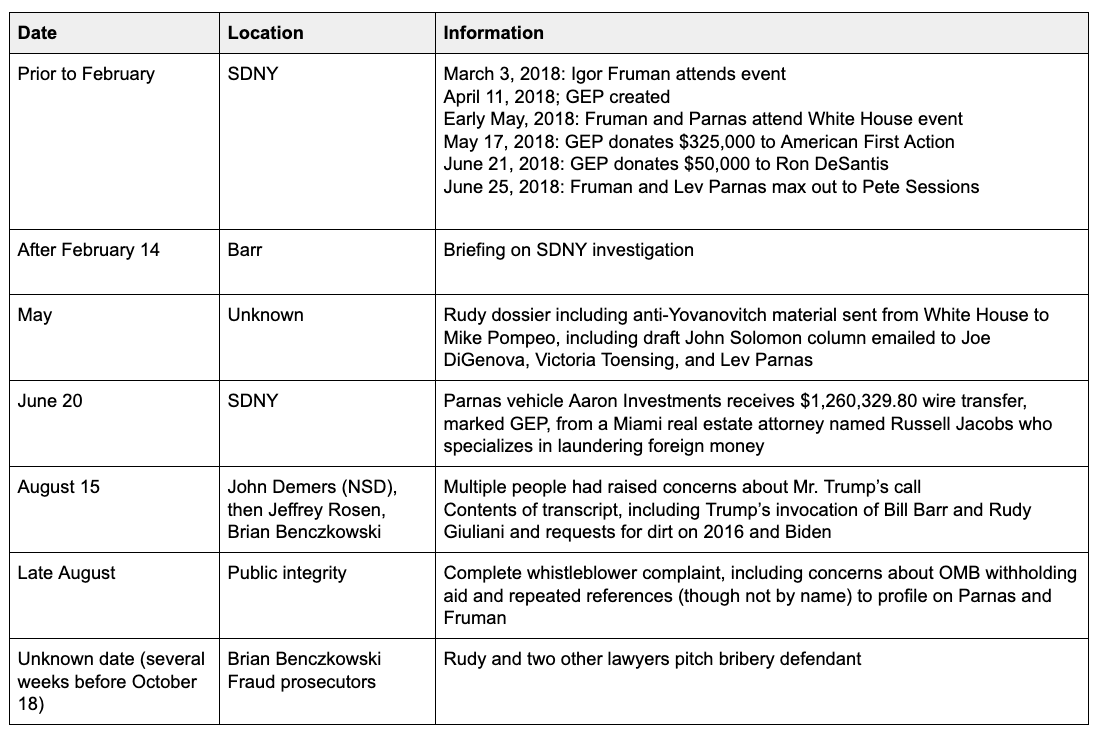
This table attempts to summarize what DOJ learned of Parnas, Fruman, and Rudy when. It’s incomplete in at least one important respect, as I’ll show. But it captures most of the ways DOJ and FBI would have been informed about parts of the Ukrainian grift.

Remarkably, we don’t yet know how the SDNY came to open the investigation. It could have been a Mueller referral, SDNY could have discovered the grift from something that happened in NYC (though the venue that ultimately got laid out in the indictment suggests the obvious signs of corruption took place in FL), or it could have stemmed from a Campaign Legal Center complaint filed with the FEC on July 25, 2018. But by the time Barr was briefed in February, we should assume that DOJ knew at least as much as CLC knew the summer before, which is that Parnas and Fruman had set up a shell company, Global Energy Producers, that they were using to make big donations to Republicans, including a $325,000 donation to a Trump SuperPAC just days after Parnas and Fruman met with Trump at the White House. That’s what Barr would have learned when he got briefed shortly after he was confirmed on February 14: that these Ukrainian-Americans were giving straw donations to Republicans in apparent coordination with key meetings with the recipients.

Here’s where the gap in this table comes in. Someone trying to spin the CNN for its version of the Benczkowski quote claimed that Rudy was not yet a focus of the SDNY investigation at the time Barr was briefed (the claim is silent, however, about all the other times Barr was briefed, per an October 10 statement from DOJ). Nevertheless, as CNN lays out, that claim is probably not true, because a NY lawyer was already getting questions from FBI counterintelligence agents by that time.

A person familiar with the matter said that at the time, Giuliani wasn’t a central figure in the case as he is now. That emerged in recent weeks, the person said.

Still, New York federal prosecutors had their eyes set on Giuliani months ago. A New York lawyer told CNN that FBI counterintelligence agents asked him questions in February or March related to Giuliani and his associates.

The day after the Ukrainian grifters’ arrest became public, NYT reported that Rudy was under investigation for FARA (for activities that extend well beyond his Ukraine work). Particularly given that the National Security Division is setting up a unit to prosecute FARA violations, that, plus the involvement of CI agents, should involve NSD and therefore would suggest that NSD head John Demers would know of the focus on Rudy. That can’t be guaranteed, however, because SDNY often does its own thing. So that’s the gap: We don’t know when Demers would have first learned that Rudy’s under investigation for his sleazy influence peddling.

We do know, however, that sometime in May, State Department’s Inspector General Steve Linick sent FBI (we don’t know which unit) the “Rudy Dossier,” the disinformation developed as part of his Ukraine work. Among the things that dossier includes is an email via which John Solomon sent a draft of this article to Rudy, Victoria Toensing, and Lev Parnas. Whoever received that dossier should have immediately identified that Parnas and Rudy were under active criminal investigation in SDNY for influence peddling, a topic on which that email would be directly relevant. In addition to Victoria Toensing and Rudy, the packet would also directly implicate the White House and Mike Pompeo, because the packet was sent under White House imprimatur to the Secretary of State. So by May, that dossier should have been in Parnas and Rudy’s investigative file. Except that, when Linick asked FBI if they were cool with him sharing the dossier with Congress, they were, which suggests it may not have been added to the investigative file.

Assuming that the vaunted SDNY is at least as sharp as a small campaign finance NGO, then by the time CLC updated their SEC complaint on June 20, SDNY would have known what that GEP’s straw donations (including a $325,000 donation to a Trump SuperPAC) came immediately after Parnas got a $1.2 million infusion from a lawyer who helps foreigners launder money through real estate, something that should have raised further counterintelligence and foreign campaign donation concerns.

After that, the whistleblower complaint comes into DOJ, in two different forms. The first time, it comes when CIA General Counsel Courtney Simmons Elwood and White House Associate Counsel John Eisenberg inform John Demers (who, remember, may or may not know about a FARA investigation into Rudy by this point). Demers went to the White House and reviews the transcript, which would have informed him that multiple people were concerned about the call, that Trump invoked both Rudy and Demers’ boss, Bill Barr, on the call, and that Trump was soliciting dirt related to both the investigation into the Russian operation in 2016 (ongoing parts of which Demers still oversees) and Trump’s imagined 2020 opponent, Joe Biden. If Demers did know that Rudy was under investigation for FARA at this time, Trump’s request that Ukraine share dirt with Rudy would have been directly relevant to that investigation, but in a way that implicated Demers’ boss as well. In any case, a simple database search would have revealed that, along with the $1.2 million cash transfer raising additional concerns about foreign money backing those campaign efforts.

Demers’ reported response to reading the transcript was to tell Brian Benczkowski (who claims not to have known about Parnas and Fruman, but whose Peter Carr quote was silent about whether he knew of any investigation into Rudy) and Jeffrey Rosen (who was probably confirmed after Barr’s first briefing on Parnas and Fruman, but who is currently Geoffrey Berman’s supervisor and so should be in the loop in the subsequent briefings that DOJ admitted Barr had after that initial briefing.

According to public reports, DOJ did nothing with this initial complaint.

DOJ avoids (admitting to) reviewing the full whistleblower complaint based off a false claim it doesn’t include direct knowledge

But then the whistleblower tried again, going to the Intelligence Community Inspector General and writing up his complaint, which then got referred to Brian Benczkowski and some public integrity investigators. According to Kerri Kupec, here’s what happened next.

In August, the Department of Justice was referred a matter relating to a letter the director national intelligence had received from the inspector general for the intelligence community regarding a purported whistleblower complaint. The inspector general’s letter cited a conversation between the president and Ukrainian President Zelensky as a potential violation of federal campaign finance law, while acknowledging that neither the inspector general nor the complainant had firsthand knowledge of the conversation,” Kupec said.

“Relying on established procedures set forth in the justice manual, the department’s criminal division reviewed the official record of the call and determined based on the facts and applicable law that there was no campaign finance violence and that no further action was warranted. All relevant components of the department agreed with this legal conclusion, and the department has concluded this matter,” Kupec concluded.

In another statement, Kupec said that Barr had not spoken with Mr. Trump about Ukraine investigating Biden, and that the president had not asked Barr to contact Ukraine or Giuliani.

In explaining how DOJ came to dismiss this complaint, Kupec cites not from the complaint itself, but from Michael Atkinson’s letter conveying the complaint. Kupec cites from the letter, which notes the whistleblower “was not a direct witness to the President’s telephone call,” and uses that to treat only the transcript of the call — not the broader whistleblower complaint itself, which does include firsthand knowledge — as the official record. And, having referred to just the call, DOJ viewed this as exclusively a campaign finance matter, and therefore dismissed it (DOJ ignores another crime laid out in Atkinson’s letter, a crime Mick Mulvaney has now confessed to, but I’ll come back to how they managed to ignore that).

In fact, parts of the whistleblower complaint make it clear that he was a direct witness to aspects of his complaint, and so DOJ should have treated the complaint itself as an official document (this is why the frothy right invested so much energy into the goddamned whistleblower form, to rationalize DOJ’s decision not to read the actual complaint).

Had DOJ read the complaint and done the most basic investigative work on the materials included in the complaint, they (including Benczkowski) would have known that Trump’s call related directly to matters under active investigation in SDNY.

While the whistleblower complaint does not mention Parnas and Fruman by name, it repeatedly invokes this OCCRP profile (see footnotes 4, 9, 10, 11), The profile would have made it crystal clear — if DOJ’s investigators couldn’t figure it out for themselves — how the evidence that SDNY was already reviewing (including the campaign finance stuff and the Rudy dossier) connected directly with the July 25 call.

Since early last year, the men have emerged from obscurity to become major donors to Republican campaigns in the United States. They have collectively contributed over half a million dollars to candidates and outside campaign groups, the lion’s share in a single transaction that an independent watchdog has flagged as a potential violation of electoral funding law.

The men appear to enjoy a measure of access to influential figures. They’ve dined with Trump, had a “power breakfast” with his son Donald Jr., met with U.S. congressmen, and mixed with Republican elites.

Months before their earliest known work with Giuliani, Parnas and Fruman also lobbied at least one congressman — former U.S. Rep. Pete Sessions, a Texas Republican — to call for the dismissal of the United States’ ambassador to Ukraine, Marie Yovanovitch. She stepped down a year later after allegations in the conservative media that she had been disloyal to Trump.

While setting up meetings for Giuliani with Ukrainian officials, the men also promoted a business plan of their own: Selling American liquefied natural gas to Ukraine to replace Russian imports disrupted by war.

Three days before the call itself, OCCRP and BuzzFeed had already laid out parts of the crime that SDNY has since indicted. And that profile was part of the whistleblower complaint provided to DOJ, in which DOJ claimed they could find no evidence of a crime.

FBI’s three investigative levels are Full Investigations (opened once FBI has evidence that a crime has occurred), Preliminary Investigations (opened once FBI has reason to believe a crime has been committed), and Assessments (the work FBI does to assess the credibility of tips). FBI Agents are expected — encouraged, explicitly, as a matter of national security — to do searches of FBI’s existing investigative databases at the Assessment level. They do this not just to make sure that suspected foreign agents like Parnas and Fruman aren’t allowed to insinuate themselves into top tiers of power unnoticed, but also for deconfliction, to make sure DOJ knows precisely which part of DOJ is investigating which people.

Had FBI followed its DIOG based on the information included in the whistleblower complaint, it would have been crystal clear that the July 25 call related to an ongoing Full Investigation, and the July 25 call — and the President’s extortion — would have been made part of that investigative record.

The Criminal Division Chief has confessed it did not follow protocols in reviewing this complaint

All of which brings me full cycle to DOJ’s efforts to pretend they didn’t know that Rudy was a suspected criminal when they met with him to discuss the accused criminals he represents.

Brian Benczkowski, the head of the Criminal Division (and yet, someone who has never prosecuted a case), claims that he had no way of knowing that Rudy Giuliani’s clients and co-conspirators were about to be indicted when he met with Rudy on some date no one wants to reveal. That may be true — though if it is, it means either his staffers did almost no due diligence before setting up that meeting, or the fact that Rudy, in addition to Parnas and Fruman, was under active investigation did not dissuade Benczkowski from taking the meeting.

But, if the meeting took place after the whistleblower review, as multiple reporters at NYT seem to believe it did, for him to claim that he didn’t know about Parnas and Fruman also amounts to an explicit confession that the investigators reviewing the whistleblower complaint did not follow FBI guidelines requiring them to look up all the names in a tip to see if the FBI already knows about them.

That is, Brian Benczkowski, in trying to claim ignorance of Rudy’s own legal problems in advance of that meeting, confessed that his division, hiding behind whatever false excuses, did not properly investigate the whistleblower complaint.


February 14: Barr sworn in.

February, undated: Barr and Public Integrity lawyers reporting to Brian Benczkowski briefed on investigation into Lev Parnas and Igor Fruman, though NYT reported lawyer questioned about Rudy in that time period.

March 5: Barr briefed on Mueller investigation.

March 22: Mueller investigation concludes.

March 24: Barr releases misleading “summary” of Mueller Report.

March 26: John Solomon posts column first reviewed by Joe DiGenova, Victoria Toensing, and Lev Parnas

April 19: DOJ releases redacted Mueller Report.

May, undated: State IG Steve Linick receives Rudy dossier, passes on to FBI.

May 31: Barr does interview explaining his Durham investigation without once explaining any irregularities to justify investigation.

June 20: Campaign Legal Center submits supplemental complaint to FEC.

July 18: OMB informs Departments that Trump has ordered suspension of all aide to Ukraine.

July 25: Trump-Zelensky phone call.

Week after call: Whistleblower informs CIA General counsel Courtney Simmons Elwood, who speaks several times to NSC lawyer John Eisenberg.

August 12: Date of whistleblower complaint.

August 14: Elwood and Eisenberg inform National Security Division head, John Demers.

August 15: Demers reads transcript of call. Senior DOJ officials, including Jeffrey Rosen, Brian Benczkowski, and Barr informed.

The deputy attorney general, Jeffrey A. Rosen, and Brian A. Benczkowski, the head of the department’s criminal division, were soon looped in, according to two administration officials.

Department officials began to discuss the accusations and whether and how to follow up, and Attorney General William P. Barr learned of the allegations around that time, according to a person familiar with the matter. Although Mr. Barr was briefed, he did not oversee the discussions about how to proceed, the person said.

August 26: IG Michael Atkinson hand delivers message on whistleblower complaint to Acting DNI Joseph Maguire.

September 3: Original classified OLC memo deeming the whistleblower complaint “not urgent,” treating Barr’s involvement as Top Secret.

September 20: Rudy, Parnas, Victoria Toensing and Joe DiGenova lunch at Trump International across the street from DOJ. Rudy also attends State Dinner for Australia.

September 24: Declassification of Telcon. Version of OLC memo hiding Barr’s involvement as classified issue.

September 26: Release of TelCon and whistleblower complaint. Justice Department explains non-prosecution:

In August, the Department of Justice was referred a matter relating to a letter the director national intelligence had received from the inspector general for the intelligence community regarding a purported whistleblower complaint. The inspector general’s letter cited a conversation between the president and Ukrainian President Zelensky as a potential violation of federal campaign finance law, while acknowledging that neither the inspector general nor the complainant had firsthand knowledge of the conversation,” Kupec said.

“Relying on established procedures set forth in the justice manual, the department’s criminal division reviewed the official record of the call and determined based on the facts and applicable law that there was no campaign finance violence and that no further action was warranted. All relevant components of the department agreed with this legal conclusion, and the department has concluded this matter,” Kupec concluded.

In another statement, Kupec said that Barr had not spoken with Mr. Trump about Ukraine investigating Biden, and that the president had not asked Barr to contact Ukraine or Giuliani.

September 29: AP claims Barr was “surprised and angry” when he learned he had been lumped in with Rudy. His further denials include a lot of wiggle room (including unofficial contacts).

Barr has not spoken with Trump about investigating Biden or Biden’s son Hunter, and Trump has not asked Barr to contact Ukranian officials about the matter, the department said. Barr has also not spoken with Giuliani about anything related to Ukraine, officials have said.

October 1: State IG Steve Linick briefs Congress on opposition packet routed to him from Pompeo. Preservation letters to Parnas and Fruman.

October 4: Initial rough date for Rudy meeting with Benczkowski.

October 9: Parnas and Fruman lunch with Rudy at Trump Hotel across from DOJ, later that eventing they are indicted and arrested.

October 10: Lev Parnas and Igor Fruman arrest unsealed. Anonymous DOJ sources report that Barr was briefed in February and “in recent weeks.”

Attorney General William Barr was briefed on the case in February, shortly after he was confirmed. Barr has received additional briefings in recent weeks and fully supports the case.

October 11: NYT reports that Rudy under investigation for Ukraine work.

October 18: NYT reports that Rudy was lobbying Brian Benczkowski and lawyers from Fraud section “a few weeks ago” about a very sensitive bribery case.

October 20: NYT story with on-the-record quote from Peter Carr states Benczkowski and fraud section lawyers would not have met with Giuliani if they had known of the investigation of his associates; it describes the meeting as taking place “several weeks ago.”

October 21: CNN adds DOJ clarification that Rudy was not central to investigation briefed to Barr in February, even though CI Agents were questioning witnesses by March, and that Public Integrity lawyers (who report to Benczkowski) were briefed.
The Significance of Fiona Hill’s Testimony: “Whatever Drug Deal Sondland and Mulvaney Are Cooking Up”

A number of people on Twitter have asked me to elaborate on some comments I’ve made about the significance of Fiona Hill’s testimony before the Ukraine impeachment team yesterday.

It’s unclear whether she shared details of her testimony or whether most of the reporting comes from Jamie Raskin (who notably got the import of the State IG’s urgent briefing utterly wrong). But NYT has thus far offered the key description (citing at least two other people beyond Raskin).

Force Bolton to shit or get off the pot

First, the NYT describes Hill citing the abrasive John Bolton saying two fairly stunning things which were bound to make headlines. First, she described Bolton saying Rudy was a “hand grenade” who would blow everyone up (a quote Rudy has already responded to).

Mr. Bolton expressed grave concerns to Ms. Hill about the campaign being run by Mr. Giuliani. “Giuliani’s a hand grenade who’s going to blow everybody up,” Ms. Hill quoted Mr. Bolton as saying during an earlier conversation.

Then, after a July 10 meeting where it became clear Trump was withholding security assistance for campaign propaganda, according to reports of Hill’s testimony, Bolton asked her to tell Deputy White House Counsel John Eisenberg that he was not part of “whatever drug deal” Trump’s flunkies were pursuing.

“I am not part of whatever drug deal Sondland and Mulvaney are cooking up,” Mr. Bolton, a Yale-trained lawyer, told Ms. Hill to tell White House lawyers, according to two people at the deposition.

It was clear even before the July 25 call that kicked off this whole scandal that Bolton was on the outs. Tellingly, Bolton was specifically excluded from the call.

But since then, Bolton has (like James Mattis) been talking about writing a book, telling his story for history, rather than for the present and the sake of the Constitution.

By including these two quotes in her testimony, Hill not only ensured that Bolton will be the target of Trump’s ire (after all, Hill didn’t say these things, Bolton reportedly did). But it will force Bolton to either deny them (if he’s certain Hill didn’t take contemporaneous notes), or take a stand against activities he clearly recognized were wrong.

And if Bolton testifies in the impeachment inquiry about his concerns, it will represent someone about whom there can be no doubts as to Republican partisan loyalty. If Hill’s inclusion of Bolton’s comments leads Trump’s former National Security Advisor to provide damning testimony to the impeachment inquiry, it will change both the profile of the inquiry and the possible response attacks.

Force Sondland to rewrite his ever-evolving testimony

Hill’s testimony about that July 10 meeting also provided damning testimony about Gordon Sondland, who is scheduled to testify on Thursday.

One of the most dramatic moments she described came in the July 10 meeting in Mr. Bolton’s office that included Mr. Sondland; Kurt D. Volker, then the special envoy for Ukraine; Rick Perry, the energy secretary; and two Ukrainian officials.

The purpose of the meeting was to talk about technical assistance to Ukraine’s national security council. The Ukrainians were eager to set up a meeting between Mr. Trump and Mr. Zelensky, who was elected on a promise to clean up corruption and resolve the country’s five-year war with Russian-armed separatists.

Mr. Bolton was trying to not commit to a meeting, according to Ms. Hill’s testimony. Mr. Sondland got agitated, Ms. Hill testified, and let out that there was an agreement with Mr. Mulvaney that there would be a meeting if Ukraine opened up the investigations the White House was seeking.

Mr. Bolton immediately ended the meeting abruptly. As the group moved toward the door, Mr. Sondland said he wanted them to come down to the ward room next to the White House mess to discuss next steps. Mr. Bolton pulled Ms. Hill aside to instruct her to go to the ward room and report to him what they talked about.

When she got downstairs, Mr. Sondland was talking with the Ukrainians and specifically mentioned Burisma, the Ukrainian energy firm that had Hunter Biden, the former vice president’s son, on its board.

Sondland has already test driven two drafts of his intended testimony, much as Michael Cohen did two years ago before he gave false testimony to Congress. Even the most recent of those drafts appears to be rendered inoperative by Hill’s testimony.

I’m sure Adam Schiff would have preferred that Sondland not get another chance to craft his testimony (and I suspect Sondland’s lawyer is trying to convince him that the possibility of being named Secretary of State is not worth perjuring himself for, which is why he’s probably not yet planning on invoking the Fifth).

But thus far, Sondland doesn’t seem to have discovered a story that he can tell that coheres with the other known testimony.

Hill ties Sondland’s actions to Trump

Hill also provided testimony — testimony we know that is backed by other witnesses — that Sondland was playing the role he was playing because the President wanted him to be.

At one point, she confronted Mr. Sondland, who had inserted himself into dealings with Ukraine even though it was not part of his official portfolio, according to the people informed about Ms. Hill’s testimony.

He told her that he was in charge of Ukraine, a moment she compared to Secretary of State Alexander M. Haig Jr.’s declaration that he was in charge after the Ronald Reagan assassination attempt, according to those who heard the testimony.

According to whom, she asked.

The president, he answered.

This will tie Trump directly to this scheme and make Sondland’s later denials about whether he knew Trump to be lying about a quid pro quo even more obviously false than they already are. This is not Rudy freelancing, or State ordering him to, but Trump ordering everyone to.

Hill implicates John Eisenberg

I noted the central role of John Eisenberg in attempts to cover this quid pro quo up weeks ago (and noted that he succeeded in preventing any record of an early quid pro quo from being being made).

Eisenberg is the guy who decided to put the transcript of the July 25 call on the Top Secret server. Eisenberg had a role in framing the crimes, as described to DOJ, such that they could shunt them to Public Integrity and dismiss them, rather than open up another Special Counsel investigation into the President’s extortion.

But Hill’s testimony makes it clear Eisenberg was told of what Bolton analogized to crimes well before the call.

Ms. Hill went back upstairs and reported the encounter to Mr. Bolton, who promptly instructed her to report the issue to John A. Eisenberg, a deputy White House counsel and the chief legal adviser for the National Security Council, along with his line about the drug deal, which he meant metaphorically.

Mr. Eisenberg told Ms. Hill he would report it up his chain of command, which would typically mean Pat Cipollone, the White House counsel.

Eisenberg (whose FBI 302 from the last Trump criminal investigation DOJ is trying to withhold) would have been on the hook anyway for a clear attempt to cover up Trump’s crime. But the revelation that he had advance warning that a crime was in process — and apparently did nothing to prevent it — changes his exposure significantly.

It was the OMB Director, misappropriating funds, in the National Security Advisor’s office

Finally, Hill puts Mick Mulvaney at the scene of the crime.

As I’ve said before, one part of this scandal that has gotten far too little attention is that, to extort Ukraine, Trump withheld funds appropriated by Congress, funds about which there was bipartisan agreement.

Last week, CNN and WSJ reported that to do this, OMB changed the way the funds were distributed, putting a political flunkie in charge, also a detail that has gotten far too little attention.

Not only does that raise the Constitutional stakes of the Executive’s refusal to spend the funds Congress had duly appropriated, but it shows consciousness of guilt.

And per Hill’s testimony Mick Mulvaney, serving in the dual role of OMB chief and Chief of Staff, knew that those funds were being withheld for a quid pro quo or (as John Bolton described it) a drug deal.

Senate Republicans might not ever convict Trump for demanding foreign countries invent propaganda on his political allies. They might feel differently once it becomes clear that the crime involves refusing to do what Congress, with its power of the purse, told him to, without even telling Congress he was doing so (or why). They may not care about Trump pressing for any political advantage for their party, but they may care about Trump neutering their most important authority.

How Twelve Years of Warning and Six Years of Plodding Reform Finally Forced FBI to Do Minimal FISA Oversight

Earlier this week, the government released the reauthorization package for the 2018 Section 702 certificates of FISA. With the release, they disclosed significant legal fights about the way FBI was doing queries on raw data, what we often call “back door searches.” Those fights are, rightly, being portrayed as Fourth Amendment abuses. But they are, also, the result of the FISA Court finally discovering in 2018, after 11 years, that back door searches work like some of us have been saying they do all along, a discovery that came about because of procedural changes in the interim.

As such, I think this is wrong to consider “FISA abuse” (and I say that as someone who was very likely personally affected by the practices in question). It was, instead, a case where the court discovered that FBI using 702 as it had been permitted to use it by FISC was a violation of the Fourth Amendment.

As such, this package reflects a number of things:

  • A condemnation of how the government has been using 702 (and its predecessor PAA) for 12 years
  • A (partial — but thus far by far the most significant one) success of the new oversight mechanisms put in place post-Snowden
  • An opportunity to reform FISA — and FBI — more systematically

This post will explain what happened from a FISA standpoint. A follow-up post will explain why this should lead to questions about FBI practices more generally.

The background

This opinion came about because every year the government must obtain new certificates for its 702 collection, the collection “targeted” at foreigners overseas that is, nevertheless, designed to collect content on how those foreigners are interacting with Americans. Last we had public data, there were three certificates: counterterrorism, counterproliferation, and “foreign government,” which is a too-broadly scoped counterintelligence function. As part of that yearly process, the government must get FISC approval to any changes to its certificates, which are a package of rules on how they will use Section 702. In addition, the court conducts a general review of all the violations reported over the previous year.

Originally, those certificates included proposed targeting (governing who you can target) and minimization (governing what you can do once you start collecting) procedures; last year was the first year the agencies were required to submit querying procedures governing the way agencies (to include NSA, CIA, National Counterterrorism Center, and FBI) access raw data using US person identifiers. The submission of those new querying procedures are what led to the court’s discovery that FBI’s practices violated the Fourth Amendment.

In the years leading up to the 2018 certification, the following happened:

  • In 2013, Edward Snowden’s leaks made it clear that those of us raising concerns about Section 702 minimization since 2007 were correct
  • In 2014, the Privacy and Civil Liberties Oversight Board (which had become operational for the first time in its existence almost simultaneously with Snowden’s leaks) recommended that CIA and FBI have to explain why they were querying US person content in raw data
  • In 2015, Congress passed the USA Freedom Act, the most successful reform of which reflected Congress’ intent that the FISA Court start consulting amicus curiae when considering novel legal questions
  • In 2015, amicus Amy Jeffress (who admitted she didn’t know much about 702 when first consulted) raised questions about how queries were conducted, only to have the court make minimal changes to current practice — in part, by not considering what an FBI assessment was
  • In the 2017 opinion authorizing that year’s 702 package, Rosemary Collyer approved an expansion of back door searches without — as Congress intended — appointing an amicus to help her understand the ways the legal solution the government implemented didn’t do what she believed it did; that brought some (though not nearly enough) attention to whether FISC was fulfilling the intent of Congress on amici
  • In the 2017 Reauthorization (which was actually approved in early 2018), Congress newly required agencies accessing raw data to submit querying procedures along with their targeting and minimization procedures in the annual certification process, effectively codifying the record-keeping suggestion PCLOB had made over two years earlier

When reviewing the reauthorization application submitted in March 2018, Judge James Boasberg considered that new 2017 requirement a novel legal question, so appointed Jonathan Cederbaum and Amy Jeffress, the latter of whom also added John Cella, to the amicus team. By appointing those amici to review the querying procedures, Boasberg operationalized five years of reforms, which led him to discover that practices that had been in place for over a decade violated the Fourth Amendment.

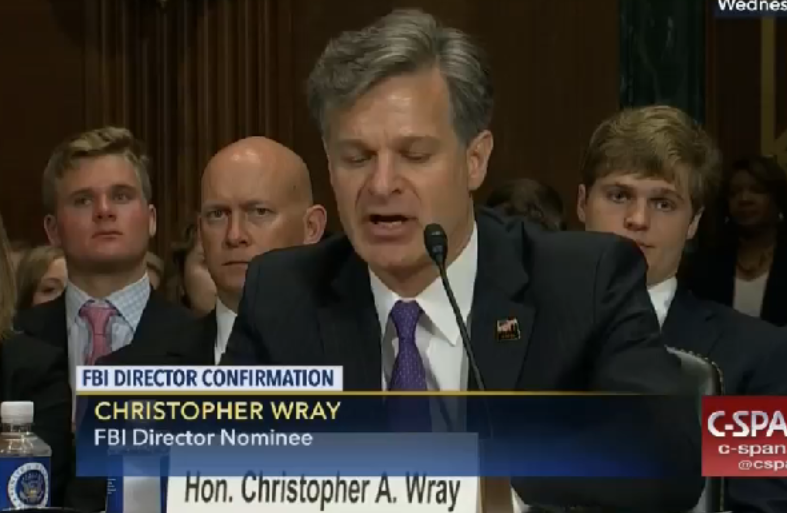
When the agencies submitted their querying procedures in March 2018, all of them except FBI complied with the demand to track and explain the foreign intelligence purpose for US person queries separately. FBI, by contrast, said they already kept records of all their queries, covering both US persons and non-US persons, so they didn’t have to make a change. One justification it offered for not keeping US person-specific records as required by the law is that Congress exempted it from the reporting requirements it imposed on other agencies in 2015, even though FBI admitted that it was supposed to keep queries not just for the public reports from which they argued they were exempted, but also for the periodical reviews that DOJ and ODNI make of its queries for oversight purposes. FBI Director Christopher Wray then submitted a supplemental declaration, offering not to fix the technical limitations they built into their repositories, but arguing that complying with the law via other means would have adverse consequences, such as diverting investigative resources. Amici Cedarbaum and Amy Jeffress challenged that interpretation, and Judge James Boasberg agreed.

The FBI’s querying violations

It didn’t help FBI that in the months leading up to this dispute, FBI had reported six major violations to FISC involving US person queries. While the description of those are heavily redacted, they appear to be:

  • March 24-27, 2017: The querying of 70K facilities “associated with” persons who had access to the FBI’s facilities and systems. FBI General Counsel (then run by Jim Baker, who had had these fights in the past) warned against the query, but FBI did it anyway, though did not access the communications. This was likely either a leak or a counterintelligence investigation and appears to have been discovered in a review of existing Insider Threat queries.
  • December 1, 2017: FBI conducted queries on 6,800 social security numbers.
  • December 7-11, 2017, the same entity at FBI also queried 1,600 queries on certain identifiers, though claimed they didn’t mean to access raw data.
  • February 5 and 23, 2018: FBI did approximately 30 queries of potential sources.
  • February 21, 2018: FBI did 45 queries on people being vetted as sources.
  • Before April 13, 2018: an unspecified FBI unit queried FISA acquired metadata using 57,000 identifiers of people who work in some place.

Note, these queries all took place under Trump, and most of them took place under Trump’s hand-picked FBI Director. Contrary to what some Trump apologists have said about this opinion, it is not about Obama abuse (though it reflects practices that likely occurred under him and George Bush, as well).

These violations made it clear that Congress’ mandate for better record-keeping was merited. Boasberg also used them to prove that existing procedures did not prevent minimization procedure violations because they had not in these instances.

As he was reviewing the violations, Boasberg discovered problems in the oversight of 702 that I had noted before, based off my review of heavily redacted Semiannual Reports (which means they should have been readily apparent to everyone who had direct access to the unredacted reports). For example, Judge Boasberg noted how few of FBI’s queries actually get reviewed during oversight reviews (something I’ve pointed out repeatedly, and which 702 boosters have never acknowledged the public proof of).

As noted above, in 2017 the FBI conducted over three million queries of FISA-acquired information on just one system, [redacted]. See Supplemental FBI Declaration at 6. In contrast, during 2017 NSD conducted oversight of approximately 63,000 queries in [redacted] and 274,000 queries in an FBI system [redacted]. See Gov’t Response at 36.

Personnel from the Office of Intelligence (OI) within the Department of Justice’s National Security Division (NSD) visit about half of the FBI’s field offices for oversight purposes in a given year. Id at 35 & n 42. Moreover OI understandably devotes more resources to offices that use FISA authorities more frequently, so those offices [redacted] are visited annually, id at 35 n. 42, which necessitates that some other offices go for periods of two years or more between oversight visits. The intervals of time between oversight visits at a given location may contribute to lengthy delays in detecting querying violations and reporting them to the FISC. See, e.g., Jan. 18, 2019, Notice [redacted] had been conducting improper queries in a training context since 2011, but the practice was not discovered until 2017).

He also noted that the records on such queries don’t require contemporaneous explanation from the Agent making the query, meaning any review of them will not find problems.

The FBI does not even record whether a query is intended to return foreign-intelligence information or evidence of crime. See July 13, 2018, Proposed Tr. at 14 (DOJ personnel “try to figure out” from FBI query records which queries were run for evidence of crime purposes). DOJ personnel ask the relevant FBI personnel to recall and articulate the bases for selected queries. Sometimes the FBI personnel report they cannot remember. See July 9, 2018, Notice.

Again, I noted this in the past.

In short, as Boasberg was considering Wray’s claim that the FBI didn’t need the record-keeping mandated by Congress, he was discovering that, in fact, FBI needs better oversight of 702 (something that should have been clear to everyone involved, but no one ever listens to my warnings).

FISC rules the querying procedures do not comply with the law or Fourth Amendment

In response to Boasberg’s demand, FBI made several efforts to provide solutions that were not really solutions.

The FBI’s first response to FISC’s objections was to require General Counsel approval before accessing the result of any “bulk” queries like the query that affected 70K people — what it calls “categorical batch queries.”

Queries that are in fact reasonably likely to return foreign-intelligence information are responsive the government’s need to obtain and produce foreign-intelligence information, and ultimately to disseminate such information when warranted. For that reason, queries that comply with the querying standard comport with § 1801 (h), even insofar as they result in the examination of the contents of private communications to or from U.S. persons. On the other hand, queries that lack a sufficient basis are not reasonably related to foreign intelligence needs and any resulting intrusion on U.S. persons’ privacy lacks any justification recognized by§ 1801 (h)(l). Because the FBI procedures, as implemented, have involved a large number of unjustified queries conducted to retrieve information about U.S. persons, they are not reasonably designed, in light of the purpose and technique of Section 702 acquisitions, to minimize the retention and prohibit the dissemination of private U.S. person information.

But Boasberg was unimpressed with that because the people who’d need to consult with counsel would be the most likely not to know they did need to do so.

He also objected to FBI’s attempt to give itself permission to use such queries at the preliminary investigation phase (before then, FBI was doing queries at the assessment stage).

The FBI may open a preliminary investigation with even less of a factual predicate: “on the basis of information or an allegation indicating the existence of a circumstance” described in paragraph a. orb. above. Id. § II.B.4.a.i at 21 (emphasis added). A query using identifiers for persons known to have had contact with any subject of a full or preliminary investigation would not require attorney approval under § IV.A.3, regardless of the factual basis for opening the investigation or how it has progressed since then.

Boasberg’s Fourth Amendment analysis was fairly cautious. Whereas amici pushed for him to treat the queries as separate Fourth Amendment events, on top of the acquisition (which would have had broad ramifications both within FISA practice and outside of it), he instead interpreted the new language in 702 to expand the statutory protection under queries, without finding queries of already collected data a separate Fourth Amendment event.

Similarly, both Boasberg and the amici ultimately didn’t push for a written national security justification in advance of an actual FISA search. Rather, they argued FBI had to formulate such a justification before accessing the query returns (in reality, many of these queries are automated, so it’d be practically impossible to do justifications before the fact).

Boasberg nevertheless required the FBI to at least require foreign intelligence justifications for queries before an FBI employee accessed the results of queries.

The FBI was not happy. Having been told they have to comply with the clear letter of the law, they appealed to the FISA Court of Review, adding apparently new arguments that fulfilling the requirement would not help oversight and that the criminal search requirements were proof that Congress didn’t intend them to comply with the other requirements of the law. Like Boasberg before them, FISCR (in a per curium opinion from the three FISCR judges, José Cabranes, Richard Tallman, and David Sentelle) found that FBI really did need to comply with the clear letter of the law.

The FBI chose not to appeal from there (for reasons that go beyond this dispute, I suspect, as I’ll show in a follow-up). So by sometime in December, they will start tracking their backdoor searches.

FBI tried, but failed, to avoid implementing a tool that will help us learn what we’ve been asking

Here’s the remarkable thing about this. Something like this has been coming for two years, and FBI is only now beginning to comply with the requirement. That’s probably not surprising. Neither the Director of National Intelligence (which treated its intelligence oversight of FBI differently than it did CIA or NSA) nor Congress had demanded that FBI, which can have the most direct impact on someone’s life, adhere to the same standards of oversight that CIA and NSA (and an increasing number of other agencies) do.

Nevertheless, 12 years after this system was first moved under FISA (notably, two key Trump players, White House Associate Counsel John Eisenberg and National Security Division AAG John Demers were involved in the original passage), we’re only now going to start getting real information about the impact on Americans, both in qualitative and quantitative terms. For the first time,

  • We will learn how many queries are done (the FISC opinion revealed that just one FBI system handles 3.1 million queries a year, though that covers both US and non US person queries)
  • We will learn that there are more hits on US persons than previously portrayed, which leads to those US persons to being investigated for national security or — worse — coerced to become national security informants
  • We will learn (even more than we already learned from the two reported queries that this pertained to vetting informants) the degree to which back door searches serve not to find people who are implicated in national security crimes, but instead, people who might be coerced to help the FBI find people who are involved in national security crimes
  • We will learn that the oversight has been inadequate
  • We will finally be able to measure disproportionate impact on Chinese-American, Arab, Iranian, South Asian, and Muslim communities
  • DOJ will be forced to give far more defendants 702 notice

Irrespective of whether back door searches are themselves a Fourth Amendment violation (which we will only now obtain the data to discuss), the other thing this opinion shows is that for twelve years, FISA boosters have been dismissing the concerns those of us who follow closely have raised (and there are multiple other topics not addressed here). And now, after more than a decade, after a big fight from FBI, we’re finally beginning to put the measures in place to show that those concerns were merited all along.

DOJ Suddenly Decides It Can Share the McCabe, Comey 302s with Congress

After DOJ asserted to DC Chief Judge Beryl Howell that US v. Nixon would be decided differently today, the judge instructed the parties fighting over whether DOJ will share the grand jury materials from the Mueller investigation with Congress to get busy. She set of bunch of short deadlines to determine the validity of DOJ’s claims to secrecy. As part of that, she had DOJ explain which FBI 302s (interview reports) it had shared of those the House Judiciary Committee requested, then had HJC fact check that list.

According to HJC, DOJ’s declaration alerted them, for the first time, that some of the redactions in 302s were made to protect “Executive Branch confidentiality,” a claim they’ll move to challenge.

Although DOJ discussed the bases for redaction in its Supplemental Submission and at the October 8, 2019 hearing, see DOJ Supp. Sub. ¶ 4; Hr’g Tr. 48-49 (Oct. 8, 2019), none of the bases for redactions are listed or otherwise indicated on the FBI-302 reports reviewed by the Committee. Instead, portions of the FBI-302 reports are simply blacked out without any explanation. During the Committee’s on-site reviews of the FBI-302 reports and in calls between Committee and DOJ officials, the Committee has repeatedly requested that DOJ specifically identify the complete set of bases for its redactions. The Committee still has not received this information as to any of the FBI-302 reports it has reviewed. While the Committee is generally aware that there were redactions for personally identifiable information, until the discussion during yesterday’s hearing and in DOJ’s Supplemental Submission, the Committee was unaware, for example, that the bases for redactions included either “Executive Branch confidentiality interests,” DOJ Supp. Sub. ¶ 4, or “presidential communications,” Hr’g Tr. 48:19- 20 (Oct. 8, 2019).

The more interesting revelation from the exchange, however, pertains to whether or not DOJ was going to supply all 302s, and which ones they might suppress. As DOJ explains, it has given HJC 302s for 17  of the 33 people they asked for (though the Rob Porter and Uttam Dhillon 302s were mostly redacted):

The Committee requested FBI-302s for 33 individuals. To date the Department has provided access to the FBI-302s of 17 of those individuals, several of whom had multiple interviews. Those individuals are (in alphabetical order): (1) Chris Christie, (2) Michael Cohen (six separate FBI-302s); (3) Rick Dearborn; (4) Uttam Dhillon; (5) John Kelly; (6) Jared Kushner; (7) Cory Lewandowski; (8) Paul Manafort (seven separate FBI-302s); (9) Mary McCord; (10) K.T. McFarland (five separate FBI-302s); (11) Stephen Miller; (12) Rob Porter (two separate FBI-302s); (13) Rod Rosenstein; (14) Christopher Ruddy; (15) Sarah Sanders; (16) Sean Spicer; (17) Sally Yates.

But it has thus far withheld 302s from a group of others.

The Department currently anticipates making the remaining FBI-302’s available under the agreed upon terms as processing is completed, so long as they do not adversely impact ongoing investigations and cases and subject to redaction and potential withholding in order to protect Executive Branch confidentiality interests. These include, in alphabetical order (1) Stephen Bannon; (2) Dana Boente; (3) James Burnham; (4) James Comey; (5) Annie Donaldson; (6) John Eisenberg; (7) Michael Flynn; (8) Rick Gates; (9) Hope Hicks; (10) Jody Hunt; (11) Andrew McCabe; (12) Don McGahn; (13) Reince Priebus; (14) James Rybicki; (15) Jeff Sessions. In addition, the Committee requested the FBI-302 for the counsel to Michael Flynn, which also has not yet been processed.

It’s an interesting list to withhold.

Hicks, of course, was privy to a great deal (including Trump’s effort to lie about the June 9 meeting), and her testimony about certain communications during the campaign was actually fairly revealing.

At least two of these may be withheld for the pendency of the Roger Stone trial; both Steve Bannon and Rick Gates will be witnesses, and Mike Flynn’s discussions of WikiLeaks may come up as well.

These 302s (and Dhillon’s heavily redacted one) cover virtually all of the White House’s side of discussions not to fire Mike Flynn right away after discovering he lied about his call with Sergey Kislyak: James Burnham, John Eisenberg, Don McGahn, and Reince Priebus, and of course Flynn himself, were all key players in that. Of course, Eisenberg (who’s the lawyer who decided to hide the records on Trump’s call to Volodymyr Zelensky) was involved in other acts that might indicate obstruction, including advising KT McFarland not to create a false record about what Flynn said. And McGahn was involved in much else (and might even have been asked about Stone’s campaign finance issues, which McGahn represented him on, and the awareness of the Trump campaign about will be an issue at Stone’s trial). But I find it acutely interesting that DOJ is withholding a bunch of records that will make it clear how damning Trump’s reluctance to fire Flynn was, even as Flynn attempts a propaganda driven effort to give Trump an excuse to pardon him.

Then there are the 302s pertaining to the recusal of Jeff Sessions and firing of Jim Comey (and immediate pressure on Andrew McCabe). Those include Comey himself, McCabe, Rybicki, Hunt, Sessions, and Dana Boente. The fact that DOJ has been withholding these (and it’s suggestion that there are ongoing investigations) is really sketchy: it suggests that DOJ may have been withholding really damning 302s from Congress so it can decide whether to indict McCabe and — presumably — wait for DOJ IG to finish its investigation of the FISA orders some of these men approved. In other words, DOJ has been releasing one after another damning claim against Comey and McCabe, but withholding evidence about why they might be targeted.

It’s also noteworthy that Boente and McGahn’s memory regarding an effort McGahn made to shut down the Russian investigation is one of the greatest conflicts of testimony in the entire Mueller Report.

The 302s DOJ has been withholding also happens to include 302s of current DOJ officials. Boente is the FBI General Counsel. More alarmingly, Jody Hunt runs the Civil Division and Burnham is his Deputy. These are the men directing the DOJ effort to make breathtaking claims about impeachment, and they’re hiding their own actions in the investigation about which Congress is considering impeachment.

But, having been asked by Howell what the state of affairs is, DOJ has now decided that they’re going to turn over 302s they previously had suggested they might withhold. HJC expressed some surprise about the sudden change of plans.

With respect to the outstanding FBI-302 reports, the Committee was surprised but encouraged by DOJ’s statement in its supplemental filing that it “currently anticipates making the remaining FBI-302s available.” DOJ Supp. Sub. ¶ 5. The Committee had previously understood from its recent communications with DOJ that DOJ’s production was nearing completion and that there were only a limited number of remaining documents that DOJ would disclose.

It will be interesting if and when HJC obtains these records to see how DOJ tried to protect itself.

Update: I’m reminded of two things. First, as I copied out this URL, I recalled that Turkey, along with Russia, would have known that he lied about his calls with Sergey Kislyak.

Also, in the government’s most recently filing in the Mike Flynn case, they revealed that he had not been in possession of the interview reports from between the time he was initially interviewed and the time he pled guilty.

Based on filings and assertions made by the defendant’s new counsel, the government anticipates that the defendant’s cooperation and candor with the government will be contested issues for the Court to consider at sentencing. Accordingly, the government will provide the defendant with the reports of his post-January 24, 2017 interviews. The government notes that the defendant had counsel present at all such interviews.

This suggests that the government was withholding reports that would make it clear that Flynn continued to lie, even after he lawyered up.