Posts

Agreement Announced on Special Operations Forces in Wardak Province, Explanations Vary Widely

NATO is claiming that there now is an agreement with Afghan President Hamid Karzai regarding the withdrawal of US Special Operations Forces from Maidan Wardak province in the wake of Karzai’s insistence last month that the troops leave immediately. Despite the presence of an agreement, however, there appear to be many different explanations for just what the agreement means for how long US SOF will be present in the province. Given the history of the US bargaining with Afghanistan in bad faith (see, for example, this post on the Parwan Prison handover and work backwards in time through the links and this post for a description of US reliance on semantics in making these sham agreements), it is not at all surprising to me that these initial reports on the agreement would cite a lack of specificity and that different news organizations would come up with widely differing descriptions of its expected effects.

Reuters puts its doubts about the meaning of the agreement right up front in its report:

Afghan President Hamid Karzai and NATO-led forces have reached an agreement on the departure of foreign troops from a strategically key province near the capital, coalition forces said, but it was unclear if U.S. special forces would leave.

An Afghan defense ministry spokesman told reporters in Kabul that the elite American force would quit Wardak within a few days, despite earlier U.S. concerns that their departure would leave a security vacuum.

The NATO-led International Security Assistance Force (ISAF) in Afghanistan said in a statement Afghan security forces would take over security from coalition forces in Wardak, but did specifically mention the withdrawal of U.S. special forces.

Note that Reuters knows that ISAF statements must be parsed carefully and they do a good job here of warning us that ISAF did not state outright that US SOF would leave the province.

Writing for AP, Kimberly Dozier provides less analysis of the statements received, and so her report provides conflicting information from ISAF and from an Afghan spokesman. The article opens:

The U.S. military and the Afghan government reached a deal Wednesday on a gradual pullout of American special forces and their Afghan counterparts from a contentious eastern province, officials said.

President Hamid Karzai has blamed the troops for egregious human rights abuses in Wardak province, allegations which U.S. military officials have steadfastly denied.

However, NATO forces said in a statement that commander Gen. Joseph Dunford agreed with Karzai to remove American troops first from Wardak’s Nerkh district and then later from other parts of the province.

But then the information from an Afghan spokesman presented next appears to conflict with the ISAF information:

Afghan Defense Ministry spokesman Gen. Zahir Azimi confirmed there has been a deal in a news conference in Kabul on Wednesday.

“The international forces are ready to withdraw the special forces from Nirkh district of Maidan Wardak province and Afghan army units are going to replace them in the coming days,” Azimi said, adding that there are no other U.S. commando units in the rest of the province.

A U.S. military official explained that a small, mostly U.S. army special operations team would withdraw from Nerkh, as would the Afghan local police force that works alongside the Americans.

Azimi states outright that the only US Special Operations Forces in Wardak are in the Nerkh district and that these will be withdrawn. Dozier misses the point that Reuters parsed out, namely, that it appears that ISAF speaks of US forces withdrawing from the province while being silent on whether SOF also would withdraw.

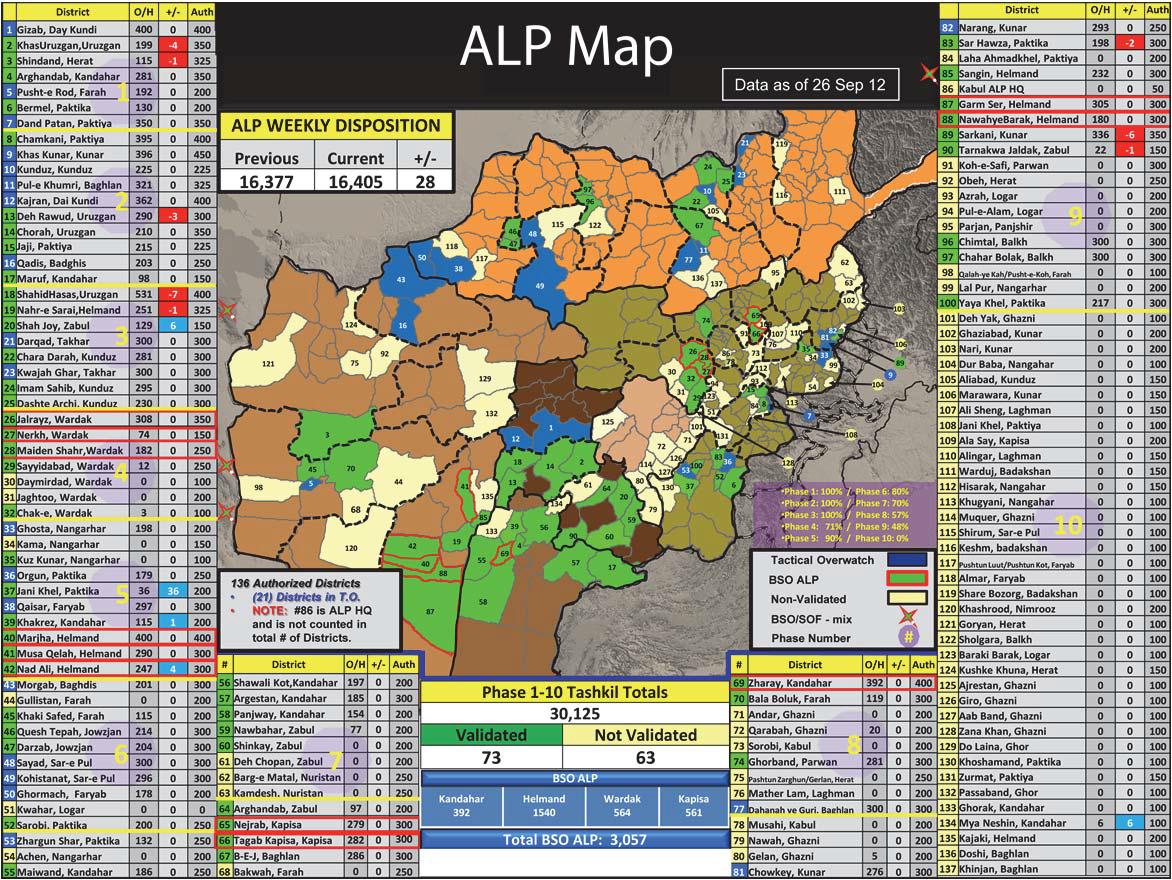
There is a larger problem with Dozier accepting Azimi’s statement at face value, though. In this post, I addressed what is known (unfortunately, September, 2012 is the latest information from this map) about Afghan Local Police presence in Wardak: Read more

Share this entry

NATO Wants US to Buy $22 Billion SOFA in Afghanistan

Both Reuters and the New York Times carry stories this morning reporting that NATO has floated the idea of extending the 352,000 Afghan National Security Force size for a number of years beyond the current plan that calls for it to fall significantly after the US completes its withdrawal. There are a number of problems with this idea. The first is that the 352,000 number bears little relation to reality at this point, since the ongoing high attrition rate for Afghan forces continued during the prolonged disruption in training due to green on blue attacks. Although ISAF continues to claim that recruiting and initial training goals to support the 352,000 level were met, the likelihood that this level of troops still exists and is integrated into ANSF is very low. (See this post for just one example of the deployment deficit at an Afghan National Border Police facility.) Second, the US bears the bulk of the budgetary load for maintaining ANSF, so extending the commitment to the increased troop level is asking for a large financial commitment from the US at a time when budget deficits are the panic du jour in Washington. Finally, because only one Afghan National Army unit now is reported to be able to function without any advisor input, a large number of US advisors is required to achieve the required ANSF force size and there is not yet a negotiated Status of Forces Agreement (SOFA) that grants immunity to US troops remaining in Afghanistan after the planned withdrawal at the end of 2014. The lack of such an agreement in Iraq resulted in our rapid withdrawal of advisors there.

Here is how the Times described the proposal:

NATO defense ministers are seriously considering a new proposal to sustain Afghanistan’s security forces at 352,000 troops through 2018, senior alliance officials said Thursday. The expensive effort is viewed as a way to help guarantee the country’s stability — and, just as much, to illustrate continued foreign support after the NATO allies end their combat mission in Afghanistan next year.

The fiscal package that NATO leaders endorsed last spring would have reduced the Afghan National Security Forces to fewer than 240,000 troops after December 2014, when the NATO mission expires. That reduction was based on planning work indicating that the larger current force level was too expensive for Afghanistan and the allies to keep up, and might not be required. Some specialists even argued that the foreign money pouring into Afghanistan to support so large a force was helping fuel rampant official corruption.

Recall that the Obama administration managed to quash the semi-annual report on “progress” in Afghanistan that was due in October until after the November elections, but once it finally came out, the New York Times reported:

As President Obama considers how quickly to withdraw the remaining 68,000 American troops in Afghanistan and turn over the war to Afghan security forces, a bleak new Pentagon report has found that only one of the Afghan National Army’s 23 brigades is able to operate independently without air or other military support from the United States and NATO partners.

So we see that there is a huge dependence on “advisors” (=US troops) who are required for there to be any semblance of function for the ANSF. And yet, as I discussed back in November, there is not yet a SOFA in place that provides full criminal immunity to US forces who are in Afghanistan posing as advisors after 2014. Is NATO floating the idea of extending the large force size myth as an enticement to Afghan officials to keep their corruption dollars coming in by approving US troop immunity in the new SOFA? Read more

Share this entry

Acknowledgement of Failure in Afghanistan Spreads Throughout US Government

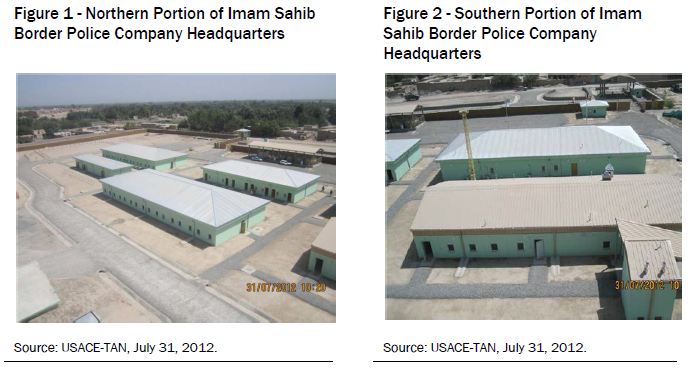
Mostly abandoned $7.3 million Border Police facility in Kunduz Province, Click on photo for a larger view.

After staying out of the headlines while the military carried out its panty-sniffing investigation of his emails, General John Allen is back in today’s Washington Post in the first of what will be many valedictories of his time as commander of US forces in Afghanistan. He is the 11th commander there since 2001, so a year seems to be about all anyone can stomach. But Allen’s reappearance comes at an inauspicious time, as two different documents released yesterday show that despite the continued “we won” attitude from Allen and his minions, many of the rest of the branches of the US government (h/t to Marcy for pointing me toward both these documents) now openly admit that we have failed there.

McClatchy’s Jonathan Landay tweeted Monday afternoon: “State Dept #Afghanistan travel warning: Afghan govt has “limited ability to maintain order and ensure security.” Did White House read this?” Following up on his tweet, the travel warning paints a bleak picture of the security situation in Afghanistan:

The Department of State warns U.S. citizens against travel to Afghanistan. The security threat to all U.S. citizens in Afghanistan remains critical.

/snip/

No region in Afghanistan should be considered immune from violence, and the potential exists throughout the country for hostile acts, either targeted or random, against U.S. and other Western nationals at any time. Remnants of the former Taliban regime and the al-Qaida terrorist network, as well as other groups hostile to International Security Assistance Force (ISAF) military operations, remain active.

The next sentence, though, is the most devastating and is what Landay referenced:

Afghan authorities have a limited ability to maintain order and ensure the security of Afghan citizens and foreign visitors.

As Landay asks, has the White House read this? After a long string of no longer operational explanations for why we are still in Afghanistan, the current line is that we must stay long enough to train and support the 352,000-strong Afghan National Security Force so that it can take responsibility for security as we withdraw. Although the Post article does note that the future for Afghanistan does not look good, when Allen is quoted, victory language returns, and it is in stark contrast to the State Department view of conditions:

With 11 days left in his tour, Allen says he’s proud of the growth of the Afghan security forces and the success of NATO’s troop surge in places such as southern Helmand, where four years ago the Taliban operated freely.

The State Department would appear to dispute that claim that the Taliban no longer operates freely in Helmand.

As if the State Department’s travel warning isn’t devastating enough to the Afghan war situation, a report released yesterday by the Special Inspector General for Afghanistan Reconstruction (SIGAR) (pdf) demonstrates that the claim that ANSF force size has achieved the 352,000 goal is a sham. The photos above depict a $7.3 million facility built by the US for Afghan Border Police in Kunduz Province. The findings of the report are devastating: Read more

Share this entry

Zero Option on Table as Karzai Comes to Washington

Afghan President Hamid Karzai is in Washington this week for a visit that culminates on Friday in a meeting with President Barack Obama and Secretary of State Hillary Clinton. He also meets with outgoing Defense Secretary Leon Panetta on Thursday. As I described in November, the US and Afghanistan are negotiating a Status of Forces Agreement that lays out the ground rules for any US troops that remain in Afghanistan beyond the planned withdrawal of combat troops by the end of 2014. As was the case with the SOFA for Iraq, the key sticking point will be whether US troops are given full criminal immunity. When Iraq refused to grant immunity, the US abruptly withdrew the forces that had been meant to stay behind.

Both the Washington Post and New York Times have prominently placed articles this morning couching the options on the number of troops to remain in Afghanistan beyond 2014 in terms of strategy for achieving US “goals” there, but the options described now include the “zero option” of leaving no troops behind after 2014. Unlike the case in negotiating the SOFA with Iraq, it appears that at least some of the folks in Washington understand this time that the US is not likely to get full immunity for its troops with Afghanistan, and so there should be some planning for that outcome. Both articles openly discuss the real possibility of a zero option with no troops remaining in the country, although the Times actually suggests full withdrawal in the article’s title (“U.S. Is Open to Withdraw Afghan Force After 2014”) and the Post hangs onto hope of several thousand troops remaining with its title (“Some in administration push for only a few thousand U.S. troops in Afghanistan after 2014”).

After describing the possibility of a zero option, the Times article then suggests that it is merely a negotiating tool to be used on Karzai, failing to note anywhere in the article that the zero option would be driven by Afghanistan refusing to confer immunity:

While President Obama has made no secret of his desire to withdraw American troops as rapidly as possible, the plans for a postwar American presence in Afghanistan have generally envisioned a residual force of thousands of troops to carry out counterterrorism operations and to help train and equip Afghan soldiers.

In a conference call with reporters, the deputy national security adviser, Benjamin J. Rhodes, said that leaving no troops “would be an option that we would consider,” adding that “the president does not view these negotiations as having a goal of keeping U.S. troops in Afghanistan.”

Military analysts have said it is difficult to conceive of how the United States might achieve even its limited post-2014 goals in Afghanistan without any kind of troop presence. That suggests the White House is staking out a negotiating position with both the Pentagon and with Mr. Karzai, as he and Mr. Obama begin to work out an agreement covering the post-2014 American role in Afghanistan.

That oblique reference to an “agreement covering the post-2014 American role in Afghanistan” is as close as the Times article gets to describing the SOFA as the true determinant of whether US troops remain past 2014. At least the Post understands this point and that it hinges on immunity: Read more

Share this entry

Military Slowly Gaining Perspective on Insider Attacks in Afghanistan

Citing a “former American official”, the New York Times today dubbed insider, or green on blue, attacks as “the signature violence of 2012” as it provided information directly from an Afghan soldier who turned his gun on US troops on May 11 of this year in Kunar province, killing one US soldier and wounding two as the US soldiers were visiting the Afghan post where Mahmood, the attacker, was stationed.

The Times points out that despite the Taliban’s claims that they have many infiltrators within Afghan forces, in the case of Mahmood, he took the initiative in approaching the Taliban once he decided that he wished to carry out an attack. It appears that local opinions where he was stationed played a role in shaping his decision:

But until May, he worked and fought alongside foreigners without incident. The change came in the Ghaziabad District of Kunar, where he ended up after the start of 2012, he said.

The area is thick with Taliban, along with Islamists from Pakistan. Many residents sympathized with the insurgents and often complained to Afghan soldiers about the abuses committed by Americans and the failure of Afghan soldiers to control much of anything beyond the perimeter of their own outpost, Mr. Mahmood said. The Taliban, they glorified.

Listening to villagers, Mr. Mahmood became convinced that the foreigners had killed too many Afghans and insulted the Prophet Muhammad too many times. He wanted to be driving them out, not helping them stay. The villagers’ stories “strengthened my desire to kill Americans with my own fingers,” he said.

The article provides hope that the military is finally gaining a real perspective on the issues highlighted in the seminal report “A Crisis of Trust and Cultural Incompatibility” (pdf), which the military first retroactively classified and then embraced as it raced to respond to the growing crisis of insider attacks by preparing “training materials” implementing (in a very crude way) some of the recommendations from the report. But it now appears that the military is stumbling its way toward a deeper understanding of how cultural flashpoints are symptomatic the larger problem that the US simply is not welcome in Afghanistan:

But behind it all, many senior coalition and Afghan officials are now concluding that after nearly 12 years of war, the view of foreigners held by many Afghans has come to mirror that of the Taliban. Hope has turned into hatred, and some will find a reason to act on those feelings. Read more

Share this entry

UK to Double Drone Fleet, Move Control From Nevada to England

While David Petraeus continues stewing over whether his request to expand the CIA’s fleet of drones will be honored, The Guardian announced yesterday that the UK will double its drone fleet and move control of its drones from Nevada to England.

It will come as a surprise to most that the UK already has a fleet of five drones. They are operated out of Creech Air Force Base in Nevada. From the article in The Guardian:

The UK’s existing five Reaper drones, which are used to target suspected insurgents in Helmand, have been operated from Creech air force base in Nevada because Britain has not had the capability to fly them from here.

/snip/

The most recent figures from the Ministry of Defence show that, by the end of September, the UK’s five Reapers in Afghanistan had flown 39,628 hours and fired 334 laser-guided Hellfire missiles and bombs at suspected insurgents.

The blog Drone Wars UK has collected the public reports it could find of the missiles fired by the UK’s fleet of drones. Skimming the list of entries, it appears that so far, the bulk of UK drone strikes have been aimed at presumed insurgents in the process of engaging with coalition troops in Afghanistan.

For information on how these attacks have turned out, we go back to The Guardian:

The MoD insists only four Afghan civilians have been killed in its strikes since 2008 and says it does everything it can to minimise civilian casualties, including aborting missions at the last moment.

However, it also says it has no idea how many insurgents have died because of the “immense difficulty and risks” of verifying who has been hit.

It would seem that in learning from the US how to operate drones, the UK also has learned from the US how to declare with certainty that exceedingly few civilians have been killed, but at the same time admit that it’s just too darned difficult to count all those bad guys we splat. The public is asked to simultaneously trust the military that civilians aren’t killed but we must accept that verifying just who has been killed is not possible.

It seems that the UK has built its own video game room drone control facility:

Pilots based at RAF Waddington in Lincolnshire will fly the recently bought American-made UAVs at a hi-tech hub built on the site in the past 18 months.

The most recent post currently at Drone Wars UK has conveniently provided a map for the location of this facility, presumably to aid protesters who may wish to be there on Friday when the new RAF squadron (“XIII”) is officially commissioned.

With a fleet of ten drones and the ability to control them anywhere in the world from the facility in Lincolnshire, how long will it take for mission creep to set in? After all, NATO says that it will have withdrawn from Afghanistan by the end of 2014. Where will these drones go then? As the article in The Guardian points out, there are not many areas within the UK where drones can be allowed to fly under current regulations. The allure of developing their own “hit list” must be overwhelming to the folks at 10 Downing Street about now.

Oh, and one last thought. The next James Bond film is set to release in about two and a half weeks. It’s title? That would be “Skyfall“. That is most likely just a coincidence, but seems entirely fitting as further advertisement of the fact that the UK is now announcing its drone capability and independence.

Share this entry

How NATO Will Game the Numbers on Afghan National Security Force Size

Last month, when the combination of rising green on blue killings and anger over the anti-Islam film finally shut down most joint operations between NATO and Afghan forces, I predicted that this would lead quickly to Afghan National Security Forces falling below the level of 350,000 that NATO has stated to be the goal when security responsibility for the country shifts to Afghan control as NATO withdraws. The prediction was based on already knowing that Afghan forces suffer from huge attrition losses and knowing that the most important aspect of training for Afghan troops occurs during joint patrols that are carried out at the platoon level where only a handful of troops from each side are present. The shutdown of joint operations was for everything below the battalion level, so it seemed to me that with the most important level of training ended, ongoing attrition would decimate the force size.

While reading today’s New York Times article in which the Times has finally realized what a huge problem the high attrition rate poses, I finally deciphered how NATO will be gaming the numbers on ANSF size in order to claim that the original plan for withdrawal can be followed without significant changes. The Times tells us:

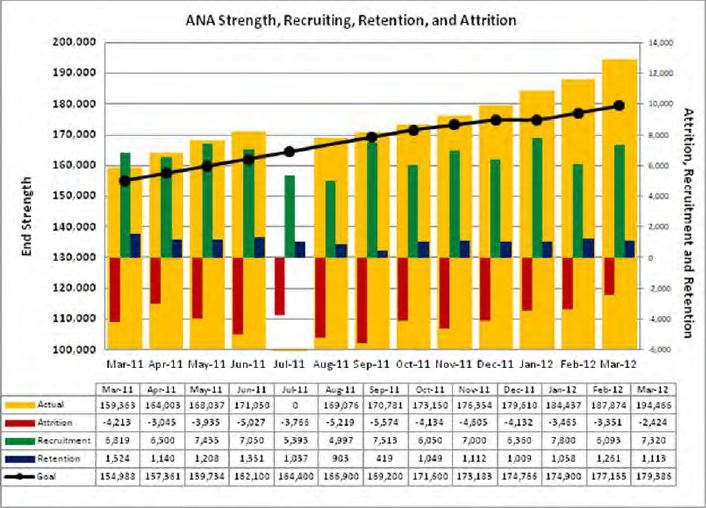
Now at its biggest size yet, 195,000 soldiers, the Afghan Army is so plagued with desertions and low re-enlistment rates that it has to replace a third of its entire force every year, officials say.

The attrition strikes at the core of America’s exit strategy in Afghanistan: to build an Afghan National Army that can take over the war and allow the United States and NATO forces to withdraw by the end of 2014. The urgency of that deadline has only grown as the pace of the troop pullout has become an issue in the American presidential campaign.

The reality is that although NATO has set a goal for ANSF size to allow withdrawal, it has completely given up on the idea of those Afghan forces being fully functional. My error when I predicted that cessation (now followed by a resumption that Panetta claims is “nearly normal”) of joint patrols would reduce force size was to think that ANSF size would be at all affected by a decreased level of training and experience gained on joint patrol.

NATO will continue to claim that ANSF size is at the goal for withdrawal because, as we see in the Times article, recruitment will continue at the rate needed to make up for the high attrition rate. Recruitment is all that matters for maintaining force size, as the Times noted:

Colonel Stanikzai, a senior official at the army’s National Recruiting Center, is on the front line of that effort; in the six months through September, he and his team of 17 interviewers have rejected 962 applicants, he said.

“There are drug traffickers who want to use our units for their business, enemy infiltrators who want to raise problems, jailbirds who can’t find any other job,” he said. During the same period, however, 30,000 applicants were approved.

“Recruitment, it’s like a machine,” he said. “If you stopped, it would collapse.” Read more

Share this entry

Despite Military’s Rosy Spin, Truth Coming From Afghanistan Highlights Civilian Casualties, Coming Political Meltdown

Even though ISAF continues its political spin claiming that the military’s strategy leading to Afghanistan assuming full control of security in 2014 is progressing as planned, new information from two independent sources indicates that the situation is far more bleak than the military’s claims.

The nonpartisan NGO International Crisis Group has released a new report (pdf) today and it predicts that a complete meltdown of the government of Afghanistan could occur in conjunction with the upcoming elections.

From the press release on the report:

Afghanistan is hurtling toward a devastating political crisis as the government prepares to take full control of security in 2014.

“There is a real risk that the regime in Kabul could collapse upon NATO’s withdrawal in 2014”, says Candace Rondeaux, the International Crisis Group’s Senior Afghanistan Analyst. “The window for remedial action is closing fast”.

/snip/

The Afghan army and police are overwhelmed and underprepared for the transition”, says Rondeaux. “Another botched election and resultant unrest would push them to breaking point”.

[Emphasis added.]

Wow. Afghan security forces being described as “overwhelmed and underprepared” is so far away from the glory days of David Petreaus’ vaunted COIN strategy that had training of ANSF as a key component. But don’t look for Petreaus’ role in this clusterfuck to be pointed out by anyone inside the Beltway.

Moving to the report itself, this section on the security situation for civilians and the government is particularly damning:

The situation worsened considerably in the wake of the September 2010 polls, which saw violence hit an all-time high on election day. Security further deteriorated shortly after President Karzai announced plans to begin transferring responsibility for it in several parts of the country from NATO to the government by July 2011. The downward trend continued almost unabated through much of 2011 and early 2012. Following an unusually severe winter that saw record snowfalls and lasted well into late March 2012, civilian casualties dropped by nearly 15 per cent to 1,154 killed and 1,954 injured in the first half of the year. This trend saw a marked reverse over the summer months, with UNAMA noting that August 2012 was the second deadliest month on record: 374 civilians killed and 581 injured.

Statistics demonstrate a notable increase overall in targeted killings of civilians and government officials, from 94 during January-June 2009 to 255 for the same six-month period in 2012. More than a dozen members of parliament have been killed since the first elections in 2005, and eleven candidates were killed during the 2010 campaign. Scores of midlevel government officials have recently been assassinated, as insurgents have ramped up such operations. Likewise, Afghans who work for non-governmental organisations and development agencies are regularly targeted, and intimidation campaigns frequently force them to live outside their home villages. The Taliban’s use of targeted killings and threats has been especially effective most recently in the northeastern provinces of Nuristan and Kunar, where cross-border shelling between Pakistan and Afghanistan has additionally plagued an already exposed population. As the 2014 campaign approaches and political competition heats up, targeted killings are likely to increase, a phenomenon witnessed repeatedly since 2003.

It has become increasingly clear that ISAF is unable to dislodge the Taliban from its strongholds in the south and east. A widening trust deficit between NATO and Afghan forces has also put ISAF further on the defensive. The Taliban, the Haqqani network and other affiliated insurgent actors have exploited these weaknesses by sending fighters into particularly vulnerable areas such as Kunar, Nuristan, Paktika, Paktia, Ghazni, Wardak and Logar.

[Emphasis added.]

Will the military dare to respond to the charge that “It has become increasingly clear that ISAF is unable to dislodge the Taliban from its strongholds in the south and east”? Read more

Share this entry

Confusion Rules in Afghanistan

Still steadfastly refusing to admit publicly that its Afghanistan strategy has failed completely and that a new, more rapid timetable for withdrawal must be developed before the November election, the Obama administration and its Department of Defense are reduced to utter confusion in trying to understand the sources of attacks on coalition forces. After halting most joint US-Afghan operations in the middle of September, Defense Secretary Leon Panetta led efforts last Thursday to claim that joint operations had returned to “nearly normal” levels while claiming that each joint operation would be evaluated carefully to reduce risks. It took less than two days for that evaluation process to be shown to be useless, as two Americans and three Afghan troops were killed in an exchange of gunfire while out on joint patrol.

The investigation into this event stands as a microcosm of the confused state of affairs in Afghanistan as the US struggles to understand that resistance to the presence of US forces now spreads through virtually all of Afghanistan and that uniforms for Afghan security forces are a tool for getting close to US targets. The military first announced Saturday’s attack as a green on blue killing and then backed off, claiming for a while that perhaps insurgents who were not a part of the joint patrol fired first and that US forces fired on the Afghan forces out of confusion. Yesterday, the Washington Post published details from a leaked report that suggests that it was indeed a member of the Afghan National Army platoon in the joint patrol who first opened fire and that he was quickly joined by other members of his patrol. Despite all of the accumulating evidence that Aghans resent our presence in the country, defense officials express surprise and confusion that multiple members of an Afghan patrol could all turn their weapons on US forces:

Two days after the U.S. military resumed joint operations with Afghan security forces last week following a spate of “insider attacks,” a platoon of American soldiers stopped at an Afghan army checkpoint in a volatile eastern province.

The Americans had a cordial conversation and cracked a few jokes with their Afghan comrades during the Saturday afternoon patrol in Wardak province. The Afghans offered the Americans tea. Then, according to a U.S. military official, an Afghan soldier, without warning or provocation, raised his weapon and opened fire — mortally wounding the senior American on the patrol.

In a war in which insider attacks have become commonplace, what happened next made the incident extraordinary, the American official said. Another Afghan soldier at the checkpoint opened fire on the Americans, killing a U.S. civilian contractor and wounding two other American soldiers. Soon, Afghan soldiers and possibly insurgents began firing at the Americans from several directions.

/snip/

A preliminary military report, however, has concluded that the gunfight began only after an Afghan soldier opened fire on U.S. troops, according to the American official, who spoke on the condition of anonymity.

“What sets this apart is that there were multiple attackers from multiple positions and there was zero provocation,” said the official, who had access to the report but was not authorized to speak for the record. Read more

Share this entry

NATO Figures: Green on Green Death Rate Exceeds Green on Blue. What About Blue on Blue?

The skyrocketing rate of green on blue attacks, where Afghan security forces turn their weapons on NATO troops, is forcing such desperate measures that NATO has given orders for all coalition troops to remain armed at all times, even when “inside the wire” on US bases, and General John Allen went so far yesterday as to suggest that Ramadan fasting may have contributed to the latest uptick in these attacks. We learn today from the New York Times that NATO has released figures for green on green attacks, where Afghan troops kill one another. The green on green killings exceed the green on blue figures.  Recent history tells us, however, that even if NATO releases the final set of data to complete the full picture on inside the wire deaths (the depressingly high suicide rate, which exceeds the combat death rate, is known) and gives us data on blue on blue deaths (more commonly referred to in the US press as “friendly fire” deaths), those numbers are likely to be so low as to lead to speculation that the real rate is being hidden.

The Times story on green on green deaths begins in a straightforward way:

Even as attacks by Afghan security forces on NATO troops have become an increasing source of tension, new NATO data shows another sign of vulnerability for the training mission: even greater numbers of the Afghan police and military forces have killed each other this year.

So far, Afghan soldiers or police officers have killed 53 of their comrades and wounded at least 22 others in 35 separate attacks this year, according to NATO data provided to The New York Times by officials in Kabul. By comparison, at least 40 NATO service members were reported killed by Afghan security forces or others working with them.

NATO displays a remarkable bit of ironic cluelessness when they describe to the Times how they think these killings come about. After first mentioning Taliban coercion of new recruits in the Afghan forces, NATO then moves on to describe the same sorts of cultural clashes among Afghan recruits that have been described as underlying green on blue attacks in a report that the US chose to retroactively classify. NATO has steadfastly refused to acknowledge the cultural clashes that underlie green on blue attacks but is now rolling them out to describe green on green:

Further, there are concerns about cultural clashes within the rapidly expanding Afghan forces themselves, Afghan and NATO officials say, raising questions about their ability to weather the country’s deep factional differences after the NATO troop withdrawal in 2014.

“Three decades of war can play a pivotal role in the internal causes,” said Maj. Bashir Ishaqzia, commander of the Afghan National Police recruitment center in Nangarhar Province. He said one of the biggest challenges for the army and police forces was a lasting “culture of intolerance among Afghans, as well as old family, tribal, ethnic, factional, lingual and personal disputes.”

Compare the “culture of intolerance” with this bit from the executive summary of the retroactively classified report, titled “A Crisis of Trust and Cultural Incompatibility” (pdf): Read more

Share this entry