Jon Kyl Justifies Military Detention by Claiming CIA-Military Credit for FBI Interrogations

In the entire two week debate over the detainee provisions of the Defense Authorization, the champions of military detention offered almost no rationale for it (a pity, then, that the opponents barely explained why it’s such a bad idea), aside from Lindsey Graham repeating endlessly that detainees shouldn’t get lawyers (he never explained how this claim jived with his promise that every detainee would have access to habeas corpus).

One exception is a statement that Jon Kyl submitted to the record but did not read (the statement starts on PDF 5). After reasserting the legality of the detainee provisions under Hamdi, Kyl’s (was it Kyl’s?) statement offered an “explanation” for military detention; I’ve reproduced that part of the statement in full below the line.

Now, the statement doesn’t make any sense. It invokes what it claims were CIA interrogations and treats them as military interrogation; though in fact a number of the interrogations the statement invokes were FBI interrogations.

The statement claims detainees wouldn’t have a lawyer, though the architects of the bill have made it clear (as has SCOTUS) detainees would have access to habeas corpus and therefore (presumably) lawyers.

Perhaps not surprising, the statement also invokes two discredited pieces of propaganda: Vice Admiral Lowell Jacoby’s January 9, 2003 Declaration in opposition to granting Jose Padilla habeas corpus and George Bush’s September 6, 2006 speech announcing he was moving 14 high value detainees to Gitmo.

It relies on Jacoby’s statement to argue for the value of a “relationship of dependency,” which seems to no more than a rebranding of Bruce Jessen’s “learned helplessness.” And note, Jacoby’s statement, written six months after DOD took custody of Padilla, spoke of intelligence he might offer prospectively; it doesn’t claim to have gotten any intelligence using this “relationship of dependency.”

And it relies on Bush’s statement to claim that military or CIA interrogations exposed that KSM was Mukhtar and Jose Padilla’s plans, both of which came from Ali Soufan’s FBI interrogation of Zubaydah. It also claims the CIA interrogations yielded Ramzi bin al-Shibh’s location, whereas Soufan, at least, claims that came from an FBI interrogation in Bagram. And it claims CIA’s interrogation of KSM revealed the Liberty Towers plot that had been broken up a year earlier. In other words, Kyl’s argument for why we need military detention consists of repeating discredited propaganda claiming CIA credit for interrogations largely conducted by the FBI. The same FBI officers who will lose their ability to interrogate detainees if and when this bill goes into place.

In short, one of the most comprehensive arguments for why we need military detention instead makes the case for retaining FBI primacy. At the same time, it appears to endorse the “learned helplessness” that ended up making delaying any value to KSM and other detainee interrogations.

Even the champions of military detention offer proof that we’re safer with civilian detention.

What follows is the statement Kyl submitted to the record.


Wahy Military Detention Is Necessary: To Allow Intelligence Gathering That Will Prevent Future Terrorist Attacks Against the American People

Some may ask, why does it matter whether a person who has joined Al Qaeda is held in military custody or is placed in the civilian court system? One critical reason is intelligence gathering. A terrorist operative held in military custody can be effectively interrogated. In the civilian system, however, that same terrorist would be given a lawyer, and the first thing that lawyer will tell his client is, “don’t say anything. We can fight this.”

In military custody, by contrast, not only are there no lawyers for terrorists. The indefinite nature of the detention–it can last as long as the war continues–itself creates conditions that allow effective interrogation. It creates the relationship of dependency and trust that experienced interrogators have made clear is critical to persuading terrorist detainees to talk.

Navy Vice-Admiral Lowell Jacoby, who at the time was the Director of the Defense Intelligence Agency, explained how military custody is critical to effective interrogation in a declaration that he submitted in the Padilla litigation. He emphasized that successful noncoercive interrogation takes time–and it requires keeping the detainee away from lawyers.

Vice-Admiral Jacoby stated:

DIA’s approach to interrogation is largely dependent upon creating an atmosphere of dependency and trust between the subject and the interrogator. Developing the kind of relationship of trust and dependency necessary for effective interrogations is a process that can take a significant amount of time. There are numerous examples of situations where interrogators have been unable to obtain valuable intelligence from a subject until months, or, even years, after the interrogation process began.

Anything that threatens the perceived dependency and trust between the subject and interrogator directly threatens the value of interrogation as an intelligence gathering tool. Even seemingly minor interruptions can have profound psychological impacts on the delicate subject/interrogator relationship. Any insertion of counsel into the subject-interrogator relationship, for example–even if only for a limited duration or for a specific purpose–can undo months of work and may permanently shut down the interrogation process.

Specifically with regard to Jose Padilla, Vice Admiral Jacoby also noted in his Declaration that: “Providing [Padilla] access to counsel now would create expectations by Padilla that his ultimate release may be obtained through an adversarial civil litigation process. This would break–probably irreparably–the sense of dependency and trust that the interrogators are attempting to create.”

In other words, military custody is critical to successful interrogation. Once a terrorist detainee is transferred to the civilian court system, the conditions for successful interrogation are destroyed.

Preventing the detention of U.S. citizens who collaborate with Al Qaeda would be a historic abandonment of the law of war. And, by preventing effective interrogation of these collaborators, it would likely have severe consequences for our ability to prevent future terrorist attacks against the American people.

We know from cold, hard experience that successful interrogation is critical to uncovering information that will prevent future attacks against civilians.

On September 6 of 2006, when President Bush announced the transfer of 14 high-value terrorism detainees to Guantanamo, he also described information that the United States had obtained by interrogating these detainees. Abu Zubaydah was captured by U.S. forces several months after the September 11 attacks. Under interrogation, he revealed that Khalid Sheikh Mohammed was the principal organizer of the September 11 attacks. This is information that the United States did not already know–and that we only obtained through the successful military interrogation of Zubaydah.

Zubaydah also described a terrorist attack that Al Qaida operatives were planning to launch inside this country–an attack of which the United States had no previous knowledge. Zubaydah described the operatives involved in this attack and where they were located. This information allowed the United States to capture these operatives–one while he was traveling to the United States.

Again, just imagine what might have happened if the Feinstein amendment had already been law, and if the Congress had stripped away the executive branch’s ability to hold Al Qaeda collaborators in military custody and interrogate them. We simply would not learn what that detainee knows–including any knowledge that he may have of planned future terrorist attacks.

Under military interrogation, Abu Zubaydah also revealed the identity of another September 11 plotter, Ramzi bin al Shibh, and provided information that led to his capture. U.S. forces then interrogated bin al Shibh. Information that both he and Zubaydah provided helped lead to the capture of Khalid Sheikh Mohammed.

Under interrogation, Khalid Sheikh Mohammed provided information that helped stop another planned terrorist attack on the United States. K.S.M. also provided information that led to the capture of a terrorist named Zubair. And K.S.M.’s interrogation also led to the identification and capture of an entire 17-member Jemaah Islamiya terrorist cell in Southeast Asia.

Information obtained from interrogation of terrorists detained by the United States also helped to stop a planned truck-bomb attack on U.S. troops in Djibouti. Interrogation helped stop a planned car-bomb attack on the U.S. embassy in Pakistan. And it helped stop a plot to hijack passengers planes and crash them into Heathrow airport in London.

As President Bush stated in his September 6, 2006 remarks, “[i]nformation from terrorists in CIA custody has played a role in the capture or questioning of nearly every senior al Qaida member or associate detained by the U.S. and its allies.” The President concluded by noting that Al Qaida members subjected to interrogation by U.S. forces: “have painted a picture of al Qaeda’s structure and financing, and communications and logistics. They identified al Qaeda’s travel routes and safe havens, and explained how al Qaeda’s senior leadership communicates with its operatives in places like Iraq. They provided information that ….. has allowed us to make sense of documents and computer records that we have seized in terrorist raids. They’ve identified voices in recordings of intercepted calls, and helped us understand the meaning of potentially critical terrorist communications.

[Were it not for information obtained through interrogation], our intelligence community believes that al Qaeda and its allies would have succeeded in launching another attack against the American homeland. By giving us information about terrorist plans we could not get anywhere else, this [interrogation] program has saved innocent lives.”

If the Feinstein amendment were adopted, this is all information that we would be unable to obtain if the Al Qaeda collaborator that our forces had captured was a U.S. citizen. It would simply be impossible to effectively interrogate that Al Qaeda collaborator–the relationship of trust and dependency that military custody creates would be broken, and the detainee would instead have a lawyer telling him to be quiet. And we know that information obtained by interrogating Al Qaeda detainees has been by far the most valuable source of information for preventing future terrorist attacks.

Again, in every past war, our forces have had the ability to capture, detain, and interrogate U.S. citizens who collaborate with the enemy or join forces with the enemy. I would submit that in this war, intelligence gathering is more critical than ever. Al Qaeda doesn’t hold territory that we can capture. It operates completely outside the rules of war, and directly targets innocent civilians. Our only effective weapon against Al Qaeda is intelligence gathering. And the Feinstein amendment threatens to take away that weapon–to take away our best defense for preventing future terrorist attacks against the American people. [my emphasis]
Share this entry

Eric Holder, Indefinitely Detained by DOD?

The most shocking phrase in the Senate’s Defense Authorization detainee provisions to me was not the language affirming indefinite detention. That language simply affirms and possibly narrows the status quo. Rather, it was this language purporting to strike a “balance” between military and civilian detention for alleged terrorists by offering the Secretary of Defense the option of waiving military custody for terrorist detainees.

The Secretary of Defense may, in consultation with the Secretary of State and the Director of National Intelligence, waive the requirement of paragraph (1) [mandating military custody of terrorism detainees] if the Secretary submits to Congress a certification in writing that such a waiver is in the national security interests of the United States.

The presumption of military detention is bad enough. But to codify that the Defense Secretary would not even consult with DOJ on this front was shocking. After all, there is no reason any of these people–Defense Secretary, DNI, or Secretary of State–would know about a terrorist suspect captured in the US. They certainly wouldn’t know the investigation and prosecution strategies. Yet, the language passed last Thursday would not only allow the Defense Secretary to bypass DOJ as a default, but wouldn’t even require the Defense Secretary to ask whether it’s a good idea to move a suspect into DOD custody.

It effectively makes civilian prosecutors supplicants to the military bureaucracy to be allowed to do their work. And it’s particularly troubling given all the Bush-era instances in which FBI’s experts on al Qaeda were prevented from using that expertise to question detainees so Cheney’s torturers could torture them instead.

And the language in the Senate bill is actually more restrictive than the equivalent language in the House equivalent, which simply gives the Secretary of Defense input on civilian prosecution decisions.

SEC. 1042. REQUIREMENT FOR DEPARTMENT OF JUSTICE CONSULTATION REGARDING PROSECUTION OF TERRORISTS.

(a) IN GENERAL.—Before any officer or employee of the Department of Justice institutes any prosecution of an alien in a United States district court for a terrorist offense, the Attorney General, Deputy Attorney General, or Assistant Attorney General for the Criminal Division, shall consult with the Director of National Intelligence and the Secretary of Defense about—

(1) whether the prosecution should take place in a United States district court or before a military commission under chapter 47A of title 10, United States Code; and

(2) whether the individual should be transferred into military custody for purposes of intelligence interviews.

Whereas in May, crazy House Republicans wanted to give the Secretary of Defense veto power over civilian prosecutions, on Thursday the Senate voted to take the Attorney General out of discussions over whether civilian prosecutions are better than military detention altogether.

And yet, of all the Administration complaints about these provisions–John Brennan, David Petraeus, James Clapper, Leon Panetta–Robert Mueller is the only one who spoke from DOJ [Update: National Security Division head Lisa Monaco spoke at the ABA National Security conference]. Unless I missed it, Eric Holder didn’t issue a statement. And it was only after the bill passed the Senate that some anonymous DOJ official released a comprehensive explanation of why this is such a bad idea Read more

Share this entry

Oklahoma Attorney General Scott Pruitt Advocates Extending PATRIOT Act to Domestic Terrorists

I watched last night’s Huckabee Presidential forum between thrilling plays in the Big 10.2 Championship game. Since each candidate appeared by him or herself, it lacked the entertaining in-fighting of other episodes of this reality show. But it was fascinating because some rising stars in the Republican Party–three far right Attorneys General, OK’s Scott Pruitt, VA’s Ken Cuccinelli, and FL’s Pam Bondi–served as co-moderators. As such, I think the forum provided some indication of where the leading edge of Republican crazy is.

Which is troubling, because in a question directed to Congressman Ron Paul, Pruitt endorsed applying the PATRIOT Act to purely domestic terrorists. [Update: bob johnson, who is from OK, says this wasn’t an endorsement. A pity, then, that Pruitt not only extended the discussion of PATRIOT to domestic grounds but also set up Bondi for more fearmongering.] After raising the specter of Tim McVeigh’s attack on the Murrah Federal Building, Pruitt asked,

Pruitt: What thoughtful alternative do you have to the PATRIOT Act to prevent acts of domestic terrorism in the future?

Paul provided the same kind of answer he has provided when he has gotten asked similar questions in the context of foreign terrorism in other debates, noting that the PATRIOT Act should have been called the repeal of the Fourth Amendment. To which Priutt doubled down:

So Congressman, you don’t believe that there needs to be a comprehensive law at the federal level equipping law enforcement to prevent domestic terrorism in this country?

Now, as I said, Paul gets asked a similar question at just about every debate. The authoritarian streak of today’s GOP party likes to call out Paul’s libertarianism so as to mock it as outside acceptable bounds of GOP ideology (usually just before everyone applauds torture).

Which is why I find it so troubling that Pruitt did so with regards to domestic terrorism.

Read more

Share this entry

Why the Iraq AUMF Still Matters

The big headline that came out of yesterday’s American Bar Association National Security panels is that DOD General Counsel Jeh Johnson and CIA General Counsel Stephen Preston warned that US citizens could be targeted as military targets if the Executive Branch deemed them to be enemies.

U.S. citizens are legitimate military targets when they take up arms with al-Qaida, top national security lawyers in the Obama administration said Thursday.

[snip]

Johnson said only the executive branch, not the courts, is equipped to make military battlefield targeting decisions about who qualifies as an enemy.

We knew that. Still, it’s useful to have the Constitutional Lawyer President’s top aides reconfirm that’s how they function.

But I want to point to a few other data points from yesterday’s panels (thanks to Daphne Eviatar for her great live-tweeting).

First, Johnson also said (in the context of discussions on cyberspace, I think),

Jeh Johnson: interrupting the enemy’s ability to communicate is a traditionally military activity.

Sure, it is not news that the government (or its British allies) have hacked terrorist “communications,” as when they replaced the AQAP propaganda website, “Insight,” with a cupcake recipe (never mind whether it’s effective to delay the publication of something like this for just one week).

But note what formula Johnson is using: they’ve justified blocking speech by calling it the communication of the enemy. And then apparently using Jack Goldsmith’s formulation, they have said the AUMF gives them war powers that trump existing domestic law, interrupting enemy communications is a traditional war power, and therefore the government can block the communications of anyone under one of our active AUMFs.

Johnson also scoffed at the distinction between the battlefield and the non-battlefield.

Jeh Johnson: the limits of “battlefield v. Non battlefield is a distinction that is growing stale.” But then, it’s not a global war. ?

Again, this kind of argument gets used in OLC opinions to authorize the government targeting “enemies” in our own country. On the question of “interrupting enemy communication,” for example, it would seem to rationalize shutting down US based servers.

Then, later in the day Marty Lederman (who of course has written OLC opinions broadly interpreting AUMF authorities based on the earlier Jack Goldsmith ones) acknowledged that Americans aren’t even allowed to know everyone the US considers an enemy.

Lederman: b/c of classification, “we’re in armed conflicts with some groups the American public doesn’t know we’re in armed conflict with.”

Now, as I’ve noted, one of the innovations with the Defense Authorization passed yesterday is a requirement that the Executive Branch actually brief Congress on who we’re at war with, which I take to suggest that Congress doesn’t yet necessarily know everyone who we’re in “armed conflict” with.

Which brings us to how Jack Goldsmith defined the “terrorists” whom the government could wiretap without a warrant.

the authority to intercept the content of international communications “for which, based on the factual and practical considerations of everyday life on which reasonable and prudent persons act, there are reasonable grounds to believe … [that] a party to such communication is a group engaged in international terrorism, or activities in preparation therefor, or any agent of such a group,” as long as that group is al Qaeda, an affiliate of al Qaeda or another international terrorist group that the President has determined both (a) is in armed conflict with the United States and (b) poses a threat of hostile actions within the United States;

It’s possible the definition of our enemy has expanded still further since the time Goldsmith wrote this in 2004. Note Mark Udall’s ominous invocation of “Any other statutory or constitutional authority for use of military force” that the Administration might use to authorize detaining someone. But we know that, at a minimum, the Executive Branch used the invocations of terrorists in the Iraq AUMF–which are much more generalized than the already vague definition of terrorist in the 9/11 AUMF–to say the President could use war powers against people he calls terrorists who have nothing to do with 9/11 or al Qaeda.

So consider what this legal house of cards is built on. Largely because the Bush Administration sent Ibn Sheikh al-Libi to our Egyptian allies to torture, it got to include terrorism language in an AUMF against a country that had no tie to terrorism. It then used that language on terrorism to justify ignoring domestic laws like FISA. Given Lederman’s language, we can assume the Administration is still using the Iraq AUMF in the same way Goldsmith did. And yet, in spite of the fact that the war is ending, we refuse to repeal the AUMF used to authorize this big power grab.

Share this entry

Bachmann Was Almost Right: The ACLU Is in Cahoots with the CIA

As I have puzzled over the civil liberties and human rights communities’ stance on the NDAA Detainee Provisions, I’ve come to the unfortunate conclusion that Michelle Bachmann was not far off when she claimed, “Barack Obama … has essentially handed over our interrogation of terrorists to the ACLU. He has outsourced it to them.”

After all, in the guise of “fixing” some of what I agree are problems with the Detainee Provisions–the laws regarding detention and interrogation of detainees–the ACLU is telling its members to lobby for the Udall Amendment to the NDAA.

But there is a way to stop this dangerous legislation. Sen. Mark Udall (D-Colo.) is offering the Udall Amendment that will delete the harmful provisions and replace them with a requirement for an orderly Congressional review of detention power. The Udall Amendment will make sure that the bill matches up with American values.

In support of this harmful bill, Sen. Lindsey Graham (R-S.C.) explained that the bill will “basically say in law for the first time that the homeland is part of the battlefield” and people can be imprisoned without charge or trial “American citizen or not.” Another supporter, Sen. Kelly Ayotte (R-N.H.) also declared that the bill is needed because “America is part of the battlefield.”

The solution is the Udall Amendment; a way for the Senate to say no to indefinite detention without charge or trial anywhere in the world where any president decides to use the military. Instead of simply going along with a bill that was drafted in secret and is being jammed through the Senate, the Udall Amendment deletes the provisions and sets up an orderly review of detention power. It tries to take the politics out and put American values back in.

As a threshold matter, the ACLU’s  support of the Udall Amendment appears to put them on the same side of the debate as–among others–former CIA exec John Brennan and the former Director of the CIA, Leon Panetta. (Current CIA Director and outspoken detention authority while still at DOD, General David Petraeus, has been eerily quiet over the last several weeks.)

And I do agree with the ACLU that the Udall Amendment sets up an orderly review of detention power.

But, as I’ve noted, there’s one aspect of the Detainee Provisions that Udall doesn’t leave for orderly review: the scope of the language describing a “covered person.” Instead, Udall’s Amendment says covered people should be those “whose detention … is consistent with the laws of war and based on authority provided by” the 9/11 and Iraq AUMFs, as well as “any other statutory or constitutional authority.”

(b) Covered Persons.–A covered person under this section is any person, other than a member of the Armed Forces of the United States, whose detention or prosecution by the Armed Forces of the United States is consistent with the laws of war and based on authority provided by any of the following:

(1) The Authorization for Use of Military Force (Public Law 107-40).

(2) The Authorization for Use of Military Force Against Iraq Resolution 2002 (Public Law 107-243).

(3) Any other statutory or constitutional authority for use of military force.

Udall pretty much unilaterally reasserts the application of the AUMFs (plural) and other vaguely defined legal bases to detention (and, because that’s how OLC has built up Executive Power over the last decade, a bunch of other things), in an effort to defeat SASC’s language that limits such detention authority to those tied directly to 9/11 or “who [were] part of or substantially supported al-Qaeda, the Taliban, or associated forces.” Udall’s Amendment may give SSCI and SJC another shot at this law, but it dictates that detention authority apply to a far broader group of people than the SASC language describes.

Hey, Mark. See that calendar? We’re not going to pass and sign this bill before December 1. We’re due to pull our troops out of Iraq by the end of that month. Are you telling me we need to include that language for less than 31 days? Or just to provide a bubble during which the Administration can do whatever it wants with Ali Mussa Daqduq, the alleged Hezbollah agent in US custody presenting so many legal dilemmas for us in Iraq? Or are you instead applying the AUMF for a war that is effectively over to grant the President authority to hold a much broader category of “terrorist” than the 9/11 AUMF authorized? Why, at this late date, are you including the Iraq AUMF?

Given your “based on authority provided” language, I assume it is the latter, meaning this attempt to do an orderly review of detention authority also mandates that that detention authority be applied as if the Iraq war were not ending.

And all that’s before you consider the “any other statutory or constitutional authority for use of military force,” which seems to say that in any circumstance in which Congress has authorized some use of military force, Udall’s Amendment also piggybacks detention authority … and whatever else (like assassination and wiretap authority) gets built off of detention authority in secret by the OLC.

The Udall Amendment, while giving the Senate Intelligence and Senate Judiciary Committees an opportunity to weigh in on what the President must and can do with detainees, goes far beyond the language in the SASC version of 1031, which reaffirmed the war on terrorists, but only on terrorists who have anything directly to do with, or are associated with, 9/11.

I may be badly misreading this. But as I understand it, the ACLU is basically lobbying to codify a vastly-expanded AUMF that will serve to legitimize many of the intelligence community’s most egregious civil liberties abuses, not just on detention, but on a range of other “war powers,” like wiretapping and assassination.

And while that may not be the same as outsourcing interrogation to the ACLU–as Bachmann described it–it does amount to using the ACLU to give sanction to a broad expansion of Executive war and surveillance powers the likes of which the CIA loves to exploit.

Share this entry

It’s the Zenith-Limiting War Declaration, Not the Detainee Restrictions, Obama Wants to Veto

A bit of a parlor game has broken out over whether Obama really means his veto threat over the detainee provisions of the Defense Authorization. Josh Gerstein weighed in here, including a quote from John McCain accusing the Administration of ratcheting up the stakes.

It’s also clear that, whether for political reasons or due to some complex internal dynamics, the administration seems at this point willing to put up more of a public fight over detainee-related strictures than it has in the past. However, whether that will ultimately translate to a willingness to blow up the defense bill with a veto is unclear. At least some lawmakers seem to view the threats as bluster, in light of the president’s track record.

As McCain said Thursday: “The administration ratcheted up the stakes…with a threat of a veto. I hope they are not serious about it. There is too much in this bill that is important to this Nation’s defense.”

The veto threat is probably tied to the new AUMF language

But I think Gerstein has the dynamic wrong–and his claim that this veto threat represents more public fight than he has shown in the past is flat out wrong. You see, Gerstein’s making the claim based on the assertion that the fight is over the Administration’s authority to move and try detainees as it sees necessary.

In the past three years, President Barack Obama’s administration has been in numerous public skirmishes with Congressional Republicans over legislation intended to limit Obama’s power to release Al Qaeda prisoners, move them to the U.S. and decide where they should face trial.

[snip]

A couple of thoughts on the dust-up: Obama has already signed legislation putting limits on releases of detainees. While officials said at the time that the White House would oppose similar proposals in the future, it is clear that as a practical matter those limits have now become the baseline for those in Congress. [my emphasis]

Gerstein’s right that Obama stopped short of vetoing the Defense Authorization last year, which had those limits, instead issuing a signing statement.

Despite my strong objection to these provisions, which my Administration has consistently opposed, I have signed this Act because of the importance of authorizing appropriations for, among other things, our military activities in 2011.

Nevertheless, my Administration will work with the Congress to seek repeal of these restrictions, will seek to mitigate their effects, and will oppose any attempt to extend or expand them in the future.

And Obama didn’t issue a veto threat on similar restrictions place on DHS funding.

But Obama has issued a veto threat on “detainee and related issues” before–on Buck McKeon’s version of the Defense Authorization in May. That version added a couple of things to last year’s Defense Authorization: More limits on when the government can use civilian courts to try terrorists, limits on the detainee review system beyond what Obama laid out in an Executive Order last year.

And this language:

Congress affirms that—

(1) the United States is engaged in an armed conflict with al-Qaeda, the Taliban, and associated forces and that those entities continue to pose a threat to the United States and its citizens, both domestically and abroad;

(2) the President has the authority to use all necessary and appropriate force during the current armed conflict with al-Qaeda, the Taliban, and associated forces pursuant to the Authorization for Use of Military Force (Public Law 107–40; 50 U.S.C. 15 1541 note);

(3) the current armed conflict includes nations, organization, and persons who—

(A) are part of, or are substantially supporting, al-Qaeda, the Taliban, or associated forces that are engaged in hostilities against the United States or its coalition partners; or

(B) have engaged in hostilities or have directly supported hostilities in aid of a nation, organization, or person described in subparagraph (A); and

(4) the President’s authority pursuant to the Authorization for Use of Military Force (Public Law 3 107–40; 50 U.S.C. 1541 note) includes the authority to detain belligerents, including persons described in paragraph (3), until the termination of hostilities.

The current bill is less harsh on several counts than McKeon’s language: it includes a series of waivers to bypass military detention and lets the Administration write procedures for determining who qualifies as a terrorist. While these loopholes require the Administration to do more paperwork, they still allow it to achieve the status quo if it does use those loopholes.

But it still includes very similar to McKeon’s defining this war.

Congress affirms that the authority of the President to use all necessary and appropriate force pursuant to the Authorization for Use of Military Force (Public Law 107-40) includes the authority for the Armed Forces of the United States to detain covered persons (as defined in subsection (b)) pending disposition under the law of war.

Read more

Share this entry

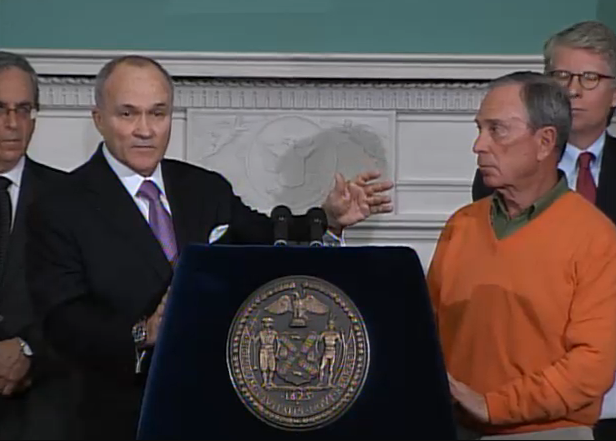
The Bloomie and Kelly Show … with Fake Video Props!

Just three days after NYPD’s cops overreacted to First Amendment protests, and two days after NY’s Muslim community protested NYPD’s heavy handed spying, Mike Bloomberg and Ray Kelly decided to roll out a big press conference to announce …

A pipe bomb.

The person who intended to use the pipe bomb is a “lone wolf” al Qaeda sympathizer  named Jose Pimental who lives with his mother.

Authorities have been tracking Pimental since May 2009 and reports are an informant was involved, which might explain why he moved from strictly talking about violence to actually going to Home Depot to buy a few pipes and (as bmaz describes it) some Christmas lights to make his bomb.

Now, Bloomie and Kelly tried to make this look spectacular. They went to the effort of blowing up a car and videotaping it to show what the bomb could have done–though there’s no indication that his pipe bombs were ever operational. (No, no journalists asked who paid for the car the NYPD destroyed so they could have a nice video prop.)

They also made a nice model of Pimental’s Christmas lights bomb.

Kelly tried to suggest that Pimental aspired to hit the same targets that Occupy Wall Street protestors were targeting. “We remain the nation’s financial capital,” he said, suggesting that’s why Pimental targeted NY. Except that Pimental’s planned targets–like the post office in Washington Heights or soldiers returning from deployments–have nothing to do with the finance industry or even anything unique to NY.

None of Bloomie and Kelly’s efforts to put on a good show prevented the journalists present from asking, repeatedly, “Did the FBI decline to take this case?” Given the way Bloomie refused to look at the camera the third time a variant of the question was asked, I’m guessing the answer is “yes.” {Update: Ryan Reilly confirms that is in fact the case.]

The lesson to take from this terrorism porn is actually that the NYPD counterterrorism effort is useless in hunting down threats like this. Pimental was first identified in Schenectady. The Albany PD referred him to the NYPD. The NYPD didn’t find this guy, they just … nurtured him.

And Pimental was, as Bloomie repeated, a “lone wolf.” Which means no amount of infiltrating mosques and Moroccan restaurants would have found him, because he had no associations that would have revealed him (unlike Najibullah Zazi, whom the NYPD missed, even though his Imam was one of their informants).

The big questions coming out of this presser–aside from who paid to blow up a car and why Bloomie wore an ugly orange sweater to a press conference–has to do with the timing. Kelly seemed to suggest the NYPD was orchestrating this somewhat when he said, “We had always intended to take him in custody before he detonated a bomb.” In addition, he said Pimental had decided to make a bomb back in August.

So why is it that their closely watched terrorist decided to actually build a bomb at the precise moment when Bloomie’s and Kelly’s heavy handed policing, including their abusive counterterrorism spying, have lost all credibility?

Update: Here’s the complaint. You’ll like how the Officer doesn’t mention they’ve been tracking this guy since May 2010, and instead says it all started in October 2010. You’ll also enjoy how Pimental handed the informant every bit of his bomb, as if he were playing a role.

Share this entry

Robert Mueller Once Again Claims Anna Chapman a Bigger Threat to US than Lloyd Blankfein

Robert Mueller addressed the Commonwealth Club in San Francisco today. He repeated a familiar theme: the biggest threats to the United States are terrorists (even aspirational ones), spies, and cyber attacks.

Terrorism, espionage, and cyber attacks are the FBI’s top priorities. Terrorists, spies, and hackers are always thinking of new ways to harm us.

As he tends to do when spreading this propaganda, Mueller once again focused on Anna Chapman and her band of suburban spies.

Consider the arrest last year of 10 agents of the Russian Foreign Intelligence Service. Many of you may have seen TV news stories and videos covering the techniques we used in our investigation, code-named Ghost Stories. It featured the stuff of a John Le Carré novel—dead-drops in train tunnels, brush passes at night, and clandestine meetings in cafés.

Though he did add the example of Kexue Huang, who sent information on organic pesticides and food to Germany and China, to his list of scary spies who threaten our country.

Last month, Kexue Huang, a former scientist for two of America’s largest agricultural companies, pled guilty to charges that he sent trade secrets to his native China.

While working at Dow AgriSciences and later at Cargill, Huang became a research leader in biotechnology and the development of organic pesticides. Although he had signed non-disclosure agreements, he transferred stolen trade secrets from both companies to persons in Germany and China. His criminal conduct cost Dow and Cargill millions of dollars.

Finally, Mueller added a neat new twist to his list of people who pose a big threat to this country. The hackers who hacked into the BART website after BART cops killed the unarmed Oscar Grant and later Charles Blair Hill, and after BART shut down cell service to interrupt free speech will bring anarchy!

And “hacktivist” groups are pioneering their own forms of digital anarchy. Here in the Bay Area, you witnessed their work firsthand when individuals hacked the BART website and released personal data of BART customers.

Because it’s not anarchy when cops shoot unarmed or drunk men. It’s not anarchy when transit companies unilaterally shut down your phone. It’s only anarchy when the hackers get involved.

You’ll note what’s missing, as it always is, from Mueller’s list of scary threats to the country? Not a peep about the banksters whose systematic fraud has done–and continues to do–far more financial damage than 9/11.

It’s anarchy, apparently, when bunch of kids break into a website. But it’s not anarchy when banksters rewrite property law to steal the homes of millions of Americans.

Share this entry

The More You Look for Terrorists, the Fewer Banksters You Have to Prosecute

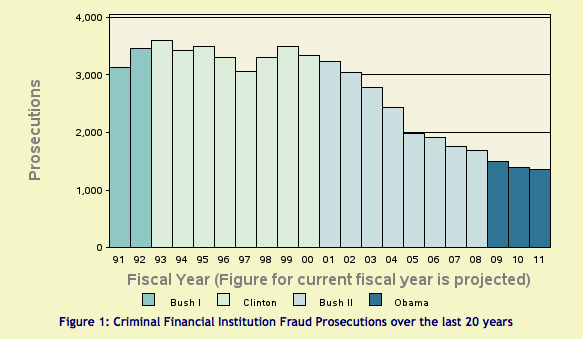
This report–or rather the HuffPo piece on it–has gotten a lot of attention. It shows the government as a whole has prosecuted 57.7% fewer financial fraud crimes than they did 10 years ago, when 9/11 changed everything.

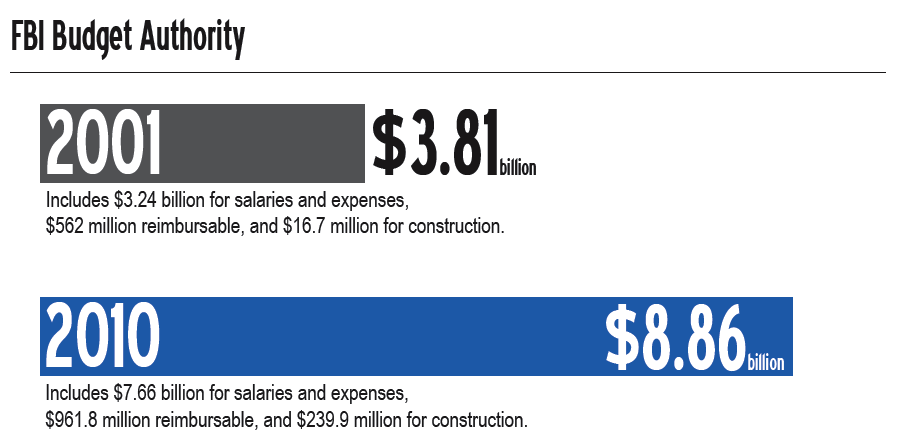
The report on our government’s growing disinterest in prosecuting banksters should be paired with this FBI report which I reported on some weeks ago (since that time, FBI has removed the link to the report). The FBI report makes it clear that the FBI, at least, has shifted its approach over the last decade from a “case driven” focus to a “threat driven” focus–meaning that it decides what it’s going to look for and then goes to find criminals committing that crime rather than finds crimes and responds to them. Depending on whether you believe this report or Director Mueller’s June reconfirmation hearing, financial fraud is either the 7th or 5th highest priority for the FBI, behind terrorism, counterintelligence, and cyberattacks.

Those priorities show. As part of its focus on terrorism, the FBI has increased surveillance capacity by 48%. And over that time, the report boasts, the FBI has written 85,500 raw intelligence reports. It has set up 10,200 SCI workstations.

All of which costs money. The FBI reports that its budget authority–which it notes is driven by the strategy–has more than doubled over the period in which it has found half as many banksters.

Most telling, though, is a stat you get by putting the two reports together. TRAC notes that FBI referred 37.6% of the fraud cases for prosecution so far this year–working out to be roughly 470 cases. But if you work out how many financial cases they say they were tracking last year (they say “more than 2,800” equates to 57% of the cases), you see they were tracking roughly 4,912 financial fraud cases. If these numbers are correct, it means fewer than 10% of the banksters and other fraudsters they’re tracking ever get charged.

In other words, it’s not that they’re not seeing the crime. They’re just not referring it for prosecution, choosing instead to look for young Muslim men to entrap.

Share this entry

A Terrorist Goes to Prison for 33 Years

On Wednesday, DOJ announced the sentencing of Carlos Mario Jimenez-Naranjo, one of the key leaders in Colombia’s AUC terrorist group, to 33 years in prison.

Carlos Mario Jimenez-Naranjo, aka “Macaco,” a paramilitary leader and one of Colombia’s most notorious drug traffickers, has been sentenced to 33 years in prison by U.S. District Judge Joan A. Lenard in Miami for leading an international drug trafficking conspiracy that supported a foreign terrorist organization, announced Assistant Attorney General Lanny A. Breuer of the Justice Department’s Criminal Division and U.S. Attorney Wifredo A. Ferrer for the Southern District of Florida.

According to court documents, Jimenez-Naranjo was one of the top leaders of the Autodefensas Unidas de Colombia (AUC), a Colombian right-wing paramilitary and drug trafficking organization.   The AUC is a U.S. Department of State-designated foreign terrorist organization.   From the mid 1990s through 2007, Jimenez-Naranjo led the Bloque Central Bolivar (BCB), a group within the AUC, commanding an estimated 7,000 armed combatants.   Jimenez-Naranjo controlled large areas where cocaine was produced, and his organization was responsible for exporting thousands of kilograms of cocaine from Colombia to Central America, Mexico and the United States using seaports and clandestine airstrips.   Jimenez-Naranjo was extradited from Colombia to the United States on May 7, 2008, based on a provisional arrest warrant from separate indictments in the District of Columbia and in the Southern District of Florida.

Mind you, Jimenez-Naranjo wasn’t actually sentenced on Wednesday. He was sentenced back in May, in a rather arbitrary, sealed hearing at which the defendant’s lawyer used actuarial data from the CIA to calculate a sentence that would not equate to a life sentence for a 45 year old man (when the US extradited men from Colombia, it promised not to impose life sentences). Since that hearing, his sentence has been sealed. Purportedly, that was done to allow him to cooperate with the government, to convince more of his former followers members to turn themselves in.

The transcript from a subsequent hearing has not yet been docketed, so it’s not clear whether the government represented that he continued to cooperate. Certainly, his sentence was not reduced from the original sentence in May.

Now I raise all this to point out the alternative approach used with Colombia (and the relative silence regarding the sentencing of a terrorist far more dangerous than the aspirational lone wolves the FBI has focused on of late). Read more

Share this entry