Three things happened in the last week that have befuddled a lot of observers, but which might best be understood as the kinds of developments we’ll see increasingly as the power structure around Trump grows fragile and fluid:
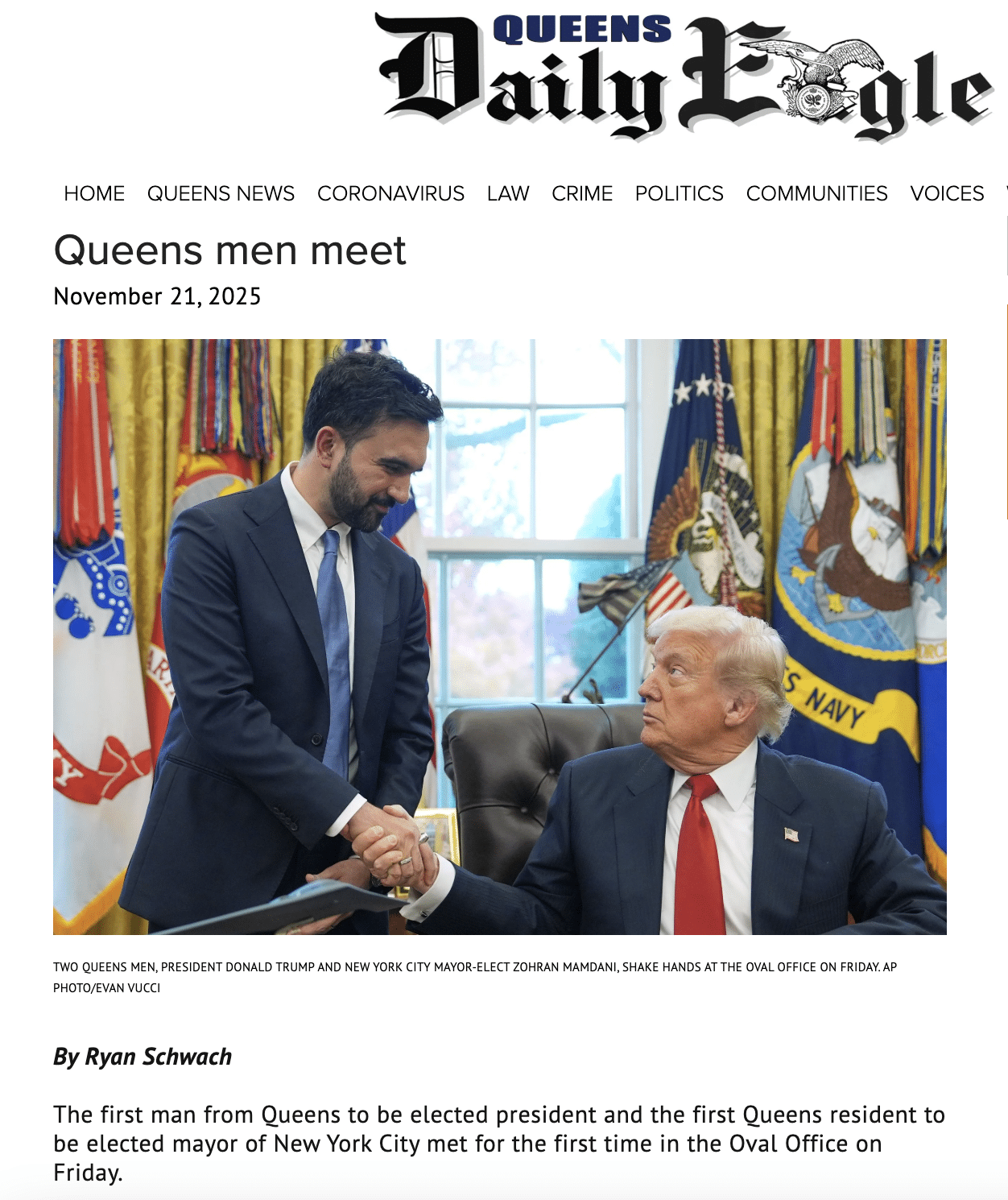
A positively giddy Trump welcomed Zohran Mamdani to the White House
“The White House” rolled out yet another plan to sell out Ukraine to Russia
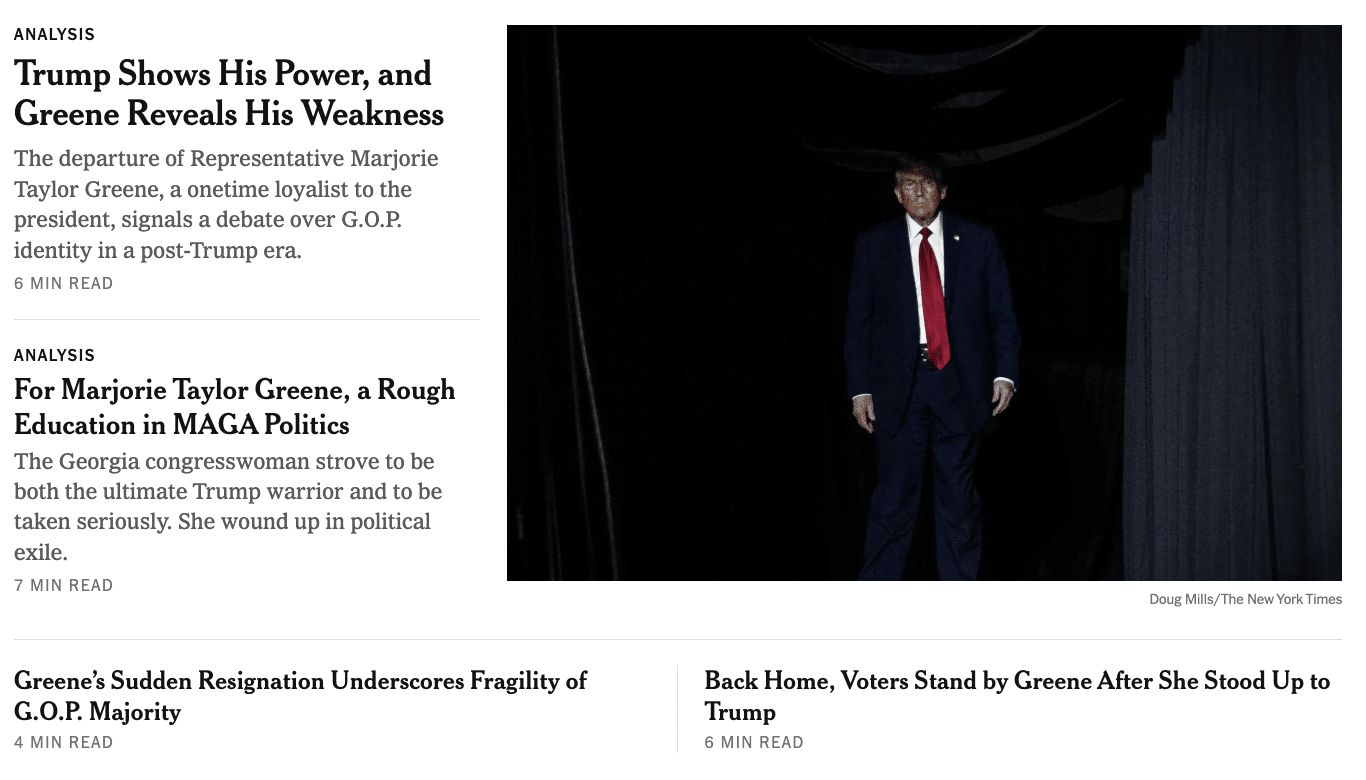
Marjorie Taylor Greene announced she will quit in early January
All of these, in my opinion, arose out of and reflect Trump’s increasing political weakness, his separate mental and physical decline, and the fight for power that results.
Mamdani speaks of Trump voters, groceries, and building
Much of the focus on the Trump-Mamdani meeting was on what Trump did, such as his interruption before Mamdani had to answer whether he believed Trump was a fascist, rather than on what Mamdani said. But if you look closely at what Mamdani said — which was often simply a restatement of his campaign pitch — he managed to say them in such a way that Trump parroted them as his own.
Mamdani’s first comment did so — as did his relentlessly disciplined campaign did — in terms of affordability; Mamdani mentioned “groceries,” the awkward shorthand Trump’s handlers have had him use to address affordability.
Mr. Trump: You know, we had some interesting conversation, and some of his ideas really are the same ideas that I have. A big thing on cost. The new word is “affordability.” Another word, it’s just groceries. It’s sort of an old-fashioned word, but it’s very accurate. They are coming down. They are coming down.
Mamdani repeatedly spoke in terms of Trump’s voters (again, a line directly from his campaign).
Trump had no idea that Mamdani targeted Trump voters, and as the coalition that elected him last year abandons him in the polls, Trump took notice when Mamdani explained that.
When I spoke to New Yorkers who had voted for the president last November on Hillside Avenue and Fordham Road, I asked them why. I heard, again and again, two major reasons. One was that they want an end to forever wars — they wanted an end to the taxpayers’ dollars we had funding violations of human rights, and they wanted to address the cost-of-living crisis. And I appreciated the chance to discuss both of those things.
Mr. Trump: He said a lot of my voters actually voted for him.
Mr. Mamdani: One in 10.
Mr. Trump: And I’m OK with that.
[snip]
Reporter: First of all, for the mayor-elect: You’re both from different parts of the political perspective. You’re both populist, though, and I just wonder to what extent the president’s campaign styles — his techniques, his social media use — inspired any part of your campaign?
Mr. Mamdani: Well, I actually told the president that, you know, so much of the focus of our campaign has been on the cost-of-living crisis, and when we asked those New Yorkers who had voted for the president — when we saw an increase in his numbers in New York City, that came back to the same issue. Cost of living. Cost of living. Cost of living.
And they spoke about the cost of groceries, the cost of rent, the cost of Con Ed, the cost of child care.
Mamdani seems to have reminded Trump that Trump got a historic number of votes last year (the voters Mamdani kicked off his campaign by canvassing) by running on affordability.
Reporter: Mr. President, you said you grew up in New York City. Mr. Mamdani, does New York City love President Trump?
Mr. Mamdani: New York City loves a future that is affordable. And I can tell you that there were more New Yorkers who voted for President Trump in the most recent presidential election because of that focus on cost of living, and I’m looking forward to working together to deliver on that affordability agenda.
President Trump: Got a lot. I got a lot of votes. One more, go ahead. One or two more. Go ahead.
Mamdani’s focus on Trump voters became a way to dodge very contentious questions.
Mr. Mamdani: I appreciate all efforts toward peace, and I shared with President Trump, when I spoke to Trump voters on Hillside Avenue — including one of whom was a pharmacist that spoke about how President Trump’s father actually went to that pharmacy not too far from Jamaica Estates — that people were tired of seeing our tax dollars fund endless wars.
By the end, Trump spoke of the way he himself (thinks he) picked up Bernie voters.
Mr. Trump: We agree on a lot more than I would have thought. I think he’s — I want him to do a great job, and we’ll help him do great job. You know, he may have different views, but in many ways, you know — we were discussing, when Bernie Sanders was out of the race, I picked up a lot of his votes, and people had no idea, because he was strong on not getting ripped off in trade and lots of the things that I practiced, and been very successful on.
Tariffs, a lot of things. Bernie Sanders and I agreed on much more than people thought, and when he was put out of the race — I think quite unfairly, if you want to know the truth — many of the Bernie Sanders voters voted for me, and I felt very comfortable frankly seeing that and saying that. And you know, it just turned out to be a statistical truth.
Perhaps the most fascinating reflection came when Trump appeared to parrot Mamdani’s shift of discussions about ICE into a question about crime, whence Trump immediately addressed building.
Mr. Trump: What we did is, we discussed crime. More than ICE, per se, we discussed crime. And he doesn’t want to see crime, and I don’t want to see crime, and I have very little doubt that we’re not going to get along on that issue. And he wants to — and he said some things that were very interesting, very interesting, as to housing construction, and he wants to see houses go up. He wants to see a lot of houses created, a lot of apartments built, et cetera. You know, we actually — people would be shocked, but I want to see the same thing.
Trump repeated that progression later, and specifically said Mamdani told him things Trump had not seen in coverage.
He wants to see no crime. He wants to see housing being built. He wants to see rents coming down, all the things that I agree with. We may disagree on how we get there. The rent coming down — I think one of the things I really gleaned very, very much today, he would like to see them come down ideally by building a lot of additional housing. That’s the ultimate way. He agrees with that, and so do I.
But, if I read the newspapers, and the stories — I don’t hear that. But I heard him say it today. I think that’s a very positive step. Now, I don’t expect — I expect to be helping him, not hurting him. A big help, because I want New York City to be great.
Look, I love New York City. It’s where I come from.
None of Mamdani’s success should be that surprising. He’s a rock star in whose aura Trump would like to bathe.
Mamdani simply managed Trump the same way everyone does: by getting alone in a room with him and making him adopt your ideas as his own.
Kirill Dmitriev continues to cultivate the people alone in the room with Trump
Which brings us to the latest Ukrainian “piece” plan, a 28-point plan to force Ukraine to capitulate to Russia on threat of losing US intelligence and arms (though Cristo Grozev believes there are two bullets that Russia did not release publicly).
Phillips OBrien announced, hopefully prematurely, that this was the long-awaited denouement of Trump’s long con of pretending he cares about Ukraine.
Instead, what actually happened on November 21 was that the Trump Administration came for Ukraine—as they always intended to do. The Secretary of the Army, Dan Driscoll, a very close associate of VP JD Vance, went to Kyiv and tried to bully the Ukrainians into accepting Trump’s 28 Point Plan to neuter Ukraine. Driscoll formally presented the plan to divide Ukraine now, and end it later, and the reality of what Ukraine and Europe was facing finally sunk in. Here was how the Atlantic story on the meeting began.
Dan Driscoll kept everyone waiting. The United States secretary of the Army had been due to arrive earlier today at the U.S. ambassador’s residence in Kyiv to speak with diplomats from NATO member states. The guests were eager to hear about the 28-point peace plan Driscoll had delivered on behalf of the Trump administration to Ukrainian President Volodymyr Zelensky. But what they heard when Driscoll finally got there left some of the Europeans infuriated. “I feel nauseous,” one diplomat told us afterward. “It’s like the world is shattering around us, and we are watching it in real time.”
The most depressing thing from the above story was that the diplomat was surprised at what the administration was doing; or I should say that the unnamed diplomat had fallen for the Trump Administration’s long con. The long con was that they would ever do anything meaningful to hurt Putin and help Ukraine, that somehow they were honest brokers in this war. They never were. They have always wanted Putin to get the best deal possible and they have always wanted to severely weaken Ukraine. Whatever steps the administration took to seem to help Ukraine were performative; steps that were designed to make it look like they would be tough on Putin, but in the end never were more mirage-like than anything else.
Michael Weiss catalogs all the signs that the deal was, instead, Kirill Dmitriev successfully manipulating the press.
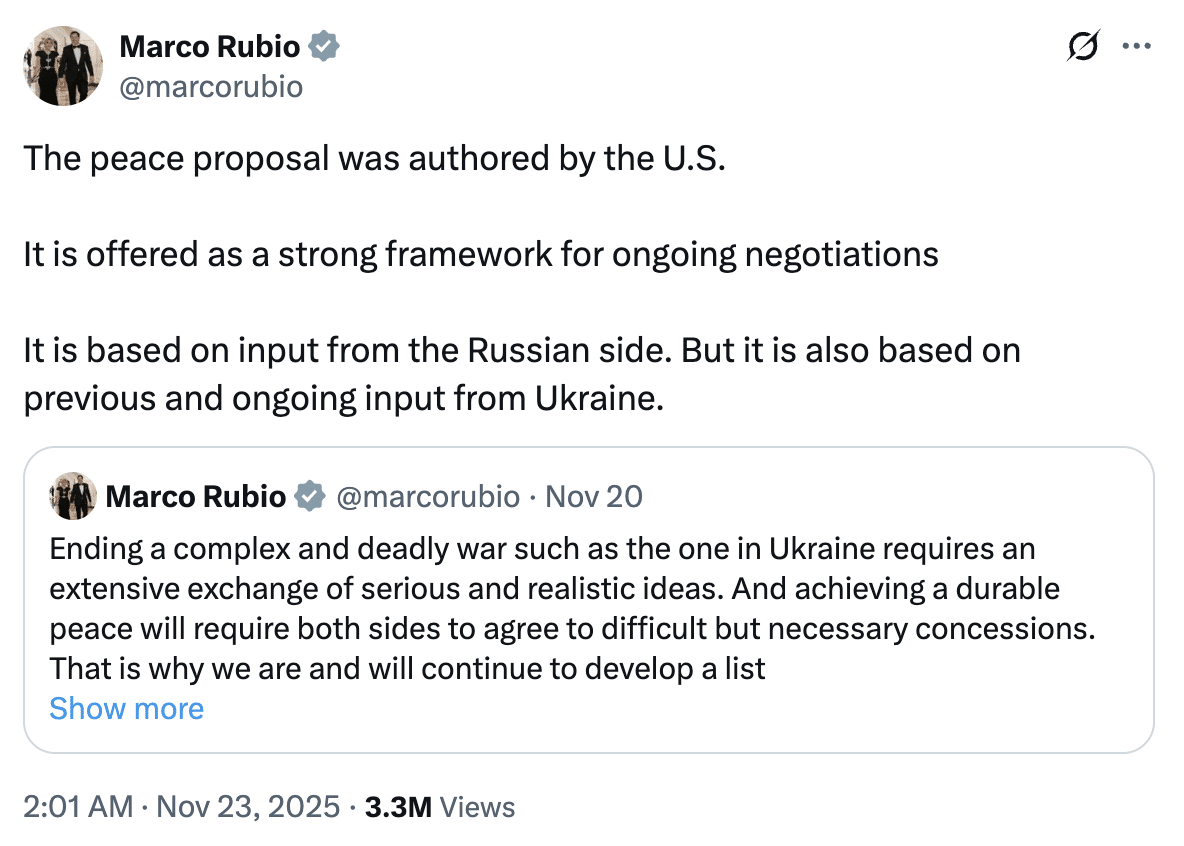
What struck me as odd about this whole affair was that for such a multi-authored, monthlong project, no one from the American side was willing to go on the record to talk about it. Everything was on-background comment — except for Dmitriev, who was only too happy to gibber. Moreover, the State Department was silent; all journalist inquiries directed at Foggy Bottom were not even redirected to the White House, which is highly abnormal on matters of foreign policy sensitivity. Then, late Wednesday night, Rubio, under his personal account, tweeted this: “Ending a complex and deadly war such as the one in Ukraine requires an extensive exchange of serious and realistic ideas. And achieving a durable peace will require both sides to agree to difficult but necessary concessions. That is why we are and will continue to develop a list of potential ideas for ending this war based on input from both sides of this conflict.”
To anyone on nodding terms with diplomatese, this sounded like the whirr of the backpedal, Rubio’s way of trying to downplay expectations created by Dmitriev and Axios and the resulting press frenzy. An “extensive exchange of serious and realistic ideas” was not, after all, a signed, sealed, and delivered plan of action, which Politico’s Dasha Burns had described (citing a “senior White House official”) as a “fait accompli,” cobbled together without the input or consent of Brussels. “We don’t really care about the Europeans,” said that same senior White House official, even though the EU and NATO will have an outsize say in determining the future of Ukraine and Europe, from sanctions relief to security assistance.
[snip]
Was Trump really acquainted with the deal in all its details? What did his “support” for Witkoff amount to? Recall that the preliminaries for the doomed Anchorage summit consisted of Witkoff misinterpreting what the Russians were offering (easy enough to do when you rely on an SVR translator) and making it seem as if they’d conceded things they hadn’t. This caused some dyspepsia in the Oval, and Trump later “jokingly” dismissed Witkoff’s ability to parlay with the Russians.
Could this be happening again? And could it be even worse now that Trump (distracted with his imploding MAGA coalition at home, a flush-worthy approval rating, a battering at the polls on Nov. 4, and bloodlust for the domestic opposition) is too busy to care about the finer points of his big, beautiful peace deal for Ukraine? “Sure, Steve, sounds great, keep going” sounded like what amounted to the Trump seal of approval here, but we don’t know because no one bothered to ask this question (or, at least, no one managed to have it answered).
[snip]
Politiconow clarified that “a number of people who would have normally been informed of such a plan at the White House and State Department were also not consulted about Witkoff’s renewed push,” with one U.S. official saying there was “zero interagency coordination.” You don’t say.
Reuters (including Erin Banco revisiting her past reporting on Dmitriev’s efforts to do precisely this in Seychelles in 2017) describes some of the machinations in Miami that went into this production.
U.S. officials and lawmakers are increasingly concerned about a meeting last month in which representatives of the Trump administration met with Kirill Dmitriev, a Russian envoy who is under U.S. sanctions, to draft a plan to end the war in Ukraine, according to multiple sources familiar with the matter.
The meeting took place in Miami at the end of October and included special envoy Steve Witkoff, President Donald Trump’s son-in-law Jared Kushner and Dmitriev, who leads the Russian Direct Investment Fund (RDIF), one of Russia’s largest sovereign wealth funds.
The most telling development, however, are competing and quickly evolving stories from Senator Mike Rounds (who would lead opposition to such a plan in the Senate) and Marco Rubio about whether this is a US plan.
Rubio reassured Senators mobilizing opposition to this development that it wasn’t a done deal, but then backtracked to avoid losing his place in the room.
Foreign nations now have to deal with rival factions of the U.S. government who keep major policy initiatives secret from each other and some of which work with foreign powers as the succession battle for 2028 begins, is how one diplomat put it.
One thing that’s happening is that Marco Rubio has survived in the Trump White House as long as he has because he is very good at mirroring, usually passively so. He says, and his State Department says, what his State Department babysitters say, people like Darren Beattie and Christopher Landau. But Rubio has generally remained in the room even at key times, and particularly with Ukraine, has thus far managed to prevent the worst from happening.
Importantly, though, Dmitriev’s tremendous success at manipulating the other people in the room with Trump comes at a time when Tom Massie and Marjorie Taylor Greene — neither big backers of Ukraine — showed how to beat Trump: by bypassing Mike Johnson to force a politically difficult vote, and to do so with enough success to force the Senate’s hand.
Brian Fitzpatrick and Don Bacon, both staunch backers of Ukraine in the House, have initiated an effort to replicate that approach.
There are the numbers right now to pass sanctions against Russia: at least 218 in the House and a filibuster-proof majority in the Senate. Those numbers just happen to be similar to the same numbers as it would take to impeach Trump.
Which is to say, the very thing that made it possible for Dmitriev to recruit (ahem) the people in the room with Trump — the flux in the White House now — is also the thing that makes him more vulnerable than he was a month ago.
Exit Marjorie Taylor Greene, for now
There’s a lot about MTG’s departure I’m not much interested in: making Trump the primary actor, making Marge the victim, debating whether she’ll be friend or foe, focusing more on the timing as it relates to getting her pension than as it relates to the healthcare crisis Republicans will soon own.
MTG is far smarter than people give her credit for and she’s very adept at using the tools of right wing politics.
In recent months the good old boys in Georgia and even Trump’s top aides refused to let her run for state-wide office in Georgia, believing she could risk an increasingly purple state.
That was part of, but only part of, the background to her willingness to take a leadership position on Epstein. She does genuinely care about the issue and/or she does recognize its salience among populists.
The part of MTG’s statement that generated the most attention (which appears in ¶¶33 and 34 of her statement) — her prediction Republicans will lose the House and have to stave off a Trump impeachment…
I have too much self respect and dignity, love my family way too much, and do not want my sweet district to have to endure a hurtful and hateful primary against me by the President we all fought for, only to fight and win my election while Republicans will likely lose the midterms. And in turn, be expected to defend the President against impeachment after he hatefully dumped tens of millions of dollars against me and tried to destroy me.
It’s all so absurd and completely unserious. I refuse to be a ‘battered wife’ hoping it all goes away and gets better.
… Comes long after (¶¶4-12) a series of paragraphs that could be spoken by a racist Zohran Mamdani, and with all the charisma and political acumen he has.
No matter which way the political pendulum swings, Republican or Democrat, nothing ever gets better for the common American man or woman.
The debt goes higher.
Corporate and global interests remain Washington’s sweethearts.
American jobs continue to be replaced whether it’s by illegal labor or legal labor by visas or just shipped overseas.
Small businesses continue to be swallowed by big corporations.
Americans’ hard earned tax dollars always fund foreign wars, foreign aid, and foreign interests.
The spending power of the dollar continues to decline.
The average American family can no longer survive on a single bread winner’s income as both parents must work in order to simply survive.
And today, many in my children’s generation feel hopeless for their future and don’t think they will ever realize the American dream, which breaks my heart.
MTG is taking her significant campaign cash and selling high, and promising to be there to buy low after whatever upcoming catastrophe happens.
When the common American people finally realize and understand that the Political Industrial Complex of both parties is ripping this country apart, that not one elected leader like me is able to stop Washington’s machine from gradually destroying our country, and instead the reality is that they, common Americans, The People, possess the real power over Washington, then I’ll be here by their side to rebuild it.
Until then I’m going back to the people I love, to live life to the fullest as I always have, and look forward to a new path ahead.
She rode Trump’s coattails until she decided the coattails weren’t worth the effort anymore.
Share this entry
https://www.emptywheel.net/wp-content/uploads/2025/11/Screenshot-2025-11-23-at-09.14.59.png14901252emptywheelhttps://www.emptywheel.net/wp-content/uploads/2016/07/Logo-Web.pngemptywheel2025-11-23 06:48:242025-11-24 07:26:47“Groceries,” and Other Secrets of Managing Donald Trump
Trump announces the end of the transatlantic alliance
First it was Emmanuel Macron, putting his hand on Trump’s knee as he publicly corrected Trump in the Oval Office, in the presence of cameras, on the fact that Europe’s contributions to support Ukraine were (a) grants, not loans, and (b) larger than the contributions made by the US. Trump, in turn, tried to toss out his well-worn talking points, but the damage was done. Trump was called out by a foreign leader as a liar, in his very own office and seat of power.
Then it was Keir Starmer, waving a fancy invitation from King Charles to a state dinner, who did exactly the same thing. He publicly corrected Trump in the Oval Office, in the presence of cameras, on Europe’s support for Ukraine. Again, Trump hemmed and hawwed, and embraced the (Starmer: “unprecedented!”) invitation to a second state visit, but the damage was done. Trump was called out by a second foreign leader as a liar, in his very own office and seat of power.
You had to know this would not sit well.
As network after network played the clip of Macron’s hand on Trump’s knee, after all the networks showed Trump fawning over the Bright Shiny Thing that Starmer dangled in front of him, as Starmer very politely called Trump a liar, everyone knew that this would not end well.
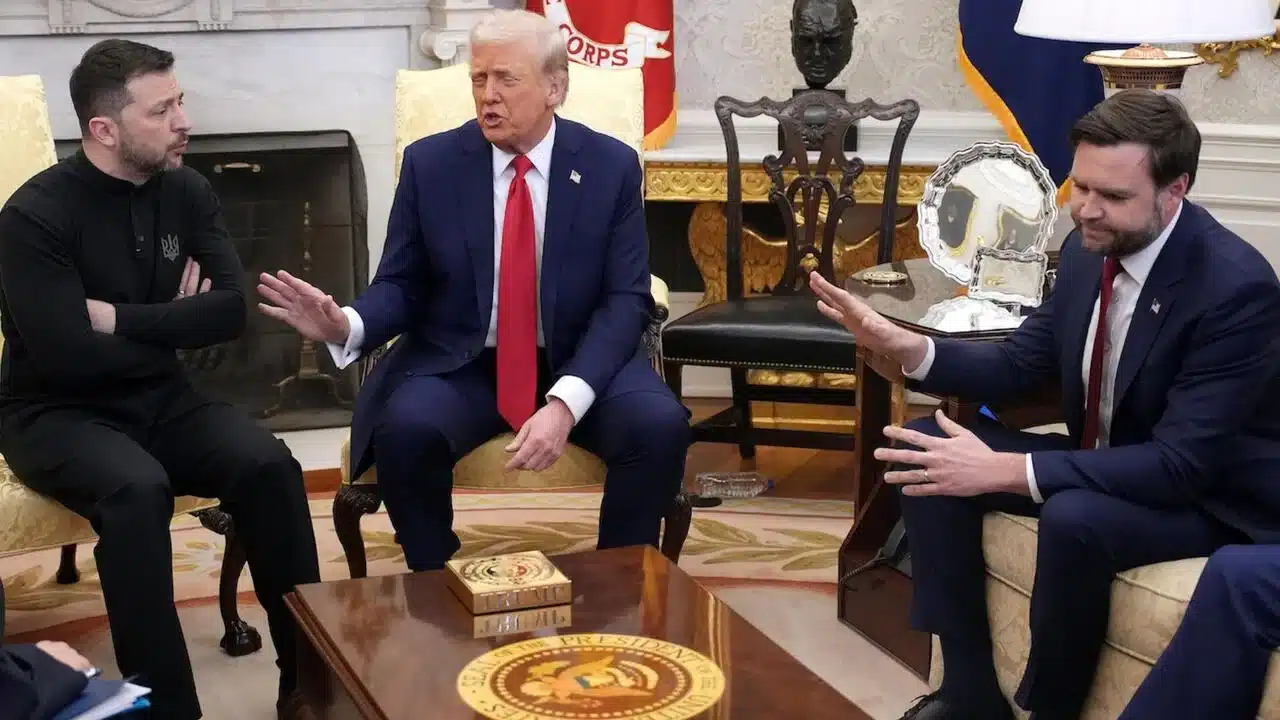
And today, it was Volodymyr Zelenskyy’s turn . . . and as anyone with half a brain could anticipate, it *did* not end well.
Personally, I was amused by J.D. Vance’s holier-than-thou whining about Zelenskyy making a benign appearance in Pennsylvania saying “thank you” to the US for their support and calling it Election Interference. I don’t remember Vance taking up umbrage when the head of DOGE Elon Musk appeared and spoke at the national political rally of the neo-Nazi Alternative for Germany (AfD) party just days ahead of the recent German election, and who repeatedly praised the AfD via Xitter. After the AfD came in second, with a sizable caucus in the new Bundestag, Musk called the head of the AfD to offer congratulations and called her party the future of Germany, and Vance’s reaction was *crickets*.
Well, to be scrupulously fair, that’s not true. He *did* say something, but rather than condemning such interference, Vance joined it. At the Munich Security Conference, Vance praised the AfD (not by name but by lauding their political positions on immigration and other policies) and attacked mainstream German political parties for refusing to work with the AfD.
Americans might not have been listening to all of this, but the Europeans were – especially the Germans – and they knew exactly who Vance was praising. After the German elections, the victorious chancellor-elect made a stunning statement. From Deutsche Welle:
After his party’s victory in the election was confirmed Sunday night, [CDU party leader Friedrich] Merz said that he wanted to work on creating unity in Europe as quickly as possible, “so that, step by step, we can achieve independence from the US.”
Until recently, this would have been a highly unusual thing for any leader of the CDU to say. After all, it has always had a strong affinity for the US.
“Merz aligns himself with the legacy of historical CDU leaders such as [former chancellors] Konrad Adenauer and Helmut Kohl, both of whom played pivotal roles in strengthening transatlantic relations,” said Evelyn Gaiser, a policy advisor on transatlantic relationships and NATO with the Konrad Adenauer Foundation, a German think tank that is associated with but independent of the Christian Democrats.
[snip]
Merz spoke out after JD Vance’s speech at the Munich Security Conference (MSC) in February, in which the US vice president said that the biggest threat to Europe did not come from Russia or China, but “from within.”
“This is really now the change of an era,” Merz said on stage at the MSC. “If we don’t hear the wake-up call now, it might be too late for the entire European Union.”
Add this into the context of withdrawing from the World Health Organization and eliminating all the work done by USAID, and the message is crystal clear. While yes, this meeting today in the Oval Office was about Ukraine, it was really a sign of something much much larger.
In April 2021, when Joe Biden addressed a joint session of Congress in a non-State of the Union address, he said this:
I’ve often said that our greatest strength is the power of our example – not just the example of our power. And in my conversations with world leaders – many I’ve known for a long time – the comment I hear most often is: we see that America is back – but for how long?
We now know the answer: four years and five weeks.
RIP the Transatlantic Alliance (1945-2025).
Share this entry
https://www.emptywheel.net/wp-content/uploads/2025/02/Trump-Vance-and-Zelenskyy.webp7201280Peterrhttps://www.emptywheel.net/wp-content/uploads/2016/07/Logo-Web.pngPeterr2025-02-28 17:54:442025-02-28 17:54:44Four Years and Five Weeks