While Obama Urges Caution, Netanyahu, McConnell, IAEA Fan Anti-Iran Rhetoric, Iran Takes Positive Diplomatic Steps

[youtube]http://www.youtube.com/watch?v=UdECxrhmFbc[/youtube]

President Obama and his administration have spent the last week trying to point out the extreme downside to an attack by Israel on Iran’s nuclear sites. Unfortunately, Obama’s words of caution are getting little play while Israel’s Prime Minister Benjamin Netanyahu and Senate Minority Leader Mitch McConnell made appearances before the war-hungry mob at AIPAC to make the case for an attack now. In the meantime, Iran took positive diplomatic steps that are likely to be overlooked, reversing a death-sentence conviction on an accused US spy and committing to an IAEA visit to the disputed Parchin site.

As seen in the video above, IAEA Director General Yukiya Amano made public statements associated with his appearance before the Board of Governors.  From his prepared remarks:

As my report on Implementation of the NPT Safeguards Agreement and Relevant Provisions of Security Council Resolutions in the Islamic Republic of Iran makes clear, the Agency continues to have serious concerns regarding possible military dimensions to Iran’s nuclear programme.

In January and February, a senior Agency team held two rounds of talks in Tehran with Iranian officials aimed at resolving all outstanding issues in connection with Iran’s nuclear programme. Despite intensive discussions, there was no agreement on a structured approach to resolving these issues. Iran did not grant access to the Parchin site during the visits, as requested by the Agency. Iran provided an initial declaration on the issues listed in the Annex to my November 2011 report, although it did not address the Agency’s concerns in a substantive manner. During the visits, the Agency also submitted questions on Parchin and the possible role of a foreign expert.

Iran’s Ambassador to the UN agency Ali Asghar Soltanieh dismissed Amano’s report as “only a summary of his earlier report“. Today, Soltanieh announced that Iran remains prepared to define the conditions under which IAEA will be allowed access to Parchin: Read more

Share this entry

In Memogate Cross-Examination, Ijaz Claims to Have Transcript of Zardari, Kayani Phone Conversation

Following up on his original video deposition from late last month, Mansoor Ijaz, once again by video link from London, was subjected to cross-examination yesterday and today by the judicial commission investigating the Memogate scandal. Ijaz reiterated his primary claim he has made from the start, that his actions were prompted by a strong belief that a military coup was imminent on the heels of the US action that killed Osama bin Laden in May, 2011.

Although he did not list the countries, Ijaz claimed to have been briefed by intelligence agents from four different countries. He submitted multiple documents as his proof. The Express Tribune described the documents as including a transcript of a phone call between Pakistan’s President and Army Chief:

After Haqqani approached him first, Ijaz said, he used his contacts with intelligence agencies of various countries to obtain documents, including travel records of Director-General Inter-Services Intelligence (ISI) chief Lt General Ahmad Shuja Pasha, minute-by-minute Pakistan Air traffic Control flight monitoring of US helicopters which infiltrated Pakistani airspace for the May 2 raid, and a transcript of a call between President Asif Ali Zardari and Army Chief General Ashfaq Parvez Kayani.

Interestingly, Dawn’s coverage of the cross-examination doesn’t specifically mention Zardari and Kayani by name as being in the transcripts, although it comes close:

During the cross-examination before the judicial commission investigating the case, the Pakistani-American businessman said he had been briefed by at least four intelligence networks of different countries after the killing of Al Qaeda chief Osama bin Laden in Abbottabad on May 2, last year.

He said he had obtained the information about actions and reactions of Army Chief Gen Ashfaq Parvez Kayani, President Asif Ali Zardari and the military secretary to the president after the incident, details of foreign visits of the Director General of Inter-Services Intelligence (ISI) and transcripts of conversation between air traffic control staff and the pilots of the US helicopters which raided Osama’s compound.

/snip/

He also claimed to have the transcripts of conversations between the President’s House and the Army House on the operation.

How is it that an American citizen of Pakistani descent would have access to intelligence agencies of so many countries?  And, especially, how could Ijaz come into possession of a transcript of a call between Zardari and Kayani? Read more

Share this entry

Unintended Consequences: Rohrabacher’s Inept Balochistan Meddling Provokes Pak Rebuke of ISI, MI for Extra-Judicial Killings

On February 8, Congressman Dana Rohrabacher (R-CA) held a hearing on Balochistan, which he followed up on February 17 with a resolution calling for an independent Balochistan. As I reported on the hearing, Rohrabacher mispronounced Balochistan so badly during the hearing that one Pakistani newspaper referred to him as “Donna Rohrbacher”. As might be expected, having a minor congressman meddle so clumsily in foreign affairs had a horrible immediate fallout, with large anti-US demonstrations in Pakistan developing in response to the independence resolution.

The fact that Rohrabacher is playing petty politics with the fate of a large number of people has not been overlooked in Pakistan. Former Pakistani Foreign Secretary Najmuddin A. Shaikh, writing yesterday in Dawn, had this to say in an opinion piece:

Rohrabacher has had an interest in Afghanistan for the last 30 years. As part of president Reagan’s stable of speech writers he takes credit for having Reagan call the Afghan Mujahideen ‘freedom fighters’ and even for the parallel Reagan drew between America’s founding fathers and the Mujahideen. In those days, Pakistan was his favourite country.

Today his attitude towards Pakistan is coloured by what he believes Pakistan is doing in Afghanistan and not by his concern for the Baloch people. Had he been genuinely concerned about Balochistan his star witness should have been Selig Harrison who has long been regarded in the American security establishment as the foremost expert on Balochistan.

That has been my concern as well. Rohrabacher’s professed support for the Balochs seems strikingly like the support the Bush administration and Congressional Republicans displayed for the Kurds after the first Gulf War, where the Kurds were encouraged to take on Saddam Hussein, only for the Republicans to then stand by idly while Hussein massacred them. In this case, it appears that Rohrabacher is professing support for the Baloch, but mainly for the way in which this support can weaken the Pakistani government, which he blames for sheltering Taliban insurgents who carry out attacks in Afghanistan and for hiding Osama bin Laden (who was no longer a Freedom Fighter, I guess).

Despite this cyncial background, however, the attention generated by Rohrabacher’s stunts is having some distinctly positive effects. Writing yesterday at BBC.com, Ahmed Rashid notes:

It took an obscure United States congressman holding a controversial hearing in Washington on the civil war in Balochistan to awaken the conscience of the Pakistani government, military and public. Read more

Share this entry

Iran Moves Toward Opening Parchin to IAEA; Warrick Surprisingly Disrupts Israel’s “Zone of Immunity” Argument

[youtube]http://www.youtube.com/watch?v=X_dRPRtzacc[/youtube]

In a long interview with RT, Iran’s envoy to the IAEA, Ali Asqar Soltaniyeh, explained yet again that Iran’s position is that the team from the IAEA that visited Iran earlier this month was not the appropriate set of inspectors to visit the Parchin site. The IAEA has accused Iran of using this facility to develop technology for explosive triggers that could be used in a nuclear weapon. Iran was working under the impression that this group was meant for negotiations aimed setting ground rules for upcoming inspections.

Working along those lines, Soltaniyeh told RT that Iran has not ruled out a future IAEA visit to Parchin:

The IAEA delegation that visited Tehran recently was comprised of experts on legal, political and technical issues and not inspectors, Soltaniyeh said in an interview with Russian RT television.

The group visited Iran for negotiations on reality and framework of mutual cooperation, he said.

Iran does not rule out the access of IAEA to its military sites such as Parchin but this depends on some preconditions which IAEA should meet, Soltaniyeh said.

Weakening his own argument somewhat, Soltaniyeh went on to tell RT that Iran had offered to allow the IAEA team to inspect a different site at which the IAEA had accused Iran of carrying out high explosives work:

“I just want to tell you that last week, perhaps this is the first time I am telling you, we, in fact, offered the agency to go to another site which the director general in his report has referred to as a large scale high-explosive test. We offered, but the team was instructed by the director general to go back to Vienna. Therefore we don’t have any hesitation that every activity we have has nothing to do with nuclear weapons.”

In the video, Soltaniyeh also points out that IAEA inspectors did visit Parchin twice in 2005, as we were reminded earlier by Moon of Alabama.

In a somewhat related, but entirely unexpected move, Joby Warrick has moved off his role of transcribing only information that paints Iran in a bad light to provide information that removes one of the primary justifications Israel has been advancing as the basis for a unilateral attack on Iran. Earlier this month, Israeli Defense Minister Ehud Barak introduced the concept of a “zone of immunity” that Iran could enter wherein their final progress toward a nuclear weapon could not be disrupted:  Read more

Share this entry

US Vows No Change of Course in Afghanistan Despite 17% of NATO Deaths in 2012 From Fratricide

"There is absolutely no reason to change course when we're making the kind of progress we're making" -- Pentagon spokesman George Little, February 27, 2012

Displaying a remarkable inability to process the meaning of ongoing events, both White House spokesman Jay Carney and Pentagon spokesman George Little ventured dangerously close to “Baghdad Bob” territory on Monday, declaring that there is no reason to change the strategy or timetable for withdrawal in Afghanistan despite violence levels that have been on a steady rise since the US diverted its attention from Afghanistan to Iraq in 2003 and a rising toll of NATO forces being killed by Afghan forces.

The first question in Monday’s White House press briefing went right to the heart of the crisis that is ongoing in Afghanistan:

But I’m wondering how you explain to the average American who has seen this war go on for 10 years and is ready for troops to come home — how do explain it when the people that we’re training turn their guns on us, or U.S. officers in a secure Afghan Interior building are shot dead?  How do you explain why it’s working?

After Jay Carney responded with a very long “stay the course” explanation of how we must remove any possibility of al Qaeda re-emerging and that we must make conditions appropriate for handing off security to the Afghans, there was this follow-up:

Q    So you just sort of recounted the case there of how the President redefined the mission and how it’s important to stick with it, to stay the course.  But I’m wondering what you do about the attitudes of the American people who, in the case — more than one case in this last week — they say the people that we are going to war with, in some cases, are killing us.  Why should we still support this war?  How do you make that case?  And do you worry that it’s going to erode — the American public support will continue to erode in an election year?

MR. CARNEY:  Well, the incidents that you refer to are tragic and horrific and indefensible, there’s no question.  But it is important to remember that 95 to 97 percent of the missions the U.S. forces embark on in Afghanistan, they do so with their Afghan partners.  We’re talking about thousands and thousands of operations that proceed successfully with Afghan partners without anything like this happening.

These are isolated incidents — which does not, of course, mean they are not terrible — and are being investigated by both the Afghan government and ISAF.  But the overall importance of defeating al Qaeda remains and that is why we need to see — to continue the focus on that; to continue the process of, in the implementation of the President’s objectives, transferring security lead over to the Afghans so that American troops can come home.

It’s important to remember the President has already, through his strategy, laid out a process by which American troops will come home as we turn over security responsibility, security lead to Afghan forces.  And as we do that, we will be unrelenting in our pursuit of al Qaeda and unrelenting in our efforts to remove leaders of al Qaeda from the battlefield.

That’s just stunning. Carney insists that “These are isolated incidents” and yet, if we look at the numbers from this year, they are horrific. From AP:

Of 52 U.S. and NATO troops killed this year in Afghanistan, nine were apparently killed by Afghan forces or impersonators. Read more

Share this entry

Hiding Report on Fratricide in Afghanistan Doesn’t Make It Go Away

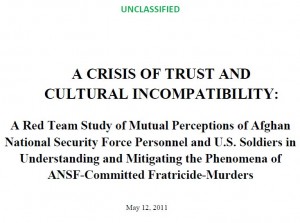
On January 20, the New York Times carried what they at first thought was a scoop on a “classified” report (pdf) on Afghan military and police personnel killing NATO forces. After they were told that the Wall Street Journal had written on the report back in June, they admitted as much in a correction. They later added another correction after I pointed out that a version of the report clearly marked “unclassified” could be found easily even though the Times referred to the report as classified. It turns out that the report had indeed been published first as unclassified but then was retroactively classified while the Wall Street Journal article was being prepared.

Events over the last few days serve to demonstrate the folly of trying to hide damaging information rather than openly reviewing it and trying to learn lessons from it. The report in question went into great detail to document the cultural misunderstandings that exist between NATO forces and their “partner” Afghan forces, and how these misunderstandings escalate to the point that Afghan personnel end up killing NATO personnel. In the executive summary of the report, we learn that “ANSF members identified numerous social, cultural and operational grievances they have with U.S. soldiers.” Arrogance on the part of U.S. soldiers often was cited, as well.

This clash of social values is at the heart of the newest wave of anti-US and anti-NATO violence in Afghanistan which erupted after an Afghan employee found Korans among materials being burned last week at a NATO base. A part of the response to the Koran burning is that on Saturday, two NATO personnel were killed inside Afghanistan’s interior ministry building. BBC reports that an Afghan police officer is suspected in the shootings:

Afghanistan’s interior ministry has said one of its own employees is suspected of the killing of two senior US Nato officers inside the ministry.

Officials earlier named police intelligence officer Abdul Saboor from Parwan province as the main suspect behind Saturday’s attack.

The NATO response to the killing was swift:

Nato withdrew all its personnel from Afghan ministries after the shooting.

The importance of this move cannot be overstated. Read more

Share this entry

Iran: Parallel to 2003 Rhetoric, Senate War Lobby Objects to Negotiations, IAEA Visit Controversial

Writing on the front page of today’s New York Times, Scott Shane finally states what should have been obvious to anyone paying attention to the steady drumbeat from the war mongers over the last couple of years:

Echoes of the period leading up to the Iraq war in 2003 are unmistakable, igniting a familiar debate over whether journalists are overstating Iran’s progress toward a bomb.

Shane notes that this time, as opposed to 2003, the Obama administration is trying to calm the war rhetoric instead of inflaming it as the Bush administration did in 2003.

However, the the bellicose Israel  war lobby in the US Senate is more than willing to take up the cause of war as the only answer. A “bipartisan” group consisting of Joe Lieberman (I-CT), Pat Toomey (R-PA),  Kelly Ayotte (R-N.H.), Richard Blumenthal (D-CT), Ben Cardin (D-MD), Kirsten Gillibrand (D-NY), John McCain (R-AZ), Bob Menendez (D-NJ), James Risch (R-ID), Marco Rubio (R-FL) and Charles Schumer (D-NY) has penned a letter to President Obama, trying to take away the major negotiated settlement which could avert war. In the letter, they state:

Second, we believe it is absolutely essential that the United States and its partners make clear to the Government of the Islamic Republic of Iran that we intend to continue ratcheting up this pressure-through comprehensive implementation of existing sanctions as well as imposition of new measures-until there is a full and complete resolution of all components of illicit Iranian nuclear activities. This must include, at a minimum, the full, verifiable, and sustained suspension of all enrichment-related and reprocessing activities and heavy water-related activities, as required by multiple UN Security Council resolutions.

This is a pre-emptive strike by the Israel war lobby in the Senate to prevent a negotiated settlement in which Iran suspends its work enriching uranium to the 20% level. From an editorial in today’s Washington Post:

 In fact, it appears likely that Tehran perceives talks as an opportunity to undermine sanctions. Mr. Jalili’s letter referred to negotiations “based on step-by-step principles and reciprocity,” language that could describe a proposal originally put forward by Russia last year. Moscow outlined a sequence of steps in which Iran would receive relief from sanctions in exchange for incremental actions to satisfy the IAEA. Iran rejected the idea, but now the P5+1, urged on by the Obama administration, is discussing a modified version. Reportedly, it could grant some sanctions relief if Iran suspended only its higher-level enrichment of uranium, and surrendered material enriched to that 20 percent level.

Clearly, the war mongers in the Senate are demanding that sanctions be ratcheted up substantially, with complete capitulation by Iran being the only way to remove any sanctions. In other words, the Senate group is demanding that negotiations be structured in a way that they are doomed.

Yesterday’s second visit by an IAEA delegation to Iran is being reported widely in the press as a failure. For example, Reuters says: Read more

Share this entry

Iran Embraces Bush Doctrine, Press Pulls a Palin

[youtube]http://www.youtube.com/watch?v=YpJsQch9uZo[/youtube]

Among the many gaffes by Sarah Palin during the 2008 presidential campaign, her “In what respect, Charlie?” response to Charles Gibson’s “Do you agree with the Bush Doctrine?” stands out as perhaps one of the biggest. After allowing Palin to flail about for a minute or so, Gibson finally explained it to Palin:

The Bush doctrine, as I understand it, is that we have the right of anticipatory self-defense, that we have the right to a preemptive strike against any other country that we think is going to attack us. Do you agree with that?

Today, speaking to Iran’s Fars News Agency, the Deputy Head of the General Staff of the Iranian Armed Forces for Logistic and Industrial Research embraced the Bush Doctrine on behalf of Iran:

General Mohammad Hejazi pointed to Iran’s latest strategy to embark on posing threats in response to enemy threats, and explained that the strategy means “we will no more wait to see enemy action against us”.

“Given this strategy, we will make use of all our means to protect our national interests and hit a retaliatory blow at them whenever we feel that enemies want to endanger our national interests,” Hejazi noted.

Despite Iran clearly stating a version of anticipatory self-defense, articles describing these comments from Reuters and the New York Times both fail to mention the parallel of this position with the Bush Doctrine. (As of this writing, the Washington Post does not appear to have written an article on Iran’s comments.)

When Iran says they endorse the Bush Doctrine, Reuters and the New York Times respond, “In what respect, Mohammad?”

Share this entry

Carnage in Pakistan’s Tribal Region Continues: US Drones Kill 21 Thurs., Suicide Bomber Kills 26 Fri.

Despite some prospects on negotiations toward peace looking better in Afghanistan and Pakistan, the carnage in Pakistan’s tribal areas continues at a rapid pace. Two separate US drone attacks in North Waziristan on Thursday killed 21 people and a suspected suicide bomber killed 26 in the Kurram Agency region on Friday.

According to Dawn, the first drone attack killed six:

According to sources, six people were killed and two others injured when two missiles slammed into a compound in the village of Spilga near Miramshah. The identities of the persons who died could not be ascertained.

The second attack was just a few hours later:

Hours later, another drone attacked a moving vehicle on the Zekerkhel-Khaisur road in Mirali tehsil.

Official sources said 15 members of a militant group were killed. Their bodies were charred.

The article noted that “unmanned planes” continued to fly around the area as local rescuers came to the scene.

There were reports that those killed in the second attack were Uzbek.

As for those killed in the first attack:

Those who died in the first attack belonged to Badar Mansoor and the Haqqani network, loyal to the Afghan Taliban, another official said. Last Thursday, officials said Mansoor, described as the “de facto leader of Al Qaeda in Pakistan” had been killed in a drone strike in North Waziristan.

There appears to be a Haqqani network tie to the suspected suicide bomb attack earlier today in Kurram Agency:

The bomber struck outside the mosque in a busy market in Parachinar, the main town in Kurram, after Friday prayers, in the latest attack by Sunni militants against minority Shias.

/snip/

Fazal Saeed, leader of a breakaway faction of the Pakistani Taliban, claimed responsibility for the attack.

“We have targeted the Shia community of Parachinar because they were involved in activities against us,” he told Reuters by telephone from an undisclosed location.

/snip/

He is said to have close ties with the Haqqani militant group, one of the most feared factions of the Afghan Taliban.

The Express Tribune coverage of this attack states that there were 26 deaths and also raises questions of whether it was a suicide bomber or another type of blast, but the Dawn article appears to be at least two hours more recent than the Express Tribune article. A Reuters article just a few minutes old as of this writing also placed the death toll in the bombing at 26 and said that it was the work of a suicide bomber.

It’s very difficult to see how either the US or the Taliban can be engaged in peace negotiations while at the same time killing large numbers of people. For both sets of killings, it appears there are more than enough survivors in the area to take up the cause of those killed, perpetuating the cycle of killing.

Share this entry

Peace Talks Breaking Out All Over

In an interview with the Wall Street Journal (behind a paywall, so no link!) Afghan President Hamid Karzai has said that Afghanistan has joined the “secret” talks that have been underway for some time now between the US and the Taliban. From Reuters:

Karzai’s government had previously been excluded from early, exploratory contacts between the Taliban and the United States, with the insurgents seen as resisting the involvement of a local administration they regard as a puppet of Washington.

But the Journal quoted Karzai on Thursday as saying the Taliban were “definitively” interested in a peace settlement to end the 10-year war in Afghanistan, and that all three sides were now involved in discussions.

“People in Afghanistan want peace, including the Taliban. They’re also people like we all are. They have families, they have relatives, they have children, they are suffering a tough time,” the Journal quoted Karzai as saying in an interview conducted on Wednesday in the Afghan capital.

“There have been contacts between the U.S. government and the Taliban, there have been contacts between the Afghan government and the Taliban, and there have been some contacts that we have made, all of us together, including the Taliban.”

Karzai also arrived in Islamabad today and entered immediately into discussions with Pakistani President Asif Ali Zardari. From the Express Tribune:

Earlier in the day, President Asif Ali Zardari and Prime Minister Yousaf Raza Gilani welcomed Afghan President Hamid Karzai at the President House.

In a meeting at the Prime Minister House, Gilani and Karzai discussed a range of issues, including the regional situation and bilateral ties, which have been hit by mistrust following recent cross-border attacks. The two leaders also discussed ongoing efforts for restoring peace in conflict-hit Afghanistan, such as US’ negotiations with the Taliban in which both Pakistan and Afghanistan have felt neglected by the US.

But those were the second and third paragraphs of the Express Tribune article. The first paragraph has material that is not nearly as prevalent in the US reporting on the talks among the US, the Taliban, Afghanistan and Pakistan. It turns out that Karzai has traveled to Islambad to take part in three way meetings with Pakistan and Iran. The first paragraph:

Iranian President Mahmoud Ahmadinejad has arrived in Pakistan for a two-day visit to attend the Pakistan-Iran-Afghanistan trilateral summit in Islamabad, Express News reported on Thursday. Read more

Share this entry