Saudis and Americans Disagree Over Whether US Is Involved in Targeting in Yemen

I noted earlier that Saudi Arabia had expressed concern about civilian casualties — when Russia caused them.

Which is why the conflict between these two statements is so interesting. Here’s Saudi Foreign Minister (and former Ambassador to the US) Adel al-Jubeir on Wednesday.

“We are very careful in picking targets. We have very precise weapons,” Adel al-Jubeir told CBS News’ Norah O’Donnell. “We work with our allies including the United States on these targets.

Al-Jubeir said collateral damage is “extremely regrettable” and should be avoided.

“But can we prevent it 100 percent? I don’t think you can. This is warfare,” he said. [my emphasis]

Here’s a statement from earlier today from NSC Spokesperson Ned Price.

We are deeply concerned about recent reports of civilians killed in Mokha, Yemen on September 28.  We were also shocked and saddened by the deaths of the Yemen Red Crescent Society volunteers in Taiz on the same day. We take all credible accounts of civilian deaths very seriously and again call on all sides of the conflict in Yemen to do their utmost to avoid harm to civilians and to comply with their obligations under international humanitarian law. The United States has no role in targeting decisions made by the Coalition in Yemen. Nevertheless, we have consistently reinforced to members of the Coalition the imperative of precise targeting. We also have underscored the importance of thoroughly investigating all credible allegations of civilian casualties. We call for an investigation into these reported civilian casualties and for the findings to be reported publicly.

More broadly, these incidents underscore the urgency of seeking a durable solution to the crisis in Yemen through a peaceful political dialogue as soon as possible. [my emphasis]

Whichever it is, it sure is hard to square either one of these comments with the joint statement earlier today expressions shock over Russian inflicted civilian casualties.

Update: I’m curious whether Jubeir’s statement precedes the withdrawal of the Dutch proposal for an outside review in Yemen. The CBS article is time stamped 3:10 PM, which seems late in the day to have influenced the UN action, but the video it includes is timestamped 11:40, which may well have been early enough.

Update: Meanwhile, the US just bombed a Medecins sans Frontieres trauma center in Kunduz, killing at least 9 MSF staffers.

Share this entry

Days after Bombing a Wedding Party and Squelching UN Investigation in Yemen, Saudi Arabia Worries about Civilian Casualties

On Monday, coalition forces in Yemen bombed a wedding party, killing over 130 people.

The death toll from an air strike on a wedding party in Yemen has jumped to 131, medics said on Tuesday, in one of the deadliest attacks on civilians in Yemen’s war that drew strong condemnation from the U.N. secretary-general.

[snip]

On Tuesday, a medical source at Maqbana hospital, where most of the casualties were taken, said the death toll had climbed to 131 people, including many women and children.

The United Nations and international rights groups have expressed alarm at the escalating number of civilian deaths in Yemen – at least 2,355 out of more than 4,500 people killed from the end of March to Sept. 24, according to figures released by the U.N. human rights office in Geneva on Tuesday.

On Wednesday, Saudi Arabia succeeded in pressuring western governments to withdraw a Dutch resolution to conduct an inquiry into the civilian casualties caused by both sides in Yemen.

In a U-turn at the United Nations Human Rights Council, Western governments dropped plans Wednesday for an international inquiry into human rights violations by all parties in the war in Yemen that has killed thousands of civilians in the last six months.

The change of direction came as the Netherlands withdrew the draft of a resolution it had prepared with support from a group of mainly Western countries that instructed the United Nations high commissioner for human rights to send experts to Yemen to investigate the conduct of the war.

[snip]

The Dutch resolution also called for the warring parties to allow access to humanitarian groups seeking to deliver aid and to the commercial import of goods like fuel that are needed to keep hospitals running. Deliveries of aid and other goods have been slowed by the coalition’s naval blockade of Yemeni ports.

But in the face of stiff resistance from Saudi Arabia and its coalition partners, and to the dismay of human rights groups, Western governments have accepted a resolution based on a Saudi text that lacks any reference to an independent, international inquiry.

On Friday, Saudi Arabia condemned civilian casualties. Just those caused by Russian airstrikes targeting Saudi backed rebels seeking to overthrown Bashar al-Assad.

As Russia continued striking targets in Syria, the U.S. was joined by the U.K., France, Germany, Qatar, Saudi Arabia and Turkey in saying a bombing campaign begun by Vladimir Putin’s government on Wednesday “led to civilian casualties” and didn’t target Islamic State militants. The statement came hours before Putin was due to meet German Chancellor Angela Merkel and the French and Ukrainian presidents, Francois Hollande and Petro Poroshenko, to discuss a Ukrainian cease-fire pact in Paris.

“These military actions constitute a further escalation and will only fuel more extremism and radicalization,” the countries said in the statement. “We call on the Russian Federation to immediately cease its attacks on the Syrian opposition and civilians and to focus its efforts on fighting ISIL,” according to the statement, which used an acronym for Islamic State. Russia has said it is only targeting “terrorist” groups.

It’s a nice statement. And civilian killings surely do fuel extremism.

But Saudi Arabia — and, for that matter, the US, which has bombed its share of wedding parties (though often because it relies on Saudi intelligence) — is probably not the country that should be condemning civilian casualties right now.

Update: Billmon has been checking and he was only able to find the statement actually posted on Turkey’s Foreign Minister’s website.

Update: Meanwhile, the US (which also claims to be concerned about civilian casualties) told Judge Ellen Hueville that Ali Jaber, whose brother-in-law and nephew a US drone strike killed, does not have standing to ask for an apology.

Update: Lee Fang asked McCain about the Saudis killing Yemenis.

Sen. John McCain, R-Ariz., spent the most time discussing the issue with me. But his answers were perplexing.

“They may be bombing civilians, which is actually not true,” McCain said, when asked about civilian casualties in Yemen.

“Civilians aren’t dying?” I asked.

“No, they’re not,” the senator replied. “Oh, I’m sure civilians die in war. Not nearly as many as the Houthis have executed,” McCain continued, referring to the Shiite militia waging an insurgency against the Sunni government in Yemen.

Asked about the recent reports of Saudi forces bombing a wedding party in Yemen, McCain said, “I’m sure in wars terrible things happen and the Houthis however are an extremist group backed by the Iranians who are slaughtering Yemenis.”

Share this entry

With One Bombing Run Russia Gets the US to Acknowledge CIA’s “Covert” Regime Change Forces

For some time, a number of us have been tracking the collective forgetfulness about CIA’s acknowledged covert forces on the ground in Syria. I often point back to the day two years ago when Chuck Hagel confirmed our covert efforts in Syria in a congressional hearing, as well as Senate Foreign Relations Committee member frustration with their inability to get details on the acknowledged covert ops (that already numbered in the thousands, according to Tom Udall) there. Jim and I have written a slew of other posts about CIA’s covert forces there (one two three four five six seven are just a small sampling).

More recently, Adam Johnson caught NYT and Vox pretending CIA’s efforts don’t exist at all.

This past week, two pieces—one in the New York Timesdetailing the “finger pointing” over Obama’s “failed” Syria policy, and a Vox“explainer” of the Syrian civil war—did one better: They didn’t just omit the fact that the CIA has been arming, training and funding rebels since 2012, they heavily implied they had never done so.

To be fair, some intelligence reporters have done consistently good reporting on CIA’s covert war in Syria. But the policy people — especially the ones reporting how if Obama had supported “moderate” rebels sooner — usually pretend no one knows that Obama did support Qatar and Saudi-vetted liver-eating rebels sooner and they often turned out to be Islamists.

The selective ignorance about CIA’s covert operations in Syria seems to have been eliminated, however, with one Russian bombing run that targeted them.

Russia launched airstrikes in Syria on Wednesday, catching U.S. and Western officials off guard and drawing new condemnation as evidence suggested Moscow wasn’t targeting extremist group Islamic State, but rather other opponents of Bashar al-Assad’s regime.

One of the airstrikes hit an area primarily held by rebels backed by the Central Intelligence Agency and allied spy services, U.S. officials said, catapulting the Syrian crisis to a new level of danger and uncertainty. Moscow’s entry means the world’s most powerful militaries—including the U.S., Britain and France—now are flying uncoordinated combat missions, heightening the risk of conflict in the skies over Syria.

Thus far, of course, US officials are insisting that the anti-Assad troops Russia targeted are wholly distinct from ISIS (even while they remain silent about whether they’re Islamic extremists).

Secretary of State John Kerry met with Russian Foreign Minister Sergei Lavrov and said he raised U.S. concerns about attacks that target regime opponents other than Islamic State, also known as ISIS or ISIL. In Syria’s multi-sided war, Mr. Assad’s military—aided by Iran and the Lebanese Shiite group Hezbollah—is fighting both Islamic State and opposition rebel groups, some of which are supported by the U.S. and its allies.

[snip]

The U.S. and its allies were angry at the Russians on many scores: that they are supporting Mr. Assad; that they aren’t coordinating their actions with the existing, U.S.-led anti-Islamic State coalition; that they provided terse notice only an hour before their operations; that they demanded the U.S. coalition stay out of Syrian airspace; and that they struck in areas where anti-Assad rebels—not Islamic State—operate.

“It does appear that they were in areas where there probably were not ISIL forces, and that is precisely one of the problems with this whole approach,” said Mr. Carter, the U.S. defense chief.

This attempt to distinguish ISIS from the CIA-backed rebels will quickly lead to an awkward place for the Administration and its allies, not least because making any distinction will require providing details on the vetting process used to select these forces, as well as addressing the evidence of cooperation with ISIS or traditional al Qaeda in the past. Plus, the more the US argues these groups that aren’t entirely distinct from al Qaeda are entirely distinct from ISIS, it will make the Administration’s claim that the 2001 AUMF against Al Qaeda authorizes it to fight ISIS (in related news, DOJ just denied USAT’s FOIA request for 3 OLC documents making that case) really wobbly. Any claim Russia makes that these anti-Assad forces are also Islamic extremists (and therefore entirely legitimate targets in the fight against ISIS) will be based on intelligence that is no more shitty than US intelligence that they’re not, especially given that CentCom admits on the record it can’t even trust (much less vet) the communications it is getting from rebels on the ground about their coordination with al Qaeda. It will devolve into a he-said-she-said about whose claims are more suspect, Assad’s or the Saudis’ who’ve been pushing for regime change long before the Arab Spring gave then an opportunity to push it along.

And all the while, any pretense that CIA’s involvement is covert will grow more and more laughable. Reporting like this — which claims Putin has “hijacked” Obama’s war on ISIS when the content only makes sense if Putin has more urgently hijacked Obama’s regime change efforts against Assad — will become more and more laughable.

Whatever Russia’s entry does for the tactical confrontation (I have no hopes it will do anything but make this conflict even bloodier, and possibly expand it into other countries), it has clarified a discussion the US has always tried to obscure. There are plenty of US backed forces on the ground — which may or may not be Islamic extremists (see Pat Lang on this point) — whose priority is toppling Bashar al-Assad, not defeating ISIS. While there will be some interesting fights about who they really are in coming days (and whether CIA has already acknowledged that it inflamed Islamists with its regime change efforts), American priorities will become increasingly clear.

Make no mistake: I am not defending Russia, Syria, our vetted “moderate” rebels, Saudi Arabia, or anyone else. It’s a volatile situation and none of the outside intervention seems to be helping. But one big reason we’ve been failing is because we’ve been lying publicly about the forces on the ground. Those lies just got a lot harder to sustain.

(As always on the Syrian quagmire, see Moon of Alabama’s latest.)

Share this entry

Command in Middle of Intelligence Scandal Admits It Can’t Vet a Twitter Picture

As a number of outlets are reporting, CentCom released this statement yesterday afternoon.

U.S. Central Command was notified at approximately 1 p.m. today that a commander of a New Syrian Forces element operating in Syria surrendered some of his unit’s Coalition-issued equipment to a suspected Al Nusra Front intermediary purportedly in exchange for safe passage within their operating area.

“Today the NSF unit contacted Coalition representatives and informed us that on Sept. 21-22 they gave six pick-up trucks and a portion of their ammunition to a suspected Al Nusra Front intermediary, which equates to roughly 25 percent of their issued equipment,” said Col. Patrick Ryder, U.S. Central Command spokesperson. “If accurate, the report of NSF members providing equipment to Al Nusra Front is very concerning and a violation of Syria train and equip program guidelines.”

Earlier this week, Al Nusra Front tweeted an image of a Coalition-issued rifle and claimed that the newest NSF members had handed over all their weapons upon re-entering Syria last week. Central Command conducted an analysis of the image depicted in the Tweet and determined the claim to be false.  This determination was based on NSF members reporting that all personnel and equipment were under NSF control and because the tweeted image was an old picture repurposed from the Facebook page of a previously deployed NSF fighter from a different training class.

“In light of this new information, we wanted to ensure the public was informed as quickly as possible about the facts as we know them at this time,” said Col. Ryder.  “We are using all means at our disposal to look into what exactly happened and determine the appropriate response.”

That is, CentCom is explaining that when they claimed reports the rebels had handed over their weapons early in the week was a lie, they were wrong. They had based that assertion on the representations of our trained and vetted rebels, including the claim that a picture posted to Twitter was a recycled image (something that happens a lot in propaganda from Syria, from all sides). Given their caveat about whether this latest claim — that the rebels handed over six pick-ups and a bunch of ammunition — may not be accurate, it suggests they still don’t actually know. Which, in turn, suggests they didn’t have the means to vet the tweeted picture, nor do they have enough independent HUMINT coming from the region to be able to fact check what the latest batch of vetted and trained rebels tell them.

This may or may not have to do with the allegations that the intelligence at CentCom is cooked. It, at a minimum, speaks to collection and analysis issues, only the latter of which was covered in the complaint to the Inspector General.

Whatever the cause, though, it does raise real concerns about how blind CentCom is right now.

Share this entry

“It’s Good to Be Back,” Petraeus Says before He Offers a Vague Apology and Oil Market Advice

Screen Shot 2015-09-22 at 1.24.13 PMJohn McCain has officially launched David Petraeus’ rehabilitation tour.

Petraeus testified today before the Senate Armed Services Committee on what to do in the Middle East. But you could tell how much this is about rehabilitation for the heartfelt thanks Petraeus offered McCain for bringing him in to testify. “It’s good to be back,” Petraeus said, before launching into the most hailed part of the hearing, this vague apology.

I think it is appropriate to begin my remarks this morning with an apology, one that I have offered before, but nonetheless one that I want to repeat to you and to the American public. Four years ago I made a serious mistake, one that brought discredit on me and pain closest–to those closest to me. It was a violation of the trust placed in me, and a breach of the values to which I had been committed throughout my life. There’s nothing I can do to undo what I did. I can only say again how sorry I am to thoseI let down and then strive to go forward with a greater sense of humility and purpose, and with gratitude to those who stood with me during a very difficult chapter in my life.

He didn’t actually say what part of the scandal he was apologizing for, though some of the press seemed to be certain that it was about one or another aspect of it. His invocation of the pain he caused those closest to him suggests it was the affair itself. The timing — just over four years ago, August 28, 2011, was the day he gave his black books full of code word intelligence to Paula Broadwell for several days — suggests it was about actually leaking intelligence.

If the acts he apologized for were four years ago, though, it means this apology doesn’t cover the lies he told the FBI on June 12, 2012 about sharing this intelligence. And it doesn’t cover keeping those books with code word intelligence in the top drawer of his unlocked desk until FBI found them on April 5, 2013, the act — mishandling classified information — that he technically pled guilty too.

Though I wouldn’t be surprised if the lawyer he shares with Hillary Clinton, David Kendall, advised him not to apologize for lying to the FBI, given that would involve admitting guilt for something he didn’t plead guilty for.

So having apparently apologized for a range of things that didn’t apparently include lying to the FBI, David Petraeus gave unsworn testimony to Congress.

The testimony was about what you’d expect. David Petraeus’ surge was, according to David Petraeus, a huge success. Petraeus told of some great things Nuri al-Maliki did even while explaining some great things Haider al-Abadi is doing. Petraeus envisioned the break up of Syria while insisting that the same couldn’t happen in Iraq (because the Sunnis in Iraq would have no oil revenues). All casualties in Syria were the fault of Bashar al-Assad, and not the US ally-backed forces Petraeus watched get armed while he was still CIA Director. Petraeus denied, without being asked, that the military had a policy of ignoring Afghan bacha bazi, as reported in NYT this week.

Not a word was mentioned about the chaos CIA-led intervention in Libya has caused, or what to do about it (Petraeus did mention Libya in a passing answer to a question), not even in discussions of why the Russians would never be willing to work under US command in countering ISIS, not even from the party that remains obsessed about Benghazi.

Nothing was mentioned about how all the men we’ve — Petraeus — has trained have been prone to flee.

The closest Petraeus came to discussing the support for Sunni extremism our allies — Qatar, Saudi Arabia, and Turkey — give (and therefore their role in the region’s instability) came when Petraeus discussed Turkey’s increasing targeting of PKK that happened at the same time Turkey agreed to let us use Incirlik Air Base, though Petraeus didn’t note any connection between those two things.

Perhaps the most interesting part of the hearing, though, came towards the end (after 2:11), when Thom Tillis asked a very reasonable question about how other countries (he didn’t say, but he probably had China in mind) reliance on Iran once they start selling oil will become important strategically.

After claiming Tillis’ break-even number for Iran’s budget (which accords with public reporting) was incorrect, Petraeus put on his private equity guy hat.

I’m the chairman of the KKR global institute and a partner in KKR, one of the global investment firms, uh [hand gesture showing breadth] big private equity firms in our country. And, first of all, by the way, the analysis on crude oil export shows that not only would the price of WTI, West Texas Intermediate go up slightly, so the producers would be better off, it would also have an impact on Brent Crude prices, which would come down, the global price, which is a lot of what we refine, and the price at the pump probably would go down. So it’s very interesting — if you look at, I think it’s the CBO that did the analysis of this. One of our analytical organizations here, I think, on Capitol Hill has looked at this. And it’s a very interesting dynamic.

[Tillis tries to interrupt, Petraeus keeps speaking.]

Beyond that, I don’t think we should get involved in markets as a country, unless we want to do something like sanctions. So again, you wouldn’t do it — if you want to use sanctions for economic tools as a weapon, gives thumbs up sign] fine, but otherwise I think you have to be very careful about intervention in the global markets.

Tillis tried again, restating his question about whether we should drill as much oil as we can to hedge against increased Iranian influence.

We ought to produce all the oil that we can, if we’re making a profit. If we can enable countries like Iraq to revive their oil industry as we did, it helps Iraq, it funds their gover–by the way they’re running into fiscal deficit now. But again, this is really about market forces I think, much more than getting involved in this as a country.

Not much of Petraeus’ answer made sense, but I can assure you, the head of KKR’s Global Institute is pretty excited about natural gas.

Sure, the expertise of a private equity guy might be worthwhile to Congress, though that affiliation was not listed on the SASC websiteScreen Shot 2015-09-22 at 12.46.32 PM

But it’s all the more absurd given the rest of Petraeus testimony, most notably his silence about Saudi Arabia’s destabilizing influence, given that we do play in global markets precisely through our unquestioningly loyalty to the Saudis.

I guess the Senate — which turned out in big numbers — finds this kind of analysis useful. But it is, once again, about David Petraeus more than it is about testimony that will help us adopt a sound policy in the Middle East.

Share this entry

So There Was ONE Cultural Difference the Military Recognized in Afghanistan

Joseph Goldstein broke a devastating story this afternoon in the New York Times:

In his last phone call home, Lance Cpl. Gregory Buckley Jr. told his father what was troubling him: From his bunk in southern Afghanistan, he could hear Afghan police officers sexually abusing boys they had brought to the base.

“At night we can hear them screaming, but we’re not allowed to do anything about it,” the Marine’s father, Gregory Buckley Sr., recalled his son telling him before he was shot to death at the base in 2012. He urged his son to tell his superiors. “My son said that his officers told him to look the other way because it’s their culture.”

Goldstein goes on to reveal that Gregory Buckley, Jr’s killer was in fact one of those boys whose screams he heard. The killer, Ainuddin Khudairaham, was one of many “tea boys” being held by the police commander on the base, Sarwar Jan. But Jan came to the base with a history. Again from Goldstein:

Lance Corporal Buckley and two other Marines were killed in 2012 by one of a large entourage of boys living at their base with an Afghan police commander named Sarwar Jan.

Mr. Jan had long had a bad reputation; in 2010, two Marine officers managed to persuade the Afghan authorities to arrest him following a litany of abuses, including corruption, support for the Taliban and child abduction. But just two years later, the police commander was back with a different unit, working at Lance Corporal Buckley’s post, Forward Operating Base Delhi, in Helmand Province.

Lance Corporal Buckley had noticed that a large entourage of “tea boys” — domestic servants who are sometimes pressed into sexual slavery — had arrived with Mr. Jan and moved into the same barracks, one floor below the Marines. He told his father about it during his final call home.

As if that’s not enough, Goldstein goes on to note that the only person punished over the killings by the tea boy was one of the officers who had gotten Jan arrested previously and contacted the new base where Jan was assigned to warn them of his pedophilia.

Goldstein’s report blows the lid off a disgusting practice by the military to allow Afghan officers to engage in what they refer to as “bacha bazi”, or “boy play” and to ascribe it to cultural differences rather than calling out criminal behavior. This practice of looking the other way has gone on for a very long time. An article Goldstein linked had this to say:

With the agreement on an action plan to combat the problem, the government will for the first time officially acknowledge the problem of child sex slaves. As part of the Afghan tradition of bacha bazi, literally “boy play,” boys as young as 9 are dressed as girls and trained to dance for male audiences, then prostituted in an auction to the highest bidder. Many powerful men, particularly commanders in the military and the police, keep such boys, often dressed in uniforms, as constant companions for sexual purposes.

/snip/

Asked about the military’s policy regarding commanders who abuse children, a spokesman for the NATO-led military alliance, Lt. Col. John L. Dorrian, said that if any members of the military encountered such abuse they would be obliged to report it. But in the past year, he said, he was not aware of any such reports.

When we go back to the reports on the trial where Ainuddin Khudairaham was convicted for the killings, we have the military scrambling to cover up the pedophilia that may well have prompted Ainuddin to act, as they provided a list of different accusations against Jan:

The investigation into what happened at FOB Delhi has been dogged by allegations that the police chief, Sarwar Jan, the shooter was working for was closely aligned with the Taliban. He previously had been removed as the police chief in another district in Helmand province in 2010 after Marines suspected he was providing supplies to the Taliban.

Nevertheless, Sarwar Jan was installed by the Afghan government as the police chief in Garmsir district in the months ahead of the shooting. A Marine officer who worked with him in 2009 and 2010, Maj. Jason Brezler, sent a warning to deployed Marines in 2012 about the police chief, but he kept his position. To do so, Brezler sent classified information over an unclassified network, and reported himself.

Yes, Brezler is the person mentioned above as the one person to be punished over the killings. And in the Washington Post piece (from July, 2014) quoted above, we see that the real meat of Brezler’s warning about Jan and his entourage of young boys is completely left out. And that seems to be as a product of the policy that Goldstein revealed today where the US military actively avoids calling out or punishing the abuse of young boys. But why would the military avoid calling it out? One hint comes from the the 2011 piece Goldstein linked and I quoted earlier: Read more

Share this entry

Brookings Expert Michael O’Hanlon Thinks We’ve Won Our Recent Wars

Fresh off the call from his hero, David Petraeus, to cooperate with al Qaeda, Michael O’Hanlon suggests we should lower the standards for vetting of “moderate” rebels, so we can then partition Syria and pretend we haven’t just empowered al Qaeda.

But envisioning a federal arrangement offers the hope that a future peacekeeping force in Syria that could deploy largely along the lines of separation rather than throughout all the major populated areas. That would reduce its needed size and its likely casualty levels. There would surely be violence, and tests of the force — so Americans would have to be part of it, to give it backbone and credibility, but to the tune of perhaps 10,000 to 20,000 troops rather than the 100,000 or more that typified our peak efforts in both Iraq and Afghanistan. Moreover, even this kind of deal would require the defeat or near-defeat of both the Islamic State and Assad, given how divisive and illegitimate each has become. So it would only be possible after moderate opposition forces had been strengthened and made much more military headway than they have so far.

This points a path forward. The United States and partners should expand their help for moderate factions, among other things by relaxing the vetting standards that have prevented us from working with anyone who wants to target Assad rather than just the Islamic State. Once somewhat larger moderate forces are available, and able to establish dependable toeholds within Syria, we should send in training teams to work with them in accelerating the recruiting and training of local forces. Such an approach would also allow the much better provisioning of humanitarian relief — an urgent priority recognized by all.

The plan itself is gibberish (and fails for the same reason his other options do: because the US won’t want to and cannot enforce this).

But it’s all premised on something else — that having an outside power intervene can end wars, including civil wars. To support that claim, he points to … America’s wars in the past 15 years.

A second potential war-ender is an intervention by some outside power, which could side with one party to win it. Beyond the U.S.-led wars of the last 15 years, good modern examples include Tanzania overthrowing Idi Amin in Uganda and the Vietnamese army defeating the Khmer Rouge in Cambodia.

Last I checked, our intervention had reignited a long-simmering civil war in Afghanistan, and started ones in Iraq and Libya. In all those places, those civil wars continue to rage.

Yet those three examples of the US causing a civil war are Brookings expert Michael O’Hanlon’s idea of how to end a civil war.


Share this entry

John Yoo’s Assistance in Starting Iraq War Might Help Obama Avoid an Iran War

Last week, Steven Aftergood released a January 27, 2003 OLC memo, signed by John Yoo, ruling that the Executive Branch could withhold WMD information from Congress even though 22 USC § 3282 requires the Executive to brief the Foreign Relations committees on such information. I had first noted the existence of the memo in this post (though I guessed wrong as to when it was written).

The memo is, even by Yoo’s standards, inadequate and poorly argued. As Aftergood notes, Yoo relies on a Bill Clinton signing statement that doesn’t say what he says it says. And he treats briefing Congress as equivalent to public disclosure.

Critically, a key part of the Yoo’s argument relies on an OLC memo the Reagan Administration used to excuse its failure to tell Congress that it was selling arms to Iran.

Fourth, despite Congress’s extensive powers under the Constitution, Its authorities to legislative and appropriate cannot constitutionally be exercised in a manner that would usurp the President’s authority over foreign affairs and national security. In our 1986 opinion, we reasoned that this principle had three important corollaries: a) Congress cannot directly review the President’s foreign policy decisions; b) Congress cannot condition an appropriation to require the President to relinquish his discretion in foreign affairs; and c) any statute that touches on the President’s foreign affairs power must be interpreted, so as to avoid constitutional questions, to leave the President as much discretion as possible. 10 Op. O.L.C. at 169-70.

That’s one of the things — a pretty central thing — Yoo relies on to say that, in spite of whatever law Congress passes, the Executive still doesn’t have to share matters relating to WMD proliferation if it doesn’t want to.

Thus far, I don’t think anyone has understood the delicious (if inexcusable) irony of the memo — or the likely reasons why the Obama Administration has deviated from its normal secrecy in releasing the memo now.

This memo authorized the Executive to withhold WMD information in Bush’s 2003 State of the Union address

First, consider the timing. I noted above I was wrong about the timing — I speculated the memo would have been written as part of the Bush Administration’s tweaks of Executive Orders governing classification updated in March 2003.

Boy how wrong was I. Boy how inadequately cynical was I.

Nope. The memo — 7 shoddily written pages — was dated January 27, 2003.The day the White House sent a review copy of the State of the Union to CIA, which somehow didn’t get closely vetted. The day before Bush would go before Congress and deliver his constitutionally mandated State of the Union message. The day before Bush would lay out the case for the Iraq War to Congress — relying on certain claims about WMD — including 16 famous words that turned out to be a lie.

The British government has learned that Saddam Hussein recently sought significant quantities of uranium from Africa.

This memo was written during the drafting of the 2003 State of the Union to pre-approve not sharing WMD information known by the Executive Branch with Congress even in spite of laws requiring the Executive share that information.

Now, we don’t know — because Alberto Gonzales apparently didn’t tell Yoo — what thing he was getting pre-authorization not to tell Congress about. Here’s what the memo says:

It has been obtained through sensitive intelligence sources and methods and concerns proliferation activities that, depending upon information not yet available, may be attributable to one or more foreign nations. Due to your judgment of the extreme sensitivity of the information and the means by which it was obtained, you have not informed us about the nature of the information, what nation is involved, or what activities are implicated. We understand, however, that the information is of the utmost sensitivity and that it directly affects the national security and foreign policy interests of the United States. You have also told us that the unauthorized disclosure of the information could directly injure the national security, compromise intelligence sources and methods, and potentially frustrate sensitive U.S. diplomatic, military, and intelligence activities.

Something about WMD that another nation told us that is too sensitive to share with Congress — like maybe the Brits didn’t buy the Niger forgery documents anymore?

In any case, we do know from the SSCI Report on Iraq Intelligence that an INR analyst had already determined the Niger document was a forgery.

On January 13, 2003, the INR Iraq nuclear analyst sent an e-mail to several IC analysts outlining his reasoning why, “the uranium purchase agreement probably is a hoax.” He indicated that one of the documents that purported to be an agreement for a joint military campaign, including both Iraq and Iran, was so ridiculous that it was “clearly a forgery.” Because this document had the same alleged stamps for the Nigerien Embassy in Rome as the uranium documents, the analyst concluded “that the uranium purchase agreement probably is a forgery.” When the CIA analyst received the e-mail, he realized that WINP AC did not have copies of the documents and requested copies from INR. CIA received copies of the foreign language documents on January 16, 2003.

Who knows? Maybe the thing Bush wanted to hide from Congress, the day before his discredited 2003 State of the Union, didn’t even have to do with Iraq. But we know there has been good reason to question whether Bush’s aides deliberately misinformed Congress in that address, and now we know John Yoo pre-approved doing so.

This memo means Obama doesn’t have to share anything about the Iran deal it doesn’t want to

Here’s the ironic part — and one I only approve of for the irony involved, not for the underlying expansive interpretation of Executive authority.

By releasing this memo just a week before the Iran deal debate heats up, the Obama Administration has given public (and Congressional, to the extent they’re paying attention) notice that it doesn’t believe it has to inform Congress of anything having to do with WMD it deems too sensitive. John Yoo says so. Reagan’s OLC said so, in large part to ensure that no one would go to prison for disobeying Congressional notice requirements pertaining to Iran-Contra.

If you think that’s wrong, you have to argue the Bush Administration improperly politicized intelligence behind the Iraq War. You have to agree that the heroes of Iran-Contra — people like John Poindexter, who signed onto a letter opposing the Iran deal — should be rotting in prison. That is, the opponents of the Iran deal — most of whom supported both the Iraq War and Iran-Contra — have to argue Republican Presidents acted illegally in those past actions.

Me? I do argue Bush improperly withheld information from Congress leading up to the Iraq War. I agree that Poindexter and others should have gone to prison in Iran-Contra.

I also agree that Obama should be forthcoming about whatever his Administration knows about the terms of the Iran deal, even while I believe the deal will prevent war (and not passing the deal will basically irretrievably fuck the US with the international community).

A key thing that will be debated extensively in coming days — largely because the AP, relying on an echo chamber of sources that has proven wrong in the past, published an underreported article on it — is whether the inspection of Parchin is adequate. Maybe that echo chamber is correct, and the inspection is inadequate. More importantly, maybe it is the case that people within the Administration — in spite of IAEA claims that it has treated that deal with the same confidentiality it gives to other inspection protocols made with inspected nations  — know the content of the Parchin side agreement. Maybe the Administration knows about it, and believes it to be perfectly adequate, because it was spying on the IAEA, like it long has, but doesn’t want the fact that it was spying on IAEA to leak out. Maybe the Administration knows about the Parchin deal but has other reasons not to worry about what Iran was allegedly (largely alleged by AP’s sources on this current story) doing at Parchin.

The point is, whether you’re pro-Iran deal or anti-Iran deal, whether you’re worried about the Parchin side agreement or not, John Yoo gave Barack Obama permission to withhold it from Congress, in part because Reagan’s OLC head gave him permission to withhold Iran-Contra details from Congress.

I believe this document Yoo wrote to help Bush get us into the Iraq War may help Obama stay out of an Iran war.

Share this entry

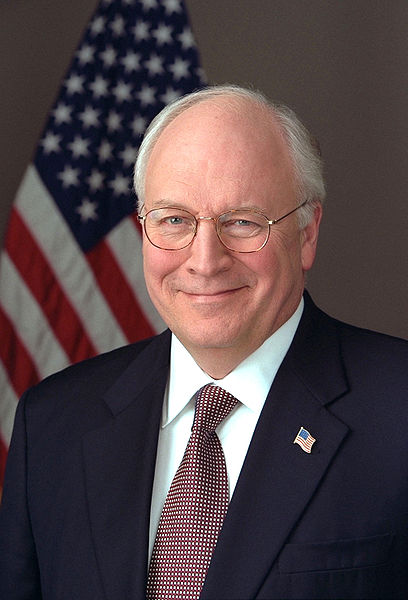
Dick Cheney Prepares to Fearmonger Again on Aluminum Tube Day

Richard_Cheney_2005_official_portraitOn September 8, 2002, the paper copy of the NYT published this story:

More than a decade after Saddam Hussein agreed to give up weapons of mass destruction, Iraq has stepped up its quest for nuclear weapons and has embarked on a worldwide hunt for materials to make an atomic bomb, Bush administration officials said today.

In the last 14 months, Iraq has sought to buy thousands of specially designed aluminum tubes, which American officials believe were intended as components of centrifuges to enrich uranium. American officials said several efforts to arrange the shipment of the aluminum tubes were blocked or intercepted but declined to say, citing the sensitivity of the intelligence, where they came from or how they were stopped.

The diameter, thickness and other technical specifications of the aluminum tubes had persuaded American intelligence experts that they were meant for Iraq’s nuclear program, officials said, and that the latest attempt to ship the material had taken place in recent months.

Scooter Libby’s grand jury testimony strongly suggested Condi Rice was one source for the article. On the 8th, Rice and Dick Cheney took to the Sunday shows to fearmonger in support of war on Iraq, citing back to the NYT article.

”From a marketing point of view,” Andy Card boasted of his PR approach once, ”you don’t introduce new products in August.”

Which is why Aluminum Tube Day is such a wonderful time to roll out a war: one of the first days in September after everyone has returned from their Labor Day holidays.

Admittedly, the fearmongers are already heavily pushing propaganda, using some of the same tired tactics. They’re even getting National Defense University professors to attack the experts supporting — or even just demanding necessary underlying details before condemning — the Iran deal. With more and more Democratic senators announcing support for the Iran deal, Aluminum Tube Day may well be too late to fearmonger this deal.

Screen Shot 2015-08-24 at 12.37.20 PM

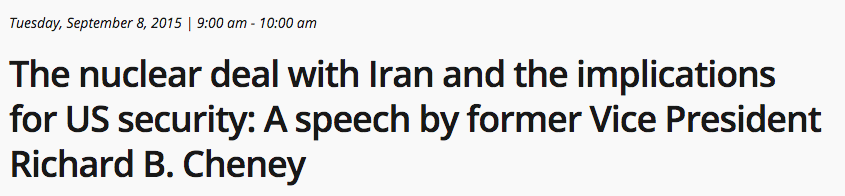
But that won’t stop Dick Cheney (and his fellow Iraq War shill Danielle Pletka) from celebrating Aluminum Tube Day by fearmongering again at American Enterprise Institute.

How will you celebrate the 13th anniversary of the kick-off of Iraq War fearmongering?


Share this entry

On Hiroshima Anniversary, Iran Deal Opponents Make One More Push Based on Parchin Photos

Hiroshima was flattened by the US on August 6, 1945 by the deployment of a nuclear weapon.

Hiroshima was flattened by the US on August 6, 1945 by the deployment of a nuclear weapon. (Wikimedia Commons)

Seventy years ago today, on August 6, 1945, the US dropped an atomic bomb on Hiroshima, Japan. By November of that same year, approximately 130,000 people were dead because of that single bomb, which targeted a civilian population. Three days later, the US deployed a second nuclear weapon in Nagasaki. It appears that these horrific weapons were not needed, despite the prevailing myth surrounding their use. Even with the subsequent proliferation of nuclear weapons, the US remains the only country to have ever used them outside a testing scenario, while countries as unstable as North Korea and Pakistan have achieved nuclear weapons capability at some level.

As might be expected, Japan’s Prime Minister Shinzo Abe is using the occasion of this anniversary to call for an end to nuclear weapons. Last week, Javad Zarif made an excellent move, in suggesting that now that Iran has signed an agreement with the P5+1 group of countries on its nuclear technology, there should be a push to remove nuclear weapons and all WMD from the Middle East. Recall that Iran has agreed to the most intrusive inspections regime ever put into place in a country that didn’t first lose a war, making their call for inspections of Israel’s nuclear weapons program especially strong. These two calls together represent an appeal to those who prefer peace over war while placing the highest possible value on civilian lives.

That attitude of favoring peace over war and putting civilians first stands in stark contrast to those who oppose the Joint Comprehensive Plan of Action signed by the P5+1 and Iran. As Barack Obama pointed out yesterday, those who are opposing the deal are the same people who were so tragically wrong about the decision to invade Iraq in 2003:

President Obama lashed out at critics of the Iran nuclear deal on Wednesday, saying many of those who backed the U.S. invasion of Iraq now want to reject the Iran accord and put the Middle East on the path toward another war.

/snip/

While calling the nuclear accord with Iran “the strongest nonproliferation agreement ever negotiated,” Obama also seemed to turn the vote on the deal into a referendum on the U.S. invasion of Iraq a dozen years ago, a decision he portrayed as the product of a “mind-set characterized by a preference for military action over diplomacy.”

Obama said that when he first ran for president, he believed “that America didn’t just have to end that war. We had to end the mind-set that got us there in the first place.” He added that “now, more than ever, we need clear thinking in our foreign policy.”

One of the saddest aspects of this push for war over diplomacy is that much of it comes from deep within the US government itself. In many of my posts on the path to the P5+1 accord with Iran, I have noted the nefarious process of anonymous “disclosures” coming sometimes from “diplomats” and sometimes from “intelligence sources” that get transcribed into the press by a small handful of “reporters”. Usually the worst offender on this front is George Jahn of AP. A recent retiree from this fold is Fredrik Dahl who now, ironically, appears to be the primary press contact for the IAEA. But never fear, rushing into the void created by the departure of Dahl (or perhaps his insertion into an operative role further inside the apparatus), we have the dynamic duo of Eli Lake and Josh Rogin. Their blather being put out as “journalism” is not worthy of a link here. If you want to find it, try going to Marcy’s Twitter and searching for “not The Onion”.

Of course, the high point of this process of manufacturing nuclear charges against Iran and then getting them into the media is the notorious “laptop of death“. Running a close second, though, are the charges that Iran has engaged in developing a high explosives trigger device at the Parchin site. Showing that those who engage in this level of deceit have absolutely no pride, the charges of this work have proceeded despite an equally plausible explanation that the high explosives chamber could just as easily have been used to develop nanodiamonds. Further, those making these charges have allowed themselves to be baited into a ridiculous level of “analysis” of satellite photos of the site, with hilarious results from how Iran has played them.

Despite this level of embarrassment, one of the primary tools in this process, David Albright, couldn’t resist one last try on the satellite photo front. Yesterday, he breathlessly informed us that there are a couple of new sheds on the Parchin site and there is even some debris. And, get this, a crate has been moved! Seriously, here is the “meat” of Albright’s analysis (pdf): Read more

Share this entry