SignalGate: “This Chat’s Kinda Dead”

DOD IG has released the unclassified version of the report confirming what was clear months ago: Whiskey Pete Hegseth has no business leading DOD.

He was wildly uncooperative with the investigation, refusing to be interviewed, refusing to let DOD inspect his phone, refusing to turn over other threads.

But Whiskey Pete may not look quite as stupid as JD Vance.

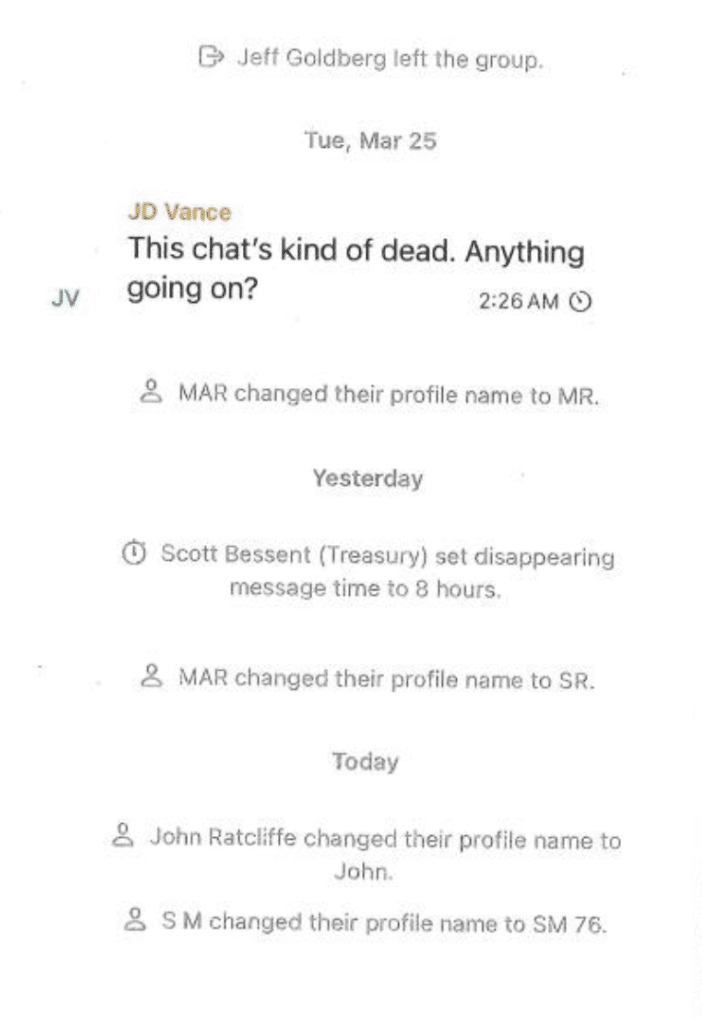
You see, Whiskey Pete turned over the Signal chat that was left on his phone after all the autodeleting these scofflaws had been doing. Most of the thread was gone. But there was a single text that post-dated Jeffrey Goldberg’s departure from the list, something the Deputy General Counsel used to suggest the Atlantic thread might not be reliable (a claim DOD IG refused to put in the body of the report because, some people still refuse bullshit).

After Jeff Goldberg left the group, JD Vance said, “This chat’s kind of dead. Anything going on?”

One after another participant on the thread changed their ID, perhaps in hopes … I don’t know what they fuck they were thinking.

These are dumb people.

No one more so, though, than JD.

Share this entry

Four Shots at an Unarmed Boat in Uncontested Waters

Twenty-eight paragraphs into the story that first focused attention on the murder Pete Hegseth ordered back in September (though as it notes, Nick Turse first revealed the second shot just days after the attack) is this revelation: it took four strikes to kill first the people then destroy any debris from the targeted boats.

The boat in the first strike was hit a total of four times, twice to kill the crew and twice more to sink it, four people familiar with the operation said.

It took the most powerful military in the history of the world four shots the get the job done.

One.

Two.

Three.

Four.

That fact lies at the core of a whole bunch of other senselessness about Trump’s feckless rule. There’s Trump’s release of Juan Orlando Hernández, a proven high-level threat, even as forces that normally prevent turbulence in the Middle East gather off of Venezuela’s oil fields. There’s the many ways, starting with the destruction of USAID and definitely including Trump’s trade war, that has added to global instability. There’s the cost involved in drone-striking small boats. There’s the neutering of legal advisors who might have saved Admiral Frank Bradley from being underbussed by the guy who promoted him. There’s the pretend press corps filled with nutballs and cranks that ensures that Whiskey Pete will never be challenged with actual knowledge.

But at root, you’ve got Pete Hegseth sitting atop that most powerful military boom boom boom boom, treating it like a children’s game.

And he doesn’t realize that on this, his first attempt, and twice more after that, the most powerful military in the history of the world could not take out an unarmed boat in uncontested waters with one shot.

Donald Trump thinks murderboats make him look strong (though the video he released of this one hid that it took four shots to get the job done).

Pete Hegseth thinks murderboats make him look strong.

But holy hell, can we talk about how feckless the reality is?

Update: This timeline of the conflicting things Trump and his minions have said about the September 2 strike is useful.

Share this entry

On Eve of Illegal Venezuelan Invasion, Pete Hegseth Utterly Destroys His Ability to Lead It

I think the trajectory of the last few weeks has been lost in the serial disclosures, so I want to summarize them here.

Mark Kelly and five other Democrats made a video reminding service members they can refuse illegal orders

On November 18, Elissa Slotkin released a video in which she and five other former military or intelligence officers — Mark Kelly, Chris DeLuzio, Maggie Goodlander, Chrissy Houlahan, and Jason Crow — reminding that they can refuse illegal orders.

One of the tactics Republicans chose to use in response was to demand that the members of Congress describe what illegal orders had been given.

An even stupider tactic was to move to prosecute the six, in Kelly’s case (because his retirement makes him susceptible to such a thing), threatening to withdrawn him from retirement to courtmartial him.

Trump and Pete Hegseth chose to give Kelly, a genuine hero, likely presidential candidate, and far more of a man than either of them, a bigger platform and fundraising draw.

WaPo publishes the first double tap story

The video from the six Democrats was likely focused on orders to target Americans, not Venezuelans (or Colombians or Trinis, all of whom have been targeted in the murderboat strikes); it specifically describes that the Trump Administration is pitting the military and intelligence community against American citizens.

But then WaPo described Pete Hegseth — verbally — giving the quintessential illegal order.

The longer the U.S. surveillance aircraft followed the boat, the more confident intelligence analysts watching from command centers became that the 11 people on board were ferrying drugs.

Defense Secretary Pete Hegseth gave a spoken directive, according to two people with direct knowledge of the operation. “The order was to kill everybody,” one of them said.

A missile screamed off the Trinidad coast, striking the vessel and igniting a blaze from bow to stern. For minutes, commanders watched the boat burning on a live drone feed. As the smoke cleared, they got a jolt: Two survivors were clinging to the smoldering wreck.

The Special Operations commander overseeing the Sept. 2 attack — the opening salvo in the Trump administration’s war on suspected drug traffickers in the Western Hemisphere — ordered a second strike to comply with Hegseth’s instructions, two people familiar with the matter said. The two men were blown apart in the water.

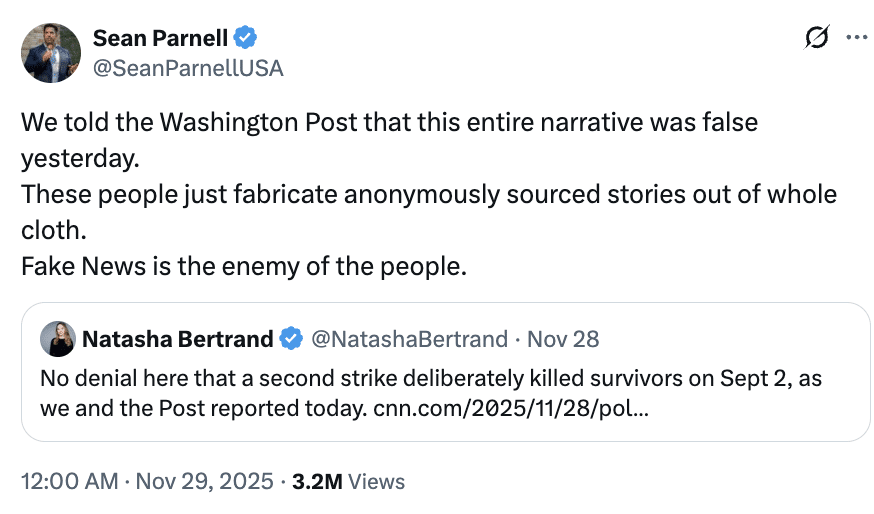
The initial response to this was the same tactic that has gotten Trump where he is: to attack the press, claiming it was fake.

Trump promises to pardon Juan Orlando Hernández, destroying pretext for war

Meanwhile, Trump totally undercut the premise behind over a year of targeting Venezuela.

There were always problems with Trump’s pretense for the murderboats and planned Venezuelan invasion, which is that Venezuela’s government leads a cartel of narcotraffickers that amounts to an invasion of the United States.

At first, Stephen Miller’s bullshit about Venezuela was rooted in false claims about Tren de Aragua. Perhaps because the Intelligence Community publicly debunked those claims (but not before Miller relied on his bullshit to send 200 mostly-innocent men to a concentration camp, where they were tortured), Miller moved onto a new predicate. Nicolás Maduro wasn’t in charge of Tren de Aragua, Miller decided; he was in charge of Cartel de los Soles.

Tren de Aragua at least exists, albeit not in anywhere near the numbers of slumlord residents as Miller has claimed. It’s not at all clear CdlS does. Plus, if it does exist, it traffics in cocaine, not fentanyl, the claimed invading drug that justifies treating drug trafficking as war (almost no right wing Senators understand this problem, which would be hilarious if it weren’t about to become the new Yellowcake).

But then Trump promised to pardon former Honduran President Juan Orlando Hernández, who actually did what Trump claims Maduro is doing, who was convicted of it, who was sentenced to decades in prison.

You cannot credibly claim to give a fuck about drug trafficking when you’re freeing major traffickers. I mean, Trump doesn’t care, but the men and women risk their lives and their liberty have to attend to the likelihood they’ll be left holding the bag for Trump’s crimes.

White House concedes the double tap but defends Hegseth

Then, as Congress — led by Senate Armed Services Committee Chair Roger Wicker — begins to investigate the operation, demanding the full video of the strike and testimony from those involved, and as legal experts made it clear that this was not just a war crime, but murder, the White House changed tack. Trump knew nothing, wouldn’t have wanted it to happen, but in fact it did happen but Pete Hegseth didn’t give the order.

While NYT was publishing a story laundering Hegseth’s claims (that he did not specifically order the murder), WaPo was back with quotes from service members recognizing that Hegseth had begun underbussing his subordinates, especially Admiral Frank Bradley.

“This is ‘protect Pete’ bulls—,” one military official, who, like others, spoke on the condition of anonymity to discuss internal conversations, told The Post.

Leavitt’s statement “left it up to interpretation” who was responsible for the second strike that killed the two survivors, a separate military official said, imploring the White House to provide clarity on the issue.

One official said of Leavitt’s statement, “It’s throwing us, the service members, under the bus.” Another person said some of Hegseth’s top civilian staff appeared deeply alarmed about the revelations and were contemplating whether to leave the administration.

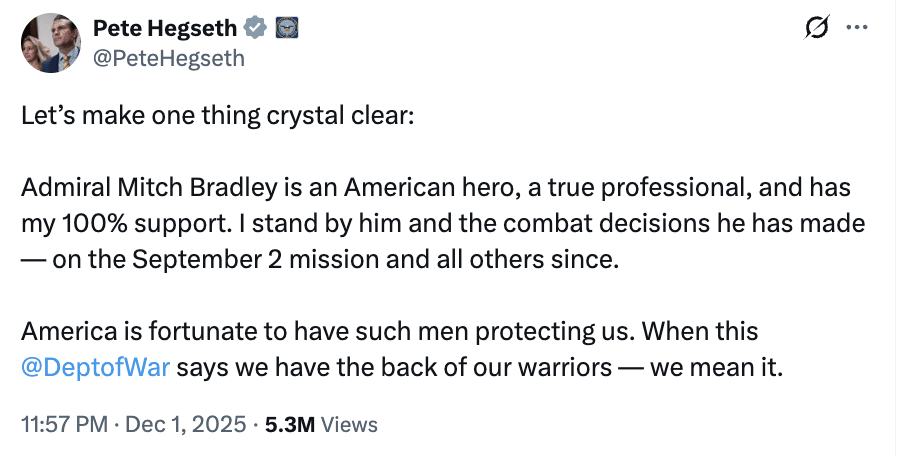
Hegseth, writing on social media Monday night, said he stands by the admiral “and the combat decisions he has made — on the September 2 mission and all others since.” His statement is likely to deepen the sense of furor among military officials who suspect Hegseth is attempting to insulate himself from any legal recourse and leave Bradley — whom the secretary called “an American hero, a true professional” — to account for the fallout alone.

Whiskey Pete even posted a tweet claiming to have Bradley’s back while emphasizing that Bradley made the decision.

CIA’s disavowal of Rahmanullah Lakanwal

This comes amid several reports that Rahmanullah Lakanwal, the accused killer of two National Guard members last week, had done terrible things for the CIA, but then was abandoned by John Ratcliffe’s CIA before declining into bouts of depression in advance of the attack.

The struggles to start over, leave the war behind, and find work were ever present. Lakanwal was fired from his job at a laundromat because he lacked a work authorization card despite being approved for asylum and authorized to work by the Trump administration, according to his former unit mate, who fought alongside him for more than a decade.

[snip]

About a month ago, Lakanwal told his unit mate that his inability to work due to missing immigration paperwork meant his family couldn’t afford rent or food. He resorted to borrowing money from friends and former unit members, and during the conversation, he broke down in tears from frustration and desperation, his unit mate said.

“Every time, like looking [for] somebody [to] help for documents, somebody [to] help for pay the rent, he’s not going to work,” the Afghan unit mate said.

His unit mate said Lakanwal sought help in June from a CIA program designed to aid Zero Unit veterans with immigration issues. Rolling Stone reviewed a screenshot of the group chat in June where Zero Unit veterans shared information with a CIA representative about ongoing issues. Lakanwal posted messages asking for help. His last post went unanswered and was deleted by the chat’s administrator.

None of this excuses the killing. It just makes clear that Lakanwal is one of thousands of men damaged by America’s war on terror who needs — in this case, needed — help before something terrible happens. Nigel Edge, the former Marine sniper who shot up a club from his boat in Cape Fear in September, is another one.

Mark Kelly models leadership

Meanwhile, precisely because Trump and Hegseth chose to attack Kelly, he was able to stage a press conference for little other reason than to attack Trump and Hegseth’s leadership failures.

That included addressing the double tap, in which he mostly deferred to investigations, but still upheld the import of international law.

We don’t know how all this will end.

What we do know is that, in advance of a likely demand that service members do something patently illegal, Pete Hegseth has made it clear he’ll sacrifice everyone to save himself.

Share this entry

Murder

In the last few days, we’ve got allegations of murder against two men who worked in counterinsurgency in Afghanistan, Whiskey Pete Hegseth and Rahmanullah Lakanwal.

We don’t yet know why Lakanwal drove from Bellingham, WA, across the country, to allegedly ambush two members of the West Virginia National Guard, Sarah Beckstrom and Andrew Wolfe. Spencer Ackerman noted that if Lakanwal came to the US committed to terrorism, he learned that commitment — and a great deal of military skills — from Americans.

[T]he most sobering fact about Wednesday’s slayings is that the alleged killer, Rahmanullah Lakanwal, was all too compatible with Western Civilization.

CIA Director John Ratcliffe issued an extraordinary statement revealing that the 29-year-old Lakanwal was a “member of a partner force in Kandahar.” While a knowledgeable source with deep experience in Afghanistan cautions that the US sponsored a variety of proxy forces in southern Afghanistan, much additional reporting has identified Lakanwal as a member of the Zero Units, death squads used by the CIA during the US’s longest overseas war.

In other words, contrary to Miller and Trump, Lakanwal’s shooting spree is not the result of importing Afghan culture to America. While much will surely be revealed in Lakanwal’s upcoming trial, it looks more like the result of importing American culture to Afghanistan. The realities of blowback – the violence America experiences as the unintended consequences of the violence of US foreign policy – are what the US needs to examine in the wake of this horrifying murder if it expects to prevent the next one.

But even Ackerman doesn’t consider the possibility that something happened since — quite possibly in the last year, as Trump keeps dicking around allies of all sorts who’ve helped the United States in the past — that led Lakanwal to drive across the country only to target members of the Guard who had been uprooted from their homes to avenge Ed “Big Balls” Coristine.

The list of Republican governors who will uproot Guardsmen from their home, family, and (for many of them) regular jobs to go to DC continues to grow:

  • Ohio Governor Mike DeWine
  • South Carolina Governor Henry McMaster
  • West Virginia Governor Patrick Morrisey
  • Tennessee Governor Bill Lee
  • Mississippi Governor Tate Reeves
  • Louisiana Governor Jeff Landry

All of these men believe protecting Big Balls is a higher priority than protecting their own constituents.

How soon we forget that the entire reason why Trump invaded DC is that Ed “Big Balls” Coristine, one of the DOGE boys hired by the richest man in the world to snoop through the private heath and social security data of Americans, got beat up by unarmed teenagers?

Contrary to what Trump and his propagandists keep squealing, Lakanwal was vetted over and over again.

The Afghan national accused of shooting two National Guard members near the White House this week underwent thorough vetting by counterterrorism authorities before entering the United States, according to people with direct knowledge of the case.

Rahmanullah Lakanwal, 29, arrived in the U.S. through Operation Allies Welcome (OAW), a Biden-era program that helped resettle Afghan nationals after the U.S. military withdrawal from Afghanistan in 2021.

[snip]

A key question from critics has been whether any evacuees managed to enter the U.S. without proper vetting. Lakanwal, however, would not have been among them, according to the individuals, who requested anonymity because of the sensitivity of the investigation. One of the individuals said Lakanwal was vetted years ago, before working with the CIA in Afghanistan, and then again before he arrived in the U.S. in 2021. Those examinations involved both the National Counterterrorism Center as well as the CIA, the person said.

Lakanwal was also granted asylum earlier this year, a process that would have brought its own scrutiny, according to #AfghanEvac, a coalition that supported the relocation effort — an assertion the White House did not dispute.

But no amount of vetting can forestall every awful possibility of violence.

Similarly, we can’t even say what led our Crusader-tatted Secretary of Defense to personally order the murder of two men who survived the first murderboat operation on September 2.

Defense Secretary Pete Hegseth gave a spoken directive, according to two people with direct knowledge of the operation. “The order was to kill everybody,” one of them said.

A missile screamed off the Trinidad coast, striking the vessel and igniting a blaze from bow to stern. For minutes, commanders watched the boat burning on a live drone feed. As the smoke cleared, they got a jolt: Two survivors were clinging to the smoldering wreck.

The Special Operations commander overseeing the Sept. 2 attack — the opening salvo in the Trump administration’s war on suspected drug traffickers in the Western Hemisphere — ordered a second strike to comply with Hegseth’s instructions, two people familiar with the matter said. The two men were blown apart in the water.

Trump claims these murderboat operations combat drug trafficking. That was always suspect. Not only are many of the people killed at most low-level shippers, but killing traffickers was less useful than capturing them.

And Trump’s promise to pardon former President of Honduras, Juan Orlando Hernández, who was a major drug trafficker, suggests Trump is not so much opposed to drug trafficking, he just wants a cut.

What we do know about Hegseth, the man who ordered defenseless men to be murdered, is that the Fox News host repeatedly failed efforts to vet him — first when he was excluded from defending the Capitol after January 6, and then the multiple warnings of abuse, incompetence, and addiction reviewed during his confirmation process.

And so it was that Pete Hegseth happily uprooted Sarah Beckstrom from her home to serve as a prop for Trump’s authoritarian theater, where she was as predicted, targeted.

[M]ilitary commanders had warned that their deployment represented an easy “target of opportunity” for grievance-based violence. The troops, deployed in an effort to reduce crime, are untrained in law enforcement; their days are spent cleaning up trash and walking the streets in uniform. Commanders, in a memo that was included in litigation challenging the high-visibility mission in D.C., argued that this could put them in danger. The Justice Department countered that the risk was merely “speculative.” It wasn’t. There are costs to performatively deploying members of the military—one of which is the risk of endangering them.

Hegseth kept Beckstrom deployed even after Judge Jia Cobb ruled, six days before Beckstrom was shot, that state governors, including WV’s Patrick Morrisey, don’t have the authority to send their Guard to DC without being invited by DC.

[T]he out-of-state National Guards are likely operating in the District in a manner contrary to law. Under section 502(f), state law defines the permissible use of the National Guard under state control—i.e., which missions the governors can order their units to conduct. Here, the state governors whose units are currently operating in the District lack authority to order these missions because the District has not properly sought their aid under D.C. law and the EMAC.

This vetting failure, Pete Hegseth, happily obeyed Trump’s order to bring even more Guard troops to DC, whose mission of “crime deterrence and passive patrolling” will now require more Metropolitan Police Department effort to protect the Guard from being targeted again.

Two alleged murderers brought demons with them from Afghanistan to the US. Both together got a young woman with all her dreams and life ahead of her killed.

And yet we’re not removing the more obvious vetting problem to prevent further disasters.

Share this entry

Without a Doubt, Worse than Nixon

[NB: check the byline, thanks. /~Rayne]

On March 18, 1969, the U.S. military launched a secret program authorized by then-president Richard Nixon. Code named Operation Menu, the U.S. bombed targets in Cambodia until May 26, 1970.

The program was never authorized by Congress; information about the bombings were withheld from both Congress and the American public.

It was a gross abuse of executive power and the basis for drafting an Article of Impeachment against Nixon. The article did not receive adequate support in Congress because a number of members of Congress felt they had not done enough to restrain Nixon with regard to the Vietnam War, and public opinion had not yet shifted firmly against Nixon because of the Watergate scandal.

Three of six Articles of Impeachment did receive approval, however; the unauthorized bombing of Cambodia emphasized the abuses of power delineated in the approved articles.

Fortunately for Nixon, Republican members of Congress took him aside and told him they had the votes to impeach and remove him if he didn’t resign. Nixon resigned on August 9, 1974, avoiding hearings and heightened scrutiny of his abuses of his office.

Donald Trump authorized the bombing of Iran. His secretary of defense did not restrain him by requiring an Authorization for Use of Military Force. Neither of them made much effort to keep the mission secret as it launched Saturday as Trump posted about it to his personal Truth Social account.

Congress was not informed of the operation in order to debate an AUMF. Congress received testimony from Trump’s director of national intelligence Tulsi Gabbard on March 25 in front of the Senate Intelligence Committee, in which she said,

… The IC continues to assess that Iran is not building a nuclear weapon and Supreme Leader Khamenei has not authorized the nuclear weapons program that he suspended in 2003. The IC continues to monitor closely if Tehran decides to reauthorize its nuclear weapons program.

In the past year, we have seen an erosion of a decades-long taboo in Iran on discussing nuclear weapons in public, likely emboldening nuclear weapons advocates within Iran’s decision-making apparatus. Iran’s enriched uranium stockpile is at its highest levels and is unprecedented for a state without nuclear weapons. …

There were exchanges with the media and public between the administration about Gabbard’s statement regarding the enriched uranium stockpile. If the status of that stockpile had changed with a firm move toward arming a weapon occurred, there has been no effort to communicate that with the Senate Intelligence or Armed Services Committees.

The American public was lied to by Trump who announced this past Thursday, “Based on the fact that there’s a substantial chance of negotiations that may or may not take place with Iran in the near future, I will make my decision whether or not to go within the next two weeks.”

Trump waffled publicly about U.S. military action against Iran, saying, ““You don’t know that I’m going to even do it,” Trump told one reporter. “I may do it. I may not do it. Nobody knows what I’m going to do. … “ I have ideas as to what to do, but I haven’t made a final [call] … I like to make a final decision one second before it’s due, you know?”

Trump failed to request approval from Congress before making that final call some time between Thursday and Saturday.

It’s possible the call had already been made and Trump’s apparent indecision was a head fake. An analyst with Haaretz seemed to think this was a possible strategy. EDIT: The Atlantic published an article at 12:29 a.m. ET Sunday in which they reported Trump had already decided to bomb Iran on Wednesday, before his public statement about a two-week window of decision.

Head fake or no, Trump violated the Constitution’s Article I, Section 8 which grants Congress the power to declare war. It is not a power granted to the executive who “shall take Care that the Laws be faithfully executed” under Article II, Section 3.

Trump has already repeatedly failed under the Take Care clause. This first strike against Iran conducted without Congressional approval should be a road too far.

The blowback from this may be enormous, beginning with global economic effects due to instability in the fossil fuels market and may include terrorist or overt military strikes against U.S. targets, perhaps by way of surrogate networks Gabbard also testified about on March 25.

Trump is without a doubt worse than Nixon. He should be impeached — again, yes — and this time removed from office.

Share this entry

There are Heroes, and Then There are Heroes

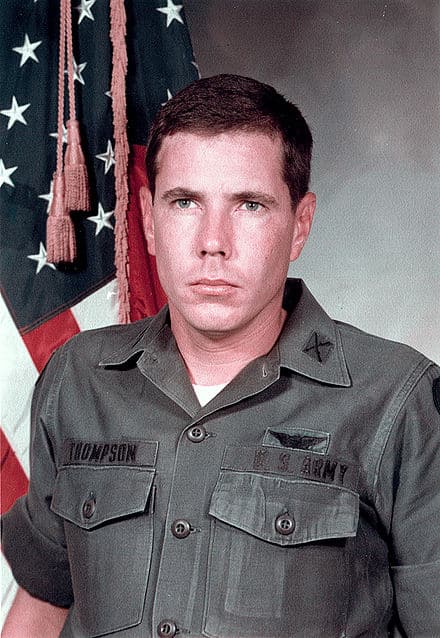
Hugh Thompson, Jr.

Memorial Day has its roots in the US Civil War, and has expanded to include remembrance of all those who have served their country and have died. In various places, the remembrance may focus on a particular conflict, like the Civil War and Carbondale, IL. It might also center on a location, like Arlington Cemetery or the Pearl Harbor Memorial. It might focus on recipients of the Medal of Honor. In a lot of places, Memorial Day is a big deal.

But on this Memorial Day, with the protests on college campuses in the US and around the world related to the unfolding events in Gaza and the West Bank, my thoughts go to Hugh Thompson, Jr., Glenn Andreotta, and Lawrence Colburn. They were three members of the US Army, who received the Soldiers Medal on March 6, 1998 for their actions 30 years earlier as they flew a mission on March 16, 1968.

Thompson commanded a observation helicopter at the time, tasked with locating enemy firing positions and then directing US forces in response. As their helicopter came over the village of My Lai, they observed no enemy fire, but were shocked to see US military forces killing obvious Vietnamese civilians. At one point, Thompson maneuvered his helicopter between civilians and US forces on the ground, so as to protect the Vietnamese civilians, and he ordered Colburn, his door gunner, to open fire on the US forces if they tried to prevent him from protecting the civilians. Colburn, without hesitation, concurred. Andreotta, the crew chief, was shocked to see the atrocities committed by US forces, and helped locate other civilians who had been shot and needed medical care. As Thompson described it,

Glenn Andreotta—if there was a hero, I don’t like that word, but if there was a hero at My Lai—it was Glenn Andreotta, because he saw movement in that ditch, and he fixed in on this one little kid and went down into that ditch. I would not want to go in that ditch. It’s not pretty. It was very bad. I can imagine what was going through his mind down there, because there was more than one still alive—people grabbing hold of his pants, wanting help. “I can’t help you. You’re too bad [off].” He found this one kid and brought the kid back up and handed it to Larry, and we laid it across Larry and my lap and took him out of there. I remember thinking Glenn Andreotta put himself where nobody in their right mind would want to be, and he was driven by something. I haven’t got the aircraft on the ground real stable. He bolted out of that aircraft into this ditch. Now he was a hero. Glenn Andreotta gave his life for his country about three weeks later. That’s the kind of guy he was, and he was a hero that day.

For their actions in 1968, Thompson. Andreotta, and Colburn received the Soldier’s Medal, given to “any person of the Armed Forces of the United States or of a friendly foreign nation who, while serving in any capacity with the Army of the United States, including Reserve Component soldiers not serving in a duty status at the time of the heroic act, distinguished himself or herself by heroism not involving conflict with an enemy.”

That last phrase — not involving conflict with an enemy — is central to why these three received the Soldier’s Medal and not the Medal of Honor.

Thompson’s medal was awarded with this description:

Soldier’s Medal, Hugh C. Thompson, Jr., then Warrant Officer One, United States Army:

For heroism above and beyond the call of duty on 16 March 1968, while saving the lives of at least 10 Vietnamese civilians during the unlawful massacre of noncombatants by American forces at My Lai, Quang Ngai Province, South Vietnam. Warrant Officer Thompson landed his helicopter in the line of fire between fleeing Vietnamese civilians and pursuing American ground troops to prevent their murder. He then personally confronted the leader of the American ground troops and was prepared to open fire on those American troops should they fire upon the civilians. Warrant Officer Thompson, at the risk of his own personal safety, went forward of the American lines and coaxed the Vietnamese civilians out of the bunker to enable their evacuation. Leaving the area after requesting and overseeing the civilians’ air evacuation, his crew spotted movement in a ditch filled with bodies south of My Lai Four. Warrant Officer Thompson again landed his helicopter and covered his crew as they retrieved a wounded child from the pile of bodies. He then flew the child to the safety of a hospital at Quang Ngai. Warrant Officer Thompson’s relayed radio reports of the massacre and subsequent report to his section leader and commander resulted in an order for the cease fire at My Lai and an end to the killing of innocent civilians. Warrant Officer Thompson’s Heroism exemplifies the highest standards of personal courage and ethical conduct, reflecting distinct credit on him, and the United States Army.

Thompson and his crew did not act against a foreign enemy, but against members their own US military. The Soldier’s Medal, therefore, was as high an honor as they could receive — but the fact that it took 30 years for the DOD to admit that they deserved it is a stain on the US military. (Stars and Stripes has a great writeup of My Lai and the aftermath, written at the death of Larry Colbrun – the last of the three heroes, and it includes the push it took to get the DOD to award these medals.)

All this came back to mind as I read a Guardian piece yesterday about a prison camp run by the Israel Defense Force:

Prisoners held at an Israeli detention camp in the Negev desert are being subjected to widespread physical and mental abuses, with at least one reported case of a man having his limb amputated as a result of injuries sustained from constant handcuffing, according to two whistleblowers who worked at the site.

The sources described harrowing treatment of detainees at the Israeli Sde Teiman camp, which holds Palestinians from Gaza and suspected Hamas militants, including inmates regularly being kept shackled to hospital beds, blindfolded and forced to wear nappies.

According to the two sources, the facility, located approximately 18 miles from the Gaza border, consists of two distinct sections: an enclosure where up to 200 Palestinian detainees from Gaza are confined under severe physical restrictions inside cages, and a field hospital where dozens of patients with war injuries are handcuffed to their beds and often deprived of pain relief.

One whistleblower, who has worked in the facility as a prison guard, said detainees were forced to stand up for hours, or to sit on their knees. The source, who spoke out at risk of reprisals, said several detainees were beaten with truncheons and not able to move their heads or to speak at the facility.

“The prisoners are detained in a sort of cages, all blindfolded and handcuffed,” the source said. “If someone speaks or moves, they are immediately silenced or they are forced to stand with their hands raised above their head and handcuffed for up to one hour.

“If they are unable to keep their hands raised, the soldiers attach the handcuffs to the bars of the cage. Many of the detainees had infected wounds that were not being properly treated.”

[snip]

The prison guard’s statements are corroborated by a second whistleblower who spoke to the Guardian and who was part of the medical staff operating in the field hospital in Sde Teiman.

“There were about 15 patients in total, they were all handcuffed and blindfolded,” he said. “They were naked, wearing diapers and were covered by blankets. Most of them appeared to have obvious war injuries, some had undergone amputations and others underwent major abdominal or chest surgery. They were practically naked except for a diaper.”

The member of the medical staff added: “I understand that it is difficult to treat a patient accused of heinous crimes, but it is the job we have chosen and as physicians we should recognise that every human being has a right to appropriate healthcare regardless of their backgrounds.”

There’s a lot packed into that article, and the link under “the facility” in the excerpt above is a big deal. It goes to the Association for Civil Rights in Israel, which says this about the conditions in this camp (emphasis in the original):

The testimonies of innocent people held in the Sde Teiman Military Base and released after being interrogated painted a horrifying picture of inhumane prison conditions, humiliation and torture. The detainees are held in a kind of cage, crowded, sitting on their knees in a painful position for many hours every day. They are handcuffed at all hours of the day and blindfolded. This is how they eat, relieve themselves and receive medical care.

Detainees at the facility were physically punished by tying them to a fence for hours with their hands raised. Those whose hands were tired and took them down were beaten. In addition, soldiers at the facility beat detainees, extinguished cigarettes on them, urinated on detainees, and deprived them of food, toilets, and sleep. Additional evidence of the inhumane conditions in the detention facility arises from requests from doctors, who serve in the hospital established at the base, for the purpose of treating detainees. They testify that detainees’ arms and legs are routinely amputated due to handcuffed wounds, lack of medication, inadequate medical care, violence suffered by detainees, and lack of food.

I have no complaints about those who have received the Medal of Honor for their heroic actions in the face of enemy fire. But folks like the heroes of My Lai and the anonymous guard and medic at Sde Teiman publicly confirming what released prisoners have said about the actions of the Israeli Defense Force are even more heroic. It’s one thing to stand up to “the enemy,” but standing up to your brothers and sisters in arms when they violate basic humanitarian norms — putting your own bodies in the path of their weapons — is truly amazing.

Enjoy your BBQ this weekend — a tradition that has been part of Memorial Day since the beginning (at least in Carbondale) — and a raise a glass to Thompson, Andreotta, Colburn, and all those who defend civilians, even in the midst of war.

Because that’s when civilians are most in need of protection.

Share this entry

The Biden Administration Staved Off Russia’s First Round of InfoWar on Ukraine, But How about the Second?

As I’ve noted (most recently in my series on Jeff Gerth’s error-ridden screed about “Russiagate” [sic]), Russian denialists cling to the John Solomon report, from the period when he and Rudy Giuliani were chumming up people like Dmitry Firtash, that Konstantin Kilimnik was really a State Department source, which — they fancy — proves he was not a Russian spy.

The actual communications between Kilimnik and people at State show him attempting to stovepipe shoddy propaganda to his State contacts, not offering useful information.

But a potentially more telling example of Kilimnik’s contacts with State are his description, after going out to drinks with John Kerry’s then-Chief of Staff, Jonathan Finer, just before Klimnik traveled to New York to meet with Paul Manafort about the election, that “Finer or whatever the fuck is his name,” was, “In total space.”

On the evening of May 6, 2016, Kilimnik’s communications suggest he met for “off the record” drinks with Department of State employees.368 Kilimnik was frustrated by this meeting, stating that he met “Finer or whatever the fuck is his name. In total space.”369

Patten said he understood “[i]n total space” to mean “in outer space” and.therefore not well informed on issues involving Ukraine. Patten Tr., p. 79; FBI, FD-302, Patten 5/22/2018.

In 2016, Paul Manafort’s handler was pissed that Finer wasn’t buying his bullshit about Ukraine.

Which is why I find these passages, from Politico’s oral history of the events leading up to Russia’s expanded invasion of Ukraine, a good place to start reading it. Finer — now Biden’s Deputy National Security Adviser — described bringing allies around to preparing for Russia’s attack by “bombarding them” with so much information they could no longer ignore evidence of Russia’s likely attack.

AMANDA SLOAT: It got to the point where we had to say to the Europeans, “Fine, we can agree to disagree analytically, but let’s start planning as if we are right. If we are right, then we’re in a good place because we’ve got all our planning. If you’re right, that’s the best possible outcome because then there’s not going to be an invasion — at best, this will have just been a waste of time.”

JON FINER: We eventually brought people around by bombarding them with information that you could not ignore.

More importantly, Finer — the guy who, Kilimnik scoffed, was “in total space” about Ukraine — described how Biden’s team preempted Russia’s efforts to use disinformation to justify their attack.

JON FINER: There was a very high likelihood that Russia would use disinformation — which is a fancy word for lies — to create some pretext for invading. By putting out information well in advance of their inevitable attempts to create this justification, we thought that we would be able to discredit any attempt by Russia to portray this as a just war.

If you haven’t already, I highly recommend you set some time aside to read the whole thing. It’s a remarkable account of American efforts to do what’s right.

It’s also an expression of the auspicious collection of people in place for the fight against Ukraine. At various times, I’ve thought about how lucky the US was to have lifelong diplomat Bill Burns at CIA, to have no-drama Avril Haines at DNI, to have an expert like Tony Blinken at State. This piece provides a glimpse of how well they all worked together, little over a year after taking over from the shambolic Trump Administration.

As Burns — who spent over thirty years at State — described, this is the way government is supposed to work.

BILL BURNS: It’s the way government should work, in my opinion. The president set a very clear sense of direction. There was a shared understanding of the problem and coordination amongst the principals. Broadly speaking, the U.S. government performed the way it should perform in a situation like that.

There are specific details I’ll likely return to: comments suggesting the US withdrawal from Afghanistan was a necessary step before Putin would launch the invasion, descriptions from deputy NSA for international economics Daleep Singh and Deputy Attorney General Lisa Monaco about how they’re targeting corrupt oligarchs.

But the most salient comments are about something that has already gotten a lot of coverage: the decision to declassify a great deal of information to undercut Russia’s information advantage.

EMILY HORNE: Many of the senior policymakers who were in and still are in the administration remember vividly seeing these intel streams in 2014 and then seeing what had been predicted come to life. There was this feeling of: “We knew this was coming, but we couldn’t say so because it was classified.” People remember that frustration and felt that we couldn’t let that happen a second time. All the conditions were there for us to try something new and bold, but risky. It was a gamble that this would work.

JAKE SULLIVAN: We convened a meeting of our team to talk through a strategy of downgrade [declassification], and then I engaged directly with the senior most people in the intelligence community about how we could do this.

BILL BURNS: The president made the decision to declassify some of our intelligence relatively early on, which is always a complicated choice to make. Along with my colleagues in the intelligence community, the DNI and others, I believe strongly that it was the right choice. I had seen too many instances where Putin had created false narratives that we never caught up to.

AVRIL HAINES: I remember quite clearly when [the president] directed me to do this. I have this sense of “OK, we’ve got to figure out how to do this in a way that protects sources and methods and understand what it is that we’re trying to achieve here.” It became a real team sport. How do we do this in a way that allows us to protect what we hold dearest?

JAKE SULLIVAN: What we would do is send to [the intelligence community] in classified form the things that we wanted to be able to say, they would tell us what could be declassified, and what couldn’t. We would take what they declassified and put it out. That began in early December and became a central feature of our approach through the beginning of the invasion — and since.

[snip]

GEN. PAUL NAKASONE: People are always asking, “Hey, did you ever think you’d be releasing your most sensitive intelligence to the American public?” I thought to myself, “Little bit of change.” But what I really think: “This is the nation’s intelligence. This isn’t an agency or the intelligence community’s or anyone else’s intelligence. When it benefits our national security, why do we not do that?”

JOHN KIRBY: I think this is one of the most valuable lessons that we have learned from a communications perspective — the real benefit to downgrading intelligence and making it public. You can really affect the decision-making process of a potential adversary. We were beating Putin’s lie to the punch, and we know that by doing so we got inside his decision-making loop.

Between this and extensive efforts to avoid the invasion, which have gotten less focus, this represented several departures from the poisonous secrecy of “the Deep State” in the decades leading up to it. Those complaining about “the Deep State” likely won’t notice, though, since they’re re-reading a debunked Sy Hersh story for the fourth time.

The oral history doesn’t address several questions I have about US efforts to anticipate and undercut Russia’s information war.

While the piece talks a lot about increased intelligence sharing, it doesn’t discuss the extent to which increased information sharing is a factor in the large number of spy networks — in Europe — that have been rolled up in recent years, starting before the invasion but accelerating since, as WaPo recently laid out.

Over the past year, as Western governments have ramped up weapons deliveries to Ukraine and economic sanctions against Moscow, U.S. and European security services have been waging a parallel if less visible campaign to cripple Russian spy networks. The German case, which also involved the arrest of a senior official in the BND, Germany’s foreign intelligence service, followed roll-ups of suspected Russian operatives in the Netherlands, Norway, Sweden, Austria, Poland and Slovenia.

The moves amount to precision strikes against Russian agents still in Europe after the mass expulsion of more than 400 suspected Russian intelligence officers from Moscow’s embassies across the continent last year.

U.S. and European security officials caution that Russia retains significant capabilities but said that its spy agencies have sustained greater damage over the past year than at any time since the end of the Cold War.

Russia laid the groundwork for this invasion for years, and it seems Europe is only now reversing some of Russia’s efforts behind it.

But what hasn’t been rolled back — and where this oral history seems overly optimistic — is a Russian backed network of propagandists who have gotten louder with the anniversary of the war.

No one has gotten louder than Tucker Carlson, who seems to be making support for Russia a litmus test in his support for 2024. In his anniversary special, he made the following baseless claims:

  • There was no proof that Russia hacked the DNC (Tucker alters the timeline by a month to sustain this claim); the Democrats weren’t even hacked.
  • The investigation into Trump was all a hoax.
  • If the Ukraine war continues, the US will lose.
  • Biden never mentioned the costs on the support for Ukraine.
  • Biden is censoring information about the war.
  • Zelenskyy is a destroyer who wants US troops to fight.
  • Ukraine is “the least free place in all of Europe, which is why it’s Joe Biden’s favorite place.”
  • Biden was elected in a sketchy election and has never had a majority of support in this country, so he has no legitimacy (Tucker made no mention of Trump’s failure to ever get majority support).
  • Extremism (he doesn’t say terrorism) will have been caused by neglect.
  • Bolsonaro and Trump are moderates.
  • The Biden Administration blew up the Nord Stream pipeline.

This is Tucker doing what he balked at doing during the transition, until he grew desperate to stave off the “demonic force” that is Trump: undermining the legitimate President of the US. This is Tucker simply making stuff up about Russia’s attack on the US in 2016, taking the already baseless claims of denialists and pushing them five steps further.

He’s doing it, of course, while mining exclusive access of footage to the most sensitive spaces in the Capitol.

I think Tucker is right about one thing: Biden sounds overly optimistic. Because the Republican Party — and a large number of horseshoe leftists — would rather Russia win this war than let him succeed. And that’s a harder information battle to win.

Share this entry

My Veterans Day

In the Summer of 1964 as I prepared to enter the University of Notre Dame as a freshman, the Army ROTC program sent me something about enrolling. I talked to my Dad, a deeply conservative man who served two years as an Army doctor and five years in the Public Health Service as a doctor in a rural Georgia town. He insisted that I sign up for the first two years, and then make a final choice for the last two years. The War in Viet Nam was nearly nothing, and it didn’t seem like a big deal, so I did.

Then in the Spring of ’66, I had to decide whether to commit to two more years of ROTC and a two-year enlistment, or quit. I talked to my Dad again. He thought it would be best to stay in. Besides the small monthly stipend, he pointed out that I was likely to be drafted, and that serving as an officer was better than being an enlisted man. Officers made more money and had a somewhat larger amount of control over their lives, he said, which was funny because he truly hated being bossed around when he was an Army pediatrician. So I stayed.

In the Spring of ’68, we were all asked to select a branch and a location. I picked Signal Corps, because they had a significant computer-oriented section, and I was good at that; and Germany and Korea as a back-up. A couple of days later Major MacIntosh asked me to stay after class. He said he had noticed my concerns about the War, and wondered if I really wanted to serve. I didn’t. I wanted to go to grad school. But I knew I was likely to be drafted, and I surely wasn’t going to go in as an enlisted man when I had the chance to be an officer. So I made up some mealy-mouthed answer. I got into the Signal Corps, and was assigned to Germany. Frankfurt I think.

I entered in October ’68. I immediately realized how much I didn’t like it. And then I was told I’d have to re-up for two more years to keep the Germany assignment. Eventually I was sent to Sinop Turkey by Betty Sammons of blessed memory.

I was reminded of this by an essay by David French in The Atlantic. I think it’s fair to say that French and I are about as far apart on the political spectrum as it’s possible for two people to be.

In his essay, French says he had been a vocal supporter of the Iraq invasion on the grounds that Saddam Hussein had to go. In 2005, French, then 36 and and out-of-shape activist lawyer, jaoined the Army as a JAG officer, and volunteered for service in Iraq. He served with a forward unit for a year and then in the Reserves. He explains his motivation:

One evening, at home in Philadelphia, I read the story of a Marine officer who had been wounded in Anbar province. He’d used the reporter’s satellite phone to call his wife and two kids and tell them that he was hurt but he’d be okay. At that instant I was hit with a burning sense of conviction. How could I support a war I wasn’t willing to fight?

French knew the Iraq War was a nightmare, but he volunteered to serve at the front. He thinks his service was worth the pain and grief he suffered.

It reminded me once again of my rationale for joining the Army, as best I can reconstruct it through the haze of he decades and many retellings. I know I was opposed to it on the grounds we discussed at Notre Dame, St. Augustine’s Just War Theory. We all talked about it all the time, discussing morality, duty, and options. I was also opposed to getting hurt or killed. I don’t clearly remember other considerations, but as I told the story to others over the years. I usually mentioned a couple of things. The alternative of going to Canada or trying to duck seemed cowardly. It’s my duty to sere my country, even if I thought the War was immoral. And, I didn’t want to make some other person take my place. At least, that’s how I remember it today.

French says his service was worthwhile not because of anything he did that was of benefit to Iraquis or the US, but because of the people he served with, and because of the experiences he had. In the same way, I think I learned a lot about being an adult, and being a leader, and figuring out how to use persuasion, technical skills, and bravado, to achieve decent results for members of my unit and myself.

French writes:

The decision to serve is a tangible declaration that you love your home—the place and its people—enough to bear profound burdens to sustain its existence and its way of life.

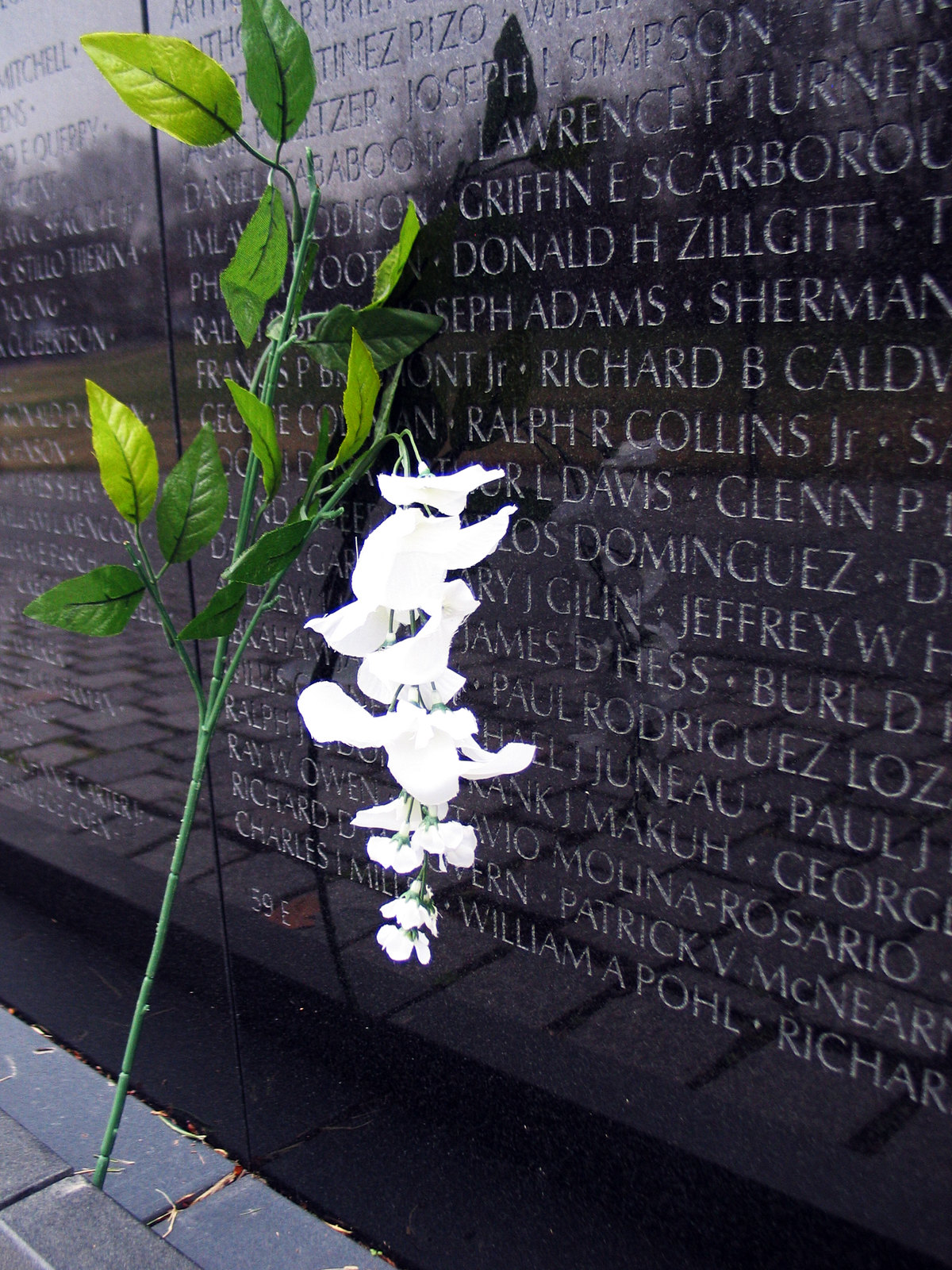
I was and am angry about the War in Viet Nam. I know dead and wounded men. I cried the first time I went to the Viet Nam Memorial in DC. and thinking about it chokes me up today. I’ve met men whose lives were wrecked by pain, drugs and alcohol as a result of their service. I knew other men who served, and who came out fine. Very rarely, we talked about out motivations.

But throughout the years I’ve felt two things above all: I was willing to take my turn. I didn’t hide out in the Reserves like W. Bush and Dan Quayle, and I didn’t duck out like Bill Clinton.

And slowly, slowly, I’ve come to agree with French about the decision to serve. I love our country and its people, and our way of life. Even when I when I am certain we need to change.

=======
Update: all of us faced terrible choices in the Viet Nam War era, because of the draft. Everyone has a story about their decisions. This is mine. I hope veterans of all eras will use this post to discuss their stories for the Emptywheel community.

Share this entry

Two Possible End Games in Ukraine

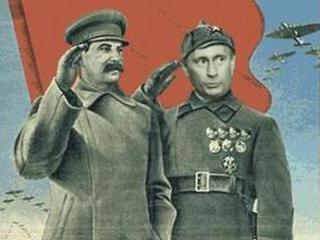
Brothers in Authoritarian Leadership: Stalin and Putin (h/t openDemocracy, (CC BY-SA 2.0)

With all the conversations around Russia’s withdrawal from around Kyiv in order to refocus on the Donbas, and the discussions of the various negotiations that seek to arrange for a cease fire if not a complete end to the fighting, there are two big possible end games that appear increasingly likely to me, though I don’t see anyone publicly talking about them. (More common are big picture “likely outcome” pieces like this.) I don’t know the odds of either of the following two end games happening, but the odds are not zero for either one of them and, IMHO, they are going up.

End Game 1 begins with a simple premise: from Putin’s point of view, Putin cannot fail – he can only be failed.

Given the demise of the initial battle plan of some of Putin’s generals and the absence of the cake walk with Ukrainians greeting the Russian Army as liberators predicted by at least some of Putin’s intelligence officers, there is plenty of failure to go around.

Per BBC Russian, via The Guardian, the Russian officer corps has been taking extreme casualties.

. . . [G]rowing evidence suggests high numbers of casualties among the units that led Russia’s invasion in February, including paratrooper units considered to be the “tip of the spear”.

The video of the memorial for the 247th Guards Air Assault Regiment, which is based in Stavropol, Russia, showed a number of men whose deaths have already been confirmed through public accounts.

Another video from a nearby cemetery that is used by the unit, along with others, showed a long row of funeral wreaths.

The unit was reported to have fought in southern Ukraine near the city of Kherson, which has been held by the Russian army since late February. A Ukrainian counter-attack near Kherson has led to heavy losses for Russian troops there.

Last month, Russia reported the death of the commander of the regiment, Col Konstantin Zizevsky, one of at least eight Russian colonels to have been killed during the war in Ukraine.

BBC Russian, which has kept a confirmed count of the number of Russian losses, has said that 217 of its 1,083 confirmed Russian war dead were officers, from junior lieutenants to generals. Senior Russian officers often fight alongside their units because decisions must be confirmed by higher-ranking personnel.

Of the confirmed deaths in the military, more than 15% come from Russia’s elite airborne, or VDV, units. The high number of losses among those units has also been accompanied by reports of desertions.

The NY Times emphasizes those casualty figures in this little nugget on the BBC report:

The Russian service of the BBC counted 1,083 military death announcements by local officials or news outlets. But 20 percent of those deaths concerned officers — a disproportionate toll indicating that vast numbers of deaths of lower-ranking soldiers may be going unreported.

Lots of dead officers means lots of newsworthy funerals, funerals, and more funerals. Add in reports of desertions by soldiers already in Ukraine. And now this as reported by the NY Times:

Word of the dangers of fighting is filtering down through the public in Russia. Mikhail Benyash, a lawyer in the southern city of Krasnodar, said he had received more than 100 requests from Russian military and national guard service members about their legal rights should they refuse to fight.

“They don’t see a point in killing anyone,” Benyash said. “Plus, they don’t see a point in being killed.”

From Putin’s POV, all of this is unacceptable, and all of it is proof that he has been failed. This, obviously, cannot be allowed to stand. With End Game 1, the question for Putin is who he should hold responsible for these failures.

Russian history demonstrates how a leader obsessed with his personal power and who sees himself as the embodiment of the nation reacts to a situation like this: he makes An Example of someone. Or several someones. Or hundreds of someones. In the post-WWII USSR, Stalin invented what came to be known as the Doctors’ Plot — a conspiracy theory that various doctors had or were preparing to kill various Soviet leaders. Stalin did so in order to justify a purge of his political enemies, consolidate power, and in various other ways continue to build up the cult of personality around him. The only thing that saved these doctors was that Stalin died before the trials could be held.

Three years later, Stalin’s successor Nikita Khrushchev denounced Stalin in his secret speech to the 20th Communist Party Congress entitled “On the Cult of Personality and its Consequences.” As Khrushchev noted, the Doctors’ Plot was but a small piece of a larger whole for Stalin:

Stalin’s willfulness vis-a-vis the party and its central committee became fully evident after the 17th party congress, which took place in 1934…

It was determined that of the 139 members and candidates of the party’s Central Committee who were elected at the 17th congress, 98 persons, that is, 70 percent, were arrested and shot (mostly in 1937-38). [Indignation in the hall.] . . .

The same fate met not only the central committee members but also the majority of the delegates to the 17th party congress. Of 1,966 delegates with either voting or advisory rights, 1,108 persons were arrested on charges of anti-revolutionary crimes, i.e., decidedly more than a majority. This very fact shows how absurd, wild, and contrary to commonsense were the charges of counter-revolutionary crimes made out, as we now see, against a majority of participants at the 17th party congress. [Indignation in the hall.] . . .

The parallels between Stalin and Putin are . . . troubling. The murder of Boris Nemtsov. The repeated assassination attempts against and subsequent imprisonment of Alexei Navalny. Dig a little more, and you come to names like Sergei Magnitsky, Anna Politkovskaya, Alexander Litvinenko, . . .

The list is long, and the pattern is clear: cross Putin or fail Putin, and Putin will have you killed.

So how might Putin choose to deal with the generals, colonels, and intelligence officers in Moscow who failed him? The more charitable path would be that Putin reassigns them to take the places of the generals, colonels, and intelligence officers killed in Ukraine. I say “charitable” because this lets them take their chances with the Ukrainians, who seem incredibly good at killing senior Russian officers, but not completely effective at it.

The less charitable path cuts out the Ukrainian middle men, and is more emphatic and more thorough: Putin simply executes them in Russia. I can hear the statement from the Kremlin now . . . “They did not properly train their troops . . . They criminally diverted money to equip our fine troops with the equipment they needed, and lined their own pockets instead . . . They lied to me about the prospects of this special military operation . . . They were acting as spies for the West . . . They have failed me. They have failed Russia. They have failed you, the Russian people. They will do so no longer.”

Either way End Game 1 is for Putin to declare failure in Ukraine, blame it on military and intelligence officers he wants to get rid of, dispose of them, and move on from there.

Which brings us to End Game 2.

Russian military and intelligence officers are no doubt much more acutely aware of and worried about End Game 1 than I am. End Game 2 is that the generals take matters into their own hands, hoping for a more successful result than Operation Valkyrie had on July 20, 1944.

Of course, Putin is aware of the possibility of End Game 2, which may make him more anxious to work toward End Game 1. But the generals know that Putin is aware of this, which may make them more anxious to work toward End Game 2. But Putin is aware that the generals are aware . . .

Let me be clear: I have no secret sources in anyone’s intelligence agencies. I simply read what is publicly available, and put it alongside a bit of historical perspective. As I said at the top, I don’t know the odds of either of these End Games happening. But between the sanctions taking a stronger bite every day and the ongoing military failures on the ground in Ukraine, Putin and his generals both need some way to bring this to an end, and fast. End Game 1 will accomplish that, and so will End Game 2.

Share this entry

Journalists Getting Suckered by Ass-Covering Sources on Afghanistan

Rather than explaining why the government didn’t know that Ashraf Ghani was going to flee the country, allegedly with bags of cash, national security sources are busy suckering journalists to report that they warned of the quick demise of the Afghan military.

A positively egregious example is this piece from WSJ’s Vivian Salama. What it reports is that 23 people in the State Department concerned about the rapid collapse of the Afghan government warned that the collapse would happen after August 31 — that is, still eleven days in the future from today. It also reports that the Biden Administration was already hastening efforts to get allies out of Afghanistan the day after those 23 people warned Tony Blinken (meaning, State was already aware of and working on the urgency).

The cable was sent to Secretary of State Antony Blinken and Director of Policy Planning Salman Ahmed. Mr. Blinken received the cable and reviewed it shortly after receipt, according to the person familiar with the exchange, who added that contingency planning was already under way when it was received, and that Mr. Blinken welcomed their feedback.

[snip]

The signatories of the dissent channel cable urged the State Department to begin registering and collecting personal data in advance for all Afghans who qualify for Special Immigrant Visas, aimed at those who worked as translators or interpreters; locally employed embassy staff; and for those eligible for other U.S. refugee programs while there was still six weeks left before the withdrawal deadline.

It also urged the administration to begin evacuation flights no later than Aug. 1, the people said.

On July 14, a day after the cable was sent, the White House announced Operation Allies Refuge to support the relocation of interested and eligible Afghan nationals and their immediate families who supported the U.S. government for the special immigrant visas. Evacuations didn’t kick into high gear until last week and have been complicated by the Taliban takeover of Kabul on Sunday.

Several other actions that have since been taken by the administration were consistent with some of the requests and recommendations in the cable, the person familiar with the cable exchange said. [my emphasis]

In other words, the story should be about how top Biden officials were already ahead of where the 23 people who signed this dissent cable were, and where they weren’t, they integrated the recommendations of the cable.

The story should be about how the process worked. The story should be about how, even these 23 people who were really alarmed about the fragile state of the Afghan government were still too optimistic about how long it could survive.

The story probably should also be about how, after Biden made comments on July 8 (which the article quotes) that were far too rosy about the state of the Afghan government, someone got him to stop.

That’s not what the story is about though. The paragraph describing how contingency planning was already underway is the seventh paragraph in the story; the paragraphs describing how the White House had already prepared an attempt to accelerate SIV evacuations appear at paragraphs 16 to 19.

In paragraph two, meanwhile, the story uses the word “imminent” to suggest days when it really means weeks.

The classified cable represents the clearest evidence yet that the administration had been warned by its own officials on the ground that the Taliban’s advance was imminent and Afghanistan’s military may be unable to stop it.

And the headline doesn’t note that the cable’s warning was, like all other warnings, too optimistic about the state of the Afghan government.

Internal State Department Cable Warned of Kabul Collapse

I get that such stories — suggesting that Biden ignored warnings and so owns this collapse — will drive a lot of traffic. Biden does own this collapse, along with Trump, Obama, and (especially) George Bush. But he owns it because of stupid decisions made 18 months and 18 years ago, not the efforts he made in July to mitigate the aftermath of those earlier decisions.

A far more urgent, and honest, story is the explanation for why, thus far, zero anonymous sources have claimed to have an explanation why no one knew that Ghani was going to flee. Another urgent story is to understand what forces helped the Taliban succeed so wildly, and how such efforts were able to so thoroughly evade our intelligence collection. Another interesting story is why Afghan veteran Christopher Miller, who was promoted way outside of his expertise level and was surrounded by flunkies fiercely loyal to the President, is making shit up about what was the real plan he was hired to implement.

Every story claiming prescience published thus far has in fact revealed that the people claiming prescience didn’t know this would happen either. It’s time to stop pretending they did and starting figuring out why they didn’t.

Share this entry