What the Exhibit Decisions and the Witness List Say to Expect from Roger Stone’s Trial (Updated)

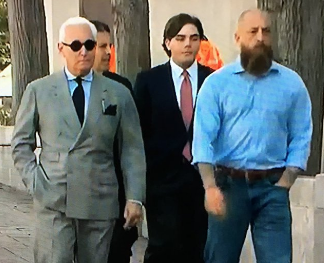
Today, jury selection begins in the the Roger Stone trial. The final jury questionnaire, which got released, includes a list of witnesses or people who will be mentioned at trial. I’ve italicized the people who’ll surely just be mentioned. I’ve marked the people whose communications may be entered by stipulation with asterisks (meaning they don’t necessarily have to testify to prove they had communications with Stone); in addition, the numbers for people like Rhona Graff and Keith Schiller have also been stipulated). Bill Binney and Peter Clay probably will not testify, as Amy Berman Jackson has excluded that line of defense for Stone.

  • Julian Assange
  • Jason Aubin
  • Steve Bannon*
  • William Binney (probably excluded)
  • Zachary Blevins
  • Matthew Boyle (Breitbart guy in the loop between Bannon and Stone)
  • Michael Caputo (said in September that he appeared on the witness list and so was banned from contact, but says he will not be a witness)
  • Peter Clay (probably excluded)
  • Hillary Clinton
  • Jerome Corsi*
  • Randy Credico*
  • Richard Gates* (this is his last testimony as part of his cooperation agreement before he moves towards sentencing)
  • Jason Fishbein
  • David Gray (Corsi’s lawyer)
  • John Kakanis
  • Margaret Kunstler (who probably won’t testify; Credico emailed her on request of Stone)
  • David Lugo
  • Theodore Malloch (testified that Corsi told him Stone knew John Podesta emails were coming)
  • Paul Manafort*
  • Rebekah Mercer (Stone told Bannon he wanted funding from her)
  • Andrew Miller
  • Tyler Nixon
  • Sam Nunberg (Stone told him he had just spoken with Julian Assange on August 4)
  • John Podesta
  • Alexandra Preate (Bannon’s assistant)*
  • Erik Prince* (probably the campaign associate that Stone WhastApped with in October 2016)
  • Bill Samuels
  • Michael Strum
  • Jason Sullivan
  • Michelle Taylor (FBI Agent)
  • Donald Trump*

Yesterday ABJ also made final decisions about witnesses and testimony (see this thread for live tweeting that didn’t make it into the coverage).

The issue people care about (but is fairly minor for the trial) is what will happen with the Godfather II clip that will explain a Frank Pentangeli reference Stone made to try to convince Credico to lie to Congress. An FBI case agent will introduce it, in concept, and after Credico testifies, the government may move to introduce the clip itself.

More interesting are debates about what Stone will do to discredit Credico, Jerome Corsi (if he testifies), and Steve Bannon. With Credico, ABJ seemed intent on leaving out stuff that discredits him, possibly including his fondness for Julian Assange.

Stone wanted to submit Jerome Corsi’s entire book (which I agree discredits him pretty readily). But ABJ will only permit him to use it to discredit Corsi if he says something inconsistent.

Most interesting has to do with Bannon, who (given the witness list) is necessarily the person that worked in the transition and the White House discussed in yesterday’s hearing. Stone says there’s something Bannon has done recently that would discredit his testimony. To be honest, I wouldn’t be surprised if the government doesn’t call Bannon at all, not least because the government only released his derogatory interview over the weekend (where he clearly lied), not the one from October 26, 2018 that would be relevant to the trial (and as a result, the government didn’t release his proffer agreement, as they did with Michael Cohen). He’s relevant because of some emails exchanged in early October 2016 between Breitbart journalist Matthew Boyle and Stone, then Stone and Bannon (which appear to be exhibits 31 and 32). The thing is, the email for Bannon (at least) and his assistant, at least, are stipulated, meaning an FBI Agent can enter those into evidence. The big reason why Bannon might be called personally is to explain the reference to this email.

FROM: Roger Stone

TO: Steve Bannon

EMAIL:

Don’t think so BUT his lawyer Fishbein is a big democrat .

I know your surrogates are dumb but try to get them to understand Danney Williams case

chick mangled it on CNN this am

https://www.dailymail.co.uk/news/article-3819671/Man-claiming-Bill-Clinton-s-illegitimate-son-prostitute-continues-campaign-former-president-recognize-him.html

He goes public in a big way Monday— Drudge report was a premature leak.

I’ve raise $150K for the targeted black digital campaign thru a C-4

Tell Rebecca to send us some $$$

We know from an earlier ABJ ruling that the government will introduce how Stone also lied to HPSCI about coordinating his dark money efforts with the campaign, before he later cleaned it up. And Bannon may be necessary to explain this. I understand that Stone’s specific late election targeting efforts suppressing the black vote in a surprise swing state — on top of his efforts to suppress the vote — would look very damning given what we otherwise know about suppression efforts. Stone clearly believes Bannon is testifying, but then he also has a grudge against him so would love to smear him publicly. But I leave open the possibility that the government enters this information via other means (especially given that they said they only need one witness in addition to the FBI Agent to introduce this stuff).

Curiously, nothing public suggests Stone is doing much to discredit Rick Gates (who will almost certainly testify to witnessing Trump get a call on his cell phone from Stone telling him of upcoming dumps) or Michael Cohen (who would testify to witnessing Trump being informed in advance about the July 22 WikiLeaks dump, if he is sprung from prison to do so), whose testimony would in some ways be far more damning.

Otherwise, ABJ seems to have made remarkably favorable rulings for the government yesterday on several counts.

On September 25, 2019, for the reasons stated on the record in the courtroom at the Pretrial Conference, the following government exhibits (“GX”) were ruled on as follows: GX 21, 22, 24, 42, 43, 44, 165, 166, and 167 are admitted. GX 148 will be admitted with redactions.

These involve:

  • June 13 and 15 emails with someone — possibly Corsi? — which would bracket the revelation of the DNC hack; there’s an email involving Corsi and Stone where they talk about “phishing with John Podesta” and given Stone’s argument that these emails would be prejudicial, I wonder if that’s it?
  • A July 29 email, (possibly to Manafort?), at the time when Trump was ordering people to get Stone to chase down these emails
  • Some texts that appear to involve Jerome Corsi from January 2018; remember there are allegations that Corsi was paid by InfoWars to keep silent (though that’s also the period when Stone was talking about getting Assange a pardon with Credico in texts that Stone didn’t challenge)
  • Three charts showing Stone’s comms with — probably — Credico (to show that he wasn’t talking to Credico until he needed a cover story) and Trump campaign officials; normally defense attorneys succeed in getting such charts excluded but the government won this fight, apparently
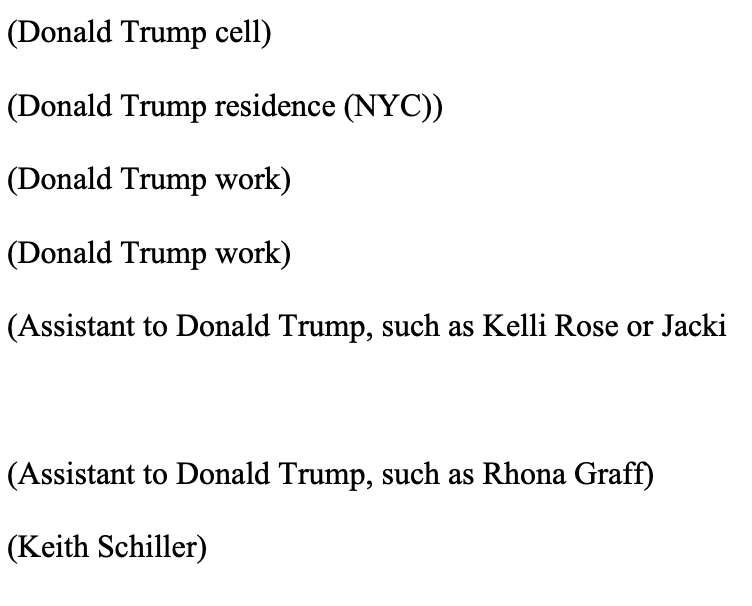
  • A redacted set of Stone’s toll records, which will show who he called when (there’s a 212 line that may be Trump’s cell phone)

In addition, ABJ generally limited Stone’s use of HPSCI majority and minority Russian reports to the parts that affect him; she specifically excluded the section on Christopher Steele, which is a testament to how desperate Stone is.

Among the only emails that Stone successfully got admitted to discredit Credico are ones from February 9, February 24, and June 3, 2017, the first two of which will be redacted.

The case against Stone is strong. He appears to be preparing to argue that he was never really subpoenaed for all the documents he told HPSCI he didn’t have (which the government will argue is why he lied about not having any). But that’s about all he seems prepared to do — besides attacking Credico, Corsi, and Bannon — to defend himself.

Share this entry

Sidney Powell Complains That Peter Strzok Is Too OCD to Investigate Her Client

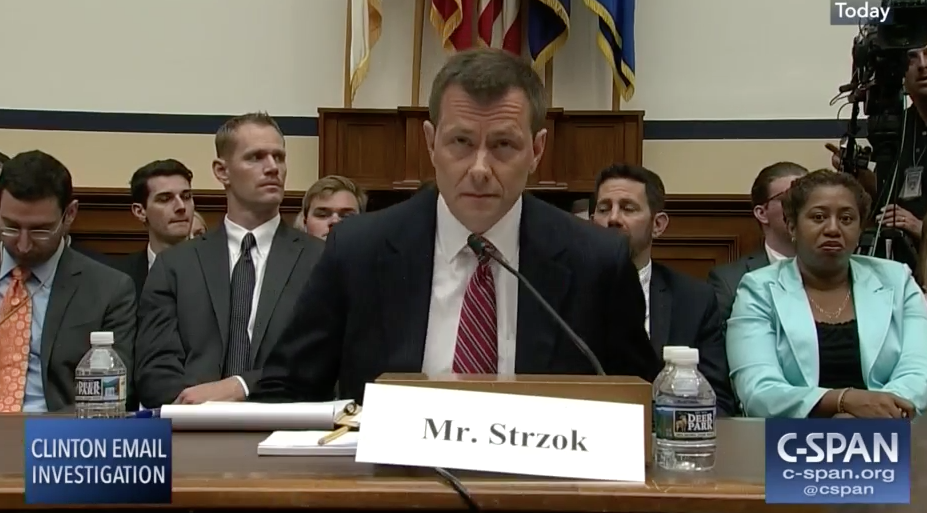
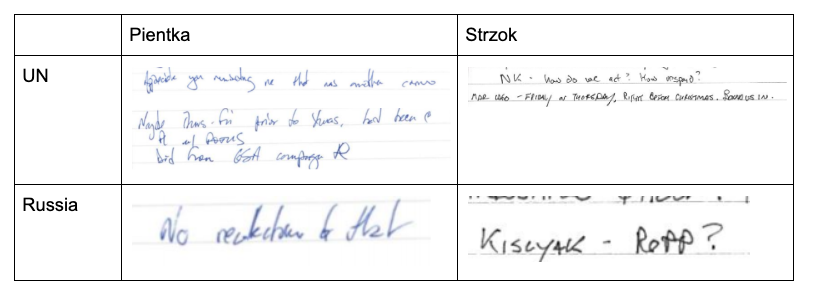
Amid the new fecal matter that Mike Flynn lawyer Sidney Powell throws at Judge Emmet Sullivan in her sur-surreply purportedly asking for Brady material is a claim (ostensibly offered to support a claim that she’s entitled to his original notes even though she admits she has no proof to otherwise support her claim) that Peter Strzok was just too damned OCD to investigate her client.

Moreover, even a layman can look at the two sets of notes and discern that Strzok’s miniscule, printed, within-the-lines, longer, and more detailed notes bear none of the hallmarks of being written during the press of an interview—much less by the secondary note-taker. That observation is even more obvious when compared with Agent 2’s notes, which do appear to be contemporaneous.

That’s not the most ridiculous thing in this latest brief, but given all the other complaints launched against Strzok in the last two years, that he operates too much “within-the-lines” is a dizzying plot twist.

Sidney Powell rewrites all of criminal procedure

The most ridiculous thing Powell does is — before she gets off the first page! — argue that the government has an obligation to comply with Brady before accepting a guilty plea or, barring that, must provide all Brady the day after he pleads.

The government’s Surreply is new only in its stunning admissions and untenable paradoxes. According to the government, it had no obligation to produce its superfluity of Brady evidence before Mr. Flynn pleaded guilty— because he was not a defendant until he was formally charged. And, it had no obligation to produce its cache after he pleaded guilty (the same or next day)—well . . . because his guilty plea erased its obligation.

If accepted, the government’s approach would allow endless manipulation by prosecutors: target individuals, run search warrants, seize devices, interrogate for days, threaten family members, cajole, but never charge until the clock strikes midnight once a plea is extracted. Yet playing cat-and-mouse with the Due Process Clause is the opposite of what the Brady-Bagley-Giglio line of cases is all about. Perhaps even more significantly, the government’s position wholly ignores this Court’s Standing Order, which not only has no such timing requirements, but is issued for the precise purpose of eliminating the games the government played here.

Even the most favorable reading of Emmet Sullivan’s standing order (the original one of which wasn’t filed until 5 days after the case got transferred to Sullivan on December 7, and the operative one of which wasn’t filed until 71 days after the case transfer, with five more days after that before the protective order first permitting the sharing of such information was filed) wouldn’t hold that the government has to turn over all Brady material within two days of pleading guilty before a judge who doesn’t have such a standing order.

It sure as hell doesn’t say the government has to disclose warrants to people under investigation or even that the government can only seize phones if they charge someone. I mean, that might be a nice world (or it might be a criminal hellhole), but that’s not the world she practices law in.

Mike Flynn is entitled to a Mulligan because he replaced his competent lawyer with a TV lawyer

Of course, there are problems.

One of which is that Flynn got everything anything normally considered Brady before he pled guilty for a second time before Sullivan. Powell deals with that in two ways. First, she suggests that everything that Flynn did under his previous counsel is reset when she came in as new counsel.

Nor was there “an extraordinary reversal” pursuant to which Mr. Flynn claims he is innocent. At no time did new, conflict-free counsel affirm the validity of Mr. Flynn’s guilty plea. In that same letter, counsel explained that “as was ingrained in [Mr. Flynn] from childhood,” he “took responsibility for what the SCO said he did wrong.”

On top of all the other things she’s demanding for her client, she’s also asking for a Mulligan.

Powell accuses Emmet Sullivan of just joking when asking Flynn about conflicts

Central to her ability to do so, of course, is the claim that Rob Kelner — whom the government described twice reviewed the issue with Flynn and waived any conflict — could not have waived that conflict. What’s awkward about all this is that (as the government noted in their filing), even without notice Sullivan raised it at Flynn’s last guilty plea.

Yet, he fails to respond to the point made in Mr. Flynn’s Reply that this conflict existed only because the government insisted not only on incessantly attacking Flynn’s FARA registration (beginning within weeks of its filing), but also on demanding its pairing with the completely unrelated White House interview prosecution. Simultaneously, the government did not even advert to the primary argument that the conflict was non-consentable, which meant that even if former counsel had fully disclosed and explained the risks associated with the conflict, Flynn could not agree to waive it. The Covington & Burling lawyers could not remain in the case. Most important of all, the government did not move to disqualify the lawyers or bring the matter to the attention of any court.

She returns to this later, suggesting that Sullivan could not know that Kelner might have a conflict when he invited Flynn to consult with other attorneys.

Mr. Van Grack unilaterally eliminated the possibility that the Court would learn enough to investigate further. He was content to allow hopelessly-conflicted counsel not merely to walk Mr. Flynn into five days of interviews with the Special Counsel team, but into an immediate, high-pressured plea of guilty without any demands for or production of Brady material, facilitated the waiver of countless rights, and signed an agreement for endless years of cooperation with the government at extraordinary personal expense. In addition to those benefits, the government was able to turn Mr. Flynn’s own counsel into the equivalent of adverse witnesses against him in the Rafiekian FARA case in the Eastern District of Virginia.

Note, Powell encouraged Kelner to expand his cooperation during the Kian trial in a bid to help sabotage it.

And then Powell claims that Flynn — who raised precisely the other claims she raises here (about impropriety leading up to his interview) — could not have known there was a problem.

The normal plea colloquy was insufficient to alert this Court to the problem, and Mr. Flynn did not know what Mr. Flynn did not know. When Mr. Flynn was asked if he was satisfied with the representation he was receiving, he had no way of knowing of the depths of the conflict of interest, and he had no way of knowing that some conflicts of interest are non-consentable. The prosecutors were more than just aware of this issue, they took full advantage of it. Their failure to address the issue in their Surreply concedes the non-consentable conflict. This is precisely why the government is required to focus the court’s attention to the issue by moving to disqualify counsel and thus letting the Court—not the government in cahoots with uber-conflicted counsel— persuade a defendant that he is getting advice from a safe source.

Effectively this is an insinuation that Sullivan, who bent over backwards to give Flynn the opportunity to ask for counsel from another lawyer, was too stupid to understand the potential need for Flynn to do so. Who knows? It could work. But pretending the Judge didn’t do precisely what you think should happen is not a good way to impress the Judge.

Powell renews the claim that her client was tricked into telling the lies he had already told

Only after asking for a Mulligan does Powell get around to reiterating her argument that mean FBI Agents ambushed her 30-year Intelligence veteran client into telling the same lies he had already told others at the White House. In doing so, she simply ignores what the government has already told her, including that they did not use the Steele dossier (which barely mentions Flynn) as a “pretext” to ask him why he was undermining the policy of the government.

The government has known since prior to January 24, 2017, that it intended to target Mr. Flynn for federal prosecution. That is why the entire “investigation” of him was created at least as early as summer 2016 and pursued despite the absence of a legitimate basis. That is why Peter Strzok texted Lisa Page on January 10, 2017: “Sitting with Bill watching CNN. A TON more out. . . We’re discussing whether, now that this is out, we can use it as a pretext to go interview some people.” 3 The word “pretext” is key. Thinking he was communicating secretly only with his paramour before their illicit relationship and extreme bias were revealed to the world, Strzok let the cat out of the bag as to what the FBI was up to.

She then, bizarrely, provides proof that the FBI recognized right away that Flynn didn’t seem to be lying but his statements contradicted with everything that was on the transcript.

Former Deputy Director Andrew McCabe as much as admitted the FBI’s intent to set up Mr. Flynn on a criminal false statement charge from the get-go. On Dec. 19, 2017, McCabe told the House Intelligence Committee in sworn testimony: “[T]he conundrum that we faced on their return from the interview is that although [the agents] didn’t detect deception in the statements that he made in the interview . . . the statements were inconsistent with our understanding of the conversation that he had actually had with the ambassador.” McCabe proceeded to admit to the Committee that “the two people who interviewed [Flynn] didn’t think he was lying, [which] was not [a] great beginning of a false statement case.”

She then claims that when Brandon Van Grack said that nothing is in the government’s possession he instead said something else, then goes on to … I’m not sure what … without addressing the Van Grack point that the original agent notes match each other and every draft of the 302, meaning nothing in between would be different.

Tellingly, Mr. Van Grack does not deny that such information is, in fact, available.

The Strzok-Page text messages confirm that Lisa Page had two opportunities to edit drafts of the crucial 302. Strzok returned to his FBI office the night of February 10, 2017, to input the edits she made on the draft she had earlier left in Bill [Priestap’s] office (about which they hatch a cover-story), then sent her another version over the weekend. The government thus implicitly admits there was at least one version prior to the February 10 edition

(Note, with the last filing, the government provided three drafts of the 302, one of which was entered on January 24, meaning she already has this; she could mention that but it thoroughly undermines her own point.)

Finally, after making the claim that Strzok is too meticulous to investigate her client, she returns to a claim that I showed to be false, that the notes don’t support two of the false statements charges.

Read the notes of both agents for hours, and you won’t find a question or an answer about Kislyak’s response on either the UN vote or the sanctions—yet those assertions underpin the factual basis for the plea.

In about 30 minutes, however, one can find stuff in the notes that is consistent between the two and consistent with Flynn denying both cases.

Powell makes this harder to see, mind you, by doing a cut-and-paste job that splits notes on Flynn’s discussion of the UN calls. But it is there and in all the drafts.

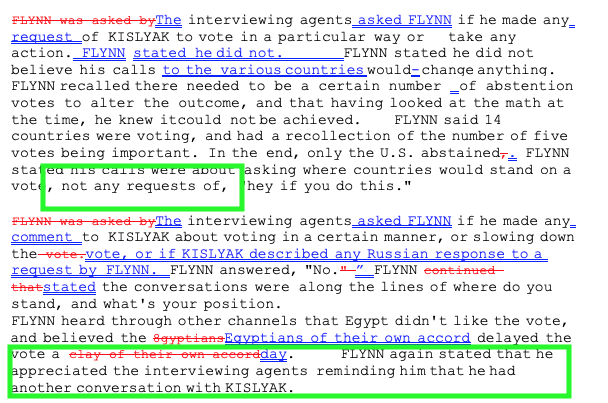
Then she claims the redline, by adding a second denial from Flynn that he didn’t request Russia to act a certain way, somehow changes that it already included such a denial.

Previously, someone added an entire assertion untethered from either set of notes: “The interviewing agents asked FLYNN if he recalled any conversation with KISLYAK in which KISLYAK told him the Government of Russia had taken into account the incoming administration’s position about the expulsions, or where KISLYAK said the Government of Russia had responded, chosen to modulate their response, in any way to the U.S.’s actions as a result of a request by the incoming administration.” Although absent from the notes of both agents, this “Russian response” underpins the alleged crime.10

The government shows what I do: that the claims are in every 302. Including this one.

As note, the evidence Powell presents actually supports the government. But at least she refrained from accusing her client of lying this time.

Powell says prosecutors should never pursue plea deals

Then Powell argues that stuff that (again) happen with many criminal defendants shouldn’t happen with her own, such as that they enter into proffers.

The letter sent by the Special Counsel to Mr. Flynn’s then-counsel, Covington & Burling, before the proffer interviews made clear that, “by receiving [Mr. Flynn’s] proffer, the government does not agree to make any motion on [his] behalf or to enter into a cooperation agreement, plea agreement, immunity agreement or non- prosecution agreement with Client.” Although the letter made a general promise not to use statements made in the interviews against Mr. Flynn, the promise included an important final clause: “Should Client be prosecuted, no statements made by Client during the meeting will be used against Client in the government’s case-in-chief at trial or for purposes of sentencing, except as provided below.” (emphasis added). The listed exceptions render the “promise” a practical nullity.

It is disingenuous to suggest that the proffer sessions were not adversarial when the government had permission to target Mr. Flynn, seized all his electronic devices, targeted his son, and seized his son’s devices. The government fails to mention that, to obtain the plea, it threatened Mr. Flynn with indictment the next day, the indictment of his son who had a new baby, promised him “the Manafort treatment,” and promised to pile on charges sufficient to put him in prison the rest of his life. The short fuse was no doubt motivated by the government’s knowledge, which it did not disclose to Flynn, that the salacious Strzok-Page emails, disclosing their vitriolic hatred of President Trump and his team, the key agents’ affair, and their termination from Mueller’s Special Counsel operation were going to be exposed the very next day. No individual, no matter how innocent, can withstand such pressure, particularly when represented by conflicted defense counsel. The advice a client is given by his lawyer in such fraught circumstances can make all the difference between standing his ground or caving to the immense pressure. Mr. Flynn caved, not because he is guilty, but because of the government’s failure to put its cards on the table, as Brady, requires, and its failure to ensure that Mr. Flynn was represented by un-conflicted counsel when he was forced to make that decision.

I mean, you sort of have to pick. Is your client a sophisticated intelligence officer with 30 years experience, or is he — represented by a very good lawyer — weaker than other similarly situated people? What Powell lays out, however, is not proof that he was treated differently, but actually proof he was treated the same, however shitty our prosecutorial practices are.

Powell admits she pulled a bait-and-switch but promises to return to it

Finally, there’s the matter of Powell’s bait-and-switch, her late demand to have the plea thrown out in the middle of a specious Brady request. As I noted, prosecutors were a little coy, suggesting that until she presents the demand as a lawyer would, with actual case law, they can only assume she’s arguing a Brady problem.

The most interesting (and potentially risky): even though Sullivan ordered them to address “the new relief, claims, arguments, and information” raised in Powell’s “reply,” they still treat this as primarily a question of Brady obligations. In addressing Powell’s demand to have the prosecution thrown out, they play dumb, noting that Powell has not presented her demand as a lawyer would, with citations and case law, and so then make an assumption that this is primarily about Brady.

In his Reply, the defendant also seeks a new category of relief, that “this Court . . . dismiss the entire prosecution for outrageous government misconduct.” Reply at 32; see also id. at 3 (“dismiss the entire prosecution based on the outrageous and un-American conduct of law enforcement officials and the subsequent failure of the prosecution to disclose this evidence . . . in a timely fashion or at all”). The defendant does not state under what federal or local rule he is seeking such relief, or cite to relevant case law.9 In order to provide a response, the government presumes, given the context in which this request for relief arose, that the defendant is seeking dismissal as a remedy or sanction for a purported failure to comply with Brady and/or this Court’s Standing Order.

9 Local Criminal Rule 47(a) specifically requires that “[e]ach motion shall include or be accompanied by a statement of the specific points of law and authority that support the motion, including where appropriate a concise statement of the facts” (emphasis added). The defendant now seeks relief from this Court for claims that he has not properly raised; the government is hampered in its ability to accurately respond to the defendant’s argument because he has failed to state the specific points of law and authority that support his motion.

I’m sure Powell’s response will be “Ted Stevens Ted Stevens Ted Stevens.” But even if it is, that’s something she could have cited in her new demand for relief and did not.

They do go on to address the claim that the FBI engaged in outrageous behavior, focusing relentlessly on the January 24 interview, rather than Powell’s more far-flung conspiracy theories. But ultimately, this seems to be an attempt to do what they tried to do when they first alerted Emmet Sullivan that Powell had raised new issues, to either force her to submit her demand to have the whole prosecution thrown out as a separate motion, or to substantiate her Brady claims.

When complaining that the government didn’t reply to her demand, she doesn’t address the fact that she hasn’t cited any law to support her.

As predicted, she instead cites Ted Stevens.

The government sought and received permission to file a Surreply by complaining that the defendant had bootlegged “new” arguments into his Reply. Yet its Surreply either elides the supposedly new material altogether or does not address it in terms.

[snip]

Rather, as a matter of procedure, counsel advised the Court that we anticipated seeking dismissal rather than withdrawal. Nothing we have found in the law requires a defendant to withdraw his guilty plea rather than seek dismissal for egregious government misconduct. Analogously, this Court did not have to grant a new trial to Ted Stevens before it could dismiss the entire prosecution in the interest of justice.

But it looks like the government gamble paid off. After bitching at the government for ignoring her bait-and-switch, at the very end of the brief, she says that she will formally ask for something she spent a good chunk of her last filing arguing for now and pretends that this is all just a Brady request.

In conclusion, yes, the government engaged in conduct so shocking to the conscience and so inimical to our system of justice that it requires the dismissal of the charges for outrageous government conduct. See United States v. Russell, 411 U.S. 423, 428 (1973). However, as fully briefed in our Motion to Compel and Reply, at this time, Mr. Flynn only requests an order compelling the government to produce the additional Brady evidence he has requested—in full and unredacted form—and an order to show cause why the government should not be held in contempt. At the appropriate time, Mr. Flynn will file a separate motion asking that the Court dismiss the prosecution for egregious government misconduct and in the interest of justice. Mr. Flynn is entitled to discovery of the materials he has requested in these motions and briefs that will help him support such a motion.

At some point, this bait-and-switch is bound to piss off Judge Sullivan, who now has to read two more briefs because of Powell’s little ploy. And I’m not sure invoking the ghost of Ted Stevens will be enough to mitigate any risk of pissing him off about this.

Share this entry

People Who Illegally Withheld Duly Appropriated Funding Refuse to Explain to Congress Why

CNN reported this morning that all four witnesses who were called to testify today blew off the request under both Executive Privilege claims (for John Eisenberg) and other complaints that the Administration won’t be able to have a lawyer present.

All four White House officials who are scheduled to give depositions on Monday during the House’s impeachment inquiry won’t show up, as a source with knowledge of the situation tells CNN that National Security Council lawyers John Eisenberg and Michael Ellis will not testify.

The two officials will join Robert Blair, assistant to the President and senior adviser to the acting White House chief of staff Mick Mulvaney, and Brian McCormack, associate director for natural resources, energy & science at the Office of Management and Budget, in not testifying on Monday, CNN reported earlier. Energy Secretary Rick Perry, who was scheduled to appear Wednesday, will not participate in a closed door deposition, an Energy Department spokesperson said Friday.
An administration official says Eisenberg isn’t showing up due to executive privilege while Blair, Ellis and McCormack aren’t going to appear because they won’t be able to have an administration lawyer present.

This is being treated like other refusals to show up, but I think it’s not.

First, if Eisenberg is claiming only Executive Privilege, those claims will quickly expose the President to evidence of guilt that Senators are busy trying to explain away. That’s because he should only have Executive Privilege for stuff that actually involves the President. And given that he wasn’t on the call with Volodymyr Zelensky, he shouldn’t have it, at all, here, unless the President wants to claim that before Eisenberg engaged in a cover-up of Trump’s extortion, he asked the President for guidance first.

In fact, if Eisenberg showed up, he’d likely have to invoke the Fifth Amendment rather than Executive Privilege. And once someone does that, it’s usually child’s play to force that person to resign from government service.

As for the others, Robert Blair and Brian McCormack were being called to explain how the funds duly appropriated by Congress got withheld.  Withholding those funds is a crime, as Mick Mulvaney helpfully admitted (in public discussions that likely void any Executive Privilege claims over the decision to withhold the funds). But it’s also a crime not to explain to Congress why you withheld funds they told you to spend.

In other words, for at least three of these men, the excuses for not testifying probably amount to crimes in and of themselves, either for the President (if he really were to claim Executive Privilege over Eisenberg’s efforts to cover-up his crime) or for the men themselves.

So while this seems like the same old obstruction, I think it may be a new kind of criminally problematic obstruction.

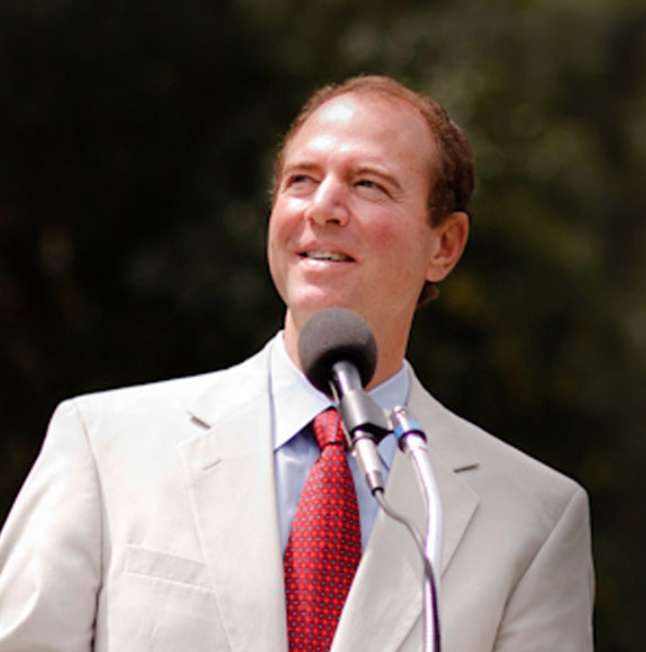
Which may be why Adam Schiff says the first public witnesses are going to be those who illegally withheld this funding.

Share this entry

The Mueller Report Was Neither about Collusion Nor about Completed Investigation(s)

In the days since BuzzFeed released a bunch of backup files to the Mueller Report, multiple people have asserted these 302s are proof that Robert Mueller did an inadequate investigation, either by suggesting that the information we’re now seeing is incredibly damaging and so must have merited criminal charges or by claiming we’re seeing entirely new evidence.

I’ve had my own tactical complaints about the Mueller investigation (most notably, about how he managed Mike Flynn’s cooperation, but that might be remedied depending on how Emmet Sullivan treats Sidney Powell’s theatrics).  But I have yet to see a complaint that persuades me.

You never know what you can find in the Mueller Report if you read it

Let’s start with claims about how the release revealed details we didn’t previously know. Virtually all of these instead show that people haven’t read the Mueller Report attentively (though some don’t understand that two of the six interview reports we’ve got record someone lying to Mueller, and all are interviews of human beings with imperfect memories). Take this Will Bunch column, which claims that Rick Gates’ claims made in a muddled April 10, 2018 interview reveal information — that Trump ordered his subordinates to go find Hillary emails — we didn’t know.

Rick Gates, the veteran high-level political operative who served as Donald Trump’s deputy campaign manager in 2016, told investigators he remembers exactly where he was — aboard Trump’s campaign jet — when he heard the candidate’s desires and frustrations over a scheme to defeat Hillary Clinton with hacked, stolen emails boil over. And he also remembered the future president’s exact words that day in summer 2016.

Gates’ disclosure to investigators was a key insight into the state of mind of a campaign that was willing and eager to work with electronic thieves — even with powerful foreign adversaries like Russia, if need be — to win a presidential election. Yet that critical information wasn’t revealed in Mueller’s 440-page report that was supposed to tell the American public everything we needed to know about what the president knew and when he knew it, regarding Russia’s election hacking.

The passage in question comes from an interview where a redacted section reflecting questions about what Gates knew in May 2016 leads into a section on “Campaign Response to Hacked Emails.” What follows clearly reflects a confusion in Gates’ mind — and/or perhaps a conflation on the part of the campaign — between the emails Hillary deleted from her server and the emails stolen by Russia. The passage wanders between these topics:

  • People on the campaign embracing the Seth Rich conspiracy
  • Don Jr asking about the emails in “family meetings
  • The campaign looking for Clinton Foundation emails
  • Interest in the emails in April and May, before (per public reports) anyone but George Papadopoulos knew of the stolen emails
  • The June 9 meeting
  • Trump exhibiting “healthy skepticism” about some emails
  • The anticipation about emails after Assange said they’d be coming on June 12
  • The fact that the campaign first started coordinating with the RNC because they had details of upcoming dates
  • RNC’s media campaigns after the emails started coming out
  • Trump’s order to “Get the emails” and Flynn’s efforts to do so
  • Details of who had ties to Russia and the Konstantin Kilimnik claim that Ukraine might be behind the hack
  • China, Israel, Kyrgyzstan
  • Gates never heard about emails from Papadopoulos
  • Sean Hannity

This seems to be more Gates’ stream of consciousness about emails, generally, then a directed interview. But Gates’ claim that 1) he didn’t know about emails from Papadopoulos but nevertheless 2) was party to discussions about emails in April and May is only consistent with some of these comments pertaining to Hillary’s deleted emails.

Once you realize that, then you know where to look for the “Get the emails” evidence in the Mueller Report: in the description of Mike Flynn making extensive efforts to get emails — albeit those Hillary deleted.

After candidate Trump stated on July 27, 2016, that he hoped Russia would “find the 30,000 emails that are missing,” Trump asked individuals affiliated with his Campaign to find the deleted Clinton emails.264 Michael Flynn-who would later serve as National Security Advisor in the Trump Administration- recalled that Trump made this request repeatedly, and Flynn subsequently contacted multiple people in an effort to obtain the emails.265

264 Flynn 4/25/18 302, at 5-6; Flynn 5/1/18 302, at 1-3.

265 Flynn 5/1/18 302, at l-3.

The footnotes make it clear that in the weeks after Mueller’s team heard from Gates that Flynn used his contacts to search for emails, they interviewed Flynn several times about that effort, only to learn that that incredibly damning effort to find emails involved potentially working with Russian hackers to find the deleted emails. And to be clear: Bunch is not the only one confused about this detail–several straight news reports have not been clear about what that April 10 interview was, as well.

A November 5, 2016 email from Manafort — which the newly released documents show Bannon wanting to hide that Manafort remained a campaign advisor — is another thing that actually does show up in the Mueller Report, contrary to claims.

Later, in a November 5, 2016 email to Kushner entitled “Securing the Victory,” Manafort stated that he was “really feeling good about our prospects on Tuesday and focusing on preserving the victory,” and that he was concerned the Clinton Campaign would respond to a loss by “mov[ing] immediately to discredit the [Trump] victory and claim voter fraud and cyber-fraud, including the claim that the Russians have hacked into the voting machines and tampered with the results.”937

In other words, there is little to no evidence that the most damning claims (save, perhaps, the one that RNC knew of email release dates, though that may not be reliable) didn’t make the Report.

The Mueller Report is an incredibly dense description of the details Mueller could corroborate

The FOIAed documents are perhaps more useful for giving us a sense of how dense the Mueller Report is. They show how several pages of notes might end up in just a few paragraphs of the Mueller Report. The entirety of the three Gates’ interviews released Saturday, for example, show up in just four paragraphs in the Mueller Report: two in Volume I describing how the campaign made a media campaign around the leaks and how Trump once told him on the way to the airport that more emails were coming.
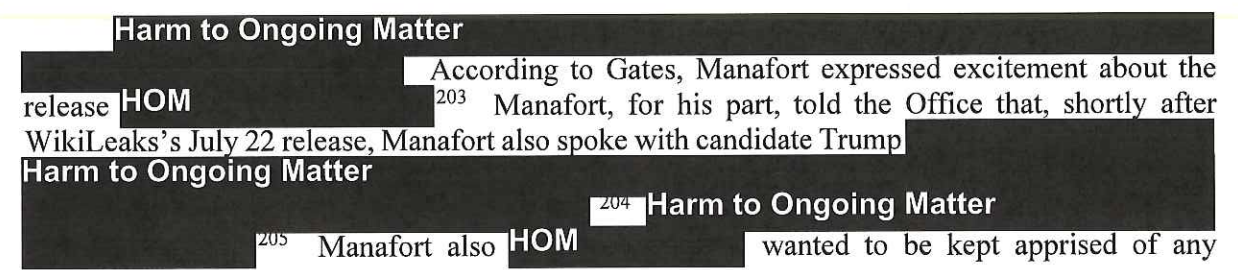
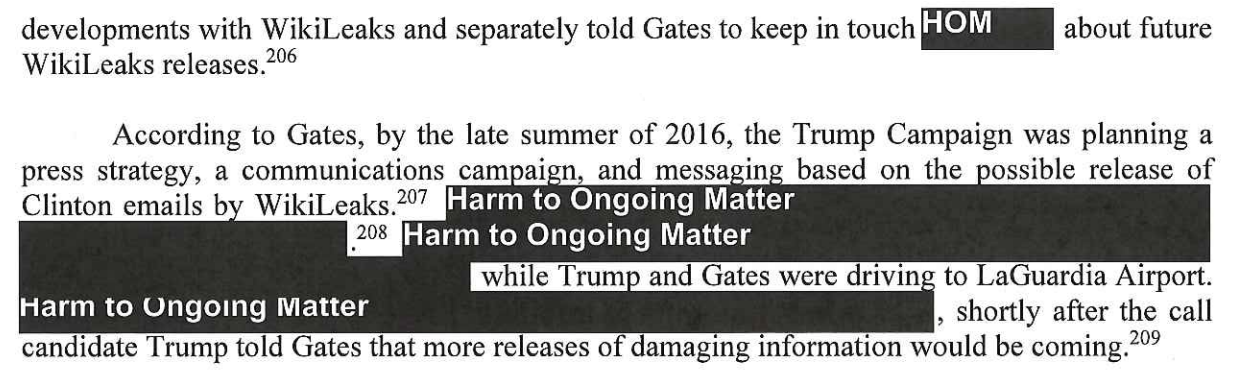
And two paragraphs in Volume II repeating the same information.
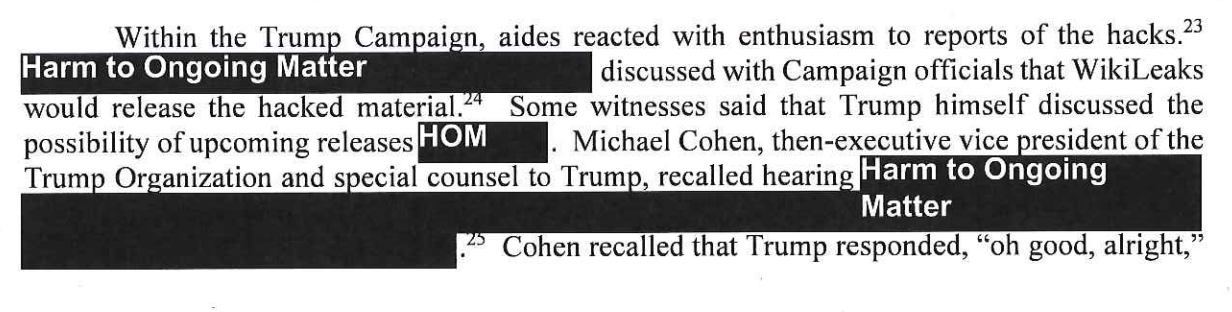

Worse still, because the government has released just six of the 302s that will be aired at the Roger Stone trial starting this week, much of what is in those interviews (undoubtedly referring to how Manafort and Gates coordinated with Stone) remains redacted under Stone’s gag order, in both the 302 reports and the Mueller Report itself.

Shocked — shocked!! — to find collusion at a Trump casino

Then there are people who read the 302s and were shocked that Mueller didn’t describe what the interviews show to be “collusion” as collusion, the mirror image of an error the denialists make (up to and including Bill Barr) in claiming that the Mueller Report did not find any collusion.

As I’ve pointed out since March 2017, this investigation was never about collusion. Mueller was tasked to report on what crimes he decided to charge or not, so there was never a possibility he was going to get into whether something was or was not collusion, because that would fall outside his mandate (and the law).

Worse still, in his summary of the investigation, Barr played a neat game where he measured “collusion” exclusively in terms of coordination by the campaign itself with Russia. It was clear from that moment — even before the redacted report came out — that he was understating how damning Mueller’s results would be, because Roger Stone’s indictment (and communications of his that got reported via various channels) made it crystal clear that he at least attempted to optimize the releases, but that involved coordination — deemed legal in part out of solid First Amendment concerns — with WikiLeaks, not Russia, and so therefore wouldn’t be covered by Barr’s narrow definition of “collusion.”

Of late, I’ve found it useful to use the definition of “collusion” Mark Meadows used in a George Papadopoulos hearing in 2018. In an exchange designed to show that in an interview where George Papadopoulos lied about his ongoing efforts to cozy up to Russia his denial that Papadopoulos, the coffee boy, knew about efforts to benefit from Hillary Clinton’s stolen emails, Meadows called that — optimizing the Clinton releases — “collusion.”

Mr. Papadopoulos. And after he was throwing these allegations at me, I —

Mr. Meadows. And by allegations, allegations that the Trump campaign was benefiting from Hillary Clinton emails?

Mr. Papadopoulos. Something along those lines, sir. And I think I pushed back and I told him, I don’t know what the hell you’re talking about. What you’re talking about is something along the lines of treason. I’m not involved. I don’t know anyone in the campaign who’s involved. And, you know, I really have nothing to do with Russia. That’s — something along those lines is how I think I responded to this person.

Mr. Meadows. So essentially at this point, he was suggesting that there was collusion and you pushed back very firmly is what it sounds like. [my emphasis]

One of the President’s biggest apologists has stated that if the campaign did make efforts to optimize the releases, then they did, in fact, collude.

The Roger Stone trial, which starts Tuesday, will more than meet that measure. It astounds me how significantly the previews of Stone’s trials misunderstand how damning this trial will be. WaPo measures that Mueller failed to find anything in Roger Stone’s actions, which is not what even the indictment shows, much less the Mueller Report or filings submitted in the last six months.

The Stone indictment suggests that what prosecutors found instead was a failed conspiracy among conspiracy theorists, bookended by investigative dead ends and unanswered questions for the team of special counsel Robert S. Mueller III.

And MoJo hilariously suggests we might only now, in the trial, establish rock solid proof that Trump lied to Mueller, and doesn’t even account for how some of its own past reporting will be aired at the trial in ways that are far more damning than it imagines.

Here’s why I’m certain these outlets are underestimating how damning this trial will be.

Along with stipulating the phone and email addresses of Erik Prince and Steve Bannon (meaning communications with them could be entered into evidence even without their testimony, though Bannon has said he expects to testify), the government plans to present evidence pertaining to four direct lines to Trump and three to his gatekeepers.
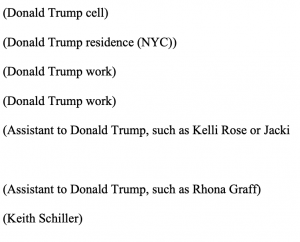
One way prosecutors will use this is to show that, when Trump told Rick Gates that more emails were coming after getting off a call he got on the way to Laguardia, he did so after speaking directly to Roger Stone. They’ll also date exactly when a call that Michael Cohen witnessed happened, after which Trump said the DNC emails would be released in upcoming days got put through Rhona Graff.

It’s not so much that we’ll get proof that Trump lied to Mueller (and not just about what he said to Stone), though we will absolutely get that, but we’ll get proof that Trump was personally involved in what Mark Meadows considers “collusion.”

The Mueller Report and the ongoing criminal investigations

Both Mueller critics and denialists are also forgetting (and, in some cases, obstinately ignorant) about what the Mueller Report actually represented.
We don’t know why Mueller submitted his report when he did — though there is evidence, albeit not yet conclusive, that Barr assumed the position of Attorney General planning to shut the investigation down (indeed, he even has argued that once Mueller decided he could not indict Trump — which was true from the start, given the OLC memo prohibiting it — he should have shut the investigation down).

A lot has been made of the investigative referrals in the Mueller Report, of which just 2 (Cohen and Greg Craig) were unredacted. We’ve seen just one more of those thus far, the prosecution of George Nader for child porn, a prosecution that may lead Nader to grow more cooperative about other issues. Some of the (IMO) most revealing details in the weekend’s dump were b7ABC FOIA exemptions for materials relating to Alexander Nix and Michael Caputo. Normally, that redaction is used for upcoming criminal prosecutions, so it could be that Nix and Caputo will have a larger role in Stone’s trial than we know. But it also may mean that there is an ongoing investigation into one or both of them.

In addition, investigations of some sort into at least three of Trump’s aides appear to be ongoing.

It is a fact, for example, that DOJ refused to release the details of Paul Manafort’s lies — covering the kickback system via which he got paid, his efforts to implement the Ukraine plan pitched in his August 2, 2016 meeting, and efforts by another Trump flunkie to save the election in the weeks before he resigned — because those investigations remained ongoing in March. There’s abundant reason to think that the investigation into Lev Parnas and Igor Fruman and Rudy Giuliani, whether it was a referral from Mueller or not, is the continuation of the investigation into Manafort’s efforts to help Russia carve up Ukraine to its liking (indeed, the NYT has a piece on how Manafort played in Petro Poroshenko’s efforts to cultivate Trump today).

It is a fact that the investigation that we know of as the Mystery Appellant started in the DC US Attorney’s office and got moved back there (and as such might not even be counted as a referral). What we know of the challenge suggests a foreign country (not Russia) was using one of its corporations to pay off bribes of someone.

It is a fact that Robert Mueller testified under oath that the counterintelligence investigation into Mike Flynn was ongoing.

KRISHNAMOORTHI: Since it was outside the purview of your investigation your report did not address how Flynn’s false statements could pose a national security risk because the Russians knew the falsity of those statements, right?

MUELLER: I cannot get in to that, mainly because there are many elements of the FBI that are looking at different aspects of that issue.

KRISHNAMOORTHI: Currently?

MUELLER: Currently.

That’s consistent with redaction decisions made both in the Mueller Report itself and as recently as last week.

It is a fact that when Roger Stone aide Andrew Miller testified, he did so before a non-Mueller grand jury. When Miller’s lawyer complained, Chief Judge Beryl Howell reviewed the subpoena and agreed that the government needed Miller’s testimony for either investigative subjects besides Stone or charges beyond those in his indictment. Indeed, one of the most interesting aspects of Mueller’s statement closing his investigation is the way it happened as Miller was finally agreeing to testify, effectively ensuring that it would happen under DC, not Muller.

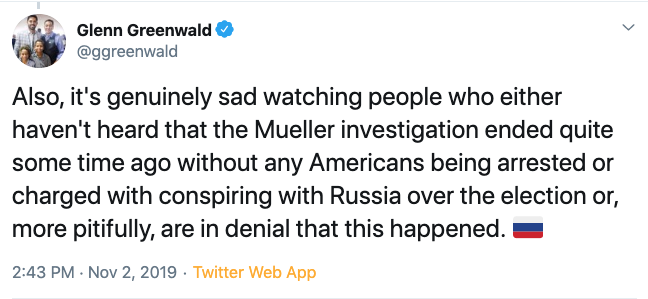
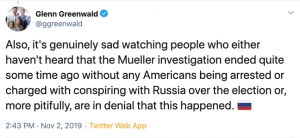
Again, these are all facts. No matter how badly Glenn Greenwald desperately wants to — needs to — spin knowing actual facts about ongoing investigations as denial, it is instead basic familiarity with the public record (the kind of familiarity he has never bothered to acquire). At least as of earlier this year — or last week! — there has been reason to believe there are ongoing investigations into three of Trump’s closest advisors and several others who helped him get elected.

At least two of those investigations continue under grand juries, impaneled in March 2019, that Chief Judge Beryl Howell can extend beyond January 20, 2021.

Why Mueller closed up shop

Nevertheless, it is indeed the case that Mueller closed his investigation after producing a report that showed abundant obstruction by the President, but stated that his investigation “did not establish” that the Trump campaign engaged in coordination or conspiracy with Russia, including regarding a quid pro quo.

In particular, the investigation examined whether these contacts involved or resulted in coordination or a conspiracy with the Trump Campaign and Russia, including with respect to Russia providing assistance to the Campaign in exchange for any sort of favorable treatment in the future. Based on the available information, the investigation did not establish such coordination.

I’d like to end this post with speculation, one not often considered by those bitching about or claiming finality of the Mueller investigation.

In his closing press conference, Mueller emphasized two things: he saw his job as including “preserving evidence” against the President, and he noted that under existing DOJ guidelines, the President cannot be charged until after he has been impeached.

First, the opinion explicitly permits the investigation of a sitting President because it is important to preserve evidence while memories are fresh and documents are available. Among other things, that evidence could be used if there were co-conspirators who could now be charged.

And second, the opinion says that the Constitution requires a process other than the criminal justice system to formally accuse a sitting President of wrongdoing.

In Mueller’s explanation of why he didn’t hold out for an interview with Trump, he said that he weighed the cost of fighting for years to get that interview versus the benefit of releasing a report  with “substantial quantity of information [allowing people] to draw relevant factual conclusions on intent and credibility” when he did.

Beginning in December 2017, this Office sought for more than a year to interview the President on topics relevant to both Russian-election interference and obstruction-of-justice. We advised counsel that the President was a ” subject” of the investigation under the definition of the Justice Manual-“a person whose conduct is within the scope of the grand jury’s investigation.” Justice Manual § 9-11.151 (2018). We also advised counsel that”[ a]n interview with the President is vital to our investigation” and that this Office had ” carefully considered the constitutional and other arguments raised by . .. counsel, and they d[id] not provide us with reason to forgo seeking an interview.” 1 We additionally stated that “it is in the interest of the Presidency and the public for an interview to take place” and offered “numerous accommodations to aid the President’s preparation and avoid surprise.”2 After extensive discussions with the Department of Justice about the Special Counsel’s objective of securing the President’s testimony, these accommodations included the submissions of written questions to the President on certain Russia-related topics. 3

[snip]

Recognizing that the President would not be interviewed voluntarily, we considered whether to issue a subpoena for his testimony. We viewed the written answers to be inadequate. But at that point, our investigation had made significant progress and had produced substantial evidence for our report. We thus weighed the costs of potentially lengthy constitutional litigation, with resulting delay in finishing our investigation, against the anticipated benefits for our investigation and report. As explained in Volume II, Section H.B., we determined that the substantial quantity of information we had obtained from other sources allowed us to draw relevant factual conclusions on intent and credibility, which are often inferred from circumstantial evidence and assessed without direct testimony from the subject of the investigation.

I take that to mean that Mueller decided to end the investigation to prevent Trump’s refusals to testify to delay the release of the report for two years.

In his testimony, Mueller agreed, after some very specific questioning from former cop Val Demings, that Trump was not truthful in his answers to Mueller.

DEMINGS: Director Mueller, isn’t it fair to say that the president’s written answers were not only inadequate and incomplete because he didn’t answer many of your questions, but where he did his answers show that he wasn’t always being truthful.

MUELLER: There — I would say generally.

She laid out what I have — that Trump refused to correct his lies about Trump Tower Moscow, as well as that he obviously lied about his coordination on WikiLeaks. So lies are one of the things the Mueller Report documents for anyone who reads it attentively.

But Trump’s obstruction extends beyond his lies. His obstruction, as described in the Report, included attempts to bribe several different witnesses with pardons, including at minimum Manafort, Flynn, Cohen, and Stone (those aren’t the only witnesses and co-conspirators the evidence shows Mueller believes Trump bribed with promises of pardons, but I’ll leave it there for now).

So here’s what I think Mueller did. I suspect he ended his investigation when he did because he was unable to get any further so long as Trump continued to obstruct the investigation with promises of pardons. So long as Trump remains President, key details about what are egregious efforts to cheat to win will remain hidden. The ongoing investigations — into Manafort and Stone, at a minimum, but possibly into others up to and including the President’s son — cannot go further so long as any prosecutorial effort can be reversed with a pardon.

That said, some of those details will be revealed for the first time starting this week, in the Stone trial. And, if the Parnas and Fruman influence operation is, indeed, related to Manafort’s own, then Trump’s personal criminal involvement in that influence operation is being revealed as part of a parallel impeachment inquiry.

Which is to say that I suspect Mueller got out of the way to allow investigations that cannot be fully prosecuted so long as Trump remains President to continue, even as Congress starts to do its job under the Constitution. And Congress has finally started doing so.

Share this entry

DOJ Pre-Dumps the Stone Trial: What BuzzFeed Obtained via FOIA

DOJ released the first batch of Mueller 302s in response to BuzzFeed’s FOIA.

While the documents are really damning (though, in part, simply because they make things reported in the Mueller Report more visible), they actually are going to be among the least damning documents released to BuzzFeed.

DOJ seems to have released documents that pertain to six Mueller team interviews that will likely come out in live testimony in Roger Stone’s trial in the next two weeks. They include interview reports and back-up from three people:

  • Rick Gates. These interviews date to April 10, 2018 (PDF 9-25); April 11, 2018 (PDF 26-38); October 25, 2018 (PDF 39-66).
  • Michael Cohen. These interviews date to August 7, 2018 (PDF 242-274); September 18, 2018 (PDF 67-95).
  • Steve Bannon. This interview is dated February 14, 2018 (PDF 96-241).

All three may testify at Roger Stone’s trial, as Gates and Bannon had direct communications with Roger Stone about WikiLeaks and Cohen witnessed a Trump-Stone phone call where Stone discussed WikiLeaks.

Significantly, while the Gates interviews and the second Cohen interview include testimony that will be repeated at trial, the first Cohen and the Bannon interview were substantially lies (the Mueller Report says this about the first Cohen interview; it’s clear Bannon was lying because much of what is recorded was contradicted by his fall 2018 testimony). Thus, to the extent that these men testify, the interviews we’re seeing will be introduced as derogatory evidence by Stone.

Arguably, the government used this BuzzFeed FOIA to pre-empt damaging information from Stone.

This release doesn’t include the Bannon interview that will be the basis for any testimony in Stone’s trial. And it includes just a tiny bit of information from Gates’ far more extensive comments about Paul Manafort’s Russian entanglements (including the Ukrainian efforts that seem to be a preview of what Rudy Giuliani has been up to). So we’re really only getting a snippet of damaging information we’ll get over the next two weeks.

Plus, by releasing these documents now, it’ll put information that will become public in the next two weeks beyond this existing FOIA, hiding it for some time until BuzzFeed appeals or someone else FOIAs for it. That is, in part, this FOIA “release” is really an attempt to lock down information.

Again, don’t get me wrong. This is valuable stuff. Jason Leopold continues to be able to liberate more useful information than Congress can, with their power of subpoena.

But this is mostly just a pre-dump of the Roger Stone trial.

Share this entry

Attorney General Bill Barr Has a Higher Opinion of George Papadopoulos’ Dirt than Steve Bannon Does

I’m working my way through the Mueller 302s that Jason Leopold liberated. But given current events, I thought it worthwhile to elevate this passage from a February 14, 2018 interview Mueller’s office had with Steve Bannon.

Bannon never worked with Papadopoulos on setting up the meetings despite Papadopoulos’s offers through email. Bannon would generally blow off Papadopoulos and thought to himself “I don’t need this guy.” Flynn would be on the hook for the meetings Papadopoulos was suggesting, and Bannon did not need Papadopoulos. Papadopoulos never told Bannon about the Russians having dirt on Clinton, and Bannon never heard Papadopoulos tell anyone else in the campaign, such as Sam Clovis, that the Russians had dirt on Clinton. Bannon had all the dirt he needed from Clinton Cash and Uranium One, he didn’t need any more dirt. Bannon didn’t need any more dirt from “clowns” like Papadopoulos and Clovis. (PDF 125)

Bannon, who remembered virtually nothing about his extensive interactions with Erik Prince (whom he admitted to respecting), remembered distinctly that he blew off all George Papadopoulos’ offers to help set up a meeting with President Abdel Fattah al-Sisi, even though he admitted knowing he had to find a way to make Trump look credible as a Commander in Chief.

After stating (months after Papadopoulos’ plea deal was announced) that he didn’t remember hearing anything about Papadopoulos offering dirt, Bannon then said he didn’t need dirt from Papadopoulos, as if it had been offered.

Anyway, Steven Bannon, who hangs out with some pretty dodgy types, calls Papadopoulos and his investigative leads a “Clown.”

That would mean that the Attorney General of the United States, who has been traveling the world on a wild goose chase for something — anything!! — that might corroborate Papadopoulos’ conspiracy theories, has a higher estimation of Papadopoulos’ dirt than Steve Bannon.

Share this entry

On the Classification Disputes over Mike Flynn’s Discovery

Over the last week, I have laid out how Mike Flynn’s TV lawyer, Sidney Powell, used what was nominally a reply brief in her Brady demand to make a new request that the entire prosecution against Flynn be thrown out. I showed how her argument misrepresented the evidence she used to make it — at one point, she even accused her own client of lying in his initial FBI interview! Nevertheless, Powell succeeded at least far enough to get Sullivan to order the government to respond to her entirely new demand, a sign he may be sympathetic to her gaslighting.

But I’d like to go back and consider the declassification process that got us to this point.

Flynn’s reply was due on October 22, a week ago Tuesday. Starting on Saturday, October 19, Flynn’s team tried to get DOJ to approve its use of the materials it had received under the protective order — 302s involving Peter Strzok and Lisa Page, Strzok and Joe Pientka’s notes from the initial interview, some of the Strzok-Page texts, and a redline of the 302 from February 10.  That exchange looked like this:

October 19, 3:54PM: Powell writes AUSA Jocelyn Ballantine cc’ing other lawyers, stating she plans to include quotes from the protected materials, including from “the various 302s of the 24th, [redacted], [Page’s] 302, and the agents [sic] notes,” stating they may file without sealing the reply or exhibits.

October 20, 1:36PM: Brandon Van Grack response, stating they need to ask “equity holders, in particular the FBI,” and offering to start reviewing quotes before the reply is finished.

October 20, 1:49PM Flynn attorney Molly McCann replies and asks Van Grack to “begin the process to clear the full documents,” including the 302s, the documents whose description is redacted, [Page]’s 302, and the agents’ notes.”

October 22, 12:00PM: Flynn files his reply under seal.

October 22, 12:45PM: Molly McCann writes Van Grack and others, attaching “our proposed redactions,” based off “the redactions [the government] made in the original Motion to Compel. McCann stated that, “until you can complete your review process we would expect to keep the exhibits under seal.”

October 22, 3:34: Van Grack replies, stating that “we have circulated the motion, and your proposed edits, to the appropriate entities,” noting that “we will need to request redactions beyond what you propose.”

October 23, 10:33AM: Powell writes Van Grack, advising him that “if we have not received your proposed redactions as to the Reply brief by 1 p.m. today, we will be filing a motion with the court.”

October 23, 10:39AM: Ballantine writes Powell, stating that “there is information in your filing beyond that which you flagged for us on Sunday,” adding, “there is one sensitive matter that is unlikely to be resolved before the end of the day.”

October 23, 11:10AM: Powell responded, “without a proposed redacted version from you that can be unsealed today or an assurance it will be resolved today, we will be seeking relief from the court by 5 p.m.

October 23, 7:17PM: Flynn’s team submits a motion to file their proposed brief.

October 24, 10:23PM: Flynn’s team submits motion for leave to file, along with their “reply,” based on adopting the government’s redactions.

Effectively, Powell got fed up waiting for FBI to decide what could and could not show up in her reply, and pushed to publish a public copy. Sure, she was insistent on filing as much of this in unredacted form as she could so she could feed the frothy right with her brief (which she effectively admits in her October 23 filing). But that is entirely her right. I’m totally sympathetic with her demand that she be allowed to file this in timely fashion (though I imagine the government would suggest they should have started the declassification process more than three days in advance).

This is one issue I’m absolutely supportive of Powell’s aggressiveness.

But, particularly given the timing, I’m interested in the substance of the dispute. I’m interested for several reasons. Powell’s entire representation of Flynn went through Bill Barr. She clearly has gotten information about the Durham investigation stovepiped to her, most recently in the form of totally irrelevant (to Flynn) information about the government obtaining Joseph Mifsud’s phones. And she made claims about what she believed she knew should and should not be redacted.

Just as interesting, on the morning of October 23, Jocelyn Ballentine said one “sensitive matter” was unlikely to get resolved that day. On October 24, the NYT and other outlets first started reporting that Durham’s inquiry had become a criminal investigation. Certainly, there could be other issues that might be that sensitive issue (including decisions about indicting Andrew McCabe). But the redactions on some of these exhibits certainly might be implicated by a Durham investigation, depending on the scope of it.

Let’s work backwards. First, of the 16 exhibits submitted with her reply, just eight came from the government and so were subject to the protective order (this post has more extensive discussions of what these are):

2) Page-Strzok texts*

3) Comey memos

5) Strzok 302 responding to propaganda Sara Carter and John Solomon “reported”*

6) Previously released Strzok 302 on his own role in the investigation*

9) Joe Pientka notes from the interview

10) Strzok notes of the interview

11) Redline of edits made to 302 on February 10*

12) Lisa Page 302 on texts with Strzok regarding the interview with Flynn*

In the exhibit showing the conversation about declassification, the existence of the Sara Carter-related 302 and the Page 302 were redacted entirely. All the exhibits were cleared for release in some fashion, though I’ll get back to what remains redacted.

In Powell’s filing asking Sullivan to intervene, she said, “The only exhibits to the Reply for which the defense knows of any reason to remain under seal are 5, 6, 9, 10, 11, and 12.” In her motion to file the reply brief, she said, “The government … proposed redactions to five of the exhibits Mr. Flynn included in his filing—Exhibits 2, 5, 6, 11, and 12,” meaning the texts included stuff she didn’t know should still be redacted. I’ve marked the exhibits the government added redactions to above.

The redactions of the redline must be — in addition to names — redactions of information that would reveal how FBI works. Among other things, it likely includes codes the agents use to track them, because DOJ screwed up who made the two changes to the redline (as I note here, they say Strzok didn’t remember something that Pientka added, but it must be the reverse given their notes).

Similarly, the only thing redacted in the Page 302 is names and organizational stuff. That would suggest that nothing in the Page 302 implicates ongoing investigations (including, but not limited to, Durham).

It’s hard to tell what got redacted in the texts. Clearly, something that the government released to Flynn was deemed too sensitive to release. But there were already two sets of redactions in the texts — the gray ones (possibly for privacy reasons) and some black ones that redact genuinely sensitive material. One of those things, for example, is the name of the person Strzok and Page were worried about locking in on May 10, 2017, which Flynn (and the rest of the frothy right) believed incorrectly to be him. But there are other things — such as a October 19, 2016 and another January 23, 2017 text — that might have been released to Flynn but cannot be released publicly. Or, it’s possible FBI just redacted the phone numbers.

Most intriguing is the Sara Carter related 302. There are two redactions, one introductory and one referring to the third allegation Carter was chasing, that after Flynn resigned, people high fived and said, “we got him.” Powell apparently knows why it was redacted. But I had heard, in reporting something else, that this was considered a hoax targeted at McCabe. If the redaction reflected badly on McCabe, Powell would be sure to include it in her filing, which she doesn’t. One possible explanation is that DOJ is still trying to chase down where this disinformation got spread (consistent with the fact that DOJ IG still hasn’t released its report on who was behind the NY Field Office leaks, in part because there were too many to pinpoint).

Finally, there’s the 302 memorializing Strzok’s role in the initiation of the investigation. It has the same redactions (and appears to be the same version) of the 302 released in June, in the wake of the Mueller Report. At the time, the government said those were deliberative privilege and personal privacy redactions — meaning most of what remains redacted consists of discussions of investigative choices.

The government continues to redact DIA stuff on Flynn’s trips to Russia

Except that last point — about the 302 memorializing Strzok’s role in initiating the investigation — might have changed.

Note that the government told Flynn’s team there were things in their actual brief that needed redaction. Aside from names, two things are redacted. First, a footnote modifying Powell’s otherwise unsubstantiated claim that the FBI knew they had no basis to investigate Flynn, which cites to the 302 on Strzok’s role in opening the investigation.

This must be something genuinely investigative, or Powell would have contested it on releasing the motion. Remember that at the time, Flynn was under investigation for being an Agent of Russia. Perhaps significantly, in the government’s Surreply, they get really vague when addressing the multiple bases for interviewing Flynn.

The defendant also now argues that the information he seeks will prove that the “FBI had no factual or legal basis for a criminal investigation.” Reply at 14-16. In support, the defendant cites to the standard necessary to obtain a warrant pursuant to the Foreign Intelligence Surveillance Act (”FISA”). See Reply at 14, n.11. Obtaining a FISA warrant, however, is entirely different from the FBI interviewing an individual as part of an ongoing counterintelligence investigation. Here, there were multiple bases for the FBI to interview the defendant. The defendant’s false statements publicly attributed to him by White House officials about his communications with Russia were alone a sufficient and appropriate basis for conducting the investigative step of interviewing the defendant.

Don’t get me wrong, they’re right that Powell is speciously arguing that the government needs probable cause showing someone is an Agent of a Foreign Power (the FISA standard) before they interview someone — it’s a point I made in bullet 9 here. But the Flynn camp has always tried to limit the reasons why the FBI interviewed Flynn (not least so they could claim it was an improper investigation into policy). There’s likely a whole lot of baggage to these redactions.

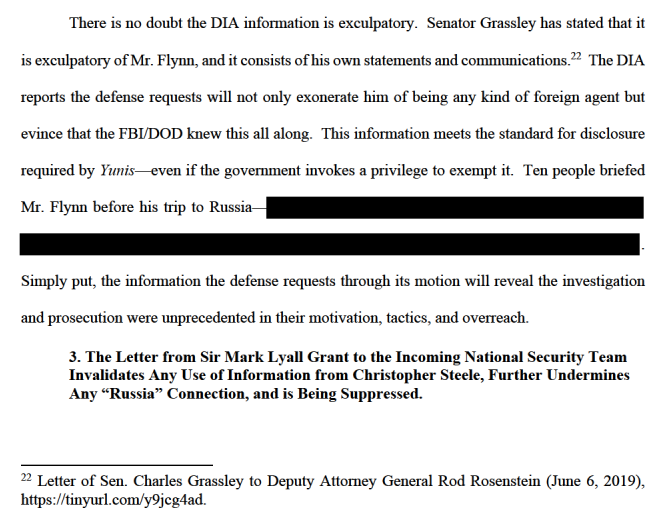
A more interesting redaction comes in a passage that invents out of thin air a claim that Chuck Grassley had seen files regarding briefings Flynn did before he went to Russia and deemed them exculpatory. In it, the government redacted a sentence about those briefings.

Probably, this stuff comes from DIA material shared with Flynn in August (after it was handed to Grassley). The government, in its response to Powell’s initial motion, said some of what Flynn told the DIA was inculpatory.

Request #15: The government is not aware of any information in possession of the Defense Intelligence Agency that is favorable and material to sentencing, including the information that the government provided on August 16, 2019. Specifically, the information of which the government is aware, including that August 16 production, is either inculpatory or has no relevance to the defendant’s false statements to the FBI on January 24, 2017, or to the FARA Unit.

Which makes it interesting, first, that Powell isn’t trying to represent the content of these supposedly inculpatory DIA files, and second, that DOJ continues to hide it.

There seem to be two tensions going on behind all this discovery. First, the possible referral of people involved in his prosecution (but apparently not Lisa Page) to Durham. But just as interesting, given ongoing redactions regarding Flynn’s ties to Russia, inculpatory information about his own ties to Russia.

Share this entry

The Government Reminds Emmet Sullivan that Mike Flynn Already Agreed His Current Complaints Don’t Change His Guilt

The government used an interesting strategy in responding to Sidney Powell’s nominal “reply” brief demanding Brady information but actually asking to have the entire prosecution thrown out.

The most interesting (and potentially risky): even though Sullivan ordered them to address “the new relief, claims, arguments, and information” raised in Powell’s “reply,” they still treat this as primarily a question of Brady obligations. In addressing Powell’s demand to have the prosecution thrown out, they play dumb, noting that Powell has not presented her demand as a lawyer would, with citations and case law, and so then make an assumption that this is primarily about Brady.

In his Reply, the defendant also seeks a new category of relief, that “this Court . . . dismiss the entire prosecution for outrageous government misconduct.” Reply at 32; see also id. at 3 (“dismiss the entire prosecution based on the outrageous and un-American conduct of law enforcement officials and the subsequent failure of the prosecution to disclose this evidence . . . in a timely fashion or at all”). The defendant does not state under what federal or local rule he is seeking such relief, or cite to relevant case law.9 In order to provide a response, the government presumes, given the context in which this request for relief arose, that the defendant is seeking dismissal as a remedy or sanction for a purported failure to comply with Brady and/or this Court’s Standing Order.

9 Local Criminal Rule 47(a) specifically requires that “[e]ach motion shall include or be accompanied by a statement of the specific points of law and authority that support the motion, including where appropriate a concise statement of the facts” (emphasis added). The defendant now seeks relief from this Court for claims that he has not properly raised; the government is hampered in its ability to accurately respond to the defendant’s argument because he has failed to state the specific points of law and authority that support his motion.

I’m sure Powell’s response will be “Ted Stevens Ted Stevens Ted Stevens.” But even if it is, that’s something she could have cited in her new demand for relief and did not.

They do go on to address the claim that the FBI engaged in outrageous behavior, focusing relentlessly on the January 24 interview, rather than Powell’s more far-flung conspiracy theories. But ultimately, this seems to be an attempt to do what they tried to do when they first alerted Emmet Sullivan that Powell had raised new issues, to either force her to submit her demand to have the whole prosecution thrown out as a separate motion, or to substantiate her Brady claims.

The government then lays out, for the second time, that the government already provided Brady by the time Flynn pled guilty a second time, this time before Judge Sullivan, on December 18, 2018.

Although the defendant now complains about the pace of that discovery, before December 18, 2018, the defendant was in possession of all of the information on which he now bases his argument that the case should be dismissed due to government misconduct. See Reply [sic] at 1-2, 16, 26; Notice of Discovery Correspondence, United States v. Flynn, 17-cr-232 (D.D.C. Oct. 1, 2019) (Doc. 123). Thereafter, on December 18, 2018, the defendant and his counsel affirmed for this Court that they had no concerns that potential Brady material or other relevant material had not been provided to the defendant. See Hearing Transcript at 8-10, United States v. Flynn, No. 17-cr-232 (D.D.C. Dec. 18, 2018) (“12/18/2018 Hearing Tr.”). The defendant further affirmed, under oath, that he wished to proceed to sentencing because he was guilty of making false statements to the FBI. See id. at 16.

Note, there’s an error in this passage, calling their past filing a “Reply” rather than Response. They should have relied on the Reply — on Powell’s own documents — to show that even her own less-detailed timeline of discovery proves that the government provided everything save some DIA files dating from well before Flynn’s lies before his aborted sentencing before Judge Sullivan.

Which leads us to the tactic that should rule the day. In both that reference to complying with Brady, and in three other places, the government reminds Emmit Sullivan that Flynn had all this information last year, when Sullivan put Flynn under oath, made him plea again, and made damn sure none of these things changed his guilty plea.

They do this, for example, regarding the derogatory information about Strzok.

The defendant also places significant weight on DAD Strzok’s remark that the defendant had “a very ‘sure’ demeanor and did not give any indicators of deception.” Strzok 302 at 3. Without citation or explanation, the defendant intimates that such words were edited out of an earlier draft of the interview report. See Reply at 24. There is no evidence that that occurred, or that the government attempted to suppress those statements. It informed the defendant of the assessment before the defendant signed the plea agreement and pleaded guilty, and documented DAD Strzok’s assessment in a separate interview of DAD Strzok (which it provided to the defendant in discovery). Moreover, DAD Strzok’s assessment does not exonerate the defendant. There is ample public evidence that the defendant also convincingly lied to other government officials about his conversations with the Russian Ambassador.

Then, after laying out how they had affirmatively asked Kelner and Flynn if the former had a conflict arising from having written Flynn’s FARA filing, they remind Sullivan that he himself offered Flynn an opportunity to consult with independent counsel to make sure he had been adequately represented by Kelner last year.

Additionally, during the scheduled sentencing hearing on December 18, 2018, the defendant declined the Court’s invitation to have the Court appoint “an independent attorney to speak with [the] defendant, review the defendant’s file, and conduct necessary research to render a second opinion for [the] defendant.” 12/18/2018 Hearing Tr. at 9.

Finally, after refuting (such as they do) Powell’s claim of abuse, they remind Sullivan that Flynn knew everything she makes a stink about when he pled guilty before Sullivan.

For all of the above reasons, it is no surprise that with the same set of facts, the defendant and his prior counsel previously represented to this Court that the circumstances of the interview had no impact on his guilt, or guilty plea. On December 18, 2018, when the Court asked the defendant if he wished to “challenge the circumstances on which you were interviewed by the FBI,” he responded, under oath, “No, Your Honor.” 12/18/2018 Hearing Tr. at 8.10 The Court then asked the defendant if he understood that “by maintaining your guilty plea and continuing with sentencing, you will give up your right forever to challenge the circumstances under which you were interviewed,” to which the defendant answered, “Yes, Your Honor.” Id. And when the Court queried whether the defendant wanted an opportunity to withdraw his plea because one of the interviewing agents had been investigated for misconduct, the defendant stated “I do not, Your Honor.” Id. at 9. His counsel likewise represented to the Court that their client was not “entrapped by the FBI,” and that they did not contend “any misconduct by a member of the FBI raises any degree of doubt that Mr. Flynn intentionally lied to the FBI.” Id. at 11-12.

Sullivan wisely put Flynn under oath last year and gave him an opportunity to back out of his plea. Unless he can be convinced there’s anything new — and while it’s shiny gaslighting, Powell’s evidence doesn’t back that claim — then he’s obliged to hold Flynn to his plea from last year.

Or, as the government suggests, Sullivan can send this thing to trial.

The baseline remedy for a Brady violation in this district is retrial, not dismissal. United States v. Pettiford, 627 F.3d 1223, 1228 (D.C. Cir. 2010) (“If we find a Brady violation, a new trial follows as the prescribed remedy, not as a matter of discretion.”)

I’ve said before and will repeat it here, it’s a fools errand to try to predict Judge Sullivan. If this ploy is going to work for anyone, it might work for Sullivan.

But Judge Sullivan’s own actions may well prevent that.

There are, to be sure, interesting details in this filing. It reveals more details about what happened when Flynn was proffering in advance of a plea deal. It explains that the timing of his January 24 interview was tied not to the release of the Steele dossier, as he alleged, but to Sean Spicer’s repetition of his denials on January 23 (something that’s consistent with Andrew McCabe’s memo on the topic). It debunks a long-standing conspiracy theory — that Lisa Page and Peter Strzok said they had to lock in Mike Flynn in a chargeable way the day Comey was fired. It reveals that the government raised — and Flynn twice waived — any concerns that Rob Kelner had a conflict tied to his role in Flynn’s FARA filing.

But mostly, this filing lays out all the way that Flynn already said, under oath and to Judge Sullivan, that these issues didn’t matter.

Update: I think I found another error. The government says that the only thing interesting in the February 10 redline of the 302 is Strzok indicating he didn’t remember two details — that Flynn said he had no particular affinity for Russia, and that he didn’t remember that Flynn said his government Blackberry wasn’t working in the Dominican Republic.

Contrary to the defendant’s assertion, there were no material changes made after February 10, 2017, to the draft of the January 24 interview report. See Reply at 26. On February 10, 2017, DAD Strzok highlighted two—and only two—sentences where he did not recall a statement that the other interviewing agent included in the draft of the report.

But this must actually be Pientka not remembering these things, because both details show up in Flynn’s notes.

Share this entry

The Republican Closing Argument against Impeachment Is Personally Implicated in the Scandal

I’m waiting on the procedural votes to authorize the House impeachment inquiry. There were some nice speeches, with Speaker Pelosi lecturing the Republicans about American history, Republicans repeating the same quote from Alexander Hamilton over and over, Steve Scalise posing next to an image of the Kremlin [Correction: This is St. Basil’s Cathedral], and Eric Swalwell accusing the President of using taxpayer dollars to lead an “an extortion shakedown scheme.”

But perhaps the most telling aspect of the debate is that the Republican closing argument — yet another recital of that same Hamilton quote — came from Majority Leader Kevin McCarthy.

Kevin McCarthy is implicated in the scandal he doesn’t want investigated.

McCarthy received money both personally and in the guise of his Protect the House PAC from Igor Fruman and Lev Parnas, the grifters at the core of the influence operation that led to Trump’s quid pro quo conversation with Volodymyr Zelensky. He also keynoted an event with the grifters. While he has said he’d donate the money to charity (though has not yet, as far as I know, shown that he did that), there is no way to unring the bell of their support. He became Majority Leader with the support of men who have since been indicted for that support.

That is the face that is leading opposition to impeachment.

Update: Here’s the roll call.

  • Impeachment curious Republicans Will Hurd and Francis Rooney both voted against the inquiry
  • Democrats Collin Peterson and Jeff Van Drew also voted against
  • Justin Amash voted for the inquiry
  • Republicans Jody Hice, John Rose, and William Timmons, and Democrat Donald McEachin did not vote

So 98.5% of the Republican caucus voted to do nothing after another branch of government usurped Congress’ power of the purse.

Share this entry

The Ellipses and the Recordings, Plural, of Joe Biden

Before I get into the NYT report on Alexander Vindman’s testimony that the White House removed damning things from the transcript of the July 25 call, I want to note something from his opening statement. At the end of his description of who he is and what he does, Vindman warned that the impeachment inquiry should carefully balance the need for disclosure against national security concerns.

Most of my interactions relate to national security issues and are therefore especially sensitive. I would urge the Committees to carefully balance the need for information against the impact that disclosure would have on our foreign policy and national security.

Then, when discussing the July 25 call, Vindman emphasized that, because the transcript is in the public record, “we are all aware of what was said.”

On July 25, 2019, the call occurred. I listened in on the call in the Situation Room with colleagues from the NSC and the office of the Vice President. As the transcript is in the public record, we are all aware of what was said.

I was concerned by the call. I did not think it was proper to demand that a foreign government investigate a U.S. citizen, and I was worried about the implications for the U.S. government’s support of Ukraine. I realized that if Ukraine pursued an investigation into the Bidens and Burisma, it would likely be interpreted as a partisan play which would undoubtedly result in Ukraine losing the bipartisan support it has thus far maintained.

Yet immediately following his statement that “we are all aware of what was said,” Vindman asserts that the call was about investigating the Bidens and Burisma. But Burisma doesn’t appear in the TELCON. It is one of the things that, according to the NYT, the White House removed — where it says “the company” in this passage — and he recommended it be put back in.

I understand and I’m knowledgeable .about the situation. Since we have won the absolute majority in our Parliament; the next prosecutor general will be 100% my person, my candidate, who will be approved, by the parliament and will start as a new prosecutor in September. He or she will look into the situation, specifically to the company that you mentioned in this issue. [my emphasis]

NYCSouthpaw had said once this had to be a reference to Burisma — he was absolutely correct.

According to NYT, the ellipsis in this passage of the TELCON,

Biden went around bragging that he stopped the prosecution so if you can look into it …

… Took out a reference to Joe Biden talking about getting Viktor Shokin fired.

The omissions, Colonel Vindman said, included Mr. Trump’s assertion that there were recordings of former Vice President Joseph R. Biden Jr. discussing Ukraine corruption,

[snip]

The rough transcript also contains ellipses at three points where Mr. Trump is speaking. Colonel Vindman told investigators that at the point of the transcript where the third set of ellipses appear, Mr. Trump said there were tapes of Mr. Biden.

Mr. Trump’s mention of tapes is an apparent reference to Mr. Biden’s comments at a January 2018 event about his effort to get Ukraine to force out its prosecutor general, Viktor Shokin. [my emphasis]

The NYT and other outlets have asserted that this is a reference to a video that Rudy Giuliani has been publicly shopping for some time, and it undoubtedly is that, at least.

But I want to suggest the possibility that it’s a reference to more.

The NYT goes to absurd lengths to make this appear as innocuous as possible, seemingly offering up the possibility that the words “the company” appeared because of a failure of the voice recognition software (though the TELCON itself notes that such a possibility would be marked by “inaudible” in the transcript).

It is not clear why some of Colonel Vindman’s changes were not made, while others he recommended were, but the decision by a White House lawyer to quickly lock down the reconstructed transcript subverted the normal process of handling such documents.

The note-takers and voice recognition software used during the July 25 call had missed Mr. Zelensky saying the word “Burisma,” but the reconstructed transcript does reference “the company,” and suggests that the Ukrainian president is aware that it is of great interest to Mr. Trump.

Which is one reason I find it notable that the NYT suggests the reference to recordings refers solely to a single publicly known recording of Biden even though both times they refer to Vindman’s testimony, they refer to tapes or recordings, plural.

The thing is, there are undoubtedly are tapes, plural, of Biden talking about firing Shokin. Indeed, in the recording in question, Biden even says that he had already gotten a commitment from Petro Poroshenko to fire Shokin.

I had gotten a commitment from Poroshenko and from Yatsenyuk that they would take action against the state prosecutor. And they didn’t.

So at the very least, there are the US versions of prior communications in which Biden would have emphasized the importance of firing Shokin. And there may well be other recordings reflecting that the ask happened, for example of Poroshenko talking to Arseniy Yatsenyuk about it. Given that getting Poroshenko to act on corruption was a key focus of Obama’s policy, it would have been a key focus of SIGINT collection. So if we had the ability to collect such conversations, we would have done so. And if we did, those recordings would still be sitting at NSA available to anyone with the need to know.

Trump would have legal access to all of that and, given his focus on Ukraine and “corruption,” an excuse to pull it up. Given that this purported concern about “corruption” is part of the official, stated policy of the US, it is not at all crazy to assume that his aides have pulled existing intercepts pertaining to past discussions of corruption and if they did, they would have, by definition, involved Joe Biden, because he was the one Obama tasked to take care of such issues.

And if there were — and if Trump’s comment reflected knowledge of that — it would explain two other details.

First, Vindman clearly doesn’t think all of the details about this call should be aired publicly. It’s certainly possible that he just didn’t want it to become public that Zelensky had parroted Trump’s demand to investigate Burisma. As I noted, by releasing the transcript, Trump has already made it clear that he succeeded in corrupting Zelensky, who ran on a platform of ending corruption. Revealing that Zelensky was literally repeating the script that Gordon Sondland had dictated for him would make that worse.

It’s also possible that whatever the other two ellipses in the TELCON hide are things he believes should remain secret. Vindman certainly would know what those ellipses hide, even if he didn’t recommend adding those details back in, and surely got asked about it yesterday.

But a national security professional like Vindman would also want to keep any details about intercepts classified. Even just the fact — not at all controversial but not something spoken of in polite company — that the US was sitting on records of Poroshenko’s resistance to dealing with corruption would be the kind of thing Vindman might want to keep secret.

Again, it may be that Vindman’s concerns about airing this dirty laundry involve nothing more than an effort to minimize the damage already done to Zelensky. But it may reflect more specific concerns about sources and methods.

And if the original transcript did reflect sources and methods, it might provide an excuse for John Eisenberg to insist it be stored on the Top Secret server. Again, his decision to do so may extend no further than a desire to cover up the President’s crime. But if the call reflected more sensitive collection, then it would need to be stored on a more secure server. That also might explain why everyone else — except the whistleblower, who wasn’t on the call — treated these details as Top Secret.

The existing TELCON does not hide that Trump was discussing right wing propaganda with Zelensky. So there would be no reason to remove Trump’s reference to another piece of right wing propaganda. But the treatment of it suggests that the TELCON as released removed classified information (the document is titled “Unclassified,” suggesting that if the TELCON included the statements reflected in the ellipses, it’d be Classified). In which case, there may be other recordings, recordings that are classified and aren’t known to every frothy right winger spouting propaganda.

For some reason, the NYT thinks Trump referred to more than one recording of Biden talking corruption. It is not at all unreasonable to imagine he knows of classified recordings.

Share this entry