Subpoenas for GOP toll records (questions by GOPers): 55
Subpoenas for GOP toll records (questions by Dems): 2
Other subpoenas for GOP witnesses (questions by GOPers): 1
Subpoenas from the stolen documents investigation (asked by Dems): 19
As that tally makes clear, the vast majority of those references came during the GOP time, focused on the subpoenas for 10 members of Congress, one of two fake scandals that Chuck Grassley created in advance of Smith’s testimony.
There were no questions — zero — about the other scandal Chuck Grassley created, that Jack Smith had subpoenaed (Grassley falsely claimed) records, mostly financial, for 430 “targets”. Even Chuck Grassley, in a December 8 post laying out the “oversight” he plans to do in 2026, barely mentioned those subpoenas.
The closest the House GOP came in last month’s Smith deposition was this question about claims that right wingers were debanked (as if being an insurrectionist were not reason enough for a bank to cut ties with someone):
Q Where they’re basically told by their bank that they need to go find a different bank. And there is a long list of, you know, Trump allied, you know, officials that were subpoenaed for the grand jury, that were, you know, brought into your investigation that claim they had been debanked and that Capital One told them to go find a different bank and numerous other banks.
Do you know anything about that?
A No, I do not.
Q Okay. So your office didn’t have any communications with banks urging a bank to separate from any of their customers?
A I have no knowledge of that.
Q Are you aware of that allegations, or is this the first you’re hearing of it?
A I’m trying to think. I didn’t know what the term meant when you first said it, so, I mean, in the scheme of the world, have I heard of the word debanking? Maybe. But if you’d asked me to define it when you first said it, I don’t think I could have.
Q Okay. But have you — so you haven’t heard that allegation that some of the folks in President Trump’s inner circle have complained that they, you know, were kicked out of their bank?
As a result, the GOP did not invite (and Democrats did not think to invite) Jack Smith to explain a slew of subpoenas he sent out, subpoenas that constituted new prongs of the investigation and expanded prongs of work done in 2021 about finances.
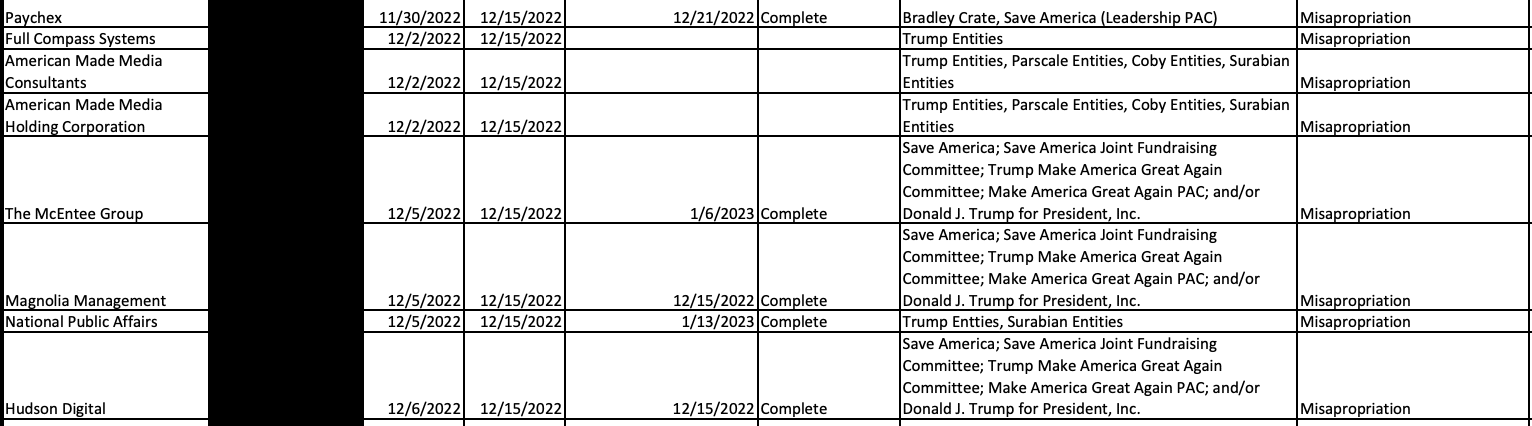
As I laid out here, those subpoenas clearly addressed known prongs of the investigation into how Trump raised tons of money based on false claims and later funneled the money to people who had remained loyal through the attack on democracy.
Five pages — which appear to match the title of the document, Arctic Frost Bank Record Subpoenas — show subpoena returns with dates long after the date of the summary, going through a subpoena pertaining to Jeffrey Clark and John Eastman to Fidelity completed on July 6, 2023. [Note: The release of this document exposes the banks of dozens of Trump associates, a fairly alarming privacy violation.]
The five pages of subpoenas focus on several topics, largely the following:
J6 $
Wire fraud
Misappropriation
Payments to lawyers
Bogus investigations
Obstruction
Credit reports
Most of this traces several prongs of investigation that were publicly reported at the time — largely picking up efforts of the January 6 Committee — showing that Trump raised money in the guise of election integrity, but then paid it to people like Brad Parscale or Dan Scavino.
Based on dates, this appears to be a key focus of Jack Smith once he was appointed
After squawking loudly (and to a significant extent, inaccurately) about the subpoenas, after doxing great swaths of the Republican Party, congressional Republicans decided they didn’t want to talk about the lucrative grift Trump took them for, in which Republican faithful paid Trump to lie.
As a result, the closest the full day deposition came to explaining how Trump abused the faith of his supporters was this exchange.
Q So did you develop evidence that President Trump, you know, was responsible for the violence at the Capitol on January 6th?
A So our view of the evidence was that he caused it and that he exploited it and 8 that it was foreseeable to him.
Q But you don’t have any evidence that he instructed people to crash the Capitol, do you?
A As I said, our evidence is that he in the weeks leading up to January 6th created a level of distrust. He used that level of distrust to get people to believe fraud claims that weren’t true. He made false statements to State legislatures, to his supporters in all sorts of contexts and was aware in the days leading up to January 6th that his supporters were angry when he invited them and then he directed them to the Capitol. Now, once they were at the Capitol and once the attack on the Capitol happened, he refused to stop it. He instead issued a tweet that without question in my mind endangered the life of his own Vice President. And when the violence was going on, he had to be pushed repeatedly by his staff members to do anything to quell it.
And then even afterwards he directed co-conspirators to make calls to Members of Congress, people who had were his political allies, to further delay the proceedings.
Trump deliberately stoked distrust to get his supporters to attack democracy.
January 6 was a violent insurrection. Never forget that.
But it was also an enormous fraud on the Republican Party.
Share this entry
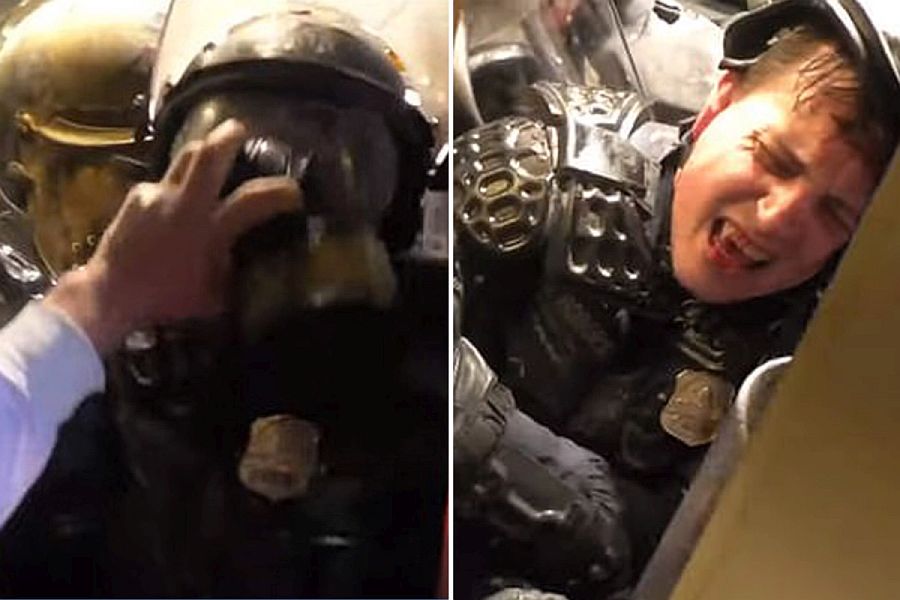
https://www.emptywheel.net/wp-content/uploads/2022/02/Jan6_CapitolPoliceOfficerCrushed_SunStoryful_06JAN2021.jpg600900emptywheelhttps://www.emptywheel.net/wp-content/uploads/2016/07/Logo-Web.pngemptywheel2026-01-06 08:36:502026-01-06 08:36:50January 6 Was a Violent Insurrection; It Was Also a Fraud Against the GOP Faithful
Jim Jordan tried to bury the Jack Smith deposition in a News Years Eve document (and video) dump.
Perhaps that’s because the funniest answer Smith gave (after already explaining why he had obtained subpoenas for the phone records of members of Congress, which was, in part, because Boris Ephsteyn and Rudy Giuliani were using two phones that day) was that Jim Jordan’s toll records were important because Jordan called the White House on January 6 because he was scared.
Q The toll record subpoena for the chairman of the committee.
A Well, I can tell you that, for example, there were — there was contact on, for example, January 6. But, again, another example for you is Mark Meadows, when he interviewed, when we interviewed him, he referenced the fact that that afternoon Chairman Jordan had been in contact with the White House. And, like Congressman McCarthy’s contact with the White House, it was relevant because, again, Meadows stated this, that these were supporters. These were credible people that the President relied on.
And what I recall was Meadows stating that “I’ve never seen Jim Jordan scared of anything,” and the fact that we were in this different situation now where people were scared really made it clear that what was going on at the Capitol could not be mistaken for anything other than what it was.
And it goes back to that sort of information from someone who is a credible source to the President, proving that that actually happened and that there’s actually a record of that call and exactly when it happened and what actions happened after that or didn’t happen after that, extremely probative to our case.
Meanwhile, after Republicans complained about Smith’s gag order on Trump,
Q Did you- — you sought gag orders in both the Florida case and the D.C. case.
Is that correct?
A We sought an order in the D.C. case under a rule — I think it’s 57.2 — and we did that because Donald Trump was making statements that were endangering witnesses, intimidating witnesses, endangering members of my staff, endangering court staff.
As you might remember, in the — right around when the indictment was released, he issued a tweet saying: “If you come after me, I’ll come after you.” He called — in a tweet he called General Mark Milley a traitor and mentioned that what he’d done in olden times people would be put to death. As a result of the things he was saying, the judge in this case was put — received vile death threats.
And with respect to D.C., both the district court and the court of appeals, a panel of judges, found that his actions were, in fact, causing what we said they caused. They were causing witnesses to be intimidated and endangering people.
And I believe it was the court of appeals also found that in addition to intimidating or chilling witnesses who existed, it would chill witnesses who had not yet come forward because they were afraid that they would be next.
So, yes, we did file that and I make no apologies for that.
Q Which witnesses do you think he would have intimidated? I mean, are there any specific witnesses that you could identify for the court?
A We did a filing. I don’t recall the specifics in that filing right now. But as I said, one of the issues from my perspective was not only the witnesses who he had specifically called out and caused threats to be issued, this phenomena that was found by both courts, it was the result of that is that a rational witness who maybe had not come forward would be completely afraid to because they would see that they would be next.
And I think the courts — both courts agreed with that.
Here’s how Smith answered Jasmine Crockett’s question about threats to Smith specifically.
Ms. Crockett. And, just to kind of finish up on this point, you, yourself — I’m not sure if this was discussed by the majority, but have you, yourself, been intimidated as a result of the actions that you took in this case.
The Witness. I’m not going to be intimidated.
Ms. Crockett. Have you been threatened.
The Witness. Yes.
Much later, Smith declined to get into the threats against him because they would endanger his (and he did not specify, but implied, his family’s) safety.
Q Do you feel like you have a target on your back?
A I believe that President Trump wants to seek retribution against me because of my role as special counsel.
Q Would you be surprised if President Trump directs the DOJ to indict you?
A No.
Q Are you concerned about the safety of people who associate with you, like your former colleagues and your attorneys here today?
A I would prefer, if it’s all right, not to talk about my safety, because I think doing so could, in fact, endanger my safety and those of people around me.
Q Understood.
Though Smith did later confirm that Trump tried to retaliate against Covington & Burling because they represented him.
Regarding Smith’s investigation, one of the more interesting insights was his explanation of why he did not try to interview Steve Bannon, Peter Navarro, or Roger Stone.
Ms. Lofgren. Can I ask — we attempted in the January 6th Committee to question Peter Navarro as well as Steve Bannon, and they were both prosecuted and spent time in jail. Roger Stone appeared but took the Fifth.
Were you able to provide — to get information from any of those three individuals and in the case of Mr. Stone provide use immunity so that he would have to testify?
The Witness. We did not.
Ms. Lofgren. Why not?
The Witness. We pursued the investigative routes that we thought were the most fruitful. We pursued those that we thought were necessary to get a complete understanding of the scope of the conspiracy. And given the highly uncooperative nature of the individuals you talked about, I didn’t think it would be fruitful to try to question them.
And the sort of information that they could provide us, in my view, wasn’t worth immunizing them for their possible conduct.
In addition to Ephsteyn, he also interviewed Rudy. Smith repeatedly said that prosecutors would have welcomed if Trump called any of his co-conspirators as witnesses.
Q Were you planning on calling John Eastman as a witness?
A I do not believe we would have, but we would have welcomed if the defense called him.
Q Okay. It gets tricky, though, for the defense to call him because the people like Eastman and Clark and, you know, Rudy Giuliani and Sidney Powell, I mean, you know, they were shrouded by the special counsel as, you know, co-conspirators one through six.
And so they all feared that they were going to be prosecuted if they said anything. Isn’t that fair?
A Well, they were co-conspirators. I can’t get into what was in their mind or not. can tell you some of the co-conspirators met with us in proffers and did interviews with us.
And so the idea that someone like Rudy Giuliani, who sat with a proffer with us, he was available as a witness, and we would have welcomed President Trump calling him as a witness.
Boris Epshteyn sat for an interview with us. We would have welcomed calling him as a witness.
Kenneth Chesebro. We would have welcomed it.
They probably had material lies all had made to either prosecutors or courts.
That comment led immediately to Republicans (who surely were trying to obtain evidence to support criminal charges against Smith) to ask why he hadn’t worked his way up through co-conspirators.
Q Why didn’t you charge any of those?
A I’m sorry?
Q Why didn’t you charge any of those, those co-conspirators?
A As we stated in the final report, we analyzed the evidence against different co-conspirators. We — my staff determined that we did have evidence to charge people at a certain point in time. I had not made final determinations about that at the time that President Trump won reelection, meaning that our office was going to be closed down.
Q Right. You’re a — you’ve had a 30-year career as a prosecutor. You prosecuted gang members, right?
A Yes.
Q You prosecuted organized crime members, right?
A Not as much.
Q But surely one of the fundamental principles of prosecutorial work is you work from the bottom up and you try to get as many fact witnesses to work with you. And a lot of times those fact witnesses have criminal liability.
And a lot of times those lower fact witnesses, the smaller fish, almost always they’re — they’re either prosecuted or they are given an immunity because they fear they’re going to be prosecuted. But here you didn’t — you know, you kept laser focused only on President Trump.
A Two points.
One, as I said, we were considering prosecutions of these people, and I think — I don’t want to say what the ultimate conclusion of that would have been, but that was something that was being considered.
The second thing I think to understand contextually is this was a case where the issue was how to present it in a concise way.
We had so many witnesses, again, so many witnesses who were allies of President Trump available to us to testify. This was not a case where we needed more witnesses, it was a case where we needed to be able to present the case in a streamlined way because there was so much evidence.
That led to Smith explaining why he focused on Trump: because none of the crime would have happened without him. It was all done for his benefit.
A All of that is false, and I’ll say a few things.
The first is the evidence here made clear that President Trump was by a large measure the most culpable and most responsible person in this conspiracy. These crimes were committed for his benefit.
The attack that happened at the Capitol, part of this case, does not happen without him. The other co-conspirators were doing this for his benefit.
So in terms of why we would pursue a case against him, I entirely disagree with any characterization that our work was in any way meant to hamper him in the Presidential election.
Aside from the two phones revelation or a detail about texts between Bannon and Ephsteyn in which Bannon told Ephsteyn that Trump was “still on fire,” there were almost no new disclosures.
Indeed, staffers from both parties were painfully unaware of all the public filings that could have supported some questioning there, including about Kash Patel’s testimony.
Meanwhile, staffers of both parties wanted to know why Trump stole the classified documents, which Smith declined to answer this way when responding to Democrats,
Q Okay. Can you draw any conclusions about his motive for refusing to return these documents?
A Unless you can point me to a filing, a public filing on that issue, I don’t want to run any risk of running afoul of the injunction. And so without a public filing on that issue, I don’t think I can answer that.
Q Just one last question. Did you come across in the course of your investigation any evidence about why President Trump took those documents in the first place?
A Again, I don’t think that’s in the indictment here, and unless you have a public filing, that given the current state of the injunction, I don’t think that’s a question I can answer.
And he responded this way when Republicans tried to offer up a stupid excuse for Trump.
Q Uh-huh. Do you know if he was intending to save those materials for his 12 Presidential library?
A You mean the classified documents?
Q The items in the boxes, all of them.
A Well, if he — if his defense were that he was intending to take classified documents that he had no authority to take and he did it intentionally because he wanted to start a Presidential library and keep these documents in the locations that we talked about today, that’s a crime.
Q No, but my question was, all the items in the boxes, the shirts and the, you know, mementos, were they being saved for a Presidential library, to the extent you were able to develop that in the course of your investigation?
A You know, I mean, there were newspaper clippings in there, there were, I think, you know, different sorts of things that I wouldn’t — wouldn’t, to me, seem like the sort of things that would be in a Presidential library. I — to be honest, I’ve never been to a Presidential library, so — but if I were starting one, I don’t think that’s the sort of things I would put in it.
Q Okay. But you didn’t develop any evidence during the course of your investigation that the materials were intended to be saved for a Presidential library?
A I don’t recall that.
Notably, Smith was uncertain whether the report discloses whether they got all the stolen documents back.
Q Do you think that the FBI was able to retrieve all the classified documents that 20 President Trump improperly retained after he lost the 2020 election?
A I’m struggling because I can’t recall if that is in the final report. And because I’m not sure of whether it’s in there, I don’t think I should answer that question.
In any case, Aileen Cannon is officially withholding information that both Democrats and Republicans want to know; perhaps that can be used to force her to release the report.
Share this entry
https://www.emptywheel.net/wp-content/uploads/2026/01/Screenshot-2026-01-01-at-2.51.09-PM.png550552emptywheelhttps://www.emptywheel.net/wp-content/uploads/2016/07/Logo-Web.pngemptywheel2026-01-01 10:17:292026-01-01 14:09:56Jim Jordan Buries His Own Cowardice in a Cowardly Document Dump
Adam Entous has a curious 15,000-word story about, “the Unraveling U.S.-Ukraine Partnership.”
As he describes, the story is based on, “more than 300 interviews with national security officials, military and intelligence officers and diplomats in Washington, Kyiv and across Europe.” Unsurprisingly, then, it has new details of Trump’s failed attempt to capitulate to Russia in a way that the President might claim was victory, such as an anecdote of how Trump came to treat Volodymyr Zelenskyy differently after Ukraine’s president chatted up a former beauty pageant wife of a Trump friend.
But this would not be a replay of the Oval Office blowup of nearly six months before.
Mr. Trump would remark to aides that when he owned the Miss Universe pageant, the Ukrainian contestants were often the most beautiful. Now, he blurted out, “Ukrainian women are beautiful.”
“I know, I married one,” Mr. Zelensky responded.
Mr. Trump explained that an old friend, the Las Vegas mogul Phil Ruffin, had married a former Miss Ukraine, Oleksandra Nikolayenko; the president had met her through the Miss Universe pageant. Now, he called Mr. Ruffin, who put his wife on the phone. Mr. Trump did the same for Mr. Zelensky, and for the next 10 to 15 minutes, the room went on pause as the two spoke in Ukrainian.
Ms. Nikolayenko talked about her family, still in Odesa. “He was surprised they didn’t leave,” she recalled of Mr. Zelensky. “My father wouldn’t leave. He’s an old-school officer. And he believes that if he leaves, there will be nothing to come back to. He wants to be with his home, with his land, with his country.”
“You could feel the room change,” said an official who was there. “The temperature dropped. Everyone laughed. What it did was create a human connection. It was kind of a mind meld. It humanized Zelensky with Trump.”
A month later, in New York for the opening of the United Nations General Assembly, Mr. Trump called Mr. Zelensky “a great man” who was “putting up a hell of a fight.” Later, on Truth Social, he wrote that after coming to understand “the Ukraine/Russia Military and Economic situation,” he believed that “Ukraine, with the support of the European Union, is in a position to fight and WIN all of Ukraine back in its original form.”
Even most of the president’s top advisers were startled by what seemed like an abrupt about-face. But according to one adviser, he was trying to shock the Russians.
There are new details of how CIA sustained its ties to Ukraine even as Whiskey Pete Hegseth betrayed them.
But there are at least two enormous gaps which would be central to explaining why Trump is betraying the Western order to ally with Russia.
First, there’s no discussion of Trump’s venality, and barely any discussion of the goodies Russia has offered to get Trump to betray Ukraine.
Worse, Entous minimizes Russia’s serial electoral assistance to Trump. Entous briefly describes the Russian investigation — not contesting Trump’s use of the term “hoax” — when explaining why (Entous claimed) Trump’s aides were reluctant to begin negotiations with Russia during the transition without sanction from Joe Biden.
Mr. Trump’s aides knew he was eager to get started, but they were also aware of the shadow that outreach to Russia had cast over his first term. Then, several aides’ undisclosed contacts with the Russians before the inauguration had become part of the investigation of Russian interference in the 2016 election. Mr. Trump took to bitterly calling it “the Russia, Russia, Russia hoax.”
This time, his aides decided, they needed official cover.
“Look, we’ve been getting all kinds of outreach,” Mr. Trump’s pick for national security adviser, Michael Waltz, told his Biden administration counterpart, Jake Sullivan. “We’d like to go ahead and start testing some of these, because Trump wants to move quickly.”
And so Mr. Waltz made a request, never before reported, for a letter of permission from Mr. Biden. [my emphasis]
And he once again doesn’t probe Trump’s narrative when describing how Trump blamed Ukraine for Russia’s 2016 interference.
There would be much tortured back story to contend with. During his first term, Mr. Trump had come to blame Ukraine, not the Kremlin, for the 2016 election interference that spawned the Russia investigation. And it was his effort to have Ukraine investigate the Bidens that led to his first impeachment. In meetings, according to five aides, Mr. Trump would sometimes say of Mr. Zelensky, “He’s a motherfucker.”
If you want to explain why Trump continues to claim to believe Russia’s lies, you would need to unpack why he would have either the political or psychological incentive to tell such lies about 2016.
You might also want to explain that, in addition to their 2016 election interference on Trump’s behalf, Russia also provided Trump electoral help in 2020 (in the form of Andrei Derkach’s outreach to Rudy Giuliani) and 2024 (which included at least more Derkach interference and a propaganda campaign targeted Tim Walz).
Why is Trump switching sides? Well maybe we should consider that we still don’t know how much help Russia gave him last year? Maybe we should consider why Nikolay Patrushev insisted that Trump “will be obliged to fulfill” the obligations Trump incurred to “certain forces” that helped him win? Why is Trump switching sides? I can’t imagine.
With that in mind, consider how Entous introduces Kirill Dmitriev, the central player in massaging Trump (and Steve Witkoff’s) venality to get them to flip sides.
Dmitriev is first introduced 14¶¶ after the paragraph describing how, “several aides’ undisclosed contacts with the Russians before the inauguration had become part of the investigation of Russian interference in the 2016 election.” Kirill Dmitriev’s origin story in this 15,000-word story dates to the time, in 2021, when Amos Hochstein tried to stave off Russia’s invasion.
In secret, a close Biden adviser, Amos Hochstein, had also tried to forestall invasion through talks with the chief of Russia’s sovereign wealth fund, Kirill Dmitriev.
Is this some secret explanation for Trump’s nonsense claim that, had he been President in 2022, Russia wouldn’t have invaded Ukraine? Did Hochstein exhibit insufficient venality for Putin’s needs?
Whatever the case, when Entous returns to Dmitriev another 15¶¶ later — the chronology so far is: Mike Waltz tries to get Joe Biden’s blessing to negotiate during the transition, which is the context for the Hochstein mention, but fails, and meanwhile even though Trump’s aides said they wouldn’t negotiate during the transition because of what happened in 2016, lo-and-behold, Steve Witkoff is!!! — the only specific history he invokes is that brief “flirt[ation] with Hochstein, before describing that Dmitriev flirts with everyone, though without providing details.
Mr. Dmitriev hadn’t only flirted briefly with the Biden administration. He’d had repeated flirtations with Trumpworld and come to know the president’s son-in-law Jared Kushner.
A month into his job as Middle East envoy, Mr. Witkoff traveled to Riyadh to meet with the Saudi crown prince, Mohammed bin Salman, about the war in Gaza. The crown prince was aware of Mr. Trump’s campaign pledge to quickly negotiate an end to the war in Ukraine, and he proffered an introduction.
“You’re going to have a lot of people come to you claiming to have a line into President Putin,” the crown prince told Mr. Witkoff. And Mr. Dmitriev, he added, was “the right guy. We’ve done business with him.” Mr. Kushner vouched for him, too.
Maybe this is the work of deceitful editors, but the silences in this narrative are stunning.
Dmitriev “hadn’t only flirted briefly with the Biden administration; he’d had repeated flirtations with Trumpworld.” The substance of those flirtations is absolutely central to this story. He had flirted, first, with Jared’s hedgie buddy Rick Gerson, who knew enough that it would be awkward to carry out such discussions during the transition.
When Dmitriev and Gerson met, they principally discussed potential joint ventures between Gerson’s hedge fund and RDIF.1101 Dmitriev was interested in improved economic cooperation between the United States and Russia and asked Gerson who he should meet with in the incoming Administration who would be helpful towards this goal.1102 Gerson replied that he would try to figure out the best way to arrange appropriate introductions, but noted that confidentiality would be required because of the sensitivity of holding such meetings before the new Administration took power, and before Cabinet nominees had been confirmed by the Senate.1103 Gerson said he would ask Kushner and Michael Flynn who the “key person or people” were on the topics of reconciliation with Russia, joint security concerns, and economic matters.1104
Then, via child molester George Nader, Dmitriev met with Eric Prince in the Seychelles, about which meeting both Prince and Steve Bannon mysteriously lost their communications.
Working both channels, Dmitriev pitched a plan not dissimilar from the one he’s pursuing now. Via Gerson, he pitched it to Kushner.
Dmitriev told Gerson that he had been tasked by Putin to develop and execute a reconciliation plan between the United States and Russia. He noted in a text message to Gerson that if Russia was “approached with respect and willingness to understand our position, we can have Major Breakthroughs quickly.”1105 Gerson and Dmitriev exchanged ideas in December 2016 about what such a reconciliation plan would include.1106 Gerson told the Office that the Transition Team had not asked him to engage in these discussions with Dmitriev, and that he did so on his own initiative and as a private citizen.1107
On January 9, 2017, the same day he asked Nader whether meeting Prince would be worthwhile, Dmitriev sent his biography to Gerson and asked him if he could “share it with Jared (or somebody else very senior in the team) – so that they know that we are focused from our side on improving the relationship and my boss asked me to play a key role in that.”1108
[snip]
On January 16, 2017, Dmitriev consolidated the ideas for U.S.-Russia reconciliation that he and Gerson had been discussing into a two-page document that listed five main points: (1) jointly fighting terrorism; (2) jointly engaging in anti-weapons of mass destruction efforts; (3) developing “win-win” economic and investment initiatives; (4) maintaining an honest, open, and continual dialogue regarding issues of disagreement; and (5) ensuring proper communication and trust by “key people” from each country.1111 On January 18, 2017, Gerson gave a copy of the document to Kushner.1112 Kushner had not heard of Dmitriev at that time.1113 Gerson explained that Dmitriev was the head of RDIF, and Gerson may have alluded to Dmitriev’s being well connected.1114 Kushner placed the document in a file and said he would get it to the right people.1115 Kushner ultimately gave one copy of the document to Bannon and another to Rex Tillerson; according to Kushner, neither of them followed up with Kushner about it.1116
Entous started his chronology with the lingering sensitivities about, “several aides’ undisclosed contacts with the Russians before the inauguration [which] become part of the investigation of Russian interference in the 2016 election,” but never mentioned that Dmitriev is one of the key Russians in question (the only other main one being Sergey Kislyak). He never mentioned that back in 2017, Dmitriev was affirmatively asking to work via Kushner.
And then when he finally got to Witkoff’s first meetings with Dmitriev, during the transition in spite of every one else’s concerns about a repeat of 2016, … Kushner is already there, vouching for the guy who attempted to broker a very same kind of deal in 2017.
Dmitriev had “come to know the president’s son-in-law Jared Kushner,” Entous reveals, but doesn’t say how. He describes Mohammed bin Salman (whose welcome by the Trump camp was brokered by Tom Barrack, who is also one of the two guys who got Trump to “hire” Paul Manafort to work for free) offering up Dmitriev’s name to carry out a job that Witkoff does not yet have, brokering peace in Ukraine, because, “We’ve done business with him.”
Entous doesn’t describe who MbS means by “we” in this context.
He simply follows that immediately by describing that MbS’ agent Jared Kushner, “vouched for him, too.” (Read Judd Legum’s piece on how Jared’s lucrative ties to MbS make his involvement in these negotiations illegal.)
And the real story no doubt starts there, with Jared’s seeming ongoing interactions with the guy who first tried to cultivate him eight years ago.
By all means, read the story.
But as you do, keep an eye on the degree to which Entous’ silences really obscure the meat of the story.
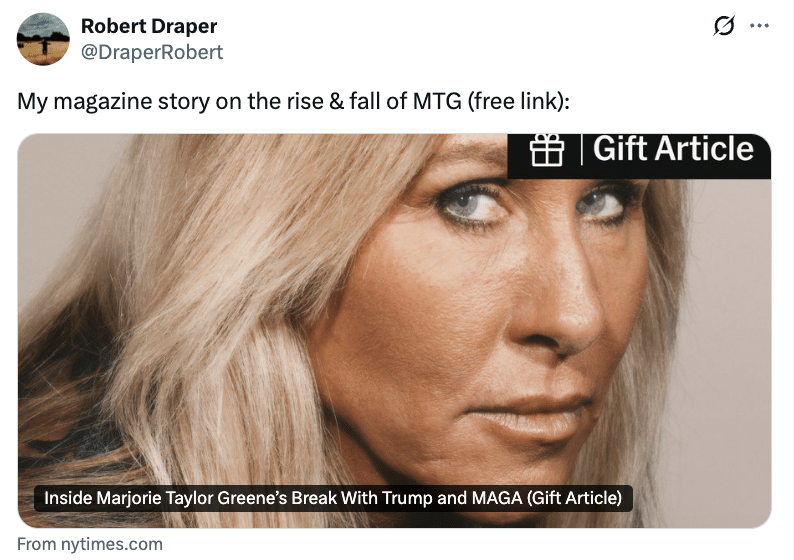
Robert Draper did a 1,000-word piece describing the Four Takeaways of his much longer magazine profile describing Marjorie Taylor Greene’s Break With Trump. It focuses on four steps in the process, which he presents out of chronological order:
“Trump’s speech at Charlie Kirk’s memorial was a clarifying moment,” because it contrasted Erika Kirk’s forgiveness with Trump’s lack of Christian faith
“Greene’s demands to release the Epstein files seemed to be the last straw for Trump,” because MTG’s threat to reveal the names of those who abused Epstein’s victims would hurt Trump’s friends
“Her disillusionment with Trump goes beyond the Epstein files,” in which Draper lumps tariffs and Gaza but focuses primarily on the way Trump’s stochastic terrorism led to threats against MTG’s son
“Greene said she was wrong for accusing Democrats of treason in the past,” which simply doubles down on the apology MTG made already on CNN and explained that MTG realized Christians don’t do such things
I don’t doubt that Draper thinks of the transformation he describes as dominated — bullets one and four — by MTG living by her faith, but the word “Christian” only appears in the 8,100-word profile six times.
And word frequency is just one tell that Draper may be indulging MTG’s own retroactive reconstruction of it.
The profile is based on interviews that took place earlier this month, though as Draper recounts, he has been covering MTG closely since 2021 and met with her repeatedly before this month. The Kirk memorial with which Draper began both his profile and his Four Takeaways occurred on September 21. He describes MTG’s perception of the difference between Erika’s forgiveness and Trump’s doubling down as the moment when, “the stress fracture that had been steadily widening between Greene and her political godfather became an irrevocable break.”
But his stress fracture comment introduces a paragraph listing five policy splits with Trump, most of which predate the Kirk memorial, the most important of which — her support for releasing all the Epstein files — predates the memorial by several weeks and gets its own paragraph here and a more focused treatment later.
Declaring the war in Gaza a “genocide”
Objecting to cryptocurrency and artificial-intelligence policies that, from her perspective, prioritized billionaire donors over working-class Americans
Criticizing the Trump administration for:
Approving foreign student visas
Enacting tariffs that hurt businesses in her district
Allowing Obamacare subsidies to expire
Argu[ing] that all investigative material pertaining to Jeffrey Epstein should be released
Much later, the profile describes that well before the Epstein break came the realization that Trump does not return loyalty (including a campaign disloyalty similar to the one that drove Elise Stefanik’s later break), followed by Trump’s targeted harassment when MTG opposed his cryptocurrency graft.
She considered running against Senator Jon Ossoff but announced in May that she had decided not to.
Greene’s stated reasoning at the time was that “the Senate is where good ideas go to die.” But the week after her announcement, The Wall Street Journal reported that Trump had shared with her a survey from his pollster, Tony Fabrizio, projecting that Ossoff would beat her by 18 points. Later, Trump would claim in a Truth Social post that their split “seemed to all begin” when he sent her the poll — suggesting, in effect, that Greene was pouting over his lack of support: “All I see ‘Wacky’ Marjorie do is COMPLAIN, COMPLAIN, COMPLAIN!” Greene insisted to me, “It wasn’t about a Fabrizio poll.” She added: “I never had a single conversation with the president about it. Instead, he told me all the time, ‘You should run for governor — you’d win.’”
Still, Greene told me, it began to dawn on her that when it came to the president, loyalty is “a one-way street — and it ends like that whenever it suits him.” Being disabused of the idea that subservience would be rewarded appeared to have a liberating effect on her.
In June, Greene did an about-face on the president’s One Big Beautiful Bill after conceding that she voted for it without realizing that it contained a provision that would prevent states from enforcing restrictions on artificial intelligence for a period of 10 years. If the Senate did not strike the moratorium from the bill, Greene publicly warned, “when the O.B.B.B. comes back to the House for approval after Senate changes, I will not vote for it with this in it.” On July 1, the Senate voted to sever the provision from the bill, which Trump signed into law three days later.
Greene broke again from Trump on July 17, arguing on X that his cryptocurrency bill could permit a future president to “TURN OFF YOUR BANK ACCOUNT AND STOP YOUR ABILITY TO BUY AND SELL!!!!!” This time, Trump made his displeasure known to her — and to her peers.
That same day, Greene and roughly a dozen other House Republicans who also had reservations about the bill were summoned to the Oval Office. In Greene’s recollection, Trump focused his wrath on her. “When you have a group of kids,” she said, “you pick the one that is the most well behaved, that always does everything right, and you beat the living shit out of them. Because then the rest of them are like: ‘Oh, man, holy shit. If Dad does that to her, what would he do to me?’” A White House spokeswoman disputes that the meeting was contentious. “Not surprising to me at all,” Greene replied when I informed her of this. “They have major problems, and it’s only starting to build.”
After the hearing, Greene held a news conference at which she threatened to identify some of the men who had abused the women. (Greene says that she didn’t know those names herself but that she could have gotten them from the victims.) Trump called Greene to voice his displeasure. Greene was in her Capitol Hill office, and according to a staff member, everyone in the suite of rooms could hear him yelling at her as she listened to him on speakerphone. Greene says she expressed her perplexity over his intransigence. According to Greene, Trump replied, “My friends will get hurt.”
When she urged Trump to invite some of Epstein’s female victims to the Oval Office, she says, he angrily informed her that they had done nothing to merit the honor. It would be the last conversation Greene and Trump would ever have.
Along the way, Draper inserts something between the Epstein break and the Kirk epiphany and the ultimate break: the 8-week recess, during which MTG stewed as she heard complaints about affordability from her constituents.
But there was one more important ingredient.
As noted, Draper describes the evolving relationship he had with MTG. He first flew down to Rome, GA, in 2022, and honored MTG’s confidences, which built trust. She blew off a meeting for drinks during last year’s convention because Trump was giving her pride of place at the Convention, but shortly thereafter met with a NYT team and scoffed at their claim Trump would pursue retribution. Draper persisted with someone who adhered to the axiom that real news was fake for years.
There are a lot of lefties who hate this profile: They feel it goes easy on her (and given the Christian reconstruction, I’d agree). They see it as a willingness to let MTG rebrand herself, even while it foregrounds her transphobia. They hate the glam photo of her, which nevertheless provides helpful context to MTG’s claim she always opposed the plastic femininity of Mar-a-Lago (and provides a useful contrast with the still fresh Karoline Leavitt portrait).
In particular, she told me recently: “I never liked the MAGA Mar-a-Lago sexualization. I believe how women in leadership present themselves sends a message to younger women.” She continued: “I have two daughters, and I’ve always been uncomfortable with how those women puff up their lips and enlarge their breasts. I’ve never spoken about it publicly, but I’ve been planning to.”
I would add that Draper still treats Trump as the actor — Trump banished MTG, rather than she stood her ground in face of his demands.
It has been tempting for some observers to predict that the meteoric crash and burn of the MAGA movement’s loudest champion signals the beginning of the end for its leader as well. But it is Greene who is exiting the stage, while Trump continues to dominate it, as he did through impeachments and indictments and other controversies that no other politician would have survived.
Still, Draper hedges his bets. Maybe she will be a harbinger.
But because it represents an evolution for Greene, she may yet again prove to be a harbinger of a sea change in the movement she once helped lead.
By far the most fascinating part of the profile to me is how Draper traces MTG’s cognitive dissonance. In 2022 — and still today — MTG is certain there’s no way Joe Biden could have won the election in 2020.
One autumn evening in 2022, I ventured to ask just how she thought the 2020 election was stolen. Did she really think that a grand conspiracy, perhaps masterminded by the Obamas and the C.I.A., had secretly rigged the results?
“Robert,” she replied with a searching look, “do you really think Joe Biden got 81 million votes without even campaigning?”
“Yes,” I said. “They counted all the votes. That was the final tally. Why wouldn’t I believe it?” The look she then gave me, which I will never forget, was one of bottomless pity.
But the contrast between the earnest stories of the survivors followed by hearing Trump complain that naming those who abused Epstein’s girls would hurt his friends broke through a belief created by the bubble of Fox News.
The reason for her lack of concern, as Greene explained it to me, might seem improbable to anyone who is unfamiliar with how the mainstream press and the right-wing media cover the same story differently — or not at all. “The story to me,” she said, “was that I’d seen pictures of Epstein with all these people. And Trump is just one of several. And then, for me, I’d seen that Bill Clinton is on the flight logs for his plane like 20-something times. So, for people like me, it wasn’t suspicious. And then we’d heard the general stories of how Epstein used to be a member of Mar-a-Lago, but Trump kicked him out. Why would I think he’s done anything wrong, right?”
For Greene, the decades that Epstein spent eluding justice for exploiting and sexually assaulting countless girls and young women while amassing a fortune, and the seeming efforts by the government to cover up the injustice, “represents everything wrong with Washington,” she told me. This September, Greene spoke with several of Epstein’s victims for the first time in a closed-door House Oversight Committee meeting. She knew that the women had paid their own way to come to Washington. She saw some of them trembling and crying as they spoke. Their accounts struck her as entirely believable. Greene herself had never been sexually abused, but she knew women who had. In her own small way, Greene later told me, she could understand what it was like for a woman to stand up to a powerful man.
One of the most important parts of MTG’s split from Trump has been an evolving relationship with the media, especially Fox News, and therefore, the truth, but with Draper always there persisting. That is, MTG had to work through the cognitive dissonance of learning that Trump really did have ties to Jeffrey Epstein’s sex trafficking, that he really was trying to cover it up, before she got to the point of retconning it all inside a faith narrative. Her own banishment from Fox News may have helped work through the cognitive dissonance.
I talk a lot about one of the ways you fight fascism is to peel off members of Congress, four in the Senate or eight in the House. I’ve laid out repeatedly how central the Epstein scandal was to that process.
Whether you like the Draper profile or not, whether or not MTG’s split from Trump will be a harbinger of more (like Stefanik’s) to come, what this profile does do is show what it took for one diehard MAGAt to go through it: political betrayal, real policy differences, retaliation, and then cognitive dissonance regarding Epstein, the Kirk epiphany, until finally responding to his terrorism in a dramatically different way than almost every other Republican, whether MAGAt or not.
There’s a process.
Share this entry
https://www.emptywheel.net/wp-content/uploads/2025/12/Screenshot-2025-12-30-at-2.51.14-PM.png560794emptywheelhttps://www.emptywheel.net/wp-content/uploads/2016/07/Logo-Web.pngemptywheel2025-12-30 12:03:032025-12-30 19:14:34Peeling Off MTG
When DOJ released its detention memo for accused January 6 pipe bomber Brian Cole, the MAGAts showed almost no interest; they’re too busy claiming to have discovered benefits fraud in Minnesota first charged under Merrick Garland’s DOJ.
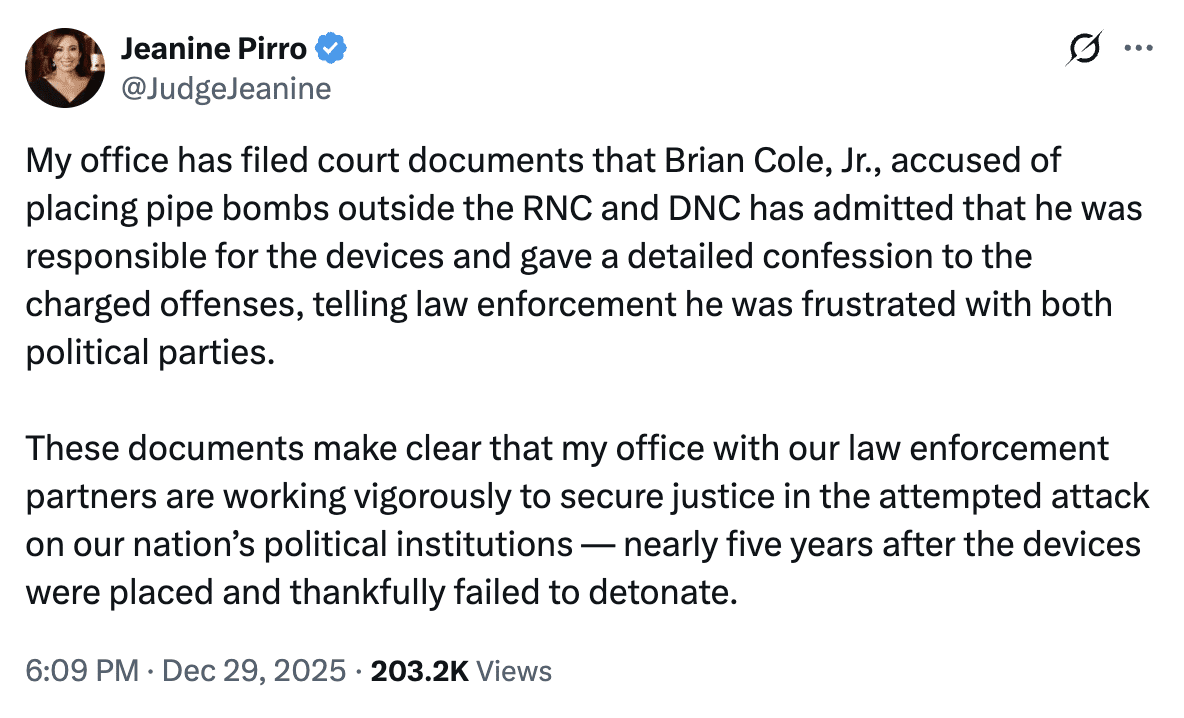
But Jeanine Pirro did. She want on social media and repeated the apparent miscitation of Cole’s own words I laid out here, treating a comment made in the present tense this month — “I really don’t like either party at this point” — as if it were a comment about his mindset on January 5, 2021.
Unsurprisingly, Cole’s attorneys took note, arguing in their bid for bail that the “government-induced excitement” around Cole’s arrest should not factor into bail consideration and in fact is a violation of local rules about prejudicing a case.
The government-induced excitement around the arrest of Mr. Cole should not take this Court’s focus away from two essential principles of law that govern bail hearings.1
1 Indeed the U.S. Attorney has made numerous comments in contravention of Local Criminal Rule 57.7(b), specifically concerning the “existence or contents of any confession, admission, or statement given by the accused” ((b)(3)(ii)) and “opinion[s] as to the accused’s guilt or innocence or as to the merits of the case or the evidence in the case” ((b)(3)(vi)). See https://abcnews.go.com/US/pipe-bomb-suspect-disappointed -2020-election-results-us/story?id=128157568 (U.S. Attorney Pirro telling the media that based on the evidence, it is “unmistakable” that Mr. Cole is guilty and that “[t]his guy was an equal opportunity bomber.”); see also https://www.facebook.com/judgeje aninepirro/posts/my-office-has-filed-court-documents-that-brian-cole-jr-accusedofplacing-pipe-b/1424070829083142/ (U.S. Attorney Pirro posting on Facebook that Mr. Cole “has admitted that he was responsible for the devices and gave a detailed confession to the charged offenses”).
The rest of their opposition memo provides mere hints of how or whether they might defend this case.
It describes the evidence against Cole as circumstantial evidence of past guilt, not proof of ongoing risk at issue in the present.
The government’s showing is entirely retrospective and circumstantial. Even if credited, the government’s evidence describes an isolated window on a single evening nearly four years ago. It does not point to a “pattern of troubling activity” that would typically warrant detention in other cases. Klein, 539 F. Supp. 3d at 155. No device detonated, and the government has not alleged any comparable conduct or dangerous affiliations in the years since. This circumstantial proof—absent a direct forensic tie or evidence of ongoing threats—cannot overcome the Bail Reform Act’s default in favor of release subject to appropriate conditions. See Munchel, 991 F.3d at 1283 (The “threat [to the community] must also be considered in context.”).
It describes the pipe bombs as having “weapon characteristics,” perhaps questioning whether they really were functioning bombs at all.
According to the affidavit, both devices were rendered safe by the U.S. Capitol Police and later assessed by the FBI Laboratory to have “weapon characteristics,” with components consistent with improvised explosive devices.
It cites relevant DC Circuit opinions on pretrial release that just happen to be January 6 cases, here, Federico Klein — the former Trump State Department official with ties to Argentina’s fascist governments who was released on pretrial bail but ultimately sentenced to 70 months in prison — and Eric Munchel (AKA the Zip Tie Guy), whose pretrial release set the standard for many other January 6 defendants, but who was ultimately sentenced to 57 months in prison. Elsewhere the filing cites Bruno Cua, who was sentenced to just a year in prison after his pretrial release, largely because he was so young and impressionable during the events at hand.
All three, of course, have since been pardoned.
But Cole’s attorneys don’t mention those back stories to the detention precedents which must be applied to Cole too. Nor do they explain what they mean when they say the specific conditions that led young Bruno Cua to stalk the halls of the Capitol created a “specific risk profile for Mr. Cole,” just like it did Cua.
Finally, the unique conditions surrounding January 5–6, 2021, are unlikely to recur in a way that would present the same risk profile for Mr. Cole.
But that comment suggests they’re skeptical — perhaps have already seen reason to be skeptical — that Cole was telling the truth when he asserted there was no tie between his alleged planting of the pipe bombs and January 6, as the government’s detention memo asserts but does not quote directly.
They have reason to do that, of course. If planting the pipe bombs was part of January 6, then Cole may already have been pardoned, just like Klein and Munchel and Cua.
They do, however, confirm that Cole has been diagnosed with being on the spectrum.
Mr. Cole is an African American adult who has been diagnosed with Autism Spectrum Disorder, Level 1 and with obsessive compulsive disorder;
The only sign that today’s combined detention hearing and preliminary hearing, scheduled for 1PM before a Magistrate Judge who presided over only a (relative) handful of January 6 cases, might harbor some surprises is a repeat of their more explicit demand in a different filing that DOJ prove probable cause.
The defense understands that the detention hearing will begin with preliminary discussions that concern whether a rebuttable presumption that Mr. Cole should be detained arises in this case. The defense’s position is that the government cannot continue to keep Mr. Cole in custody absent a valid finding of probable cause.
One reason to do that is it raises the bar on pretrial detention.
True, the Bail Reform Act creates a rebuttable presumption “that no condition or combination of conditions will reasonably assure . . . the safety of the community if . . . there is probable cause to believe that the person committed” one of an enumerated list of crimes. 18 U.S.C. § 3142(e)(2). But for purposes of making that determination, “[a] grand jury indictment, by itself” is what establishes the probable cause “to believe that a defendant committed the crime with which he is charged.” Taylor, 289 F. Supp. 3d at 62 (quoting Stone, 608 F.3d at 945); see also United States v. Smith, 79 F.3d 1208, 1210 (D.C. Cir. 1996) (“[T]he indictment alone would have been enough to raise the rebuttable presumption that no condition would reasonably assure the safety of the community.”)
But who knows. There might be more.
Share this entry
https://www.emptywheel.net/wp-content/uploads/2025/12/Screenshot-2025-12-30-at-11.01.58.png7181184emptywheelhttps://www.emptywheel.net/wp-content/uploads/2016/07/Logo-Web.pngemptywheel2025-12-30 06:42:102025-12-30 07:14:28Brian Cole’s Lawyers Admonish Jeanine Pirro for Yapping Her Mouth
DOJ has submitted its detention memo for accused January 6 pipe bomber Brian Cole.
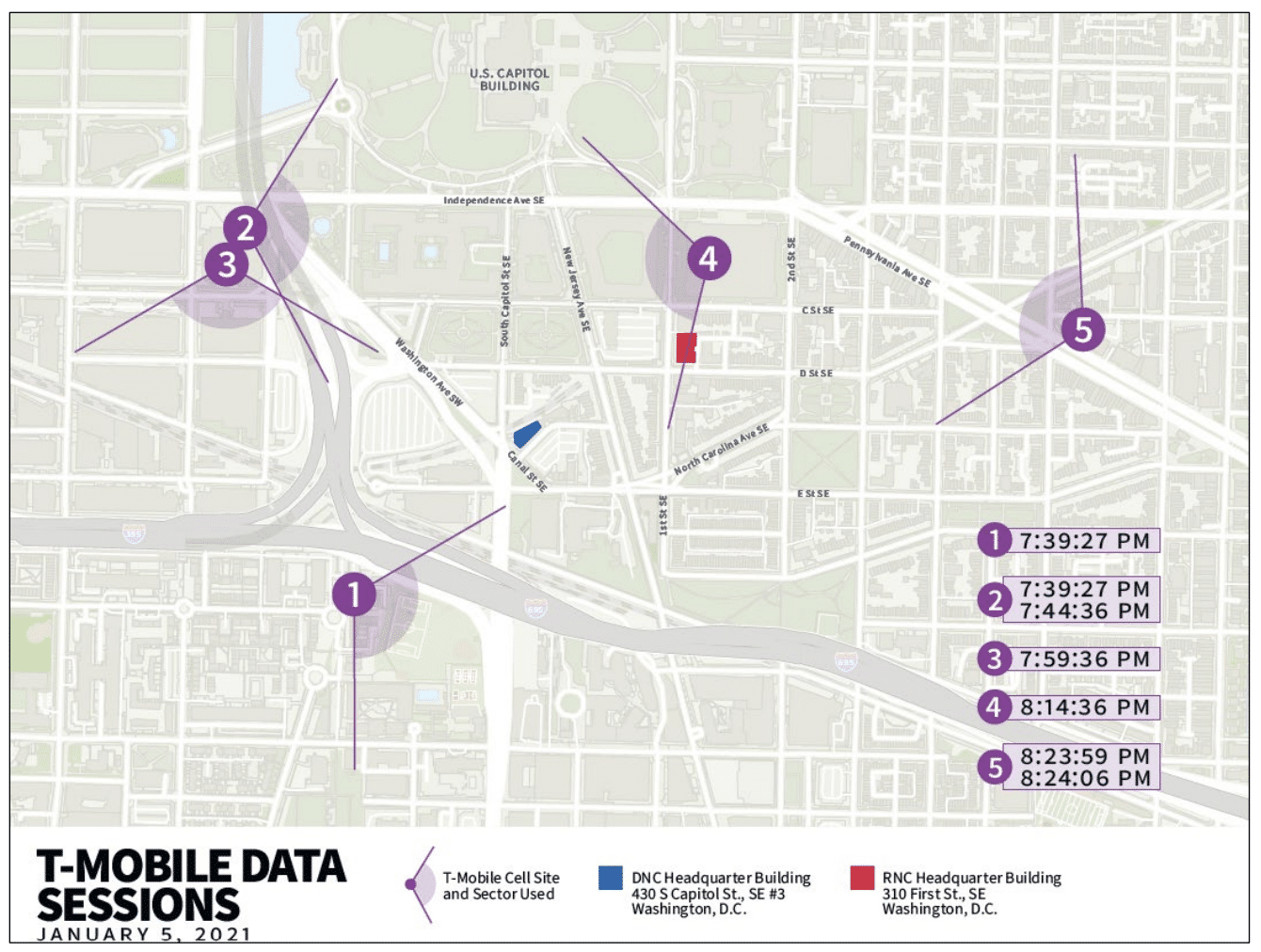
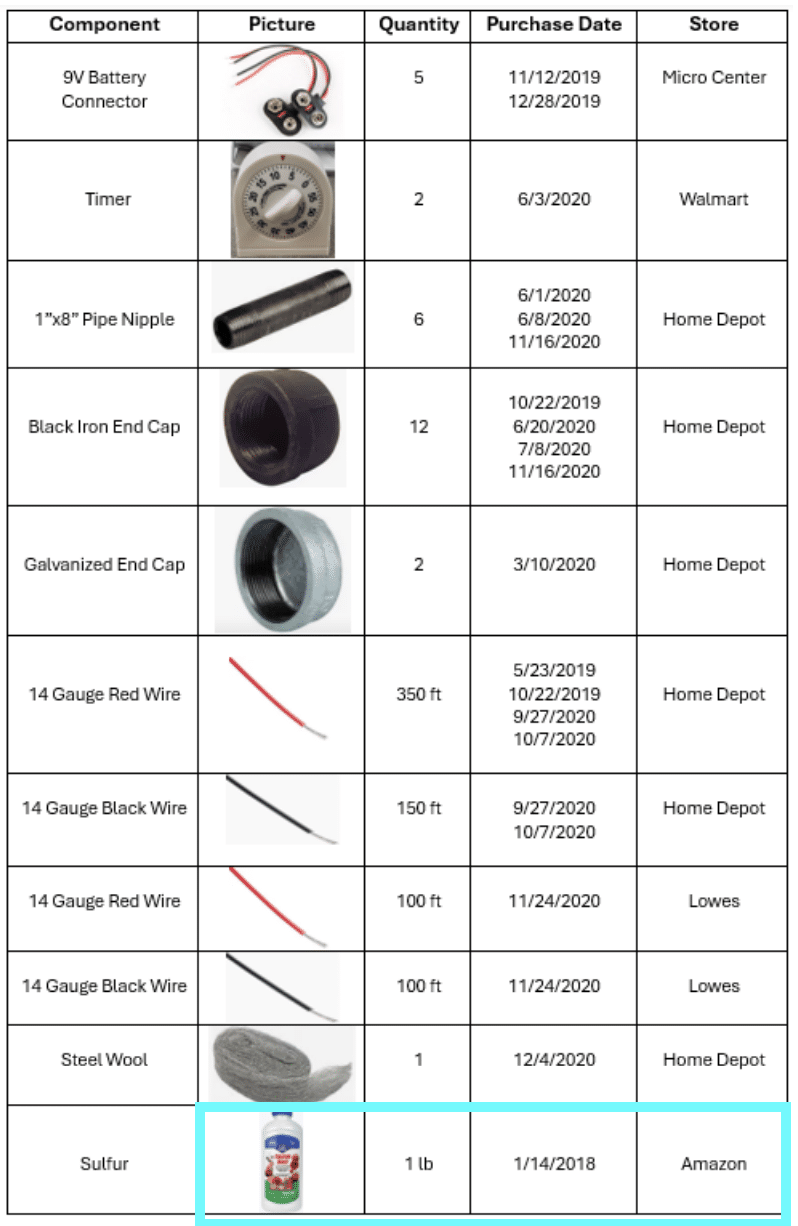
It largely tracks his arrest affidavit, only includes nifty maps and tables to show how his cell phone movement and his purchases showed his actions in preparation for and laying the pipe bombs.
It also includes details of his Mirandized, videotaped confession.
The description of his motive confirms he was a Trump supporter, but then explains he just planted the pipe bombs at both the DNC and RNC because he hated both parties — it had nothing to do with January 6, the filing claims (without quoting him).
The defendant stated that he does not align politically with his family members and did not tell them that he “was going to a protest in support of [then President] Trump.”
[snip]
When the interviewing agents returned to the defendant’s motive, he explained that “something just snapped” after “watching everything, just everything getting worse.” The defendant wanted to do something “to the parties” because “they were in charge.” When asked why he placed the devices at the RNC and DNC, the defendant responded, “I really don’t like either party at this point.” The defendant also explained that the idea to use pipe bombs came from his interest in history, specifically the Troubles in Ireland. The defendant denied that his actions were directed toward Congress or related to the proceedings scheduled to take place on January 6.
But there are two holes in the detention affidavit.
First, it describes Cole taught himself how to make explosives from YouTube, and used Google Maps to decide where to plant the bombs.
According to the defendant, he learned to make the black powder from a video game that listed the ingredients, and he also viewed various science-related videos on YouTube to assist him in creating the devices.
[snip]
The defendant explained that he had used Google Maps to look up these locations in advance.
Both of those details should show up in a Google warrant.
The detention memo makes no mention of them (or of any Google warrant).
More stunning, the detention affidavit drops a key detail from the arrest affidavit: That he was on Capitol Hill on December 14, 2020.
The FBI has analyzed COLE’s purchase history associated with the Accounts. Between January 2018 and January 2021, COLE made a total of five purchases within Washington, D.C. on or about the following dates: January 13, 2018; January 16, 2018; October 31, 2019; December 5, 2020; and December 14, 2020.
Approximately three weeks before the pipe bombs were placed, on or about December 14, 2020, COLE made a purchase at a restaurant located near First and D Streets, Southeast. The restaurant is located across the street from the entrance to Rumsey Court on D Street, Southeast.
What the detention affidavit does reveal is that — starting on December 15, 2020 — the day after being on Capitol Hill and a full three weeks before planting the pipe bombs, Cole started factory resetting his phone.
A Samsung cellular device was seized from the defendant’s person at the time of his arrest. A forensic review of the device’s contents showed that between December 2020 and December 2025, the device recorded 943 events identified as a “factory reset” or “wipe,” including a “wipe” event approximately three hours before the defendant’s arrest on December 4, 2025.2
2 The first “factory reset” or “wipe” event took place on December 15, 2020. The next such event did not occur until July 15, 2022. From that date, the “factory reset” or “wipe” events occurred at least once a week. On some days, the device appears to have been wiped multiple times in the same day.
The alleged pipe bomber started exercising operational security the day after that trip to Capitol Hill, the scene of his alleged crime.
And now, Jeanine Pirro doesn’t want to talk about the trip he made there at all.
Update: Cole’s attorneys complain that DOJ is attempting to push his first appearance out to January 7 or 8, which would be past any 5-year statute of limitation (though his charged crimes have a longer 10-plus year statute of limtiation).
2. On December 28, 2025, when pressed on the question of proceeding with the preliminary hearing on December 30, the government asked to push the preliminary hearing to either January 7 or 8. That request comes too late and does not meet Rule 5.1(d)’s rigorous standard. The Court should confirm that December 30 is the preliminary hearing and detention hearing and direct the government to be prepared to present its evidence in support of probable cause.
[snip]
4. In its email to defense counsel, the government has identified no extraordinary circumstances; rather, the reasons referenced are ordinary scheduling matters and the possibility of a forthcoming indictment. Rule 5 “does not allow the [preliminary] hearing date” to be extended merely “to accommodate the pace of the grand jury investigation.” United States v. Gurary, 793 F.2d 468, 472 (2d Cir. 1986). And where the defendant does not consent—as he does not here—Rule 5.1(d) imposes “far more rigorous criteria” than the Speedy Trial Act’s ends-of-justice standard. Id. at 473; see also United States v. Fortenberry, 2014 WL 6969615, at *2 (D. Nev. Dec. 9, 2014) (“Rule 5.1 does not permit continuance solely to enable the government to avoid a preliminary hearing by securing an indictment.”) (citation omitted).
Update: This is a super minor point. But in the detention memo, DOJ quotes Cole as saying (this month), “I really don’t like either party at this point,” which is at least consistent with him having been a Trump supporter and souring on him.
A few paragraphs later, they change the tense of that, claiming he placed that opinion in 2020.
In his own words, the defendant did so because he did not “like either party,” but “they were in charge” and thus were, in the defendant’s mind, an appropriate target for extreme acts of violence.
And they turn it into a both-sides thing.
By his own admission, the defendant committed these chilling acts because he was unhappy with the response of political leaders on both sides of the political aisle to questions raised about the results of the 2020 election, and “something just snapped.” [my emphasis throughout]
It may well be that something about what Cole said makes it fair to put his animosity to both parties back in time to 2020, but that’s not the tense he used.
Additionally, this is the table DOJ uses to claim they found purchase records for all the components he used to make the bombs.
But this is misleading. While the table includes Lilly Miller sulfur dust, one of the things he said he used to make black powder (and charcoal, another, would be readily on hand), that’s actually a purchase 14 months earlier than any other component, and from a different store. But they didn’t find a purchase record for the potassium nitrate, which they say he said he got at Lowes (from which they have a bunch of other purchase records).
Share this entry
https://www.emptywheel.net/wp-content/uploads/2025/12/Screenshot-2025-12-28-at-20.34.33.png10121340emptywheelhttps://www.emptywheel.net/wp-content/uploads/2016/07/Logo-Web.pngemptywheel2025-12-28 16:18:202025-12-29 13:50:50Jeanine Pirro Got Curiously Silent about What Brian Cole Did on December 14, 2020
Not long after something happened in November to prevent four Dan Richman dockets from being unsealed in DC District, Judge Anthony Trenga ordered a docket about a National Security Letter from the same period as the Dan Richman investigation (which he referred in 2019 to then Magistrate Judge Michael Nachmanoff) to be unsealed.
Both the four Dan Richman dockets and the NSL docket remain substantially sealed.
As I have laid out before, when Magistrate Judge William Fitzpatrick first held a hearing about DOJ’s bid to breach Jim Comey’s privilege on November 5, he started the hearing by focusing on all the sealed documents. When he asked Loaner AUSA Tyler Lemons about the status of the underlying warrants, Lemons equivocated.
THE COURT: Mr. Lemons, what’s the status of that?
MR. LEMONS: Thank you, Your Honor. Your Honor, we have made a request to the issuing district as to those search warrants, for them to be unsealed. My understanding, last speaking with an AUSA in that district, is that motion has not been filed at this time. They are preparing to provide notice to other potentially interested parties, per their practice and the rules they have to abide by in that district. So we requested it, and our understanding is at this time that the warrants all remain completely under seal. That is the only reason why the government designated these search warrants as protected material and filed them under seal and understands why the defense filed them under seal. If it was in my power and ability here today, those search warrants would be totally unsealed. [my emphasis]
After the hearing Fitzpatrick ordered that the parties take steps to unseal both the underlying warrant dockets and the sealed filings about them.
ORDERED that the Government shall, on or before November 10, 2025, move in the issuing district to unseal the four 2019 and 2020 search warrants referenced in the Government’s Reply to Defendant’s Response to the Government’s Motion for Implementation of Filter Protocol (ECF 132), together with all attendant documents, or, in the alternative, file a motion in the issuing district setting forth good cause as to why the subject search warrants and all attendant documents should remain under seal, in whole or in part; and it is further
[snip]
ORDERED that, if necessary, the Court shall hold a hearing on the pending motions to seal (ECFs 56, 72, 109, and 133) on November 21, 2025, at 10:00 a.m. in Courtroom 500, and the materials subject to those motions shall remain UNDER SEAL until further order of the Court; and it is further
ORDERED that, to the extent the Government seeks to seal Exhibit A to Defendant’s Response to the Government’s Motion for Expedited Ruling (ECF No. 55-1), the Government shall file a supporting brief in accordance with Local Criminal Rule 49 on or before November 12, 2025; Defendant may file a response on or before November 19, 2025; and, if necessary, the Court shall hold a hearing on the Government’s sealing request on November 21, 2025, at 10:00 a.m. in Courtroom 500;
Over a month ago, by November 10, the Loaner AUSAs in EDVA should have filed to unseal the four warrant dockets in DC or they should have filed a motion in DC “setting forth good cause as to why the subject search warrants and all attendant documents should remain under seal.”
If the Loaner AUSAs followed that order, it would seem to suggest someone insisted on keeping the dockets in DC sealed.
Fitzpatrick listed those dockets in a footnote of his November 17 opinion (that is, a week after DOJ would have had to file to keep everything sealed) granting Comey access to the grand jury transcripts in his case.
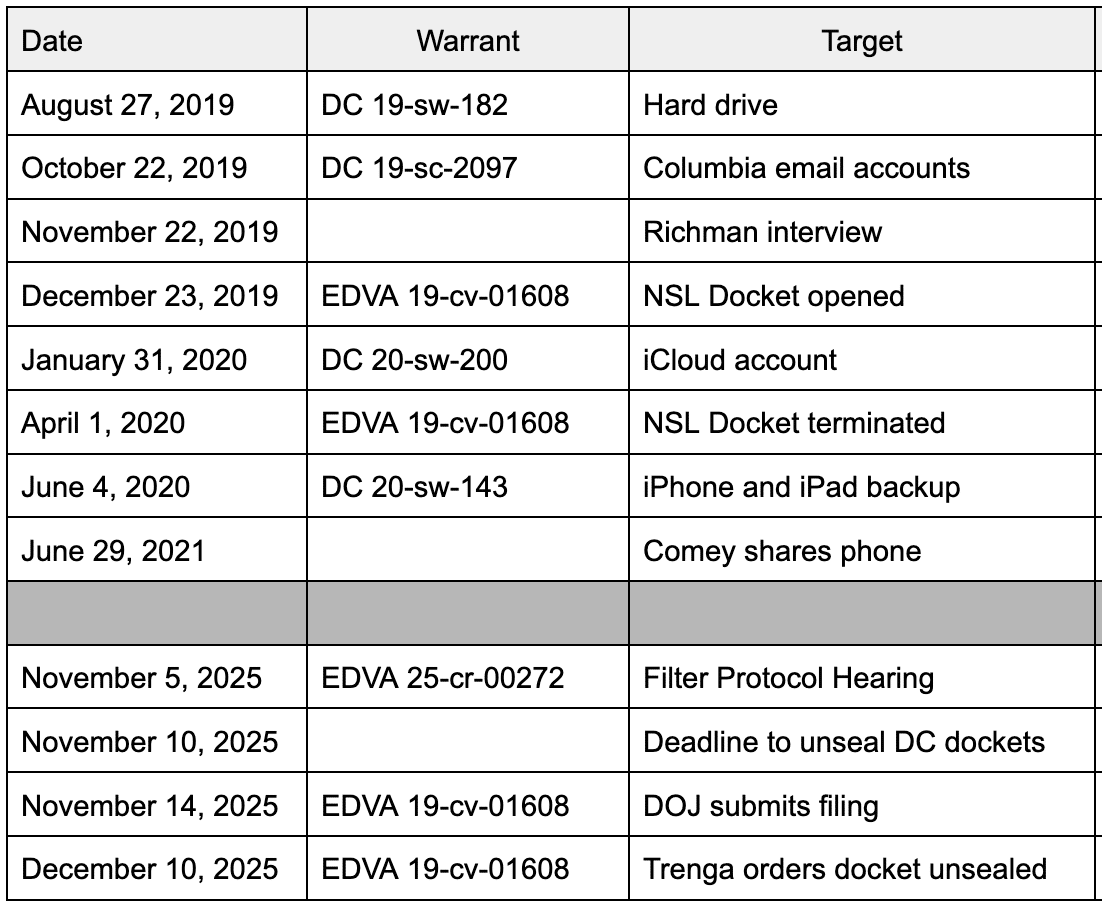
2 Search warrant 19-sw-182 was issued on August 27, 2019, and authorized the search of Mr. Richman’s hard drive from February 1, 2017 to April 30, 2017. ECF 89-1.
Search warrant 19-sc-2097 was issued on October 22, 2019, and authorized the search of Mr. Richman’s Columbia University and Law School email accounts from March 1, 2016 to May 30, 2017. ECF 89-2.
Search warrant 20-sw-200 was issued on January 31, 2020, and authorized the search of Mr. Richman’s iCloud account from March 1, 2016 to May 30, 2017. ECF 89-3. Attachment B to the warrant specifically limits the information to be seized to “non-privileged communications.” Id.
Search warrant 20-sw-143 was issued on June 4, 2020, and authorized the search of the backup files for Mr. Richman’s iPad and iPhone from March 1, 2016 to May 30, 2017. ECF 89-4. Attachment B to the warrant specifically limits the information to be seized to “non-privileged communications.” Id.
I just checked. They’re still sealed.
Some weeks ago, I did what any resourceful person would do to try to solve a docket mystery: I asked Seamus Hughes (of CourtWatch fame) if he could find anything.
He didn’t find any docket at DC asking to keep the files sealed.
What he did find is at least as interesting.
He found a docket, described as National Security Letter 19-498157 and listing Bill Barr as the defendant, which was originally referred to Michael Nachmanoff when he was a Magistrate Judge, with a recent update. On December 10, Judge Anthony Trenga, citing a response from DOJ on November 14 (which is sealed), ordered the docket about a 2019-2020 National Security Letter to be unsealed.
Aside from that order though, it remains substantially sealed.
This docket may be totally unrelated to the Comey case.
But the table above shows how neatly the two overlap. The NSL docket was opened a month after a Dan Richman interview in November 2019, and it was closed before DOJ obtained warrants to seize the iPhone which they’ve since been snooping into.
Maybe Santa can help us unwrap this in time for Christmas.
Share this entry
https://www.emptywheel.net/wp-content/uploads/2025/12/Screenshot-2025-12-18-at-5.56.16-PM.png9061102emptywheelhttps://www.emptywheel.net/wp-content/uploads/2016/07/Logo-Web.pngemptywheel2025-12-18 13:01:592025-12-18 13:13:02The National Security Letter Seamus Hughes Found When Looking for a Dan Richman Docket
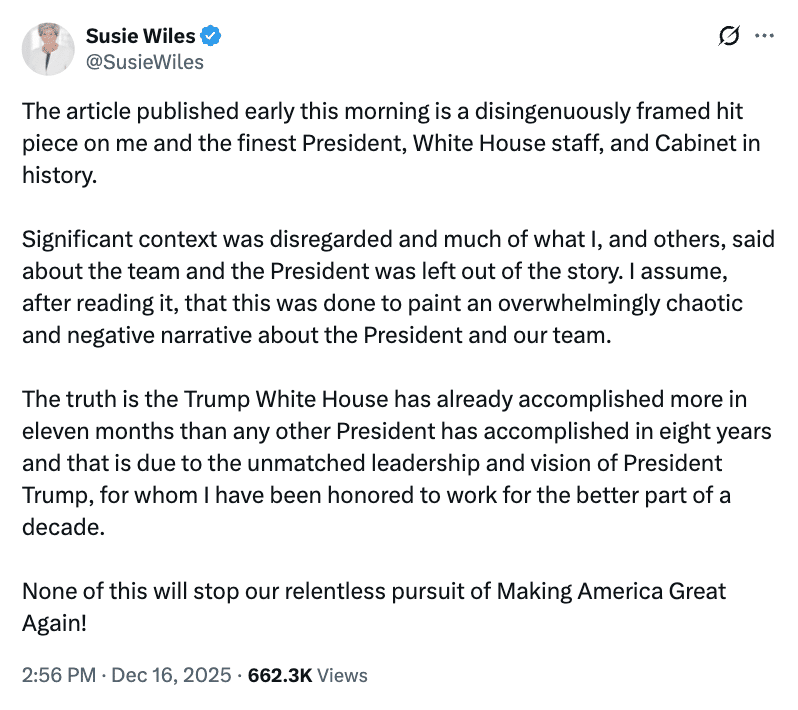
One of the longest part of Vanity Fair’s two-part (one, two) interview with Susie Wiles focuses on Jeffrey Epstein. It goes like this:
¶1: Chris Whipple’s explanation of why it’s important.
¶2: Wiles’ admission she underestimated the import of it.
¶3: A review of Pam Bondi’s binder fiasco, with Wiles commenting on Bondi’s fuck-up.
¶4: A report on how many FBI agents reviewed the files, with Wiles’ claim they weren’t just searching for Trump.
¶5: Wiles’ claim there was nothing bad on Trump in the files, just him and Epstein being “young, single playboys.”
¶6: Wiles debunking Trump’s false claims about Clinton’s ties to Epstein.
¶7: Wiles describing that Kash Patel and Dan Bongino really understood Epstein, except Kash was wrong.
¶8: Wiles’ failure to offer an explanation for Todd Blanche’s interview with Ghislaine Maxwell.
¶9: Wiles’ claim that Trump was pissed Ghislaine got moved.
¶10: Wiles’ claim that the birthday letter to Epstein is not from Trump.
¶11 – ¶12: Wiles’ claim that Trump would sit for a deposition in his WSJ lawsuit if necessary.
¶13: Whipple explaining the threat of the Epstein files again, then quoting Wiles on who cares about it.
¶14: Someone at the White House who might be JD Vance explaining who cares about it.
¶15: A specific mention of Vance, with further explanation of those who care about Epstein.
Elsewhere, Wiles credits herself with a great read of electoral outcomes (even while describing her own prediction that Jack Ciattarelli might beat Mikie Sherill last month): She was certain they would win last year, she didn’t think November would be that bad, they’re going to win midterms.
Her confidence (even if feigned) is why I’m so interested in Wiles’ description of the relative knowledge about Epstein. As noted, she admitted to Whipple that she didn’t understand how important this scandal could be, deferring knowledge on such issues to Kash Patel, Dan Bongino, and JD Vance — two of whom she describes as conspiracy theorists.
Wiles told me she underestimated the potency of the scandal: “Whether he was an American CIA asset, a Mossad asset, whether all these rich, important men went to that nasty island and did unforgivable things to young girls,” she said, “I mean, I kind of knew it, but it’s never anything I paid a bit of attention to.”
[snip]
The people that really appreciated what a big deal this is are Kash [Patel] and [FBI deputy director] Dan Bongino,” she said. “Because they lived in that world. And the vice president, who’s been a conspiracy theorist for a decade…. For years, Kash has been saying, ‘Got to release the files, got to release the files.’ And he’s been saying that with a view of what he thought was in these files that turns out not to be right.” [brackets original]
But then six paragraphs after describing that longtime Trump loyalist Kash Patel was totally into [a false belief] about the Epstein files, first Wiles and then someone who might be JD Vance (who is mentioned in the following paragraph) describe their understanding of who cares about this: “people that are sort of new to our world.”
The Epstein files debacle poses a dire political threat to Trump and the future of the GOP. “The people that are inordinately interested in Epstein are the new members of the Trump coalition, the people that I think about all the time—because I want to make sure that they are not Trump voters, they’re Republican voters,” Wiles said. “It’s the Joe Rogan listeners. It’s the people that are sort of new to our world. It’s not the MAGA base.”
A senior White House official described the mindset of an overlapping bloc of voters who are angered by both Trump’s handling of the Epstein files and the war in Gaza. It’s as much as 5 percent of the vote and includes “union members, the podcast crowd, the young people, the young Black males. They are interested in Epstein. And they are the people that are disturbed that we are as cozy with Israel as we are.”
Susie Wiles, who has been around Trump since he was first elected, claims “the people that are inordinately interested in Epstein” are “not the MAGA base”!!!
And then that anonymous White House official who might be JD Vance (whom Wiles explains is a conspiracy theorist) describes that the “young Black males” are the ones who care about Epstein.
To be fair, it is the case that the MAGAt base voters who do care deeply about this — people like Charlie Kirk, Benny Johnson, and Jack Posobiec — quickly fell in line when Trump demanded they stop talking about Epstein in July.
But like Kash and Bongino themselves, these are the people who made Epstein specifically and conspiracy theories about pedophiles more generally some of the central glue of Trump’s coalition.
As I wrote for TPM’s anniversary series, the superpower of reclaiming attention which Trump has honed with these same far right trolls has always been developed in parallel with the use of conspiracy theories about pedophilia — from Posobiec’s Pizzagate, to QAnon, to Epstein — to keep that attention.
On July 8, something happened to Donald Trump that I’ve not seen happen in the entire decade he has dominated presidential politics. As his base clamored for more disclosures about sex trafficker Jeffrey Epstein, his superpower — his ability to grab and redirect attention — briefly failed him. “Are you still talking about Jeffrey Epstein?” he whined when a journalist asked about the Justice Department’s decision to abort any further disclosure of documents related to the case. “This guy’s been talked about for years.”
[snip]
Two things had disrupted Trump’s superpower. First, after Trump’s top DOJ appointees — Attorney General Pam Bondi, FBI Director Kash Patel, and his deputy Dan Bongino – had fueled, then disappointed, MAGA’s demand for Epstein disclosures, the failure to fulfill their promises fed the conspiracy itself. By thwarting the conspiracists’ demands, Bondi, especially, created rifts and distrust in Trump’s own base.
Conspiracy theories about Epstein were always non-falsifiable; the mob will never be satisfied. But Bondi made that dynamic worse.
More important for understanding what happened in July: the very same online trolls who’ve been critical partners in Trump’s success managing attention were precisely the same people who had spun those conspiracy theories. There is a direct through-line from a relatively small set of social media accounts that helped Trump win the 2016 election to PizzaGate and, after that, QAnon. QAnoners played a key role in Trump’s 2021 insurrection attempt, and its adherents remain a substantial portion of Trump’s base. Since 2016, pro-Trump trolls’ exploitation of social media algorithms to redirect political news coverage — whether from legacy media or newer outlets — has disrupted traditional news cycles.
And while some of what Wiles says about Epstein — her claim Trump was pissed Ghislaine got moved, her feigned certainty that the birthday letter is not from Trump — is clearly bullshit, Wiles and the anonymous person who might be JD nevertheless offered a very specific, and very inaccurate, description of which Trump voters care about Epstein.
Maybe they’re telling this tale because it’s the same thing they told House members in a bid to kill the Massie-Khanna discharge petition. Maybe they’re telling this tale because everyone Wiles thinks knows about Epstein is a conspiracy theorist and the guy who really knows is just a former young playboy.
But even though Trump got Kirk and Benny and Posobiec to give up their sustained demand for Epstein materials, it remains the case that Trump has never fully recovered from the fiasco in July. First Mike Johnson had to flee a week early in July or risk embarrassing votes, then Bondi’s desperate bid — using the White House situation room — to convince Lauren Boebert to defect from the discharge petition backfired, then the Epstein fiasco ultimately led Marjorie Taylor Greene to break with Trump more substantially.
And tomorrow, DOJ will be forced to hand over the Epstein files themselves.
For five months, Epstein has remained at least a low-level burn undermining Trump’s ability to manage the public’s focus and his own policy goals. The Epstein thing was the first thing that led Republicans to defect, and now they’re defecting left and right.
And yet Wiles (and her anonymous friend who might be conspiracy theorist JD Vance) professes to believe the only people who care about Epstein are the young Black voters that Trump just won over last year?
That’s either a fantastic lie. Or a confession that explains far more about why Trump has bolloxed Epstein so badly.
Update: On Xitter, Liz Wheeler (no known relation), one of the recipients of Bondi’s binder, focuses on the same passages I did — blaming Wiles for misinforming Trump about how important this is to MAGAts. But she doesn’t note what I do: that Wiles, at least, is still unclear how important it is.
It now makes total sense as to why President Trump has—at times—dismissed the Epstein scandal and even called it a “hoax.” Over the summer, Trump said he did not understand why many of his supporters were so fixated on Epstein.
Well, now why know why he said that—it would seem Susie Wiles was the one misinforming Trump about the MAGA base’s concerns.
We care about the Epstein files because we want transparency, we want the elites held accountable, and we want JUSTICE for the Epstein victims.
Share this entry
https://www.emptywheel.net/wp-content/uploads/2025/12/Screenshot-2025-12-16-at-3.50.16-PM.png710798emptywheelhttps://www.emptywheel.net/wp-content/uploads/2016/07/Logo-Web.pngemptywheel2025-12-16 11:27:082025-12-19 14:46:42The Epistemology of the Epstein Scandal
As originally scheduled, Magistrate Judge Michael Harvey would have held a detention hearing today for Brian Cole, the guy accused of planting pipe bombs on January 5, 2021.
We might have learned more about evidence and motive at such a hearing, but now we’ll have to wait until December 30, if at all.
Last Wednesday, the AUSA in the case, submitted a filing basically saying, “Regarding your question about whether we still need a detention hearing on December 15, I respond that the defense wants another two weeks to review discovery before such a hearing, and we’d like an exclusion of time under Speedy Trial Act.”
The United States respectfully moves the Court to exclude time under the Speedy Trial Act from the date of defendant Brian J. Cole, Jr.’s arrest on December 4, 2025, through the date of the detention hearing, which the defense has requested to continue. 1
In response to the Court’s inquiry, the government conferred with defense counsel. Defense counsel has requested that the government represent the following to the Court in this motion: The defense requests that the Court continue the detention hearing in this case currently set for December 15, 2025, to allow the defense additional time to review the significant amount of discovery provided by the government to date. The defense consents to the exclusion of time under the Speedy Trial Act from December 4, 2025, through the date of the rescheduled detention hearing.
The government does not oppose a defense continuance of the detention hearing. The parties jointly request that the detention hearing be reset for December 30, 2025.
1 For administrative efficiency, the government is submitting a single motion reflecting the relief sought by both parties.
Before I unpack what this means — and what we can or cannot assume from this — let me point to this WSJ story that explains why it took so long to find Cole: Basically, an FBI Agent wrote code to be able to read cell tower dumps T-Mobile provided, which the government had claimed — for years! — was corrupted.
For four years, a tranche of cellphone data provided to the FBI by T-Mobile US sat on a digital shelf because investigators couldn’t figure out how to read it, people familiar with the matter said. The data turned out to be essential to cracking the case, the people said, a breakthrough that happened only recently when a tech-savvy law-enforcement officer wrote a new computer program that finally deciphered the information. That move led to the arrest of 30-year-old Brian Cole Jr. at his home in Northern Virginia, where he had been quietly living with his mother and other relatives.
[snip]
Increasingly desperate and under pressure to make progress, supervisors urged agents and analysts to take a new look at what they had, including the data from T-Mobile—reflecting phone locations based on internet usage—that investigators had set aside years earlier.
Once investigators were finally able to read the data, they said it led them to Cole’s phone number because his cellphone’s movements tracked what investigators had seen in surveillance footage.
I have no doubt that the government believed they couldn’t access some or most of the T-Mobile data; it is a problem that has shown up in court filings for years. How well-founded that belief was is something we may learn in the months ahead.
WSJ also describes why we’re getting — and why we should expect to continue getting — so much leaking from this investigation: Because Kash Patel is claiming credit and accusing the FBI of sandbagging before now.
In a four-hour interview with investigators, Cole acknowledged placing the bombs, people familiar with the probe said. He expressed support for Trump and said he had embraced conspiracy theories regarding Trump’s 2020 election loss, the people said. He had thrown out the Air Max sneakers, he said. Cole hasn’t entered a plea, and his lawyer didn’t respond to requests for comment.
Inside the Justice Department, agents and prosecutors have privately expressed widespread relief that an arrest has finally been made, but also resentment over FBI Director Kash Patel, who has suggested that they didn’t work doggedly on the probe until Trump administration leadership arrived.
The assertion that Cole is a Trump supporter, which was always the most likely explanation for his actions, adds to the likelihood of leaks. All the people crowing about the Cole arrest — Pam Bondi, Kash, and Dan Bongino — could well get fired if they find proof of another Trump supporting terrorist. So they’re no doubt trying to minimize the chances that becomes public via official channels.
The fact that the FBI had to write code simply to read the T-Mobile data may explain something that I allude to here: The language the complaint uses to refer to location data is not described in the normal way, usually expressed as a percentage likelihood that a device was within a certain range at the time in question.
The seven transactions between the COLE CELLPHONE and Provider’s towers occurred at approximately 7:39 p.m., 7:44 p.m., 7:59 p.m., 8:14 p.m., 8:23 p.m., and 8:24 p.m. Two transactions took place at 7:39 p.m. During this time period, the COLE CELLPHONE had transactions with five different sectors on Provider’s cell towers.
a. At approximately 7:39:27 p.m., the COLE CELLPHONE interacted with a particular sector of Provider tower 59323, which faces southeast (approximately 120˚) from its location at 103 G Street, Southwest in Washington, D.C. (“Sector A”). Also at 7:39:27 p.m., the COLE CELLPHONE interacted with a particular sector of Provider tower 126187, which faces east1 (approximately 90˚) from its location at 200 Independence Avenue, Southwest in Washington, D.C. (“Sector B”). Video surveillance footage shows that at approximately 7:39:32 p.m., the individual who placed the pipe bombs walked westbound on D Street, Southeast and then turned southbound on South Capitol Street, Southeast. These locations are consistent with the coverage areas of Sector A and B.
b. At approximately 7:44:36 p.m., the COLE CELLPHONE interacted with Sector B of Provider tower 126187. Video surveillance footage shows that at approximately 7:44:36 p.m., the individual who placed the pipe bombs walked east on Ivy Street, Southeast. This location is consistent with the coverage area of Sector B.
Here, the complaint claims only that the cell tower data is consistent with Cole’s presence in a certain cardinal directions from the cell towers; it doesn’t even explain how far that cell site is.
Even without the hack of the data needed to read the T-Mobile data, this case might have been vulnerable on Fourth Amendment grounds. While the geofences for the Capitol itself have been sustained in a series of court orders, these tower dumps did not (as the Capitol-focused geofences did) collect data of people who were by definition culprits or victims. But if the T-Mobile data showing Cole’s location comes from some untested code, it would be far more vulnerable to challenge, with the likelihood of dueling experts about whether the software hack faithfully rendered the location data.
Sure, there’s the confession, but any good defense attorney will attempt to challenge any Miranda waiver, particularly in the case (as here) where a suspect is reportedly on the spectrum or is otherwise vulnerable to pressure.
Meanwhile, consider the implications of DOJ finding a way to read T-Mobile data that had been unavailable for years. What else might that data reveal? Might that data reveal a meeting between Cole and someone else on Capitol Hill on December 14?
Approximately three weeks before the pipe bombs were placed, on or about December 14, 2020, COLE made a purchase at a restaurant located near First and D Streets, Southeast. The restaurant is located across the street from the entrance to Rumsey Court on D Street, Southeast.
I think it inconceivable that Cole placed those bombs at the perfect location set to explode at the perfect time for an attack the following day without consultation with others. Which means any investigation into Cole could break open (or reopen) an investigation into the far more coordinated attack that was evident in movement that day but — for whatever reason — not charged.
Imagine the possibility that the FBI could find proof — and a witness — to explain how January 6 was an exceedingly well-coordinated terrorist attack? That would be sure to get Bondi, Kash, and Bongino fired!
As noted, DOJ asked for and got an exclusion of the 15-day delay in detention hearing time from the Speedy Trial Act (STA). That’s actually a very big deal, because when DOJ arrested Cole on December 5, the month they had to indict Cole under the STA coincided with the month that existed before the normal 5-year statute of limitations on most crimes expired.
First, while I think it likely FBI got their guy, if Cole’s confession is at all vulnerable to challenge, the case might be exceedingly weak, not least because the data has been manipulated.
Meanwhile, DOJ really is in crunch time regarding both the charges and any further investigation. That likely suits Trump’s appointees, who could be fired if the arrest of Cole provides cause to investigate further.
And that’s all on top of any colorable claim that Cole is entitled to the pardons Trump has already given his mob (not least if he had contact with someone else who has already been pardoned).
That’s the kind of mix that gives DOJ strong incentive to push for a plea, using as leverage the possibility of further charges, on top of an already draconian possible 40-year sentence.
Everyone else may be focused on holidays. But the people involved in this prosecution are likely involved in a very delicate game of chicken, as the ticking clock of dual deadlines threatens to explode.
Share this entry
https://www.emptywheel.net/wp-content/uploads/2025/12/Screenshot-2025-12-04-at-20.29.25.png726660emptywheelhttps://www.emptywheel.net/wp-content/uploads/2016/07/Logo-Web.pngemptywheel2025-12-15 05:42:592025-12-16 05:08:43Four Years and 345 Days
Yesterday, the guy in charge of FBI’s National Security Branch, Michael Glasheen, exhibited the same kind of cowardice that allowed January 6 to happen, when he delivered the scripted lines that Kash Patel and Donald Trump permit him to say at the Global Threats Hearing. First, he sustained the bullshit claim that Antifa was the greatest threat to the US, then he played dumb when asked about the Proud Boys.
This is precisely the kind of cowardice that allowed January 6 to happen.
To be sure, there are several layers of cowardice built into this. Glasheen shouldn’t have been testifying in the first place; Kash should have been. But unusually for the Global Threats hearing, Kash blew off the committee entirely and Kristi Noem left early after one and then another Democrat personalized the veterans her goons have targeted and the Americans she arrested.
Then early in the hearing, Bennie Thompson (after making a clear misstatement to call the shooting of two National Guards members in DC only to have Noem refuse to admit that Rahmanullah Lakhanwal received asylum under Trump) asked Glasheen about terrorist threats. Here’s how USA Today described the exchange.
“When you look at the data right now, you look at the domestic terrorist threat that we’re facing right now, what I see from my position is that’s the most immediate violent threat that we’re facing on the domestic side,” he said.
But when Rep. Bennie Thompson, D-Mississippi, the ranking chairman of the House Homeland Security committee, asked whether the group is headquartered or how many members it has, Glasheen did not have answers.
“We are building out the infrastructure right now,” Glasheen said.
“So what does that mean?” Thompson replied. “We’re trying to get the information. You said antifa is a terrorist organization. Tell us, as a committee, how did you come to that? How many members do they have in the United States, as of right now?”
Glasheen said the number is “very fluid” and that the investigation into the movement and its members is ongoing, comparing it to al-Qaeda and ISIS.
[snip]
“Well, the investigations are active,” Glasheen responded, pausing before closing his mouth.
Thompson shook his head.
“Sir, you wouldn’t come to this committee and say something you can’t prove. I know you wouldn’t do that. But you did,” the congressman said, ending the exchange.
The exchange was one of the most-reported stories from the hearing yesterday (the advantage Ranking Members have for going first).
But few provided the background.
It was this kind of cowardice — it was precisely this kind of politicized threat focus — that allowed January 6 to happen. Bill Barr, too, was pushing the Antifa myth in advance of Trump’s insurrection. Trump even prepared precisely the kind of terrorist designation in advance that he rolled out in the wake of the Charlie Kirk killing, no doubt anticipating clashes that didn’t arise.
More troubling, a bunch of people in the Proud Boys network were treated as informants on Antifa rather than used to collect awareness of the militia. There was Jenny Loh, as Brandi Buchman described in her coverage of the trial.
Tarrio’s next witness is teed up for Monday after much commotion: FBI informant Jennylyn Salinas, also known as “Jenny Loh.”
Loh’s anticipated appearance threw proceedings into disarray last week as defense attorneys claimed they had no idea Loh was an informant. Loh maintains she told her handlers nothing about her interactions with the Proud Boys and that once the government became aware that she could be called to testify in the case, her informant relationship ended completely. Prosecutors say Loh, who was associated with Latinos for Trump, was an informant from April 2020 through this January and only received a single payment from the bureau after sharing footage with agents of people harassing her at home. Loh has said that her communications with the FBI were not about Proud Boys but the threat that antifa posed.
More troubling still, there was “Aaron,” whose participation in the Kansas City cell made it incredibly difficult for prosecutors to prosecute those participants. WaPo described his testimony while describing the larger problem.
[A]t least four FBI sources were approached by the defense. Two others are on trial. And it was federal prosecutors who undermined the credibility of a federal informant, suggesting that the man — who only pronounced his name as “Aaron” — had deleted evidence and eliciting testimony that he repeatedly understated his own participation in the riot.
[snip]
On cross-examination, “Aaron” — who did not spell his name into the trial record — acknowledged that a member of his Kansas City Proud Boys chapter “had said some pretty wild things” about violence in advance of Jan. 6 that he did not share with the FBI. He admitted entering the Capitol without FBI authorization and not revealing that he helped prop open a gate for other rioters.
He later tried to justify his actions to agents by saying he thought he could help stop the destruction of “items of historical significance or historical artifacts,” according to the testimony.
The evidence shown in court indicates that many of the FBI sources inside the Proud Boys were asked only about their ideological opponents on the left, even as the right-wing group was implicated in threats and violence at protests across the United States.
[snip]
“Aaron” testified Wednesday that before Jan. 6, the FBI never asked him to look for information about the Proud Boys. When he informed his handler that he was coming to D.C. for the protest, he was asked only “to try to see if I could locate someone in D.C. that had nothing to do with the Proud Boys,” he testified.
The FBI missed an attack on the Capitol in significant part because they treated right wing threat actors as informants rather than a far more urgent threat.
I have no doubt Glasheen knows he’s chasing ghosts, which explains his discomfort. I have no doubt that Glasheen, as Chris Wray did before him, is treading carefully to avoid being fired. He probably calculates, correctly, that if he gets fired, a less competent whack job would replace him.
This is all by design: The fearmongering at FBI did, already, and will, again, blinds the FBI to real threats.
Share this entry
https://www.emptywheel.net/wp-content/uploads/2025/12/Screenshot-2025-12-12-at-14.16.13.png482680emptywheelhttps://www.emptywheel.net/wp-content/uploads/2016/07/Logo-Web.pngemptywheel2025-12-12 09:30:032025-12-12 11:07:59Cowardice Like Michael Glasheen’s Is How January 6 Happened