The Long List of Reasons Why Potential Intimidation of Proud Boy Jurors Must Be Taken Seriously

Enrique Tarrio has already been investigated by a grand jury in Prettyman Courthouse for any role he had in threats to undermine a criminal prosecution.

That’s important background to Brandi’s report, at the end of her update on the Proud Boys trial, of how much of last week the trial was halted for a series of sealed hearings.

Apart from routine objections launched by the defense to even the most mundane of issues and separate from the unending series of motions for mistrial, last week featured a new and unwelcome variable: the sealed hearing.

A sealed hearing, or a hearing closed to the public and press, is typically held when sensitive or classified matters are being discussed by the parties. Trial days were stopped and started three times last week for sealed hearings that stretched for more than an hour. A press coalition moved to unseal proceedings on at least one of those days but was promptly denied by Judge Kelly for reasons he failed to describe on the record.

Though the exact reason was not disclosed by the court (nor would one expect it to be at this point), CNN reported that multiple sources said the sealed hearing was prompted after a juror raised concerns that she was being followed. Another juror has said they were “accosted” but no further details were available.

As CNN reported, a juror had become worried that someone was following her.

A juror told the court an individual came up to her outside of a Washington, DC, metro station and asked if she was a juror, multiple sources told CNN. The juror told court staff she had seen the same individual on several occasions and thought they might be following her.

Some jurors appear to be split on their views of the incidents, people familiar said. One juror told the judge he thought it was possible the interactions were random and it might have been someone experiencing homelessness in the area.

[snip]

When other jurors found out about the incident, they also began to look out for the individual and had taken at least one picture of the person, according to someone familiar with the matter.

Other jurors also told the court in sealed hearings this week that they had been “accosted,” one source told CNN, though it’s unclear to what extent.

But that report and some of the discussions I’ve seen elsewhere didn’t describe the list of reasons why such threats should be taken seriously.

First, there’s the fact that defendant Enrique Tarrio has already been investigated in this courthouse for his potential role in a threat against a judge. In 2019, Amy Berman Jackson put Roger Stone under oath and asked how he came to post an Instagram post of her with crosshairs on it. He blamed the “volunteers” who had made the meme — one of whom, he named, was Tarrio.

Amy Berman Jackson. How was the image conveyed to you by the person who selected it?

Stone. It was emailed to me or text-messaged to me. I’m not certain.

Q. Who sent the email?

A. I would have to go back and look. I don’t recognize. I don’t know. Somebody else uses my —

THE COURT: How big is your staff, Mr. Stone?

THE DEFENDANT: I don’t have a staff, Your Honor. I have a few volunteers. I also — others use my phone, so I’m not the only one texting, because it is my account and, therefore, it’s registered to me. So I’m uncertain how I got the image. I think it is conceivable that it was selected on my phone. I believe that is the case, but I’m uncertain.

THE COURT: So individuals, whom you cannot identify, provide you with material to be posted on your personal Instagram account and you post it, even if you don’t know who it came from?

THE DEFENDANT: Everybody who works for me is a volunteer. My phone is used by numerous people because it can only be posted to the person to whom it is registered.

[snip]

[AUSA] Jonathan Kravis. What are the names of the five or six volunteers that you’re referring to?

Stone. I would — Jacob Engles, Enrique Tarrio. I would have to go back and look

As CNN itself later reported, those whom Stone named were subpoenaed to testify about whether Stone had paid them to make threatening memes targeting his judge.

Tarrio, the leader of the Proud Boys, had been helping him ​with his social media, Stone said under oath, as had the Proud Boys’ Florida chapter founder Tyler Ziolkowski, who went by Tyler Whyte at the time; Jacob Engels, a Proud Boys associate who is close to Stone and identifies himself as a journalist in Florida; and another Florida man named Rey Perez, whose name is spelled Raymond Peres in the court transcript​.

A few days later, federal authorities tracked down the men and gave them subpoenas to testify to a grand jury, according to Ziolkowski, who was one of the witnesses.

Ziolkowski and the others flew to DC in the weeks afterwards to testify.

“They asked me about if I had anything to do about posting that. They were asking me if Stone has ever paid me, what he’s ever paid me for,” Ziolkowski told CNN this week. When he first received the subpoena, the authorities wouldn’t tell Ziolkowski what was being investigated, but a prosecutor later told him “they were investigating the picture and if he had paid anybody,” Ziolkowski said. He says he told the grand jury Stone never paid him, and that he hadn’t posted the photo.

So four years ago, in this very courthouse, Tarrio or his associates were questioned about the circumstances of any participation they had in threatening a judge.

That wasn’t the only role the Proud Boys had in Stone’s witness tampering in that case. The first contact that Randy Credico had with FBI agents investigating 2016 was not the highly publicized grand jury testimony to which he brought his comfort dog Bianca. It was a Duty to Warn contact earlier that summer after the FBI had identified credible threats against him. Those credible threats came from the gangs, including the Proud Boys, that Stone hung out with.

In entirely unrelated news, Credico posted pictures showing him in Moscow last week.

It didn’t end with Stone’s guilty verdict, either. After the verdict, Stone associates got leaked copies of the jury questionnaires. Mike Cernovich started hunting down details on the jurors to retroactively cast doubt on the judgment, and Trump joined in the effort to create a mob. In the wake of those efforts, the jurors expressed fear and some regret at having served.

ALL 12 OF the jurors in the Roger Stone case have expressed fear in court filings on Wednesday. They worry they will continue to be harassed and they fear for the safety of themselves and their families if their identities are revealed.

According to The National Law Journal, jurors cited tweets from President Trump and remarks from conspiracy theorist Alex Jones as the reason “the threats to the jurors’ safety and privacy persist” after the trial ended in November.

One juror wrote, “I try to stay away from danger, but now it seems like the danger is coming to me.”

The jurors are looking to thwart the legal efforts of right-wing conspiracy theorist Mike Cernovich, who is attempting to make public the pretrial questionnaires the jurors filled out. Those questionnaires include jurors’ private information and employment history. The supposed aim of the petition to release the questionnaires is to vet them for bias in hopes of getting a new trial for Stone.

Another juror wrote, “Given the current climate of polarization and harassment, I do not want to draw any attention to myself, my family, or my employer in any way, shape, or form. It is intimidating when the president of the United States attacks the foreperson of a jury by name.”

“I am frightened that someone could harm my family simply because I was summoned and then chosen to serve on the jury,” another juror wrote.

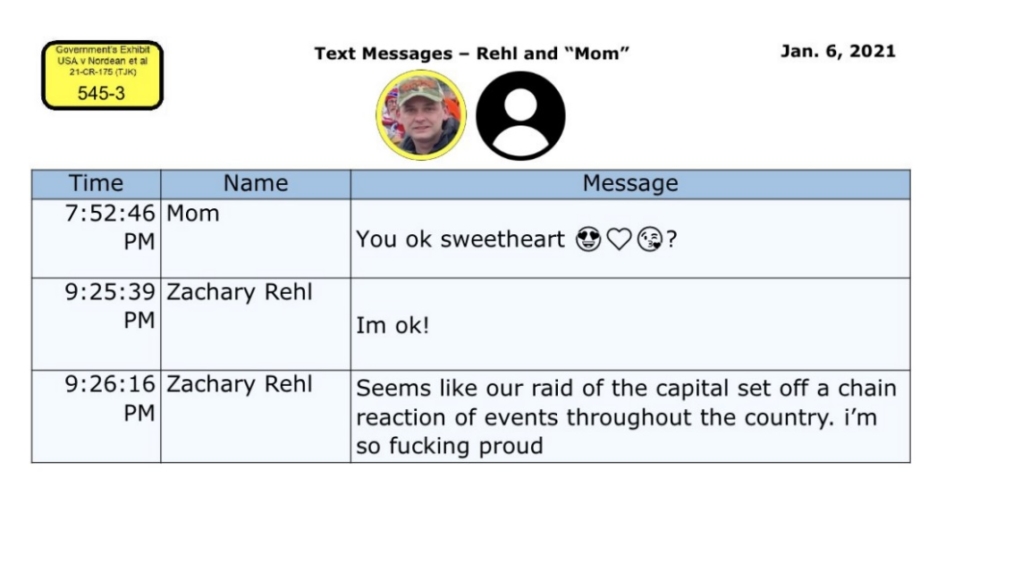
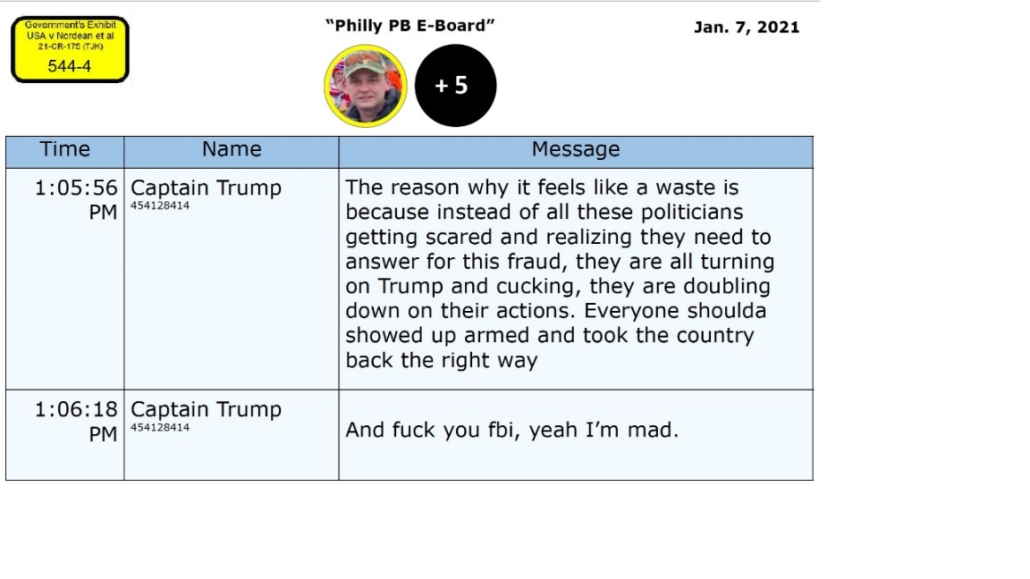
The efforts to intimidate have continued to this case. During a period when Zach Rehl was reportedly considering a plea, Tarrio sent messages to other Proud Boys about remaining loyal.

“The bigger problem with that is the guys that are in prison right now are holding on to hope that everybody is f—ing staying put because they didn’t do anything wrong,” Tarrio said. “The moment that they think one of the guys flipped, it throws everything off and it makes everybody turn on each other, and that’s what we are trying to f—ing avoid.”

Asked about the audio message, Tarrio told Reuters he was simply trying to stop members from speculating that anyone had decided to help prosecutors who are examining the deadly insurrection. “What I was trying to avoid is them turning against each other because of media stories,” he said.

Trial testimony showed that witnesses for the defense — in this case Fernando Alonzo — made threatening comments about Eddie Block for posting the video of the Proud Boys he shot on January 6. [Warning: he used an ableist slur against Block, who relies on a mobility scooter.]

Witnesses for other January 6 defendant have been harassed, as when one January 6 participant confronted Sergeant Aquilino Gonell during the trial of Kyle Fitzsimons on assault charges.

[January 6 participant Tommy] Tatum also tried to confront another officer, this one with the Capitol Police, in a courthouse elevator on Wednesday. He recorded and posted clips of both exchanges with the officers and identified himself outside the courthouse.

U.S. Capitol Police Sgt. Aquilino Gonell, who is also testifying in the trial, said that Tatum told him that he should be ashamed of himself in an exchange near the bathroom inside the courthouse on Wednesday. Shortly after, Tatum got into an expletive-laden confrontation with David Laufman, an attorney for Gonell, after he tried to get into an elevator with Gonell, Laufman and an NBC News reporter.

NBC News separately heard Tatum make negative comments inside the courthouse about how he believed Gonell was acting. Outside the courthouse, Tatum recorded himself accusing Gonell of committing perjury.

The confrontations with Gonell came before the conclusion of his testimony in the case against Fitzsimons, who is accused of assaulting Gonell inside the tunnel. Gonell’s cross-examination by Fitzsimons’ federal public defender will continue on Thursday morning.

“For Sgt. Gonell to be accosted like that, within the courthouse and while he remains a live witness at trial, was outrageous and amounts to witness intimidation that promptly should be addressed by the court as well as the FBI and the Department of Justice,” Laufman, who is representing Gonell pro bono, told NBC News on Wednesday night.

Finally, there are other key players in January 6 — most notably former Green Beret, Ivan Raiklin, who played a key role in Operation Pence Card, the effort to pressure Pence to overturn the election — who lurk around all events associated with January 6. Fellow Proud Boy Gabriel Garcia, in a recent bid to avoid pre-trial release sanctions for going to CPAC after he told Judge Amy Berman Jackson he was coming to DC to observe — among other things — the Proud Boys trial, claimed that he hung out with Raiklin at CPAC to formulate his defense.

While at CPAC, Mr. Garcia was working on his defense to these charges. Indeed, he asked Congressman M. Gaetz, who is from Mr. Garcia’s home state, how and when could his defense team access the 40,000 hours of unreleased video Capitol Police have. Also, he and his counsel met, and conferred extensively with, attorney Ivan Raiklin, whom they may retain for assistance and trial preparation. Mr. Raiklin had spoken to Mr. Garcia on March 2 at CPAC, and he told Mr. Garcia to return the next day with his counsel to discuss at length defense strategies, which they did.

Former Army Captain Garcia is one of the Proud Boys who, in exhibits submitted at trial (here, Gabriel PB), was issuing the most chilling threats in advance of January 6.

None of this makes things easier for Tim Kelly, as he tries to sustain this jury long enough to get through deliberations. It’s not yet clear whether the jurors, watching testimony about the extent to which Proud Boys using intimidation to protect their organization, are seeing shadows, or whether there’s a real attempt to intimidate jurors before they start deliberating.

But given the history of individuals directly associated with the defendants, the threat is not an idle one.

Share this entry

Time is almost up for Proud Boys on trial for seditious conspiracy: Another week gone and another week begins in historic Jan. 6 case

From emptywheel: Thanks to the generosity of emptywheel readers we have funded Brandi’s coverage for the rest of the trial. If you’d like to show your further appreciation for Brandi’s great work, here’s her PayPal tip jar.

The Proud Boys seditious conspiracy trial, after three arduous months, is on the verge of its conclusion. Closing arguments in the historic case unfolding just steps away from the U.S. Capitol could come as early as this week though not before at least one of the defendants may testify. 

On Tuesday, when U.S. District Judge Timothy Kelly takes the bench for the 53rd time in the trial’s proceedings, the final contours of the Proud Boys defense are expected to be outlined and any final attempts by the defendants to undercut what has been a massive presentation of damning evidence by the Justice Department will be made. 

If this trial has been a marathon, this is now the final leg, and as the defendants arrive at the finish line, they only have so much time left support their argument that they were not part of a conspiracy to forcibly stop the transfer of power on Jan. 6, 2021, nor were their efforts aimed at obstructing Congress from certifying the results of the 2020 election. 

Last week, Norm Pattis, a defense attorney for Proud Boy Joseph Biggs, said the former Infowars contributor wouldn’t take the witness stand. To what may end up being his benefit, Biggs has been a largely quiet figure at trial, sitting mostly silently for weeks in a series of gray suits and dark-framed glasses as he occupies a corner of the defense table positioned furthest away from the jury. 

Pattis and his co-counsel Dan Hull have mostly managed to keep Biggs and questions about his specific conduct on Jan. 6, alleged or otherwise, limited. 

When it has come to the cross-examination of government witnesses who suggested Biggs was integral to the breaching of initial barriers on Jan. 6 alongside defendant Ethan Nordean or when it has come to claims that he played a central role in whipping people into a frenzy, Pattis has often worked to refocus the jury’s attention to matters tangentially-related, like philosophical or ideological points around protest, speech or assembly. 

Where that has failed outright or faced disruption through a series of sustained objections from prosecutors, Biggs’ legal team has invoked the suggestion that the violence of Jan. 6 was the byproduct of FBI interference or incitement or just pure herd mentality. 

In court this week, the only evidence Biggs presented was a roughly 90-minute video of a Proud Boys video teleconference meeting held on Dec. 29, 2020. The video, according to the defense, goes toward the claim that Proud Boys had only planned to engage in a peaceful protest and respond to antifa or leftist interlopers accordingly. 

The force of that video’s effect, however, may have been mitigated since Biggs said little in it to start and on top of that, it featured unsavory moments steeped in anti-Semitism and misogyny. 

For example, jurors heard Tarrio and fellow Proud Boys in the meeting laugh as Tarrio discussed wearing a “six-pointed star” on Jan. 6 and making their official colors white and blue, like the Israeli flag. 

As the men laugh in the clip, Tarrio is heard assuring them that Proud Boys would never elect a “small hat” to their elders’ council. A small hat is a presumed reference to a yarmulke. Then, at another unsympathetic moment in the meeting, one Proud Boy is heard recalling how at the Dec. 12 rally in D.C., a woman tried to walk past him in the crowd. 

She told him to “make a hole” so she could squeeze by. In the clip, the Proud Boy recounted what he thought in the moment to Tarrio and crew: “I’m about to make a hole and put you in it you fucking whore,”

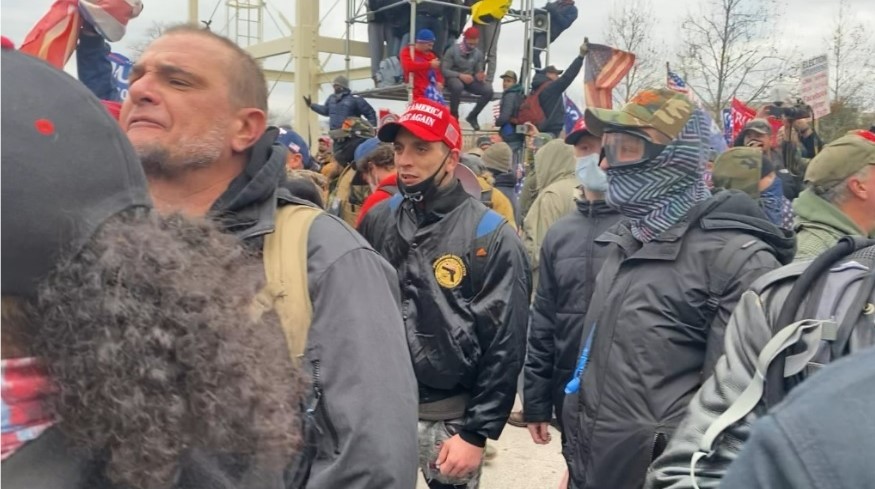
The jurors, as such, have mainly been left to acquaint themselves with Biggs through footage of him on Jan. 6 where he is regularly seen exuberantly clutching a bullhorn or shouting angrily about antifa or marching past police barriers with fellow Proud Boys as the melee around them comes to a crashing head. 

The leader of the neofascist network, Henry “Enrique” Tarrio, is very unlikely to testify barring any last-minute changes of heart. Though he was absent from the Capitol on Jan. 6, prosecutors argue the Miami, Florida-based Proud Boy oversaw and coordinated the group’s efforts from afar and had intended to stop the certification for weeks. 

During the trial this February, jurors saw evidence to suggest that Tarrio had by Dec. 30, 2020, possessed and shared a key document entitled “1776 Returns” that contained a detailed proposal to occupy federal buildings in Washington, D.C.

It didn’t mention the U.S. Capitol building specifically and Tarrio has vehemently denied authoring the proposal or knowing the document’s origins. Nonetheless, in text messages shown to jurors last month where “1776 Returns” was discussed, Tarrio is seen vowing that his “every waking moment” consisted of thinking about a “revolution.”

This poked a large hole in the defense’s already-thin theory that Proud Boys only concerned themselves on Jan. 6 with the task of protecting innocent Trump supporters who wanted to rally unmolested by rabid leftists hiding in plain sight.

During trial last week, Tarrio’s attorney Sabino Jauregui entered text messages into the record between the Proud Boys leader and Shane Lamond, a D.C. police lieutenant. The messages, according to Jauregi, support Tarrio’s assertion that he informed police of Proud Boys activities and whereabouts regularly and that he didn’t obscure his intent with officers for Jan. 6. 

Almost all of the texts shown in court last week (there were 46) were from points long before Jan. 6. And while Tarrio has painted the relationship he had with Lamond as one of equal input, some of the texts suggest the relationship may have been lopsided and most of his messages to Lamond were short and sweet. 

Lamond is currently under investigation for his communications with Tarrio. He has not been charged with any crime and he has denied any wrongdoing. Lamond has, however, invoked his Fifth Amendment right against self-incrimination and has opted against testifying at the trial.  

The texts were varied; mostly showing Lamond asking Tarrio where Proud Boys would be during a rally or other high-profile event. The men were friendly, with Lamond calling Tarrio “brother” and Tarrio calling Lamond “bruv.” They discussed getting drinks. He told Tarrio in November 2020 just a few days before the Million MAGA March in Washington, D.C., that he didn’t want the ringleader of the extremist group to think cops were keeping “tabs” on him or the Proud Boys when they were in town. 

But, Lamond told him,  knowing their movements could help police keep counterprotesters away from them. 

Jurors also saw texts where Lamond warned Tarrio in the days before the Capitol assault, that alerts were going out to police that Proud Boys were on Parler talking about “mobilizing and ‘taking back the country.’” 

And in at least one eyebrow-raising message displayed in court last week, Lamond told Tarrio to text him on an encrypted channel. 

By the time Dec. 19 rolled around, Tarrio told Lamond if Proud Boys came to D.C. at all, it would be in “extremely small” numbers and without their traditional black and yellow colors. 

Ultimately, prosecutors say Tarrio instructed members to hide or delete communications about Jan. 6, and by assuming the role of the group’s “marketing” leader, Tarrio developed a means to control the flow of information about the alleged conspiracy internally and externally. 

Though prosecutors have seemed to concede that Proud Boys were, at least for a time, focused on groups like “antifa” when they prepared for political rallies, they argue that purpose shifted dramatically once Proud Boy Jeremy Bertino was stabbed following the Dec. 12, 2020 “Stop the Steal’ rally. Text messages and witness testimony offered in court have shown Proud Boys airing frustrations about police routinely after that episode. 

Once Tarrio was arrested on Jan. 4, 2021, for burning a Black Lives Matter banner in Washington, D.C. a few weeks prior, the animosity had ratcheted up. In video footage from Jan. 5 and Jan. 6, Tarrio’s familiar and a fellow member of the group’s so-called “Ministry of Self Defense,” Florida Proud Boy Gilbert Fonticoba, is seen wearing a shirt proclaiming Tarrio’s innocence in the face of his arrest. 

His shirt read: “Enrique Tarrio Did Nothing Wrong.” 

Meanwhile, in court on March 30, while appearing as a witness for defendant Zachary Rehl, former West Virginia Proud Boys chapter president Jeff Finley flatly denied that the organization held animosity toward the police. His testimony lost some credibility though once prosecutors presented him with a text he sent to the Proud Boys “Boots on the Ground” channel on the morning of Jan. 6. In the message, Finley urged: “fuck the blue.”

He told the jury with little remorse if that’s what the record showed, that’s what it showed. Finley struck a plea agreement with the Justice Department and is in the process of serving out a 75-day prison sentence now. 

As for Fonticoba, he is one of several Proud Boys who falls under the prosecution’s “tools” theory. That theory suggests the defendants relied on each other as well as other members of the network to be their foot soldiers on Jan. 6 so they could forcibly stop the certification. Among the “tools” of the conspiracy activated by the defendants, according to the Justice Department, are Proud Boys like Paul Rae, John Stewart, Gabriel Garcia, AJ Fisher, Nicholas Ochs, Arthur Jackman, James Haffner, Ronald Loehrke, Nate and Kevin Tuck, Eddie Geroge, Dion Rajewski, Briele Boele, James Brett, Zach Johnson, and others. 

Proud Boy leader Ethan Nordean of Washington State isn’t expected to testify before all is said and done. Nordean has had far greater exposure to jurors over the course of the trial in comparison to Biggs and this despite the fact that both of the men are alleged to have led dozens of Proud Boys and other people past police barricades in equal measure. 

Footage of a hard-drinking Nordean has been depicted in court alongside other evidence, including communications where the Proud Boy expresses an intense and unwavering outrage at a “stolen” election. Testifying for Nordean would be particularly risky given his proximity to several “tools” in the conspiracy, like Ronald Loehrke, who prosecutors say he recruited to be on the front lines of the breach. If Nordean were to come under cross, it likely wouldn’t take prosecutors long before they would open a door to questions about his efforts recruiting fellow Proud Boys to the alleged cause. 

Only defendants Dominic Pezzola and Zachary Rehl have indicated they would testify but it is less clear if Rehl will take the risk. 

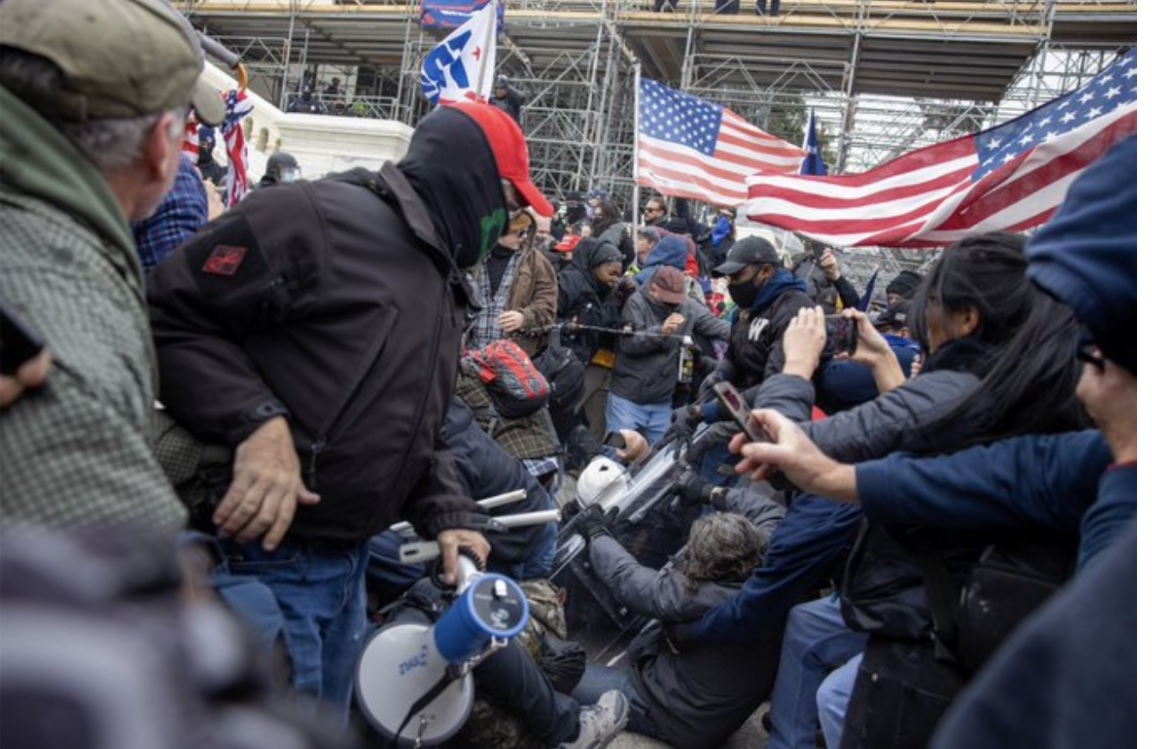
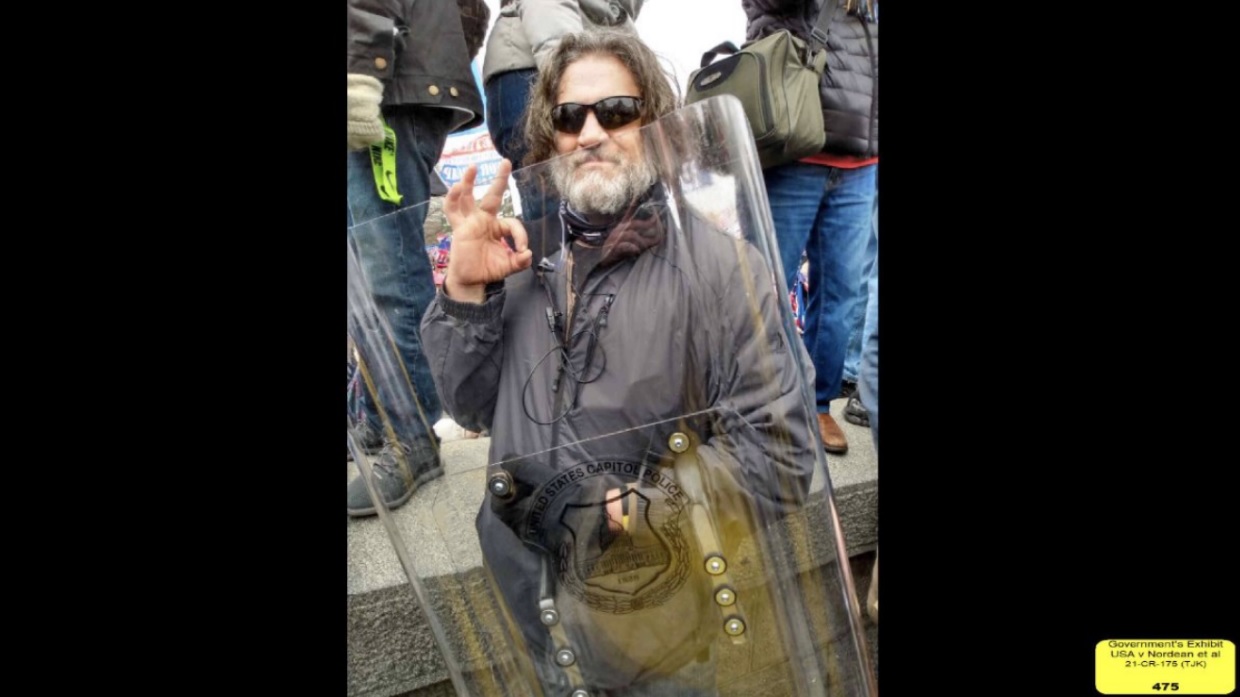
On top of seditious conspiracy and other charges, Pezzola is alleged to have stolen a police riot shield on Jan. 6 as well. Video footage, prosecutors contend, plainly shows Pezzola using that shield to smash apart a window at the Capitol that would allow rioters to stream rapidly inside. Pezzola’s attorney Steven Metcalf last week said he was confident the Rochester, New York Proud Boy would testify on his own behalf. 

Pezzola’s wife, Lisa Magee, testified on his behalf last week. She was often a sympathetic figure. Pezzola may not have gone to D.C. at all, she recalled, if he had listened to sage advice from her father. 

She told jurors how her father had warned her husband on Jan. 5 to stay home and not go to D.C. And at the time, she recalled as she sighed in court last week, Pezzola agreed to stay home and out of trouble. Less than a month before, she testified, she called her reaction to seeing Pezzola’s face after it was splashed across the Washington Post following the Stop the Steal rally in December. 

She told jurors she recalled telling her husband plainly that he was “a fucking idiot.” 

But on the eve of the insurrection, she went out for a girls-night and Pezzola left for D.C. When she testified, she was convincing when she suggested that Pezzola’s activities with the Proud Boys were mostly kept away from her view. She expressed frustration with her husband. He had changed, she said, after inundating himself with politics and Fox News. He started drinking heavily. The Covid-19 pandemic hit his business hard. He was angered, she said, when protests sparked by the police killing of George Floyd bubbled over and turned violent. She told the jury she didn’t know that her husband believed a civil war was imminent or if he was in the throes of a battle against good vs. evil, capitalism vs. communism, or freedom vs. tyranny. 

As a former U.S. Marine, her husband was a man who once devoted to a principle, would go to great lengths to uphold it, she said. 

But this quality can cut both ways. 

For the defense, Pezzola’s purported moral fortitude and ritualistic devotion to American ideals meant he would never dream of conspiring against the United States. For prosecutors, the trait meant Pezzola would act unflinchingly if he felt his version of America was under attack. 

And, prosecutors elicited, once Pezzola returned home from Washington, he got rid of his cell phone and was unable to be reached by his wife until Jan. 9. 

At trial last week, a witness for Pezzola, Steven Kay Hill, tried to give the Rochester Proud Boy and former Marine cover with his testimony. In short, Hill was set to argue that Pezzola did not steal the riot shield by the looks of it, but rather, that he was reacting to an overzealous police force that deviated from a policy that would have kept the mob calm on Jan. 6. It was essentially police who were to blame for the use of chemical irritants and less than lethal munitions, Metcalf argued. 

Metcalf walked Hill, a former police officer and law enforcement training instructor from New Mexico, through a series of video clips from the moments before and after Pezzola got ahold of the riot shield. On direct, Hill testified that the mob became incensed only after police fired a less-than-lethal munition into the crowd and hit a rioter, Joshua Black, in his cheek. 

Jurors saw a gruesome photo of Black moments after he was struck, a hole bored into the side of his face and blood at his feet. 

“They were angry. They were upset. They were pissed because one of their own has just been shot in the face,” Hill testified on April 6. 

Jurors saw footage of Black being approached by a police officer in riot gear after he is hit in the cheek. The officer appears to rest his hand on Black’s shoulder as both of the men are crouched down looking at each other. Hill conceded that while he couldn’t tell what was being said, it did appear the officer was extending aid. 

In video footage, the officer is nodding briefly while speaking to Black and they are flanked on either side by protesters and police. Prosecutors say it was at this moment that the officer was offering to help Black before attempting to take him behind police lines to treat his injuries. 

Hill told jurors this was “a mistake.” 

When the crowd saw the officer try to take Black, they only thought: ‘You’re not taking him. He’s one of ours,” Hill said. 

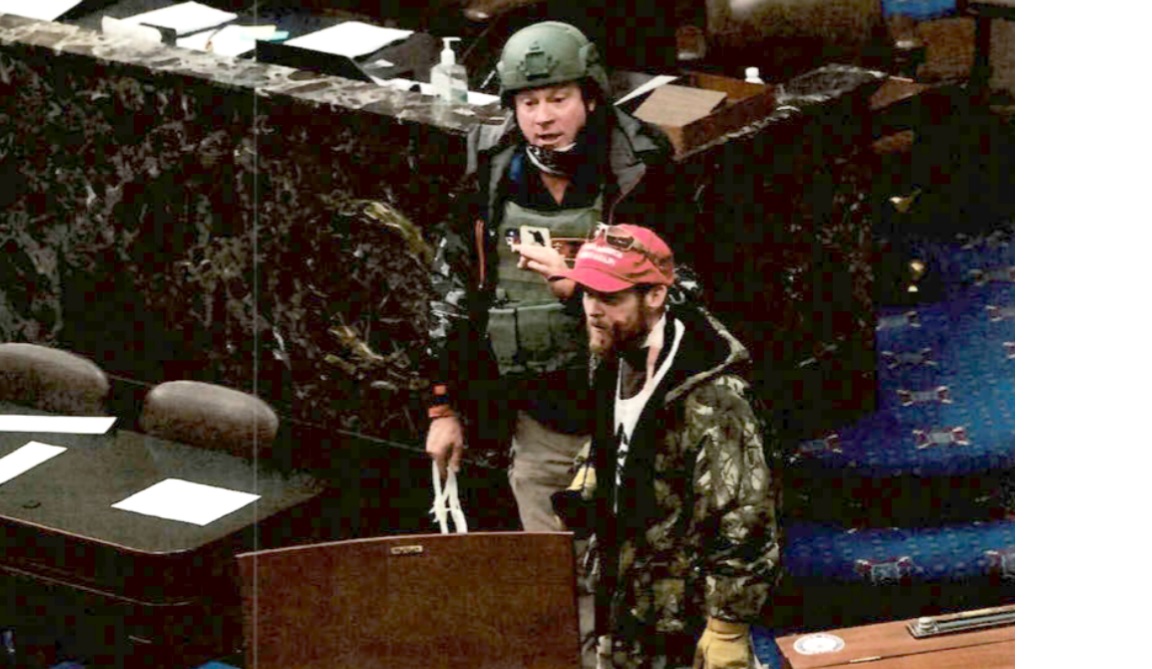
Black, injury be damned, would fall back in with the crowd and eventually make it all the way to the floor of the Senate. 

This moment played out almost simultaneously to the moment Pezzola “fell” to the ground, Metcalf argued, and incidentally grabbed a riot shield in the fracas. Metcalf stopped short of calling Pezzola’s possession of the shield self-defense but his client’s actions, he argued, could be chalked up to panic, not an intent to steal. 

On cross-examination however, prosecutor Conor Mulroe elicited that long before Black was hit in the face with a munition, the crowd was already at a fever pitch and clashing with police. 

Long before Pezzola got the shield, Hill testified, there was a lot of fighting and yelling directed at officers. For every 50 to 60 police officers on duty, Hill estimated, there were at least 500 to 600 protesters. 

Where the defense said Pezzola acted reflexively, prosecutors say Pezzola was opportunistic. 

Hill also testified that police didn’t fire indiscriminately into the crowd, as Metcalf had insinuated and he agreed that footage from Jan. 6 appeared to show police only targeting those rioters in the crowd who had visibly attacked officers. 

To support this, jurors heard police radio transmissions where officers are heard describing active police assaults in progress as they identify specific assailants in a hectic scene.

In court last Thursday, Hill said he couldn’t tell if Pezzola was being shoved from behind or not as he finally entered the fray. 

As for Rehl, should he testify, he runs the risk of unwinding whatever good favor his attorney Carmen Hernandez may have raised for him over the course of the trial. Hernandez, at the risk of being repetitive, takes every chance she can to remind jurors that Rehl had no weapons on him when he entered the Capitol. Rehl was a servicemember, a graduate, a husband, and a father, Hernandez has said. 

Rehl didn’t celebrate violence, Hernandez insists and he didn’t give anyone any orders on Jan. 6. But prosecutors have showed the jury a less favorable view of Rehl. They have shown the jury a Rehl who deeply lamented Trump’s election loss and worked hard at recruitment efforts. They have shown the jury a Rehl who, instead of retreating as officers were clearly overrun on the 6th, sent updates to Proud Boys in group chats. 

To that end, as a horde of rioters breached the building that afternoon, Rehl wrote, “Civil war started.” 

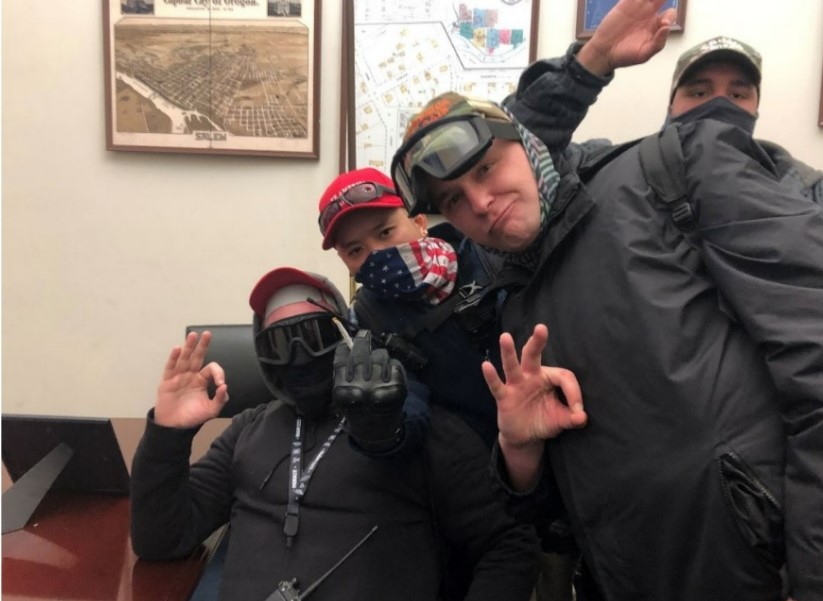
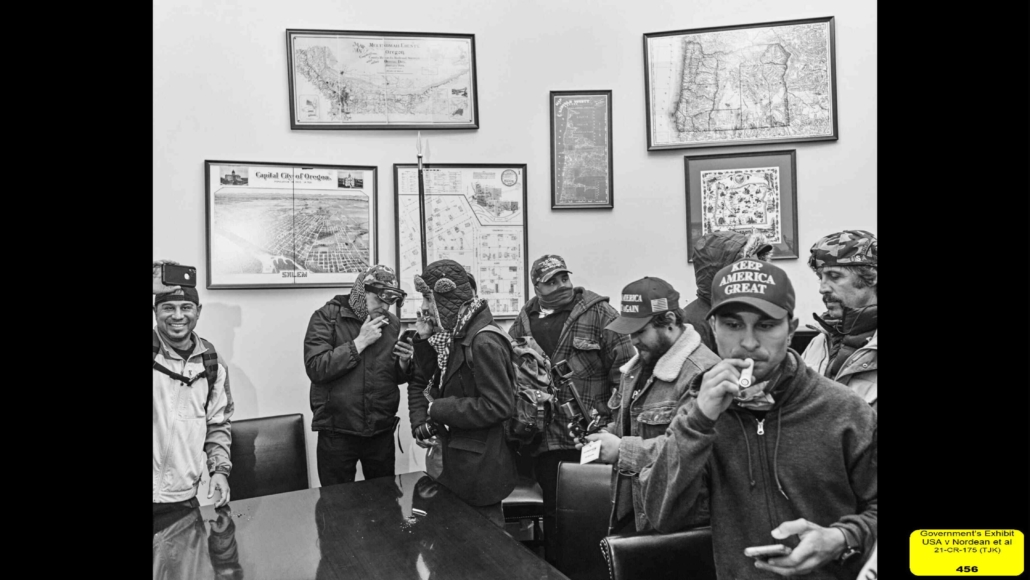
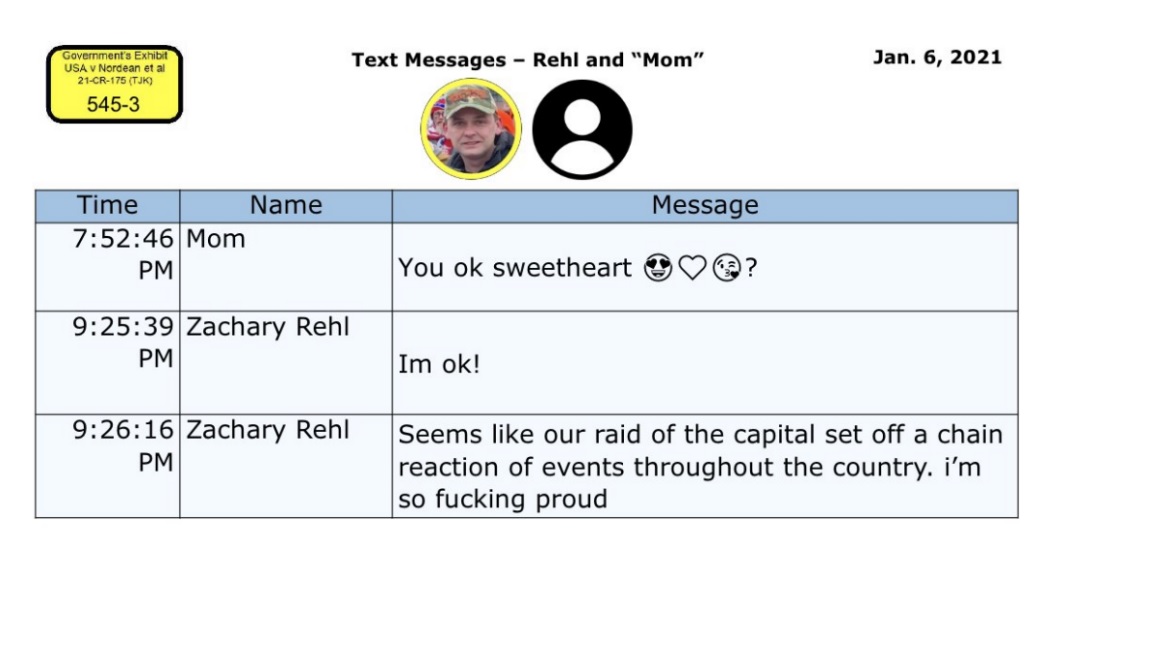
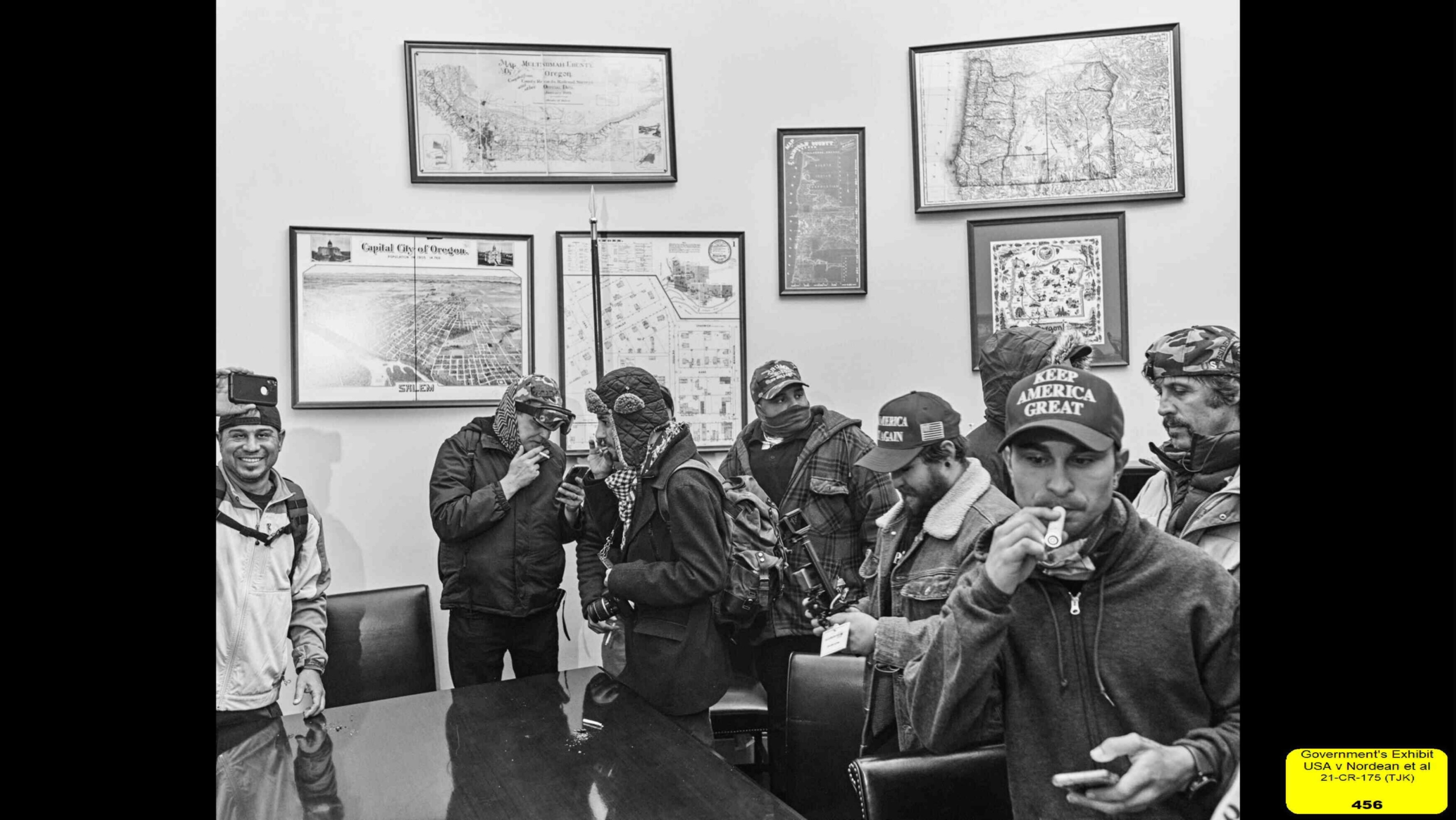
He pushed past barricades and broke into Senator Jeff Merkley’s office with other rioters and Proud Boys, including some members who prosecutors have said are “tools” of the conspiracy. 

Not one week in the Proud Boys seditious conspiracy trial has passed by smoothly and last week was no different. Apart from routine objections launched by the defense to even the most mundane of issues and separate from the unending series of motions for mistrial, last week featured a new and unwelcome variable: the sealed hearing. 

A sealed hearing, or a hearing closed to the public and press, is typically held when sensitive or classified matters are being discussed by the parties. Trial days were stopped and started three times last week for sealed hearings that stretched for more than an hour. A press coalition moved to unseal proceedings on at least one of those days but was promptly denied by Judge Kelly for reasons he failed to describe on the record. 

Though the exact reason was not disclosed by the court (nor would one expect it to be at this point), CNN reported that multiple sources said the sealed hearing was prompted after a juror raised concerns that she was being followed. Another juror has said they were “accosted” but no further details were available.

Share this entry

“Forthwithier:” Peter Navarro Attempts to Pull a Fast One on His Incriminating Use of ProtonMail

Peter Navarro appears to be attempting to stall out a month-long order to avoid turning over ProtonMail content he has been trying to withhold from DOJ since last July.

In the guise of doing a more thorough search for materials he should have turned over under the Presidential Records Act, he has not turned over 200 to 250 already identified ProtonMail records that, last year, his attorney said would incriminate him if he turned them over.

I wrote about the lawsuit DOJ filed to force Navarro to turn over the records last August. In effect, after Navarro lawyered up last year and DOJ told them they were going to sue, Navarro’s lawyer went through his emails, identified 200 to 250 ProtonMail records that should have been turned over, but said he would not on the grounds that it would amount to self-incrimination. So DOJ sued to get them.

In March, Judge Colleen Kollar-Kotelly ruled for the government and ordered Navarro to turn over the documents he had already identified to be covered by the Presidential Record Act, “forthwith.”

ORDERED, that Defendant shall produce to Plaintiff the 200 to 250 documents that his counsel has identified as Presidential records forthwith.

In a status report submitted yesterday describing all the new files Navarro is looking for, DOJ included a footnote making it clear Navarro still has not complied with the March 9 order.

1 As of the filing of this status report, Plaintiff advises that it has not received any of the 200 to 250 documents that Defendant’s counsel has identified as Presidential records, nor has Defendant obtained a stay of this Court’s order from the D.C. Circuit.

Navarro has appealed and is asking for a stay of Judge KK’s order; his reply brief for that stay is due Monday. He has clearly ignored a pending order for over a month in hopes that the DC Circuit — a panel consisting of Patricia Millett, Robert Wilkins, and Neomi Rao — will give allow him to delay turning over the 200 to 250 documents his lawyer has said include evidence of a crime.

Share this entry

Elon Musk “Censors” Matt Taibbi’s Post about Twitter “Censoring” the “Hunter Biden” “Laptop” Story

Back in October 2020, #MattyDickPics Taibbi wrote a post on his Substack about the great scandal that Twitter throttled the dodgy NYPost story.

The incredible decision by Twitter and Facebook to block access to a New York Post story about a cache of emails reportedly belonging to Democratic nominee Joe Biden’s son Hunter, with Twitter going so far as to lock the 200 year-old newspaper out of its own account for over a week, continues to be a major underreported scandal.

The hypocrisy is mind-boggling. Imagine the reaction if that same set of facts involved the New York Times and any of its multitudinous unverifiable “exposes” from the last half-decade: from the similarly-leaked “black ledger” story implicating Paul Manafort, to its later-debunked “repeated contacts with Russian intelligence” story, to its mountain of articles about the far more dubious Steele dossier.

[snip]

The flow of information in the United States has become so politicized – bottlenecked by an increasingly brazen union of corporate press and tech platforms – that it’s become impossible for American audiences to see news about certain topics absent thickets of propagandistic contextualizing.

That makes the effect of Elon Musk’s decision yesterday to block links to Substack (as well as WordPress, on which this site is built) all the more tragicomic.

Here’s how that tragicomedy unfolded, in four five acts (note: Mehdi made the same joke I made yesterday at about the same time):

One:

Two:

Three:

Four:

Just days ago, as Mehdi Hasan shredded his false claims, #MattyDickPics squirmed as he explained that he had no criticism to make of authoritarian narcissist Elon Musk because he believed Musk intended to reverse what, #MattyDickPics claimed to believe, amounted to censorship from Twitter, including the throttling for 24-hours of one story from the NYPost.

Almost immediately after that, Elmo throttled not just #MattyDickPics’ own posts about “Hunter Biden’s” “laptop,” but scores of other such posts as well.

Update, Five:

Share this entry

DC Circuit Upholds 18 USC 1512(c)(2), Sort Of

This passage from Judge Justin Walker’s concurring opinion in the DC Circuit’s ruling upholding the application of 18 USC 1512(c)(2) to three defendants accused of assaulting cops on January 6 may be the most important language, until further litigation sorts out the rest.

5 The dissenting opinion says a defendant can act “corruptly” only if the benefit he intends to procure is a “financial, professional, or exculpatory advantage.” Dissenting Op. 35. I am not so sure. Cf. United States v. Townsend, 630 F.3d 1003, 1010-11 (11th Cir. 2011); United States v. Girard, 601 F.2d 69, 70 (2d Cir. 1979); Trushin v. State, 425 So.2d 1126, 1130-32 (Fla. 1982). Besides, this case may involve a professional benefit. The Defendants’ conduct may have been an attempt to help Donald Trump unlawfully secure a professional advantage — the presidency. Like the clerkship that Samuel Vaughan corruptly sought hundreds of years ago, the presidency is a coveted professional position. See Vaughan (1769) 98 Eng. Rep. at 308-10; but see Telegram from William T. Sherman to Republican National Convention (1884) (“I will not accept if nominated, and will not serve if elected.”).

True, the Defendants were allegedly trying to secure the presidency for Donald Trump, not for themselves or their close associates. But the beneficiary of an unlawful benefit need not be the defendant or his friends. Few would doubt that a defendant could be convicted of corruptly bribing a presidential elector if he paid the elector to cast a vote in favor of a preferred candidate — even if the defendant had never met the candidate and was not associated with him. See Oral Arg. Tr. 18-19, Chiafalo v. Washington, 140 S. Ct. 2316 (2020) (discussing the fear that electoral college voters might one day be bribed).

[snip]

[I]t might be enough for the Government to prove that a defendant used illegal means (like assaulting police officers) with the intent to procure a benefit (the presidency) for another person (Donald Trump). * *

I most recently wrote about this appeal here (which links to my past coverage). DOJ has charged over 300 people with obstructing the vote certification on January 6. All but one judge — former Clarence Thomas clerk Carl Nichols — upheld the application. Judge Nichols said that the application of 1512 to these defendants, who allegedly engaged in significant assaults as part of their actions on January 6, had to involve a documentary component, like destroying a document.

Walker joined Florence Pan’s majority opinion upholding the obstruction statute with Garret Miller, Joseph Fischer, and Jake Lang. The decision before the court was primarily whether obstruction required a documentary aspect, and Pan and Walker agreed it did not, though at the hearing, Walker and Greg Katsas made it clear they were interested in limiting the “corrupt purpose” requirement of the statue.

That’s where Walker disagreed with Pan: whether the “corrupt purpose” part of 1512 must involve some kind of personal corruption or may be broader. He argues here — in a part of the opinion that Greg Katsas did not join — that it must.

But he interpreted his own definition requiring some personal corruption to extend to those, like the appellees, who committed crimes in service of keeping Trump in office.

I’m not sure his adoption of personal corruption to assault in the service of election theft is so obvious (his opinion makes it sound like he’s not sure either).

But as written, his language would extend to virtually all the people already charged with obstruction.

This will be further litigated. But given that this is the starting place, unless SCOTUS does something remarkable, it likely means obstruction will be upheld for all those currently charged and could be used with Trump and all his aides who were more clearly working for a corrupt purpose.

[Fixed appellee appellant — because I forgot the defendants won before Nichols]

Update: Earlier this week, I did a podcast with Joshua Holland. I said there were a number of things that Jack Smith might wait on before charging Trump. One of those was this appeal.

Update: Added a bit more description the Nichols’ holding that was overturned.

Update: Both Nick Smith (for Ethan Nordean and the guy who argued before the DC Circuit) and Carmen Hernandez (for Zach Rehl) are using the opinion to disrupt the Proud Boy trial, with Hernandez making a much more expansive ask.

They argue that because Walker would not have joined Pan’s majority opinion on the documents issue without a more narrow reading of “corruptly” than she adopted, Tim Kelly has to apply Walker’s standard in the Proud Boy case. That’s why I noted that Walker had little problem applying his “corruptly” standard to the defendants before him: if it can apply to guys who weren’t called out by the President in advance of playing a key role in an assault on the Capitol, then it surely could apply to guys accused of doing just that.

In her majority, Pan noted that Thomas Robertson’s appeal includes a challenge to the “corruptly” language used to convict him on obstruction, but this bid by the Proud Boys may hasten DOJ’s request for some other resolution.

Share this entry

Matt Taibbi Is Furious that Election Integrity Project Documented How Big Trump’s Big Lie Was

As you’ve no doubt heard, #MattyDickPics Taibbi went on Mehdi Hasan’s show yesterday and got called out for his false claims.

After the exchange, #MattyDickPics made a show of “correcting” some of his false claims, which in fact consisted of repeating the false claims while taking out the proof, previously included in the same tweet, that he had misquoted a screen cap to sustain his previous false claim.

#MattyDickPics made a mishmash of these same claims in his sworn testimony before Jim Jordan’s committee, which may be why he doesn’t want to make wholesale corrections. I look forward to him correcting the record on false claims made under oath.

#MattyDickPics also wrote a petulant post announcing that MSNBC sucks, in which, after a bunch of garbage that repeatedly cites Jeff Gerth as a factual source (!!!), finally gets around to admitting how sad he is that no one liked his Twitter Files thread making claims about the FBI.

After the first thread, Mehdi was one of 27 media figures to complain in virtually identical language: “Imagine volunteering to do PR work for the world’s richest man.”

I laughed about that, but couldn’t believe the reaction after Twitter Files #6, showing how Twitter communicated with the FBI and DHS through a “partner support channel,” and in response to state requests actioned accounts on both sides of the political aisle for harmless jokes. Mehdi’s take wasn’t that this information was wrong, or not newsworthy, but that it shouldn’t have been published because Elon Musk put Keith Olbermann in timeout for a day, or something. “Even Bari Weiss called him out, but Taibbi seems to want to tweet through it,” Mehdi tweeted.

If it sounds like my beef with MSNBC is personal, by now it is. Take the Twitter Files. When first presented with the opportunity to do that story, my first reaction was to be extremely excited, as any reporter would be, including anyone at MSNBC. In the next second however I was terrified, because I care about my job, and knew there would be a million eyes on this thing and a long way down if I got anything wrong. If you’ve ever wondered why I look 100 years old at 53 it’s because I embrace this part of the process. Audiences have a right to demand reporters lie awake nights in panic, and every good one I’ve ever met does.

But people who used to be my friends at MSNBC embraced a different model, leading to one of the biggest train wrecks in the history of our business. Now they have the stones to point at me with this “What happened to you?” routine. It’s rare that the following words are justified on every level, but really, MSNBC: Fuck you.

As I showed, #MattyDickPics made a number of egregiously false claims in that very same Twitter Files #6, the very same one he’s stewing over because it wasn’t embraced warmly.

But one of the other key false claims Mehdi caught #MattyDickPics making is far more important: the claim that the Election Integrity Project “censored” 22 million tweets; in his tweet, he claimed that “According to EIP’s own data, it succeeded in getting nearly 22 million tweets labeled in the runup to the 2020 vote.”

After Mehdi posted the appearance, #MattyDickPics “removed” his error.

Then, after a guy named Mike Benz, who is at the center of this misinformation project, misinformed him, #MattyDickPics reverted to his original false claim.

As to the factual dispute, there is none. #MattyDickPics and his Elmo-whisperer Mike Benz are wrong. The error stems from either an inability to read an academic methodology statement or the ethic among these screencap boys that says you can make any claim you want so long as you have a screencap with a key word in it.

At issue is a report the Election Integrity Project released in 2021 describing their two-phase intervention in the 2020 election. The first phase consisted of ticketing mis- or disinformation in real time in an attempt to stave off confusion about the election. Here’s the example of real-time ticketing they include in their report.

To illustrate the scope of collaboration types discussed above, the following case study documents the value derived from the multistakeholder model that the EIP facilitated. On October 13, 2020, a civil society partner submitted a tip via their submission portal about well-intentioned but misleading information in a Facebook post. The post contained a screenshot (See Figure 1.4).

Figure 1.4: Image included in a tip from a civil society partner.

In their comments, the partner stated, “In some states, a mark is intended to denote a follow-up: this advice does not apply to every locality, and may confuse people. A local board of elections has responded, but the meme is being copy/pasted all over Facebook from various sources.” A Tier 1 analyst investigated the report, answering a set of standardized research questions, archiving the content, and appending their findings to the ticket. The analyst identified that the text content of the message had been copied and pasted verbatim by other users and on other platforms. The Tier 1 analyst routed the ticket to Tier 2, where the advanced analyst tagged the platform partners Facebook and Twitter, so that these teams were aware of the content and could independently evaluate the post against their policies. Recognizing the potential for this narrative to spread to multiple jurisdictions, the manager added in the CIS partner as well to provide visibility on this growing narrative and share the information on spread with their election official partners. The manager then routed the ticket to ongoing monitoring. A Tier 1 analyst tracked the ticket until all platform partners had responded, and then closed the ticket as resolved.

It wasn’t a matter of policing speech. It was a matter of trying to short circuit even well-meaning rumors before they start going viral.

According to the report, social media companies acted on 35% of the identified tickets, most often those claiming victory before the election had been called. Just 13% of all those items ticketed were removed.

35% of the URLs we shared with Facebook, Instagram, Twitter, TikTok, and YouTube were either labeled, removed, or soft blocked. Platforms were most likely to take action on content that involved premature claims of victory.

[snip]

We find, overall, that platforms took action on 35% of URLs that we reported to them. 21% of URLs were labeled, 13% were removed, and 1% were soft blocked. No action was taken on 65%. TikTok had the highest action rate: actioning (in their case, their only action was removing) 64% of URLs that the EIP reported to their team.

Then after the election, EIP looked back and pulled together all the election-related content to see what kinds of mis- and disinformation had been spread, including after the election. Starting in Chapter 3, the report describes the waves of mis- and disinformation they identified, starting with claims about mail-in voting, to claims about how the votes would be counted, to organized efforts to “Stop the Steal” that resulted in the January 6 attack. It looked at a number of case studies, including Stop the Steal, the false claims about Dominion that have already been granted a partial summary judgment in their Fox lawsuit, and nation-state campaigns including the Iranian one that involved posing as Proud Boys to threaten Democratic voters that #MattyDickPics has systematically ignored.

Chapter 5 describes the historic review that #MattyDickPics misrepresented. It clearly describes that this analysis was done after the fact, starting only after November 30.

Through our live ticketing process, analysts identified social media posts and other web-based content related to each ticket, capturing original URLs (as well as screenshots and URLs to archived content). In total, the EIP processed 639 unique tickets and recorded 4,784 unique original URLs. After our real-time analysis phase ended on November 30, 2020, we grouped tickets into incidents and narratives. We define an incident as an information cascade related to a specific information event. Often, one incident is equivalent to one ticket, but in some cases a small number of tickets mapped to the same information cascade, and we collapsed them. As described in Chapter 3, incidents were then mapped to narratives—the stories that develop around these incidents—where some narratives might include several different incidents. [my emphasis]

Then it describes how it collected a bunch of data for this historic review. One of three sources of data used in this historic review was Twitter’s API (the other two were original tickets and data from Facebook and Instagram). Starting from a dataset of 859 million tweets pertaining to the election, EIP pulled out nearly 22 million tweets that involved “election incidents” of previously identified mis- or disinformation.

We collected data from Twitter in real time from August 15 through December 12, 2020.1 Using the Twitter Streaming API, we tracked a variety of election-related terms (e.g., vote, voting, voter, election, election2020, ballots), terms related to voter fraud claims (e.g., fraud, voterfraud), location terms for battleground states and potentially newsworthy areas (e.g., Detroit, Maricopa), and emergent hashtags (e.g., #stopthesteal, #sharpiegate). The collection resulted in 859 million total tweets.

From this database, we created a subset of tweets associated with each incident, using three methods: (1) tweets recorded in our ticketing process, (2) URLs recorded in our ticketing process, and (3) search strings.

Relying upon our Tier 1 Analysis process (described in Chapter 1), we began with tweets that were directly referenced in a ticket associated with an incident. We also identified (from within our Twitter collection) and included any retweets, quote tweets, and replies to these tweets. Next, we identified tweets in our collection that contained a URL that had been recorded during Tier 1 Analysis as associated with a ticket related to this incident. Finally, we used the search string and time window developed for each incident to identify tweets from within our larger collection that were associated with each election integrity incident.

In total, our incident-related tweet data included 5,888,771 tweets and retweets from ticket status IDs directly, 1,094,115 tweets and retweets collected first from ticket URLs, and 14,914,478 from keyword searches, for a total of 21,897,364 tweets.

Here’s the EIP table of its top-10 most viral examples of mis- or disinformation, amounting to over 14 million of the tweets in question. Right away, it should alert you to the effect, if not the goal, of conflating EIP’s real-time tickets to social media companies, including of things like an overgeneral statement about how ballots are treated in different states, with what EIP found in their historical review of how mis- and disinformation worked in 2020.

What #MattyDickPics and his Elmo whisperer Mike Benz are complaining about is not that EIP attempted to “censor” speech in real time. What they’re complaining about is that a bunch of academics and other experts figured out what the scale and scope of mis- and disinformation was in 2020. And what those experts showed is that systematic Republican disinformation (and mind you, this is just the disinformation through December 12; it missed the bulk of the build-up to January 6) made up the vast majority of mis- and disinformation that went viral in 2020. It showed that, even by December 12, almost 45% of the mis- and disinformation on Twitter consisted of two campaigns tied to Trump’s Big Lie, the attacks on Dominion and the organized Stop the Steal campaign.

EIP’s list of repeat spreaders is still more instructive, particularly when you compare it against the list of people that Elmo has welcomed back to Twitter since he took over.

What EIP did was catalog how central disinformation from Trump and his family — and that of close allies in the insurrection — was in the entire universe of mis- and disinformation (Mike Roman, one of least known people on this list, had his phone seized as part of the January 6 investigation last year).

Some mis- and disinformation did not go viral in 2020. What did, overwhelmingly, was that which Trump and his allies made sure to promote.

The dataset of 22 million tweets is not a measure of mis- or disinformation identified in real time. What it is, though, is a measure of how central Trump is to disinformation on social media.

Whether #MattyDickPics understands the effect of the stubborn false claim that Mike Benz fed him, whether #MattyDickPics understands how his false claim provides Elmo cover to replatform outright white supremacists, or not, the effect is clear.

The concerted effort to discredit the Election Integrity Project has little effect on flagging mis- or disinformation in real time. What it does, however, is discredit efforts to track just how central Trump is to election disinformation in the US.

Update: Here’s the full Mehdi Hasan interview.

Update! Oh no!! Drama!!

Share this entry

The Testimony Jack Smith Gets This Week Builds on Work from Over a Year Ago

Starting on Tuesday, Jack Smith’s prosecutors started getting return grand jury appearances for a set of key Trump aides who had invoked Executive Privilege in earlier appearances. In the days ahead, that same January 6 grand jury will get the testimony of Dan Scavino, Stephen Miller, Mark Meadows and — unless Trump succeeds with some kind of last minute challenge — Mike Pence.

Starting tomorrow, Secret Service agents will testify in the stolen documents case. That comes after (according to CNN), witnesses who gave voluntary testimony last summer have made subsequent appearances before the grand jury and Evan Corcoran provided crime-fraud excepted documents and testimony to the same grand jury. Multiple other lawyers already testified before the grand jury.

While there are a few outstanding items, such as the exploitation of Scott Perry’s phone, the DC Circuit decision on the application of 18 USC 1512(c)(2) to January 6, finding a way to obtain any remaining classified documents Trump has been hoarding, a verdict in the Proud Boys trial (which may dictate charging decisions for others) — all of which efforts have been pending for over six months, before Smith was appointed — the twin investigations headed by Jack Smith appear to be headed to imminent resolutions.

In recent weeks, the same TV lawyers who were wailing last summer about the January 6 investigation into Trump (the stolen documents investigation, while already laying the groundwork for charging a former President under the Espionage Act, still remained entirely unknown), have suggested that Alvin Bragg’s indictment of Trump might, “might light a fire under other prosecutors and advance the proposition that even ex-presidents must follow the law.”

It’s an obscene suggestion, that Jack Smith or his AUSAs or Merrick Garland needed some push to pursue the investigation into Donald Trump, when instead the TV lawyers simply needed a push to review what steps the investigation was actually pursuing. That’s because all of the recent developments in the Jack Smith case — the crime-fraud ruling, the Executive Privilege waiver, the testimony of Mike Pence — very obviously build on work done last year, well before Garland appointed Jack Smith. Some of those steps were even public at the time last summer when the very same TV lawyers were wailing. All of the climactic steps occurring in recent weeks were easily foreseeable by August.

Prosecutors have been building to this moment for a long time.

As I noted here, investigations in the era of cloud computing usually follow a clear logic:

  • Use subpoenas to obtain metadata to identify key subjects
  • Use metadata to obtain cloud warrants of subjects
  • Use cloud warrants to obtain warrants for phones (a necessary step if encrypted apps were used in furtherance of a crime, as was the case in the lead-up to January 6)
  • Use overt subpoenas for other witnesses to obtain evidence
  • Obtain grand jury testimony from witnesses

By the time the first overt subpoenas and warrants go out — which in the January 6 case was May 2022, though in the case of Sidney Powell was September 2021 — DOJ will already have obtained metadata and cloud content from key subjects of the investigation. Only after DOJ works through that covertly obtained evidence does it start doing the things that alert subjects to the scope of the investigation by subpoenaing other witnesses or seizing phones.

Even in a garden variety investigation, it can take six months from the date of seizure of a subject’s phone until an arrest. This was true even in the militia conspiracy cases, where arrests were an attempt to stave off further violence, in part because FBI was exploiting so many phones.

In the case of sensitive witnesses like lawyers, presidential advisors, and members of Congress, it takes a number of extra steps to get grand jury testimony or access content.

In Rudy Giuliani’s case, a privilege review of his phone content took nine months (though that review incorporated content relating to January 6, so it has been done since January 2022). In Enrique Tarrio’s case (largely due the security he used on his phone), it took over a year to access the content on his phone. In Scott Perry’s case, prosecutors are still working on it seven months later. In James O’Keefe’s unrelated case, Project Veritas still has one more chance to prevent prosecutors from getting evidence the FBI seized in November 2021, almost 17 months ago. You can’t skip privilege reviews, because if you do, key evidence will get thrown out during prosecution, rendering any downstream evidence useless as well.

In cases of privilege, DOJ first gets grand jury testimony where the witness invokes privilege, and then afterwards makes a case that the needs of the investigation overcome any privilege claim. DOJ first started pursuing privileged testimony regarding events involving Mike Pence with grand jury testimony from Pence aides Greg Jacob and Marc Short last July, then with testimony from the two Pats, Cipollone and Philbin, in August. It got privilege-waived testimony from Pence’s aides in October and from the two Pats on December 2. That process undoubtedly laid the groundwork for this week’s DC Circuit ruling that people like Mark Meadows and Dan Scavino must likewise testify to the grand jury.

By the time DOJ first overtly subpoenaed material in the fake electors plot last May, it had done the work to obtain cloud content from John Eastman and Jeffrey Clark. If DOJ had obtained warrants for the already seized phone content from Rudy — which is likely given the prominence of Victoria Toensing from the start of the fake elector subpoenas — then it would have built on content it obtained a year earlier in another investigation.

Some of this undoubtedly benefitted from the January 6 Committee’s work. I would be shocked, for example, if DOJ didn’t piggyback on Judge David Carter’s March 28, 2022 decision ruling some of John Eastman’s communications to be crime-fraud excepted. As NYT reported in August, in May 2022, DOJ similarly piggybacked on J6C’s earlier subpoenas to the National Archives (and in so doing avoided any need to alert Joe Biden to the criminal, as opposed to congressional, investigation); this is consistent with some of what Mueller did in the Russian investigation. Cassidy Hutchinson’s testimony, obtained via trust earned by Liz Cheney, has undoubtedly been critical. But the January 6 Committee also likely created recent delays in the January 6 and Georgia investigation, thanks to the delayed release of transcripts showing potentially exculpatory testimony.

But much of it preceded the January 6 Committee. I’ve shown, for example, that DOJ had a focus on Epshteyn before J6C first publicly mentioned his role in the fake electors plot. Toensing’s involvement came entirely via the DOJ track.

The path that brought us here went from the covert steps in advance of the May 2022 Clark and Eastman warrants (possibly including Rudy Giuliani warrants), to testimony from Trump’s aides, to testimony from White House Counsels, to Meadows and Pence and the rest of them.

There’s not a shred of evidence that DOJ’s prosecutors or Garland were afraid of taking these steps (FBI might be another issue). Instead, there’s a clear timeline of public steps DOJ has taken to get us to this point, which necessarily built on non-public things DOJ did to get to the point of obtaining warrants for the email accounts of several lawyers (and whatever covert steps it took with non-lawyers that won’t be public for years).

A timeline of the stolen document investigation is here.

Some key dates in the January 6 investigation are:

January 4, 2021: DC authorities seize Enrique Tarrio’s phone

January 25, 2021: Stop the Steal VIP Brandon Straka arrested; DOJ IG opens probe into Jeff Clark and others

February 17, 2021: First allegedly cooperative interview with Straka

March 17, 2021: DOJ makes first tie between Oath Keepers investigation and Roger Stone

March 25, 2021: Second allegedly cooperative interview with Straka

April 21, 2021 (Lisa Monaco’s first day on the job): DOJ obtains warrant targeting Rudy Giuliani’s cell phones in Ukraine investigation

June 23, 2021: First Oath Keeper who interacted with Stone enters into cooperation agreement

August 19, 2021: Alex Jones sidekick Owen Shroyer, who participated in Friends of Stone list and served as a communication hub between Proud Boys and others, arrested

September 2021: DOJ subpoenas records from Sidney Powell grift

September 3, 2021: SDNY makes an ultimately successful bid to review all content on Rudy’s devices for privilege (making such content available if and when DOJ obtains January 6 warrant targeting Rudy)

Fall 2021: Thomas Windom appointed to form fake elector team

October 28, 2021: Merrick Garland tells Sheldon Whitehouse DOJ is following the money of January 6

November 2, 2021: Special Master Barbara Jones releases first tranche of materials from Rudy’s phones, including content through seizure

November 22, 2021: Trump appointee Carl Nichols asks James Pearce whether 18 USC 1512(c)(2) might be applied to someone like Trump (he would go on to issue an outlier opinion rejecting the application)

By December 2021: JP Cooney starts long-invisible investigation into financial side of January 6

December 2021: NARA and Mark Meadows begin process of completing his record of PRA-covered communications

December 10, 2021: Judge Dabney Friedrich (a Trump appointee) upholds application of 18 USC 1512(c)(2) to January 6

January 5, 2022: Merrick Garland reiterates that DOJ is investigating the financial side of January 6

Mid-January 2022: DOJ finally obtains contents of Tarrio’s phone

January 19, 2022: Jones releases remaining content from Rudy’s phones; SCOTUS declines to review DC Circuit rejection of Trump’s Executive Privilege claims with respect to January 6 subpoenas

January 5, 2022: Lisa Monaco confirms DOJ is investigating fake electors plot

February 18, 2022: In civil cases, Judge Amit Mehta rules it plausible that Trump and militias conspired to obstruct vote certification, as well that he aided and abetted assaults

March 2, 2022: Oath Keeper in charge of Stone security on January 6, Joshua James, enters into cooperation agreement

March 28, 2022: Judge David Carter issues crime-fraud ruling covering John Eastman’s communications with and on behalf of Trump

May 2022: DOJ subpoenas all NARA records provided to J6C

May 26, 2022: Subpoenas for fake electors plot including Rudy, John Eastman, Boris Epshteyn, Bernie Kerik, and Jenna Ellis, among others; warrants for email accounts of Jeffrey Clark, John Eastman, Ken Klukowski, and one non-lawyer

June 6, 2022: DOJ charges Proud Boy leaders with seditious conspiracy

June 21, 2022: Second set of fake electors subpoenas, adding Mike Roman and others, warrants for NV GOP officials and GA official

June 22, 2022: DOJ searches Jeffrey Clark’s home and seizes his phone

June 28, 2022: DOJ seizes John Eastman’s phone

June 23, 2022: DOJ completes exploitation (but not scoping) of Shroyer’s phone

June 24, 2022: Ali Alexander grand jury appearance

June 27, 2022: Then Chief Judge Beryl Howell permits prosecutors to obtain emails between Scott Perry and Clark and Eastman

July 22, 2022: Marc Short appears before grand jury

August 9, 2022: Scott Perry’s phone seized

August 2022: Mark Meadows provides previously withheld PRA covered materials to NARA

Early September, 2022: Pre-election legal process includes seizure of Boris Epshteyn and Mike Roman’s phones, subpoenas to key aides including Dan Scavino, Bernie Kerik, Stephen Miller, Mark Meadows, subpoenas pertaining to Trump’s PAC spending,

October 13, 2022: Marc Short and Greg Jacob make second, privilege-waived grand jury appearance

November 18, 2022: Merrick Garland appoints Jack Smith

December 2, 2022: Pats Cipollone and Philbin make second, privilege-waived grand jury appearance

December 2022: Rudy Giuliani subpoena asks for information on his payment

February 9, 2023: Mike Pence subpoenaed

February 23, 2023: DC Circuit hears Scott Perry’s challenge to order providing access to his phone content

March 9, 2023: Judge Kollar-Kotelly orders Peter Navarro to turn over PRA-covered contents from Proton Mail account

March 28, 2023: Chief Judge Jeb Boasberg rules Mike Pence must testify (though protects some areas on Speech and Debate grounds)

April 4, 2023: DC Circuit declines to stay Beryl Howell ruling ordering testimony from Mark Meadows and others

Share this entry

Trump Edition: What Is And What Shall Never Be

Upon request I, hopefully, will come back to the big Alvin Bragg indictment of Trump. Later. When have really had a chance to digest and analyze it.

So far, at least, not too sold on it. Not like all the Boyz at Just Security, several of whom I respect, but they have been been overselling, led by Weissmann, this entire scenario mercilessly. To the extent of being dubious.

Anybody who thinks this is all cut and dried as Bragg makes it is a dope. To what extent we shall see. But, yes, we shall see. Tomorrow will be merely the start of the analysis, not merely the end like other dopes will tell you.

So, let us see what is, and what will never really be. They are very different things. Am prepared to be totally wrong. Are you? And how long are you willing to play the long game out?

Criminal law will never be your personal political savior.

Share this entry

The Espionage Act Evidence WaPo Spins as Obstruction Evidence

The WaPo, with Devlin Barrett as lead byline and Mar-a-Lago Trump-whisperer Josh Dawsey next, has a report describing either new evidence or more evidence of obstruction in the stolen documents case.

Some of it, such as that investigators “now suspect that boxes including classified material were moved from Mar-a-Lago storage area after the subpoena was served,” is not new — not to investigators and not to the public. The version of the search affidavit released on September 14 showed that on June 24 investigators subpoenaed the surveillance footage for the storage room and at least one other, still-redacted location, going back to January 10, 2022, long before subpoena for documents with classification marks was served on May 11. So unless Trump withheld surveillance footage, then DOJ has known since early July 2022 on what specific dates boxes were moved. And a redacted part of the affidavit explains the probable cause the FBI had in August that there might be classified documents in Trump’s residential suite.

In other words, much of what WaPo describes is that DOJ has obtained substantial evidence since August to prove the probable cause suspicions already laid out in their August warrant affidavit. You don’t search the former President’s beach resort without awfully good probable cause, and they were able to show substantial reason to believe that Trump had boxes moved to his residence after he received the May 11 subpoena, where he sorted out some he wanted to keep, eight months ago.

They’ve just gotten a whole lot more proof that they were right, since.

Other parts of the story do describe previously unknown (to us, at least) details, and those may be significantly more important for Trump’s fate. The most intriguing, to me, is that witnesses are being asked about Trump’s obsession with Mark Milley.

Investigators have also asked witnesses if Trump showed a particular interest in material relating to Gen. Mark A. Milley, the chairman of the Joint Chiefs of Staff, people familiar with those interviews said. Milley was appointed by Trump but drew scorn and criticism from Trump and his supporters after a series of revelations in books about Milley’s efforts to rein in Trump toward the end of his term. In 2021, Trump repeatedly complained publicly about Milley, calling him an “idiot.”

The people did not say whether investigators specified what material related to Milley they were focused on. The Post could not determine what has led prosecutors to press some witnesses on those specific points or how relevant they may be to the overall picture that Smith’s team is trying to build of Trump’s actions and intent.

Remember that reports on investigations, especially ones that include Mar-a-Lago court reporters, often amount to witnesses attempting to share questions they’ve been asked with other witnesses or lawyers. Trump’s team has no idea what kinds of classified items were seized. This detail suggests that among the classified documents seized are a document or documents pertaining to Milley.

According to Bobs Woodward and Costa in Peril, Milley called China twice in the last months of the Trump administration to reassure his counterpart that the US was not going to attack China without some build-up first.

On Friday, October 30, four days before the election, Chairman Milley examined the latest sensitive intelligence. What he read was alarming: The Chinese believed the United States was going to attack them.

Milley knew it was untrue. But the Chinese were on high alert, and whenever a superpower is on high alert, the risk of war escalates. Asian media reports were filled with rumors and talk of tensions between the two countries over the Freedom of Navigation exercises in the South China Sea, where the U.S. Navy routinely sails ships in areas to challenge maritime claims by the Chinese and promote freedom of the seas.

There were suggestions that Trump might want to manufacture a “Wag the Dog” war before the election so he could rally the voters and beat Biden.

[snip]

This was such a moment. While he often put a hold on or stopped various tactical and routine U.S. military exercises that could look provocative to the other side or be misinterpreted, this was not a time for just a hold. He arranged a call with General Li.

Trump was attacking China on the campaign trail at every turn, blaming them for the coronavirus. “I beat this crazy, horrible China virus,” he told Fox News on October 11. Milley knew the Chinese might not know where the politics ended and possible action began.

To give the call with Li a more routine flavor, Milley first raised mundane issues like the staff-to-staff communications and methods for making sure they could always rapidly reach each other.

Finally, getting to the point, Milley said, “General Li, I want to assure you that the American government is stable and everything is going to be okay. We are not going to attack or conduct any kinetic operations against you.

“General Li, you and I have known each other for now five years. If we’re going to attack, I’m going to call you ahead of time. It’s not going to be a surprise. It’s not going to be a bolt out of the blue.

The two Bobs also described how, in the days after January 6, Milley reviewed nuclear launch procedures with senior officers of the National Mission Command Center to make sure he would be in the loop if Trump ordered the use of nukes.

Without providing a reason, Milley said he wanted to go over the procedures and process for launching nuclear weapons.

Only the president could give the order, he said. But then he made clear that he, the chairman of the JCS, must be directly involved. Under current procedure, there was supposed to be a voice conference call on a secure network that would include the secretary of defense, the JCS chairman and lawyers.

“If you get calls,” Milley said, “no matter who they’re from, there’s a process here, there’s a procedure. No matter what you’re told, you do the procedure. You do the process. And I’m part of that procedure. You’ve got to make sure that the right people are on the net.”

If there was any doubt what he was emphasizing, he added, “You just make sure that I’m on this net. “Don’t forget. Just don’t forget.”

He said that his statements applied to any order for military action, not just the use of nuclear weapons. He had to be in the loop.

Since these details about Milley came out, Trump and his frothers have claimed Milley committed treason, in concert with Nancy Pelosi (who had expressed concerns to Milley about the safety of America’s nuclear arsenal).

The attack on Milley is the same kind of manufactured grievance — often cultivated by investigation witness Kash Patel (who was DOD Chief of Staff during the transition) — as the Russian investigation. That other inflated grievance led Trump to compile a dumbass binder of sensitive documents that didn’t substantiate his grievances. If Trump did the same with Milley, either before or after he left office, those documents might include highly sensitive documents, including SIGINT reports about China’s response to Milley’s contacts.

If DOJ were ever to charge Trump for refusing to give back classified documents under 18 USC 793(e), DOJ would select a subset of the documents to charge, probably from among those seized in August. They would pick those that, if declassified for trial, would not do new damage to national security, documents that would allow prosecutors to tell a compelling story at trial. And given WaPo’s report, there’s good reason to think there’s a story they think they could tell about documents that may be part of Trump’s grievance campaign against Milley.

WaPo also described that witnesses are being asked whether Trump shared documents, including a map, with donors.

As investigators piece together what happened in May and June of last year, they have been asking witnesses if Trump showed classified documents, including maps, to political donors, people familiar with those conversations said.

According to the story, communications from Trump’s former Executive Assistant, Molly Michael, have been key for investigators.

[A]uthorities have another category of evidence that they consider particularly helpful as they reconstruct events from last spring: emails and texts of Molly Michael, an assistant to the former president who followed him from the White House to Florida before she eventually left that job last year. Michael’s written communications have provided investigators with a detailed understanding of the day-to-day activity at Mar-a-Lago at critical moments, these people said.

Michael is likely the person in whose desk drawer at least two of the classified documents seized in August were found: the two “compiled” with messages from a pollster, a faith leader, and a book author, the kind of document you would show to donors. That document, which combines two classified documents obtained before Trump left the White House with messages from after he left, is the kind of smoking gun that shows Trump didn’t just hoard documents because of ego (as Barrett reported even after the existence of this document was made public), but because he was putting classified documents to his own personal use. We learned back in November that there was evidence that Trump had used two classified documents in what sounds like a campaign document. Perhaps one of those classified documents was a map (of Israel? of Ukraine?).

Whatever it is, this is the kind of story prosecutors might like to tell at stolen classified document trials, not just because it would show Trump putting the nation’s secrets to his own personal gain and sharing classified documents with people who never had clearance, but because it would be proof that people on Trump’s team knew of and accessed documents after they lost their need to access such documents. This document would go a long way to proving that Trump didn’t just hoard classified documents out of negligence (which is currently the explanation why both Joe Biden and Mike Pence did), but because he wanted to make use of what he took.

Molly Michael is also the person who ordered a more junior aide to make a digital copy of Trump’s schedules from when he was President, an order that led to documents with classification markings being loaded to a laptop and likely to the cloud. That’s another example of the kind of exploitation of classified documents that would make a good story at trial.

It’s also the kind of story that could expose Michael herself to Espionage Act charges, such that she might work hard to minimize her own exposure. And yes, because she was Trump’s Executive Assistant, both at the White House and after he moved back to Mar-a-Lago, she likely can explain a lot about how Trump used documents he took from the White House and brought to Mar-a-Lago, including documents used as part of his political campaigning afterwards.

Without conceding it was incorrect, WaPo notes that in November, after it was already public that Trump had self-interested reason to refuse to return documents, it reported it was all just ego (it now attributes that conclusion entirely to what Trump told his aides, not — as claimed in the first line of last fall’s story — what “Federal agents and prosecutors have come to believe”).

Such alleged conduct could demonstrate Trump’s habits when it came to classified documents, and what may have motivated him to want to keep the papers. The Post has previously reported that Trump told aides he did not want to return documents and other items from his presidency — which by law are supposed to remain in government custody — because he believed they belonged to him.

Even in a story describing prosecutors collecting evidence about at least two stories about classified records that they might tell at a trial, the WaPo remarkably suggests to readers that obstruction is the primary crime being investigated here.

The application for court approval for that search said agents were pursuing evidence of violations of statutes including 18 USC 1519, which makes it a crime to alter, destroy, mutilate or conceal a document or tangible object “with the intent to impede, obstruct, or influence the investigation or proper administration of any matter within the jurisdiction of any department or agency.”

A key element in most obstruction cases is intent, because to bring such a charge, prosecutors have to be able to show that whatever actions were taken were done to try to hinder or block an investigation. In the Trump case, prosecutors and federal agents are trying to gather any evidence pointing to the motivation for Trump’s actions.

[snip]

Investigators have also amassed evidence indicating that Trump told others to mislead government officials in early 2022, before the subpoena, when the National Archives and Records Administration was working with the Justice Department to try to recover a wide range of papers, many of them not classified, from Trump’s time as president, the people familiar with the investigation said. While such alleged conduct may not constitute a crime, it could serve as evidence of the former president’s intent.

By treating this as only an obstruction investigation, WaPo incorrectly claims that lying to NARA (as opposed to the FBI) could not be part of a crime.

Here’s my attempt to lay out the elements of offense of both crimes — what prosecutors would have to prove at trial (I wrote more about the elements of an 18 USC 793e charge here and here).

To prove obstruction, DOJ would focus on the things of which — WaPo describes — Jack Smith’s team has developed substantial proof. Most conservatively, they would pertain to a grand jury investigation, because that application would be uncontroversial. After DOJ sent Trump a grand jury subpoena (which would be presented at trial as proof that Trump had notice of the grand jury investigation, his knowledge of which Evan Corcoran’s recent testimony would further corroborate), Trump took steps to hide documents and thereby prevent full compliance with that subpoena, and so thwarted a grand jury investigation. That’s your obstruction charge.

DOJ could charge a second act of obstruction tied to NARA’s effort to recover documents as part of its proper administration of the Presidential Records Act. But such an application would be guaranteed to be appealed. So the safer route would be to charge behavior that post-dates Trump’s knowledge of the grand jury investigation (and indeed, WaPo describes a close focus on events that took place starting last May).

But Trump’s longer effort to deceive the government in order to hoard documents is proof of 18 USC 793(e). To prove that, DOJ would need to prove that the government, whether NARA or FBI, told Trump he was not authorized to have documents covered by the Presidential Records Act, a subset of which would include documents with classification marks. They would need to show that Trump had been told about why he needed to protect classified records, which Trump’s former White House counsels and Staff Secretary have described (and documented) doing. For good measure they would show that Jay Bratt affirmatively told Trump that he had been (and, the August search would prove, was still) storing classified documents in places not authorized for such storage.

To prove 18 USC 793(e) at trial, you would need to describe specific documents Trump refused to give back and explain to a jury why they fit the definition of National Defense Information, material that remained closely held that, if released, could do damage to the US. That may be why they’re asking questions about Trump’s obsession with Milley or sharing maps with donors: because it’s part of the story that prosecutors would tell at trial, if they were to charge 18 USC 793.

All of which is to say that WaPo not only reported that DOJ has collected more evidence to prove what DOJ already suspected when they did the search on August 8, but they’ve been collecting information that would go beyond that, to a hypothetical Espionage Act charge.

Charging a former President with violating the Espionage Act is still an awfully big lift, and in the same way that charging obstruction for impeding NARA’s proper administration of the Presidential Records Act would invite an appeal, charging 18 USC 793(e) in DC would invite a challenge on venue (and charging it in Florida would risk spending the next three years fighting Aileen Cannon). But in addition to developing more evidence to prove the suspicions that they already substantiated in August, WaPo describes Jack Smith’s team asking the kinds of questions — about specific documents that might be charged as individual violations of the Espionage Act — that you’d ask before charging it.

Asking whether Trump (or Molly Michael or anyone else from Trump’s PAC) showed donors a classified map in a package also showing polling and a faith leader’s support for Trump’s policy in an attempt to raise money doesn’t get you evidence of obstruction. If the map is classified, though, it gets you proof that Trump not only knew he had classified documents, but had turned to profiting off of them.

That’s not a guarantee they’re going to charge 18 USC 793e. It’s a pretty good sign they’re collecting evidence that might support that charge.

Update: CNN has a much more measured story, describing how Jack Smith’s team is locking in the voluntary testimony they got last summer.

The new details come amid signs the Justice Department is taking steps typical of near the end of an investigation.

The recent investigative activity before a federal grand jury in Washington, DC, also includes subpoenaing witnesses in March and April who had previously spoken to investigators, the sources said. While the FBI interviewed many aides and workers at Mar-a-Lago nearly a year ago voluntarily, grand jury appearances are transcribed and under-oath – an indication the prosecutors are locking in witness testimony.

[snip]

The grand jury activity – expected to continue to occur at a frequent clip in the coming weeks – builds upon several known reactions Trump and others around him had to the DOJ’s attempt to reclaim classified records last year, and which prompted the FBI to obtain a judge’s approval to search Mar-a-Lago in August for classified records.

Some of the evidence the DOJ has used to persuade a judge to allow that search is still under seal.

It also notes that Smith is still pursuing how a box including documents with classification marks came to be brought back to Mar-a-Lago after the search.

Since then, the Justice Department has pushed for answers around how a box with classified records ended up in Trump’s office after the FBI search took place.

Share this entry

Pride before the fall? Testimony from witnesses in seditious conspiracy trial leaves weaknesses in defense wide open

From emptywheel: Thanks to the generosity of emptywheel readers we have funded Brandi’s coverage for the rest of the trial. If you’d like to show your further appreciation for Brandi’s great work, here’s her PayPal tip jar.

The end of the Proud Boys seditious conspiracy trial may be growing closer but the hole the defendants seemingly dug themselves into this week with yet more testimony from their own witnesses has grown larger.

Testimony continued briefly this week with Tarrio’s witness George Meza. Meza is the self-proclaimed rabbi and former third-degree Proud Boy who described Jan. 6 as ‘the most patriotic act” in a century in a gushing, white power-hand-gesture-wielding video post mere days after former President Donald Trump incited a mob to descend on the U.S. Capitol. 

As a witness for Tarrio, Meza was meant to credibly convince jurors that while he was admittedly once part of a rowdy, reactive brotherhood unbound by social mores, it didn’t mean that he or fellow members of the group, including its national leader, were ever part of a violent conspiracy to stop Congress from certifying the election in 2020. 

Their support of Trump was prolific but to hear Meza insist upon it, it was only in a wholesome patriotic fashion, the way that any American might exercise their right to free speech and assembly.

But Meza’s claims collided, in the final hour of his appearance before jurors, with the cold reality of the prosecution’s evidence against the defendants. Impeaching Meza was often done with a sober tone from Assistant U.S. Attorney Jason McCullough. 

When Meza, also known as “Ash Barkoziba,” insisted he had been ousted from the exclusive text channel at the heart of the charges; Tarrio’s so-called “Ministry of Self Defense” or MOSD, by Jan. 3, McCullough presented evidence where Meza’s frantic rantings about the 6th had continued into chats dated Jan. 9. 

“I can’t tell what chat this belongs to,” he said, speaking fast. “It’s hard to believe they would let me back in after they kicked me out…The average Proud Boy didn’t even know this chat existed. I question this statement if I made it at all in this chat.” 

Jan. 6 was “mass hysteria” Meza later told the jury. People were simply “emoting,” he said. He denied having any understanding that police were under extreme duress when he was near the Columbus Doors seconds before they were forced open. He denied attacking the door or being part of the breach there. 

And though suspicions had been raised about the truthfulness of his testimony for a little more than a day, before he left the stand he told one of Tarrio’s attorneys, Nayib Hassan, that he never received instruction from the Proud Boy leader to go to the Capitol. There wasn’t even a discussion about going there, Meza testified. 

Hassan worked to elicit testimony through Meza that seemed intent to portray Tarrio as all flash and no substance, or a showboater who simply enjoyed to “razzle dazzle” the masses or antagonize the media. But objections over the scope and relevance on this count were sustained, leaving an already thin argument more impotent.

Battered by Meza’s testimony, it was followed with a First Amendment heavy defense from fourth-degree Florida Proud Boy Fernando Alonso that was rich in controversy.

Like Meza, Alonso was a member of MOSD and told the jury when he joined the chapter on Dec. 31, 2020, it was his understanding that the local D.C. division of Proud Boys didn’t want “any heat” and the Vice City member learned that other chapters of the extremist group were warned about coming to Washington on Jan. 6. 

Nonetheless, Alonso came on the 5th. 

And when he did, it wasn’t because there was a plan arranged to storm the Capitol, he said. Any suggestion otherwise, Alonso repeated through a gruff, often heavy accent, was “just ludicrous.”

He knew to meet at the Washington Monument, however, having consulted the MOSD chat that day, he testified, but there was “no objective” discussed. Alonso told the jury he didn’t know what was going to happen and when a video of Proud Boys shooing press away from their group as they congregated near the Capitol was played in court this week, Alonso said this wasn’t about hiding conduct. 

It was because Proud Boys didn’t want to be “doxxed” and didn’t want attention on their club. 

Though Alonso testified on direct that the Proud Boys weren’t doing “photo ops” on Jan. 6, another defense witness, Proud Boy Travis Nugent, said that’s exactly how he perceived things. At trial, Alonso insisted Proud Boys were “peacekeepers” on Jan. 6. 

“The objective was we were going to walk towards the Capitol, stop somewhere along the line, and say a prayer. That was the only objective I knew of at that point,” he said.

Tarrio always contacted law enforcement before Proud Boys rallied, he told defense attorney Sabino Jauregui, “as he should.”

But when pressed, he testified that he never saw any messages about that himself, and he admitted to the jury, that while he considered himself a “good friend” of Tarrio who understood the ringleader’s intentions, he also never saw a single private message between Tarrio and Proud Boy elders or leaders like Nordean or Biggs.

 If he had even an inkling that the plan was for Proud Boys to attack the Capitol on Jan. 6 and stop the certification, well, that would have been an affront so severe to Alonso’s sensibilities, he told the jury, “I would have left right there and then.”

Alonso elaborated on how offended he was at the suggestion that Proud Boys would incite violence. They did charity work and hurricane relief. 

It “insulted” him, in fact, that people could think Proud Boys would even ponder the idea of storming the Capitol.

But in court, jurors heard and saw a different side of Alonso.

In an audio clip, he is heard breezing right over the news that a woman (Ashli Babbitt) had been shot inside the Capitol. From the grounds as people around him exclaim, he is heard only asking if then-Vice President Mike Pence had “betrayed” Trump and whether the vote had been certified. 

“Going on the 6th is not about fighting lefties. It’s about joining patriots on the Capitol steps and awaiting the outcome of history that affects us all,” Alonso once wrote under the handle “Deplorable51” in a message to fellow Proud Boy Michael Priest, also known as Al Tourna, on Dec. 20. Priest was brought into the Ministry of Self Defense by Tarrio, according to application records for the “ministry.”

When Tourna, who used the handle “AL PB,” told him that Jan. 6 would be the moment people would need to “take DC” and then warned that it “may not be peaceful,” Alonso didn’t shrink away. 

Unlike much trial testimony from other defense witnesses who vowed the Proud Boys focus was grounded in defending the Trump-loving masses from antifa, Alonso told Priest going to the Capitol on Jan. 6 “is not for antifa.” 

They were going “as patriots to stand with normies together united awaiting the outcome… when we are amongst them they feel safer and the purpose is what will happen that day…” he wrote

“It’s not a meet at Harry’s [bar at] 8 p.m. to go hunt antifa,” he added. 

Alonso had attended the Stop the Steal rally in Washington, D.C. in December 2020 with fellow Proud Boys, and on his application form for MOSD, he said he had “provided intel” to members of the extremist group while they were on the ground in D.C. for the Million MAGA March a month earlier. He stayed in Florida for that event.

Proud Boys engaged in violent clashes with counterprotesters after both of those rallies. After the rally in November, a Black woman with long braids brandishing a knife and surrounded by Proud Boys was knocked unconscious by a man who cracked a helmet over the crown of her head prompting her to crumple to the ground immediately.

Prosecutors say Alonso greeted that violence merrily.

“‘Put up the video of that predator bitch,’” Mulroe said in court, quoting Alonso’s texts found in a Miami Proud Boys channel that counted Tarrio as a member.  Alonso denied writing it. 

It didn’t sound like him, he said. 

But Alonso joked about that violent episode and others, Mulroe told presiding U.S. District Judge Timothy Kelly this week as he fought off objections from the defense that this evidence was prejudicial and irrelevant to impeaching one of Tarrio’s few witnesses. But Mulroe convinced Judge Kelly that this show of force, appearing sanctioned by Tarrio, encouraged Alonso to return to the next pro-Trump rally in December and later, to join his fellow Proud Boys in January after Trump’s “wild” invite to Washington. 

Assistant U.S. Attorney Conor Mulroe presented evidence spread out over a series of text messages where Alonso excoriated law enforcement roughly a week before he would officially be invited into the Ministry of Self-Defense by Proud Boy Gilbert Fonticoba, an intimate of Tarrio’s. 

Police in D.C. backed antifa, Alonso wrote on Dec. 23. So too did the FBI. Police had turned their backs on Proud Boys when one of their brothers, Jeremy Bertino, who has already pleaded guilty to seditious conspiracy, was stabbed at the Dec. 12 event.

Weeks later on Jan. 6, when defendant Ethan Nordean spoke to a mass of Proud Boys and others gathered at the Washington Monument with a megaphone, it was he who encouraged them to “back the yellow.” Jurors saw this footage of Nordean invoking the Proud Boys black and yellow “colors” in the same way pro-law enforcement groups may invoke their slogan “back the blue.”

Nordean told the crowd just before 11 a.m. on Jan. 6 that police had let the people who stabbed Proud Boys get away last time. Tarrio had been arrested unfairly just two days before, Nordean wailed. Video footage played for the jury on March 7 showed Nordean passing the bullhorn off to defendant Joseph Biggs next. 

Excitedly speaking to the crowd, Biggs told them it was their “goddamned city” and started chants of “fuck antifa.” But once Biggs would reach the location of what would be the first barrier breach of the day, Alonso testified in court this week that Biggs used the bullhorn again. This time as Proud Boys and non-Proud Boys alike were gathered near the Peace Monument less than 100 yards away from the Capitol, Biggs led chants of “Whose House, Our House” and “1776,” Alonso testified.

Prosecutors contend that Proud Boys relied on “tools” of the alleged conspiracy to pull it off and that included Proud Boys as well as non-members, the  “normies” at the Capitol. In sum, the Justice Department argues Proud Boys believed they could whip the “normies” into a frenzy and this would aid them to breach barricades, subsequently overwhelm law enforcement and get inside the Capitol to stop the certification.

After the Stop the Steal rally just three weeks before the insurrection, positive attitudes toward law enforcement among Proud Boys had dried up, prosecutors allege, and the group’s anger morphed and hardened into a multi-layered paranoia: Trump’s “victory” was stolen. Cops in D.C. had sided with “antifa.” The Democrats and radical left needed to be stopped. 

In a text chat seized off Tarrio’s phone dubbed “Croqueta Wars,” Tarrio and other Florida Proud Boys including Gabriel Garcia, George Meza, Pedro Barrios, and others, shared messages about efforts to keep Trump in power. On Dec. 17, Alonso forwarded a message to the group that laid out a “plan” for Trump to win. He had “dueling electors from 7 state legislatures [and] he has VP Pence as final arbiter of the ballots to accept,” Alonso’s friend “Tim Moore” wrote in the forward. The message was rich in conspiracy theories invoking Julian Assange, Seth Rich, and Sidney Powell’s “Kraken.” 

In the transcript from Alonso’s testimony, during a sidebar with Judge Kelly, Nordean’s defense attorney Nick Smith objected to the introduction of evidence indicating Michael Priest had something a “little less complex in mind” than the theories Alonso forwarded to the Croqueta Wars chat.

While Smith argued it was irrelevant, Mulroe managed to convince Judge Kelly to let in Alonso’s exchange in the next sequence. Priest, as a member of the Ministry of Self-Defense and “tool” of the conspiracy—something Kelly agreed with during the sidebar—was fed up. 

“Unleash the Kraken. Trust the plan. Blah. Blah. Blah. When do we start stacking bodies on the White House lawn?” Priest wrote. 

“Jan. 7,” Alonso replied. 

When Priest told him they would stack the bodies of “RINOs,” or “Republicans in Name Only” first and make Democrats watch, Alonso affirmed in court this week that he said “yes.” But it was just “locker room talk, if you will,” he said. 

In the Ministry of Self-Defense chat on Jan. 3, a day before Tarrio would be arrested and three days before the insurrection, Gabriel Garcia shared a message with MOSD members. It was a blog post from the Hal Turner Radio Show promoting the false claim that a “1776 flag” was flying over the White House that night. But the image wasn’t new. Trump White House deputy chief of staff Dan Scavino posted an image of a colonial-era flag over the White House in June 2019 though that image was doctored too.

But Garcia seemed to believe it was realand so did others in the Ministry like one Proud Boy identified in chats only as “BrotherHunter Jake Phillps.” When Phillips asked whether the “normies and ‘other’ attendees” were going to “push thru police lines and storm the capitol buildings,” and invoked the violence that unfolded in D.C. on December, Alonso replied: “cue in the music… let the bodies hit the floor, let the bodies hit the floor.” 

On direct, Alonso told Jauregui the “bodies” were “regular people” not the police. The police, he said, were going to make people hit the floor at the Capitol. On cross, he told Mulroe it was just a song. It was just locker room talk. It was all just a joke. 

Norm Pattis, for Biggs, argued during a bench conference that Alonso’s comments were protected under the First Amendment and “no more prohibited than saying you’re going to line up capitalists against the wall and shoot them.” 

At the end of his testimony on Tarrio’s behalf, Fernando Alonso said under oath that as far as overtaking the U.S. government was concerned or storming the Capitol, he had no part in it or wanted no part in it. It was a reprehensible suggestion. That was behavior that wouldn’t make him proud. 

Yet, Mulroe pointed out to him, he sat in court today with a yellow shirt bearing the Proud Boys laurel on its chest, hiding just beneath his fleece. And he didn’t seem insulted when Priest talked about storming the Capitol. No one else seemed put off by the suggestion in MOSD either, that Alonso could recall. And though he had claimed he knew Tarrio’s intent, he wasn’t ever a witness to meetings or calls or chats that Tarrio may have had with elders, leaders, or even local police in advance of a Proud Boys official event. 

There was no indication one way or the other to Alonso, Mulroe elicited, that Tarrio had even told local police Proud Boys would plan to meet at the Monument on the morning of the 6th. And he certainly had ample opportunity: Tarrio was arrested on the 4th and ordered by law enforcement to stay out of Washington after his release on the 5th. 

Yet, Mulroe elicited, there was no indication that law enforcement was hipped to the Ministry of Self-Defense’s plan to gather at the Monument with what Alonso said was at least 100 men.

Alonso never went into the Capitol on Jan. 6. He never went with the defendants or anyone else that day to hear Trump, their man of the hour, speak at the Ellipse. When people were breaching the Capitol, he told the jury he thought it would be “too extreme” for anyone to go inside or past police lines. Police could shoot them, he testified.  Alonso, like other Proud Boys on Jan. 6, carried a radio but like other members, he claimed “there was no communication” on it. He downplayed evidence of him railing over Proud Boy Eddie Block’s decision to circulate  footage from Jan. 6 just a week after the insurrection. The wheelchair-bound Block, he told Mulroe, was doxxing them. 

“Crip or not,” Alonso wrote in a Proud Boy chat. “Snitches get stitches.” He added later: “That fuck needs to be duct taped to the National Mall, his scooter placed at the top of it.” 

Congress went into recess on Jan. 6 ultimately stopping the certification for several hours after the mob had rushed past police barriers, subsumed the Capitol steps, tunnels, archways, and inaugural scaffolding before streaming through broken windows or doors like the 20,000-pound Columbus Doors that were ripped from their hinges. 

Tarrio, it appears now, is unlikely to testify on his own behalf. 

Following suboptimal testimony from Tarrio’s witnesses this week, defendant Ethan Nordean squeezed in witness testimony from an FBI confidential human source and Proud Boy who appeared in court using only his middle name, “Ehren.” 

Unfortunately for the defense, “Ehren,” testified under cross-examination that he was not at the Capitol on Jan. 6 as an FBI informant in any meaningful sense. He was there, he affirmed, as a member of the Proud Boys. Though the spelling of his name was not reported into the record, “Ehren” would appear to be the individual that Jan. 6 internet sleuths have identified as “TrackSuitPB.”

In video footage, jurors could see how “Ehren” entered the Capitol carrying zip tie cuffs he said he acquired incidentally as a memento of sorts. At another point, he appears in capitol CCTV  footage flanked by Kansas City Proud Boys like William “Billy” Chrestman, Chris Kuehne, and others, as he helps place a podium under an interior electric gate to keep it from closing while others set chairs in the way. Police are seen working over and over to drop the barrier as rioters advanced.

Poking holes in the defense’s direct and indirect suggestions over these many weeks of trial that the FBI was responsible for guiding the violence of Jan. 6, “Ehren” admitted he wasn’t instructed by the bureau to obstruct the gate. Or enter the Capitol. Or impede police. In hindsight, he admitted, he shouldn’t have helped prop open gates police were trying to lower at all.

While he testified, evidence was also presented to strongly support the government’s claim that he was playing up the “informing” he offered to the FBI. 

“Ehren” texted his handler on Jan. 6 at 1:02 p.m. ET just as barriers were overrun: “Pb did not do it, nor inspire. The crowd did as a herd mentality. Not organized. Barriers down at capital [sic] building crowd surged forward, almost to the building now.” 

During his interviews with the FBI in the summer of 2021, he claimed he was standing 100 people back from the front of the first breach. In court, however, footage showed him more like 20 or 30 people back. He was also close to defendant Zachary Rehl at one point as Rehl filmed from the fore of the crowd.

FBI Agent Nicole Miller testified earlier in the trial that in this particular clip shot by Rehl, she was able to identify the Philadelphia chapter president’s voice screaming “Fuck them! Storm the Capitol” moments before Proud Boy William “Billy” Chrestman is seen scrambling over snow fencing and outnumbered police start to run backward. “Ehren” told the jury he followed Chrestman. The crowd’s chants of “fight for Trump” reverberated as they ran closer to the Capitol. There were hundreds of people behind them, he affirmed. 

When he approached the terrace of the Capitol, he said in court that he saw people topple barricades. 

And yet, he told his handler that the Proud Boys didn’t inspire the breaches.

“Ehren” said he had sent his text vouching for the Proud Boys to his handler earlier than the handler received it but bad cell service caused his message to go through on delay. His testimony around the timing of the message changed over two interviews with the FBI and diverged again once he appeared in court this last week. 

“Ehren” told Nordean’s attorney on direct that his handler urged him: if he saw a crime committed and was asked to talk about it, he was to be truthful with the bureau. 

On cross, he testified under oath that the FBI never “embedded him” with the Proud Boys. He was tasked to report on “antifa” or leftist violence, then a focus for Trump’s Attorney General Bill Barr. “Ehren” was never part of MOSD or the Boots on Ground chat created just for Jan. 6. He said it was his local chapter president who told him to go to the Washington Monument on the 6th and not to wear Proud Boy colors. He never saw messages from Bertino or Tarrio suggesting otherwise but it would seem that information was passed down to him nonetheless.  When he arrived that morning, it was clear, he testified, that Nordean was in charge. 

Proud Boys were to blend in, he said, making themselves identifiable only to each other by slapping a piece of orange tape on their shoulder or arm. Antifa would infiltrate the crowds on the 6th, they believed, “Ehren” testified, and the orange tape allowed so-called Proud Boys brothers to identify each other.

Adding further ammunition to the prosecution’s “tools” argument, “Ehren” also said that Three Percenter Robert Geiswein approached him that morning and asked to march with the Proud Boys to the Capitol. “Ehren” said he told Geiswein he could stick around for a bit but once his brothers started to get on the move, he would have to go his own way.

On redirect by Dominic Pezzola’s attorney Roger Roots, “Ehren” said “Geiswein “didn’t listen very well about staying back once we met with other Proud Boys.”

Indeed, Geiswein would be spotted shoulder-to-shoulder with Pezzola on Jan. 6 just outside of the Senate Chamber. 

 As for “Ehren,” he wouldn’t leave the Capitol until after police told him a woman had been shot. Prior to that moment, he said, he didn’t attempt to de-escalate the situation because he figured if there was an “emergency situation” he “might be asked about it” by his handler. But this testimony ran up against video footage of “Ehren” also pumping his fist in the air in celebration after breaching. 

He rather sheepishly conceded that, in the moment, it all seemed “funny” and “exciting.” 

Witnesses for defendant Zachary Rehl didn’t fare much better this week, save for the largely innocuous testimony of Rehl’s wife, Amanda. Cutting a sympathetic figure, her voice was gentle as she testified and admitted to Rehl’s attorney, Carmen Hernandez, that she was nervous. They married after Rehl graduated from Temple University; she told jurors how three of her uncles were policemen and his father and grandfather were policemen, too. Jurors saw pictures of Zachary’s father and grandfather in their uniforms, including one photo of a young Rehl in tow. They also saw a photo of her child with Zachary, a cherubic-looking little girl of maybe two or three years old. 

On Jan. 6, her husband, she said, left out for D.C. with Isaiah Giddings, Brian Healion, and Freedom Vy. She didn’t come. On the witness stand, Amanda Rehl said she couldn’t distinguish her husband’s voice in the video he shot from the first breach at the Peace Circle. She could hear someone say “Fuck them! Storm the Capitol” but if it was her husband’s, she couldn’t say. 

Testimony from Rehl’s next witness, former West Virginia Proud Boy chapter president Jeff Finley followed. 

Finley was easygoing on the stand with responses neatly tailored on direct. He pleaded guilty to a misdemeanor charge of entering restricted grounds in last April and was sentenced to 75 days. Finley’s first reporting to prison was delayed so he could appear at the trial on Rehl’s behalf. 

Though not a member of MOSD, he was part of the Boots on the Ground chat using the handle “El Jefe.” Finley was often in close proximity to Biggs and the co-defendants on Jan. 6 including at the west terrace where some of the worst fighting of the day occurred. He couldn’t recall whether any police officers asked him not to come inside the capitol that day, however, and he couldn’t identify any of the  Proud Boys Rehl had brought to DC from Philly when Hernandez asked. 

But, he testified succinctly, “no,” he didn’t do anything that day to stop legislators from certifying the election. He was in and out in 10 minutes, he said. 

Finley was a fourth-degree Proud Boy deeply invested in the club—he has a tattoo etched across his chest declaring him a “West Virginia Proud Boy” jurors learned. And in the run-up to the insurrection, prosecutors brought out texts and video showing Finley looking to Nordean as the leader. In his guilty plea, he said as much to investigators and from the witness stand, Finley testified that while Proud Boys marched on the Capitol, it was Biggs, Nordean, and Charles “ Yut Yut Cowabunga” Donohoe, who would sometimes break off from the group for chats he was not privy to. Rehl, Biggs, and Donohoe did the same, he testified. 

Donohoe pleaded guilty to conspiracy to obstruct an official proceeding a year ago this week. 

Finley told the jury he never saw any of the defendants throw projectiles at police and didn’t hear any conversations that led him to believe a plan to stop the certification was in place. He presented Jan. 6 as an opportunity he seized on to “make my voice heard” about potential discrepancies in the 2020 election. 

Yet, prosecutors presented pages of text messages to the jury where Finley urged Proud Boys to delete their communications. Some of the messages showed Finley was furious with Eddie Block for filming, just like Alonso had been. In the weeks after the attack, Finley steadily discouraged Proud Boys from saving information or from having mementos, like challenge coins commemorating Jan. 6, mocked up.

“It would just place you in D.C. give more ammo against you,” he wrote on Jan. 12.

 He deleted his own socials after the 6th but not before making a podcast appearance where he told the interviewer he didn’t know a single Proud Boy who was remotely close to being in the Capitol on Jan. 6. 

“But you were a Proud Boy and you went in with Rehl and three other Philadelphia Proud Boys?” prosecutor Nadia Moore asked Finley in court on March 30. 

He did, he admitted, but in the podcast, the host wasn’t a member of law enforcement so he was in no way obligated to tell the truth. 

When the trial resumes starting Monday, it is expected that defendant Joe Biggs will start to come into focus as his attorneys, Norm Pattis and Dan Hull, make their case. Dominic Pezzola’s attorneys Steven Metcalf and Roger Roots shouldn’t be far behind. While it seemed that Biggs would likely take the stand earlier in the trial, after grueling days for the defense without any immediately obvious pay-off, that likelihood now seems low.

It may behoove Pezzola to try his luck or admit to charges that will be the hardest for him to beat because of compelling video evidence compiled by prosecutors, including video footage of him smashing open a window and allegedly stealing a police riot shield. In the first Oath Keepers case, which in many ways is quite similar to this one, defendant Jessica Watkins admitted to jurors that she impeded officers. In the end, her remorse from the stand may have helped her. She was convicted for impeding officers during a civil disorder (and conspiracy and obstruction) but she evaded a destruction of property charge despite being in the thick of a quite brutal push into the Capitol. She also was not convicted of seditious conspiracy. 

The light is now visible at the end of the tunnel in this three-month-long trial and this week, parties are expected to hash out jury instructions. If there are any Hail Mary moves to be made by the remaining defendants, the window to make them is inching closed.

Share this entry