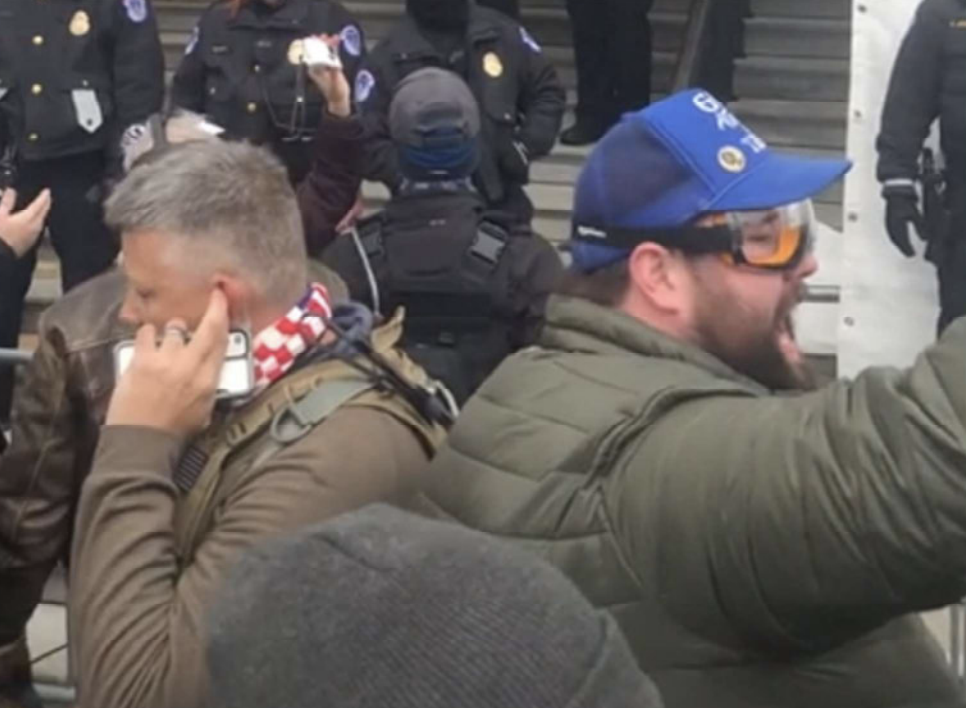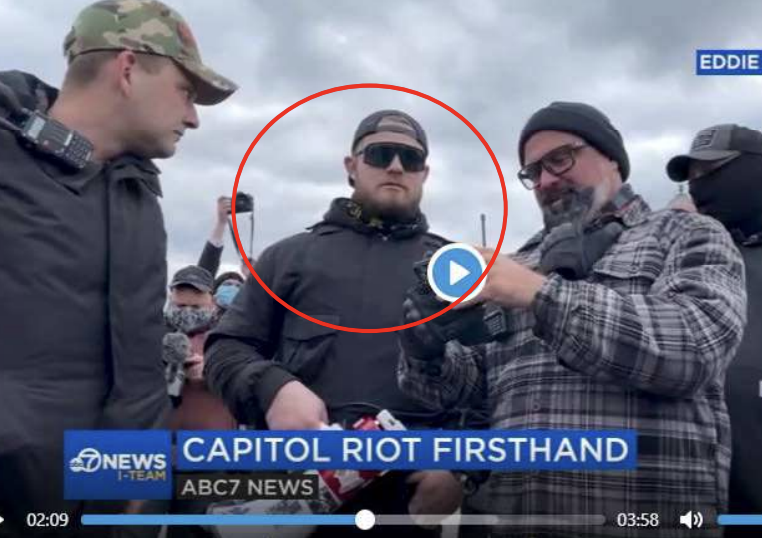
Beryl Howell’s Biggest Secret: Whether Bill Barr Killed the Egyptian Bank Investigation

As I noted, Judge Beryl Howell ended her tenure as DC’s Chief Judge yesterday decisively, ruling that Evan Corcoran must testify about topics she has found to be crime-fraud excepted.

By dint of age and tenure, Howell was appointed Chief Judge just in time to preside over the most remarkable set of investigations against a sitting and former President: the Mueller investigation and certain follow-on investigations, the January 6 investigation, and the stolen documents investigation.

And now Jeb Boasberg gets to pick up her work. Like Howell, he’s an Obama appointee; he already did a stint presiding over the FISA Court.

Howell’s decision requiring Corcoran to testify elicited all sorts of superlative language about the import of the decision. I’ll return to the number of other Trump lawyers against whom Howell has already approved legal process. The Corcoran decision really is not that unusual in the twin Jack Smith investigations. Or even in the other grand juries over which Howell has presided.

Indeed, the fruits of a warrant Howell approved on August 1, 2017 as part of an investigation into suspicious payments (especially those from Viktor Vekelselberg) to Michael Cohen’s Essential Consultants’ bank account, will likely yield Donald Trump’s first criminal indictment next week. Referrals of part of the resulting investigation to SDNY led to Cohen’s 2018 prosecution, including on the hush payments scheme. NYC has started making security preparations for Trump’s arrest on the same campaign finance scheme next week.

To repeat: a fairly uncontroversial decision Howell made six years ago — to approve the first of a series of warrants targeting Trump’s personal lawyer, Michael Cohen — will have played a part if and when Alvin Bragg indicts Trump next week.

Howell’s colleagues razzed her yesterday about all the secrets she may keep from the past seven years.

Howell seemed to freeze in her seat as the most senior jurist on the court, Judge Paul Friedman, publicly described her still-secret rulings in grand jury-related matters, pointing to press accounts of Howell ruling in favor of Trump in a contempt dispute over his office’s response to a grand jury subpoena for classified records and against Trump on an effort to assert attorney-client privilege in the same probe.

“What fascinating issues!” Friedman declared wryly as Howell remained stone-faced on the dais. “We’d all love to read her opinions, but we can’t,” he said to laughter.

Friedman did note, however, that Howell had issued 100 secret grand jury opinions during her seven-year term.

Another colleague, Judge Tanya Chutkan, also alluded to Howell’s work resolving disputes related to the court’s grand juries over the past seven years.

“There’s so much work Chief Judge Howell has done that we may never know about,” Chutkan said.

In an interview with Zoe Tillman, though, Howell suggested she expects some of it will be unsealed.

Howell said she was still processing the past seven years.

“A lot of my work in the grand jury arena remains under seal, so it is going to be very hard to say what my legacy will be until after some of that work gets unsealed and people are able to evaluate it,” she said.

I expect a good deal of her recent work will be unsealed, in fairly short order.

It bears reminding, though, that Judge Howell attempted to share information about what she had been overseeing in a grand jury with the House Judiciary Committee in 2019. In a 75-page opinion invoking the Federalist papers and defending separation of powers, Howell issued a ruling that should have been uncontroversial: that the House could have grand jury materials in contemplation of impeachment.

In her opinion, Howell cited a number of the things the House might get with grand jury testimony. They included Paul Manafort’s description of how Trump ordered him to chase the documents stolen from Hillary.

Again, the Mueller Report recounts an incident when then-candidate Trump spoke to associates indicating that he may have had advance knowledge of damaging leaks of documents illegally obtained through hacks by the Russians, stating “shortly after WikiLeaks’s July 22, 2016 release of hacked documents, [Manafort] spoke to Trump [redacted]; Manafort recalled that Trump responded that Manafort should [redacted] keep Trump updated. Deputy campaign manager Rick Gates said that . . . Manafort instructed Gates [redacted] status updates on upcoming releases. Around the same time, Gates was with Trump on a trip to an airport [redacted], and shortly after the call ended, Trump told Gates that more releases of damaging information would be coming.” Id. at II-18 (footnotes omitted) (redactions in original, with citation in footnote 27 redacted due to grand jury secrecy).

They included Don Jr’s refusal to testify to the grand jury about the June 9 meeting.

[A] discussion related to the Trump Tower Meeting contains two grand jury redactions: “On July 12, 2017, the Special Counsel’s Office [redacted] Trump Jr. [redacted] related to the June 9 meeting and those who attended the June 9 meeting.” Id. at II-105 (redactions in original).

They included Manafort’s details of his discussions with Konstantin Kilimnik.

The Mueller Report further recounts evidence suggesting that then-candidate Trump may have received advance information about Russia’s interference activities, stating:

Manafort, for his part, told the Office that, shortly after WikiLeaks’s July 22 release, Manafort also spoke with candidate Trump [redacted]. Manafort also [redacted] wanted to be kept apprised of any developments with WikiLeaks and separately told Gates to keep in touch [redacted] about future WikiLeaks releases. According to Gates, by the late summer of 2016, the Trump campaign was planning a press strategy, a communications campaign, and messaging based on the possible release of Clinton emails by WikiLeaks. [Redacted] while Trump and Gates were driving to LaGuardia Airport. [Redacted], shortly after the call candidate Trump told Gates that more releases of damaging information would be coming.

Id. at I-53–54 (footnotes omitted) (redactions in original, with citation in referenced footnote 206 redacted due to grand jury secrecy).

But Bill Barr’s DOJ, after having challenged the uncontroversial notion that the House should be permitted to receive what was obviously an impeachment referral, appealed to the DC Circuit, lost, and then stalled long enough to outlast Congress. Bill Barr effectively refused to let Congress receive and act on an impeachment referral. But Howell did her constitutionally mandated part.

It’s an action DOJ took during precisely the period when Barr was stalling long enough to outlast Congress that, in my mind, is the biggest secret Howell takes from her tenure: What happened with an investigation into a suspected $10 million donation in September 2016 from an Egyptian-owned bank that allowed Trump to stay in the race when he was running out of funds. Though aspects of the investigation were dribbled out in grand jury unsealings from Howell along the way, CNN first confirmed the Egyptian bank angle in 2020.

For more than three years, federal prosecutors investigated whether money flowing through an Egyptian state-owned bank could have backed millions of dollars Donald Trump donated to his own campaign days before he won the 2016 election, multiple sources familiar with the investigation told CNN.

The investigation, which both predated and outlasted special counsel Robert Mueller’s probe, examined whether there was an illegal foreign campaign contribution. It represents one of the most prolonged efforts by federal investigators to understand the President’s foreign financial ties, and became a significant but hidden part of the special counsel’s pursuits.

The investigation was kept so secret that at one point investigators locked down an entire floor of a federal courthouse in Washington, DC, so Mueller’s team could fight for the Egyptian bank’s records in closed-door court proceedings following a grand jury subpoena. The probe, which closed this summer with no charges filed, has never before been described publicly.

Prosecutors suspected there could be a link between the Egyptian bank and Trump’s campaign contribution, according to several of the sources, but they could never prove a connection.

Shortly after the investigation was killed, Barr went up to Hillsdale College and ranted about prosecuting corruption.

This criminalization of politics is not healthy. The criminal law is supposed to be reserved for the most egregious misconduct — conduct so bad that our society has decided it requires serious punishment, up to and including being locked away in a cage. These tools are not built to resolve political disputes and it would be a decidedly bad development for us to go the way of third world nations where new administrations routinely prosecute their predecessors for various ill-defined crimes against the state. The political winners ritually prosecuting the political losers is not the stuff of a mature democracy.

The Justice Department abets this culture of criminalization when we are not disciplined about what charges we will bring and what legal theories we will bless. Rather than root out true crimes — while leaving ethically dubious conduct to the voters — our prosecutors have all too often inserted themselves into the political process based on the flimsiest of legal theories. We have seen this time and again, with prosecutors bringing ill-conceived charges against prominent political figures, or launching debilitating investigations that thrust the Justice Department into the middle of the political process and preempt the ability of the people to decide.

This criminalization of politics will only worsen until we change the culture of concocting new legal theories to criminalize all manner of questionable conduct. Smart, ambitious lawyers have sought to amass glory by prosecuting prominent public figures since the Roman Republic. It is utterly unsurprising that prosecutors continue to do so today to the extent the Justice Department’s leaders will permit it.

Even at the time — with the Mike Flynn, Roger Stone, and Paul Manafort cases — it was clear that Barr was engaged in fairly unprecedented corruption of DOJ to protect Trump. Since then, we’ve learned of more. Most notably, as we await a potential Bragg indictment, Geoffrey Berman described how, after Cohen pled guilty in the hush payment case, Barr not only shut down any investigation of Trump on the charge, but attempted to reverse Cohen’s own prosecution.

While Cohen had pleaded guilty, our office continued to pursue investigations related to other possible campaign finance violations. When Barr took over in February 2019, he not only tried to kill the ongoing investigations but—incredibly—suggested that Cohen’s conviction on campaign finance charges be reversed.

Barr summoned Rob Khuzami in late February to challenge the basis of Cohen’s plea as well as the reasoning behind pursuing similar campaign finance charges against other individuals. Khuzami was told to cease all investigative work on the campaign finance allegations until the Office of Legal Counsel, an important part of Main Justice, determined there was a legal basis for the campaign finance charges to which Cohen pleaded guilty—and until Barr determined there was a sufficient federal interest in pursuing charges against others.

Barr even attempted to put supervision of the case in the hands of Richard Donoghue, as he did do with the Rudy Giuliani case.

Given that Barr didn’t think Trump should be prosecuted for the Cohen illegal contribution case, there’s no telling what he thought of the suspected Egyptian bank donation. Certainly, he was in complete control of DC USAO at the time, if he wanted to shut down an otherwise viable investigation.

We are, as Howell herself said, likely to know much of what she has been doing for the last two years. But her biggest secret is whether Bill Barr prevented DOJ from fully attempting to learn whether Donald Trump was beholden to Egypt or some other foreign country for the entirety of the time he served as President.
Share this entry

Evan Corcoran: You’re the Next Contestant on Trump’s Crime-Fraud Reality Show

Multiple outlets are reporting that Judge Beryl Howell, in what may be her last ruling as Chief Judge, has ruled that Evan Corcoran must testify about his conversations with Trump.

This follows the news, from ABC, that Jack Smith’s team is particularly interested in a conversation Trump and Corcoran had on June 24, 2022, after prosecutors sent a subpoena to Trump Organization for surveillance footage that would show Walt Nauta moving boxes out of the storage room where the FBI would later find 70 classified documents. As I noted last year, in the early weeks of Trump’s efforts to stall the investigation, there was a discrepancy about what date this subpoena was served, which I suspected might suggest DOJ had to file subpoenas to two different entities before Trump agreed to comply.

So now we’ve ended up where it was clear we were going to end up in September, with another of Trump’s lawyers whose communications with him are found to be crime fraud excepted.

Corcoran is in good company. He is probably at least the fourth Trump lawyer whose comms were deemed crime-fraud excepted in the last five years. The others are:

Indeed, the first such instance, the conversation Cohen recorded of Trump agreeing to a hush payment, will likely lead to the first (or possibly second, depending on what Fani Willis is doing) indictment of Trump, perhaps early next week.

With both Cohen and Rudy, the lawyers withdrew objections after Special Master Barbara Jones deemed the comms not to be privileged.

Corcoran should feel pretty good, though. He may be the first Trump crime-fraud contestant who manages to avoid legal exposure himself.

That’s got to count for something in the Trump Crime-Fraud Reality Show, right?


Share this entry

The New Investigation into Bannon and Boris Buried Under Bannon’s Bluster

For at least six years — from Rick Gates sharing stuff with Maggie as a way to share it with Roger Stone, to Stefan Passantino sharing Cassidy Hutchinson’s damaging testimony because “Maggie’s friendly to us. We’ll be fine” — people in Trump’s camp explicitly state they go to Maggie Haberman because she’s useful to their goals. The results are obvious, such as the time when Maggie buried the news that Trump had spoken to Vladimir Putin about adoptions immediately before crafting a bullshit cover story for the June 9 meeting that claimed it was all about adoptions; Maggie buried the story by repeating Trump’s threats to fire Jeff Sessions first.

That’s why it’s useful to look at two damaging details Maggie buried in what purports to be a profile of Boris Epshteyn, the non-Breaking News parts of which I covered here and other parts that WaPo covered in November.

First, NYT buried the news that SDNY has opened an investigation into the crypto currency scam Epshteyn and Steve Bannon grifted loyal Trump supporters with beneath not one, not two, but three flashy quotes about Epshteyn from Bannon himself, followed by 22 paragraphs, many focused on how Boris charged campaigns for keeping them on Trump’s good side, then one  paragraph that included 17 words of tortured Enhanced Euphemism Techniques in an 83 word paragraph, only then to reveal that Bannon is under investigation for the crypto currency scheme, too.

A cryptocurrency with which [Epshteyn] is involved has drawn scrutiny from federal prosecutors.

[snip]

“Boris is a pair of heavy hands — he’s not Louis Brandeis,” said Stephen K. Bannon, a close ally of Mr. Epshteyn and former adviser to Mr. Trump, referring to the renowned Supreme Court justice. But Mr. Trump, he said, “doesn’t need Louis Brandeis.”

“You need to be a killer, and he’s a killer,” Mr. Bannon added.

But Mr. Epshteyn’s attacking style grates on other people in Mr. Trump’s circle, and he has encouraged ideas and civil lawsuits that have frustrated some of Mr. Trump’s lawyers, like suits against the journalist Bob Woodward and the Pulitzer Prize committee. His detractors see him as more of a political operative with a law license than as a provider of valuable legal advice.

“As soon as anybody starts making anything happen for Trump overall, the knives come out,” Mr. Bannon said. He described Mr. Epshteyn as “a wartime consigliere.”

[21 paragraphs, many focused on Epshteyn’s dodgy consulting gig]

[This paragraph, in which 17 tortured words out of 83 are Enhanced Euphemism Techniques:

]

More recently, a pro-Trump cryptocurrency that Mr. Epshteyn and Mr. Bannon are involved with managing is facing an inquiry from federal prosecutors in the Southern District of New York, according to a person familiar with the matter.

Breaking: A key source for this story, Steve Bannon, is under investigation for the shameless grift of printing pro-Trump money, then bilking Trump supporters every time they bought it.

Compare how ABC reported the same story when they covered it a few hours later:

A cryptocurrency linked to former Trump White House strategist Steve Bannon and Trump adviser Boris Epshteyn has caught the attention of federal prosecutors in New York, who have started looking into it, sources familiar with the matter told ABC News.

News of federal prosecutors’ interest in the Bannon and Epshteyn-fronted cryptocurrency comes on the heels of an ABC News investigation into the cryptocurrency, which looked at allegations of internal chaos and mismanagement by the two high-profile Trump associates over the past year, including accusations that they’ve failed in their commitment to continue to donate portions of the coin’s proceeds to charities.

The New York Times was the first to report the news of the inquiry from federal prosecutors.

MORE: Internal chaos plagues Bannon-fronted $FJB cryptocurrency, critics say
The cryptocurrency — dubbed $FJB from the shorthand version of the vulgar MAGA expression “F— Joe Biden” and now officially said to stand for Freedom Jobs and Business — has lost 95% of its value amid internal turmoil, at least in part due to an industry-wide downturn.

Critics say $FJB represents the latest in a string of ill-fated efforts to leverage MAGA support for financial returns — particularly on the part of Bannon, who in September pleaded not guilty to unrelated charges that he defrauded donors with the promise of building a wall on the U.S.-Mexico border.

Acquired by Bannon and Epshteyn from original lead creator Grant Tragni and two other co-founders in late 2021, $FJB was promoted as a rejection of President Joe Biden and an alternative financial institution for conservatives by the two MAGA influencers — who also emphasized that part of the currency’s 8% transaction fee would go to charities including the Wounded Warriors Project, Tunnels To Towers, Semper Fi and Patriot Freedom Project.

But according to a spokesperson for the Wounded Warriors Project, as of January this year, no donations had been made by $FJB to the organization since Bannon and Epshteyn took over in December 2021. Wounded Warriors told ABC News that they had only received the one donation from $FJB in November 2021 — prior to Bannon and Epshteyn’s involvement.

NYT, apparently, thought it more important to string out a bunch of quotes from a suspected serial fraudster — “heavy hands — he’s not Louis Brandeis,” … “You need to be a killer, and he’s a killer,” … “a wartime consigliere” — rather than ask the serial fraudster if he had knowingly defrauded a bunch of MAGAts or at least describe how he exploited Trump’s loyal followers. (Note, this scam is also covered in Denver Riggelman’s The Breach, which is better than I thought it’d be.)

The other thing buried twelve paragraphs into a story covering stuff many people have already covered is that Ephsteyn tried to retroactively claim he was providing legal advice after the search of Mar-a-Lago.

After the search last summer of Mar-a-Lago by F.B.I. agents looking for classified documents still in Mr. Trump’s possession, Mr. Epshteyn retroactively changed his agreement with the political action committee. The agreement, which had been primarily for communications strategy, was updated to include legal work, and to say it covered legal work since the spring of last year, a campaign official said. His monthly retainer doubled to $30,000.

But he dropped a separate effort to have Mr. Trump sign a letter retroactively designating him as a lawyer for Mr. Trump personally, dating to March of last year, soon after Mr. Trump’s post-presidency handling of classified documents became an issue. The letter specifically stated that their communications would be covered by attorney-client privilege, multiple people familiar with the request said.

Now, credit where credit is due. As I noted when I described Maggie’s recent solo foray into campaign finance journalism, after a slew of stories in which Maggie called Epshteyn Trump’s “in-house counsel,” once she looked at the FEC documents, she described that Boris had billed all this as strategic consulting.

NYT has, in various stories including Maggie in the byline, described Epshteyn’s role in the stolen documents case as “an in-house counsel who helps coordinate Mr. Trump’s legal efforts,” “in-house counsel for the former president who has become one of his most trusted advisers,” and “who has played a central role in coordinating lawyers on several of the investigations involving Mr. Trump.” Another even describes that Epshteyn “act[ed] as [a] lawyer [] for the Trump campaign.” The other day, Maggie described his role instead as “broader strategic consulting.”

In this story, the story that reveals that after the search of MAL Epshteyn attempted to retroactively declare that he had been providing legal advice all along, Maggie calls him the, “self-described in-house counsel.”

I guess we know who was describing him as “in-house counsel” for all those stories stating as fact that he was the in-house counsel?

Epshteyn’s attempted retroactive claim that he had been providing legal services is not a minor detail.

Effectively what Epshteyn did was, after playing a key role in Trump’s coup attempt followed by a year of grifting off his access to Trump, he swooped back into Trump’s orbit when it became public that Trump had been fighting to withhold documents from the government; who knows what more details Ephsteyn had about all the highly sensitive documents stored in a leatherbound box in his office when he swooped in. And over the course of the next five months, Ephsteyn brought in a group of lawyers who are highly inappropriate to advise on a classified documents case, including Evan Corcoran, who treated a potential Espionage Act case as an 18 USC 1924 case, Chris Kise, fresh off his work for the Maduro regime, and, for a bit part playing the fall gal, former OAN host Christina Bobb. Some of these people are accomplished lawyers, but they’re not remotely appropriate to this investigation.

It’s unclear whether Epshteyn assembled such an inappropriate team because he wants Trump to go down, with all the chaos that will cause, because he’s stupid and wildly unsuited to this role, or because Trump was desperate. But after ensuring there was no one who could be called an adult in the terms of Espionage Act investigations left in the room, Epshteyn then reportedly masterminded a shell game on June 3 in which Trump boarded his jet to Bedminster at the moment that Corcoran handed over a packet of documents that Bobb claimed, with no way of knowing, constituted everything Trump had left.

“Wartime consiglieres,” as Bannon called his brother in cryptocurrency scam, don’t orchestrate such transparently stupid schemes.

And then after DOJ called Trump’s bluff with a search of Mar-a-Lago on August 8, according to this story, Epshteyn attempted to make all the conversations he had in the run-up to that search privileged, retroactively. Epshteyn appears not to have considered this legal advice until the moment it became clear his shell game had failed.

And given that some of Maggie’s best sources — including some of the sources who’ve long had the knives out for Epshteyn — have chatted with prosecutors since the search, prosecutors likely know that Epshteyn only belatedly decided he had been playing a lawyer all along. Maybe they even found it out before they seized Ephsteyn’s phone in early September under a January 6 warrant. Or maybe some of the recent activity in the stolen documents case, including the effort to get crime-fraud testimony from Corcoran, aims to shore up a warrant for stolen documents-related Epshteyn phone content that the FBI already has in its possession.

Indeed, this new detail explains something else in the story, something that NYT and others have already covered. Among the questions that Bobb and Corcoran and others have gotten from prosecutors pertains to Epshteyn’s attempt to set up a common-interest agreement.

Prosecutors investigating Mr. Trump’s handling of classified material have looked at whether Mr. Epshteyn improperly sought a common-interest agreement among witnesses as a shield against the investigation, the people familiar with the matter said.

Til now, this detail has always been reported without explanation of why it would be wrong — why it would deviate from normal white collar practice. The line of questioning didn’t make sense to me. It makes far more sense, however, if Epshteyn did so after his shell game blew up on him. It makes more sense if Epshteyn was trying to shield his own behavior, just as retroactively declaring his advice legal advice would do.

The question is why. Why Epshteyn advised Trump to take such a catastrophically stupid approach to stolen classified documents. By embedding this breaking news in a profile about the way Epshteyn monetized access to Trump, NYT seems to suggest that’s the motive (and I’ve heard similar descriptions from others): Epshteyn was just giving Trump what he wanted when no one else would as a way to make sure his other grift could continue.

That’s not the only possible motive, though: there are other more obvious reasons someone who failed to get clearance, even in Trump’s White House, might want to help Trump hoard highly classified documents (NYT reports that “the issue has been resolved”).

The question of why Epshteyn did all this has likely become closely intertwined with prosecutors’ attempts to assess why Trump withheld the documents in the first place, as well as attempts to understand why two separate searches found 47 empty classified document folders.

Tim Parlatore — another lawyer who is woefully ill-suited for a stolen documents case — is quoted by the NYT stating that the rest of the lawyers Epshteyn has assembled will be good so long as Epshteyn, himself, doesn’t become a target, as if the seizure of his phone is not some kind of tip off.

“Boris has access to information and a network that is useful to us,” said one of the team’s lawyers, Timothy Parlatore, whom Mr. Epshteyn hired. “It’s good to have someone who’s a lawyer who is also inside the palace gates.”

Mr. Parlatore suggested that he was not worried that Mr. Epshteyn, like a substantial number of other Trump lawyers, had become at least tangentially embroiled in some of the same investigations on which he was helping to defend Mr. Trump.

“Absent any solid indication that Boris is a target here, I don’t think it affects us,” Mr. Parlatore said.

I don’t even know what to make of Parlatore’s quote explaining that Boris’ network “is useful to us.” To do what? Isn’t the goal to keep Trump out of prison?

But I do know that none of these people seem to be sufficiently worried about 18 USC 793(g), the built-in conspiracy clause in the Espionage Act. Even if Epshteyn’s motives are no more ignoble than attempting to monetize his access to Trump — and, again, his motives are likely as much a focus as Trump’s at this point — that doesn’t exempt him from exposure to conspiracy charges himself if he agreed to help Trump hoard the classified documents. Indeed, adding Epshteyn as a co-conspirator might have several advantages for prosecutors.

Epshteyn is, as this profile and others have laid out, someone monetizing access to Trump. The more salient detail, for the investigation, is why Epshteyn only retroactively tried to protect his own involvement in the alleged attempt to withhold classified documents.

Share this entry

How Tucker Carlson Duped the People His Producer Called “Dumb … Cousin-Fucking … Terrorists”

In response to Tucker Carlson’s misleading propaganda claiming that Jacob Chansley was just a peaceful tourist escorted at all times by his own dedicated cop, a number of January 6 defendants are demanding mistrials because of claimed Brady violations.

Dominic Pezzola’s attorneys, for example, argued that the video released by Tucker shows that the Senate never had to recess, which (they claim) undermines the government’s obstruction claim against the Proud Boys.

Never during this trial has there been any evidence of any raucous or extremely disruptive or violent demonstration in the Senate chamber. (There have been a few images of demonstrators sitting on chairs or standing in the well of the Senate.)

Then came the Tucker Carlson show on the evening of March 6, 2023.

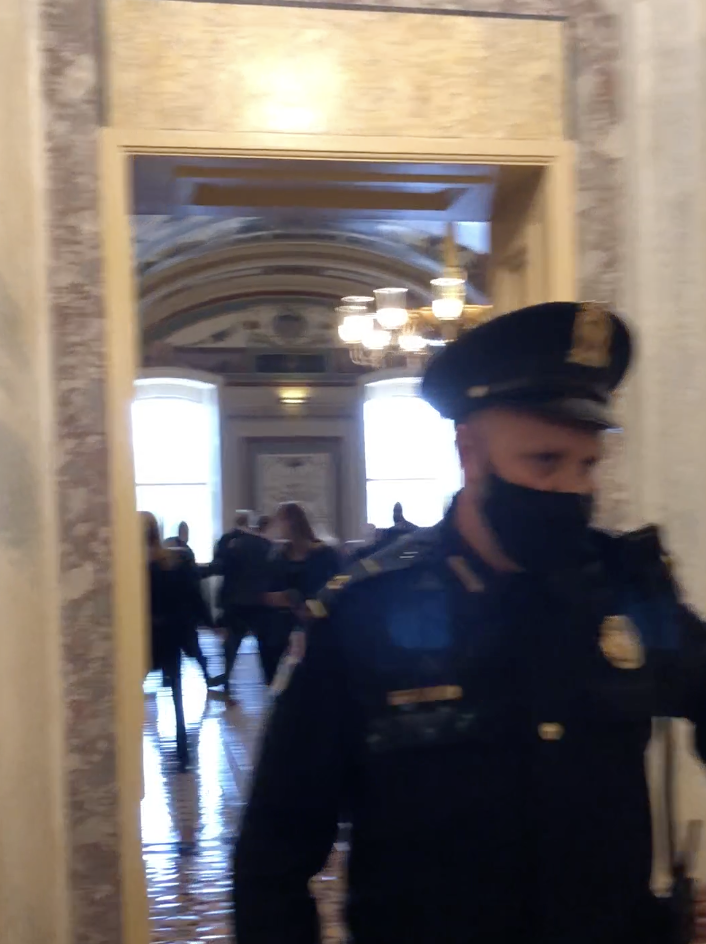
On March 6, Tucker Carlson released shocking footage from January 6th, 2021 that showed “QAnon Shaman” Jacob Chansley walking calmly through the halls of the Capitol with two Capitol Police officers. At one point, one of the officers appears to try opening a door or elevator, and then turns and leads Chansley in another direction. Later in the video clips, Chansley is seen walking past nine police officers gathered in a hallway intersection. Chansley and his police escorts walk right past the nine officers without any resistance.

And then the Tucker Carlson show presented footage of officers calmly escorting Chansley (and apparently other protestors) into the Senate chamber. The Washington Post wrote that Albert Watkins, Chansley’s attorney through sentencing in November 2021, said he had been provided many hours of video by prosecutors, but not the footage which Carlson aired Monday night. He said he had not seen video of Chansley walking through Capitol hallways with multiple Capitol Police officers.

“What’s deeply troubling,” Watkins said Tuesday, “Is the fact that I have to watch Tucker Carlson to find video footage which the government has, but chose not to disclose, despite the absolute duty to do so. Despite being requested in writing to do so, multiple times.” [emphasis original]

The government’s response lays out that, in fact, both Chansley’s attorneys and Pezzola’s received this video in global discovery (there was a 10-second segment not released until January that was not exculpatory, which likely shows a Senator fleeing even as Pezzola stands just feet away — see below).

Pezzola’s motion describes “shocking footage” of Chansley “walking calmly through the halls of the Capitol” with two police officers who purportedly “escort[] Chansley (and apparently other protestors) into the Senate chamber.” ECF 679, at 4. Pezzola quotes Chansley’s former attorney for the proposition that the government “withheld” this footage from discovery in Chansley’s and Pezzola’s cases. Id. The footage is not shocking, and it was not withheld from Pezzola (or Chansley, in any material respect, for that matter).

The footage in question comes from the Capitol’s video surveillance system, commonly referred to as “CCTV” (for “closed-circuit television”). The Court will be familiar with the numerous CCTV clips that have been introduced as exhibits during this trial. The CCTV footage is core evidence in nearly every January 6 case, and it was produced en masse, labeled by camera number and by time, to all defense counsel in all cases.3 With the exception of one CCTV camera (where said footage totaled approximately 10 seconds and implicated an evacuation route), all of the footage played on television was disclosed to defendant Pezzola (and defendant Chansley) by September 24, 2021.4 The final 10 seconds of footage was produced in global discovery to all defense counsel on January 23, 2023. Pezzola’s Brady claim therefore fails at the threshold, because nothing has been suppressed. United States v. Blackley, 986 F. Supp. 600, 603 (D.D.C. 1997) (“For an item to be Brady, it must be something that is being ‘suppress[ed] by the prosecution.’”) (quoting Brady v. Maryland, 373 U.S. 83, 87 (1963)).

While discovery in this case is voluminous, the government has provided defense counsel with the necessary tools to readily identify relevant cameras within the CCTV to determine whether footage was produced or not. Accordingly, the volume of discovery does not excuse defense counsel from making reasonable efforts to ascertain whether an item has been produced before making representations about what was and was not produced, let alone before filing inaccurate and inflammatory allegations of discovery failures.

3 The productions excluded a limited set of footage that the Capitol Police designated as security information, such as X-Ray machine feeds and views of evacuation routes and Sensitive Compartmented Information Facility (“SCIF”) office lobbies.

4 The remaining CCTV was disclosed in global discovery on January 23, 2023. It similarly – as with other CCTV – depicts defendant Chansley outside of the Senate Chamber with law enforcement, after his initial breach of the Chamber.

It’s hard to overstate how much this exchange vindicates DOJ’s decision to make all the January 6 video available to all defendants, which delayed trials for probably six months, but which ensured that at the moment defendants like Chansley and Pezzola started claiming they didn’t get something, DOJ could point to when they in fact did receive it.

DOJ rebuts Pezzola’s argument that any of this is exculpatory, relying, in part, on former Army Staff Sergeant Joe Biggs’ description of overwhelming the Capitol.

Pezzola’s argument seems to be that the snippets of Chansley’s movements that were televised by Carlson establish that there was no emergency necessitating the suspension of proceedings. The televised footage lacks the context of what occurred before and after the footage. Chansley entered the building as part of a violent crowd that gained access as a result of Pezzola’s destruction of a window and he traveled with Pezzola during the initial breach. And just as Defendant Biggs had recounted in a recorded statement after January 6, 2021, by the time Pezzola forcibly breached the Capitol and Chansley rode his coattails, the mob—through the sheer force of its size and the violence of those within it—had wrested control of portions of the Capitol grounds and the Capitol itself from a vastly outnumbered U.S. Capitol Police force. 5 As a result, for a period that afternoon, those defending the Capitol were in triage mode—trying to deal with the most violent element of those unlawfully present, holding those portions of the Capitol that had not yet been seized by rioters, and protecting those Members and staffers who were still trapped in the Capitol.

5 Biggs stated, in part: “When you’re holding a position, like a fort, and you’re being overrun, if there’s three of you or four of you, and you’re outnumbered a hundred to one, are you gonna sit there and just go, ‘I’m holding the door’? No, you’re just gonna get your ass beat. That’s already gone. if that many people show up to your house, there’s nothing you can do about it.” Gov’t Ex. 611B. Biggs later continued, “You’re gonna stand up to [] tens of thousands of people storming that? No, that’s stupid. You step [] aside. That puts less chance of anyone getting hurt or anything like that, and you allow it to happen.” Id.

DOJ also lays out specifically how Tucker chose to release only video from after the damage — in the form of the violent breach of the Capitol and the decision to flee the Senate — had been done.

Chansley piggybacking on Pezzola’s violent breach of the Capitol provides more than enough evidence of his corrupt intent to interfere with Congress that day. But there is much more evidence of his and others’ conduct. The televised footage shows Chansley’s movements only from approximately 2:56 p.m. to 3:00 p.m. Prior to that time, Chansley had, amongst other acts, breached a police line at 2:09 p.m. with the mob, entered the Capitol less than one minute behind Pezzola during the initial breach of the building, and faced off with members of the U.S. Capitol Police for more than thirty minutes in front of the Senate Chamber doors while elected officials, including the Vice President of the United States, were fleeing from the chamber. Chansley then entered the Senate Gallery, where he proceeded to scream obscenities while other rioters rifled through the desks of U.S. Senators on the floor below. All these actions were captured by Senate floor and/or CCTV cameras. In sum, Chansley was not some passive, chaperoned observer of events for the roughly hour that he was unlawfully inside the Capitol. He was part of the initial breach of the building; he confronted law enforcement for roughly 30 minutes just outside the Senate Chamber; he gained access to the gallery of the Senate along with other members of the mob (obviously, precluding any Senate business from occurring); and he gained access to and later left the Senate floor only after law enforcement was able to arrive en masse to remove him. It is true that a sole officer, who was trying to de-escalate the situation, was with Chansley as he made his way to the Senate floor after initially breaching the Chamber, as the televised footage reflects.6 But the televised footage fails to show that Chansley subsequently refused to be escorted out by this lone officer and instead left the Capitol only after additional officers arrived and forcibly escorted him out.

6 Notably, this officer’s statement regarding these events was also disclosed in discovery to Chansley’s attorney on May 19, 2021.

It’s a classic lesson in how propaganda is made, by focusing on the least damning part of a story and suppressing the rest. It happens to have been released in the same period where the Dominion lawsuit revealed that Tucker’s then investigative producer, Alex Pfeiffer, likened Tucker’s own viewers to “dumb,” “cousin-fucking” “terrorists.”

“Might wanna address this, but this stuff is so f—— insane. Vote rigging to the tune of millions? C’mon,” Shah wrote.

Carlson’s producer, Alex Pfeiffer, responded: “It is so insane but our viewers believe it so addressing again how her stupid Venezuela affidavit isn’t proof might insult them.”

Shah advised that Carlson should mention the affidavit noting it was “not new info, not proof” but then quickly “pivot to being deferential.”

Pfeiffer, who has since left the network, answered that the delicate dance was “surreal.”

“Like negotiating with terrorists,” he added, “but especially dumb ones. Cousin f—– types not saudi royalty.”

The kerfuffle also gave journalists an opportunity to go back and ask for the video used in the Chansley case to be released to journalists.

One of the videos newly released to journalists shows the mob closing in on the Senate and — I suspect this may be the 10-second clip that was originally withheld — one or more Senators fleeing as a single cop holds off the mob by yelling “back off” repeatedly.

Kyle Cheney, who first pointed to this segment, suspects the fleeing Senator may be Chuck Grassley.

In other words, what we’ve learned from this incident is that Tucker is the one lying about what happened. DOJ, in fact, had been withholding some of the most damning video from the public but not defense attorneys, and Tucker’s propaganda effort has provided yet another glimpse of how many close calls the police managed to avert on January 6.

Share this entry

Matt Taibbi Declares John Podesta’s Risotto Recipe Was “True”

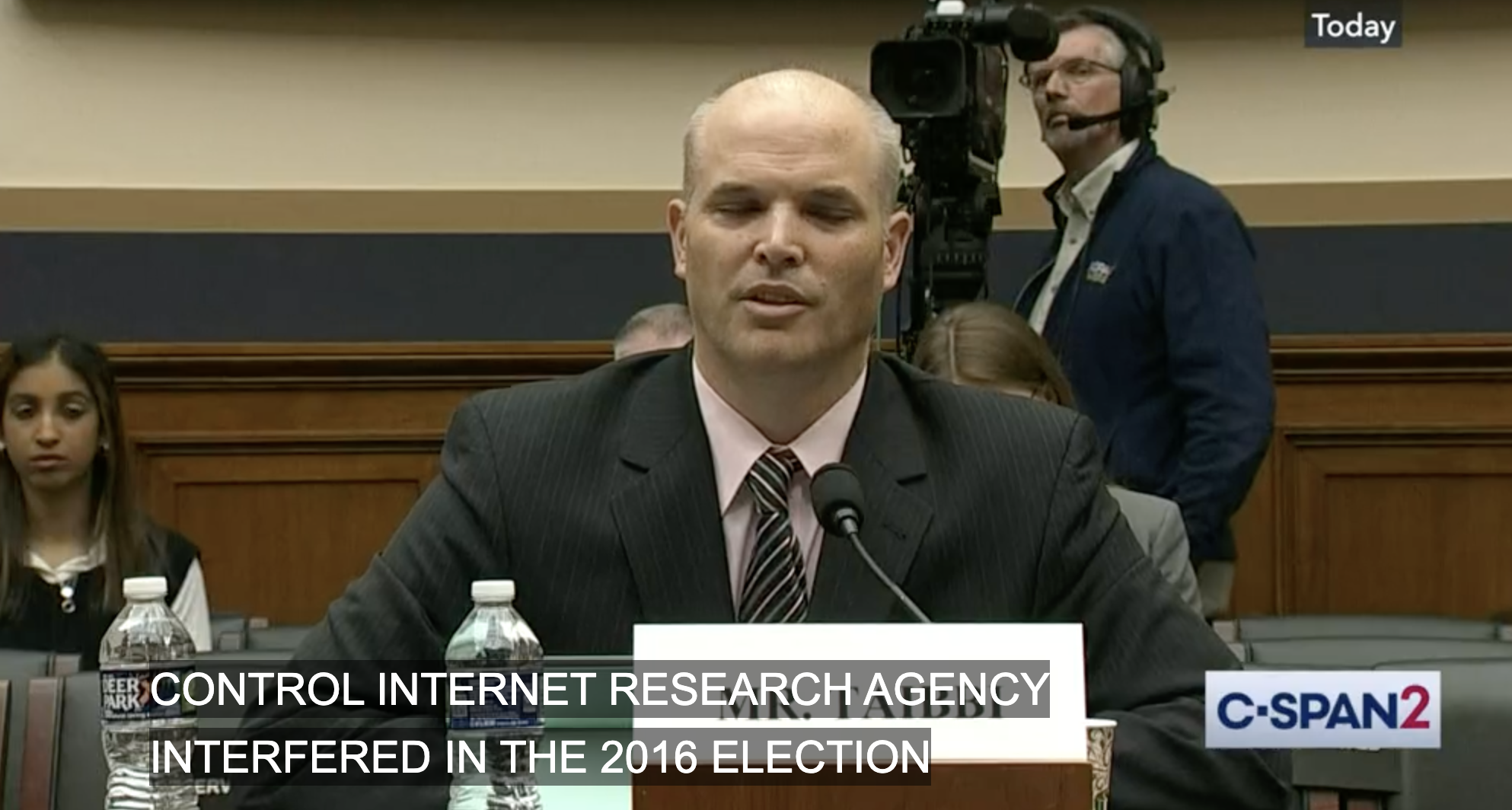
The Democrats on Jim Jordan’s insurrection protection committee were really unprepared for Matt Taibbi and Michael Shellenberger yesterday, failing to call out their repeated false claims.

One of the most interesting details came when Taibbi described that someone besides Elon Musk invited him to have unfettered access to a company under a consent decree. Given the likelihood that this person was not even a Twitter employee, it gives the FTC far more reason to want to know why a company under a consent decree made information on individual users available to journalists.

But the hearing was nevertheless useful for the way it revealed that Taibbi doesn’t know the difference between “authentic” and “true.” In an exchange with Stephen Lynch about whether Russia interfered in the 2016 election (in which Lynch falsely claimed that the intelligence report attributing the Russian campaign to Russia involved 18 intelligence agencies, instead of three, and mispronounced both Shellenberger’s and Yevgeniy Prigozhin’s name), Taibbi professed to be uncertain whether Russia conducted a hack-and-dump campaign.

Lynch: Do you believe that Russia engaged in a hack-and-release campaign damaging to the Clinton campaign, back in 2016?

Taibbi: I don’t know and I would say it’s irrelevant.

[snip]

Lynch: Mr. Shellenbech [sic] do you believe that the Russians engaged in a hack-and-release campaign with respect to the damaging information they released regarding the Clinton campaign?

Shellenberger: To the best of my awareness, that is what happened, yes.

Lynch: Okay, fair enough.

Shellenberger: That’s not the same thing as influence campaign.

Lynch: I understand.

Taibbi: Also that material was true. That is not a legitimate predicate for censorship.

Taibbi obviously thought he was being very clever, justifying publishing material stolen from an American because it was “true.” (And Shellenberger was being equally clever, not understanding that a hack-and-leak campaign is, indeed, part of an information operation.)

But instead, he betrayed something that is obvious from his propaganda efforts: Taibbi doesn’t understand the difference between “authentic” and “true.” When someone makes false claims about authentic material, it is a lie.

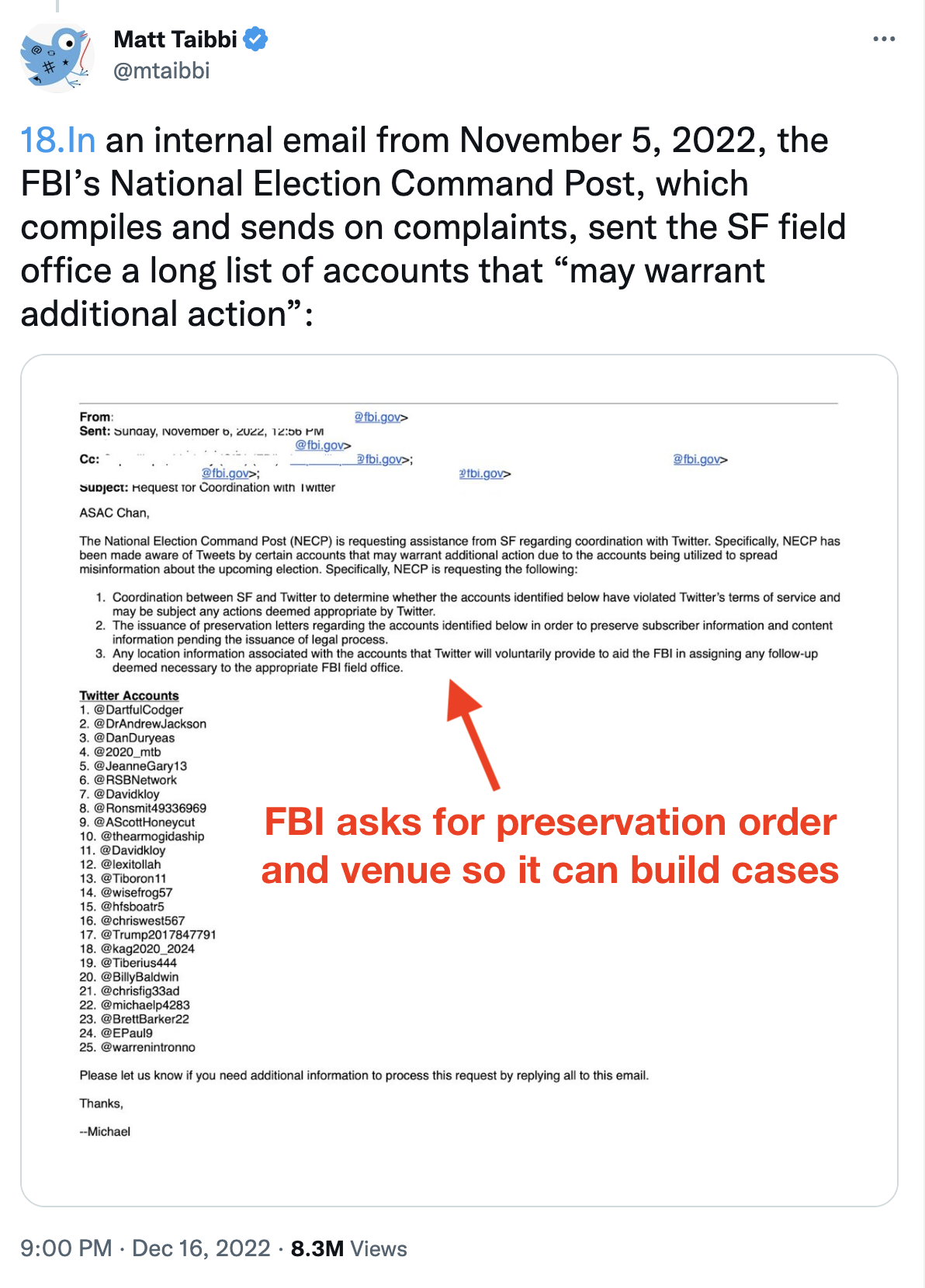
For example, Taibbi has repeatedly claimed that the FBI was not building cases on the suspected voter suppression accounts they turned over to Twitter, even though he included a screen cap showing the FBI taking steps — asking in what venue they needed to serve legal process and seeking a preservation order — that allows them to conduct an investigation.

The email is authentic. His claims about FBI’s efforts to investigate voter suppression are — he himself proved — a lie.

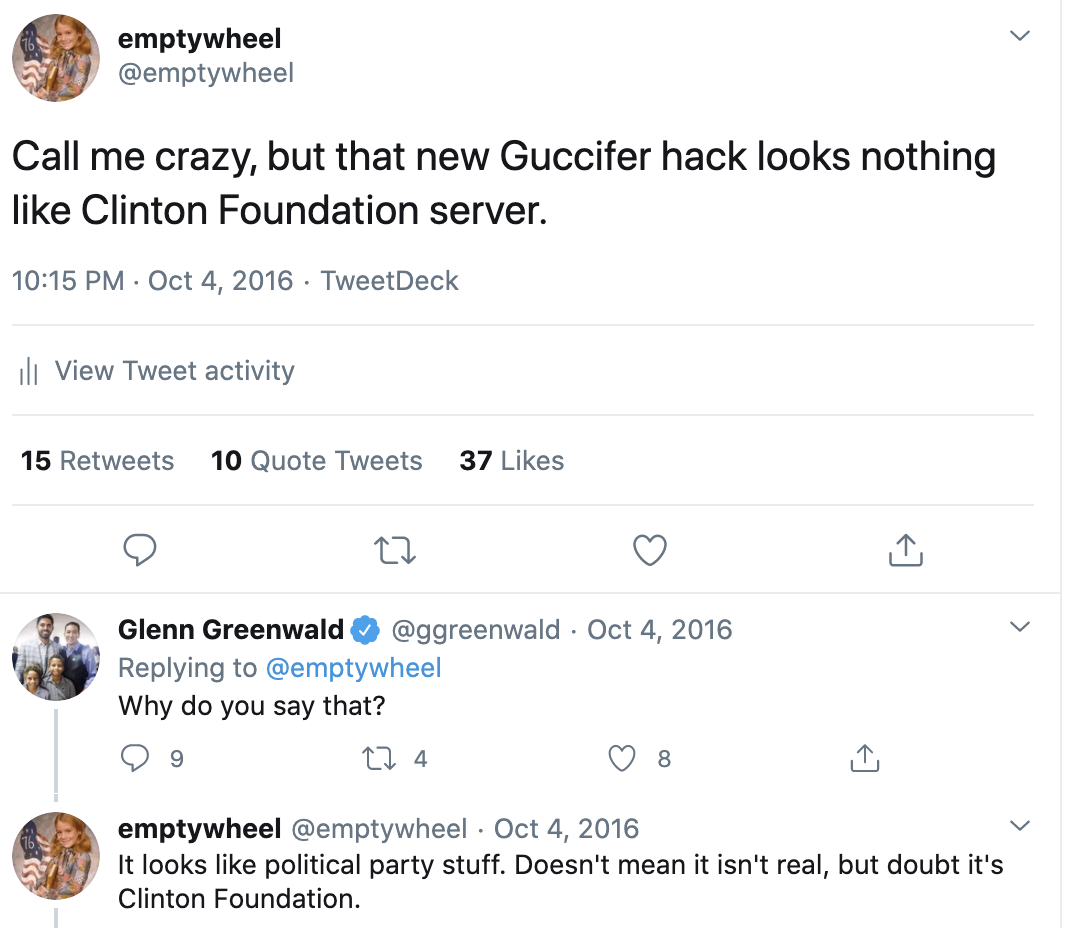
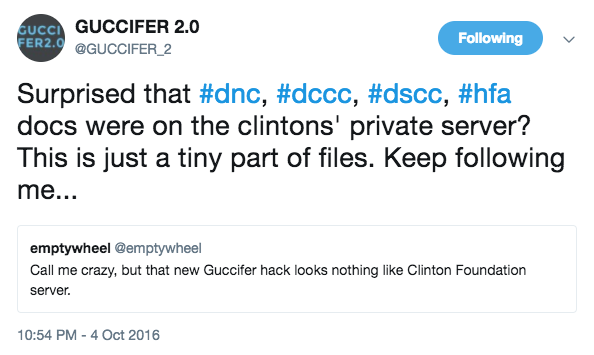
He also betrays that he doesn’t understand some of the material released in 2016 was neither “true” nor “authentic.” Not only were the Guccifer 2.0 documents altered, but the persona repeatedly falsely claimed they were something they were not, most obviously when the persona claimed he was releasing Clinton Foundation documents and I had to explain that that’s not what they were to Glenn Greenwald.

That persona did just what Taibbi has done with the Twitter files, wow credulous people (like Greenwald) with “authentic” files, while making false claims about them.

#MattyDickPic’s confusion about the difference between “true” and “authentic” became more obvious later in the hearing.

Goldman: Are you aware that there was an analysis of the hard drive that was done by the Washington Post at a later date?

Shellenberger: My awareness is that multiple media organizations have done an analyses, including CBS, and found that it was indeed, the laptop was authentic, and that nothing had been changed on it.

Goldman: Let’s just get something clear. The laptop that the FBI had is different than the hard drive that Rudy Giuliani gave to the New York Post. A hard drive, you will agree with this, is a copy of a laptop, right?

Shellenberger: Yes.

Goldman: And you are aware that hard drives can be altered, are you not?

Shellenberger: Of course.

Goldman: So are you aware that the Washington Post analysis of the hard drive showed that it had been altered?

Shellenberger: I have heard that, but I’m also saying that CBS verified —

Taibbi: Politico …

Shellenberger: and other media organizations have verified…

Never mind that Shellenberger seems to have no fucking clue that the laptop CBS analyzed is not the same hard drive that Rudy gave to the Post, and therefore is not the “laptop” on which the story that Twitter throttled was based. Never mind that CBS’ analysis is inconsistent with John Paul Mac Isaac’s claims that the process by which he made his own copy of the laptop was repeatedly interrupted, a problem that would make it difficult to distinguish from an iCloud hack and a real laptop (who puts voice mail messages on a laptop hard drive, for example?), a detail consistent with what I know of the Washington Post analysis (which was conducted by two different people).

But the cutest was little #MattyDickPics chiming in to claim that Politico had authenticated “the laptop.”

They claim no such thing! They authenticated some files (and not forensically, but instead by a witness who couldn’t even confirm the emails hadn’t been altered).

Shreckinger’s source remembered viewing both emails but was not able to compare the text leaked to the Post with the original emails. Other emails from the leaked files matched a cache of emails released by a Swedish government agency, two people who communicated with Hunter Biden said.

This kind of “authentication,” when the claims of someone with a bias like Tony Bobulinski can supplant forensic authentication, is precisely the problem with hack-and-leak reporting, regardless of whether Russian hackers or Matt Taibbi’s buddies do the hacking.

And neither Michael Shellenberger nor Matt Taibbi understand that.

Matt Taibbi does not know the difference between “true” and “authentic,” and it shows in his propaganda.

Share this entry

Jenna Ellis Lied and Lied and Lied and Lied and Lied and Lied and Lied and Lied and Lied and Lied

In an attempt to settle the Colorado challenge to her law license, Jenna Ellis stipulated that she made ten “misrepresentations” in public statements she made about the election in 2020.

Those, um, lies were:

  • On November 13, 2020, Respondent claimed that “Hillary Clinton still has not conceded the 2016 election.”
  • On November 20, 2020, Respondent appeared on Mornings with Maria on Fox Business and stated: “We have affidavits from witnesses, we have voter intimidation, we have the ballots that were manipulated, we have all kinds of statistics that show that this was a coordinated effort in all of these states to transfer votes either from Trump to Biden, to manipulate the ballots, to count them in secret . . .”
  • On November 20, 2020, Respondent appeared on Spicer & Co. and stated, “with all those states [Nevada, Michigan, Pennsylvania, Wisconsin, Georgia] combined we know that the election was stolen from President Trump and we can prove that.”
  • On November 21, 2020, Respondent stated on Twitter under her handle @JennaEllisEsq., “ . . . SECOND, we will present testimonial and other evidence IN COURT to show how this election was STOLEN!”
  • On November 23, 2020, Respondent appeared on The Ari Melber Show on MSNBC and stated, “The election was stolen and Trump won by a landslide.”
  • On November 30, 2020, Respondent appeared on Mornings with Maria on Fox Business and stated, “President Trump is right that there was widespread fraud in this election, we have at least six states that were corrupted, if not more, through their voting systems. . . We know that President Trump won in a landslide.” She also stated, “The outcome of this election is actually fraudulent it’s wrong, and we understand than when we subtract all the illegal ballots, you can see that President Trump actually won in a landslide.”
  • On December 3, 2020, Respondent appeared on Mornings with Maria on Fox Business and stated, “The outcome of this election is actually fraudulent it’s wrong, and we understand than when we subtract all the illegal ballots, you can see that President Trump actually won in a landslide.”
  • On December 5, 2020, Respondent appeared on Justice with Judge Jeanine on Fox News and stated, “We have over 500,000 votes [in Arizona] that were cast illegally . . .”
  • On December 15, 2020, Respondent appeared on Greg Kelly Reports on Newsmax and stated, “The proper and true victor, which is Donald Trump . . .”
  • On December 22, 2020, Respondent stated on Twitter, through her handle @JennaEllisEsq, “I spent an hour with @DanCaplis for an in-depth discussion about President @realDonaldTrump’s fight for election integrity, the overwhelming evidence proving this was stolen, and why fact-finding and truth—not politics—matters!” [my emphasis]

Remarkably, Ellis told four of these lies on Fox, the same shows that feature prominently in the Dominion lawsuit against Fox. But because the lies Ellis was telling weren’t about Dominion, they don’t show up in the Dominion lawsuit. They’re just more instances of lies that Fox broadcast unchallenged.

The presiding disciplinary judge in the case, Byron Large, only censured Ellis in response to her admitted lies, because she didn’t tell those lies in her function as lawyer. (Politico reported on the decision here.) She didn’t stipulate to making these false claims to Trump or as the attorney of record in any of the lawsuits that Trump filed, and so, according to a standard adopted by the CO Supreme Court, she should only be censured, not disbarred.

Although ABA Standard 7.2 seemingly fits the fact pattern at hand, the Colorado Supreme Court’s opinion in In re Rosen counsels against relying on that Standard outside the context of lawyers’ misrepresentations while executing their professional duties. Rosen further counsels against imposing a sanction in the gap left between ABA Standards 5.11(b) and 5.13. Indeed, the Rosen court addressed at length the appropriate Standards to apply when faced with instances of lawyer misrepresentation:

Unless deceit or misrepresentation is directed toward a client, see ABA Standard 4.6, a tribunal, see ABA Standard 6.1, or the legal profession itself (as, for example, by making false representations in applying for admission to the bar), see ABA Standard 7.0, it is considered by the ABA Standards to be the violation of a duty owed to the public, see ABA Standard 5.0. As the violation of a duty owed to the public (as distinguished from a client, a court, or the profession), even conduct involving dishonesty, fraud, deceit, or misrepresentation, as long as it falls short of actual criminality or comparable intentional conduct seriously adversely reflecting on one’s fitness to practice law, should generally be sanctioned only by reprimand, or censure. [emphasis original; citations omitted]

So long as Ellis is not found to have committed a crime with her lies, she can keep her law license.

Therein lies the rub.

Also as part of the stipulation, Ellis described her role on the Trump campaign this way:

From February 2019 to January 15, 2021, Respondent was a senior legal advisor to the then-serving President of the United States. She “was a member of President Trump’s legal team . . . that made efforts to challenge President Biden’s victory in the 2020 Presidential Election.”1 Though Respondent “was part of the legal team . . . she was not counsel of record for any of the lawsuits challenging the election results.”2

As it is, there was actually some dispute among witnesses to the January 6 Committee about whether Ellis was playing a legal role or a media one.

For example, Alyssa Farrah described that at one point, Mark Meadows considered Ellis to become White House spokesperson.

[W]hen Meadows brought me to the White House — well, he physically brought me tothe West Wing to ask if I would come back. He asked me to be press secretary. I said no, I am not — I would not be a good face for Donald Trump, I cannot defend a lot of what he’s doing, but I can professionalize the comms operation.

He said, okay, if its not you, it’s between Kayleigh McEnany and Jenna Ellis, And said, I mean, that’s not an embarrassment of riches, but between the two, I would go with Kayleigh McEnany.

[snip]

Q When you interacted with Ms. Ellis, did it seem like she was exercising more of a communications function or a campaign surrogate for television?

A Campaign surrogate for television, yeah. I didn’t get the sense that she was particularly up to speed on what we were working on in the White House or even what the campaign was. She was just sort of floating around the broader Trump orbit.

Here, though, Ellis has invoked a legal role that would protect great swaths of her communications under attorney-client privilege.

But among the communications turned over to the J6C not covered by privilege are a number that show Ellis advocating for Pence to break the law — including one email sharing that strategy with Jeanine Pirro. She was involved in the pressure campaign in the fake elector plot. Ellis invoked the Fifth Amendment over and over in her testimony to J6C.

Those actions weren’t included in the complaint against Ellis. Large emphasized that his decision was based only on, “the limited information before the Court—which includes only the four corners of the parties’ stipulation and their arguments supporting this outcome at the hearing on March 1, 2023.”

But to get there — to get to a place where Ellis was censured rather than disbarred — she had to admit to knowingly lying when she made false claims that served actions she took that may be criminal, convincing both electors and Pence to violate their duty under the law.

This decision, by itself, will not affect Jenna Ellis much. But the admission, in addition to all the evidence that Jack Smith has in hand, could.

Share this entry

Judge Unseals Details on Cooperating Witness in Douglass Mackey Case

The government was just forced to reveal that it has a cooperating witness against Douglass Mackey, the far right troll who tried to help Trump win in 2016 by tricking Hillary voters into texting their vote instead of casting it legally. The cooperating witness will testify against Mackey, whose trial starts on March 16.

The documents were all made available today:

The charge against Mackey accuses him of conspiring with four other people. As Luke O’Brien laid out when Mackey was arrested in 2021, three of Mackey’s co-conspirators were readily identifiable.

HuffPost can report that one co-conspirator is a prominent alt-right botmaster who goes by “Microchip” and was instrumental in making pro-Trump and anti-Hillary Clinton hashtags and content go viral on Twitter during the 2016 election. A fascist accelerationist who has expressed admiration for Adolf Hitler and Nazism, Microchip claims to have been involved in the early spread of the QAnon conspiracy cult and repeatedly told this reporter that his goal was to destroy the United States.

Another of Mackey’s co-conspirators is Anthime “Baked Alaska” Gionet, a pro-Trump white nationalist who was arrested on Jan. 16 for his involvement in storming the Capitol on Jan. 6. Gionet also participated in the deadly white nationalist “Unite the Right” rally in Charlottesville, Virginia, in 2017. (A New York Times story reported Wednesday afternoon that Gionet was a co-conspirator, citing a source close to the investigation, and HuffPost can confirm that reporting based on the Twitter ID cited in the complaint.)

HuffPost was able to link the Twitter IDs in the complaint to Gionet and Microchip through previously collected Twitter data, interviews and evidence left by both extremists on other websites. In direct messages with this reporter last year, Microchip also confirmed that he was using the Twitter account associated with the user ID listed in the complaint.

The user ID for a third co-conspirator belongs to a pro-Trump far-right activist who goes by “Nia” and has a long history of spreading disinformation on Twitter. HuffPost has not yet been able to identify the fourth co-conspirator.

The fourth was not.

As the government laid out in its motion, at some point, the cooperating witness pled guilty to the same crime charged against Mackey, a violation of the Ku Klux Klan Act. Since then, he has been cooperating with the government on other investigations, presumably targeting the far right.

The CW has pleaded guilty to a violation of 18 U.S.C. § 241 and entered into a cooperation agreement with the government. The government expects that the evidence at trial will show that the CW had communications with the defendant and other relevant persons over the internet through the use of Twitter, including communications discussing the creation and dissemination of deceptive images concerning the time, place, and manner by which voters could cast a vote in the 2016 presidential election. In particular, the CW participated in direct-message groups that included the defendant and others. In all instances, the CW used an online moniker for these communications and did not reveal his or her true identity, face, or likeness to the defendant or the other participants in the groups.

The government intends at trial to introduce the CW’s communications as exhibits and to question the CW concerning them and the CW’s understanding of the purpose of the deceptive images discussing the time, place, and manner of voting, among other related online activities. The CW has advised that apart from the CW’s family, a former girlfriend. and possibly one or two former business associates, no one is aware that the CW is in fact the user of the relevant internet monikers. As far as the government is aware, the CW’s true identity has never been publicly associated with any of the online monikers used by the CW on Twitter or other social media, notwithstanding the efforts of investigative journalists who have attempted to learn the CW’s identity.

In addition, since entering into the cooperation agreement, the CW has provided assistance to the FBI in other criminal investigations beyond the scope of this case. The CW is presently involved in multiple, ongoing investigations and other activities in which he or she is using assumed internet names and “handles” that do not reveal his or her true identity. The CW has not interacted with any witness, subject, or target in these investigations and activities on a face-to-face basis, and the government has no reason to think that the CW’s true identity has been compromised as a result of this work.

The government provides no other details about the CW (though Mackey’s reply refers to him as male), but it does go out of the way to note that the person had not flipped by 2016, I guess to avoid any possibility Republicans will claim this was part of Crossfire Hurricane.

For the avoidance of doubt, the CW was not cooperating with the government at any point before or during 2016.

The government noted in its reply, the technical proficiency of those who might suspect they were being investigated is such that revealing his identity might make him the target of harassment and cyber attacks.

The fact of the CW’s cooperation is sure to be seen by many in that community as a profound betrayal, with the result that, at a minimum, online harassment is bound to follow the CW should his or her identity become a matter of public record. That harassment can have negative consequences in and of itself. In addition, to claim that intense online attacks do not endanger a person’s physical safety is to ignore the reality of our current world, as evinced in common newspaper headlines. See, e.g., Sheera Frenkel, The Storming of Capitol Hill Was Organized on Social Media, N.Y. TIMES, Jan. 6, 2021, available at https://www.nytimes.com/2021/01/06/us/politics/protesters-storm-capitol-hillbuilding.html; Eric Lipton, Man Motivated by “Pizzagate” Conspiracy Theory Arrested in Washington Gunfire, N.Y. TIMES, Dec. 5, 2016, available at https://www.nytimes.com/2016/12/05/us/pizzagate-comet-ping-pong-edgar-maddisonwelch.html. It is simply (and regrettably) a fact of the times that many acts of politically motivated violence in current society arise from campaigns of online harassment.

Beyond the risk to the CW, the potential consequences include the disruption of the CW’s ongoing work with the FBI. It is certainly true that the nature of this work is online and anonymous, but, if the CW’s name and location were to become known, the CW would become a target for all who believe that they might be under investigation (whether they are or not). Given the technical proficiency of those with whom the CW associates, it is not difficult to envision multiple scenarios in which the CW’s online work could be jeopardized by way of a cyberattack (at a minimum).

While it doesn’t say so, those two past incidences in which online trolling led to violence — January 6 and PizzaGate — are both other instances in which Mackey’s other co-conspirators and those in the same network were involved. Indeed, co-conspirator Baked Alaska is currently serving time for his role in the January 6 attack.

Unsurprisingly, the government provides no details about how long this cooperation has been going on — but it presumably started before Mackey was arrested in 2021. Which is likely to make a lot of right wingers awfully nervous.

Share this entry

The 759 Digital Devices Tucker Carlson Didn’t Review

To sustain his false claims that the January 6 Committee released a biased selection of videos, Tucker Carlson has insinuated that only he and the J6C have had access to the video of the attack.

That’s, of course, false. The defense attorneys have had access to most of the same video to which Tucker has claimed exclusive access. In fact, his claims that Jacob Chansley was unfairly treated is an implicit attack on Albert Watkins, Chansley’s defense attorney during the period he pled guilty to facts Tucker ignored, such as that he ignored an officer’s direction to get out of Mike Pence’s seat or that he “considered it a win” that Members of Congress had to “hunker down, put on their gas masks and retreat into their underground bunker.” (Chansley has since retained William Shipley, an even more partisan attorney, one who has sown partisan bullshit about legal cases going at least as far back as the Mike Flynn case.)

Plus, defense attorneys have had access to far more: the other evidence collected as part of the investigation. In responses to two defendants —  Ryan Nichols and Shane Jenkins — attempting to delay their trials so they might review the files Tucker has boasted about accessing, DOJ has laid out the evidence available to defense attorneys (this is the version submitted in the Jenkins case).

The United States has provided voluminous global and case-specific discovery in this case. In addition to the case-specific discovery that has been provided to the defendant (which includes, inter alia, videos of the defendant breaking a window with a metal tomahawk and throwing various objects at officers in the Lower West Terrace tunnel), as of March 6, 2023, over 4.91 million files (7.36 terabytes of information) have been provided to the defense Relativity workspace. These files include (but are not limited to) the results of searches of 759 digital devices and 412 Stored Communications Act accounts; 5,254 FBI FD-302s and related attachments (FD-302s generally consist of memoranda of interviews and other investigative steps); 395 digital recordings of subject interviews; and 149,130 (redacted or anonymous) tips. Over 30,000 files that include body-worn and hand-held camera footage from five law enforcement agencies and surveillance-camera footage from three law enforcement agencies have been shared to the defense evidence.com video repositories. For context, the files provided amount to over nine terabytes of information and would take at least 361 days to view continuously. All of this information is accessible to the defendant, as well as camera maps and additional tools that assist any defense counsel with conducting their own searches for information that they might believe is relevant. With respect to U.S. Capitol Police Closed Circuit Video (“CCV”), subject to some exclusions such as evacuation footage and cameras depicting sensitive areas (that would also not capture relevant moments related to the charges the defendant now faces), the defendant, like all January 6 defendants, has had access to nearly all exterior USCP camera footage as well as nearly all interior Capitol and Capitol Visitor Center footage recorded on January 6, 2021 from noon to 8 p.m.

Hundreds of defense attorneys — many of them more loyal adherents to Trumpism than Tucker (who apparently secretly hates Trump) — have seen most of the video he has seen as well as far more, including the video that other defendants and reporters have collected.

And thus far, those vigorous advocates for their clients — including Joseph McBride, who represents Nichols, and who famously admitted he “doesn’t give a shit about being wrong” when he spreads conspiracy theories — have been unsuccessful in making the kinds of arguments Tucker is making, though it is not for want of trying.

Hundreds of lawyers would love to have been able to tell a story about peaceful tourists. With few exceptions, those efforts have always failed in court.

Share this entry

Proud Boys seditious conspiracy trial enters 32nd day

From emptywheel, 4/2: Thanks to the generosity of emptywheel readers we have funded Brandi’s coverage for the rest of the trial. If you’d like to show your further appreciation for Brandi’s great work, here’s her PayPal tip jar.

Hello, I’m Brandi Buchman and I am a reporter covering the aftermath of the attack on the U.S. Capitol on Jan. 6, 2021. I have covered the events of Jan. 6 since their inception and I have covered the Proud Boys seditious conspiracy trial since its start as well as the first Oath Keepers seditious conspiracy trial gavel-to-gavel.

It is the 32nd day (and eighth week) of the Proud Boys seditious conspiracy trial involving ringleader Henry “Enrique” Tarrio and his cohorts Ethan Nordean, Joseph Biggs, Zachary Rehl, and Dominic Pezzola. After a break for jurors on Monday—a lengthy motion hearing was held outside of their presence—they will return on Tuesday to hear more evidence from the prosecution as the historic trial trudges toward its expected end this April.

Monday’s motion hearing focused exclusively on the admissibility of certain evidence presented under a key legal argument advanced by the prosecution known as the “tools” theory. In short, prosecutors argue that roughly two dozen associates and/or members of the Proud Boys were utilized as blunt “tools” by the defendants on Jan. 6 to pull off the plot to forcibly stop the certification of the 2020 election.

It was Tarrio and his fellow chapter leaders, the Justice Department contends, who handpicked the “tools” of the conspiracy, and of those individuals identified, most were not charged alongside Tarrio, Nordean, Biggs, Rehl, or Pezzola. The defense has balked over whether some of the tools were truly members of Proud Boys and has suggested this “catch-all” approach by the prosecution is improper.

Presiding U.S. District Judge Timothy Kelly has for weeks accepted the government’s “tools” theory as viable, so the fight during Monday’s motion hearing largely revolved around the admissibility of specific video footage featuring roughly two-dozen so-called “tools” of the conspiracy.

Here’s a bit of background for the “tools” listed by prosecutors:

William Pepe, a former Proud Boy of New York, was seen near Pezzola in footage from Jan. 6 and he was originally charged in the same indictment. Pepe was also a member of Boots on the Ground, a Proud Boys chat set up specifically for Jan. 6, 2021. He was not, however, a member of the Ministry of Self-Defense chat where operations for the Capitol assault were allegedly hashed out among a core group of Proud Boy leaders including the defendants.

Barton Shively, a former aspiring Proud Boy of Pennsylvania—allegedly—is seen on footage from Jan. 6 where he’s near the Washington Monument on the morning of the 6th. This was a designated meet-up location for the defendants, prosecutors argue. Shivley has already pleaded guilty to assaulting police.

Christopher Worrell, a Proud Boy of Florida who used a chemical spray on officers and was a member of Boots on the Ground chat, is seen in video clips from Jan. 6 where he’s very close to fellow Proud Boys who breached barriers.

Dan “Milkshake” Scott, a Proud Boy of Florida, breached police lines after marching with Proud Boys. Defense attorneys on Monday vehemently denied Scott’s membership with the organization.

Barry Ramey, an alleged Proud Boy of Florida, was in Scott’s proximity on Jan. 6 as they marched on the Capitol. Ramey has been charged with assaulting police with chemical spray and defense attorneys for Tarrio have argued he is not an official member of the extremist group.

Marc Bru, a Proud Boy from Washington state, is seen on video footage leading a group of people toward the Capitol, according to prosecutors.

Trevor McDonald, who entered the Capitol with defendant Joseph Biggs, has been brought forward as a tool of the conspiracy by prosecutors but evidence of his direct connection to the Proud Boys struck Judge Kelly as thin. McDonald came to Washington on Jan. 6 with his father, Shannon Rusch. In video clips, McDonald is seen near Biggs, Nordean, and Rehl as well as other Proud Boys like Gilbert Fonticoba, Arthur Jackman, and Paul Rae.

Ronald Loehrke, an alleged Proud Boy of Washington state, received a text from defendant Ethan Nordean leading up to the Capitol attack where Nordean suggested bringing him to the front lines. Loehrke promised in return that he would bring “bad motherfuckers” to the Capitol.

James Haffner of Washington state appears in Jan. 6 footage wielding chemical irritants, and prosecutors say evidence shows Haffner standing close to Biggs before helping tear apart barricades at the Capitol.

Nicholas Ochs, a Proud Boy chapter leader from Hawaii and onetime elder of the extremist group, made it into the Capitol on Jan. 6 and recorded another Proud Boy, Nicholas DeCarlo, writing “Murder the Media” onto a door. Once inside, prosecutors say Ochs interacted with Nordean.

Gilbert Fonticoba, a member and alleged “captain” of the Proud Boys Ministry of Self Defense group, Fonticoba participated in the Proud Boys Boots on the Ground chat where operations for Jan. 6 were siloed. Prosecutors say Tarrio invited Fonticoba into the Ministry group chat but defense attorneys have denied this connection. Other evidence shows Fonticoba reported his location back to Proud Boy Aaron Wolkind during some of the thickest rioting and after Wolkind told Proud Boys he was “storming the Capitol” several times.

Paul Rae made it inside of the Capitol on Jan. 6 and prosecutors argue they heard Rae on footage telling members to “find” former Speaker of the House Nancy Pelosi.

Arthur Jackman met up with Proud Boys at the Washington Monument on the morning of Jan. 6 and is an alleged member of the group.

Eddie George Jr. of Florida, a member of the Ministry of Self-Defense chat, appeared in a selfie with Biggs and Nordean on Jan. 6 and faces multiple charges including obstruction, disorderly conduct, and civil disorder.

Nate and Kevin Tuck, are a father-son duo from Florida. Kevin Tuck was a police officer and Nate Tuck was a former police officer who resigned in 2020. Kevin Tuck resigned after his arrest in July 2021.

Alan AJ Fisher III was a member of both the Ministry of Self Defense and Boots on the Ground chat who joined Nordean and Joseph Biggs at an AirBnB in D.C. on the eve of the insurrection. Footage shows Fisher at the lower west terrace tunnel archway of the Capitol on Jan. 6, close to where some of the worst violence of the day occurred.

Brian Boele ends up at the lower west terrace tunnel archway and may have been a direct part of the violent push inside the tunnel.

Dion Rajewski ends up at the lower west terrace tunnel archway with Fisher III and Zach Johnson and others.

Zach Johnson, a member of Boots on the Ground chat appeared in a selfie with defendant Biggs, at the lower west tunnel archway. He also appears in video footage from the west plaza where Biggs, Nordean, and others are spotted near him. Also appearing in the video from this time and place are Rae, Boele, Fonticoba, and Fisher.

James Brett IV was at the lower west tunnel archway and was later seen inside of the Capitol.

Other individuals like Robert Gieswein and William Chrestman were initially featured on the government’s list of “tools” of the conspiracy. But on Monday, neither Gieswein nor Chrestman made the cut.

Though he was short on details on Tuesday morning once court was underway, Judge Kelly said he would exclude evidence from Barry Ramey and Barton Shivley.

“The constellation of information we knew about these two people didn’t get over the hump as far as evidence being sufficiently relevant,” Kelly said.

Video evidence identifying Dion Rajewski, Brian Boele, and James Brett will be excluded in part for now but videos showing AJ Fischer and Zach Johnson in this group can be included. Kelly said footage involving AJ Fisher and Zach Johnson can come in because they are seen marching with defendants on the national mall.

To save the jury time this morning, Judge Kelly said he would explain his decisions at length about the “tools” of the conspiracy in writing later.

Share this entry

Welcome to Brandi Buchman

As some of you likely know, last week, Brandi Buchman was one of a number of people laid off from DailyKos.

She was laid off perhaps halfway through her coverage of the Proud Boy Leaders trial (and in the midst of a really tough personal week for her). This trial is of historic import, both on its own terms, and for the prospect of holding related participants in January 6 accountable. She is just one of a few journalists who has covered the grueling trial from the start.

We at emptywheel are really privileged to welcome Brandi to emptywheel to finish her important work covering the trial. I know I’ve relied on Brandi’s coverage; if you haven’t yet followed her live-tweeting, she’s at https://twitter.com/brandi_buchman.

The trial is likely to last at least five more weeks — another week for the government case, plus at least two weeks for defense witnesses (the lawyer Joe Biggs shares with Alex Jones, Norm Pattis, claims he wants to call Donald Trump to testify), plus any rebuttal case, and finally, jury watch.

We don’t host advertising and do not paywall our site.

From emptywheel, 4/2: Thanks to the generosity of emptywheel readers we have funded Brandi’s coverage for the rest of the trial. If you’d like to show your further appreciation for Brandi’s great work, here’s her PayPal tip jar.

Thanks!

And welcome to Brandi!

Share this entry