The Orbanization of US Politics Began Years Ago

In this post, I posited a way of understanding the election. Where Kamala Harris and down ballot Democrats engaged in traditional politics, it worked (as exhibited by Harris’ better performance in swing states and the retention of at least four of the swing state Senate seats, among other things). But propaganda worked far better across the board (exhibited, in part, by the large numbers of disaffected voters who supported Trump because they believed false claims about his policies or were mobilized by propaganda campaigns stoking fear).

Since I wrote the post, the election results have actually gotten a lot closer. Trump won by a lower percentage of the popular vote than Joe Biden did (and only just cracked 50% of the vote), and like Biden, won by narrow margins in the states that mattered.

If I’m right about that dynamic — that politics worked but propaganda worked far better — then it means much of the post-election soul-searching is misplaced (and, indeed, a dangerous misallocation of focus). That’s because Harris lost, in part, because of media disfunction, because electoral choice became dissociated from political persuasion more than any recent US election, largely due to an assault on the press and rational thought.

All this builds on Fox News and other institutions of right wing propaganda — though, partly because of the Dominion judgment and partly because Pete Buttigieg had started to crack through that facade, that’s an area where Dems did important work.

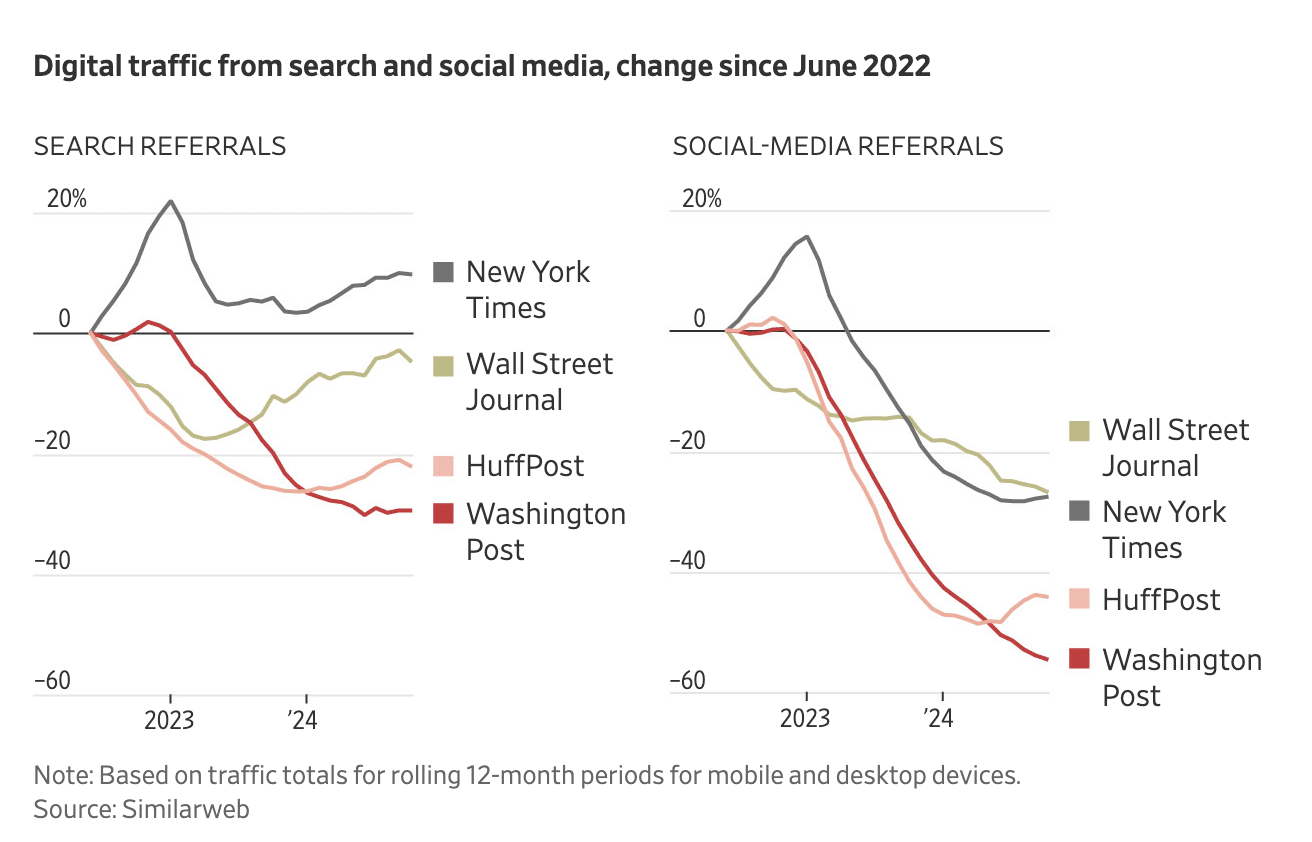
It builds on the hollowing out of the traditional press that has been happened for years, as corporate raiders turn news into a profit center. Several things made that worse, this year. As WSJ reported the other day, social media referrals to legacy newspapers cratered last year.

This was a deliberate choice by gatekeepers to dramatically alter their function, from a referral service to a disinformation swamp. But it had an immediate affect on the readership of those legacy outlets and other services relying on them, effectively neutering their power. (One reason I recommend Bluesky over other Xitter alternatives is because Bluesky encourages outlinks.)

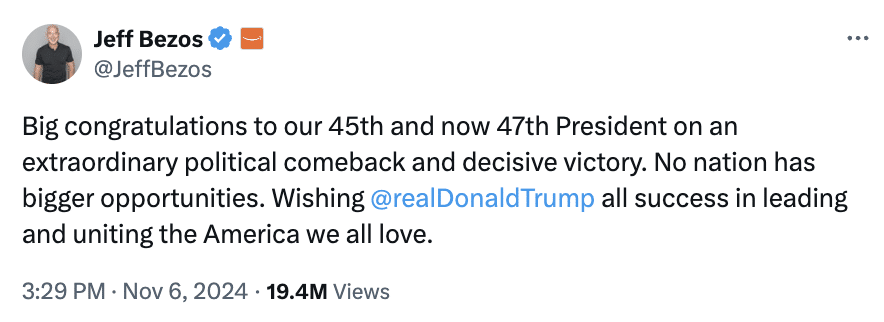
At the same time, the oligarchs who own those papers shifted their priorities in ways that would have more subtle impact on the coverage. WSJ, which has flourished in spite of the media environment, nevertheless fired a bunch of journalists in spring, targeting local news and, anecdotally, a certain profile of journalist. Jeff Bezos taunted WaPo’s reporters with their declining influence when he brought in Will Lewis, a Murdoch retread with a history of protecting the boss, and Will Lewis reveled in the kind of ethically problematic both sides journalism that chases manufactured scandals as much as GOP crime. Bezos taunted his journalists again when he declined to endorse Kamala Harris, only to issue a simpering congratulations once Trump won.

There’s still a lot to unpack about the turn of the oligarchs (I’ve left out their embrace of AI because I hope even they will soon have to concede that AI hasn’t replaced human workers but it has enshittified their product). But when a number of these things all happened in spring, I remember wondering whether all the oligarch owners had gotten together in a room and decided to make their product worse in an election year, all in the name of chasing different kinds of influence.

Partly, they’re trying to compete with podcasts. And while there’s a lot to be said for the authenticity of podcasts, it’s another industry driven by algorithms, and some of the key platforms cater to far right politics.

Before we turn to Musk, consider that Trump used manufactured grievances — including the goddamned Hunter Biden hard drive!! — from 2020 to bully Mark Zuckerberg in advance of the election. It’s unclear to what degree Zuckerberg’s efforts to depoliticize Meta stem from fear, from a desire for another tax cut, or from a genuine solidarity with his oligarch brothers. Whatever the motive, Threads was built not to replicate what Twitter used to be, yet it continues to be the destination for journalists exercising no critical thinking of what they need from a new social media platform. And Meta sold at least a million dollars in ad spending that violated Meta guidelines. Something led Zuckerberg to reverse his prior support for democracy, and it had a significant effect on the election.

Ah, Elon Musk. Perhaps his original motivation for buying Xitter was simply the imagined moral injury his ego suffered when Grimes ditched him to (briefly) date Chelsea Manning and his daughter, Vivian Jenna Wilson, transitioned (since the election, Wilson has announced she’s leaving the US for a country more welcoming to trans people). But the plan definitely took shape in the aftermath of January 6. It appears to have taken shape with the kibbitzing of Stephen Miller.

Musk — aided by David Sacks — played a key role in the kind of operation we see in the Viktor Orbán regime, but which happened in order to install Trump for a second term. By giving Substackers who were willing to misrepresent primary documents access to Xitter’s documents, Musk created a false narrative about moderation, pitching voluntary efforts to protect democracy as instead efforts to censor far right speech. That, in turn, gave demagogues in Congress the opportunity to create the appearance of substantiating that narrative with an investigation into the people who formerly moderated social media. This investigation resulted in legal costs and death threats to those involved — but only easily debunked propaganda reports that melt under the least scrutiny.

Nevertheless, those investigations have an enormous chilling effect. Paired with lawsuits against entities like the Stanford Internet Observatory, they disrupted most of the infrastructure attempting to limit disinformation on social media.

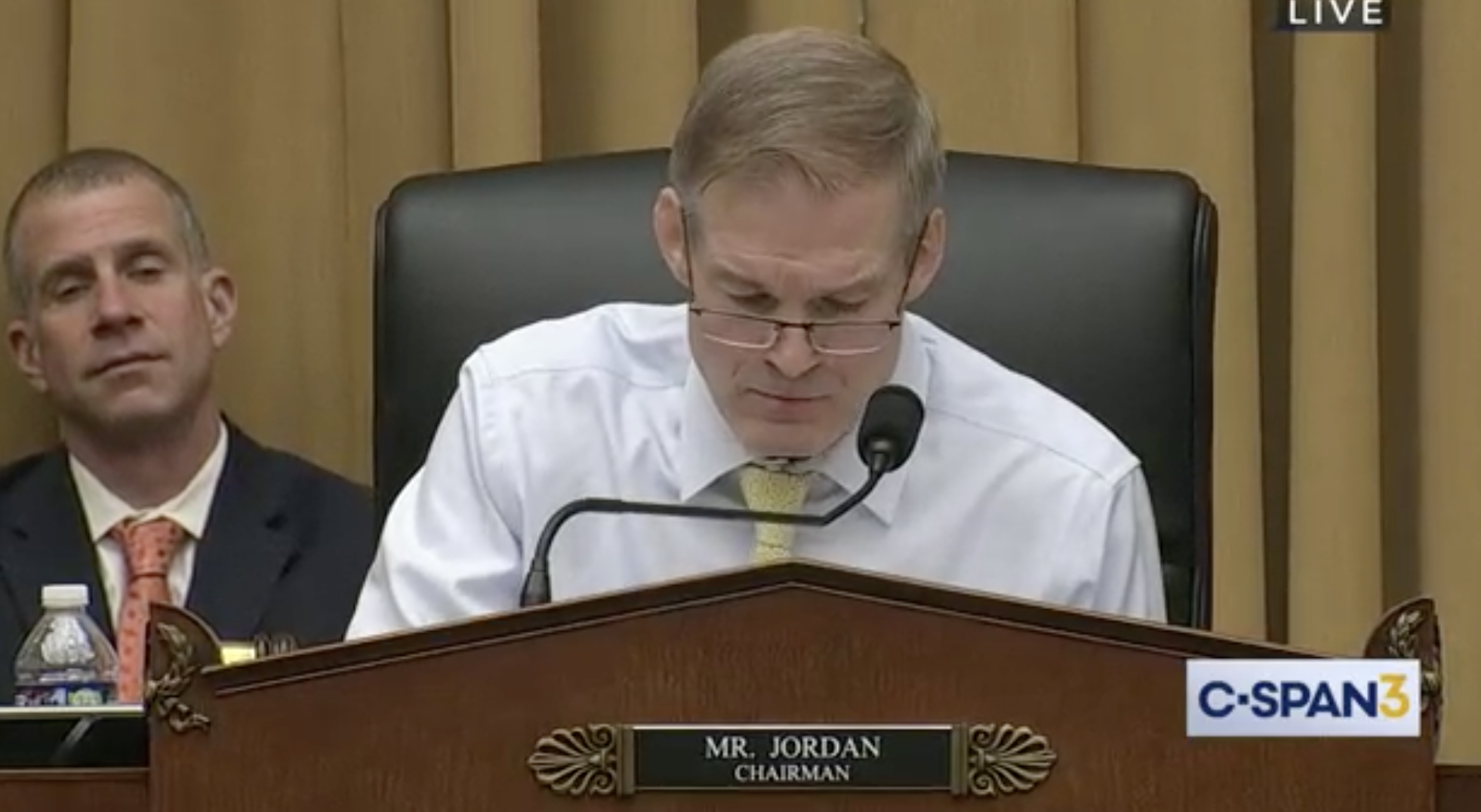
When Congressmen like Jordan and James Comer investigate, they aren’t bound by mere facts. They invent wildly. But with the help of process-oriented Congressional beat journalists, they still manage to tell their tales anyway. Such journalists report what Jordan and Comer said and who they’ve subpoenaed with almost no scrutiny of whether any of it makes sense. Those beat journalists are getting played.

This is precisely the kind of persecution of civil society at which Viktor Orbán has excelled. Many people are just beginning to think of what will come, but (as Renee DiResta, one of the targets of Jim Jordan’s wrath, keeps noting on Bluesky), what will come already started, years ago, and accelerated two years ago in earnest.

The election result significantly built on these prior Orbanization efforts. Certainly, Xitter became the cesspool of disinformation that researchers formerly combatted. Musk favored pro-Trump speech and seems to have throttled others (though some of Musk’s Terms of Service and API changes make it far harder to quantify). That favored speech includes his own, from the day he endorsed Trump.

And it wasn’t just the assault on moderation. Congress also targeted state and local prosecutors, the professionalization of the FBI, FTC Commissioner Lina Khan, any pushback on Elon Musk, and even government efforts to protect against Russian influence operations. The lawsuits against media outlets — even the embarrassingly frivolous ones launched by Devin Nunes, and the efforts to co-opt oligarch owners, also played a role. The Hunter Biden witch hunt, with its mythical foundation in the laptop that is not a laptop, its projections of corruption, the constant narrative it fed right wing propaganda (drowning out even Ron DeSantis’ bid to challenge Trump), was undoubtedly a big part of Joe Biden’s terrible approval ratings, and it is precisely what we’ll see all the time going forward.

We can’t assess the election without assessing the degree to which such efforts impacted the race. We sure as hell can’t discuss how to win the next election without thinking of how Republicans will work to further neuter liberal and nonpartisan civil society that protects democracy. Some of the biggest supporters for Kamala Harris will spend the next four years fighting to protect their professional lives and, in some cases, even their freedom.

The same disinformation researchers who’ve been evicted from safe university posts did their job in at least documenting what happened and in real time the press tracked what they were seeing (and what dedicated journalists found themselves). Next time, however, both the disinformation researchers and the press will be under more sustained assault (or, via their oligarch owners, cooptation), both via targeting their funding and creating more scapegoats to chill such work.

So if you want to think about the next election — if you’re optimistic enough to assume there will be a next election — you have to factor in the assault on civil society that has already started and will ratchet up in the next few years.

Share this entry

How Garland-Whinger Ankush Khardori’s Willful Impotence Helps Trump Evade Accountability

There’s a telling quote from Greg Sargent in his description of Kamala Harris’ difficulties in convincing voters that Trump was a bad president.

Some Democrats believe that the leading pro-Harris Super PAC, Future Forward, failed to spend enough of its enormous budget on advertising early on that might have reminded voters of the horrors of the Trump presidency. That perhaps allowed him to slowly rehabilitate himself and edge up his favorable numbers while Democrats weren’t looking.

“There was a calculation among Democrats after 2020 that Trump was disqualified and wouldn’t be back,” Democratic data analyst Tom Bonier told me. “That evolved into a calculation that he would be disqualified by his legal troubles and could end up in jail. Democrats undeniably failed to disqualify him. The result was that by the time the Harris campaign started, it was too late.”

“Was disqualified … would be disqualified … failed to disqualify.”

Bonier is just one person. But the passivity he describes on the part of Democrats expecting and hoping that some magic unicorn would just make the problem of Donald Trump go away is telling. As described, Democrats as a party apparently abdicated all agency for making that case themselves until it was far too late.

It is precisely the reason I’m so impatient with the Merrick Garland whinger industry, which has flourished again since Trump’s win: because they replicate precisely the impotence that got us here. They always asked that Garland do the work, singlehandedly, of making Trump go away, without considering the political groundwork that was necessary to any successful legal case.

Take Ankush Khardori’s description of Trump’s legal impunity. After laying out that, with his election, Trump’s legal troubles will now go away, with which I mostly agree, Khardori then lays out his three culprits: Merrick Garland, Mitch McConnell, SCOTUS.

His culprits are not in temporal order; if McConnell — who had an immediate way to disqualify Trump from further office — had engaged in an impeachment effort, DOJ would have had more time to prosecute.

They’re not in order of culpability. He addresses SCOTUS’ actions in four paragraphs close to the end of his rant. He ignores how their interventions on the Colorado case and Fischer also affected DOJ’s options, and never mentions precisely how long they stalled the case: eight months, with a guarantee of more on the back end. Once you address SCOTUS’ delays and rewriting of the Constitution, it’s not clear a case could ever have been brought before an election, even ignoring how COVID stalled everything for a year, to say nothing of bringing an insurrection charge that would be (per the Colorado decision) the only thing that could disqualify Trump from office. If that’s the case, it wouldn’t matter whether Garland or a gun-toting Adam Schiff, as prosecutor, were in charge. SCOTUS’ intervention, assuming it would have been the same whether it happened in 2021 or 2022 or 2023, was decisive. Trump’s judges made a prosecution of him before the election impossible and further ruled that the only thing that could disqualify him was an insurrection charge.

Instead of focusing primarily on the main culprits, Khardori prioritizes what he imagines was Garland’s role over that of McConnell and — astonishingly — SCOTUS.

And as is typical with Garland whingers, his indictment of Garland is riddled with problems (and, as the red typeface I used to mark links to his own past pieces shows, his own bellybutton lint).

It is now clearer than ever that Garland was a highly questionable choice to serve as attorney general from the start. From the outset of the Biden presidency, it was readily apparent that Garland had little desire to investigate and potentially prosecute Trump.

The most comprehensive accounts on the matter, from investigative reporting at The Washington Post and The New York Times, strongly indicate that the Jan. 6 committee’s investigation and public hearings in 2022 effectively forced Garland to investigate Trump and eventually to appoint Smith in November of that year — nearly two years after Trump incited the riot at the Capitol.

There are many people — including many Democratic legal pundits — who have continued to defend this delay and may continue to do so, so let me be very clear: Those people are wrong.

It was clear after Trump’s loss in 2020 — even before Jan. 6 — that his conduct warranted serious legal scrutiny by the Justice Department, particularly in the area of potential financial crimes. But that probe, which could and should have been pursued by Biden’s U.S. Attorney and aspiring attorney general in Manhattan, somehow never materialized.

It was also clear — on Jan. 6 itself — that Trump may have committed criminal misconduct after his loss in 2020 that required immediate and serious attention from the Justice Department.

The formation of the Jan. 6 committee in early 2021 did nothing to change the calculus. There too, it was clear from the start that there would still need to be a criminal investigation to deliver any meaningful legal accountability for Trump.

In fact, the warning signs for where this could all end up — where the country finds itself now — were clear by late 2021, less than a year into Biden’s term. The public reporting at the time indicated (correctly, we now know) that there was no real Justice Department investigation into Trump and his inner circle at that point, even though the outlines of a criminal case against Trump — including some of the charges themselves that were eventually brought nearly two years later — were already apparent.

As a result, the Biden administration and the Garland Justice Department were running an extremely obvious risk — namely, that Trump would run for reelection and win, and that any meaningful criminal accountability for his misconduct after 2020 would literally become impossible. That, of course, has now happened. It was all eminently predictable.

Garland’s defenders over the years — including many Democratic lawyers who regularly appear on cable news — claimed that Garland and the department were simply following a standard, “bottom-up” investigative effort. Prosecutors would start with the rioters, on this theory, and then eventually get to Trump.

This never made any sense.

It did not reflect some unwritten playbook for criminal investigations. In fact, in criminal cases involving large and potentially overlapping groups of participants — as well as serious time sensitivity — good prosecutors try to get to the top as quickly as possible.

The Justice Department can — and should — have quickly pursued the rioters and Trump in parallel. The fact that many legal pundits actually defended this gross dereliction of duty — and actually argued that this was the appropriate course — continues to amaze me.

As for Garland, his legacy is now out of his control, and the early returns are not looking good.

Garland is a serious, well-intentioned and complex figure. But given all this, he may go down as one of the worst and most broadly unpopular attorney generals in American history — hated by the anti-Trump part of the country for failing to bring Trump to justice, and hated by the pro-Trump part of the country for pursuing Trump at all. I sincerely hope he provides a first-hand accounting of what happened after he too leaves office next year.

The only sources of information on the investigation Khardori cites (aside from his own posts about what he could see without looking) are a WaPo and a NYT article. From both, only Glenn Thrush, a political journalist rehabilitated to the DOJ beat, covered the Trump case closely; none covered the larger investigation.

The WaPo article, which fairly obviously relies heavily on sources from the January 6 Committee members and people who left DOJ when Garland came in, has a number of problems I’ve laid out before (one, two, three).

  • It missed the significance of Brandon Straka, whose “cooperation” I believe was mishandled, but had it not been, might have gotten you into the Willard in March 2021.
  • It focused on the Oath Keepers and almost entirely ignores the Proud Boys, and in the process misunderstands the specific role they played, the ways DOJ under Bill Barr had made their prosecution far harder, and their importance to any hypothetical insurrection charge (because they kicked off the insurrection before Trump did, a problem impeachment prosecutors faced).
  • It ignored the decisions DOJ made with Rudy Giuliani’s phone — which was seized with a warrant obtained on Lisa Monaco’s first day on the job — which made that content, including content J6C never got, available to DOJ starting in November 2021.
  • It ignored the way DOJ, in August 2021, opportunistically used the prior Deferred Prosecution Agreement of Alex Jones sidekick Owen Shroyer to arrest and exploit the phone of someone who otherwise would likely be protected under media guidelines.
  • It ignored the overt investigative steps against Sidney Powell taken no later than September 2021.
  • It ignored a subpoena that was overt in May 2022, which included people who were not immediately a focus of J6C (and so not derivative of that investigation), as well as warrants dating no later than May 2022 targeting (among others) John Eastman. Since then, thanks to Khardori’s colleagues at Politico who do cover these investigations, we’ve learned the exact date that kicked off over ten months of Executive Privilege fights to get the testimony of 14 of Trump’s closest aides: June 15, 2022, one day before J6C interviewed those same witnesses: Marc Short and Greg Jacob. Which is to say, WaPo’s timeline even of known investigative steps is off in a way that suggests DOJ was entirely derivative of J6C, which it could not have been.
  • Perhaps predictably, given the obvious reliance on J6C sources, it didn’t talk about how their decision to delay sharing transcripts from April until December 2022 withheld information both helpful and crucial from criminal investigators.

More importantly, WaPo focused on Steve D’Antuono’s hesitancy to turn to the fake electors, even as DOJ was pushing to do so. Which is to say that D’Antuono — someone no longer at DOJ — was the key cause for delay, not Garland.

So there are a lot of problems with the WaPo story that Khardori, if he had actually tracked the investigation or followed those of us (including Politico’s own reporters) who do, should have known.

But Khardori didn’t even need to do that to understand that the WaPo had blind spots. That’s because the NYT story describes two prongs of the investigation, started in 2021, that don’t make the WaPo. It describes that,

  • Garland encouraged investigators to follow the money in his first meeting with them, though that turned out to be largely a dead end (note: Garland publicly implied that investigators were following the money in October 2021).
  • By summer of 2021, Lisa Monaco convened a team focusing on John Eastman, Boris Epshteyn, Rudy, and Roger Stone.

The NYT story missed a lot of what I included above, too (though not the Proud Boys), but it tells a very different story about efforts to focus on people close to Trump in 2021 than the WaPo did.

In spite of the NYT description of two prongs of the investigation that started in March and summer 2021 that attempted to get directly to those in Trump’s orbit, Khardori spent four paragraphs of his complaint claiming that DOJ had exclusively tried to work their way up from rioters. That’s not what the public record shows, it’s not what NYT says happened, it’s not what public reports on the Powell subpoenas say, it’s not what Garland said in October 2021 testimony. And yet that is the basis Khardori uses to condemn Garland. Further, the NYT describes that, in his first meeting with investigators, Garland, “said he would place no restrictions on their work, even if the ‘evidence leads to Trump,'” That statement is inconsistent with most of Khardori’s first two paragraphs on Garland. The Attorney General told investigators from the start he had no problem investigating Trump. Yet Khardori still links his own past work and claims vindication, rather than confessing that, if the NYT piece he relies on is accurate, he was wrong.

Which is to say, Khardori doesn’t claim to (and shows no signs of) having reviewed how the investigation actually happened.  That’s not his job, I guess, as a legal journalist. Instead, he relies on two sources, one of which partly debunks the other, as well as countering his own claim about Garland’s unwillingness to investigate and his four-paragraph argument that Garland should have pursued multiple routes to Trump but did not.

There are facts. And Khardori chooses to ignore them, clinging instead to past assertions that he falsely claims have been vindicated.

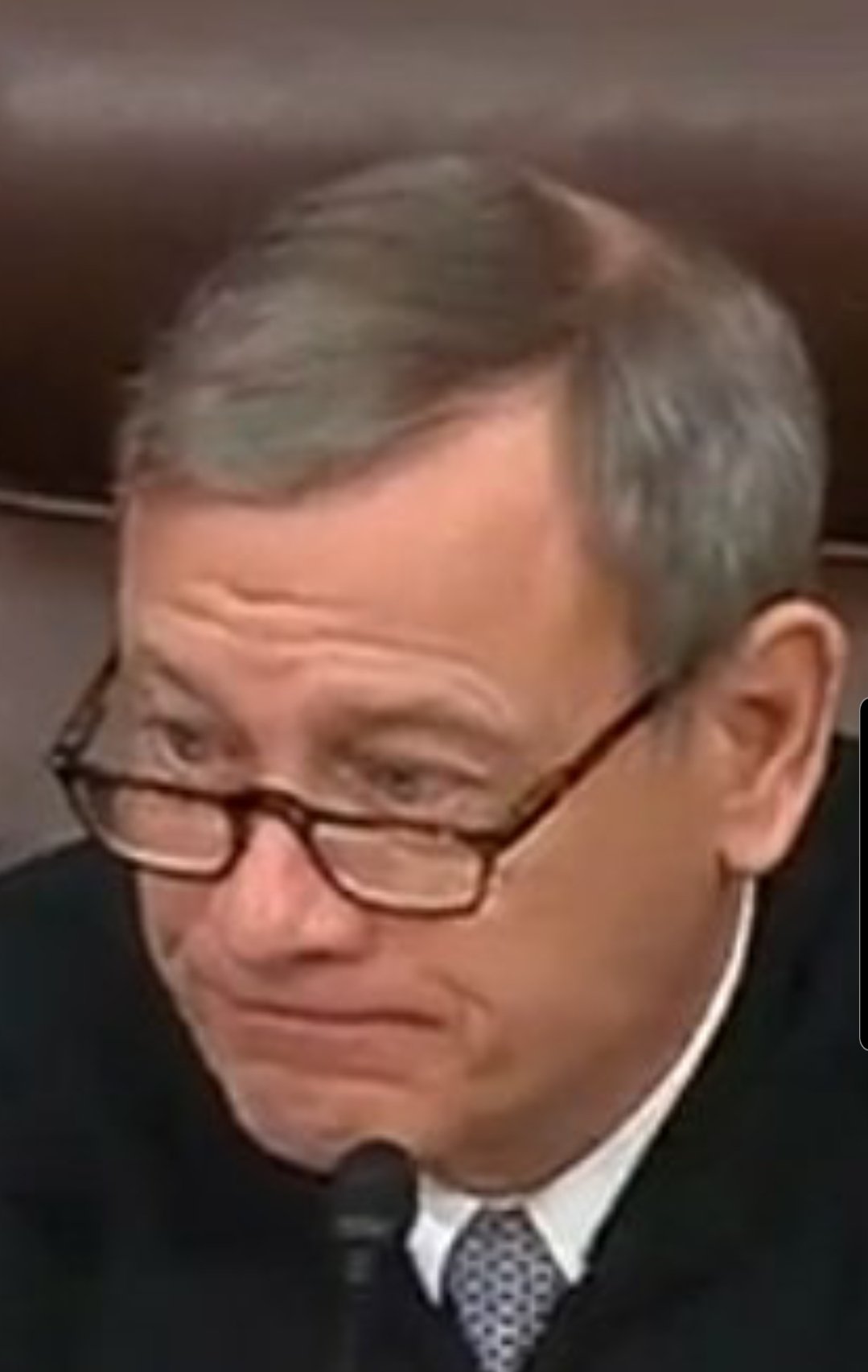
It’s the most irresponsible kind of laziness. Without having learned what really happened, Khardori concocts out of his uncertainty and frustration broad judgements that support his priors but are inconsistent with the public record. Via that invented theory to explain the scary unknown, Merrick Garland remains his primary villain, not John Roberts, not Mitch McConnell.

Poof! Thousands of clicks, each time misleading another despondent reader, encouraging helplessness.

Having made Garland his villain, he proclaims defeat.

I am, if anything, more furious than Khardori that Trump will not face legal accountability for his alleged crimes, because I know the kind of insurrectionists whose likely pardons will effectively flip patriotism on its head, valorizing Trump over country. This is a potentially irreparable blow to rule of law in the US.

But I’m not ready, as Khardori seems to be, to concede defeat. That’s because legal accountability is not the only recourse; indeed, we were never going to get legal accountability without first demanding political accountability. That’s the mistake many made: by looking passively at Merrick Garland and begging for a sparkle unicorn to make Trump go away, many failed to take steps, themselves, to hold Republicans to account for abandoning rule of law.

Consider how Khardori disempowers himself elsewhere in his column. Here’s how he describes Jack Smith’s closure of the case.

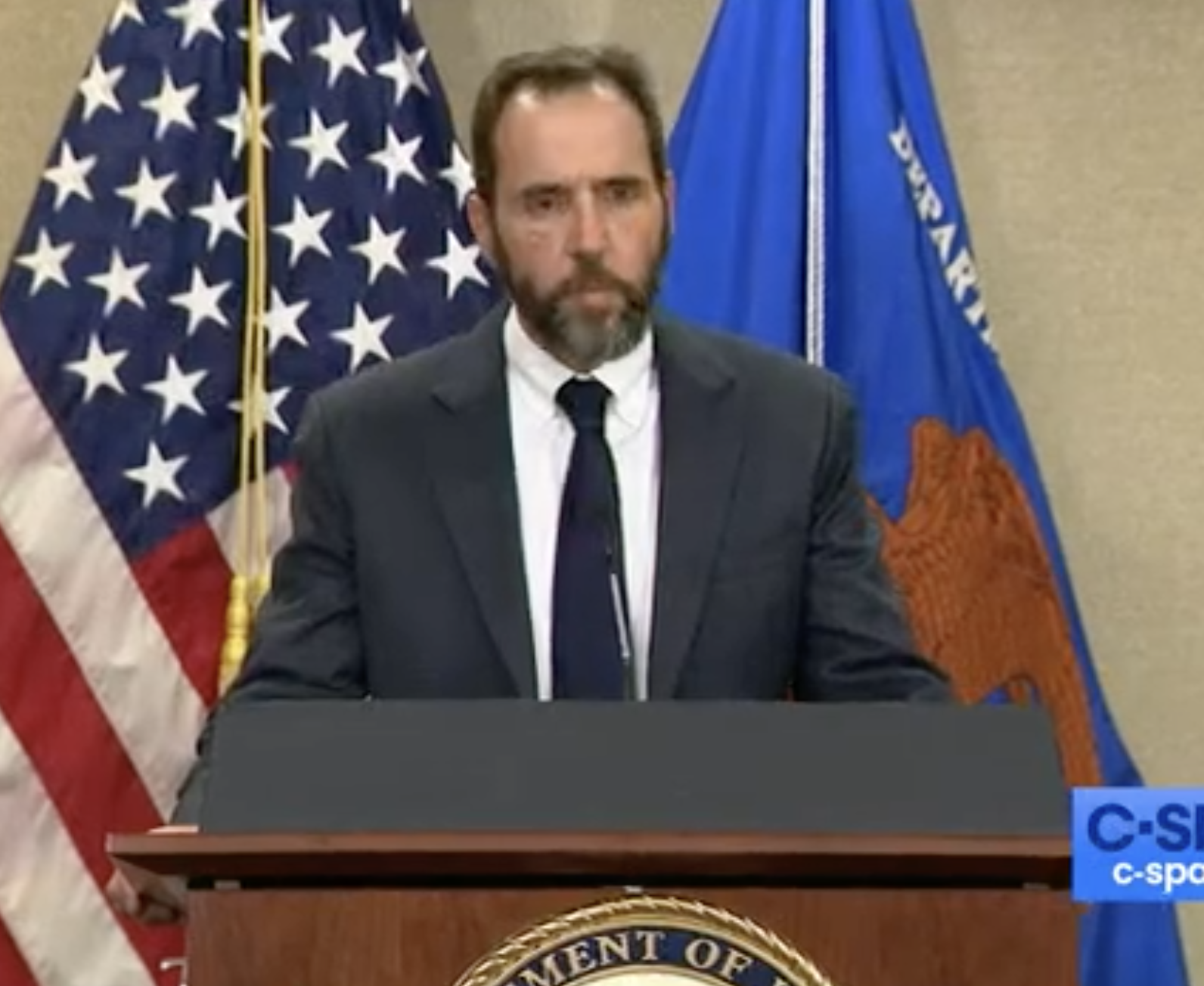
Already there is reporting suggesting that special counsel Jack Smith will leave his post and dismiss the pending cases, which is not that surprising considering that Trump pledged to fire him once back in office anyway.

He describes this as driven by Trump’s threat to fire Jack Smith, not DOJ regulations that prohibit further prosecution. He doesn’t link or consider any of the reports that lay out the obvious: by stepping down rather than waiting to get fired, Smith obliges himself to write a report. He chooses how he will go out. Admittedly, Khardori published his piece before last week’s filing that suggests we’ll have, at least, clarity by early December which, if it were the actual report, would (among other things) be early enough to hold a hearing.

That’s not going to change Trump’s win. But it provides an opportunity to lay a marker in the sand: This is what Republicans have chosen to enable going forward. This is what Republicans have chosen as a party to become.

It lays a marker for the two other villains in Khardori’s column: McConnell and the other Senate Republicans who refused to convict Trump, and John Roberts and his colleagues who vastly expanded his power without even knowing what Jack Smith had discovered.

Fresh off a big electoral victory, I doubt any will much care. But when the obvious repercussions come — when a guy who stored nuclear documents in a coat closet further compromises US security — the report and the hearing provide a marker that those who failed to stop Trump were warned and chose to do nothing (or worse, on the part of SCOTUS, chose to give him more power).

One of the only remaining possible checks on Trump’s power are the people in the Senate and SCOTUS who failed to check him on these alleged crimes before (though SCOTUS did check some of his other initiatives the first time around). We won’t soon persuade any of them to change their minds. But that doesn’t mean we stop trying — or at least laying a record of their complicity. In that path lies capitulation.

All the more so given that Roberts and his colleagues will be the villains in many more stories that have direct impact on people’s lives going forward.

Donald Trump is about to do a great deal of outrageous things at the start of his term to reverse the treatment of January 6 as a crime. The response cannot be to say, ho hum, if only that awful Merrick Garland would have yelled louder, and give up, especially not when no amount of yelling was going to change what SCOTUS did.

The response is to stop hoping for a sparkle unicorn to do this work for us. The response is to take some agency for making the case about Donald Trump. And a first step in that process is to stop blaming Garland for things — the public record shows — he didn’t do, and especially to stop blaming Garland for things that more important villains, like John Roberts, did do.

The first step to effective accountability is to identify the actual villain.

Update: Ty Cobb, when asked what he thinks about Trump’s promise to pardon the Jan6 defendants, stated, I don’t think anybody in our history has more tarnished the rule of law than Donald Trump.”

Share this entry

Jack Smith Asks for Three Weeks

Jack Smith just requested and got a consent motion to file a status report “or otherwise inform” Judge Tanya Chutkan of what they’re going to do with the January 6 case.

As a result of the election held on November 5, 2024, the defendant is expected to be certified as President-elect on January 6, 2025, and inaugurated on January 20, 2025. The Government respectfully requests that the Court vacate the remaining deadlines in the pretrial schedule to afford the Government time to assess this unprecedented circumstance and determine the appropriate course going forward consistent with Department of Justice policy. By December 2, 2024, the Government will file a status report or otherwise inform the Court of the result of its deliberations. The Government has consulted with defense counsel, who do not object to this request.

If that “otherwise inform” is a report, it would be done in plenty of time for Dick Durbin to hold a hearing.

Share this entry

The Legal Cases Implicating Donald Trump’s Conduct That Won’t Go Away [Because of His Election]

There’s been a lot of chatter since Tuesday about how the criminal cases against Donald Trump will go away because of his election (CNN has one of the most comprehensive discussions of what will happen to Trump’s guilty verdict in New York, for which he is due to be sentenced this month).

But there’s been less discussion of the legal cases implicating Donald Trump’s conduct that won’t go away solely because of his election (which is to say, they may go away for other reasons). These implicate Trump, but because his biological person is not the defendant, should not be implicated by his election.

Consider AJ Delgado’s lawsuit against Trump’s first campaign and his campaign managers. She sued five years ago for sex, gender, and pregnancy discrimination after Trump’s people allegedly retaliated when she filed a discrimination case when she was sidelined after Jason Miller got her pregnant. Of late, she’s been slogging along pro se, seeking evidence of other women who were discriminated against by either of his then two campaigns and getting depositions of people who were involved in the effort to silence her. In September, Trump filed his motion for summary judgment. But Delgado just got a continuance on hers until the end of December because she had to depose Michael Glassner and because Miller continues to waste her time dicking around on paternity issues in Florida.

More interesting still, there’s Peter Strzok. In July, DOJ settled the Privacy Act lawsuits Strzok and Lisa Page filed for having their texts shared with the press. But his claim that he had been fired for his First Amendment protected speech and denied due process continued. In September, DOJ filed its motion for summary judgement. While the filing and exhibits are significantly redacted, the motion seems to dirty Strzok up based on claims about his actions in the cases related to 2016 and argue standard Human Resources claims about the process by which he was fired. Last week, Strzok filed his own motion for summary judgment. Again, it’s heavily redacted, but he notes that the FBI changed their firing guidelines after he and Andrew McCabe were fired. He lays out evidence that others who sent inappropriate content on their FBI devices, including racist language and language attacking Hillary Clinton, were not fired.

But the case is most likely to come down to David Bowdich’s credibility. Bowdich’s deposition appears to say that he fired Strzok because of the damage his texts did to the FBI. Strzok will attempt to discredit Bowdich’s claims, firstly, with a statement from Andy McCabe that when the texts were first discovered, Bowdich said nothing to disagree with McCabe’s stance that Strzok would not be fired. There’s something else, which is completely redacted, that the FBI only disclosed when they settled the Privacy Act suit, but it’s not clear what that is. If it ever goes to trial, then Trump’s claims that he was responsible for the firing will be at issue (and anything else interesting he said in the hard-won deposition Strzok got, as well as Trump’s requests for retaliation.

All that said, the judges in these two cases — Magistrate Judge Katharine Parker (and if it survives, Analisa Torres) for Delgado, and Amy Berman Jackson for Strzok — seem pretty skeptical of these two cases, so they may get dismissed on summary judgment. If not, you might see trials on Trump’s discrimination and retaliation against his perceived enemies next year. But if ABJ doesn’t throw out this case, DOJ is likely to appeal before trial in a bid to expand their authority to fire people without due process.

But I see no reason they’ll get dismissed because Trump will be President. His campaign is the defendant in the first case, FBI is the defendant in the second.

An even more interesting example is Hunter Biden.

A lot of people are rightly saying that Biden should protect his son (and brother) by simply pardoning them on the way out — and I get that instinct. All the more so because, yesterday, James Comer suggested he — or Trump’s DOJ — would renew his pursuit of Hunter Biden in the next Congress. But even after that, Karine Jean-Pierre reiterated the answer she’s always given: President Biden will not pardon his son.

President Biden still has no plans to pardon his son, Hunter Biden, in the final months of his presidency, the White House press secretary reiterated on Thursday.

“We’ve been asked that question multiple times and our answer stands — which is no,” White House press secretary Karine Jean-Pierre said at Thursday’s press briefing.

I had already been thinking that Hunter may not want a full pardon, because he still has appeals that might succeed.

And amid discussions of DOJ’s hopes to defeat the Aileen Cannon precedent on Special Counsels, rather than just dismiss the stolen documents case against Trump and the two aides who protected him, it makes more sense.

Here’s a (dated) summary of all the legal proceedings in Hunter’s life (the two disgruntled IRS agents have since added several suits, one targeting Abbe Lowell for defamation).

The basis for appeal that most dick pic sniffing journalists are focused on is Hunter’s Second Amendment challenge to his conviction in Delaware. In the wake of Bruen, other defendants have had some (mixed) success arguing that — for example — the government can only prohibit possessing guns during drug impairment, and prosecutors very pointedly dodged having to prove that in Hunter’s case. Because other (more dangerous) defendants are delaying incarceration during appeal, I think it plausible that Judge Maryellen Noreika will agree to do so here, too.

But Trump’s successful claim that Jack Smith was not lawfully appointed carries over to Hunter’s cases too (and, importantly, Alexander Smirnov’s). David Weiss was hired under the very same authority that Jack Smith was, the authority that Cannon said was unconstitutional. And both Hunter and Smirnov already tried to make the same argument on interlocutory basis.

On paper, Hunter’s challenge to David Weiss’ appointment as Special Counsel is weakest in Delaware, because Weiss could have prosecuted him as US Attorney anyway. But Cannon’s ruling says that improper appointment resets everything to before the appointment happened. And the most important evidence submitted at Hunter’s trial — the gun residue, a warrant to search his laptop for evidence of drug use, and probably key interviews with Zoe Kestan — all happened after Weiss started acting as Special Counsel. They also all happened after statute of limitations for the crime expired. If this challenge succeeded, the case should be time barred.

Hunter’s case against David Weiss’ appointment would be stronger in LA, because Weiss chose not to use special attorney authority to charge Hunter there (though given how prosecutors charged him, Trump’s DOJ would have until next year to refile the charges).

The case is stronger still for Smirnov, because — by all appearances — Weiss got Special Counsel authority so he could investigate a matter implicating Joe Biden, Smirnov’s allegedly false attempt to frame Biden. Smirnov’s charges, too, are getting stale. Because Weiss charged Smirnov for statements he made in 2020, not last year, they would expire next spring (I’ll return to what recent motions in the case say about Weiss’ investigation).

But as I already said, Smirnov is someone whom Trump might have real incentive to pardon at the start of his term, particularly if Smirnov gets his renewed bid for a delay, meaning a pardon would be pre-trial.

While there are other people (most notably, Michael Cohen) who might challenge their prosecution based on the Cannon precedent, if prosecutions against Smirnov, Walt Nauta, and Carlos De Oliveira went away, via whatever means, then Hunter Biden would be the sole person facing prison time based on what Cannon said was an unconstitutional appointment. While normally he might not do so, given those circumstances, I think both Judge Mark Scarsi might let Hunter stay out of prison pending appeal as well.

The Second Amendment and Special Counsel appeals will get the most attention.

It’s Hunter’s other appeals that might be more interesting, though. Best as I can tell, Hunter has preserved the following issues for appeal in one or both of his cases:

  • David Weiss reneged on a signed deal (the Noreika and Scarsi decisions are slightly inconsistent on this point, so there’s a circuit split already)
  • Pressure from Trump and Congress led Weiss to change his mind about prosecuting Hunter (I’m not certain this has been preserved in Los Angeles)
  • Pressure from the IRS agents led Weiss to renege on the tax plea deal
  • Noreika improperly admitted evidence from the laptop
  • Noreika improperly excluded evidence of how the Delaware cop who interviewed Hunter in 2018 and the gun shop owner pushed to get Hunter prosecuted and then revised their stories long after the fact
  • Noreika improperly refused discovery on issues pertaining to the Brady side channel and Smirnov’s attempt to frame Joe Biden

Hunter’s lawsuits against the IRS and Garrett Ziegler may strengthen his hand in some of these challenges. The Ziegler lawsuit, for example, implicates chain of custody going back to John Paul Mac Isaac, and therefore chain of custody that reflects on the chain of custody problems the FBI chose to ignore. The IRS lawsuit may provide a way to depose the IRS agents’ lawyers about when their contacts with Congress really started.

And one of the claims that Noreika blew off that would have renewed import are two IRS laws that criminalize pressuring the IRS to investigate people, one of which explicitly pertains to the President.

Some of Trump’s possible actions, like a Smirnov pardon, might strengthen Hunter’s hand in making these arguments.

Barring a Hunter Biden pardon, he gets to at least try to make these appeals after he is sentenced in December. And because his appeals will implicate two other legal appeals popular on the right — Trump’s own argument about Special Counsels, and efforts to eliminate gun controls — he may be able to do that on (lengthy) pretrial release.

Again, these are all uphill fights. I’m not saying these appeals will work. But even just arguing them will implicate the kinds of corruption we expect to see going forward.

Right wingers are going to make sure Hunter Biden’s life sucks anyway. But by dint of Trump’s conviction, he has what almost no one else in the country will be able to have: standing to argue about Trump’s own corruption.

Share this entry

Trump Sold Grievance and America Liked What He Was Selling

Once Trump got everyone hooked on his grievance drug, Merrick Garland was never going to make a difference.

I have tried, over and over, to explain how the investigation into Trump and his co-conspirators proceeded. More recently, I’ve explained how you couldn’t have charged Trump with insurrection — the only thing that would have disqualified him from running — until after May 2023, and had Jack Smith done so, it would have ended up exactly where we are here, with John Roberts delaying everything until after the election.

No effort to explain the process — the two years of exploiting phones, the months of January 6 Committee delay, the ten months of privilege fights, the month Elon Musk stole, or the eight months John Roberts bought Trump — none of that has mattered, of course. People needed an explanation for their own helplessness and Merrick Garland was the sparkle pony they hoped would save them.

But nothing Merrick Garland would have done would have mattered anyway.

That’s because since January 2017, since Trump learned that Mike Flynn had been caught undermining sanctions on the phone with Sergey Kislyak, Trump has used every effort to hold him accountable as a vehicle to sell grievance.

This is the core premise of the Ball of Thread podcast I’ve been doing with LOLGOP.

Rather than being grateful when learning that FBI was investigating four of his close campaign advisors had monetized their access to him — rather than imagining himself as the victim of the men who snuck off and met with Russian spies — Trump made himself the victim of the FBI. He invented a claim he was wiretapped, and then kept inventing more and more such false claims. And then he (possibly on the advice of Paul Manafort, whose associate Oleg Deripaska funded HUMINT before the Democrats did) used the dossier as stand-in for the real Russian investigation. It wasn’t the Coffee Boy yapping him mouth that led to the investigation into those trying to monetize access, this false story tells, it was the dossier Russia filled with disinformation, a guaranteed way to discredit the investigation. Once you convince people of the lie that the FBI really did investigate a candidate based off such a flimsy dossier, it becomes easy to target all those involved, along the way gutting the Russian expertise at FBI.

Then Bill Barr came in and used the authority of the Attorney General to lie about what the investigation found; almost no media outlets have revisited the findings once it became clear that Barr didn’t even bother learning what the report said. While trying to kill Zombie Mueller — the parts of the investigation that remained after Mueller finished — Barr’s DOJ literally altered documents in an attempt to put Joe Biden at the genesis of the investigation into Donald Trump, yet another attempt to replace the actual investigation, the Coffee Boy and campaign manager and National Security Advisor and personal lawyer and rat-fucker who were found to have lied to cover up the 2016 Russian operation, with a storytale in which Democrats are the villains.

John Durham never bothered to learn what the report actually said either. Had he done so, it would have been far harder to criminalize Hillary Clinton for being a victim of a hack-and-leak operation, along the way taking out still more expertise on Russia.

And while Barr was criminalizing people, he followed Rudy’s chase for dick pics in an effort to criminalize Hunter Biden and his father.

Do you see the genius of this con, Donald Trump’s most successful reality TV show ever?

Vast swaths of America, including at least half the Supreme Court, and millions of working class voters, really believe that he — the guy who asked Russia to hack his opponent some more — was the victim.

And that’s how a billionaire grifter earns the trust of the working guy.

For the most part, the press just played along, repeating Trump’s claims of victimhood as if they were true.

It’s also the problem in thinking that if only Trump faces legal consequences, he’ll go away, he’ll be neutralized.

We saw this every time he faced justice. The first impeachment. The second one. The New York trials. Each time, his grievance became a loyalty oath. Each time, he sucked more and more Republicans into the con. Each time he made them complicit.

The hatred of and for Trump by Rule of Law is what made him strong, because he used it to — ridiculously!! — place himself into the role of the little guy, the target of those mean elites.

We’ll have decades, maybe, to understand why Trump resoundingly won yesterday. Some of it is inflation (and the unrebutted claims it is bigger than it is), which makes working people angry at the elites, people they might imagine are the same people persecuting Trump.

For many, though, it’s the appeal of vengeance.

Trump has spent nine years spinning a tale that he has reason to wreak vengeance on Rule of Law. The greatest con he ever pulled.

So even if DOJ had charged Trump, two months before Merrick Garland was confirmed (though all three of the charges people imagine would be easy — incitement, the call to Brad Raffensperger, and the fake electors plot — have been unsuccessful in other legal venues), even if DOJ had convicted Trump along with the earliest crime scene defendant in March 2022, even if Trump hadn’t used the very same means of delay he used successfully, which would have still stalled the case past yesterday’s election, it still wouldn’t have disqualified him from running.

It still would be the centerpiece of his manufactured tale of grievance.

It still would be one of the elements he uses to make working people think he’s just like them.

You will only defeat Trumpism by destroying that facade of victimhood. And you will not achieve meaningful legal victories until you do that first.

I know we all need an easy way to explain this — an easy culprit for why this happened.

But it’s not Merrick Garland, because years before he came on the scene, Trump had already convinced everyone that any attempt to hold him accountable was just another attempt by corrupt powers to take him down.

Trump sold the country on grievance and victimhood. And in the process he made half the country hate Rule of Law.

Update: This is a good summary of how Trump lures in people attracted to grievance.

The Republican Party has been the party of the Low-Trust voter for a very long time. It’s the party that wants to get rid of institutions, of any of the bonds that connect us all together. The Democratic Party is the party of institutions, the party of Good Governance. It’s the party of trusting other Americans to make good choices for you. There is very little that the Democrats can do to appeal to the Low-Trust voter, and you saw what that means for the future of our politics last night. I would go so far as to say that we’re seeing the effects of a realignment of what partisanship is. The GOP is the party of the perpetual outsider and the Low-Trust voter, the people calling for things to be torn down. The Democrats are the insiders, the institutionalists. That’s why you saw realignment of people like Liz Cheney and Vermont Governor Phil Scott, people who still think the government matters even if they disagree on how it should be doing things.

I don’t know what you can do to win back the Low-Trust voters.

[snip]

I don’t know how you build back trust in the government. Things like FEMA in disasters are supposed to be able to do that, but the post-hurricane situation in North Carolina, where outside agitators went in to try to destroy that trust, and people on the Internet went out of their way to spread lies about how the Federal government had abandoned Asheville, are just examples of how everything can be used to pop out more Low-Trust voters.

Share this entry

Ball of Threads: Durham Descends

LOLGOP finished this just in time for you to spend your day watching it while you wait. We describe how Bill Barr and John Durham attempted to criminalize being the victim of a hack-and-leak attack.

Here’s the Patreon for the series.

You can also subscribe on:
Apple Podcasts

Spotify 
YouTube
 
Audible

RSS
Podcast Addict

Share this entry

What It Would Take to Charge Donald Trump with Inciting Insurrection

I’ve been thinking a lot about Donald Trump’s second impeachment.

As we approach the election with Trump still facing a decent (though declining) chance of winning, a lot of justifiably worried people are again choosing to spend their time whinging about Merrick Garland rather than doing something constructive to help defeat Trump.

There remains a belief that it was Garland’s job — and that Garland had the power — to disqualify Trump from running this race.

A remarkable instance is Rachel Bitecofer, a PoliSci professor who has written on negative partisanship, the way in which people vote against something rather than necessarily for something.
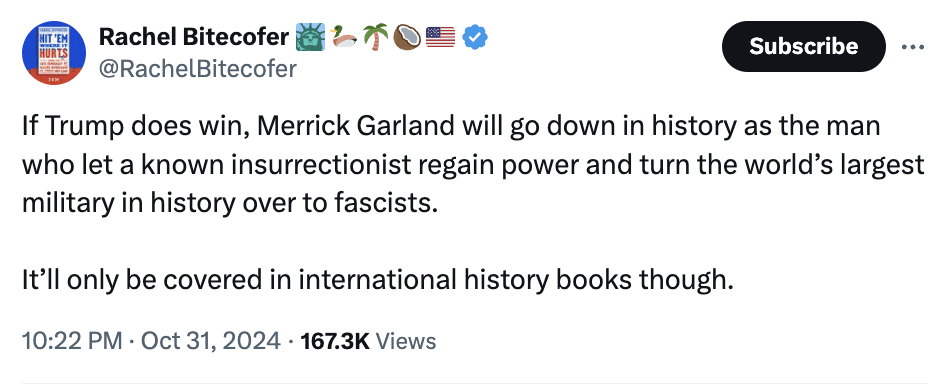
That Bitecofer is spending days in advance of the election doing PR for John Roberts is especially inexcusable because her using partisan anger to get them to vote.

Days before the election, she falsely told voters to be mad about Merrick Garland rather than mad about John Roberts, the guy who is directly responsible for eight months of delay, or Mitch McConnell, the guy with primary responsibility for disqualifying Trump.

She’s breaking her own rule.

That’s one reason I’ve been thinking about the January 6 impeachment: because, in fact, it was McConnell’s job to disqualify Trump from running this race, and McConnell chickened out. Oh, I think there are things that might have altered the outcome of impeachment. Most notably, I think Nancy Pelosi made a mistake in not appointing Liz Cheney to the prosecution team. That would have given Cheney an earlier opportunity to play the formidable leadership role that she later played on the January 6 Committee. Cheney, as a member of GOP leadership, was witness to conversations involving Mike Johnson and Kevin McCarthy that might have tipped the decision to call witnesses. And as her support for Kamala Harris’ campaign has shown, she has the stature to persuade Republicans to put country over party.

But I’m also thinking about why that impeachment failed. Republicans offered two kinds of excuses, one procedural and one evidentiary. Procedurally, McConnell and others argued, they didn’t have the authority to impeach Trump after he left office.

It was a cop out, but — as we’ll see — one that played a role in the immunity decision.

Trump also made some evidentiary arguments against the claim that Trump incited the attack. Trump argued, for example, that rioters planned their attack in advance, and so couldn’t have been incited by Trump.

Despite going to great lengths to include irrelevant information regarding Mr. Trump’s comments dating back to August 2020 and various postings on social media, the House Managers are silent on one very chilling fact. The Federal Bureau of Investigation has confirmed that the breach at the Capitol was planned several days in advance of the rally, and therefore had nothing to do with the President’s speech on January 6th at the Ellipse. According to investigative reports all released after January 6, 2021, “the Capitol Police, the NYPD and the FBI all had prior warning there was going to be an attack on the Capitol…” 14

14 Ian Schwartz, John Solomon: Capitol Riot Was A “planned Attack,” Can’t Blame Trump; What Did Pelosi and McConnell Know?, Real Clear Politics (Jan. 13, 2021), https://www.realclearpolitics.com/video/2021/01/13/john_solomon_capitol_riot_was_a_planned_attack_c ant_blame_trump_what_did_pelosi_mcconnell_know.html

Leaning almost entirely on the presence of provocateur John Sullivan at the riot, Trump argued that because rioters had motives other than to support Trump, Trump couldn’t have been responsible.

The real truth is that the people who criminally breached the Capitol did so of their own accord17 and for their own reasons, and they are being criminally prosecuted. 18

17 Some anti-Trump, some ani-government. See, e.g., Alicia Powe, Exclusive: “Boogaloo Boi” Leader Who Aligns with Black Lives Matter, Gateway Pundit, (Jan. 17, 2021), https://www.thegatewaypundit.com/2021/01/boogaloo-boi-leader-aligns-black-lives-matter-boastedorganizing-armed-insurrection-us-capitol/. “The goal of swarming the home of the U.S. House of Representatives and Senate is “to revel in the breach of security while mocking the defenses that protect tyrants…whether that be Trump or others.” See also Robert Mackey, John Sullivan, Who Filmed Shooting of Ashli Babbitt, The Intercept (Jan. 14, 2021), https://theintercept.com/2021/01/14/capitol-riot-john-sullivan-ashli-babbitt/ (“The rapper, who later retweeted a brief video clip of himself and Sullivan inside the Rotunda that was broadcast live on CNN, told me in an Instagram message … “I’m far from a Trump supporter…I really don’t even get into politics at all. It was an experience for me and that’s really the only reason I was there.”)

18 See, e.g., Tom Jackman, Marissa J. Lank, Jon Swaine, Man who shot video of fatal Capitol shooting is arrested, remains focus of political storm, Washington Post (Jan. 16, 2021), https://www.washingtonpost.com/nation/2021/01/16/sullivan-video-arrested/.

Trump repeatedly treated his use of the word “fight” as figurative.

Of the over 10,000 words spoken, Mr. Trump used the word “fight” a little more than a handful of times and each time in the figurative sense that has long been accepted in public discourse when urging people to stand and use their voices to be heard on matters important to them; it was not and could not be construed to encourage acts of violence Notably absent from his speech was any reference to or encouragement of an insurrection, a riot, criminal action, or any acts of physical violence whatsoever. The only reference to force was in taking pride in his administration’s creation of the Space Force. Mr. Trump never made any express or implied mention of weapons, the need for weapons, or anything of the sort. Instead, he simply called on those gathered to peacefully and patriotically use their voices. [emphasis original]

Most crucially, Trump noted that the attack on the Capitol started before he finished speaking.

A simple timeline of events demonstrates conclusively that the riots were not inspired by the President’s speech at the Ellipse. “The Capitol is 1.6 miles away from Ellipse Park which is near the White House. This is approximately a 30-33 minute walk. Trump began addressing the crowd at 11:58 AM and made his final remarks at 1:12 PM… Protesters, activists and rioters had already breached Capitol Grounds a mile away 19 minutes prior to the end of President Trump’s speech.”20

Trump also complained that the House Democrats used news reports of the rioters’ actions, rather than legal documents.

Some of these excuses are flimsy. Most rely on a rupture between the law prohibiting incitement, which prohibits both inciting an insurrection but also “set[ting] on foot, assist[ing], or engag[ing]” in insurrection, and the holding in Brandenburg, which limited incitement to those stoking imminent illegal action. Those who claim that Trump committed a crime in plain sight would have to rebut these defenses.

In the January 6 Committee’s incitement referral, the argument shifted away from arguing that Trump incited insurrection with just his speech, focusing more on Trump’s failure to stop the riot. They argued:

  • Trump summoned a mob and then further provoked the already rioting mob with his Tweet targeting Mike Pence.
  • Two of the rioters described their actions in terms of Trump’s orders.
  • After the riot was already started, Trump refused to take action to protect the Capitol.
  • Trump told close aides that Mike Pence deserved the chants threatening to hang him.
  • Trump has since — starting as early as September 2022, before either sedition trial — promised to pardon the rioters.

J6C did good work, but this insurrection referral was just as thin as their obstruction one. Their citation to January 6ers still relied on press reports rather than court records. And rather than relying on Oath Keeper Kelly Meggs’ hunt for Nancy Pelosi — Meggs had been convicted of sedition a few weeks earlier — the report relies on Cleveland Meredith, who never made the insurrection. They don’t incorporate the excellent work J6C did to reconstruct how Trump ordered language targeting Mike Pence back into his speech after Pence refused the President’s entreaties to steal the election.

To be sure, at that point in December 2022, prosecutors were still working on the case that Trump incited the mob. The Proud Boy leaders’ trial — which J6C’s decision to withhold their transcripts had delayed three months — wouldn’t start until early the next month and wouldn’t conclude until May 2023. And it would take another five months, until April 2023, for DOJ to present their best evidence that Trump incited someone at his speech — Danny Rodriguez — to go attack the Capitol and tase Michael Fanone; in the wake of Fischer, however, the sentences of Rodriguez’ co-conspirators have been sharply reduced. People complain that DOJ focused on the crime scene, but before you could even consider incitement, you’d have to account for the Proud Boys and people like Rodriguez.

Before SCOTUS started rewriting the laws applying to January 6, prosecutors were prepared to show specifics about Trump’s culpability for the attack. This is how Jack Smith’s team described Trump’s responsibility for his mob almost exactly a year ago.

Ultimately, the defendant’s three conspiracies culminated and converged when, on January 6, the defendant attempted to obstruct and prevent the congressional certification at the Capitol. One of the ways that the defendant did so, as alleged in the indictment, was to direct an angry crowd of his supporters to the Capitol and to continue to stoke their anger while they were rioting and obstructing the certification.

At trial, the Government will prove these allegations with evidence that the defendant’s supporters took obstructive actions at the Capitol at the defendant’s direction and on his behalf. This evidence will include video evidence demonstrating that on the morning of January 6, the defendant encouraged the crowd to go to the Capitol throughout his speech, giving the earliest such instruction roughly 15 minutes into his remarks; testimony, video, photographic, and geolocation evidence establishing that many of the defendant’s supporters responded to his direction and moved from his speech at the Ellipse to the Capitol; and testimony, video, and photographic evidence that specific individuals who were at the Ellipse when the defendant exhorted them to “fight” at the Capitol then violently attacked law enforcement and breached the Capitol.

The indictment also alleges, and the Government will prove at trial, that the defendant used the angry crowd at the Capitol as a tool in his pressure campaign on the Vice President and to obstruct the congressional certification. Through testimony and video evidence, the Government will establish that rioters were singularly focused on entering the Capitol building, and once inside sought out where lawmakers were conducting the certification proceeding and where the electoral votes were being counted. And in particular, the Government will establish through testimony and video evidence that after the defendant repeatedly and publicly pressured and attacked the Vice President, the rioting crowd at the Capitol turned their anger toward the Vice President when they learned he would not halt the certification, asking where the Vice President was and chanting that they would hang him. [my emphasis]

A year ago, prosecutors promised to prove that Trump sent his mob to the Capitol, where many of the people Trump had told to “fight” assaulted cops. They have argued for over a year that the mob was the tool that Trump used to obstruct the vote certification.

Last month, subsequent to Fischer, Jack Smith’s argument changed a bit. He relied more on an aid and abet theory of Trump’s liability for his mob’s actions.

Contrary to the defendant’s claim (ECF No. 255 at 7) that he bears no factual or legal responsibility for the “events on January 6,” the superseding indictment plainly alleges that the defendant willfully caused his supporters to obstruct and attempt to obstruct the proceeding by summoning them to Washington, D.C., and then directing them to march to the Capitol to pressure the Vice President and legislators to reject the legitimate certificates and instead rely on the fraudulent electoral certificates. See, e.g., ECF No. 226 at ¶¶ 68, 79, 82, 86-87, 94. Under 18 U.S.C. § 2(b), a defendant is criminally liable when he “willfully causes an act to be done which if directly performed by him or another would be” a federal offense. See, e.g., United States v. Hsia, 176 F.3d 517, 522 (D.C. Cir. 1999) (upholding a conviction for willfully causing a violation of 18 U.S.C. § 1001).

One way or another, however, as charged Jack Smith is relying on the 18 USC 1512(c)(2) charges to tie Trump to his mob. DOJ needs to sustain at least some of the obstruction charges against crime scene defendants to make this stick. And an opinion from Beryl Howell, freeing two Proud Boys from prison based on her judgment that nothing they did at the Capitol impaired the availability or integrity of the electoral certificates, will make that harder to do.

But let’s go back to whether Merrick Garland — or DOJ prosecutors who spent 30 months showing that Trump incited people like Danny Rodriguez to go nearly murder Michael Fanone, or Jack Smith — could then prove that Trump incited an insurrection.

In August 2023, when Smith indicted Trump, it was not clear he could do that. At the least, he faced the likelihood that Trump would argue his acquittal immunized him from being charged criminally. Indeed, even though Smith didn’t charge Trump with inciting an insurrection, he nevertheless sustained that argument all the way to the Supreme Court, causing precisely the delay that people like Bitecofer blame on Garland.

But in the last year, SCOTUS did three things to clarify the issue. As noted, SCOTUS interpreted 18 USC 1512(c)(2) in a way that may imperil Smith’s ability to tie Trump to the actions the mob took via his obstruction charge.

Even before that, on March 4, a unanimous Supreme Court held that the only way Merrick Garland could disqualify Trump from taking office — and technically he still could — would be to convict him 18 USC 2383.

Instead, it is Congress that has long given effect to Section 3 with respect to would-be or existing federal officeholders. Shortly after ratification of the Amendment, Congress enacted the Enforcement Act of 1870. That Act authorized federal district attorneys to bring civil actions in federal court to remove anyone holding nonlegislative office—federal or state—in violation of Section 3, and made holding or attempting to hold office in violation of Section 3 a federal crime. §§14, 15, 16 Stat. 143–144 (repealed, 35 Stat. 1153–1154, 62 Stat. 992–993). In the years following ratification, the House and Senate exercised their unique powers under Article I to adjudicate challenges contending that certain prospective or sitting Members could not take or retain their seats due to Section 3. See Art. I, §5, cls. 1, 2; 1 A. Hinds, Precedents of the House of Representatives §§459–463, pp. 470–486 (1907). And the Confiscation Act of 1862, which predated Section 3, effectively provided an additional procedure for enforcing disqualification. That law made engaging in insurrection or rebellion, among other acts, a federal crime punishable by disqualification from holding office under the United States. See §§2, 3, 12 Stat. 590. A successor to those provisions remains on the books today. See 18 U. S. C. §2383.

And thanks to Trump’s own argument about impeachment, SCOTUS has clarified that he can be charged with 18 USC 2383. Sonia Sotomayor cited Mitch McConnell’s cop out in her dissent in the impeachment case.

Indeed, Trump’s own lawyers during his second impeachment trial assured Senators that declining to impeach Trump for his conduct related to January 6 would not leave him “in any way above the law.” 2 Proceedings of the U. S. Senate in the Impeachment Trial of Donald John Trump, S. Doc. 117–2, p. 144 (2021). They insisted that a former President “is like any other citizen and can be tried in a court of law.” Ibid.; see also 1 id., S. Doc. 117–3, at 339 (Trump’s impeachment counsel stating that “no former officeholder is immune” from the judicial process “for investigation, prosecution, and punishment”); id., at 322–323 (Trump’s impeachment counsel stating: “If my colleagues on this side of the Chamber actually think that President Trump committed a criminal offense . . . [a]fter he is out of office, you go and arrest him”). Now that Trump is facing criminal charges for those acts, though, the tune has changed. Being treated “like any other citizen” no longer seems so appealing. In sum, the majority today endorses an expansive vision of Presidential immunity that was never recognized by the Founders, any sitting President, the Executive Branch, or even President Trump’s lawyers, until now. Settled understandings of the Constitution are of little use to the majority in this case, and so it ignores them.

John Roberts didn’t address the cop out in his majority opinion, but he did say that if the political process of impeachment failed for whatever reason — including failing to “muster the political will to impeach” (which sure sounds like why McConnell failed) — the criminal process remained open.

The implication of Trump’s theory is that a President who evades impeachment for one reason or another during his term in office can never be held accountable for his criminal acts in the ordinary course of law. So if a President manages to conceal certain crimes throughout his Presidency, or if Congress is unable to muster the political will to impeach the President for his crimes, then they must forever remain impervious to prosecution.

Impeachment is a political process by which Congress can remove a President who has committed “Treason, Bribery, or other high Crimes and Misdemeanors.” Art. II, §4. Transforming that political process into a necessary step in the enforcement of criminal law finds little support in the text of the Constitution or the structure of our Government

Whatever else SCOTUS did, on July 1, 2024, almost a full year after Smith charged Trump, John Roberts clarified that Smith could charge Trump with insurrection.

If Jack Smith had charged Trump with inciting insurrection on August 2023, the case still would have gone to SCOTUS. Given what a hack John Roberts is, he might have fought harder to avoid creating the following set of rules covering Trump. But between the three opinions this year, Roberts has held that:

  • Obstruction may be a reach for January 6, particular a conspiracy between Trump and his mob to obstruct the vote certification
  • Insurrection remains good law and the law disqualifies someone from serving as President
  • Trump’s acquittal on insurrection does not preclude him being charged with it

The legal questions about whether Merrick Garland could disqualify Trump from running were not resolved until August 7, and the evidentiary questions will not be decided for months yet.

More importantly, those claiming that DOJ could have charged Trump right away are missing a great many steps that had to happen first:

  • DOJ had to prosecute all the crime scene defendants — people like Danny Rodriguez — it will use to prove that Trump incited rioters; with Rodriguez, that was held up by COVID, the evidentiary challenges, and his own legal challenges to using his own confession against him. In the case of Rodriguez’ co-conspirator, that took until April 2023.
  • DOJ had to resolve the Proud Boy leaders’ case to explain Trump’s relationship to the riot that kicked off even as he was still speaking, which — even though Tarrio’s phone was seized before January 6 — took until May 2023.
  • DOJ had to obtain Executive Privilege-waived testimony from (at a minimum) Greg Jacob (who predicted violence), Stephen Miller (to get his testimony regarding the speech), Dan Scavino (to confirm details about the Tweet targeting Pence), and Mike Pence himself. Those challenges started when DOJ subpoenaed Jacob on June 15, 2022, and necessarily proceeded by steps, until Smith obtained Pence’s testimony on April 27, 2023.
  • DOJ had to exploit the phone used by Trump on January 6; it’s unclear when that happened.
  • DOJ had to force Elon Musk’s Twitter to comply with a warrant for Trump’s Twitter account. He stalled for 23 days in January and February 2023.
  • DOJ would probably need the contents of Mike Roman’s phone, which show him egging on a colleague to “Make them riot” at the TCF counting center in Detroit, and Boris Epshteyn’s phone, which implicates Steve Bannon in the conspiracy and through him makes Bannon’s prediction that “All Hell is going to break loose tomorrow” part of the conspiracy. Those phones were seized in September 2022, but I have argued that Roman and Bannon’s belated treatment as conspirators may suggest it took longer than 11 months to exploit those phones (which was known to happen with Enrique Tarrio and Scott Perry’s phones).

As I keep laying out, we know how long the investigation took. We know it took 14 months before the first crime scene defendants could be tried. We know it took over a year to exploit Tarrio’s phone. We know J6C caused at least three months of delay by withholding transcripts. We know it took ten months to get privilege-waived testimony from necessary witnesses.

And we know that John Roberts chose to delay the legal questions from December 2023 until August 2024, eight months.

Merrick Garland might yet charge Trump with insurrection. He might need to, to sustain the tie between Trump and his mob. But we have a pretty clear understanding of why that didn’t happen, couldn’t have happened, before tomorrow’s election.

Share this entry

David Weiss Chose Not to Record the Alexander Smirnov Interview He Attended

Alexander Smirnov has started filing motions in limine. I’ll return to them after Tuesday.

But for the moment I want to flag a detail he included in a motion to exclude the interview he had on September 27, 2023.

The interview takes up four pages of the indictment. In addition to providing varying statements about the charged false statement — that is, that in a call in 2019, Mykola Zlochevsky accused Joe Biden of accepting a bribe — Smirnov allegedly told a new false story, one that is not charged. he claimed that Hunter Biden had been recorded at the Premier Palace in Kyiv. As the indictment pointed out, that was obviously false, as Hunter Biden had never been to Kyiv.

I’ve always argued that that was an attempt to string on investigators, to give them more dirt on Hunter Biden, precisely what (I speculated) Smirnov perceived that they wanted.

But it was not charged for any of the claims he made in that interview, in which he substantially restated the initial false claim.

This may be why: His motion in limine describes that Special Counsel — that is, David Weiss — attended the interview, and it was not recorded.

Despite seeking an Indictment based solely on statements made in June 2020, Mr. Smirnov understands that the Government intends to introduce statements Mr. Smirnov allegedly made more than three years later, during his interview the FBI on September 27, 2023. Special Counsel was present at this interview, which was never recorded.

This is not — not remotely!! — how you approach an interview with a guy you suspect of lying.

On the contrary, it’s how you approach an interview with someone you’re still treating as a witness against someone else.

This strongly suggests that as late as September 27, 2023 David Weiss was still chasing the effort, launched by Bill Barr’s DOJ, to frame Joe Biden.

As I’ll explain more next week, there are other elements that suggest Weiss and his prosecutors are trying to hang all this exclusively on Smirnov.

Share this entry

Proud Boy Closure or John Roberts’ Get Out of Jail Free Card?

There have been some developments in the Proud Boy prosecutions I want to note.

First, according to a status update filed on October 23, Jeremy Bertino — the most important cooperating Proud Boy witness — is done cooperating. That follows a four month continuance obtained in June. He will be sentenced in February.

Then, in the case of the Ron Loerkhe and Jimmy Haffner, on October 24, DOJ asked for and got an awkwardly timed 35-day motion to continue, until December 3, between the election and inauguration. AUSA Jason McCullough — who took over the case from Erik Kenerson a year ago, had previously asked for and gotten a 75-day continuance in July, which would have expired Tuesday. This case has done nothing but continue like this since they were first charged in December 2021. As I described then, Loehrke especially, who is a former Marine, was pretty instrumental in moving the crowd around on January 6, and would have been involved in any charges tied to the effort to open a second front of attack on the East doors of the Capitol.

Finally, on October 25, Alexis Loeb dropped off some or all of her cases. For years, the AUSA has shepherded a fairly breathtaking number of Proud Boy and Proud Boy adjacent cases — often those where the defendants couldn’t be tied to the Proud Boy leaders. In that role, she has had to manage a number of the cases that SCOTUS’ Fischer decision most complicated, in some cases shifting obstruction charges into civil disorder ones or arguing that defendants get the same sentence on the latter charge after the government gave up on the former. Ockham’s razor would suggest she’s dropping off because she has already put years into an investigation that for most others was a six month assignment. All the more so given she has finished up some recent business. On October 8, she got a plea with Jerry Braun; on October 18, Tim Kelly denied his bid to stay out of prison pending sentencing. On October 25, Colleen Kollar-Kotelly denied a bid by George Tenney to reduce his sentence. And on October 23, Kollar-Kotelly held a stipulated trial for Nicholas Kennedy’s obstruction charge (he already pled to his other charges, including Civil Disorder) under the new Fischer rules.

But not only is Fischer himself still pending, with trial scheduled in February, but Kennedy is not done. Immediately after the stipulated trial, Kollar-Kotelly ordered more briefing, scheduled out through November.

MINUTE ORDER as to NICHOLAS KENNEDY (1): Yesterday, October 23, 2024, the Court held a stipulated trial on Count Two of the 63 Second Superseding Indictment (Obstruction of an Official Proceeding and Aiding and Abetting, in violation of 18 U.S.C. §§ 1512(c)(2) and 2). After reviewing the stipulated facts with Defendant, the Court discussed with the parties the 82 Proposed Jury Instructions. During that discussion, it became clear that the parties agreed on the elements of a Section 1512(c)(2) offense but disagreed about the application of those elements to Defendant’s stipulated conduct. The Court has not yet reached a verdict. The Court ORDERS the Government to file proposed findings of fact and conclusions of law on or before NOVEMBER 1, 2024. Defendant shall respond on or before NOVEMBER 15, 2024. And the Government shall reply, if necessary, on or before NOVEMBER 25, 2024. Signed by Judge Colleen Kollar-Kotelly on 10/24/2024. (lcckk3) (Entered: 10/24/2024)

This briefing will go to the core of DOJ’s theory via which they think they can hold people accountable for trying to disrupt the counting of actual vote certifications.

Still, the most likely explanation is that Loeb has earned a break.

What I’m wondering, given the silence about the Proud Boys in Jack Smith’s immunity briefing, is what these movements mean for any implication of the militia into a case for Trump or his closest allies (the cases Loeb has overseen treated both Alex Jones and Roger Stone as unindicted co-conspirators).

I speculated earlier this month that we might see something implicating the Proud Boys after the election.

Back in December, in the last filing Jack Smith submitted before Trump’s lawyers got Judge Chutkan to prohibit such things, Smith said he wanted to introduce Trump’s encouragement of the Proud Boys as 404(b) evidence.

The Government plans to introduce evidence from the period in advance of the charged conspiracies that demonstrates the defendant’s encouragement of violence. For instance, in response to a question during the September 29, 2020, presidential debate asking him to denounce the extremist group the Proud Boys, the defendant instead spoke publicly to them and told them to “stand back and stand by.” Members of the group embraced the defendant’s words as an endorsement and printed merchandise with them as a rallying cry. As discussed below, after the Proud Boys and other extremist groups participated in obstructing the congressional certification on January 6, the defendant made clear that they were acting consistent with his intent and direction in doing so.

[snip]

Of particular note are the specific January 6 offenders whom the defendant has supported— namely, individuals convicted of some of the most serious crimes charged in relation to January 6, such as seditious conspiracy and violent assaults on police officers. During a September 17, 2023, appearance on Meet the Press, for instance, the defendant said regarding Proud Boys leader Enrique Tarrio—who was convicted of seditious conspiracy—“I want to tell you, he and other people have been treated horribly.” The defendant then criticized the kinds of lengthy sentences received only by defendants who, like Tarrio, committed the most serious crimes on January 6. [my emphasis]

But the Proud Boys don’t appear, at all, in the immunity filing. You can go search for them using this OCR version. Nothing. Jack Smith said he wanted them to be part of the trial, but they’re not in this filing laying out that Smith might mention them at trial.

To be sure, there is a section of the immunity filing that addresses Trump’s fondness for convicted Jan6ers.

In the years after January 6, the defendant has reiterated his support for and allegiance to 39478 39479 rioters who broke into the Capitol, calling them “patriots478 and “hostages,479 providing them financial assistance,480 and reminiscing about January 6 as “a beautiful day.”481 At a rally in Waco, Texas, on March 25, 2023, the defendant started a tradition he has repeated several times—opening the event with a song called “Justice for All,” recorded by a group of charged—and in many cases, convicted—January 6 offenders known as the “January 6 Choir” and who, because of their dangerousness, are held at the District of Columbia jail.482 At the Waco Rally, of the January 6 Choir, the defendant said, “our people love those people, they love those people.”483 The defendant has also stated that if re-elected, he will pardon individuals convicted of crimes on January 6.484

But not only doesn’t it mention the Proud Boys directly (one of them was part of the Jan6 Choir, though not any of the seditionists), it doesn’t include the September 2023 interview in which Trump addressed Enrique Tarrio by name (bolded above).

478 GA 1973 at 16:52 (Video of Waco Rally 03/25/2023); GA 1962 at 48:29 (Video of Trump at Faith and Freedom Coalition 06/17/2022); GA 1971 (Video of Trump Interview 02/01/2022).

479 GA 1935 at 35:50, 01:16:16 (Video of Greensboro Rally 03/02/2024).

480 GA 1966 at 09:30 (Video of Trump Interview 09/01/2022).

481 GA 1967 at 45:18 (Video of Trump Interview 08/23/2023); GA 1692 (Transcript of CNN Town Hall 05/10/2023).

482 GA 1973 at 03:00 (Video of Waco Rally 03/25/2023). See, e.g., United States v. Jordan Robert Mink, 21-cr-25 (D.D.C. 2023); United States v. Ronald Sandlin, 21-cr-88 (D.D.C. 2022); United States v. Barton Shively, 21-cr-151 (D.D.C. 2022); United States v. Julian Khater, 21-cr-222 (D.D.C. 2022); United States v. James McGrew, 21-cr-398 (D.D.C. 2022).

483 GA 1973 at 06:02 (Video of Waco Rally 03/25/2023).

484 GA 1971 at 15:51 (Video of Trump Interview with Schmitt 02/01/2022).

If you’re going to impress SCOTUS with Trump’s outrageous support for convicted rioters, you would include the Proud Boys.

Maybe that’s right.

Or maybe, with Fischer, John Roberts effectively wrote people like Jones and Stone a Get out of jail free card. For years, I’ve been laying out how Alex Jones and Roger Stone are right there in a networked conspiracy between the Proud Boys and Oath Keepers and Donald Trump.

But that was envisioned — I believe DOJ envisioned it, starting years ago — as a conspiracy built around obstruction charges, 18 USC 1512(k).

Given Fischer’s new evidentiary component, I’m not sure whether you could sustain charges for obstruction against Jones and Stone.

There’s at least one clue that DOJ doubts it can sustain such charges against people further from the action. In the SoCal Conspiracy, in which some anti-vaxers and Three Percenters joined up to plan their travel to January 6, DOJ just filed an information for Morton Irvine Smith, for just trespassing.

Smith funded much of the conspiring. He appeared to be involved in earlier plotting, going back to the MAGA March in December 2020. And DOJ imaged his computer years ago, back in June 2021.

To be sure, since he was charged via information, it’s clear that Smith has negotiated these charges. But particularly as the obstruction charges against the guys he funded, notably Alan Hostetter, have been put at risk with Fischer, I wonder whether DOJ has simply given up trying to hold Smith to any more serious charges.

It may be we’ll see some new Proud Boy developments after the election. But it’s just as likely that John Roberts’ revision of 18 USC 1512(c)(2) made it difficult if not impossible to hold key players between the crime scene and the Willard accountable.

Share this entry

On the Legacy of Bill Barr’s Luzerne County Intervention

Somewhere, I have a half-finished post about the way that Bill Barr refused to cooperate with three different Inspector General Reports reviewing his actions — his actions during May and June 2020 protests in DC, his intervention in the Roger Stone sentencing, and his decision to seek out a voter fraud cause he could publicize. (There’s at least one more investigation, probably the one into subpoenas targeting journalists and Congress, that is ongoing.)

I hope to return to that if we still have a democracy next week.

But I want to review the third of these, because it hangs over DOJ’s ongoing investigation of a number of suspect election crimes, including the arson targeting ballot drop boxes in Oregon and Washington earlier this week.

As you may recall, someone — who turned out to be a mentally disabled man — threw away nine mail-in ballots in Luzerne County, PA in September 2020. The US Attorney for Middle District of Pennsylvania in Scranton, David Freed, big-footed into the investigation, in part (the IG Report discovered) because Bill Barr was looking for some case to talk about. Barr told Trump about the case and Trump made public comment.

…These ballots are a horror show. They found six ballots in an office yesterday in a garbage can. They were Trump ballots—eight ballots in an office yesterday in—but in a certain state and they were—they had Trump written on it, and they were thrown in a garbage can. This is what’s going to happen. This is what’s going to happen, and we’re investigating that. It’s a terrible thing that’s going on with these ballots. Who’s sending them, where are they sending them, where are they going, what areas are they going to, what areas are they not going to?… When they get there, who’s going to take care of them? So, when we find eight ballots, that’s emblematic of thousands of locations perhaps.

After which, Barr and Freed decided to release a public comment about the investigation, including that all nine of the discarded ballots had been cast for Trump (that turned out to be inaccurate; Freed issued a corrected statement days later). By the time Freed made that statement, it was pretty clear they weren’t going to charge the man involved; nevertheless, it wasn’t until the following January before the US Attorney’s Office revealed there would be no charges. Nevertheless, Freed also sent a letter to the county providing still more details from the investigation.

Barr refused to be interviewed for the Inspector General investigation, though his attorney kept providing new statements that didn’t answer all the questions about his behavior (one of my favorite Barr comments is that of course he didn’t advertise this case for political reasons because that would be inconsistent with his public statement on December 1 that there had been no decisive voter fraud). Barr spun the entire thing as an effort to reassure people.

Barr told the OIG in his letter to the Inspector General that he “favored and authorized putting out information along the lines of [MDPA’s] September 24 statement,” and Freed told the OIG that Barr specifically approved inclusion of investigative details in the statement, including the fact that “all nine ballots were cast for presidential candidate Donald Trump.” Barr stated in his letter that he favored including “the basic facts that prompted the investigation” in the MDPA statement as a way to quell public concerns about election integrity. Specifically, Barr stated: “Due to the involvement of local officials and county witnesses, I thought that further revelations of information about the incident were likely, potentially could come at any time, and could be mistaken.” Barr further wrote:

…I was concerned that the vagueness of the local officials’ statement, coupled with the Department’s silence, was contributing to undue speculation and potentially unsettling the public more than necessary about the election’s integrity. I considered this was a matter in which the public interest could likely be best served by getting out in front of the story by recounting the basic facts that prompted the investigation. Among other things, doing so would help dispel needless mystery and speculation by delimiting the nature and scope of the issue being investigated.

Barr’s letter went on to assert that a public statement would “have a salutary deterrent effect” and serve as “a reminder to election administrators” of their responsibility to safeguard election integrity. Barr ultimately stated that he had determined, in his judgment, that “a strategy of remaining silent” about details of the Luzerne County ballot investigation “would have ended up doing more harm to the public interest than getting out in front with a more forthcoming statement in the first place.”76 Freed, for his part, told us that he believed releasing details about the investigation was important because it was the “best way” to keep the public officials running these elections “honest,” and because it would alert military voters that their ballots may have been discarded.77

In comments submitted to the OIG after reviewing a draft of this report, Barr stated that it was important at the outset to reassure the public “that there was a legitimate basis for the federal government to take over the investigation.” Barr continued: “The key fact that justified the federal government taking over the investigation was that only Trump ballots—no Biden ballots—had been found discarded.” Barr added that this fact was a “red flag” for investigators and “suggested that the discarding of ballots was not random or accidental, but potentially intentional.” In comments submitted after reviewing a draft of this report, Freed’s counsel echoed this sentiment, stating: “Had the statement not included [that the discarded ballots were all for President Trump], it would have omitted the operative fact that provided the predicate for federal involvement and would have left the public completely confused.” We found that this concern expressed by both Barr and Freed about federal involvement could just as easily have been satisfied by stating that all of the ballots were for the same presidential candidate, rather than identifying a particular candidate, which would have avoided injecting partisan considerations into a public statement by the Department. Moreover, the MDPA statement includes no information about the choices of the voters in the district’s congressional race, which would have been equally relevant to establish federal jurisdiction in the matter.

76 We were struck by the similarity between the justifications presented here and the explanation former FBI Director James Comey gave during our review of his conduct in advance of the 2016 election. In explaining why he announced to Congress that the FBI had resumed its investigation of then presidential candidate Hillary Clinton less than 2 weeks before the 2016 election, Comey told the OIG that he had determined, in his own judgment, that “there was a powerful public interest” in commenting on the Clinton email investigation, and that it would have been “catastrophic” to the Department and the FBI to not do so. DOJ OIG, A Review of Various Actions by the Federal Bureau of Investigation and Department of Justice in Advance of the 2016 Election, Oversight and Review Division Report 18-04 (June 2018), https://oig.justice.gov/reports/review-various-actions-federal-bureau-investigation-and-department-justiceadvance-2016, 365.

77 Neither Barr nor Freed, nor any witness we spoke to, suggested that § 1-7.400(C)’s second exception—permitting comment on investigations when “release of information is necessary to protect the public safety”—applied here.

Ultimately, DOJ IG found the whole thing to be wildly inappropriate, but because of the discretion afford the Attorney General to share information with the President and make public comment, it said that it could not find that Barr had engaged in misconduct; it did find that Freed had engaged in misconduct, both by blabbing about an ongoing investigation and doing so without consulting with Public Integrity before doing so.

DOJ referred both Barr and Freed to the Office of Special Counsel for a review of whether this was a Hatch Act violation.

We concluded that the MDPA statement did not comply with the DOJ policy generally prohibiting comment about ongoing criminal investigations before charges are filed; however, we did not find that either Barr or Freed committed misconduct because of ambiguity as to the applicability of Barr’s authority to approve the release of the statement pursuant to 28 C.F.R. § 50.2(b)(9). We found that Freed violated the DOJ policy prohibiting comment about ongoing criminal investigations before charges are filed when he publicly released his letter to Luzerne County officials. We found that Freed also violated DOJ policies requiring employees to consult with PIN before issuing a public statement in an election-related matter and requiring U.S. Attorneys to coordinate comments on pending investigations with any affected Department component—in this case, the FBI. Finally, while we were troubled that Barr relayed to President Trump investigative facts about the Luzerne County matter, we concluded that Barr’s decision to provide that information to President Trump did not violate DOJ’s White House communications policy because the policy appears to leave it to the Attorney General’s discretion to determine precisely what information can be shared with the President when a communication is permissible under the policy, as we found was the case here.

We make a number of recommendations in this report. First, as DOJ policy does not address what information Department personnel may include in a statement that is determined to be necessary to reassure the public that the appropriate law enforcement agency is investigating a matter or to protect public safety, we recommend that the Department revise this policy to require that the information contained in a statement released pursuant to JM 1-7.400(C) be reasonably necessary either to reassure the public that the appropriate law enforcement agency is investigating a matter or to protect public safety. Second, we recommend that the Department make clear whether the Justice Manual’s Confidentiality and Media Contacts Policy, Justice Manual § 1-7.000, applies to the Attorney General. Third, we recommend that the Department clarify its policies to address whether any of the provisions of 28 C.F.R. § 50.2 remain Department policy in light of the existence of the Confidentiality and Media Contacts Policy contained in the Justice Manual. Fourth, if 28 C.F.R. § 50.2(b)(9) remains valid Department policy, we recommend that the Department require that requests to the Attorney General or Deputy Attorney General for approval to release information otherwise prohibited from disclosure and any approval to release such information pursuant to § 50.2(b)(9) be documented. Lastly, we recommend that the Department consider revising its White House communications policy to clarify what information can be disclosed to the White House in situations where the policy permits communication about a contemplated or pending civil or criminal investigation.

As noted above, the federal Hatch Act prohibits executive branch employees from using their “official authority or influence for the purpose of interfering with or affecting the results of an election.”89 The U.S. Office of Special Counsel has sole jurisdiction to investigate Hatch Act violations.90 Because the circumstances described in this report raise a question as to whether these former Department officials’ actions violated the Hatch Act, we are referring our findings to the Office of Special Counsel for its review and determination of that issue.

It’s not entirely clear how many of DOJ IG’s recommendations DOJ has implemented since this report was released in July.

But one way or another, the conduct described in this report would look indistinguishable from the investigations currently ongoing. That is, weighing in to talk about whether specific election crimes were being committed by Trump or Harris supporters (or none of the above, as was the case in Luzerne and may be the case if the Northwest arsonist really is motivated by Gaza, as the incendiary devices imply) would be deemed a violation of DOJ guidelines.

DOJ is only supposed to make comments to reassure people that something is under investigation. DOJ has done so, formally, in Washington.

“The US Attorney’s Office and the FBI want to assure our communities that we are working closely and expeditiously together to investigate the two incendiary fires at the ballot boxes in Vancouver, Washington, and the one in Portland, Oregon, and will work to hold whoever is responsible fully accountable,” US Attorney Tessa M. Gorman and Greg Austin, acting special agent in charge of the FBI’s Seattle office said in a statement Tuesday.

But you are not going to hear more than that unless and until DOJ charges someone.

On September 4, at the very press conference where he rolled out the indictment against the useful idiots being secretly paid by RT, on the very last day before the election blackout would go into place, Merrick Garland discussed the Election Threats Task Force that Lisa Monaco put into place back in June 2021.

DOJ has made statements about specific crimes — including the one Elon Musk is suspected of committing, as well as more general efforts to prosecute Election Fraud.

I promise you, that’s all you’re going to get unless charges are filed.

Share this entry