Peeling Off MTG

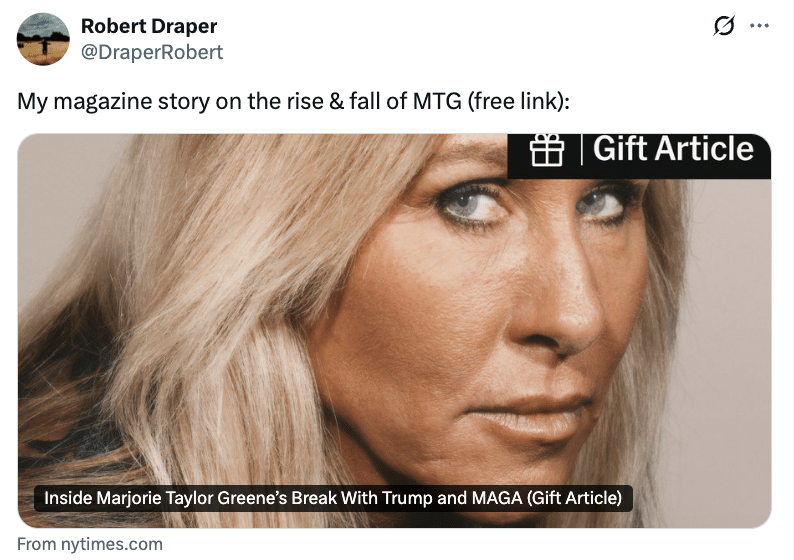
Robert Draper did a 1,000-word piece describing the Four Takeaways of his much longer magazine profile describing Marjorie Taylor Greene’s Break With Trump. It focuses on four steps in the process, which he presents out of chronological order:

  • “Trump’s speech at Charlie Kirk’s memorial was a clarifying moment,” because it contrasted Erika Kirk’s forgiveness with Trump’s lack of Christian faith
  • “Greene’s demands to release the Epstein files seemed to be the last straw for Trump,” because MTG’s threat to reveal the names of those who abused Epstein’s victims would hurt Trump’s friends
  • “Her disillusionment with Trump goes beyond the Epstein files,” in which Draper lumps tariffs and Gaza but focuses primarily on the way Trump’s stochastic terrorism led to threats against MTG’s son
  • “Greene said she was wrong for accusing Democrats of treason in the past,” which simply doubles down on the apology MTG made already on CNN and explained that MTG realized Christians don’t do such things

I don’t doubt that Draper thinks of the transformation he describes as dominated — bullets one and four — by MTG living by her faith, but the word “Christian” only appears in the 8,100-word profile six times.

And word frequency is just one tell that Draper may be indulging MTG’s own retroactive reconstruction of it.

The profile is based on interviews that took place earlier this month, though as Draper recounts, he has been covering MTG closely since 2021 and met with her repeatedly before this month. The Kirk memorial with which Draper began both his profile and his Four Takeaways occurred on September 21. He describes MTG’s perception of the difference between Erika’s forgiveness and Trump’s doubling down as the moment when, “the stress fracture that had been steadily widening between Greene and her political godfather became an irrevocable break.”

But his stress fracture comment introduces a paragraph listing five policy splits with Trump, most of which predate the Kirk memorial, the most important of which — her support for releasing all the Epstein files — predates the memorial by several weeks and gets its own paragraph here and a more focused treatment later.

  • Declaring the war in Gaza a “genocide”
  • Objecting to cryptocurrency and artificial-intelligence policies that, from her perspective, prioritized billionaire donors over working-class Americans
  • Criticizing the Trump administration for:
    • Approving foreign student visas
    • Enacting tariffs that hurt businesses in her district
    • Allowing Obamacare subsidies to expire
  • Argu[ing] that all investigative material pertaining to Jeffrey Epstein should be released

Much later, the profile describes that well before the Epstein break came the realization that Trump does not return loyalty (including a campaign disloyalty similar to the one that drove Elise Stefanik’s later break), followed by Trump’s targeted harassment when MTG opposed his cryptocurrency graft.

She considered running against Senator Jon Ossoff but announced in May that she had decided not to.

Greene’s stated reasoning at the time was that “the Senate is where good ideas go to die.” But the week after her announcement, The Wall Street Journal reported that Trump had shared with her a survey from his pollster, Tony Fabrizio, projecting that Ossoff would beat her by 18 points. Later, Trump would claim in a Truth Social post that their split “seemed to all begin” when he sent her the poll — suggesting, in effect, that Greene was pouting over his lack of support: “All I see ‘Wacky’ Marjorie do is COMPLAIN, COMPLAIN, COMPLAIN!” Greene insisted to me, “It wasn’t about a Fabrizio poll.” She added: “I never had a single conversation with the president about it. Instead, he told me all the time, ‘You should run for governor — you’d win.’”

Still, Greene told me, it began to dawn on her that when it came to the president, loyalty is “a one-way street — and it ends like that whenever it suits him.” Being disabused of the idea that subservience would be rewarded appeared to have a liberating effect on her.

In June, Greene did an about-face on the president’s One Big Beautiful Bill after conceding that she voted for it without realizing that it contained a provision that would prevent states from enforcing restrictions on artificial intelligence for a period of 10 years. If the Senate did not strike the moratorium from the bill, Greene publicly warned, “when the O.B.B.B. comes back to the House for approval after Senate changes, I will not vote for it with this in it.” On July 1, the Senate voted to sever the provision from the bill, which Trump signed into law three days later.

Greene broke again from Trump on July 17, arguing on X that his cryptocurrency bill could permit a future president to “TURN OFF YOUR BANK ACCOUNT AND STOP YOUR ABILITY TO BUY AND SELL!!!!!” This time, Trump made his displeasure known to her — and to her peers.

That same day, Greene and roughly a dozen other House Republicans who also had reservations about the bill were summoned to the Oval Office. In Greene’s recollection, Trump focused his wrath on her. “When you have a group of kids,” she said, “you pick the one that is the most well behaved, that always does everything right, and you beat the living shit out of them. Because then the rest of them are like: ‘Oh, man, holy shit. If Dad does that to her, what would he do to me?’” A White House spokeswoman disputes that the meeting was contentious. “Not surprising to me at all,” Greene replied when I informed her of this. “They have major problems, and it’s only starting to build.”

That all preceded the date when MTG signed the Epstein discharge petition, which Tom Massie initiated in July, the day before Trump told her that his friends would get hurt if she exposed their names.

After the hearing, Greene held a news conference at which she threatened to identify some of the men who had abused the women. (Greene says that she didn’t know those names herself but that she could have gotten them from the victims.) Trump called Greene to voice his displeasure. Greene was in her Capitol Hill office, and according to a staff member, everyone in the suite of rooms could hear him yelling at her as she listened to him on speakerphone. Greene says she expressed her perplexity over his intransigence. According to Greene, Trump replied, “My friends will get hurt.”

When she urged Trump to invite some of Epstein’s female victims to the Oval Office, she says, he angrily informed her that they had done nothing to merit the honor. It would be the last conversation Greene and Trump would ever have.

Along the way, Draper inserts something between the Epstein break and the Kirk epiphany and the ultimate break: the 8-week recess, during which MTG stewed as she heard complaints about affordability from her constituents.

But there was one more important ingredient.

As noted, Draper describes the evolving relationship he had with MTG. He first flew down to Rome, GA, in 2022, and honored MTG’s confidences, which built trust. She blew off a meeting for drinks during last year’s convention because Trump was giving her pride of place at the Convention, but shortly thereafter met with a NYT team and scoffed at their claim Trump would pursue retribution. Draper persisted with someone who adhered to the axiom that real news was fake for years.

There are a lot of lefties who hate this profile: They feel it goes easy on her (and given the Christian reconstruction, I’d agree). They see it as a willingness to let MTG rebrand herself, even while it foregrounds her transphobia. They hate the glam photo of her, which nevertheless provides helpful context to MTG’s claim she always opposed the plastic femininity of Mar-a-Lago (and provides a useful contrast with the still fresh Karoline Leavitt portrait).

In particular, she told me recently: “I never liked the MAGA Mar-a-Lago sexualization. I believe how women in leadership present themselves sends a message to younger women.” She continued: “I have two daughters, and I’ve always been uncomfortable with how those women puff up their lips and enlarge their breasts. I’ve never spoken about it publicly, but I’ve been planning to.”

I would add that Draper still treats Trump as the actor — Trump banished MTG, rather than she stood her ground in face of his demands.

It has been tempting for some observers to predict that the meteoric crash and burn of the MAGA movement’s loudest champion signals the beginning of the end for its leader as well. But it is Greene who is exiting the stage, while Trump continues to dominate it, as he did through impeachments and indictments and other controversies that no other politician would have survived.

Still, Draper hedges his bets. Maybe she will be a harbinger.

But because it represents an evolution for Greene, she may yet again prove to be a harbinger of a sea change in the movement she once helped lead.

By far the most fascinating part of the profile to me is how Draper traces MTG’s cognitive dissonance. In 2022 — and still today — MTG is certain there’s no way Joe Biden could have won the election in 2020.

One autumn evening in 2022, I ventured to ask just how she thought the 2020 election was stolen. Did she really think that a grand conspiracy, perhaps masterminded by the Obamas and the C.I.A., had secretly rigged the results?

“Robert,” she replied with a searching look, “do you really think Joe Biden got 81 million votes without even campaigning?”

“Yes,” I said. “They counted all the votes. That was the final tally. Why wouldn’t I believe it?” The look she then gave me, which I will never forget, was one of bottomless pity.

But the contrast between the earnest stories of the survivors followed by hearing Trump complain that naming those who abused Epstein’s girls would hurt his friends broke through a belief created by the bubble of Fox News.

The reason for her lack of concern, as Greene explained it to me, might seem improbable to anyone who is unfamiliar with how the mainstream press and the right-wing media cover the same story differently — or not at all. “The story to me,” she said, “was that I’d seen pictures of Epstein with all these people. And Trump is just one of several. And then, for me, I’d seen that Bill Clinton is on the flight logs for his plane like 20-something times. So, for people like me, it wasn’t suspicious. And then we’d heard the general stories of how Epstein used to be a member of Mar-a-Lago, but Trump kicked him out. Why would I think he’s done anything wrong, right?”

For Greene, the decades that Epstein spent eluding justice for exploiting and sexually assaulting countless girls and young women while amassing a fortune, and the seeming efforts by the government to cover up the injustice, “represents everything wrong with Washington,” she told me. This September, Greene spoke with several of Epstein’s victims for the first time in a closed-door House Oversight Committee meeting. She knew that the women had paid their own way to come to Washington. She saw some of them trembling and crying as they spoke. Their accounts struck her as entirely believable. Greene herself had never been sexually abused, but she knew women who had. In her own small way, Greene later told me, she could understand what it was like for a woman to stand up to a powerful man.

One of the most important parts of MTG’s split from Trump has been an evolving relationship with the media, especially Fox News, and therefore, the truth, but with Draper always there persisting. That is, MTG had to work through the cognitive dissonance of learning that Trump really did have ties to Jeffrey Epstein’s sex trafficking, that he really was trying to cover it up, before she got to the point of retconning it all inside a faith narrative. Her own banishment from Fox News may have helped work through the cognitive dissonance.

I talk a lot about one of the ways you fight fascism is to peel off members of Congress, four in the Senate or eight in the House. I’ve laid out repeatedly how central the Epstein scandal was to that process.

Whether you like the Draper profile or not, whether or not MTG’s split from Trump will be a harbinger of more (like Stefanik’s) to come, what this profile does do is show what it took for one diehard MAGAt to go through it: political betrayal, real policy differences, retaliation, and then cognitive dissonance regarding Epstein, the Kirk epiphany, until finally responding to his terrorism in a dramatically different way than almost every other Republican, whether MAGAt or not.

There’s a process.

Share this entry

David Sacks and the Entire American Tech Stack Win!

Something funny is happening over at Xitter.

Yesterday, NYT published a 3,000-word profile of David Sacks describing how his installment as the White House AI and crypto czar has led to a number of decisions that may not benefit the US, such as sharing AI technology with UAE in seeming exchange for personal gain for others, including Trump. The profile quotes Sacks’ own spokesperson explaining that poor David Sacks just “wants the entire American tech stack to win.”

It also quotes Steve Bannon, which might hint at where the article came from, warning of the “road to perdition”!

Steve Bannon, a former adviser to Mr. Trump and a critic of Silicon Valley billionaires, said Mr. Sacks was a quintessential example of ethical conflicts in an administration where “the tech bros are out of control.”

“They are leading the White House down the road to perdition with this ascendant technocratic oligarchy,” he said.

In general, the article is a bit of a squish. As one critical example, it doesn’t mention Sacks’ role in fueling a run on Silicon Valley Bank only to whine and whine and whine until Sleepy Joe Biden bailed out the billionaires, the most significant lesson to explain Sacks’ installation.

The closing paragraphs nod to the significance of all this: that at a time when both crypto and AI need a bailout — a vastly bigger bailout than SVB needed — David Sacks is there to ensure that gets prioritized over real America.

In the keynote speech, Mr. Trump described Mr. Sacks as “great” before signing executive orders to speed the building of data centers and exports of A.I systems.

Then he handed Mr. Sacks the presidential pen.

The tech bros need a bailout and Sacks is there to deliver it to them.

But NYT doesn’t lay out the stakes. If this was a Bannon-attempted hit job, it missed its mark.

Or so I thought until I watched the Xitter response to Sacks’ whiny 1,500-word complaint about how he lawyered the article, to which he attached a much longer letter from defamation lawyers.

INSIDE NYT’S HOAX FACTORY Five months ago, five New York Times reporters were dispatched to create a story about my supposed conflicts of interest working as the White House AI & Crypto Czar. Through a series of “fact checks” they revealed their accusations, which we debunked in detail. (Not surprisingly the published article included only bits and pieces of our responses.) Their accusations ranged from a fabricated dinner with a leading tech CEO, to nonexistent promises of access to the President, to baseless claims of influencing defense contracts. Every time we would prove an accusation false, NYT pivoted to the next allegation. This is why the story has dragged on for five months. Today they evidently just threw up their hands and published this nothing burger. Anyone who reads the story carefully can see that they strung together a bunch of anecdotes that don’t support the headline. And of course, that was the whole point. At no point in their constant goalpost-shifting was NYT willing to update the premise of their story to accept that I have no conflicts of interest to uncover. As it became clear that NYT wasn’t interested in writing a fair story, I hired the law firm Clare Locke, which specializes in defamation law. I’m attaching Clare Locke’s letter to NYT so readers have full context on our interactions with NYT’s reporters over the past several months. Once you read the letter, it becomes very clear how NYT willfully mischaracterized or ignored the facts to support their bogus narrative.

In response, every one of the loathesome crypto and AI bros whose installation Sacks served piped up to describe what a hero poor beleaguered David Sacks is.

Mark Andreessen who of course hosts or hosted a private chat of tech bros talking up other tech bros, may have kicked it off with his claim that Sacks was performing some kind of noble citizenship, which Daddy then picked up.

Marc Benioff seconded Gavin Baker’s tautology even while treating AI bros as “builders.”

David Marcus described tech bros’ efforts to collapse dollar hegemony in glowing terms while scoffing at “incompetent technocrats.”

Zach Witkoff — the man facilitating corrupt foreign investment in precisely these technologies — hailed Sacks’ role in “helping advance the ball forward on AI and Crypto.”

Martin Shkreli, who misspelled Sacks’ name, nevertheless insisted this is the kind of guy Americans want selling away American power.

And they all tagged Sacks and he RTed them (well, except for Shkreli) and all these billionaire tech bros were performing a circle jerk for the benefit of the foreign trolls their host has installed, as if that performance itself could affirm the value of all this tech brobery to real Americans.

None of this exposes the real underlying problem here, the degree to which the American economy has been hollowed out so these bro boys can attempt to divorce themselves from the physical reality of real people entirely.

But it performs it.

Share this entry

Trailer Park Slum Lord: The Generational Corruption of Bill Pulte

The thing about Bill Pulte’s corruption is that a fair number of Republicans seem have it in for him, too (as laid out in this Politico piece in September).

That may help to explain the 3,000 word profile airing the family’s dirty laundry while detailing that Pulte’s closest ties to his family’s developing empire are to some decrepit trailer parks.

He did not issue press releases about the five mobile home parks his companies acquired in Florida for about $3 million in the two years before he was nominated to become the F.H.F.A. director in January.

Recent visits to two of the mobile home parks revealed a broken fence and overflowing trash bins. The dozen or so trailers at the parks were aging. Some had windows covered with faded American flags and cardboard. Duct tape patched torn screens.

Documents show Mr. Pulte was the signatory on a $2 million mortgage taken out on three of the properties in August 2024. The woman listed as an agent on some of the mobile home parks also works in his charitable organization. In January 2024, he told an interviewer on an investing podcast that the “Pulte Family” was buying mobile home parks and planning to revamp them amid a market of rising rents.

In the same interview, Mr. Pulte said he planned to make them into “nice communities.”

But his companies have been slow to make repairs, said residents of three of the parks, who spoke on the condition of anonymity because they feared retribution.

A resident of one property, in Lake Worth in Palm Beach County, said he had gone months without a working stove, despite asking the management company to fix it. Another resident said he had spent $300 to repair his broken air-conditioning unit. Some trailer park leases warn tenants that if they miss rent payments, which are due weekly, “they will be removed for trespassing by the local sheriff!!”

At some properties, rents have been rising. A resident at a mobile home park in Cottondale in the Florida panhandle said in a filing in Jackson County Court this summer that his monthly rent had increased to $950 from $550 after Mr. Pulte’s company took over. At a park in Ruskin, south of Tampa, rents recently rose $100 a month — about 16 percent — to pay for a new dumpster, several residents said.

None of the mobile home properties carry the Pulte family’s name.

One of the quickest ways to taint someone in Trump’s eyes is to make him look squalid.

Meanwhile — and purely by happenstance — the Epstein dump James Comer released to distract from Trump’s knowledge of Epstein’s sex trafficking included a document that seems to be Epstein’s side of the split with Trump.

In a February 1, 2019 email first sent to himself (possibly BCCed to someone else?), and then sent to Michael Wolff, Epstein transitions directly from a claim in one of the letters from which Comer was trying to distract — that Trump came to his house a lot while someone Epstein trafficked was there, purportedly Virginia Giuffre — to his description over the fight about the property that Trump would one day launder into cash from Dmitry Rybolovlev, the fight that Trump had also publicly used to explain the split. Much of Epstein’s focus was on his suspicions that Trump didn’t have the money to buy the mansion in the first place and probably didn’t pay taxes on it.

But amid the description, Epstein describes that “his friend pulty the developer” was part of Trump’s bid. If that is Pulte, it would be Pulte’s father who, like Trump’s dad, fronted him in the real estate business. [Update, corrected per this report. h/t DrAwkward]

In Epstein’s mind, then, there’s a tie between Trump’s knowledge he “stole” his spa girl and the fight over the Palm Beach mansion, a fight in which “pulty the developer” played some part.

But all that is in the past.

Let’s move onto concerns about the present and future.

AP reports that an aide to Pulte pulled information on single home mortgage rates and shared it with a competitor. When Fannie executives pointed out this was collusion, they were fired (another part of the explanation for Pulte’s purge last month).

A confidant of Bill Pulte, the Trump administration’s top housing regulator, provided confidential mortgage pricing data from Fannie Mae to a principal competitor, alarming senior officials of the government-backed lending giant who warned it could expose the company to claims that it was colluding with a rival to fix mortgage rates.

Emails reviewed by The Associated Press show that Fannie Mae executives were unnerved about what one called the “very problematic” disclosure of data by Lauren Smith, the company’s head of marketing, who was acting on Pulte’s behalf.

“Lauren, the information that was provided to Freddie Mac in this email is a problem,” Malloy Evans, senior vice president of Fannie Mae’s single-family mortgage division, wrote in an Oct. 11 email. “That is confidential, competitive information.”

He also copied Fannie Mae’s CEO, Priscilla Almodovar, on the email, which bore the subject line: “As Per Director Pulte’s Ask.” Evans asked Fannie Mae’s top attorney “to weigh in on what, if any, steps we need to take legally to protect ourselves now.”

While Smith still holds her position, the senior Fannie Mae officials who called her conduct into question were all forced out of their jobs late last month, along with internal ethics watchdogs who were investigating Pulte and his allies.

This effort seems to stem from Pulte’s response to Trump’s orders to push builders to build more single family homes.

Pulte’s power over the mortgage lending industry is unusual. Not long after his Senate confirmation, he appointed himself chairman of both Fannie Mae and Freddie Mac, which hold trillions of dollars in assets. The companies serve as a crucial backstop for the home lending industry by buying up mortgages from individual lenders, which are packaged together and sold to investors.

The three competing roles present the potential for a conflict of interest that is detailed in emails reviewed by AP. Like many matters of public policy in Trump’s Washington, it appears to have begun with a social media post.

In October, Trump criticized the homebuilding industry, which he likened to the oil-market-dominating cartel OPEC.

“They’re sitting on 2 million empty lots, A RECORD,” the president posted to his social media platform, Truth Social. “I’m asking Fannie Mae and Freddie Mac to get Big Homebuilders going.”

“On it,” Pulte posted in response on X.

That is, Pulte may have abused his overlapping roles running the country’s housing finance in an attempt to solve the fact that he’s not otherwise good at his job.

And so he tried to cheat.

And when caught cheating, he fired the people who caught him.

The fact that Pulte keeps getting caught botching his day job — the one that, when he fails, could tank the entire US if not global economy — has not distracted him from his real love: framing Trump’s enemies.

This time, Eric Swalwell was the target.

A top housing official in President Donald Trump’s administration has referred California Democratic Rep. Eric Swalwell to the Justice Department for a potential federal criminal probe, based on allegations of mortgage and tax fraud related to a Washington, D.C., home, according to a person familiar with the referral.

He is the fourth Democratic official to face mortgage fraud allegations in recent months.

Bill Pulte, the director of the Federal Housing Finance Agency, alleged in a letter sent to Attorney General Pam Bondi on Wednesday that Swalwell may have made false or misleading statements in loan documents.

The matter has also been referred to the agency’s acting inspector general, this person said.

“As the most vocal critic of Donald Trump over the last decade and as the only person who still has a surviving lawsuit against him, the only thing I am surprised about is that it took him this long to come after me,” Swalwell said in a statement to NBC News.

Perhaps Pulte has a whole portfolio of flimsy claims about Trump’s enemies in a folder somewhere, to deliver up to Trump every time someone, even some Republican, raises real concerns about his basic competence.

Thus far, it seems to have insulated him from any real accountability.

Share this entry

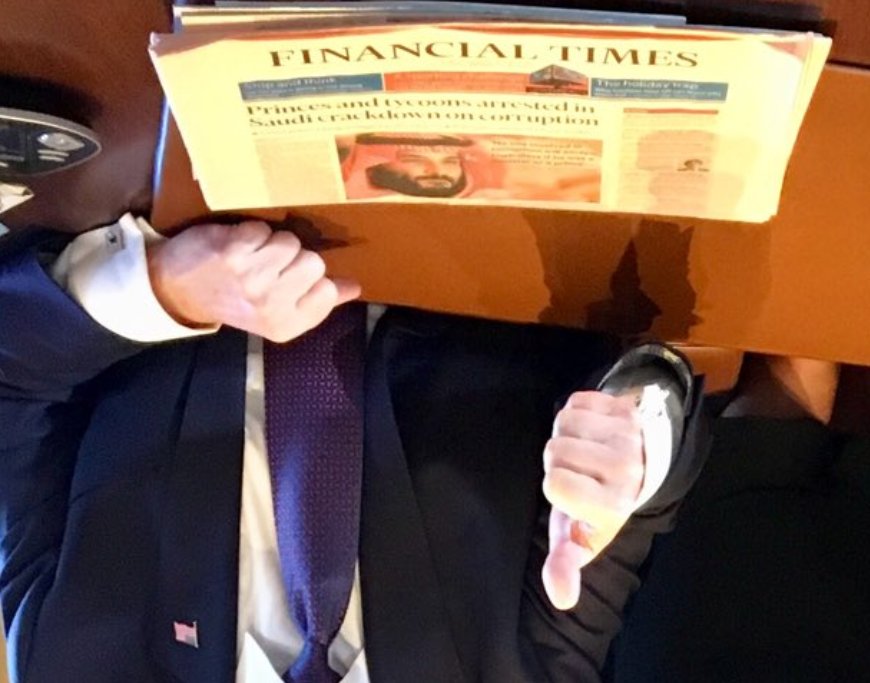
Brazil Charges Coup-Plotter Bolsonaro for Saudi Gifts as Trump Org Unveils New Saudi High Rise

Brazilian authorities will charge Jair Bolsonaro with money laundering for keeping $3.2 million in diamonds given to him and his spouse by the Saudi government.

Brazilian federal police on Thursday formally accused former President Jair Bolsonaro of embezzlement for allegedly misappropriating jewelry he received while head of state, including luxury items given by the Saudi Arabian government, two police sources said.

This is the second time police have formally accused Bolsonaro of a crime. He was charged in March with forging his COVID-19 vaccine records.

The jewelry, some of it made by Chopard of Switzerland, was valued at $3.2 million and included a diamond necklace, ring, watch and earrings given to Bolsonaro and former first lady Michelle Bolsonaro by the Saudi government.

Some of the jewelry was seized by customs officials at Sao Paulo’s international airport in October 2021 when it was found in the backpack of a government aide returning from Riyadh.

The police accused Bolsonaro of money laundering, criminal association and embezzlement, according to one of the sources, who spoke to Reuters on the condition of anonymity.

Meanwhile, buried on page A7 of the NYT on Monday, behind mountains of stories about Old Man Joe Biden, NYT’s Eric Lipton reported that Trump Organization unveiled in new project in Saudi Arabia.

The Trump Organization has signed a new deal with a Saudi real estate company to build a residential high-rise tower in the city of Jeddah, extending the family’s close ties with the kingdom.

Saudi Arabia has become one of the few reliable sources of growth for the Trump family’s business operations, as new real estate deals in the United States have slowed or stopped since the Jan. 6, 2021, assault on the Capitol and since former President Donald J. Trump left the White House.

This new deal is like other international projects the Trump family has signed over the past decade. It offers the family’s name and brand to a well-financed developer that will build the project and sell luxury resident units, it hopes at a premium, based on the marketability of the former president’s perceived star power. Other projects include a resort complex in Oman and Saudi-backed golf tournaments at Trump courses in recent years.

This seems to be structured like the Moscow Trump Tower deal would have been: basically, free money to the Trump Organization for the use of a coup-plotter’s brand.

The Saudis allegedly supported one coup-plotter with piddling gifts of mere millions. Meanwhile, it has been funneling far more to the Trump family, all in plain sight (albeit buried beneath a bunch of breathless coverage of Joe Biden’s age).

Isn’t it time voters learned whether the Republican candidate for President is a mere house boy for the Saudi royal family?

Share this entry

An Egyptian Bank Claimed Details of a Suspected $10 Million Payment to Trump Might be in China

Back on September 19, 2018, then DC Chief Judge Beryl Howell denied a motion brought by an Egyptian bank to quash a subpoena for information on a suspected $10 million payment made to then-candidate Trump in fall 2016. That set off litigation that continued, at the District, Circuit, and Supreme Courts, for at least nine months.

As CNN described in 2020, not long after the investigation got shut down under Bill Barr, investigators had been trying to see whether Egypt (or some entity for which Egypt served as go-between) provided the money that Trump spent on his campaign weeks before the election.

For more than three years, federal prosecutors investigated whether money flowing through an Egyptian state-owned bank could have backed millions of dollars Donald Trump donated to his own campaign days before he won the 2016 election, multiple sources familiar with the investigation told CNN.

The investigation, which both predated and outlasted special counsel Robert Mueller’s probe, examined whether there was an illegal foreign campaign contribution. It represents one of the most prolonged efforts by federal investigators to understand the President’s foreign financial ties, and became a significant but hidden part of the special counsel’s pursuits.

The investigation was kept so secret that at one point investigators locked down an entire floor of a federal courthouse in Washington, DC, so Mueller’s team could fight for the Egyptian bank’s records in closed-door court proceedings following a grand jury subpoena. The probe, which closed this summer with no charges filed, has never before been described publicly.

Prosecutors suspected there could be a link between the Egyptian bank and Trump’s campaign contribution, according to several of the sources, but they could never prove a connection.

It took months of legal fight after Judge Howell denied that motion to quash before the Egyptian bank in question complied, and once they got subpoena returns, prosecutors repeatedly complained that the bank was still withholding information, which led prosecutors to reopen the investigation with a new grand jury.

That much we know from documentation unsealed back in 2019 (part one, part two, part three), in response to a Reporters Committee for Freedom of the Press request for unsealing.

On August 17, 2023, while she was still Chief Judge, Beryl Howell ordered the government to post newly unsealed sets of some of the orders she issued during the litigation. On Thursday, Chief Judge Boasberg ordered that newly redacted set of opinions to be released. While Howell released six opinions in June 2019 along with the other materials from the case — with redactions done digitally, thereby hiding the length of redactions — just three new versions of her orders got released last week:

These may be limited to orders incorporated as appendices in prior appeals, which might also explain why the first two appear twice in the newly-released materials.

Much of the newly unsealed material pertains to a fight over how much Alston & Bird, the law firm representing the Egyptian bank, could say about the litigation publicly. Among other things, prosecutors under Robert Mueller objected to their own names appearing publicly, out of a desire to tie this litigation to the narrow scope of Mueller’s investigation into interference in 2016.

One thing made clearer by a redaction in that January 2019 opinion on public comments is that the DC Circuit considered what public comments the two sides could make, in addition to SCOTUS, as part of its denial of cert.

It’s possible that the DC Circuit has weighed in, secretly. Among the details newly unsealed in the original opinion are the names of two of the bank’s other lawyers: Ashraf Shaaban (who appears to be or have been in-house counsel) and Mona Zulficar (who runs a Cairo corporate law firm). Those lawyers were named in conjunction with declarations they submitted arguing some part of the claim that Egyptian Anti-Money Laundering law would prohibit compliance with the subpoena as would unspecified law in a third country, described as Country B

Howell described that Alston & Bird are relying on,

conclusory declarations by [redacted] own Country A in-house and retained counsel, which themselves cite no legal authority on this question of [redaction] See Decl. of Ashraf Shaaban,, Mov’s Group Legal Counsel (“Shaaban Decl.”)¶7, ECF No. 3-6; Suppl. Decl. of Mona Zulficar, “Suppl. Zulficar Decl.”)¶ 4, ECF No. 12. The Court gives these declarations little weight. [bold newly unsealed, compare this passage with this one]

So if we can figure out who Shaaban works or worked for to ID the bank.

It’s the unspecific third country, Country B, that is the most interesting new disclosure, however.

The newly unsealed passages do not identify which country, described as Country A and which CNN identified as Egypt, owns this bank. But they do show that the bank or its lawyers wanted to share the subpoena with personnel in Cairo.

The newly unsealed passages do identify which third country’s laws, unspecified laws, might prohibit lawyers from searching for responsive documents in that country: China.

In other words, a bank owned by Egypt said it couldn’t comply with a subpoena seeking information on a suspected payment to Trump during the 2016 election, in part, because China’s laws would prevent that.

Update: Ashraf Shaaban works for the National Bank of Egypt.

Share this entry

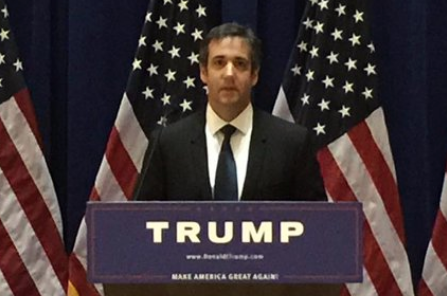
“Swept Up!” The Russian Payments that Led to Trump’s Felony Conviction

There has been a lot of performed ignorance about the origin of the investigation that led to the felony conviction of Donald Trump.

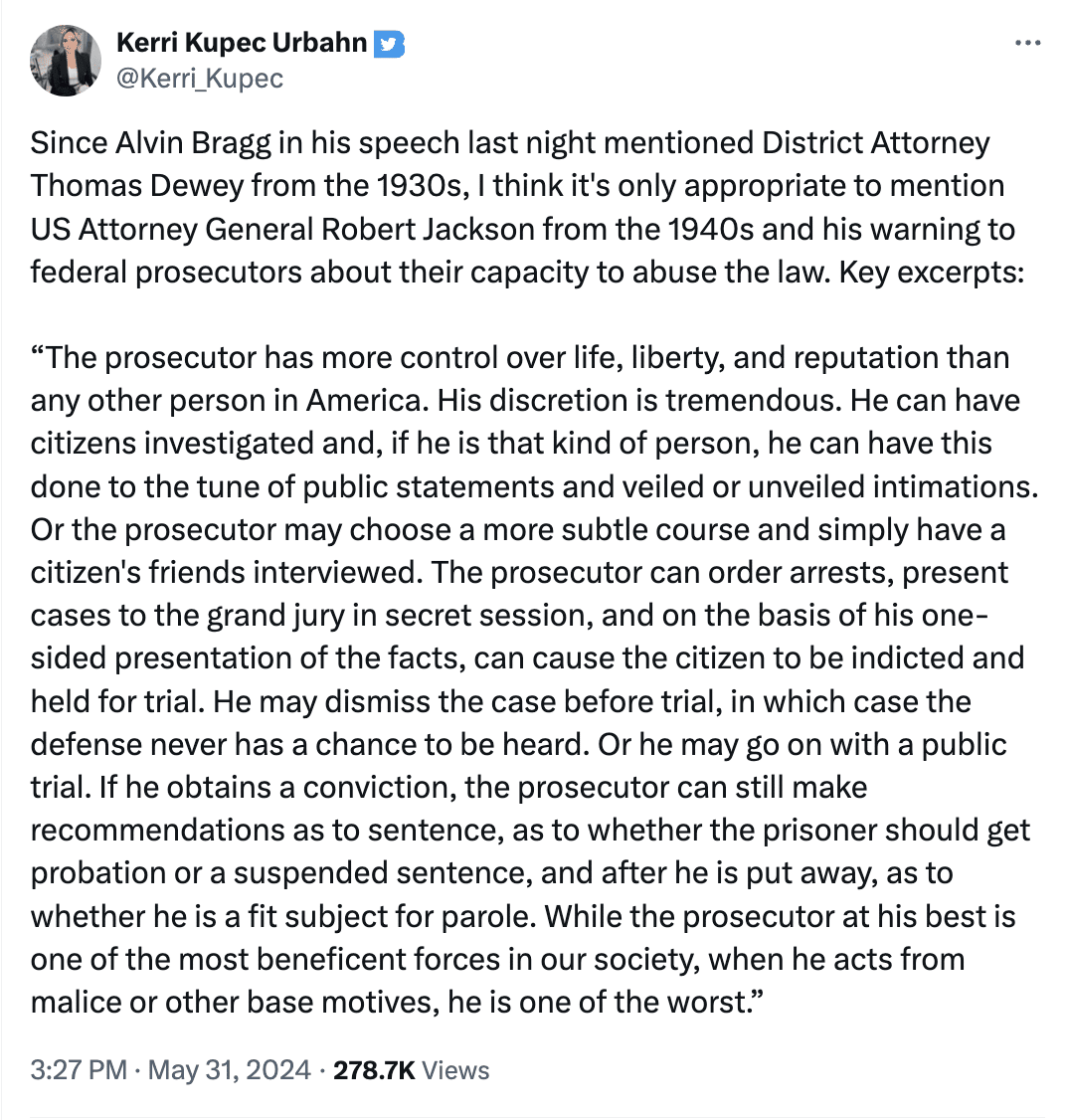
Former Attorney General Jeff Sessions’ spox, Sarah Isgur, quoted Robert Jackson about prosecutors choosing defendants.

Kerri Kupec, the DOJ spox who helped Bill Barr spin key aspects of his unprecedented corruption at DOJ, likewise quoted Jackson.

Both mouthpieces for Trump’s DOJ insinuated that Alvin Bragg invented this case out of thin air, rather than pursuing the fraud revealed by an investigation that developed — and was substantially interfered with by Barr — while they were at DOJ.

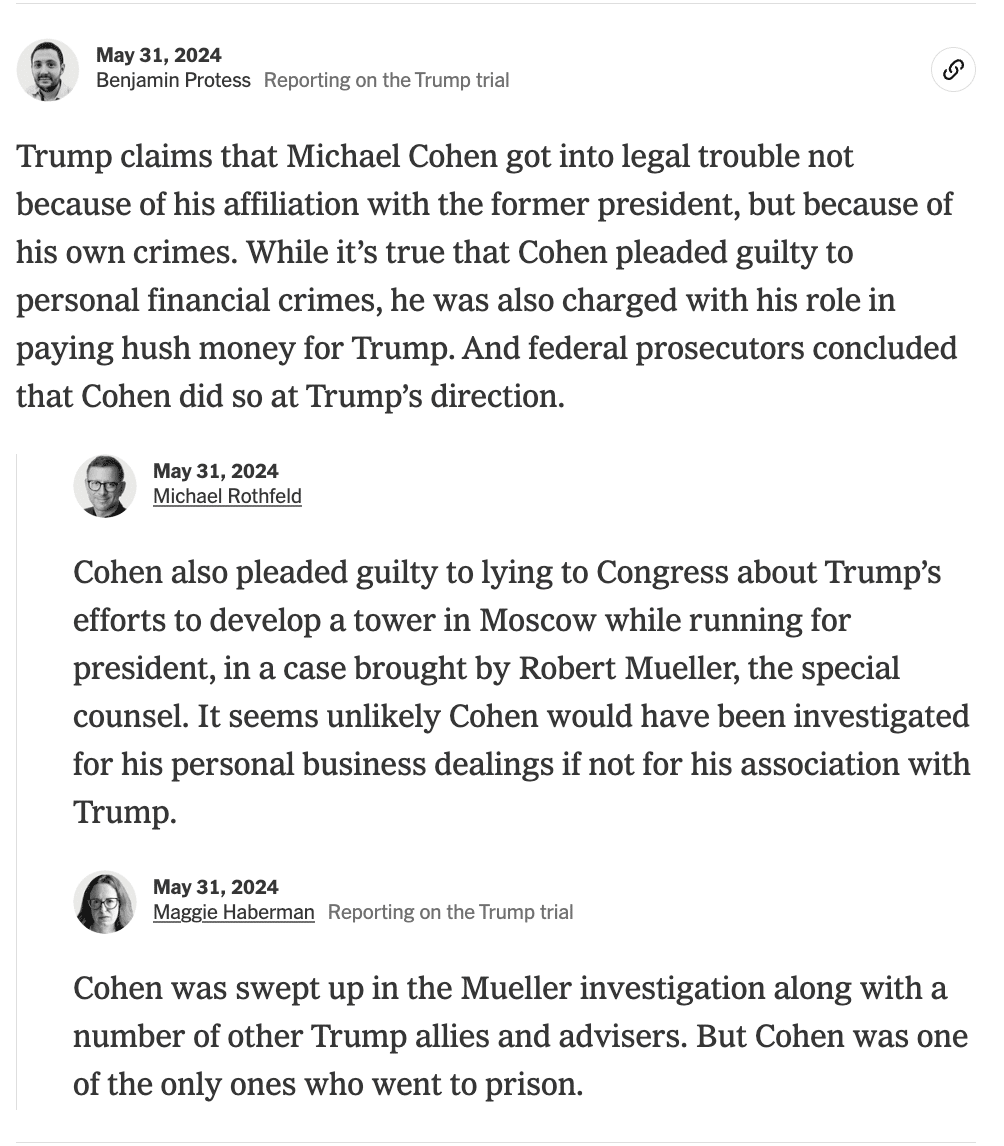
Then, three of the NYT reporters who commented on Trump’s wild screed the other day mused about whence this investigation might have come from, with Maggie describing those whose own actions made them targets of the Mueller investigation in the passive voice, “swept up,” as she is wont to do (to say nothing about her refusal to discuss the way Trump’s pardons silenced key witnesses against him).

We know whence the investigation into Cohen, and therefore the investigation into Trump, came from, thanks in part to a media coalition including NYT, because the coalition liberated the warrants used to investigate Cohen.

As the first warrant targeting Michael Cohen, dated July 18, 2017, lays out, the investigation started from information “supplied by” — almost certainly in the form of Suspicious Activity Reports — a bank known to be First Republic Bank.

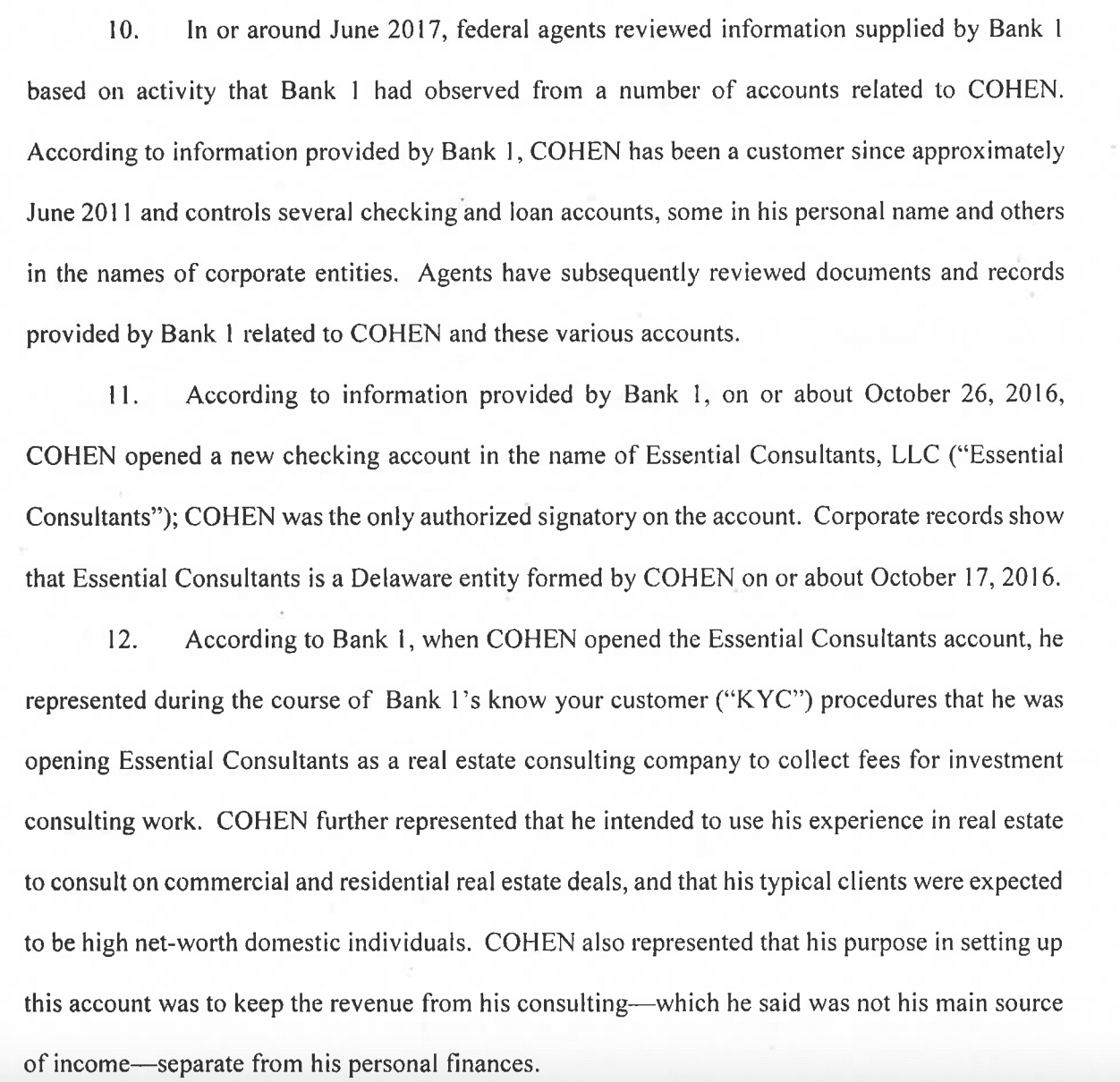
This Know Your Customer filing was submitted as an exhibit at the Trump trial.

The entity will be set up to receive consulting fees in the form of wires and ACH — all under 10K 1-2 a month, the wires and fees will be income from consulting work from personal clients, all domestic. He will then internally transfer the funds to his personal account at First Republic. He is setting this account to keep the income from his consulting work separate.

Even the original Stormy Daniels payment violated the representations Cohen made in that KYC statement (as likely explained in still-redacted passages in the warrant affidavit).

As Gary Farro, a witness who had worked at First Republic explained at trial, Cohen denied that the account (and an earlier one, Resolution Consultants, the plan for which he abandoned) had anything to do with political fundraising.

Q Looking now at the question in — labeled number 12. What does that say?

A “Is the entity associated with political 21 fundraising/political action committee PAC.”

Q And what answer is checked?

A “No.”

Q And do you know why the form includes a question about political fundraising?

A Because it would be something the bank would want to know.

Q And if somebody checked “yes,” is that something that would require additional review by the bank?

A Yes, it would.

[snip]

Q And looking at the questions towards the top third of 3 the page.

In the form does it say — does this have the same question that we saw in the Resolution Consultants form?

It says: “Is the entity associated with political fundraising or political action committee.”

A Yes. This is just the digital form of what was provided earlier, which would be the hard copy.

Q What’s the answer to the political fundraising question 11 on the form?

A Is “No.”

Q Now, turning to the business narrative portion in the middle of the page.

What business narrative is provided for Essential Consultants LLC?

A It’s Michael Cohen is opening Essential Consultants LLC as a real estate consulting company to collect fees for investment consulting work he does for real estate deals.

Within days after he set up the account on October 13, 2016, his October 27 transfer to Keith Davidson violated Cohen’s claims to be engaging in real estate deals. As Farro explained, had Cohen indicated the transfer had a political purpose, it would have invited more scrutiny from the bank — and possibly a delay in the payment.

Q Did any of the wire transfer paperwork indicate that money was being transferred on behalf of a political candidate?

A No.

Q Would the bank’s process for approving the wire transfer be different if Mr. Cohen had indicated that the money was being transferred on behalf of a political candidate?

A We would have additional due diligence.

Q Would that have delayed the transaction?

A It certainly could.

Had it ended with just that hush payment, had the hush payment remained secret, Cohen might have gotten away with it.

But it didn’t.

As that first warrant goes on to explain, after Cohen quit Trump Organization and announced he was serving as Trump’s personal lawyer, he used the same account to accept payment from a bunch of foreign companies, some of them controlled by foreign governments. That led the bank to provide more information — again, almost certainly in the form of SARs — to the Feds.

The most alarming of those payments involved $416,665 in payments over five months from Columbus Nova, which is ultimately controlled by Viktor Vekselberg.

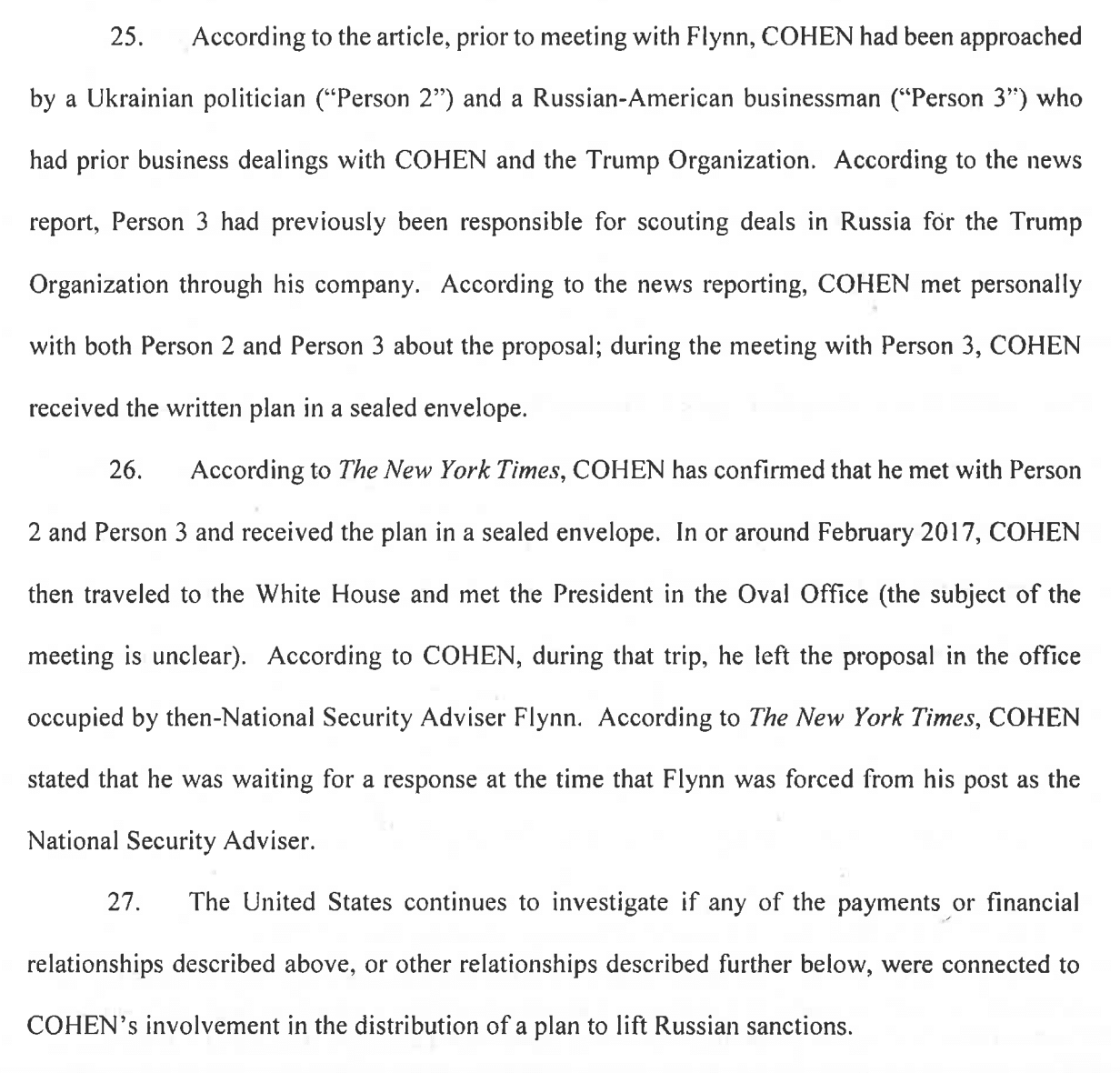
The reason those payments were such a concern is that, as the NYT itself reported on February 19, 2017, Andrii Artemenko (Person 2) and Felix Sater (Person 3) had used Cohen to pitch a “peace deal” for Ukraine to Mike Flynn.

The warrant affidavit really downplayed the substance of the NYT story, which described Artemenko claiming that the “peace plan” “he had received encouragement for his plans from top aides to Mr. Putin.” In the story, Cohen excused chasing a plan with support from Russia based on Artemenko’s claim to have proof of corruption implicating then Ukrainian President, Petro Poroshenko.

After speaking with Mr. Sater and Mr. Artemenko in person, Mr. Cohen said he would deliver the plan to the White House.

Mr. Cohen said he did not know who in the Russian government had offered encouragement on it, as Mr. Artemenko claims, but he understood there was a promise of proof of corruption by the Ukrainian president.

“Fraud is never good, right?” Mr. Cohen said.

Cohen’s claim that, “Fraud is never good,” did not make the warrant affidavit that would set off an investigation that would lead to the conviction of Donald Trump on 34 counts of fraud.

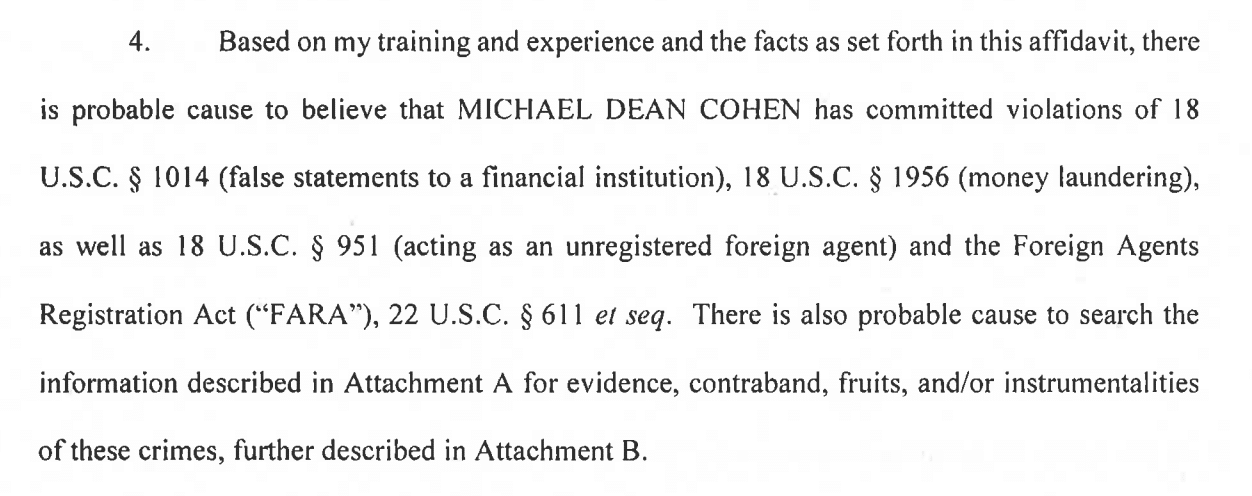
The payments from Columbus Nova — along with payments from Korea Airspace Industries, Kazkommertsbank, and Novartis — would undoubtedly have resulted in SARs in any case. But given the report on the “peace deal,” it substantiated probable cause to suspect that Cohen was acting as an agent of a foreign power and/or violating FARA, which statutes were two of the four crimes the warrant authorized the FBI to investigate.

But false statements to a financial institution were also in there, in part, lying to First Republic about using the Essential Consultants account to pay off porn stars and accept big payments from foreign companies.

Michael Cohen, and so, Donald Trump, was not investigated simply because he had ties to Donald Trump. Claiming he was ignores the public record, including legal and reporting work done by the NYT. It ignores Cohen’s actions, including boneheadedly stupid moves he made as he tried to profit from his proximity to Trump.

He was investigated because he lied to his bank and then, even as he was making public comments about entertaining a “peace deal” with Russian involvement, used the bank account associated with the hush payment to accept big payments from a prominent Russian oligarch.

Importantly, this predication — a SAR implicating a politically exposed person about big payments from a foreign company — is far more than what predicated the investigation, and now six years of non-stop attention from the GOP, into Hunter Biden. That investigation started from a SAR about sex workers, from which an IRS agent fished out Hunter Biden’s name and then spent seven months digging before using Burisma to predicate a grand jury investigation.

If mouthpieces for Trump’s DOJ have a problem with this investigation, then they should be speaking out even more loudly about the investigation into Hunter Biden in which Bill Barr personally tampered.

Update: Corrected an error where I transposed the number of fraud counts Trump was convicted on. It’s hard to keep count!

Update: Isgur is out with an op-ed that scolds Hunter Biden he should plead guilty, without noting that to appeal the motion to dismiss based on the reneged plea deal, he can’t do that. Isgur also doesn’t mention that the gun shop doctored the form.

Share this entry

Trump Undone by the Truth of His Pecker

In days ahead, the criminal protection racket known as the GOP will spend an enormous amount of energy reinforcing Trump’s spin on the crimes of which he was convicted.

The court room was so cold it violated his due process rights.

Any judges who have Democrats in their family are disqualified from presiding over trials of Donald Trump.

It is unfair for a man to be tried in the state where he lived for 70 years of his life, where he built a business, where he committed his crimes.

Trump cannot be prosecuted for cheating to win while he was President and cannot be prosecuted for cheating to win after he lost the presidency.

Trump’s practice of hiring liars to lie for him should immunize him from any criminal liability for crimes committed by those liars.

All of this is nonsense. But it is nonsense that has become an article of faith for members of a cult that make up 40% of the US voting population. All of this nonsense is the price of admission to the Republican Party. And because they all adhere to this nonsense, it serves as a kind of reality for those who adhere to that faith.

I’m of the belief that Trump’s prosecution will only matter if the entire GOP is held accountable for willfully sustaining the Reality Show that says Donald Trump, and only Donald Trump, must be immune from accountability. Indeed, the criminal protection racket must double down now, because if Donald Trump starts being held accountable for his own actions, then the years of coddling his misconduct — the corrupt choices they made to sustain his fiction of invincibility — may start to backfire on all those who made those corrupt choices.

Upholding the fraud Donald Trump has been spinning for eight years has become an object of survival for the entire party. And not just for the party, but for their psyches.

And that’s why it is important to emphasize why Donald Trump lost the case, as was made clear by the single substantive question the jurors had: To re-read four passages of testimony, three involving David Pecker.

Those passages made it clear that Trump was personally involved in efforts to kill stories that would harm Trump’s election chances — and that Pecker refused to kill a third, the Stormy Daniels story, in part because he couldn’t have his tabloid be associated with a porn star.

Q. Around this time, in October of 2016, did you also have any conversations with Michael Cohen about Stormy Daniels?

A. Yes, also a number of conversations.

Q. Can you tell the jury about some of those conversations?

A. Michael Cohen asked me to pay for the story, to purchase it.

I said, I am not purchasing this story. I am not going to be involved with a porn star, and I am not — which I immediately said, a bank. After paying out the doorman and paying out Karen McDougal, we’re not paying any more monies.

Q. How did Michael Cohen take that?

A. He was upset. He said that The Boss would be furious at me and that I should go forward in purchasing it.

I said, I am not going forward and purchasing it. I am not doing it. Period.

Pecker’s testimony, which validated Michael Cohen’s, came from a man who said he still considers Trump a friend. It came from a man who said he viewed Trump as a mentor.

David Pecker spent years spinning fictions. He put that fiction spinning machine to work for Trump’s campaign, attacking his opponents and killing harmful stories.

And then, he told the truth about spinning those fictions. He told the truth about why and how he spun those fictions. He told the truth about Trump’s role in spinning those fictions.

Trump’s success, his persona, has always been a careful creation built on fraud.

And that fraud became criminal in significant part because David Pecker told the truth about the fictions that go into sustaining the fraud.

Update: ernesto1581 reminded me that this account of the epic production efforts that went into making Trump look like a flashy CEO came out yesterday, thanks to the final lapse of the NDA.

Share this entry

Michael Schvartsman Prepares to Plead … with Trump Org’s Sometime Lawyer Alan Futerfas

Days after the merger between Truth Social and Digital World Acquisition Corporation went through, the new company, Trump Media and Technology Group, released its 8K. It described that it’s not sure Truth Social will make it a year.

In connection with the Company’s assessment of going concern considerations in accordance with Financial Accounting Standard Board’s Account Standards Update (“ASU”) 2014-15, “Disclosure of Uncertainties about an Entity’s Ability to Continue as a Going Concern” as stated above, the Company has until September 8, 2024 to consummate a Business Combination. It is uncertain that the Company will be able to consummate a Business Combination by this time. If a Business Combination is not consummated by this date, there will be a mandatory liquidation and subsequent dissolution of the Company. Additionally, the Company has incurred and expects to incur significant costs in pursuit of its acquisition plans. The Company lacks the financial resources it needs to sustain operations for a reasonable period of time, which is considered to be one year from the date of the issuance of the financial statements. As a result, these factors raise substantial doubt about the Company’s ability to continue as a going concern. The financial statements do not include any adjustments that might result from the outcome of these uncertainties.

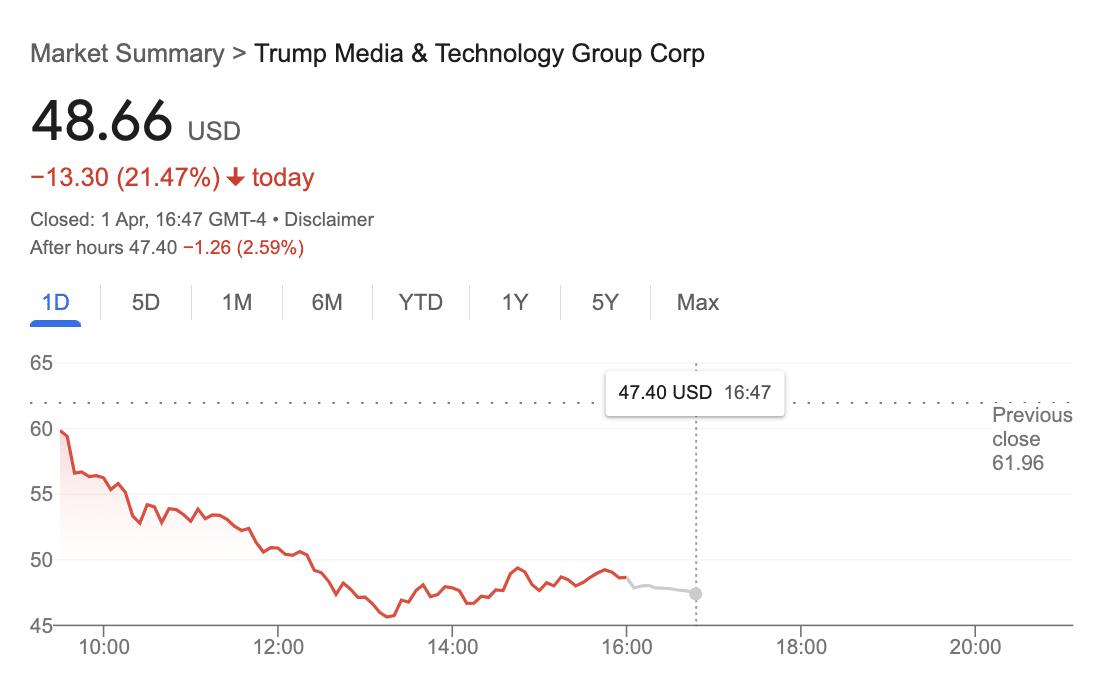
It further described that it is hemorrhaging cash. Josh Marshall did a thread on it and concluded the company is basically worthless. (Update: Now he has done a full post on it.)

TMTG tanked on the news.

As that was happening, something curious was happening in the case of Michael Schvartsman.

He was charged last summer with insider trading in conjunction with the merger between DWAC and Truth Social. In February, DOJ supserseded his indictment, adding a money laundering charge for laundering the proceeds of his insider trading to buy a yacht he has since renamed Provocateur.

As part of the pretrial motions, lawyers revealed that a Russian porn investor, Anton Postolnikov, had also participated in the insider trading.

A Russian-American businessman based in Miami is suspected of making nearly $23 million from alleged insider trading involving former President Donald Trump’s media company, according to federal court records.

The businessman, Anton Postolnikov, is the owner of a Caribbean bank that caters to the porn industry and also reportedly loaned $8 million to Trump’s media company. Postolnikov, who owns a few residences on exclusive Fisher Island in Miami, is the nephew of a former high-ranking Russian government official who at one time was a staffer for Russian President Vladimir Putin, according to media reports.

[snip]

One of Troiano’s affidavits includes an e-mail Garelick sent Postolnikov on June 24, 2021, about four months before the merger was announced.

“Anton, Good times last night! Following up on that Trump Media Group SPAC we mentioned. The deal is going to finalize this week. Please let us know if you are interested in investing. . . .,” Garelick wrote in the message, which was also copied to Michael Shvartsman.

In March, the judge in the case, Lewis Liman, rejected the motions to dismiss of Schvartsman and his co-defendants.

Today, Schvartsman and his brother, Gerald, docketed plans to change their plea on Wednesday.

Normally, that’d just be an interesting coincidence with Trump’s crashing social media empire.

Except for one detail. Also today, Schvartsman added a lawyer to his defense team: Alan Futerfas.

Futerfas has long done work for Trump Organization and was closely involved on Don Jr’s representation during the Mueller investigation.

Share this entry

As the GOP House Burns, James Comer Keeps Sniffing Dick Pics

As of yesterday, the House had gone for 17 days without a Speaker. Patrick McHenry, McCarthy’s temporary replacement, says he no authority to do anything but schedule yet more futile votes (and, apparently, evict Nancy Pelosi and Steny Hoyer).

The government has less than four weeks of funding.

It’s not clear anything set up by McCarthy before his deposition should be proceeding.

But all the while — this entire time that House Republicans have been struggling to fulfil the most basic function of government — James Comer and his staffers have been hunched in a dark room somewhere, feverishly pursuing the same delusions of dick pics and … personal loans!! … they’ve been frothing over since January.

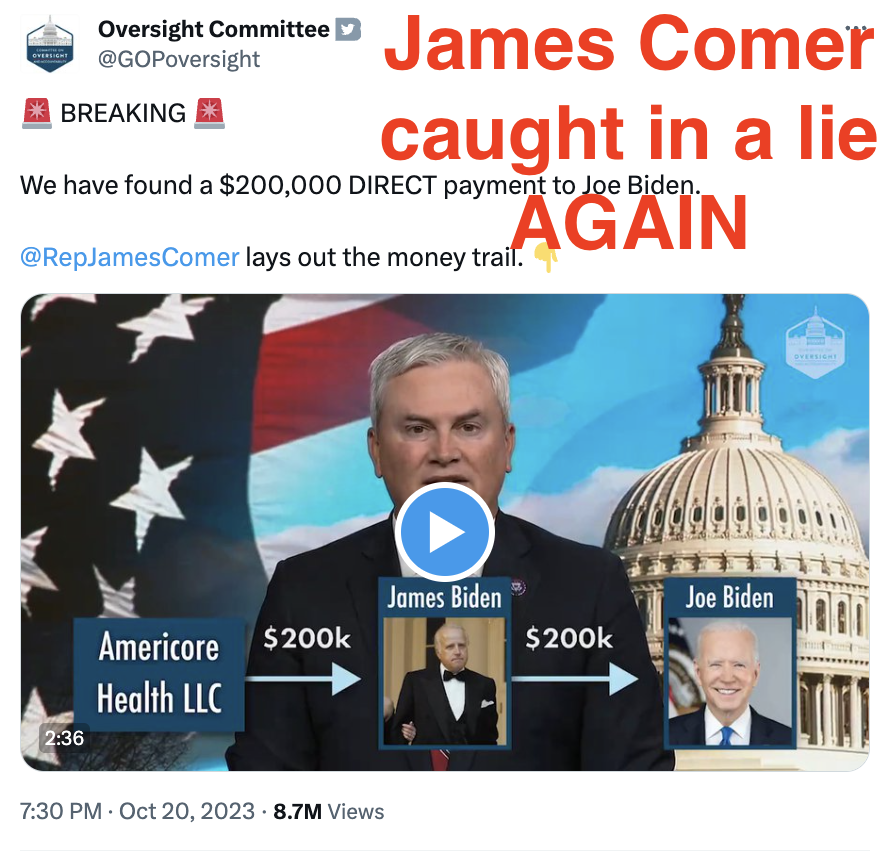
And so it was on Friday afternoon, after Jim Jordan’s third humiliating defeat in the House, that Comer ran out, like a child discovering a dead frog in a gutter, waving a check.

It was a check that James Biden — the President’s brother — used to pay off a personal loan on March 1, 2018, over a year after Joe Biden left the Naval Observatory, years before Joe Biden entered the White House, and six weeks after his brother gave him that loan.

As Democrats explained minutes after James Comer ran out waving his dead frog, after 3 million people had already poked around at Jamey’s dead frog, Joe Biden loaned his brother $200,000 six weeks earlier.

James Biden paid it off.

As of this moment, 8 million people have excited themselves with Comer’s transparent bullshit about that check, all the while Comer and Jim Jordan and Kevin McCarthy and Steve Scalise have proven themselves impotent to do the most basic things Nancy Pelosi did — in heels and backward — to keep the House running for years.

While millions of fragile-minded dupes glee over a check between brothers, Republicans haven’t managed to keep the House open or fund the Government.

Some guy from Kentucky fiddling while the House burns.

In the weeks since Comer got his stash of (as Democrats described) another 1,400 records payments for, “life insurance policies, doctor visits, holiday and birthday presents, groceries, vet visits and pet care, and plumbing repairs” and Matt Gaetz deposed the Speaker, the Trump Organization fraud trial in NYC has shown:

  • Eric Trump claimed he “pour[ed] concrete” rather than dealt with the appraiser who described that he had “lofty ideas” about valuation
  • Trump’s retired CFO and co-defendant Allen Weisselberg,
    • Professed to be unable to answer 90 questions
    • Claimed his $2 million severance had nothing to do with his criminal tax penalty, to say nothing of his forgetfulness
    • Was accused, by Forbes, of lying on the stand about his involvement in Trump’s three-times inflation of his penthouses square footage
  • Weisselberg’s son Jack was involved in key loans pertaining to Trump Tower and another NYC property
  • Mazars complained that Trump Organization, “were not getting us all the documents” they needed to do their work

Every one of these is a scandal worth a congressional hearing. Every one of these should raise questions about whether the guy engaging in so much adjudged fraud while claiming it didn’t matter because he could just find some “buyer from Saudi Arabia” to make him good should be anywhere in politics, much less in the White house.

But instead, James Comer is waving his dripping dead frog around — a personal check for a personal loan between brothers — like he just found a $2 billion bribe from Saudi Arabia.

This is … fucking insane.

Republicans can’t keep their own caucus together. They may not be able to keep government open.

And all the while, James Comer is there writhing around about about easily debunked conspiracy theories about a personal loan.

Share this entry

Alleged Menendez Co-Conspirator Fred Daibes’ Life Just Got More Difficult

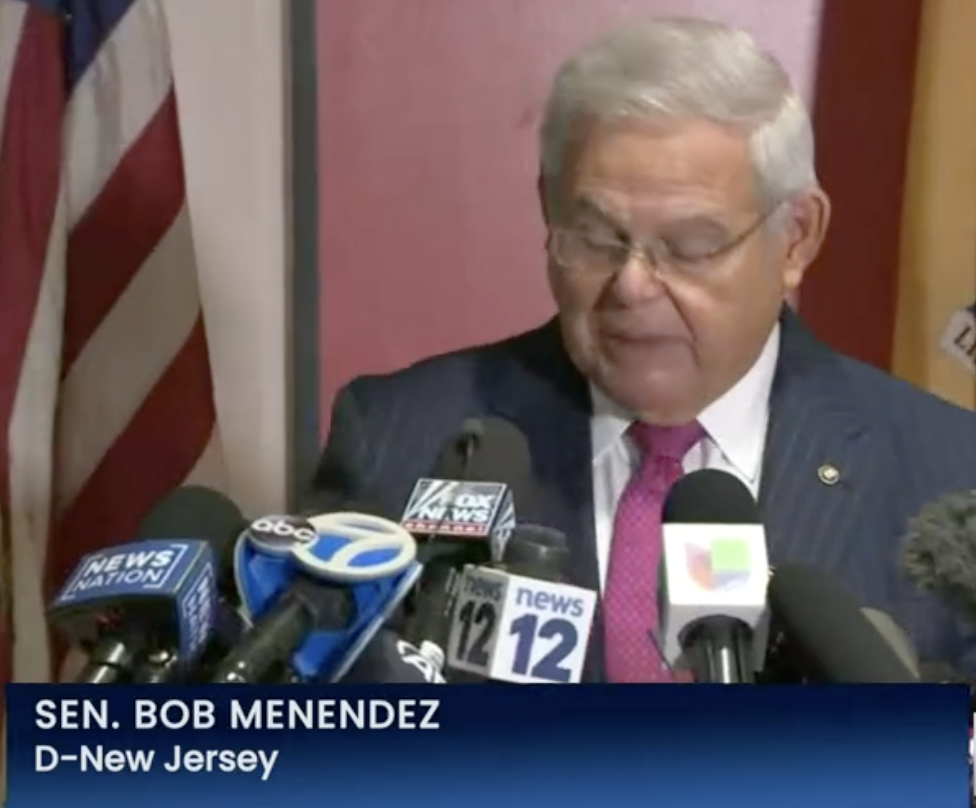
In Robert Menendez’ side of the Robert Menendez bribery docket, things are going as they do at the beginning of complex prosecutions: The two sides are squabbling over protective orders and prosecutors are asking for a CIPA hearing.

Not so on Fred Daibes’ side.

Daibes, you’ll recall, is the long-term Menendez fundraiser implied to have given Menendez gold bars to help him beat a criminal prosecution. The indictment alleges that Menendez tried to intervene with the US Attorney he helped get the job, Phil Sellinger, as well as Sellinger’s First AUSA, but failed to have much of an effect.

According to the indictment, Menendez did. The indictment alleges that Menendez raised Daibes before supporting Sellinger for the nomination.

In that meeting, MENENDEZ criticized the U.S. Attorney’s Office for the District of New Jersey’s prosecution of FRED DAIBES, the defendant, and said that he hoped that the Candidate would look into DAIBES’s case if the Candidate became the U.S. Attorney. MENENDEZ did not mention any other case in the meeting. After the meeting, the Candidate informed MENENDEZ that he might have to recuse himself from the DAIBES prosecution as a result of a matter he had handled in private practice involving DAIBES. MENENDEZ subsequently informed the Candidate that MENENDEZ would not put forward the Candidate’s name to the White House for a recommendation to be nominated by the President for the position of U.S. Attorney.

And Menendez allegedly called Sellinger’s First AUSA, Vikas Khanna.

b. On or about January 21, 2022, MENENDEZ called Official-3 and asked the identity of Official-3’s First Assistant U.S. Attorney (“Official-4”). As a result of Official3’s recusal, Official-4 had supervisory responsibility over the prosecution of DAIBES.

[snip]

d. On or about January 24, 2022, DAIBES’s Driver exchanged two brief calls with NADINE MENENDEZ. NADINE MENENDEZ then texted DAIBES, writing, “Thank you. Christmas in January.” DAIBES’s Driver’s fingerprints were later found on an envelope containing thousands of dollars of cash recovered from the residence of MENENDEZ and NADINE MENENDEZ in New Jersey. This envelope also bore DAIBES’s DNA and was marked with DAIBES’s return address. In or about the early afternoon of January 24, 2022— i.e., approximately two hours after NADINE MENENDEZ had texted DAIBES thanking him and writing “Christmas in January”—MENENDEZ called Official-4, in a call lasting for approximately 15 seconds. This was MENENDEZ’s first phone call to Official-4. On or about January 29, 2022—i.e., several days after NADINE MENENDEZ had texted DAIBES, thanking him and writing “Christmas in January”—MENENDEZ performed a Google search for “kilo of gold price.”

[snip]

45. Official-3 and Official-4 did not pass on to the prosecution team the fact that ROBERT MENENDEZ, the defendant, had contacted them as described in the above paragraphs, and they did not treat the case differently as a result of the above-described contacts. In or about April 2022, FRED DAIBES, the defendant, pled guilty pursuant to a plea agreement that provided for a probationary sentence.

Apparently completely unrelated to all that, after a series of continuances on Daibes’ sentencing after entering into a sweetheart plea deal, the judge in the case, Susan Wigenton, threw out the terms of the deal (presumably meaning the probation sentence).

TEXT ORDER as to FRED DAIBES, MICHAEL MCMANUS: All parties are hereby advised that, pursuant to Federal Rule of Criminal Procedure (Rule) 11(c)(3)(A), and as stated on the record on April 27, 2022, the date of the Courts deferred decision of acceptance of the plea agreement at the time of the entry of Defendant Fred Daibes’s plea of guilty, the Court has had an opportunity to review the presentence report (PSR). Pursuant to Rule 11(c)(5), the Court hereby rejects the plea agreement dated April 13, 2022. (D.E. 67.) Similarly, as stated on the record on May 24, 2022, the date of the Courts deferred decision of acceptance of the plea agreement at the time of the entry of Defendant Michael McManus’s plea of guilty, the Court has had an opportunity to review the PSR. Pursuant to Rule 11(c)(5), the Court hereby rejects the plea agreement dated May 5, 2022. (D.E. 76.) The Court is not required to adhere to the terms of the plea agreements, and the cases may be disposed of less favorably toward the Defendants than the plea agreements contemplated. Should any party wish to withdraw from either of the plea agreements (D.E. 67, 76), they must do so by Monday, October 16, 2023. If the pleas are not withdrawn, this Court will proceed with sentencing as scheduled. So Ordered by Judge Susan D. Wigenton on 10/5/2023. (cds) (Entered: 10/05/2023)

Daibes now has ten days to withdraw from the plea deal or accept what sounds like will be a far harsher sentence.

Meanwhile, prosecutors in the Menendez docket are curious why Daibes’ lawyers from that case are now representing Wael Hana in the Menendez case, suggesting there may be a conflict, not just with the Hana representation, but also because Lawrence Lustberg is a witness to some of the events in the Menendez case.

As discussed at the October 2, 2023 initial pretrial conference, Mr. Lustberg presently represents co-defendant Fred Daibes in his pending federal case in the District of New Jersey, which case is related to the charges in this matter. See, e.g., Indictment ¶ 38. Ms. Collart likewise also represents Daibes in the pending New Jersey federal case. Since the initial conference before Your Honor earlier this week, the district judge in the District of New Jersey has rejected Daibes’s plea agreement pursuant to Federal Rule of Criminal Procedure 11(c)(1)(C), increasing the likelihood of future litigation in that case. This representation presents at least a potential conflictof-interest regarding Mr. Lustberg’s and Ms. Collart’s ongoing duty to Daibes, including their duty to maintain confidences. See, e.g., United States v. Perez, 325 F.3d 115, 127 (2d Cir. 2003).

In addition, as discussed at the initial pretrial conference, Mr. Lustberg has personal knowledge of certain facts relevant to this matter. See, e.g., Indictment ¶¶ 40, 44(c). Such knowledge raises two related, but distinct concerns: First, the Government at trial may seek to call Mr. Lustberg and/or enter into evidence materials or elicit testimony from other witnesses regarding events with which Mr. Lustberg was involved. Second, Mr. Lustberg (and his cocounsel) may be limited in their ability to make certain arguments to the Court or the jury at trial, irrespective of whether their client, Hana, wishes them to make these arguments. Although the Court need not resolve the question now, the first of these issues could present an “unsworn witness” issue regarding at least Mr. Lustberg. See, e.g., United States v. Locascio, 6 F.3d 924, 933-34 (2d Cir. 1993); United States v. Kerik, 531 F. Supp. 2d 610, 614-16 (S.D.N.Y. 2008). The Government believes that the second of these issues is waivable by the defendant. See, e.g., Perez, 325 F.3d at 125-27.

As I noted, I think the indictment actually presents far less clarity about what Daibes got in exchange for a good deal of cash than most commentators acknowledge.

The complications in Daibes’ life might present a way to clarify them.

In tangential news, after a series of reports on the fatal accident that led Nadine Menendez to need a new car, New Jersey has reopened that investigation.

Share this entry