Treasury Accuses Iran of Hacking

The Treasury Department just added the Iranian Ministry of Intelligence and Security (MOIS) to the other Iranian entities listed as Specially Designated National (other entities already covered include Quds Force and the National Police and their leaders). It sanctioned MOIS for a laundry list of reasons generally categorized as support for Syria’s human rights abuses, Iran’s own human rights abuses, and support for terrorism. Under the latter section, Treasury lists the following:

  • MOIS provides financial, material, or technological support for, or financial or other services to Hizballah, a terrorist organization designated under E.O. 13224. MOIS has participated in multiple joint projects with Hizballah in computer hacking.
  • MOIS provides financial, material, or technological support for, or financial or other services to HAMAS, a terrorist group also designated under E.O. 13224.
  • MOIS has facilitated the movement of al Qa’ida operatives in Iran and provided them with documents, identification cards, and passports.
  • MOIS also provided money and weapons to al Qa’ida in Iraq (AQI), a terrorist group designated under E.O. 13224, and negotiated prisoner releases of AQI operatives.

It is the official position of our government that Iran has facilitated the travel of al Qaeda operatives (this accusation may, in fact, date to pre-9/11 transiting of Iran on the same terms as others). And, not surprising, the government says Iran helped Hamas and Al Qaeda in Iraq.

But it’s the Hezbollah claim I’m most intrigued by. Treasury says that Iran’s intelligence service “participated in multiple joint projects with Hizballah in computer hacking.”

Hacking? We’re declaring hacking a terrorist act now? Like the StuxNet project we engaged in with Israel.

And what, precisely, is Iran alleged to have hacked? Because the most public allegations pertain to … drones. You know, the drones violating Iran and Lebanon’s airspace?

We’ve made that a terrorist act now?

Share this entry

Alan Gross and Jacob Appelbaum

This AP story describing the backstory of USAID contractor Alan Gross’s imprisonment in Cuba is interesting in its own right. Past reporting had made it clear that Cuba had declared Gross a spy because he was setting up secure communications technology for Cuba’s Jewish community.

Gross’ company, JBDC Inc., which specializes in setting up Internet access in remote locations like Iraq and Afghanistan, had been hired by Development Associates International Inc. of Bethesda, Maryland, which had a multimillion-dollar contract with USAID to break Cuba’s information blockade by “technological outreach through phone banks, satellite Internet and cell phones.”

The AP story describes the vast array of telecom equipment Gross and some Jewish humanitarian groups he partnered with smuggled into Cuba, where some of it is explicitly prohibited:

12 iPods, 11 BlackBerry Curve smartphones, three MacBooks, six 500-gigabyte external drives, three Internet satellite phones known as BGANs, three routers, three controllers, 18 wireless access points, 13 memory sticks, three phones to make calls over the Internet, and networking switches.

And it explains what it was that finally got Gross arrested: his importation of a “discreet” SIM card that would make it impossible to track satellite phone transmissions.

On his final trip, he brought in a “discreet” SIM card — or subscriber identity module card — intended to keep satellite phone transmissions from being pinpointed within 250 miles (400 kilometers), if they were detected at all.

The type of SIM card used by Gross is not available on the open market and is distributed only to governments, according to an official at a satellite telephone company familiar with the technology and a former U.S. intelligence official who has used such a chip. The officials, who spoke on condition of anonymity because of the sensitivity of the technology, said the chips are provided most frequently to the Defense Department and the CIA, but also can be obtained by the State Department, which oversees USAID.

So Gross was arrested for trying to make sure a subset of Cuba’s population could access the Internet in privacy.

Back when Alan Gross was “convicted,” the White House officially condemned the decision, as they’ve condemned his treatment repeatedly since.

Alan Gross has been unjustly detained and deprived of his liberty and freedom for the last 14 months. Instead of releasing Mr. Gross so he can come home to his wife and family, today’s decision by Cuban authorities compounds the injustice suffered by a man helping to increase the free flow of information, to, from, and among the Cuban people.

We remain deeply concerned for Mr. Gross’ well being and that of his family and reiterate our call for his immediate release.

Gross’ case would make you think the government inherently valued secure Internet communication.

But compare their treatment of Gross with the treatment they’ve given Jacob Appelbaum, the Tor researcher who they’ve treated like a suspected terrorist.

Tor, like the communications equipment Gross was installing, makes it easier for dissidents and other members of civil society to communicate freely.

Tor is a network of virtual tunnels that allows people and groups to improve their privacy and security on the Internet. It also enables software developers to create new communication tools with built-in privacy features. Tor provides the foundation for a range of applications that allow organizations and individuals to share information over public networks without compromising their privacy.

Individuals use Tor to keep websites from tracking them and their family members, or to connect to news sites, instant messaging services, or the like when these are blocked by their local Internet providers. Tor’s hidden services let users publish web sites and other services without needing to reveal the location of the site. Individuals also use Tor for socially sensitive communication: chat rooms and web forums for rape and abuse survivors, or people with illnesses.

Journalists use Tor to communicate more safely with whistleblowers and dissidents. Non-governmental organizations (NGOs) use Tor to allow their workers to connect to their home website while they’re in a foreign country, without notifying everybody nearby that they’re working with that organization.

And like Gross, Appelbaum has traveled internationally to help foster such private communications. If you follow him on Twitter, you can even see him tracking and responding to attacks on secure networks in the Middle East.

So if Administration expressions of concern about the free flow of information were sincere, you’d think they’d be celebrating Appelbaum’s efforts.

Instead, partly because of his ties to WikiLeaks, they routinely harass him. Not only have they subpoenaed his Twitter IP information and a slew of other data as part of their WikiLeaks investigation, but every time he returns to the country, they temporarily detain him. Read more

Share this entry

FBI Director Mueller Boasts of FBI’s Cyber Expertise before Anonymous Hacks Cyber Call

As you may have heard, Anonymous hacked into and released a conference call between the FBI and Scotland Yard discussing their efforts to crack down on the hackers’ group.

What makes the hack all the more ironic is its release comes just days after Robert Mueller bragged of the FBI’s cyber expertise at the Threat Assessment hearing on Tuesday (the actual call took place on January 17, which makes me wonder whether they have gotten subsequent calls as well). In response to MD (and therefore NSA’s) Senator Barbara Mikulski’s suggestion that the NSA was the only entity able to investigate cybercrime, Mueller insisted (after 2:01) the FBI can match the expertise of NSA. He even bragged about how important partnering with counterparts in other countries–like Scotland Yard–was to the FBI’s expertise.

Mueller: If I may interject, we have built up a substantial bit of expertise in this arena over a period of time, not only domestically but internationally. We have agents that are positioned overseas to work closely with–embedded with–our counterparts in a number of countries, and so we have, over a period of time, built up an expertise. That is not to say that NSA doesn’t have a substantial bit of expertise also, understanding where it’s located.

Mikulski: But it’s a different kind.

Mueller: Well, no, much of it is the same kind, much of it is the same kind, in terms of power, I think NSA has more power, in the sense of capabilities, but in terms of expertise, I would not sell ourselves short.

I don’t want to sell the FBI short or anything. But regardless of their expertise in investigating cybercrimes, it sure seems like they’ve got the same crappy security the rest of the Federal government has.

Share this entry

On the Manning Art. 32, Court Secrecy & Nat. Sec. Cases

I somehow stumbled into an article for The Nation by Rainey Reitman entitled Access Blocked to Bradley Manning’s Hearing. To make a long story short, in a Twitter exchange today with Ms. Reitman and Kevin Gosztola of Firedoglake (who has done yeoman’s work covering the Manning hearing), I questioned some of the statements and inferences made in Ms. Reitman’s report. She challenged me to write on the subject, so here I am.

First, Ms. Reitman glibly offered to let me use her work as “foundation” to work off of. Quite frankly, not only was my point not originally to particularly go further; my point, in fact, was that her foundation was deeply and materially flawed.

Reitman starts off with this statement:

The WikiLeaks saga is centered on issues of government transparency and accountability, but the public is being strategically denied access to the Manning hearing, one of the most important court cases in our lifetime.

While the “WikiLeaks saga” is indeed centered on transparency and accountability for many of us, that simply is not the case in regard to the US Military prosecution of Pvt. Bradley Manning. The second you make that statement about the UCMJ criminal prosecution of Manning, you have stepped off the tracks of reality and credibility in court reportage and analysis. The scope of Manning’s Article 32 hearing was/is were the crimes detailed in the charging document committed and is there reason to believe Manning committed them. Additionally, in an Article 32 hearing, distinct from a civilian preliminary hearing, there is limited opportunity for personal mitigating information to be adduced in order to argue for the Investigating Officer to recommend non-judicial punishment as opposed to court martial trial. That is it. There is no concern or consideration of “transparency and accountability”, within the ambit suggested by Ms. Reitman, in the least.

Calling the Manning Article 32 hearing “one of the most important court cases in our lifetime” is far beyond hyperbole. First off, it is, for all the breathless hype, a relatively straight forward probable cause determination legally and, to the particular military court jurisdiction it is proceeding under, it is nothing more than that. The burden of proof is light, and the issues narrow and confined to that which is described above. The grand hopes, dreams and principles of the Manning and WikiLeaks acolytes simply do not fit into this equation no matter how much they may want them to. Frankly, it would be a great thing to get those issues aired in this country; but this military UCMJ proceeding is not, and will not be, the forum where that happens.

Moving on, Reitman raises the specter of “the death penalty” for Manning. While the death penalty remains a technical possibility under one of the charges, the prosecution has repeatedly stated it will not be sought and, after all the statements on the record in that regard, there is simply no reason to embellish otherwise. Reitman next states:

This case will show much about the United States’s tolerance for whistleblowers who show the country in an unflattering light.

No, it most certainly will not. In fact, the Manning criminal military prosecution has nothing whatsoever to do with “whistleblowers”. Despite the loose and wild eyed use of the term “whistleblower” in popular culture, not to mention by supporters of Bradley Manning, the concept Read more

Share this entry

Ahmed Warsame and StuxNet

Back in November, I suggested one intended purpose of the detainee provisions in the Defense Authorization is to require a paper trail that would make it a little harder for the Administration to disappear detainees on floating prisons. The bill:

  • Requires written procedures outlining how the Administration decides who counts as a terrorist
  • Requires regular briefings on which groups and individuals the Administration considers to be covered by the AUMF
  • Requires the Administration submit waivers whenever it deviates from presumptive military detention

These are imperfect controls, certainly. But they do seem like efforts to bureaucratize the existing, arbitrary, detention regime, in which the President just makes shit up and tells big parts of Congress–including the Armed Services Committees, who presumably have an interest in making sure the President doesn’t make the military break the law–after the fact.

I suggested this effort to impose bureaucratic controls was, in part, a reaction to the Ahmed Warsame treatment, in which it appears that the Armed Services Committees learned Obama had declared war against parts of al-Shabaab and used that declaration as justification to float Warsame around on a ship for two months. (It appears that the Intelligence Committees, but not the Armed Services Committees, got briefed in this case, though Admiral McRaven was testifying about floating prisons as it was happening). [Update: I may be mistaken about what Lindsey Graham’s language about making sure the AUMF covered this action meant, so italicized language may be incorrect.]

This is not to say the ASCs are going to limit what the President does–just make sure they know about it and make sure the military has legal cover for what they’re doing.

With that in mind, take a look at Robert Chesney’s review of the new cyberwar authorization in the Defense Authorization, which reads:

SEC. 954. MILITARY ACTIVITIES IN CYBERSPACE.

Congress affirms that the Department of Defense has the capability, and upon direction by the President may conduct offensive operations in cyberspace to defend our Nation, Allies and interests, subject to—

(1) the policy principles and legal regimes that the Department follows for kinetic capabilities, including the law of armed conflict; and

(2) the War Powers Resolution (50 U.S.C. 1541 et seq.).

Chesney’s interpretation of this troubling language is that by requiring a Presidential statement in some cases, it will force interagency consultation before, say, DOD launches a cyberwar on Iran. (Oh wait, too late.)

Read more

Share this entry

Did Iran Hack Our Drone?

I’ve been saying for some time that America’s hubris about drones will end as soon as one of our antagonists figures out how to hack them.

Which is why it’s interesting that Iran has updated its claims to have “shot down” an American drone to suggest they had “brought it down.” (Note, I found this statement on the Mehr website, but not the Fars one.)

The wreckage of the Lockheed-Martin RQ-170 Sentinel stealth drone was largely intact after it was downed, the Fars news agency said.

“Iran’s army has downed an intruding RQ-170 American drone in eastern Iran,” Arabic-language al-Alam TV said, quoting an anonymous source.

“The spy drone, which has been downed with little damage, was seized by the armed forces,” the news network added.

The cyber warfare unit managed to take over controls of the drone and bring it down, a military official said, according to the TV.

An unnamed military official also told the Fars that Iran’s response “will not be limited to the country’s borders.” [my emphasis]

And after some initial doubts that the Iranian claims were correct, ISAF has now admitted that they lost control of a drone last week.

The UAV to which the Iranians are referring may be a US unarmed reconnaissance aircraft that had been flying a mission over western Afghanistan late last week. The operators of the UAV lost control of the aircraft and had been working to determine its status.

Though the US remains coy over whether DOD was operating the drone (suggesting an Afghan mission) or the CIA was (suggesting a non-Afghan mission).

Although the Sentinel was developed for the Air Force, the U.S. official declined to confirm whether it was the U.S. military or the U.S. intelligence community operating the drone at the time of the incident.

Mind you, lurking in the background are the two recent attacks on Iran–the assassination of Hassan Moqaddam and the explosion in Isfahan. With both those previous explosions, Iran has officially offered conflicting stories about whether or not there was an explosion or why.  If the drone was conducting reconnaissance of missile runs over Iran, both sides might say Iran “brought it down” to avoid discussions of where the drone was operating.

Remember, though: less than two months ago, Wired revealed that someone had gotten keylogger software onto Creech Air Force Base’s system in Nevada. So someone already infiltrated the Air Force drone system. It’s just not clear who did so.

Update: Also remember the probable disinformation from a few weeks back saying that the Israelis deliberately let Hezbollah take down one of its drones over Lebanon, which it then detonated to blow up a weapons depot. One reason the ISAF might admit to losing a drone is if it wasn’t their drone.

Update: This appears to confirm the Iranians were right. Though I would suggest both sides still might be lying about aspects of this.

Share this entry

Why the Iraq AUMF Still Matters

The big headline that came out of yesterday’s American Bar Association National Security panels is that DOD General Counsel Jeh Johnson and CIA General Counsel Stephen Preston warned that US citizens could be targeted as military targets if the Executive Branch deemed them to be enemies.

U.S. citizens are legitimate military targets when they take up arms with al-Qaida, top national security lawyers in the Obama administration said Thursday.

[snip]

Johnson said only the executive branch, not the courts, is equipped to make military battlefield targeting decisions about who qualifies as an enemy.

We knew that. Still, it’s useful to have the Constitutional Lawyer President’s top aides reconfirm that’s how they function.

But I want to point to a few other data points from yesterday’s panels (thanks to Daphne Eviatar for her great live-tweeting).

First, Johnson also said (in the context of discussions on cyberspace, I think),

Jeh Johnson: interrupting the enemy’s ability to communicate is a traditionally military activity.

Sure, it is not news that the government (or its British allies) have hacked terrorist “communications,” as when they replaced the AQAP propaganda website, “Insight,” with a cupcake recipe (never mind whether it’s effective to delay the publication of something like this for just one week).

But note what formula Johnson is using: they’ve justified blocking speech by calling it the communication of the enemy. And then apparently using Jack Goldsmith’s formulation, they have said the AUMF gives them war powers that trump existing domestic law, interrupting enemy communications is a traditional war power, and therefore the government can block the communications of anyone under one of our active AUMFs.

Johnson also scoffed at the distinction between the battlefield and the non-battlefield.

Jeh Johnson: the limits of “battlefield v. Non battlefield is a distinction that is growing stale.” But then, it’s not a global war. ?

Again, this kind of argument gets used in OLC opinions to authorize the government targeting “enemies” in our own country. On the question of “interrupting enemy communication,” for example, it would seem to rationalize shutting down US based servers.

Then, later in the day Marty Lederman (who of course has written OLC opinions broadly interpreting AUMF authorities based on the earlier Jack Goldsmith ones) acknowledged that Americans aren’t even allowed to know everyone the US considers an enemy.

Lederman: b/c of classification, “we’re in armed conflicts with some groups the American public doesn’t know we’re in armed conflict with.”

Now, as I’ve noted, one of the innovations with the Defense Authorization passed yesterday is a requirement that the Executive Branch actually brief Congress on who we’re at war with, which I take to suggest that Congress doesn’t yet necessarily know everyone who we’re in “armed conflict” with.

Which brings us to how Jack Goldsmith defined the “terrorists” whom the government could wiretap without a warrant.

the authority to intercept the content of international communications “for which, based on the factual and practical considerations of everyday life on which reasonable and prudent persons act, there are reasonable grounds to believe … [that] a party to such communication is a group engaged in international terrorism, or activities in preparation therefor, or any agent of such a group,” as long as that group is al Qaeda, an affiliate of al Qaeda or another international terrorist group that the President has determined both (a) is in armed conflict with the United States and (b) poses a threat of hostile actions within the United States;

It’s possible the definition of our enemy has expanded still further since the time Goldsmith wrote this in 2004. Note Mark Udall’s ominous invocation of “Any other statutory or constitutional authority for use of military force” that the Administration might use to authorize detaining someone. But we know that, at a minimum, the Executive Branch used the invocations of terrorists in the Iraq AUMF–which are much more generalized than the already vague definition of terrorist in the 9/11 AUMF–to say the President could use war powers against people he calls terrorists who have nothing to do with 9/11 or al Qaeda.

So consider what this legal house of cards is built on. Largely because the Bush Administration sent Ibn Sheikh al-Libi to our Egyptian allies to torture, it got to include terrorism language in an AUMF against a country that had no tie to terrorism. It then used that language on terrorism to justify ignoring domestic laws like FISA. Given Lederman’s language, we can assume the Administration is still using the Iraq AUMF in the same way Goldsmith did. And yet, in spite of the fact that the war is ending, we refuse to repeal the AUMF used to authorize this big power grab.


Share this entry

Robert Mueller Once Again Claims Anna Chapman a Bigger Threat to US than Lloyd Blankfein

Robert Mueller addressed the Commonwealth Club in San Francisco today. He repeated a familiar theme: the biggest threats to the United States are terrorists (even aspirational ones), spies, and cyber attacks.

Terrorism, espionage, and cyber attacks are the FBI’s top priorities. Terrorists, spies, and hackers are always thinking of new ways to harm us.

As he tends to do when spreading this propaganda, Mueller once again focused on Anna Chapman and her band of suburban spies.

Consider the arrest last year of 10 agents of the Russian Foreign Intelligence Service. Many of you may have seen TV news stories and videos covering the techniques we used in our investigation, code-named Ghost Stories. It featured the stuff of a John Le Carré novel—dead-drops in train tunnels, brush passes at night, and clandestine meetings in cafés.

Though he did add the example of Kexue Huang, who sent information on organic pesticides and food to Germany and China, to his list of scary spies who threaten our country.

Last month, Kexue Huang, a former scientist for two of America’s largest agricultural companies, pled guilty to charges that he sent trade secrets to his native China.

While working at Dow AgriSciences and later at Cargill, Huang became a research leader in biotechnology and the development of organic pesticides. Although he had signed non-disclosure agreements, he transferred stolen trade secrets from both companies to persons in Germany and China. His criminal conduct cost Dow and Cargill millions of dollars.

Finally, Mueller added a neat new twist to his list of people who pose a big threat to this country. The hackers who hacked into the BART website after BART cops killed the unarmed Oscar Grant and later Charles Blair Hill, and after BART shut down cell service to interrupt free speech will bring anarchy!

And “hacktivist” groups are pioneering their own forms of digital anarchy. Here in the Bay Area, you witnessed their work firsthand when individuals hacked the BART website and released personal data of BART customers.

Because it’s not anarchy when cops shoot unarmed or drunk men. It’s not anarchy when transit companies unilaterally shut down your phone. It’s only anarchy when the hackers get involved.

You’ll note what’s missing, as it always is, from Mueller’s list of scary threats to the country? Not a peep about the banksters whose systematic fraud has done–and continues to do–far more financial damage than 9/11.

It’s anarchy, apparently, when bunch of kids break into a website. But it’s not anarchy when banksters rewrite property law to steal the homes of millions of Americans.

Share this entry

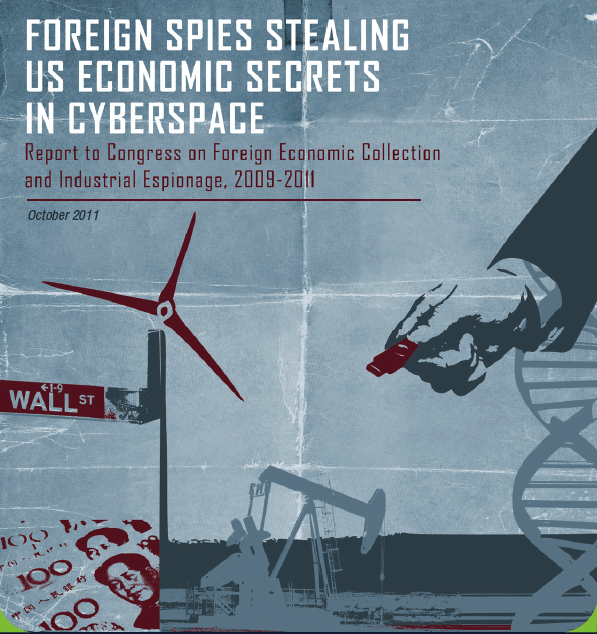
CHINA! and RUSSIA! and [an unnamed ally that is likely Israel] Are Stealing Our Stuff!

Last week, ODNI released a report on cyberwarfare that is raising eyebrows for the way it named China and Russia as the sponsors of cyberespionage explicitly.

Jack Goldsmith wonders what naming them will accomplish.

I am sure that naming the Chinese and Russians specifically and openly was a big deal inside the government.  The Wall Street Journal reports that a “senior intelligence official said it was necessary to single out specific countries in order to confront the problem and attempt contain a threat that has gotten out of control.”  Perhaps so, but naming names alone will not accomplish much.  For one thing, the U.S. government has presented no public evidence on Chinese and Russian cyberespionage, and those countries generally deny it.  (Chinese Embassy spokesman Wang Baodang said yesterday, in response to the DNI Report, that China opposes “any form of unlawful cyberspace activities.”)  For another, Cyberespionage does not violate international law.  For yet another, the United States itself, while it does not engage in broad-ranging industrial or economic espionage, does do so on a limited scale.

[snip]

In light of these factors, it is hard for me to understand what naming names is supposed to accomplish, especially since the Chinese and Russian hand in industrial espionage is widely known.

Whereas Shane Harris compares this moment to Churchill’s Iron Curtain speech.

The report marks the first time the United States government has unequivocally stated, in empathetic and highly publicized fashion, that China and Russia are responsible for a pervasive electronic campaign to steal American intellectual property, trade secrets, negotiating strategies, and sensitive military technology. Read more

Share this entry

Why Does Duqu Matter?

The short answer is that if your PC got infected by Stuxnet last year, you were just collateral damage, unless you were operating a very specific set of uranium enrichment centrifuges. If you get Duqu this year, your network is under attack from a CIA/Mossad operation. They might seem a little outrageous, but bear with me while we get into the weeds of what Duqu is all about. I will lay out a set of assertions that lead to the conclusion that Duqu really is the “precursor to the next Stuxnet” as Symantec say in their whitepaper.

1. Stuxnet was created by the CIA and the Mossad

Although no one has officially claimed responsiblity for Stuxnet, both the U.S. and Israeli governments have done everything but take offical responsibility. Neither government has ever denied responsibilty, even when directly asked. In fact, officials in both governments have been reported as breaking out in big smiles when the subject comes up.

2. Duqu is from the same team that created Stuxnet.

The first clue that Duqu is from the Stuxnet team is the similarities between the rootkit components in both pieces of malware. The folks who have studied the two most closely are sure that Duqu is based on the Stuxnet component’s source code. Despite what you may have read on the internet, the actual source code to Stuxnet is not publicly available. Some folks have reverse-engineered some of the Stuxnet source code from the binaries that are available, for various technical reasons, I’m sure that these don’t serve as the basis for Duqu.

Duqu even has a fix for a bug in Stuxnet. Also, the only two pieces of malware in history to install themselves with as Windows device drivers with legitimate, but stolen, digital certificates are Stuxnet and Duqu. Both Stuxnet and Duqu were active in the wild and managed to evade detection for many months. While that’s not unheard of for malware, it is another point of similarity.

Stuxnet targeted a specific industrial control system (ICS) installation (the Siemens PLCs that were used to control the centrifuges at Natanz). Here’s the lastest on what Duqu targets:

Some of the companies affected or targeted by Duqu include the actual equipment that an ICS would control such as motors, pipes, valves and switches. To date, the vendors that make the PLC, controllers and systems/applications found in control centers are not yet affected, although this information could change as more variants are identified and these vendors look more closely at their systems.

There are no other instances of computer malware that target these sorts of installations.


3. Stuxnet was a worm, Duqu is not.

Stuxnet was a very aggressive computer worm. It had to be to jump the “air gap” that protects a secure ICS such as the system that ran the Natanz installation. When Stuxnet was discovered, the A-V vendors quickly discovered millions of computers had been (benignly) infected with Stuxnet. Duqu, on the other hand, has been found on only a handful of computers. Interestingly, no one has yet discovered the dropper, that is, the program used to place the Duqu rootkit on the infected machines. This is almost certainly because Duqu is being placed on these machines via a spear phishing attack. In spear phishing, specific targets are chosen and the attack is customized to the target.

4. Duqu is being used to download a RAT (Remote Access Trojan)

The rootkit component was used to download a standalone program designed to steal information from the computer that it has infected (including screenshots, keystrokes, lists of files on all drives, and names of open windows). Duqu is doing computer network reconnaissance. The information gathered by Duqu is very useful for planning future attacks. Before the command and control server was taken off-line, Symantec observed Duqu downloading three additional files to an infected machine.   The first was a module that could be injected into other processes running on the machine to gather some process-specific information as well as the computer’s local and system times (including time zone and daylight savings time bias). Another downloaded module was used to extend the normal 36-day limitation on Duqu installations. The last downloaded module was a stripped down version of the standalone RAT, lacking the key logging and file exploration functionality.

5. Put it all together and it adds up to a well-executed, highly targeted covert operation

For the last ten months, Duqu has been quietly stalking a small number of industrial manufacturers. No one even noticed before early September and it wasn’t until last week that the nature of the threat was clear to anyone. Duqu is spying on a handful of companies, gathering data that will be used for the design and development of the true Stuxnet 2.0. One thing we don’t know is who the target of Stuxnet 2.0 will be. But I have a suspicion. Nothing indicates that the ultimate target (i.e., Iran) of the Stuxnet team has changed. In August of this year, Iran announced that it had activated its first pre-production set of his newer IR-2m and IR-4 centrifuges. These are the successors to the centrifuges that Stuxnet attacked. If you wanted to do these centrifuges what Stuxnet did to the earlier IR-1 centrifuges, you would need a lot of specific data about the safe operating specs of the various components that go into making advanced centrifuges. If you knew or suspected who was supplying Iran with these components, you might want to gather some data from the internal networks of those suppliers. That’s what I think the point of Duqu really is.

Share this entry