Yes, the Government Does Believe the Military Can Use Military Force in the US

I made an error.

In this post, I suggested that debates about whether the 2001 Authorization to Use Military Force constituted an exception to the Posse Comitatus Act ignore that for 7 years — from the time John Yoo wrote a memo on whether the Fourth Amendment inhibited military deployment in the US  in 2001 until the time Steven Bradbury “withdrew” the memo in 2008 — the official position of the Executive Branch was that PCA had been suspended under the AUMF.

Armando Llorens and Adam Serwer have debated — specifically in the context of whether the President could kill Americans within the US – whether PCA applies in this war. And while they’re staging an interesting argument (I think both are engaging the AUMF fallacy and therefore not discussing how a President would most likely kill Americans in the US), what the Yoo memo shows, at the least, is that the folks running the Executive Branch believed, for 7 years, the PCA did not apply.

To be clear, this memo was withdrawn in October 2008 (though not without some pressure from Congress). While the PCA aspect of the opinion is one of the less controversial aspects in the memo, as far as we know it has not been replaced by similar language in another memo. So while this shows that PCA was, for all intents and purposes, suspended for 7 years (as witnessed by NSA’s wiretapping of Americans), it doesn’t mean PCA remains suspended.

My error was in suggesting Bradbury “withdrew” the memo.

He did not.

Instead, Bradbury directed that “caution should be exercised” before relying on it.

The purpose of this memorandum is to advise that caution should be exercised before relying in any respect on the Memorandum for Alberto R. Gonzales, Counsel to the President, and William J. Haynes II, General Counsel, Department of Defense, from John C. Yoo, Deputy Assistant Attorney General, and Robert J. Delahunty, Special Counsel, Office of Legal Counsel, Re: Authority for Use of Military Force to Combat Terrorist Activities Within the United States (Oct. 23, 2001) (“10/23/01 Memorandum”) as a precedent of the Office of Legal Counsel, and that certain propositions stated in the 10/23/01 Memorandum, as described below, should not be treated as authoritative for any purpose.

As noted, he said that five propositions in the Yoo memo should not be treated as authoritative for any purpose.

We also judge it necessary to point out that the 10/23/01 Memorandum states several specific propositions that are either incorrect or highly questionable. The memorandum’s treatment of the following propositions is not satisfactory and should not be treated as authoritative for any purpose:

But then, in a series of bullet points laying out the problems with those five propositions, Bradbury doesn’t always dismiss the outcomes Yoo’s analysis supported, but in several cases accepts the outcomes but simply provides a different basis for supporting them. Read more

Share this entry

Count Von Count Counts 20 Times the Administration Has Blown Off Targeted Killing Memo Requests

1 – 2 – 3 – 4 – 5 – 6 – 7 – 8 – 9 – 10 – 11 – 12 – 13 – 14 – 15 – 16 – 17 – 18 – 19 -20

With Bob Goodlatte’s — and several other members of the House Judiciary Committee — renewed requests on Wednesday for the Office of Legal Counsel memos authorizing the targeted killing of American citizens, we have reached a milestone.

20

Members of Congress have asked for the targeted killing memos more than 20 times. And with the exception of the 35 members of the intelligence committees getting a quick peek without staff assistance and (presumably) a more substantial review by members of the Gang of Eight, the Administration has blown off every single one of those 20 requests.

I’ve included the updated timeline below. In addition to the hard count, note two letters from Ted Poe and Trey Gowdy to Eric Holder that don’t specifically ask for the memo, but ask a lot of pretty good questions about drone and other targeted killings.

February 2011: Ron Wyden asks the Director of National Intelligence for the legal analysis behind the targeted killing program; the letter references “similar requests to other officials.” (1)

April 2011: Ron Wyden calls Eric Holder to ask for legal analysis on targeted killing. (2)

May 2011: DOJ responds to Wyden’s request, yet doesn’t answer key questions.

May 18-20, 2011: DOJ (including Office of Legislative Affairs) discusses “draft legal analysis regarding the application of domestic and international law to the use of lethal force in a foreign country against U.S. citizens” (this may be the DOJ response to Ron Wyden).

October 5, 2011: Chuck Grassley sends Eric Holder a letter requesting the OLC memo by October 27, 2011. (3)

November 8, 2011: Pat Leahy complains about past Administration refusal to share targeted killing OLC memo. Administration drafts white paper, but does not share with Congress yet. (4)

February 8, 2012: Ron Wyden follows up on his earlier requests for information on the targeted killing memo with Eric Holder. (5)

March 7, 2012: Tom Graves (R-GA) asks Robert Mueller whether Eric Holder’s criteria for the targeted killing of Americans applies in the US; Mueller replies he’d have to ask DOJ. Per his office today, DOJ has not yet provided Graves with an answer. (6)

March 8, 2012: Pat Leahy renews his request for the OLC memo at DOJ appropriations hearing.(7)

June 7, 2012: After Jerry Nadler requests the memo, Eric Holder commits to providing the House Judiciary a briefing–but not the OLC memo–within a month. (8)

June 12, 2012: Pat Leahy renews his request for the OLC memo at DOJ oversight hearing. (9)

June 22, 2012: DOJ provides Intelligence and Judiciary Committees with white paper dated November 8, 2011.

June 27, 2012: In Questions for the Record following a June 7 hearing, Jerry Nadler notes that DOJ has sought dismissal of court challenges to targeted killing by claiming “the appropriate check on executive branch conduct here is the Congress and that information is being shared with Congress to make that check a meaningful one,” but “we have yet to get any response” to “several requests” for the OLC memo authorizing targeted killing. He also renews his request for the briefing Holder had promised. (10)

July 19, 2012: Both Pat Leahy and Chuck Grassley complain about past unanswered requests for OLC memo. (Grassley prepared an amendment as well, but withdrew it in favor of Cornyn’s.) Leahy (but not Grassley) votes to table John Cornyn amendment to require Administration to release the memo.

July 24, 2012: SSCI passes Intelligence Authorization that requires DOJ to make all post-9/11 OLC memos available to the Senate Intelligence Committee, albeit with two big loopholes.

December 4, 2012: Jerry Nadler, John Conyers, and Bobby Scott ask for finalized white paper, all opinions on broader drone program (or at least a briefing), including signature strikes, an update on the drone rule book, and public release of the white paper.

December 19, 2012: Ted Poe and Tredy Gowdy send Eric Holder a letter asking specific questions about targeted killing (not limited to the killing of an American), including “Where is the legal authority for the President (or US intelligence agencies acting under his direction) to target and kill a US citizen abroad?”

January 14, 2013: Wyden writes John Brennan letter in anticipation of his confirmation hearing, renewing his request for targeted killing memos. (11)

January 25, 2013: Rand Paul asks John Brennan if he’ll release past and future OLC memos on targeting Americans. (12)

February 4, 2013: 11 Senators ask for any and all memos authorizing the killing of American citizens, hinting at filibuster of national security nominees. (13)

February 7, 2013Pat Leahy and Chuck Grassley ask that SJC be able to get the memos that SSCI had just gotten. (14)

February 7, 2013: In John Brennan’s confirmation hearing, Dianne Feinstein and Ron Wyden reveal there are still outstanding memos pertaining to killing Americans, and renew their demand for those memos. (15)

February 8, 2013: Poe and Gowdy follow up on their December 19 letter, adding several questions, particularly regarding what “informed, high level” officials make determinations on targeted killing criteria.

February 8, 2013: Bob Goodlatte, Trent Franks, and James Sensenbrenner join their Democratic colleagues to renew the December 4, 2012 request. (16)

February 12, 2013: Rand Paul sends second letter asking not just about white paper standards, but also about how National Security Act, Posse Commitatus, and Insurrection Acts would limit targeting Americans within the US.

February 13, 2013: In statement on targeted killings oversight, DiFi describes writing 3 previous letters to the Administration asking for targeted killing memos. (17, 18, 19)

February 20, 2013: Paul sends third letter, repeating his question about whether the President can have American killed inside the US.

February 27, 2013: At hearing on targeted killing of Americans, HJC Chair Bob Goodlatte — and several other members of the Committee — renews request for OLC memos. (20)

Share this entry

Zoe Lofgren Didn’t Vote to Let Presidents Wage Unlimited War, But John Yoo Did

As a series of Presidents continue to claim the September 18, 2001 Authorization to Use Military Force authorizes fairly unlimited power on an unlimited battlefield, I keep coming back to this Tom Daschle op-ed, in which he described how Congress refused to extend the AUMF to US soil.

Just before the Senate acted on this compromise resolution, the White House sought one last change. Literally minutes before the Senate cast its vote, the administration sought to add the words “in the United States and” after “appropriate force” in the agreed-upon text. This last-minute change would have given the president broad authority to exercise expansive powers not just overseas — where we all understood he wanted authority to act — but right here in the United States, potentially against American citizens. I could see no justification for Congress to accede to this extraordinary request for additional authority. I refused.

The op-ed is, as far as I know, the only public statement describing how Congress narrowed a breathtakingly broad claim for military force.

Until Wednesday’s drone hearing, that is.

In response to a comment from John Bellinger that it was appropriate for the Executive Branch to refuse to share its OLC memos with Congress, Zoe Lofgren suggested (1:36 and following) the President was exceeding the terms of the AUMF (she comes very close to saying the President broke the law, but stops herself). She refers to — as Daschle did — negotiations leading up to the AUMF that actually did get passed.

Lofgren: If you take a look at the Authorization to Use Military Force, which all of us voted for — those of us who were here (there was only one no vote in the House) — it says “the President is authorized to use all necessary and appropriate force against those nations, organizations, or persons he determines planned, authorized, committed, or aided the terrorist attacks.” Now, are we to believe that everyone on this list was responsible for the 9/11 attack? I mean, is that the rationale?

Bellinger: No, your exactly right. All four of us agree with you that the 2001 AUMF, which was only about 60 words long — I was involved in drafting it literally almost on the back of an envelope while the World Trade Center was still smoldering — now is very long in the tooth. The good government solution, while extremely difficult and controversial, would be for Congress to work together with the Executive Branch to revise that AUMF. It’s completely unclear about what it covers, who it covers, where it covers.

Lofgren: If I may, I think it’s not as unclear as you suggest. There are — this was a limitation, and there were big arguments about it as you’re, I’m sure, aware, there was a prior draft that was  much more expansive. There was a prior draft that was much more expansive and it was narrowed so we could get bipartisan consensus and it was narrowed for an important reason. And I guess I — yes, the Executive has the ability to keep his legal advice confidential, that’s a long-standing principle, but since it looks like — at least, questions are raised — as to whether the executive is complying with the law, then if he feels he is, then I feel it would be a very positive thing for the Administration to share that legal advice with this committee and with the American people. Read more

Share this entry

ACLU, Obama’s White Whale

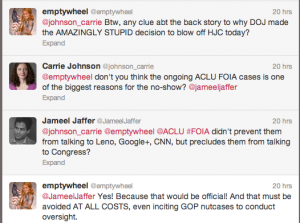
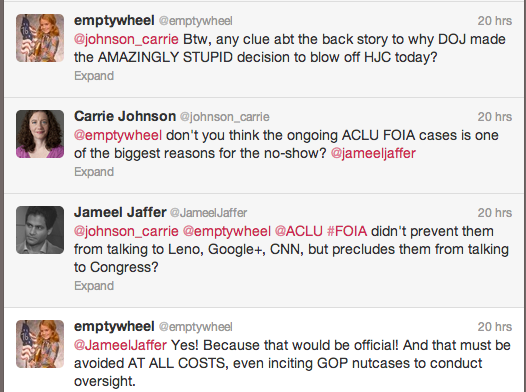
Screen shot 2013-02-28 at 10.47.36 AMNPR’s Carrie Johnson, ACLU’s Jameel Jaffer, and I discussed yesterday whether the Administration decided to blow off the House Judiciary Committee panel on targeted killing because appearing and answering questions might compromise their uncompromising stance in the targeted killing FOIA.

It’s a point Ben Wittes made in a response to my query from yesterday,

I can’t imagine what kind of stupidity drove the decision to blow off the committee.

(Note, thanks to Wittes for displaying my potty-mouth in its well-celebrated glory; MSNBC Lawfare is not.)

In which he suggests both John Brennan’s nomination and ACLU’s FOIA may have driven that decision.

I can imagine two reasons, though I agree with Marcy that it was stupid—and, I will also add, wrong—of the administration to stiff the committee. The first is John Brennan’s pending confirmation. The last thing administration wants right now, prior to a Senate vote on Brennan, is to create a forum in which officials get more questions on targeted killings.

The second reason, as I said at the hearing, is FOIA litigation. Every disclosure prompts more demands for more disclosures and prompts arguments that material is not, in fact, secret. So there’s a hunker-down-and-say-nothing mentality that has kicked in. As I say, it’s wrong. And as the tone of yesterday’s hearing—where Republicans and Democrats alike were clamoring for judicial review of targeting decisions—shows, the administration has a lot of work to do with Congress if it means to maintain confidence in its policies—work that will have to be done, at least in part, in public. But it’s not hard, in my opinion, to imagine what’s behind it.

First, with regards to Brennan’s nomination, I present this:

The Senate intelligence committee on Wednesday postponed until next week a vote on the confirmation of White House aide John Brennan to be CIA director, dashing hopes of Democratic leaders who had hoped to have a vote on Thursday.

[snip]

No explanation for the delay was immediately available. However, the Obama administration has been at odds with members of the committee’s Democratic majority over White House unwillingness to disclose some highly classified legal documents related to “targeted killings,” including the use of lethal drone strikes against suspected militants.

[snip]

On Wednesday, administration officials met with intelligence committee members to discuss the contents of the disputed documents. Copies of the material were not turned over to the committee, however, said a source familiar with the matter.

On Tuesday, the Administration shared the Benghazi emails with the Benghazi Truthers, which had been their plan to move Brennan’s nomination forward without turning over any more memos. And while some Republicans, just moments after they received the emails, made a mild stink about Brennan’s thoroughly predictable involvement in efforts to craft talking points about the attack, by Wednesday, that already proved insufficient to move the nomination.

By Wednesday, the Administration was sharing more information on the memos, not Benghazi. And then, after sharing such information, we learn the Administration has been left to stew over the weekend.

Now, perhaps the leaks to National Journal changed the game:

A senator who sits on the Intelligence Committee and has read some of the memos also said that the still-unreleased memos contain secret protocols with the governments of Yemen and Pakistan on how targeted killings should be conducted. Information about these pacts, however, were not in the OLC opinions the senator has been allowed to see. The senator, who also would speak to National Journal only on condition of anonymity, said the only memos that the committee has been given represent mainly legal analysis justifying the drone strikes, and that the rest contain “case-specific” facts about operations.

In response to which an anonymous official who looks like Tommy Vietor made dickish comments about how unreasonable it would be to let the Senate Intelligence Committee exercise oversight and how mean it is to use confirmations to insist on being able to do so because it just feeds into Republican plots.

An Obama administration official who is familiar with the negotiations with Feinstein’s committee indicated that the White House was miffed at efforts by the senator and her staff to obtain all the memos at once, because such efforts play into the Republican strategy of using the dispute to delay the confirmation of John Brennan, Obama’s nominee to head the CIA and the main architect of the drone program, as well as Chuck Hagel as Defense secretary.

“These guys don’t even know what the hell they’re asking for,” the official said. “They think they can ‘reverse-engineer’ the [drone] program by asking for more memos, but these are not necessarily things that exist or are relevant…. What they’re asking for is to get more people read into very sensitive programs. That’s not a small decision.”

Perhaps senior administration officials leaking information presumably contained in the memos to the NYT didn’t help matters.

And while lofty Senators on Intelligence Committees usually couldn’t give a damn about lowly Congressman on Judiciary Committees, I can’t imagine yesterday’s hearing helped. Because in that hearing, a bunch of very partisan Republicans made a case that will be credible to moderates and civil libertarians like me (not to mention, really feed the Tea Partiers) that the Administration is abusing its power, both in regards to the way it is treating Congress, but also in its claims to potentially unchecked authority. (Note, on that front, I owe HJC Chair Bob Goodlatte an apology: it was a well-run and well-crafted hearing.)

With the Talking Point emails shared, Benghazi is frittering out, and the Republicans will need a new scandal to fundraise off of. And a potential fight over whether or not the President has to say whether he thinks he can kill Americans in America has the distinct advantage over both Fast and Furious (their most successful scandal to date) and Benghazi (which wasn’t nearly as successful) in that people across the political spectrum (save those who think Obama should be trusted with this authority because, well, he’s trustworthy) may think it’s reasonable.

That is, while (some) Republicans may only be picking this up because it demonstrates the Administration’s double standard with respect to the Bush Administration, or because their prerogatives have been slighted, or because they figure this paranoid level of secrecy might be hiding real misconduct, the targeting killing memos are close to reaching a tipping point at which they turn into a real political issue.

And that may be what the Administration will be stewing over this weekend.

In the face of that threat, then, there’s just the FOIA. Mean old ACLU Legal Director Jameel Jaffer, FOIAing for more information on the President’s authority to kill Americans (and also, it should be said, helping the Awlaki and Khan families sue for wrongful death). How dare he do that, even if John Brennan, in one of the Administration’s key counterterrorism speeches, emphasized how important presumptive disclosure on FOIA was?

Our democratic values also include—and our national security demands—open and transparent government. Some information obviously needs to be protected. And since his first days in office, President Obama has worked to strike the proper balance between the security the American people deserve and the openness our democratic society expects.

[snip]

The President also issued a Freedom of Information Act Directive mandating that agencies adopt a presumption of disclosure when processing requests for information.

So what if John Brennan says the terrorists will win if the Administration plays stupid games with FOIA? There are lawsuits to be won, damnit!

Now, I have no doubt that the Administration might delay Congressional oversight solely to gain an advantage over the ACLU. Not only did Daniel Klaidman’s sources reveal such suits were at the forefront of their considerations when deciding not to be as transparent as promised, but it appears the Administration already delayed Congressional oversight so as to gain an advantage in ACLU’s FOIA suit.

So yes, it is likely that is one of the reasons DOJ chose to snub the Committee, thereby making this issue more of a political issue.

But it seems the Administration has lost all perspective about how those FOIAs might play out. That’s true, as Jack Goldsmith pointed out, because even if a judge rules that the Administration has revealed what it has been trying to avoid revealing, it’s not the end of the FOIA world for them.

But what if the Court does rule that the USG has acknowledged CIA’s involvement in drone strikes?  What would the ACLU gain, since the whole world already knows this fact?  Such a ruling would require CIA to file a Vaughn index listing responsive documents to the CIA request.  But at that point the government would have further legal options for non-disclosure.  As I once explained:

Even if the D.C. Circuit concludes that the USG has in effect officially acknowledged CIA involvement in drone strikes, however, it need not follow that the CIA must cough up a list of all responsive documents.  These lists alone – which typically contain document titles, dates, and the like – can disclose quite a lot about what the CIA is doing.  Some of the information in a Vaughn index might reveal or point to sources and methods or other properly classified information that would harm national security.  I see no reason why the D.C. Circuit could not rule that the USG has acknowledged CIA involvement, but then rule that (a) the CIA need not produce a Vaughn index if doing so would disclose properly classified information, or (b) the CIA must produce a Vaughn index but can redact any entries in the index (including all of them) that would, if revealed, disclose properly classified information.  Option (a) was suggested by Judge Easterbrook in Bassiouni v. CIA, 392 F. 3d 244 (7th Cir. 2005) – an approach that, as Easterbrook noted, is entirely consistent with the FOIA statute.  Option (b) is simply a more fine-grained substitute for the Easterbrook approach that would force the government to explain its redactions (and which need be no trickier than the already-tricky process of forcing the government to explain why the documents referenced in a Vaughn index need not be disclosed).

Even if ACLU wins on the “official acknowledgment” issue, in short, it has a long way to go to get the records it seeks.  But as we have seen more than once in the last decade, even heavily redacted Vaughn indexes can reveal important information and constitute the basis for further FOIA requests and further disclosures (through FOIA or other means).

I’d add that, at least in the 2nd Circuit, the Administration seems to be protected by overly broad protection for the Memorandum of Notification that authorizes targeted killing and everything else.

And unless there are really big disclosures in there that even I can’t imagine (plus, who besides me is going to look that closely?), there’s simply nothing that will come out in FOIA that will be more damaging than inciting the Republicans to turn this — a real example of abuse of power — into their next political scandal.

Trust me, Obama folks, you made the wrong calculation here, and you’d do well to reverse course before it’s too late.

Though I will make one final caveat.

I don’t think the FOIA could be all that damaging to the Administration.

But I do think the wrongful death suit might. This discussion will make it very hard for the Administration to dismiss of this counterterrorism suit the same way they have every other one, by invoking state secrets (and while there might be standing issues, particularly for Nasser al-Awlaki, Sam Alito won’t be able to suggest the Awlakis and Khans can’t prove their family members were killed in a US drone strike). And having lost the veil of state secrets, there are all sorts of issues that might come out, both about Awlaki’s history, and about why the FBI let Samir Khan leave when every other known radical trying to head to Yemen gets arrested before he boards a plane.

And, quite simply, if they can’t prevent Khan from pursuing this wrongful death suit, some interesting legal conclusions.

So while I think to the extent the Administration is still stalling Congress because of the FOIA, they’re crazy. If that’s the case, they’d be risking giving Republicans a really dangerous issue to politicize next.

All that said, I think the wrongful death suit may present real issues for them, particularly as this information becomes more public. But if it does, then it just serves to prove that the case for killing Awlaki and Khan and Abdulrahman doesn’t withstand legal review.

Share this entry

The Targeted Killing Memos Shared with NYT, But Not Senate Intelligence Committee

According to the National Journal, one of the memos the Administration refuses to share with the intelligence committees authorizes the use of force in Algeria and, perhaps also in the same memo, with Mali.

Despite President Obama’s pledge in his State of the Union address to make the drone program “even more transparent to the American people and to the world,” his administration continues to resist efforts by Congress, even from fellow Democrats, to obtain the full range of classified legal memos justifying “targeted killing.”

A key reason for that reticence, according to two sources who have read the memos or are aware of their contents, is that the documents contain secret protocols with foreign governments,

[snip]

Others may have been signed with the leaders of Algeria and Mali, the legal expert said. Given the widespread unpopularity of the drone program, the disclosure of these agreements could prove extremely embarrassing both for the United States and partner governments.

The Senate Intelligence Committee can’t learn the details of what the government is up to, the Administration says, because even sharing information (much less publicizing details) about our agreements with governments like Algeria would be embarrassing for all parties involved.

So who are the former and current government officials and senior administration officials leaking information to the NYT about new efforts — including the use of unarmed drones — to target the Algerian militant Mokhtar Belmokhtar in Algeria and Mali?

The NYT reports that earlier concerns about conducting operations not covered by the 2001 AUMF have recently been allayed.

The idea of taking stronger action in the region has been supported in recent months by Michael Sheehan, the senior counterterrorism official at the Pentagon, and Daniel Benjamin, who until December was the senior State Department counterterrorism official. In the past, State Department lawyers have questioned whether the military action approved by Congress against Al Qaeda after the Sept. 11, 2001, attacks authorized efforts to target extremists who were not clearly linked to the group. But according to some officials, those legal arguments  have recently been overcome.

“Those legal arguments have recently been overcome.” By the adoption of new OLC advice the Administration won’t share with Congress?

Read more

Share this entry

Does This Explain Why Minh Quang Pham Is Languishing Away?

TBIJ has a troubling report (see also this Independent story) on a number of British citizens who have been stripped of their citizenship so they can be targeted by drones or rendered here to the US. I described the fate of one of them — Mahdi Hashi — here. Another was the Russian spy Anna Chapman, though that happened after her arrest here.

I’m particularly interested, however, in this entry in TBIJ’s report.

B2
Deprived December 2011. Successfully challenged. Government now appealing.

This is one of three known cases where notice has been served on an individual while they were still in the UK. B2 came to the UK as a child with his refugee Vietnamese parents. He became a UK citizen in 1995, and later converted to Islam. In 2010 he reportedly traveled to Yemen, where MI5 alleges he trained with al Qaeda in the Arabian Peninsula (AQAP). He apparently returned to the UK in July 2011 and the Home Secretary informed him he would lose his British citizenship that December. B2 appealed, saying the decision would make him stateless. The Vietnamese government agreed that he was not its citizen, and the order was overturned. However the Home Office told the Bureau it is appealing. B2 is thought still to be in the UK.

These details make B2 sound like Minh Quang Pham, whom I wrote about here and here. Though here’s the timeline DOJ offered when they conspicuously announced Pham’s arrest last May, with a few additional details from Pham’s docket included.

December 2010: Pham travels from the UK to Yemen.

March 2011: Pham’s military training in Yemen begins.

March and April 2011: Pham carries a Kalashnikov.

April 2011: Pham works with Samir Khan and meets Anwar al-Awlaki.

July 2011: End date for military training in Yemen.

September 27, 2011: AQAP releases Inspire, Issue 7.

September 30, 2011: Khan and Awlaki killed in drone strike.

December 2011: End date of material support charges.

May 24, 2012: Pham indicted in NY.

June 29, 2012: Pham “arrested,” while still being held by British authorities in immigration custody. Indictment publicly released by DOJ.

August 23, 2012: Pham’s indictment officially unsealed.

Compare that to these dates regarding the UK’s efforts to strip B2’s citizenship.

February 9, 1983: B2 born in Vietnam.

August 1989: B2 travels with parents to UK, where they are granted asylum.

1995: B2 and his family get British citizenship.

December 2010: B2 travels to Yemen.

July 25, 2011: B2 leaves Yemen.

December 20, 2011: British Secretary of State decides to strip B2 of his citizenship.

December 22, 2011: British SoS provides notice and strips B2 of citizenship.

January 13, 2012: B2 appeals decision based on claim he would be stateless if he lost British citizenship.

June 13-14, 2012: B2’s citizenship hearing.

June 29, 2012: B2’s appeal succeeds.

Much of this lines up perfectly: The December 2010 departure for Yemen, the July 2011 end to military training, and the December 2011 immigration detention.

More important still, note that the British court released its decision about B2 on the same day — June 29, 2012 — that DOJ hastily announced Pham’s arrest, though without formally unsealing his indictment (note, DOJ’s original press release, though not FBI’s version, got disappeared, though can still be accessed via Internet Archive; see also this screen cap showing the press release missing).

The only discrepancy — and it may not be one — is B2’s claim he left Yemen on July 25, 2011. While DOJ’s military training charges end in July 2011, its material support charges continue until December 2011. Though note this Telegraph article says Pham was arrested when he arrived in Heathrow on July 27, 2011.

In short, unless there are a whole lot more Vietnamese refugees to Britain wandering back and forth from Yemen on the very same days, B2 is Pham.

Not only that, but it’s clear his “arrest” appears to be nothing more than an attempt to establish a fall-back position if and when holding him in immigration detention becomes impossible because he gets his citizenship restored. Barring that, they may well leave Pham in immigration custody in the UK indefinitely.

The most curious aspect of all this, though, is that material support charge that continues while, at least according to the Telegraph, Pham was in custody. Maybe the Telegraph is wrong, but if not, it means — according to the US — Pham continued to materially support AQAP while in British custody.

Share this entry

Obama Administration Stokes Embers of GOP Interest in Oversight by Blowing Off Targeted Killing Hearing

Boy, what fucking idiots run DOJ (and, presumably, the Obama Administration generally).

As I noted when I first remarked on Bob Goodlatte, the new Chair of the House Judiciary Committee, showing some interest in the targeted killing memo, a perceived slight on Congressional prerogative (and perhaps a suspicion that paranoid levels of secrecy tends to indicate misconduct somewhere) seemed to get mainstream Republicans like Goodlatte interested in the targeted killing program for the first time.

And then HJC decided to hold a hearing on targeted killing, something solidly within their jurisdiction. And then Goodlatte invited a representative from DOJ, something they get to do to conduct oversight.

And then DOJ blew off HJC.

Whoo boy! You had Trey Gowdy, of all people, out there endorsing the idea of killing people in everything from hot pursuit to stand your ground contexts, but still demanding oversight in this case. You had Republican after Republican (and more Republicans did show up, even given the committee imbalance) show an interest in the proper limits to a President’s authority to kill. Republican after Republican (plus a few Democrats, including John Conyers) complained that the Administration had blown off the committee.

I mean, I’ll take it. If the Administration wants to stupidly give the GOP a reason to make this a political issue, I’m happy to finally have someone pushing for oversight in this area.

But I can’t imagine what kind of stupidity drove the decision to blow off the committee.

Share this entry

The Blowback Inherent to Network Analysis Kill Lists

As I noted Gregory McNeal has a fascinating series of posts at Lawfare on how the government develops kill lists (this post even has a mock-up of a Kill List baseball card). But I find this post, which describes how the Kill List makers use network analysis to pick and choose whom to kill, the most interesting. It implicitly reveals one of the most fundamental problems with the way we’re doing drone targeting.

McNeal describes how the government uses network analysis to find the most crucial people in the functioning of a terrorist network. Those people, he explains, may not be the most senior or public members of the group.

Networked based analysis looks at terrorist groups as nodes connected by links, and assesses how components of that terrorist network operate together and independently of one another.  Those nodes and links, once identified will be targeted with the goal of disrupting and degrading their functionality.  To effectively pursue a network based approach, bureaucrats rely in part on what is known as “pattern of life analysis” which involves connecting the relationships between places and people by tracking their patterns of life. This analysis draws on the interrelationships among groups “to determine the degree and points of their interdependence.” It assesses how activities are linked and looks to “determine the most effective way to influence or affect the enemy system.”

[snip]

Viewing targeting in this way demonstrates how seemingly low level individuals such as couriers and other “middle-men” in decentralized networks such as al Qaeda are oftentimes critical to the successful functioning of the enemy organization. Targeting these individuals can “destabilize clandestine networks by compromising large sections of the organization, distancing operatives from direct guidance, and impeding organizational communication and function.” Moreover, because clandestine networks rely on social relationships to manage the trade-off between maintaining secrecy and security, attacking key nodes can have a detrimental impact on the enemy’s ability to conduct their operations.

McNeal’s description of the role of network analysis is not entirely new. We’ve seen hints of it in the drone speeches made by various officials. But the description greatly fleshes out what the government thinks it is doing when it engages in pattern of life analysis.

From there, McNeal explains that a range of outsiders — NGOs, journalists, even family members — may not be able to see what the network analysts privy to this magic information can see, the crucial role someone has in a terrorist network.

Thus, while some individuals may seem insignificant to the outside observer, when considered by an analyst relying on network based analytical techniques, the elimination of a seemingly low level individual might have an important impact on an enemy organization. Moreover, because terrorist networks rely on secrecy in communication, individuals within those networks may forge strong ties that remain dormant for the purposes of operational security. This means that social ties that appear inactive or weak to a casual observer such as an NGO, human rights worker, journalist, or even a target’s family members may in fact be strong ties within the network. Furthermore, because terrorist networks oftentimes rely on social connections between charismatic leaders to function, disrupting those lines of communication can significantly impact those networks. [my emphasis]

Even assuming the software that lays at the core of network analysis provides better knowledge than the deeply embedded understanding of those more familiar with the culture in question (and for a robust view on that, see Haley Barbour on steak power lunches), there is a serious problem with this result.

The most complete description of the network analysis that lies behind our drone killing makes it clear that members of a target’s own community may not understand why he was targeted.

Adam Baron, describing the aftermath of the drone killing of the Yemeni Adnan al Qadhi in Beit al Ahmar last year, shows what happens when members of a target’s community don’t understand why he was killed.

Few here dispute Qadhi’s open sympathy toward AQAP. After all, the target’s house, modest compared to nearby fortress-like compounds, sticks out because of a mural on one side that shows al Qaida’s signature black flag.

But his relatives and associates say there’s more nuance to Qadhi’s story. While he was labeled as a local leader of AQAP after his death, as recently as last winter he’d participated on a team that mediated between the government and AQAP-linked militants who’d seized control of the central town of Rada. The scion of a prominent local family who still held a position as an officer in the Yemeni military, Qadhi had refused to take part in the fighting, relatives said. They said he stayed home even as other AQAP militants carved out a base in the southern province of Abyan.

“He may have supported al Qaida, but he wasn’t taking part in activities,” said Abdulrazzaq Jamal, a Yemeni journalist and analyst who met with Qadhi shortly before his death. “There were connections, but there wasn’t perceptible tangible support.”

While Qadhi appeared to make little secret of his extremist ideology, his relatives said the strike against him came as a total shock. There had been no indication that he was a potential drone target, they said. Had they known he was considered such a high-value target, they claimed, they would’ve assured his cooperation with the authorities.

[snip]

His neighbor, Mohamed Abdulwali, took a break from repairing a water canister to chime in: “Any action has a reaction. Any violence will breed violence.” [my emphasis]

It’s not that Qadhi’s neighbors didn’t know about his support for AQAP. But they had a very different understanding of what kind of threat he posed — particularly given his role in mediating between locals and AQAP and his decision not to engage in hostilities — then the network analysts in the US who ordered up his death.

And that different understanding made the US strike illegitimate in their view, a perceived violation of rule of law. It led to open calls for a violent response.

In short, it converted an otherwise neutral community into one opposed to the United States.

If network analysis results in killings that local communities do not understand and therefore consider illegitimate, it will lead to us losing the political battle for hearts and minds.

There are more potential problems that come from network analysis killing. For example, unless the analysts are also doing network analysis of the surrounding community, they may miss the role a person — and Qadhi is a perfect example — might play in persuading locals to turn against al Qaeda. That is, killing someone like Qadhi may rule out what we did with the Sons of Iraq, effectively undercutting a really violent insurgency by buying the loyalty (or perhaps renting, as this violence is returning now) of key leaders within the insurgency. Aiming to kill the key figures in the network may not be the most efficient way of achieving peace and stability, even if it allows Administration figures to boast about stomping out the enemy.

But at its core, it’s the (claimed) asymmetric understanding of this network that makes this kind of killing so stupid. Drone killing that presumes a special knowledge about individuals’ roles in a terrorist network — but doesn’t share it with the people whose sympathy we must have to win this fight — is bound to backfire.

Update: McNeal reminds me that network analysis involves human analysts assisted by software, not just software. It’s a fair point. To be clear, though, I’m not dismissing the value of network analysis (though I question how good our HUMINT going into it is). I’m suggesting that information asymmetry makes it really dangerous to use.

Share this entry

What Is the Overlap between Signature Strikes and “Side Payment” Counter-Insurgency Drone Strikes?

ProPublica has a very worthwhile article drawing attention back to signature drone strikes.

My favorite part is their focus on John Brennan’s effort to dodge a question about signature strikes last year, which happened not long before anonymous sources working on Brennan’s behalf launched his Kill List Shiny Object campaign, which served to distract from the signature strikes he had just approved for use in Yemen.

Brennan was asked about signature strikes last April but sidestepped the question. He replied: “You make reference to signature strikes that are frequently reported in the press. I was speaking here specifically about targeted strikes against individuals who are involved.”

He continued that “everything we do, though, that is carried out against Al Qaeda is carried out consistent with the rule of law, the authorization on the use of military force, and domestic law… that’s the whole purpose of whatever action we use, the tool we use, it’s to prevent attack [sic] and to save lives.”

The article also catalogs how Brennan and the Administration have dodged questions from Jerry Nadler, John Conyers, and Bobby Scott, as well as from John McCain.

The administration has rebuffed repeated requests from Congress to provide answers – even in secret.

[snip]

Sen. John McCain, R-Ariz., recently sent his own letter to Brennan asking several pointed questions on signature strikes.

“How do ‘signature strikes’ square with your statement that targeted killing operations are only approved when a targeted individual poses a ‘significant threat to U.S. interests?’” McCain asked, quoting a speech Brennan gave on drone strikes last April.

“How can the Administration be certain it is not killing civilians in areas, like many parts of Yemen and Pakistan, where virtually all men, including civilians, carry weapons?” the letter continued.

A McCain spokesman said the senator had not received a response.

In any case, go read the article. But read it in conjunction with this remarkable Lawfare post on How to Make a Kill List, from Gregory McNeal, who once worked in counterterroism at State (though this work derives from a range of sources). McNeal has a follow-up on network analysis, which I’ll return to later.

McNeal’s post is notable because it is, as far as I know, one of the first times that someone has gone on the record admitting that our drone war is, in part, targeting people our allies pick, effectively us waging their counterinsurgency for them.

There are three basic categories of targets who might find their way onto a kill-list: (1) Targets who fall within the AUMF, and its associated forces interpretations [AUMF Targets], (2) targets who fall within the terms of a covert action finding [Covert Action Targets], and (3) targets provided by allies in a non-international armed conflict in which the U.S. is a participant. [Ally Targets or derisively “side payment targets.”] [my emphasis; all other brackets original]

“Side payment targets.” Wow. Evocative.

The reason I say this article should be read in conjunction with the ProPublica one is that the two places where we know the US is engaging in counterinsurgency targets, Pakistan and Yemen, are also the two places we know we’ve used signature strikes. Read more

Share this entry

The Repeated Concern about Brennan: His Ties to Saudis

In a piece questioning President Obama’s second term cabinet, David Ignatius describes John Brennan (who will be voted out of the Senate Intelligence Committee on Thursday) this way:

Obama’s choice for CIA director is also telling. The White House warily managed Petraeus, letting him run the CIA but keeping him away from the media. In choosing Brennan, the president opted for a member of his inner circle with whom he did some of the hardest work of his presidency. Brennan was not a popular choice at the CIA, where some view him as having been too supportive of the Saudi government when he was station chief in Riyadh in the 1990s; these critics argue that Brennan didn’t push the Saudis hard enough for intelligence about the rising threat of Osama bin Laden. But agency officials know, too, that the CIA prospers when its director is close to the president, which will certainly be the case with Brennan and Obama.

To some degree, the report that people within the CIA question Brennan’s actions from when he was Riyadh station chief just reports what we already know. Michael Scheuer has been airing those complaints along the way. And Saxby Chambliss asked Brennan about Scheuer’s allegations with his very first question at Brennan’s confirmation hearing.

CHAMBLISS: Mr. Brennan, the 9/11 commission report describes a canceled 1998 CIA operation to capture Osama bin Laden using tribal groups in Afghanistan. The former head of CIA’s bin Laden unit told staff that you convinced Director Tenet to cancel that operation. He says that following a meeting you had in Riyadh with Director Tenet, the bin Laden unit chief and others that you cabled National Security Adviser Sandy Berger, saying the operation should be canceled in favor of a different approach, described by the 9/11 Commission as a, quote, “an all-out secret effort to persuade the Taliban to expel bin Laden.” Now, as we know, bin Laden was not expelled. Three months later the bin Laden wrath was unleashed with the attack on our embassies. Did you advise senator — Director Tenet and National Security Adviser Berger against this operation? And if so, why?

BRENNAN: I had conversation with George Tenet at the time. But I must point out — out, Senator, that every single CIA manager — George Tenet, his deputy, the head of the director of operations at the time, and other individuals, the chief of the counterterrorism center — argued against that operation, as well, because it was no well-rounded in intelligence, and its chance of success were minimal — minimal. And it was likely that other individuals were going to be killed. And so when I was involved in those discussions, I provided the director and others my professional advice about whether or not I thought that that operation should go forward. I also was engaged in discussions with Saudi — the Saudi government at the time and encouraged certain actions to be taken so that we could put pressure on the Taliban as well as on bin Laden.

CHAMBLISS: So I’m taking it that your answer to my question is you did advise against — in favor of the cancellation of that operation?

BRENNAN: Based on what I had known at the time, I didn’t think that it was a worthwhile operation and it didn’t have a chance of success.

While it has largely been ignored in the press, there have been hints throughout Brennan’s confirmation process that some within the CIA blame Brennan for not pursuing al Qaeda more aggressively before 9/11.

But look at the formulation: this is a concern about what Brennan did 15 years ago, not what he did last year, when he decided to pursue signature strikes he had previously opposed in Yemen based on entreaties from someone in the Arabian peninsula.

Have folks at the CIA had their concerns about Brennan’s stovepipes with the Saudis assuaged, based in part on what they’ve seen with his actions in Yemen? Or does the mention of pre-9/11 concerns serve as stand-in for a bunch of covert dealings no one can discuss?

Share this entry