Trailer Park Slum Lord: The Generational Corruption of Bill Pulte

The thing about Bill Pulte’s corruption is that a fair number of Republicans seem have it in for him, too (as laid out in this Politico piece in September).

That may help to explain the 3,000 word profile airing the family’s dirty laundry while detailing that Pulte’s closest ties to his family’s developing empire are to some decrepit trailer parks.

He did not issue press releases about the five mobile home parks his companies acquired in Florida for about $3 million in the two years before he was nominated to become the F.H.F.A. director in January.

Recent visits to two of the mobile home parks revealed a broken fence and overflowing trash bins. The dozen or so trailers at the parks were aging. Some had windows covered with faded American flags and cardboard. Duct tape patched torn screens.

Documents show Mr. Pulte was the signatory on a $2 million mortgage taken out on three of the properties in August 2024. The woman listed as an agent on some of the mobile home parks also works in his charitable organization. In January 2024, he told an interviewer on an investing podcast that the “Pulte Family” was buying mobile home parks and planning to revamp them amid a market of rising rents.

In the same interview, Mr. Pulte said he planned to make them into “nice communities.”

But his companies have been slow to make repairs, said residents of three of the parks, who spoke on the condition of anonymity because they feared retribution.

A resident of one property, in Lake Worth in Palm Beach County, said he had gone months without a working stove, despite asking the management company to fix it. Another resident said he had spent $300 to repair his broken air-conditioning unit. Some trailer park leases warn tenants that if they miss rent payments, which are due weekly, “they will be removed for trespassing by the local sheriff!!”

At some properties, rents have been rising. A resident at a mobile home park in Cottondale in the Florida panhandle said in a filing in Jackson County Court this summer that his monthly rent had increased to $950 from $550 after Mr. Pulte’s company took over. At a park in Ruskin, south of Tampa, rents recently rose $100 a month — about 16 percent — to pay for a new dumpster, several residents said.

None of the mobile home properties carry the Pulte family’s name.

One of the quickest ways to taint someone in Trump’s eyes is to make him look squalid.

Meanwhile — and purely by happenstance — the Epstein dump James Comer released to distract from Trump’s knowledge of Epstein’s sex trafficking included a document that seems to be Epstein’s side of the split with Trump.

In a February 1, 2019 email first sent to himself (possibly BCCed to someone else?), and then sent to Michael Wolff, Epstein transitions directly from a claim in one of the letters from which Comer was trying to distract — that Trump came to his house a lot while someone Epstein trafficked was there, purportedly Virginia Giuffre — to his description over the fight about the property that Trump would one day launder into cash from Dmitry Rybolovlev, the fight that Trump had also publicly used to explain the split. Much of Epstein’s focus was on his suspicions that Trump didn’t have the money to buy the mansion in the first place and probably didn’t pay taxes on it.

But amid the description, Epstein describes that “his friend pulty the developer” was part of Trump’s bid. If that is Pulte, it would be Pulte’s father who, like Trump’s dad, fronted him in the real estate business. [Update, corrected per this report. h/t DrAwkward]

In Epstein’s mind, then, there’s a tie between Trump’s knowledge he “stole” his spa girl and the fight over the Palm Beach mansion, a fight in which “pulty the developer” played some part.

But all that is in the past.

Let’s move onto concerns about the present and future.

AP reports that an aide to Pulte pulled information on single home mortgage rates and shared it with a competitor. When Fannie executives pointed out this was collusion, they were fired (another part of the explanation for Pulte’s purge last month).

A confidant of Bill Pulte, the Trump administration’s top housing regulator, provided confidential mortgage pricing data from Fannie Mae to a principal competitor, alarming senior officials of the government-backed lending giant who warned it could expose the company to claims that it was colluding with a rival to fix mortgage rates.

Emails reviewed by The Associated Press show that Fannie Mae executives were unnerved about what one called the “very problematic” disclosure of data by Lauren Smith, the company’s head of marketing, who was acting on Pulte’s behalf.

“Lauren, the information that was provided to Freddie Mac in this email is a problem,” Malloy Evans, senior vice president of Fannie Mae’s single-family mortgage division, wrote in an Oct. 11 email. “That is confidential, competitive information.”

He also copied Fannie Mae’s CEO, Priscilla Almodovar, on the email, which bore the subject line: “As Per Director Pulte’s Ask.” Evans asked Fannie Mae’s top attorney “to weigh in on what, if any, steps we need to take legally to protect ourselves now.”

While Smith still holds her position, the senior Fannie Mae officials who called her conduct into question were all forced out of their jobs late last month, along with internal ethics watchdogs who were investigating Pulte and his allies.

This effort seems to stem from Pulte’s response to Trump’s orders to push builders to build more single family homes.

Pulte’s power over the mortgage lending industry is unusual. Not long after his Senate confirmation, he appointed himself chairman of both Fannie Mae and Freddie Mac, which hold trillions of dollars in assets. The companies serve as a crucial backstop for the home lending industry by buying up mortgages from individual lenders, which are packaged together and sold to investors.

The three competing roles present the potential for a conflict of interest that is detailed in emails reviewed by AP. Like many matters of public policy in Trump’s Washington, it appears to have begun with a social media post.

In October, Trump criticized the homebuilding industry, which he likened to the oil-market-dominating cartel OPEC.

“They’re sitting on 2 million empty lots, A RECORD,” the president posted to his social media platform, Truth Social. “I’m asking Fannie Mae and Freddie Mac to get Big Homebuilders going.”

“On it,” Pulte posted in response on X.

That is, Pulte may have abused his overlapping roles running the country’s housing finance in an attempt to solve the fact that he’s not otherwise good at his job.

And so he tried to cheat.

And when caught cheating, he fired the people who caught him.

The fact that Pulte keeps getting caught botching his day job — the one that, when he fails, could tank the entire US if not global economy — has not distracted him from his real love: framing Trump’s enemies.

This time, Eric Swalwell was the target.

A top housing official in President Donald Trump’s administration has referred California Democratic Rep. Eric Swalwell to the Justice Department for a potential federal criminal probe, based on allegations of mortgage and tax fraud related to a Washington, D.C., home, according to a person familiar with the referral.

He is the fourth Democratic official to face mortgage fraud allegations in recent months.

Bill Pulte, the director of the Federal Housing Finance Agency, alleged in a letter sent to Attorney General Pam Bondi on Wednesday that Swalwell may have made false or misleading statements in loan documents.

The matter has also been referred to the agency’s acting inspector general, this person said.

“As the most vocal critic of Donald Trump over the last decade and as the only person who still has a surviving lawsuit against him, the only thing I am surprised about is that it took him this long to come after me,” Swalwell said in a statement to NBC News.

Perhaps Pulte has a whole portfolio of flimsy claims about Trump’s enemies in a folder somewhere, to deliver up to Trump every time someone, even some Republican, raises real concerns about his basic competence.

Thus far, it seems to have insulated him from any real accountability.

Share this entry

Corruption Is All Fun and Games Until It Threatens to Tank the Economy

WSJ has a follow-up to the story Reuters published a week ago, on November 5 (which I wrote about here). The Reuters piece described that FHFA’s Inspector General had been fired as he was preparing to share information relevant to EDVA’s cases — so Letitia James — and also Congress.

The ouster of Joe Allen, FHFA’s acting inspector general, follows the agency’s director, Bill Pulte, becoming an outspoken voice in support of the Trump administration. Across the government, the Trump administration has so far fired or reassigned close to two dozen agency watchdogs, who police waste, fraud and abuse. It has also defunded the group that supervises those offices.

[snip]

Allen received notice of his termination from the White House after he made efforts to provide key information to prosecutors in that office, according to four sources. The information he turned over was constitutionally required, two of them said, while a third described it as being potentially relevant in discovery.

His ouster also came about as he was preparing to send a letter to Congress notifying lawmakers that the FHFA was not cooperating with the inspector general’s office, three of the sources said.

WSJ describes that Allen was investigating whether Bill Pulte ordered people to snoop in Trump’s adversaries’ records. It also confirms that Allen did share that information with EDVA (it doesn’t mention whether Allen had succeeded in sending off any letter to Congress).

Fannie Mae watchdogs who were removed from their jobs had been probing if Trump appointee Bill Pulte had improperly obtained mortgage records of key Democratic officials, including New York Attorney General Letitia James, according to people familiar with the matter.

Fannie’s ethics and investigations group had received internal complaints alleging senior officials had improperly directed staff to access the mortgage documents of James and others, according to the people. The Fannie investigators were probing to find out who had made the orders, whether Pulte had the authority to seek the documents and whether or not they had followed proper procedure, the people said.

That group elevated the probe about the James documents to the more senior Office of Inspector General for the Federal Housing Finance Agency, the agency that oversees Fannie Mae and Freddie Mac and that Pulte heads, the people said. The acting inspector general then passed the report to the U.S. attorney’s office in eastern Virginia, some of the people said.

[snip]

The FHFA acting inspector general sent the office the report at least in part because it could be considered material information for James’s defense in the case, one of the people said.

The very days this all happened, on November 4, the Loaner AUSA in the James case, Roger Keller, filed a notice saying DOJ was not going to comply with Judge Jamar Walker’s order to turn over vindictive and selective prosecution evidence, specifically pointing to the carve out in Federal Rules of Criminal Procedure for “reports, memoranda, or other internal government documents” made by “other government agents in connection with the investigation,” language that would cover any FHFA reports into Bill Pulte’s corruption.

Federal Rule of Criminal Procedure 16 does not require the Government to produce vindictive/selective prosecution-related evidence before a defendant files such a motion. The Rule permits a defendant to discover evidence material to her defense, FED. R. CRIM. P. 16(a)(1)(C), but “defense” means the “defense against the Government’s case in chief, . . . not to the preparation of selective prosecution claims.” Armstrong, 517 U.S. at 462 (citing FED. R. CRIM. P. 16(a)(1)(C))(emphasis added). FED. R. CRIM. P. 16(a)(2) underscores the limitation to “defense” as it “exempts from defense inspection ‘reports, memoranda, or other internal government documents made by the attorney for the government or other government agents in connection with the investigation or prosecution of the case.’” Id. (quoting FED. R. CRIM. P. 16(a)(2)). “If a selective-prosecution claim is a ‘defense,’ Rule 16(a)(1)(C) gives the defendant the right to examine Government work product in every prosecution except his own.” Id. [my emphasis]

James did mention the earlier Reuters report in her vindictive and selective prosecution motion, submitted last Friday.

The retribution campaign against AG James had only just begun. Around the same time, another federal agency, the Federal Housing Finance Agency (FHFA), led by Director William Pulte, was also looking for dirt to use against AG James. By April 14, they had concocted it. Mr. Pulte delivered a criminal referral “[b]ased on media reports” to DOJ against AG James, claiming she had “in multiple instances, falsified bank documents and property records to acquire government backed assistance and loans and more favorable loan terms.” Ex. F at 1. The criminal referral cherry-picked documents to claim fraud over three properties—one even going back to 1983—none of which was the Peronne Property at issue in the indictment.16 The referral asked DOJ to open a criminal investigation into AG James. See Ex. F at 1. Mr. Pulte also coordinated with Edward Martin—the self-described “captain” of DOJ’s Weaponization Working Group who is President Trump’s close confidante and would later also be named a Special Attorney.17

16 Mr. Pulte’s conduct demonstrates how far allies of the President would go to carry out his “get James” orders. Public reports indicate that Mr. Pulte “skipped over his agency’s inspector general when making criminal referrals” against President Trump’s political enemies. Reports also indicate he may have bypassed ethics rules in doing so. Marisa Taylor & Chris Prentice, Exclusive: Trump official bypassed ethics rules in criminal referrals of Fed governor and other foes, sources say, Reuters (Oct. 6, 2025), https://perma.cc/HK6Y-LJVR. The FHFA has no generalized crimefighting or anti-fraud authority. It does not even have an express authority to make criminal referrals besides those granted to the FHFA’s Inspector General under the Inspector General Act of 1978. In addition to violations of the act itself, Mr. Pulte may have failed to comply with the FHFA’s own Privacy Act regulations, which require FHFA to “ensure” that records containing personally identifiable information are “protected from public view.” Domenic Powell, Are Pulte’s “Mortgage Fraud” Investigations Legal?, Yale J. Reg.: Notice and Comment (Nov. 1, 2025), https://perma.cc/2U6G-S46X.

17 Alan Feuer et al., Trump Demands That Bondi Move ‘Now’ to Prosecute Foes, N.Y. Times (Sept. 20, 2025), https://perma.cc/FC9R-U8TK. [link added]

This story may provide opportunity to submit a follow-up (or at least revisit the issue in a reply memo due in two weeks).

By then, of course, we may have more visibility into who got Allen fired, and whether simply the referral to Lindsey Halligan did the trick.

Particularly if Allen did succeed in getting that letter sent to Congress.

All this is happening at a curious time. First, just yesterday Politico claimed someone in Trump’s immediate orbit was furious at the way Pulte sold Trump on an insanely stupid 50-year mortgage plan.

White House officials are furious with Bill Pulte, the Federal Housing Finance Agency director, who talked the president into suggesting a 50-year mortgage plan.

The White House was blindsided by the idea, according to two people familiar with the situation granted anonymity to discuss internal thinking, and is now dealing with a furious backlash from conservative allies, business leaders and lawmakers.

On Saturday evening, Pulte arrived at President Donald Trump’s Palm Beach Golf Club with a roughly 3-by-5 posterboard in hand. A graphic of former President Franklin Roosevelt appeared below “30-year mortgage” and one of Trump below “50-year mortgage.” The headline was “Great American Presidents.”

Roughly 10 minutes later, Trump posted the image to Truth Social, according to one of the people familiar, who was with the president at the time.

Almost immediately, aides were fielding angry phone calls from those who thought the idea – which would endorse a 50 year payback period for a mortgage – was both bad politics and bad policy, a move that could raise housing costs in the long run, the person said.

After describing fury about how Pulte did this — hitting Trump up with visuals at the golf club — Politico spends 11 paragraphs describing a range of people panning the idea before describing the last time Pulte did this: when pitching a plan to bring Fannie and Freddie public, another insanely stupid idea.

“Anything that goes before POTUS needs to be vetted,” said the person present for Pulte’s poster presentation. “And a lot of times with Pulte they’re not. He just goes straight up to POTUS.”

[11 ¶¶ of influencers and experts panning the idea]

This is not the first time Pulte’s policy proposals have caused headaches. He was also behind the idea Trump floated earlier this year to take Fannie Mae and Freddie Mac public, which also resulted in significant pushback from industry.

Which brings us to the very last paragraph of the WSJ story, a story mostly focused on Pulte’s investigation-related corruption. It suggests Pulte’s corruption may make it harder to bring Fannie and Freddie public, that prior idea he floated by cornering Trump with unvetted ideas.

The Trump administration is considering an initial public offering for Fannie Mae and Freddie Mac, one of the biggest IPOs in history at a crucial moment for the mortgage market. That process will require convincing potential investors, and the broader mortgage-bond market, the management of the companies is stable.

As I read both James’ and Comey’s motions to dismiss for vindictive prosecution, there’s part of me that selfishly wants this process to be one step harder than it needs to be: rather than simply dismissing on the abundant evidence of vindictive prosecution laid out (or, even more likely, because Lindsey the Insurance Lawyer is only playacting as US Attorney, about which there is a hearing tomorrow), I want them to get discovery so we can unpack all this process and bring down the corrupt enablers like Pulte, Eagle Ed Martin, on up to Pam Bondi and Todd Blanche.

Still, there’s something that may force this to go even more public than it otherwise would: Lisa Cook, into whose private records Pulte was likely also snooping, who will have a hearing about whether Trump attempted to fire her “for cause,” or because Pulte snooped in her private records looking for cause.

Corruption is all fun and games until it gets fast-tracked to SCOTUS (where, admittedly, Justices have been all too happy to legalize corruption). It’s all fun and games, Trump’s team seems to believe, until it poses a risk to the housing market.

For whatever reason, Bill Pulte seems to be getting fast-tracked in Trump world, from a useful corrupt flunky to a dangerous liability.

Share this entry

Three Ways You Can Tell Trump Is Lying about Tariff Rebates

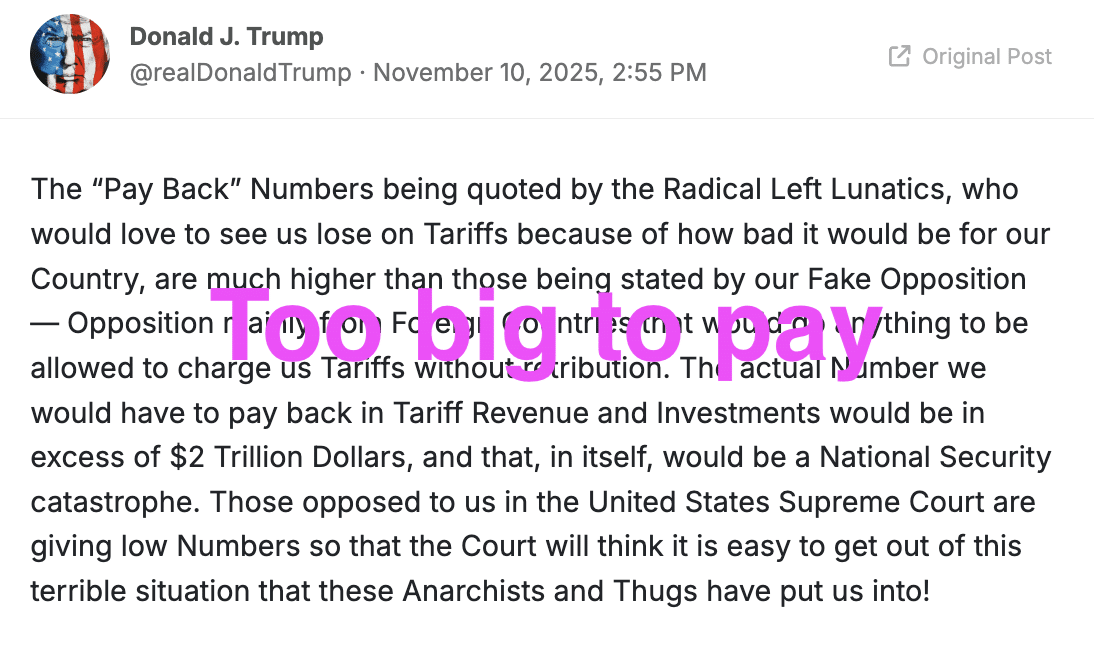
Trump is lying about his tariffs again (or rather, still), in fact telling similar lies that he did in a letter that backfired before SCOTUS, because he boasted about how much revenue he was making.

But, perhaps because people are just tuning in, they’re treating Trump’s false claims as if they’re somehow less false than every other thing he says.

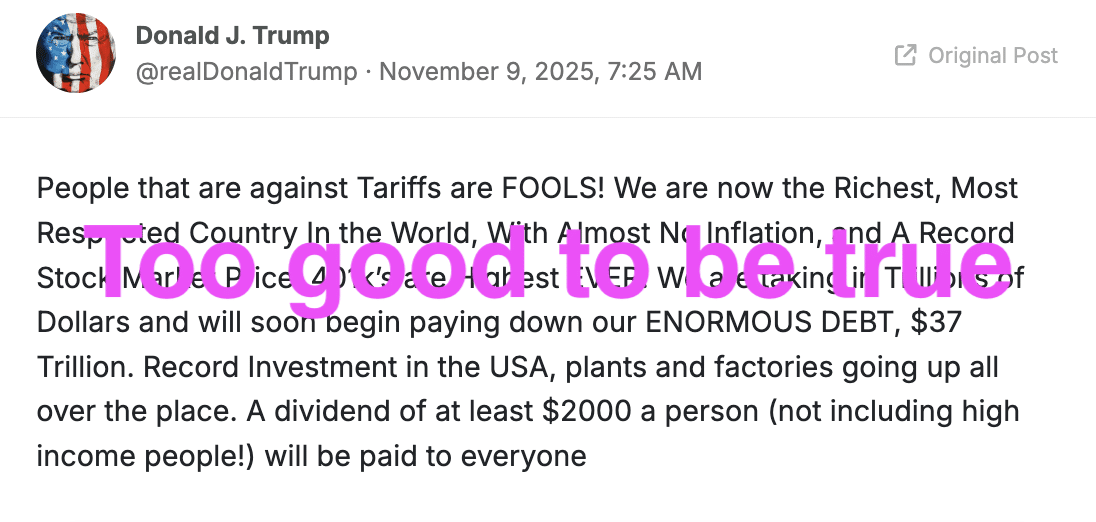
First, Trump promised he’d give all the non-rich $2000 rebates from his unlawful tariffs.

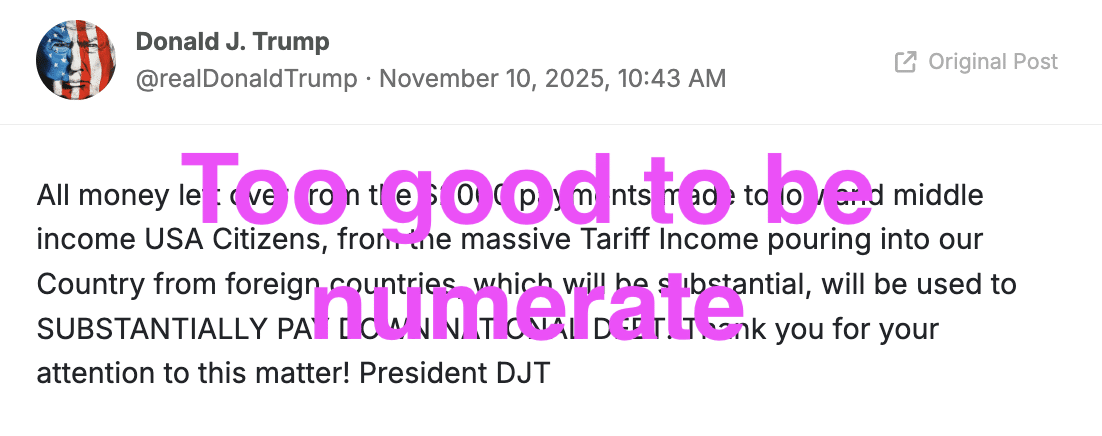
Then, he claimed there’d still be money leftover after he had sent people “free” money.

Then, he accused Democrats of making numbers up.

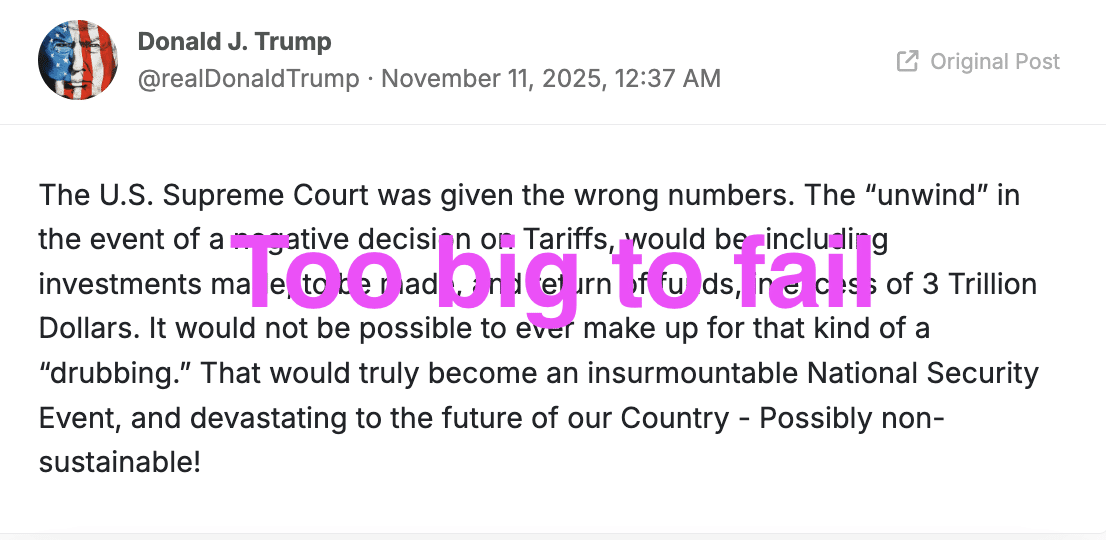
Then, he said it would create a national security crisis if the Supreme Court made him give back money he raised unlawfully.

But there are three ways you can tell Trump is just as full of shit as he always is.

First, because because Kevin Hassett invoked the Laffer Curve when trying to claim we could afford it.

Next, because — as Dean Baker laid out — the numbers don’t add up.

Doing the simple arithmetic, the country has 340 million people. If 10 percent of these people fit Trump’s definition of high-income, and therefore don’t get the rebate, roughly 300 million people would get the checks.

At $2,000 a piece it would come to $600 billion, more than twice what Trump is collecting from us with his import taxes. Since he’s already $330 billion short, how can Trump think he has money to pay down the national debt? Also, he seems not to know that our deficit this year is projected to be $1.8 trillion, so he is actually adding considerably to the debt and would be adding even more with his $600 billion tariff “rebate.”

Most importantly — the the likely reason he’s telling these particular lies right now — because when Trump got a stay from the first ruling that his tariffs were illegal, he promised to pay the tariffs back, at least for the plaintiffs, even while insisting it could not replace the revenue raised from the tariffs.

And a stay would not harm plaintiffs, who can be made whole through a refund, including interest, if tariffs paid during these appeals are ultimately held unlawful.

[snip]

And, absent a stay, the government will receive reduced revenue that it will be unable to recoup if the tariffs are ultimately upheld—another irreparable harm. See Department of Educ. v. California, 145 S. Ct. 966, 968-969 (2025) (per curiam).

2. Conversely, a stay would not cognizably harm plaintiffs. If tariffs imposed on plaintiffs during these appeals are ultimately held unlawful, then the government will issue refunds to plaintiffs, including any postjudgment interest that accrues. See Sunpreme Inc. v. United States, 2017 WL 65421, at *5 (C.I.T. Jan. 5, 2017) (“there is virtually no risk to Plaintiff that it would not be made whole should it prevail”). The balance of harms is not close.

Trump’s advisors have told him he’s going to lose at SCOTUS on this. And like a kid caught with his hand in the cookie jar, he’s trying to claim (simultaenously) that the cookies have already been eaten, but here, would you like some? in an effort to stave off an order to give the cookies back.

You could already tell in last week’s hearing that the Justices are struggling with the prospect of making Trump pay the money back.

JUSTICE BARRETT: And then if you win, tell me how the reimbursement process would work. Would it be a complete mess? I mean, you’re saying before the government promised reimbursement. And — and now you’re saying, you know, well, that’s rich, but how would this work? It seems to me like it could be a mess.

MR. KATYAL: So the first thing I would say is that just underscores how major a question this is, the very fact that you are dealing with this with quotas, there’s no refund process of — to the tunes of billions of dollars or embargoes, but there is here. But for our case, the way it would work is, in this case the government’s stipulated for the five plaintiffs that they would get their refunds. So for us that’s how it would work.

Your question, I take it, is about everyone else. We don’t have a class action or anything like that.

With respect to everyone else, there’s a whole specialized body of trade law. And 19 U.S.C. 1514 outlines all these administrative procedures. It’s a very complicated thing. There’s got to be an administrative protest. There was a Harbor Management case earlier that this Court was involved with in United States Shoe in which, you know, the refund process took a long time. There were any number of claims and equitable relief and —

JUSTICE BARRETT: So a mess.

MR. KATYAL: So it’s difficult, absolutely

JUSTICE BARRETT: Okay.

MR. KATYAL: We don’t — we don’t deny that it’s difficult, but I think what this Court has said in — in — in the McKesson case in 1990, a serious economic dislocation isn’t a reason to do something.

Northern Pipeline, you guys stayed your decision for a while in order to let the congressional process unfold. There may be a congressional process here as well.

You know, your — you know, you may be able to also — be that this Court could limit its decision to prospective relief under the John Q. Hammons case. There’s lots of possibilities.

Neal Katyal, in a rush to ensure that the payback question doesn’t given the Justices cause to make a really bad decision, quickly offered a bunch of terrible options for all the other people who’ve been paying Trump’s illegal taxes because Judges didn’t impose a stay. Trump may think the mere prospect of paying the money back might yet persuade his captive court to rule for him.

But more likely, Trump is just applying political pressure — on the Justices, with false claims about what the real numbers are, on his mob, in hopes they’ll provide another kind of pressure if denied money he claims is free but which in reality they’ve actually already paid out of pock themselves — to avoid being ordered to pay the money back to everyone.

If and when SCOTUS rules against Trump on the tariff issue, it will be a very significant loss, the first time right and left joined together to force Trump to stop doing something unlawful.

But if SCOTUS rules Trump has to pay the money back, to everyone, it will create the kind of fiscal challenge that could turn his current political woes into a crisis, not least because right wing members of Congress have been treating this tariff revenue as “free” money they could point to to pretend they were addressing the deficit.

And that’s why Trump is ranting about tariffs.

Not because he wants to give out “free” — in reality, unlawfully seized money that American consumers already paid — money. But because he doesn’t want to pay any consequences for his unlawful actions.

And he definitely wants to avoid the default reality: that Trump will be forced to pay back importers, but consumers will get nothing.

Share this entry

We’re on the Unfuck Stage of Trump’s Abuse of Power

I listened to the arguments at the Supreme Court over Trump’s tariffs (my live tweet of John Sauer and the plaintiffs; the transcript), with John Sauer arguing for Trump, Neal Katyal arguing for the small businesses that sued, and Benjamin Gutman arguing for Democratic states that sued.

The primary argument comes down to Katyal’s emphasis: that because tariffs raise revenues, they are part of Congress’ power.

Sauer was stuck, over and over again, attempting to argue that the intent of these tariffs was not to raise revenue, it was to encourage capacities in the US.

And I said there’s two buckets there. One is, first of all, when it comes to the trade deficit emergency, if no one ever pays the tariff but instead they direct their consumption domestically and spur the creation of a rebuilding of our — of our hollowed-out manufacturing base, that directly addresses the crisis. It’s more effective if no one ever pays the tariff. That’s the point of it, really. You know, that’s a fundamental point of it. And that’s one piece of these.

[snip]

That — those tariffs, if no one ever collects them but the threat of imposing those tariffs gets China and our other trading partners across the world to change their behaviors in a way that addresses this, then that’s the most effective use of the policy. So they’re clearly regulatory tariffs, not taxes. They are not — they’re not an exercise of the power to tax. They are the exercise of the power to regulate foreign commerce. And that’s why the statute says “regulate.” It doesn’t say “tax.” It says “regulate.”

Eventually, Katyal pointed out that the government had already bragged in declarations that they planned to make $4 trillion from the tariffs.

This is obviously revenue-raising. Their own brief to the Court says it’s going to raise $4 trillion.

No one talked about coffee, or anything else that the US has no ability to replace. Katyal did raise Switzerland, with which we have a trade surplus.

It’s just that this President has torn up the entire tariff architecture. You know, for example, he’s tariffing Switzerland, one of our allies, which we have a trade surplus, 39 percent. That is just not something that any President has ever had the power to do in our history.

Amy Coney Barrett asked why they had to impose tariffs on Spain and France.

These are imposed on — I mean, these are kind of across the board. And so is it your contention that every country needed to be tariffed because of threats to the defense and industrial base? I mean, Spain, France? I mean, I could see it with some countries, but explain to me why as many countries needed to be subject to the reciprocal tariff policy as are.

Sonia Sotomayor raised the silly tariffs on Brazil for hold Jair Bolsonaro to account.

But the President threatened to impose a 10 percent tax on Canada for an ad it ran on tariffs during the World Series. He imposed a 40 percent tax on Brazil because its Supreme Court permitted the prosecution of one of its former presidents for criminal activity. The point is, those may be good policies, but does a statute that gives, without limit, the power to a President to impose this kind of tax, does it require more than the word “regulate”?

After Sauer claimed there was some oversight to this, Elena Kagan observed that Trump keeps declaring emergencies.

The President has to make a formal declaration of a national emergency, which subjects him to particularly intensive oversight by Congress, repeat — you know, natural lapsing, repeated review, reports, and so forth. It says you have to consult with Congress to the — the maximum extent possible.

JUSTICE KAGAN: I mean, you yourself think that the declaration of emergency is unreviewable. And even if it’s not unreviewable, it’s, of course, the kind of determination that this Court would grant considerable deference to the — to the President on. So that doesn’t seem like much of a constraint.

GENERAL SAUER: But it is a —

JUSTICE KAGAN: And, in fact, you know, we’ve had cases recently which deals with the President’s emergency powers, and it turns out we’re in emergencies everything all the time about, like, half the world.

GENERAL SAUER: Well, this particular emergency is particularly existential, as Executive Order 14257 says, and, of course, no one disputes the existential nature of the fentanyl crisis, which, you know, we had an agreement last week to create progress on, which illustrates the effectiveness of the tariffs tool h

Even Sammy Alito all-but conceded that there was no real emergency here, the basis on which Trump has accrued the power to impose taxes. “Would you have the same suspicion that President trying to achieve a goal other than the raising of money,” in case of an undisputed emergency. Kavanaugh came in a few minutes later raising the India tariffs, asserting blindly that the purpose of them was to end the Russian war (no one asked why Trump set tariffs on India first or why he didn’t just impose sanctions).

I don’t bank lots on my impression of how arguments went. John Roberts was mostly silent, but when he did weigh in, it was always in ways fairly devastating for that argument. My guess, then, is that the women plus Justice Roberts, plus maybe Neil Gorsuch, will rule against Trump, though don’t hold me to it.

There were several other interesting parts of the discussion though. There was the discussion of what happens if plaintiffs win. It came up several times, but close to the end, ACB asked Katyal how reimbursement will work. He sort of answered it wasn’t his problem; he represents six fairly minor plaintiffs, not a Class. It would be a much bigger problem for the states, which probably make up half of imports to the US. Plus, as Bloomberg laid out, other businesses have, in recent days, been suing in order to accelerate the process of getting reimbursed. Katyal even suggested maybe Congress can straighten this out.

MR. KATYAL: We don’t — we don’t deny that it’s difficult, but I think what this Court has said in — in — in the McKesson case in 1990, a serious economic dislocation isn’t a reason to do something. Northern Pipeline, you guys stayed your decision for a while in order to let the congressional process unfold. There may be a congressional process here as well.

This Congress?!?!

The point being, we’re at the point of Trump 2.0, in what may be — now appears to be likely to — be the first area where the Court reverses one of Trump’s abusive power grabs. And it has to be a consideration of how to unfuck the problems Trump caused because courts (in this case, lower courts, but usually, it’s the Supreme Court) allowed Trump to continue abusing power while matters were litigated.

Another concern, and even Sammy Alito expressed it (!!!!), was whether Congress could ever claw back the authority to tariff if it is lost here. Here’s how Gorsuch first raised it.

JUSTICE GORSUCH: Okay. You emphasize that Congress can always take back its powers. You mentioned that a couple of times. But don’t we have a serious retrieval problem here because, once Congress delegates by a bare majority and the President signs it — and, of course, every president will sign a law that gives him more authority — Congress can’t take that back without a super majority. And even — you know, even then, it’s going to be veto-proof. What president’s ever going to give that power back? A pretty rare president. So how — how should that inform our view of delegations and major questions?

[snip]

JUSTICE GORSUCH: Fair enough. As a practical matter, in the real world, it can never get that power

The questions that resonated the most came from Gorsuch (though I suspect he sounded more gung ho against the government in arguing against Sauer than he necessarily is). At one point, he tried to get Sauer to see the risk that a Democratic President would just impose huge tariffs to address a climate change emergency.

Could the President impose a 50-percent tariff on gas-powered cars and auto parts to deal with the unusual and extraordinary threat from abroad of climate change?

GENERAL SAUER: It’s very likely that that could be done, very likely.

JUSTICE GORSUCH: I think that has to be the logic of your view.

GENERAL SAUER: Yeah. In other words, I mean, obviously, this Administration would say that’s a hoax, it’s not a real crisis, but — but, obviously —

JUSTICE GORSUCH: I’m sure you would.

Sauer pretty much dodged that question, stating that this Administration would declare it a hoax, but that would be of not interest if he weren’t in the Administration. Ketanji Brown Jackson followed up to lay out the problems of claiming the courts have no review.

JUSTICE JACKSON: Let me just ask one more question about the unusual threat. So, in your conversation with Justice Gorsuch that we had, the climate change tariff hypo and you indicated that there would be challengers to the notion that that was an unusual and extraordinary threat, and I’m just wondering, under your position, would they be able to make a legal challenge? Are you saying the Court would not be able to review that concern?

GENERAL SAUER: On that particular hypothetical, I think I said that would be a question for Congress.

JUSTICE JACKSON: So not a court?

GENERAL SAUER: Yeah. I don’t — in other words, that wouldn’t be the sort of thing the courts are going to weigh into, is this really an emergency. You know, that would not be — probably very unlikely. That would be a situation where at least there would be very, very, very deferential judicial review of that kind of determination, a legal dispute, but —

But even before that Gorsuch pointed out that if Congress could trade away its authority to tax, they could trade away their authority to declare war.

JUSTICE GORSUCH: General, just a few questions following up on the major questions discussions you’ve had. You say that we shouldn’t be so concerned in the area of foreign affairs because of the President’s inherent powers. That’s the gist of it, as I understand it, why we should disregard both major questions and nondelegation. So could Congress delegate to the President the power to regulate commerce with foreign nations as he sees fit —

GENERAL SAUER: We don’t —

JUSTICE GORSUCH: — to lay and collect duties as he sees fit?

[snip]

JUSTICE GORSUCH: But you’re saying we shouldn’t look —

GENERAL SAUER: He has broad powers in this very narrow assignment.

JUSTICE GORSUCH: — we shouldn’t be concerned with — I want you to explain to me how you draw the line, because you say we shouldn’t be concerned because this is foreign affairs, the President has inherent authority, and so delegation off the books more or less.

GENERAL SAUER: Or at least —

JUSTICE GORSUCH: And if that’s true, what would — what would prohibit Congress from just abdicating all responsibility to regulate foreign commerce, for that matter, declare war to the President?

[snip]

JUSTICE GORSUCH: Can you give me a reason to accept it, though? That’s what I’m struggling and waiting for. What’s the reason to accept the notion that Congress can hand off the power to declare war to the President?

GENERAL SAUER: Well, we don’t contend that. Again, that would be —

JUSTICE GORSUCH: Well, you do. You say it’s unreviewable, that there’s no manageable standard, nothing to be done. And now you’re — I think you — tell me if I’m wrong. You’ve backed off that position

Again, I’m not sure my read of Gorsuch has much salience. But we are at the stage — as Trump continues to murder-bomb people on a three degree of separation in an undeclared not-war not-drug action — where a right wing Justice asks whether Congress can cede their most fundamental authorities.

And where another one asks how we start to unfuck the damage Trump has already done.

Share this entry

Stocking up on Containers of Vapor

[NB: check the byline, thanks. / ~Rayne]

Hold this image in your mind for a few moments; I thought of it after listening to some right-wing propaganda about the tariffs and shipping. Marcy’s post this morning about the emergency-not-emergency trade deficit brought to mind again:

Port of Rotterdam Moored Vessels by Johan Jongkind, c. 1857

[Port of Rotterdam Moored Vessels by Johan Jongkind, c. 1857]

Way back in my salad days I worked in import/export. With the exception of a rather messy breakbulk import of niger seed from Ethiopia, I handled exports of agricultural commodities and manufactured goods.

It wasn’t the kind of work one learned in B-school. I learned it all on the job: which products needed phytosanitary certificates; how to handle letters of credit; what to do if customer wanted to charter a plane for a load of 20-foot pipe lengths; what the difference was between terms like EXW, FOB, and CIF. Not the textbook definitions, but the reality-smacks-you-with-a-container-overboard definition.

I also learned how to use intermodal shipping to ports overseas, to what used to be among the largest ports in the world. Felixstowe, Rotterdam, and Kaohsiung were the ports to which I shipped most often.

Trump’s tariffs and the ensuing change in ocean shipping volume triggered a lot of flashbacks over the last couple of weeks, though much has changed since I worked in exports. The current list of largest containerized shipment terminal ports is an indicator of the magnitude of change. Rotterdam no longer cracks the top ten largest ports by shipping volume, while most of the ports in the current top ten are now in China and were definitely not on the list +30 years ago.

Tracking vessels on maps in real time is something I wished I could have had back then. When our freight was loaded on a vessel we didn’t really have anything more than an estimated arrival date by which to plan our load’s arrival. For my first job in exports we didn’t even have email let alone fax to communicate about a shipment’s status.

I used one of these beasts:

Telex machine model ASR-32, via Wikipedia

It’s just a boat anchor now.

But some things haven’t changed in that period of time. Heck, they haven’t changed much since international shipping looked like the image I shared at the top of this post.

When a port is active, there are ships at the dock. Freight is unloaded. There are vehicles moving that freight about.

Here are two examples of an active port:

Moored container ships unloaded at Port of Rotterdam, 1750h 30-APR-2025 via YouTube

[Moored container ships unloaded at Port of Rotterdam, 1750h 30-APR-2025 via YouTube]

Port of Jakarta container terminal gate 0123h local time, 06-MAY-2025 via YouTube

[Port of Jakarta container terminal gate 0123h local time, 06-MAY-2025 via YouTube]

Compare the above to this very inactive port:

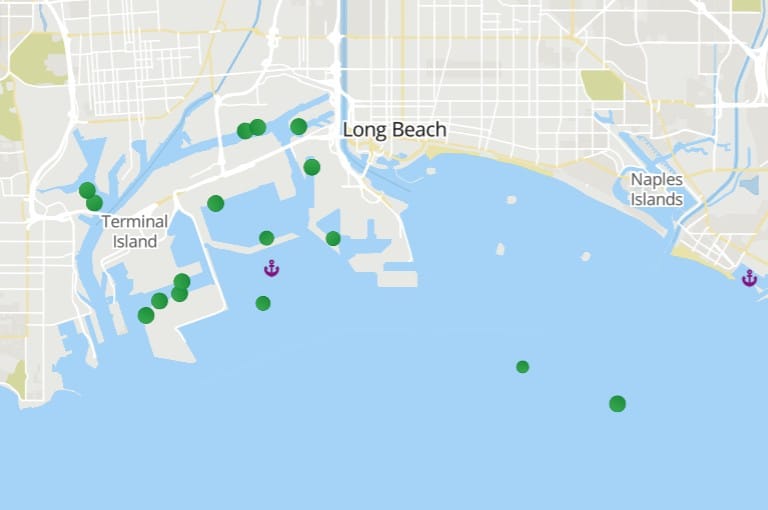
Port of Long Beach/Los Angeles-Wilmington, 0848h local time, 30-APR-2025 via EarthCam

[Port of Long Beach/Los Angeles-Wilmington, 0848h local time, 30-APR-2025 via EarthCam]

Screenshot of container vessel tracking 1300h ET 11-MAY-2025 via MyShipTracking

[Screenshot of container vessel tracking 1300h ET 11-MAY-2025 via MyShipTracking]

The dates on the images of the inactive port may be more than a week apart, but the level of activity has been consistently low over that time period.

Ships moored, being loaded or unloaded, moving to or from docks are all signs of an active port. While cranes hover above, tugboats and other service vessels move about between ships.

Even in low- to no-wake zones, the water shows activity.

There are people and vehicles scuttling about, moving freight once offloaded. Only in an inactive port are there expanses of pavement with no freight, no trucks, trailers, or other vehicles, no people.

Not like the activity visible in the live stream of the container port terminal at Jakarta, Indonesia shown above as an example.

This hasn’t changed in hundreds of years. Not in millennia.

When propagandists declare the drop in ocean shipments to ports in the US is a hoax, they’ve lost touch with a reality based in human history. When they say this is just a temporary hiccup they’re just as out of it.

They are unmoored, one might say.

I’m not going to link to one video in particular that uses ship schedules as an argument freight from China is still inbound to US west coast ports and at volume. It’s an ignorant argument based on a lack of knowledge about container vessels. Container lines still schedule arrivals at port because they may have a partial vessel on a long-arranged route and they don’t want to lose access to the slot in case of a brief disruption in shipping volume. The booking shows as an incoming ship on the schedule even though the container line may be scrambling to consolidate partial loads onto one vessel to reduce fuel.

In some cases ships will approach a port and skip it if they have freight for a different port – let’s say a container vessel from a Chinese port normally scheduled to make sequential drops at Vancouver BC, Long Beach, and Manzanillo MX moors at Vancouver then skips Long Beach and heads for Manzanillo.

It’s clumsily explained as “blank sailing” as CNN’s Erin Burnett explained clumsily on April 25:

That’s why container ship volume crossing the Pacific may continue to look busy on short-term schedules, but containers may not arrive at US west coast ports. Eventually the container line reorganizes and consolidates freight so that it can altogether drop some sailings. Just as in trucking, container lines don’t want the equivalent of deadhead hauls.

And yes, there are some container ships in the screenshot of a vessel tracking site shared widely last week. There are few container ships in that snap of Port of Seattle.

Compare the activity in Port of Kaohsiung, Taiwan, which is no longer in the top ten largest ports based on shipping volume, smaller than Port of Long Beach. It’s crowded with container vessels:

Screenshot of container vessel tracking at Port of Kaohsiung, Taiwan 1300h ET 11-MAY-2025 via MyShipTracking

[Screenshot of container vessel tracking at Port of Kaohsiung, Taiwan 1300h ET 11-MAY-2025 via MyShipTracking]

Let me point out that Port of Long Beach-Los Angeles is the 9th busiest container port; Rotterdam is 13th and Kaohsiung is 17th. Jakarta doesn’t even crack the top 50 busiest container ports.

The freight is not coming. It’s not sailing between China and the US west coast, it’s not in the west coast ports. We can literally see this from space, by way of GPS tracking. There are no container vessels waiting off west coast ports for a berth. There will not suddenly be ships off the west coast before the end of the month.

Why the right-wing insists on lying about this rather than bracing themselves and preparing the country for the reality check to come in mere days is beyond me. They can’t spew enough believable denials to hide the shelves as they empty in the days and weeks ahead. They can’t cover up the damage already done to the US economy, the worst of which has yet to arrive.

Conditions won’t change much based on the so-called 90-day pause and temporary tariff reduction announced overnight. It’s still going to take time for factories in China to ramp back up, rejigger containerized shipping – and all of this is at risk of being changed again in 90 days. The loss of faith by consumers and business purchasers here in the states may not be restored as quickly.

The reduction of tariffs on Chinese goods from 145% to 30% will not be enough to prevent some businesses from failing. Those operating on margins of less than 10% are at extreme risk during the next several months.

Or maybe less if Trump vacillates again.

Share this entry

The Sound of Teeth on Bone: You Are Here

[NB: check the byline, thanks. /~Rayne]

Where to begin:

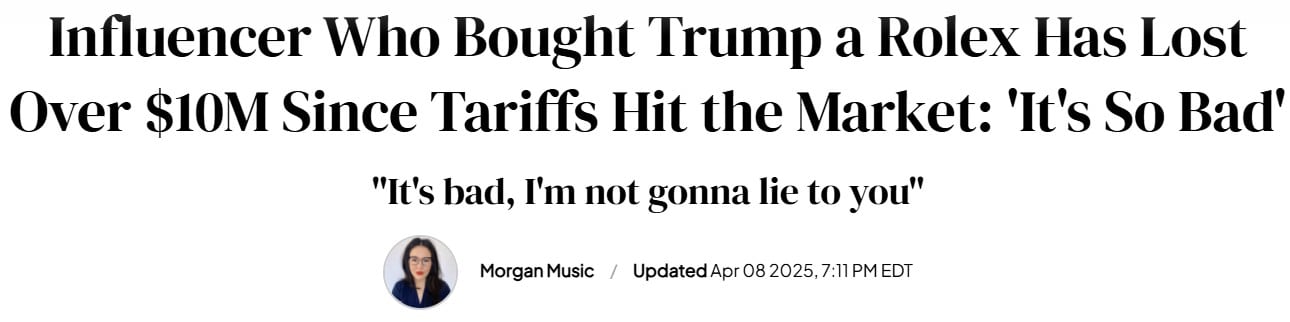
“Damn! You over here like, damn, Kamala, come back to me!” Akademiks joked, speculating that Ross may regret his enthusiastic endorsement of Trump on the campaign trail, now that the president’s economic policy has cost him at least $10 million.

In August 2024, Trump appeared on Ross’s livestream, where the young influencer gifted Trump a $100,000+ custom Cybertruck, Rolex, and his endorsement. While he was visibly morose over the financial hit, he didn’t have anything negative to say about Trump.

Source: Latin Times

Nothing bad to say about the man who cost him eight figures — so far.

This influencer is among many who are why Harris-Walz made no inroads with white and Latino men. They feel a need to belong to a tribe and it’s one which pulls up the tree house ladder to prevent women especially those of color from joining.

Harris warned them and they still can’t fully acknowledge she warned them and they were wrong, let alone admit that really is a leopard sitting on their chests gnawing on their cheekbones.

I’d like to laugh but my investment portfolio is down by a lot and unlike 2008 there was no safe haven I could trust thanks to DOGE Muskrats mucking about in Treasury.

At some point we’ll have to rescue these guys like Bluebeard’s last wife because we’ll be rescuing ourselves at the same time.

~ ~ ~

And now for something critically important — an urgent call to action.

Go to Indivisible.org and read the explanation about H.R. 22, a bill which will disenfranchise a massive number of voters. This is one of the methods by which Trump will attempt to hang onto the White House as well as a stranglehold over executive functions. If voters are deprived of their right to vote, they won’t be able to remove bad representation at mid-terms let alone the general election.

https://indivisible.org/campaign/trumps-new-executive-order-eo-silence-americans-what-you-need-know

While all eligible voters will be affected, those most likely to be disenfranchised are married and divorced women because they will be assessed a poll tax in the form of additional identity documentation in the form of a marriage license. Trans persons and adoptees will also be affected negatively.

The bill also has a hole in it, and I’ll tell you right now it affects me, my father, and my sibling as an example. The word “territory” never appears in this bill, and my father is an American citizen born in what was then a territory, now a state.

Bill text at: https://www.govtrack.us/congress/bills/119/hr22/text

This legislation needs to die and the 107 Republican House members who co-sponsored it need to hear from their constituents that they are failing their oaths of office to uphold the Constitution.

Don’t let this slip by you, take action. We can’t trust the Supreme Court to do the right thing and protect Americans’ right to vote.

Congressional switchboard: (202) 224-3121


Share this entry

Stupid or Evil? It’s Definitely Not Liberation

[NB: check the byline, thanks. /~Rayne]

I don’t have the words for Donald Trump’s liberation-by-massive-tax-increase yesterday. I’ll let an academic handle it:

The one problem with France 24’s video above is that it repeats Trump’s bullshit, even though it offers a rebuttal to the tariffs themselves.

The “economically illiterate” bullshit it repeated was the percentage Trump claimed other countries assessed the US. The numbers are skewed.

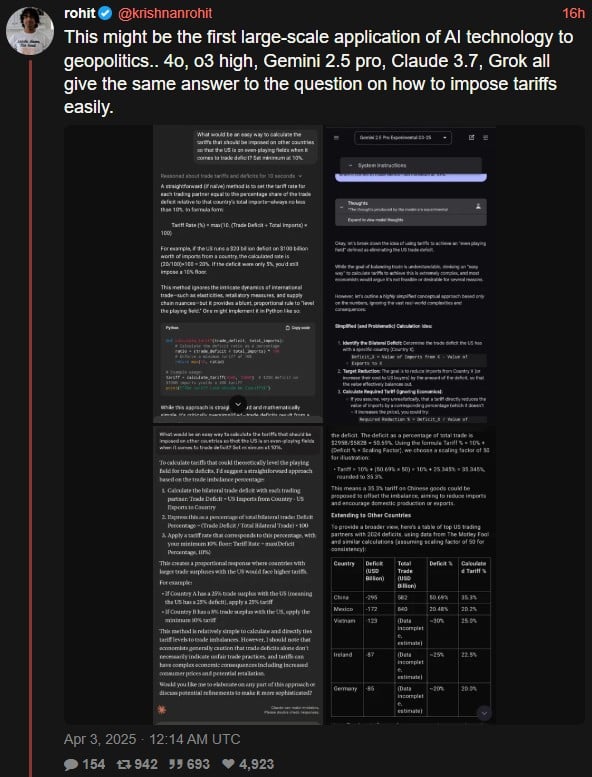
One potential source for the inaccuracy: AI. Krishnan Rohit queried several AI platforms and received a freakishly uniform response which may explain Trump’s numbers.

The rest of the thread can be found here.

Somebody with more smarts about large language models (LLMs) and AI will have to validate this, but it sure looks fishy. Given Team Trump’s predilection for appointing/hiring individuals based on ideology and affinity with Trump, it’s not impossible AI was relied on during the tariff formulation and rollout process, versus the expertise and experience of qualified individuals.

Whatever the case, Trump just rolled out a massive tax increase on the American public. Oddly, CNN conveyed this succinctly in spite of its bent toward pro-Trump rhetoric:

Note the rollout using one of the stupidest Trump appointees across either of Trump’s terms — Peter Navarro. He’d parrot bullshit all day if a mic is shoved in his face.

Also note the phrase “repeated belief,” not a fact but a belief. Team Trump expects the public take what they are saying on faith and not on the basis of past experience.

And then the outright lies CNN’s Chris Isidore points out in that bit emphasized with a red underline: tariffs are NOT paid abroad but here in the US by the importer. The tariffs are added to the cost of goods sold, thereby increasing the likelihood prices to consumers will be higher very soon.

Another academic explains how tariffs — taxes on buyers of imported goods work. See Richard Wolff’s explanation at 5:17 to 6:20 in this video:

Tariffs on imported goods = taxes on us.

You like coffee and tea? It’s going to be more expensive, especially since we don’t grow tea here and our coffee industry is minuscule, consisting of Kona coffee beans. Even fabric for clothing made in the US will be more expensive because we don’t have a fabric industry here in the US any longer at any serious scale; it would take years to re-establish manufacturing here.

Re-establishing industries to replace products now so much more expensive will be challenging given the cost of materials and the competition for labor both to build facilities and staff them after completion.

It’ll take much longer than the 10 years over which this massive tax increase is supposed to generate $6 trillion dollars in revenue — that’s about $1800 per American citizen, $150 more a month.

This country has made this same stupid choice before, so stupid it became part of a movie’s economics teacher’s schtick:

What does uber conservative Ben Stein think about this iteration of voodoo economics rising from the grave, wearing orange foundation and a straw-like hairdo, stomping about as if credibly alive? What does he think about Trump kicking off an unnecessary recession and possibly a depression with his irrational import duties?

This entire mess represents two facets of Trump his base haven’t accepted or ignored. He’s the kind of guy who likes to destroy stuff but can’t successfully build a better version afterward, as if he’s permanently stuck in the demolition phase of construction.

He’s also a plain old fashioned mafioso. All of this is a form of shakedown, borne by the American public as well as global trading partners. You know he’d lift tariffs on any country that offered him vigorish of some form. Quid pro quos are his thing.

He’s a made man — which may explain why tiny islands with US bases on them being assessed tariffs, but Russia isn’t.

Are we really supposed to believe that because trade with Russia is so low that Russia should escape tariffs altogether, while our most valuable trade partners haven’t?

Share this entry
Donald J. Trump wearing an apron while dispensing french fries at a McDonald's fast food restaurant in Pennsylvania as part of a campaign stunt on Sunday, October 20, 2024. Photo by Doug Mills/AP.

What Wannabe Cosplayer-in-Chief Doesn’t Grab

[NB: check the byline, thanks. /~Rayne]

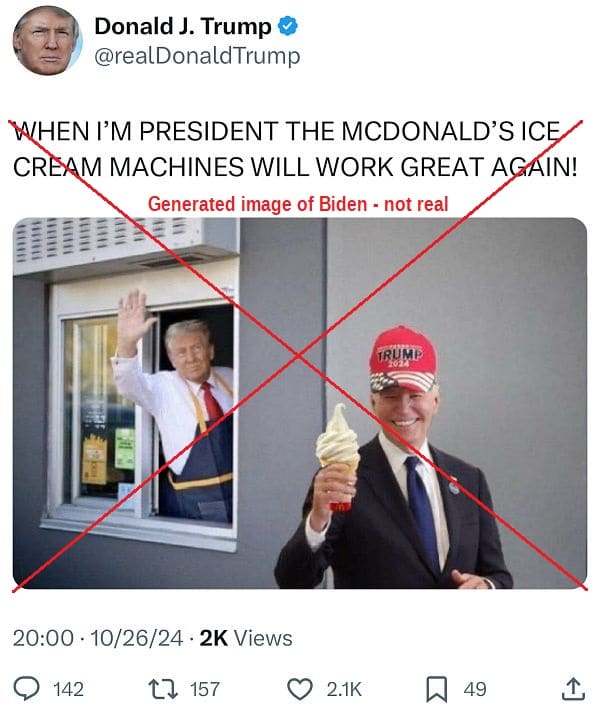
Trump cosplayed this weekend before his Nazi love fest in Madison Square Garden, using a photo of himself in his McDonald’s costume in a social media post:

Funny how he depicts Biden in real presidential attire, as if Trump’s unconscious recognizes he is not presidential while Biden is.

(Trump also claimed unearned credit for repairing ice cream equipment resolved wholly without his participation in any way.)

He cosplayed once again today, pretending to drive a truck:

It’s still just dress up, though.

Trump is playing around, including using his image like a child would have used a paper doll decades ago. Pop Mr. Trump in a McDonald’s drive-thru, add his nemesis Mr. Biden with an ice cream because Mr. Biden likes ice cream, get it? What a good job, Donnie. What will you do with a photo of you “driving” a truck?

Meanwhile, reality grinds on, chewing up real lives and crushing real futures.

Trump’s responses to reality remain as flat and shallow as his playtime.

~ ~ ~

I had a moment recently, before Trump indulged in his McDonald’s cosplay fixation. I was triggered deeply as I packed up to leave my classroom; I made it to my car where I managed to fend off a PTSD panic attack.

Yes, I’m back in school. I’m pursuing another degree as part of a personal goal. I’m on campus in class several times a week. It’s a little awkward at times being older than the rest of the students, half of which are freshmen, not to mention being older than the instructors.

At my age the experience is also a solid kick in the head. Two months into class I’ve realized that I’ve forgotten so much about my own experience beginning college. My fellow students bring it all back.

I had forgotten how goddamned poor I was then. Some weeks I just barely scraped by living on dimes obtained by scavenging soft drink cans and turning them it for the deposit money. Thank goodness Michigan has had a bottle deposit law for decades or it would have been even worse.

A classmate reminded me unintentionally of the experience when they mentioned they would have to see if they could afford the necessary supplies for our next class segment after they got their next paycheck.

In contrast, as soon as I had received an email that I was approved for this class I’d ordered everything I needed all at once. I order double of a few items, didn’t even give the cost a second thought.

It wasn’t always this way. Back in 1978 when I was starving student I’d have had to ask for extra hours at work or find a way to defer a payment in order to purchase something required for a class.

Eventually I had to leave school because I couldn’t afford tuition and fees. In the big picture it all worked out – I landed jobs with companies that paid my tuition – but my late teens and early twenties were really grim. The Reagan years I’d rather not recall at all, thank you.

It was incredibly difficult to make ends meet on 20-36 hours a week at minimum wage jobs. I was fortunate I never had to work in fast food though I’d applied for my share of those jobs. I dreaded the possibility I’d not only get shitty hours I couldn’t count on from week to week, but I might come home smelling like catsup-mustard-onions-pickles with a coating of fryer grease.

A close friend who worked for a major fast food chain couldn’t get the odor out of their hair and skin; it embedded itself in any synthetic fabric. They smelled like a Wendy’s burger for as long as they worked there. Kamala Harris knows what this is like, the feeling of being branded by a necessary but short-term low-wage job.

Cosplayers don’t have to deal with that reality.

Because I worked in retail for a decade, my uniform was business professional with nylons and heels. No apron or hairnet required but 4 to 8 hours on your feet in 2-3 inch heels isn’t fun. It screws with your feet and posture for years afterward.

(Heel spurs, Donnie? Hah. What a pussy.)

Doing stock work in this kind of attire is also distinctly unpleasant, humping bulky and heavy inventory from boxes in the back room to the front of the store to hang on rods you may have just finished waxing, also part of the job while wearing a smile for customers.

I dreaded the stock work because I might ruin a pair of pantyhose. They’d cost me a couple hours’ pay to replace before my next shift. Don’t snap off a heel or break a shoe strap because that’s a week’s pay to repair and more to replace.

Gods help me if the vehicle I relied on – not mine as I couldn’t afford payments, plates, insurance – needed repairs, the cost of which I’d have to help absorb.

If you’re cosplaying you don’t have to worry about little financial set backs like these.

Thankfully I was healthy then. I also didn’t have to worry about my family or daycare at the time.

Unfortunately my classmate not only has to count pennies to afford the next class segment, but their remaining parent is suffering from a life-threatening illness. You know where much of the household’s income is going – right into Big Pharma’s pockets.

That detail isn’t included in the cosplay kit.

Cosplaying a minimum wage worker’s job is simply not the same as actually doing their job, not the same as living their life.

It’s so fucking hard in reality that I “forgot” about it decades later, blocking the unpleasantness of hardship. I also know that it’s considerably more difficult now than it was back then. Health care alone is a nightmare, even with Affordable Care Act coverage.

~ ~ ~

Math is also not part of the cosplayer’s kit.

In reality, the math is inescapable.

There’s no escaping the fact the federal minimum wage is $7.25 per hour and it’s been that since 2009. Minimum tipped wage is $2.13 per hour provided base wage and tips total $7.25 per hour.

States’ minimum wage may be more, but 21 states’ minimum wages are also $7.25 per hour.

Doesn’t matter if individual state’s cost of living index is higher or lower than the average.

Which means the expenses have steadily outstripped wages for years.

Minimum wage jobs are rarely full-time because employers who need cheap labor also don’t want to pay unemployment. The most part-time workers can expect is 36 hours a week and probably not regularly to avoid the appearance of full-time work.

Most will average 20-36 hours a week.

Which means gross pay is somewhere between $145 and $261 a week, or $7540 to $13572 a year.

Now take those numbers and analyze them using NerdWallet’s average monthly expenses by category:

The average expenditures among all consumer units totaled $77,280 annually. That’s up 5.9% from 2022.

Average monthly expenses for housing:
Average expenses for housing totaled $25,436 annually. That works out to $2,120 per month.

Average monthly expenses for transportation:
$13,174 annually. That works out to $1,098 per month.

Average monthly expenses for food:
$9,985 annually. That works out to $832 per month.

Average monthly expenses for personal insurance and pensions:
$9,556 annually. That works out to $796 per month.

Average monthly expenses for entertainment:
$3,635 annually. That works out to $302 per month.

Average. Monthly. Expenses. There’s no way a single person working 20-36 hours a week for federal minimum wage comes close to covering half of these expenses, even if insurance, pensions, and entertainment are completely removed from the calculations.

BLS Employment Cost Index for July 31, 2024 indicates wages have increased, but whose wages and where?

… Wages and salaries increased 4.2 percent for the 12-month period ending in June 2024 and increased 4.6 percent for the 12-month period ending in June 2023. Benefit costs increased 3.8 percent over the year and increased 4.2 percent for the 12-month period ending in June 2023. …

Chances are good these increases still don’t make a dent anywhere in the U.S. when benefits also increased and corporations continue to gouge consumers on top of it to make record profits.

Cosplayer TFG may actually know a little bit about this but from the perspective of a landlord and an employer. He’s cheated renters in his lifetime violating the Fair Housing Act and hired undocumented workers repeatedly because he won’t pay a living or legally-mandated wage to documented workers.

No cosplay required – the guy who’s familiar with this bit of economics wears a blue suit and red tie when he’s not wearing a white golf shirt and khaki golf slacks.

He wants to do this kind of cheating on housing and wages all the time to every American.

No costume required to be an asshole.

~ ~ ~

Let me be more direct: Cosplayer TFG has avoided answering questions about increasing the minimum wage, failing to respect working Americans by offering a bullshit response:

Trump held a campaign photo op Sunday at a McDonald’s in swing-state Pennsylvania, where he was asked about raising the minimum wage.

“Well, I think this. These people work hard. They’re great,” the Republican nominee responded.

The vice president pounced on the remark, criticizing Trump on Monday by saying that she “absolutely” believed in raising the minimum wage to ensure that “hardworking Americans, whether they’re working at McDonald’s or anywhere else, should have at least the ability to be able to take care of their family.”

No wonder he hid behind his McDonald’s costume or climbed into another truck cab.

~ ~ ~

I wish I could assure my classmate that there’s an end to this hardship in sight soon, that there will be elected officials who will work as hard as they do to ensure they get the opportunities they need and a lifeline when necessary.

But that’s on all of you who have yet to vote and aren’t in my class this term.

We aren’t going back. Do something and make this better. Vote for someone who understands what it’s going to take and is willing to do it. Vote for the candidates down ticket who’ll help her deliver.

Vote for somebody who isn’t going to cosplay at working while being a fascist slacker in reality.

Share this entry

Michael Shear and Reid Epstein Feign Stupidity about Trump’s Decade-Long Pitch for Authoritarianism

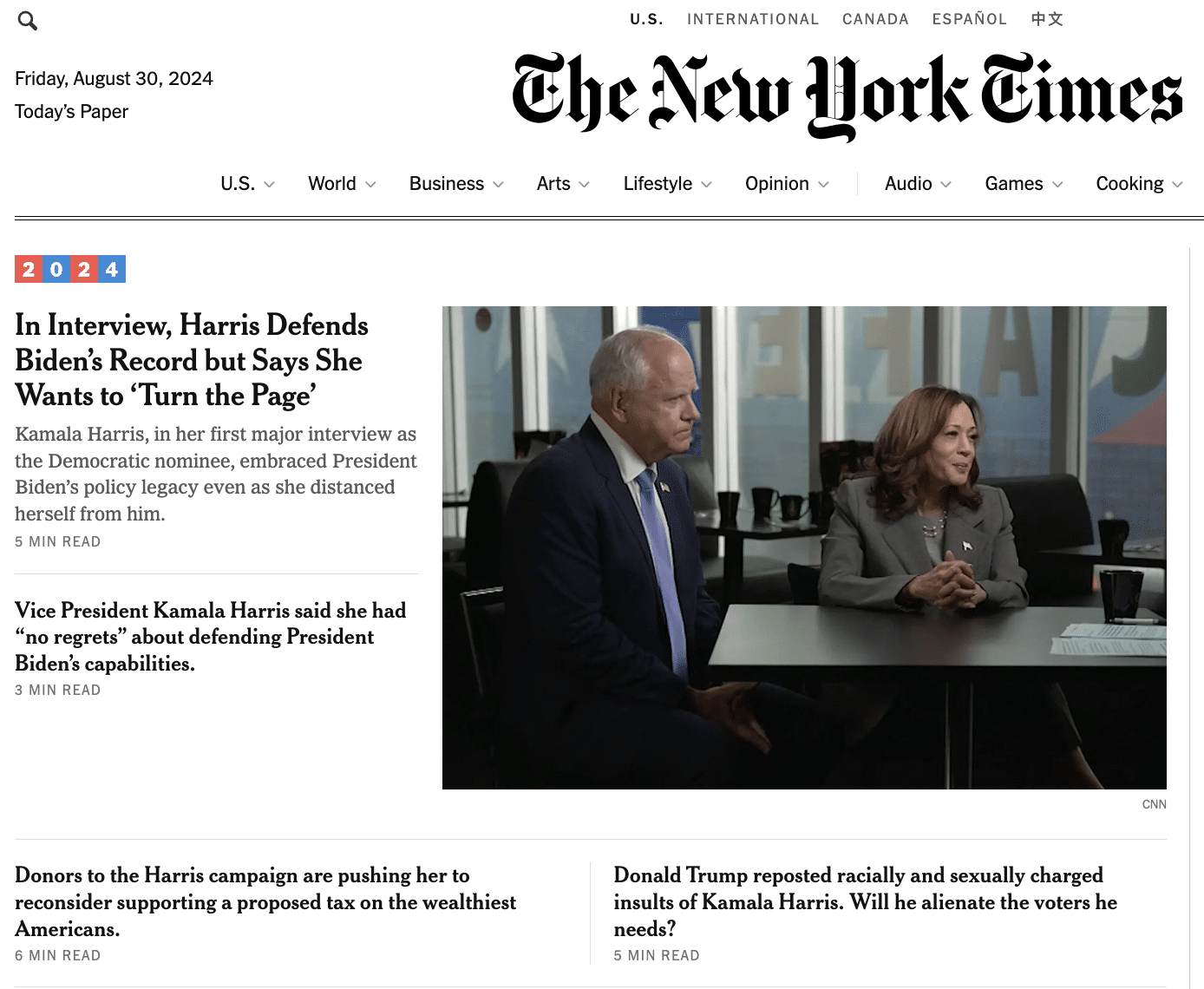
Here’s what the NYT digital front page looks like for me this morning.
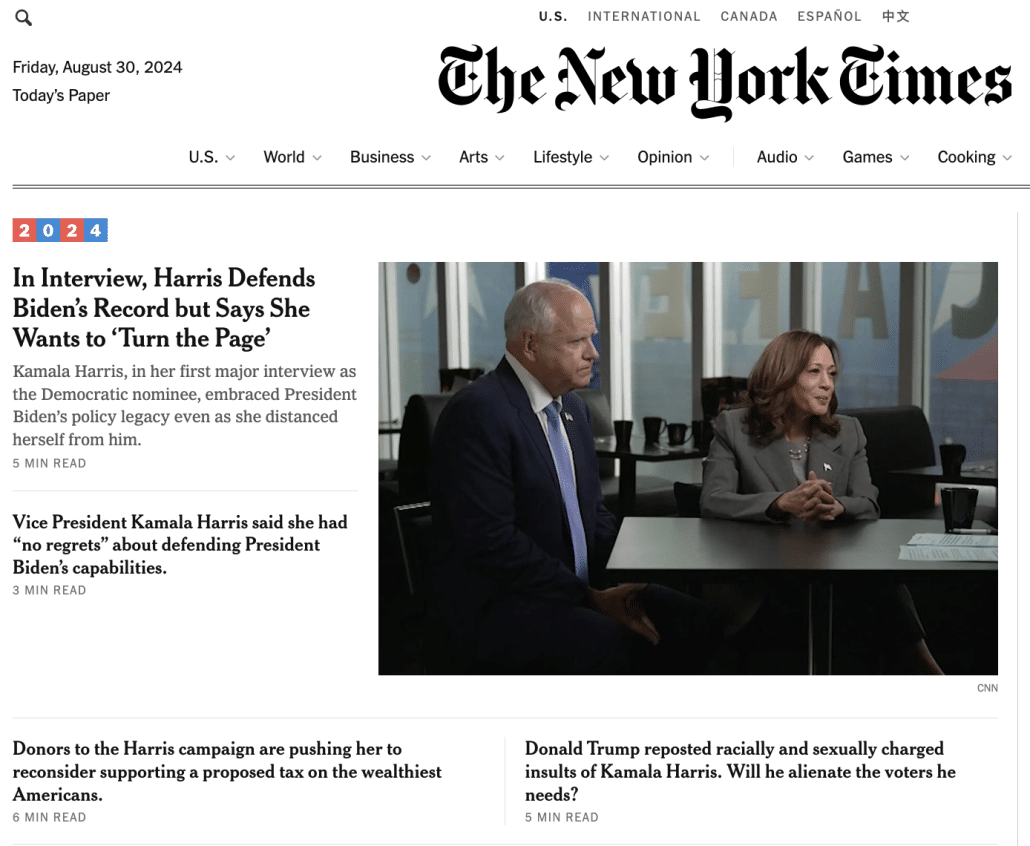
It features Kamala Harris’ rather unremarkable interview with CNN (part one, part two, part three) as prominently as CNN itself (other political outlets are more focused on an upcoming Brian Kemp decision on how Georgia’s election will be run, Trump’s attempt to flip-flop on abortion, and yet another attempt from Trump to delay his sentence in his New York case).

Whatever.

After demanding it for a month, I get that some outlets need to claim this interview was more useful than it was.

But the remarkable thing about NYT’s focus on it is they’ve written two stories substantially about the same thing: The NYT’s own month-long campaign to drive Joe Biden from the race.

Yet in adopting that focus, Reid Epstein and Michael Shear ignored the logic that their own outlet adopted for such an unrelenting push to oust Biden, and in the process, covered up the threat Trump poses to democracy.

Of the seven things Epstein took away from the interview, the first was an overstatement of the degree to which Kamala was “hugging” Biden’s legacy versus the degree to which (for example, on fracking) she will make concessions if it achieves an overall policy goal.

Nevertheless, Epstein is right that Harris was better able to explain the success of Biden’s policies, one of two reasons I was pretty sure, from the start, swapping Harris for Biden would be an improvement, justifying the swap.

As it turns out, Ms. Harris is a better salesperson for Mr. Biden’s accomplishments and defender of his record than he ever was. Perhaps that’s little surprise, given the president’s diminished political skills and trouble speaking coherently in recent years.

Having thus maligned Biden, Epstein then claimed that Harris wants to turn the page on both Biden and Trump. He focused on Harris’ depiction of her opponent not by name, but time period — the last decade — and quipped (I’m sure Epstein thinks this is clever!) that Biden has been prominent over the last decade and a half (treating the two years between when Biden reacted strongly to Charlottesville and the time he actually announced as part of his candidacy).

… but wants to turn the page on him as well as Trump.

What Ms. Harris did do was offer herself up as a continuation of Mr. Biden’s leadership even as she distanced herself from him.

Asked by Ms. Bash if she had any regrets about defending Mr. Biden’s fitness for office and ability to serve a second term, Ms. Harris said she did not and praised the president.

Then, in the next breath, she deftly put both him and Mr. Trump in the rearview mirror.

“I am so proud to have served as vice president to Joe Biden,” she said. “I’m so proud to be running with Tim Walz for president of the United States and to bring America what I believe the American people deserve, which is a new way forward, and turn the page on the last decade of what I believe has been contrary to where the spirit of our country really lies.”

Mr. Biden, of course, has been either president, vice president or a leading candidate for president for most of the last 15 years.

Then Epstein returned to it in his commendation for the boring interview, suggesting that Bash didn’t demean Biden as much as Epstein — or rather, “Republican critics” — want.

Republican critics of Ms. Harris may have wished for a harsher grilling — or for more direct questions about how she felt about Mr. Biden’s aptitude and acuity — but Ms. Bash pressed the vice president when necessary.

Shear did something similar.

His entire post focused on how Kamala answered Dana Bash’s question (three minutes into the third part) of whether the Vice President regretted supporting Biden until he dropped out.

Vice President Kamala Harris said on Thursday that she did not regret defending President Biden against claims that he had declined mentally, saying that she believes he has the “intelligence, the commitment and the judgment and disposition” Americans expect from their president.

“No, not at all. Not at all,” the vice president said when asked if she regretted saying Mr. Biden was “extraordinarily strong” in the moments following the disastrous debate in June that led him to abandon his bid for re-election a month later.

Shear did not, as Epstein did, feign confusion about what Harris meant when she adopted that “last decade” moniker. He explained — perhaps for Epstein’s benefit? — that it was a reference to Trump.

Instead, he misrepresented what she was doing with Biden, temporally, claiming that “she talked about Mr. Biden mostly in the past tense[,] with a kind of nostalgia.”

But she talked about Mr. Biden mostly in the past tense — fondly, but with a kind of nostalgia that made it clear that he no longer represents the future of the country that she hopes to be leading in January.

[snip]

“History is going to show,” she said, “not only has Joe Biden led an administration that has achieved those extraordinary successes, but the character of the man is one that he has been in his life and career, including as a president, quite selfless and puts the American people first.”

Her reminiscing about Mr. Biden’s place in history — she said it was “one of the greatest honors of my career” to serve with him — came just after she said she was determined to “turn the page” on a decade of American politics that has not been good for the country.

“Of course, the last three and a half years has been part of your administration,” Ms. Bash reminded the vice president.

Ms. Harris said she was talking about “an era that started about a decade ago,” an apparent reference to the beginning of former President Donald J. Trump’s first campaign for the White House in 2015. She said the era represented a “warped” idea that “the strength of a leader is based on who you beat down.”

That was clearly directed at Mr. Trump, and she suggested that the warped era would continue if he returned to the White House next year. [my emphasis]

Now, in point of fact, both men misrepresented how the Vice President used that “decade” moniker. She actually used it twice. Once, the instance they focused on, in the last third of the interview, which I’ll get to.

But she also used it in response to Bash’s very first question, the dumb “what would you do on Day One” question that TV pundits love.

I think sadly, in the last decade, we have had in the former president someone who has really been pushing an agenda and an environment that is about diminishing the character and strength of who we are as Americans, really, and I think people are ready to turn the page on that. [My emphasis; after this, Bash snapped back, repeating the, “what would you do on Day One” question.]

That is, Harris defined what she meant by “the last decade” in what was probably her fifth sentence in the interview (possibly even fourth — the woman may use longer sentences than me!), after introducing a focus on the middle class and a return to hope. From her very first response, Harris tied the way Trump (whom she never named) has diminished America to some kind of effect it might have on the middle class.

And the questions that followed that one were focused on policy, which Harris always addressed, whether in the present tense or past, in her role as Vice President. “Well first of all, we had to recover, as an economy,” Harris explained why she (and Biden) had not implemented further steps she’d like to take to help the middle class. “That’s good work,” Kamala boasted, after listing a bunch of Biden’s economic accomplishments. “There’s more to do, but that’s good work.”

In fact, Kamala’s answer to the question NYT dedicated much of two columns on, whether she regretted defending President Biden after he bombed the debate, was in the present tense.

Harris: I have served with President Biden for almost four years now and I’ll tell you it’s one of the greatest honors of my career. Truly. He cares so deeply about the American people. He is so smart and loyal to the American people. And I have spent hours and hours with him, be it in the Oval Office or the Situation Room. He has the intelligence, the commitment, and the judgment, and disposition that I think the American people rightly deserve in their President. By contrast, the former President has none of that. And so, one, I am so proud to have served as Vice President to Joe Biden. And two, I am so proud to be running with Tim Walz for President of the United States, and to bring America what I believe the American people deserve, which is a new way forward and turn the page on the last decade of what I believe has been contrary to where the spirit of our country really lies. [my emphasis]

In a question implicitly about how successful she has been thus far, in the race, Kamala defined who Biden is, present tense, and then explicitly contrasted that to Trump. Biden has, present tense, the intelligence, commitment, judgment, and disposition to be President, and Trump has, present tense, none of that. That’s what she used to springboard from her tenure as Vice President into her candidacy with Walz, a way to turn the page on the last decade that has been contrary to the spirit of the country.

Bash, like Epstein, tried to make this a gotcha, which is when Kamala explained for the second time what she was talking about.

Bash: The last decade — of course, the last three and a half years has been part of your Administration.

Harris: I’m talking about an era that started about a decade ago where there is some suggestion — warped, I believe it to be — that, the measure of the strength of a leader is based on who you beat down, instead of where I believe most Americans are, which is to believe that the true measure of the strength of a leader is based on who you lift up. That’s what’s at stake as much as any other detail that we could discuss in this election. [my emphasis]

But then Harris returned to what she said in that very first question: When she says “last decade” as stand-in for the opponent she won’t name, she means that a different vision of leadership is as important as any of the policy questions.

Where things turn to a past tense in which Harris does not presume herself to have participated — the one that Shear quotes to support his claim that “she talked about Mr. Biden mostly in the past tense” — came in response to her telling of how Biden told her he was going to drop out, which led her to think about how history — people in the future — will regard Joe Biden and the decision he was making, placing this past tense as past to some future time when pundits finally get their heads out of their asses.

The VP told the story: she was interrupted while making extra bacon for one of her grand nieces by a call from Joe Biden. Biden told her his decision, and, “I asked him, are you sure. And he said, yes. And that’s how I learned about it.”

The past tense Shear quoted came in response to a follow-up.

Bash had asked, and pressed a second time, whether Biden offered to endorse Harris right away. Harris responded that Biden was very clear he was going to support her (Kamala didn’t actually answer about the endorsement, but then they may have had earlier conversations), but that that wasn’t her first priority.

My first thought was not about me, to be honest with you. My first thought was about him, to be honest.

She then launched on a reflection about what, “I think history is going to show” about Joe Biden’s presidency, describing it as transformative economically, bringing back American alliances. Then she addressed “the character of the man.”

This is a question that goes back to one of two reasons Biden offered in February why he remained in the race: because he was really good at being President. The other (as I reviewed the day after the debate) was that he believed, in February, he had the best shot at beating Trump.

On July 21 — on the day that Biden was still scrambling to make the prisoner exchange with Russia even as NYT pundits were falsely reporting he was totally isolated — Biden was still very good at being President. With the significant exception of Gaza, he may still be. By that point on July 21, though, it had become clear that Harris is better able to beat Trump. As suggested by Epstein’s begrudging admission that when Kamala lays out Biden’s economic accomplishments, they look pretty good, part of that is defending the things the Biden Administration did to recover from the mistakes Trump made.

But part of it is offering a contrast with Trump. Which, because Harris apparently chose not to name her opponent and not to let silly pundits demand a response to Trump’s latest attention-getting provocation, as Bash did with a question about Trump’s presumption to define Harris’ race, the Vice President is referring to as a last decade. She did it in response to the first question, and she did it a second time in response to the question NYT chose to write about twice.

This is actually a pretty subtle way to do this. Obviously, Harris has befuddled two men who imagine themselves experts.

In their confusion about it, though, Epstein and Shear make a similar mistake to the one their colleague Shane Goldmacher did when he described that Kamala was running as a change candidate. They did so, even though Goldmacher himself referred to what Kamala was running against as Trump’s “decade”-long “bulldozing approach” advocating for “urgent upheaval.”

[S]o much of Trump’s lasting influence is about his lasting attack on rule of law. The insistence that this is about incumbency obscures the real threat Trump poses to democracy, whether or not he’s president.

Take this crazy Goldmacher paragraph.

For nearly a decade, Mr. Trump’s bulldozing approach has been premised on the idea that the nation was staring into an abyss and only urgent upheaval could save the country. The question for Ms. Harris is whether she can frame Democrats keeping power in 2024 as a break from that dark and divisive era.

It is true that Trump has been claiming that “only urgent upheaval could save the country.” But that was a fascist trope. It wasn’t true and even if it were, none of the policies Trump pushed would do anything but enrich people like him. Journalism should do more than observe that he made those false claims; it should explain why they’re false.

In the very next sentence, though, Goldmacher asserts that the challenge for Kamala (again adopting the dumb poll-driven assumption that she’ll only win if she is the change candidate) is by offering, “a break from that dark and divisive era.” What “era”? By reference, Goldmacher must mean that the near-decade in which Trump has told fascist lies is the “dark and divisive era” (though Trump’s racist birtherism started long before that). But it’s not an era. It’s a fascist belief, a means of exercising power, a means of dehumanizing your political opponents, one that had huge influence, but one that with the exception of the political violence it fostered, only held sway over a minority of the country (albeit a large one).

All three of these men — Goldmacher with his treatment of Trump’s tropes about America as an era, Epstein with his confusion about Harris’ (second) reference to a decade, and Shear’s invention of past tense usage that doesn’t exist — struggle because they’re viewing this exclusively about policy, even though Harris described that “the true measure of the strength of a leader” is “what’s at stake as much as any other detail that we could discuss in this election.”

As I noted in the earlier post, when people flatten this out into policies and incumbency, they ignore the ongoing threat that Trump poses to democracy and Kamala’s vision of how to defeat it.

Kamala is running on democracy just as much as Biden did in 2020. It just looks different, because she has more successfully wrapped it in a bipartisan flag. Even there, there’s real continuity (don’t forget that one of Biden’s most important speeches about democracy in 2022, one that had a real impact on the election, was at Independence Hall).

Largely enabled by Trump’s ongoing effect — again, especially on Choice — Kamala has just found a way to make democracy matter more personally, more viscerally.

Kamala is not eschewing the incumbency she has Vice President. On the contrary, she is running on a continuation and expansion of Joe Biden’s successful policies (even if journalists are missing that). And she is running, just as Biden did, on defeating both Trump’s electoral bid but also the threat he poses to democracy itself.

This is precisely why the NYT said the stakes on Biden dropping out were so high as it kicked off a relentless campaign to force Biden out: because, first, Donald Trump was a menace, and second, Biden didn’t have what it takes to hold Trump accountable.

Donald Trump has proved himself to be a significant jeopardy to that democracy — an erratic and self-interested figure unworthy of the public trust. He systematically attempted to undermine the integrity of elections. His supporters have described, publicly, a 2025 agenda that would give him the power to carry out the most extreme of his promises and threats. If he is returned to office, he has vowed to be a different kind of president, unrestrained by the checks on power built into the American political system.

[snip]

He struggled to respond to Mr. Trump’s provocations. He struggled to hold Mr. Trump accountable for his lies, his failures and his chilling plans. More than once, he struggled to make it to the end of a sentence.

These self-imagined pros apparently haven’t thought through how this all works. Epstein, at least, is still looking for his pound of flesh, for further humiliation for Joe Biden. The others are ignoring the two tasks: win an election, and reinvigorate an American dream that — because doing so would prove that democracy can deliver for the middle class — proves the value of democracy.

Kamala Harris is, in no way, disavowing Joe Biden. Rather, even as she’s pitching their joint policy success, she’s renewing the effort to package an American exceptionalism that can defeat Trump’s American carnage.

In 2020, Joe Biden, a member of the Silent Generation, offered a defense of democracy as democracy, which was enough for people who remember fascism and actual communism. In an era when many have forgotten that history and lost faith in democracy, GenX Kamala Harris has to do something more: She has to sell democracy, which Trump has been discrediting for a decade, itself.

Share this entry

Three Things: So Much Stupid

[NB: check the byline, thanks. /~Rayne]

There’s a lot of stupid going on right now. Here’s an open thread to talk about it. Let me start off with three examples.

~ 3 ~

Ding dong, the witch is dead — Ronna McDaniel has been terminated less than a week after she signed a contract with NBC.

Even her agency dropped her.

I like journalist Sam Adam’s take:

Story at HuffPo: https://www.huffpost.com/entry/nbc-fires-ronna-mcdaniel-election-lies_n_6602d903e4b06a4403a3e80a

NBCUniversal News Group Chairman Cesar Conde accepted the blame for McDaniel’s hiring though he noted it was a collective decision by “collective recommendation by some members of our leadership team” to hire the unindicted January 6 co-conspirator.

It’d be nice if folks who support democracy and a free press checked their investment portfolios for Comcast (Nasdaq:CMCSA) including their mutual fund holdings’ portfolios — and then sent letters to Investor Relations asking for accountability at Comcast and NBC for this stupid hiring decision which damaged NBC.

~ 2 ~

BlackRock CEO is fucking clueless about Millennials and Gen Z, spewing this crap:

You know what’s causing these two demographic groups so much economic anxiety? The two things which cost them the most: tuition debt and housing.

They can’t save for a house if they have tuition debt hanging over them. President Biden has steadily chipped away at this but it isn’t enough.

They can’t buy a house because there’s too little housing available which in turn drives up pricing. Sure, mortgages are pricey right now but if there’s not enough housing, mortgages aren’t the bigger problem.

Rental housing is also overpriced and getting worse; it’s been unaffordable for persons working a full-time minimum wage job for years thanks to continued corporate pressure to resist raising minimum wages at state and federal level for decades. This has begun to change but Millennials are digging their way out of a deep hole to amass savings.

One of the biggest contributors to rising rental housing costs is the commodification of housing as a tradeable asset in the form of real estate investment trusts (REITs). Investors treat REITs as if they should increase in value and payouts like other tradeable stocks.

Gee, guess what BlackRock’s funds include?

Fink also hasn’t gotten the memo that there is a growing wave of disability as a result of the COVID pandemic. People will need to retire earlier, not later, and his bullshit refusal to accept wealthier persons must pay more into Social Security is not going to help.

Side note: I can’t recommend using Fortune magazine at this time. The link to this story follows but be warned: Fortune changed its privacy policy and you will be forced to accept that policy in order to read the fucking privacy policy. Absolutely unacceptable dark pattern.

Source: https://fortune.com/2024/03/26/blackrock-ceo-larry-fink-boomers-fix-retirement-crisis-millennials-gen-z-economically-anxious/

~ 1 ~

Trump’s POS social media platform appears to have lifted older Mastodon source code and slapped on a new frontend, without having addressed vulnerabilities in the older source code or handled the open source licensing correctly.

source: https://mstdn.social/@stux/112163975507522652

This massive stupidity is what the new Trump Media & Technology group is based on — the stock for which began trading today.

I’m going to have to buy popcorn futures for this.

~ 0 ~

Once again, this is an open thread. Bring all the stray stupid here along with topics not covered by other posts.

Share this entry