
Comey’s Emphasis on Expiring PATRIOT Provisions: Other 215 Uses and Roving Wiretaps


A number of outlets have reported that, in an appearance Wednesday at Georgetown, Jim Comey suggested the other PATRIOT Act provisions expiring on June 1, not Section 215, are the critical ones. Here’s one example:

In a speech Wednesday, FBI Director James B. Comey said losing the ability to use roving wiretaps or track lone wolves in terrorism investigations would be a “big problem.” The bureau since the 1980s has been able to follow criminal suspects as they changed phones, he said, and the Patriot Act extended that capability to terrorism cases.

“That’s going to go away” unless the law is reauthorized, Comey said.

That’s not actually what Comey said. (Starting at 20:45) Rather, he said that losing other uses of Section 215 — in situations where FBI can’t get use a grand jury subpoena or an NSL — would be “a big problem.” He did say that losing Roving Wiretap Authority would be “a big problem.” About Lone Wolf, he said only that it, “matters.”

Significant impact, in ways that we’re not talking about much, and I’m trying to make sure we’re talking about. A lot of the focus on 215 is on the NSA’s telephony metadata — should that be with the NSA, should that be with individual telepho–telephony providers and accessed by the NSA, and that’s an important discussion. That’s a useful tool the FBI [shrugs] so it’s a conversation I care about, but there are critical tools to the FBI that are going to sunset on June 1 that people don’t talk about.

The first is, Section 215 is the vehicle through which the NSA, telephony database, was assembled, but we use Section 215 in individual cases, in very important circumstances fewer than 200 times a year we go to the FISA Court in a particular case and get particular records that are important to a Counterintelligence investigation or a Counterterrorism investigation. If we lose that authority, which I don’t think is controversial with folks, that is a big problem. Because we will find ourselves in circumstances where we can’t use a grand jury subpoena or we can’t use a National Security Letter, unable to obtain information, with the court’s approval that I think everybody wants us to be able to obtain, in individual cases, so that’s a problem.

The second that’s a big problem is the Roving Wiretap Authority is gonna expire on June 1. This is an authority we’ve had in criminal cases since the early, mid-eighties, where if a drug dealer or a criminal is dropping phones repeatedly, the judge can give us authority to intercept that individual’s communications, no matter what device they’re on, so we don’t have to go back and start the process each time they dump a phone. What the PATRIOT Act did in 2001 was extend that authority to international terrorism investigations and counterintelligence investigations. That is not a controversial thing. That’s gonna go away June 1 unless it’s reauthorized.

And there’s one other provision that matters. And that’s the so-called Lone Wolf — that’s not a term I like but it’s call a Lone Wolf provision by most people. And that is if we can’t, if we can establish probable cause that someone in this country is up to terrible no good, they have probable cause to believe they are an international terrorist of some sort, but we can’t prove what particular organization they’re hooked up with, this provision would allow us — the judge — to authorize the interception, even if we can’t say, “well they’re Al Qaeda, no they’re ISIL, no they’re AQAP. That’s an important, I think uncontroversial authority, these 3 are going to go away June 1. And I don’t want them to get lost in the conversation about metadata.

The emphasis, then, is on the first two — other uses of Section 215 and Roving Wiretaps — and not Lone Wolf as much.

To be fair, Comey is likely obfuscating about all three of these.

We know that when the Internet collection that had formerly (until 2009) been done under NSLs is bulky; the FISC spent a lot of time policing minimization procedures on that collection until FBI finally started complying with the law in 2013. And when Comey says these are “individual cases,” he likely means they are things like US-based Jihadist fora encompassing the communications of many individuals, or frequent or critical cyber targets with which many individual people might communicate as well. Indeed, these collection points are probably — like the phone dragnet — tied to enterprise investigations, which would explain why grand jury subpoenas would not be available.

As for the Roving Wiretap, remember that in 2007 the FISC reinterpreted that statute in secret to mean NSA could collect from entire circuits because al Qaeda targets used many different email and phone addresses served by that circuit. While NSA is likely not relying on that particular opinion anymore (the Protect America Act and FISA Amendments Act replaced that collection), the opinion has likely been repurposed in similar ways to permit NSA to target far more broadly than actual suspect individuals. For example, for a frequent cybersecurity target, I could imagine NSA making an argument that hackers are frequently using (in reality, attacking) those servers, and therefore the FBI can collect on it. Similarly, I could imagine them using Roving Wiretaps to authorize US-based efforts to undermine the Tor network.

The same is almost certainly true of the Lone Wolf provision (in fact it has to be, because for years FBI insisted on extending even though they admitted they had never used it directly). Remember, Lone Wolves are supposed be US-based non-US persons engaged in international terrorism. But for a bunch of reasons, I suspect the provision is used to claim someone with zero tie to a terrorist organization overseas is a Lone Wolf (making him a foreign power) and then use that to claim some young Muslim man in the US “planning” plots with the foreign-based Lone Wolf can be targeted under FISA. (There must be some such explanation because there are lot of young sting targets apparently targeted using traditional FISA orders who have no discernible status as an agent of a Foreign Power.)

For what it’s worth, I suspect the extension of WMD trafficking designations under USA F-ReDux to include those who conspire with or abet actual proliferators is intended to work the same way: to expand the Foreign Power definition to encompass many fairly.

All that said, Comey’s emphasis was, in large part, on those other use of Section 215, and certainly didn’t seem to be on the Lone Wolf provision. And he may well be correct that FBI can’t replace this function easily, if my guess that FBI uses Section 215 to conduct bulky collection for enterprise investigations is correct. Moreover, note that the assessments of agents in the IG Report released yesterday — that they could not “identify any major case developments from the records obtained in response to Section 215 orders” — predates the big spike in use of Section 215 to collect those Internet communications. So the question would need to be asked again about this collection to see if it has been critical.

All that said, if these other uses are so important, than the Intelligence Community shouldn’t have played a game of chicken to retain a phone dragnet function which FBI largely duplicates with individualized collection already, which has never been critical to stopping a terrorist plot, and which may well hold up these purportedly critical other uses.
Share this entry

Finally! That Person Who Claims Section 215 Involves Interception of Communications!

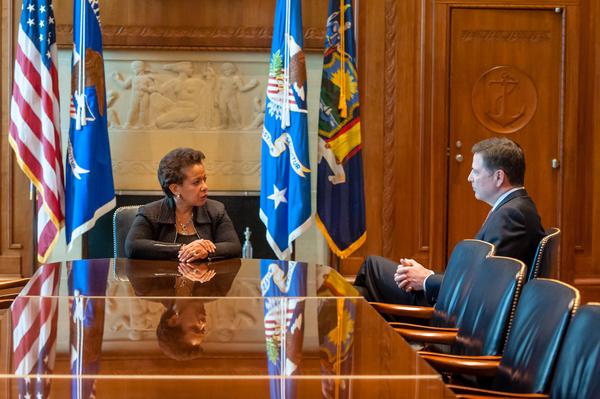
Comey LynchFor two years, a key pushback strategy against those complaining about the phone dragnet program collecting records of every single American has been to falsely claim that opponents of the dragnet were claiming the dragnet collected content.

Of course, this was a straw man, as Mike Lee laid out brilliantly during his second speech supporting Rand Paul’s filibuster the other night.

So while it is true people point out that under section 215 of the PATRIOT Act, under this particular program, the NSA is not listening to telephone conversations. They are not listening to them.

Interestingly enough, this is very often a straw man argument that is thrown out by those who want to make sure that section 215 of the PATRIOT Act is reauthorized without any reforms. They claim that those who are opposed to this type of action are out there falsely claiming that the NSA is listening to phone calls over this program.

Well, that accusation of falsehood is, itself, false. That accusation of falsehood is, itself, a straw man effort. It is a red herring. It is a lie. It is a lie intended to malign and mischaracterize those of us who have genuine, legitimate concerns with this very program, because the fact is we don’t make that argument. The argument we are making is that the NSA doesn’t even need to do that. The NSA can tell all kinds of things about people just by looking at that data.

Because it is automated and because it is within a system thatoperates with a series of computers, they can tell very quickly it is alot less human resource-intensive than it would be if they were havingto listen to countless hours of phone conversations. It is a lot moreefficient.

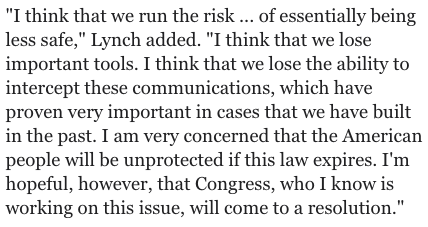
Nevertheless I finally have — after two years of this debate — found someone actually suggesting that Section 215 involves the interception of communications.

Lynch Intercept

Now, to be fair, Attorney General Loretta Lynch likely misstated here. Or perhaps because she knows that the dragnet serves to identify content of interest, she may treat the two as connected (because they are to a degree program defenders like to obscure). Or maybe she is simply admitting what dragnet opponents keep arguing — that collecting metadata amounts to interception of very revealing data. [Update: As Josh Gerstein points out, she could be talking about Roving Wiretaps, which would mean CBS should not introduce this paragraph as being about the phone dragnet.]

Whatever the reason for AG Lynch to make this claim, I think it worth noting that the most prominent person suggesting that Section 215 gives “the ability to intercept communications” is the nation’s top law enforcement officer, not some dirty hippie trying to impugn the phone dragnet.

Share this entry

DOJ IG Report Confirms Government Flouted Statutory Requirements of Section 215 for 7 Years

For over a year, Congress has been working on a “reform” to Section 215 that it claims will rein in abusive government spying.

Also for about a year, DOJ’s Inspector General has been trying to release a Report on Section 215 use up to 2009. That investigation first began 1,800 days ago.

DOJ has finally managed to release the report.

It confirms a number of things I have been reporting for years: that the government uses the provision to collect records that have nothing to do with phone records in bulk, the majority of which are now Internet records, definitely including URLs and probably including subject lines.

But the takeaway report is something else I’ve been reporting on for some time.

The government completely blew off a requirement imposed with the 2006 PATRIOT Act Reauthorization that the FBI (which is the only agency that’s supposed to use Section 215) adopt minimization procedures specifically for Section 215. Even after FBI missed its September 2006 deadline by claiming it had Interim Procedures, FISC kept approving Section 215 orders, even including paragraphs that appear in every phone dragnet order claiming the government has met that statutory requirement. A year after DOJ’s Inspector General pointed out FBI was violating the statute, FISC started imposing its own minimization procedures and reporting requirements (though not — as a court operating with more transparency might have done — denying orders). Finally, in March 2013, DOJ adopted minimization procedures (though it did not start actually complying with them until more than four months after Edward Snowden’s leaks focused more attention on bulk 215 orders).

In other words, Congress imposed a mandate designed to protect innocent Americans’ privacy in 2006. And DOJ blew that statutory mandate off for years. And FISC let it do so for years, approving order after order requiring FBI to have fulfilled that mandate. And only after 7 years (and some unexpected transparency) did DOJ start following the law.

These are the people Congress is rushing headlong to provide new authorities (including an Emergency provision that is designed to invite abuse): government agencies who simply refuse to follow Congressional mandates.

Share this entry

The Paul Filibuster

As some of you were live-commenting yesterday, Rand Paul conducted a 10.5 hour filibuster of the USA F-ReDux last night.

A lot of journalists are calling it meaningless. But it may not be. As Sunlight Foundation explains, by occupying the floor for the balance of yesterday, Paul may have prevented Mitch McConnell from invoking cloture on his short-term reauthorization, leaving only USA F-ReDux as the only legislation that might possibly get through the Senate before House members start leaving for recess tonight.

What does the currently ongoing filibuster have to do with this? It’s not just that it stalls the vote in the Senate and wedges it up closer to Section 215’s expiration. If Paul and his allies get to midnight tonight, as far as we can tell, it stops the Senate from considering any bill other than the House-passed USA FREEDOM Act, or, by default, sunset before Saturday. Without this filibuster, McConnell could have moved today to proceed on from the trade vote to USA FREEDOM or the 2-month reauthorization (though the Senate will have a cloture vote on trade tomorrow no matter what), and in turn begun the cloture process, which would have matured Friday. While the House is supposed to be out on Friday, keeping the House for another day, versus through the weekend and into Memorial Day, is a bit different.

Tomorrow, two things start to kick in: NSA has to start detasking from collection, and the deadline to apply for a new FISC order passes (the latter of which I first noted months ago).

All that said, I suspect there was an underlying deal here.

That’s true because the 9 or so people who supported Paul in this filibuster were all USA F-ReDux supporters (and of them, only Ron Wyden has called for significant amendment process, which is what Paul said he was fighting for with his filibuster).

More telling, Paul stopped 11 minutes short of midnight. And McConnell seemed to expect that — he had Bill Cassidy come on the floor to submit the highways bill for cloture.

In other words, McConnell could have, but didn’t, file cloture on his short-term reauthorization last night.

It’s quite possible that the Senators from KY made an agreement to get themselves out of holes they had created for themselves, Paul, in pushing against the bill, and McConnell, in leveraging such that sunset of Section 215 became a real possibility. By appearing to be left with no choice but USAF, McConnell could then whip it, and ensure it passes, to be quickly sent to Obama for signature. If McConnell really whipped it, Paul could even cast a symbolic vote against it.

If that ends up happening, Paul’s filibuster will not be a waste. It would have prevented — or been the tactic that allowed all sides to accept the prevention — of the bill getting worse in the Senate, which was always a real possibility.

But no one should be breaking out tequila to celebrate a PATRIOT Sunset yet.

Update: McConnell apparently just filed cloture on his short-term reauthorization. That would put the vote on Saturday, with the House having to come back to deal with it.

Share this entry

Will Gary Peters Help Mitch McConnell Expand Illegal Surveillance?

A year ago, Michigan Senator Gary Peters voted with 302 of his House colleagues for that version of USA Freedom Act (the incarnation I called USA Freedumb). He voted for a badly flawed bill (perhaps looking forward to his Senate campaign), but he did vote for a smushy compromise to get the government out of the business of holding all Americans’ phone records.

Also about a year ago, Peters voted for the Massie-Lofgren Amendment which would have defunded back door searches of data collected under Section 702. It was an easy vote; there was little chance then Senate Appropriations Committee Chair Barb Mikulski would have let that remain in the Defense Appropriations.

But Peters at least pretended he cared about abusive surveillance.

This week, however, Peters claims to be uncertain about whether he will support a short-term extension of sunsetting PATRIOT Act authorities. His office twice did not respond to a request for clarification on this front.

Let me be very clear: supporting Mitch McConnell’s short-term extension serves just one purpose: To make the already weak reform, USA F-ReDux worse. Peters’ claimed uncertainty about what he will do just enables McConnell’s stunt to expose innocent Americans to more spying.

If, like me, you’re a Peters constituent, please call his office and urge him to hold the line on the already weak USA F-ReDux. (202) 224-6221


Share this entry

Mitch McConnell Prepares to Reject a 6-Month Window to Set Up Dragnet Replacement

The surveillance hawks are out feeding the propaganda machine.

First there’s Eli Lake claiming that, if Congress were to pass legislation newly immunizing and compensating providers to conduct two-hop spying on Americans, most of whom would be innocent, it would amount to “tak[ing] back some of the extraordinary powers it granted to the executive branch [by…] revok[ing] the NSA’s authority to collect telephone records in bulk.” The implication is that Congress affirmatively granted the NSA that authority.

Of course, that’s not what happened. First, the Bush Administration secretly assumed that authority as it rolled out Stellar Wind, without even fully informing Congress about it or considering the legal implications of collecting Internet metadata via telecom switches. Years later, DOJ found that part of the program unlawful. When DOJ asked the FISA Court to approve that collection — well, in truth, it didn’t ask; DOJ told the court it “shall” authorize the collection under the terms of the Pen Register statute — it specifically refused to go to Congress to get it approved. “Government cannot pursue that route because seeking legislation would inevitably compromise the secrecy of the collection program the Government wishes to undertake,” the government’s application claimed.

It took years after getting a secret court to rubber stamp, twice (in the second instance, without even writing an opinion to explain how the Section 215 statute dictating relevance might be deemed to mean all) these new dragnet collections before the Executive briefed the full Intelligence Committees, and the Executive didn’t share the materials on the program until obligated to do so by the FISA Amendments Act. Though well into 2010, the Executive was withholding documents mandated under FAA for disclosure to the oversight committees. The Executive did provide short, in some ways misleading, summaries to be shared with Congress before they reauthorized the PATRIOT Act. But not only weren’t those summaries made easily available to members, in 2011, Mike Rogers didn’t pass it on, ensuring that a sufficient number of Congressmen to make the difference in the vote could not be informed. And the briefings held instead were affirmatively misleading.

This is what Eli Lake considers Congress “granting the executive branch authority to collect[] telephone records in bulk,” which is where he gets the claim that in shifting the program to providers it would be taking away an authority.

For all its other faults and, at times, outright inaccuracies, Lake accidentally reveals the problem with Mitch McConnell’s logic calling for a 2-month reauthorization.

Opponents of the bill raise one technical concern: The legislation gives the NSA 180 days to build a new computer architecture for querying the phone company databases. It’s a tricky matter. Phone companies store the records of only their customers, whereas the NSA stored all of these records in one database.

Even Representative Adam Schiff, the ranking Democrat on the House Intelligence Committee and a supporter of the bill to curb bulk collection, acknowledged this could be a problem. Speaking to reporters Tuesday at a breakfast sponsored by the Christian Science Monitor, Schiff said: “I think if we reach an impasse on the authority sunsets, then the NSA will have some responsibility for that breach. I have been urging the NSA for quite some time now to begin the process for developing the process to take data from different providers so they can talk to each other.”

If USA F-ReDux were to pass tomorrow, NSA would have 6 months to set up the replacement (though as Schiff notes, they could have been implementing the new plan for months). Read more

Share this entry

GOP Brought in Guy Who Authorized Dragnet to Talk Dragnets

I’m far more alarmed by this tidbit in the latest report on the fight over USA F-ReDux than many who are commenting on it.

McConnell’s presser came following Senate lunches, during which former Attorney General Michael Mukasey, who served under George W. Bush, briefed Republicans on the importance of the surveillance authorities. While defending the NSA’s phone-records dragnet, Mukasey did say a recent federal appeals court deeming the program illegal could complicate McConnell’s efforts to renew the Patriot Act without changes, given the legal uncertainty that could result, according to two senators present.

“He did recommend some acknowledgment of the decision so that it is addressed in the legislation,” Sen. John Hoeven, a North Dakota Republican, said.

The Republicans sat down to talk about dragnet surveillance and they brought in Michael Mukasey, who not only presided over the expansion of Stellar Wind in the form of FISA Amendments Act, but authorized SPCMA after some previous DOJ officials appear to have refused to.

SPCMA, you’ll recall, is the authority to contact chain on US-person metadata collected under EO 12333 that current FBI General Counsel James Baker refused to authorize in an earlier position at DOJ in 2006 but which Mukasey signed in early 2008 (and DOJ then promptly hid from FISC as it was considering whether the contact chaining that provided particularly under PRISM was constitutionally sound). The actual authorization for it languished for several months, half-signed, before Mukasey signed it in the early part of his tenure as Attorney General.

There is reason to believe SPCMA — that is, Internet data collected overseas, in addition to telephone metadata — is where a lot of the Internet chaining currently occurs, with almost none of the controls (or subject limitations) that existed under the PATRIOT-Authorized Internet dragnet. There is also reason to believe that USA F-ReDux envisions the government federating queries of metadata collected under its new Call Detail Record function with SPCMA data. Finally, I suspect that the Second Circuit decision on Section 215 may have repercussions for SPCMA as well.

In other words, I find it fairly alarming that GOP brought in Michael Mukasey and his advice was to make a nod to the Second Circuit even while talking about why the authorities — plural — were important.

Which is to say I don’t think his acknowledgment that Courts are Courts is very comforting, given that he appears to recommend sustaining existing “surveillance authorities” in current bulk form.

Share this entry

USA F-ReDux Is Non-Exclusive, but the Second Circuit Might Be

I’m still trying to figure out WTF Mitch McConnell is doing with his Senate machinations over USA F-ReDux. Currently, he has both his short-term reauthorization and USA F-ReDux prepped for a vote, which probably means he’ll bring USA F-ReDux up for cloture or a vote, show that it doesn’t have enough support, and then use that to scaremonger the short-term reauthorization through as a way to wring more concessions out of the House.

Still, given what a dead-ender he is on a bill, USA F-ReDux, that gives the Intelligence Community so many goodies, I can’t help but wonder if there’s another explanation for his intransigence. I can think of one other possibility.

The House Judiciary Committee made it clear USA F-ReDux would be the exclusive means to obtain prospective Call Detail Records under Section 215:

This new mechanism is the only circumstance in which Congress contemplates the prospective, ongoing use of Section 501 of FISA in this manner.

But it made it equally clear it is not the exclusive means to obtain Call Detail Records. That’s because the report envisions conducting federated queries including “metadata [the government] already lawfully possess.”

The government may require the production of up to two ‘‘hops’’—i.e., the call detail records associated with the initial seed telephone number and call detail records (CDRs) associated with the CDRs identified in an initial ‘‘hop.’’ Subparagraph (F)(iii) provides that the government can obtain the first set of CDRs using the specific selection term approved by the FISC. In addition, the government can use the FISC-approved specific selection term to identify CDRs from metadata it already lawfully possesses. Together, the CDRs produced by the phone companies and those identified independently by the government constitute the first ‘‘hop.’’

I suggested here that that other “lawfully possessed metadata” probably consisted of data collected under EO 12333 (and permissible for chaining on US persons under SPCMA) and PRISM metadata.

But maybe that’s not all it includes. Maybe, the government has devise a way by which AT&T (or some other backbone provider) will still provide phone records in bulk on a daily basis? Maybe — as Richard Burr claimed before he later unclaimed — the government secretly maintains an IP dragnet under some other authority?

If that was the plan (though keep in mind, USA F-ReDux passed the House after the Second Circuit decision), then the Second Circuit may have ruined that effort. The ruling should limit all collection under a “relevant to” standard, not just that conducted under Section 215. And, as Faiza Patel argued, the decision should also affect collection where the government has dodged Fourth Amendment issues by focusing on “searches” rather than “seizures.”

[A]s Jennifer Daskal explained last Friday, “collection matters.” The Second Circuit rejected the government’s contention that there was no cognizable injury until plaintiffs’ phone records were actually analyzed and reviewed. It ruled that collection is properly analyzed as “seizure,” which if unlawful constitutes a separate injury from the “search” that takes place when records are analyzed either by a human being or a computer.

As the Supreme Court has recognized, in Fourth Amendment cases the analysis of standing is intertwined with the merits question of whether there has been an invasion of a protected privacy interest. Thus, the Second Circuit’s position on collection could have serious implications for other government programs beyond the standing question.

I’ve already suggested the decision might create problems for the virgin birth DOJ secretly gave to EO 12333 data used in SPCMA.

But who knows what else it applies to?

After all, USA F-ReDux was written so as to allow other dragnets (which is what EO 12333 is, after all). But the Second Circuit may pose problems for such dragnets that USA F-ReDux did not.

Going back to Richard Burr’s odd colloquy — which his office’s excuses simply cannot rationally explain — I think it (very remotely) possible the government is dragnetting IP addresses (perhaps for cybersecurity rather than counterterrorism purposes), but worries it has lost authority to do so with the Second Circuit decision. If so, it might be using this fight over counterterrorism data collection to lay congressional support for broader dragnet collection, to be able to sustain whatever other dragnets it has in place.

Share this entry

Michael Hayden’s Masturbatory Claims of Dragnet Efficacy

In a bid to extend a dragnet that has proven useless in the function the Intelligence Community claims it serves, Mitch McConnell is claiming there are secret reasons we need to keep the dragnet.

It’s possible this is just a tactic, to gain leverage to make USA F-ReDux even worse.

It’s possible that McConnell just wants to retain the dragnet to identify people to coerce into becoming informants, the use the FBI has claimed for the dragnet that never got included in its more public assessments of value.

It’s possible McConnell wants to retain a dragnet — and finally expand it to include most Internet metadata — because he can (and all of our Five Eyes allies have done so in the wake of Snowden’s leaks).

But I want to submit another possibility, based on the Stellar Wind IG Report.

In its assessment of the Stellar Wind dragnet — the same section that notes that 1.2% of all tips made a “significant” contribution to finding terrorists (and that measure included deporting suspected terrorists and identifying potential informants, not just identifying actual terrorists) and Internet dragnet tips had made no contribution — the report explained Michael Hayden’s justification.

Hayden also observed that the enemy may not have been as embedded in the United States as much as feared but said that he believes Stellar Wind helped determine this.

[snip]

Other witnesses, such as General Hayden, said that the value of the program may lie in its ability to help the Intelligence Community determine that the terrorist threat embedded within the country is not as great as once feared. (PDF 647, 664)

Now, remember, to justify operating this program in defiance of the law (and to justify getting FISC to rubber stamp it in 2004 in defiance of common sense), John Brennan and his colleagues would routinely write a “scary memo” to establish that the threat of a terrorist attack on the US was so big that the government needed the program. Probably, they used Khalid Sheikh Mohammed’s claim that he had gotten a Briton to recruit non-existent black Muslims in Montana to start forest fires for the 3 months of 2003 that CIA believed that ruse. We know in 2004, the CIA drummed up fear of an election year plot — seeded by a fabricator and sustained through CIA’s use of torture — to sustain the initial Internet dragnet order.

The point is, for the entire life of the dragnet, the government justified it by talking about scary terrorists embedded in the US.

And then, when challenged in 2009 to explain the value of the dragnet, Hayden explained that it was useful because it proved those claims of scary terrorists embedded in the US turned out to be overblown.

The best Hayden can offer — after years of overseeing a dragnet — is that it proved the IC’s overblown claims in the first place were overblown.

Behind all this dragnettery, then, lies a great deal of masturbatory fear-mongering.


Share this entry

Joel Brenner Reveals David Addington’s Sources and Methods

Several people (including Dan Froomkin) have pointed to the speech former NSA Inspector General Joel Brenner gave at NSA today for the confirmation of what was pretty clear from the joint IG Report on Stellar Wind — that David Addington ran the program out of OVP.

The seed of the problem was planted shortly after 9/11, when the White House determined to undertake certain collection outside the FISA regime under a highly classified, but now mostly declassified, program called STELLAR WIND. That program was not SAP’ed, because the creation of a new special access program requires Congressional notification, but it was run directly by the Office of the Vice President and put under the direct personal control of the Vice President’s counsel, David Addington.

But there’s another detail I find more interesting (aside from Brenner’s note that parts of the program remain classified, which people often forget).

Stellar Wind was not SAP’ed, Joel Brenner (who was, at least according to the IG Report, not read in himself until far later than he makes out in his speech).

Because if it were SAP’ed — if it were made a Special Access Program — then Congress would have had to be notified.

I’m interested in that for two reasons.

First (and most prosically), the Executive was messing around with the classification of Stellar Wind at least until January 2009, when they appear to have been making last minute adjustments to gain advantage in the al-Haramain suit.

More interestingly, because the Executive claims Congress was notified (even in that IG Report, though interestingly enough, some accountings of Congressional briefings got redacted in the underlying reports). Joel Brenner is here suggesting that they weren’t, really. Which is consistent with the fact that the briefing Congress got on March 10, 2004 was different in substance than what they had gotten before then.

Finally, because there are questions about when and who made the torture program a SAP. It appears not to have happened until early 2003 (and some of CIA’s own briefing records suggest that’s when the first torture briefings were, notwithstanding the September 2002 briefings for the Gang of Four).

Brenner’s suggestion makes it likely (as if it weren’t already) that that decision, too, was driven by Addington.

Share this entry