Sy Hersh Writing about Politicized Intelligence Again, Syria Edition

Sy Hersh has a long piece in the London Review of Books accusing the Obama Administration of cherry-picking intelligence to present its case that Bashar al-Assad launched the chemical weapons attack on August 21.

To be clear, Hersh does not say that Assad did not launch the attack. Nor does he say al-Nusra carried out the attack. Rather, he shows that:

  • At some unidentified time since the beginning of the Civil War, Assad had discovered and neutralized wiretaps on his inner circle, leaving US intelligence blind to discussions happening among his top aides
  • Sensors planted to detect any movement of Assad’s CW immediately had not been triggered by the August 21 attack
  • By June, some intelligence entity had concluded that an Iraqi member of al-Nusra had the capability to manufacture sarin in quantity

A lot of the story serves to establish that two days after the attack, the US had yet to respond to it, presumably because it did not have any intelligence Syria had launched the attack, in part because nothing had triggered the sensors that had worked in the past. To develop its intelligence on the attack days afterwards, the NSA performed key word searches on already-collected radio communications of lower level Syrian military figures.

‘There are literally thousands of tactical radio frequencies used by field units in Syria for mundane routine communications,’ he said, ‘and it would take a huge number of NSA cryptological technicians to listen in – and the useful return would be zilch.’ But the ‘chatter’ is routinely stored on computers. Once the scale of events on 21 August was understood, the NSA mounted a comprehensive effort to search for any links to the attack, sorting through the full archive of stored communications. A keyword or two would be selected and a filter would be employed to find relevant conversations. ‘What happened here is that the NSA intelligence weenies started with an event – the use of sarin – and reached to find chatter that might relate,’ the former official said. ‘This does not lead to a high confidence assessment, unless you start with high confidence that Bashar Assad ordered it, and began looking for anything that supports that belief.’ The cherry-picking was similar to the process used to justify the Iraq war.

Ultimately, according to one of Hersh’s sources, they used intelligence collected in response to last December’s Syrian exercise on CW as the basis for what the Syrians would have been doing in case of an attack.

The former senior intelligence official explained that the hunt for relevant chatter went back to the exercise detected the previous December, in which, as Obama later said to the public, the Syrian army mobilised chemical weapons personnel and distributed gas masks to its troops. The White House’s government assessment and Obama’s speech were not descriptions of the specific events leading up to the 21 August attack, but an account of the sequence the Syrian military would have followed for any chemical attack. ‘They put together a back story,’ the former official said, ‘and there are lots of different pieces and parts. The template they used was the template that goes back to December.’

The White House presented this cherry-picked intelligence 9 days after the attack to a group of uncritical journalists (Hersh notes Jonathan Landay was excluded).

That’s the damning part of Hersh’s story on the intelligence used to support the Syrian warmongering (it is largely consistent with observations made at the time).

Hersh also describes how the NYT ignored the conclusions of MIT professor Theodore Postol, who determined at least some of the shells used in the attack were locally manufactured and had a much shorter range than publicly described.

Ultimately, though, Hersh’s biggest piece of news describes how someone — he doesn’t say who, but this part of his story relies on a senior intelligence consultant of unidentified nationality — sent Deputy DIA Director David Shedd a report on June 20 concluding that a former Iraqi CW expert with the capability of manufacturing sarin was operating in Eastern Ghouta.

An intelligence document issued in mid-summer dealt extensively with Ziyaad Tariq Ahmed, a chemical weapons expert formerly of the Iraqi military, who was said to have moved into Syria and to be operating in Eastern Ghouta. Read more

Share this entry

When Susan Rice Is Right, She’s Right!

gps31From the No Kidding Files, courtesy of Jason Leopold, comes this gem from vaunted National Security Advisor Susan Rice:

“Let’s be honest: at times we do business with govts that do not respect the rights we hold most dear”

Well, hello there Susan, I couldn’t agree more. Especially on days when I see things like this from the Glenn Greenwald and Pierre Omidyar Snowden file monopoly err, Barton Gellman at the Washington Post:

The National Security Agency is gathering nearly 5 billion records a day on the whereabouts of cellphones around the world, according to top-secret documents and interviews with U.S. intelligence officials, enabling the agency to track the movements of individuals — and map their relationships — in ways that would have been previously unimaginable.
….
The number of Americans whose locations are tracked as part of the NSA’s collection of data overseas is impossible to determine from the Snowden documents alone, and senior intelligence officials declined to offer an estimate. “It’s awkward for us to try to provide any specific numbers,” one intelligence official said in a telephone interview. An NSA spokeswoman who took part in the call cut in to say the agency has no way to calculate such a figure.

It is thoroughly loathsome that Americans must do business with a government that does this, and insane that it is their own government.

It is “awkward” to determine how many innocent Americans are rolled up in the latest out of control security state dragnet the United States government is running globally. Actually, that is not awkward, it is damning and telling. Therefore the American citizenry must not know, at any cost.

Susan Rice is quite right, we are forced to “do business” with a government that does “not respect the rights we hold most dear”

[Here is the full text of the Susan Rice speech today that the above quote was taken from. It is a great speech, or would be if the morals of the United States under Barack Obama matched the lofty rhetoric]

Share this entry

Imran Khan’s PTI Party Retaliates for Drone Strike, Outs Islamabad CIA Station Chief

Recall that back on November 21, John Brennan allowed the CIA to carry out a drone strike that hit a settled area of Pakistan rather than the tribal areas where most strikes occur. I noted that by striking within the province governed by former cricket star Imran Khan’s PTI party, Brennan was setting himself up for some significant blowback.

Today, less than one week after the drone strike, that blowback has hit hurricane force. From The Guardian:

The political party led by the former cricket star Imran Khan claims to have blown the cover of the CIA‘s most senior officer in Pakistan as part of an increasingly high-stakes campaign against US drone strikes.

The Pakistan Tehreek-e-Insaf (PTI) party named a man it claimed was head of the CIA station in Islamabad in a letter to police demanding he be nominated as one of the people responsible for a drone strike on 21 November, which killed five militants including senior commanders of the Haqqani Network.

John Brennan, the CIA director, was also nominated as an “accused person” for murder and “waging war against Pakistan”.

Recall that another station chief was outed in 2010, also in response to a drone strike. He left the country very quickly. If you insist on knowing the name that was revealed, this article mentions it, but the name strikes me as more of a cover name than a real name.

The document that names John Brennan and the Islamabad station chief is an FIR, or First Information Report. Here is how those reports work in Pakistan:

First Information Report (FIR) is a written document prepared by the police when they receive information about the commission of a cognizable offence. It is a report of information that reaches the police first in point of time and that is why it is called the First Information Report. It is generally a complaint lodged with the police by the victim of a cognizable offence or by someone on his/her behalf. Anyone can report the commission of a cognizable offence either orally or in writing to the police. Even a telephonic message can be treated as an FIR. It is a duty of police to register FIR without any delay or excuses. Non-registration of FIR is an offence and can be a ground for disciplinary action against the concerned police officer.

/snip/

A cognizable offence is one in which the police may arrest a person without warrant. They are authorized to start investigation into a cognizable case on their own and do not require any orders from the court to do so.

In the FIR, PTI officials are claiming that the station chief does not have diplomatic immunity and should be blocked from exiting the country. I wonder if John Kerry is going to have to make another surreptitious pick-up like the one he did when he spirited out of Pakistan the unidentified driver who killed a pedestrian on his failed mission to rescue Raymond Davis before his arrest in Lahore.

Khan’s party also has been attempting to shut down NATO supply vehicles passing through Khyber Pakhtunkhwa Province, but they have not been very successful in that regard. Returning to the Guardian article:

Khan responded with a massive rally in the provincial capital of Peshawar and ordered PTI activists to block vehicles carrying supplies to Nato troops in Afghanistan.

However, party workers have struggled to identify Nato cargo amid all the sealed containers plying the roads to Afghanistan. The exercise has received no support from the national government and the police have tried to stop PTI workers blocking lorries.

There also are reports of arrests for damaging shipping containers on trucks and attacking drivers.

Khan has clearly upped the stakes in his battle with Brennan. How will Brennan respond? At a bare minimum, more drone strikes in the province seem like a pretty safe bet.

Share this entry

In the Middle of Spying Scandal, Scotland Yard Gives Up on Another One

I’ll be honest. I’ve been thinking about Gareth Williams — the GCHQ spy found dead in a duffle bag in his safe house — since the Snowden leaks started. With each new disclosure, especially about GCHQ (though remember that Williams also worked with NSA closely on busting the liquids plot), I’ve wondered, “Is this the new spying effort that got Williams expertly killed?”

Which is why I find it so interesting that Scotland Yard chose today to announce — to much incredulity on both sides of the Atlantic — that he killed himself by accident.

His spy background and the fact that expensive, unworn women’s clothes were found at his flat provoked a wide range of “weird and wonderful” theories, London Police Deputy Assistant Commissioner Martin Hewitt said, but further investigations now suggested it was more likely he had not been murdered.

“Most probably, it was an accident,” Hewitt told reporters. “I’m convinced that Gareth’s death was in no way linked to his work.”

[snip]

Hewitt denied suggestions Britain’s spies had simply staged an elaborate cover-up.

“I do not believe I have had the wool pulled over my eyes.”

Just as an example, would any of the OPEC countries NSA and GCHQ hacked have reason to be particularly sensitive about it? There were past allegations Russian organized crime did him in — and I pointed out that those claims resembled an application of Gauss which reported tracked Lebanese bank data. Did some other financial institution catch him stealing their data? Did he catch someone stealing other data?

In any case, Williams’ death is a reminder that it wasn’t so outlandish when Snowden suggested he might be murdered for having leaked intelligence.

Share this entry

Lavabit and The Definition of US Government Hubris

Graphic by Darth

Graphic by Darth

Well, you know, if you do not WANT the United States Government sniffing in your and your family’s underwear, it is YOUR fault. Silly American citizens with your outdated stupid piece of paper you call the Constitution.

Really, get out if you are a citizen, or an American communication provider, that actually respects American citizen’s rights. These trivialities the American ethos was founded on are “no longer operative” in the minds of the surveillance officers who claim to live to protect us.

Do not even think about trying to protect your private communications with something so anti-American as privacy enabling encryption like Lavabit which only weakly, at best, even deigned to supply.

Any encryption that is capable of protecting an American citizen’s private communication (or even participating in the TOR network) is essentially inherently criminal and cause for potentially being designated a “selector“, if not target, of any number of searches, whether domestically controlled by the one sided ex-parte FISA Court, or hidden under Executive Order 12333, or done under foreign collection status and deemed “incidental”. Lavabit’s Ladar Levinson knows.

Which brings us to where we are today. Let Josh Gerstein set the stage:

A former e-mail provider for National Security Agency leaker Edward Snowden, Lavabit LLC, filed a legal brief Thursday detailing the firm’s offers to provide information about what appear to have been Snowden’s communications as part of a last-ditch offer that prosecutors rejected as inadequate.

The disagreement detailed in a brief filed Thursday with the U.S. Court of Appeals for the Fourth Circuit resulted in Lavabit turning over its encryption keys to the federal government and then shutting down the firm’s secure e-mail service altogether after viewing it as unacceptably tainted by the FBI’s possession of the keys.

I have a different take on the key language from Lavabit’s argument in their appellate brief though, here is mine:

First, the government is bereft of any statutory authority to command the production of Lavabit’s private keys. The Pen Register Statute requires only that a company provide the government with technical assistance in the installation of a pen- trap device; providing encryption keys does not aid in the device’s installation at all, but rather in its use. Moreover, providing private keys is not “unobtrusive,” as the statute requires, and results in interference with Lavabit’s services, which the statute forbids. Nor does the Stored Communications Act authorize the government to seize a company’s private keys. It permits seizure of the contents of an electronic communication (which private keys are not), or information pertaining to a subscriber (which private keys are also, by definition, not). And at any rate it does not authorize the government to impose undue burdens on the innocent target business, which the government’s course of conduct here surely did.

Second, the Fourth Amendment independently prohibited what the government did here. The Fourth Amendment requires a warrant to be founded on probable cause that a search will uncover fruits, instrumentalities, or evidence of a crime. But Lavabit’s private keys are none of those things: they are lawful to possess and use, they were known only to Lavabit and never used by the company to commit a crime, and they do not prove that any crime occurred. In addition, the government’s proposal to examine the correspondence of all of Lavabit’s customers as it searched for information about its target was both beyond the scope of the probable cause it demonstrated and inconsistent with the Fourth Amendment’s particularity requirement, and it completely undermines Lavabit’s lawful business model. General rummaging through all of an innocent business’ communications with all of its customers is at the very core of what the Fourth Amendment prohibits.

The legal niceties of Lavabit’s arguments are thus:

The Pen Register Statute does not come close. An anodyne mandate to provide information needed merely for the “unobtrusive installation” of a device will not do. If there is any doubt, this Court should construe the statute in light of the serious constitutional concerns discussed below, to give effect to the “principle of constitutional avoidance” that requires this Court to avoid constructions of statutes that raise colorable constitutional difficulties. Norfolk S. Ry. Co. v. City of Alexandria, 608 F.3d 150, 156–57 (4th Cir. 2010).

And, later in the pleading:

By those lights, this is a very easy case. Lavabit’s private keys are not connected with criminal activity in the slightest—the government has never accused Lavabit of being a co-conspirator, for example. The target of the government’s investigation never had access to those private keys. Nor did anyone, in fact, other than Lavabit. Given that Lavabit is not suspected or accused of any crime, it is quite impossible for information known only to Lavabit to be evidence that a crime has occurred. The government will not introduce Lavabit’s private keys in its case against its target, and it will not use Lavabit’s private keys to impeach its target at trial. Lavabit’s private keys are not the fruit of any crime, and no one has ever used them to commit any crime. Under those circumstances, absent any connection between the private keys and a crime, the “conclusion[] necessary to the issuance of the warrant” was totally absent. Zurcher, 436 U.S., at 557 n.6 (quoting, with approval, Comment, 28 U. Chi. L. Rev. 664, 687 (1961)).

What this boils down to is, essentially, the government thinks the keys to Lavabit’s encryption for their customers belong not just to Lavabit, and their respective customers, but to the United States government itself.

Your private information cannot be private in the face of the United States Government. Not just Edward Snowden, but anybody, and everybody, is theirs if they want it. That is the definition of bullshit.

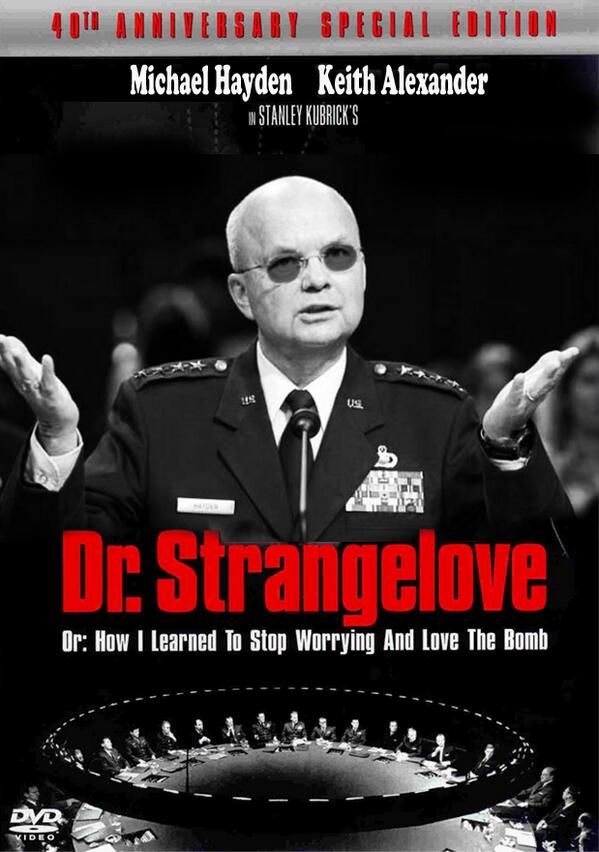
[Okay, big thanks to Darth, who generously agreed to let us use the killer Strangelovian graphic above. Please follow Darth on Twitter]

Share this entry

The New Antiwar Release: “They can’t keep this stuff secret. Nothing is secret anymore.”

Two years ago, Antiwar.com became aware of files relating to the site, that had been requested and were posted in relation to a FOIA on allegations Israelis had observed the 9/11 attack. I wrote about those files here. The files — which started in relation to another investigation on Pakistani terrorism suspects and got picked up because Justin Raimondo had written about the Israeli allegations — were referred to San Francisco for further investigation. But since the FOIA that had returned the documents pertained to the Israeli allegations, it was not immediately clear what happened to the San Francisco investigation.

Antiwar FOIAed then — after FBI wouldn’t give them their file — sued, with the help of ACLU.

What they learned is that:

  1. A complaint Eric Garris made in 2001 was treated as a threat by San Francisco’s FBI office
  2. An investigation drummed up, in part, because of Garris and Raimondo’s antiwar views in 2004 used that misinterpreted complaint as one justification to demand further investigation

The substantive content of what they got includes:

  • 2 pages dating to 1972 (!) on a mock tribunal Garris served on as a judge for representing the Peace and Freedom Party. (Note, the file in question postdates J Edgar Hoover’s death by 4 months, so it can’t be called a genuine Hoover file.)
  • 2 pages pertaining to San Francisco’s utter fuck-up of an investigation into a threat Garris forwarded to them on 9/12/01. Antiwar had received a threatening email, but when Garris forwarded the email to the FBI, the FBI treated it as a cyberthreat to the FBI.
  • 22 pages from a much larger chunk of what was supposed to be a Threat Assessment conducted in Newark and dated 4/30/04 (this is the part that had been revealed before). I believe my comments on that material here remain valid; I’ll explain what’s new below.
  • 3 pages recording (sort of) San Francisco’s response to the Newark referral dated 7/29/04, though the FBI has redacted the results of that response.
  • 2 pages from Pittsburgh (missing a third page between the two) from what appears to be a referral of a lead from the Newark Threat Assessment dated 8/18/04. (Remember, according to a DOJ IG Report, Pittsburgh was one of the worst offenders for harassing anti-war protestors.)
  • 2 pages from some activity from Springfield, IL dated 9/12/05. The tie to Antiwar is tangential, but because it has a file, this office seems to have suggested digging up all the old documents on it. This file notes that “SF declined the recommendation of Newark,” which is how we can surmise San Francisco declined to open a preliminary investigation into them.
  • 2 pages from a referral to St. Louis dated 9/22/05. Given the timing, I suspect it is a follow-up to the Springfield lead, but most of the file is purportedly outside the scope of the FOIA (so unrelated to Antiwar).
  • 2 pages from the main Counterterrorism office referring back to the original Newark Threat Assessment dated 4/22/08 as part of a longer review (the Newark investigation of Antiwar is mentioned on page 6 of the document, and the earlier materials is deemed unrelated).

In other words, there was the San Francisco fuck-up, the Threat Assessment tied to a terrorism case in Newark, and then the effort to use that to drum up further investigation of Antiwar that way.

What’s particularly interesting is the material that had been withheld for privacy reasons in the earlier FOIA release (see pp 62-71) which are now unredacted. In addition to personal information on Garris and Raimundo, it includes observations about what had been written about and by them.

One entry, for example, describes a story about the FBI’s monitoring of peace groups in which Raimundo is quoted.

The Argus, dated 2/18/2003, HEADLINE: Watchlist resurrects ’50s fears; critics say FBI information in many ways is worse than Mc Carthy’s hunt for communists, by Sean Holstege. In this article Justin Raimondo states “They can’t keep this stuff secret. Nothing is secret anymore.”

Perhaps the FBI wouldn’t turn this file over without a lawsuit to prevent us from knowing they thought that was newsworthy?

Based on that, other writings, some of their readers (as laid out in my earlier post) and the fact that Raimondo had posted a very very early terrorist watchlist he had found on the Internet, FBI concluded Garris and Raimondo needed more attention. These two judgments about them were redacted in the earlier FOIA release.

Due to the lack of background information available on Justin Raimondo, it is possible that this name is only a pseudonym used on www.antiwar.com.

Many individuals do view this website including individuals who are currently under investigation and Eric Garris has shown intent to disrupt FBI operations by hacking the FBI website.

And from this the Newark office appears to have tried to get an Antiwar publication investigated.

One more observation. Page 15 and 16 of the current release seems to be the release notice for what I’ve been calling “the Newark investigation.” But in fact, it appears not to be the same files released in the earlier FOIA, because that one had extensive hand lettering (and so I suspect that version of the file were the documents that resided in Newark’s office files). Just as interesting, though, FBI withheld 64 pages (probably actually more) using a “trade secrets” exemption.

Now, I might think that file came from ECAU, the web monitoring part of the FBI at the time that Newark instructed to keep monitoring Antiwar.com. But the B4 exemption suggests it is some private entity. So is that chunk of 64 documents the work of some contractor?

I’d sure like to know. Cause apparently someone has (or had) made it their trade secret to read the writings of peace activists for the FBI.


Share this entry

Apparently Criticizing TSA’s Boss Is Anti-Worker

Yasha Levine insinuates I’m responsible for Paul Ciancia’s attack on TSA workers the other day.

The “progressive” blog FireDogLake was perhaps the biggest and loudest leftie media outlet to promote the anti-TSA crusade. The site even launched a “Petition to Investigate the TSA,” adopting right-wing lingo in calling the agency’s pat down procedures “aggressive groping” and getting “sexually assaulted by a government official.” FireDogLake blogger Marcy Wheeler frequently referred to TSA checkpoints procedures as “rape” and “groping.” In December 2010, she warned her readers that anywhere from a quarter-million to 1 million people “had their genitalia groped by a stranger working for the government” in a single week, and the Obama administration simply didn’t care. “That sort of seems like a lot of junk-touching in just one week.”

Two years later, Wheeler was comparing TSA workers to rapists, Tweeting out: “Rape is not about sexual enjoyment. It’s about power. So is this TSA stuff.”

[snip]

But so far the left has been strangely silent about the violent right-wing rhetoric and conspiracy-mongering that inspired the TSA shooting at LAX. I guess that isn’t very surprising, considering the left helped enable it.

I’m not going to respond to this beyond pulling together all the posts where I talk about how asinine the TSA screenings are. If there’s a villain in them, it’s TSA Director John Pistole, the guy setting that asinine policy, not the line workers who implement his policy. There are a number I haven’t included talking about John Pistole’s potential role in the UndieBomb 2.0 leak, some references in “Links” posts, some on relative choices in counterterrorism approaches, and a few on contractors.

Note, especially, the post with the asterisk, where I unpacked the illogic of Levine’s first conspiracy theory on TSA, which might explain why he’s now accusing me of contributing to someone’s death.

That is all.

June 28, 2007: TSA versus Booz Allen

August 15, 2007: Behavior Detection

November 22, 2010: John Pistole Wants Us to Be Afraid of His Shadow

November 22, 2010: White House: Only 170,000 People Have Had Genitalia Groped by Complete Stranger in Last Week

November 23, 2010: Did Just 170,000 Passengers Get Groped by Strangers Last Week? Or a Million?

*November 25, 2010: Correlation Does Not Equal KochNation

December 1, 2010: FBI Entrapment Leads to TSA Pat-Downs

December 9, 2010: John Pistole: “What I Think Is Appropriate in Terms of Privacy”

December 19, 2010: Protecting DC’s Metro from the FBI and Facebook

December 27, 2010: TSA’s Legal Justification for Gate Grope

May 17, 2011: Apparently the Terrorists Can’t Learn How Much Radiation They’ll Get from Going through TSA Security

May 21, 2011: First Mickey Donned Night Vision Goggles, Now Mickey Embraces GateGrope

June 14, 2011: More Security Theater as Play

May 7, 2012: It Takes an Attempted Terrorist Attack to Actually Test Backscatter Machines

August 12, 2012: Racial Profiling Is Wrong, Sometimes

August 7, 2013: The Ooga Booga* Continues to Wear Off 

Share this entry

Angry Mom and First Principles: What is the Nature of a Broken Lock?

This won’t be a cool, calm, collected post like Marcy writes, because it’s me, the angry mom. You might even have seen me Tuesday afternoon in the school parking lot waiting to pick up a kid after sports practice. I was the one gripping the steering wheel too tightly while shouting, “BULLSHIT!” at the top of my lungs at the radio.

The cause? This quote by President Obama and the subsequent interpretation by NPR’s Ari Shapiro.

President Obama to ABC’s new Latino channel, Fusion (1:34): It’s important for us to make sure that as technology develops and expands and the capacity for intelligence gathering becomes a lot greater that we make sure that we’re doing things in the right way that are reflective of our values.

Ari Shapiro (1:46): And, Audie, I think what you’re hearing in that quote is a sense that is widespread in this administration that technological improvements have let the government do all kinds of things they weren’t able to do before. They tapped the German Chancellor’s personal cellphone and nobody really stopped to ask whether these are things they should be doing. And so that question, just because we can do something, well, does it mean we should be doing it, that’s the question that seems to be the focus of this review.

Bullshit, bullshit, bullshit.

Here, let me spell this out in terms a school-aged kid can understand.

photo, left: shannonpatrick17-Flickr; left, Homedit

This is a doorknob with a lock; so is the second closure device on the right.

The lock technology used on the second door is very different; it’s no longer simple analog but digitally enhanced. The second lock’s technology might be more complicated and difficult to understand. But it’s still a lock; its intrinsic purpose is to keep unauthorized persons out.

If one were to pick either lock in any way, with any tools to enter a home that is not theirs and for which they do not have permission to enter, they are breaking-and-entering.

If it’s law enforcement breaching that lock, they’d better have a damned search warrant or a court order, in the absence of a clear emergency or obvious crime in progress.

The argument that information technology has advanced to the point where the NSA blindly stumbles along without asking whether they should do what they are doing, or asking whether they are acting legally is bullshit. They have actively ignored or bypassed the proverbial lock on the door. It matters not where the lock is located, inside or outside the U.S.

The Washington Post’s revelation Wednesday that the NSA cracked Yahoo’s and Google’s SSLsecure sockets layer — is equivalent to evidence of deliberately busted door locks. So is the wholesale undermining of encryption systems on computers, cellphones, and network equipment revealed in reports last month, whether by weakened standards or by willfully placed holes integrated in hardware or software.

The NSA has quite simply broken into every consumer electronic device used for communications, and their attached networks. When the NSA was forced to do offer explanations for their actions, they fudged interpretations of the Constitution and laws in order to continue what they were doing. Their arguments defending their behavior sound a lot like a child’s reasoning. Read more

Share this entry

The White House — Lisa Monaco? — “Cutting Off the Intelligence Community”

Too bad for Obama he has decided the great new way to aggressively prosecute leaks without the bad PR of doing it through the Courts is to have James Clapper’s Inspector General investigate them. Because I’m betting the IC IG will be unenthusiastic about hunting down this admitted leaker.

Some U.S. intelligence officials said they were being blamed by the White House for conducting surveillance that was authorized under the law and utilized at the White House.

“People are furious,” said a senior intelligence official who would not be identified discussing classified information. “This is officially the White House cutting off the intelligence community.”

But I’m a bit more interested in this barb, putting Homeland Security Advisor Lisa Monaco solidly in the line of communication receiving intelligence from wiretaps on foreign leaders.

Any decision to spy on friendly foreign leaders is made with input from the State Department, which considers the political risk, the official said. Any useful intelligence is then given to the president’s counter-terrorism advisor, Lisa Monaco, among other White House officials.

As I have twice noted, Monaco brings dramatically different experience to the position than her predecessor, John Brennan. Rather than being implicated in the illegal program that was the root of many of the problems as the program moved under FISA Court review, she had had to try to clean them up while Assistant Attorney General for National Security, including at least the upstream violations. She also participated in the decision to shut down the Internet dragnet collection program.

After prior bitching about her silence during this scandal, she penned an op-ed last week laying out the evolving White House position.

Today’s world is highly interconnected, and the flow of large amounts of data is unprecedented. That’s why the president has directed us to review our surveillance capabilities, including with respect to our foreign partners. We want to ensure we are collecting information because we need it and not just because we can.

[snip]

Going forward, we will continue to gather the information we need to keep ourselves and our allies safe, while giving even greater focus to ensuring that we are balancing our security needs with the privacy concerns all people share.

The implication, of course, is that the same person voicing this “because we need it and not just because we can” has been implicated by receiving intelligence with Merkel’s and other leaders names on it, and may be responsible for not alerting the President to it. The accuracy of the claim, of course, depends on whether the White House really shut down the collection on Merkel earlier this summer or only in the last week or so; remember tasking priorities are reassessed biannually. Moreover, it’s not like wiretaps on allied leaders would be the primary focus of someone whose job centers on counterterrorism.

The thing is, this attack can backfire, as having received this information puts Monaco in an appropriate position to know whether we were collecting it because we could, not because we need to.

Monaco has, in the past, been part of a team that deemed a program not valuable enough to sustain. Which means she has a little experience for the pushback the IC may be throwing at her in coming days.

Share this entry

Who Is Behind Latest Iran-Pakistan Border Incident? Who Benefits?

Before diving into Friday night’s border incident where fourteen Iranian border guards were killed and Iran retaliated the next morning by hanging sixteen prisoners already in detention, we need to look back at the important events surrounding other such outbreaks of violence at the Iran-Pakistan border.

On January 1 of 2012, Pakistan detained three Iranian border guards whom they claimed had crossed into Pakistan. Details of the event were sketchy, but Iran claimed the guards were chasing drug smugglers and most of the stories on the event brought up the likely involvement of the group known as Jundallah. Less than two weeks later, a prominent Iranian nuclear scientist was assassinated on January 11. Only two days after that event, the famous “false flag” article by Mark Perry appeared in Foreign Policy, making the remarkable claim that Mossad agents were posing as CIA agents while recruiting members of Jundallah for operations including assassinations.  Marcy had a series of three posts (one, two, three) delving into the many implications surrounding the false flag accusation. Another border incident then happened in late January, where six “Pakistanis” were killed by Iranian border agents, but there was a lot of confusion over just who the victims were, including their nationality.

Here is how Reuters first broke the news Saturday on this latest incident:

Fourteen Iranian border guards were killed and three others captured by “bandits” on the southeastern frontier with Pakistan overnight, Iranian media reported on Saturday.

In response, the Iranian judiciary executed 16 people it said were elements of “terrorist” groups, according to the ISNA news agency. There were no further details of who they were or whether or when they had been tried.

A follow-up story by Dawn from Sunday has more details, with the identity of the attackers unknown (but Jundallah is still mentioned prominently in the article):

It was still unclear whether the attackers were drug smugglers or armed opposition groups.

However, Iran’s Deputy Interior Minister Ali Abdollahi called on the Pakistani government to “take measures to control the border more seriously.”

Pakistan’s charge d’affaires was received at the Iranian foreign ministry to receive an official demand that Islamabad “act firmly with officials and members of terrorist groups who have fled to Pakistani territory,” IRNA reported.

The Dawn article also notes a second, separate border incident on Sunday in which one Pakistani was killed and four others were wounded.

Responsibility for the attack has now been claimed by a group known as Jeish Al-Adl:

A little-known Iranian Sunni group says it carried out the killing of 14 border guards on Friday night.

Jaish al-Adl said the attack was in retaliation for an alleged Iranian “massacre” in Syria and the “cruel treatment” of Sunnis in Iran.

Iran is now saying that they are a subgroup within Jundallah:

14 Iranian border guards were killed and 6 more were injured during the terrorist attack in Saravan border region in Southeastern Iran in the early hours of Saturday morning. The terrorists who have reportedly been members of the outlawed Jeish Al-Adl radical Sunni Wahhabi movement affiliated to the terrorist Jundollah group fled into Pakistan after the operation in Iran’s Southeastern Sistan and Balouchestan province.

It seems quite interesting to me that Iran would point out the “radical Sunni Wahhabi” connection of the group they are blaming. Of course, the primary sponsor of “radical Sunni Wahhabi” teachings is Saudi Arabia through their madrassas. But Iran seems to be dancing around an outright referral to Saudi involvement in this attack, even though it would make sense since we know that Bandar is now very upset both with the US “failure” to launch a strike on the Assad regime in Syria and the US diplomatic push toward Iran. This same Fars News article doesn’t name names, but refers to “two countries” providing financial support and “three countries” providing intelligence and equipment to them: Read more

Share this entry