How Will City Council Oversee NYPD’s Spooks after This?

In their stories on the way the NYPD’s intelligence programs profile religious and ethnic minorities, Goldman and Apuzzo have repeatedly noted that the only entity providing oversight of the programs is the City Council.

The department has dispatched undercover officers, known as “rakers,” into minority neighborhoods as part of a human mapping program, according to officials directly involved in the program. They’ve monitored daily life in bookstores, bars, cafes and nightclubs. Police have also used informants, known as “mosque crawlers,” to monitor sermons, even when there’s no evidence of wrongdoing.

Neither the city council, which finances the department, nor the federal government, which has given NYPD more than $1.6 billion since 9/11, is told exactly what’s going on.

[snip]

The department’s primary watchdog, the New York City Council, has not held hearings on the intelligence division’s operations and former NYPD officials said council members typically do not ask for details.

“Ray Kelly briefs me privately on certain subjects that should not be discussed in public,” said City Councilman Peter Vallone. “We’ve discussed in person how they investigate certain groups they suspect have terrorist sympathizers or have terrorist suspects.”

Today, the NYPD handcuffed and detained City Councilman, Jumaane Williams, at an ethnic celebration.

A city councilman from Brooklyn was handcuffed and briefly detained by the police on Monday afternoon during the West Indian Day Parade after an argument with officers over whether he was allowed to use a closed sidewalk, said Public Advocate Bill de Blasio, whose aide was also detained in the dispute.

The councilman, Jumaane D. Williams, was not charged with a crime, nor was the aide, Kirsten John Foy, Mr. De Blasio’s community affairs director.

Observers suggested Williams and his aide may have been targeted–profiled, just like the targets of the NYPD’s intelligence program–because they are black. And Williams has already been a critic of the NYPD’s intrusive tactics.

He has been an outspoken critic of the Police Department’s “stop, question and frisk” policy.

So one of the 50 or so people who are tasked with making sure the CIA-on-the-Hudson doesn’t improperly profile or abuse New Yorkers on the basis of their race or religion just got thrown to the ground after he dared use a sidewalk an apparent police supervisor had said he could use.

I’m sure this incident won’t affect this oversight relationship at all.

Share this entry

10 Years Later, 9/11 Commission Says President Is Failing to Protect Civil Liberties

The 9/11 Commission released a 10-year report card on the recommendations they made back in 2004. And one of three recommendations that remains entirely unfulfilled–the only one that is entirely the responsibility of the executive branch–is implementing a board to defend civil liberties.

“[T]here should be a board within the executive branch to oversee adherence to the [privacy] guidelines we recommend and the commitment the government makes to defend our civil liberties.”

An array of security-related policies and programs present significant privacy and civil liberty concerns. In particular, as the FBI and the rest of the intelligence community have dramatically expanded their surveillance of potential terrorists, they have used tools such as National Security Letters that may implicate the privacy of Americans. Privacy protections are also important in cyber security where the government must work with the private sector to prevent attacks that could disrupt information technology systems and critical infrastructure. The same Internet that contains private correspondence and personal information can also be used as a conduit for devastating cyber attacks.

To ensure that privacy and liberty concerns are addressed, the 9/11 Commission recommended creating a Privacy and Civil Liberties Oversight Board to monitor actions across the government. Congress and the president enacted legislation to establish this Board but it has, in fact, been dormant for more than three years.

Describing the PCLOB as “dormant” is actually a huge favor to Obama. It only suggests, but does not make explicit, that before the end of his Administration Bush actually got around to rolling out the PCLOB–evenven if it was so compromised by executive branch control that Lanny Davis felt obliged to resign.

But Obama has avoided even that much oversight by simply letting the PCLOB go unfilled for his entire Presidency. As the report card explains, Obama finally got around to making nominations after Democrats lost the numbers in the Senate to approve his nominees (though one was the Michael Mukasey Assistant Attorney General who rolled out greater investigative powers for the FBI). And even if those two were by some freakish even confirmed, PCLOB would still be short a quorum to do any work.

The Obama administration recently nominated two members for the Board, but they have not yet been confirmed by the Senate. We take the administration at its word that this Board is important: in its May 2009 review of cyber security policy, the administration noted the Board’s importance for evaluating cyber security policies. We urge the president to appoint individuals for the remaining three positions on the board, including the chairman, immediately, and for the Senate to evaluate their nominations expeditiously.

[snip]

If we were issuing grades, the implementation of this recommendation would receive a failing mark. A robust and visible Board can help reassure Americans that these programs are designed and executed with the preservation of our core values in mind. Board review can also give national security officials an extra degree of assurance that their efforts will not be perceived later as violating civil liberties.

PCLOB is an entity mandated by law. But the President refuses to comply with that law to provide for some oversight over civil liberties, no matter how inadequate.

It’s not me accusing Obama of failure on this point–it’s a bipartisan commission primarily concerned with the national security of the country. But they are, in fact, calling him a failure.

Share this entry

NYPD’s Failed Ethnic Profiling Program

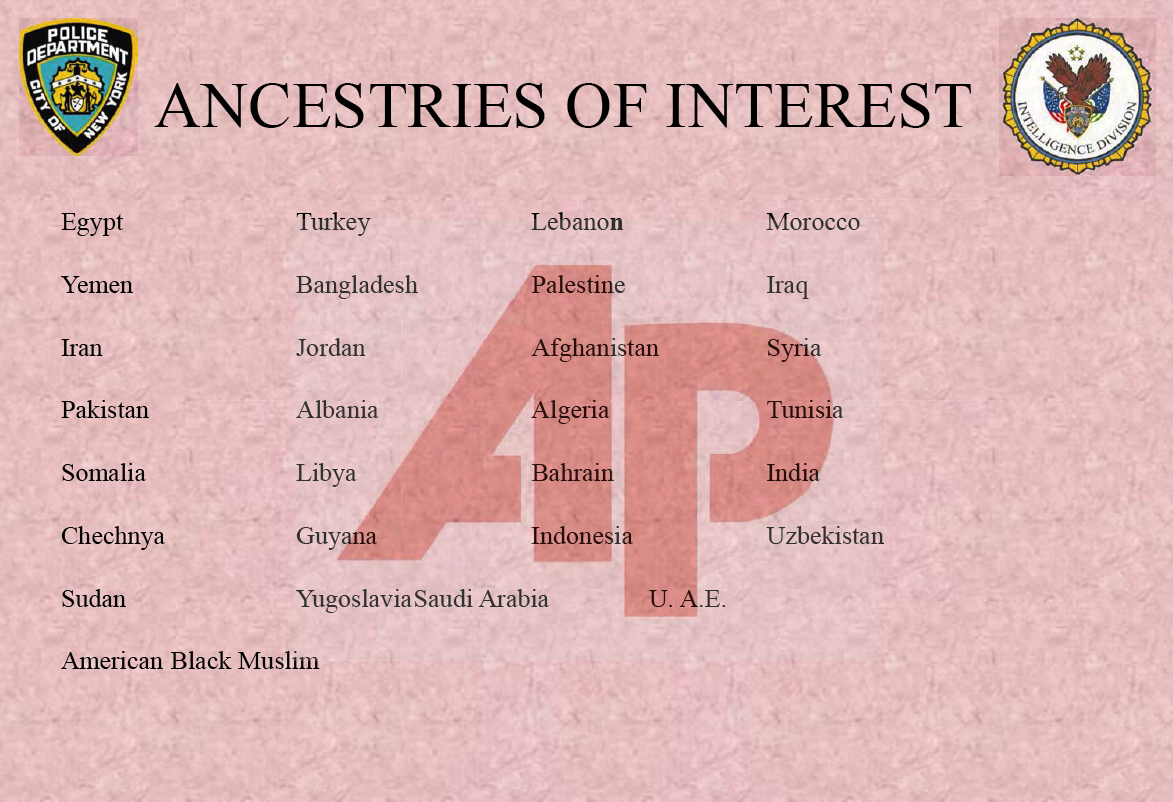
When Goldman and Apuzzo exposed NYPD’s domestic spying program last week, NYPD insisted it didn’t exist. So this time, they’ve posted documentary proof.

As they report, the domestic spying program employed a “Demographics Unit” that mapped out “ethnic hotspots” in the NY city area.

The program, it seems, would not even (and, as I’ve noted, did not even) accomplish what it aspired to do. While the ancestries of interest included far more nationalities than the federal government’s National Security Entry-Exit Registration System (which served a slightly different kind of ethnic profiling), adding obvious countries like Somalia and allies like Bahrain or Turkey, as well as the “American Black Muslim” ethnicity, it leaves out Nigeria (the Undie-Bomber’s nationality) and all South East Asian Muslim nationalities save Indonesia. Moreover, the group did not, apparently have the linguistic capabilities to infiltrate those groups (a slide lists Arabic, Bengali, Hindi, Punjabi, and Urdu as its linguistic capabilities).

And among the other details from the program, I find one more admission to be telling: the unit aspired to,

Identify and map ethnic residential concentrations within the Tri-State area.

Last week, I noted that the NYPD might have explained that they missed Faisal Shahzad because he lived in CT and received funds from Pakistan via a hawala on Long Island. But clearly both would fall within the scope of NYPD’s aspired goals (if not within its legal jurisdiction).

In other words, as comprehensive as this ethnic profiling program aimed to be, not only did it fall short in conception, but (by missing Shahzad and Najibullah Zazi) in execution.

Share this entry

NYPD’s Spooks Didn’t Find Two of the Most Significant Terrorists to Attempt Attacks on NYC

The AP’s Goldman and Apuzzo have another blockbuster counterterrorism article, this time describing how the NYPD has built its own intelligence service to target Muslims. It’s long, but it’s worth reading the whole thing. Keep an eye out for these key details:

  • The program in part serves to overcome CIA failures to recruit a more diverse workforce
  • The NYPD borrowed some of their community mapping techniques from Israel’s efforts in the West Bank
  • The NYPD shreds documents to keep their community mapping program secret
  • The NYPD uses informants in mosques without predication, something the FBI claims it won’t do
  • The city looked for Pakistani cab drivers with fraudulent licenses as a way to recruit informants
  • The NYPD passed information to the CIA via unofficial channels
  • A top CIA operative is working at the NYPD, while still on the CIA’s payroll

As comprehensive as this story is, it leaves out two of the program’s most significant failures. The NYPD claims that this program is successful because NY hasn’t been attacked.

For [retired CIA officer David] Cohen [who pioneered this program], there was only one way to measure success: “They haven’t attacked us,” he said in a 2005 deposition. He said anything that was bad for terrorists was good for NYPD.

Granted, Cohen made that statement in 2005.

But, first of all, it’s no longer true that “they haven’t attacked us.” The Faisal Shahzad attempt last year may have been unsuccessful, but it is an example of an attack launched with international support.Yet neither the NYPD (nor, for that matter, the FBI) had any clue about Shahzad before he attacked.

That may be perfectly understandable for the NYPD. After all, Shahzad lived in Connecticut. He used a hawala (the guy who ran it just signed a plea deal), but that was in Long Island, not the City. So the few hints that Shahzad might attack were outside of NYPD’s jurisdiction. The AP article notes the NYPD’s spooks operate far outside of the city, but in any case, the failure to identify Shahzad shows how much will remain hidden even from the NYPD’s invasive approach.

The case of Najibullah Zazi is still more problematic.

The NYPD had infiltrated Zazi’s mosque in NY, which was the focus of his conspiracy. They even used the Imam there, Ahmad Wais Afzali, as an informant. Yet they appear to have had no advance warning that Zazi and two friends from NY were training for an attack (the FBI is reported to have gotten their first lead on Zazi from the Pakistanis).

In other words, all the activity described in the AP piece included Zazi’s immediate circle of associates. Yet that activity apparently failed to identify Zazi as a threat.

Even worse, the NYPD’s confidence in Afzali compromised the FBI’s case. After the FBI tipped of the NYPD, the NYPD tried to develop its own leads. That included showing Afzali a picture of Zazi, which led Afzali to call Zazi’s father and then Zazi himself to warn them of the investigation.

Media reports quoting anonymous FBI officials have suggested the NYPD botched the case when it showed a picture of Najibullah Zazi, the Denver shuttle-bus driver at the heart of the investigation, to Ahmed Afzali, a Queens Imam and sometime police informant. Afzali, the reports say, first called Zazi’s father Mohammed, then Najibullah himself, alerting them to the probe. The FBI, which had been monitoring the calls, was then forced to move immediately to arrest the Zazis — much sooner than it had planned.

[snip]

When Zazi traveled to New York ahead of the anniversary of 9/11, the FBI as a precaution alerted the NYPD. That’s when officers from the NYPD’s intelligence unit consulted Afzali. “It looks like they did this on their own initiative — they really trusted this Imam,” says the law-enforcement official. “But if they’d consulted with the bureau first, they’d have been told not to talk to anybody.”

The NYPD spoke to Afzali three times after they were tipped off to the investigation.

The NYPD’s freelancing apparently began when an Intelligence Division detective of its top secret Special Services Unit — identified in government documents as Dan Sirakowsky — telephoned Afzali on Sept. 10, a day before the eighth anniversary of the Trade Center attacks.

Afzali had been Sirakowsky’s confidential informant, or C.I., since 9/11.

Sirakowsky told Afzali the department needed to speak to him right away. Minutes after the phone call, a detective and a sergeant showed up at Afzali’s home with pictures of Zazi and three of his alleged accomplices.

According to [Afzali’s lawyer] Kuby, Afzali recognized Zazi and two others. They had been students in Afzali’s mosque class years before. The police then asked Afzali to find out more about what the three were up to in the city.

In addition, it appears that the NYPD shared information on the Zazi investigation with cops who did not have clearance.

Four NYPD detectives have been hauled before a federal grand jury probing leaks of top-secret information about a terror plot to blow up city subways, sources told the Daily News.

[snip]

The inquiry is said to be focusing on leaks of sensitive information from the FBI-NYPD Joint Terrorism Task Force to cops who did not have clearance.

Some of the information ended up in the press.

(Read that entire article for a sense of how Ray Kelly has retaliated against those who might expose the abuses and failures of his intelligence division.)

In short, not only did this elite intelligence unit not find the one guy who has actually attacked NYC, but it significantly endangered the investigation into another terrorist who came close to attacking NYC.

Share this entry

In Last Two Years, FBI Developed Intrusive Files on 77,100 Innocent Americans

Charlie Savage has a story reporting on the number of assessments the FBI opened in the last two years that turned into preliminary investigations. It shows that over the period, the FBI has conducted assessments of 77,100 Americans whom they determined were not a cause for concern. Their investigations of 3,315 others turned into preliminary investigations.

Data from a recent two-year period showed that the bureau opened 82,325 assessments of people and groups in search for signs of wrongdoing. Agents closed out most of the assessments, the lowest-level of F.B.I. investigation, without finding information that justified a more intensive inquiry.

[snip]

The disclosure, covering March 25, 2009, to March 31, 2011, focused on assessments, which an agent may open “proactively or in response to investigative leads” and without first having a particular factual basis for suspecting a target of wrongdoing, according to the F.B.I. manual. Former Attorney General Michael Mukasey issued guidelines for the bureau creating that category in 2008.

During an assessment, agents may use a limited set of techniques, including searching databases about targets, conducting surveillance of their movements and sending a confidential informant to an organization’s meetings. But to use more intrusive techniques, like secretly reading e-mail, agents must open a more traditional “preliminary” or “full” investigation. Such inquiries require agents to first have a greater reason to start scrutinizing someone: either an “information or allegation” or an “articulable factual basis” indicating possible wrongdoing.

According to the data, during the 2009-11 period agents opened 42,888 assessments of people or groups to see whether they were terrorists or spies. A database search in May 2011 showed that 41,056 of the assessments had been closed. Information gathered by agents during those assessments had led to 1,986 preliminary or full investigations.

The data also showed that agents initiated 39,437 assessments of people or groups to see whether they were engaged in ordinary crime. Of those, 36,044 had been closed, while 1,329 preliminary or full investigations had been opened based on the information gathered.

The FBI would like to spin this as good news. Some of these investigations, Valerie Caproni explains in the story, would have been full-blown preliminary investigations in the past. But, as Mike German points out, the FBI is keeping records of all these searches.

The threat assessment conducted on Antiwar.com provides a really good example of what this means, even though it dates to an earlier period. That assessment–conducted in April 2004–fell under slightly different categories than the ones that generated these data. Nevertheless, the general guidelines (what FBI Agents could do to investigate these people) are roughly similar.

And what we saw in the threat assessment was the collection (and dissemination) of information that tied incidences of First Amendment protected activities of other people–an explosives suspect surfing the web, antiwar activists handing out literature at a peaceful protest–to criminal investigations. The result flips the notion of criminality on its head for the way other people’s potential criminal behavior gets lumped onto Antiwar’s free speech.

The Antiwar.com threat assessment also shows what this kind of assessment means in reality. The FBI searched somewhere between 2-4 public databases for information on Eric Garris and Justin Raimondo that they don’t want even to even admit searching publicly (they’ve exempted the disclosure under investigative techniques exemption).

Finally, the Antiwar.com threat assessment shows the kind of logic the FBI uses to advance to the next level: it found that Raimondo uses his middle name, that Antiwar.com posted a publicly available document (the watch lists showing terrorist suspects), and that some unsavory characters like white supremacists and explosives suspects had read their work. And from that–partly because Antiwar.com relies on donations for funding–the FBI decided it had sufficient basis to conduct a preliminary investigation into whether Garris and Raimondo are spies.

Share this entry

The FBI’s File on Antiwar.com

As I reported yesterday, the FBI conducted a threat assessment into Antiwar.com in April 2004 in conjunction (apparently) with a terrorist watch list posted on the site. I briefly reviewed what they found, but I wanted to look in more detail at what the report on them (see pages 62-71) shows.

As I explain below, what I believe happened is that an Agent in the Newark office investigating one or two people with ties to Pakistan for terrorism did an investigation into Antiwar.com because it posted watch lists with the investigation subject’s name on them. That Agent recommended that the Electronic Communications Analysis Unit (a part of the Counterterrorism Division) continue monitoring Antiwar.com (someone is being paid to surf Antiwar.com!), and that the San Francisco office (which would have been local to Raimondo and Garris) do a Preliminary Investigation, presumably to figure out if they were posting such documents to help Islamic terrorists.

But in the course of explaining the Israeli Movers story that Raimondo had written on, that Agent referenced an investigation of the Movers that may not be an FBI investigation. Either in the course of the document circulating within the Newark office, or because it came up on a later search, someone noticed the reference to this investigation, and forwarded the document to those conducting the newly-reopened Israeli Movers investigation.

The April 2004 Threat Assessment

First, remember what this is: it’s a search in April 2004 of the FBI’s files and public databases on Justin Raimondo, Eric Garris, and Antiwar.com as those files existed in 2004. The report recommends that the San Francisco office conduct a preliminary investigation. Raimondo and Garris were stopped by DHS in 2005 on their return from a trip to Malaysia; the contents of every piece of paper that Garris had on him were copied. So it seems safe to assume that the FBI continued to investigate them after this report.

In other words, a FOIA of what the FBI currently has on them would likely have more material in it, particularly if the FBI did do that preliminary investigation on them.

Also, the report is labeled as a Threat Assessment, which the FBI’s Domestic Investigation and Operation’s Guide describes requires the following predication:

Although “no particular factual predication” is required, the basis of an assessment cannot be arbitrary or groundless speculation, nor can an assessment be based solely on the exercise of First Amendment protected activities or on the race, ethnicity, national origin or religion of the subject. Although difficult to define, “no particular factual predication” is less than “information or allegation” as required for the initiation of a preliminary investigation.

The relevant reason to conduct a preliminary investigation would be (given the suggestion in the threat assessment that Antiwar.com might working on behalf of a foreign power) the Agent’s conclusion that there was enough reason–information–indicating a threat to national security may be occurring.

“information or an allegation” indicating the existence of

[snip]

An activity constituting a federal crime or a threat to the national security has or may have occurred, is or may be occurring, or will or may occur and the investigation may obtain information relating to the activity or the involvement or role of an individual, group, or organization in such activity.

All that suggests that this document may have been the first step toward conducting a more detailed investigation of Antiwar.com.

The Antiwar.Com Material

The first thing noted in the report is results of a search of the FBI’s Universal Index, which would show,

… people who are the subjects of an FBI investigation (main file) or are associated with the subject of an investigation.

Obviously, that search returned some results, all of which have been redacted under privacy exceptions to FOIA. One of either Garris or Raimondo has a significantly longer file than the other. (Note, the first reference of them by name, which is redacted, appears to list Garris first based on the redaction; unredacted mentions of them on pages 2 and 8 maintain that order. If that order was sustained throughout, it suggests the FBI has significantly more information on Garris than Raimondo.) Interestingly, Antiwar.com didn’t return any results in the UNI.

The FBI then searched the Electronic Case Files and found either 12 or 13 documents (or 15 or 16, counting the FISA files individually). The report describes each one of these (save 4 FISA-generated documents that are just referenced by serial number). Here are descriptions of each of the documents:

The first document is completely redacted with no FOIA exemption noted.

The second document is also completely redacted, but has a b7A (Law enforcement proceeding) exemption. If the exemption is to be believed (they often aren’t), the file has been withheld because the FBI though releasing it would hurt a trial or some similar reason.

The third document is named 65T-HQ-1427774 serial 26 and is dated April 14, 2004. Its clearly a counterintelligence document, and has been exempted for national defense/foreign policy information. There’s also a “referral/consult” notation on it, which may suggest the FBI needed to consult someone else–maybe another agency–about redaction (given that this was the period when CIFA was rampant, I’m wondering if it’s a DOD generated report). The code in the document name also indicates this was a counterintelligence investigation.

The fourth and fifth documents appear from their serial numbers–315M-SL-188252 serial 152 and 315N-SL-188252 serial 176–to come from the same international terrorism (indicated by the 315) investigation. They are dated, respectively, November 17, 2003 and December 27, 2003, and the second appears to be a Letterhead Memo incorporating the first for communication outside of that FBI office. The description of the documents appear to indicate the Saint Louis office noting that Raimondo had the threat lists, reflecting particular concern about one or more people listed on the lists. Given that this document is described as pertaining to Pakistan and al Qaeda, I’m guessing these documents explain that an Islamic terrorist suspect might learn he was under investigation from the threat list. The exemptions here are national defense/foreign policy.

The sixth document, dated May 21, 2002, describes someone who wrote on US military assistance to Israel and cited Antiwar.com. In addition to law enforcement proceedings exemption, redactions cite privacy exemptions.

The seventh document, dated November 13, 2002, describes a peaceful protest at an Air Force base in the UK held four days before the report was filed. An article from Antiwar.com was passed out at the rally. The file serial number was redacted using law enforcement proceedings exemption, which seems bizarre to me, unless the FBI is trying to hide the lame reasons they’re using to investigate peaceful antiwar protests.

The eighth document, 100A-PG-67450-302 serial 970 and dated October 3, 2002 describes what appears to be the FBI infiltration of a National Alliance meeting at which one member advocated reading Antiwar.com for information on the Middle East conflict.

The ninth document, 174A-LA-234485 serial 55 and dated November 10, 2003, describes hard drives seized during an investigation (the code indicates it’s an explosives investigation) that showed the hard drives’ user visited Antiwar.com between July 25, 2002 and June 15, 2003.  A description of the investigation is redacted using privacy exemptions.

All but the date of the tenth document, February 5, 2003, is redacted using privacy and law enforcement proceedings exemptions.

The entire eleventh document is redacted using a law enforcement proceedings exemption.

As noted, there are four FISA references. All share a serial number–315B-NK-102595-EL6–that is also one of four serial numbers given to the report itself. So it appears there are 4 FISA references to Antiwar.com that may have been picked up in an investigation of Pakistani terrorists.

I’m not going to look at the results for the various database searches. Note, however, that the exemption b7E used on many of these refers to information redacted to prevent people from circumventing investigation or law enforcement. Which is another way of them saying they don’t want us to know all the public databases they can search to find information in a very low level FBI investigation.

The Israeli Movers Investigation

One more note on the content of this. Page 8 describes webpages that either discuss Antiwar.com documents or things Raimondo wrote. The fourth unredacted paragraph describes an article (later, a book) he wrote. The entire paragraph is bracketed and there are Xes in the margin, suggesting that the copy of the report in the file was handmarked by someone. What’s most interesting, however, is the last sentence.

(S) On www.chroniclesmagazine.org, an article by Justin Raimondo, “Chronicles Intelligence Assessment–the Terror Enigma: Israel and the September 11 Connection,” outlined the activities of the Mossad. It also included information obtained from a story in the Bergen Record dated 09/12/2002 regarding a group of Israelis detained by FBI, Newark, for possible involvement in the events of 9/11. [handwritten bracket] (An active investigation was conducted on the five Israeli Nationals. For a detailed report of this investigation, see [redacted]) [close handwritten bracket]

That is, the reason the recipient of this report found this paragraph interesting is because of that bracketed comment identifying “an active investigation.” But the report’s name remains redacted using the national defense/foreign policy exemption.

Now, the redaction is interesting not least because the FOIA request that resulted in this document release pertained to the Israelis, not to Antiwar.com. Yet the report redacts the instructions on where to find another report on precisely that topic.

It’s possible that the redacted report is among the case files listed on the front page of this report; one of the case IDs is redacted, and given that the Israelis were first investigated in the context of 9/11, it might not be a stretch to think it’d be included. But there’s also a circled handwritten note next to the case ID numbers written in a pen that might be the same as the one used to bracket this entire paragraph. It appears to say:

See pag 8 for real link

 Given that paragraph appears on page 8 and the only other redaction pertains to articles about Antiwar.com, it seems likely that the reference to this “active investigation” is the reason the report on Antiwar.com ended up in the Israeli Movers file in the first place. This suggests it’s likely that the redacted report is not an FBI file (because otherwise they wouldn’t need to stick an unrelated file into just to reference it).

Two more marks on the first page is worth noting here. In the lower left corner there’s a word or phrase redacted, using a national defense/foreign policy exemption. If I had to guess (and it’s just a wildarsed guess), I’d say it looks like the kind of mark people use to label a document to indicate where to file it. In addition, there’s a national defense/foreign policy exempted mark just next to the file names.

The Circulation

Another detail of interest on the first page is the circulation list:

  • Three recipients in the Counterterrorism office
  • ECAU–basically the group that would continue monitoring Antiwar.com online–which is also in Counterterrorism
  • One named Counterterrorism Agent
  • Two named Agents in the NY Office
  • One named Agent in Philadelphia
  • St. Louis’ Pakistan Squad
  • San Francisco’s Pakistan Agent

In addition, the document is titled, “IT-Pakistan; IT UBL/Al Qaeda.”

All that (plus the Case ID numbers all referencing international terrorism investigations) suggest the document was originally generated by someone investigating an alleged Pakistani terrorist, not the Israeli Movers. Thus, it appears that what I’ve referred to as documents four and five–describing the watch lists–were a key source of interest to the Agent writing the report, not the Israeli Movers (note, too, that those documents were generated in the Saint Louis office, which is likely why they received this report).

The Classifications

Finally, there’s something interesting about the classification history of not just this document, but all the documents in this FOIA pack.

When this document was initially generated in April 2004, each paragraph and the document itself was marked with a classification mark. But it didn’t get a classifying stamp right away. That’s probably just FBI sloppiness.

But then, 16 months after the document was first generated, on August 3, 2005 (or August 2 for other parts of the packet), someone did go in and add a classification stamp (see the bottom left corner) to this and all the other documents in the file. The reason given for classification is intelligence activities. The person who added that stamp may be the person who marked individual classification marks (such as the Secret mark to the notation on the bottom right corner of the document) in fairly thick pen. Those marks are generally either marking public information as unclassified (those paragraphs were wrongly classified in the first place), or marking that front page notation and that reference to the other Israeli Movers investigation secret. If so, that same person may have written the Xes and the bracket in the paragraph about the Israeli Movers on page 8.

Then, at some point, someone declassified the document. (See the stamp, at a 90 degree angle, which is crossed out, in the left hand margin.)

Then, in September 2010, someone went back in and classified the whole set of documents again (see the notation at the top left of the page). In addition to the intelligence activities cited in the 2005 classification, this one cites foreign government information (reason b) and foreign activities of the US (reason d). This suggests someone got squeamish in 2010 about what the investigation on the Israeli Movers might do to our relations with Israel.

And then, presumably in response to this FOIA, the entire packet was declassified again. I suspect the mechanical notations–both the redactions and the printed new classification marks–were done for this declassification.

Update: Made a bunch of syntactical fixes.

Share this entry

FBI Conducts Threat Assessment on Antiwar.Com Journalists for Linking to Publicly Available Document

Antiwar.com has a troubling story detailing how what appears to be either an FBI counterintelligence investigation of suspected Israeli spies or an attempt to track down everyone who had posted terrorist watch lists online led to the FBI to investigate the site and Justin Raimondo and Eric Garris.

The story is troubling for several reasons:

  1. The report on Antiwar.com reveals the FBI’s Electronic Communications Unit (the same one involved in using exigent letters to get community of interest phone numbers) was already monitoring Antiwar.com when the FBI did a threat analysis of them in 2004.
  2. Based on the fact that they had posted two watch lists, that a number of people under investigation read the site, and other redacted reasons, the FBI recommended a preliminary investigation into whether (basically) they were spying.
  3. The report cited electronic communications collected under FISA. While that may be no more than 4 FISA references in another case out of the Newark Office (which appears to be a prior investigation tied to the Israelis), that’s not clear that that’s the only FISA-collected information here.
  4. Whether or not the FBI already had used FISA on Antiwar.com, the low bar for PATRIOT powers (connection to a counterterrorist or counterintelligence investigation; the Israeli investigation would qualify) means the government could have used PATRIOT powers to investigate them.

Read more

Share this entry

The Re-Scoop that Pakistan Showed China Our Stealth Chopper

On May 10, ABC news reported Pakistanis saying both they and the Chinese wanted to take a look at the stealth helicopter used in the Osama bin Laden raid. That story quoted a US official saying he would be “shocked” if the Pakistanis had not already, by May 10, shown it to the Chinese.

Pakistani officials said today they’re interested in studying the remains of the U.S.’s secret stealth-modified helicopter abandoned during the Navy SEAL raid of Osama bin Laden’s compound, and suggested the Chinese are as well.

The U.S. has already asked the Pakistanis for the helicopter wreckage back, but one Pakistani official told ABC News the Chinese were also “very interested” in seeing the remains. Another official said, “We might let them [the Chinese] take a look.”

A U.S. official said he did not know if the Pakistanis had offered a peek to the Chinese, but said he would be “shocked” if the Chinese hadn’t already been given access to the damaged aircraft.

At that point, the Pakistanis had already had the tailpiece for 10 days. It took a John Kerry trip several days later and another week of delay before the Pakistanis returned the helicopter pieces.

So why, following the FT scoop (re-scoop?) confirming that the Pakistanis had shown the helicopters to the Chinese, are folks acting so surprised?

The US now has information that Pakistan, particularly the ISI, gave access to the Chinese military to the downed helicopter in Abbottabad,” said one person in intelligence circles, referring to the Pakistani spy agency. The Chinese engineers were allowed to survey the wreckage and take photographs of it, as well as take samples of the special “stealth” skin that allowed the American team to enter Pakistan undetected by radar, he said.

And note that the NYT’s CIA reporter tries to inject doubt where the FT scoop has little (though ultimately, Mazzetti does quote one person who is “certain” Pakistan shared the helicopter).

American spy agencies have concluded that it is likely that Chinese engineers — at the invitation of Pakistani intelligence operatives — took detailed photographs of the severed tail of the Black Hawk helicopter equipped with classified technology designed to elude radar, the officials said.

[snip]

American officials cautioned that they did not yet have definitive proof that the Chinese were allowed to visit to Abbottabad. They said that Pakistani officials had denied that they showed the advanced helicopter technology to other foreign governments. One military official said Sunday that Pakistani officials had been directly confronted about the American intelligence.

One person with knowledge of the intelligence assessments said that the American case was based mostly on intercepted conversations in which Pakistani officials discussed inviting the Chinese to the crash site. He characterized intelligence officials as being “certain” that Chinese engineers were able to photograph the helicopter and even walk away with samples of the wreckage. [my emphasis]

Are we really supposed to believe it took the NSA 3 months to translate intercepts of top Paksitani officials “inviting” the Chinese to see the helicopter?

Really?

At issue may be efforts to force General Ashfaq Kayani to deny showing the Chinese the helicopter (from the FT).

“We had explicitly asked the Pakistanis in the immediate aftermath of the raid not to let anyone have access to the damaged remains of the helicopter,” said the person close to the CIA.

Senior US officials confronted General Ashfaq Kayani, head of the Pakistan military, about this but he flatly denied it, according to a person with knowledge of the meeting. A senior Pakistani official also denied it to the FT. China declined to comment, as did the White House and CIA.

Or perhaps the 3 month delay in reporting on something that was widely believed to have happened may have to do with the CIA’s desire to allow the fiction that this did not occur to continue.

In any case, the whole scoop seems, at best, the effort of someone trying to force the Administration to admit that Kayani is not dealing in good faith. At worst, it’s another case of discovering gambling going on in the casino.

Share this entry

John Brennan: Immunizing the Truth

The first time I read Nicholas Schmidle’s breathtaking account of Osama bin Laden’s killing, I gave up when I got to this passage:

John Brennan, Obama’s counterterrorism adviser, told me that the President’s advisers began an “interrogation of the data, to see if, by that interrogation, you’re going to disprove the theory that bin Laden was there.” The C.I.A. intensified its intelligence-collection efforts, and, according to a recent report in the Guardian, a physician working for the agency conducted an immunization drive in Abbottabad, in the hope of acquiring DNA samples from bin Laden’s children. (No one in the compound ultimately received any immunizations.)

The article, which alternated between incredibly detailed accounts of the SEALs’ actions with more generalized depictions of Obama’s leadership, seemed designed to puff up the operation anyway. And while I’m not at all qualified to fact check the military details of it, the fact that Schmidle cited the Guardian–and not any of his own sources–for the most criticized aspect of the raid tells you a lot about the agenda of his sources. Furthermore, the fact that the Guardian provided slightly different details about the outcome of the immunization operation than Schmidle …

A nurse known as Bakhto, whose full name is Mukhtar Bibi, managed to gain entry to the Bin Laden compound to administer the vaccines. According to several sources, the doctor, who waited outside, told her to take in a handbag that was fitted with an electronic device. It is not clear what the device was, or whether she left it behind. It is also not known whether the CIA managed to obtain any Bin Laden DNA, although one source suggested the operation did not succeed.

… may indicate yet another level of manipulation on this detail of the raid.

Since that first reading, a number of people who are qualified to fact check the military details have suggested it was a nice propaganda piece. But they all remained mum about how they could tell.

Which is why I found this article, which describes Schmidle’s efforts to avoid questions about his sourcing, instructive. Among other things, it explains that Schmidle has made linguistic mistakes when covering Pakistan in the past, and suggests he might have limited linguistic understanding here, too.

He even describes how the translator Ahmed hollered in Pashto at the locals that a security operation was ongoing to allay their suspicions about the nature of the cacophony in the cantonment town. (This detail caught my eye as the majority of persons in Abbottabad, where the raid took place, speak Hindko rather than Pashto.)

While this piece doesn’t tell us what details are false, it emphasizes that Schmidle did not source the article where it appears to be sourced, to the SEALs who took part in the operation.

Now, I’m not surprised folks within the Obama Administration are leaking such heroic versions of the OBL raid. But in the context of the Administration’s war on leaks, it deserves more discussion. For example, I find it telling that a “counterterrorism official” repeatedly refutes the events presented from the perspective of the SEALs that–we know–Schmidle isn’t reporting directly.

After blasting through the gate with C-4 charges, three SEALs marched up the stairs. Midway up, they saw bin Laden’s twenty-three-year-old son, Khalid, craning his neck around the corner. He then appeared at the top of the staircase with an AK-47. Khalid, who wore a white T-shirt with an overstretched neckline and had short hair and a clipped beard, fired down at the Americans. (The counterterrorism official claims that Khalid was unarmed, though still a threat worth taking seriously. “You have an adult male, late at night, in the dark, coming down the stairs at you in an Al Qaeda house—your assumption is that you’re encountering a hostile.”)

[snip]

Three SEALs shuttled past Khalid’s body and blew open another metal cage, which obstructed the staircase leading to the third floor. Bounding up the unlit stairs, they scanned the railed landing. On the top stair, the lead SEAL swivelled right; with his night-vision goggles, he discerned that a tall, rangy man with a fist-length beard was peeking out from behind a bedroom door, ten feet away. The SEAL instantly sensed that it was Crankshaft. (The counterterrorism official asserts that the SEAL first saw bin Laden on the landing, and fired but missed.)

These are, after all, some of the details that raise legal questions about the raid (and which John Brennan botched in the days immediately following the raid). And by presenting this story falsely as if Schmidle spoke directly to the SEALs, it allows whatever Administration official who gave it to him the ability to both admit that SEALs fired at unarmed men while providing a Hollywood version that glosses over that part. From a narrative perspective, it’s worthy of a popular novelist.

Finally, though, the whole thing raises questions about who leaked this, presumably with Obama’s explicit or implicit permission.

Here’s a list of the named sources Schmidle relies on, in rough order of appearance:

Shuja Nawaz, an expert on the Pakistani Army

John Radsan, a former assistant general counsel at the C.I.A.

General James Cartwright

John Brennan, Obama’s counterterrorism adviser

Ben Rhodes, a deputy national-security adviser

Cartwright

Brennan

Ben Rhodes, the deputy national-security adviser

And here’s a list of the anonymous sources:

Senior defense and Administration officials

special-operations officer who is deeply familiar with the bin Laden raid

A senior counterterrorism official

a senior Defense Department official

a Pakistani senior military official

a senior adviser to the President

the special-operations officer

the special-operations officer

the counterterrorism official

The counterterrorism official

the special-operations officer

A former helicopter pilot with extensive special-operations experience

the special-operations officer

The senior adviser to the President

the senior Defense Department official

the special-operations officer

the special-operations officer

the special-operations officer

the special-operations officer

the special-operations officer

the special-operations officer

The senior adviser to the President

In other words, this story relies almost entirely on four sources: the special-operations officer, the senior counterterrorism official, the senior Defense Department official, and the senior adviser to the President. And among the named sources in the article are Obama’s counterterrorism adviser John Brennan, General James Cartwright, and Deputy National Security Adviser Ben Rhodes. (Former helicopter pilot and assistant commander of JSOC, Brigadier General Marshall Webb, figures prominently in the narrative, though is not quoted by name.)

And Brennan and Rhodes were reported by Schmidle to be present at some of the key low attendance events described here, such as the meeting at which Obama announced his decision to go with a SEALs operation, and the meeting at which the SEALs briefed Obama after the mission. Which is all the more telling, given that Schmidle attributed his story’s sourcing to the SEALs recollections.

…some of their recollections—on which this account is based—may be imprecise and, thus, subject to dispute.

In other words, it seems likely that Brennan and Rhodes serve as both anonymous and named sources for this story.

John Brennan had a direct role in Jeffrey Sterling’s battles with the CIA. Sterling is now being tried for allegedly leaking information equivalent to the information included in this story. Mind you, if Brennan leaked these details, he no doubt did so under the Insta-Declassification schtick that Scooter Libby used when he leaked Valerie Plame’s identity and the contents of the Iraq NIE. If the President okays leaks, they’re legal in this day and age; otherwise, they deserve the harshest punishment.

Still, this story is so thinly-veiled an Administration puff piece, it ought to attract as much attention for the sheer hypocrisy about secrecy it demonstrates as it will for the heroism such hypocrisy attempts to portray.

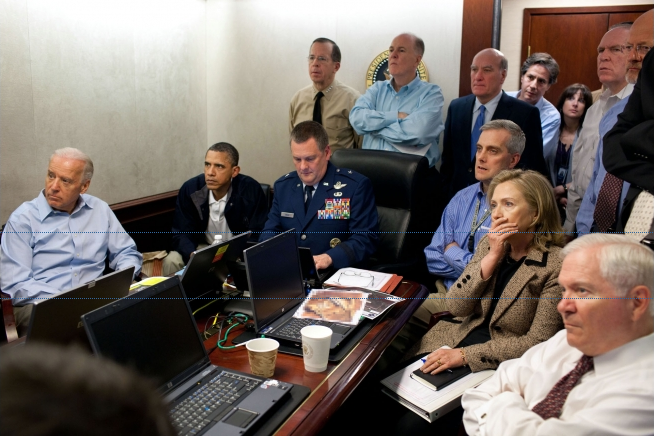
Update: Here’s the reason I focused on Webb (shown typing on his computer above) as the “special-forces official.”

Brigadier General Marshall Webb, an assistant commander of JSOC, took a seat at the end of a lacquered table in a small adjoining office and turned on his laptop. He opened multiple chat windows that kept him, and the White House, connected with the other command teams. The office where Webb sat had the only video feed in the White House showing real-time footage of the target, which was being shot by an unarmed RQ 170 drone flying more than fifteen thousand feet above Abbottabad. The JSOC planners, determined to keep the operation as secret as possible, had decided against using additional fighters or bombers. “It just wasn’t worth it,” the special-operations officer told me. The SEALs were on their own.

Obama returned to the White House at two o’clock, after playing nine holes of golf at Andrews Air Force Base. The Black Hawks departed from Jalalabad thirty minutes later. Just before four o’clock, Panetta announced to the group in the Situation Room that the helicopters were approaching Abbottabad. Obama stood up. “I need to watch this,” he said, stepping across the hall into the small office and taking a seat alongside Webb. Vice-President Joseph Biden, Secretary Gates, and Secretary of State Hillary Clinton followed him, as did anyone else who could fit into the office. On the office’s modestly sized LCD screen, helo one—grainy and black-and-white—appeared above the compound, then promptly ran into trouble. [my emphasis]

First, this passage describes Webb alone in the office that ultimately filled up. Sure, others must have known he was there, alone in the office, but it is a detail that no other people were present for.

More tellingly, why include the detail that Obama took a seat alongside Webb? It’s a detail that Schmidle could get from the photo–so it’s not a question of how Schmidle learned the detail. Rather, it’s a question of who would care (and who would orient the President’s actions from Webb’s perspective, rather than orienting Obama’s position in the room generally). In a way, it feels like one of those renaissance paintings that includes an image of the patron in the corner of the frame, just to make sure the viewer knows who sponsored the whole thing.

Share this entry

Judge Brinkema Cites Espionage Act to Protect Reporter’s Privilege

Charlie Savage tells the headline story from Leonie Brinkema’s opinion on whether or not James Risen must testify in Jeffrey Sterling’s leak trial.

“A criminal trial subpoena is not a free pass for the government to rifle through a reporter’s notebook,” wrote the judge, Leonie Brinkema of the United State District Court in Alexandria, Va.

But I’m just as interested in a few other things she says. First there’s the way she dismisses the government’s claim that two of the people who testified to the Grand Jury–Jeffrey Sterling’s ex-girlfriend and a former CIA officer with knowledge of the MERLYN operation–would be unable to testify at he trial.

The government had argued that the girlfriend was protected by spousal privilege and that the former CIA officer would be hearsay.

Separate and apart from Risen’s concession regarding the admissibility of his grand jury affidavit at trial, see Mot. p. 45, other evidence relied upon by the Court in its Memorandum Opinion similarly would be inadmissible at trial. For example, the grand jury testimony of the witness cited by the Court at page 7 of its Memorandum Opinion would be inadmissible under Rules 801(c), 802 and 803 of the Federal Rules of Evidence and United States v. Acker, 52 F.3d 509, 514-515 (4th Cir. 1995)(availability of spousal privileges to testifying and non-testifying spouses). The grand jury testimony of the witness cited by the Court at pages 7, 9, 10, 20, and 34 of its Memorandum Opinion – testimony that this Court deemed one of the key facts in its conclusion – is inadmissible hearsay on its face absent some exception; yet Risen treats the admissibility of the testimony of both witnesses as a foregone conclusion.

But as Risen’s lawyer Joel Kurtzberg pointed out during the hearing on Risen’s subpoena, she’s not his wife!

They actually cite in their papers as to the testimony of Mr. Sterling’s ex-girlfriend, suggest that it wouldn’t be admissible because they cite to a Fourth Circuit case about the marital privilege.

And in fact, if you look at the case they cite, the case holds the exact opposite. It holds that if you are not married, even if you have been living together I believe for 26 years in that case, the marital privilege doesn’t apply.

Here’s how Brinkema dismisses this William Welch gimmick.

Although the government argues that the spousal privilege would prevent this witness from testifying, nothing in the record indicates thta Sterling and the witness are married now or were married during the time of Sterling’s alleged statements.

More interesting still is the way Brinkema dismisses the government’s claim that the CIA officer’s testimony would be inadmissible hearsay.

Brinkema starts by citing Federal Rules of Evidence describing the exception for a statement against interest.

A statement is admissible under this exception if: (1) the speaker is unavailable; (2) the statement is actually adverse to the speaker’s penal interest; and (3) corroborating circumstances clearly indicate the trustworthiness of the statement.

After noting that Risen’s testimony would be unavailable if she found that reporter’s privilege prevented his testimony or if he refused to testify, she then invokes the Espionage Act.

Risen’s statements are adverse to his penal interest because receiving classified information without proper authorization is a federal felony under 18 U.S.C. 793(e); see U.S. Sentencing Guidelines Manual 2M3.3 (providing a base offense level 29 for convictions for the “Unauthorized Receipt of Classified Information.”). 6

6 The government clearly recognizes Risen’s potential exposure to criminal liability and has offered to obtain an order of immunity for him.

Brinkema uses the overzealous interpretation of the Espionage Act the government itself has been floating lately as a way to force the government to have the former CIA officer testify, which I suspect they’d much rather not do.

And note that footnote about immunity. I’m not sure whether we knew the government had discussed offering Risen immunity or not, but particularly given claims they’re pursuing his testimony so aggressively as a way to jail him for protecting his sources, it is an interesting revelation.

Finally, there’s one more passage I find telling. In the middle of a passage discussing whether the government has access to the information Risen would testify to via other means, she notes,

The government has not stated whether it has nontestimonial direct evidence, such as email messages or recordings of telephone calls in which Sterling discloses classified information to Risen; nor has it proffered in this proceeding the circumstantial evidence it has developed.

In a case in which the government has pointed to records of emails and calls, Brinkema notes, the government has never said whether or not it has the content of those emails and calls. Given that this statement is a non sequitur (it appears amid a discussion of circumstantial evidence), and given that Brinkema knows the government may have improperly accessed Risen’s phone records in the warrantless wiretap case, I find her comment mighty suggestive.

Share this entry