Calvinball

Yesterday at 7:39PM, the 11th Circuit denied Walt Nauta and Carlos De Oliveira’s bid to enjoin the Jack Smith report. But the unsigned order did not tell Aileen Cannon to fuck off. Instead, it invited DOJ to appeal her decision.

ORDER:

Appellees’ “Emergency Motion for Injunction with Relief Requested by January 10, 2025” is DENIED.

To the extent that Appellant seeks relief from the district court’s January 7, 2025, order temporarily enjoining Appellant, Appellant may file a notice of appeal from that order.

DAVID J. SMITH Clerk of the United States Court of Appeals for the Eleventh Circuit

ENTERED FOR THE COURT – BY DIRECTION

DOJ did appeal; their appeal hit Judge Cannon’s docket around 11:04PM.

NOTICE OF APPEAL by USA as to Donald J. Trump, Waltine Nauta, Carlos De Oliveira Re: 682 Order. Filing fee $ 605.00. USA/FPD Filer – No Filing Fee Required.

Just after midnight, DOJ filed a notice of appeal to the existing 11th Circuit docket.

Earlier this evening, January 9, this Court denied defendants’ emergency motion to enjoin the Attorney General from publicly releasing any portion of the Final Report of the Special Counsel. The Court further indicated that, “[t]o the extent that Appellant seeks relief from the district court’s January 7, 2025, order temporarily enjoining Appellant, Appellant may file a notice of appeal from that order.”

We write to notify the Court that the United States has tonight filed a notice of appeal from the district court’s order of January 7, 2025. See Dkt 686. As the Court knows, that order temporarily enjoined the Department of Justice, the Attorney General, the Special Counsel, and others from releasing or sharing the Special Counsel’s Final Report “outside the Department of Justice” pending this Court’s ruling on defendants’ emergency motion. Dkt. 682 at 2. The district court specified that this prohibition would “remain[] in effect until three days after” this Court’s resolution of defendants’ motion in this Court. Id

[snip]

Given the unusual exigencies of this case, as illustrated by the emergency motions practice in both the district court and this Court, the United States respectfully renews its request that this Court promptly vacate the district court’s temporary injunction.1

1 The government’s notice of appeal, filed tonight, squarely invokes this Court’s appellate jurisdiction. As soon as the new appeal is docketed in this Court, the United States intends to move to have that appeal consolidated with this one. To the extent there is any doubt concerning the Court’s authority to review the temporary injunction, furthermore, we respectfully request that the Court construe our appeal as a petition for a writ of mandamus. See Suarez-Valdez v. Shearson Leahman/American Express, Inc., 858 F.2d 648, 649 (11th Cir. 1988) (holding that appeal can be construed as a petition for mandamus if the Court harbors doubts as to its appellate jurisdiction).

They renewed their request to tell Cannon to fuck off, and asked them to treat this as a writ of mandamus in the meantime.

Because the 11th Circuit order is unsigned, it’s really difficult to understand what whatever judges involved intend by this muddle — besides giving Nauta and De Oliveira a shot at appealing to SCOTUS on the very narrowed question before the 11th Circuit: whether they can prohibit Merrick Garland from doing anything given it will cause them no harm.

By inviting DOJ to appeal, they have squarely invoked the 11th Circuit’s appellate jurisdiction, meaning Cannon should be barred from meddling any more (not like that ever stopped her).

And if SCOTUS does nothing before 7:39PM on Sunday, then Garland can do what he says he wants: release the January 6 report and share the documents report with the Chairs and Ranking members of the Judiciary Committees.

But if DOJ files their appeal, then the 11th Circuit can weigh in on Cannon’s far more expansive demands.

There are at least hints here that DOJ is going to take steps to share the reports one way or another.

Until then, we’re waiting to learn how this game of Calvinball will turn out.

Update: Here’s DOJ’s motion to reverse Aileen Cannon.

Share this entry

Will Aileen Cannon Succeed at Suppressing Hunter Biden Dick Pic Sniffing?

I had a dream last night that the documents side of the Jack Smith report, which is the subject of a heated legal battle right now, revealed that Smith developed evidence that Trump had given documents he took to the Saudis in the context of several major business deals. To be clear: It was a dream! I don’t think that’s the most likely content of the report.

But the report is sure to be pretty damning. I’m virtually certain the report shows that aspiring FBI Director Kash Patel lied to help Trump retain classified documents. Senior White House counselor designee Stan Woodward played a role in giving Patel and Walt Nauta legal protection to, themselves, run legal interference for Trump (though there’s absolutely no reason to believe the report will say Woodward’s actions were unethical). Questions remain about whether Trump succeeded in retaining and disposing of still-unidentified documents. And the report may explain the sensitivities of the documents and the mitigation the Intelligence Community had to do as a result.

That said, my dream convinced me — against my better judgment — to explain what I think DOJ is trying to do with this legal fight, because it conveys the outer limits of potential scandal that could be buried in that document. Just the stuff implicating Kash alone is damning, but it could be far worse.

I want to talk about the government response — in the person of the SDFL US Attorney’s Office and DOJ’s Appellate team, because Jack Smith has already withdrawn from the 11th Circuit — to Walt Nauta and Carlos De Oliveira’s bid to enjoin the release of the stolen documents half of the Jack Smith report.


Procedurally, here is what happened in the 11th Circuit (I may or may not go back to fill in Aileen Cannon’s side, but as you can see, she tried to bigfoot into an ongoing matter before the 11th Circuit, which may have pissed off the 11th).

January 7, 9:02 AM, 11th Circuit: Emergency motion to bar release. “Garland is certain to release the report and it will impugn on our right to a free trial and the report cannot be released lawfully, because Jack Smith was unconstitutionally appointed and Trump is President-elect.”

January 7, 1:13PM, 11th Circuit: Notice. DOJ shall submit a response by 10AM on January 8.

January 7, 1:23PM, 11th Circuit: USDC Order. Aileen Cannon’s order enjoining the release of everything docketed at 11th Circuit.

January 7, 1:28PM, 11th Circuit: Notice of appearance. DOJ Appellate lawyer Mark Freeman files an appearance.

January 7, 3:18PM, 11th Circuit: Supplemental. “Here’s the order that already got filed in this docket. We’re, uh, filing it so it has a procedural purpose on the docket.”

January 8, 9:49AM, 11th Circuit: Response. “The part of the report pertaining to Nauta and De Oliveira won’t be released so they have no standing.”

January 8, 11:28AM, 11th Circuit: Notice of intention to reply. “We’re going to reply by 10AM on Thursday.”

January 8, 12:22PM, 11th Circuit: Notice. “No, you’ve got until 5PM today to respond.”

January 8, 5:06PM, 11th Circuit: Reply. “What if it leaks?”

January 8, 10:52PM, 11th Circuit: Trump Amicus. “Block both volumes!!”


The government response effectively argues the following: There are two volumes to the report, Volume One, which covers Trump’s attempted coup, and Volume Two, which covers the documents case. Walt Nauta and Carlos De Oliveira are not mentioned in Volume One, and so they have no interest in it and so no legal standing to try to block it.

Because of the ongoing case against Nauta and De Oliveira (the Response explains), Merrick Garland has decided that no part of Volume Two will be released. It will, instead, only be made available for in camera review to the House and Senate Judiciary Chairs and Ranking Members at their request, with their agreement that no information from it will be publicly released.

Nauta and De Oliveira have no authority to affect the release of Volume One. Not only did Judge Cannon’s original order deeming the Jack Smith appointment unconstitutional limit itself to the case before her (that is, not even the one in DC), but she cannot have the authority to deem all Special Counsels unlawful.

Please specify that this is the last word, unless the 11th Circuit en banc or the Supreme Court tries to get involved.

Narrow the legal dispute

I don’t pretend any of this is satisfying to people who want both reports. But here’s the legal logic to it.

First, because of the the posture of this appeal, the entire documents side of the case is in uncertain status. When Judge Cannon ruled Jack Smith’s appointment was unconstitutional, she said that everything Smith had done since his appointment had to be unwound. So unless the report only covered stuff before that point — that is, through the document seizure, but during which Cannon’s injunction on the investigation largely prevented any interviews of people like Nauta — then it remains in limbo awaiting the 11th Circuit decision on Cannon’s ruling. So it’s not just that there’s a pending case against Nauta and De Oliveira, it’s also that the entire legal status of the work done after November 18, 2022, which makes up the bulk of the obstruction investigation.

So whatever Garland (or Brad Weinsheimer, the top nonpartisan lawyer at DOJ, whom I’m certain is involved) thinks about the merit of releasing the report, for the purposes of this dispute, he is trying to eliminate any standing anyone has to interfere with the release of the January 6 volume. (Side note: it was short-sighted for Jack Smith to release these as volumes to the same report, rather than separate free-standing reports.) Nothing Garland has authorized with the volume pertaining to Nauta and DeOliveira can affect their hypothetical right to a fair trial they’ll never face, because nothing from the report will become public in such a way that potential jurors would see it. That is, sacrifice immediate publication of the documents volume in an attempt to release the January 6 one.

Create a dead man’s switch

Garland has agreed with Jack Smith that Volume Two should not be released so long as the Nauta and De Oliveira cases are pending, but that suggests once they no longer are pending, the information could be released.

Attorney General Garland is committed to ensuring the integrity of the Department’s criminal prosecutions. Considering the risk of prejudice to defendants Nauta’s and De Oliveira’s criminal case, the Attorney General has agreed with the Special Counsel’s recommendation that Volume Two of the Final Report should not be publicly released while those cases remain pending. See 28 C.F.R. § 600.9(c). There is therefore no risk of prejudice to defendants and no basis for an injunction against the Attorney General.

[snip]

The Attorney General’s determination not to authorize the public release of Volume Two fully addresses the harms that defendants seek to avoid in their emergency motion. As noted, consistent with 28 C.F.R. 600.9(a), the Attorney General intends to make Volume Two of the Final Report available for in camera review by the Chairmen and Ranking Members of the House and Senate Judiciary Committees, pursuant to restrictions to protect confidentiality. Even then, however, consistent with legal requirements, the Department will redact grand jury information protected by Rule 6(e) as well as information sealed by court order from the version made available in camera for congressional review. Defendants have no colorable claim to prejudice from these carefully circumscribed in camera disclosures.

The filing leaves unsaid what happens when the cases against them go away, which will happen either because the 11th Circuit affirms Cannon’s ruling that Jack Smith was unlawfully appointed, Trump’s DOJ withdraws from the appeal, or Trump simply pardons his co-conspirators. Everyone knows they will go away, but once they do, then in theory Volume Two could come out.

Everyone has made sure the report could come out in current form; because of the redactions they’ve done, no grand jury material would be implicated, nor any information sealed by Cannon.

This creates an effective dead man’s switch tied to the Nauta and De Oliveira prosecution. Once that case goes away, Jamie Raskin and Dick Durbin would be free to talk about it. And, it’s possible, there’s a standing order at DOJ that it will be released publicly.

Of course, either the landing team at DOJ or Pam Bondi, once she’s confirmed, can and undoubtedly would override any such order. Assuming they can find every report at DOJ or they disseminate an order forbidding its release sufficiently broadly to cover all potential distributions within DOJ, they can and likely will succeed in preventing the release.

I’m not saying we’ll get the report, which is one reason I hesitated to even post this.

At that point, though, whoever orders the report’s suppression would, in effect, be suppressing damning information about — at least — Kash Patel. And Trump. And (with my clear caveat that there’s no reason to believe Woodward did anything unethical), Woodward, who one of these days should expect nomination as a judge.

And, if Jamie Raskin and Dick Durbin get to review it, they would know that.

In other words, if, by taking any legal dispute off the table, Garland succeeds in letting Raskin and Durbin read the report, it’ll create a headache.

Not to mention, the existence of the report will likely form a key part of Jim Jordan and Kash Patel’s efforts to retaliate against Jay Bratt and Jack Smith. And it may create ethical obligations to recuse from such matters for everyone but Bondi.

Again, I’m not saying this will work. I’m saying it may cause headaches.

Implicate the Hunter Biden report

That brings us to the second thing that Garland/Weinsheimer have done to muddle these legal issues.

As I’ve said repeatedly, David Weiss was appointed under the same legal authority as Jack Smith. If Jack Smith’s appointment was unconstitutional, then Weiss’ was, too, especially with respect to Hunter Biden’s Los Angeles prosecution and even more with respect to Alexander Smirnov’s prosecution. Yet several DC judges have rejected that claim.

And we’re about to get a report from Weiss, too, one that remains unmentioned, at least specifically, in this legal dispute.

After Joe pardoned Hunter, Weiss got Smirnov to agree to a baffling above-guidelines sentence plea deal, with the caveat that he be sentenced almost immediately; yesterday, Judge Otis Wright sentenced him to six years. I expect that Weiss has already completed his report, with the expectation it’ll be released along with Trump ones on Friday. (I’ve been guessing this would all go down on January 10 for some time; looks like a pretty prescient guess.)

So when DOJ repeatedly mentions the impossibility that Cannon’s order could enjoin all Special Counsels nationwide, they are implicitly including David Weiss, even if only Jack Smith’s DC report gets mentioned.

Defendants also reiterate their claim that the Special Counsel was unlawfully appointed. The United States has thoroughly rebutted that contention in its merits briefs in this appeal. But in any event, the argument is irrelevant to the only action here at issue—the handling of the Final Report by the Attorney General. The district court, in dismissing the indictments against defendants, did not purport to enjoin the operations of the Special Counsel nationwide, nor could it have properly done so in this criminal case. Accordingly, as required by Department of Justice regulations, the Special Counsel duly prepared and transmitted his confidential Final Report to the Attorney General yesterday (as permitted by the district court’s recent order). 28 C.F.R. § 600.8(c) (“Closing documentation.”). What defendants now ask this Court to enjoin is not any action by the Special Counsel, but the Attorney General’s authority to decide whether to make such a report public. See id. § 600.9(c); 28 U.S.C. § 509. As noted above and discussed in more detail below, the Attorney General determined that he will not make a public release of Volume Two while defendants’ cases remain pending. That should be the end of the matter.

[snip]

Although the district court in this case concluded that the Special Counsel was not properly appointed and ordered that the indictment be dismissed as a remedy, the district court did not purport to enjoin the ongoing operations of the Special Counsel’s Office nationwide. This is a criminal case, and the district court limited its remedy to dismissal of the indictment. See Dkt. 672 at 93. The court did not purport to issue—and it could not properly have issued—a nationwide injunction barring the Special Counsel from discharging the functions of his office in Washington, D.C. or elsewhere.

Indeed, while defendants argue that the order appointing the Special Counsel became “void” upon issuance of the district court’s judgment in this case, Mot. 14, the district court was clear that its order was “confined to this proceeding,” see Dkt. 672 at 93. —i.e., to this criminal prosecution. The district court never barred the Special Counsel from performing other duties, including the preparation of the Final Report. Had it purported to do so, the district court would have had to grapple with the fact that the D.C. Circuit—whose law governs Department headquarters and the Special Counsel’s offices where the Final Report was prepared—has rejected the same Appointments Clause theory that the district court accepted. See, e.g., In re Grand Jury Investigation, 916 F.3d 1047, 1053 (D.C. Cir. 2019). The district court with responsibility for the Election Case did so as well.

On paper, at least, Nauta and De Oliveira have no legal dispute, and Trump’s amicus demanding that the DC volume be suppressed, too, has even less.

But who knows? Trump’s dealing with a set of judges and justices who could care less about legal standing if it means protecting him.

And that’s why the Hunter Biden report matters.

If the 11th Circuit issues an order enjoining all currently pending Special Counsel reports, it would have the effect of enjoining the Hunter Biden one, as well. And then, when Pam Bondi comes in and tries to suppress the Trump one, any release of the Hunter Biden one (which I expect to assign a specific time and cost value of the pardon to Hunter), will amount to an ethical problem, a double standard serving to protect Trump.

Again, I’m not saying that any of this will work. I’m saying that if and when it doesn’t, it has the ability create a big ethical and potentially legal headache for Trump’s wildly conflicted DOJ just at the start of their tenure.

Update (h/t Lemon Slayer): Garland wrote the Chairs and Ranking Members about the completion of the report and the delay caused by Cannon. This language sure sounds like Garland has intended his order will release the report when the investigation into Nauta and De Oliveira is killed.

Consistent with local court rules and Department policy, and to avoid any risk of prejudice to defendants Waltine Nauta and Carlos De Oliveira, whose criminal cases remain pending, I have determined, at the recommendation of the Special Counsel, that Volume Two should not be made public so long as those defendants’ criminal proceedings are ongoing. Therefore, when permitted to do so by the court, I intend to make available to you for in can1era review Volume Two of the Report upon your request and agreement not to release any information from Volume Two publicly. I have determined that once those criminal proceedings have concluded, releasing Volume Two of the Report to you and to the public would also be in the public interest, consistent with law and Department policy.

Share this entry

Why and How to Hold John Roberts Accountable

I want to explain why and how to hold John Roberts accountable for Trump’s corruption. It is based on the following presumptions.

  • Blaming Merrick Garland for Trump’s reelection has required inventing facts about the timeline, which is why I argue it is conspiratorial thinking.
  • Because of how SCOTUS rewrote the Constitution, no counterfactual gets Trump disqualified before the election, and probably doesn’t get him to trial.
  • This was a political failure that started well before January 6.

So one reason I advocate focusing on accountability for John Roberts is because he and his colleagues, in fact, are responsible. They intervened to ensure the leader of their party would evade accountability. And so they enabled everything that comes next.

And Trump has responded by flouting all concern about legal accountability.

  • He set up a kickback system for his inauguration, the proceeds of which will go to his own pocket.
  • Trump boasted of his expanded business deals with the Saudis.
  • He hailed $20 billion in investments from the same guys whose payments Alexander Smirnov was hiding on his taxes.

This is corruption in plain sight. The corruption is the obvious result of Roberts’ grant of immunity. So I propose to track it, name it, make John Roberts own it.

I’m not arguing that doing so will immediately make John Roberts regret what he has done. While Roberts has shown the ability to moderate off his prior shitty decisions, he’s pretty wedded to making corruption legal.

But one of the only short-term guardrails on Trump will be the things the Senate and SCOTUS choose to place on him. They’ve failed every other time they could reverse Trump’s damage, but in his first term, they did push back on his worst instincts. So by at least making the effects of the immunity ruling visible, you increase the chance that Roberts might do so.

The same is true of the violence that Trump will stoke. Roberts doesn’t want to own that. He does.

There’s good reason to go through this exercise, repetitively, insistently, that doesn’t invest hope that it’ll somehow convince Roberts.

MAGAt has spent years building their villain: migrants and trans people.

Defenders of democracy have done a far poorer job of doing the same — so much so that MAGAts have also projected a false claim of corruption onto the Bidens, transferring it from themselves.

But it’s time that we made corruption — and the Republican-picked judges that enabled it — the villain. We need to explain the world, and the explanation really is corruption, not migrants.

And if we do so from the start, with discipline, with repetition, then when Trump’s corruption ends up breaking things, causing catastrophe, that explanation will be ready at hand. I can’t tell you which of Trump’s corrupt schemes will do catastrophic damage first. Possibly his embrace of crypto currency, or maybe the dodgy types who set up his personal piggy banks will do something so shocking that even Pam Bondi’s DOJ can’t look the other way. But when Trump’s corruption causes catastrophe — and it’s a matter of when, not if — we need to be ready to name it, rather than let them scapegoat migrants for Trump’s doing.

There’s one more reason I advocate this approach. As I tried to lay out here, polarization is Trump’s most useful weapon. Every time you present an issue in terms of loyalty to Trump or opposition to him, a great many people will choose Trump, even if only symbolically, because it’s the price of admission to GOP politics. So I advocate, as often as possible, to make someone else the figurehead for the problem.

Even in much of the conspiracy theorizing targeting Garland as the villain, I’ve seen people — smart people!! — who don’t understand the full shocking import of the immunity ruling. Reversing that oversight is a necessary step in reclaiming democracy.

Share this entry

“False in Numerous Respects:” House Democrats Package Up Liz Cheney’s Evidence of “Despicable Malice”

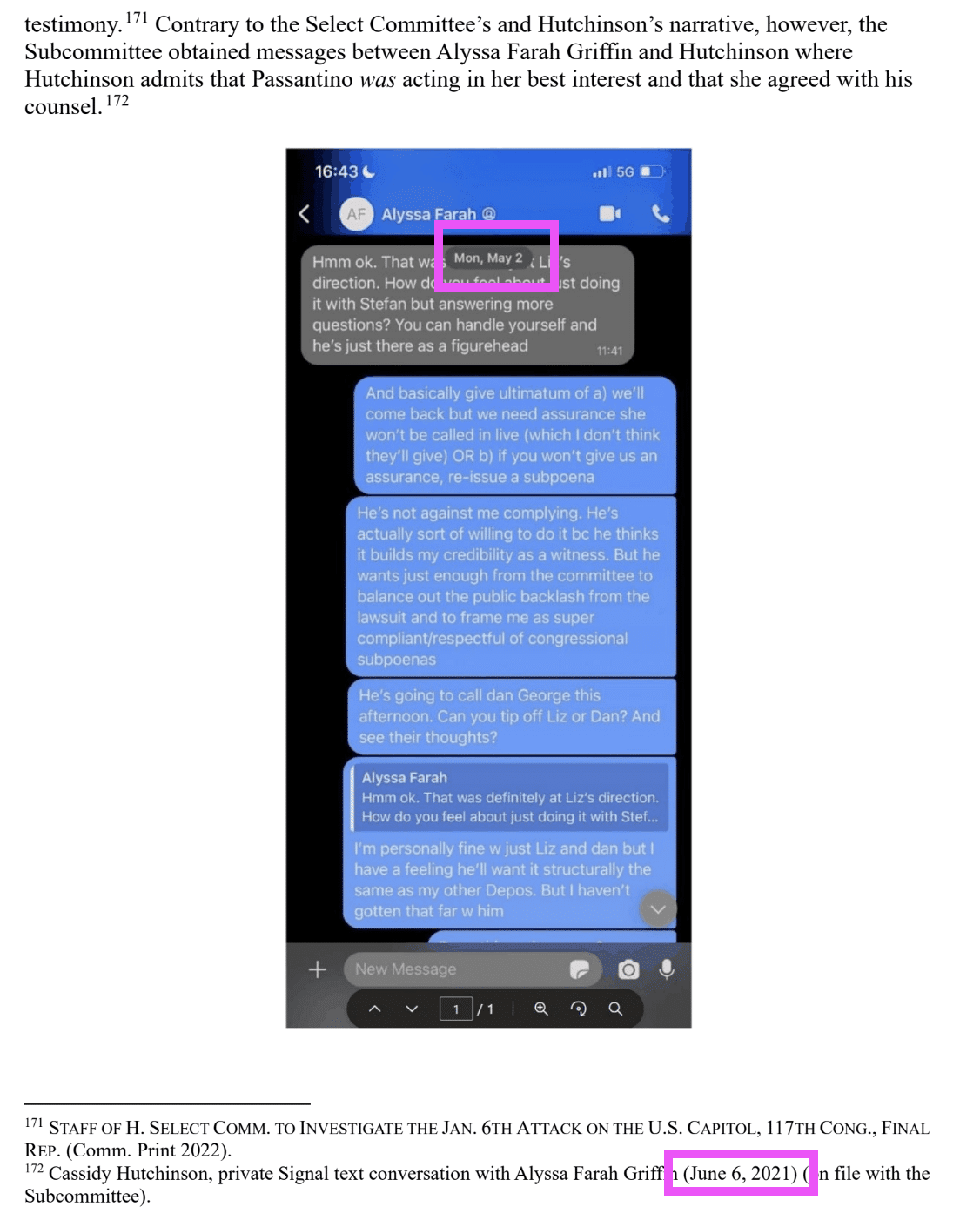
In a letter [alternate link] Cassidy Hutchinson’s attorney, William Jordan, sent to the DC bar, he corrected some of the false claims made in Barry Loudermilk’s report claiming that Liz Cheney had inappropriately suborned perjury from Hutchinson.

The Loudermilk Report is false in numerous respects, including its suggestion that Ms. Hutchinson and Congresswoman Cheney had any improper communications.

[snip]

The Loudermilk Report is replete with other politically motivated falsehoods, but at a minimum Ms. Hutchinson wanted specifically to correct this error because it has been seized on by Mr. Passantino and other individuals in this Complaint. [my emphasis]

The other individuals likely including private citizen Donald Trump.

And that’s interesting because the report in which the letter was published includes an interesting line at the end of a long explanation of why this is an assault on Speech and Debate.

That section cites the Supreme Court opinion holding that “once it is determined that Members are acting within the ‘legitimate legislative sphere’ the Speech or Debate Clause is an absolute bar to interference.” Then it cites the amicus brief the GOP sent in support of Scott Perry’s fight to keep content from his phone involving things that had nothing to do with formal oversight from prosecutors. “The Clause is not abrogated by allegations that a legislative official acted unlawfully or with an unworthy purpose, and applies both in civil cases and criminal prosecutions.” It cites to Scott Perry’s own filing. After including Trump’s tweet invoking the report, it trashes Loudermilk’s shoddy analysis.

Then it notes that Speech and Debate protects Loudermilk from any claim of defamation someone might bring against him.

If the Clause did not apply to congressional investigations, Chairman Loudermilk could be subject to liability himself for defamation.

Oh. And then it notes that those without Speech and Debate protection who falsely accused her of a crime, “may also be liable.”

All those who republish these allegations outside speech or debate may also be liable.

And that’s interesting because Cheney — whose reference to this report in a Tweet was the first I heard of it — specifically said that the “report destroying Loudermilk’s fraudulent allegations shows the despicable malice behind Trump’s efforts.”

“Despicable malice” sounds like the kind of thing you might sue over.

Share this entry

Barry Loudermilk Wasted $250K Making Security Footage available on Rumble

In response to Barry Loudermilk’s report on January 6, his counterpart of the committee, Joe Morelle, released a response. [Alternate link]

I’ll say more about its central Speech and Debate argument; as I’ve noted, DOJ can’t investigate Liz Cheney without falling afoul of the same Speech and Debate that protected Scott Perry from investigation for his role in the insurrection.

But there’s an important detail that deserves its own post.

There’s a long section of the report that describes right wing efforts to make security footage from January 6 available. It describes how, rather than hosting the video on the Committee’s own website, right wingers chose to post it on Rumble instead. It includes a quote from USCP Acting Director of Intelligence Julie Farnham about the downsides of doing so: It meant making the content readily available to extremists.

Ms. Farnam: Well, the audience is largely extremists, and those are people who have — not everyone, but some of them have celebrated the threats to our democracy and have worked to undermine our democracy. And so having that security information makes it even more dangerous for the people trying to protect the Capitol and more dangerous for all the Members of Congress.188

And for the privilege of making security video readily available to extremists, the report reveals, Republicans paid $250,000.

In other words, Barry Loudermilk and Mike Johnson wasted tax payer money to make themselves and their colleagues less safe.

Share this entry

The Opportunity Costs of Conspiracy Theories about Merrick Garland

You have a choice.

You can spend the next few weeks laying the groundwork for making a big stink about the fact that the aspiring FBI Director tried to help Trump steal classified documents.

Or you can spend it clinging to false claims about Merrick Garland so you can blame him for the fact that Trump won reelection rather than blaming the guy directly responsible for preventing a trial (and the guy who’ll remain responsible for Trump’s license going forward), John Roberts, to say nothing of the failed Democratic consultants and voters themselves.

Sadly, Democrats and lefties — from random people on Bluesky to TV lawyers to the President himself — are choosing the latter path, the path that will guarantee they remain maximally ineffective.

They’re rolling out all the tired false claims: Merrick Garland waited before investigating people close to Trump, they claim. According to NYT, Garland approved an effort to follow the money in his first meeting with prosecutors — an effort that turned out to be a dry hole, but nevertheless was precisely the approach that people like Sheldon Whitehouse and Andrew Weissmann demanded.

After being sworn in as attorney general in March 2021, Merrick B. Garland gathered his closest aides to discuss a topic too sensitive to broach in bigger groups: the possibility that evidence from the far-ranging Jan. 6 investigation could quickly lead to former President Donald J. Trump and his inner circle.

At the time, some in the Justice Department were pushing for the chance to look at ties between pro-Trump rioters who assaulted the Capitol on Jan. 6, 2021, his allies who had camped out at the Willard Hotel, and possibly Mr. Trump himself.

Mr. Garland said he would place no restrictions on their work, even if the “evidence leads to Trump,” according to people with knowledge of several conversations held over his first months in office.

“Follow the connective tissue upward,” said Mr. Garland, adding a directive that would eventually lead to a dead end: “Follow the money.”

In June 2021, they focused on the Willard, precisely the people everyone wanted investigated.

In late June, Mr. Garland, Ms. Monaco and several aides decided they needed to take a dramatic step: creating an independent team, separate from Mr. Cooney’s original group, tasked with investigating the Willard plotters, with no restriction on moving up the ladder to Mr. Trump if the evidence justified it.

They did not want too many people knowing about it. So they gave it a vanilla name: the “Investigations Unit.”

NYT misses — as everyone else has, too — one of the most opportunistic things DOJ did to accelerate the investigation. It used the existing warrant for Rudy’s devices obtained on Lisa Monaco’s first day on the job, April 21, 2021, to do a privilege review of the January 6 content at the same time. The Special Master prioritized the phone Rudy used on January 6 — 1b05A, which appears throughout Rudy’s privilege log for January 6 related material — and started turning over that material to DOJ starting on November 11, 2021. That effort yielded at least one key document that shows up in Trump’s January 6 indictment but not the January 6 Report, as well as encrypted content not available anywhere else.

DOJ started with Rudy, Co-Conspirator 1, the guy through whom the entire fake elector plot got pitched to Trump, and people are whining that DOJ didn’t start at the top of the conspiracy. They did. You just didn’t notice.

Those are not the only things DOJ was doing in 2021. The plodding DOJ IG started investigating Jeffrey Clark on January 25, 2021. DOJ appears to have figured out a way to solve a difficult problem — how to get waivers of Executive Privilege without violating White House contact policies — in July 2021. DOJ sent overt subpoenas pertaining to Co-Conspirator 3, Sidney Powell, in September 2021. DOJ was also working to fill out the encrypted communications the militias exchanged with people like Roger Stone (who first showed up in a court filing in March 2021) and Alex Jones, but it took even longer, over a year, to exploit Enrique Tarrio’s phone, than it did Rudy’s, nine months, and that process necessarily requires working phone by phone.

You can complain that investigations take too much time. You can gripe that investigators did precisely what everyone wanted them to do — follow the money and investigate the Willard. But they were pursuing precisely the angles people were demanding, and long before virtually everyone understands.

That 2021 focus is inconsistent with other conspiracy theories people are floating, too: None of this started until Jack Smith was appointed (or that Jack Smith gave it new life), they say. Nothing happened for two years, they say.

As far as I know, every phone that went into the indictment and immunity brief (which added information from Boris Ephsteyn and Mike Roman’s phone) was seized before Smith’s appointment. The onerous 10-month process of obtaining Executive Privilege waivers for testimony from Trump’s top aides, without which you couldn’t prove that Trump held the murder weapon — the phone used to send a tweet targeting Mike Pence during the riot — started on June 15, 2022, five months before Smith’s appointment. Jack Smith looks prolific to those who don’t know those details, because 10 months of hard work finally came to fruition in the months after he was appointed.

The claim nothing happened for two years? The only major investigative step that happened after the two-year anniversary of Merrick Garland’s confirmation was Mike Pence’s testimony.

The claims people are using to blame Merrick Garland that Trump was reelected — all of them!!! — are easily falsifiable. (I’m happy to entertain arguments that Garland’s grant of Special Counsel status to David Weiss affected the election, but the decision to keep Weiss was one Biden made.) The single possible action from DOJ (likely either Brad Weinsheimer or Public Integrity) that could have created a delay would be pre-election limits on what prosecutors could including the August 2024 superseding indictment. But it’s just as likely that prosecutors believed a narrow superseding indictment was tactically smart.

This is the point, though. This is not about Merrick Garland. I’m happy to criticize him for things he did. I’ve written more critical of his picks and handling of Special Counsels than anyone.

I could give a flying fuck about Merrick Garland.

What I care about is that at a time when we need to start establishing means of accountability for a second Trump term, much of the Democratic world has chosen instead to wallow in false claims about the Trump investigation in order to make Garland a scapegoat, rather than the guy directly responsible, John Roberts. It’s classical conspiracy thinking. Something really bad happened (Trump got elected), it’s not entirely clear why (because almost no one bothers to learn the details I’ve laid out here, to say nothing of considering the political work that didn’t happen to make Trump own this), and so people simply invent explanations. Every time those explanations get debunked, people double down on the theory — it’s Garland’s fault — rather than reconsidering their chosen explanation.

And those explanations have the effect of distracting attention from Roberts. Rather than talking about how six partisan Justices rewrote the Constitution to give the leader of the GOP a pass on egregious crimes, Democrats are choosing to blame a guy who encouraged prosecutors to follow the money in March 2021.

It’s a choice. And it’s a choice that guarantees maximal impotence. It’s a choice that eschews actual facts (and therefore the means to actually learn what happened). It’s a choice that embraces irrational conspiracy thinking (which makes people weak and ripe for manipulation by authoritarians). It’s a choice that distracts from Roberts’ role.

And there is a better, more urgent, option.

We have every reason to believe we’ll get a report from Jack Smith (though I would be unsurprised if Trump tried to enjoin its release). Given David Weiss’ great rush to sentence Alexander Smirnov on January 8, I suspect we’ll get a report from Weiss too. My guess (given Weiss’ January 8 sentencing day) is we may get both reports at the same time — maybe January 10 or so. That’s a wildarse guess.

And so rather than in wallowing in conspiracy theories, Democrats would do well to prepare a messaging plan for those reports.

I expect David Weiss’ report to smear up not just Hunter but also Joe Biden, for pardoning Hunter. I expect he’ll suggest that Kevin Morris’ support of Hunter (a loan Hunter would have had to pay back after the election, but which he had no means to pay) has amounted to a massive campaign contribution to Joe. I wouldn’t even rule out Weiss pushing for Republicans to impeach Biden over that.

I spoke with Harry Litman back in November about what a Jack Smith report might have. Remember, his mandate is to describe both charging decisions (the two indictments he filed) but also declination decisions (the people and crimes he didn’t charge).

That means the report — if Trump doesn’t thwart its release — should answer a lot of questions that have people spun into conspiracy theories. Why didn’t Smith charge all of Trump’s co-conspirators (probably because the Mueller investigation showed how futile it would be to charge anyone before Trump, which the Florida prosecution seems to confirm)? Why didn’t Smith charge any members of Congress (undoubtedly because their actions would be covered by Speech and Debate, as confirmed by a DC Circuit opinion written about the exploitation of Scott Perry’s phone)? It likely will even provide more fulsome descriptions of the documents Trump refused to give back.

But there are three possible or likely aspects to the report that may become important for the confirmation of Trump’s appointees (which is one reason he might try to enjoin the release) and the pardons he plans shortly thereafter.

First, prosecutors had investigated how Trump used money raised on a promise to spend on election integrity to instead pay everyone off. That’s how he paid Deputy Attorney General nominee Todd Blanche, Solicitor General nominee John Sauer, and PADAG Emil Bove (Bove does not need Senate confirmation). Trump’s incoming Chief of Staff (who also does not need Senate confirmation), Susie Wiles, managed much of that process. DOJ did not charge this scheme, but we may get an explanation for what it entailed and why Smith didn’t charge it. While Blanche, et al, have no legal exposure themselves in the way Trump paid them, if we learned more about it, it would further highlight the wildly inappropriate conflicts all these men would have in running DOJ. That is, there’s the distinct possibility that a report would provide tangible explanation for why Blanche and Sauer have grave conflicts.

Far more important is the point I made here. FBI Director nominee Kash Patel may figure in both sides of Jack Smith’s report, the January 6 and the documents side. With Christopher Miller, Kash engaged in what Barry Loudermilk treated as insubordination by refusing Trump’s order to get him 10,000 troops for January 6; this post talked about how that might be a more productive way to make Loudermilk’s Liz Cheney referral a problem for Kash. That’s a way to raise distrust of Kash among Republicans.

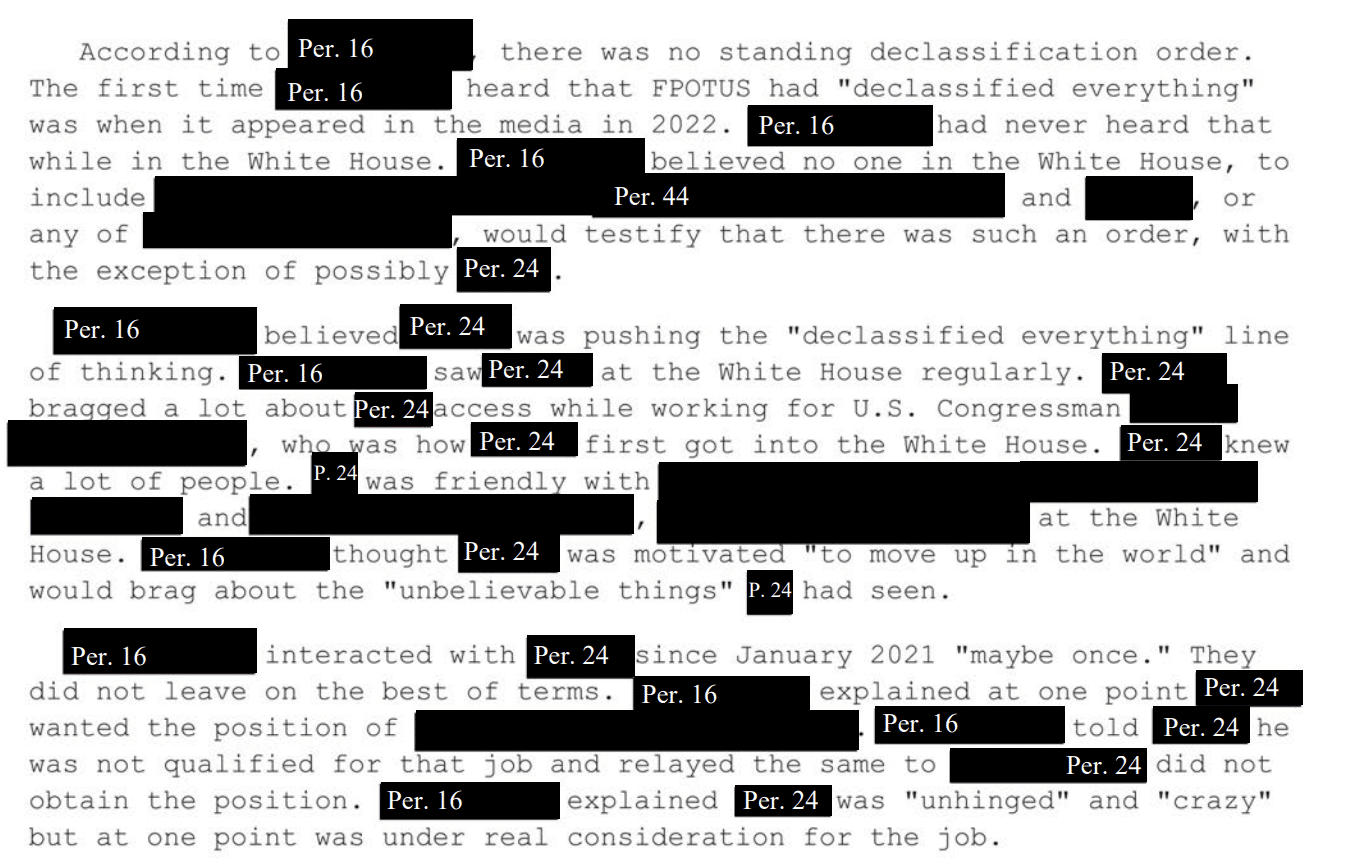
But Kash’s involvement in the other side of the investigation (which appears at 19:00 in the video above) is more important. A key prong of the investigation into Trump’s treatment of the documents found at Mar-a-Lago involve disproving Kash’s public claim — made just before DOJ subpoenaed the documents — that Trump had declassified everything.

Patel did not want to get into what the specific documents were, predicting claims from the left that he was disclosing “classified” material, but said, “It’s information that Trump felt spoke to matters regarding everything from Russiagate to the Ukraine impeachment fiasco to major national security matters of great public importance — anything the president felt the American people had a right to know is in there and more.”

Someone whose potty mouth resembles Eric Herschmann (Person 16) debunked this claim just before Patel (Person 24) testified.

What Kash said in his immunized November 2022 testimony didn’t show up in either of the Florida indictments (and we only got reports of what he thought he’d say beforehand). We don’t know whether he backed off his unsworn comments. We don’t know whether he gave testimony debunked by five other people. We don’t know how much Kash had to say about efforts to take the Crossfire Hurricane binder home.

But all that is highly likely to show up in a report.

If we get the report, it is highly likely that we’ll get evidence that the aspiring FBI Director lied to help Trump take classified documents home from the White House.

If we get the report, it is highly likely that, shortly before his confirmation process, we’ll get evidence that the aspiring FBI Director helped Trump commit a crime.

Now, the Republicans don’t care. That’s not going to affect their willingness to rubber stamp Kash’s nomination. But if Democrats do their job well, then they can use this information to dramatically raise the costs of the Kash confirmation.

Or Democrats can continue to wallow in conspiracy theories about Merrick Garland.

Finally, I think it highly like a report — if we get one — will talk about how Trump’s call to the rally motivated certain key rioters to conspire to obstruct the election. We’ll learn about how his exhortation to Stand Back and Stand By had an immediate effect on Proud Boy membership. We’re likely to learn about how Danny Rodriguez immediately responded to Trump’s targeting of Mike Pence in his January 6 speech to make slitting motion at his throat, naming Joe Biden, and then proceeded to almost murder Michael Fanone, pretty close to meeting the Brandenberg definition of incitement. We’re likely to learn how the guys who helped breach the East door, then broke into the Senate gallery, then rappelled down to the Senate floor and let others in believed that Trump ordered them to come to DC on December 19, 2020. Trump has been desperate to prevent just this evidence from being submitted at trial.

But it will also raise the stakes of his pardons. If this information comes out, then it will make it clear that Trump isn’t just pardoning his fans, he’s pardoning people who believed they were responding to his orders to attack Congress.

Democrats can spend the time between now and confirmation hearings making ever-evolving conspiracy theories about Merrick Garland, something that makes them as weak as possible, something that makes them more susceptible to authoritarian manipulation.

Or they can spend the time making it clear just how corrupt Trump’s appointments and pardons are.

Democrats seem to be struggling even to chew gum without faceplanting. They can’t do both.

It’s just my opinion. But I think Democrats would be far better served focusing on the facts that we do know from the twin investigations of Trump rather than inventing false claims about why they didn’t go to trial. This is the work Democrats didn’t do in 2023, when Trump was making unchallenged false claims that these investigations were witch hunts. The failure to do that work is a more direct explanation why the indictments didn’t disqualify him with voters than anything Merrick Garland did or didn’t do. And until Democrats do this work, they’ll be politically sunk.

Share this entry

Cotton Swabs and Grievance Myths: Do Not Invite Republicans to Express Support for Kash Patel’s Witch Hunts

I want to elaborate on some points I made in a Bluesky exchange I had with Greg Sargent about his post on the Barry Loudermilk report referring Liz Cheney for investigation yesterday. It was, I hope, a civil and substantive exchange (multiple people have mentioned it since), and for that I want to thank Sargent.

But I wanted to explain some points I tried making at more length.

Sargent’s post noted — and he’s right — that Trump’s embrace of Loudermilk’s report discredits false assurances Senate Republicans have offered that Kash Patel won’t pursue political witch hunts if confirmed as FBI Director.

Barely moments after Donald Trump announced that he’d chosen loyalist Kash Patel as FBI director, Republicans stampeded forth to insist that this in no way means Trump will unleash law enforcement on his enemies, even though Trump himself has threatened to do so. Senator John Cornyn suggested such threats were only for “public consumption.” Senator Rick Scott said Trump is “not gonna do it.” And Representative Dan Meuser scoffed that the very idea is “nonsense.”

These lawmakers should take a moment to consult Trump’s Truth Social feed. At 3:11 a.m. on Wednesday, demonstrating characteristic emotional balance, Trump posted this reaction to a new report from a House subcommittee chaired by GOP Representative Barry Loudermilk, which recommends that the FBI investigate former GOP Representative Liz Cheney over her role in the House’s January 6 inquiry:

Liz Cheney could be in a lot of trouble based on the evidence obtained by the subcommittee, which states that “numerous federal laws were likely broken by Liz Cheney, and these violations should be investigated by the FBI.” Thank you to Congressman Barry Loudermilk on a job well done.

Note the trademark mobspeak here: Cheney could be in a lot of trouble for federal lawbreaking, Trump declares, as if he’s merely a passive observer remarking on the danger she faces, rather than someone who will control the nation’s sprawling federal law enforcement apparatus in just over a month. Trump has been raging at Cheney for years and has amplified suggestions that she should face televised military tribunals.

Now, in a dark turn in this whole farcical saga, Trump is pretending that House Republicans have given him a legitimate basis for prosecuting Cheney, when in fact their claims were cooked up in bad faith for precisely that purpose.

Sargent argues that the press should “hound[ GOP Senators] mercilessly” on whether they’ll still support Kash after Trump’s endorsement of Loudermilk’s report.

Trump’s veiled threat toward Cheney should prompt the press to revisit those reassurances from Republicans. GOP senators should be hounded mercilessly by reporters on whether they’ll knowingly support Patel now that Trump has made the corrupt reality of the situation so inescapably, alarmingly clear.

If we lived in a world where Republican hypocrisy could be shamed, where journalists had the skill to manage such an exchange, that would be worthwhile.

We don’t live in that world.

Trying to budge Republicans from their reassurances would backfire.

Here’s why.

First, consider the utter incompetence of most journalists this side of Mehdi Hasan to handle such an exchange.

I’ve been tracking a right wing technique I’ve dubbed “Cotton swabs” (because Tom Cotton is a skilled practitioner in the technique). In it, when Republicans get asked these kind of gotcha questions by Manu Raju in the hallway or by Kristen Welker on a Sunday show, they instead flip the gotcha on its head, using it as an opportunity to air unrebutted propaganda. And the journalist is left as a discredited prop in Trump’s assault on the press.

For example, when Welker recently asked Trump if he would, in the interest of unifying the country, concede he lost the 2020 election, Trump not only refused to concede he lost, but he used the question to blame Biden that the country was divided, and then — with absolutely no pushback from Welker — lied about Joe Biden weaponizing DOJ to go after him, Trump. (The exchange introduced precisely the same kind of false reassurance that Sargent called out.)

KRISTEN WELKER:

Yes. And sir, I don’t have to tell you this, because you’ve talked about it. It comes at a time when the country is deeply divided, and now you’re going to be leading this country for the next four years. For the sake of unifying this country, will you concede the 2020 election and turn the page on that chapter?

PRESIDENT-ELECT DONALD TRUMP:

No. No, why would I do that? But let me just tell you —

KRISTEN WELKER:

You won’t ever concede —

PRESIDENT-ELECT DONALD TRUMP:

– when you say the country is deeply divided, I’m not the president. Joe Biden is the president.

KRISTEN WELKER:

But you’re going to be the president.

PRESIDENT-ELECT DONALD TRUMP:

No, no. I’m not the president. So when you say it’s deeply divided, I agree. But Biden’s the president, I’m not. And he has been a divider. And you know where he divided it more than anything else, and it probably backfired on him. I think definitely is weaponization. When he weaponized the Justice Department and he went after his political opponent, me. He went after his political opponent violently because he knew he couldn’t beat him. And I think it really was a bad thing, and it really divided our country.

So instead of giving the harmless concession she invited, that Trump lost to Joe Biden in 2020, Trump instead hijacked Welker’s platform to lie about being a victim. She asked for something to support unity. He stoked division more, blaming the polarization of the country on Biden. Then he made false claims of grievance.

It had exactly opposite effect Welker imagined. And in the fact check NBC did after the interview? Trump’s lie about Biden weaponizing DOJ went unmentioned.

NBC treated it, a brazen lie, as if it were true.

If you want to know how Trump got elected even after being charged in two federal indictments, you might start with the way that every legacy media outlet lets lies like this go uncontested.* Always. Trump never gets fact checked on his false claims about the federal investigations into his attempted coup and stolen documents.

As a result, even newsies who watch mainstream Sunday shows might be forgiven for believing the cases against Trump were ginned up, to say nothing of the judges and lawyers, from Aileen Cannon to Bill Barr to Sam Alito, who instead pickle their brains with the propaganda on Fox News.

If journalists don’t fact check these false claims, where would voters learn differently? Where would your average voter learn that the investigations against Trump were just?

Sometimes Cotton swabs involve speaking over the questioner (a favorite technique of JD Vance [see update below for an example] and Marco Rubio). Sometimes it involves flipping the entire premise of the question. It always involves, first, a shameless refusal to disavow the outrageous Trump practice or statement. As such, these are performative moments of obeisance, reinforcing Trump’s power and the assault on truth he demands.

And on questions regarding Trump’s troubled relationship with rule of law, it always involves false claims about past DOJ practice, either denials he politicized DOJ or false claims it was politicized against him. Sometimes both!

Trump and his allies have used Cotton swabs to sneak hundreds — probably thousands — of false claims that he, and not his adversaries, was a victim of politicized prosecution onto purportedly factual news outlets with no pushback.

None.

Indeed, at least one of the underlying examples of Republicans giving reassurances about Kash that Sargent cited was itself a Cotton swab. Rick Scott didn’t just say that Trump wouldn’t launch investigations in his second term, the part Sargent quoted, he premised his answer on a false claim that Trump didn’t do so in his first term (a very common claim among Trump’s most loyal allies).

“He didn’t do it the first time. He’s not gonna do it this time,” Scott said. (Trump actually did press for prosecutions of his enemies during his first term, such as by publicly musing there should be probes of former Democratic presidential candidate Hillary Clinton, and he also pushed for a criminal investigation into a previous investigation of his 2016 campaign.)

Even with Arthur Delaney’s fact check (a rarity in the reporting of Cotton swabs), HuffPo didn’t note that Trump did more than simply demand investigations of his adversaries, he got them. A key prong of the John Durham investigation chased possible Russian disinformation exacerbated by Durham’s own fabrications to criminalize Hillary’s use of oppo research. And both Durham’s indictments presented dodgy false statement accusations as conspiracies extending to the Hillary campaign. Trump’s DOJ set up a side channel via which Biden was framed — a false allegation used to ratchet up felony charges against his son. And there’s a long line of investigations — IRS audits, DOJ IG investigations used to fire people without due process, US Attorneys ordered to pursue special investigations (including another one targeting Hillary) — that targeted Trump’s enemies.

Trump’s administration targeted his enemies all the time, via a variety of means. And yet that gets buried in the HuffPo report. What should have been an opportunity to debunk Scott’s premise was, even from a diligent journalist, an exchange that still obscured how systematically Trump politicized rule of law in his first term.

And these Cotton swabs are part of a larger process, the extended con via which Trump has gotten Republicans to hate rule of law that LOLGOP and I have been tracing in the Ball of Thread podcast. Rather than treating the Russian investigation as a welcome review of four associates all of whom were monetizing their access to Trump with foreign countries, he instead latched onto false claims he was wiretapped, making himself a victim. With the help of Kash Patel, Trump substituted the Steele dossier for the real substance of the Russian investigation, convincing most Republicans that the investigation started not from the Trump campaign’s foreknowledge of the Russian attack on Hillary, but instead from Hillary’s attempt to understand Trump’s unabashed Russian ties — that oppo research Durham would criminalize. Trump then turned on the FBI, claiming that a bunch of people who were just trying to protect the country from an attack by a hostile country were instead targeting him personally; the myth that FBI targeted him is precisely what John Cornyn internalized when he attributed his support for Kash because Kash planned, “to restore the FBI to its former reputation as a nonpartisan, no political institution, and he told me he agreed” (also part of the Delaney story). Via both his own propaganda and the Durham investigation designed to flip the script on Hillary, Bill Barr reinforced that myth of Trump grievance. And all that while the entire Republican party responded to Trump’s extortion of Ukraine by relentlessly pursuing Joe Biden’s kid to the exclusion of pursuing policy, using a fabricated bribery allegation to ratchet things up before their rematch. Think about that! Trump dodged his first impeachment by ginning up a politicized investigation of Biden and his kid, and that entire process has been memory holed!

Gone!

Poof!

And while LOLGOP and I still have several episodes to do, it is no accident that the same team that turned a hard drive of Hunter’s dick pics — a relentless campaign of revenge porn — into yet another claim that poor Donald Trump was the victim, it is no accident that that very same team turned immediately to using the Big Lie to attack the foundations of American democracy. And Trump did it again when he beat the second (impeachment) and third (criminal indictment) attempts to hold him accountable. The price of admission in today’s GOP is these moments of performed fealty, the willingness to use legitimate questions about the politicized justice Kash has promised to instead publicly adopt Trump’s false claims that he is a victim.

The entire GOP is currently built around this myth of grievance. It gets reinforced with every Cotton swab. It was Trump’s platform during the election. It was the lie he used to make a bunch of disaffected Americans believe they had something in common with a billionaire grifting off their vulnerabilities.

This is the core of Trump’s super power, the claims of grievance he manufactures to justify his assault on rule of law.

The last thing you should want is for journalists to rush out to give Republican Senators yet another opportunity to perform their obeisance to Trump and his false myths of grievance, because all it will do is reinforce the polarization Trump thrives on and do further damage to truth and rule of law.

If we’re going to break this spell, we need to go about it a different way, some of which Sargent and I also discussed with respect to Kash, some of which I laid out in an earlier post responding to something Sargent wrote.

You are not going to defeat a Kash Patel or Pam Bondi nomination by asking for promises about political investigations. As I noted in that earlier post, Democrats (and even Lindsey Graham) attempted that approach with Bill Barr, and he proceeded directly from his confirmation to turn DOJ into a propaganda factory, down to the fabricated bribery allegation against Joe Biden.

Leave the direct assault on Kash to Olivia Troye (if she remains willing), to whom Kash already provided opportunity to talk not about his past role in abusing rule of law for Trump, but instead about how he lied to the people who relied on him, up to and including Mike Pence. Troye gives Republicans reason to oppose Kash because he has harmed Republicans. If you instead focus on Kash’s past and promised politicization, you’ll just trigger more obeisance to Trump’s myth of grievance.

Luckily, with Kash, there are other ways to get at this.

The question that kicked off the entire exchange between Sargent and me, for example, was about Speech and Debate, which should protect Liz Cheney from any scrutiny even if the false claims alleged in the Loudermilk report were true. Raising the Loudermilk referral as a question about Speech and Debate has the advantage of addressing the one area that has gotten Republicans to stand up to Trump, their own prerogatives (for example, by defending advice and consent on nominations). Questions about Speech and Debate would provide cause to raise the opinion — written by Trump appointee Neomi Rao, with a concurrence from former Trump White House Counsel Greg Katsas — that extended Speech and Debate protection to Scott Perry’s plotting on the Big Lie and affirmed its application in less formal situations than Liz Cheney’s communication with Cassidy Hutchinson at the core of Loudermilk’s report.

The district court, however, incorrectly withheld the privilege from communications between Representative Perry and other Members about the 2020 election certification vote and a vote on proposed election reform legislation.

Does Kash know better than Neomi Rao about Liz Cheney’s immunity from this kind of investigation, he should be asked (whether Rao or Kash is a bigger nutball is admittedly a close question, but one that can sow some useful discomfort). Questions to Kash about whether Speech and Debate defeats Loudermilk’s referral would have a very different valence than questions about politicization, because they would carry with them the implication that if Kash can investigate Liz Cheney and Adam Schiff, Mitch McConnell will be next.

Plus, they provide cause to focus on something Senators should address anyway: Kash’s lawsuit against DOJ for his own subpoena. In addition to claiming that the subpoena targeting him and others (including Adam Schiff, though he neglected to mention that) was “a chilling attempt to surveil the person leading the Legislative Branch’s investigation into the Department of Justice’s conduct,” something also included in the scope of the January 6 Committee, Kash also made preposterous claims about the standard for subpoenas (which is why it was dismissed unceremoniously in September).

Even Kash’s legally illiterate claims won’t disqualify him with Republican Senators, but raising them gets him on the record as to his understanding of the law before he signs a bunch of orders adopting wildly different standards targeting Trump’s adversaries. Kash has made expansive claims about privacy rights and right of redress against the federal government. Fine. Let’s make aspiring FBI Director Kash Patel adhere to that standard.

But they also provide a way to point out that Kash’s targets actually aren’t Trump’s targets. Many of those on his enemies list, for example, are people, like Rod Rosenstein (the real target of Kash’s lawsuit) against whom he’s got a grudge. Trump and GOP Republicans don’t give a damn if Kash pursues Trump’s enemies. Either they’re too cynical to care, or they believe — or have to feign that they believe — that Trump’s enemies have it coming. But if Kash turns the FBI into his own personal fiefdom? Too many Republicans have been at odds with Kash to abide by that.

Finally, there’s the point I made about the Loudermilk report, after actually taking the time to read it (which no one else seems to have done). In the 39 pages of his report dedicated to DOD’s inaction, Loudermilk gets vanishingly close to accusing then Acting Secretary of Defense Christopher Miller of criminal insubordination for not deploying 10,000 members of the National Guard on January 6.

President Trump instructed the highest-ranking Pentagon official to use any and all military assets to ensure safety three days prior to January 6, 2021. The Acting Secretary of Defense concedes that external variables, such as the “Twitter sphere”, accusations of being a “Trump crony” and Representative Cheney’s Op-Ed, weighed on his mind as he determined how and whether to employ the National Guard on January 6, 2021. During this period of time, Acting Secretary Miller published his January 4 memo, with significant restrictions and control measures on the DCNG.

To date, no investigation or disciplinary action has taken place against Acting Secretary of Defense Miller for his failure to follow directives from the sitting Commander-in-Chief on January 3, 2021.

Loudermilk sources this accusation in DOD IG’s own investigation of their inaction for some very good reasons. First, the January 6 Committee revealed that what really happened is that a bunch of Trump loyalists, up to and including Mark Meadows, scoffed at the notion that Trump would march to the Capitol protected by 10,000 National Guard troops. More importantly, Kash Patel’s claims about his own involvement in this process put him right there at Miller’s side, part of the same insubordinate inaction. That’s a fiction Loudermilk needed to spin. It’s a fiction even more outrageous than his referral of Liz Cheney.

But it’s also a referral that implicates Trump’s pick for FBI Director personally. Did Kash fail the President? Or did he instead join everyone else in recognizing what it would mean for Trump to march to the Capitol?

A damn good question for a confirmation hearing.

Kash Patel’s own big mouth, past actions, and wacky legal claims provide ample material to create friction between him and Senate Republicans guarding their own prerogatives. That’s almost certainly not enough to sink his nomination, though it would be more effective than inviting Republicans to reaffirm their belief in Trump’s grievance myth. But questions about such topics may provide better material going forward to box him in.

About one thing I’m certain, though: you will get nowhere if you make this a loyalty contest. You will get nowhere if you keep framing this as an opportunity for Republicans to either reaffirm that loyalty oath, even if it entails a direct assault on rule of law, or invite an attack on themselves personally.

Virtually all GOP Senators will find a way to back Trump and his assault on rule of law. Every single time.

And given the inept media we’ve got right now, it will serve only to do more damage, reinforcing Trump’s conceit that the law is just a matter of political loyalty.

Do not give Republicans an opportunity to condemn or endorse Kash Patel’s witch hunt against Trump’s enemies. It’s the quickest way to ensure they remain unified in supporting him.


*The night after I wrote this, I woke up and remembered that CNN’s Daniel Dale had written a fairly extensive fact check about Trump going after his adversaries. The exchange with Martha Raddatz he responded to was a good example of how JD Vance talks over people to deliver his Cotton swabs, filibustering to prevent any rebuttal.

RADDATZ: Would Donald Trump go after his political opponents?

VANCE: No —

RADDATZ: He suggested that in the past.

VANCE: Martha, he was president for four years and he didn’t go after his political opponents.

You know who did go after her political opponents? Kamala Harris, who has tried to arrest everything from pro-life activists to her political opponents —

(CROSSTALK)

RADDATZ: He said those people who cheated would be prosecuted.

VANCE: — and used the Department of Justice as a weapon against people — well, he said that people who violated our election laws will be prosecuted. I think that’s the administration of law. He didn’t say people are going to go to jail because they disagree with me. That is, in fact, been the administration and the policy of Kamala Harris, Martha.

Look, under the last three-and-a-half years, we have seen politically-motivated after politically-motivated prosecution. I’d like us to just get back to a system of law and order where we try to arrest people when they break the law, not because they disagree with the prevailing opinion of the day, and there’s a fundamental difference here between Donald Trump and Kamala Harris. Donald Trump may agree — agree or disagree on a particular issue, but he will fight for your right to speak your mind without the government trying to silence you.

Kamala Harris is explicitly —

RADDATZ: Senator Vance, I —

(CROSSTALK)

VANCE: — censorship of folks who disagree with her.

RADDATZ: I want to go back to Donald Trump.

(CROSSTALK)

In response to Dale’s fact check, Trump’s campaign accused the media of a double standard because DOJ hadn’t indicted Biden or Hillary for their non-crimes.

Trump made extensive behind-the-scenes efforts to get his political opponents charged with crimes. But you don’t have to rely on investigative reporting or the memoirs of former administration officials to know that Trump went after political opponents as president.

He often went after them in public, too.

As CNN reporter Marshall Cohen has noted, there is a long list of political opponents whom Trump publicly called for the Justice Department and others to investigate or prosecute. The list includes not only 2016 election opponent Hillary Clinton and 2020 election opponent Joe Biden but also Biden’s son Hunter BidenDemocratic former Secretary of State John KerryTrump’s former national security advisor turned critic John BoltonDemocratic former President Barack Obamaunspecified Obama administration officialsthe anonymous author of a New York Times op-ed by a Trump administration official critical of TrumpMSNBC host and Trump critic Joe Scarboroughformer FBI director turned Trump critic James Comeyother former FBI officialsformer British spy Christopher Steele (the author of a controversial dossier of allegations against Trump), and various congressional Democrats – including former House Speaker Nancy PelosiRep. Adam Schiff of CaliforniaRep. Ilhan Omar of Minnesota, Sen. Richard Blumenthal of Connecticut, and Sen. Mark Warner of Virginia.

Asked for comment for this article on Monday, Vance spokesperson Taylor Van Kirk accused the media of having a biased “double standard” and said “it is indisputable that under Kamala Harris and Joe Biden’s DOJ, the Republican nominee for president was targeted and indicted, while under President Trump, nothing like that ever transpired against either of the Democrats he faced off with in 2016 or 2020.”

But that wasn’t for a lack of Trump trying.

Trump repeatedly pressured the Justice Department as president to prosecute both Clinton and Biden, in addition to trying to get foreign countries to investigate Biden. That the Trump-era Justice Department declined to charge Clinton and Biden doesn’t mean it’s true that Trump didn’t “go after” them or others. (In fact, Trump literally said in 2017 that he wanted the department to be “going after” Clinton.) [my emphasis]

But even Dale, the best in the business, made no mention of how aggressively Durham investigated Hillary and her campaign and ignored that the Brady side channel led directly to the elevation of Alexander Smirnov’s attempt to frame Joe Biden, which had a role in David Weiss’ elevation as Special Counsel, which led to the felony conviction of Hunter [Dale relies heavily on CNN’s Marshall Cohen, who got the Durham investigation wildly wrong].

In 2019, Barr satisfied Trump’s investigate-the-investigators demand by tasking a federal prosecutor to help investigate the origins of the FBI’s probe related to Russia and the 2016 election. In late 2020, with about three months left in Trump’s presidency, Barr gave that prosecutor, John Durham, the status of special counsel.

And in early 2020, Barr tasked a different federal prosecutor with taking in information from members of the public, notably including then-Trump lawyer Rudy Giuliani, related to allegations about the Bidens and Ukraine, which had been a subject of Trump’s public and private focus.

Share this entry

Barry Loudermilk Provides Proof of Kash Patel’s Incompetence Wrapped Up inside His Liz Cheney Referral

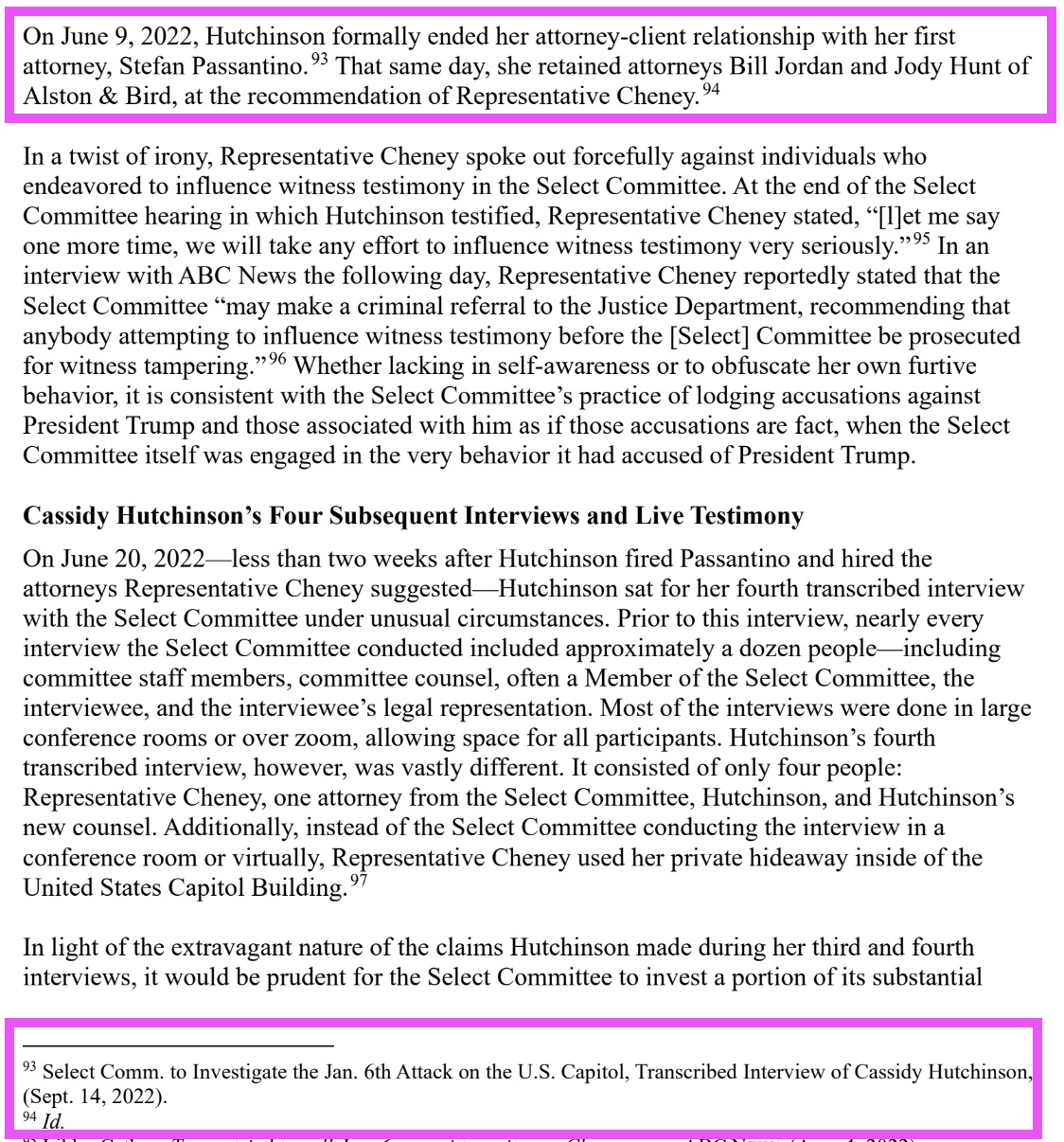
As you’ve no doubt heard, Congressman Barry Loudermilk released a report that, beneath what seems to be an appendix, refers Liz Cheney for investigation because she made sure that Cassidy Hutchinson had a lawyer who represented the former Mark Meadows aide’s interests when testifying before the Committee.

Loudermilk claims obtaining witness testimony for a proceeding amounts to obstructing it and also claims Cheney — and not those who provided testimony inconsistent with other sworn documents — suborned perjury.

Based on the evidence obtained by this Subcommittee, numerous federal laws were likely broken by Liz Cheney, the former Vice Chair of the January 6 Select Committee, and these violations should be investigated by the Federal Bureau of Investigation. Evidence uncovered by the Subcommittee revealed that former Congresswoman Liz Cheney tampered with at least one witness, Cassidy Hutchinson, by secretly communicating with Hutchinson without Hutchinson’s attorney’s knowledge. This secret communication with a witness is improper and likely violates 18 U.S.C. 1512. Such action is outside the due functioning of the legislative process and therefore not protected by the Speech and Debate clause.

The Federal Bureau of Investigation must also investigate Representative Cheney for violating 18 U.S.C. 1622, which prohibits any person from procuring another person to commit perjury. Based on the evidence obtained by this Subcommittee, Hutchinson committed perjury when she lied under oath to the Select Committee. Additionally, Hutchinson was interviewed by the FBI as part of its investigation into President Trump. This Subcommittee sought a copy of the FBI report 302, documenting this interview and Hutchinson’s statements, but the FBI has refused to produce this vital document. The FBI must immediately review the testimony given by Hutchinson in this interview to determine if she also lied in her FBI interview, and, if so, the role former Representative Cheney played in instigating Hutchinson to radically change her testimony.

Loudermilk’s tribute to Kash Patel’s leadership

Before Loudermilk delivers his welcome wagon for aspiring FBI Director Kash Patel, however, he provides solid evidence that Kash Patel is not fit to be FBI Director.

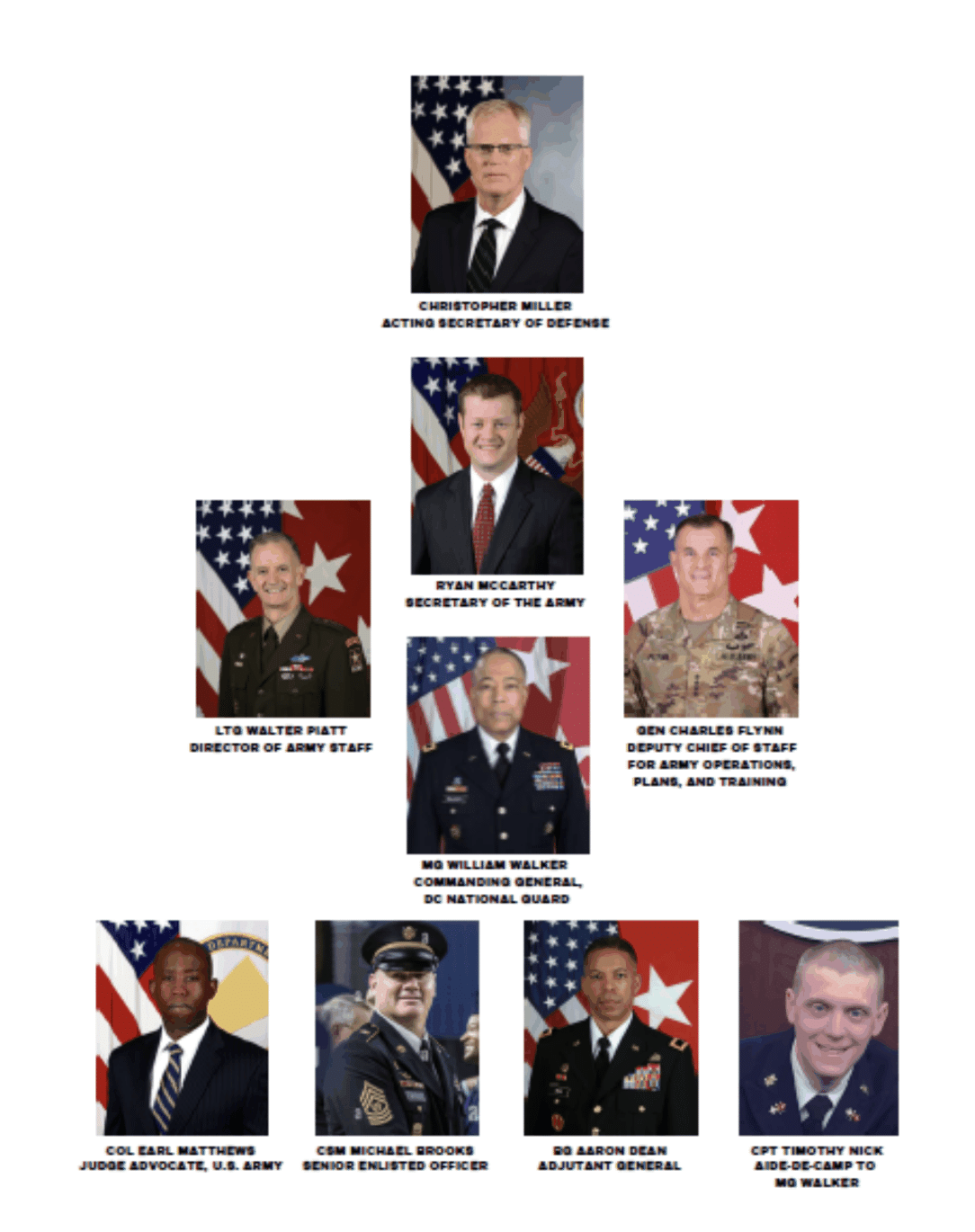
It turns out that the longest section of his report — 39 pages as compared to 36 for the Cassidy and Liz section — lays out how top DOD officials misrepresented their decisions regarding the National Guard leading up to and on January 6.

Just five pages of that pertain to Christopher Miller’s inaction on what Loudermilk treats as a legitimate request from Trump to have 10,000 National Guard in DC (Loudermilk doesn’t lay out the testimony from top Trump aides nixing that idea, based in part on a fear that Trump wanted an armed guard to accompany him to the Capitol).

But the rest has to do with delays created in deploying the Guard after the riot started. It has long been clear that DOD was blowing smoke about their claimed actions that day. On its face, this part of Loudermilk’s report is fair pushback to DOD’s past unpersuasive claims. He even sneaks some quasi-referrals — whether to aspiring FBI Director Kash Patel or aspiring Secretary of Defense Pete Hegseth, it’s not clear — for Miller and Ryan McCarthy into his report.

To date, no investigation or disciplinary action has taken place against Acting Secretary of
Defense Miller for his failure to follow directives from the sitting Commander-in-Chief on
January 3, 2021.

[snip]

To date, no investigation or disciplinary action has taken place against Secretary of the Army Ryan McCarthy for his failure to relay the Acting Secretary of Defense’s lawful deployment order at 3:04 PM on January 6, 2021.

[snip]

To date, no investigation or disciplinary action has taken place against Secretary of the Army Ryan McCarthy for deceiving congressional leadership with false statements regarding the delay in deployment of the D.C. National Guard to the U.S. Capitol on January 6, 2021.

The referrals are kind of interesting because McCarthy, at least, is on Kash’s dated and disorderly enemies list.

Mind you, if McCarthy was at fault for his January 6 response, it suggests there was something real to be at fault for. Maybe that’s why these referrals are snuck into the longest section of the report?

What’s most interesting, however, is Loudermilk’s picture of the DOD leadership that failed.

Someone — DOD’s then Acting Chief of Staff at the time — is missing.

Indeed, Kash’s name doesn’t show up anywhere in the 128-page report. Kash is a no-show even though, in the immediate wake of the insurrection, he had a great deal to say to Vanity Fair about his personal involvement in the two issues for which Loudermilk faults DOD.

On the evening of January 5—the night before a white supremacist mob stormed Capitol Hill in a siege that would leave five dead—the acting secretary of defense, Christopher Miller, was at the White House with his chief of staff, Kash Patel. They were meeting with President Trump on “an Iran issue,” Miller told me. But then the conversation switched gears. The president, Miller recalled, asked how many troops the Pentagon planned to turn out the following day. “We’re like, ‘We’re going to provide any National Guard support that the District requests,’” Miller responded. “And [Trump] goes, ‘You’re going to need 10,000 people.’ No, I’m not talking bullshit. He said that. And we’re like, ‘Maybe. But you know, someone’s going to have to ask for it.’” At that point Miller remembered the president telling him, “‘You do what you need to do. You do what you need to do.’ He said, ‘You’re going to need 10,000.’ That’s what he said. Swear to God.”

[snip]

On the morning of January 6, as Miller recounted, he was hopeful that the day would prove uneventful. But decades in special operations and intelligence had honed his senses. “It was the first day I brought an overnight bag to work. My wife was like, ‘What are you doing there?’ I’m like, ‘I don’t know when I’m going to be home.’” To hear Patel tell it, they were on autopilot for most of the day: “We had talked to [the president] in person the day before, on the phone the day before, and two days before that. We were given clear instructions. We had all our authorizations. We didn’t need to talk to the president. I was talking to [Trump’s chief of staff, Mark] Meadows, nonstop that day.”

[snip]

Miller and Patel both insisted, in separate conversations, that they neither tried nor needed to contact the president on January 6; they had already gotten approval to deploy forces. However, another senior defense official remembered things quite differently, “They couldn’t get through. They tried to call him”—meaning the president.The implication: Either Trump was shell-shocked, effectively abdicating his role as commander in chief, or he was deliberately stiff-arming some of his top officials because he was, in effect, siding with the insurrectionists and their cause of denying Biden’s victory.

As for Mike Pence, Miller disputed reports that the vice president was calling the shots or was the one who sent in the Guard. The SECDEF stated that he did speak with Pence—then in a secure location on the Hill—and provided a situation report. Referring to the Electoral College certification that had been paused when the mob stormed the building, Miller recalled Pence telling him, “We got to get this thing going again,” to which the defense secretary replied, “Roger. We’re moving.” Patel, for his part, said that those assembled in Miller’s office also spoke with congressional leaders Nancy Pelosi, Chuck Schumer, and Mitch McConnell. “We were called upon to do our job, and we executed because we had the reps and sets built into our process to get the troops where they were requested, to put up a fence, to secure a perimeter, and to help clear the Capitol compound. I mean, that’s just what we do.”

Some of what Kash said to Vanity Fair somewhat resembles Kash’s testimony to the January 6 Committee.

Although look forward to discussing these events in detail, I would like to make three things clear at the outset — excuse me — at the outset:

One, the actions the DOD took before January 6, 2021, to prepare for the planned protest in Washington, D.C., on January 5th and 6th, 2021, were appropriate, supported by requirements, consistent with the DOD’s roles and responsibilities, and compliant with laws, regulations, and other applicable guidance; two, the DOD’s actions to respond to the United States Capitol Police request for assistance on January 6th, 2021, were appropriate, supported by requirements, consistent with the DOD’s roles and responsibilities, and compliant with the laws, regulations, and other applicable guidance; and, three, DOD officials did not delay or obstruct the DOD’s response to the United States Capitol Police request for assistance on January 6th, 2021.

These are not just my words but, in fact, the findings of the DOD’s independent inspector general under President Biden’s administration. The IG’s November 16, 2021, report has marked has been marked as exhibit 3, I think.

But when January 6 Committee staffers asked the now-aspiring FBI Director about the Vanity Fair article itself he got … squirmy. His testimony to J6C was inconsistent with both what he told Vanity Fair and what Loudermilk lays out in his report.

A Oh, so you remember stuff like that. So, going off just the memory, and we can go back to the article when you bring it up, there was a meeting with the President of the United States, Acting Secretary Miller, and some others — I can’t recall off the top of my head where we were discussing, as the article states, something related to Iran.

And, in that same meeting, I believe it was on or around January 4th, 3rd, 4th, or 5th, the -as I stated earlier, in order for the Department of Defense’s National Guard to 11 be activated in any way we needed Presidential authorization. And President Trump at that

[Discussion off the record.]

Q sure. Go ahead.

A Okay. And so this question appears to implicate core executive privilege concems. I’m prepared to answer it, but I want the record to reflect my serious concerns about congressional overreaching of this matter.

So what I remember is that we knew, in order to get the National Guard even mobilized, we needed the President to at least say yes first. So what — my recollection of that meeting is the President preemptively authorized 10 to 20 National Guardsmen and-women around the country sorry? 10- to 20,000.

[snip]

Q Do you remember if the President mentioned anything that he may need these 19 troops to protect the Trump people?

A don’t recall him ever saying that.

Whichever Kash story you believe, however, both stories put Kash in the center of everything. Both stories claim he had the ability to directly affect all of the failures Loudermilk lays out (which might also explain why DOD’s story about January 6 is so unpersuasive).

If Kash was right there at the center of the story of DOD’s failures leading up to and on January 6, as told by Barry Loudermilk, then Loudermilk would have to include him, the aspiring FBI Director, among the referrals for investigation.

Perhaps that’s why Loudermilk instead just disappears the aspiring FBI Director: to avoid referring him to the aspiring FBI Director for accountability for his failures on that day?

How Barry Loudermilk covers up his own coverup

Which brings us to Loudermilk’s own coverup.

Loudermilk has been fluffing Trump’s non-response for some time as in this report, when he shows no interest in the Commander in Chief’s inaction that day.

Rather than dwelling on Trump’s demonstrable inaction, including in accelerating the Guard deployment, Loudermilk claims there was a witness present that day who would have heard if (as Hutchinson testified) Trump had cheered the taunts of “Hang Mike Pence,” rather than (as Jack Smith described) Nick Luna testifying that Trump simply said, “So what” when told Pence was evacuated.

Loudermilk puts great stock in this witness being better situated than Hutchinson to hear what Trump was saying.

This individual was within earshot of President Trump the entire time the President was in the President’s Dining Room. Additionally, in its investigation, the Subcommittee spoke with numerous individuals who worked closely with Meadows in the White House, and they confirmed that Meadows would not react apathetically to calls for violence, nor repeat an incident like the one alleged by Hutchinson so carelessly in a public space.

Only, this appears to be the area where Loudermilk was dealing with incomplete information. As Kyle Cheney first pointed out, Loudermilk released a redacted copy of what appears to be this person’s transcript.

But Jack Smith released an unredacted fragment of that transcript.

The transcript suggests Trump was far more entranced with the mob than Loudermilk wants to admit.

Loudermilk excuses his own gaps in knowledge by accusing Jack Smith of … collusion.

Chairman Loudermilk and the Subcommittee have uncovered evidence of collusion between the Special Counsel Jack Smith—the prosecutor appointed by Attorney General Merick Garland to conduct two separate criminal investigations into President Trump207—and either the White House or the Select Committee. On October 18, 2024, Special Counsel Smith released some of the documents used in his filing against President Trump.208

Among the released documents was an unredacted version of the transcript of a Select Committee interview with a certain White House employee. 209 Given that the Select Committee did not archive, or otherwise destroyed this transcript, and that the White House refused to provide an unredacted version to the Subcommittee, the only remaining explanation is that Special Counsel Smith received the unredacted version from one of the two institutions which did not cooperate fully with the Subcommittee.

207 Press Release, U.S. DEP’T OF JUST., Appointment of a Special Counsel (Nov. 18, 2022).

208 April Ruben, More docs unsealed in Jack Smith’s Jan. 6 case against Trump, AXIOS (Oct. 18, 2024).

209 Kyle Cheney (@kyledcheney), X (Oct. 18, 2024, 11:45 AM).

We may find out soon enough how Jack Smith got an unredacted transcript that Loudermilk did not get. But he’s wrong that they’re the same transcript. They’re paginated differently (what is page 38 on Loudermilk’s copy is page 30 on Smith’s). Which ought to be a hint to Loudermilk’s crack team: the transcript is sourced differently, which may prove that January 6 committee didn’t destroy evidence he accuses them of destroying.

Plus, the point remains: Loudermilk’s own excuses for Trump’s inaction look different in light of more fulsome evidence, which shows Trump was entranced by the riot as soon as he returned to his office.

Loudermilk’s sketchy evidence

As to Loudermilk’s referral of Liz Cheney to an aspiring FBI Director whom Loudermilk would have to refer as well if not for his utter silence about the aspiring FBI Director’s centrality to what Loudermilk describes as insubordination and misconduct?

I hope, for Loudermilk’s sake, that it is intentionally half-hearted, an effort to do what he knows Trump is demanding, to simply give the aspiring FBI Director an excuse to predicate an investigation into Liz Cheney (if not himself).

Because key parts of his argument don’t say what he claims they do.

For example, a footnote in Loudermilk’s report appears to claim that texts between Cassidy Hutchinson and Alyssa Farrah apparently dated May 2 (by context, this would be 2022) are instead from June 6 (2021, the footnote says; my annotations, but Loudermilk appears to have mixed up two sets of texts he has).

Even assuming the footnote meant June 6, 2022, not 2021, the difference matters, because as Loudermilk notes, Hutchinson appeared a third time before the committee represented by Stefan Passantino on May 17, 2022, so her continued satisfaction with Passantino on May 2, 2022 is inconsistent with Loudermilk’s story and consistent with Cheney’s.

Loudermilk makes much of the fact that Passantino was not disciplined after a complaint in which Hutchinson refused to cooperate. Except the source he relies on for that claim, this NYT story, describes (in addition to the fact that Hutchinson refused to cooperate) that Passantino was ordered to do training about written conflict disclosure to his clients.

In a Feb. 2 letter, the office said that while Ms. Hutchinson had consented to having Mr. Passantino’s fees paid by the political action committee aligned with Mr. Trump, putting the arrangement in writing is mandatory under Rule l. 5(b) of the District of Columbia Rules of Professional Conduct. It required him to take legal ethics training classes during a probation period.

But, citing Ms. Hutchinson’s unwillingness to talk to investigators, the office said there was insufficient evidence on the larger matter.

“Ms. Hutchinson made some allegations about your conduct to the committee, but she refused to cooperate in our investigation,” it said. “Accordingly, except for the Rule l. 5(b) allegation, which you admit, we are not proceeding on her other allegations at this time. We are unable to prove those allegations by clear and convincing evidence, as we must.”

Elsewhere, Loudermilk claims that Hutchinson’s own House testimony supports his claim that Hutchinson selected Alston & Bird “at the recommendation of Representative Cheney” (he doesn’t provide a page number). But that section of Hutchinson’s testimony doesn’t support his contention about Cheney’s role in it.

Which brings us to the biggest problem with all this. Loudermilk’s conspiracy theory that Liz Cheney went out and got Hutchinson a lawyer who would support a propaganda line that Committee was seeking gets very close to claiming that Hutchinson’s new legal team, including former top DOJ official Jody Hunt, was himself engaged in unethical conduct.

I would bet a good deal of money that if Hunt were ever asked if he acted ethically when he represented Hutchinson’s later appearances before the committee, he would say he did.

And even if everything Loudermilk claimed were true, even if Cheney were acting as a lawyer and not a Committee member, she’d still be guilty of no more than unethical — not illegal — conduct.

Especially when by focusing on Cheney but ignoring aspiring FBI Director Kash Patel, Loudermilk gives up the game.

This report does more to cover up what Loudermilk himself suggests is potential misconduct from aspiring FBI Director than it exposes real crimes by Liz Cheney.

And he provides this evidence of either incompetence or (Loudermilk claims) misconduct in the black hole where Kash Patel should be just in time for Kash’s confirmation hearings before the Senate.

Share this entry

If an Informant Narcs on a Riot But No FBI Agent Asks about It, Did It Really Happen?

Way at the back of the DOJ IG Report on January 6 showing that there were roughly 26 informants present at the attack, only three of whom had been tasked with telling their handlers what was going down, is the FBI response.

Here’s the signature block.

These are normally signed. For example, the report on subpoenas to Congress and journalists was signed by Brad Weinsheimer, the top career official at DOJ.

But on the day Chris Wray announced his upcoming departure, no one at FBI wanted to take responsibility for their response.

The response disputes a key finding of the Report: DOJ IG concludes (after a close review of emails that went out) that no one bothered to ask field offices if their informants knew anything about the event.

[T]he FBI did not take a step that could have helped the FBI and its law enforcement partners with their preparations in advance of January 6. Specifically, the FBI did not canvass its field offices in advance of January 6, 2021, to identify any intelligence, including CHS reporting, about potential threats to the January 6 Electoral Certification. Several FBI officials told the OIG that it is common practice for the FBI to ask field offices to canvass their sources for information—in advance of a large event, such as the Inauguration, the Super Bowl, or other events with significant attendance and to report that information to the requesting field office, which, in this instance, would have been the WFO. FBI Deputy Director Paul Abbate, who was Associate Deputy Director at the time, described the lack of a canvass prior to January 6 as a “basic step that was missed,”

The FBI, however, says,

[T]he FBI continues to disagree with certain of the factual assertions in the Report regarding the manner of specific steps, and the scope of the canvas undertaken by the FBI in advance of January 6, 2021, a time period during which the Report recognizes as including multiple field offices providing information in response to direction from Washington Field Office and FBI Headquarters.

Among the things that an FBI informant knew but — not having been asked by his or her handler — did not report until after the riot? That the informant reported on the meeting between Stewart Rhodes and Enrique Tarrio in a parking garage.

During the course of the FBI’s January 6 investigation, the FBI learned that on the night of January 5 the CHS was in contact with Tarrio and reported on a meeting with Tarrio and Rhodes, which became a subject matter of the Tarrio prosecution

An earlier report from this informant, claiming 100 Proud Boys would make the trip and they were beginning to get cranky, did get filed in DC on January 4. But not the detail that Stewie and Enrique were in cahoots — a meeting that remains unexplained to this day, a piece of intelligence that might have led to a different approach to policing the militias or the Trump associates they had in common, people like Roger Stone and Alex Jones.

The FBI also didn’t share another informant’s tips about Rhodes’ plans to travel to DC for January 6.

On December 15, the Field Office 1 CHS reported to the Field Office 1 Handling Special Agent and the Field Office 1 RA 1 Special Agent that Rhodes intended to travel to DC for the events of January 6. This was the first time the Field Office 4 CHS provided reporting that specifically referenced January 6. According to the FD-1023 documenting this contact, the Field Office 1 CHS reported that Rhodes had been “trying to attract Oath Keepers who are current law enforcement members to travel for events on that day so they can carry concealed firearms legally.” In addition, the FD-1023 stated, “Rhodes has made recent public statements suggesting Oath Keepers and the militia can be called up on [sic] to assist the current president to stay in office and resist perceived deep state enemies.” The Field Office 1 CHS reported that the CHS “[doesn’t know of] specific plans by Rhodes or any of his associates to instigate any acts of violence,” but was “very concerned that extremist members of Oath Keepers or other groups may become involved in unplanned violent activity on January 6.

This information, including that Rhodes was planning to travel to DC for January 6, was recorded in Field Office 1 case files on December 22 but was not emailed or otherwise provided to WFO. The Field Office 1 handling agent told the OIG that the Field Office 1 RA 1 Special Agent, as the assessment’s case agent, took the lead in communicating with WFO and that she may have sat in on conference calls with WFO, but she did not initiate any contact with WFO.

[snip]

The Field Office 1 RA 1 Special Agent told the OIG that even though this source reporting was properly documented and was not “dynamic” information, “this was one where I kick myself every day” for not emailing a copy of the reporting to WFO and DTOS. The Field Office 1 RA 1 Special Agent said that given that Rhodes had been present for the MAGA I and MAGA II election protests and was so visible about his objections to the election results, and given Field Office 1’s many communications with DTOS and WFO about Rhodes, he would have expected DTOS and WFO to be made aware that Rhodes was planning to be in DC on January 6.

We determined that the last reporting from the Field Office 1 CHS before January 6 was on January 4 when the Field Office 1 CHS told the Field Office 1 handling agent that the Oath Keepers “contingent headed to DC is 200+ strong.” The FD-1023 includes the statement that the “CHS did not have anything more detailed to provide.” This reporting also was not provided to WFO or filed in any WFO case file. The Field Office 1 CHS did not travel to DC for the events of January 6.

The report is, nevertheless, unbelievably soft on the FBI, which built and sustained a phone dragnet for fourteen years after 9/11 because the FBI missed one phone call involving Osama bin Laden. Here, FBI’s informants gave it multiple warnings about plans men since convicted of sedition had on January 6. And a number of those warnings weren’t shared.

Instead of hammering the FBI for missing such leads from its informants, the report concluded that the FBI didn’t miss anything “critical” by failing to call on its extensive informant network to find out what they knew.

Although WFO and DTOS did not direct field offices to canvass their CHSs in advance of January 6, our review of documented CHS reporting in FBI field offices as of January 6 did not identify any potentially critical intelligence related to a possible attack on the Capitol on January 6 that had not been provided to law enforcement stakeholders prior to January 6. For example, the FBI had received CHS reporting about online threats to the Electoral Certification that included maps of the Congressional tunnels. WFO distributed this intelligence through the established January 6 coordination mechanisms. Moreover, we found that the USCP, the MPD, the USPP, DHS, and the Supreme Court Police all learned about similar intelligence in advance of January 6 through their own intelligence gathering mechanisms and other established coordination efforts. 95 Additionally, our review of information in the FBI’s possession as of January 6, in addition to the then-documented CHS reporting, did not identify any potentially critical intelligence that had not been provided to, or was not otherwise known to, law enforcement stakeholders prior to January 6. We also took note of the fact that the extensive previous oversight (by Congress, the GAO, and other Inspectors General) of the events of January 6, including preparation by law enforcement in advance of January 6, did not identify potentially critical intelligence that was not shared by the FBI in advance of January 6. [my emphasis]

This applies a wildly different standard for white seditionists than it did, for decades, for Muslim men.

And yet, having been treated with an incredibly lax standard, the FBI still refuses to own up to their January 6 failures.

Share this entry

The Zombie Case against Trump’s Indicted Co-Conspirators

Jack Smith signed the motion to dismiss the January 6 case against Trump, but his appellate lawyer, James Pearce, (digitally) signed the parallel request before the 11th Circuit.

Who knows whether that means anything.

But now that Smith has committed to sustaining the appeal of Judge Aileen Cannon’s decision as it applies to Walt Nauta and Carlos De Oliveira, someone needs to take over the case and write the reply, which is due on December 2. Pearce has done the primary work for all Jack Smith’s appeals and so could do so here — or, perhaps Jack Smith will close up shop, along with Pearce, and let Solicitor General Elizabeth Prelogar take over before she’s replaced by John Sauer in January.

One way or another, there’s likely to be a transfer of the Zombie case back to DOJ, where it will be suffocated with pillows never to be heard from again.

The decision to sustain the Nauta and De Oliveira case just long enough for Trump to shut down next year has certain ramifications I only touched in passing in this discussion with Harry Litman about what we might get in a report from Jack Smith, which is probably more accessible than this post about what declination decisions we might see (transcript here).

First, they’ve got due process rights. Meaning, you can’t say anything in a report that might endanger their ability to get a fair trial (a trial they’ll never face, of course). That may lead to redactions of the sort we saw in the original Mueller Report but which were re-released under FOIA. Or it may lead prosecutors to gloss certain things — such as the obstruction — in the report. In the chat with Litman, I noted that ABC reported that Walt Nauta and Trump went back to Mar-a-Lago after hiding documents from the FBI, which might make the report. But if it appears in there, it would need to be presented in such a way to protect Nauta’s due process rights.

It’s possible, even, that until the appeal, DOJ would avoid describing the investigative steps taken in the documents case after Smith was appointed in November 2022. The logic of Cannon’s opinion basically wiped out all that investigative work. Poof. Though it’s possible that Julie Edelstein and David Raskin — who left Smith’s team in October — have done something to recreate some of the work, such as the declassification that had happened in advance of an imagined Florida trial.

Meanwhile, sustaining the case against Nauta and De Oliveira creates an interesting dilemma for DOJ that may have repercussions for others and Trump’s DOJ going forward: how to get rid of the appeal. He would pay least political capital by just dismissing the appeal. But that would reflect a DOJ stance that Jack Smith was unconstitutionally appointed — something that might bind DOJ going forward (as if Pam Bondi won’t just pick Trumpy US Attorneys to do her dirty work like Bill Barr did) — though that may be unavoidable if Trump’s Solicitor General and Deputy Attorney General had both argued that Smith was unconstitutionally appointed, as they have.

But that would go some way to arguing that David Weiss’ appointment as Special Counsel is unconstitutional as well. It might give Hunter Biden, if his father doesn’t pardon him (and Alexander Smirnov, if he is convicted next month and not pardoned) cause to enjoin Weiss’ prosecutors from publishing a report; it would also make Hunter’s appeal of his charges far easier, especially in Los Angeles, where Weiss is not the confirmed US Attorney.

Which may be why (as both Litman and I suggested) Trump might want to pardon Hunter — to give the air of magnanimity to unintended consequences of his efforts to kill the case against him. To say nothing of the transparency into Trump’s first term that Hunter might get if he succeeds with his other appeals.

The case against Nauta and De Oliveira will be dead, one way or another, in two months. But until then, it’ll exist as a Zombie, having potentially unanticipated consequences.

Update: The full Jack Smith team has submitted its reply brief.

Share this entry