Today was a big day in New Jersey. It was the day that both Congresswoman LaMonica McIver and DOJ had to submit supplemental fillings in McIver’s case about whether the second of three charges against her fit entirely within her duties of oversight as a Congressperson.
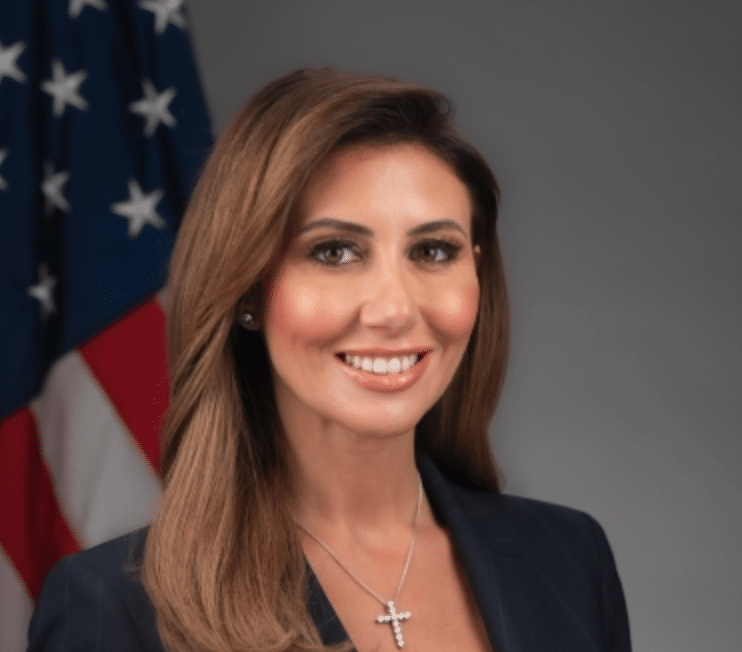
It was also the day after Alina Habba finally gave up play-acting as US Attorney in the wake of the Third Circuit ruling that such play-acting was unlawful, something that sane-washing journalists inaccurately called a resignation.
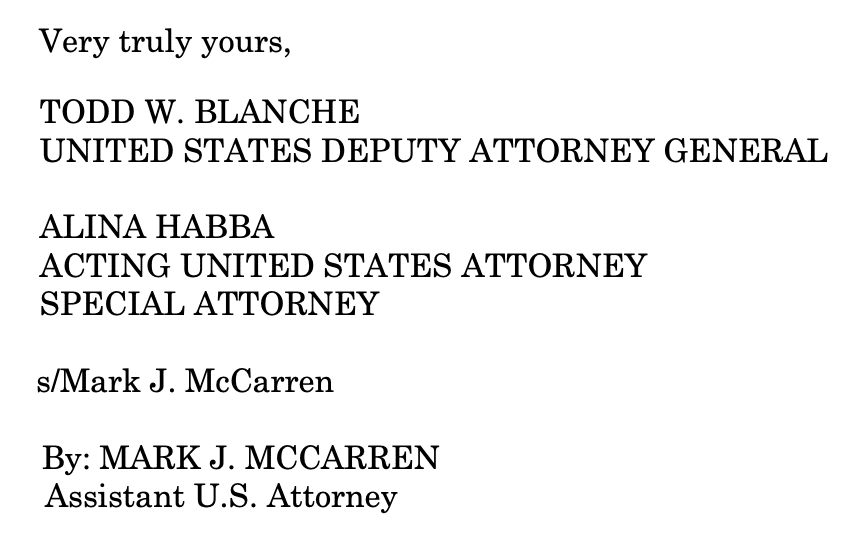
Indeed, the most interesting thing about the government’s response was that it was signed by the guy, Phillip Lamparello, Pam Bondi installed to oversee criminal matters as part of her contemptuous refusal to permit a US Attorney be appointed in a legal manner (which may be why Todd Blanche remains on these filings, because this is still bullshit).
Otherwise, that motion complained that, “the Defendant had not included among her exhibits the video footage that most clearly depicted the events described in Count Two.” It argued that physical contact initiated by ICE was just a continuation of what happened outside the gate.
The Defendant’s actions as alleged in Count Two were simply the continuation of her actions in Count One, albeit with a different individual being subject to her ongoing efforts to interfere with the Mayor’s arrest.
And it argued that when ICE assaults members of Congress it still must be treated as an assault on ICE unprotected by Speech and Debate.
The Government respectfully asserts that any assault upon a federal officer should qualify as an act that is “clearly non-legislative” given that such an act is clearly an “illegitimate activity.” And it would be clearly non-legislative whether the arrest that triggered the assault took place outside the Security Gate or inside of Delaney Hall.
2. Exhibit X is a true and correct copy of a signal chat produced by the U.S. Attorney’s Office as part of a folder titled USA-000353, including participants from DHS and HSI. This exhibit will be filed under seal pursuant to a protective order signed by the parties and entered by the Court. See ECF No. 38.
3. Exhibit Y is a true and correct copy of a signal chat produced by the U.S. Attorney’s Office as part of a folder titled USA-000334, including participants from HSI. This exhibit will be filed under seal pursuant to a protective order signed by the parties and entered by the Court. See ECF No. 38.
Most of McIver’s filing conducts a second-by-second analysis of the video, showing that when she got back inside the gate she immediately headed towards the facility and not to where Mayor Baraka was being arrested without probable cause.
But a footnote describes one of the things in those Signal chats (another appears to have been notice that McIver and her colleagues said they were there to conduct oversight).
It wasn’t until November 26 — almost two weeks after Judge Jamel Semper ruled on McIver’s immunity bid — that DOJ turned over texts copying this video, observing that it looked bad.
5 The Spotlight News video came to light during the course of supplemental briefing only because it was referenced in a May 9, 2025, text message that the government finally turned over on November 26, 2025. HSI special agents exchanged the video in that May 9 conversation, where the agents also acknowledged that the evidence in the video was “bad.” Ex. Y at 2-3. The prosecution team therefore clearly knew about the text messages (and thus the video) when disclosures were due in July.
McIver’s lawyer, Paul Fishman, says he will address this delayed discovery in a follow-up letter.
Inexplicable delays in the government’s discovery productions mean that the record continues to be developed.1
1 Congresswoman McIver will detail these shortcomings in a forthcoming letter to the Court.
But the implication of this is clear.
DOJ was never going to turn over these discussions — conducted on Signal — until Judge Semper ordered this supplemental briefing. They were sitting on evidence that shows that before DHS first started calling McIver’s actions an assault on May 10 (McIver had to ask to have these Tweets taken down, but the timeline is in her motion to do so), they had shared video noting that their own actions looked bad.
Over and over this year, DHS has assaulted opponents of ICE and then charged them for it. And these Signal texts sure seem to support that they knowingly did the same thing with Congresswoman McIver.
And then buried it in a discovery violation.
Update: At the status hearing pertaining to these filings, which was on November 17. McIver’s attorneys complained they were getting screen shots of Signal texts collected by Agents rather than texts with actual metadata from the posts.
Your Honor, I will just tee up that we have, you know, that there is certainly going to be an issue with respect to the government’s messages. We have received a partial production of the messages. I believe it is 54. And, you know, we are going to be, you know, we are preparing a letter to send to Your Honor. We have had some dialogue —
THE COURT: The text messages between the agents on the day in question?
MR. CORTES: That is correct, Your Honor. We have gotten 54 of them. They are a mish-mash of things of what appear to be Signal chats. Some of which seem like text messages. We have gotten a few emails.
But the broader issue I think, Your Honor, and just to preview it, obviously, I will put this in writing because I don’t — I want Your Honor to have the complete take, and, obviously, the government is going to have responses; but just as an overview, Judge, the messages that we have gotten, appear to be messages that the agents themselves searched for on their devices, applying search terms that the government tells us that they supplied to the agents, but they would not share with us the entirety of what those search terms were.
And then the agents took their devices and took photographs, screen shots of the messages that were responsive to the search terms that they applied. And then provided that to the government. And the government provided us a selection of those screen shots.
This led the AUSA to ask Judge Semper to provide clear guidelines of what they should be turning over, which led to this colloquy.
MR. CORTES: That I — One, the government, that the prosecutor, the A.U.S.A. should be the one conducting this search, applying the search term, applying, you know, conducting the review. Right? They should be the ones conducting the review.
THE COURT: Yes.
MR. CORTES: The other thing I would add is, if there is material before and after the visit that is dealing with how to deal with the members of the congress that are showing up or in the wake of the experience that is, that is, right, that is material, that deals with it, that deals with reactions, all of that as well.
THE COURT: Then I think we are in search term land.
MR. CORTES: Sure.
THE COURT: But for this period of time 12 and 5, Ijust think we are in, you know, what do the videos show, what do the text messages show land. And if there is something beyond that that you see, counsel, you are an officer of the court, I respect whatever representation you put before me.
You can do your search terms on the other areas outside of the block that I’ve mentioned. If there are things that relate to the congressional delegation and the visit, procedures that would occur, obviously, I’m very focused on 527, so anything that relates to that, would be fair game.
But for right now, let’s just do it quick and dirty; 12 to 5. And then anything that floats from that, that you think needs individualized assessment, come to me. I’m here
So one explanation for the late disclosure of these messages are that the Agents were withholding them in their own searches.
https://www.emptywheel.net/wp-content/uploads/2025/12/Screenshot-2025-12-10-at-00.11.28.png6581186emptywheelhttps://www.emptywheel.net/wp-content/uploads/2016/07/Logo-Web.pngemptywheel2025-12-09 19:34:272025-12-10 06:54:17DOJ Withheld Proof They Knew Their Assault of LaMonica McIver Was “Bad” before They Charged Her
In the first appellate court decision on Donald Trump’s persistent effort to put Insurance Lawyers, Election Deniers, and other sundry actors play-acting as US Attorneys, the Third Circuit has unanimously ruled that Alina Habba really is nothing more than a Parking Garage lawyer.
Habba is not the Acting U.S. Attorney for the District of New Jersey by virtue of her appointment as First Assistant U.S. Attorney because only the first assistant in place at the time the vacancy arises automatically assumes the functions and duties of the office under the FVRA. Additionally, because Habba was nominated for the vacant U.S. Attorney position, the FVRA’s nomination bar prevents her from assuming the role of Acting U.S. Attorney. Finally, the Attorney General’s delegation of all the powers of a U.S. Attorney to Habba is prohibited by the FVRA’s exclusivity provision. Therefore, we will affirm the District Court’s disqualification order.
Abbe Lowell, who represents Letitia James in EDVA, argued this case before the court.
The Third Circuit ruling comes even as the Eleventh Circuit ruled that Alina the Parking Garage lawyer is not only just a Parking Garage lawyer, but a frivolous one at that, sustaining the $1 million in fees on her and her liege Donald Trump.
https://www.emptywheel.net/wp-content/uploads/2025/12/Screenshot-2025-12-01-at-3.54.21-PM.png652742emptywheelhttps://www.emptywheel.net/wp-content/uploads/2016/07/Logo-Web.pngemptywheel2025-12-01 10:56:102025-12-02 18:27:38Alina Habba: A Parking Garage Lawyer with $1 Million in Sanction Penalties
For months, I’ve been anticipating the possibility that Trump’s politicized prosecutions will backfire, both by empowering the political martyrs they create and by exposing their own corruption.
I’m interested in this for two reasons: first, the possibility that these prosecutions will backfire, not just by creating sympathetic political martyrs, but also by further exposing Bondi and her top aides as liars violating legal ethics.
A package of filings from Congresswoman LaMonica McIver submitted last night suggests that may soon happen.
A motion to require DHS to withdraw false prejudicial claims about McIver
Two crucial details lie behind all of them.
First, according to Body Cam footage provided in discovery (and available to Judge Jamel Semper), after Newark Mayor Ras Baraka left the Delaney Hall facility in response to Ricky Patel’s order to do so, the Deputy Attorney General of the United States instructed Patel (listed as V-1 in all the filings) to arrest the Mayor.
Allegation: After the Mayor complied with HSI’s instructions to “leave the secured area,” agents placed him under arrest “in the unsecured area.” Indictment at 2-3.
Evidence: After a phone call, [Ricky Patel] announced a decision to arrest Mayor Baraka: “I am arresting the mayor . . . even though he stepped out, I am going to put him in cuffs . . . per the Deputy Attorney General of the United States.” Ex. B at 1:16:27-1:17:35. Meanwhile, the Members— who were still being prevented from entering the facility—returned to the entrance gate where they learned that the agents were changing course and renewing their plan to arrest the Mayor on baseless charges. Ex. A at 1:26:40-1:26:50; Ex. H, JR Axon Body Camera Arrest.mp4, at 00:30-00:40.
Start with the immunity filing. After laying out her election last year (which she notes was a landslide, so let’s hope Trump sees this), McIver describes how starting on her third day in office, she prioritized oversight of immigration matters, with a town hall, a visit to a different detention facility, a letter to Kristi Noem, and a meeting with ICE. She then describes how the video produced in discovery captured her (and Rob Menendez — whose father’s earlier prosecution is the standard for Speech and Debate immunity in the Third Circuit — and Bonnie Watson Coleman) repeatedly describing their visit as congressional oversight.
Body Cam video captured them identifying theirs as a congressional oversight visit when they entered the facility. (This declaration describes the source of each video.)
Allegation: Count One alleges that on May 9, 2025, Congresswoman McIver and her congressional delegation “arrived at Delaney Hall allegedly to conduct a congressional oversight inspection.” Indictment at 1.
Evidence: Representatives McIver, Watson Coleman, and Menendez identified themselves as Members of Congress, explained they were there to conduct congressionally authorized oversight, and asserted their “right to look at the facility” and inspect its “safety, health, [and] services.” See Ex. B, CD Axon Body Camera Pre and Arrest.mp4, at 1:34-2:08.
Other video captured them questioning GEO employees as part of that oversight, while they were made to wait for an hour.
Allegation: The congressional delegation “entered the secured area and proceeded to an interior reception area.” Indictment at 2.
Evidence: The Members were told to remain in that small space for about an hour, during which they were denied access to the facility despite their repeated assertions of statutory authority. Nevertheless, the Members spent that hour pursuing their oversight mission, in part by questioning employees about the facility and its operations. During this time, unbeknownst to the Members, ICE was mobilizing its forces: high-level officials of ICE and Homeland Security Investigations (“HSI”) reported to the facility; munitions-filled vehicles took formation in its secured parking lot, and approximately 15 armed agents assembled just inside the gates. Ex. B at 6:40-13:30, 16:30-17:23, 20:09-35:14; Ex. A, NEPTZ.avi, at 23:00-23:15, 29:40-29:50, 40:50-41:05; Ex C, Axon_Body_4_Video_2025-05- 09_1418_D01AA954X.mp4, at 00:30-00:44; Ex D, Axon_Body_4_Video_2025-05- 09_1418_D01AA942W.mp4, at 00:37
More video captured McIver citing the law permitting members of Congress to conduct such oversight as ICE started its attack on Baraka.
Allegation: The “Congressional Delegation overheard this conversation and [] protest[ed].” Indictment at 3.
Evidence: Arriving by the Mayor’s side, Congresswomen McIver and Watson Coleman reprimanded the agents for “creating a problem” that did not exist. Congresswoman McIver reiterated that the agents had kept them waiting for “over an hour,” in blatant violation of federal law, and repeated, “We are here to do our oversight visit.” Congressman Menendez summed up the absurdity of the situation the agents had created: “You have an unarmed Mayor of the largest city in the state, and you have two dozen people out here and cars barricading us? This is an act of intimidation and you know it.” Ex. F at 4:32-5:58.
More video describes Patel — one of the purported victims — conceding the legality of the presence of the Members of Congress.
Allegation: An HSI agent, identified in the indictment as “V-1,” explained that “members of Congress had lawful authority to be in the secured area of Delaney Hall, but that” the Mayor “did not.” Indictment at 3.
Evidence: Although the indictment otherwise ignores the oversight context, V-1 verified the Members’ lawful authority, explaining, “congressmen are different, congresswomen are different.” Ex. F at 7:04-7:12.
Video captured the members identifying themselves as such when the melee ensued.
Allegation: As agents moved in to arrest the Mayor, Congresswoman McIver “hurried outside towards the agents” as someone “yelled ‘circle the mayor.’” Indictment at 3. Congresswoman McIver then “placed her arms around” the Mayor. Id.
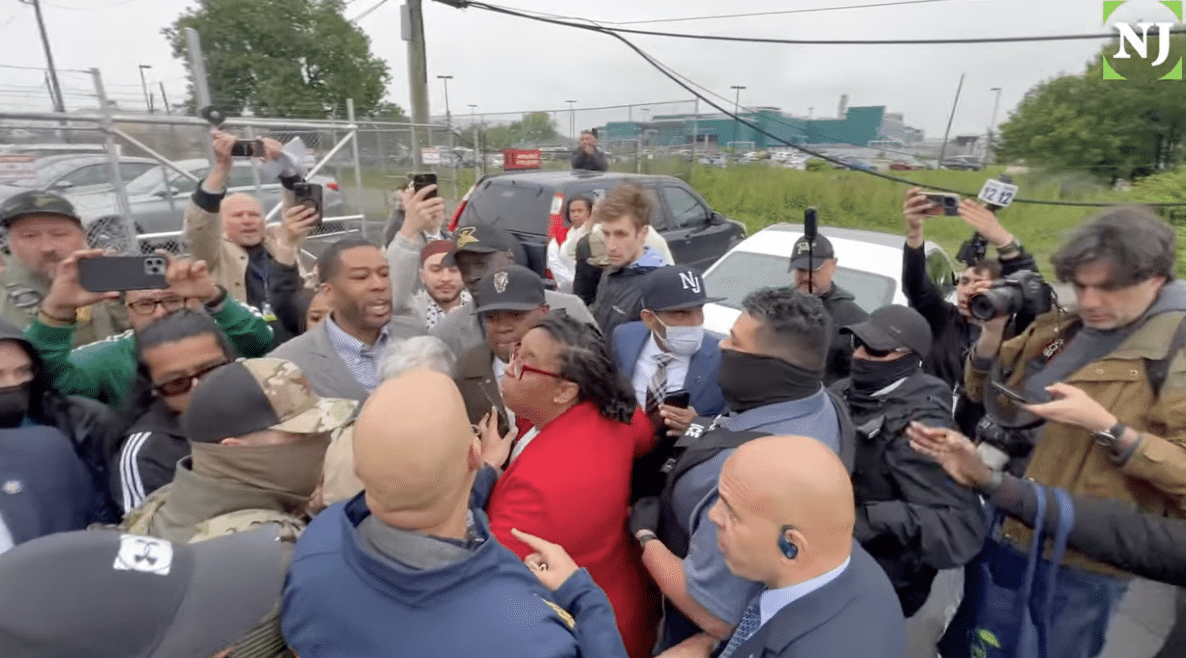
Evidence: ICE agents, heavily armed and most of them masked, rushed out of the gate to arrest the Mayor where he was on public property surrounded by reporters, his staff, and members of the public. The Members walked through the gate at approximately the same time. Ex. A at 1:26:50-1:26:56. As a crush of over a dozen agents descended on the Mayor, a man called out to “circle the Mayor,” and the Members coalesced around him, holding one another’s arms to remain upright in the crowd. Ex. A at 1:26:50-1:27:08; Ex. I, AG Axon Body Camera Arrest.mp4, at 00:47-00:55. Agents and protestors alike pushed toward the Members, destabilizing the group. The Members repeatedly asserted their federal status and instructed the agents not to touch them. Ex. I at 1:00-1:20. Agents nevertheless pressed in on the Members as the crowd formed more tightly around them.
McIver has mapped this all onto the indictment to prove that to defend the case, McIver would have to submit her actions as a Member of Congress to the jury for scrutiny.
McIver then goes on to argue that she is therefore immune under both Speech and Debate and — citing Trump v. US — separation of powers.
The separation of powers accordingly confers an immunity on the official acts of legislators symmetrical with the immunity for the President’s official acts. The Speech or Debate Clause confers immunity on legislative acts, which represent legislators’ “core constitutional powers,” and are thus absolutely immune. Trump, 603 U.S. at 606. The separation of powers extends further, making clear that legislative immunity also covers official acts, which represent “the outer perimeter of [the legislator’s] official responsibility.” Id. at 596. But that broader scope comes with a caveat: these acts are only presumptively immune. Id. at 614. Immunity for this wider class of official conduct may be rebutted when “the Government can show that applying a criminal prohibition to that act would pose no dangers of intrusion on the authority and functions of the” Legislative Branch. See Trump, 603 U.S. at 615 (cleaned up).17 The prosecution cannot do so here.
Motion to Compel
Virtually all of that narrative comes from Body Cam video provided in discovery. There’s one important exception: where an ICE agent shoved McIver so hard that she immediately said she was going to file a complaint.
Allegation: Count Two alleges that “[f]ollowing the arrest of” the Mayor, Congresswoman McIver “pushed past” another agent “using each of her forearms to forcibly strike” the agent “as she returned inside of the secured area of Delaney Hall.” Indictment at 5.
Evidence: After a few short moments, the Mayor made his way to V-1 to submit to arrest, and was promptly dragged back into the secured area and handcuffed. Congresswoman McIver followed, and an agent forcefully shoved her backward before she could reenter the secured area. NJ Spotlight News (@NJSpotlightNews), X (May 9, 2025 15:29 ET), https://x.com/NJSpotlightNews/status/1920926649777852742. Indeed, the agent’s use of force against Congresswoman McIver as she was reentering the facility was so egregious that—unlike the officers responding to the Congresswoman’s actions—she immediately informed an ICE official that she intended to file a complaint. Ex. I at 3:30-3:43. Congressman Menendez reentered with Congresswoman McIver, and Congresswoman Watson Coleman was escorted back through the gates with the help of agents. After the turmoil subsided, the Members were permitted to enter the building and complete their inspection.
That is one of the reasons she filed a motion to compel. She didn’t get Body Cam footage from at least two key ICE officers: the second guy she allegedly assaulted, and the guy who shoved her.
Second, there were as many as 15 uniformed law enforcement officers or agents with BWCs on site; several, however, apparently made no recordings. The lack of videos from those who were wearing BWCs appears to be inconsistent with applicable ICE policy and instructions at the scene from a supervisory agent. Indeed, at least two critical individuals have no BWC footage: the law enforcement agent identified in the Indictment as V-2, who is the alleged victim in Count 2; and another agent who appeared to violently shove Congresswoman McIver in the chest as she attempted to return inside the Delaney Hall gate. A government agent’s deliberate failure to activate a BWC contrary to policy and instructions clearly is relevant to the preparation of the defense. In addition, there were other agents who had no BWC at all.
In the guise of proving the full context of her visit that day, McIver has also asked for other video from the facility (which might provide more proof of the calls to people like Todd Blanche or might explain why a bunch of ICE vehicles arrived while the members of Congress were waiting).
To that end, the defense’s discovery letter requested that the government provide “all interior and exterior surveillance footage of any events on May 9, beginning at least 10 minutes before Congresswoman McIver’s arrival at Delaney Hall through at least 4:00 p.m., which is after she departed the facility’s secured perimeter.” Ex. K, Req. I.A. The government’s response was inconsistent. On one hand, the government indicated that it would attempt to locate and produce “footage of the Representatives’ tour of the Delaney Hall facility after the arrest of Mayor Baraka had taken place,” though it disclaimed the relevance of such footage. On the other hand, the government claimed that it received these two surveillance videos from GEO Group (the private company that ICE has retained to operate Delaney Hall). However, the government claims that other GEO Group materials are not in the government’s possession and suggests that the government has no other surveillance videos from stationary or fixed cameras. The government did not otherwise respond to Congresswoman McIver’s request for more complete surveillance videos, apparently taking the position that this material is not relevant. Ex. M at 1 (“To the extent this letter does not provide the requested materials, it is the position of the Government that those materials do not fall within the ambit of Rule 16”).
She’s also seeking the communications of everyone present pertaining to whether they were assaulted or not.
Although Congresswoman McIver may seek further relief from the Court to require production of those communications as this case progresses, the Court should at least order the government to disclose now:
VII.A. All contemporaneous text, voice, instant, chat or email messages – sent via either Telegram, Signal, or any other communications method, application, or medium – to, from, between, or among anyone present at Delaney Hall on May 9, 2025 and anyone else affiliated or associated with the GEO Group, DOJ, the U.S. Attorney’s Office, ICE, HSI, or DHS describing, reflecting, or implying that any government employee present on May 9 at Delaney Hall did not experience or report harm, injury, danger, or fear as a result of Congresswoman McIver’s actions.
VII.B. All written, verbal, or other reports or statements – whether or not memorialized – by any government official, individual affiliated with GEO, member of the public, or anyone else that is inconsistent with the charge that Congresswoman McIver knowingly, intentionally, or forcibly assaulted, resisted, opposed, impeded, intimidated, or interfered with federal officials on May 9.
These requests concern statements that show a lack of harm, injury, or fear by the alleged victims of the Congresswoman’s charged conduct.
Again, there’s a very sound reason to demand these communications based on the charges. But the video and the communications might also explain the involvement of Todd Blanche, Alina Habba, and Kristi Noem.
Selective Prosecution
Which brings us to the selective prosecution filing. As I said a million times when covering Hunter Biden’s selective prosecution bid (which I think might have survived if he had had money to appeal), these are almost impossible to win because you have to prove that someone similarly situated was not charged.
But McIver does that one better. She compares how DOJ dismissed all the January 6 assaults, even while charging her.
Just months ago, the Department of Justice dismissed cases against hundreds of defendants involved in the January 6, 2021, attack on the U.S. Capitol. Among these dismissals were over 160 prosecutions charging the defendants with violations of 18 U.S.C. § 111 stemming from their assault of federal law enforcement officials who were protecting the Capitol and the Members of Congress and their staff. Video footage showed these defendants throwing explosives, beating federal officers with baseball bats and riot shields, and spraying them with pepper spray, all in an effort to overturn the 2020 presidential election. The Justice Department not only walked away from those charges, but it has since fired career prosecutors, agents, and support staff for their mere participation in the investigations and prosecutions. This case charges Congresswoman LaMonica McIver, a sitting Democratic Member of Congress, with violating the same federal assault statute. But the similarity ends there. As the government concedes in the indictment, Congresswoman McIver was exercising her statutory and constitutional oversight responsibilities when she visited Delaney Hall—a privately run immigration detention facility that Immigration and Customs Enforcement (ICE) recently reopened in her District. Unlike the January 6 rioters, Congresswoman McIver had every right to be on those premises. Indeed, she was there to do her job.
There is also a palpable difference between the actions of those at the Capitol on January 6 and Congresswoman McIver’s conduct. Footage that the government has provided in discovery shows that federal officials made a series of manipulative, irresponsible, and dangerous decisions that placed dozens of bystanders, as well as three Members of Congress, at risk of physical harm. In fact, the video recorded almost two dozen armed agents and officers of ICE and Homeland Security Investigations (HSI) surging into a crowd in a public space to arrest the Mayor of Newark for supposedly trespassing on federal land. The government, of course, has since dismissed that ill-conceived and unfounded charge against the Mayor. But during that episode, it was those heavily armed law enforcement personnel who precipitated and were responsible for creating several minutes of physical chaos. In the end, as the indictment implicitly concedes, no federal agent experienced any injury whatsoever.
In that respect, too, January 6 was entirely different. That day, outnumbered Capitol Police officers stood their ground against hundreds—if not thousands—of rioters who were trying to overrun the Capitol to intimidate the legislators inside in hopes of overriding a national election. A substantial number of those brave officers were seriously injured. Yet, the Department of Justice has dropped the charges against over 160 individuals accused of that conduct.
Later in the filing, McIver cites three particularly egregious cases that were still pending when DOJ dismissed all these cases: Daniel Ball, Tim Boughner, and Jake Lang, all of whom were detained pretrial until Trump made their charges go away.
What, McIver ponders, led to the starkly different prosecutorial decisions? Well, there’s proof, in the form of a letter then Acting Deputy Attorney General and now Third Circuit Judge who might preside over any appeal, Emil Bove, sent ordering the firing of a bunch of FBI Agents who had been involved in January 6 investigations.
What explains the government’s insistence on prosecuting Congresswoman McIver, but not rioters charged with serious violence under the same statute? Senior federal officials have made ample public statements that point inexorably to the answer. In particular, the leadership of the Department of Justice, echoing the President’s official proclamation, has described the January 6 prosecutions as “a grave national injustice.”1
1 Mem. from Acting Dep. Att’y Gen. Emil Bove to Acting Dir., FBI (Jan. 31, 2025) (quoting Proc. No. 10887, 90 Fed. Reg. 8331, 8331 (Jan. 20, 2025)), https://perma.cc/C5NB-KV3V.
A press release accusing the Members of Congress of breaking into the Delaney Hall.
A Tweet disseminating a heavily edited picture of the alleged assault involving McIver.
Another press release purporting the debunk the “fake news” correcting prior false claims about the incident.
Yet another press release implicating McIver in an assault on an ICE officer that happened in California (which ICE was trying to blame on Salud Carbajal).
One more press release, one of the recurrent ones that claim wildly inflated numbers for ICE assaults, again implicating McIver in those assaults.
For each of the statements, McIver notes how the communications are misleading and how they prejudice her case.
When Kilmar Abrego tried to get DHS gagged, the judge said they weren’t parties to his criminal case. But here, DHS runs the facility where this happened and employs the men who claim to have been assaulted.
McIver is asking for an order that these statements be taken down and threatens to ask for her prosecution to be dismissed if DHS continues such statements.
So here’s how this will all play out: If DOJ wants to sustain this prosecution, they will need to first defend against the Congressional immunity claim — including a potential interlocutory appeal — and Todd Blanche and John Sauer will be held to claims they made last year to get Trump out of trouble. But even as that’s proceeding, Judge Semper may well order DOJ to provide more discovery, either on her normal discovery request or to support the selective prosecution claim. Because, yeah, it is pretty shady that two of the three most important witnesses to this alleged assault somehow don’t have any Body Cam footage, and yeah, it’s pretty shady that DOJ claims not to have access to prison footage that might capture additional calls to DOJ.
Meanwhile, Baraka’s malicious prosecution lawsuit has done nothing since June; perhaps DOJ is thinking twice about defending it? In that case, Ricky Patel made sworn statements to justify Baraka’s arrest that conflict with the evidence here. If he didn’t already know, Baraka has just learned that before Patel made those statements, Todd Blanche personally ordered him to arrest Baraka, even after Baraka complied with Patel’s order to leave the facility. And if this were to go to trial, Patel’s inconsistent statements would be a central focus of the case.
I don’t know how this case will end.
But it won’t end well for DOJ.
Update: There’s one more way this filing may prove useful: the Democratic members of Congress lawsuit against DHS for denying them access to detention facilities. DOJ got a delay in their response, but the MoCs could file an amended complaint.
https://www.emptywheel.net/wp-content/uploads/2025/08/Screenshot-2025-08-16-at-1.59.55-PM.png548856emptywheelhttps://www.emptywheel.net/wp-content/uploads/2016/07/Logo-Web.pngemptywheel2025-08-16 11:03:562025-08-16 12:56:41LaMonica McIver Prepares to Hoist Todd Blanche with His Own Petard
Note: I’m obviously failing my effort to get off this website for a week. I haven’t left yet!! But hopefully I can wean myself off this thing for a week starting … now.
Twice yesterday, Alina Habba made claims about prosecutorial priorities that mandate she charge her boss, Donald Trump.
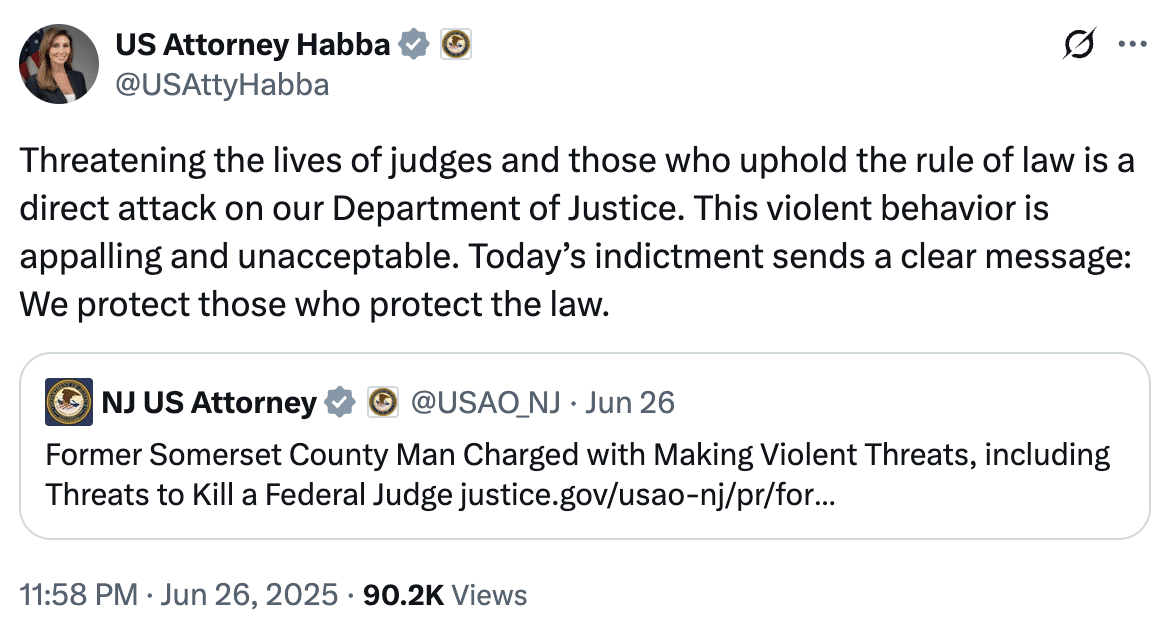
First, she RTed the NJ USAO announcement of charges against someone who threatened several judges.
The charges seem real, involving phoned threats to cut off judges’ fingers or shoot them, though the accused perpetrator left the country (possibly to India) in 2018, and there’s no announcement of an extradition request. Plus, Ricky Patel — the same guy who ginned up the arrest of Ras Baraka after Baraka obeyed Patel’s request to leave a property onto which he had been invited — is involved, which makes it suspect.
In both the Tweet and the press release, Alina Habba, who represented Donald Trump when he routinely attacked judges in that case and others, presumably Tweeting some of those threats from his property in New Jersey, whose attacks led to phoned-in threats to Judge Juan Merchan and his staffers, talked about how heinous it is threaten judges.
“The conduct alleged in the Indictment is as heinous as it is troubling: threats to a federal judge, two state superior court judges, an elected official, and a private New Jersey resident. The conduct is not just reckless — it is a direct attack on our justice system. Targeting those who uphold the rule of law is an attack on every community they serve. This egregious behavior is unacceptable. And, as the charges make clear, no matter where you are, we will find you and hold you responsible.”
Excuse me? If you believe this, Alina, you charge Donald Trump for what you call heinous behavior.
Maybe even consider whether you need to turn yourself in for some of your attacks on the judge?
But Habba wasn’t done.
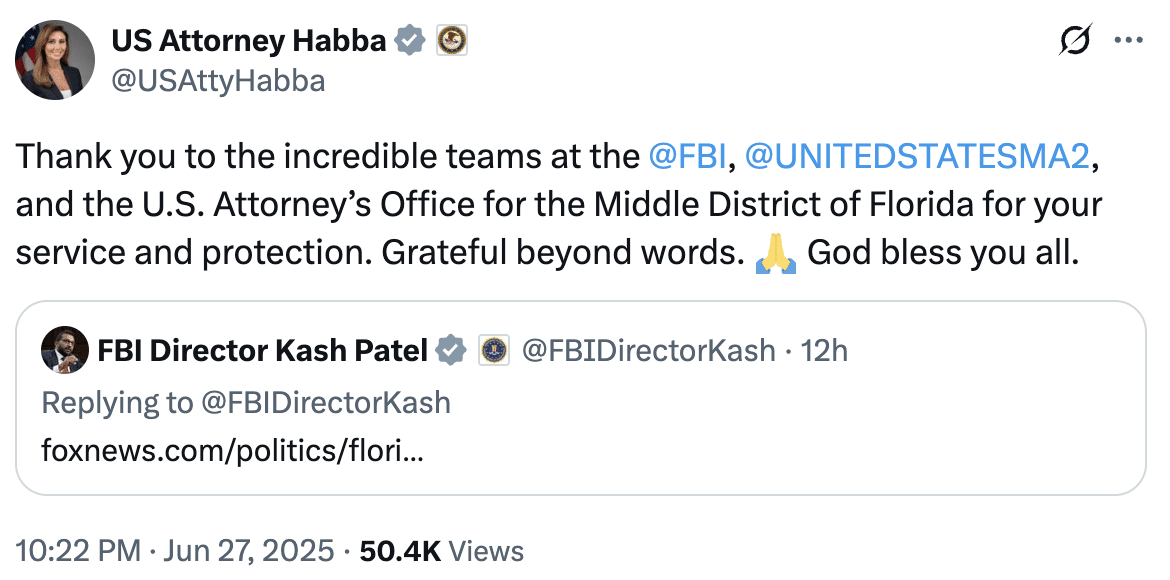
After that, Habba RTed Kash Patel’s announcement of charges for a man in Florida who allegedly — and I emphasize allegedly — threatened Habba.
Kash claimed this was an instance of a “copycat” threat using “86,” a clear reference to Jim Comey’s Tweeting something he saw on a beach.
A dangerous copycat, fueled by reckless rhetoric from former officials, threatened those protecting our country. Political violence has no place here. Proud of our @FBITampa and thankful to our Florida partners for acting fast to deliver justice.
The indictment in question charges a guy named Salvatore Russotto with two counts — threatening an official and assault (18 USC 111) — for four kinds of statements:
Calling Alina Habba the C-word, repeatedly
Hoping she dies a painful death (but not threatening to cause that himself)
Saying “86” her
Calling for “death penalty for all traitors”
Kash already charged someone else for using the 86-term, though in that case, the threats were much more graphic and personalized.
But this? Hoping someone dies? Calling someone the C-word?
The only real threat is calling for the death penalty for traitors. Remember Trump’s threats against Liz Cheney? Against Peter Strzok?
How about the time when current FBI Director and then private citizen Kash Patel told a lie about something in a John Durham filing, which led Trump to claim that Michael Sussmann should be put to death?
Trump calls his adversaries traitors all the time, and he has repeatedly called for them to be killed. Speaking of copycat, so did hundreds of the Jan6ers Trump pardoned after they stormed the halls of Congress calling to “Hang Mike Pence.” Those people weren’t charged with assault for that, but then I guess DOJ could now charge them?
And again, some of these threats Trump made undoubtedly were issued from New Jersey, and many of them were less than five years ago.
Of course, Kash’s decision to charge someone for the kind of threat he has facilitated is about Comey, not rule of law, perhaps an attempt to make nothing into something. Kash wants to claim that this is a copycat, but that Jack Posobiec’s even more viral use of the very same term against Joe Biden, also fewer than five years ago, was not.
If I were the lawyer of the guy in Florida, I would raise all this in a selective prosecution bid. As I also would if I represented the Alabama woman charged with bringing home classified documents (also a seemingly legitimate case) after a search the likes of which Kash called “unlawful” when such a search targeted Mar-a-Lago.
https://www.emptywheel.net/wp-content/uploads/2025/06/Screenshot-2025-06-28-at-07.10.39.png6361166emptywheelhttps://www.emptywheel.net/wp-content/uploads/2016/07/Logo-Web.pngemptywheel2025-06-28 03:19:122025-06-28 03:40:19“Egregious Behavior:” Alina Habba Confesses She Must Prosecute Donald Trump
As I noted the other day, Alina Habba rushed to announce the indictment of LaMonica McIver, which names Ras Baraka as Individual-1, at 6:56PM on Tuesday night, an hour before polls closed in the election in which Baraka won the second-most votes. But it took most of a day before the indictment was docketed, meaning most coverage of the indictment relied on Habba’s press release. As a result, that coverage didn’t point out some of the gaping holes and contradictions in the story AUSA Mark McCarren, which Habba’s presser identified as part of a “Special Prosecutions Division,” told to get a grand jury to approve the charges (NPR addressed a few of the issues on Wednesday).
The facts of this case will prove was I was simply doing my job and will expose these proceedings for what they are: a brazen attempt at political intimidation. This indictment is no more justified than the original charges, and is an effort by Trump’s administration to dodge accountability for the chaos ICE caused and scare me out of doing the work I was elected to do. But it won’t work–I will not be intimidated. The facts are on our side, I’ll be entering a plea of not guilty, I’m grateful for the support of my community, and I look forward to my day in court.
The holes in the indictment — about permitting concerns raised by Newark, about GEO Group’s ownership of Delaney Hall, about the property lines at the facility, about McIver’s completion of an inspection after she allegedly assaulted several cops — obscure the complexity about who had authority to do what at the facility.
The ways in which DOJ has changed its story about key events will undermine key witnesses, starting with alleged victim Ricky Patel and extending to a guard whose story appears to have changed three times.
And the key disputed facts, about where Mayor Ras Baraka was, when — whom DOJ treats like he is Schrödinger’s cat — may blow this entire case out of the water.
The government has told more than six versions of the story about what happened at Delaney Hall on May 9:
Start with several key details that do not appear in the McIver indictment — and so may not have been shared with the grand jury.
Unlike the complaint Victim-1 Ricky Patel swore out against Ras Baraka, neither the complaint nor the indictment charging LaMonica McIver mention that GEO owns Delaney Hall, the site of the confrontation (see the pink boxes). In the criminal complaint against Baraka, that relationship was a necessary part of claiming that Baraka trespassed on a federal facility, without which DOJ would not and likely does not have jurisdiction.
The Delaney Hall Facility currently operates as a federal immigration facility pursuant to a contract between the GEO Group, Inc., the entity that owns the Delaney Hall Facility, and U.S. Immigration and Customs Enforcement (“ICE”). As a result of this contract, the Delaney Hall Facility has been acquired for the use of the United States and is under the jurisdiction of the United States.
That property relationship underlies several key other aspects of the confrontation that don’t show up in either of the McIver charging documents. First, Newark claims that Delaney Hall is not certified for its current use, over which Newark has actually sued the facility. Once you have even a dispute over the certification of the facility, than the Mayor of Newark has official business at the facility.
The fact that GEO, and not ICE, owns the property goes to whether Baraka was even trespassing at all. In the complaint against Baraka, Patel relied exclusively on the normal restrictions on entry — the chainlink fence, the No Trespassing signs, and the guard — to claim Baraka was trespassing. The problem with that is that at one point, a guard employed by GEO invited Baraka in.
The testimony of the guard (yellow boxes) is wildly inconsistent, as follows:
McIver complaint: Baraka was originally told he could not enter but was subsequently admitted because “the guard was under the impression that the Mayor was part of the Congressional delegation”
McIver indictment: Baraka was originally denied entry when he claimed he was part of the Congressional delegation, but then was let in because the guard was concerned for Baraka’s safety
Baraka lawsuit: The guard told Baraka he let him in to “calm the crowd”
That inconsistent testimony is important, because according to Baraka, when Patel told him to leave, Baraka told Patel he was invited on to the property, which the government now concedes but which, in real time, Patel disputed. This is, undoubtedly, a big part of the reason why Habba dismissed the complaint against Baraka. Not only is it not clear she had federal jurisdiction over a private facility in Baraka’s city, but when Patel filed the complaint, he at least knew that Baraka claimed to have been invited onto the property by a representative of GEO, and he may well have known that Baraka was right when he charged Baraka.
In other words, Victim-1 in the McIver indictment, Patel, left out key details in his sworn complaint, if not outright lied to a judge when claiming that Baraka was trespassing at all.
And that — the good faith understanding from both Baraka and the members of Congress that Baraka was not trespassing — is important background to the biggest discrepancy between the claims Baraka has made, what WaPo shows, and what Special Prosecutions Division AUSA Mark McCarren appears to have told the grand jury.
In the McIver charging documents (which include no timeline), Patel ordered Baraka to leave, he told him to place his hands behind his back, the members of Congress came out and started to make a stink, Baraka somehow exited out the gate, which is where the key confrontation took place.
Even in that story, there are two key discrepancies. The McIver charging documents call the land outside the gate, vaguely, “the unsecured area of the facility” or “just outside the security gate for the facility.” That is, the McIver documents imply that GEO (though they don’t mention GEO) owns the property both inside and immediately outside the gate. But Baraka calls that area, “public Newark property.” DOJ says GEO owns the land where the confrontation took place. The Mayor of Newark says it’s the city’s public land.
Perhaps the craziest discrepancy — and the reason I’m treating this as Schrödinger’s Baraka — is the description of how Baraka came to leave (green text).
Baraka complaint: He never left!
McIver complaint: “the Mayor was then moved outside the gate”
Habba presser: “the Mayor was escorted outside the secured gate” (in context, suggesting HSI did it)
McIver indictment: he “was escorted by his security detail”
Both Baraka’s lawsuit and the WaPo describe something totally different: he walked out, “arm-in-arm” with Congresswoman Bonnie Watson Coleman (Baraka’s lawsuit mentions that first he retrieved her phone from one of her staffers), by all accounts a successful effort by members of Congress to deescalate the situation.
In none of these scenarios was Baraka moved outside the gate by HSI. He left, whether arm-in-arm with Watson Coleman or escorted by his detail, of his own accord.
And then he was arrested.
He was ordered to leave, he left (even though he believed he had been invited by the property owner), and then he was arrested for trespassing.
Those discrepancies would be bad enough. But there’s a far bigger one. As the McIver charging documents tell it, the attempted arrest, Baraka’s departure, and then the successful arrest were one continuous event: Ricky Patel orders Ras Baraka to leave, attempts to arrest him, is thwarted by McIver, then proceeds outside the gate immediately to conclude the arrest. The effort by members of Congress to deescalate is instead portrayed as the beginning of an effort to thwart the arrest.
WaPo (and Baraka’s lawsuit) say it happened in two phases. First HSI ordered Baraka to leave, the members came out from the GEO waiting room, attempted to de-escalate, he left, then the members returned inside only to hear HSI premeditating a plan to arrest him even though he had already left the facility, after which they re-joined Baraka, this time in that area that DOJ claims is the unsecured property of GEO (only they don’t tell you it is GEO) and that the Mayor of Newark claims is public property.
For nearly 45 minutes, Baraka remained just inside the secured area, occasionally chatting with members of his security detail, according to time-stamped videos. Then, at around 2:33 p.m., Homeland Security agents exited the building and confronted Baraka. In snippets of the conversation captured in video, agents told Baraka he had to leave because he was not a member of Congress. The three members of Congress joined the discussion as it grew tense.
Minutes later, video shows, an agent took a step toward Baraka, and Watson Coleman can be heard urging calm.
Referencing that moment, the Justice Department’s complaint said a Homeland Security agent ordered the mayor to “put his hands behind his back and displayed his handcuffs.”
McIver grew animated, calling the agent’s intervention “unnecessary” and “ugly.” One of the agents can be heard in videos saying: “All right, then. Walk out.”
At 2:39 p.m., within moments of that remark, and six minutes after agents first confronted Baraka, he turned and walked away, arm-in-arm with Watson Coleman. The guard reopened the gate, and Baraka exited to an area in front of the facility, recessed from the sidewalk.
With concerns about Baraka’s presence seemingly resolved, the three House members returned to the building for a tour, according to interviews with congressional staffers. The mayor remained outside the gate, speaking with reporters and protesters. Inside the building, congressional staffers said, lawmakers saw agents huddled and overheard them discussing plans to arrest the mayor.
Menendez then quickly exited the building and approached the gate, videos show. He spoke to Baraka through the chain-link fence, warning that agents were going to arrest him.
According to Baraka’s timeline, five minutes elapsed between the time he left, HSI plotted his arrest, and then everyone came out and had that confrontation. And the members of Congress knew (this detail doesn’t make any DOJ documents and it’s likely they don’t have testimony from any of them) that HSI planned Baraka’s arrest even though he had already left. Or at least left the secured property, whatever the property status of the land outside the gate.
Here I am 1,700 words into this post, and I haven’t even gotten to several other key discrepancies in the documents.
The McIver charging documents mention that McIver was at Delaney Hall “allegedly to conduct a congressional oversight investigation,” but they don’t provide much detail, aside from Patel’s comments distinguishing Baraka from the members, about the legal protection for such things. They certainly don’t mention how long DHS kept the members waiting, which Baraka alleges (and WaPo backs) was over an hour. They claim that the Democrats planned a protest, but Baraka says that, instead, McIver invited Baraka for a press conference after the members toured the facility, which would have happened just before 2PM, over 40 minutes before the alleged assaults, if DHS hadn’t kept the members waiting.
That is, the McIver charging documents totally obscure her right to be on the premises.
Crazier still, even though both the complaint and indictment claim that McIver was “allegedly” there to conduct an inspection, neither explains that she did, in fact, conduct that inspection, nor do they explain that she did so — she was allowed back inside Delaney Hall — after she allegedly assaulted two different officers outside it.
This is how DOJ describes the second alleged assault: “McIVER pushed past V-2 while using each of her forearms to forcibly strike V-2 as she returned inside the secured area of Delaney Hall.” But then the story just ends. It appears that Special Prosecutions Division AUSA Mark McCarren didn’t bother to tell the grand jury that she didn’t just allegedly show up for an inspection, she did in fact conduct that inspection, with the victims’ permission, after she allegedly assaulted them.
Maybe I’m skeptical of cops who lie, but if I were in the jury, I’d acquit on all charges in less time than DHS left the members of Congress waiting that day.
Meanwhile, there’s unrest in Delaney Hall because — detainees say — they’re getting fed shitty food at irregular hours, precisely the kind of problem that oversight from Congress and Newark might have avoided.
Francisco Castillo, a Dominican immigrant who has been held at Delaney Hall since last week, said in a phone interview from the detention center on Tuesday that the facility was so overcrowded when he arrived that some detainees had to sleep on the floor. He said on Tuesday that the crowding issue had been recently resolved.
But he said detainees were being served dismal meals at irregular hours, an issue that was particularly affecting detainees who are diabetic and need to eat at regular times to control their blood sugar levels. He said detainees were often served small cartons of expired milk for breakfast. Dinners were sometimes not served until around 11 p.m., he said.
The living conditions grew so bad, he said, that a group of about 30 detainees had begun drafting a petition detailing the conditions that they could get to the public through their relatives and lawyers.
“Every day is a disaster with the food here,” Mr. Castillo, 36, who was detained by ICE at an immigration courthouse in New York City on June 4, said in Spanish.
At about 4:30 p.m. on Thursday, a woman who lives in Elizabeth, N.J., said she got a call from her partner, who has been detained at Delaney Hall since early last month. He was crying, she said, and described rising tension within the facility linked to frustration over food.
To her great credit, McIver remains on the case, issuing the following statement about the rising unrest at the facility.
I am carefully monitoring the situation unfolding at Delaney Hall, and am in contact with local and state law enforcement and officials. I have serious concerns about the reports of abusive circumstances at the facility. Even now, as we are hearing reports from news organizations and advocates on the ground about a lack of food and basic rights for those inside, the administration appears to be stonewalling efforts to learn the truth. My office has reached out to ICE for answers. ICE has not yet provided them.
This case is dogshit, and it looks likely that Mark McCarren only succeeded in getting his indictment by keeping key details from the grand jury. But it may not even survive to trial, because when laid out side by side, there’s far more evidence of DHS lying to judges than there is of crimes by Democrats trying to fulfill their jobs as Mayor and Members of Congress.
Update: This was just beginning to be reported when I first posted this post. But four detainees at Delaney Hall escaped through an external drywall wall.
https://www.emptywheel.net/wp-content/uploads/2025/05/Screenshot-2025-05-26-at-16.51.30.png564472emptywheelhttps://www.emptywheel.net/wp-content/uploads/2016/07/Logo-Web.pngemptywheel2025-06-13 11:45:402025-06-13 13:53:07LaMonica McIver and Schrödinger’s Baraka
One reason — I laid out a week ago — I was interested in the ways that Trump’s DOJ keeps getting caught in false claims, is because they create, “the possibility that these prosecutions will backfire, not just by creating sympathetic political martyrs, but also by further exposing [Pam] Bondi and her top aides as liars violating legal ethics.”
Which Ras Baraka is attempting to facilitate by suing Alina Habba for false arrest and malicious prosecution.
There are several key details about the lawsuit that might sustain it beyond what would normally be prosecutorial immunity, at least far enough to get discovery (discovery that might also sink the prosecution against LaMonica McIver).
First, Baraka showed that even before she was sworn in, Habba made clear that she would abuse the office for political gain.
13. Days before being sworn in, Habba announced on Fox News that she would be “investigating” New Jersey’s Democratic Governor and his appointed Attorney General, claiming New Jersey’s lawful Immigrant Trust Directive is thwarting Trump’s immigration policies. Habba claimed that New Jersey’s Governor and Attorney General were interfering with her effort to take “all criminals out of the country” — apparently except for her former client, convicted felon Donald Trump.
Along with including all the other false claims made about Baraka (an interview Habba did with Fox, a CNN interview DHS propagandist Tricia McLaughlin did, as well as false claims in the arrest affidavit), he included the tweet that Habba sent from her personal Xitter account even before Baraka was charged.
And he described the exceptional efforts to exacerbate Baraka’s arrest, not just by arresting him rather than citing him, but by subjecting him twice to fingerprinting and a mugshot.
One thing Baraka doesn’t mention, however, is the imminent primary for New Jersey’s gubernatorial race. He Baraka was well behind in polls before his arrest, but he will be able to make a plausible claim that the arrest harmed his chances — all the more so given that Pam Bondi’s own DOJ dismissed the charges against Eric Adams precisely because of the damage it would allegedly do to him in the upcoming primary.
As Liz Dye noted on Bluesky, Baraka is represented by the same lawyer, Nancy Smith, who forced Habba into a settlement on behalf of a Bedminster staffer whom Habba tricked into a hush payment in conjunction with being sexuallly harassed. She knows Habba’s tricks well.
https://www.emptywheel.net/wp-content/uploads/2025/06/Screenshot-2025-06-03-at-4.50.06 PM.png5361188emptywheelhttps://www.emptywheel.net/wp-content/uploads/2016/07/Logo-Web.pngemptywheel2025-06-03 12:07:222025-06-03 12:14:45Alina Habba Back in Trouble for (Allegedly) Lying While Lawyering
Let’s start with the good news, not least because the good news may explain some of the bad news.
Habeas Corpus still exists in the US
In the last several weeks, judges in Vermont and Alexandria, VA, have ordered the government to free Mohsen Mahdawi, Rumeysa Ozturk, and Badar Khan Suri from custody. Their release does not end their legal fight over whether Trump can deport them for their First Amendment protected speech or not. But they will be able to continue their academic work, live at home, and make public comments while those legal proceedings go forward.
Now the horrible news.
As noted above, some of the releases were ordered by Federal judges in Vermont — William Sessions in the case of Ozturk and Geoffrey Crawford in the case of Mahdawi.
Yesterday, detained Harvard genetics researcher Kseniia Petrova had a hearing before a third Vermont judge, Chief Judge Christina Reiss. Anna Bower live-skeeted it here.
Petrova’s case differs from the others in several ways. She wasn’t detained for her First Amendment protected speech. Rather, she was detained because she didn’t declare frog samples from France she was carrying back to Harvard for her research at the border.
And while the government’s public actions to date — a quick transfer for Petrova to Louisiana in a transparent attempt to make any habeas corpus challenge more difficult — look quite similar, the legal posture was different for several reasons: a Customs and Border Patrol Officer had reportedly canceled her visa themselves upon discovering the samples (an offense that is normally let off with a warning). Petrova had agreed to leave the country, so long as she wasn’t deported to her native Russia, where she credibly expects she’d be harshly persecuted for her speech there. Because of that threat, Petrova also started applying for asylum.
But as laid out in the hearing yesterday, Petrova had always said she’d be willing to leave for France, and the government still publicly maintained they wanted to deport her to Russia.
Judge Reiss noted that she had reviewed the statute laying out the grounds for customs officers to find someone inadmissible to the United States, and “I don’t see anything about customs violations.”
Jeffrey M. Hartman, an attorney representing the Department of Justice, said “it’s the secretary of state’s authority” to cancel a visa, and that the secretary has delegated that authority to customs officials.
“The C.B.P. office was our first line of defense against unknown biological materials from a foreign national out of a port of entry,” he said.
Mr. Hartman argued that the federal court in Vermont had no jurisdiction over Ms. Petrova’s detention. He said Ms. Petrova may contest her detention, but only in an immigration court in Louisiana, where ICE is holding her.
“It’s not something that a district court can entertain,” he said. “We think the proper venue for that question is Louisiana, where she is detained and where her custodian is.”
“But she is only detained there because you moved her,” said the judge.
Judge Reiss asked the government to clarify whether or not it planned to deport Ms. Petrova to Russia.
“You are asking for her removal to Russia?” she asked.
“Yes, your honor,” Mr. Hartman replied.
Shortly after telling Judge Reiss that the government wanted to deport Petrova to Russia, DOJ instead unsealed a criminal complaint against Petrova, obtained on Monday (the first business day after Ozturk’s release), saying they actually want to prosecute Petrova for crimes that can impose up to a 20-year sentence.
Two months after detaining Petrova, as judges in Vermont free targets of Stephen Miller’s witch hunt and as problems with the unilateral revocation of her visa become clear, the government suddenly decided Petrova engaged in smuggling, without taking the time to present the case to a grand jury first.
The key paragraph of this complaint claims that Petrova prevaricated when asked about carrying biological materials and whether she knew she had to declare them, first denying she had biological material, then admitting she did.
PETROVA was asked to present herself at the secondary inspection area. She was wearing a backpack and carrying a plastic bag. When questioned about her luggage, PETROVA denied carrying any biological material. When the CBP officer asked her again, PETROVA identified the plastic bag she was carrying as having biological material. An inspection of the bag revealed a foam box containing frog embryos in microcentrifuges, as well as embryo slides. A CBP officer interviewed PETROVA under oath and conducted a manual review of her cell phone. PETROVA admitted that the items in her duffle bag and in the plastic bag were biological specimens. PETROVA was asked if she knew that she was supposed to declare biological material when entering the United States. After a long pause, she answered she was not sure. The CBP officer then confronted PETROVA with a text message on her phone from an individual who she identified as her colleague at a Boston-area medical school, where she is currently a research assistant. The individual wrote, “if you bring samples or antibody back make sure you get the permission etc. Like that link I sent to leon-/group chat about frog embryos because TSA went through my bags at customs in Boston.” When asked again whether she knew she was supposed to declare the items, she responded that she “was not sure about embryos specifically”
Even though the government maintains that they have to deport Petrova to Russia, not France, they make much of her past work in a Russian research lab, as if she’s some Russian threat, even while treating her fear of deportation as feigned.
11. PETROVA told CBP agents that she was educated in Russia and worked at the Moscow Center for Genetics as a bioinformatician of genetic disorders from 2016 to 2023. When asked if this was a Russian government institution, she replied that about half of the scientists worked for the Russian government and the other half for hospitals. She also stated that she was most recently employed by the Institute of Genetic Biology in Moscow from 2023 to 2024.
Again, on its face, this looks like the government’s bid to ratchet up its attack in the face of embarrassing setbacks in Petrova’s case. I wonder if they would have unsealed this if not for what looked like a pending loss before Judge Reiss and possibly even this powerful op-ed from Petrova, published by NYT on Tuesday, implicitly likening the plight of scientists in Russia to increasing threats in the US.
The political environment in Russia made it hard to do science because everything was unpredictable. The war in Ukraine affected scientists’ ability to get funding and materials; we worried that our male colleagues might be conscripted. That type of uncertainty is incompatible with science, which requires the ability to plan what type of experiments and research you will do a year into the future. I fear that if I return to Russia I will be arrested.
I am hesitant to comment broadly on what it’s like for scientists now in America because I have only limited information about what is going on outside of this detention center. What I do know is that my colleagues, many of whom are, like me, foreign scientists, are terrified of being detained or having their visa status revoked.
One more thing may have convinced the government to charge Petrova, though.
As pattern jury instructions on the charge lay out, to prove the case against Petrova, the government must prove that Petrova had the intent of defrauding the government.
To find the defendant guilty of this crime you must be convinced that the government has proved each of the following beyond a reasonable doubt:
[snip]
Third: the defendant acted knowingly and willfully with intent to defraud the United States. [It is not necessary, however, to prove that any tax or duty was owed on the merchandise.]
[Fourth: the defendant did something which was a substantial step toward committing [crime charged], with all of you agreeing as to what constituted the substantial step. Mere preparation is not a substantial step toward committing [crime charged], rather the government must prove that the defendant, with the intent of committing [crime charged], did some overt act adapted to, approximating, and which in the ordinary and likely course of things would result in, the commission of [crime charged].
To act with “intent to defraud” means to act with intent to deceive or cheat someone.
To prove this, the government will have to call the people with whom Petrova discussed how to address the samples at customs.
9. Another text message on PETROVA’s phone contained the following question from her medical school colleague: “What is your plan to pass the American [referred to as US in PETROVA’s interview] Customs with samples? This is the most delicate place of the trajectory.”
10. The CBP officer confronted PETROVA with another text message between her and another individual who she identified as her principal investigator in which she was asked by this individual: “what is your plan for getting through customs with samples?” To that question, PETROVA replied, “No plan yet. I won’t be able to swallow them.
That is, this will put Petrova’s lab on trial, with her colleagues either forced to testify against her or possibly implicated with it, as if there’s some great conspiracy against the United States to … do science.
DOJ unsealed this complaint on Tuesday, after Harvard expanded its lawsuit against the US, adding the retaliation Trump has taken in response to Harvard’s initial lawsuit.
7. In response to Harvard’s defense of its own constitutional freedoms, the federal Government announced that it was freezing “$2.2 billion in multiyear grants and $60M in multiyear contract value to Harvard University” (the “April 14 Freeze Order,” attached as Exhibit C). Ex. C at 2. Within hours of the April 14 Freeze Order, Harvard began receiving stop work orders. And the situation is getting worse. On April 20, it was reported that the Government is “planning to pull an additional $1 billion of [Harvard]’s funding for health research.”6 On May 5, the Secretary of Education, purporting to speak on behalf of every agency and department, announced an “end of new grants for the University,” and directed that “Harvard should no longer seek GRANTS from the federal government, since none will be provided,” and “Harvard will cease to be a publicly funded institution” (the “May 5 Letter” or “May 5 Freeze Order,” attached as Exhibit D). Ex. D at 3-4. That announcement reiterated the Government’s earlier demands and said it was based, among other things, on the Government’s assessment of Harvard’s “academic rigor,” admissions requirements and practices, grading systems, faculty hiring, teaching, and course construction. Id. at 2. The April 14 Freeze Order and May 5 Freeze Order are collectively referred to herein as the “Freeze Orders.”
8. Following in the footsteps of the April 14 and May 5 Freeze Orders, Harvard began, starting on May 6, to receive institution-wide termination notices for various agencies, invoking the earlier April 11 and 14 communications. On May 6, for example, the National Institutes of Health sent Harvard a letter stating that it was terminating all of Harvard’s grant funding from that agency based on “the University’s unwillingness to take corrective action or implement necessary reforms” and that Harvard’s grant “awards no longer effectuate agency priorities” because of “recent events at Harvard University involving antisemitic action” and “Harvard’s ongoing inaction in the face of repeated and severe harassment and targeting of Jewish students” (the “May 6 Letter” or “May 6 NIH Termination Letter,” attached as Exhibit E). Ex. E at 2-3. The letter states that “NIH generally will suspend (rather than immediately terminate) a grant and allow the recipient an opportunity to take appropriate corrective action,” but “no corrective action is possible here.” Id. at 3.
And the escalation continues. In the last week, Trump announced more cuts on funding to Harvard as well as an EEOC investigation into a faculty that underrepresents women and people of color, claiming it discriminates against people who look like Stephen Miller.
Charging Petrova for daring to commit science in the United States is undoubtedly a way to rescue a legally problematic case against her. It’s also another way to put Harvard’s defense of scholarship on trial.
Perhaps it is an auspicious sign, then, that British professors just determined that a copy of the Magna Carta that Harvard bought for $30 in 1946, thinking it was a copy made in 1327, is in fact a seventh original of the 1300 document.
British researchers have determined that a “copy” of the Magna Carta owned by the Harvard Law School Library is a rare original issued by England’s King Edward I in 1300. The copy was previously thought to date back to 1327.
The Magna Carta, issued by King John in 1215, established that the monarch is a subject under the law, just like any other citizen. It was reissued a number of times throughout the thirteenth century, and was released for the final time with the king’s seal in 1300.
Seven original charters issued by King Edward I are known to exist. Six copies are in the United Kingdom, while Harvard Law School’s Magna Carta is now the only known copy abroad.
The discovery was made by David Carpenter, a professor at King’s College London, and Nicholas Vincent, a professor at the University of East Anglia. Carpenter, a Magna Carta expert, was researching unofficial copies of the charter and suspected the Law School’s copy was actually an original. He then worked with Vincent, another Magna Carta expert, to investigate further.
The charter, an agreement between the King of England and rebel barons, gave way to the idea of a limited government and inspired the writers of the U.S. Constitution and Bill of Rights. In a joint press release between the three universities, Vincent called it “the most famous single document in the history of the world.”
All this time, an original document enshrining habeas corpus — the legal right Petrova was asserting, the legal right that got Mahdawi, Ozturk, and Suri released, the legal right Stephen Miller wants to suspend — was sitting right there in Boston, where the fight for American freedom started.
There will be multiple other developments in Stephen Miller’s deportation regime today.
SCOTUS will review whether judges can issue nationwide injunctions on matters — birthright citizenship — that necessary apply nationwide.
Hannah Dugan
Judge Hannah Dugan will be arraigned in Milwaukee on an indictment obtained Tuesday. The indictment claims, with no context, that Dugan “falsely [told the ICE team] they needed a judicial warrant to effective the arrest of [Eduardo Flores-Ruiz].” That claim goes beyond anything mentioned in the complaint and likely misrepresents the intent of Dugan’s comment. The indictment similarly provides no context for Dugan’s order directing the ICE team to go to the Chief Judge’s office, who was still working on a policy covering such issues; nor does it mention that there was no policy that Dugan violated.
The indictment also makes clear that the grand jury obtained testimony from Flores-Ruiz’ attorney, claiming that Dugan,
advis[ed] E.F.R.’s counsel that E.F.R. could appear by “Zoom” for his next court date.
But having spoken to Flores-Ruiz’ attorney, there’s still no allegation that Dugan told her that ICE was in the courthouse. This means the government lacks that kind of evidence that might substantiate corrupt intent, making it a much weaker case than the one against Judge Shelly Joseph back in 2019.
Nothing about this case has gotten stronger at the indictment stage. It still appears to lack any evidence about Dugan’s intent.
That said, the indictment is not a ham sandwich either. The government has clearly provided probable cause that a person who knew of an administrative arrest warrant made it difficult for ICE to arrest someone.
There’s no evidence that prosecutors explained why Dugan’s question about an administrative versus judicial warrant is actually exculpatory. Likewise, there’s no evidence that prosecutors told the grand jury that two DEA agents from the ICE team had the opportunity to detain Flores-Ruiz in the hallway there were staking out. And the matter of judicial immunity, which was left for an appellate phase that never happened in Joseph’s case (the Biden DOJ dismissed the case), would not have been briefed to the grand jury.
The latter detail, judicial immunity, may be litigated more aggressively than it was for Judge Joseph because of actions Trump took.
Yesterday, Dugan filed a motion to dismiss the case based on judicial immunity. The motion cited Trump’s own successful attempt to avoid any trial based on his claim of immunity three times.
The problems with this prosecution are legion, but most immediately, the government cannot prosecute Judge Dugan because she is entitled to judicial immunity for her official acts. Immunity is not a defense to the prosecution to be determined later by a jury or court; it is an absolute bar to the prosecution at the outset. See Trump v. United States, 603 U.S. 593, 630 (2024).
[snip]
Judge Dugan’s subjective motivations are irrelevant to immunity. “Judges are entitled to absolute immunity for their judicial acts, without regard to the motive with which those acts are allegedly performed.” Id.; accord Trump v. United States, 603 U.S. at 618 (“In dividing official from unofficial conduct, courts may not inquire into the President’s motives”).
[snip]
Judge Dugan therefore has both immunity from conviction and immunity from prosecution. “The essence of immunity ‘is its possessor’s entitlement not to have to answer for [her] conduct’ in court.” Trump, 603 U.S. at 630, quoting Mitchell v. Forsyth, 472 U.S. 511, 525 (1985); Mitchell, 472 U.S. at 526 (“The entitlement is an immunity from suit rather than a mere defense to liability; and like an absolute immunity, it is effectively lost if a case is erroneously permitted to go to trial.”) (emphasis in original)
This last citation adopts John Sauer’s own reliance on civil, not criminal, liability. A citation to Mitchell itself would be inapt (a criticism some people are making); but Dugan is citing the current Solicitor General’s inapt reliance on it, not the case directly. Effectively, Dugan is saying that if Trump can avoid trial for anything covered by his official duties, than so can Dugan.
Ras Baraka
Ras Baraka will also have a hearing in his prosecution for misdemeanor trespassing today. As with Dugan’s case, there’s reason to believe Trump’s public comments about the case are overblown.
To substantiate the misdemeanor trespassing charge against him, the complaint against Newark’s Mayor does not make the claims that Alina Habba made publicly, that Baraka was repeatedly asked to leave. Rather, HSI Special Agent in Charge Ricky Patel relied only on the no trespassing signs and the presence of security guards.
3. The Delaney Hall Facility is surrounded by chain-link fences and is accessible only through granted access. In addition to maintaining security, it likewise displays No Trespassing signage.
But video shows that after security guards asked Baraka to leave (after first letting him in), he did. The arrest happened on public ground, not in the facility itself. The video undermines the complaint as attested.
In advance of today’s hearing, the AUSA who presented the case on Friday was swapped out for Alina Habba herself and another AUSA, often a sign under this Administration that an attorney wasn’t telling the lies the government wants to tell.
Having made that swap, Habba tried to get today’s hearing canceled (though she couldn’t even manage to get the date right!), so they could move right to trial.
The Government writes with respect to the upcoming preliminary hearing scheduled for Thursday, May 12, 2025. The Government does not believe that a preliminary hearing is warranted in this case. Under Fed. R. Crim. P. 5.1(a), “[i]f a defendant is charged with an offense other than a petty offense, a magistrate judge must conduct a preliminary hearing unless” certain conditions are satisfied. Fed. R. Crim. P. 5.1(a) (emphasis added). Here, the charge is a petty offense. Under state law, assimilated under 18 U.S.C. § 13, the statutory maximum sentence is 30 days. That means the offense is a class C misdemeanor under federal law. See 18 U.S.C. § 3559(a). That, in turn, means that it’s a “petty offense” under federal law. See 18 U.S.C. § 19. Defendant, therefore, is not entitled to a preliminary hearing under Rule 5.1. See United States v. Radin, No. 16 Cr. 528, 2017 U.S. Dist. LEXIS 77783, 2017 WL 2226595 (S.D.N.Y. May 22, 2017).
The Government requests that the Court cancel the preliminary hearing and schedule this matter for trial at an appropriate time. [my emphasis]
Magistrate Judge André Espinosa, to whom Patel didn’t disclose that Baraka left the facilities when asked, was having none of that. He granted Habba’s request to vacate a preliminary hearing as unnecessary, but in the same order, granted Baraka’s request for a status conference to be held at the previously scheduled time.
WHEREAS the United States of America (the “Government”), by way of a May 13, 2025 letter brief emailed to the Court and all counsel, now seeks cancellation of that hearing, arguing that it is not required under Federal Rule of Criminal Procedure Rule 5.1; and
WHEREAS the clear language of Rule 5.1(a) does not require a preliminary hearing when a defendant is charged with a petty offense; and
WHEREAS the offense charged in this action carries a maximum penalty of 30 days’ imprisonment, making it a Class C misdemeanor, see 18 U.S.C. § 3559(a), and constituting a “petty offense” under federal law. See 18 U.S.C. § 19; and
WHEREAS, nevertheless, by way of email correspondence to the Court, copying counsel for the Government, counsel for Defendant has sought a status conference on the same date and at the same time, if the preliminary hearing does not proceed; therefore
IT IS on this 13th day of May 2025,
ORDERED that the Court’s May 9, 2025 oral Order setting a preliminary hearing in this action for May 15, 2025, at 10:00 a.m., is VACATED; and it is further
ORDERED that the Court will hold a status conference in this action on May 15, 2025, at 10:00 a.m., in Courtroom 2D of the Martin Luther King Courthouse, in Newark, at which all counsel shall appear.
As Josh Gerstein observed, in last week’s hearing, in response to a request from Baraka, Espinosa issued a warning about public statements that violate local rules.
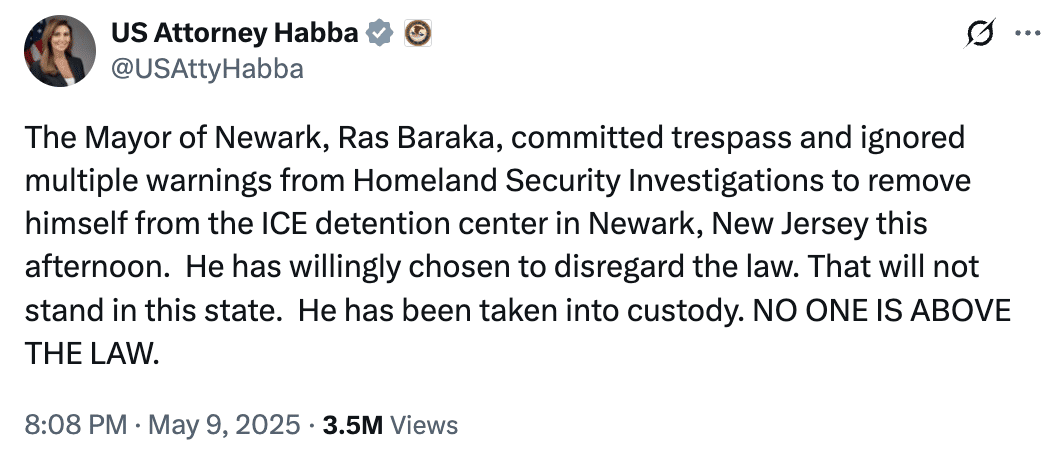
COME ON ALINA — In Baraka hearing, magistrate cautioned federal officials about public statements, by POLITICO’s Ry Rivard and Josh Gerstein: Before Newark Mayor Ras Baraka was released from custody on Friday, a federal magistrate quickly determined he was not a flight risk and cautioned federal officials against making out-of-court statements about the mayor, who is also running for New Jersey governor, according to a newly-released transcript of the extraordinary virtual hearing … During the 18-minute videoconference, Baraka’s attorney Raymond Brown asked [U.S. Magistrate André M.] Espinosa to warn Trump administration officials against making derogatory public statements about his client … Earlier in the day, interim U.S. Attorney for New Jersey Alina Habba had posted on social media that Baraka had “willingly chosen to disregard the law” before he was arrested at the immigration detention center he was protesting and seeking to inspect along with three members of New Jersey’s congressional delegation. Espinosa said to the extent anyone had made such comments, he would “caution them to heed carefully to the rules of professional conduct” and “boundaries of propriety for public comment related to an ongoing investigation and/or prosecution.”
So it may turn out that Trump’s Parking Garage Lawyer, who has a history of struggling with basic lawyering tasks, will get directly warned about her violation of due process even before Pam Bondi or Chad Mizelle or Kristi Noem or Kash Patel. Or maybe Habba will have to warn Noem to shut her yap after DHS continued to attack members of Congress for engaging in oversight of a facility they claim still lacks the proper local permits.
In short, basic due process remains a struggle. But there are some reasons to believe that authentic Magna Carta is an auspicious sign.
https://www.emptywheel.net/wp-content/uploads/2025/05/Screenshot-2025-05-15-at-13.22.58.png4661054emptywheelhttps://www.emptywheel.net/wp-content/uploads/2016/07/Logo-Web.pngemptywheel2025-05-15 08:30:502025-05-15 09:38:05The Comings and Goings from Stephen Miller’s Gulag
I have a standing complaint that reporters serially fall into Donald Trump’s trap of reporting on his courtroom tantrums rather than the evidence of his fraud and crime presented therein. But I’m going to do just that, because I believe reporters are misunderstanding the way in which Donald Trump is approaching the second E. Jean Carroll trial and what it bodes for his attack on democracy ahead.
It started with a series of requests to delay the trial so Trump could attend the funeral of Melania’s mother.
The funeral was a ruse: even as he made the requests, Trump continued to obviously and publicly plan campaign events in New Hampshire for the period of potential delay. After initial denials, Alina Habba renewed the request to the famously irascible Judge Lewis Kaplan. That drew a predictable rebuke, in response to which Habba mouthed off to the judge.
Earlier Wednesday, Kaplan told Habba to sit down after she tried yet again to get Kaplan to postpone the trial on Thursday so Trump could attend his mother-in-law’s funeral.
“I will hear no further argument on it. None. Do you understand that word? None. Please sit down,” Kaplan said.
“I don’t like to be spoken to that way,” Habba responded.
Habba had to have know this would go over poorly. She attended Trump’s first rape trial. Plus, even a parking garage lawyer from New Jersey would know of Kaplan’s strict decorum in his court.
Habba invited follow-on rebukes by failing other basic rules of trial decorum.
Over the course of the day, Trump’s attorneys asked Kaplan first to recuse, then for a mistrial, just as they repeatedly did with Judge Arthur Engoron in Trump’s civil fraud trial.
Then Carroll took the stand. Throughout, Trump audibly fumed, leading Carroll’s lawyer to ask Judge Kaplan to quiet him. That led, again predictably, to a clash between him and Kaplan.
“Mr. Trump has the right to be present here. That right can be forfeited, and it can be forfeited if he is disruptive, which is what has been reported to me,” the judge said.
Kaplan then spoke directly to Trump, who was seated at the defense table. “Mr. Trump, I hope I don’t have to consider excluding you from the trial,” he said. “I understand you are probably very eager for me to do that.”
At that point, Trump threw up his hands, saying, “I would love it. I would love it.”
“I know you would. I know you would,” Kaplan replied. “You just can’t control yourself in this circumstance, apparently.”
Trump shot back: “You can’t either.”
Again, all this was predictable. And commentators are probably correct in guessing that they’ll lead the jury to boost the award.
But two things about this reality theater make me convinced it is also entirely planned.
First, something led Joe Tacopina to drop off the team the day before trial. In the past, other lawyers have dropped when they had a conflict with Boris Epshteyn, who continues to run the reality TV show that substitutes for Trump’s legal defenses. And Epshteyn even attempted to speak up, before Judge Kaplan told him, as he has told Habba repeatedly, to take a seat.
The other indication that this has all been carefully scripted are Trump’s posts, rolling out even as he sits in the courtroom without his phone, defaming Carroll again over and over, or bitching about Kaplan. Either Trump drafted those posts in advance, or granted a staffer license to defame and attack on his behalf.
This one attacking Judge Kaplan, for example, suggests that his (male) lawyer asked him not to attend his last rape trial, but now he is attending to witness what Trump falsely claims is bias and unfairness.
Trump is attending this trial, which will almost certainly result in much larger award for Carroll than she would otherwise get, in order to delegitimize it.
And Trump has decided it is worth millions to do that.
Given that he’s a notorious cheapskate who stiffs his lawyers, that ought to give commentators pause. Does he simply plan to not pay, setting up further confrontation and ultimately a contempt fight? What then? A call to violence?
This ploy comes at a key time, too. After the Iowa caucus, with its anemic turnout signaling Trump’s expected victory may shrink the GOP so badly it will lose races up and down the ballot, political journalism instead turned to treating the results themselves as news. WaPo paid almost 20 journalists to write 10 stories the day after the caucus! Political journalists want to pretend everything is normal.
Yet Trump has not been running a campaign. He has been running an effort to consolidate the party to him, increasingly committed to his attack on rule of law.
Within days (hopefully), the DC Circuit will rule that he is not immune (and therefore Joe Biden can’t assassinate him with impunity), which will finally set up a test of SCOTUS’ willingness to rule against him criminally.
His other court filings are similarly descending into louder and louder wails.
At the same time, even before joining Mike Roman’s challenge to Fani Willis in Georgia, he has started working her into court filings in other cases, as in this motion to compel in the Florida case.
A January 12, 2024 congressional inquiry and other sources indicate that such materials exist. See Ex. 63. Specifically, Congress sent a letter to “Attorney Consultant” and “Special Assistant District Attorney” Nathan Wade regarding documents suggesting that Wade helped coordinate with the Biden Administration in 2022. One of Wade’s invoices indicates that he devoted eight hours to a “conf. with White House Counsel” on May 23, 2022. Id. at 2. The meeting occurred within weeks of the New York Times reporting on President Biden’s leaked statement that President Trump “should be prosecuted,” Ex. 62 at 1, and around the same time that Jonathan Su, from the White House Counsel’s Office, was working with NARA to manipulate the PRA in an effort to disclose records to the FBI and the January 6th Committee.
Willis will not formally respond until early February, after responding to Nathan Wade’s divorce, leaving a vacuum where any explanation should be. And while I think this report gets ahead of the verified facts, it’s a good warning of where the challenge to Willis may go. Until that is resolved, Trump will try to taint every single legal case against him with a tie to Willis.
Plus, it’s not just Trump whose legal woes are coming to a head. Peter Navarro is set to be sentenced January 25, and there have been sealed filings in DOJ’s civil suit to recover encrypted comms from him that should have been provided under the President Records Act. Steve Bannon’s New York trial is set for May.
Roger Stone is even back under investigation (even beyond the January 6 investigation) for his reported discussions of assassinating Jerry Nadler or Eric Swalwell.
Trump’s entire fascist cohort would, in a normal world, be facing up to the possibility of consequences for their acts.
But that’s not how this crowd rolls. They would rather bring down rule of law in the US than face consequences themselves. Indeed, it’s such a central part of their plan that Trump’s actually willing to spend money — or invite contempt, followed by whatever incitement with which he responds.
It is a category error to view Trump’s trial tantrums within the rubric of normal legal consequences, even in Kaplan’s entirely predictable courtroom. They are, instead, part of a concerted effort to take down rule of law. For years, Trump has been training his cult to loathe rule of law, and his latest theater is all part of that process.
Even as Trump is ensuring he will be the GOP’s only possibly choice in November, he is also guaranteeing that the entire party will need his attack on rule of law to succeed.
Trump’s fascist mouthpiece, Stephen Miller, has even already started a campaign claiming that Joe Biden is causing the chaos that Trump is about to unleash.
It’s all part of the plan.
https://www.emptywheel.net/wp-content/uploads/2024/01/Screenshot-2024-01-18-at-11.33.18.png874936emptywheelhttps://www.emptywheel.net/wp-content/uploads/2016/07/Logo-Web.pngemptywheel2024-01-18 07:16:592024-01-18 07:18:15Donald Trump Has Chosen to Pay Millions to Trash Rule of Law
Today, Donald Trump is attending the first day of the fraud trial that he already substantially lost.
Depending on who you believe, he is either attending because he’s using his attendance to delay a deposition in his own lawsuit against Michael Cohen (who will also be a key witness in this fraud trial).
He cited this as his excuse for skipping out on 2 deposition days in his federal case against ex-lawyer Michael Cohen.
If he didn’t show up, he’d be in contempt of court.
Or, he’s using it as a way to affect the outcome — the outcome that was already substantially determined by Judge Engoron’s ruling last week, a ruling addressed in passing, without explaining how he can affect something that has already occurred.
For Mr. Trump, his attendance at trial is far more personal than political, according to a person familiar with his thinking. The former president is enraged by the fraud charges and furious with both the judge and the attorney general. And Mr. Trump, who is a control enthusiast, believes that trials have gone poorly for him when he hasn’t been present, and he hopes to affect the outcome this time, according to the person.
In his courthouse remarks, Mr. Trump lashed out at the judge’s earlier fraud ruling on his property valuations. “I didn’t even put in my best asset, which is the brand,” he said.
I think Trump is attending to spin a judgment that has already been issued as, instead, an outcome he predicted.
Today.
Days after the ruling.
Here’s how it works. On the way into the trial, Reality TV Star Donald Trump made a public statement in which he told his cult followers that the judge that the judge was rogue and the prosecutor was racist. He renewed his claim that Judge Engoron erred by using Palm Beach’s valuation (the one they made in 2011, not in 2021) rather than his boast that Mar-a-Lago is worth a billion dollars.
Few outlets reported that 77-year old Reality TV Star Donald Trump had slurred his words.
No one asked why his spouse hadn’t accompanied him to this trial. (Though this time, one of his co-defendant sons accompanied him to the courthouse.)
Few outlets reported Tish James’ comments about how no one is above the law.
Many outlets were so busy reporting on Reality TV Star Donald Trump’s statements that they didn’t explain that Trump’s Parking Garage Lawyer, Alina Habba, didn’t even try to push for a jury trial, something Judge Engoron confirmed as the trial started.
At least some of the outlets that reported Chris Kise’s arguments about valuation did not explain that those issues were already decided, in a ruling last week.
Most outlets reported that Reality TV Star Donald Trump glared at The Black Woman Prosecutor on his way out for lunch. Some also reported that she laughed that off.
On the way back in the courthouse, Reality TV Star Donald Trump made even more incendiary comments about the judge who already did and will decide his fate. Reality TV Star Donald Trump told his followers that the judge presiding over a trial that might lead him to lose his iconic Trump Tower should be prosecuted and was guilty of election interference.
Many observers clucked that such a stunt would lead the judge — the one who already ruled against Trump — to rule against him.
Trump is going to lose this trial. Know how I know? Judge Engoron already ruled against him!
But most of Trump’s followers don’t know that. Most of Trump’s followers believe that Chris Kise’s comments about valuation were still at issue. Most cult members will see Trump’s comments today — it won’t be hard, because every outlet is carrying them — and remember that before the trial, Trump “predicted” that The Corrupt Judge and The Black Woman Prosecutor would gang up on him.
Reality TV Show Actor Donald Trump used his presence at the trial to create a reality in which he will have correctly predicted a loss that was baked in last week. Because he “predicted” such an outcome, his millions of cult followers will not only treat him as more trustworthy than the journalists playing some role in Trump’s Reality TV Show, cluck-clucking about his attacks on justice without focusing on the fraud and the more fraud and the already adjudged fraud.
Not only will Reality TV Show Actor Donald Trump have “predicted” the outcome, leading his followers to renew their faith in his reliability, but they will implicitly trust his explanation: that he lost the trial not because he is, and has always been, a fraud, but instead because Corrupt Judges and Black Prosecutors continue to gang up on him.
And in the process, Reality TV Show Actor Donald Trump will have continued the big con, the very same fraud of which he has already been adjuged. He will have once again distracted from his own fantasy self-worth and instead led people to report on his golden brand.
When you let Reality TV Show Actor Donald Trump to set the stage, as journalists, you are yet more actors in his Reality TV creation.
It’s not that journalists are bad or biased or corrupt (though some of their editors are). It’s just that Trump already cast them in a role and they’re playing it to a T.
https://www.emptywheel.net/wp-content/uploads/2023/09/Screenshot-2023-09-27-at-15.18.04.png11421076emptywheelhttps://www.emptywheel.net/wp-content/uploads/2016/07/Logo-Web.pngemptywheel2023-10-02 15:35:502023-10-02 16:16:22Why Reality TV Star Donald Trump Is More Trusted than Most News Outlets