Posts

DOJ’s Politically Illegitimate Basis for Political Illegitimacy in Nicolás Maduro Indictment

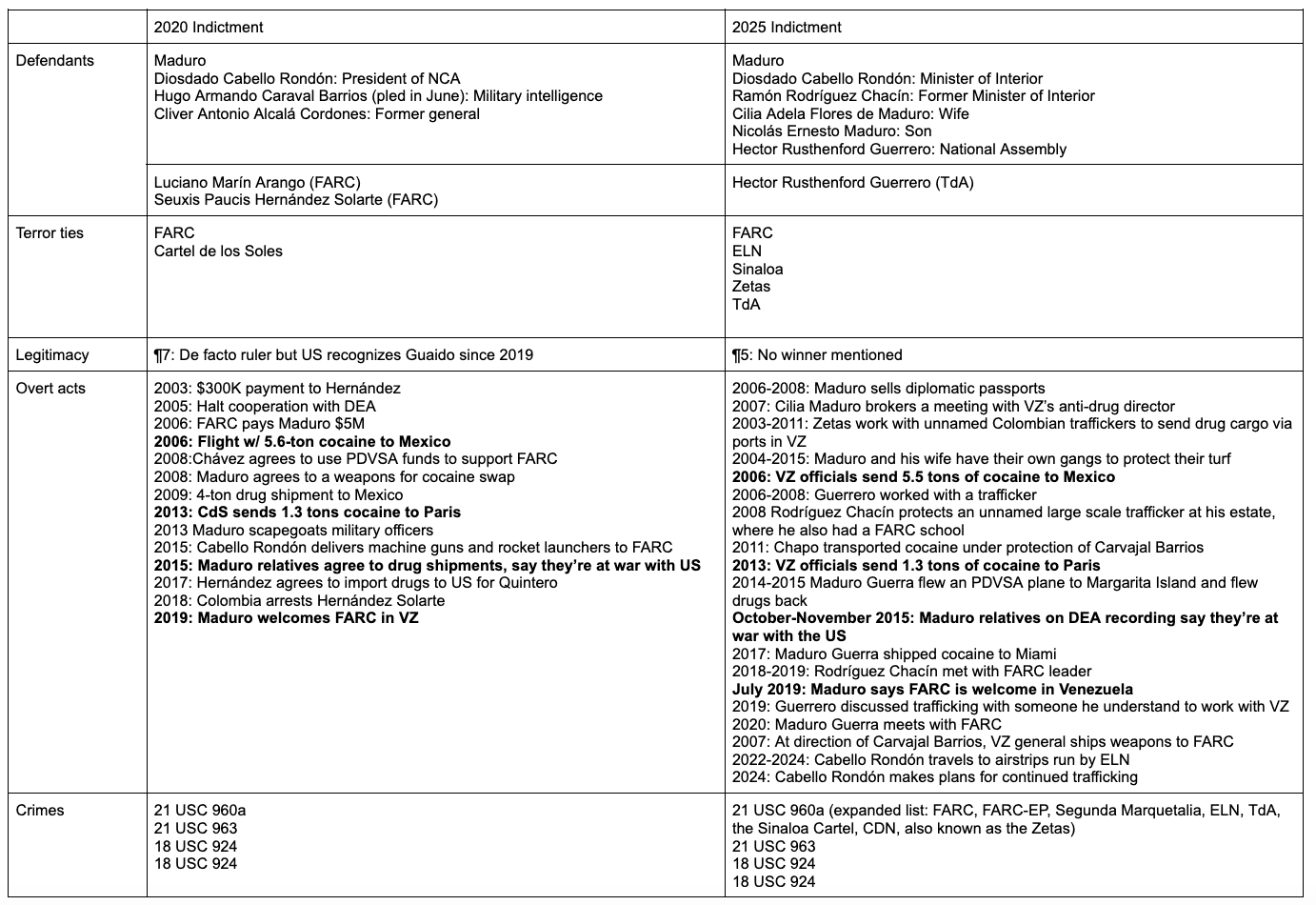
As I’ll explain below (and mapped in this table), the superseding indictment against Nicolás Maduro and his wife unsealed yesterday is a more political document than the one that first charged Maduro in 2020. One important difference lies in how DOJ attempted to claim Maduro is not the leader of Venezuela, which will be a key element required to overcome any immunity claim Maduro will surely invoke.

Before I explain the differences between these indictments, let me stress that both are real indictments, documenting decades of corruption and cooperation with drug traffickers and terrorists. Prosecutors worked hard to pull them together and investigators (in the US and around Latin America) and sources no doubt risked their lives to make it possible.

The charges remain the same as in 2020

Both indictments charge the same four crimes:

  • Narco-Terrorism Conspiracy (21 USC 960a)
  • Cocaine Importation Conspiracy (21 USC 963)
  • Two counts of use of machine guns or destructive devices in furtherance of the conspiracies (18 USC 924)

The latter charges, charging Maduro for possessing machine guns, have attracted some mockery, including from me. DOJ is at the same time arguing that DC must allow semi-automatic weapons and at the same time charging a foreign leader with possessing machine guns. The charges are there (and were put there years ago) because they’re a way to get significant sentencing enhancements for other crimes. The presentencing memo for Hugo Armando Caraval-Barrio, who was charged with Maduro in 2020 and pled guilty in June, added so many sentencing enhancements they’re having a multi-day hearing later this month to fight about which ones apply. But given the evolution of gun prohibitions in the US since Bruen (issued in 2022), Maduro may try to challenge this charge, though Caraval-Barrio pled to those same charges in June.

DOJ includes Sinaloa, los Zetas, and Tred de Aragua for reasons that likely have to do with Stephen Miller’s fever dreams

In addition to adding overt acts that happened since 2020, the Narco-Terrorism Conspiracy charged in the newly unsealed indictment is interesting — and may have further significance — because it added several new cartels that have been deemed terrorist organizations last year. The 2020 indictment focused on FARC, the left wing Colombian terrorist organization that trafficked drugs, and Cartel de Soles (the vague name used for Maduro’s corruption). But in the last year, the Trump Administration has, for the first time (and controversially), designated drug cartels that engage in extreme violence as terrorist organizations. So the new indictment names not just FARC and ELN — Colombian terrorists whom Maduro gave shelter — but Sinaloa and the Zetas, along with Tren de Aragua.

24. It was a part and an object of the conspiracy that NICOLAS MADURO MOROS, DIOSDADO CABELLO RONDON, and RAMON RODRIGUEZ CHACIN, the defendants, and others known and unknown, would and did engage in conduct that would be punishable under Title 21 , United States Code, Section 841 ( a), if committed within the jurisdiction of the United States, to wit, the distribution of, and possession with the intent to distribute, five kilograms and more of mixtures and substances containing a detectable amount of cocaine, knowing and intending to provide, directly and indirectly, something of pecuniary value to a person and organization that has engaged and engages in terrorism and terrorist activity (as defined in Title 8, United States Code, Section 1182(a)(2)(B)), or terrorism (as defined in Title 22, United States Code, Section 2656f(d)(2)), to wit, the following organizations that have been designated by the United States Secretary of State as FTOs pursuant to Section 219 of the INA, during times relevant to this Superseding Indictment: FARC, FARC-EP, Segunda Marquetalia, ELN, TdA, the Sinaloa Cartel, CDN, also known as the Zetas, and each organization’s members, operatives, and associates, having knowledge that such organizations and persons have engaged and engage in terrorist activity and terrorism, in violation of Title 21, United States Code, Section 960a. [my emphasis]

This is one of the things I view as political. There’s far more substance behind the FARC allegations than the Sinaloa and Zetas ones. The Zetas allegation relies on the Zetas’, working with unnamed Columbian traffickers, use of Venezuelan ports from 2003 to 2011. The Sinaloa allegation relies on Caraval-Barrio’s protection of Chapo Guzmán in 2011. Both those allegations took place long before Marco Rubio included the Mexican cartels in his new designations. But by including them in this indictment, DOJ makes this application of such crimes applicable in Mexico, an ominous inclusion given Trump’s overt threats to pull the same kind of invasion in Mexico next.

The Tren de Aragua is likewise thin. In the 2020 indictment, two FARC leaders were included as co-conspirators, but that reflected a sustained relationship with Maduro as laid out in the overt acts. The TdA inclusion here relies on a similar move, including its leader, Hector Ruthsenford Guerrero Flores as a co-conspirator. But his inclusion relies on two overt acts that don’t involve Maduro: Guerrero’s actual trafficking with someone not alleged to be part of this conspiracy, and comments made in a Venezuelan prison in 2019. (These may be the comments that US intelligence services have deemed to be unreliable.)

f. Between approximately 2006 and 2008, HECTOR RUSTHENFORD GUERRERO FLORES, a/k/a “Nifio Guerrero,” the defendant, worked with one of the largest drug traffickers in Venezuela, Walid Makled. Members of the Venezuelan regime helped protect Makled’s cocaine shipments that were transported from San Fernando de Apure, Venezuela, to Valencia, Venezuela, and were then sent by plane from the Valencia international airport to Mexico and other locations in Central America for eventual distribution to the United States. Between in or about 2008 and in or about 2009, GUERRERO FLORES also provided another major Venezuelan drug trafficker with protection for cocaine shipments moving through Venezuela, including by providing armed men who carried, among other automatic weapons, AK47s, MP5s, and AR-15s, as well as grenades. At times, GUERRERO FLORES personally accompanied large cocaine loads as they were guarded by the teams of armed men, en route to airports or airstrips for transport north and eventual distribution to the United States. GUERRERO FLORES was paid a fee per kilogram of cocaine transported or received and he sometimes received an interest in portions of these massive cocaine shipments in lieu of payment. The traffickers that GUERRERO FLORES worked with moved thousands of kilograms per shipment, multiple times per month, resulting in the distribution of hundreds of tons of cocaine to the United States. In or about 2009, Makled was charged with narcotics offenses in this District and is a fugitive.

[snip]

o. In or about 2019, TdA’s leader, GUERRERO FLORES, discussed drug trafficking with an individual he understood to be working with the Venezuelan regime. Over multiple calls, GUERRERO FLORES offered to provide escort services for drug loads, explaining that GUERRERO FLORES and TdA had control of the coastlines of Venezuela’s Aragua State. GUERRERO FLORES, speaking from TdA’s base of operations in Tocor6n Prison, explained that TdA could handle the logistics of every aspect of the drug trade, including the use of storage compartments that GUERRERO FLORES called “cradles” located on a beach in Aragua State. In doing so, GUERRERO FLORES confirmed TdA’s ability to protect over one ton of cocaine.

That is, neither is TdA necessary to substantiate the narco-trafficking charges, which are well-substantiated based on protection of FARC, nor is the substance of TdA’s inclusion all that convincing.

At all.

But no doubt Stephen Miller will use this — a grand jury finding probable cause tying TdA to Maduro — to attempt to renew his Alien Enemies Act deportations.

Adding the family, leaving behind the key co-conspirator

On top of swapping FARC co-conspirators for a TdA one, the newly unsealed indictment adds Maduro’s wife and son as co-conspirators.

The inclusion of Maduro’s son is better substantiated. The indictment alleges that his plane was used to ship drugs, he shipped drugs to Miami, and he met with FARC (though neither he nor his mother are included in the narco-trafficking charge).

The inclusion of Cilia Maduro — who was shipped to SDNY along with her husband — rests on her allegedly accepting a bribe in 2007 to broker a meeting between a trafficker and Venezuela’s corrupt top anti-drug cop.

b. In approximately 2007, CILIA ADELA FLORES DE MADURO, the defendant, attended a meeting in which FLORES DE MADURO accepted hundreds of thousands of dollars in bribes to broker a meeting between a large-scale drug trafficker and the director of Venezuela’s National Anti-Drug Office, Nestor Reverol Torres. The drug trafficker later arranged to pay a monthly bribe to Reverol Torres, in addition to approximately $100,000 for each flight that was transporting cocaine to ensure the flight’s safe passage, a portion of which was then paid to FLORES DE MADURO. In or about 2015, Reverol Torres was charged with narcotics offenses in the Eastern District of New York and is a fugitive.

But prosecutors likely included Maduro’s family — and snatched Cilia along with her spouse — to acquire leverage against him.

One more point about alleged co-conspirators. In the wake of yesterday’s invasion, Diosdado Cabello Rondón, who is incorporated into the narco-trafficking charge and was already in 2020, was the first person to call for calm, calling the Americans terrorists.

At the crack of dawn, Diosdado Cabello, the regime’s second-in-command, appeared on state-run Venezolana de Televisión, clad in tactical vest and helmet and surrounded by members of the political police. Cabello called the U.S. attack “treacherous and vile” and urged his supporters “not to lose their composure, to avoid despair.” “Avoid situations that favor the invading enemy,” he said. Cabello questioned the role of “international organizations” in this crisis, accusing them of being “complicit in a massacre of civilians.” The leader addressed his men on camera with the two central slogans of the regime’s security forces: “Always loyal, never traitors” and “To doubt is treason.”

This analysis of the aftermath notes that you’d have to take out more of Maduro’s aides, including Cabello, to defeat his government.

For more than a decade, real power in Venezuela has been held by a small circle of senior officials. Analysts and officials say though that the system depends on a sprawling web of loyalists and security organs, fueled by corruption and surveillance.

Within the inner circle, a civilian-military balance reigns. Each member has their own interests and patronage networks. Currently Rodriguez and her brother represent the civilian side. Padrino and Cabello represent the military side.

This power structure makes dismantling Venezuela’s current government more complex than removing Maduro, according to interviews with current and former U.S. officials, Venezuelan and U.S. military analysts and security consultants to Venezuela’s opposition.

“You can remove as many pieces of the Venezuelan government as you like, but it would have to be multiple actors at different levels to move the needle,” said a former U.S. official involved in criminal investigations in Venezuela.

A big question mark surrounds Cabello, who exerts influence over the country’s military and civilian counterintelligence agencies, which conduct widespread domestic espionage.

“The focus is now on Diosdado Cabello,” said Venezuelan military strategist Jose Garcia. “Because he is the most ideological, violent and unpredictable element of the Venezuelan regime.”

Donald Trump conducted a months-long operation to carry out an arrest, he claims. But somehow they left behind someone alleged to be just as culpable in the headline charges of the indictment, Cabello.

Disavowing democracy in attempting to negate Maduro’s immunity claim

Yesterday, Trump and Marco Rubio claimed that Maduro’s Vice President, Delcy Rodriguez, would do as she was told. Then she went on TV and said Maduro was still the president and Venezuela would never again be the colony of an empire. It’s unclear whether she’s misleading Marco Rubio or the Venezuelan people, or simply trying to find middle ground.

But her claim to authority only comes through Maduro.

And that’s important because, as Oona Hathaway explained this in an interview with Isaac Chotiner, whether or not Maduro is and was a head of state is central to what will surely be an attempt to claim he is immune from all this.

What do you mean, exactly, about his “seizure and indictment”? Venezuela had an election. It was not a free election. He declared himself President, and he’s broadly recognized as the President of Venezuela, but, again, he was not freely elected by the people of Venezuela. That could justify his indictment in an American court?

I should back up. As part of this military operation, at least one of the key goals seems to have been the capture of Maduro and his wife, who have been indicted for criminal charges in the Southern District of New York. The only way they can do that is if they’re claiming that he’s not a head of state, because heads of state get immunity and heads of state are not subject to criminal prosecution in the domestic courts of other states. That’s just a basic rule of international law. The United States has long recognized it.

So you were not saying that the fact that he stole an election per se means you can grab him and try him in an American court but, rather, that if he were not a head of state, that would at least allow for trying him in an American court, which normally would not be the case?

Right. So if he’s not actually a head of state, then head-of-state immunity doesn’t apply. And it’s connected to this broader question of the use of military force in that it may be that they would make a claim—although I haven’t yet seen this—that because he’s not the legitimate head of state that somehow they have a legal authority to use force to grab him. But, again, the two don’t connect. So the problem is that merely saying that he’s not head of state doesn’t then justify the use of military force in Venezuela.

[snip]

So if Maduro goes to trial in an American court, is this going to be a contested legal issue about whether he can even be tried based on whether he is the head of state of Venezuela? Is that something that American courts are going to have to weigh in on?

Yes, it is something that the American courts are going to have to weigh in on. It definitely is the case that his lawyers will make the argument that he’s a sitting head of state at the time that he was seized and that he remains the sitting head of state and therefore, under international law and under U.S. law, he should be given immunity, which means that he’s not subject to the jurisdiction of U.S. courts and can’t be criminally charged. This has come up once before with the criminal indictment of Manuel Noriega, the former leader of Panama, when the U.S. invaded Panama in 1989 and seized Noriega and then brought him back to the United States and indicted him for drug smuggling and money laundering.

Back then, Noriega argued that he enjoyed head-of-state immunity, and the executive branch argued that he didn’t because the United States had not recognized him as a legitimate leader of Panama. That gives us a hint as to what is likely to happen in this case. My guess is that the United States will argue that it’s never recognized Maduro as a legitimate leader of Venezuela and therefore he doesn’t receive immunity. And the courts are going to be in the position of having to decide whether they defer to the executive branch’s determination that he’s not head of state or whether they make an independent assessment of his legitimacy as a leader of Venezuela.

How did the Noriega case play out?

In the Noriega case, the courts deferred to the executive branch. They said they were going to accept that the executive branch said that he’s not a constitutional head of state, and therefore he can, in fact, be prosecuted.

Seems quite possible they will do so again now.

It seems likely they’re going to do the same thing. I mean, this is a weaker argument on the part of the executive branch.

Both indictments attempt to deal with this issue. The 2020 one does so by pointing to the US’ 2019 endorsement of Juan Guaidó.

In or about 2018, MADURO MOROS declared victory in a presidential election in Venezuela. In or about 2019, the National Assembly of Venezuela invoked the Venezuelan constitution and declared that MADURO MOROS had usurped power and was not the president of Venezuela. Since in or about 2019, more than 50 countries, including the United States, have refused to recognize MADURO MOROS as Venezuela’s head of state and instead recognized Juan Guaidó as the interim president of Venezuela. In or about January 2020, the United States Department of State certified the authority of Guaidó, as the interim president of Venezuela, to receive and control property in accounts at the United States Federal Reserve maintained by the Venezuelan government and the Central Bank of Venezuela.

The Trump Administration went all-in on declaring Guaidó interim president and … that went nowhere.

This equivalent paragraph in the newly unsealed indictment doesn’t say who runs Venezuela.

5. NICOLAS MADURO MOROS, the defendant, a Venezuelan citizen, was previously the President of Venezuela, and is now, having remained in power despite losses in recent elections, the de facto but illegitimate ruler of the country. MADURO MOROS also previously held a seat in Venezuela’s National Assembly between in or about 2000 and in or about 2006, acted as the Venezuelan Minister of Foreign Affairs between in or about 2006 and in or about 2013, and acted as the Vice President of Venezuela in or about 2013. MADURO MOROS succeeded to the Venezuelan presidency after former President Hugo Chavez died in or about 2013 and, during MADURO MOROS’s own presidency, continued to participate in cocaine trafficking with drug dealers and narco-terrorist groups. In or about 2018, MADURO MOROS declared victory in a disputed and internationally condemned presidential election in Venezuela. In or about 2019, Venezuela’s National Assembly invoked the Venezuelan constitution and declared that MADURO MOROS had usurped power and was not the legitimate President of Venezuela. Nonetheless, MADURO MOROS continued to exercise the powers of the Venezuelan presidency, causing more than 50 countries, including the United States, to refuse to recognize MADURO MOROS as Venezuela’s head of state. In or about 2024, Venezuela held another presidential election that was again widely criticized by the international community, in which MADURO MOROS declared himself the winner despite widespread condemnation.

Most independent observers believe Edmundo González won last year’s election. María Corina Machado just won a Nobel Prize as the leader of the opposition (though she claims González is the rightly elected President).

Yet not only doesn’t this indictment name either of them, yesterday Trump said of Machado, “She’s a very nice woman, but she doesn’t have the respect.”

I’ll leave it to experts like Hathaway to unpack whether Trump’s explicit denial of those with a real democratic claim to power has any impact on an immunity claim that Maduro is sure to mount. Her observation that SCOTUS, especially this SCOTUS, will likely defer to the Administration.

I’m simply observing that this indictment was designed, from the start, to rely on illegitimate claims about the lawful president in Venezuela. It had puppet power built into it.

Again, none of this says that the guts of this indictment are suspect. They’re not.

But it’s the packaging of it — a shift that occurred since Trump last indicted Maduro in 2020 — that could have significantly broader repercussions.

Trump’s Selective Drug Enforcement in Latin America

Donald Trump conducted a military invasion of Venezuela purportedly in service of arresting Nicolás Maduro to stand trial in the US.

The indictment against him (I assume it has been superseded since he was added in March of 2020) alleges that he personally was involved in negotiating FARC-sourced cocaine shipments.

5. While pursuing these and other objectives, NICOLÁS MADURO MOROS, the defendant, negotiated multi-ton shipments of FARC-produced cocaine; directed that the Cártel the Los Soles provide military-grade weapons to the FARC; coordinated foreign affairs with Honduras and other countries to facilitate large-scale drug trafficking; and solicited assistance from FARC leadership in training an unsanctioned militia group that functioned, in essence, as an armed forces unit for the Cártel de Los Soles.

Maduro’s former military intelligence head, Hugo Armando Carvajal Barrios, pled guilty in June. There’s no sign, at least not public, that Carvajal Barrios is cooperating (they’re holding a hearing this month before Judge Alvin Hellerstein because he claims not to have pled to the individual elements of the offense from which SDNY crafted an onerous sentence).

Meanwhile, I have already pointed to this excellent Bloomberg piece on the similar efforts SDNY made to bring former. President of Honduras Juan Orlando Hernández to justice. It describes how JOH’s family pitched Trump on a pardon in part by promising that with his pardon (and the return of his party to power, as has happened), Honduras would return the autonomous zones Trump allies like Peter Thiel have championed.

By July, the family and their lawyers had written an 18-page draft outlining some of the ways they might appeal to Trump’s pardon czar, Alice Marie Johnson. From Trump, they’d learned the language of modern political grievance: “Just like President Trump, President Hernández is a victim of lawfare, waged by the Biden administration.” If pardoned, Hernández would return to Honduras and dedicate himself to building a political movement in Latin America aligned with Trump’s foreign policy ambitions. The memo noted that Hondurans would go to the polls on Nov. 30 to elect a new president, and it suggested a timely pardon could energize conservatives in a region threatened by “radical left” regimes, including China and Venezuela. (Johnson didn’t respond to a request for comment.)

But it wasn’t only Trump who could benefit from a pardon. Castro, Hernández’s successor, repealed the legal framework that had established the country’s semi-autonomous economic development zones, including Próspera. That led the Honduran supreme court to declare those zones unconstitutional, triggering still-unresolved lawsuits from their investors. (Próspera continues to operate.) The memo asserted that Castro’s administration “has effectively stolen billions” from the financial backers of Próspera. The memo named Peter Thiel (“a longtime collaborator of Vice President J.D. Vance”) and Marc Andreessen (“who also donated millions to ensure that Trump’s policy goals could be achieved”).

A timely pardon—especially one delivered before the election—might remedy all that. It could also give Trump one more regional ally against the “narco-dicatorship” in Venezuela, where the Trump administration in September would begin launching military strikes against boats suspected of carrying drugs.

This kidnapping of Maduro is not about drug trafficking, though the indictment against him is real.

It’s about getting a piece of the action.

Update: Here’s the final paragraphs of a 1989 OLC opinion that then OLC head and future AG when Maduro was first indicted Bill Barr signed to rationalize the Panama invasion, on which this was surely modeled.

IV. Conclusion This Office concludes that at the direction of the President or the Attorney General the FBI may use its statutory authority under 28 U.S.C. § 533(1) and 18 U.S.C. § 3052 to investigate and arrest individuals for violations of applicable United States law, even if those actions depart from customary international law or unexecuted treaties. Moreover, we conclude that the President, acting through the Attorney General, has inherent constitutional authority to deploy the FBI to investigate and arrest individuals for violations of United States law, even if those actions contravene international law. Finally, we conclude that an arrest that is inconsistent with international or foreign law does not violate the Fourth Amendment.

35 There is some doubt whether the Fourth Amendment standard includes a requirement o f domestic law authority to arrest. The 1980 Opinion concluded that it does 4B Op O L C at 553-54. That Opinion relied principally on United States v. D i Re, 332 U S 581, 589-92 (1948), a case involving exclusion o f evidence obtained incident to an unauthorized arrest by federal officials. But it is not clear that Di Re was a Fourth Amendment decision, and it is also unclear that the-Constitution requires statutory or other authonty to arrest. See 1 Wayne R. LaFave, Search- and Seizure § 1 5(b) at 107 (2d ed. 1987) (concluding that D i Re is not a Fourth Amendment case but “simply an instance of the court utilizing its supervisory power to exclude from a federal prosecution evidence obtained pursuant to an illegal but constitutional federal arrest”). Cf George E Dix, Fourth Amendment Federalism: The Potential Requirement of State Law Authorization for Law Enforcement Activity, 14 Am J. Crim L. 1, 10 (1987) ( “There is considerable doubt. as to whether the Court has . . committed itself to the position that the fourth amendment reasonableness o f an arrest depends upon the existence o f state Jaw and the arrest’s validity under that law.”). In any event, as we have previously stated, we believe that authority exists for the Executive to authorize the FBI to make arrests in foreign countnes 3r’As to an arrest in a non-public place, there are circumstances in which an arrest warrant is required. Payton v New York., 445 U S 573, 576 (1980). While presumably an arrest warrant often could be obtained, there are limitations to the extraterritonal junsdiction o f the magistrate’s writ See 18 U.S C §§ 3041-3042 Commentators have questioned, however, whether the warrant requirements o f Payton and other cases should apply overseas. See Saltzburg, supra, 20 Va J Int’l L. at 762; Stephan, supra, 20 Va. J Int’l L at 792 n.44 37 We note that fear that our agents will be extradited for violations of foreign law during an enforcement operation authonzed by the President or the Attorney General is not a warranted concern The Secretary o f State always has discretion to refuse to extradite, even if the offense is covered by an extradition treaty entered into with another country See 18 U S C. § 3186 (Secretary of State “may” extradite the person committed under section 3184); Stndona v Grant, 619 F.2d 167 (2d Cir 1980), Wacker v. Bisson, 348 F.2d 602, 606 (5th Cir 1965). 183

WILLIAM P. BARR

Assistant Attorney General

Office of Legal Counsel

Update: Here’s the superseding indictment.The machine gun allegations are far sillier than I imagined.

CIA Finally Declassifies “Gloves Come Off” Memorandum of Notification Reference

Screen Shot 2016-06-14 at 3.22.25 PM

Back in 2012, I wrote a series of posts on the Obama Administration’s extraordinary efforts to censor this title. (post 1, post 2, post 3, post 4, post 5, post 6post 7, post 8)

The title was part of some smart CYA on the part of George Tenet. When things started to go south with the torture program in 2003, he wrote this document, ostensibly putting order to the torture program, but also making it clear the whole thing operated on Presidential authority. (The document, which should have been released to David Passaro in his criminal trial for torturing a detainee who subsequently died, was withheld, which prevented him from pointing out anything he did, he did with Presidential approval, so Tenet’s CYA didn’t help him at all.)

The judge in ACLU’s lawsuit to liberate torture documents, Alvin Hellerstein, decided the language should not be censored, and ordered the government release it. Then National Security Advisor Jim Jones wrote a secret declaration stating that it could not be disclosed. All the while, ACLU thought they were fighting to release a description of waterboarding, when in fact Hellerstein was trying to force the Administration to release the single detail that torture had been done on the President’s order.

But the Second Circuit overruled Hellerstein, declaring these 8 words a source and method (for the record, I guessed exactly what was behind the redaction so their secret was only useful for legal challenges).

That the torture program operated pursuant to a Finding (that is, as a covert op) had long been known thanks to blabby CIA types like John Rizzo. But it was formally declassified as part of the Torture Report. It got released today as part of a Jason Leopold lawsuit.

So there you have it. “Presidential Memorandum of Notification of 17 September 2001.” A secret Obama fought to the circuit court, now public for all the world to see.

It doesn’t feel so momentous, does it?

Some Torture Facts

At the request of some on Twitter, I’m bringing together a Twitter rant of some facts on torture here.

1) Contrary to popular belief, torture was not authorized primarily by the OLC memos John Yoo wrote. It was first authorized by the September 17, 2001 Memorandum of Notification (that is, a Presidential Finding) crafted by Cofer Black. See details on the structure and intent of that Finding here. While the Intelligence Committees were briefed on that Finding, even Gang of Four members were not told that the Finding authorized torture or that the torture had been authorized by that Finding until 2004.

2) That means torture was authorized by the same Finding that authorized drone killing, heavily subsidizing the intelligence services of countries like Jordan and Egypt, cooperating with Syria and Libya, and the training of Afghan special forces (the last detail is part of why David Passaro wanted the Finding for his defense against abuse charges — because he had been directly authorized to kill terror suspects by the President as part of his role in training Afghan special forces).

3) Torture started by proxy (though with Americans present) at least as early as February 2002 and first-hand by April 2002, months before the August 2002 memos. During this period, the torturers were operating with close White House involvement.

4) Something happened — probably Ali Soufan’s concerns about seeing a coffin to be used with Abu Zubaydah — that led CIA to ask for more formal legal protection, which is why they got the OLC memos. CIA asked for, but never got approved, the mock burial that may have elicited their concern.

5) According to the OPR report, when CIA wrote up its own internal guidance, it did not rely on the August 1, 2002 techniques memo, but rather a July 13, 2002 fax that John Yoo had written that was more vague, which also happened to be written on the day Michael Chertoff refused to give advance declination on torture prosecutions.

6) Even after CIA got the August 1, 2002 memo, they did not adhere to it. When they got into trouble — such as when they froze Gul Rahman to death after hosing him down — they went to John Yoo and had him freelance another document, the Legal Principles, which pretend-authorized these techniques. Jack Goldsmith would later deem those Principles not an OLC product.

7) During both the August 1, 2002 and May 2005 OLC memo writing processes, CIA lied to DOJ (or provided false documentation) about what they had done and when they had done it. This was done, in part, to authorize the things Yoo had pretend-authorized in the Legal Principles.

8) In late 2002, then SSCI Chair Bob Graham made initial efforts to conduct oversight over torture (asking, for example, to send a staffer to observe interrogations). CIA got Pat Roberts, who became Chair in 2003, to quash these efforts, though even he claims CIA lied about how he did so.

9) CIA also lied, for years, to Congress. Here are some details of the lies told before 2004. Even after CIA briefed Congress in 2006, they kept lying. Here is Michael Hayden lying to Congress in 2007

10) We do know that some people in the White House were not fully briefed (and probably provided misleading information, particularly as to what CIA got from torture). But we also know that CIA withheld and/or stole back documents implicating the White House. So while it is true that CIA lied to the White House, it is also true that SSCI will not present the full extent of White House (read, David Addington’s) personal, sometimes daily, involvement in the torture.

11) The torturers are absolutely right to be pissed that these documents were withheld, basically hanging them out to dry while protecting Bush, Cheney, and Addington (and people like Tim Flanigan).

12) Obama’s role in covering up the Bush White House’s role in torture has received far too little attention. But Obama’s White House actually successfully intervened to reverse Judge Alvin Hellerstein’s attempt to release to ACLU a short phrase making it clear torture was done pursuant to a Presidential Finding. So while Obama was happy to have CIA’s role in torture exposed, he went to great lengths, both with that FOIA, with criminal discovery, and with the Torture Report, to hide how deeply implicated the Office of the President was in torture.

Bonus 13) John Brennan has admitted to using information from the torture program in declarations he wrote for the FISA Court. This means that information derived from torture was used to scare Colleen Kollar-Kotelly into approving the Internet dragnet in 2004.

Targeted Killing Timeline

A timeline!

I’ve been working on this timeline for almost nine months, trying to pull together the known dates about strikes against Americans, the evidence supporting the strike against Anwar al-Awlaki, the legal cases surrounding both targeted killing and torture, to which targeted killing is linked via the Memorandum of Notification, and Congressional efforts to exercise oversight.

September 17, 2001: George Bush signs Memorandum of Notification (henceforth, Gloves Come Off MON) authorizing a range of counterterrorism techniques, including torture and targeted killing.

September 18, 2001: Congress passes the Authorization to Use Military Force.

November 3, 2002: US citizen Kamal Derwish killed in drone purportedly targeting Abu Ali al-Harithi.

Late 2008: Ruben Shumpert reported killed in Somalia.

June 24, 2009: Leon Panetta gets briefed on assassination squad program.

June 26, 2009: HPSCI passes a funding authorization report expanding the Gang of Eight briefings.

July 8, 2009: The Administration responds with an insulting appeal to a “fundamental compact” between Congress and the President on intelligence matters.

July 8, 2009: Silvestre Reyes announces CIA lied to Congress.

October 26, 2009: British High Court first orders British government to release language on Binyam Mohamed’s treatment.

October 28, 2009: FBI kills Imam Luqman Asmeen Abdullah during Dearborn, MI arrest raid.

October 29, 2009: Hearing on declassifying mention of Gloves Come Off MON before Judge Alvin Hellerstein; in it, Hellerstein reveals NSA James Jones has submitted declaration to keep mention of MON secret.

November 5, 2009: Nidal Hasan attacks Fort Hood, killing 13.

December 24, 2009: JSOC tries but fails to hit Anwar al-Awlaki. On that day, the IC did not yet believe him to be operational.

December 25, 2009: With Umar Farouk Abdulmutallab attack, FBI develops full understanding of Awlaki’s operational goals.

January 2, 2010: In conversation with David Petraeus, Yemeni President Ali Abdullah Saleh http://www.cablegatesearch.net/cable.php?id=10SANAA4“>speaks as if Awlaki, whom he refers to as a cleric, not an AQAP member, was a designated target of December 24 attack.

Read more

Colleen McMahon’s Cheshire Cat: CIA’s Stephen Preston

As you no doubt remember from Alice in Wonderland, the Cheshire Cat keeps disappearing. Indeed, the cat’s habit of disappearing at will presents an insurmountable challenge to the Queen’s normally simple rules on executions.

When [Alice] got back to the Cheshire Cat, she was surprised to find quite a large crowd collected round it: there was a dispute going on between the executioner, the King, and the Queen, who were all talking at once, while all the rest were quite silent, and looked very uncomfortable.

The moment Alice appeared, she was appealed to by all three to settle the question, and they repeated their arguments to her, though, as they all spoke at once, she found it very hard indeed to make out exactly what they said.

The executioner’s argument was, that you couldn’t cut off a head unless there was a body to cut it off from: that he had never had to do such a thing before, and he wasn’t going to begin at HIS time of life.

The King’s argument was, that anything that had a head could be beheaded, and that you weren’t to talk nonsense.

The Queen’s argument was, that if something wasn’t done about it in less than no time she’d have everybody executed, all round. (It was this last remark that had made the whole party look so grave and anxious.)

Alice could think of nothing else to say but ‘It belongs to the Duchess: you’d better ask HER about it.’

‘She’s in prison,’ the Queen said to the executioner: ‘fetch her here.’

And the executioner went off like an arrow. The Cat’s head began fading away the moment he was gone, and, by the time he had come back with the Duchess, it had entirely disappeared; so the King and the executioner ran wildly up and down looking for it, while the rest of the party went back to the game.

While Judge Colleen McMahon’s reference to Alice was probably just an offhand reference, I submit that she’s got a Cheshire Cat right in the middle of her ruling: CIA General Counsel Stephen Preston and the Gloves Come Off Memorandum of Notification.

As you read her ruling, it’s helpful to remember that she has seen some materials that plaintiffs ACLU and NYT have not. Moreover, this ruling was not sufficient to her argument. She has also written a classified Appendix.

This opinion will deal only with matters than have been disclosed on the public record. The Government has submitted material to the Court ex parte and for in camera review. Certain issues requiring discussion in order to make this opinion complete relate to this classified material. That discussion is the subject of a separate, classified Appendix to this opinion, which is being filed under seal and is not available to Plaintiff’s counsel.

As a threshold matter, then, it is perhaps judicious to assume that any big holes in McMahon’s ruling are dealt with, by necessity, in that Appendix.

There is one obvious, glaring hole (though I am biased, given that I was the first to point to it in the government’s filings): her analysis of whether the government’s searches for documents was adequate. After laying out the relevant standard (page 35), she simply lists the Government’s explanation of its searches–one of which is a classified CIA declaration–and concludes,

This court has reviewed these explanations and concludes that the searches by the responding agencies comported with their statutory obligations.

Again, I’m biased, having pointed out all sorts of reasons why the searches were inadequate, but for McMahon to conclude they were, there must be more compelling evidence in that classified declaration, and she should have to explain how those facially inadequate searches were adequate.

But consider her treatment of a different document I’ve found missing in the past: Preston’s very public speech obliquely covering targeted killing. McMahon acknowledges (page 20) that the plaintiffs have included that in their list of public statements Obama officials have made about targeted killing, but she doesn’t give it the detailed treatment she gives several other speeches by John Brennan, Harold Koh, President Obama, Jeh Johnson, and Eric Holder.

I find that significant given that Preston laid out different logic for the legality of targeted killing than the others did, situating it in Article II rather than in the AUMF.

Preston checks off the first box–authorization under US law before the op–by looking to Article II, not the AUMF Congress passed.

First, we would confirm that the contemplated activity is authorized by the President in the exercise of his powers under Article II of the U.S. Constitution, for example, the President’s responsibility as Chief Executive and Commander-in-Chief to protect the country from an imminent threat of violent attack. This would not be just a one-time check for legal authority at the outset. Our hypothetical program would be engineered so as to ensure that, through careful review and senior-level decision-making, each individual action is linked to the imminent threat justification.

A specific congressional authorization might also provide an independent basis for the use of force under U.S. law. [my emphasis]

That’s interesting for several reasons. First, it situates the authority to use lethal force not in the stated basis OLC is using–the one SCOTUS has affirmed (sort of), but in Article II. Just where John Yoo would look to situate it.

This also means that CIA maintains it has this authority–presuming a Presidential Finding–outside the context of a declared war.

The memo described by Charlie Savage, like all the other speeches, relies on the AUMF.

Mr. Awlaki, who was born in New Mexico, was also accused of playing a role in a failed plot to bomb two cargo planes last year, part of a pattern of activities that counterterrorism officials have said showed that he had evolved from merely being a propagandist — in sermons justifying violence by Muslims against the United States — to playing an operational role in Al Qaeda in the Arabian Peninsula’s continuing efforts to carry out terrorist attacks.

Other assertions about Mr. Awlaki included that he was a leader of the group, which had become a “cobelligerent” with Al Qaeda, and he was pushing it to focus on trying to attack the United States again. The lawyers were also told that capturing him alive among hostile armed allies might not be feasible if and when he were located.

Based on those premises, the Justice Department concluded that Mr. Awlaki was covered by the authorization to use military force against Al Qaeda that Congress enacted shortly after the terrorist attacks of Sept. 11, 2001 — meaning that he was a lawful target in the armed conflict unless some other legal prohibition trumped that authority.

Preston’s speech suggests that if OLC were writing a memo authorizing the CIA to kill Awlaki–as distinct from a memo authorizing DOD to kill him–it wouldn’t necessarily situate the authority in the AUMF. And from that we can surmise that DOJ might have an entirely different memo for CIA than for DOD, with the one described by Savage being the DOD one.

I’ve suspected that’s the case for quite some time (I’ll try to rewrite the 2 very long unpublished posts laying this out).

But I suspect it even more so now.

About 30 pages of McMahon’s opinion addresses why DOD can withhold OLC opinions it has acknowledged. As part of that discussion, she asserts the NYT only wants the DOD opinion.

The Times sole apparent goal at this point is to get a hold of the OLC-DoD Memo, which, it assumes, contains the final legal analysis and justification it seeks.

The ruling doesn’t note this, but I think NYT is doing more than assume here. Savage suggested, after all, that the memo he described was the memo that governed the killing of Awlaki.

But the document that laid out the administration’s justification — a roughly 50-page memorandum by the Justice Department’s Office of Legal Counsel, completed around June 2010 — was described on the condition of anonymity by people who have read it.

So I assume he was told that the memo described to him was the memo that governed the killing a full 15 months later, at a time when CIA had taken over the lead in drone killings in Yemen from DOD.

But McMahon leaves a lot of suggestions that this is not the case, particularly in this long passage explaining why deliberative privilege governs the DOD memo the government has acknowledged. (Thoughout this section, bold emphasis mine, italics McMahon’s, and citations omitted.)

But there is no suggestion, in any of those speeches or interviews, that the legal reasoning being discussed is the reasoning set out in the OLC-DoD Memo, a document which the Government acknowledges exists. This document, unlike the OLC opinions on local enforcement of immigration laws, has never been mentioned in any public statement. For that matter, OLC has never been mentioned in any public statement; none of the speeches attribute any legal principles announced to OLC or to any opinion it has issued.

Indeed, she even quotes from a colleague’s opinion raising the possibility of other memos addressing the same topic.

My colleague Judge Scheindlin noted [in National Day Laborer Organization v ICE], “[U]nless the defendants have unlawfully withheld other legal memoranda from plaintiffs and this Court, it was the only document comprehensively laying out the legal authority for making Secure Communities mandatory. Thus, the analysis in the Memorandum seems to be the only rationale that the agency could have relied upon and adopted as the legal basis for the policy.”

In this case, however, there is no evidence that the Government “continually relied upon and repeated in public the arguments made” specifically in the OLC-DoD Memo. Read more

We Can’t Afford Another “Complicated and Quirky” Presidency

You’ve no doubt heard about the BoGlo piece that describes 9 different legal documents on which Mitt Romney was listed as CEO of Bain after the time–in 1999–when he now claims to have left the company.

Romney has said he left Bain in 1999 to lead the winter Olympics in Salt Lake City, ending his role in the company. But public Securities and Exchange Commission documents filed later by Bain Capital state he remained the firm’s “sole stockholder, chairman of the board, chief executive officer, and president.”

[snip]

Romney did not finalize a severance agreement with Bain until 2002, a 10-year deal with undisclosed terms that was retroactive to 1999. It expired in 2009.

[snip]

The Globe found nine SEC filings submitted by four different business entities after February 1999 that describe Romney as Bain Capital’s boss; some show him with managerial control over five Bain Capital entities that were formed in January 2002, according to records in Delaware, where they were incorporated.

I’m envisioning Mitt Romney, in 2017, claiming the treaty he signed with China in 2014 doesn’t really count because he wasn’t really acting as President when he signed it, in spite of his legal status as President.

But I’m most interested in the scant response the Mitt campaign gave.

A Romney campaign official, who requested anonymity to discuss the SEC filings, acknowledged that they “do not square with common sense.” But SEC regulations are complicated and quirky, the official argued, and Romney’s signature on some documents after his exit does not indicate active involvement in the firm.

“Complicated and quirky” says a guy (or gal) now spending his time trying to get Mitt elected to an even more complicated and quirky office, the Presidency.

Frankly, though, there’s precedent for a President claiming “complicated and quirky” absolves him of responsibility for things that occurred under his presidency. After all, while Bush signed the paperwork in the first 6 years of his presidency, it wasn’t until he fired Rummy that Bush actually took over responsibility for the big decisions from Dick Cheney.

And I can’t help but harp on the “complicated and quirky” document–the “Gloves Come Off” Memorandum of Notification, effectively written by now Romney advisor Cofer Black–that has undermined the accountability Presidency more generally. Effectively, that MON pre-authorized the CIA (at least) to do whatever they wanted within certain general areas of organization. It served as Presidential authorization, but insulated the President from any provable involvement in torture and assassination and partnering with lethal regimes. When proof that the President had authorized all this torture threatened to come out via legal means, the current President went to the mat to prevent that from happening.

All the rest–the debates about what Congress authorized the day after this complicated and quirky document, the OLC memos, the repeated investigations that always end up in immunity for all (or almost all)–are just the legal facade that hides the fact that in fact even our Constitution has become “complicated and quirky.” And while Obama at least admits his involvement in these issues–while still hiding them from legal liability–he has chosen to keep the structure in place and has relied on the plausible deniability it gives.

The thing is, as damning as this revelation may prove to be for Mitt, it is in fact quite unsurprising that a man can run for President on a resumé for which–his advisors say, behind the veil of anonymity–he can simultaneously claim credit but no responsibility.

That’s the way this country increasingly works. Even–perhaps especially–the Presidency.

Either Torture Is Ongoing Or the Administration Is Hiding Something Else

I don’t mean to be ungrateful that the NYT wrote an editorial about the 2nd Circuit’s decision to help the CIA hide its torture documents from FOIA. I’m not! I’m glad they’re noting how the courts are collaborating in hiding our government’s crimes from us.

But I’m going to be a bit pedantic about it.

As almost every outlet has when covering the 2nd Circuit decision, the editorial focuses primarily on the picture of Abu Zubaydah after he was tortured. That makes sense. A picture is so concrete, so easy to understand.

It does, however, also mention the court’s ruling hiding what the government has all-but confirmed is mention of the Gloves Come Off Memorandum of Notification. But it interprets those references to “concern the origins” of the torture program (I’m also grateful that NYT used the word “torture,” btw).

The court also said the C.I.A. was justified in withholding two passages in Justice Department memos that appear to concern the origins of the Bush torture program.

Now, I don’t blame the NYT for not saying this is the Gloves Come Off MON–while both Judge Alvin Hellerstein and DOJ have all-but confirmed that, that’s not adequate proof for the NYT. But these passages either represent more than “the origins of the torture program,” or we’re still in the torture business.

That’s because in his opinion, Judge Richard Wesley makes it clear that the references are to an ongoing activity.

We give substantial weight to the Government’s declarations, which establish that disclosing the redacted portions of the OLC memoranda would reveal the existence and scope of a highly classified, active intelligence activity.

In the middle of an opinion discussing torture, Wesley said some activity relating to torture  is still active.

Now, I’m not saying I think torture (well, waterboarding, anyway) is still ongoing. As I have noted, all the evidence suggests the government is hiding this very short reference to the Gloves Come Off MON because releasing it might amount to admission of all the other covert programs either explicitly or implicitly included in it–including the drone program, but also including things like buying the services of the Egyptian intelligence services.

Furthermore, we reject the district court’s suggestion that certain portions of the redacted information are so general in relation to previously disclosed activities of the CIA that their disclosure would not compromise national security. It is true that the Government has disclosed significant aspects of the CIA’s discontinued detention and interrogation program, but its declarations explain in great detail how the withheld information pertains to intelligence activities unrelated to the discontinued program.

But until the Administration explains all this, what we’ve got is a Circuit Court judge saying that he can’t release a half sentence phrase–one appearing in the title of Torture Guidelines–because that half sentence phrase relates to an activity that is still ongoing.

Which is it folks? Torture? Or simply a whole bunch of equally terrible things?

2nd Circuit: President Can Declare Proof that President Authorized Torture Secret

As I showed in a series of posts several weeks ago, the Obama Administration appealed Judge Alvin Hellerstein’s order to release a reference to–or at least a summary of it–the President’s September 17, 2001 “Gloves Come Off” Memorandum of Notification the government used to authorize the torture program and a whole slew of other things. (post 1, post 2, post 3, post 4, post 5, post 6, post 7, post 8) The 2nd Circuit just sided with the government, finding that the MON constituted an intelligence activity that could be classified under EO 12,958.

The Government contends that the information redacted from the OLC memoranda may be withheld from disclosure under either FOIA Exemption 1 or 3. In our view, Exemption 1 resolves the matter easily.4 Exemption 1 permits the Government to withhold information “specifically authorized under criteria established by an Executive order to be kept secret in the interest of national defense or foreign policy” if that information has been “properly classified pursuant to such Executive order.” 5 U.S.C. § 552(b)(1). The Government contends that the redacted information was properly classified under Executive Order No. 12,958, as amended, which authorized the classification of information concerning “intelligence activities (including special activities), intelligence sources or methods, or cryptology.”

[snip]

Based on our ex parte and in camera review of the unredacted OLC memoranda and the Government’s classified declarations, we agree with the Government that the redacted information was properly classified because it pertains to an intelligence activity.

Of particular note, the Circuit held that letting Americans know who and how the torture program was authorized would reveal the existence and scope of a still-ongoing program.

We give substantial weight to the Government’s declarations, which establish that disclosing the redacted portions of the OLC memoranda would reveal the existence and scope of a highly classified, active intelligence activity.

Though it did suggest that the parts of the program put at jeopardy would be the other activities authorized by the MON–things like targeted killings and use of SWIFT and the “purchasing” of some Middle East intelligence services.

It is true that the Government has disclosed significant aspects of the CIA’s discontinued detention and interrogation program, but its declarations explain in great detail how the withheld information pertains to intelligence activities unrelated to the discontinued program.

Note, though: this passage is as close as the opinion comes to addressing my point–that the government already acknowledged the existence of the MON in its Vaughn Index in this case (not to mention via John Rizzo’s blabbing about it). Which is to say the court didn’t acknowledge it at all.

The CIA has already revealed the existence of this MON. The only thing that keeping it secret does is shield President Bush for all the torture committed in his name.

Government Invokes Valerie Plame to Argue CIA Acknowledgment that Bush Authorized Torture Is Not Official Acknowledgment

As you’ll recall, back in April I went on a week-long rant about the great lengths–including submitting a secret declaration from the National Security Advisor–the Obama Administration had gone to hide a short reference to the September 17, 2001 “Gloves Come Off” Memorandum of Notification. In doing so, it appears the Obama Administration hid George Tenet’s invocation of the Presidential MON that authorized the capture and detention of terrorists but which the Bush Administration used as its authorization to torture those alleged terrorists. (post 1, post 2, post 3, post 4, post 5, post 6, post 7)

In a classified hearing on March 9, the government claimed that releasing the reference in question would “reveal[] for the first time the existence and the scope of” what now clearly appears to be the MON. After I went on my rant, the ACLU informed the Circuit Court that the claim might be false. If the reference was indeed to the MON, ACLU wrote, then the CIA had already revealed that the September 17, 2001 MON authorized torture in this litigation.

If true, it may be relevant to this Court’s consideration that the CIA officially acknowledged the existence of that memorandum in this very litigation.

In response to appellees’ Freedom of Information Act request, the CIA identified as responsive “a 14-page memorandum dated 17 September 2001 from President Bush to the Director of the CIA pertaining to the CIA’s authorization to detain terrorists” and “to set up detention facilities outside the United States.” Eighth Declaration of Marilyn A. Dorn

On Friday, the government responded, effectively saying that Marilyn Dorn’s declaration doesn’t count as official acknowledgement of the MON.

For the reasons set forth in the Government’s classified filings, the disclosures identified in plaintiffs’ letter, including the information provided in the Dorn declaration, do not constitute an official disclosure of the information redacted from the OLC memoranda.

Notably, in its discussion of the cases which it cited to support its claim that Dorn’s description of the MON doesn’t count, it also included language that would address John Rizzo’s extensive blabbing about the MON as well as Glenn Carle’s CIA Publication Review Board-approved reference to CIA having received a Finding covering torture (neither of which the ACLU mentioned in its letter). But look what case they cited to make that argument.

This Court applies “[a] strict test” to claims of official disclosure. Wilson v. CIA, Read more