Posts

Stephen Miller Has Similar Plans for Colombia and Columbia

Laura Jedeed wonders whether Trump is testing out a new kind of colonialism, where you basically issued orders to the corrupt illegitimate authorities, rather than installing the opposition.

Trump and Rubio’s talking points combine into a message intended not for the people of America, but for the heads of state in Cuba, Columbia, [sic] and worldwide. The message itself is simple, elegant, and ugly: do exactly what we say or America will destroy you—not your country, or your economy, or your people, but you, personally. This strategy doesn’t just let America “run” Venezuela. It allows this administration to “run” any country unable to attack us on our home turf: extract their resources, dictate their domestic policy, force their leaders to resign. All by credibly threatening extreme personal violence against any head of state who pushes back.

Credit where credit is due: it’s an entirely new approach to colonialism. Here’s how it’s worked since Britain perfected the art: you invade the country, then place the opposition party in power. That party requires your support to maintain control (if they had enough force to do it themselves they’d already be in charge). In exchange for military backup, their leader will do anything you ask.

Trump, on the other hand, has endorsed Maduro’s Vice President, Delcy Rodríguez, allegedly because the opposition party “doesn’t have the support within, or the respect within the country.” This assertion is aggressive nonsense. Opposition party weakness is a feature, not a bug, for the reasons stated above. It’s also patently untrue in this case. Election monitors from several countries agree that candidate Edmundo González Urrutia beat Maduro in a landslide two years ago by as much as 51 percent. Trump and his allies know this—they’ve used Maduro’s election theft to justify invasion. It’s kind of perfect: the party doesn’t have the power to gain power by themselves, but they’re popular enough to minimize the danger of revolt. It’s the dream situation—so why isn’t the Trump administration going for it?

Most people seem to think Trump’s endorsement of the unpopular and hostile Rodríguez stems from bitterness towards María Corina Machado, the opposition party leader who received the Nobel Peace Prize that Trump wanted so badly last year. Machado seems to think so too; she’s offered to give the prize to Trump and spent ten minutes abasing herself before the Peace President on Hannity yesterday. It won’t help. Trump is petty to the core, it’s true, but Stephen Miller and the other ghouls actually running this country would never set the entire colonial playbook on fire just to appease some old queen’s ego.

The real reason, I suspect, is this: leaving Rodríguez in charge is the only move that does not require a full-scale invasion.

Unlike Machado, Rodríguez possesses a military and police force capable of holding Venezuela together. Under the old model, that force would have threatened our hegemony, but under Colonialism 2.0, she has a strong incentive to do exactly as she’s told regardless; she is, after all, one surgical strike away from losing her freedom or possibly her life. As long as she doesn’t call Trump’s bluff or get coup’d herself, it’s foolproof.

[snip]

And the administration was right: Rodríguez is already rolling over. “We consider it a priority to move towards a balanced and respectful relationship between the US and Venezuela,” she wrote on Telegram late Sunday. “We extend an invitation to the US government to work together on an agenda for cooperation that is aimed towards shared development.” So far, so good.

That’s certainly what Trump is trying to do.

But it’s wildly premature to assess whether it’ll work.

Before I explain how it may backfire, let me observe that this plan is precisely the same plan Trump (Stephen Miller, really) is attempting with the US.

What Trump plans for Colombia is little different than what he succeeded in doing with Columbia University: Make demands on the elected leader, extract tribute, change the rules to benefit the authoritarian state. Whether it will work long term has yet to be seen, but the lesson of New College in Florida shows where things may head in the medium term: with dramatically increased costs and noticeably decreased utility. Once DeSantis is out of power, the effort is likely to be abandoned, turning New College into a bigger shell than it is already is. Columbia might take longer to collapse, unless Stephen Miller doubles down on his demands.

Now consider what makes Venezuela (or Colombia) different from Columbia, starting with the guns, guns which might come from at least three different places.

First, there are Russia, China, and some other Venezuelan patron states that are under assault as well. Trump has ordered Venezuela to expel them, stop doing business with them, and sell oil only to the US.

The Trump administration has told Venezuela’s interim president Delcy Rodriguez that the regime must meet the White House’s demands before being allowed to pump more oil, according to three people familiar with the administration’s plan.

First, the country must kick out China, Russia, Iran, and Cuba and sever economic ties, the sources said. Second, Venezuela must agree to partner exclusively with the U.S. on oil production and favor America when selling heavy crude oil, they added.

According to one person, Secretary of State Marco Rubio told lawmakers in a private briefing on Monday that he believes the U.S. can force Venezuela’s hand because its existing oil tankers are full. Rubio also told lawmakers that the U.S. estimates that Caracas has only a couple of weeks before it will become financially insolvent without the sale of its oil reserves.

As we speak, the Trump Administration is carrying out a replay of the OJ White Bronco chase, but with an empty oil tanker headed for Russia.

Russia has sent a submarine and other naval assets to escort an empty, rusting oil tanker that has become a new flashpoint in U.S.-Russia relations, according to a U.S. official.

The tanker, formerly known as the Bella 1, has been trying to evade the U.S. blockade of sanctioned oil tankers near Venezuela for more than two weeks. The vessel failed to dock in Venezuela and load with oil. Although the ship is empty, the U.S. Coast Guard has pursued it into the Atlantic in a bid to crack down on a fleet of tankers that ferry illicit oil around the world, including black-market oil sold by Russia.

The vessel’s crew repelled an effort by the U.S. to board the vessel in December and steamed into the Atlantic. As the Coast Guard followed it, the crew sloppily painted a Russian flag on its side, changed its name to the Marinera and switched its registration to Russia.

Russia has been concerned by U.S. seizures of tankers that ferry its illicit oil around the world and power its economy, and it has made the unusual move of allowing the tanker to register in Russia without an inspection or other formalities, experts say.

Update: The US has now seized the tanker.

Will this lead to some kind of direct conflict? I have no fucking clue and neither do you, because both Trump and Putin are fucking nuts. If Trump were rational, he’d retaliate not with direct confrontation in the North Sea, but by arming Ukraine and giving them the green light to up its attacks on Russia, but he’s not rational. Russia’s economy is actually close to collapse, and it wouldn’t take much to get it there. Russia, of course, has other means it might use to retaliate against Trump.

We shall see.

China is another matter though. China not only is rational, but China kicked the shit out of Trump in his last attempt to demand obeisance, the tariffs. Trump thought he could achieve with tariffs what he is trying to achieve with Venezuela: obeisance and personal tribute. Not only have all the tariffs harmed the US, spiking small business bankruptcies and inflation (and in the process making Trump’s political support far weaker), but China used its near-monopoly on rare earths and ability to replace US soybeans to bring Trump to his knees instead.

In fact, the Venezuelan coup might be partly a response to China’s success at wielding the rare earth weapon. While there’s much I disagree with in it, this post argues the Venezuela invasion was not about oil, but about the rare earth China currently extracts.

Investigative reporting documented Chinese buyers operating directly at mining sites in Bolívar state. The Venezuelan government established official collection centers in Los Pijiguaos and Morichalito in 2023 specifically for cassiterite, coltan, nickel, rhodium, and titanium. The Maduro regime designated these as strategic resources for commercialization, meaning state control over extraction and export, with Chinese buyers integrated into official operations from the start.

The supply chain from Venezuelan mines to Chinese refineries operates through both formal and informal channels, with Chinese buyers exercising operational control at the extraction source. Minerals extracted in the Orinoco Arc move by river and air transport to Colombian border towns, then to Bogotá for smelting into refined bars. These materials are relabeled under incorrect tariff codes, transforming raw ore into processed ferro-tantalum or other classifications that obscure origin. Final export occurs through Colombian ports at Santa Marta and Buenaventura, destined for Chinese processing facilities.

Once Venezuelan minerals blend with Colombian or Brazilian ore in these intermediary steps, tracing origin becomes effectively impossible. This laundering mechanism allows Venezuelan minerals to enter legitimate global supply chains, including those feeding US defense contractors. The result is Pentagon weapons systems potentially incorporating materials extracted under Chinese buyer supervision in Venezuelan territory, then processed in Chinese refineries controlled by Beijing.

Chinese buyers do not operate at arm’s length through market transactions. They coordinate directly at the mining sites with both Colombian guerrilla groups (ELN, FARC dissidents) who control physical security and Venezuelan state security (SEBIN) who facilitate transport using official government vehicles. One miner described seeing Chinese operatives and ELN commanders “eating together, buying material together, and getting off the helicopter together.” This is not commercial activity. This is integrated operational control where Chinese buyers work directly with armed groups and state officials to extract strategic minerals.

Trump doesn’t need — indeed, the oil companies probably don’t want — Venezuela’s oil, at least not in the short term.

He does need rare earth deposits (which is also the stated purpose of usurping Greenlands).

It took us some months to understand how China responded to Trump’s threat of tariffs. It took less time to recognize China’s advance preparation for them (based on Trump’s trade war from the first term).

A lot of the coverage of the coup views it as a profound humiliation for China, not least because China’s Latin American envoy met with Nicolás Maduro the day before the coup. That didn’t stop China (and Russia and Iran) from attending Rodríguez’ signing in, so there’s a distinct possibility they’re in at least as close coordination with Rodríguez right now as Marco Rubio.

But the most belligerent thing — the thing people expect — is that China will take Taiwan, as it was practicing to do even as Trump had a fifth of deployed assets in the Caribbean preparing to invade.
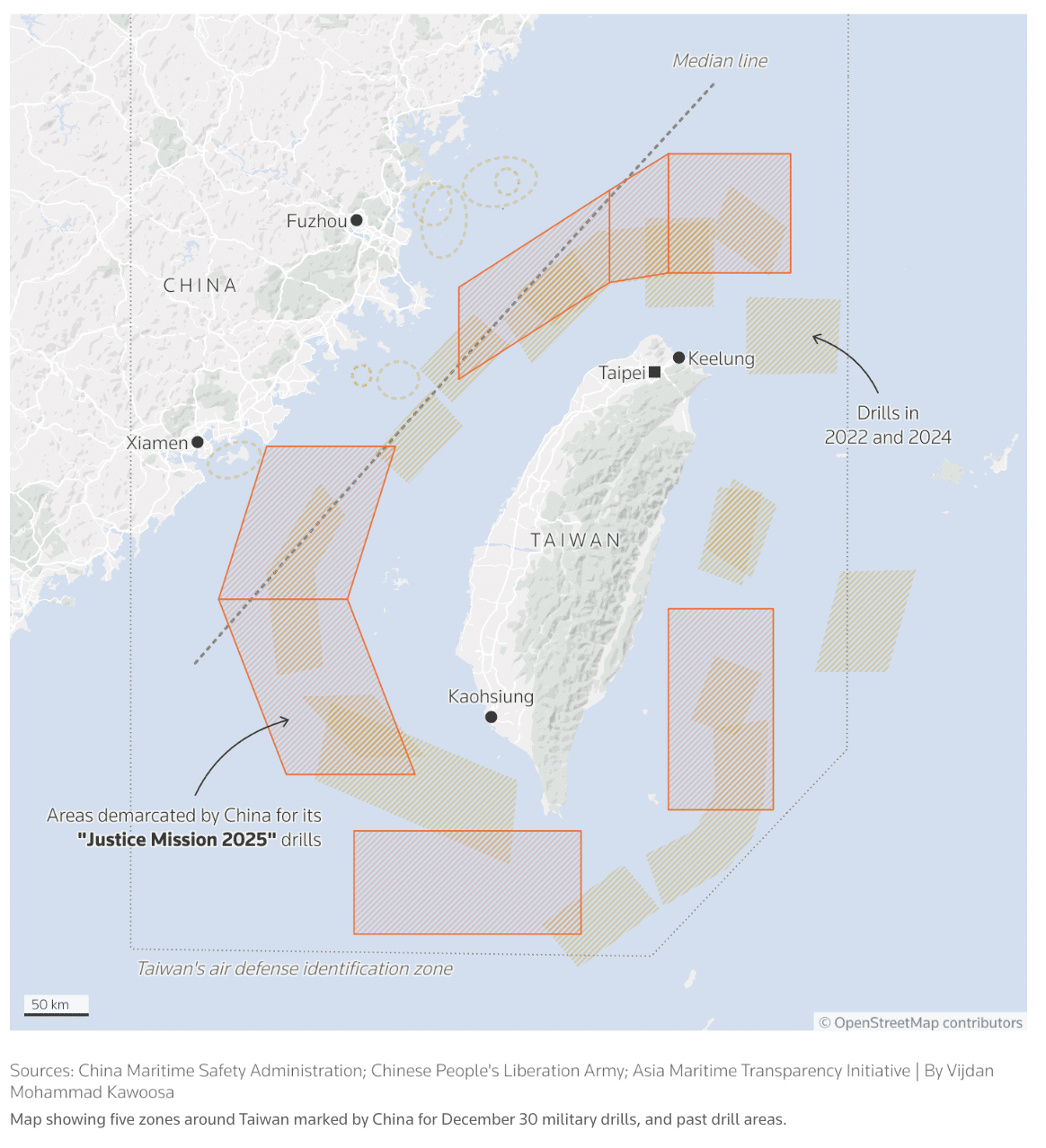
With all the attention on Venezuela, there has been too little attention on vacuums created with this extended deployment off the coast of Venezuela (the most immediate of which is probably in the Middle East). But it is clear that Trump keeps launching little wars with resources most of Congress believes should be used to counter China’s expansionary plans.

But as China showed with the tariffs, they likely have ways to respond that are less direct and at least as devastating.

But China and Russia aren’t the only ones who have guns here.

So does, just as one example, Interior Minister Diosdado Cabello, who has been indicted in SDNY alongside Maduro since 2020. Reuters describes that the US already threatened Cabello.

In the meantime, they have communicated to Cabello via intermediaries that if he is defiant, he could face a similar fate to Maduro, the authoritarian leader captured in a U.S. raid on Saturday and whisked away to New York to face prosecution on “narco-terrorism” charges, or could see his life in danger, the source said.

But taking out Cabello could be risky, possibly motivating pro-government motorcycle groups, known as colectivos, to take to the streets, unleashing the chaos Washington wants to avoid. Their reaction may depend on whether they feel protected by other officials, however.

In one of her first decisions as acting president, Rodríguez appointed General Gustavo González López as new head of the Presidential Honor Guard and the Directorate General of Military Counterintelligence (DGCIM), state TV said late on Tuesday.

González López, who has been sanctioned by the U.S. and EU along with at least half a dozen other high-ranking officials for rights violations and corruption, served as Venezuela’s intelligence director until mid-2024, when he was replaced by Maduro in a reshuffle of his cabinet and security team.

Later that year, he began working with Rodríguez as head of strategic affairs and control at state oil company PDVSA.

González López was considered close to Cabello, but it was not immediately clear whether his appointment was a gesture of support from Rodríguez to the man considered the strongman of the ruling party, or, on the contrary, a sign of a rift.

The officer replaces General Javier Marcano, whose performance came under scrutiny after Maduro’s capture, according to analysts.

One thing I’ve seen no coverage of is why the US thinks Rodríguez will be secure within Venezuela now that Trump killed the 40 Cubans who were protecting Maduro. And the militias via which Cabello exercises some of his repression could carry out a deniable kind of violence.

But Cabello isn’t even the only one with guns in question. The purported purpose of this operation is about stopping drug trafficking. But unless Trump is doing what every other caudillo does — manage the trade while extracting tribute — there will, eventually, be a counter response from the cartels, which don’t take kindly to losing their markets and have the ability to exercise violence both on site — in Venezuela — but also closer to home, including in the United States. Stephen Miller has so much of US law enforcement snatching workers at Home Depot that certain kinds of crime are likely far easier to pull off. Update: About which the NYT has another story today.

Finally, there are the Venezuelan people. Maduro only remained in power with a great deal of repression, and Trump is tinkering with that system of repression. Meanwhile, Trump’s plans to expel much of the Chinese may exacerbate already dire economic conditions for Venezuelans, because Trump won’t subsidize soft power in the way China has been willing to (to say nothing of the expulsion of Cubans who were providing medical care). Where Stephen Miller’s authoritarianism has failed most dramatically in the US is the way the counter reaction to his goons has revitalized civil society in cities that stand up to the goons. And there’s already a practiced opposition in Venezuela that, as in the US, dramatically outnumbers the goons in charge.

It’s only day four. We have no fucking idea how this will turn out. While Delta Force and the CIA performed spectacularly, there’s really just a handful of people in charge, and most — like Stephen Miller, who thinks of Venezuela as an island surrounded by a US armada and therefore is likely forgetting about a porous border with Colombia — are utterly ignorant about Venezuela and childish about power.

Columbia University was easy to subjugate, because no one had guns. But even there it only happened by damaging the host. There are a lot of people with guns with an interest in Venezuela.

It’s just as likely, in my opinion, that this precipitates World War III as that it succeeds in Venezuela much less produces the treasure Trump is demanding.

Update: CEO of the Human Rights Foundation, Venezuelan Thor Halvorssen, predicts Delcy Rodríguez’ quick demise.

Reports indicate the Trump administration has struck a deal with Delcy Rodríguez, Mr. Maduro’s iron-fisted vice president, positioning her as a transitional leader. She has, it seems, convinced U.S. officials that she can dismantle the Maduro dictatorship, which would have to include demobilizing the armed militias, disbanding the dreaded secret police and ending the regime’s drug empire. But this is a fantasy. Ms. Rodríguez will fail spectacularly, leading to the final unraveling.

Venezuela isn’t like Mexico, where a state coexists uneasily with cartels. Here, the cartel is the state. Factions—enriched generals, intelligence chiefs and narco-traffickers—won’t surrender power in a Washington-brokered deal. Ms. Rodríguez herself faces insurmountable obstacles, beginning with her utter lack of legitimacy. Never elected vice president, she has less authority than Mr. Maduro, the usurper who appointed her.

I think he wildly overestimates the extent that Trump would even permit any lapse in repression.

Update: Meanwhile on Xitter, I take this as confession that Stephen Miller knows fuckall about the oil market, especially the discount at which Venezuelan oil must be sold and the price at which it is worth drilling.
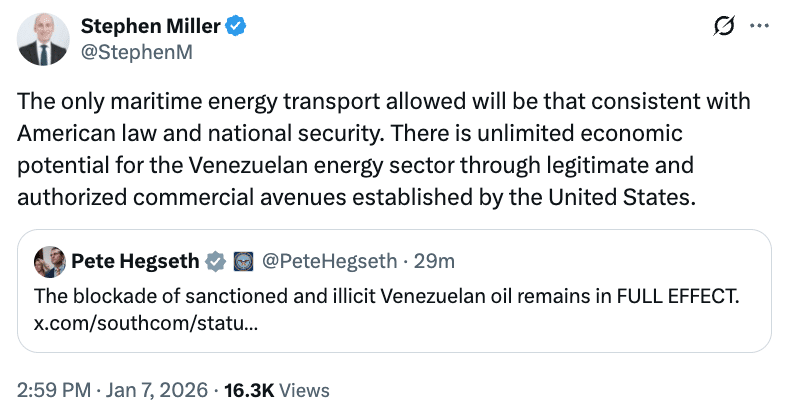
Paul Krugman’s column today is on how Trump’s oil math doesn’t add up.

[W]hatever it is we’re doing in Venezuela isn’t really a war for oil. It is, instead, a war for oil fantasies. The vast wealth Trump imagines is waiting there to be taken doesn’t exist.

Update: WSJ goes into more depth about the challenges Cabello may pose to Trump’s plans.

Fond of swinging a spiked club while spouting conspiracy theories on his hourslong weekly show on state television called “Bringing Down the Hammer,” now on its 556th episode, Cabello is hard to predict.

Cabello, a 62-year-old whose official title is minister of interior, justice and peace, has so far signaled unity, taking part in Rodriguez’s swearing-in ceremony on Monday, where various factions of Venezuela’s ruling socialist party were present.

But that night, Cabello was toting a rifle and riling up black-uniformed security forces before they patrolled Caracas to prevent citizens from protesting.

“Doubting is treason!” he said, before telling the armed group, “Now, off to battle in the streets for victory.”

Under a state of emergency that the government declared after Maduro’s capture, security forces were ordered to hunt down U.S. sympathizers, according to the Official Gazette, where the Venezuelan government publishes new laws and decrees. Residents in the capital reported new roadblocks around the city where armed, masked men checked the phones of ordinary Venezuelans for antigovernment messages.

Update: This offers a good explanation of all the people with guns who would make things difficult even if Delcy Rodríguez did want to cooperate with the US.

Update, January 9: This analysis lays out the difficulties of Delcy Rodriguez’ position better than I did.

For her part, Rodríguez confronts an unprecedented challenge for a Venezuelan leader: She must satisfy Washington’s demands while maintaining sufficient Chavista coalition support to prevent an internal fracture or a military coup. The Trump administration demands sufficient cooperation to enable US oil company operations, likely including transparent property contracts and regulatory stability—precisely the institutional environment that Chavismo systematically dismantled. Rodríguez making such an agreement with Trump would alienate the regime’s hardliners, who would view her accommodation as a betrayal. Thus, Rodríguez may be unable to guarantee the stability required for the business operations Trump wants to run in Venezuela.

Her public contradictions reflect this impossible position. In her first televised addresses as interim president, she demanded Maduro’s immediate release to demonstrate loyalty to domestic audiences. Less than twenty-four hours later, however, she declared it a priority to move toward a “balanced and respectful” economic cooperation between the United States and Venezuela.

This double game cannot persist indefinitely. Rodríguez must choose between accommodating Trump’s demands or preserving Chavista unity. Trump’s threat that if Rodríguez “doesn’t do what’s right, she is going to pay a very big price, probably bigger than Maduro” makes clear that there will be consequences of noncompliance. Purging the hardliners may be Rodríguez’s best option.

Perhaps Rodríguez’s most complex challenge is managing Venezuela’s deep entanglements with China, Russia, Iran, and Cuba while simultaneously partnering with the Trump administration. This is especially the case after the Trump administration demanded that Venezuela immediately cut ties and cease intelligence cooperation with Russia, China, Iran, and Cuba. These relationships represent more than diplomatic alignments—they constitute binding financial obligations, operational dependencies, and strategic commitments that cannot simply be abandoned without triggering massive economic and security consequences.

China presents the most significant financial exposure. Venezuela owes Beijing around twenty billion dollars in loans. These debts are secured through oil-for-loan arrangements that require repayment through crude deliveries, with China currently absorbing more than half of Venezuela’s oil exports (approximately 746,000 barrels per day in November 2025).

Beyond petroleum, Chinese state enterprises control critical Venezuelan infrastructure.
Stephen Miller and Plans for Post-Decapitation

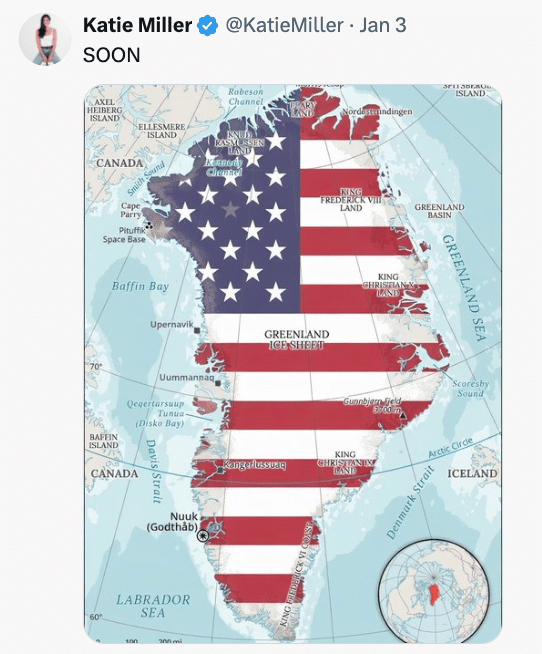
Stephen Miller’s breeding partner created a worldwide scandal by posting a picture of Greenland as an American flag.

The map from a far right podcaster, however well-connected, was actually less important than that the US President, the same day, told Michael Scherer, “we do need Greenland” because it was “surrounded by Russian and Chinese ships,” a sentiment Trump repeated on Air Force One yesterday.

During our call, Trump, who had just arrived at his golf club in West Palm Beach, was in evident good spirits, and reaffirmed to me that Venezuela may not be the last country subject to American intervention. “We do need Greenland, absolutely,” he said, describing the island—a part of Denmark, a NATO ally—as “surrounded by Russian and Chinese ships.”

Of course, since both Katie Miller and Donald Trump largely parrot what they’ve recently heard, both comments likely reflected the views of Stephen Miller.

Meanwhile, this passage of a story describing how Trump really hasn’t (yet) committed regime change, but instead decapitated the Venezuelan state only to leave Maduro’s cronies in place (for now), attracted a flood of confirmation bias.

Two people close to the White House said the president’s lack of interest in boosting Machado, despite her recent efforts to flatter Trump, stemmed from her decision to accept the Nobel Peace Prize, an award the president has openly coveted.

Although Machado ultimately said she was dedicating the award to Trump, her acceptance of the prize was an “ultimate sin,” said one of the people.

“If she had turned it down and said, ‘I can’t accept it because it’s Donald Trump’s,’ she’d be the president of Venezuela today,” this person said.

I have no doubt Trump was pissed María Corina Machado got the Nobel Prize and he did not. But a Miami Herald story published just six days after Machado’s recognition described that Delcy Rodriguez had been pitching a Madurismo without Maduro via back channels for months.

A group of senior Venezuelan government officials, led by Vice President Delcy Rodríguez and her brother Jorge, who is president of the National Assembly, have quietly promoted a series of initiatives in recent months aimed at presenting themselves to Washington as a “more acceptable” alternative to Nicolás Maduro’s regime, according to people with direct knowledge of the talks.

The proposals, funneled through intermediaries in Qatar, sought to persuade sectors of the U.S. government that a “Madurismo without Maduro” could enable a peaceful transition in Venezuela—preserving political stability without dismantling the ruling apparatus.

According to the sources, Qatari mediators presented to the U.S. two formal proposals this year, one in April and another in September. Both outlined potential governing mechanisms without Maduro in power. In those scenarios, Delcy Rodríguez would serve as the institutional continuity figure, while retired Gen. Miguel Rodríguez Torres, who is currently in exile and is not related to the Rodriguez siblings, would head a transitional government.

The central argument, the sources said, was that the Rodríguez siblings represent a “more palatable” version of so-called chavismo — the socialist ideology named for deceased leader Hugo Chávez — for Washington, since neither has been indicted on narcotrafficking charges by U.S. courts. However, former regime officials— whose accounts have been used by U.S. prosecutors in cases linked to the so-called Cartel of the Suns—have implicated both siblings in logistical support and money laundering operations.

Delcy Rodriguez is also the person who, according to the indictment charging Marco Rubio’s old roomie, former Congressman David Rivera, with acting as an unregistered agent of Venezuela (for which he is due to stand trial next month) who ordered CITGO to serve as a front for the contract. As part of the contract, Rivera lobbied Rubio in 2017 on a Maduro succession plan.

Delcy Rodriguez has been in the thick of such efforts from the moment Trump first became President.

So while the attribution of Trump’s sidelining of Venezuela’s democratic opposition — by a single person “close to the White House” — to the President’s narcissism surely has some truth, I’m more interested in that same story’s report that Stephen Miller may actually take on some of the duties of Viceroy that Trump initially assigned to the Miami-raised Spanish speaking Marco Rubio, not least because that may explain why Trump chose decapitation — retention of the oppressive Maduro regime — over regime change, replacement with a democratic one.

Having dismantled much of the U.S. foreign policy infrastructure since he came to power, Trump depends on a small number of trusted personnel and business associates to handle core issues such as his peace plan in Gaza, negotiations between Ukraine and Russia, and now Venezuela.

The National Security Council staff has been gutted and the administration has yet to nominate an assistant secretary of state to handle the Western Hemisphere.

The White House is weighing giving Stephen Miller, Trump’s deputy White House chief of staff and homeland security adviser, a more elevated role in overseeing post-Maduro operations in Venezuela, according to one person with knowledge of the conversations, who, like others, spoke on the condition of anonymity to discuss sensitive dealings.

Miller has been the architect of the administration’s anti-immigration and border policy, and took a central role in the effort to remove Maduro. He was among the handful of top administration officials flanking the president during the news conference Saturday at Trump’s Mar-a-Lago Club.

War on the Rocks argues that too many people are trying to read Trump’s decision to invade Venezuela as a statement of his ideology, rather than the result of the chaotic fight for influence within his White House.

Many observers of this administration underestimate the power struggle inside the administration and how it scrambles the output. Venezuela has been an interesting case of this. My hypothesis here is that Venezuela has been an outlet of sorts for the hawks, especially Secretary of State Marco Rubio but also others. There has been no sustained appetite for confrontation with Russia or China, and only limited room to maneuver on those fronts without significant escalation risks. Iran and Venezuela, by contrast, offered arenas for hawkish foreign policy.

[snip]

When it comes to predicting the president’s next move, too many politicians and analysts assume coherence where there is division, chaos when there is improvisation, and restraint where there is only selectivity. Trump’s foreign policy behavior emerges not from doctrine but from friction. Venezuela offered a target that felt weak, morally disreputable, geographically proximate, and manageable.

Under Trump, foreign policy outcomes are less the product of grand strategy than of episodic alignment. Observers should stop asking whether a given action is consistent with Trump’s supposed beliefs and start asking whether it is legible to him as fast, dominant, and containable. They should pay closer attention to intra-administration dynamics and to how ideas persist even when not immediately acted upon. Otherwise, the failure to predict Venezuela will not be an outlier.

Given the WaPo report (which came after Viceroy Rubio bombed on the Sunday shows) that Miller will be playing in a key role in America’s new colony, I want to situate the Venezuelan coup in Miller’s own history.

It is my belief — this is a hunch based entirely on observation, not any insider reporting — that Miller made himself indispensable when he helped Trump pull himself together after the Butler assassination attempt. Trump was completely dysfunctional after the near-death experience (I don’t blame him — everyone would be floored by that trauma). I would argue that Trump has never actually reclaimed his poise since then — throughout the campaign, he was already surpassing all decency on his political attacks, and he frequently got lost on the campaign trail, including his sundowning episode on the campaign trail. Everything people point to now as proof that he is unfit to be President was evident on the campaign trail. But Trump buried his collapse under ever grandiose fascist theater, much of it orchestrated by Miller, leading up to Trump’s fascist rally at Madison Square Garden, and shortly after, to election victory.

Whether or not that’s the case, it is clear that in the same period, Miller started laying the groundwork to use Venezuela as a propaganda foil for his assault on democracy, which I documented here.

  • 2023: Miller decides invoking the Alien Enemies Act will be a nifty way to deport people without due process.
  • September 2024: right wing propagandists stoke claim that Aurora, CO has been invaded by Tren de Aragua.
  • October 11, 2024: Miller stages a hate fest in Aurora.
  • October 18, 2024: After Tim Walz and others debunk Miller’s lies, he accuses them of defending gang members.
  • February 9, 2025: One of Miller’s earliest high profile raids targets Aurora but nets just a single TdA member.
  • February 26, 2025: The IC debunks Miller’s false claims about TdA.
  • March 14, 2025: Trump nevertheless relies on those lies while invoking the Alien Enemies Act.
  • March 16, 2025: DHS unloads planes of mostly innocent Venezuelan men in defiance of order from Judge James Boasberg.
  • March 21, 2025: Trump claims he’s not the one who signed the AEA invocation.
  • April 2025: WaPo reports that the NIE also debunked Miller’s false claims about TdA.
  • April 10, 2025: SCOTUS rules Trump has to make some effort to get Kilmar Abrego back.
  • April 14, 2025: Performance art with Nayib Bukele in Oval Office.
  • April 19, 2025: SCOTUS halts an AEA deportation order in process.

But then, on July 18, 2025, Trump swapped Venezuelans from CECOT for 10 Americans in Venezuela, seemingly dealing Stephen Miller a major defeat in his plan to rely on AEA.


I questioned why that happened here. And on the same day, NYT provided what is in retrospect even more critical background, a batshit insane story I glossed here. As the entire CECOT drama was proceeding, Trump was dicking around the Miami Hispanic community, which was clamoring to pressure Maduro, first halting then renewing Chevron’s Venezuela license.

  • January 31: Maduro makes a deal with Grenell.
  • February: Cuban-American Members of Congress (CAMC) pressure Trump to pull the Chevron license, which he does in late February (possibly between the time Rubio signs the deal with Bukele and the day 200 mostly-innocent men are loaded on planes?).
  • Chevron CEO Mike Wirth notes that if Chevron can’t export Venezuela’s oil, China will do so.
  • CAMC learn that Trump might reverse his decision, so threaten to vote against the Big Ugly Bill.
  • Stephen Miller pitches Trump on murderboats.
  • Trump lets Chevron license expire on May 27.
  • CAMC vote to pass Big Ugly.
  • Around the same time Trump considers a pardon for convicted drug kingpin Hernández, Marco Rubio sells Trump on a claim that Maduro is a drug kingpin.
  • July: Based in part on Wirth’s China argument, Trump reverses course, again, on Chevron license, Maduro accepts the CECOT prisoners and releases 10 Americans, including a triple murderer.

Trump’s flip-flopping over the Chevron license would lead up to Trump’s command, ten days before the actual invasion, that oil companies prepare to invest in Venezuela if they want compensation for equipment Maduro seized.

But we know that, after Miller first pitched Trump on drone strikes in Mexico, and then he and Rubio (Miller to support his fascist project including hopes to return to using the AEA declaration, Rubio to cater to Miami’s Cuban-American desires) pitched Trump to instead attack Venezuelan-related drug trafficking. On July 25 — a week after returning the hundreds of mostly innocent men to Venezuela — Trump signed an order to begin the murderboat campaign, with murderboat strikes beginning in September. That same day, Marco Rubio pretended this was all about the election Maduro stole last year. Another week later, Pam Bondi upped the reward to help capture Maduro — $50 million we don’t yet know whether has been claimed.

This would have been the period when CIA and Delta Force started practicing the snatch of Maduro.

According to a new WSJ story, it wasn’t yet a foregone conclusion that Trump would approve the attack. Maduro remained dancing in videos that reported inflamed Trump, and dancing in negotiations to leave peacefully (even as Delcy Rodriguez was working back channels to assume power in his wake).

  • October 7: CNN reveals Trump has a covert finding authorizing strikes on cartels.
  • October 10: Machado wins Nobel Prize.
  • October 15: Trump confirms he has signed a finding authorizing strikes on cartels.
  • October 16: Alvin Holsey announces his retirement.
  • November 16: Ford carrier group arrives in the Caribbean.
  • December 1: Trump pardons Juan Orlando Hernández, whose crimes include shipping drugs originating in and protected by Venezuela.
  • December 10: Trump starts seizing oil tankers; Machado arrives in Oslo just after the prize is awarded.
  • December 23: Maduro rejects offer to exile in Turkey.
  • Roughly December 25: Trump orders oil companies to prepare to invest in Venezuela.
  • December 29: CIA strikes a loading facility in Venezuela.
  • Unknown date: DOJ supersedes existing indictment against Maduro, shifting emphasis (without much substantiation) from Cartel de los Soles to Tren de Aragua, and including Maduro’s wife and son.
  • January 3: Trump snatches Maduro.

And immediately after Trump’s Administration imagined that they had proven their concept of decapitation without regime change, Trump started listing other places he would attack, including Cuba — high on Rubio’s list — but also Mexico (which Miller had had to defer earlier), Colombia, and Greenland.

If Marco Rubio had unilaterally won these battles, the chances would have been greater for genuine regime change; and his failure to deliver may soon sour his constituency on the snatch.

That this was, at least for the moment, decapitation, suggests Miller presided in the end.

After all, Trump also immediately likened the snatch operation to Miller’s domestic efforts to subjugate both civil society, including universities, law firms, and hospitals treating trans children, but also entire blue states, with paramilitary invasions launched in the name of deportation.

Miller’s goals are to demand subservience from everyone on threat of invasion, if not death, the stated means of keeping Delcy Rodriguez on track.

In the end, Stephen Miller is perfectly happy to get in bed with proud socialists, it turns out, so long as he can appropriate their authoritarian tools to his own ends.

“Border security is the primary element of national security.”

That sentence — “Border security is the primary element of national security” — comes from page 11 of the National Security Strategy.

Border security is the primary element of national security. Not one important element. The primary one.

That’s an insane assertion, of course. The military, the economy, real terrorism (including far right terrorism), cybersecurity, sovereign democracy all take a back seat to whatever Stephen Miller flunky had final control over the edit of the NSS, who wrote down something insane, prioritizing the border over all else.

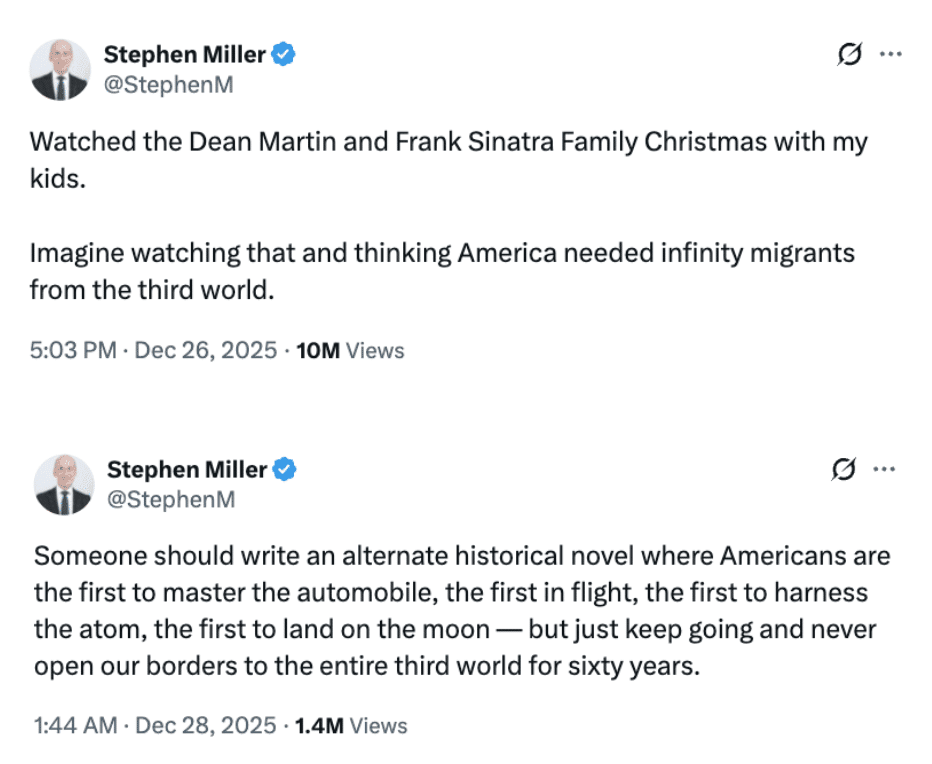
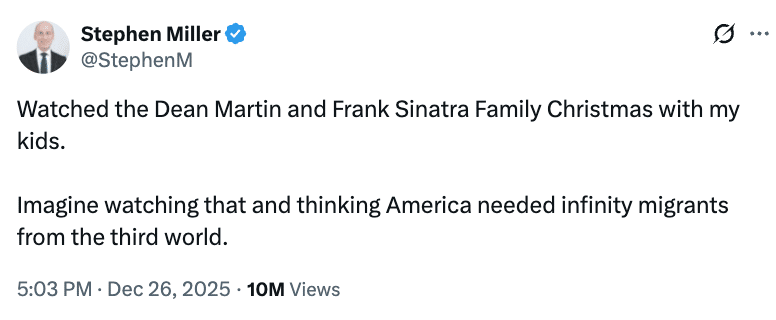
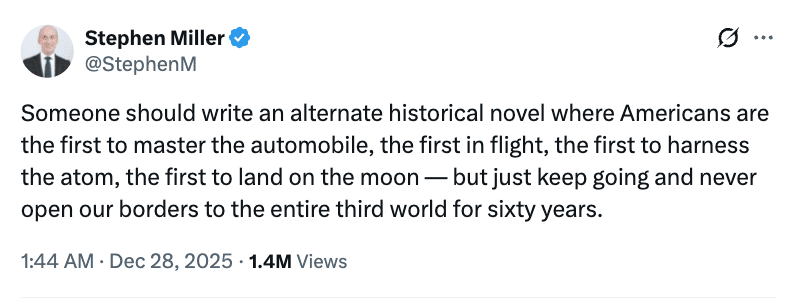
I’ve been obsessing about that comment ever since I read it, and kept thinking of it as I read this long NYT article that purports to explain Trump’s “policy” to target Venezuela. The article came out after I wrote this post attempting to understand Stephen Miller’s most prominent reversal over the last year, and in-between these two Tweets that make it very clear Miller’s entire conception about immigration to the US — even his own family’s immigration to the US — is based off his historically ignorant fantasies.

The story might be better staged as a Coen Brothers buddy movie featuring Stephen Miller, channeling Dr. Strangelove, looking for any opportunity to push harder against immigration, preferably in the form of bombing, even if it contributes to the root cause of drug trafficking and immigration, while Marco Rubio pursues the most stale kind of Cuban-American politics.

The story is so rambling, presumably because the subject and the insanity requires it, that I will attempt to map it.

NYT claims the current focus on Venezuela started when Marco Rubio signed a deal with Nayib Bukele to deport 300 people to his concentration camp.

The seeds of militarizing the approach to Mr. Maduro and Venezuelans were planted in February, when Mr. Rubio struck a deal with Nayib Bukele, the authoritarian leader of El Salvador, at his lakeside villa: The United States would pay nearly $5 million to send about 300 Venezuelans accused of being gang members to El Salvador’s Terrorism Confinement Center, or CECOT.

Soon after his visit with Mr. Bukele, Mr. Rubio designated eight Latin American criminal groups as foreign terrorist organizations. Tren de Aragua, a Venezuelan gang, topped the list.

Mr. Miller had already landed on a legal tool to bypass due process: the Alien Enemies Act, an 18th-century law that permits immediate detention and deportations of citizens of a country that has invaded the United States or is at war with it.

Mr. Trump signed an executive order in March invoking the act, with a title warning of “the invasion of the United States by Tren de Aragua.” In retrospect, the order was an important opening salvo against Mr. Maduro: It was the administration’s first formal framing of Mr. Maduro and the United States as being in a type of war. Contrary to a secret U.S. intelligence assessment, it said Tren de Aragua was an instrument of Mr. Maduro.

In this story, NYT is silent about Bukele’s goal with this deal — to obtain the return of MS-13 members who were testifying to his own ties to the gang (it is also silent about Trump’s pardon of Juan Orlando Hernández). It nods to the multiple lies Trump’s Administration told to claim the men it was sending to CECOT were gang members or even criminals (something covered at more length in this story, which it links). But it doesn’t describe how by misrepresenting the men, the Trump Administration failed to fulfill the terms of the deal made with Bukele.

Stephen Miller’s lies were a problem even for Nayib Bukele.

But NYT also doesn’t explain a temporal problem with this story: As the next major section of the story explains, at the beginning of the Administration, Ric Grenell had gotten Nicolás Maduro to accept deportation flights.

It began when Cuban American lawmakers pressed Mr. Trump early this year to end Chevron’s Biden-era confidential license. After Mr. Trump and Mr. Rubio announced in late February that they would do so, Mr. Maduro stopped accepting deportation flights of Venezuelans. Mr. Maduro had agreed to them on Jan. 31 with Richard Grenell, a special envoy for Mr. Trump.

One point of sending the men Stephen Miller falsely claimed were TdA members to CECOT was that Maduro was refusing to accept them. But Maduro had earlier agreed to accept them. So to understand the need to send planes full of men falsely claimed to be TdA members to Bukele’s concentration camp, you have to review Trump’s flip-flops on Chevron’s license to export Venezuelan oil.

That Chevron section goes like this:

  • January 31: Maduro makes a deal with Grenell.
  • February: Cuban-American Members of Congress (CAMC) pressure Trump to pull the Chevron license, which he does in late February (possibly between the time Rubio signs the deal with Bukele and the day 200 mostly-innocent men are loaded on planes?).
  • Chevron CEO Mike Wirth notes that if Chevron can’t export Venezuela’s oil, China will do so.
  • CAMC learn that Trump might reverse his decision, so threaten to vote against the Big Ugly Bill.
  • Stephen Miller pitches Trump on murderboats.
  • Trump lets Chevron license expire on May 27.
  • CAMC vote to pass Big Ugly.
  • Around the same time Trump considers a pardon for convicted drug kingpin Hernández, Marco Rubio sells Trump on a claim that Maduro is a drug kingpin.
  • July: Based in part on Wirth’s China argument, Trump reverses course, again, on Chevron license, Maduro accepts the CECOT prisoners and releases 10 Americans, including a triple murderer.

So while Trump was helping Nayib Bukele bury his ties with a dangerous gang and weighing a pitch to free convicted drug kingpin Juan Orlando Hernández, he began entertaining the idea of using the claim that Maduro is a drug kingpin so he can satisfy Stephen Miller’s need to bomb something and Marco Rubio’s Cuban-American fantasies.

Meanwhile, for reasons NYT doesn’t fully explain (though it suggests this was about SCOTUS’ decisions against the Alien Enemies Act), Stephen Miller was searching for things to bomb.

At the same time, Mr. Miller was exploring policies unrelated to Venezuela that, like the deportations, had their roots in the so-called U.S. war on terror. He looked at the idea of bombing fentanyl labs in Mexico. But it became clear that Mexican leaders would not consent, and the administration feared losing their cooperation on drug and migrant issues. The Washington Post reported earlier on Mr. Miller’s discussions about striking cartels in Mexico.

By early May, Mr. Miller’s team began asking for further options for using force against drug cartels.

White House officials and others bandied around relatively more constrained ideas, including using the C.I.A. to carry out covert strikes on docked boats that did not have people in them. But Mr. Miller’s team wanted to publicize the strikes. Officials also discussed blowing up fake drug boats to instill fear in traffickers. But Mr. Miller’s aides wanted the real thing, officials said.

This passage adds to what The Atlantic reported — that Miller wanted to murderbomb people “to paint immigrants as a dangerous menace.” But Miller demanded that he get real dead people, not just fake drug boats (and to be fair, given the degree to which various nations are tracking the specific people being murderboated, Miller was right that he needed real dead people for whatever purpose he believes this serves, even if his claim it serves that purpose is probably baseless).

Then Trump or Miller or Marco came up with a list of drug gangs they wanted to target, some of which have little relation to the danger the gangs represent, some of which are (like many of the claims about Tren de Aragua beforehand) invented.

On July 25, [Trump] signed a secret order telling the Pentagon to take action against drug-trafficking groups, putting in motion the targeting of Venezuelans.

[snip]

The two-page order contained a previously unreported written proposal for boat strikes. It directed Mr. Hegseth to target vessels in international waters carrying drugs for any of 24 Latin American “narco-terrorist” groups. The attached list included ones from Venezuela.

[snip]

The secret list of 24 groups included major cartels and groups that the Trump administration had formally designated as terrorists, along with numerous relatively obscure Mexican gangs. The same day Mr. Trump signed the directive, the Treasury Department announced sanctions against “Cartel de los Soles,” a slang term for drug corruption in Venezuela’s military, declaring it a terrorist organization led by Mr. Maduro. The name was at the bottom of Mr. Trump’s secret list.

And that’s where Trump’s flunkies turned to cutting and pasting legal rulings from the war on terror to be used in Stephen Miller’s campaign to create dead bodies that he can spin as evidence of the danger of immigrants.

Only, in their rush to brainlessly cut-and-paste from a WOT policy that was unsuccessful in its original incarnation, these geniuses failed to consider that drone strikes on the sea are different, legally, from drone strikes on land.

Around the same time, a Trump appointee with little national security law experience was drafting a Justice Department memo saying boat strikes would be lawful based on Mr. Trump’s wartime powers. The legal blessing was already developed by late July, when the Senate confirmed the top two lawyers responsible for reviewing such an operation — T. Elliot Gaiser, head of the department’s Office of Legal Counsel, and Earl G. Matthews, Pentagon general counsel. They were essentially presented with a done deal.

[snip]

Mr. Hegseth signed an execute order that created the operational framework for the attacks. Dated Aug. 5 and written without input from many career Pentagon officials, it lifted language from previous orders developed for drone strikes against Al Qaeda targets in places like rural Yemen.

It lacked elements crucial to maritime operations — including any mention of what to do with shipwrecked survivors of an attack, officials said.

[snip]

The Pentagon also bypassed a process called the Maritime Operational Threat Response, used to get input from various agencies when proposing a maritime action with international implications, said William D. Baumgartner, a retired Coast Guard rear admiral and lawyer who oversaw Caribbean operations.

Which is how Miller, Rubio, and Whiskey Pete Hegseth got themselves in trouble for even worse murder, that of survivors of the initial drone strike.

But that wasn’t yet good enough for Strangelove Miller. One of his top aides then loosened the standards from what they were in the WOT.

During the planning, an aide to Mr. Miller, Anthony Salisbury, pushed the Pentagon for ways to expand the scope of the operations, including loosening standards — like the level of confidence military officials would need that a target meets the criteria. Gen. Dan Caine, the chairman of the Joint Chiefs of Staff, advised that the military establish targeting criteria using lessons learned from the post-Sept. 11 wars. Ms. Kelly, the White House spokeswoman, said the account of Mr. Salisbury’s role was “made up.”

The NYT story ends with the unresolved problem posed by murderboats — what to do with survivors.

On the same day, WaPo described what happened when one of the only survivors — a known drug trafficker — was returned to Ecuador.

The police arrived at the airport prepared to arrest a drug trafficker — a mariner whose crewmates the U.S. military had just killed.

Andrés Fernando Tufiño Chila was one of only two people known to have survived a U.S. strike on a vessel that the Trump administration alleged was smuggling drugs from South America. President Donald Trump had described the Ecuadorian and a fellow survivor of the Oct. 16 strike in the Atlantic Ocean as “terrorists” who would be returned to their countries of origin “for detention and prosecution.”

[snip]

Tufiño, then 41, stepped off the U.S. military plane at the Quito airport on the morning of Oct. 18 in shackles, cut and bruised from the attack but walking on his own, according to Col. Carlos Ortega, then the director of anti-narcotics for Ecuador’s national police. He was already a known trafficker: He had pleaded guilty in U.S. federal court to cocaine distribution conspiracy in 2021 and served more than three years in a U.S. prison before he was deported home to Ecuador last year. Now the U.S. military had picked him up amid the wreckage of a semisubmersible vessel — a “narco sub.”

In his gang-controlled hometown, Tufiño was known as Fresco Solo, neighbors said, a skilled navigator who they alleged was recruited by criminals to smuggle drugs north.

But in transferring him to Ecuadorian custody, three officials here said, U.S. forces didn’t provide any evidence that could be used to detain him — no seized drugs, no phone or GPS records, no videos, none of the intelligence that led them to target his vessel.

On landing in Quito, U.S. officials told the Ecuadorians that the transfer was a “humanitarian” repatriation, Ortega said.

Within hours, Tufiño was let go.

There’s very little discussion in the NYT about what happens if Marco and his Cuban-American cheerleaders get their wish, a collapse of the Maduro and Cuban Communist regimes. As noted, they ignore the degree to which this policy has led to three drug traffickers — Hernández, Bukele, and Tufiño — going free. There actually is an interesting question about what will happen to the drug trade if the US makes sea trafficking less lucrative after having shut down the US-Mexico border to illegal entries. Drug markets don’t disappear; they morph, and such shifts can bring really serious unintended consequences.

After all, one of Miller’s blind spots are the American citizens who play a key role in all this trafficking. And by treating drug trafficking as an immigrant problem, he surely makes it easier for citizens to go undetected — the kind of detail real drug criminals tend not to miss.

Meanwhile “China” is mentioned just twice in NYT’s 3,400-word article laying out how a rather senseless “policy” on Latin America has developed. But then these are the same geniuses who started a trade war with China that gave China a great deal of new leverage over the United States based, in part, on claims of fentanyl trafficking.

As noted, this NYT story really would be better as a humorous buddy flick, because it is so full of idiocy.

Update: Trump is murderboating off invented intelligence not just against Latin America; it appears he did the same in Nigeria.

We Don’t Know How Stephen Miller Fails

There have been a slew of profiles or useful commentary on Stephen Miller this year:

  • January 16, 2025: NYT describes how he built power (with a focus on his cultivation of Mark Zuckerberg)
  • March 10, 2025: David Klion reviews Jean Guerrero’s 2021 biography, Hatemonger, with an eye on understanding Stephen Miller’s Jewish background
  • May 9, 2025: NYT considers Stephen Miller’s (thus far, at least, abandoned) attack on habeas corpus
  • May 30, 2025: NYT traces Stephen Miller’s Salvadoran operation to his obsession with the Alien Enemies Act
  • June 14, 2025: Guardian considers how the invasion of Los Angeles might be viewed as revenge
  • June 20, 2025: WSJ describes how thoroughly Miller guides Trump’s White House
  • June 25, 2025: ProPublica talks about Miller’s attempt to centralize investigations into organized crime
  • July 7, 2025: Jason Zengerle compares Miller’s failures in the first term with his successes in this one, while considering what might halt that success
  • September 15, 2025: Bulwark discusses Miller’s plan to exploit Charlie Kirk’s killing
  • October 9, 2025: John Harwood argues Miller is uniquely fascist
  • November 28, 2025: Andrew Egger and Catherine Rampell discuss his latest devious plans to strip work permits
  • December 15, 2025: Greg Sargent reviews his xenophobic plans
  • December 18, 2025: WaPo describes how he started with a plan to attack Mexico but instead murderboated Venezuelans

There are more I’m still searching for; I’ll add them when I find links.

There has also been great reporting on what happened to the Venezuelan men sent to CECOT, including multiple ProPublica articles, this Frontline documentary, the 60 Minutes episode Bari Weiss killed, and this Tim Miller interview.

There has even been reporting on the weird relations the Trump administration has pursued with Venezuela, first sending Ric Grenell to negotiate and then moving an entire fleet to murderboat Venezuela into submission. The Atlantic’s version of the latter describes that, “Stephen Miller views the air strikes as an opportunity to paint immigrants as a dangerous menace” — murder as propaganda tactic.

There were reports when the Venezuelan men were sent home in July as part of a prisoner swap for ten Americans.

But in spite of the sustained focus on Stephen Miller, the CECOT operation, and Trump’s turn to Venezuela, I’m aware of no story that explains how — much less why — the Administration shifted from staging stunts in the Oval Office with Nayib Bukele and claiming Trump is helpless to do anything about the men he sent to torture, to instead sending them all to Venezuela as part of a purported prisoner swap.

To be sure, there’s a sense of what could explain the move.

Maybe Trump’s team just used the Salvadoran concentration camp to pressure Nicolás Maduro to accept its own deportees. Maybe the sustained focus on the prison — to say nothing of coverage of witnesses who tied Bukele to MS-13 — created problems for the Salvadoran strongman. Maybe the attention on Kilmar Abrego and his release raised pressure to release the others. Maybe one or two of the Americans stuck in Venezuela were that valuable to the Administration to make the swap worthwhile (aside from the ex-Marine triple murderer freed as a result of the swap, there has been far less focus on the Americans who were released than on the Venezuelans the US sent away). Maybe after John Sauer was confirmed in early April and he reviewed the paperwork — to say nothing of SCOTUS’ intervention on Easter weekend to prevent another AEA deportation operation — Miller was informed that his AEA deportations would be unsustainable even with a court packed to support Trump.

All of those are possible. None have been substantiated in reliable reporting.

And as a result, we don’t know what it looks like when one of Stephen Miller’s most extreme experiments with fascism fails. Aside from the public reporting on tensions between Grenell and Marco Rubio, there’s no discussion of whether Stephen Miller also lost out in a political dispute and if so how, or whether he was just placated by the opportunity to serially murderboat Latinos as a consolation prize.

Even the Administration is hiding how this went down. When the government told its story, as part of Judge Boasberg’s since re-halted contempt inquiry, of how it blew off Boasberg’s order to return the flights to El Salvador back in March, they did not include Stephen Miller in that story.

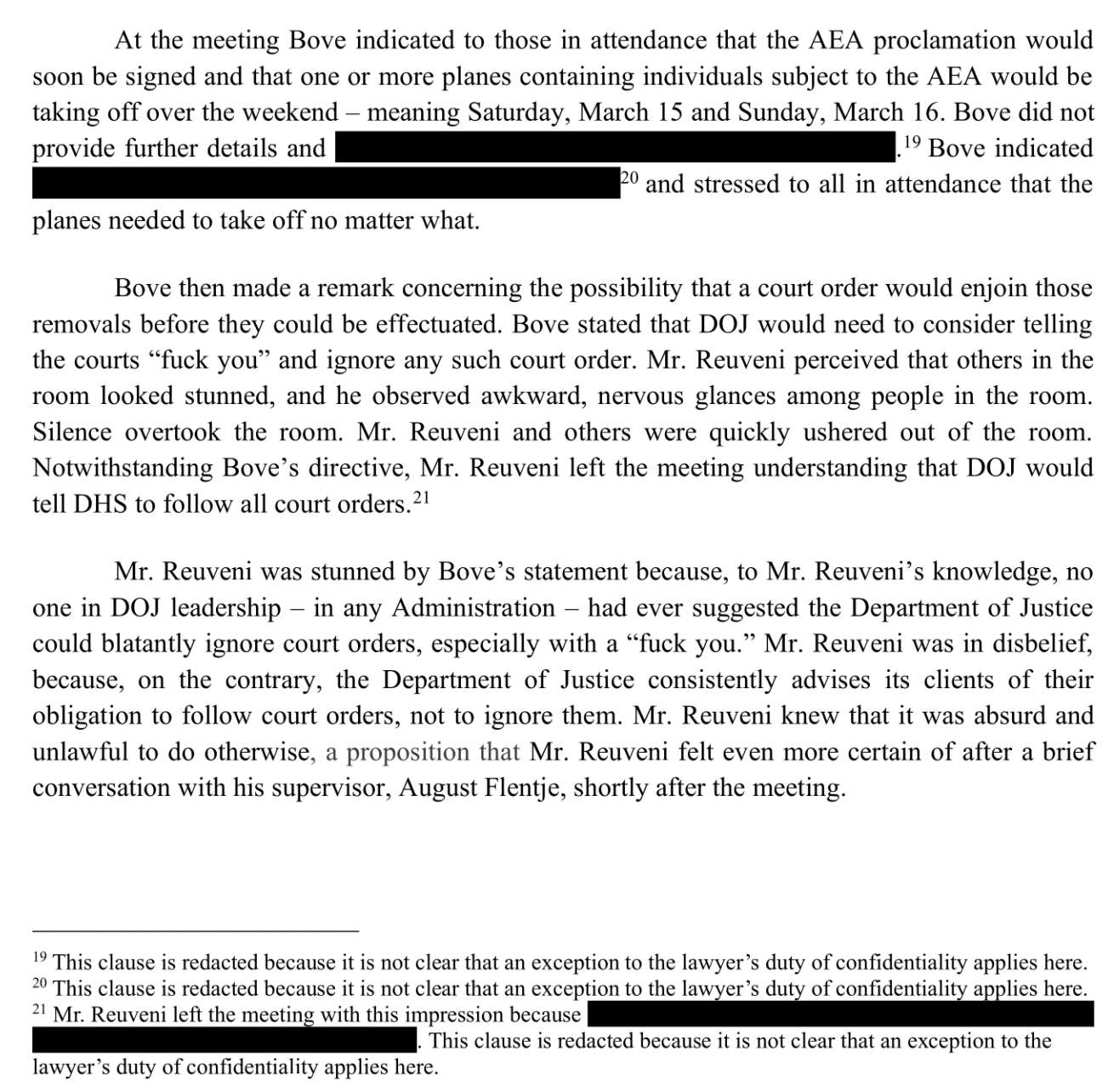
1. At approximately 6:45 PM on March 15, 2025, the Court orally directed counsel for the Government to inform his clients of the Court’s oral directives at the hearing, including statements directing that any removed class members “need to be returned to the United States.” By that point, two flights carrying individuals designated under the Alien Enemies Act (AEA) had already departed from the United States and were outside United States territory and airspace.

2. At approximately 7:25 PM, the Court memorialized its temporary restraining order in a written order, as the Court had indicated at the hearing it would do. The written order enjoined Defendants “from removing” class members pursuant to the AEA. The written order, unlike the oral directives, said nothing about returning class members who had already been removed.

3. Deputy Assistant Attorney General Drew Ensign promptly conveyed both this Court’s oral directives and its written order to the Department of Homeland Security (DHS), through its Office of General Counsel, and to the leadership of the Department of Justice (DOJ).

4. Deputy Attorney General Todd Blanche and Principal Associate Deputy Attorney General Emil Bove provided DHS with legal advice regarding the Court’s order as to flights that had left the United States before the order issued, through DHS Acting General Counsel Joseph Mazzara. Mr. Mazzara then conveyed that legal advice, as well as his own legal advice, to Secretary of Homeland Security, Kristi Noem. See 6 U.S.C. § 113(a)(1)(J). After receiving that legal advice, Secretary Noem directed that the AEA detainees who had been removed from the United States before the Court’s order could be transferred to the custody of El Salvador. As explained below, that decision was lawful and was consistent with a reasonable interpretation of the Court’s order.

5. Although the substance of the legal advice given to DHS and Secretary Noem is privileged, the Government has repeatedly explained in its briefs—both in this Court and on appeal—why its actions did not violate the Court’s order, much less constitute contempt. Specifically, the Court’s written order did not purport to require the return of detainees who had already been removed, and the earlier oral directive was not a binding injunction, especially after the written order.

It all happened without any involvement from Stephen Miller, if you can believe that.

There’s certainly reason to believe that if Erez Reuveni told his side of the story (testimony that was also thwarted by the DC Circuit’s renewed stay of the contempt proceeding), these redacted bits might disclose the role of the White House in the decision.

But in spite of all the profiles describing — credibly, to be sure — that Miller is really the one running most policy out of the White House, the government has gone to some lengths to avoid confirming that in legal contexts, perhaps for all the legal problems that would arise if Trump had to explain how he’s not the one who signed the Alien Enemies Act.

Vanity Fair’s profile of Susie Wiles described — and seemingly quoted her as agreeing — the deportation effort as a failure.

In mid-March, after Trump invoked the Alien Enemies Act, Immigration and Customs Enforcement agents (ICE) shackled and herded 238 immigrants onto transport planes and flew them to a notoriously brutal Salvadoran prison. According to Trump, the men were members of Tren de Aragua, a violent Venezuelan gang, but the evidence was sketchy (often based on tattoos alone). Most had committed no serious crimes; one, Kilmar Abrego Garcia, was deported by mistake, the Trump administration admitted.

“I will concede that we’ve got to look harder at our process for deportation,” Wiles told me at the time.

When we spoke again in April, in cities across the country, masked ICE agents were snatching people off the street, throwing them in vans, and zip-tying and frog-marching them into makeshift deportation camps. Many were US citizens or entitled to be here. (ProPublica documented 170 cases in the first nine months of 2025 of US citizens being caught up in ICE’s dragnet.)

“If somebody is a known gang member who has a criminal past, and you’re sure, and you can demonstrate it, it’s probably fine to send them to El Salvador or whatever,” Wiles told me. “But if there is a question, I think our process has to lean toward a double-check.” But as the usa.gov site itself notes, “In some cases, a noncitizen is subject to expedited removal without being able to attend a hearing in immigration court.”

But there’s no hint that the Administration as a whole shares the opinion attributed to Wiles, and Miller’s other abusive deportations have continued with no pause.

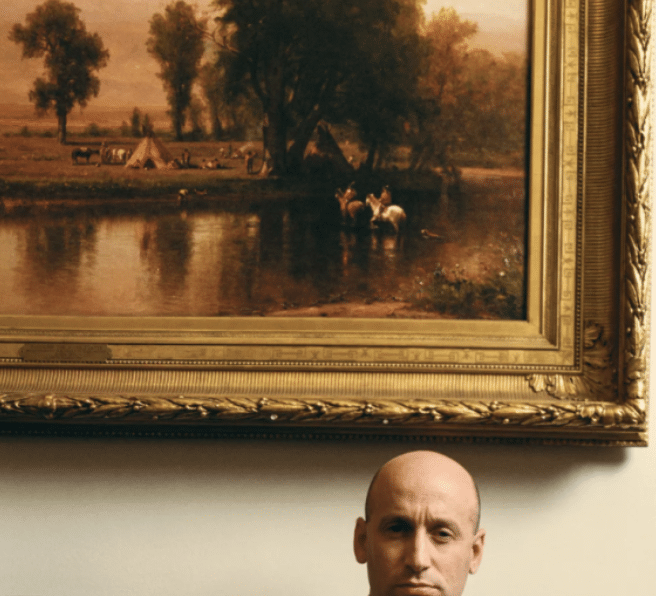
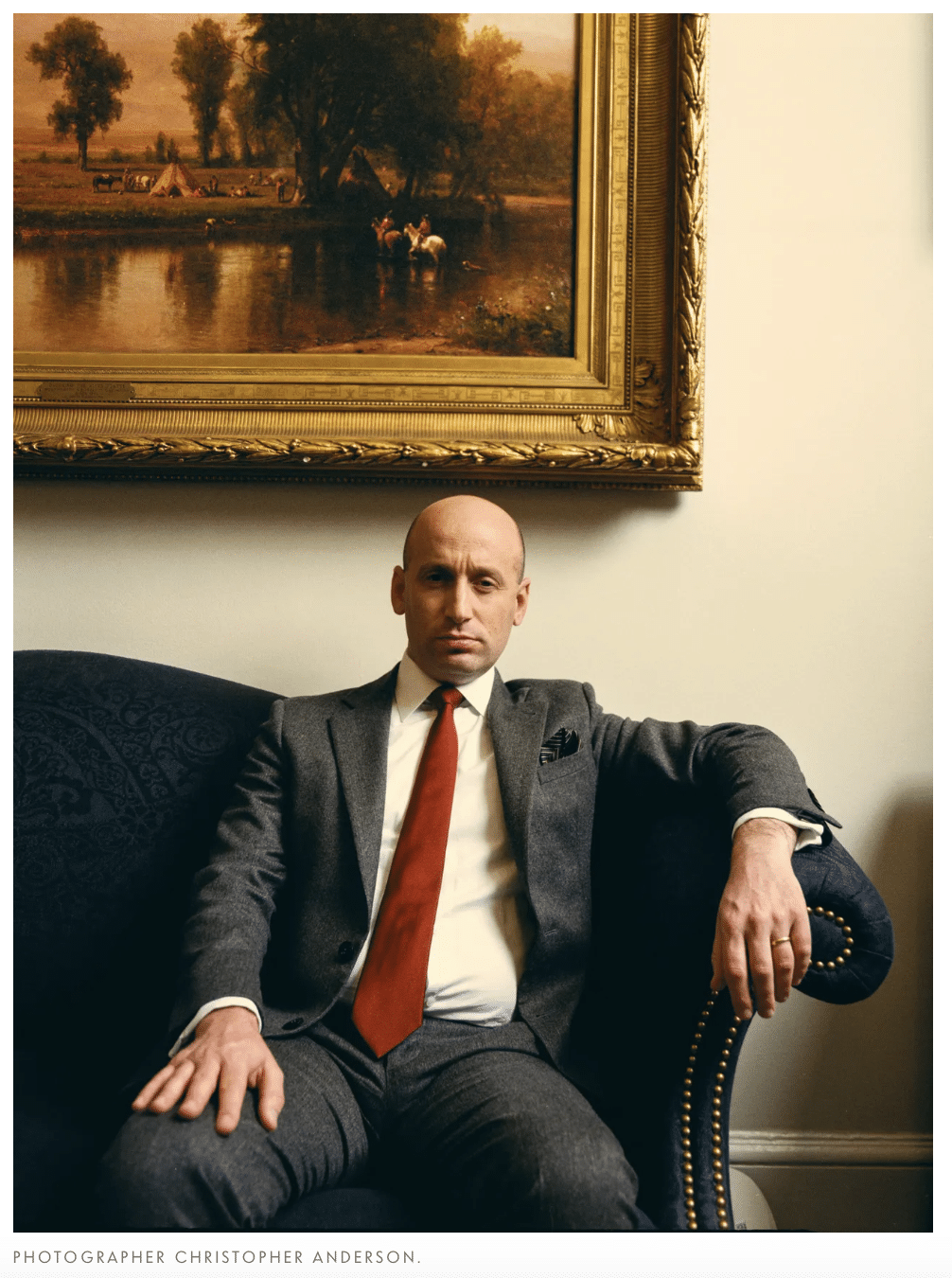
Photographer Christopher Anderson’s two descriptions of taking that photograph of Miller, which Vanity Fair sandwiched right in the middle of the El Salvador discussion, may be one of the few pieces of journalism describing Miller’s vulnerabilities.

What is the encounter you remember most?

For me the most interesting encounter for the day was with Stephen Miller. I find him to be a really interesting character on many levels, both at this moment in time and just what he represents and how he carries himself. He’s not someone who’s been photographed a lot in this way. So he was clearly a little bit nervous about sitting for a portrait, and he asked a lot of questions. “Why are you doing this? Why are you shooting film as opposed to shooting digital? Why do you know what that thing does? And how does it look? How am I? How do I look sitting here? Does it look like I’m slouching?” And at one point, I said to him, “you know, the people may say a lot of things about you, but slouching is not one of the things they will accuse you of.” And at the end of the session he comes up to me to say goodbye, and he says, “You know, you have a lot of power in the discretion you use to be kind to people,” meaning kind to people in my pictures. And I looked at him, and I said, “Yeah, you know, you do too.” It was interesting to me, his reaction. But just being in that place is in itself a fascinating experience, to be kind of within the halls of that kind of power, but yet to see it that it is a little bit [like] the Wizard of Oz behind the curtain. The place is small and shabby and you see paint marks on the wall, the wiring is done in a shabby way, and the desks can be messy, and it’s—I guess it’s a little bit like looking at middle management at a lot of companies.

[snip]

Is there anything the readers haven’t yet noticed in your pictures?

There’s the one Easter egg that I hoped people might see, and maybe they are starting to see a little bit, is that I had Stephen Miller sit underneath one of the oil paintings in the Roosevelt Room that is a beautiful depiction of Native Americans crossing a river on horseback to return to their teepee village home. It was one of those things that—I found it to be kind of interesting and maybe incongruous, that I thought might be picked up on. Go look, go look for it.

But while a bunch of the Miller profiles talk about how powerful he is (most have sources protected by further anonymity describing how much some portion of Republicans in Congress hate him), few to none talk about what a Miller setback in this administration looks like.

I’ve been thinking about that as part of my year-end inventory of what we’ve learned this year.

To halt Trump’s worst abuses, Stephen Miller must be made toxic — which is not hard to do, at least not if people are granted anonymity. The costs his bigotry causes — the dollar signs, the trade-offs the monomaniacal implementing of his bigotry entails, the human cost of prioritizing bigotry over saving children from sexual assault — must be made visible.

But it would also become necessary to understand what confluence of events could lead Miller to experience a policy setback. Preferably not just one setback, but all of them, a collapse of his near-monopoly on the President’s ear and therefore on policy.

Contrary to his well-curated press, Stephen Miller is not omnipotent. His slovenly execution makes him even more vulnerable. He hates when his physical tics are visible; he probably also hates that his paunch appears in that same photo.

His long-planned bid to use the Alien Enemies Act to deport men based off soccer tattoos to be indefinitely tortured failed.

And we don’t know how or why it failed.

Update: This NYT story fills in some of the circumstances surrounding these events — describing a team that makes shit up on the fly, excludes experts, and then changes their mind months later. At its core is a flipflop (or perhaps cynical manipulation of Cuban-American legislators) on Chevron’s license to export oil from Venezuela.

It began when Cuban American lawmakers pressed Mr. Trump early this year to end Chevron’s Biden-era confidential license. After Mr. Trump and Mr. Rubio announced in late February that they would do so, Mr. Maduro stopped accepting deportation flights of Venezuelans. Mr. Maduro had agreed to them on Jan. 31 with Richard Grenell, a special envoy for Mr. Trump.

Chevron’s chief executive, Mike Wirth, lobbied the administration for a license extension, speaking to Mr. Trump several times over the coming months.

The Cuban American lawmakers got wind that the license could be extended, and they threatened to withhold their votes for Mr. Trump’s signature legislation, “the One Big Beautiful Bill.”

At the Oval Office meeting in late May, Mr. Trump told Mr. Rubio and Mr. Miller that he needed to get the bill passed. But he said he had heard about the downsides of ending the license, including that Chinese companies would take over Chevron’s stakes, said an official.

The president demanded options. That was when Mr. Miller offered to help. He had been nurturing his ideas for mass deportations and boat strikes.

Mr. Trump did not renew Chevron’s license when it expired on May 27. His domestic policy bill passed Congress five weeks later.

The president held a series of White House meetings on whether to strike at Venezuela. At one in the early summer that included Mr. Rubio, Mr. Miller and Mr. Grenell, Mr. Rubio argued that Mr. Maduro was a drug kingpin, a characterization that appeared to stick with Mr. Trump, an official said.

In late July, Mr. Trump reversed course on Chevron’s license. He ordered the Treasury Department to issue one with revised terms. That happened around the time Mr. Maduro freed 10 American prisoners in exchange for the more than 250 Venezuelans that the Trump administration had sent to CECOT, the Salvadoran prison. And Mr. Trump had been swayed by Mr. Wirth’s argument that Chevron was a bulwark against China.

But behind the scenes, Mr. Trump set a course for confrontation. On July 25, he signed a secret order telling the Pentagon to take action against drug-trafficking groups, putting in motion the targeting of Venezuelans.

The National Security Strategy’s Structure and Presumptions

Last week, the Trump Administration released the National Security Strategy that was dated from the month before.

In an effort to highlight how the Administration — no doubt led by Stephen Miller and his fascist allies — claims to have adopted a utilitarian foreign policy stemming from things called principles and based on wildly imaginary assessment of America’s current strengths, this post will lay out what is in it. (Note, the titles are links.)

Follow-ups will say more.

Pages 2-3: My fellow Americans

This is a letter from Trump bragging about what he claims his accomplishments since Biden left are. They include:

  • Restoring borders (this does not explicitly talk about immigration)
  • Kicking qualified trans service members and other “DEI” hires out of the military
  • Making NATO allies pay 5% in defense costs
  • Getting Congress to pay $1 trillion for a Golden Dome that won’t work
  • Launching a trade war that has devastated soybean farmers, bankrupted many small businesses, and allowed China to acquire leverage by withholding rare earth products
  • Attacking Iran’s nuclear facility and claiming the attack did more damage than it did (this makes no mention of the inconclusive attack on the Houthis or the murderboat strikes)
  • Forcing Americans to prefer oil and gas over strategically smarter renewable energy
  • Ending eight wars (he claims)

Among the things this letter does not mention is destroying USAID and America’s soft power, and obviously it treats some of the grave damage Trump has done with his trade war and attacks on science and universities as strengths.

Page 4: Contents

Pages 5-6: Ends over Values

Two pages describing that the US has been doing everything wrong since the Cold War, chasing “platitudes” (also known as values) rather than desired ends.

Pages 7-8: What Should the US Want

These two pages describe a bunch of things it claims the US should, normatively, want.

Just half of these are things Trump has actually pursued (and even there, some of Trump’s policies have gone beyond what Trump says is ideal):

  • ¶3 Secure borders and controlled immigration
  • ¶5 A lethal military in which everyone is proud of their mission
  • ¶6 A Golden Dome
  • ¶10 A reinvigorated American culture (code for white nationalism)

More than half of these are things Trump has affirmatively destroyed:

  • ¶1 Continued survival of US sovereignty
  • ¶2 Protect the country from human trafficking, foreign influence, propaganda, and espionage
  • ¶4 “A resilient national infrastructure that can withstand natural disasters, resist and thwart foreign threat”
  • ¶7 The most dynamic economy
  • ¶8 A robust industrial base
  • ¶9 Unrivaled soft power that “believe[s] in our country’s inherent greatness and decency”)

Page 9: What do “we” want from the rest of the world?

  • A Trump corollary to the Monroe Doctrine
  • Halt damage an unnamed China has done while keeping stability in Indo-Pacific and keeping shipping lanes free and supply chains secure
  • Impose Stephen Miller’s idea of civilizational identity on Europe
  • “[P]revent an adversarial power from dominating the Middle East, its oil and gas supplies, and the chokepoints through which they pass while avoiding the ‘forever wars’ that bogged us down”
  • “[E]nsure that U.S. technology and U.S. standards—particularly in AI, biotech, and quantum computing—drive the world forward”

Note, this section parallels the discussion of regions, below, with the exception of laying out how the US will remain the standard-setter in the world by being an asshole and adopting crank conspiracies.

Pages 10-11: What are America’s means to get these ends?

This includes a list of things the US did have when Trump took over (I’ve italicized those which he has squandered, though there are others he is squandering):

  • A still nimble political system that can course correct;
  • The world’s single largest and most innovative economy, which both generates wealth we can invest in strategic interests and provides leverage over countries that want access to our markets;
  • The world’s leading financial system and capital markets, including the dollar’s global reserve currency status;
  • The world’s most advanced, most innovative, and most profitable technology sector, which undergirds our economy, provides a qualitative edge to our military, and strengthens our global influence;
  • The world’s most powerful and capable military;
  • A broad network of alliances, with treaty allies and partners in the world’s most strategically important regions;
  • An enviable geography with abundant natural resources, no competing powers physically dominant in our Hemisphere, borders at no risk of military invasion, and other great powers separated by vast oceans;
  • Unmatched “soft power” and cultural influence; and
  • The courage, willpower, and patriotism of the American people.

It also includes a list of things that Trump thinks are good, which I’ve restated to reflect reality:

  • “Instilling a culture of competence:” They’ve gotten rid of brown people and women who made them insecure
  • “Unleashing our enormous energy production capacity:” They’ve forced America to stop competing in renewable energy
  • “Reindustrializing our economy:” They’ve gutted the economy with tariffs
  • “Returning economic freedom to our citizens:” They’ve exploded the deficit with tax cuts to oligarchs huge tax cuts while cutting the health care that drives the economy
  • “Investing in emerging technologies and basic science:” They’ve destroyed America’s higher educational advantage and replaced it with state socialism

The strategy

Pages 12-15: Principles [sic]

This starts with a page of shite about Trump’s greatness. Then includes the following bullets:

  • Focused Definition of the National Interest (Trump will ignore key parts of the world)
  • Peace Through Strength (white nationalism)
  • Predisposition to Non-Intervention (with excuses permitted for invasions of choice)
  • Primacy of Nations (a nice way of saying they’ll gut international organizations)
  • Sovereignty and Respect (in which the NSS protects projecting “free speech” demands into other sovereign nations)
  • Balance of Power (China and Russia can extend their power so long as they allow America to do the same)
  • Pro-American Work (claims utterly inconsistent with Trump’s catering to oligarchs)
  • Fairness (code for making NATO, Japan, and South Korea pay more)
  • Competence and Merit (White men should not have to compete with brown people and women, and especially should not have to compete with H1B holders)

Pages 15-19: Priorities

  • The Era of Mass Migration Is Over: “Border security is the primary element of national security”
  • Protection of Core Rights and Liberties: This is defined as “the rights of free speech, freedom of religion and of conscience, and the right to choose and steer our common govern,” but apparently does not include due process or similar rights for Europeans or the Anglosphere
  • Burden-Sharing and Burden-Shifting: “The United States will stand ready to help— potentially through more favorable treatment on commercial matters, technology sharing, and defense procurement—those counties that willingly take more responsibility for security in their neighborhoods and align their export controls with ours.”
  • Realignment Through Peace: The President will intervene everywhere and claim to have fostered peace
  • Economic Security
    • Balanced Trade
    • Securing Access to Critical Supply Chains and Material
    • Reindustrialization
    • Reviving our Defense Industrial Base: We need to build drones in the US cheaply
    • Energy Dominance (in oil, gas, coal, and nuclear, explicitly)
    • Preserving and Growing America’s Financial Sector Dominance

Page 19: The Regions

A half page excusing largely ignoring key swaths of the world, as when you dedicate just a half page to Africa or mention Russia only in a section discussing Europe not as a place but a greatness to be imposed from outside.

Pages 19-23: Western Hemisphere: The Donroe Doctrine

  • Enlist: Treat a swath of countries as agents insofar as they can help stop the movement of people and drugs
  • Expand: Eight paragraphs on combatting “foreign influence” not named as Chinese, and three paragraphs imagining this can be driven by corporate investment

Pages 23-29: Asia: Win the Economic Future, Prevent Military Confrontation

  • Leading from a position of strength: Asia has gotten strong through manufacturing and we will combat that with false platitudes
  • Economics: the Ultimate Stakes: A claim that Trump’s disastrous trade policy will bring results the opposite of what have happened
  • Deterring Military Threats: A lot of talk about deterrence, some in passive voice

Pages 29-31: Promoting European Greatness

These are the two pages attracting the most attention, and I will return to it. Note that Europe is not described as a place, like the other regions are. The only mentions of Russia (ten) are in this section, and Russia is defined as not-Europe (and therefore not addressed as a region at all).

Pages 31-33: The Middle East: Shift Burdens, Build Peace

This section claims the Middle East is no longer as important because it is not longer the dominant energy producer, and then explains that major conflicts (including radicalism) are no big deal anymore.

Half of page 33: Africa

Africa will not get aid. It will get investment and Trump claims of peace deals.


Fridays with Nicole Sandler, Thanksgiving Wednesday Edition!

Listen on Spotify (transcripts available)

Listen on Apple (transcripts available)

“Groceries,” and Other Secrets of Managing Donald Trump

Three things happened in the last week that have befuddled a lot of observers, but which might best be understood as the kinds of developments we’ll see increasingly as the power structure around Trump grows fragile and fluid:

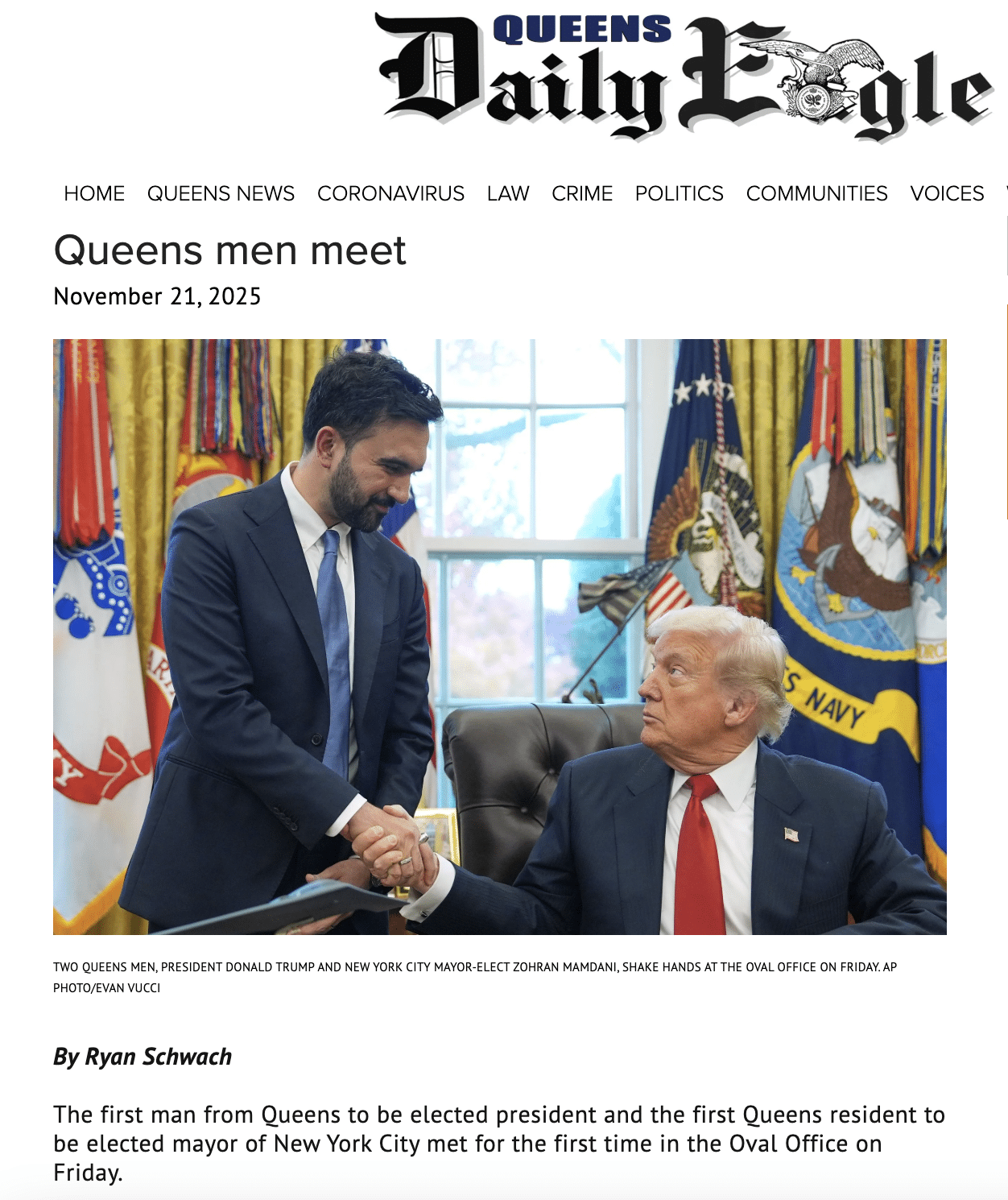
  • A positively giddy Trump welcomed Zohran Mamdani to the White House
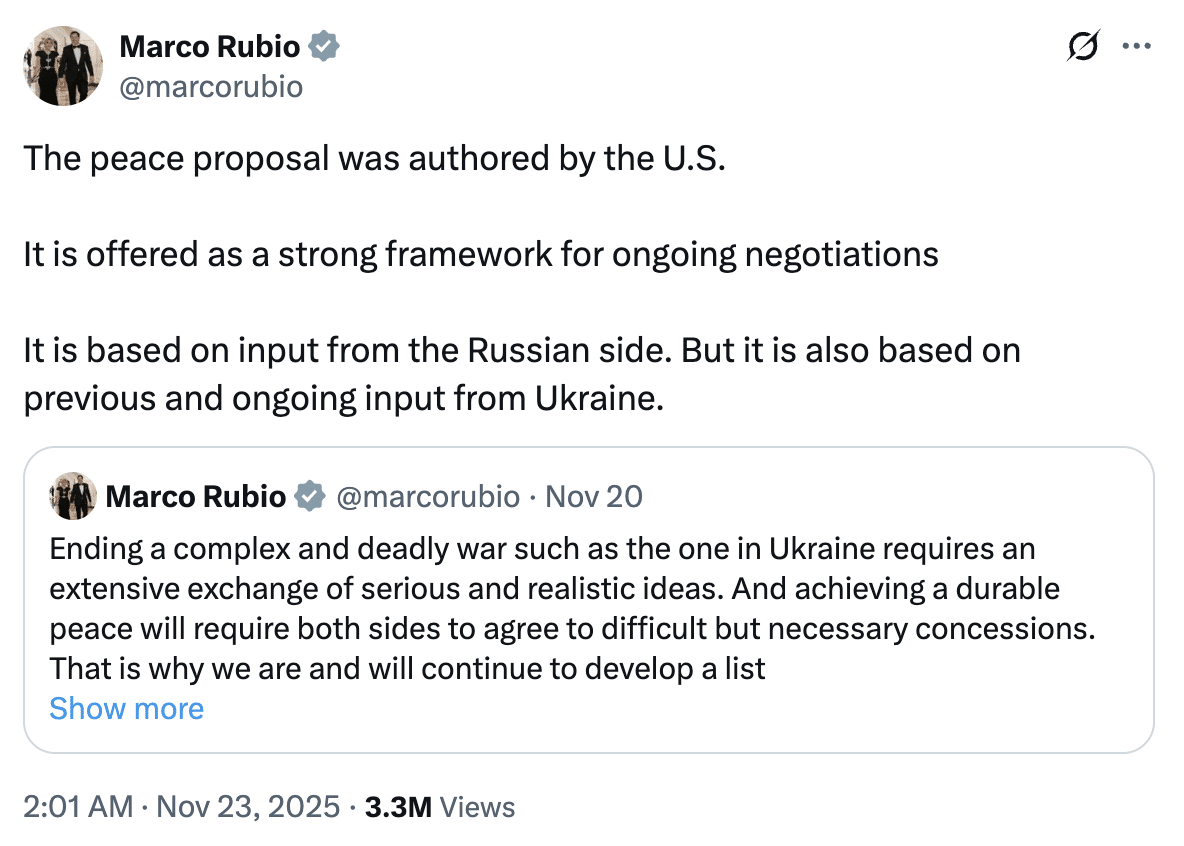
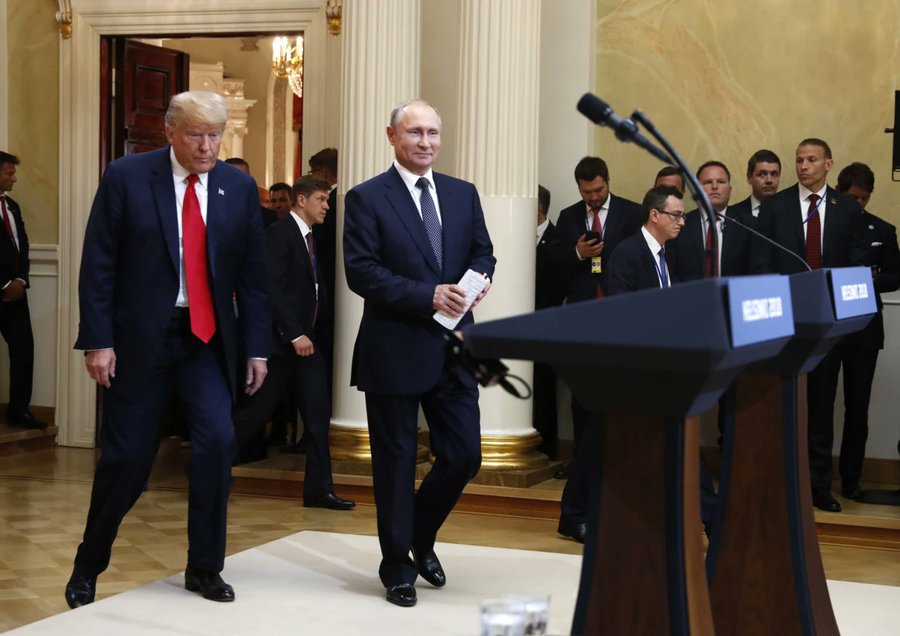
  • “The White House” rolled out yet another plan to sell out Ukraine to Russia
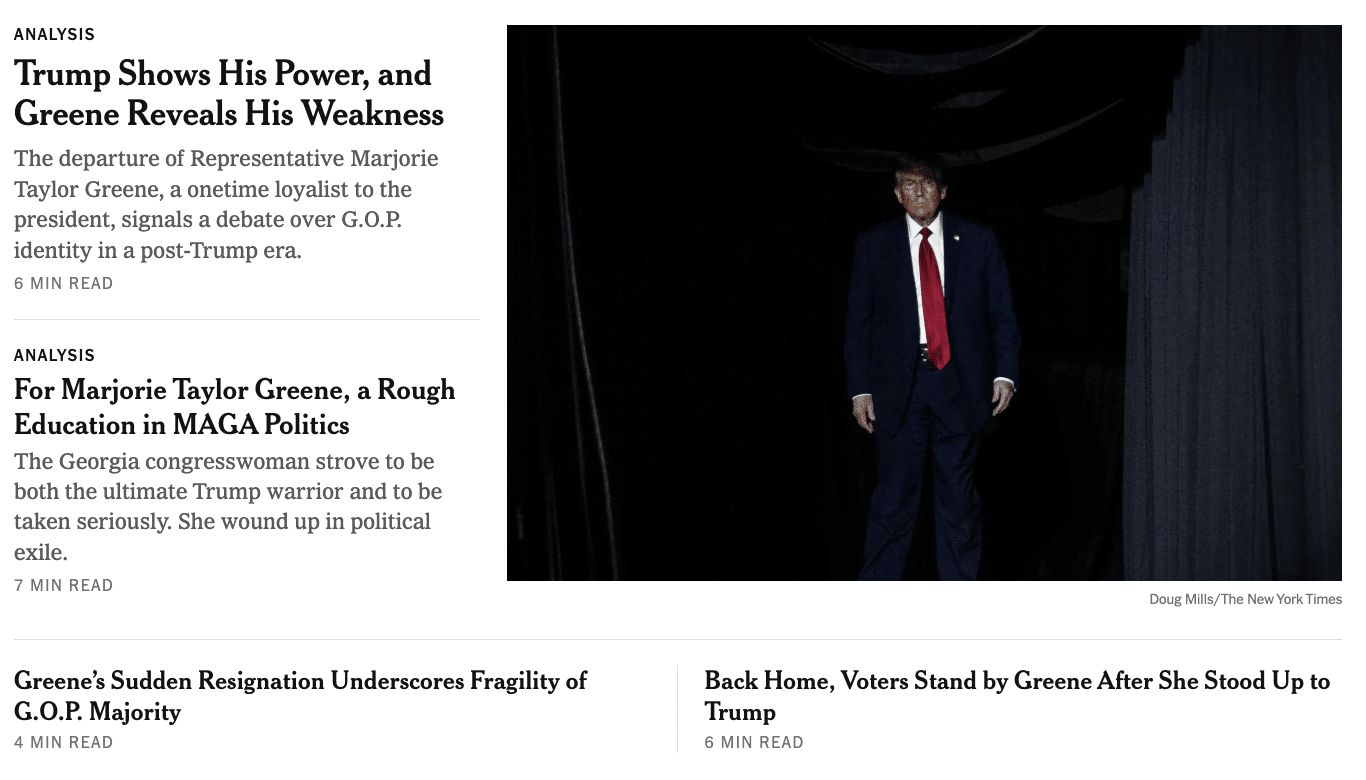
  • Marjorie Taylor Greene announced she will quit in early January

All of these, in my opinion, arose out of and reflect Trump’s increasing political weakness, his separate mental and physical decline, and the fight for power that results.

Mamdani speaks of Trump voters, groceries, and building

Much of the focus on the Trump-Mamdani meeting was on what Trump did, such as his interruption before Mamdani had to answer whether he believed Trump was a fascist, rather than on what Mamdani said. But if you look closely at what Mamdani said — which was often simply a restatement of his campaign pitch — he managed to say them in such a way that Trump parroted them as his own.

Both men centered their statements on their shared love of New York City, which is real and has been underplayed.

Mamdani’s first comment did so — as did his relentlessly disciplined campaign did — in terms of affordability; Mamdani mentioned “groceries,” the awkward shorthand Trump’s handlers have had him use to address affordability.

Mr. Trump: You know, we had some interesting conversation, and some of his ideas really are the same ideas that I have. A big thing on cost. The new word is “affordability.” Another word, it’s just groceries. It’s sort of an old-fashioned word, but it’s very accurate. They are coming down. They are coming down.

Mamdani repeatedly spoke in terms of Trump’s voters (again, a line directly from his campaign).

Trump had no idea that Mamdani targeted Trump voters, and as the coalition that elected him last year abandons him in the polls, Trump took notice when Mamdani explained that.

When I spoke to New Yorkers who had voted for the president last November on Hillside Avenue and Fordham Road, I asked them why. I heard, again and again, two major reasons. One was that they want an end to forever wars — they wanted an end to the taxpayers’ dollars we had funding violations of human rights, and they wanted to address the cost-of-living crisis. And I appreciated the chance to discuss both of those things.

Mr. Trump: He said a lot of my voters actually voted for him.

Mr. Mamdani: One in 10.

Mr. Trump: And I’m OK with that.

[snip]

Reporter: First of all, for the mayor-elect: You’re both from different parts of the political perspective. You’re both populist, though, and I just wonder to what extent the president’s campaign styles — his techniques, his social media use — inspired any part of your campaign?

Mr. Mamdani: Well, I actually told the president that, you know, so much of the focus of our campaign has been on the cost-of-living crisis, and when we asked those New Yorkers who had voted for the president — when we saw an increase in his numbers in New York City, that came back to the same issue. Cost of living. Cost of living. Cost of living.

And they spoke about the cost of groceries, the cost of rent, the cost of Con Ed, the cost of child care.

Mamdani seems to have reminded Trump that Trump got a historic number of votes last year (the voters Mamdani kicked off his campaign by canvassing) by running on affordability.

Reporter: Mr. President, you said you grew up in New York City. Mr. Mamdani, does New York City love President Trump?

Mr. Mamdani: New York City loves a future that is affordable. And I can tell you that there were more New Yorkers who voted for President Trump in the most recent presidential election because of that focus on cost of living, and I’m looking forward to working together to deliver on that affordability agenda.

President Trump: Got a lot. I got a lot of votes. One more, go ahead. One or two more. Go ahead.

Mamdani’s focus on Trump voters became a way to dodge very contentious questions.

Mr. Mamdani: I appreciate all efforts toward peace, and I shared with President Trump, when I spoke to Trump voters on Hillside Avenue — including one of whom was a pharmacist that spoke about how President Trump’s father actually went to that pharmacy not too far from Jamaica Estates — that people were tired of seeing our tax dollars fund endless wars.

By the end, Trump spoke of the way he himself (thinks he) picked up Bernie voters.

Mr. Trump: We agree on a lot more than I would have thought. I think he’s — I want him to do a great job, and we’ll help him do great job. You know, he may have different views, but in many ways, you know — we were discussing, when Bernie Sanders was out of the race, I picked up a lot of his votes, and people had no idea, because he was strong on not getting ripped off in trade and lots of the things that I practiced, and been very successful on.

Tariffs, a lot of things. Bernie Sanders and I agreed on much more than people thought, and when he was put out of the race — I think quite unfairly, if you want to know the truth — many of the Bernie Sanders voters voted for me, and I felt very comfortable frankly seeing that and saying that. And you know, it just turned out to be a statistical truth.

Perhaps the most fascinating reflection came when Trump appeared to parrot Mamdani’s shift of discussions about ICE into a question about crime, whence Trump immediately addressed building.

Mr. Trump: What we did is, we discussed crime. More than ICE, per se, we discussed crime. And he doesn’t want to see crime, and I don’t want to see crime, and I have very little doubt that we’re not going to get along on that issue. And he wants to — and he said some things that were very interesting, very interesting, as to housing construction, and he wants to see houses go up. He wants to see a lot of houses created, a lot of apartments built, et cetera. You know, we actually — people would be shocked, but I want to see the same thing.

Trump repeated that progression later, and specifically said Mamdani told him things Trump had not seen in coverage.

He wants to see no crime. He wants to see housing being built. He wants to see rents coming down, all the things that I agree with. We may disagree on how we get there. The rent coming down — I think one of the things I really gleaned very, very much today, he would like to see them come down ideally by building a lot of additional housing. That’s the ultimate way. He agrees with that, and so do I.

But, if I read the newspapers, and the stories — I don’t hear that. But I heard him say it today. I think that’s a very positive step. Now, I don’t expect — I expect to be helping him, not hurting him. A big help, because I want New York City to be great.

Look, I love New York City. It’s where I come from.

None of Mamdani’s success should be that surprising. He’s a rock star in whose aura Trump would like to bathe.

Mamdani simply managed Trump the same way everyone does: by getting alone in a room with him and making him adopt your ideas as his own.

Kirill Dmitriev continues to cultivate the people alone in the room with Trump

Which brings us to the latest Ukrainian “piece” plan, a 28-point plan to force Ukraine to capitulate to Russia on threat of losing US intelligence and arms (though Cristo Grozev believes there are two bullets that Russia did not release publicly).

Phillips OBrien announced, hopefully prematurely, that this was the long-awaited denouement of Trump’s long con of pretending he cares about Ukraine.

Instead, what actually happened on November 21 was that the Trump Administration came for Ukraine—as they always intended to do. The Secretary of the Army, Dan Driscoll, a very close associate of VP JD Vance, went to Kyiv and tried to bully the Ukrainians into accepting Trump’s 28 Point Plan to neuter Ukraine. Driscoll formally presented the plan to divide Ukraine now, and end it later, and the reality of what Ukraine and Europe was facing finally sunk in. Here was how the Atlantic story on the meeting began.

Dan Driscoll kept everyone waiting. The United States secretary of the Army had been due to arrive earlier today at the U.S. ambassador’s residence in Kyiv to speak with diplomats from NATO member states. The guests were eager to hear about the 28-point peace plan Driscoll had delivered on behalf of the Trump administration to Ukrainian President Volodymyr Zelensky. But what they heard when Driscoll finally got there left some of the Europeans infuriated. “I feel nauseous,” one diplomat told us afterward. “It’s like the world is shattering around us, and we are watching it in real time.”

The most depressing thing from the above story was that the diplomat was surprised at what the administration was doing; or I should say that the unnamed diplomat had fallen for the Trump Administration’s long con. The long con was that they would ever do anything meaningful to hurt Putin and help Ukraine, that somehow they were honest brokers in this war. They never were. They have always wanted Putin to get the best deal possible and they have always wanted to severely weaken Ukraine. Whatever steps the administration took to seem to help Ukraine were performative; steps that were designed to make it look like they would be tough on Putin, but in the end never were more mirage-like than anything else.

Michael Weiss catalogs all the signs that the deal was, instead, Kirill Dmitriev successfully manipulating the press.

What struck me as odd about this whole affair was that for such a multi-authored, monthlong project, no one from the American side was willing to go on the record to talk about it. Everything was on-background comment — except for Dmitriev, who was only too happy to gibber. Moreover, the State Department was silent; all journalist inquiries directed at Foggy Bottom were not even redirected to the White House, which is highly abnormal on matters of foreign policy sensitivity. Then, late Wednesday night, Rubio, under his personal account, tweeted this: “Ending a complex and deadly war such as the one in Ukraine requires an extensive exchange of serious and realistic ideas. And achieving a durable peace will require both sides to agree to difficult but necessary concessions. That is why we are and will continue to develop a list of potential ideas for ending this war based on input from both sides of this conflict.”

To anyone on nodding terms with diplomatese, this sounded like the whirr of the backpedal, Rubio’s way of trying to downplay expectations created by Dmitriev and Axios and the resulting press frenzy. An “extensive exchange of serious and realistic ideas” was not, after all, a signed, sealed, and delivered plan of action, which Politico’s Dasha Burns had described (citing a “senior White House official”) as a “fait accompli,” cobbled together without the input or consent of Brussels. “We don’t really care about the Europeans,” said that same senior White House official, even though the EU and NATO will have an outsize say in determining the future of Ukraine and Europe, from sanctions relief to security assistance.

[snip]

Was Trump really acquainted with the deal in all its details? What did his “support” for Witkoff amount to? Recall that the preliminaries for the doomed Anchorage summit consisted of Witkoff misinterpreting what the Russians were offering (easy enough to do when you rely on an SVR translator) and making it seem as if they’d conceded things they hadn’t. This caused some dyspepsia in the Oval, and Trump later “jokingly” dismissed Witkoff’s ability to parlay with the Russians.

Could this be happening again? And could it be even worse now that Trump (distracted with his imploding MAGA coalition at home, a flush-worthy approval rating, a battering at the polls on Nov. 4, and bloodlust for the domestic opposition) is too busy to care about the finer points of his big, beautiful peace deal for Ukraine? “Sure, Steve, sounds great, keep going” sounded like what amounted to the Trump seal of approval here, but we don’t know because no one bothered to ask this question (or, at least, no one managed to have it answered).

[snip]

Politico now clarified that “a number of people who would have normally been informed of such a plan at the White House and State Department were also not consulted about Witkoff’s renewed push,” with one U.S. official saying there was “zero interagency coordination.” You don’t say.

Reuters (including Erin Banco revisiting her past reporting on Dmitriev’s efforts to do precisely this in Seychelles in 2017) describes some of the machinations in Miami that went into this production.

U.S. officials and lawmakers are increasingly concerned about a meeting last month in which representatives of the Trump administration met with Kirill Dmitriev, a Russian envoy who is under U.S. sanctions, to draft a plan to end the war in Ukraine, according to multiple sources familiar with the matter.

The meeting took place in Miami at the end of October and included special envoy Steve Witkoff, President Donald Trump’s son-in-law Jared Kushner and Dmitriev, who leads the Russian Direct Investment Fund (RDIF), one of Russia’s largest sovereign wealth funds.

The most telling development, however, are competing and quickly evolving stories from Senator Mike Rounds (who would lead opposition to such a plan in the Senate) and Marco Rubio about whether this is a US plan.

Rubio reassured Senators mobilizing opposition to this development that it wasn’t a done deal, but then backtracked to avoid losing his place in the room.

As Yaroslav Trofimoev quipped,

Foreign nations now have to deal with rival factions of the U.S. government who keep major policy initiatives secret from each other and some of which work with foreign powers as the succession battle for 2028 begins, is how one diplomat put it.

One thing that’s happening is that Marco Rubio has survived in the Trump White House as long as he has because he is very good at mirroring, usually passively so. He says, and his State Department says, what his State Department babysitters say, people like Darren Beattie and Christopher Landau. But Rubio has generally remained in the room even at key times, and particularly with Ukraine, has thus far managed to prevent the worst from happening.

Importantly, though, Dmitriev’s tremendous success at manipulating the other people in the room with Trump comes at a time when Tom Massie and Marjorie Taylor Greene — neither big backers of Ukraine — showed how to beat Trump: by bypassing Mike Johnson to force a politically difficult vote, and to do so with enough success to force the Senate’s hand.

Brian Fitzpatrick and Don Bacon, both staunch backers of Ukraine in the House, have initiated an effort to replicate that approach.

There are the numbers right now to pass sanctions against Russia: at least 218 in the House and a filibuster-proof majority in the Senate. Those numbers just happen to be similar to the same numbers as it would take to impeach Trump.

Which is to say, the very thing that made it possible for Dmitriev to recruit (ahem) the people in the room with Trump — the flux in the White House now — is also the thing that makes him more vulnerable than he was a month ago.

Exit Marjorie Taylor Greene, for now

There’s a lot about MTG’s departure I’m not much interested in: making Trump the primary actor, making Marge the victim, debating whether she’ll be friend or foe, focusing more on the timing as it relates to getting her pension than as it relates to the healthcare crisis Republicans will soon own.

MTG is far smarter than people give her credit for and she’s very adept at using the tools of right wing politics.

In recent months the good old boys in Georgia and even Trump’s top aides refused to let her run for state-wide office in Georgia, believing she could risk an increasingly purple state.

That was part of, but only part of, the background to her willingness to take a leadership position on Epstein. She does genuinely care about the issue and/or she does recognize its salience among populists.

The part of MTG’s statement that generated the most attention (which appears in ¶¶33 and 34 of her statement) — her prediction Republicans will lose the House and have to stave off a Trump impeachment…

I have too much self respect and dignity, love my family way too much, and do not want my sweet district to have to endure a hurtful and hateful primary against me by the President we all fought for, only to fight and win my election while Republicans will likely lose the midterms. And in turn, be expected to defend the President against impeachment after he hatefully dumped tens of millions of dollars against me and tried to destroy me.

It’s all so absurd and completely unserious. I refuse to be a ‘battered wife’ hoping it all goes away and gets better.

… Comes long after (¶¶4-12) a series of paragraphs that could be spoken by a racist Zohran Mamdani, and with all the charisma and political acumen he has.

No matter which way the political pendulum swings, Republican or Democrat, nothing ever gets better for the common American man or woman.

The debt goes higher.

Corporate and global interests remain Washington’s sweethearts.

American jobs continue to be replaced whether it’s by illegal labor or legal labor by visas or just shipped overseas.

Small businesses continue to be swallowed by big corporations.

Americans’ hard earned tax dollars always fund foreign wars, foreign aid, and foreign interests.

The spending power of the dollar continues to decline.

The average American family can no longer survive on a single bread winner’s income as both parents must work in order to simply survive.

And today, many in my children’s generation feel hopeless for their future and don’t think they will ever realize the American dream, which breaks my heart.

MTG is taking her significant campaign cash and selling high, and promising to be there to buy low after whatever upcoming catastrophe happens.

When the common American people finally realize and understand that the Political Industrial Complex of both parties is ripping this country apart, that not one elected leader like me is able to stop Washington’s machine from gradually destroying our country, and instead the reality is that they, common Americans, The People, possess the real power over Washington, then I’ll be here by their side to rebuild it.

Until then I’m going back to the people I love, to live life to the fullest as I always have, and look forward to a new path ahead.

She rode Trump’s coattails until she decided the coattails weren’t worth the effort anymore.

Stephen Miller’s Trains Don’t Run on Time

I was going to write a piece anticipating the showdown at SCOTUS over Stephen Miller’s invasion of Chicago, which may well determine the future of democracy in the US.

But as I was contemplating all the lies that Miller and his henchman have been caught telling in Chicago and Portland, two other stories came out that highlight how bad Miller is at execution. Both pertain to his effort, built on a edifice of lies, to rationalize a war in Venezuela based off a largely manufactured claim that Tren de Aragua is “invading the US” on behalf of Nicolás Maduro.

Chronologically, WaPo provides new details about the quid pro quo behind Marco Rubio’s deal to send planeloads of Venezuelans to a concentration camp in El Salvador: The US would have to send the people who had cooperated with DOJ to expose Nayib Bukele’s ties to MS-13, a gang that Trump purported to treat as a terrorist organization.

In the days before the Trump administration deported hundreds of Venezuelan immigrants to a notorious prison in El Salvador, the president of that country demanded something for himself: the return of nine MS-13 gang leaders in U.S. custody.

Secretary of State Marco Rubio, in a March 13 phone call with Salvadoran President Nayib Bukele, promised the request would be fulfilled, according to officials familiar with the conversation. But there was one obstacle: Some of the MS-13 members Bukele wanted were “informants” under the protection of the U.S. government, Rubio told him.

To deport them to El Salvador, Attorney General Pam Bondi would need to terminate the Justice Department’s arrangements with those men, Rubio said. He assured Bukele that Bondi would complete that process and Washington would hand over the MS-13 leaders.

[snip]

The deal would give Bukele possession of individuals who threatened to expose the alleged deals his government made with MS-13 to help achieve El Salvador’s historic drop in violence, officials said. For the Salvadoran president, a return of the informants was viewed as critical to preserving his tough-on-crime reputation. It was also a key step in hindering an ongoing U.S. investigation into his government’s relationship with MS-13, a gang famous for displays of excessive violence in the United States and elsewhere.

We’ve known from earlier reporting that Bukele’s ask was top level MS-13 members in US custody. We didn’t know they were informing against Bukele.

Note that this reported conversation with Bukele on March 13 was two days before the invocation of the Alien Enemies Act and three before the men — most guilty of nothing more than sporting less incriminating tattoos than the Secretary of Defense — got shipped away in a rush.

One of the many things that remains unexplained about the story is the reason for the rush — the rush to get an agreement, the rush to put men on planes.

Even given the rush (and the narrowly averted government shutdown), that’s when things started falling apart, when the ACLU got notice of the deportations, got an order from James Boasberg enjoining the deportations, and so set Erez Reuveni on a path that would get him fired. Not long after, one of the Salvadorans that Rubio intended to deal to Bukele, Vladimir Arévalo Chávez (who is mentioned in the WaPo story, started challenging the dismissal of his case and subsequent deportation, ultimately leading Judge Joan Azrack to order parts of the docket unsealed.

Then there are the murderboats in the Caribbean — a series of wildly illegal strikes lacking any recognizable legal justification. The murderboats appear to be an attempt to draw Nicolás Maduro into a war — though the Atlantic describes the underlying motivation as something far more craven, little more than an attempt to “paint immigrants as a dangerous menace.”

Then there are the senior officials who see Venezuela as a means to project a tough-guy, defender-of-the-homeland image. Stephen Miller views the air strikes as an opportunity to paint immigrants as a dangerous menace, according to one of the White House officials. Vice President J. D. Vance, though often inclined toward isolationism, has pushed the necessity of defending U.S. borders. And Hegseth, who prefers to be known as the war secretary, is seeking a means of projecting military strength in a region where Defense Department planners hope to reassert American primacy.

Donald Trump’s top aides have all decided to murder people in cold blood as a propaganda stunt.

Even before the most powerful military in the history of the world failed to fully execute its murderboat mission days ago, there were cracks in Miller’s murderboat propaganda campaign — not just the increasing demands for some kind of credible legal explanation, but also the resignation of SouthCom Commander Alvin Holsey. And even before all that, it became clear that Miller’s murderboat targets were not what he claimed they were: Venezuelans bringing fentanyl to the United States. The boats were too small. That’s not how fentanyl is trafficked to the US, most importantly, they weren’t all Venezuelans. Two were Trinis. Weeks ago, Colombian President Gustavo Petro started complaining that Colombians were being targeted.

And then the most powerful military in the history of the world failed its mission, operating in uncontested waters, to completely destroy a submersible it claims was shipping drugs to the United States.

The most powerful military in the history of the world failed to destroy a boat and as a result two very awkward targets — neither Venezuelan — survived.

And now, because of the slovenly execution of Miller’s attempt to gin up a war with Venezuela, Petro and Trump are ratcheting up a war of words over the earlier targeting of what Petro claims was a fishing boat in distress inside Colombian waters.

The slovenliness is so ingrained that the people writing Trump’s tweets can’t even spell Colombia properly.

Stephen Miller is incredibly powerful and so fascistic that Trump even hesitates to describe his ambition.

But he is also downright slovenly.

Stephen Miller is attempting to start a war to rationalize his domestic war. And he can’t even be fucked to dot his I-s and cross his T-s.

Update: We have always been at war against Eastasia.

The U.S. military has killed three men and destroyed another boat it suspected of running drugs in the Caribbean Sea, this one alleged to have been affiliated with a Colombian insurgency group, Defense Secretary Pete Hegseth announced on Sunday.

It was the seventh boat known to have been attacked since early September as part of the Trump administration’s use of the military to kill people suspected of smuggling drugs as if they were enemy soldiers in a war, rather than arresting them as criminals. The latest strike took place on Friday, and Mr. Hegseth said in a social media post on Sunday that it had targeted a vessel associated with the National Liberation Army, a Colombian rebel group known as the E.L.N.

What Trump’s UNGA Speech Tells the World

1896 sculpture of Cain by Henri Vidal, not 2025 sculpture of Marco Rubio

Speeches by national leaders at the opening of the UN General Assembly (UNGA) have multiple goals and various audiences. Leaders of small countries hope to raise concerns with large countries in a setting where they can be the center of attention, if only for 15 minutes. Leaders of ostracized countries often seek to justify the behavior that got them ostracized in the first place. Some speeches are aimed at the leaders in the room, while others are aimed at the folks back home. Some are aimed at allied leaders, and others at competitors and still others at enemies.

Under normal circumstances, preparation for the US president’s speech is probably on par with preparing the State of the Union address to Congress. Both speeches utilize folks from multiple agencies and both are subject to weeks and months of internal debates about what will and will not get into the speech. While the SOTU address is as long as the President wants to make it, the UN politely asks that UNGA addresses be kept to 15 minutes or less, because so many leaders will be speaking. The UNGA speech is primarily foreign policy, while the SOTU is more domestic, but both are critical to laying out the president’s – and by extension, the USA’s – positions on all kinds of things.

For UNGA, the State Department takes the lead (broadly speaking) in preparing drafts and posing options to the final decisionmakers in the White House. Other agencies like DOD, Treasury, Commerce, and DHS, as well as folks like the Director of National Intelligence, all weigh in and put their requests into the funnel out of which the final draft emerges.

While all the prep work on the speech is under way, so too is the prep work for listening to the speeches delivered by other leaders. Is it more of the same, are there new policy nuances, or even major changes of direction being conveyed? Different analysts at State, DOD, and the Intelligence community will prepare a list of “what to listen for” points as they get ready to listen to the UNGA speeches from the countries within their purview. Once the speeches have been made, these same folks will then be sharing their analysis with their superiors and the White House. “Here’s what we heard . . . , here’s what it means . . . , and here’s how it may affect our own policies and responses . . .”

Meanwhile, every other foreign ministry and intelligence service in the world does the same with the UNGA speech of the President of the United States of America. Especially when that president is Donald J. Trump.

So what will these folks notice about Trump’s speech, and what will their analysis of his speech lead them to think or do?

First, they will notice the absolute dichotomy between policy prescriptions and petty personal grievances. Yes, the speechwriting team and the professionals behind them put a lot of substantive stuff into the draft of the speech that went on the teleprompter, but Trump went off-script so much that it was easy for that stuff to get lost in the verbal flood of whining about his domestic political enemies alternated with his own personal self-promotion. If the substance was prepared to fill the 15 minute time slot, the whining and boasting filled another 45 minutes or so. That 3:1 ratio speaks volumes about what matters to Trump: “Three parts me, and one part everyone else. And that ratio is me being generous to everyone else.”

Second, even in the substantive parts of the speech, the presentation was arrogant and insulting. (Why yes, I do think Stephen Miller had a large role in shaping the speech. Why do you ask?) Trump’s “I alone can fix it” from campaigns gone by was echoed in Trump’s declaration at UNGA that he has always been right about everything. From immigration to energy to wars to peacemaking to cultural issues to history, Trump’s assertion that he is always right and that the world would be better off if everyone just bowed down and did what he said was at the center of his speech. The prepared draft of the speech might have been more polite about it, but the message was the same. All the world could see how Trump views them — little kids who need to listen to Daddy, and then do what Daddy says so that they don’t get punished.

Third, Trump’s UNGA speech was a confirmation and distillation of something these folks have seen since 2015 from Trump: facts are optional to Donald Trump. They will see that science takes a back seat to whatever Trump’s particular views and preferences are. Signed agreements, especially those signed by someone other that Trump, are optional, not binding. Historical facts that do not fit with Trump’s worldview are overlooked, ignored, or blithely dismissed as irrelevant. Leaders and nations who seek to move Trump and US policies with fact-based arguments will have a very difficult, if not impossible task if they follow this route.

Fourth, Trump has no use for the opinions of other leaders, unless they comport with his own opinions. Dozens of nations call what Israel is doing in Gaza “genocide” but Trump does not give a damn. Countries of all political stripes recognize the reality of climate change (even as they might differ in how it should be addressed), but not Donald Trump.

Fifth, this speech confirms yet again that what Trump desperately seeks is validation. In his head, he dreams of giving his own version of Sally Field’s academy award acceptance speech — “I haven’t had an orthodox career and I’ve wanted more than anything to have your respect. The first time [I won] I didn’t feel it, but this time I feel it. And I can’t deny the fact that you like me. Right now, you like me! Thank you.”

Sixth, these analysts from other nations regularly ask themselves “How long will Trump hold to a given position?” He renegotiated the NAFTA treaty with Canada and Mexico in 2019 and finalized it in 2020, only to come back in 2025 and ask “who would have ever sign a thing like this?” Grudges over personal slights he will carry with him for decades, but agreements with other leaders and other nations are much less predictable.

The danger to all of this is one basic thing: the world is learning –again — not to listen to the United States.

  • When Trump and RFK Jr. issued their untethered-to-scientific-analysis declaration that Tylenol should not be used by pregnant women, not only did the US medical community loudly shout “NO!” but so did medical leaders around the world (UK, Spain, India, Australia, etc.). The US has a long record of leadership in medical research and treatment — think of the elimination of smallpox and the work to do the same with polio — but now? Around the world, folks are asking what used to be an unimaginable question: Should we listen to anything medical coming out of the CDC?
  • When Trump made his big Liberation Day announcements and sought to put tariffs on almost every nation, he followed up on this with all kinds of exceptions, adjustments, and incoherent statements. Today the tariffs might look like this, but next week they went down, then a month later some of them went higher than before . . . and what the hell will they look like next year?
  • When NGOs and other leaders around the world found the rug yanked out from under them when Trump used DOGE to cancel grants for things like malaria prevention and anti-AIDS programs, as well as letting US food aid funneled through USAID rot in warehouses rather than be delivered to those who feed the hungry, they had to ask if the word of the US is worth anything any more. “We had a five year agreement – you put up this and we’ll handle that — and after 3 years, you reneged. Why should we trust you the next time you want to make a deal?”

Trump and his lackeys can laugh at the world all they want, but if the financial world follows the lead of the medical world and the scientific world, and ceases to trust that the word of the US is good, the US will be in a world of hurt. A non-trivial portion of US debt is held by foreign governments. When the Canadian public decided not to travel to the US or buy US bourbon, that hit the US hospitality industry hard. If foreign governments decide that rather than buying US treasury bonds, they’d prefer bonds from Germany or France or Australia, that will mean the US government would have to offer higher rates of return in order to get the money needed to pay for tax breaks for the rich run the US government.

In the world of international affairs, trust matters, and Donald Trump is pissing away what it took decades to earn. Good luck with that, Secretary of State/National Security Advisor/Archivist of the United States Marco Rubio.


[Corrected to fix a minor editing error regarding bond costs in the penultimate paragraph.]


Trump Confesses that the United States Is a Client of Russia

There’s a great deal of normalcy bias in the reporting on Trump’s capitulation. NYT reports (based on watching the Sunday shows) that Marco Rubio and Steve Witkoff “hint” that Putin will make concessions to reach a plea deal with Ukraine, without questioning whether those are anything but personal inducements to Trump (like a Trump Tower) and without noting that Wikoff is incompetent to understand what would be a real concession in any case. WaPo describes that Putin was willing to offer security guarantees, without noting that guarantees without NATO are useless (and one of the tools Putin has used to lull his imperial victims in the past).

Curiously, one place that is not suffering from normalcy bias is WSJ’s editorial page, which notes what is being shared with “friendly media” (seemingly excluding WSJ from that moniker) are “worse than worthless.”

The President went into the summit promising “severe consequences” if there was no agreement on a cease-fire. He left the summit having dropped the cease-fire with no consequences in favor of Vladimir Putin’s wish for a long-term peace deal as the war continues. Mr. Trump took new sanctions on buyers of Russian oil off the table.

Mr. Trump also said the burden is now on Ukraine to close the deal. European leaders told the press that, in his conversations with them, Mr. Trump said Mr. Putin demanded that he get all of Ukraine’s Donetsk region, which would mean that Ukraine give up its main line of defense in the east.

White House leaks to friendly media suggest Mr. Putin promised that, in return for Donetsk, he’ll stop his assault and won’t invade other countries. No wonder Russian commentators and Putin allies were celebrating the summit’s results. Their President ended his isolation in the West, made no public concessions, and can continue killing Ukrainians without further sanction.

Mr. Putin’s promises are worse than worthless. He has broken promise after promise to Ukraine and the West. This includes the 1994 Budapest Memorandum promising to defend Ukraine against outside attack, and multiple Minsk agreements. He wants Donetsk because he would gain at the negotiating table what he hasn’t been able to conquer on the battlefield. It would also make it easier to take more territory when he or his successor think the time is right to strike again.

The silver lining is that European leaders say Mr. Trump told them Mr. Putin had agreed to accept “security guarantees” for Ukraine. The suggestion is that the U.S. might even be one of those guarantors, albeit outside NATO. But Mr. Trump provided no details.

For guarantees to have real deterrent effect, they would have to include foreign troops in Ukraine. Kyiv would need the ability to build up its military and arms industry.

All this is distracting from the question not asked at the Sunday shows yesterday: Why Trump’s team walked out of their meeting with Putin looking like they had seen death.

Let’s recap what got us here:

  • Some weeks ago, Trump gave Putin the 50 days the Russian president wanted before he would come to the table. Then, as Putin kept bombing, making Trump look weak, Trump shortened the timeline to ten days. But instead of imposing the sanctions that Lindsey Graham had spent months crafting, Trump instead sent Steve Witkoff to Moscow. Witkoff, by design (because this is what happens when you choose to put someone with no relevant expertise or temperament in charge of negotiating deals), came back promising deals he couldn’t describe, it’s just not clear for whom.
  • On an impossibly short notice, Trump arranged to host Putin on former Russian land. Going in, Trump promised that if Russia didn’t deal on a cease fire, there would be tough consequences. Europeans and Volodymyr Zelenskyy smelled a rat, but didn’t succeed in convincing Trump how badly he would be manhandled.
  • And manhandled he was. Sergei Lavrov showed up wearing a CCCP jersey, Putin displayed undisguised contempt for everyone. And Trump walked out looking ashen. Putin treated Trump like a menial client.
  • Trump told Sean Hannity that he shouldn’t have done his interview right afterwards, and I wonder if he had not — if Trump had not felt it necessary to immediately declare a success, ten of ten — then Trump’s team might have tried to find a way out. But whatever Trump then said to Zelenskyy and European leaders made them realize things were worse than they anticipated.
  • Trump sent out Rubio and Witkoff on the Sunday shows to basically defer, making transparently bullshit claims of concessions from Russia. But today, Trump is making it clear that he will made demands Zelenskyy cannot accept — the Crimea recognition Trump floated to get elected in 2016, and no hopes of NATO membership — even while suggesting that Zelenskyy will have to make all the concessions.

Effectively, Putin ordered Trump to make Ukraine capitulate. Hell, maybe he even gave Trump a deadline.

And I would be unsurprised if Trump does what happened in February, after he bullied Zelenskyy, but for which Trump later blamed Pete Hegseth’s incompetence. I would be unsurprised Trump withdrew US intelligence sharing, without which Ukraine cannot defend itself, possibly even halting the sale of weapons to Ukraine.

But the implications of all this are much larger. These demands, particularly the demand that Ukraine turn over the part of Donetsk that Moscow has never conquered, would leave Ukraine defenseless. Conceding these demands would make Zelenskyy vulnerable (indeed, one of Russia’s puppets in Ukraine is already challenging his leadership). Ukraine really is the front line of Europe — of Moldova (with elections scheduled in September), of Czechia (with elections scheduled in October), of the Baltics, where Putin has been staging for some time.

And remember: one of the promises Trump floated during the election, one of the promises that — Nicolay Patrushev said — is why Russia helped reinstall Trump is that Trump limit intelligence sharing with Europe, all of it. Europe relies on that intelligence to combat Russia’s influence operations within Europe. Without that intelligence, one after another country would fall to a pro-Russian party.

Since returning to office, Trump has dismantled every tool the US created to win the Cold War. It doesn’t need to be the case that Trump has stashed his Administration with actual Russian agents — narcissism and venality explain much of what we’re seeing — but there are somewhere between two and twenty Trump advisors who I have good reason to suspect are Russian agents. Over the past three years, right wingers have forced the tech platforms to eliminate the moderation that had provided visibility on Russia’s influence operations. As I laid out, Trump dismantled US Russian expertise and the investigative tools created to hunt and prevent Russian influence operations in the US. Meanwhile, he is willfully bankrupting the country based on plans largely adopted in joint venture with Putin client Viktor Orbán.

Trump has made the United States powerless against Russia, and I expect he will be instructed to make Europe powerless against Russia as well.

This is the point I’m trying to convey: All of Trump’s power depends on his continued reinforcement of the disinformation that Russia used to get him elected the first time. Without Russia’s continued indulgence, the foundational myths to Trump’s power would crumble. Particularly amid the willful destruction of US power, it would provide cause — and maybe even the will, among right wingers — to expel and prosecute him.

The hold Putin has over Trump is existential for Trump. And unless we can expose that, the US will increasingly become a mere satellite of Russia.

Trump is not making America great. He is gutting America.

This is not just about forcing Ukraine to surrender.

Trump has surrendered. And going forward, it is only going to get worse.