Posts

Blind Man’s Bluff in the Jim Comey Docket

Threshold issues

The very last thing Judge Michael Nachmanoff asked Michael Dreeben in Wednesday’s hearing on Jim Comey’s bid to throw out his indictment for vindictive prosecution, before turning to prosecutors’ argument, was whether he should wait and address all of Comey’s challenges at once or deal with vindictive prosecution on its own.

THE COURT: All right. Thank you. But before you sit down, let me just ask you, do you think that the other pending motions, including the issue of literal truth and ambiguity and the other matters that are yet to be litigated, are so wrapped up in vindictive prosecution that the Court should deal with them all at one time, or do you think that the Court can and should deal with vindictive prosecution separately?

MR. DREEBEN: I think vindictive prosecution, like our motion based on the appointment of the U.S. attorney, are threshold matters that the Court should resolve as a threshold. Mr. Comey would like to see both of those motions resolved because they both go to the very heart of whether a prosecution in this case is permissible, one by virtue of a challenge to the official who brought it, the other by virtue of whether it complies with the Constitution to bring a prosecution at all.

Our other motions are very important, and we have a series of them that challenge other aspects of the prosecution. As I’m sure the Court is well aware, there are issues relating to the conduct of the prosecutor in the grand jury. But this one and the appointments issue stand at the threshold. They’re the gateway to all further motions, and those should be resolved at the outset of the case, in our view.

Dreeben, calling vindictive prosecution and disqualification (which Judge Cameron Currie had heard the week before) “threshold” matters, said they should be decided at the outset.

That may explain Nachmanoff’s decision at the very end of the hearing to deny Jessica Carmichael’s request to move up the next motions hearing — the one that would address the other issues Nachmanoff asked Dreeben about — from December 9, what would be almost three weeks (including the Thanksgiving holiday) from that day, to the prior week.

There’s also a motion to move up the next oral argument, which is set on December 9th. I commend everyone’s enthusiasm for trying to move this even faster, but the Court is reluctant to do that. I believe that it was Ms. Carmichael that had a conflict, and I will permit counsel to appear without Ms. Carmichael, who’s local counsel, so that she doesn’t have that issue, but I will keep the current schedule that we have.

If Nachmanoff does treat the vindictive prosecution challenge as a threshold issue, then he may hope to rule before holding another hearing. If Nachmanoff were to rule for Comey on vindictive prosecution (or Currie were to disqualify Lindsey Halligan, as is likely), the December hearing might be delayed anyway during an appeal, possibly all the way to SCOTUS.

It’s worth noting that Comey’s appellate lawyers — Ephraim McDowell in the disqualification hearing and Dreeben in the vindictive prosecution one — argued these District level motions hearings. As I noted when they were added, Comey walked into these challenges preparing to fight this all the way to SCOTUS.

The Comey prosecution may go away, pending appeal, in less than 20 days, via one of at least two ways. Indeed, given Judge Currie’s promise to rule before Thanksgiving, it could go away in the next week (again, pending appeal).

I lay that out as a way to understand some other things that have happened since Nachmanoff’s hearing.

The drama

But first, the drama, which started shortly after Dreeben answered that question about threshold issues.

Loaner AUSA Tyler Lemons had barely started his argument when Nachmanoff questioned the prosecutor’s claim that the grand jury, “returned a true bill.”

THE COURT: Well, we’ll have some questions about that —

MR. LEMONS: That’s correct, Your Honor.

THE COURT: — but I’ll let you get through your argument.

Shortly thereafter, Nachmanoff challenged Lemons’ claim that Comey was relying on, “newspaper articles, anonymous sources, innuendo, [and] conjecture.”

THE COURT: Well, let me stop you there. With regard to the words of the president, whether it’s the post from September 20th or his answers to questions from reporters, you’re not suggesting that those aren’t things the president has said, are you?

Immediately before the drama of the declination memo, Nachmanoff bristled at Lemons’ insinuation that Erik Siebert, whom — the EDVA judge noted — had been appointed as US Attorney by the judges of EDVA, was involved in “machinations.”

MR. LEMONS: Absolutely, Your Honor. What I’m referring to is the newspaper reports that are relying on anonymous sources as to the machinations of former U.S. Attorney Siebert or to other decisions that essentially are not directly quoting the president or someone else.

THE COURT: Well, let me stop you there.

MR. LEMONS: Yes, sir.

THE COURT: I’m not sure what machinations you’re referring to. Are you referring to the fact that Mr. Siebert was the interim U.S. attorney and then appointed by the Court, and then either resigned on September 19th or was fired by the president on September 19th?

MR. LEMONS: Yes, Your Honor. And I guess more specifically referring to any sort of — across, it sounds like multiple cases, not just this case — any reluctance or willingness to pursue cases in this Court.

That’s when Nachmanoff spent several minutes slowly cornering Lemons into admitting, in spite of direction from Todd Blanche’s office to avoid doing so, that he did not just know of a declination memo, but had read it.

THE COURT: Well, was there a declination memo?

“Was there a declination memo?” was question one. Questions ten and eleven in the colloquy, which also included Nachmanoff reminding Lemons he was “counsel of record in this case” and then getting him to explain that Todd Blanche’s office had instructed him to dodge these questions, went this way:

THE COURT: And had one been prepared?

MR. LEMONS: My understanding is that a draft prosecution memo had been prepared.

THE COURT: All right. And did you review that?

MR. LEMONS: I — yes, Your Honor, I did.

That still wasn’t the most dramatic part of the hearing, of course.

Lemons finished his argument, and then Nachmanoff returned to that question, the grand jury presentment. From the start, he mentioned it would be useful to hear from Lindsey, but he did allow Lemons to explain what he thought had happened, first.

THE COURT: Well, I have a couple more questions before you sit down.

MR. LEMONS: Okay.

THE COURT: At the beginning of your remarks, you said that the grand jury had returned an indictment and there’s a presumption of regularity with what happened, but as we know from other litigation in this case, there have been some questions and some attempts to resolve those issues, and Ms. Halligan submitted a declaration on Friday that explained, in part, in response to the question from Judge Currie about what happened after the grand jury began to deliberate, and then what went on —

MR. LEMONS: Yes, Your Honor.

THE COURT: — after that. And I’ll ask you these questions, but it may be more direct to ask Ms. Halligan directly.

In spite of noting that it might be easier if Lindsey explained all this, Nachmanoff let Lemons explain what he understood had happened at length, including that the EDVA grand jury coordinator had had direct communications with the foreperson.

The judge asked Lemons the question about whether the full grand jury had voted on what he referred to as the second indictment three times, which is when he finally invited Lindsey to speak, as counsel of record. She barely said good morning before she interrupted the judge.

THE COURT: And so that the record is clear, when the grand jury return was taken, only the foreperson was in the courtroom, correct, the rest of the grand jurors were not present; is that right?

MR. LEMONS: Can I have a moment, Your Honor?

THE COURT: You can. Ms. Halligan, you can come to the podium. You’re counsel of record. You can address the Court. It might be easier. Good morning.

MS. HALLIGAN: Good morning.

THE COURT: So am I correct that, as is the usual —

MS. HALLIGAN: No, Your Honor.

THE COURT: — practice, that the grand jurors were not present, just the foreperson?

MS. HALLIGAN: The foreperson and another grand juror was also present, and Judge Vaala corrected the record in open court, and the foreperson said in open court, We only no true billed Count One, we want to true bill Count Two and Three, and the foreperson signed that indictment.

THE COURT: I’m familiar with the transcript.

MS. HALLIGAN: Okay.

THE COURT: But I just wanted to make sure that the entire grand jury never had the opportunity to see the second indictment. You may sit down. Thank you.

The government, of course, has now refuted this account, thinking it helps them to claim that Halligan (and Lemons) stood before the judge and misinformed him, all because a confused foreperson said that the entire grand jury had voted for the two-count indictment, which served primarily to corrode any presumption of regularity DOJ is afforded.

From the start (and so when he asked whether he should wait on the other challenges), Nachmanoff had at least those two questions, the grand jury and the declination memo, in mind, and also, probably, how Lindsey could have assessed the case in the three days before indicting.

THE COURT: Well, that’s why I was asking you the questions about the declination memo and the prosecution memo, because she was appointed on September 22nd, and she went into the grand jury on the 25th, and I believe what you’re saying is that she made an independent evaluation of the case and concluded to move forward with it in that time period, in those couple of days. And so my question is, what independent evaluation could she have done in that time period?

MR. LEMONS: Your Honor, I think that — that discussion is inevitably one that we would have if you order expanded discovery.

Michael Dreeben, in rebuttal, asserted that the irregularity with the indictment was obtained is yet another cause to dismiss the indictment, and asserted that Nachmanoff didn’t need to see what the declination memo said to dismiss it.

Nachmanoff closed the hearing not just by denying Carmichael’s request to advance the next motions hearing, but by ordering both parties to brief a case.

I have some housekeeping matters to address. I would like, especially in light of our argument today, both parties to address the case of Gaither v. United States, 413 F.2d 1061 (D.C. Cir. 1969), and it addresses this issue regarding the foreperson signing an indictment. And I know you have your objections due at 5:00 p.m. today, so I wanted to make sure the government was aware of the Court’s interest in addressing that case, and, of course, the defense can address it in turn when they file their response.

The oddities of a three-judge docket

Now, I’m going through this exercise not to share the drama from the transcript, much of which got covered in real time, but because I want to understand how the hearing on Wednesday — particularly Lindsey’s confession about the grand jury — jumbled what would have happened and will happen in the brief window before December 9, when some or all of this might be launched on its way to appeal, possibly all the way to SCOTUS.

Here’s what happened and will happen in the week since the hearing; I’ve color-coded response chains:

November 19: Vindictive prosecution hearing before Michael Nachmanoff; Nachmanoff denies motions schedule change, orders CIPA schedule, orders briefing on Gaither

November 19: Government objection to Fitzpatrick order giving Comey grand jury transcripts, writing up interactions between grand jury coordinator and grand jury foreperson and seemingly confirming that court reporter left after rest of grand jury left

November 19: Government brief on Gaither (responding to Nachmanoff’s order)

November 19: Insanely stupid Lindsey Halligan interview with NYPost misrepresenting record and attacking Judge Nachmanoff

November 20: Comey Reply on fundamental ambiguity

November 20: Comey Reply on Bill of Particulars (including exhibits on discovery, kicking off graymail)

November 20: Government notice “correcting” record, including return transcript

Later November 20: Comey Reply on his motion for grand jury materials

November 21: Consent motion to set CIPA hearing on December 9 instead of filing CIPA 5

November 21: Comey Response to government objection to Fitzpatrick order

November 21: Motion to dismiss because there is no indictment

November 21: Amended motion to dismiss because there is no indictment

November 24: Comey requested response date on MTD no indictment

November 26: Expected Cameron Currie ruling on disqualification

November 26: Comey motion to suppress due

Start from the end: with a motion to dismiss because there is no indictment, which Comey almost immediately amended. As the citations page makes clear, this is substantially Comey’s response to Nachmanoff’s request for briefing on Gaither.

As Comey explains in a footnote, rather than just responding to Gaither, he’s using belated disclosures — from the discovery about the Fourth Amendment and attorney-client violations, from William Fitzpatrick’s opinion on the grand jury transcript, and regarding the failure to present the second indictment — to submit a separate motion to dismiss to be considered along with the other ones.

Mr. Comey respectfully submits that the Court can and should consider this motion along with Mr. Comey’s other dispositive motions. ECF Nos. 59 [vindictive], 60 [disqualification], 105 [fundamental ambiguity]. Those motions are fully briefed, and the government has filed its notice concerning Gaither v. United States, 413 F.2d 1061 (D.C. Cir. 1969). See ECF No. 201. The defense requests that the Court direct the government to file its response to this Motion—if any—by November 24, 2025.

He is effectively attempting to squish this motion to dismiss into the window when Nachmanoff will be deciding the vindictive prosecution motion and Judge Cameron Currie will be deciding the disqualification motion, with the unrealistic request that the government have to respond over the weekend to also squish it into that same window.

Dreeben did say he was going to file another motion to dismiss and Nachmanoff did not object, but he’s trying to squish that motion into this window when the judges are deliberating.

The new motion to dismiss overlaps in significant part with two other filings submitted since the hearing: Comey’s reply on his request to get grand jury transcripts, and Comey’s response to the government’s objection to William Fitzpatrick’s order that he get those transcripts.

In his reply, Comey explains how all of these documents fit together.

1 The absence of a valid charging instrument will be the basis of a forthcoming motion to dismiss [that is, the Gaithner briefing as motion to dismiss].

2 As the Court is aware, Mr. Comey will file his response to the government’s appeal of Magistrate Judge Fitzpatrick’s order for the government to disclose the grand jury proceedings on Friday, November 21, 2025. This reply brief responds to the government’s arguments in opposition to the motion (ECF No. 184) to disclose the grand jury proceedings and highlights additional irregularities that have surfaced further warranting disclosure. Mr. Comey’s response to the government’s appeal of Magistrate Judge Fitzpatrick’s order will explain why Judge Fitzpatrick’s ruling is well supported by fact and law warranting affirmance and address the government’s opposition to that ruling. These litigation streams present two related, but separate, avenues to order the government to produce the grand jury proceedings.

And the seeming cause for amendment to the motion to dismiss — a replacement of one claim about how Lindsey Halligan integrated privileged material in the grand jury…

Ms. Halligan referred to those materials in her presentation to the grand jury and elicited extensive testimony about privileged materials from Agent-3. ECF No. 192 at 14.

With another…

In turn, Ms. Halligan extensively questioned Agent-3 about communications between Mr. Comey and Mr. Richman during Agent-3’s testimony before the grand jury. ECF No. 192 at 14.

… reveals one of the things going on. In all three documents, Comey aggressively accuses the government of purposely seeking out privileged material in advance of the presentment.

Agents knowingly reviewed and printed out dozens of pages of privileged communications between Mr. Comey and his lawyers and appear to have presented at least certain of those privileged communications to the grand jury in this matter.

Thus the delicate balance Comey tried to correct with the amendment: they’re pretty sure Miles Starr did not just present tainted testimony, but that Lindsey cued him with tainted questions, but that overstates what they can say without seeing the grand jury transcript.

Both those sentences must rely on this passage of Fitzpatrick’s opinion (they cite the unredacted version rather than this one; the redacted discussion starts on the next page).

The government’s position is that the grand jury materials “confirm the baselessness of the defendant’s claim that privileged information may have been shared with the grand jury.” ECF 172. While it is true that the undersigned did not immediately recognize any overtly privileged communications, it is equally true that the materials seized from the Richman Warrants were the cornerstone of the government’s grand jury presentation. The government substantially relied on statements involving Mr. Comey and Mr. Richman in support of its proposed indictment. Agent3 referred to these statements in response to multiple questions from the prosecutor and from grand jurors and did so shortly after being given a limited overview of privileged communications between the same parties. The government’s position that privileged materials were not directly shared with the grand jurors ignores the equally unacceptable prospect that privileged materials [page break] were used to shape the government’s presentation and therefore improperly inform the grand juror’s deliberations.

Both sides are working at a disadvantage in this argument. The government complained that it couldn’t see what Comey shared in ex parte submission to Fitzpatrick (and, generally, complained that it hadn’t been able to get its filter protocol).

2 Although the docket indicates the government provided the materials for in camera review, Dkt. No. 179, the docket does not reflect that defendant submitted ex parte information to the Magistrate Judge. However, the magistrate judge referenced the defendant’s ex parte notice in its opinion. See Dkt. 191 at 7.

In his response, Comey described some of what was included in that.

Pursuant to Judge Fitzpatrick’s order during the hearing, the defense filed an ex parte sealed submission to guide Judge Fitzpatrick’s review, which was supplemented with evidence that the government had produced to the defendant, such as the privileged communications the government’s agents printed out and used in September 2025 after their warrantless search of the materials seized from Daniel Richman.

[snip]

Mr. Comey plainly had an expectation of privacy in his communications with his lawyer, which was clear from the face of the communications the government agents reviewed and printed in September 2025, ECF No. 172-2 at 2,2 as set forth in the ex parte submission the defense submitted to Judge Fitzpatrick.

But unlike the government, Comey doesn’t know precisely what was said about the Richman texts to the grand jury, in particular whether Halligan’s promise of more evidence — a reference the government did no more than to confirm in its response by saying, “the government anticipated presenting additional evidence were the case to proceed to trial” — pertains specifically to the Comey side of the Richman texts.

Plus, both seem to be trying to hold their fire. Perhaps Comey is waiting on the motion to suppress — which may be held in abeyance if Judge Currie rules for him. Surely, he is guarding his privilege claim.

And, after admonishments from Fitzpatrick, the Loaner AUSAs dropped their reliance on the Richman texts in their Bill of Particulars response, so they’re probably trying to avoid knowing Fourth Amendment violations.

So neither will say what I keep saying: On the morning before the grand jury presentment, Spenser Warren provided others with a two page printout of Richman texts, all of which preceded the moment when the FBI knew Comey had retained Richman. But someone went back into that unscoped material they knew to include privileged texts and printed out at least eight pages of texts, going well beyond the time Comey had retained Richman.

And whatever the reason for the reticence on both sides, unless you are misrepresenting the questions at issue (and remember, there is no transcript of the exchange Comey had with Ted Cruz included among the 14 exhibits that appear to have been presented to the grand jury), there is no sound reason to present any of these texts. None could be proof that Comey had authorized Richman to share this information while at FBI, because Richman had left months earlier. None could be proof that Comey lied to Chuck Grassley on May 3, 2017 about serving as a source for stories on the Russian investigation (which Grassley called the Trump investigation), because they all postdated Grassley’s question. None could be proof that Comey intended to obscure all this in September 2020, because he had already told Susan Collins about all of this on June 8, 2017. Contrary to what Loaner AUSAs claimed in their urgent bill for a filter protocol (authored by James Hayes), nothing in the public record supports a claim that Comey and Richman (and Patrick Fitzgerald) were conspiring to leak classified information.

The only crime Comey committed was exposing Donald Trump’s corruption, which led to a Special Counsel investigation that showed abundant evidence Trump obstructed the investigation into his ties with Russia.

But in his effort to mislead a grand jury to believe that was a crime, Miles Starr may have knowingly and unlawfully surveilled attorney-client communications without a warrant much less a filter protocol.

As of now, Nachmanoff has not ruled on either parallel request to grant Comey grand jury access (he said he would rule on the filings, without a hearing), though a footnote to the motion to dismiss, “reserves the right to supplement this Motion with further facts and argument if and when the grand jury materials are disclosed to the defense.” So unless and until he does, the record will remain what it is, with vague gestures from both sides about a conflict at the heart of this case, potentially excluded from the record if this thing gets appealed.

When caught lying, troll

Meanwhile, of course, Lindsey Halligan is already resorting to the tactics she learned from her boss, falsely misrepresenting a question Nachmanoff posed about Dreeben’s belief, laid out in Comey’s reply to prosecutors’ arguments about imputation (which I laid out here)…

MR. DREEBEN: That is certainly correct, and that is an additional obstacle that supported the court’s factual conclusion that imputation was not appropriate on the facts of the case. But we, of course, have a very different situation. In the hierarchy, the president stands at the top, and he has declared himself to be the chief law enforcement officer of the United States. He has vested in him executive power, which includes supervision of the Department of Justice. The U.S. attorneys help him carry out his responsibility to see that the laws are faithfully executed, and as we argued in the brief, that is not just a theoretical constitutional structural argument; it is actually an argument that applies to the facts of this case because the president has taken on the responsibility and the authority to direct the Justice Department to take actions in the investigatory and prosecutorial realm that he thinks should be taken, and he has, in effect, substituted himself for the U.S. attorney as the decision-maker, and the facts of this case reveal that that’s why his vindictive motive is imputed to the prosecution. No, he didn’t go into the grand jury, but exercising the authority that’s vested in him, he brought about the prosecution through the chain of causation that we described earlier.

THE COURT: So your view is that Ms. Halligan is a stalking horse or a puppet, for want of a better word, doing the president’s bidding?

MR. DREEBEN: Well, I don’t want to use language about Ms. Halligan that suggests anything other than she did what she was told to do. The president of the United States has the authority to direct prosecutions. She worked in the White House. She was surely aware of the president’s directive. She didn’t have prosecutorial experience, but she took on the job to come to the U.S. Attorney’s Office and carry out the president’s directive, and this was a directive to the attorney general. I think we know that the attorney general is highly responsive to the president’s directives. She doesn’t say, Excuse me, Mr. President, this is my job.

The makebelieve US Attorney for EDVA instead falsely claimed this was a direct expression of Nachmanoff’s own opinion.

Interim US Attorney Lindsey Halligan suggested Wednesday that the Biden-appointed judge overseeing the criminal case against former FBI Director James Comey violated judicial conduct rules by asking if she was a “puppet” of President Trump.

District Judge Michael Nachmanoff asked Comey’s defense lawyer if he thought Halligan, the prosecutor who brought the indictment against the former FBI boss, was acting as a “puppet” or “stalking horse” of the commander in chief, during a hearing in an Alexandria, Va., courtroom.

“Personal attacks — like Judge Nachmanoff referring to me as a ‘puppet’ — don’t change the facts or the law,” Halligan exclusively told The Post.

“The Judicial Canons require judges to be ‘patient, dignified, respectful, and courteous to litigants, jurors, witnesses, lawyers, and others with whom the judge deals in an official capacity’ … and to ‘act at all times in a manner that promotes public confidence in the integrity and impartiality of the judiciary,’” she continued.

Lindsey’s attack in the NYP was similar to the one prosecutors made in their response to Fitzpatrick’s order (which Comey addressed in response).

Federal courts have an affirmative obligation to ensure that judicial findings accurately reflect the evidence. Canon 2(A) of the Code of Conduct for United States Judges requires every judge to “act at all times in a manner that promotes public confidence in the integrity and mpartiality of the judiciary” and to avoid orders that “misstate or distort the record.” Canon 3(A)(4) requires courts to ensure that factual determinations are based on the actual record, not assumptions or misrepresentations. Measured against these obligations and the rule of law, the magistrate’s reading of the transcript cannot stand.

They’re trolling.

They’re doing precisely what Trump always does when caught in a crime: he trolls and attacks rule of law.

Share this entry

Lindsey the Insurance Lawyer Confesses There Is No Indictment

As I have suspected since at least Friday, there is no Jim Comey indictment.

That’s because, rather than re-presenting the case after the jury no-billed on one count, Lindsey Halligan never re-presented the remaining two counts.

Here’s CNN. (See also Politico, ABC, and WaPo.)

In a shocking back and forth, prosecutors said that instead of presenting a new indictment to the grand jury after it declined to approve one of the counts, Halligan simply brought an altered version to the magistrate’s courtroom for the grand jury’s foreperson to sign.

“The new indictment wasn’t a new indictment,” Lemons said, attempting to justify that it was only reviewed by the foreperson.

Judge Michael Nachmanoff quickly called Halligan, who was the only prosecutor who presented the case to the grand jury, to the lectern, asking her to confirm that the entire grand jury was never presented the altered indictment.

The judge started, “Am I correct -”

“No, you’re not,” Halligan interrupted. She said that there was one additional grand juror in the magistrate’s courtroom and quoted her back-and-forth with that judge.

“I’m familiar with the transcript,” Nachmanoff said. He then told her to sit down.

Apparently Michael Dreeben declared, correctly, that therefore there is probably no indictment, period, because the full grand jury did not vote to support it.

The problem goes beyond just the basics of how a grand jury works. As I noted here, Lindsey’s Loaner AUSAs already confessed that they want to rely on the no-billed count to support their obstruction case.

[A]s provided in discovery and via the indictment, the government intends to seek the admission of evidence at trial on this count regarding the defendant’s statements to senators during the September 30, 2020, committee hearing. For instance, the defendant’s statements to Senators Grassley and Cruz regarding his use of Richman as an anonymous source concerning the Clinton email investigation and his statements to Senators Graham and Hawley regarding his alleged lack of memory concerning the so-called Clinton plan to “tie Trump” to Russia.

And it’s worse than the poor Loaner AUSAs seem to realize.

The September 30, 2020 hearing had a specific scope, which could fairly be taken as the scope of the investigation the Senate was pursuing at the time. The Clinton email investigation was not included in that scope.

1 Before the hearing, the committee agreed that it would be limited to four specific topics: (i) “Crossfire Hurricane,” (ii) the December 2019 Department of Justice Inspector General report’s “Review of Four FISA Applications and Other Aspects of the FBI’s Crossfire Hurricane Investigation,” (iii) the Carter Page FISA applications, and (iv) Christopher Steele’s source network and primary sub-source.

Without the no-billed count, nothing charged against Comey would be included in the scope of the hearing.

Her fuck-ups continue to snowball!

Share this entry

Lindsey Halligan’s Grand Jury Violation, with Love to Aileen Cannon

Most of this post lays out Jim Comey’s vindictive and selective prosecution challenge. It is very tidy, providing little we didn’t already know.

Aside from the confirmation that Lindsey Halligan was appointed under 28 USC 546, that’s generally true of Comey’s motion to dismiss because of Halligan’s unlawful appointment, as well.

But it feels different, because it’s a bid to win before the far right Supreme Court.

That starts with the memo that Sammy Alito wrote in 1986 — a memo conservative lawyer Ed Whelan has highlighted in his commentary against such an appointment. Back then, Sammy interpreted 28 USC 546 as prohibiting making serial Interim US Attorney Appointments, as Trump did in EDVA to install Lindsey the Insurance Lawyer.

Just three days after Congress enacted the 1986 law, the Office of Legal Counsel (OLC) within the DOJ issued a memorandum, authored by then-Deputy Assistant Attorney General Samuel Alito, interpreting the provision in precisely the same manner as Mr. Comey here. See Definition of Vacancy for the Purpose of Interim Appointment of United States Attorneys pursuant to 28 U.S.C. 546, as amended, Office of Legal Counsel (Nov. 13, 1986), https://perma.cc/SD5Q7CPH. Specifically, OLC concluded that while a “vacancy exists when the 120-day period expires under the amended section 546 and the President has either not made an appointment or the appointment has not been confirmed,” “it does not follow that the Attorney General may make another appointment pursuant to 28 U.S.C. 546(a) after the expiration of the 120-day period.” Id. at 3 (emphasis added)

There’s the dickish comment from Bill Essayli, whose own appointment is being challenged in Los Angeles (before a Hawaiian judge).

Nor is the government’s gambit limited to this case. In several cases throughout the country, the government has sought to end run Congress’s framework in Section 541 and 546 before being rebuffed by courts. See Giraud, 2025 WL 2416737, at *1, *8 (detailing the Executive Branch’s perpetuation of “Alina Habba’s appointment to act as the United States Attorney for the District of New Jersey through a novel series of legal and personnel moves” and concluding that she “was not lawfully acting as the United States Attorney in any capacity” 120 days after the Attorney General first invoked her power under Section 546(a)); United States v. Garcia, et al, No. 25-cr-227, 2025 WL 2784640, at *3 (D. Nev. Sept. 30, 2025) (“The Nevada judges did not have an opportunity to exercise [Section 546(d)] power because, on the 119th day of Ms. Chattah’s term, the government purported to switch her appointment to the [Federal Vacancies Reform Act] and its longer term of service.”). In fact, when one interim U.S. Attorney was asked whether his term was “up at the end of this month” given subsection (c)(2)’s 120-day limit, he responded that “we’ve got some tricks up our sleeves.”15 This Court should reject the government’s machinations here.

15 See The Glenn Beck Program: Bill Essayli, at 44:14 (Jul. 22, 2025), http://bit.ly/4nc6yck.

But the real high point comes in the challenge under the Appointments Clause, where a team including Michael Dreeben cites liberally from Trump v. US and US v. Trump to argue that one of Trump’s defense attorneys from his stolen documents case was unlawfully appointed under the very same logic Aileen Cannon used to throw out that case.

B. Ms. Halligan’s Appointment Also Violates The Appointments Clause

As explained above, the Appointments Clause allows Congress to “by Law vest the Appointment of such inferior Officers, as they think proper, in the President alone, in the Courts of Law, or in the Heads of Departments.” U.S. Const., Art. II, § 2, cl. 2. The requirement that Congress participate in the appointment of inferior officers—either through Senate confirmation or through specifying an appointment procedure “by Law”—reflects the Framers’ concerns about the Executive Branch’s “manipulation of official appointments.” Freytag v. Comm’r, 501 U.S. 868, 883 (1991) (citations omitted).

Here, Congress vested the appointment of interim U.S. Attorneys “by Law” in a “Head of Department[]”—the Attorney General—as well as in “the Courts of Law”—district courts. In so doing, Congress established a finely tuned statutory scheme for such appointments. See supra at 8-9. Because the Attorney General appointed Ms. Halligan in violation of that scheme, Ms. Halligan’s appointment as an inferior officer is not authorized “by Law.” And the “head of a department has no constitutional prerogative of appointment to offices independently of the legislation of Congress, and by such legislation he must be governed, not only in making appointments, but in all that is incident thereto.” United States v. Perkins, 116 U.S. 483, 485 (1886). The Attorney General’s appointment of Ms. Halligan thus violates not only Section 546, but also the Appointments Clause. See Trump v. United States, 603 U.S. 593, 644-45 (2024) (Thomas, J., concurring) (citations omitted); United States v. Trump, 740 F. Supp. 3d 1245, 1263 (S.D. Fla. 2024).

[snip]

In light of these principles, the Supreme Court has invalidated judgments issued or reviewed by an improperly appointed adjudicator. In Ryder v. United States, 515 U.S. 177 (1995), for instance, the Supreme Court “reversed” the court-martial conviction of a defendant after he successfully challenged the appointment of the intermediate appellate judges who reviewed his case. Id. at 188. Likewise, in Lucia v. SEC, 585 U.S. 237 (2018), the Court set aside an agency adjudication “tainted with an appointments violation,” making clear that a decision of an improperly appointed official cannot stand. Id. at 251.

Similarly, in United States v. Trump, 740 F. Supp. 3d 1245 (S.D. Fla. 2024), the court applied these principles when dismissing an indictment on Appointments Clause grounds because of a defect in the appointment of the prosecutor who secured the charges. The court concluded that “[b]ecause Special Counsel Smith’s exercise of prosecutorial power has not been authorized by law,” there was “no way forward aside from dismissal of the Superseding Indictment.” Id. at 1302. Indeed, the government there did not even “propose an alternative course.” Id. The court reasoned that “[i]nvalidation follows directly from the government actor’s lack of authority to take the challenged action in the first place.” Id. at 1302-03.

That is, a team with a lawyer from Jack Smith’s team is citing Aileen Cannon’s disastrous opinion in Trump’s stolen documents case for the principle that for a lawyer to do what Lindsey the Insurance Lawyer did, she needs to be Senate approved.

Lindsey the Insurance Lawyer should know that (as should Deputy Attorney General Todd Blanche). After all, she was part of that “successful” defense team.

This is not to endorse this view. It is to say that if the sentiment behind Aileen Cannon’s dismissal of Trump’s stolen documents prosecution holds — if Clarence Thomas really wants to go there — than Halligan’s appointment, and all the work she did, must be thrown out, just as Jack Smith’s was.

The other vindictive and selective prosecution argument — that Donald Trump cannot simply appoint a US Attorney to take out his enemies is right on the facts but inapt on the legal precedents. But this one is designed to corner the right wingers on the Supreme Court.

And if that happens, this motion to dismiss goes further than the other — it puts Lindsey the Insurance Lawyer in an awkward spot. Because if she was not authorized by law to go before the grand jury, she violated grand jury secrecy rules.

Here, Ms. Halligan’s unlawful appointment tainted the structural integrity of the grand jury process. Absent Ms. Halligan’s unlawful title, she would not have been able to enter the grand jury room, let alone present and sign an indictment. Indeed, the Federal Rules of Criminal Procedure allow only “attorneys for the government” to be “present while the grand jury is in session,” Fed. R. Crim. P. 6(d)(1), and define such attorneys to include only “attorney[s] authorized by law to conduct” grand jury proceedings, Fed. R. Crim. P. 1(b)(1)(D) (emphasis added). Those rules implement the longstanding principle “that the proper functioning of our grand jury system depends upon the secrecy of the grand jury proceedings”—a principle that “is ‘as important for the protection of the innocent as for the pursuit of the guilty.’” United States v. Sells Eng’g, Inc., 463 U.S. 418, 424 (1983) (citations omitted). By limiting participation to government attorneys “authorized by law,” Rules 1 and 6 maintain the secrecy of the grand jury proceeding and reinforce that an unlawfully appointed attorney’s presentation to the grand jury underminesthe structure of that proceeding. The fundamental error here thus allows a presumption that Mr. Comey was prejudiced, “and any inquiry into harmless error would [require] unguided speculation.” Bank of Nova Scotia, 487 U.S. at 257.

Which is weird, because she was trying to lecture Anna Bower about relying on NYT reporting from witnesses … who are allowed to share their testimony before the grand jury.

This is the easier way to throw out this prosecution. It’s the same interpretation of the law that already got Alina Habba and Sigal Chattah disqualified from cases that won’t, however, sink the entire case.

But if that does happen, Lindsey may be in a bit more trouble for even pretending to be a government prosecutor.

Share this entry

Jim Comey Prepares to Prevail at SCOTUS

On Nicole’s podcast today, I said that many of the criminal issues that will arise from Trump’s politicization of DOJ won’t be all that controversial at SCOTUS (and SCOTUS is least awful on criminal justice issues). But I said one area would likely break new ground: selective and vindictive prosecution.

Jim Comey’s prosecution — and that of everyone else Trump is pursuing — fits poorly in the existing precedents for selective and vindictive prosecution, even while they clearly are vindictive.

Plus, I noted, that Trump’s penchant for yapping about legal cases even as DOJ attempts to protect him from liability in them conflicts with the language of Trump v. USA that — recklessly — puts the President in a prosecutorial function.

And the Executive Branch has “exclusive authority and absolute discretion” to decide which crimes to investigate and prosecute, including with respect to allegations of election crime. Nixon, 418 U. S., at 693; see United States v. Texas, 599 U. S. 670, 678–679 (2023) (“Under Article II, the Executive Branch possesses authority to decide ‘how to prioritize and how aggressively to pursue legal actions against defendants who violate the law.’” (quoting TransUnion LLC v. Ramirez, 594 U. S. 413, 429 (2021))). The President may discuss potential investigations and prosecutions with his Attorney General and other Justice Department officials to carry out his constitutional duty to “take Care that the Laws be faithfully executed.” Art. II, §3. And the Attorney General, as head of the Justice Department, acts as the President’s “chief law enforcement officer” who “provides vital assistance to [him] in the performance of [his] constitutional duty to ‘preserve, protect, and defend the Constitution.’” Mitchell v. Forsyth, 472 U. S. 511, 520 (1985) (quoting Art. II, §1, cl. 8).

Investigative and prosecutorial decisionmaking is “the special province of the Executive Branch,” Heckler v. Chaney, 470 U. S. 821, 832 (1985), and the Constitution vests the entirety of the executive power in the President, Art. II, §1. For that reason, Trump’s threatened removal of the Acting Attorney General likewise implicates “conclusive and preclusive” Presidential authority. As we have explained, the President’s power to remove “executive officers of the United States whom he has appointed” may not be regulated by Congress or reviewed by the courts. Myers, 272 U. S., at 106, 176; see supra, at 8. The President’s “management of the Executive Branch” requires him to have “unrestricted power to remove the most important of his subordinates”—such as the Attorney General—“in their most important duties.” Fitzgerald, 457 U. S., at 750 (internal quotation marks and alteration omitted).

Either Trump is properly in a prosecutorial role, in which case he needs to be at the center of these cases (and interventions like the Eric Adams bribery case), exposed to discovery. Or, his interventions are improper.

The current state of affairs, where DOJ claims the President is immune from discovery, permitted to speak endlessly about criminal cases, yet order up criminal prosecutions, is fundamentally inconsistent with rule of law.

Which is why I’m interested in four people Comey has added to his defense team (while also getting permission to submit a 45-page selective and vindictive prosecution brief, 15 pages extra).

Comey has added:

Donaleski is interesting enough, not least given the loaner AUSA bid to play games with filter teams. Plus, she would have overlapped with Maurene Comey at SDNY (and with some of Jim Comey’s old pals when she first got there, probably).

But the others, especially Dreeben, signal that Comey is going into this with a plan and the expectation that he will have to argue this case before SCOTUS.

This team is a signal that Comey intends to reverse some of the damage done by Trump v. USA.

Share this entry

Brett Kavanaugh Thinks that Jack Smith Is as Crazy as Ken Starr Was

There was a subtle moment in yesterday’s SCOTUS hearing on Trump’s absolute immunity claim.

Former Whitewater prosecutor Brett Kavanaugh asked Michael Dreeben whether DOJ had weighed in on this prosecution.

Did the President weigh in? he asked. The Attorney General?

JUSTICE KAVANAUGH: As you’ve indicated, this case has huge implications for the presidency, for the future of the presidency, for the future of the country, in my view. You’ve referred to the Department a few times as having supported the position. Who in the Department? Is it the president, the attorney general?

MR. DREEBEN: The Solicitor General of the United States. Part of the way in which the special counsel functions is as a component of the Department of Justice.

The regulations envision that we reach out and consult. And on a question of this magnitude, that involves equities that are far beyond this prosecution, as the questions of the Court have —

JUSTICE KAVANAUGH: So it’s the solicitor general?

MR. DREEBEN: Yes.

Having been told that Jack Smith consulted with a Senate-confirmed DOJ official on these tough issues, Kavanaugh immediately launched into a screed about Morrison v. Olson, the circuit court decision that upheld the Independent Counsel statute.

JUSTICE KAVANAUGH: Okay. Second, like Justice Gorsuch, I’m not focused on the here and now of this case. I’m very concerned about the future. And I think one of the Court’s biggest mistakes was Morrison versus Olson.

MR. DREEBEN: Mm-hmm.

JUSTICE KAVANAUGH: I think that was a terrible decision for the presidency and for the country. And not because there were bad people who were independent counsels, but President Reagan’s administration, President Bush’s administration, President Clinton’s administration were really hampered —

MR. DREEBEN: Yes.

JUSTICE KAVANAUGH: — in their view —

MR. DREEBEN: Mm-hmm.

JUSTICE KAVANAUGH: — all three, by the independent counsel structure. And what I’m worried about here is that that was kind of let’s relax Article II a bit for the needs of the moment. And I’m worried about the similar kind of situation applying here. That was a prosecutor investigating a president in each of those circumstances. And someone picked from the opposite party, the current president and — usually —

MR. DREEBEN: Mm-hmm.

JUSTICE KAVANAUGH: — was how it worked. And Justice Scalia wrote that the — the fairness of a process must be adjudged on the basis of what it permits to happen —

Kavanaugh slipped here, and described the horror of “Presidents,” not former Presidents, routinely being subject to investigation going forward.

MR. DREEBEN: Mm-hmm.

JUSTICE KAVANAUGH: — not what it produced in a particular case. You’ve emphasized many times regularity, the Department of Justice. And he said: And I think this applied to the independent counsel system, and it could apply if presidents are routinely subject to investigation going forward. “One thing is certain, however. It involves investigating and perhaps prosecuting a particular individual. Can one imagine a less equitable manner of fulfilling the executive responsibility to investigate and prosecute? What would the reaction be if, in an area not covered by this statute, the Justice Department posted a public notice inviting applicants to assist in an investigation and possible prosecution of a certain prominent person? Does this not invite what Justice Jackson described as picking the man and then searching the law books or putting investigators to work to pin some offense on him? To be sure, the investigation must relate to the area of criminal offense” specified by the statute, “but that has often been and nothing prevents it from being very broad.” I paraphrased at the end because it was referring to the judges.

MR. DREEBEN: Mm-hmm. Yes.

JUSTICE KAVANAUGH: That’s the concern going forward, is that the — the system will — when former presidents are subject to prosecution and the history of Morrison versus Olson tells us it’s not going to stop. It’s going to — it’s going to cycle back and be used against the current president or the next president or — and the next president and the next president after that. All that, I want you to try to allay that concern. Why is this not Morrison v. Olson redux if we agree with you? [my emphasis]

Kavanaugh pretended, as he and others did throughout, that he wasn’t really suggesting this was a case of Morrison v. Olson redux; he was just talking hypothetically about the future.

JUSTICE KAVANAUGH: Right. No, I was just saying this is kind of the mirror image of that, is one way someone could perceive it, but I take your point about the different structural protections internally. And like Justice Scalia said, let me — I do not mean to suggest anything of the sort in the present case. I’m not talking about the present case. So I’m talking about the future.

This intervention came long after Kavanaugh suggested that charging Trump with defrauding the US for submitting fake election certificates and charging Trump with obstructing the vote certification after first charging hundreds of others with the same statute amounted to “creative” lawyering.

JUSTICE KAVANAUGH: Okay. For other official acts that the president may take that are not within that exclusive power, assume for the sake of argument this question that there’s not blanket immunity for those official acts but that to preserve the separation of powers, to provide fair notice, to make sure Congress has thought about this, that Congress has to speak clearly to criminalize official acts of the president by a specific reference. That seems to be what the OLC opinions suggest — I know you have a little bit of a disagreement with that — and what this Court’s cases also suggest.

JUSTICE KAVANAUGH: Well, it’s — isn’t — it’s a serious constitutional question whether a statute can be applied to the president’s official acts. So wouldn’t you always interpret the statute not to apply to the president, even under your formulation, unless Congress had spoken with some clarity?

MR. DREEBEN: I don’t think — I don’t think across the board that a serious constitutional question exists on applying any criminal statute to the president.

JUSTICE KAVANAUGH: The problem is the vague statute, you know, obstruction and 371, conspiracy to defraud the United States, can be used against a lot of presidential activities historically with a — a creative prosecutor who wants to go after a president.

But Kavanaugh returned to his insinuation that it was a stretch to prosecute a political candidate for submitting false certificates to Congress and the Archives under 18 USC 371 after his purported complaint about Morrison v. Olson.

Second, another point, you said talking about the criminal statutes, it’s very easy to characterize presidential actions as false or misleading under vague statutes. So President Lyndon Johnson, statements about the Vietnam War —

MR. DREEBEN: Mm-hmm.

JUSTICE KAVANAUGH: — say something’s false, turns out to be false that he says about the Vietnam War, 371 prosecution —

MR. DREEBEN: So —

JUSTICE KAVANAUGH: — after he leaves office?

None of this intervention made any sense; it wouldn’t even have made sense if offered by someone who hadn’t criminalized an abusive, yet consensual, blowjob for years.

After all, contrary to the demands of many, Merrick Garland didn’t appoint a Special Counsel until Trump declared himself a candidate. By that point, hundreds of people had already been charged under 18 USC 1512(c)(2) and DOJ was at least four months into Executive Privilege fights over testimony from Mike Pence’s aides and Trump’s White House counsel. Jack Smith was appointed nine months after Lisa Monaco publicly confirmed that DOJ was investigating the fake electors and six months after overt subpoenas focused on the scheme came out (to say nothing of the treatment of Rudy Giuliani’s phones starting a year earlier).

This is not a Morrison v. Olson issue.

Rather, Kavanaugh is using his well-established hatred for Morrison v. Olson to complain that Trump was investigated at all — and that, after such time that a conflict arose, Garland appointed a non-partisan figure to head the already mature investigation.

It was one of many examples yesterday where the aggrieved white men on the court vomited up false claims made by Trump.

Kavanaugh made no mention of the appointment of Robert Hur — not just a Republican but a Trump appointee who had deprived Andy McCabe of due process — to investigate Joe Biden for precisely the same crime for which Trump was charged. That’ll become pertinent at such time as Donald Trump’s claim to Jack Smith’s appointment gets to SCOTUS. After all, in that case, Trump will have been similarly treated as Joe Biden. In that case, Hur’s distinction between Biden’s actions and Trump’s should (but probably won’t) reassure the right wing Justices that Trump was not selectively prosecuted.

Speaking of things Kavanaugh didn’t mention, his false complaint — and which Clarence Thomas raised as well — comes at a curious time.

Because of Aileen Cannon’s dawdling, Trump’s challenge to Jack Smith’s appointment won’t get to SCOTUS for months, if ever.

But Hunter Biden, whose challenge to David Weiss’ appointment takes the same novel form as Trump’s — an appropriations clause challenge — may be before the Third Circuit as soon as next week. In a passage of Abbe Lowell’s response to Weiss’ demand that the Third Circuit give Lowell, an observant Jew, three days including Passover to establish jurisdiction for his interlocutory appeal, Lowell scolded Weiss for presuming to know the basis of his appeals.

The Special Counsel boasts that it prepared its motion in “two days” (Mot.Exped.3), but the legal errors that permeate its motion to dismiss only underscore why more time is needed to adequately research and thoughtfully brief the jurisdictional issues for this Court. The Special Counsel ignores numerous bases for jurisdiction (e.g., 28 U.S.C. §§ 1291 (collateral order doctrine), 1292(a)(1) (denial of Appropriations Clause injunction), and 1651 (mandamus)) over this appeal, and the legal claims it does make are flatly wrong, compare Mot.6 (falsely claiming “all Circuit Courts” reject reviewing denials of motions to enforce plea agreements as collateral orders), with United States v. Morales, 465 F. App’x 734, 736 (9th Cir. 2012) (“We also have jurisdiction over interlocutory appeals of orders denying a motion to dismiss an indictment on the ground that it was filed in breach of a plea agreement.”)

In addition to mandamus (suggesting they may either attack Judge Noreika’s immunity decision directly or ask the Third Circuit to order Delaware’s Probation Department to approve the diversion agreement that would give Hunter Biden immunity), Lowell also invoked an Appropriations clause injunction — basically an argument that Weiss is spending money he should not be.

Normally, this would never work and it’s unlikely to work here.

But even on the SCO challenge, there are a number of problems in addition to Lowell’s original complaint: that Weiss was appointed in violation of the rules requiring someone outside of DOJ to fill the role.

For example Weiss keeps claiming to be both US Attorney and Special Counsel at the same time (most obviously in claiming that tolling agreements signed as US Attorney were still valid as Special Counsel), or the newly evident fact that Weiss asked for Special Counsel status so that he could revisit a lead he was ordered to investigate — in the wake of Trump’s complaints to Bill Barr that Hunter Biden wasn’t being investigated diligently enough — back in 2020, a lead that incorporated Joe as well as Hunter Biden, a lead that uncovered an attempt to frame Joe Biden, an attempt to frame Joe Biden to which Weiss is a witness.

The oddities of Weiss’ investigation of Joe Biden’s son may even offer another claim that the right wing Justices claim to want to review. Jack Smith claims to have found only two or three charges with which Kavanaugh, who insists (former) Presidents can only be charged under statutes that formally apply to Presidents, would leave available to charge a President. But there’s one he missed: 26 USC 7217, which specifically prohibits the President from ordering up a tax investigation into someone, which Lowell invoked in his selective and vindictive prosecution claim. Lowell has not yet proven that Trump directly ordered tax officials, as opposed to Bill Barr and other top DOJ officials, to investigate Hunter Biden for tax crimes. But there’s a lot of circumstantial evidence that Trump pushed such an investigation. Certainly, statutes of limitation on Trump’s documented 2020 intrusions on the Hunter Biden investigation have not yet expired.

The Hunter Biden investigation has all the trappings of a politicized investigation that Kavanaugh claims to worry about — and with the Alexander Smirnov lead, it included Joe Biden, the Morisson v. Olson problem he claims to loathe.

That’s a made to order opportunity for Brett Kavanaugh to restrict such Special Counsel investigations.

Except, of course, it involves Democrats.

Share this entry

King John Would Like a Word with Justice Alito

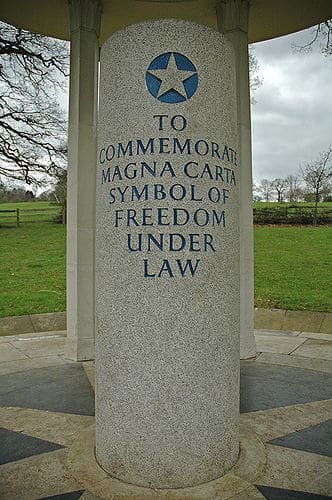
The Magna Carta Monument, Runnymede England

I am annoyed by folks who claim to love history and are blind to it. I am disgusted by folks who claim to love history, are willfully blind to it, and in their willful blindness try to use their power to inflict damage on others.

Why yes, I *did* listen to the oral arguments at SCOTUS today. Why do you ask?

sigh

Here’s an exchange between Justice Alito and Michael Dreeben, speaking for the government:

JUSTICE ALITO: Mr. Dreeben, you dispute the proposition that a former president has some form of immunity.

MR. DREEBEN: Mm-hmm.

JUSTICE ALITO: But, as I understand your argument, you do recognize that a former president has a form of special protection, namely, that statutes that are applicable to everybody must be interpreted differently under some circumstances when they are applied to a former president.

Isn’t that true?

MR. DREEBEN: It is true because, Justice Alito, of the general principle that courts construe statutes to avoid serious constitutional questions. And that has been the longstanding practice of the Office of Legal Counsel in the Department of Justice.

JUSTICE ALITO: All right. So this is more, I think, than just a — a quarrel about terminology, whether what the former president gets is some form of immunity or some form of special protection because it involves this difference which I’m sure you’re very well aware of.

If it’s just a form of special protection, in other words, statutes will be interpreted differently as applied to a former president, then that is something that has to be litigated at trial. The — the former president can make a motion to dismiss and may cite OLC opinions, and the district court may say: Well, that’s fine, I’m not bound by OLC and I interpret it differently, so let’s go to trial.

And then there has to be a trial, and that may involve great expense and it may take up a lot of time, and during the trial, the — the former president may be unable to engage in other activities that the former president would want to engage in. And then the outcome is dependent on the jury, the instructions to the jury and how the jury returns a verdict, and then it has to be taken up on appeal.

So the protection is greatly diluted if you take the form — if it takes the form that you have proposed. Now why is that better?

MR. DREEBEN: It’s better because it’s more balanced. The — the blanket immunity that Petitioner is arguing for just means that criminal prosecution is off the table, unless he says that impeachment and conviction have occurred.

Oh, the horrors of forcing a former president to defend himself in a trial! So sayeth Justice Alito, he who cites a 17th century English witchburner of a jurist (who also invented the marital rape exception), in order to justify denying women bodily autonomy.

If Justice Alito is fond of citing old English judicial writings, let me walk him back another 4 centuries and introduce him to John, by the grace of God King of England, Lord of Ireland, Duke of Normandy and Aquitaine, and Count of Anjou.

Once upon a time — long before a bunch of rabble-rousing colonial insurrectionists said that “Governments are instituted among Men, deriving their just powers from the consent of the governed, –That whenever any Form of Government becomes destructive of these ends, it is the Right of the People to alter or to abolish it, and to institute new Government, laying its foundation on such principles and organizing its powers in such form, as to them shall seem most likely to effect their Safety and Happiness.” — there was a little dustup between John, by the grace of God King of England etc., and a bunch of his barons, as well as various bishops and archbishops. The barons and clergy, distressed at what seemed to them to be very ill treatment at the hand of their king, expressed their frustrations in a manner that could not be ignored.

In June 1215, John and the barons negotiated an agreement. In it, after an introduction and 60 separate clauses in which King John agreed to various reforms and promised to make specific restitution in various particular cases that were demanded by his barons, the 1215 version of the Magna Carta ends like this:

* (61) SINCE WE [ed: John] HAVE GRANTED ALL THESE THINGS for God, for the better ordering of our kingdom, and to allay the discord that has arisen between us and our barons, and since we desire that they shall be enjoyed in their entirety, with lasting strength, for ever, we give and grant to the barons the following security:

The barons shall elect twenty-five of their number to keep, and cause to be observed with all their might, the peace and liberties granted and confirmed to them by this charter.

If we, our chief justice, our officials, or any of our servants offend in any respect against any man, or transgress any of the articles of the peace or of this security, and the offence is made known to four of the said twenty-five barons, they shall come to us – or in our absence from the kingdom to the chief justice – to declare it and claim immediate redress. If we, or in our absence abroad the chief justice, make no redress within forty days, reckoning from the day on which the offence was declared to us or to him, the four barons shall refer the matter to the rest of the twenty-five barons, who may distrain upon and assail us in every way possible, with the support of the whole community of the land, by seizing our castles, lands, possessions, or anything else saving only our own person and those of the queen and our children, until they have secured such redress as they have determined upon. Having secured the redress, they may then resume their normal obedience to us.

Any man who so desires may take an oath to obey the commands of the twenty-five barons for the achievement of these ends, and to join with them in assailing us to the utmost of his power. We give public and free permission to take this oath to any man who so desires, and at no time will we prohibit any man from taking it. Indeed, we will compel any of our subjects who are unwilling to take it to swear it at our command.

If one of the twenty-five barons dies or leaves the country, or is prevented in any other way from discharging his duties, the rest of them shall choose another baron in his place, at their discretion, who shall be duly sworn in as they were.

In the event of disagreement among the twenty-five barons on any matter referred to them for decision, the verdict of the majority present shall have the same validity as a unanimous verdict of the whole twenty-five, whether these were all present or some of those summoned were unwilling or unable to appear.

The twenty-five barons shall swear to obey all the above articles faithfully, and shall cause them to be obeyed by others to the best of their power.

We will not seek to procure from anyone, either by our own efforts or those of a third party, anything by which any part of these concessions or liberties might be revoked or diminished. Should such a thing be procured, it shall be null and void and we will at no time make use of it, either ourselves or through a third party.

* (62) We have remitted and pardoned fully to all men any ill-will, hurt, or grudges that have arisen between us and our subjects, whether clergy or laymen, since the beginning of the dispute. We have in addition remitted fully, and for our own part have also pardoned, to all clergy and laymen any offences committed as a result of the said dispute between Easter in the sixteenth year of our reign (i.e. 1215) and the restoration of peace.

In addition we have caused letters patent to be made for the barons, bearing witness to this security and to the concessions set out above, over the seals of Stephen archbishop of Canterbury, Henry archbishop of Dublin, the other bishops named above, and Master Pandulf.

* (63) IT IS ACCORDINGLY OUR WISH AND COMMAND that the English Church shall be free, and that men in our kingdom shall have and keep all these liberties, rights, and concessions, well and peaceably in their fullness and entirety for them and their heirs, of us and our heirs, in all things and all places for ever.

Both we and the barons have sworn that all this shall be observed in good faith and without deceit. Witness the abovementioned people and many others.

Given by our hand in the meadow that is called Runnymede, between Windsor and Staines, on the fifteenth day of June in the seventeenth year of our reign (i.e. 1215: the new regnal year began on 28 May).

Note the third paragraph, that begins “If we, our chief justice, . . .” In that paragraph, King John, by the grace of God King of England etc., is agreeing that he and his administration are not immune from accountability.

John and the barons agreed on a process for adjudicating disputes. They agreed on a panel that could both bring charges and judge them.  They agreed on how the panel should be chosen, and how the panel should select new members at the death of old ones. They agreed on how many members of the panel needed to agree in order for a judgment to be final. They agreed on a time frame for restitution. Most importantly, should John be found to have violated the terms of this document and yet refuse restitution, John, by the grace of God King of England etc., agreed that his castles and lands could be seized under order of the panel to make restitution for what he had done, or his officials had done on his behalf.

To be fair, the Magna Carta was changed and altered in the years and centuries that followed. But the original text of the original version makes it clear that even the King of England, Lord of Ireland, Duke of Normandy and Aquitaine, and Count of Anjou does not enjoy absolute immunity.

Trump may wish to be a monarch with absolute immunity and not a president.

Alito may wish to treat him as a monarch with absolute immunity and not a president.

But in a meadow at Runnymede, between Windsor and Staines, John, by the grace of God King of England, Lord of Ireland, Duke of Normandy and Aquitaine, and Count of Anjou, said no. That’s not how even a divinely appointed monarch is to be treated.

Share this entry

Sam Alito Says that Donald Trump Is a Maligned Ham Sandwich

I’m not, now, as full of despair as I was at one point in the SCOTUS hearing on Presidential immunity. (Here’s my live thread.) I believe that a majority of the court will rule that for private conduct — adopting the Blassingame rule that a President acting as candidate acts in a private role — a former President can be prosecuted.

But whooboy, Sam Alito really really believes everything Trump has said about this being a witch hunt. He repeatedly said that the protections that we assume ensure rule of law in the US — DOJ guidelines on prosecutions, the role of a grand jury, the role of a judge — are not enough in the case of Donald Trump. Sam Alito believes that Donald Trump should not have to be inconvenienced by a trial while he could be doing something else. Sam Alito also believes that January 6 was a mostly peaceful protest.

Alito even suggested that a President would be more likely to engage in violence after a closely contested election if he knew he might be prosecuted for it than not.

It was fairly insane.

Meanwhile, while I think there’s a majority (though Steve Vladeck is not as convinced) — with at least all the women in a majority — to let this case proceed at least on the private acts alleged in the indictment (with the huge caveat that Trump’s demands of Pence would not be considered a private act!), it’s clear that Neil Gorsuch doesn’t see how 18 USC 1512(c)(2) could be applied to Trump because we don’t know what corrupt purpose is, even though, of all the January 6 defendants, his corrupt purpose — his effort to obtain a improper private benefit — is most clearcut.

But there’s a whole lot of garbage that will come out of this decision, including immunity for core actions, like pardons and appointments, that could clearly be part of a bribe.

Notably, both Clarence Thomas and Brett Kavanaugh appear to be gunning for Special Counsels (though possibly only with respect to Presidents, not the sons of Presidents).

Michael Dreeben backtracked and backtracked far enough to preserve a case. But it’s not sure what else there will be.

Share this entry

When Michael Dreeben Accepted John Sauer’s Invitation to Talk about Speech and Debate

Trump’s appeal of Judge Tanya Chutkan’s immunity opinion is interesting for the personnel involved. The briefs repeat the very same arguments — and in some instances, include the same passages almost verbatim — made less than three months ago. But first Trump brought in John Sauer to argue his appellate cases, then in the last few weeks, former Deputy Solicitor General Michael Dreeben quietly joined the Special Counsel team (importantly, the Solicitor General appointed by Joe Biden has no role in this appeal).

That makes any changes in the arguments of particular interest, because accomplished appellate lawyers saw fit to add them.

Admittedly, two things happened in the interim to change the landscape significantly. In Blassingame, issued hours before Chutkan released her order, DC Circuit Chief Judge Sri Srinivasan laid out how a President running for reelection does not act in his official duty. In Meadows, 11th Circuit Chief Judge William Pryor adopted that analysis in the criminal context with regards to Mark Meadows in the Georgia case.

That provided both sides the opportunity to address what I had argued, on October 21, was a real weakness in Jack Smith’s first response: the relative silence on the extent to which Trump’s actions were not part of his official duties.

In total, DOJ’s more specific arguments take up just six pages of the response. I fear it does not do as much as it could do in distinguishing between the role of President and political candidate, something that will come before SCOTUS — and could get there first — in the civil suits against Trump.

Citing both Blassingame and Meadows, Smith and Dreeben invited the DC Circuit to rule narrowly if it chose, finding that the crimes alleged in the indictment all pertain to Trump’s role as candidate.

The Court need not address those issues here, however. The indictment alleges a conspiracy to overturn the presidential election results, JA.26, through targeting state officials, id. at 32-44; creating fraudulent slates of electors in seven states, id. at 44-50; leveraging the Department of Justice in the effort to target state officials through deceit and to substitute the fraudulent elector slates supporting his personal candidacy for the legitimate ones, id. at 50-54; attempting to enlist the Vice President to fraudulently alter the election results during the certification proceeding on January 6, 2021, and directing supporters to the Capitol to obstruct the proceeding, id. at 55-62; and exploiting the violence and chaos that transpired at the United States Capitol on January 6, 2021, id. at 62-65. The indictment thus alleges conspiracies to advance the defendant’s prospects as a candidate for elective office in concert with private persons as well as government officials, cf. Blassingame, 87 F.4th at 4 (the President’s conduct falls beyond the outer perimeter of his official duties if it can only be understood as having been undertaken in his capacity as a candidate for re-election), and the defendant offers no plausible argument that the federal government function and official proceeding that he is charged with obstructing establish a role—much less an exclusive and conclusive role—for the President, see Georgia v. Meadows, No. 23-12958, 2023 WL 8714992, at *11 (11th Cir. Dec. 18, 2023); United States v. Rhodes, 610 F. Supp. 3d 29, 41 (D.D.C. 2022) (Congress and the Vice President in his role as President of the Senate carry out the “laws governing the transfer of power”) (internal quotation marks omitted).

The short term goal here is to convince Judge Karen Henderson, the Poppy Bush appointee on this panel whose judicial views have grown as radical as any Trump appointee’s, to reject Trump’s claims. Ultimately, Jack Smith is arguing against Presidential immunity even for official acts, but a ruling limited to acts taken as a candidate might provide a way to get Judge Henderson to join the two Biden appointees on the panel, Florence Pan and Michelle Childs, in rejecting Trump’s immunity claims.

In both his briefs, Trump had — ridiculously! — argued that Nixon’s Watergate actions were private acts yet Trump’s January 6 actions were part of his official duties. Smith swatted that claim away in a passage noting that Nixon’s acceptance of a pardon served as precedent for the notion that a President could be tried for actions done as President.

That President Nixon was named as an unindicted coconspirator in a plot to defraud the United States and obstruct justice, Nixon, 418 U.S. at 687, entirely refutes the defendant’s efforts (Br.27-28, 41) to distinguish that case as involving private conduct. See United States v. Haldeman, 559 F.2d 31, 121-22 (D.C. Cir. 1976) (en banc) (per curiam) (explaining that the offense conduct included efforts “to get the CIA to interfere with the Watergate investigation being conducted by the FBI” and “to obtain information concerning the investigation from the FBI and the Department of Justice”) (internal quotation marks omitted). And President Nixon’s acceptance of the pardon represents a “confession of guilt.” Burdick v. United States, 236 U.S. 79, 90-91 (1915).

Again, once the categorization adopted by Srinivasan is available, it makes the comparison with Nixon far more damning.

One of the most interesting additions to the earlier arguments, however, is that Sauer added a second kind of immunity to Trump’s earlier discussion that the principles of judicial immunity carry over to Presidential immunity: Speech and Debate. In two cursory paragraphs, Sauer claimed that, like members of Congress, Trump should enjoy both civil and criminal immunity for their official, “legislative” acts.

Legislative immunity. Legislative immunity encompasses the “privilege … to be free from arrest or civil process” for legislative acts, i.e., criminal and civil proceedings alike. Tenney, 341 U.S. at 372. Such immunity enables officials “to execute the functions of their office without fear of prosecutions, civil or criminal.” Id. at 373–74 (quoting Coffin v. Coffin, 4 Mass. 1, 27 (Mass. 1808)).

Thus, legislative immunity “prevent[s]” legislative acts “from being made the basis of a criminal charge against a member of Congress.” Johnson, 383 U.S. at 180. A legislative act “may not be made the basis for a civil or criminal judgment against a Member [of Congress] because that conduct is within the sphere of legitimate legislative activity.” Gravel v. United States, 408 U.S. 606, 624 (1972) (emphasis added). Speech and Debate immunity “protects Members against prosecutions that directly impinge upon or threaten the legislative process.” Id. at 616.

Did I say two developments have changed the landscape of this discussion? I’m sorry, I should have added a third: In response to the September DC Circuit remand of Scott Perry’s appeal of Judge Beryl Howell’s decision that Jack Smith could have some stuff from his phone — in a panel including Henderson — on December 19, Howell’s successor at Chief Judge, James Boasberg reviewed the contested files anew and ruled that Smith could have most of them, including communications pertaining to “efforts to work with or influence members of the Executive Branch.”

Subcategories (c), (d), (e), and (f) comprise communications about non-legislative efforts to work with or influence members of the Executive Branch. Even if such activities are “in a day’s work for a Member of Congress,” the Speech or Debate Clause “does not protect acts that are not legislative in nature.”

Kyle Cheney (who snagged an accidentally posted filing before it was withdrawn) described what many of those communications would include, including Perry’s advance knowledge of Trump’s efforts to install Jeffrey Clark as Attorney General.

Boasberg’s order required Perry to turn over those communications by December 27; if he appealed that decision, I’m not aware of it. So as you read this Speech and Debate section, consider the likelihood that Jack Smith finally obtained records from a member of Congress DOJ has been seeking for 17 months, since before Smith was appointed.

The DC Circuit opinion in Perry is not mentioned in any of these briefs. But the developments provide an interesting backdrop for Dreeben’s much longer response to Sauer’s half-hearted Speech and Debate bid. Much of it is an originalist argument, noting that whereas Speech and Debate was explicitly included in the Constitution, immunity for Presidents was not, not even in a landscape where Delaware and Virginia had afforded their Executive such immunity.

Along the way, Dreeben includes two citations that weren’t in Jack Smith’s original submission: One from Clarence Thomas making just that originalist argument about Presidential immunity: “the Constitution explicitly addresses the privileges of some federal officials, but it does not afford the President absolute immunity.” And one from Karen Henderson, the key vote in this panel, noting that, contra Sauer’s expansive immunity claim, “it is well settled that a Member is subject to criminal prosecution and process.”

Unlike the explicit textual immunity granted to legislators under the Speech or Debate Clause, U.S. Const. art. I, § 6, cl. 1, which provides that “for any Speech or Debate in either House,” members of Congress “shall not be questioned in any other Place,” the Constitution does not expressly provide such protection for the President or any executive branch officials. See Vance, 140 S. Ct. at 2434 (Thomas, J., dissenting) (“The text of the Constitution explicitly addresses the privileges of some federal officials, but it does not afford the President absolute immunity.”); JA.604-06. By contrast, state constitutions at the time of the founding in Virginia and Delaware did grant express criminal immunity to the state’s chief executive officer. JA.605 (citing Saikrishna Bangalore Prakash, Prosecuting and Punishing Our Presidents, 100 Tex. L. Rev. 55, 69 (2021)). To be sure, the federal Constitution’s “silence . . . on this score is not dispositive,” Nixon, 418 U.S. at 705 n.16, but that silence is telling when placed against the Constitution’s Impeachment Judgment Clause, which presupposes and expressly preserves the availability of criminal prosecution following impeachment and conviction. See U.S. Const. art. I, § 3, cl. 7.

[snip]

The defendant suggests (Br.16-17, 18-19) that common-law principles of legislative immunity embodied in the Speech or Debate Clause, U.S. Const. art. I, § 6, cl. 1, inform the immunity analysis here, but that suggestion lacks support in constitutional text, history, or purpose. The Framers omitted any comparable text protecting executive officials, see Vance, 140 S. Ct. at 2434 (Thomas, J., dissenting), and no reason exists to look to the Speech or Debate Clause as a model for the defendant’s immunity claim.

In contrast to the defendant’s sweeping claim of immunity for all Presidential acts within the outer perimeter of his duties, the Speech or Debate Clause’s scope is specific: it is limited to conduct “within the ‘sphere of legitimate legislative activity.’” Gravel v. United States, 408 U.S. 606, 624 (1972). “Legislative acts are not all-encompassing,” and exclude a vast range of “acts in [a Member’s] official capacity,” such as outreaches to the Executive Branch. Id. Beyond that limitation, the Clause “does not purport to confer a general exemption . . . from liability . . . in criminal cases.” Id. at 626. Nor does it “privilege [Members or aides] to violate an otherwise valid criminal law in preparing for or implementing legislative acts.” Id. Courts have therefore recognized for more than 200 years that a Representative “not acting as a member of the house” is “not entitled to any privileges above his fellow-citizens” but instead “is placed on the same ground, on which his constituents stand.” Coffin v. Coffin, 4 Mass. 1, 28-29 (1808); see Rayburn House Off. Bldg., 497 F.3d at 670 (Henderson, J., concurring in the judgment) (observing that “it is well settled that a Member is subject to criminal prosecution and process”). The Speech or Debate Clause does not “make Members of Congress super-citizens, immune from criminal responsibility.” United States v. Brewster, 408 U.S. 501, 516 (1972). The defendant’s immunity claim, however, would do just that, absent prior impeachment and conviction.

The Speech or Debate Clause’s historical origins likewise reveal its inapplicability in the Presidential context. The Clause arose in response to successive British kings’ use of “the criminal and civil law to suppress and intimidate critical legislators.” United States v. Johnson, 383 U.S. 169, 178 (1966); see United States v. Gillock, 445 U.S. 360, 368-69 (1980) (noting that the English parliamentary privilege arose from “England’s experience with monarchs exerting pressure on members of Parliament” in order “to make them more responsive to their wishes”). In one instance, the King “imprison[ed] members of Commons on charges of seditious libel and conspiracy to detain the Speaker in the chair to prevent adjournment,” and the judiciary afforded no relief because “the judges were often lackeys of the Stuart monarchs.” Johnson, 383 U.S. at 181. That history has no parallel here: the defendant can point to no record of abuses of the criminal law against former Presidents, and the Article III judiciary provides a bulwark against any such abuses. [my emphasis]

Having been invited to discuss congressional immunity, Smith’s brief cites another comment from Henderson’s Rayburn concurrence elsewhere. “[T]he laws of this country allow no place or employment as a sanctuary for crime.”

see United States v. Rayburn House Off. Bldg., 497 F.3d 654, 672-73 (D.C. Cir. 2007) (Henderson, J., concurring in the judgment) (“[T]he laws of this country allow no place or employment as a sanctuary for crime.”) (citing Williamson v. United States, 207 U.S. 425, 439 (1908)). [my emphasis]

Tactically, all this is just an argument — an originalist argument — that even an immunity explicitly defined in the Constitution, Speech and Debate, does not — Judge Karen Henderson observed in 2007, when the question of immunity pertained to Black Democrat William Jefferson, in a case in which she sided with DOJ attorney Michael Dreeben — exempt anyone from criminal prosecution. Read her concurrence! She makes the same arguments about Tudor kings that Smith and Dreeben make!

But much of Jack Smith’s response, in my opinion, lays the ground work for other, future appeals. For example, this brief adopts a slight change in the way it describes the fake elector plot, emphasizing the centrality of Trump, “caus[ing his fake electors] to send false certificates to Congress,” a move that may be a preemptive response to any narrowing of 18 USC 1512(c)(2) that SCOTUS plans in the Fischer appeal of obstruction’s use for January 6.

Ultimately, Smith is still arguing for a broader ruling, rejecting Trump’s presidential immunity claims more generally. Ultimately, I imagine this adoption of language from Clinton v Jones is where Jack Smith would like to end up.

Given that, the Constitution cannot be understood simultaneously (and implicitly) to immunize a former President from criminal prosecution for official acts; rather, the Constitution envisions Presidential accountability in his political capacity through impeachment and in his personal capacity through prosecution. See Clinton, 520 U.S. at 696 (“[F]ar from being above the laws, [the President] is amenable to them in his private character as a citizen, and in his public character by impeachment.”) (quoting 2 J. Elliot, Debates on the Federal Constitution 480 (2d ed. 1863) (James Wilson)).

To get there without possibly fatal delays, though, Dreeben and Smith need to get Henderson to agree to at least a narrow rejection of Trump’s immunity claims.

And so, responding to Sauer’s invitation, Dreeben reminded Henderson of what she said about a case he argued 16 years ago.

But if I were Scott Perry, three days after he was ordered to turn over records about his plotting with Donald Trump to overturn the election, I’d be watching these arguments closely.

Share this entry

What Jack Smith Didn’t Say in His Double Jeopardy Response

Jack Smith just submitted his response to Trump’s immunity claims before the DC Circuit.

While most attention will be on the absolute immunity claims, given the disqualification of Trump in Colorado and Maine, I’m more interested in Smith’s response to Trump’s claim that his impeachment acquittal precludes these charges.

That’s because, depending on how this appeal goes, Jack Smith could make the question of Trump’s (dis)qualification much easier by superseding this indictment with an insurrection charge.

Most of the response argues that impeachment and criminal charges are different things. That argument is likely to prevail by itself.

In addition, though, the response repeated a passage, almost verbatim, that appeared in Smith’s response before Chutkan. In it, Smith said that the elements of offense currently charged do not overlap with the elements of offense for an insurrection charge.

Any double-jeopardy claim here would founder in light of these principles. Without support, the defendant asserts that his Senate acquittal and the indictment in this case involve “the same or closely related conduct.” Br.52. Not so. The single article of impeachment alleged a violation of “Incitement of Insurrection,” H.R. Res. 24, 117th Cong. at 2 (Jan. 11, 2021) (capitalization altered), and charged that the defendant had “incit[ed] violence against the Government of the United States,” id. at 3. The most analogous federal statute is 18 U.S.C. § 2383, which prohibits “incit[ing] . . . any rebellion or insurrection against the authority of the United States or the laws thereof.” A violation of Section 2383 would therefore require proof that the violence at the Capitol on January 6, 2021, constituted an “insurrection against the authority of the United States or the laws thereof” and that the defendant incited that insurrection. Incitement, in turn, requires proof that the speaker’s words were both directed to “producing imminent lawless action” and “likely to incite or produce such action.” Brandenburg v. Ohio, 395 U.S. 444, 447 (1969) (per curiam); NAACP v. Claiborne Hardware Co., 458 U.S. 886, 927-28 (1982). None of the offenses charged here—18 U.S.C. § 371, 18 U.S.C. § 1512(c)(2) and (k), and 18 U.S.C. § 241—has as an element any of the required elements for an incitement offense. And the elements of the charged offenses—e.g., conspiring to defeat a federal governmental function through deceit under Section 371, obstruct an “official proceeding” under Section 1512, and deprive persons of rights under Section 241—are nowhere to be found in the elements of a violation of Section 2383 or any other potential incitement offense. The mere fact that some of the conduct on which the impeachment resolution relied is related to conduct alleged in the indictment does not implicate the Double Jeopardy Clause or its principles. See Dixon, 509 U.S. at 696.

This doesn’t mean that Smith will supersede Trump, if this appeal succeeds. There are a lot of reasons not to do so (including that Trump would get to file a motion to dismiss that charge).

That said, Smith might have another reason to do so if SCOTUS significantly narrowed the obstruction charge in the Fischer appeal, because the obstruction charge is how Smith is presenting the evidence that Trump caused the attack on the Capitol.

In my view, this language keeps options open.

Share this entry