US, Russia Agree on Syria Plan; UN Security Council Vote Could Come Later Today

In a continuation of Barack Obama’s pivot to diplomacy, it appears that the US and Russia, along with several other UN Security Council members, have come to an agreement on how to structure the UNSC resolution on the surrender and destruction of Syria’s chemical weapons. Further good news comes in the early analysis of the disclosure by Syria of its chemical weapon stockpile, as it appears that most of the material is composed of binary precursors. Because of this, Syria can be effectively disarmed quickly by destruction of the mixing equipment. Further, these sarin precursors can be destroyed more quickly and safely than sarin that has already been prepared. Finally, hints are now being dropped that the rapid progress on the diplomatic front may have been brought about by a realization that Assad may not be in full control of the use of Syria’s chemical weapons.

Talks between the US and Russia had been stalled for some time over the issue of how Chapter 7 of the UN Charter would be invoked in the UNSC resolution. The US has favored putting that language into the resolution currently under discussion, spelling out military action to be taken should Syria default in its responsibilities in the disarming process. Russia has resisted such an automatic process. It appears that the issue has been resolved by making it clear that if Syria should violate the initial agreement, the Security Council will meet again to vote on invocation of Chapter 7 and potential military action. Although war hawks will dismiss this approach as allowing Syria to delay and obfuscate, it also prevents manipulation by the US to blow a minor violation out of proportion and initiate military action without a full hearing before the Security Council.

Reuters emphasizes the current absence of Chapter 7 consequences in the draft resolution in the opening of its article on developments:

Ending weeks of diplomatic deadlock, the United States and Russia agreed on Thursday on a U.N. Security Council draft resolution that would demand Syria give up its chemical arms, but does not threaten military force if it fails to comply.

Samantha Power, the U.S. ambassador to the United Nations, said a deal was struck with Russia “legally obligating” Syria to give up its chemical stockpile and the measure went to the full Security Council in a closed-door meeting on Thursday night. U.N. diplomats said a vote could come within 24 hours.

The process which would be followed in the event of a violation of the agreement by Syria is described by the New York Times:

Western diplomats said the resolution would be legally binding and would stipulate that if Syria failed to abide by the terms, the Security Council would take measures under Chapter VII of the United Nations Charter, the strongest form of a Council resolution. Such measures could include economic sanctions or even military action. But before any action could be taken, the issue would have to go back for further deliberations by the Security Council, on which Russia, like the other permanent members, holds a veto.

By making any Chapter 7 actions subject to a separate vote both the US and Russia will be forced to provide convincing evidence for the positions they take. The US won’t be able to move for military action on shaky grounds and Russia will be under a huge amount of pressure if they attempt to prevent a response to a clear violation. Gosh, such a process would put the UN into a position of functioning as it was intended. What a concept.

With all of the usual caveats that this is yet another transcription by Joby Warrick, there is very interesting and encouraging news coming from the initial disclosures on Syria’s chemical weapons: Read more

Share this entry

Syrian Moderate Coalition Fractures — Is al Nusra the Next MEK?

The US grand strategy of arming moderate groups within Syria’s opposition in the ongoing civil war (remember, we only arm folks so moderate that they eat enemies’ hearts) took a huge blow yesterday, as several groups previously aligned with the moderates threw their support into a group including the Islamist group Jabhat al Nusra, which has affiliations with al Qaeda. With the moderate coalition in disarray, it occurred to me to wonder whether al Nusra will now undergo a reputation-scrubbing and a lobbying campaign similar to that applied to MEK, which has been removed from the official list of terrorist organizations and continues to support US politicians who are willing to sell their services to any group with enough funding. There is hope for the future, though, as a UN treaty that would take significant steps toward stemming the flow of conventional weapons is gathering steam and has now been signed by more than half of the members of the UN.

The Washington Post brings us the news of the fractured moderate coalition:

American hopes of winning more influence over Syria’s fractious rebel movement faded Wednesday after 11 of the biggest armed factions repudiated the Western-backed opposition coalition and announced the formation of a new alliance dedicated to creating an Islamic state.

The al-Qaeda-affiliated Jabhat al-Nusra, designated a terrorist organization by the United States, is the lead signatory of the new group, which will further complicate fledgling U.S. efforts to provide lethal aid to “moderate” rebels fighting to topple Syrian President Bashar al-Assad.

The defecting groups are blaming the US for failing to come through with promised arms and for not bombing Assad after the August 21 chemical weapons attack:

Abu Hassan, a spokesman for the Tawheed Brigade in Aleppo, echoed those sentiments, citing rebel disappointment with the Obama administration’s failure to go ahead with threatened airstrikes to punish Assad for using chemical weapons in the suburbs of Damascus last month, as well as its decision to strike a deal with Russia over ways to negotiate a solution.

“Jabhat al-Nusra is a Syrian military formation that fought the regime and played an active role in liberating many locations,” he said. “So we don’t care about the stand of those who don’t care about our interests.”

Toward the end of the New York Times story on this development, we see the al Nusra group being described as less radical than the new kid on the block, the Islamic State in Iraq and Syria (ISIS): Read more

Share this entry

Speaking at UN, Obama Tries to Claim He Was Always For Diplomacy in Syria

I had seen several indications this morning that Obama planned to call for a diplomatic approach to the ongoing conflict in Syria despite the earlier indications that he intended to pursue a military strike even if the UK did not join and the UN did not provide a resolution authorizing force. I was hopeful that this new-found reliance on diplomacy would go all the way to calling for a ceasefire to provide safe conditions for the gathering and destruction of Syria’s stockpile of chemical weapons.

Alas, my hopes were once again dashed as Obama fell far short of proposing a ceasefire and he wound up delivering very convoluted remarks as he tried to maintain the fiction that Bashar al-Assad’s forces have been proven to have carried out the August 21 chemical weapons attack and that he favors diplomacy over military action. The quotations I will use here are from the Washington Post’s transcript of his speech.

In a move that approaches Colin Powell’s historic spinning of lies before the invasion of Iraq, Obama stated that there is no dispute that Syrian forces are responsible for the August 21 attack:

The evidence is overwhelming that the Assad regime used such weapons on August 21st. U.N. inspectors gave a clear accounting that advanced rockets fired large quantities of sarin gas at civilians. These rockets were fired from a regime-controlled neighborhood and landed in opposition neighborhoods.

It’s an insult to human reason and to the legitimacy of this institution to suggest that anyone other than the regime carried out this attack.

As I stated shortly after the UN report came out, the report did not show that the rockets for which they determined trajectories carried sarin. That argument is strengthened further by the subsequent realization by others that not one of the environmental samples from the Moadamiyah site came back as positive for sarin. So now one of the famous lines that cross at a Syrian military installation has to be disregarded entirely because there is no evidence of sarin at the point of rocket impact. [Look for the website and reporters for the linked post to be attacked mercilessly. Both the Global Research site I linked to in one questioning post and the Mint Press site which suggested a Saudi false flag operation have been attacked savagely as to their credibility. Remarkably, I have yet to see any of those attacks actually contradict the questions that have been raised.*]

Let’s take a look at Obama’s logical gymnastics as he tried to justify both his initial intent to attack Syria and then his rediscovery that he prefers a diplomatic approach. Early in his Syria comments, he claimed ” A peace process is stillborn.” He gave no evidence of what, if any, role the US played in the peace process. In fact, his next sentence provides a partial clue to just how the peace process died: “America and others have worked to bolster the moderate opposition, but extremist groups have still taken root to exploit the crisis.”

You see, those moderate groups that we are arming are not able to defeat the extremists that others are arming. Sounds like a child caught fighting who says “he hit me back first”.

So that background of a stillborn peace process is why, even before the weak evidence from the UN that the US is misrepresenting came out, Obama insisted that he had to attack Assad. Obama’s ploy to support his actions approached a George W. Bush administration level of disdain for the UN itself as he supplied his rationalization: Read more

Share this entry

Afghanistan: New Green on Blue, Green on Green and a Politicized Memorial Service

With so much attention focused on Syria, it is important that we don’t lose sight of just how badly the situation in Afghanistan is limping toward a final resolution. There is a report ToloNews website this morning on a memorial service that was held yesterday in Kabul. It’s not clear why the service was held yesterday (the anniversary of the US invasion isn’t until early October), but the service was described as honoring both foreign and Afghan soldiers who have fallen in the war. While the words attributed to Dunford were simple enough in deploring terrorism, the quotes attributed to Afghan figures were appalling in their attempts to use a solemn occasion to shill for what their US military handlers want in the coming months:

Highlighting on the importance of support from the international community post-2014, the Ministry of Defense (MoD) requested the international community to continue assisting the Afghan forces by providing equipment and proper training post-2014.

The battle of Afghanistan against terrorism has seen some big sacrifices in terms of military and civilian casualties. Over the past 12 years, since the beginning of the Afghan war, over 3,000 foreign soldiers and over 10,000 Afghan soldiers have lost their lives.

The foreign forces’ combat mission is scheduled to end in the next few months, but a greater question looms large with regard to how effective has the fight against terrorism been over the past 12 years?

In light of this, Bismillah Mohammadi, the Minister of Defence expressed concerns over the training and equipping of the Afghan Security Forces post-2014. Mr. Mohammadi urged the international community to continue assisting the Afghan forces beyond 2014.

“We urge the international community to equip and train the Afghan Security Forces post- 2014,” said Mr. Mohammadi.

And how well is all that “training” going? Pretty much as we saw before. Despite massive efforts by the US to re-screen Afghan personnel in the military and to decrease the number of interaction points between Afghan recruits and their trainers, there was another green on blue killing on Saturday. From ToloNews:

“Three International Security Assistance Force (ISAF) service members died when an individual wearing an Afghan National Security Forces uniform shot them in eastern Afghanistan today,” a statement from the coalition said.

A US defence official confirmed to AFP that the three victims were from the United States.

An Afghan official, speaking on condition of anonymity, told AFP that the attack happened during a training session in the insurgency-hit province of Paktia.

The Afghan soldier opened fire on US soldiers, killing two on the spot, he said. A third later died of his wounds.

The attacker was killed when Americans and Afghan soldiers returned fire.

The article, which originally comes from AFP, lists the various programs the US has put into place in response to green on blue killings. By listing these programs in such proximity, we can see how they are self-contradictory:

There have been seven “insider attacks” this year against coalition forces, compared with 48 in 2012. ISAF officials say the decline has been due to better vetting, counter-intelligence and cultural awareness.

Foreign soldiers working with Afghan forces are regularly watched over by so-called “guardian angel” troops to provide protection from their supposed allies.

The military really wants us to believe that they have finally learned cultural awareness and that they have put into place appropriate screening and counterintelligence processes that will eliminate threats. And those programs are working so well that the military now assigns soldiers to act as armed guards during training sessions.

Hidden in a Khaama Press article today about a Taliban attack that killed eleven Afghan border police, we learn that there was an insider killing in an Afghan Local Police unit: Read more

Share this entry

Further Questions Arise on Ghouta Attack

There has been quite a rush to assign blame to the Syrian government for the August 21 chemical weapons attack in the Ghouta area of greater Damascus. Perhaps more than any other piece of evidence, the fact that the two rocket trajectories the UN report described cross inside a Syrian military base has prompted people to jump to that conclusion. However, as I have pointed out, the UN report itself does not state directly that the two rockets for which trajectories were described actually tested positive for sarin. That is a very important point, since we know that conventional shelling of the attack site, from the base identified by the rocket flight paths, continued in the days between the chemical weapon attack and the arrival of the UN inspection team.

I had seen suggestions that some of the video evidence on which the US based its huge estimate of the death toll from the attack may have been staged. Below is a video compiled by Global Research that summarizes much of the case calling those videos into question. The video raises several important points. First, we learn here that at least one of the regions of the attack had actually been abandoned by citizens prior to August 21 because the area had been rendered unlivable by repeated shelling. The video also suggests that a large number of kidnapped Alawite women and children may have been transported to the attack site to serve as the victims of the attack. A number of faces of male victims of this kidnapping appear to be matched from pre-August 21 videos to those same faces showing up among the dead after the attack.

I don’t profess to know the truth of who carried out this brutal attack with sarin, but the questions raised in this video are just as worthy of pursuing fully as those raised by the folks who already assume Assad gave the order for this attack.

[youtuber youtube=’http://www.youtube.com/watch?v=EzLVfdrQRsY’]

Share this entry

Is Lindsey Graham the Weakest Politician in the United States?

Apparently with the blessing of Supreme Leader Ayatollah Ali Khamenei, Iranian President Hassan Rouhani is taking huge and significant steps toward a thawing of relations with the West while also moving to lessen the grip of hard line positions within Iran.

Rouhani and US President Barack Obama have been exchanging letters that seem to have paved the way for further discussions and improved negotiations on the issue of Iranian nuclear technology. Iran released a number of political prisoners on Wednesday. Iran also appears headed toward another round of P5+1 talks, with the date to be arranged while diplomats are in New York next week for Rouhani to address the UN. The diplomatic push reached a high point on Wednesday when Rouhani sat down in Tehran for an interview with NBC’s Ann Curry:

[youtuber youtube=’http://www.youtube.com/watch?v=DefgX2xPJR4′]

The entire interview in this clip is compelling, but I want to emphasize one bit that occurs near the end once the discussion moved to Syria. From the NBC blog post where the interview video is posted:

Asked whether he thought Obama looked weak when he backed off the air-strike threat, Rouhani replied, “We consider war a weakness.  Any government or administration that decides to wage a war, we consider a weakness.  And any government that decides on peace, we look on it with respect to peace.”

What a different viewpoint than we see inside the DC beltway. Throughout the entire Syria episode, we have been bombarded with the refrain that Obama simply had to attack Syria because if he didn’t, he would lose his credibility and look weak. Rouhani, on the other hand, states that it is resorting to war that is the real weakness.

If going to war is the real weakness, then it appears that Lindsey Graham may want to be the weakest politician in the US:

Sen. Lindsey Graham (R-S.C.) said Tuesday he’s working on legislation that would give the president the green light to attack Iran if negotiations over the country’s alleged nuclear weapons program stall.

Graham is clearly approaching the issue from a very different side than Rouhani.

Who’s weak now, Lindsey?

Rouhani and Khamenei are taking steps to tell the “weaker” elements on their side to STFU:

On Monday, the new president said the Revolutionary Guards — who report to Khamenei and have been accused of backing hard-liners — should stay out of politics. The next day, Khamenei was quoted on state TV as saying, “It is not necessary for the Guards to have activities in the political field.”

If only Lindsey would show a little bit of strength and bite his tongue while diplomacy has its best chance in years.

Share this entry

Dilma Throws Obama a BRIC

Screen shot 2013-09-17 at 2.57.28 PMI was actually surprised, back in May, when the White House announced a State Visit for Brazil’s President, Dilma Rousseff.

After all, not long after Obama visited Brazil in March 2011, the real started gaining value against the dollar, significantly slowing the boom Brazil had enjoyed in the wake of our crash.

When she was here in April 2012, Dilma explicitly blamed US Quantitative Easing for the reversal in currencies, and suggested the policy was meant to slow growth in countries like Brazil. Before that, Brazil’s boom and its advances in energy independence had put Brazil in a position to assume the global stature a country of its size might aspire to. And Dilma (partly correctly) blamed US actions for undercutting that stature.

I interpreted the State Dinner to be an attempt to woo Brazil away from natural coalitions with the Bolivarist governments of Latin America and the BRICS (Brazil, Russsia, India, China, and South Africa).

Fast forward to today, when the Brazilian government announced that it has postponed the visit that had been scheduled for October 23.

The usual suspects are mocking Dilma’s decision, insisting that everyone spies, and that Brazil is just making a stink for political gain. The White House statement echoes that, suggesting that it was the revelation of US spying, and not the spying itself, that created the problems.

The President has said that he understands and regrets the concerns disclosures of alleged U.S. intelligence activities have generated in Brazil and made clear that he is committed to working together with President Rousseff and her government in diplomatic channels to move beyond this issue as a source of tension in our bilateral relationship.

There is something to that stance. Dilma’s government faces a lot of unrest and the tensions of preparing for the World Cup. The portrayal that the US was taking advantage of Brazil caught her at a politically sensitive time.

All that said, those poo-pooing Brazil’s complaints ignore the specific nature of the spying as revealed. As I noted, even James Clapper’s attempt to respond to concerns raised by the original reports in Brazil didn’t address (and indeed, may have exacerbated) concerns that the US is engaging in financial war, including manipulating its currency to undercut other countries as they rise in relative power. If the US is using its advantages in SIGINT to engage in such financial war, Brazil has every reason to object, because it’s not something Brazil’s currency or telecommunications position make possible.

US disclaimers of industrial espionage no longer matter if the US is collecting SIGINT that would support substantive financial attacks, especially since Clapper in March made it clear the US envisions such attacks (even if they only admit to thinking in defensive terms).

Read more

Share this entry

NYTimes Finally Finds Concern Over Impunity for War Crimes, But Only Assad’s War Crimes

Despite the fact that the US has never faced prosecution for its illegal invasion of Iraq or for the many documented acts of rendition and torture in the Great War on Terror, the New York Times this morning found it possible to rail against the injustice of impunity for war crimes. But only after jumping on the bandwagon to convict Bashar al-Assad’s government of a war crime for which definitive proof has not yet been developed. Here is their hand-wringing:

The repercussions have elevated the 30-month-old Syrian conflict into a global political crisis that is testing the limits of impunity over the use of chemical weapons.

The Times goes on to present the evidence from the UN analysis in the most unflattering light toward Assad. Nowhere in the report do we get discussion of the fact that the UN inspectors were not at the attack site until five to eight days after the attack. Even more importantly, the Times completely elides any reference to the cautionary note in the report that “potential evidence is being moved and possibly manipulated“.

The most damning accusations in the Times article rely on material outside the UN report (pdf). The report does not disclose any findings on the quality of the sarin found in the analysis, but that did not stop the “diplomats” who are eager to assign blame:

Both the British and American ambassadors to the United Nations also told reporters that the report’s lead author, Dr. Ake Sellstrom, a Swedish scientist who joined Mr. Ban in the Security Council briefing, had told members that quality of the sarin used in the attack was high.

“This was no cottage-industry use of chemical weapons,” said Britain’s ambassador, Sir Mark Lyall Grant. He said the type of munitions and trajectories had confirmed, “in our view, that there is no remaining doubt that it was the regime that used chemical weapons.”

Much attention has been given to the analysis of munitions found by the inspectors. The smaller of the two types described, the M14 or 140 mm rocket (which reportedly can carry about two liters of sarin), is typically launched by a towed launcher such as the one pictured here on Wikipedia. The larger type, a previously undescribed 330 mm rocket (which could carry over 50 liters of sarin) would be launched from a much larger vehicle, presumably the type usually seen mounted on the back of a large truck. Multiple sources state that the various Syrian rebel groups have not been documented to have launchers of these types.

Much also has been made of the triangulation of the two flight paths that the UN inspectors described, since the paths cross at a known Syrian military site. There is a huge problem, however, in using this information by itself to state conclusively that the flight paths prove that Syrian forces, under orders from Assad, fired the chemical weapons. From the way that the UN report is written, it is impossible to determine whether the two rockets for which these flight paths were determined actually tested positive for sarin, or if they even were tested at all. That is very important, since we know that Syrian forces continued to attack the Ghouta area during the time between the chemical attack and when the UN inspectors were allowed to do their work. In fact, we know that conventional shelling was carried out from the very base the ballistics analysis points to:

The Local Coordination Committees, another activist group, also reported several air raids on the suburbs, and added that President Bashar Assad’s forces were shelling eastern Ghouta from the Qasioun mountain overlooking Damascus.

The analysis by Casual Observer, which he posted in this tweet and this close-up identifying Qasioun matches the information in the previously linked diagram from the Times and allows us to confirm that conventional artillery from the Qasioun base was known to have been fired at the chemical attack zone in the time between the chemical attack and the UN inspection.

At most, the ballistics analysis provides circumstantial evidence that supports the allegations that the Qasioun base was the source of at least some of the shelling where the chemical attack took place. The insecure nature of the site, coupled with the UN report being silent on whether there were positive sarin tests on the two rockets for which flight path analysis was carried out, prevents any conclusion that the sarin originated from the Syrian military base. And that’s before even getting to the question of whether Assad himself gave a command to fire chemical weapons.

Share this entry

Happy “Dirty Your Hands” by Partnering with Bashar al-Assad Day

The Colbert Report
Get More: Colbert Report Full Episodes,Video Archive


As I noted last week, 12 years ago today, President Bush signed the Memorandum of Notification that governed — and as of last year, at least, still governs — our war on terror.

Part of that MON, according to Bob Woodward’s Bush at War, includes partnering with “rogue regimes” like Syria on intelligence collection.

[Tenet] called for initiating intelligence contact with some rogue states such as Libya and Syria that he said might be helpful in trying to destroy al Qaeda. For the CIA to obtain helpful information against the terrorists, they might have to get their hands dirty.

After signing that MON, Bush’s own regime sent people like Maher Arar off to be tortured by Bashar al-Assad’s government.

The same guy we almost went to war against last week because he’s so barbaric, we partnered with, in a policy set by the President, outsourcing our torture.

As of May 25, 2012, the government was still relying on this MON (probably, at a minimum, to cover the drone and other method assassinations that aren’t covered by any AUMF).

I already noted all this; I wasn’t going to otherwise call out the anniversary of the day the “Gloves Came Off.”

But then I saw this clip of Philip Mudd on Colbert. About halfway through, Mudd says we have to fight Syria because Assad is,

a tyrant who has a reckless abandon when he murders innocents. At what point do you draw a line and say we are not just US citizens, we’re global citizens?

Mudd then goes on to answer a question about whether he tortured prisoners by saying he was Deputy Director of the Counterterrorism Center, which held and tortured prisoners.

He doesn’t regret that, he says.

He then goes on to admit he signed papers to render prisoners.

Mudd: If you’re asking if I’m responsible for some of that, the answer’s yes.

Colbert: Alright, you think that was the right thing to do.

Mudd: Yes.

Colbert: And we renditioned some of those people to Syria.

Mudd: Uh, I think the answer’s yes, I don’t [shakes head]

Colbert: OK

Mudd: We rendered a lot of people.

At what point do you draw a line, says this man, who can’t even remember that Syria was indeed one of the countries we outsourced our torture to, even the torture of an innocent man. We must be global citizens, not just American citizens, he says, and doing anything else is a sign of cowardice.

And yet, this intelligence expert can’t even figure out why Assad thinks he can get away with murdering his own people.

Share this entry

Working Thread: UN Chemical Weapon Report on Syria Released

The UN has finally released its report (pdf) on the analysis of both human and environmental samples relating to the chemical weapon attack in the Ghouta area of Syria on August 21. The report finds unequivocal evidence of sarin in blood, urine and environmental samples.

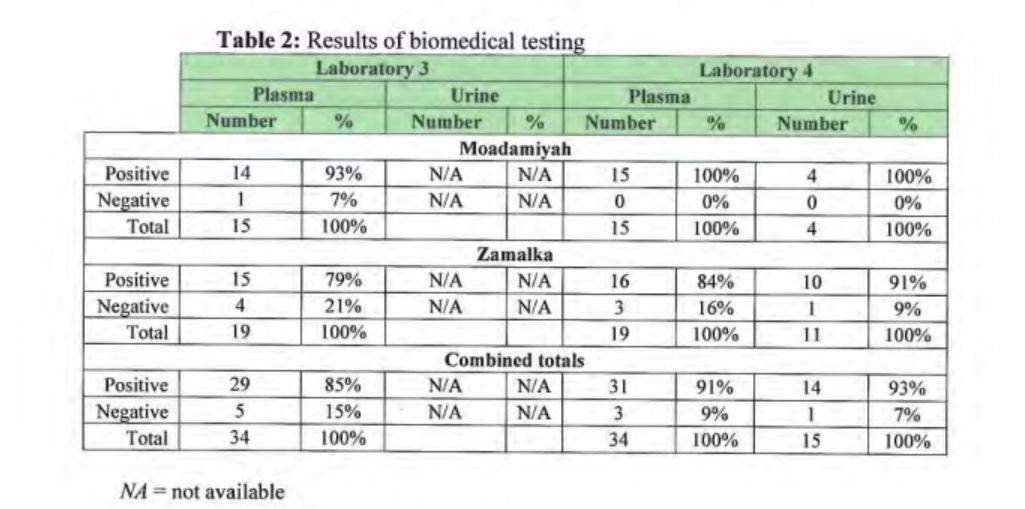
A total of 36 primary victims and first responders who were exposed were interviewed. Sixteen of them were from Moadamiyah and twenty were from Zamalka. Seventy eight percent of them lost consciousness, 61% had difficulty breathing and 42% had blurred vision. Thirty four of the thirty six had blood samples taken (two refused) and 15 showing the most severe symptoms submitted urine samples. The materials were sent to two separate laboratories for analysis:

Medical test results


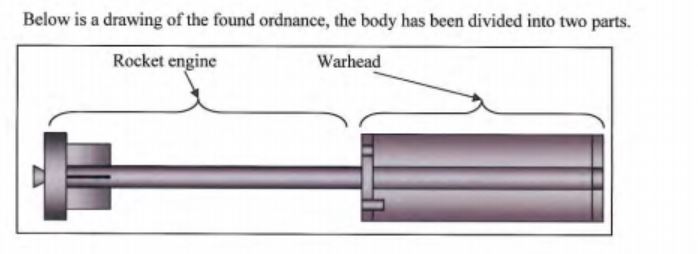
Rockets that could have delivered the chemical agent were found at some sites. At least one was capable of carrying up to 50 liters of liquid. Schematic of intact rocket:

Intact rocket schematic


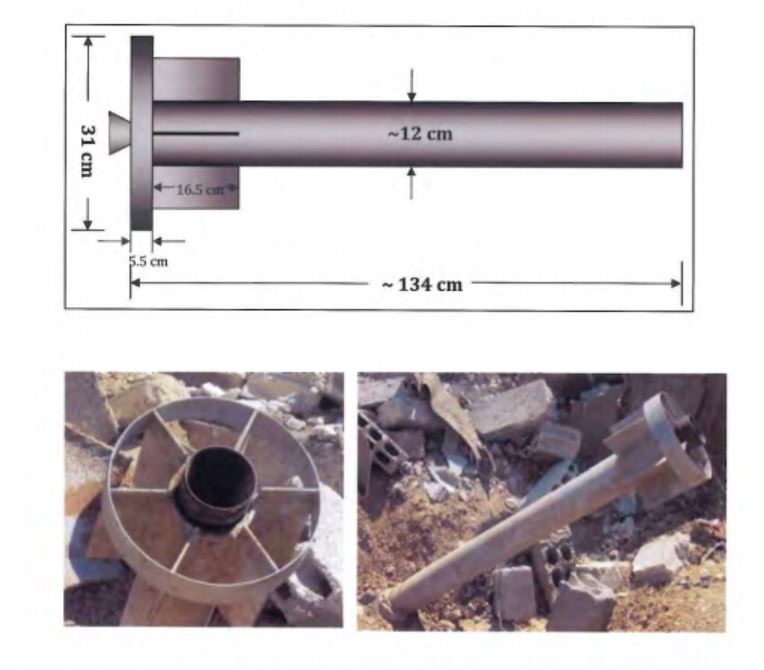
The engine end was exposed at the impact site:

Rocket engine


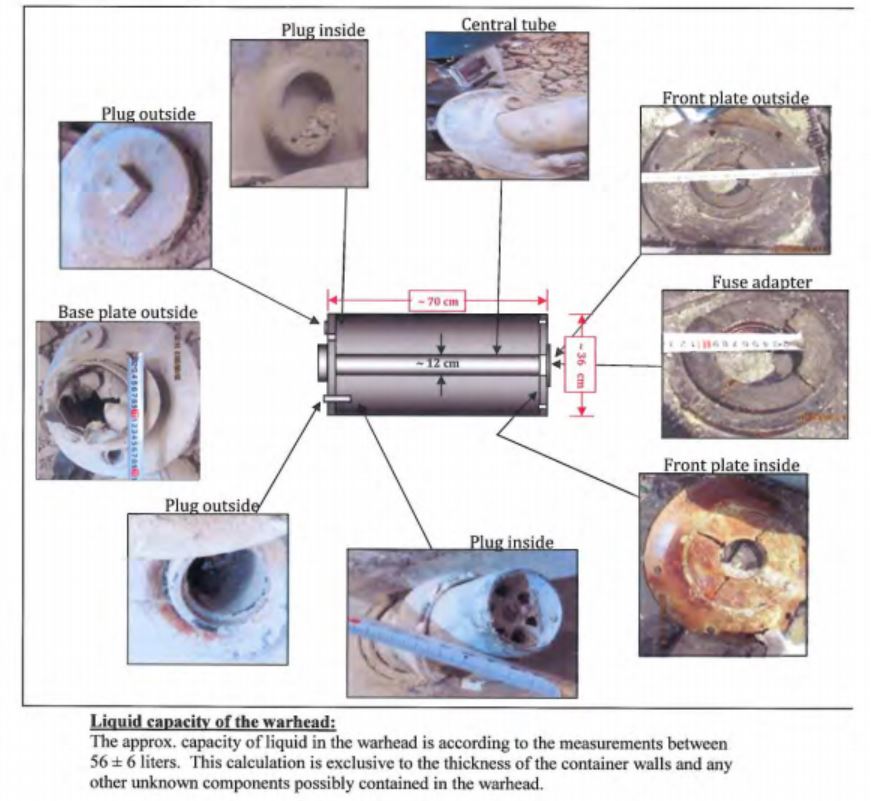
The warhead:

50 liter warhead

But of course, these inspections came on August 26 in Moadamiyah and August 28 and 29 in Zamalka, so 5 to 8 days passed between the attack and the analysis. The key point to keep in mind when considering the rocket evidence is this:

Manipulation

People had plenty of time to move things around before the UN inspectors came onto the site. The possibility that evidence has been manipulated cannot be ruled out.

My first impressions from the report are that it is without question that the people interviewed and who submitted samples were indeed exposed to sarin. How it was delivered is another question entirely. Rockets were found in the vicinity where people were exposed and environmental samples, including from the rockets themselves, showed evidence of sarin, but it is impossible to conclude the rockets definitely delivered the sarin. It is impossible to rule out sarin being put onto the rocket debris after impact.

I’ve only skimmed the report, please consider this a working thread and share any findings in comments.

Share this entry