
MOTU Rules: Material Support for Terror Edition

AmericaBlog’s Chris is right. We should not look at yesterday’s sentencing of Raj Rajaratnam as the first act of justice against the banksters who killed our economy.

As I’ve said many times before, if Rajaratnam is guilty, fine, find him guilty and send him to prison. But let’s not confuse this case with the much larger problem of Wall Street triggering the recession. Rajaratnam was a swindler and used insider information to profit by tens of millions of dollars. That’s a much different story than the trillions of dollars needlessly lost by Wall Street, yet we see no legal action related to those losses.

Not only doesn’t Rajaratnam’s sentence represent a victory for the 99%, a former FBI Agent claims that he was largely convicted because of his material support for the Tamil Tigers. (h/t scribe)

Jay Kanetkar, who was [FBI Tamil Tiger infiltrator] Rudra’s main F.B.I. handler from 1999 until he left the bureau in June 2006, says that Rajaratnam’s alleged involvement with terrorism was a significant factor in why the F.B.I. and the Department of Justice went to such extraordinary lengths to nail him. “It was a conscious decision,” Kanetkar says, “to treat Raj the terrorist the way they treated Al Capone when they got him for tax evasion.”

[snip]

By 2005, Rudra’s penetration of the Tigers’ network was so deep that the F.B.I. had acquired a comprehensive picture of the group’s fund-raising capability. Raj Rajaratnam’s name came up frequently. “On the recordings, he was spoken of in a reverential way, with all the kudos he got as a financial whizz,” says Kanetkar. “At the same time, he wasn’t a commoner, which is why it was hard for Rudra to get close to him. He was reserved for the big stuff.” For example, in September 2005, two Tamil Tiger members were duped by the F.B.I. In an attempt to have the Tigers removed from the government terrorism list, they agreed to pay $1 million to two “corrupt State Department officials” (in reality, F.B.I. agents) whom Rudra had introduced them to. The Tamils went straight from that meeting to Rajaratnam’s house, apparently to arrange to get the money, according to Rudra and Kanetkar.

“Rudra told us that the L.T.T.E. had given Raj a very large sum of money for him to invest in the Galleon fund,” says Kanetkar. “It was clear that the Tigers did have that kind of money. They were raising $1 million every time they held a function, and also going door to door—extorting people to pay thousands of dollars for the next wave of operations.” Kanetkar and his counterterrorist colleagues had been aware of evidence that Rajaratnam was using illegal insider information since 2001, when wiretaps caught an executive from the Intel Corporation offering him insider tips. The F.B.I. saw the two endeavors—terrorism and insider trading—as connected, says Kanetkar: “Money from insider trading was going into his pocket, and money from his pocket was going to the L.T.T.E.”

In other words, if you believe David Rose, the reason FBI prosecuted Rajaratnam as opposed to all the other banksters who engage in insider trading is because the gains from his insider trading went to fund the Tamil Tigers.

But there’s even something funky with that story.

According to Rose’s story, the FBI was aware of Rajaratnam’s insider training starting in 2001, when they got him on tape getting a tip from an Intel. According to Rose, the FBI was collecting evidence tying Rajaratnam to the Tigers as early as November 2002 (and was reviewing money transfers going back to 2000). And while Rose doesn’t mention it, we know the government was already using SWIFT to track terrorist financing by that point. That doesn’t help you track insider trading, but it does mean any suspicion that rajnaratam was financing terrorism would make his money transfers fairly transparent.

And while I’m not surprised in the least that the Bush DOJ chose not to prosecute Rajaratnam for insider trading (indeed, the implication of the Rose story is that the Obama DOJ is still ignoring a lot of insider trading that doesn’t have a terrorism aspect), the entire story suggests that the FBI was tracking a prominent trader’s alleged financing of terrorism for 7 years and not only never pursued him for that, but didn’t indict him for it when they got around to indicting on insider trading, even though at that same point DOJ was sending non-bankster material supporters to jail for 65-year sentences.

Now, maybe the Rose story oversells Rajaratnam’s ties to the Tamils, or at least his awareness that they were terrorists. Clearly, the case against Rajaratnam, unlike (say) that against Chiquita’s top managers during the same time frame, was not so cut and dry. Perhaps DOJ believed they couldn’t convict Rajaratnam.

But the lesson seems not only to be that this is one very small conviction that doesn’t even begin to touch the much larger crimes, but that MOTUs get treated differently even for terrorism-related crimes than ordinary people.

Share this entry

Why Is Thomas Perrelli Negotiating a Settlement If the Banksters Didn’t Commit Fraudulent Actions?

In his press conference today, Obama said,

Well, first, on the issue of — on the issue of prosecutions on Wall Street, one of the biggest problems about the collapse of Lehman’s and the subsequent financial crisis and the whole subprime lending fiasco is that a lot of that stuff wasn’t necessarily illegal, it was just immoral or inappropriate or reckless.

[snip]

So you know, without commenting on particular prosecutions — obviously, that’s not my job; that’s the attorney general’s job – you know, I think part of people’s frustrations — part of my frustration was a lot of practices that should not have been allowed weren’t necessarily against the law, but they had a huge destructive impact. And that’s why it was important for us to put in place financial rules that protect the American people from reckless decision-making and irresponsible behavior.

[snip]

The president can’t go around saying prosecute somebody. But as a general principle, if somebody is engaged in fraudulent actions, they need to be prosecuted. If they’ve violated laws on the books, they need to be prosecuted. And that’s the attorney general’s job. And I know that Attorney General Holder, U.S. attorneys all across the country — they take that job very seriously. [my emphasis]

His comments are funny for a number of reasons. Apparently, the President can’t go around saying “prosecute somebody,” but he can go around saying, “assassinate somebody.”

More curiously, though, he insists that if someone has engaged in “fraudulent actions, they need to be prosecuted.”

FHFA has sued 18 banks, a number of them for fraud, most of them in federal court. As part of those suits, it has sued a number of named individuals. DOJ, however, seems to have no interest in all those entities accused of fraud.

More troubling still, mortgage servicers have, in sworn depositions, admitted to fraud of a variety of types.

And yet Associate Attorney General Thomas Perrelli is busy trying to craft a settlement–not a prosecution–with those who engaged in this fraud. (And in the wake of CA’s withdrawal from the settlement talks, the banks are crowing that DOJ is still going to sign such a deal.)

The Administration needs to be asked not just why no big banksters have been prosecuted, but also why in the face of massive fraudulent actions, DOJ is choosing to settle, rather than prosecute.

Share this entry

Taking Back Wall Street Trash Talk

Well we are a little late getting started on the trash talk this weekend, I apologize about that. I have been fixated on the Anwar Awlaki scenario and, today, the Occupy Wall Street effort. In honor of the citizens trying to take back the Street in New York, this week’s music is by Jimmy Cliff; you can get it if you really want it. But, you must actually try.

That, folks, is what is meant by the term “a democracy, if you can keep it”. The people still have the power, the people still have the vote; but they must have the information, and they must have the desire to exercise their power. Our friends and colleagues at FDL, via Kevin Gosztola, are doing great work covering the protests. And, if you have seen what I have on Twitter, it really appears to be something significant starting to form in the Big Apple. I am told about 400 people have been arrested; let’s hope they are replaced by 4,000 others.

Quite frankly it is a rather lackluster day in college football, the only 2 games I really had my eye on are Nebraska at Wisconsin, and 13th ranked Clemson at 11th ranked Virginia Tech. The Clemson game is already over, with the Tigers laying an unheard of whipping on Frank Beamer and the Hokies in Blacksburg. Not so for the Badgers however, the Cornfuckers are in Camp Randall right now with the Huskers up by a point 14-13. The rest of the game should be something fun, and the quarterback for Wisconsin, Russell wilson is really a special kid.

On the pro end of things, it is really not a very enticing slate of games on tap. Seriously there are like three games worth watching. The first is the Stillers at the Texans. Normally, this would be an easy call; but Pittsburgh has not settled in yet this season, and Houston has a fine team and is at home. That is a pickem. The second decent tilt, and maybe my most anticipated game, is Deetroit at Dallas. The Kittehs are THE hot team this year, and Suh is gonna be Romo rib hunting. But the ‘Boys are a little tougher than people think, and are at the JerryDome. I am leery of this, but am still going to go with the Lions. The other game tomorrow of interest is the Pats at the Black Hole to visit those nice Raider chaps. Darren McFadden got a bit nicked up in his huge day against the Jets, Jets, Jets last week, but looks good to go tomorrow. Marcy smells a Rayduhs upset here. So do I. Honorable mention to the Jets versus Ravens on NBC’s Sunday Night Football. It’s in Baltimore, gonna go with the home team there.

Lastly, it is October baby. Reggie Jackson time! and playoff baseball is in full swing. Unless the game is at Yankee Stadium, in which case it is in full swim. Tampa Bay just clocked the Rangers behind 22 year old rookie sensation Matt Moore to open the series, but Texas is up 7-3 in the 7th inning tonight. Oops, Eva Longoria just hit a three run tater to bring it to 7-6. Rays are like butter. On a roll. Diamondbacks got freaking smoked by the BrewCrew today in game one of the NLDS. Arizona has the youngest team in baseball and has been on a great run this year, but still may be a year and another starting pitcher away from being serious contenders. Never count out Kirk Gibson though, and the DBacks are Gibby’s team through and through.

Share this entry

Why Blame the Failure of the 50-State Settlement Solely on Tom Miller?

Yesterday, CA Attorney General Kamala Harris announced she was withdrawing from the 50-state foreclosure fraud settlement.

California Atty. Gen. Kamala Harris will no longer take part in a national foreclosure probe of some of the nation’s biggest banks, which are accused of pervasive misconduct in dealing with troubled homeowners.

Harris removed herself from talks by a coalition of state attorneys general and federal agencies investigating abusive foreclosure practices because the nation’s five largest mortgage servicers were not offering California homeowners relief commensurate to what people in the state had suffered, a person familiar with the matter said.

The big banks were also demanding to be granted overly broad immunity from legal claims that could potentially derail further investigations into Wall Street’s role in the mortgage meltdown, the person said.

With CA–the largest state and the one with the greatest foreclosure exposure–this effectively kills the settlement. See DDay for more on why Harris made this decision and what it means going forward.

But Harris’ letter announcing her decision makes something else (which had become increasingly obvious in recent weeks) clear.

Harris gives US Associate Attorney General Thomas Perrelli, not IA Attorney General Tom Miller, top billing on her letter.

This failure has become Perrelli’s baby as much as it is Miller’s.

When they held their last ditch attempt to save this meeting last week, they met in DC, not in IA or some other central location. And the settlement reportedly discussed at that meeting was heavily skewed towards giving the same people who fucked up HAMP another shot at trying to solve the housing situation.

About 80 per cent of the settlement figure, earmarked for the federal government, could be used to fund another round of debt and payment reductions for struggling US homeowners, people with knowledge of the Illinois document said. That would be split between principal reductions on first-lien mortgages and junior liens; payment forbearance for unemployed borrowers; and short sales, blight remediation and transition assistance for homeowners to move into rentals.

The remainder, about $4bn-$4.4bn in cash, could be designated for the states, which then would divide the proceeds to fund a variety of programmes, including assistance to borrowers. About half that amount could be used to pay up to $2,000 to an estimated 1.1m aggrieved borrowers who allege they were harmed by improper practices. [my emphasis]

So when Harris wrote…

California is hurting. We have the most homes and most home borrowers in default. During the period we have been negotiating, more than 560,000 additional homes in California have fallen into the foreclosure process. When we began this process 11 months ago, five of the ten cities hardest hit nationally by foreclosures were in California. Today, eight of those ten hardest-hit cities are here. And, recently, at the same time that we have been negotiating in good faith, foreclosures in California have surged again.

[snip]

Last week, I went to Washington, D.C. in hopes of moving our discussions forward. But it became clear to me that California was being asked for a broader release of claims than we can accept and to excuse conduct that has not been adequately investigated. In return for this broad release of claims, the relief contemplated would allow far too few California homeowners to stay in their homes.

What she was saying, politely but nevertheless saying, is that giving a state like CA that has been devastated by foreclosures perhaps $500 million to deal with the aftermath, and in the process let the banks off the legal hook for abuses beyond just robo-signing just won’t fly.

The Obama Administration may have been offering Harris less than $1,000 per each new homeowner who has fallen into default (to say nothing of all the previous foreclosures), whereas in a state settlement, NV Attorney General Catherine Cortez Masto was able to get about $57,000 per affected homeowner in a Morgan Stanley settlement.

That tells you two things. First, the Obama Administration still doesn’t understand the extent of the damage the banksters they are trying to protect have done. They don’t understand the scale of the challenges facing states and towns and homeowners affected by the banks’ crimes. And second, the “Department of Justice” was ready to sign away justice for scraps with which to fund another ineffectual Treasury-run program without, first, having forced the banks to face the full consequences of what will happen if they don’t offer principal write-downs.

In other words, if you didn’t already know it, DOJ was (and presumably still is) actively looking for ways not just to ignore the banksters’ crimes, but to help them avoid the non-legal consequences of those crimes, too. Which sort of explains the vitriol directed at Eric Schneiderman of late. Two prosecutors, after all, can conduct a national investigation of the banksters’ crimes, DOJ, and the NY Attorney General. And by refusing to go along with the criminally stupid deal Perrelli was negotiating, Schneiderman has made it a lot harder for for DOJ to sponsor yet more injustice.

Share this entry

The Freddie Mac/Bank of America Settlement: Billions of Reasons to Actually Investigate the Loans

As Gretchen Morgenson tells it, the headline story from an FHFA Inspector General report on a $1.35B deal Freddie Mac made last year with Bank of America is that the analysis behind the deal was flawed.

Freddie Mac used a flawed analysis when it accepted $1.35 billion from Bank of America to settle claims that the bank misled it about loans purchased during the mortgage boom, according to an oversight report scheduled for release on Tuesday.

The faulty methodology significantly increased the probable losses in Freddie Mac’s portfolio of loans, according to the report, prepared by the inspector general of the Federal Housing Finance Agency, which oversees the company.

It’s not until the 11th paragraph that Morgenson reveals the underlying issue: Freddie Mac  refused to examine whether certain later-defaulting mortgages with unpaid principal amounting to $50 billion–ones originated during the peak of the housing boom–were defaulting because of bank representation and warranties defects before it settled with Bank of America. While it’s unclear how many of the 300,000 loans in this category were Countrywide loans covered in the settlement, of the Countrywide loans Freddie did review, they made buy back requests on 24% of them. So this might represent several billion in problem loans they didn’t make BoA buy back.

Back in March 2010, a senior examiner noted that a bunch of mortgages originated during the 2005-2007 period, when Option ARM and Interest Only mortgages were popular, were defaulting later than traditional mortgages–3-5 years after origination rather than during the first 3 years. He posited that the later default date might be because teaser rates were only beginning to end at that point, meaning that mortgages that had affordable for the first 3 years would become unaffordable after reset, leading to default.

[I]t would be reasonable to assume that many of the borrowers, faced with significantly increasing payments in the near term and very little equity in their home, made the decision to default before their [payments reset to higher levels]. It would also be reasonable to assume that the stated income and stated asset underwriting requirement played a role, but neither assumption can be tested without a review of the loans.

He raised this possibility with his supervisors and later, with Freddie’s senior managers, suggesting they review these later loans to test his theory (they attributed the atypical default pattern to falling house prices). Doing so was important, the senior examiner argued, because at that point Freddie only reviewed loans that had defaulted by the 2-year mark for reps and warranties defects.

In effect, Freddie might be exempting a whole class of the most exotic mortgages from reps and warranties review because they didn’t default until after Freddie’s review process stopped tracking them.

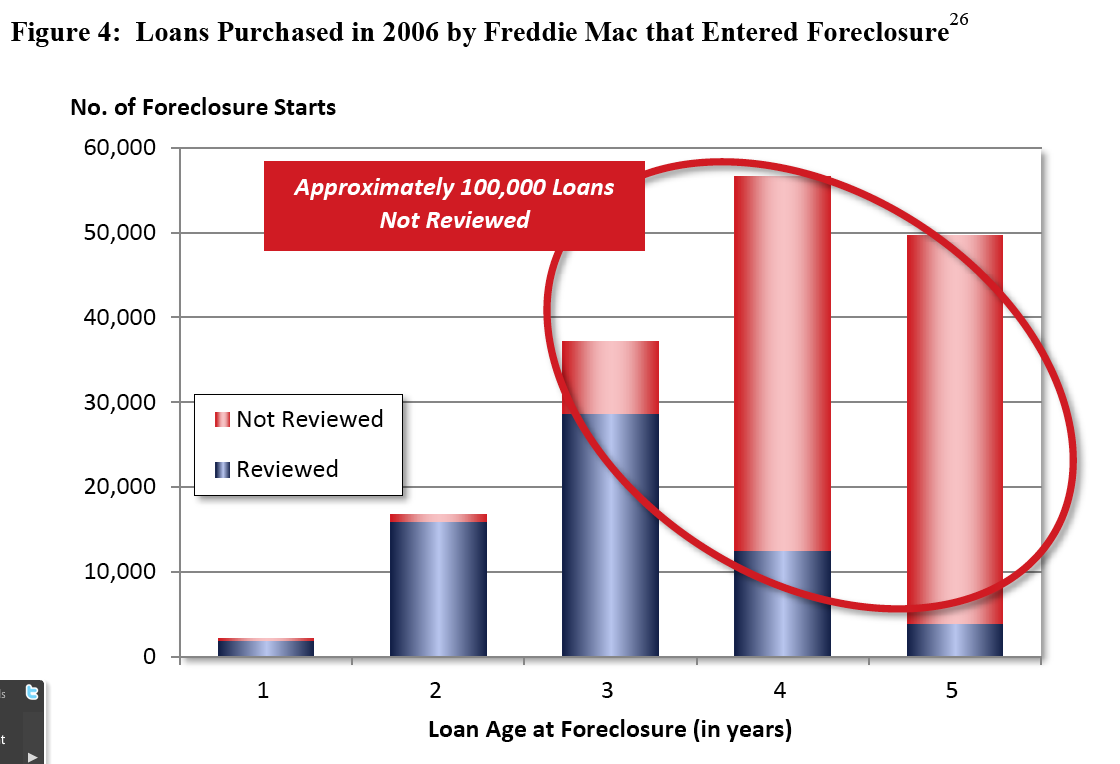
As an FHFA memo made clear, Freddie wasn’t reviewing for defects 93% of the loans originated in 2005-6 that had defaulted in the first half of 2010 (the graphic above shows the portion of loans that weren’t examined).

In response to the senior examiner’s concerns, in June 2010, a Freddie senior manager (someone who would report to Freddie’s CEO) agreed to do a review of these loans. But then, weeks later, a different senior Freddie manager stated he was “vehemently against looking at more loans.” That senior manager offered no justification, though others thought such an examination would make little difference and that doing the investigation might lose Freddie BoA’s business.

The senior examiner kept raising this issue–to at least 12 different FHFA people, including Acting Director Edward DeMarco. And when Freddie’s internal auditors reviewed the proposed settlement with BoA–which effectively settled all outstanding reps and warranties issues pertaining to Countrywide–they raised this sampling issue, too, and recommended Freddie do a sampling to see what might be included in these other loans. Because they were rushing to close the BoA deal, Freddie looked at a non-representative sample of mortgages (these came from all originators, not just Countrywide, which had a much higher defect rate than other banks) and declared everything kosher.

So to review: a senior examiner found $50B worth of defaulted mortgages that Freddie had not examined for reps and warranties and raised a plausible reason they might want to do so. Freddie agreed, then refused, to do so. Then, as Freddie was rushing through this BoA deal last December, Freddie’s auditors suggested they might want to check their math on these loans, so Freddie checked their math on a completely different set of mortgages. In spite of having a 6-month warning that up to $50B worth of loans might be a problem, Freddie signed away any BoA liability for good for the piddling price of $1.35B.

Of course, Tom Miller–with his $7.8B servicing deal with BoA–and Bank of New York Mellon–with their $8.5B investors deal with BoA–are trying to do this again. They’re rushing through settlements without taking the time to actually investigate the loan level data to see what the settlement should actually be. As the FHFA IG noted in its report,

Regardless of the cause of these defaults, the search for representations and warranties defects is the point of the loan review process; and if the search does not begin, then the defects will not be found.

Like Tom Miller and BNYM, Freddie was “vehemently opposed” to actually examine what they were settling with BoA on. And while we don’t know the cost, we might start calculating that amount in the billions.

And in the case of the possible bailout Freddie gave BoA because it refused to look at the loans, US taxpayers paid the bill.

Update: I originally conflated the amount of total loans that Freddie hasn’t been reviewing–$50B–with the amount of Countrywide loans in question. For other banks, Freddie should be able to do the analysis and make buyback requests for these exotic loans.

Share this entry

Does Treasury Believe Spreading Our Flawed Banking System Is a Solution to Terrorism?

Sheldon Whitehouse had a hearing on terrorist finance the other day. There was an interesting exchange that I think bears notice.

The hearing focused, in part, on hawalas, not least because DOJ recently prosecuted Mohammad Younis, the guy whose hawala Faisal Shahzad used to fund his terrorist attempt. Richard Blumenthal suggested (around 75:50 and following) that that funding may have come from Pakistani authorities (implicitly, the ISI). The FBI’s acting head of counterterrorism wouldn’t answer a question about that in public session.

A more interesting response came from Treasury’s Assistant Secretary for Terrorist Financing, Daniel Glaser. Sheldon Whitehouse asked him (at 92:50 and following) whether we were making progress on solving the problem hawalas create for counterterrorism efforts. Here’s my transcription of Glaser’s response:

Daniel Glaser: The reason hawala and other forms of informal remittances and informal money services exist is because there’s large communities around the world that don’t have access to formal financial services or affordable financial services. So the long-term quote-unquote solution to hawala is a generational one and it is about building an international financial system that everybody around the world has access to. Now, since that’s a long-term solution, we need to address the problem in a shorter term way as well.

[snip]

The way we try to approach it beyond the long term effort to make financial services available to everybody is regulatory prong, enforcement, international standards, and general economic development.

While Glaser described a four-pronged approach in his written testimony (and described in more detail in the parts of his response that I’ve snipped), he said the ultimate solution would come when international financial services were available to everyone.

So the way to solve terrorism, then, is to make sure everyone banks at Jamie Dimon’s bank?

That’s an exaggeration, of course. And unless and until bankers get squeamish about the way the US government is accessing SWIFT, integrating everyone into the formal finance system would give counterterrror investigators transparency into terror financing. But given the state of the banking system–given how much more damage the international financial system has done to the world in the last decade than terrorism (leaving aside the effect of couter-terrorism and false counter-terrorism, like the Iraq War) it troubles me that a high ranking Treasury Department official believes one solution to terrorism is modern banking.

Now Glaser strikes me as an incredibly intelligent and sincere guy–coming from him this “generational solution” sounded like a completely sincere idea. So while this comment made my spidey sense tingle, it didn’t in the way it would have if, say, TurboTax Timmeh Geithner had said it.

Nevertheless, here are some issues it raises.

Read more

Share this entry

Jamie Dimon: The Face of America’s Free Market Politburo

Sorry for the Jamie Dimon obsession today, but the extended article from his interview with the Financial Time is just as infuriating as his whining about “anti-American” banking rules. In this one, this so-called capitalist lays out his solution to mortgage woes: a Larry Summers figure should invite a bunch of public companies down to DC for a private meeting at which they’ll decide what the market will look like.

Meanwhile, the increasingly distant relationship between politicians and financial leaders has, Mr Dimon suggests, caused its own problems. In the 1990s, Larry Summers as Treasury secretary allegedly phoned a recalcitrant regulator and told her he had 13 bankers in his office who said proposed rules on derivatives could create economic chaos. Reformers saw this as supremely unhealthy. But a meeting between regulators, banks and investors could usher in a grand bargain over the future of mortgage finance, according to Mr Dimon.

“The right way … is to convene all the people involved in the markets, discuss all the plusses and minuses, talk about what you want, design a new mortgage market and go,” he says.

“We’re raring to go. If someone called me and said: ‘Come on down’, I’d get on an airplane and do it today. And so would every major bank.”

As it is, the various plans for mortgages – like other regulations – create overlap that ends up with an unworkable system, he says. “You could design several different types of mortgage market that would work but you can’t design a warthog – you can’t have it be non-recourse, pre-payable, fixed rate, 500 days to foreclose and think you can have a mortgage market. It’s got to work for investors, it’s got to work for everybody.”

Dimon (or the FT–this is a bit unclear) is advocating doing what Summers did when he forced Sheila Bair to back off her consideration of regulations on derivatives. Most people now believe that Bair was right in that dispute, that regulations would have limited the damage of our recent crash. But Dimon, it appears, would like to repeat the short-sighted decisions about regulation that got us into this mess.

And note how “all the people involved in the markets” for Dimon includes regulators, banksters, and investors, but no actual consumers?

Can’t let the riff raff into the Politburo.

Note, too, that Dimon’s promise that “all the major banks” would be at the table if called comes just a week after the banksters blew off Tom Miller and the other Attorneys General trying to give them a Get Out of Jail Free card for their mortgage servicing abuses.

On that note, Dimon whines that the crappy housing market has held back the banks’ recovery. That’s like saying, “If people would just recover from their radiation poisoning more quickly, the country would be better able to recover from having nuked them.” There’s no self-consciousness here, no admission that the woes of the banks (and the economy generally) stem from the banks having marketed of a bunch of shitpile put together using faulty securitization in the first place.

In a normal recovery, some of these issues would diminish in significance. A resurgent housing market would not only help bank profits and cushion the impact of regulation but stem the lawsuits that have engulfed the industry.

If mortgage-backed securities perform better, investors have little incentive to sue for the way banks mishandled their construction.

If only investors didn’t have good reason to sue, they wouldn’t sue.

Which sort of makes clear that when Dimon complains about double jeopardy, he is again bidding for an AG settlement that releases the banks from their other shitpile liability.

But we are not there. “My guess is the legacy litigation is going to go on for three to 10 years because every securitisation is different,” says Mr Dimon. “We are geared up and we’ve hired some top experts that do nothing but this. We’ve put away billions of dollars [in reserves against losses] already. It’s an unfortunate drag on the company but we’re still looking at the mortgage business as a very important business going forward and these are legacy problems that will have to work themselves out.”

One litigation issue that participants say should be settled is the foreclosure mess, where banks improperly processed the mechanism for repossessing homes of people not making their payments.

State attorneys-general want a big financial settlement, including help for struggling homeowners. Banks, though, will only pay up if they get a broad release from future litigation. “Obviously some errors were made regarding who signed off on files,” says Mr Dimon. “We are working hard to settle these matters. But you can’t settle something and be subject to double jeopardy – that’s the issue. But we’re willing to be punished for what we’ve done wrong.”

Dimon, of course, is pretending that robo-signing fraud was the only crime the banks committed here, and that the big banks don’t have a range of liabilities.

Altogether, this poor capitalist is whining and bitching that the government is not helping banks avoid the consequences of their past decisions.

Share this entry

After Trading with the Enemy, JP Morgan Chase Whines for Regulators to Fight “Anti-American” Regulations

Two and a half weeks ago, JP Morgan Chase signed an $88.3 million settlement with the government. JPMC traded with Iran, Sudan, Liberia, and Cuba, all in violation of Treasury’s various trade restrictions. When subpoenaed on the Sudan transfer, JPMC at first denied it had the documents in question. While I think many of these sanctions (particularly the Cuban ones) are silly, the settlement revealed that JPMC thought it was above rules designed to serve America’s self-interest.

Which is why I find MOTU Jamie Dimon’s wail for help fighting “anti-American” regulations so distasteful.

The United States should consider pulling out of the Basel group of global regulators, Jamie Dimon, chief executive of JPMorgan Chase, said in an interview with the Financial Times.

[snip]

“I’m very close to thinking the U.S. shouldn’t be in Basel anymore. I would not have agreed to rules that are blatantly anti-American,” he said in the interview.

“Our regulators should go there and say: ‘If it’s not in the interests of the U.S., we’re not doing it’.”

Dimon is complaining because Basel’s rules require more reserves from the very largest banks–including JPMC–to hold 9.5% of reserves, as opposed to the 7% required from smaller banks. Just three of the eight banks with higher reserve requirements are from the US. The Basel rules also treat “covered bonds”–a European product–differently from mortgage backed securities with a GSE guarantee.

I’m particularly amused with the way Dimon describes “global financial firms” to be in the best interest of the US.

“I think any American president, secretary of Treasury, regulator or other leader would want strong, healthy global financial firms and not think that somehow we should give up that position in the world and that would be good for your country.”

Bank of America’s global status right now risks putting the US at great risk, because the bank is insolvent but regulators have a tough time unwinding it because of that global reach. We know that because a bunch of global financial firms crashed the economy just a few years ago.

There’s one more ugly irony about Dimon’s wail. His concern, he says, is that because of these rules, Asian banks will pick up market share in the US.

He’s saying this, of course, at a time when Obama is about to push through a trade deal with Korea–one that will ultimately cause American manufacturers to lose market share in the US–in significant part so JPMC and Goldman Sachs can spread their toxic finance to Korea. That is, he’s whining about competing on an uneven playing field with Asian banks at the same time as the government is helping his company get preferential access to Korea’s finance market.

Jamie Dimon wants to pretend he is both a free market capitalist and a good American. But his whining and the actions his bank have taken suggest he’s neither of those things.

Update: In the longer account of this interview, Dimon whines even more about how poor American banks won’t be able to compete against Asian and European banks.

In his office, looking relaxed in white shirt with two buttons undone, Mr Dimon is still exercised about what he sees as a “miscarriage of justice”. US policymakers, he says, have sold their banks down the river – the Yangtze river. “There are plenty of countries out there that are happy with the changes being implemented in the US. They realise that they can be huge beneficiaries of this. I’m talking about China, India, Singapore, Japan. I wouldn’t want to see, 20 years from now, the US asking, ‘what happened? How come the winners in the marketplace are all outside the US?’”

[snip]

Derivatives dealt off exchanges will need to use clearing houses – which Mr Dimon supports – and will be subject to margin rules governing how much collateral they have to supply.

These he does not like, particularly if, as currently framed, they apply to JPMorgan’s overseas businesses too. He fears British, French and German competitors might not be subject to the same standards and will gain market share.

Update: Yves Smith debunks Dimon’s jingoism.

Dimon manages to play yet another jingoistic card, acting as if Basel III singles out US banks when a majority of the financial firms subject to the most stringent rules are outside the US. And he raises the truly bizarre specter of “Asian” hordes invading the US. Huh? Does he mean HSBC? I presume not, that’s a UK bank. The only Asian bank in the top 10 is Mitsubishi UFJ, and the Japanese are not likely to be in aggressive expansion mode (they’ve never gotten the knack institutionally of hiring and managing good top level foreigners; I know of a very few Japanese executives who have figured it out and did a good job when they were posted in the US, but as soon as they were rotated back to Japan, their successors made a hash of what they had put in place).

The Chinese are even less likely to move in near term (long term is a completely different matter). First, the Chinese were apparently interested in investing in US players in the crisis and were rebuffed. But having worked repeatedly with foreign banks in the US, building a denovo operation (or using small acquisitions as a platform) is a completely different kettle of fish. And going from the Chinese market of heavy state control and limited product scope to the US is like saying a drayage company can operate a supersonic plane because both are in the transportation business. I’ve seen what a hard time foreign banks have had in the US with a vastly lesser skill gap (one they closed over a period of decades). The Chinese are too far behind skill-wise to constitute a threat in the US until they can acquire the skills via a major acquisition (and that was not the scenario Dimon was hinting at).

And it goes without saying that Dimon made clear that he believe that what is good for banks is good for the US, when that has been demonstrably false for at least the last decade.

What’s striking about Dimon’s comments is how brazen they are. He’s not making clever, narrowly accurate but substantively misleading comments. Much of what he says and implies is unadulterated bunk. The fact that he peddles this tripe shows how confident he is that his message will go unchallenged. And that in turn reveals that he is secure in his belief that the banks have won the war; all he is caviling about is the speed of the mop-up operation.

Share this entry

FHFA Shows TurboTax Timmeh Geithner What a REAL Long Weekend Is

Because after the bomb they just dropped on the finance world, I would imagine Geithner will be busy.

Here’s the listof banks they’re suing:

  1. Ally Financial Inc. f/k/a GMAC, LLC
  2. Bank of America Corporation
  3. Barclays Bank PLC
  4. Citigroup, Inc.
  5. Countrywide Financial Corporation
  6. Credit Suisse Holdings (USA), Inc.
  7. Deutsche Bank AG
  8. First Horizon National Corporation
  9. General Electric Company
  10. Goldman Sachs & Co.
  11. HSBC North America Holdings, Inc.
  12. JPMorgan Chase & Co.
  13. Merrill Lynch & Co. / First Franklin Financial Corp.
  14. Morgan Stanley
  15. Nomura Holding America Inc.
  16. The Royal Bank of Scotland Group PLC
  17. Société Générale

FHFA explains,

These complaints were filed in federal or state court in New York or the federal court in Connecticut. The complaints seek damages and civil penalties under the Securities Act of 1933, similar in content to the complaint FHFA filed against UBS Americas, Inc. on July 27, 2011. In addition, each complaint seeks compensatory damages for negligent misrepresentation. Certain complaints also allege state securities law violations or common law fraud.

Finally, someone calls it fraud.

Update: Just scanned the BoA suit. Their suit is based on $6B of certificates, between Fannie and Freddie. The defaults and foreclosures range from 7.6 to 61.6%, perhaps averaging 30%.

To emphasize what a stinker BoA was, the complaint notes that even Countrywide thought BoA was going after high-risk loans very aggressively (note FHFA sued Countrywide in separate capacity).

BOA was one of the most aggressive competitors in the mortgage origination market. Even the top executives of Countrywide Financial Corp., the notorious mortgage lender singled out by the FCIC for having originated high-risk loans destined to bring “financial and reputational catastrophe,” FCIC Report at xxii, complained to each other at the time that BOA’s appetite for risky products was greater than that of Countywide. In a June 13, 2005 e-mail Countrywide CEO Angelo Mozilo wrote to President and COO David Sambol: “This is the third deal in the last 10 days that BoA has offered that is impossible to beat. In fact the other two were substantially worse than this one. It appears to me that BofA is making an aggressive move into mortgages once again.” [Emphasis in the complaint]

Yet in spite of the fact that they lay this out in detail, they specifically do not make any claim of fraud.

Plaintiff realleges each allegation above as if fully set forth herein, except to the extent that Plaintiff expressly excludes any allegation that could be construed as alleging fraud.

I find that rather curious–are they going easy on BoA because they’re already broke?

Though that can’t be it–they allege fraud throughout the Countrywide complaint.

Update: Here’s an interesting detail. The naming convention used for most of these complaints is FHFA v. [BankName]. But it’s different for five of them. Société Générale is a big long number (including, but not limited to, today’s date). Morgan Stanley and GE (two of the last ones uploaded) have some version of “Final Complaint.” And Countrywide and Ally have that plus a “Filing Copy” in the name.

I’m guessing that suggests additional iterations for those banks.

Share this entry

Just in Time To Undercut Eric Schneiderman, the (Ongoing) HUD Investigation!

American Banker has an article suggesting that Tom Miller will be able to use the results of HUD’s investigations into servicing problems to craft a settlement with the banks.

The state attorneys general have a secret weapon in their negotiations with the largest mortgage servicers: the results of a HUD investigation into the banks’ robo-signing practices.

But by all appearances, this is an attempt on the part of IA Attorney General Tom Miller to undercut claims that the Attorneys General need to do more investigation. The article–which relies almost entirely on Miller’s own staff–concludes that this report will “fill in a major gap” in what the Attorneys General know (that is, real data about how bad the robo-signing problem is).

The Department of Housing and Urban Development has completed an investigation begun last year of foreclosure robo-signing and given state officials the results, a spokesman for Iowa Attorney General Tom Miller says.

A full government investigation would fill in a major gap in state officials’ information as they negotiate with the servicers: the attorneys general have not known the full scope of the banks’ robo-signing practices, or how many homeowners have been affected by their paperwork lapses.

[snip]

“One of our federal partners, HUD, has conducted a thorough investigation of robo-signing,” says Geoff Greenwood, a spokesman for Miller. “HUD has shared that investigation with our executive committee.”

The states and their “federal partners,” including HUD, “have the information we need concerning the banks’ robo-signing activities, and this is key to the strength of our understanding and our negotiating position,” he says. [my emphasis]

There’s something funny about Tom Miller’s flack’s claims that the HUD investigation fills in what the Attorneys General didn’t already have: the one thing that HUD would say about it is that it wasn’t finished.

A HUD spokesman would not discuss any investigation, except to say its probes into robo-signing are ongoing. [my emphasis]

Maybe the claim HUD’s probe is complete is just a mis-paraphrase of Greenwood’s comments; such a claim doesn’t show up in his direct quotes. But if the investigation is not done–and HUD says it’s ongoing–then how does the incomplete study give the AGs what they need?

In any case, I find it particularly neat that the AGs’ Executive Committee got this incomplete complete study after Eric Schneiderman got booted from it.

Share this entry