Albright Follows Warrick Into Full Neocon Mode, Presents Iran Sanction Manifesto

On January 7, I noted that the Washington Post’s Joby Warrick had allowed the neocon think tank Foundation for the Defense of Democracies to frame his discussion of the newest round of sanctions set to take effect against Iran. It now is clear that the article from Warrick was meant to prepare the ground for the unveiling, one week later, of David Albright’s new working group developed precisely for the purpose of furthering the neocon position on Iran sanctions. By taking on additional policy members in this working group, Albright is now branching out from his usual area of commentary on technical issues (where Moon of Alabama has dubbed his Institute for Science and International Security the “Institute for Scary Iran Stories“) all the way into policy and now promotes the full neocon position that Iran is dangerously close to having a nuclear weapon and therefore sanctions must be ratcheted up further.

Note how the press release from the working group opens:

Warning that time is running out as Iran accelerates its nuclear program, the non-partisan Project on U.S. Middle East Nonproliferation Strategy called on President Obama to use current U.S. sanctions laws to implement a “de facto international embargo on all investments in, and trade with, Iran (other than provision of humanitarian goods)” before Iran achieves “critical capability” – the point at which it could produce enough weapon-grade uranium (or separated plutonium) for one or more bombs so rapidly that neither the International Atomic Energy Agency (IAEA) nor Western intelligence agencies could be able to detect the move before it was too late to respond.

Let’s unpack the lies just in that opening sentence.

First, the group chooses to label itself as “non-partisan”. Nothing could be further from the truth. Of the five co-chairs of the group, two have direct ties to the Foundation for the Defense of Democracies, which SourceWatch documents to be a primary force for the furtherance of neocon views, describing it as both a think tank and a lobbying organization. Mark Dubowitz, the Executive Director of the foundation, is one of the working group co-chairs and was the one chosen by Warrick to voice the neocon position earlier in January. Another co-chair is Orde Kittre, described in the press release as a Professor of Law at Arizona State University. The press release fails to note that Kittre also is a Senior Fellow at the Foundation for the Defense of Democracies. Co-chair Leonard Spector is listed as Deputy Director of the James Martin Center for Nonproliferation Studies. I see that he has been a featured speaker by the “non-partisan” AIPAC. The final co-chair besides Albright is Michael Yaffe of the National Defense University, whose own biography (pdf) notes: “In the immediate aftermath of the attack on September 11, 2001, he served as a coordinator on the counter-terrorism task force in support of “Operation Enduring Freedom.”” With a lineup composed of Albright and four people hand-selected for backgrounds likely to promote neocon positions, this working group is nothing close to non-partisan.

Next, the flat statement that Iran now “accelerates its nuclear program” is so misleading as to border on falsehood as well. Iran is expanding its enrichment capability, but there also are indications that portions of the 20% enriched uranium Iran is producing are being converted into chemical forms that are harder to submit to further enrichment to weapons grade. Further, the US stated in its 2007 National Intelligence Estimate that Iran ceased all nuclear weapons work in 2003. That NIE has been a target for neocons ever since, but there has been no definitive evidence provided that Iran has re-started weapons work or that it intends to enrich uranium beyond 20% to the 90%+ level required for weapons. All of the fear-mongering over Iran being able to have a weapon soon relies on a major step forward in enrichment for which there is zero evidence that Iran has either the capability or desire.

The biggest falsehood in the opening of the press release, though, is that the existing and expanded Iran sanctions don’t extend to humanitarian goods. As I pointed out in the January 7 post, there already are reports of critical medical shortages as a result of the sanctions, so claiming that ratcheting up the sanctions even further can be done along with the “provision of humanitarian goods” is pure bunk. I had noted back in October the economic devastation of Iranian citizens by the sanctions and also linked to a report in January on the possible impact of the sanctions on recent acute air pollution in Tehran. The Iran sanctions are a humanitarian disaster of huge proportions and any claim that only Iran’s government is affected is an outright lie.

The timing of Albright’s release of the working group’s findings also is not a coincidence. Today, the IAEA and Iran are meeting, with a primary focus on finalizing the framework that would allow IAEA access to the Parchin site which Albright has been claiming Iran has cleansed of decade-old work to develop an explosive trigger device. Also, Iran and the P5+1 group are very close to re-starting their negotiations, so the neocons are afraid that peace just might break out despite their best efforts to promote a war in Iran.


Amid Reports of Near Agreement and IAEA, Iran Followup Meeting, Jahn Eats Crow

Despite the best efforts of those who want a military attack on Iran to paint Iran as hiding attempts to develop a nuclear weapon, cooler heads appear to be prevailing as yesterday’s talks in Tehran produced reports of a likely agreement and a follow-up meeting between the IAEA and Iran in only a month. One of the most important signs of progress is that the AP’s George Jahn, who has served as a conduit for many of the most flimsy charges against Iran even gave space at the end of his report today to provide an alternate viewpoint that calls most of his reporting for the past year into significant question.

From Reuters, Fred Dahl (who at times has dabbled in the same rumor-mongering as Jahn, but not as blatantly) reports on the progress made yesterday:

The U.N. atomic agency failed to gain access to a military site in talks with Iran this week but expects to reach a deal in January to resume a stalled nuclear probe, the chief U.N. inspector said after returning from Tehran on Friday.

Even though the International Atomic Energy Agency was not allowed to see the Parchin complex during Thursday’s visit to the Iranian capital, IAEA team leader Herman Nackaerts said progress had been made in the meeting.

/snip/

“We expect to finalize the structured approach and start implementing it then shortly after that,” he said, referring to a framework agreement that would enable the IAEA to restart its investigation into suspected atomic bomb research in Iran.

“We had good meetings,” Nackaerts added. “We were able to make progress.”

It is not just the IAEA who characterized the meeting as productive. From PressTV, we also get positive news from the Iranian side of the meeting:

Earlier, Iran’s Ambassador to the IAEA Ali-Asghar Soltanieh told Press TV that Tehran and the UN nuclear body agreed at the end of the one-day meeting to hold a next round of talks in January.

“This round of talks was constructive and good progress was made,” Soltanieh added.

Adding to the possible momentum generated yesterday, both the Reuters article linked above and this Fars News piece from Iran report that a new round of the P5+1 talks also could be taking place soon.

But perhaps the most encouraging news of all comes from what appears in today’s report from the AP’s George Jahn, who has been at the center of controversy many times during the last year because of the way he publishes “leaked” material coming from countries that favor military action in Iran and who want to disrupt diplomatic negotiations. In today’s story, he does recite some of his litany of charges against Iran and the claims that work at the Parchin military site may have been carried out to develop an explosive trigger device for a nuclear weapon. He also relates that David Albright emailed to AP a “series of commercial satellite photographs of the Parchin site” detailing activities at the site that Albright and Jahn have been hyping as aimed at “cleansing” the site of radioactive signatures of the trigger development work. Presumably, Albright had to email the photos to Jahn because Jahn is not able to find them on Albright’s website where he posted them along with a “they’re still at it” type of “analysis” earlier this week.

However, after giving space for more information from Albright, Jahn makes the remarkable move of providing an alternate viewpoint from an authoritative source [emphais added]:

But a former IAEA inspector questioned what the information shown on the satellite photos actually mean.

This ‘sanitization story’ is an old wives’ tale,” said Robert Kelley, in an email Friday to the AP. “It is clear from examination of the satellite images that there is no concerted effort to disguise possible uranium contamination outside the building.”

Kelley said the activities at Parchin reflected “a construction project, not a demolition effort,” adding: “This is clearly not a sanitization.

Seeing his last year of work on behalf of war mongers dismissed as “an old wives’ tale” and then including it in his report had to hurt Jahn. He is due a bit of respect for reporting it, even if he did hide it at the very end of his report.


Where Are the Dirt Photos? We Must Have Dirt Photos!

As I have noted many times, there is a prescribed, choreographed sequence for getting reports of “cleanup” activities at Iran’s Parchin site into the US news media. First, “diplomats” release information (arising from intelligence agencies or the IAEA) to George Hahn of AP or Fredrik Dahl of Reuters, and then David Albright emerges within just a few hours with an “analysis”, usually including satellite imagery. The choreography and imagery reached a comedic highpoint when Iran covered a number of buildings at the Parchin site with pink tarps last summer. Once Albright provides his viewpoint, various US media chime in to tell us how devious the Iranians are being with this military site that might house work that could somehow, one day, sort of help Iran produce a nuclear weapon.

Now, however, the cycle appears to have been broken. Late Wednesday, Fredrik Dahl published an article where he reported that a “closed-door” IAEA briefing had disclosed that satellite images of Parchin dated November 7 found new piles of dirt. Whether due to the Thanksgiving holiday or a lack of enthusiasm after the embarrassment of the pink tarp photos, Albright has not yet followed up by publishing these all-important photos of the piles of dirt.

Here is Dahl’s report:

Iran has been hauling dirt to a military site U.N. nuclear inspectors want to visit, Western diplomats said on Wednesday, saying the findings were based on satellite images and they reinforced suspicions of a clean-up.

They said the pictures, presented during a closed-door briefing for member states of the International Atomic Energy Agency (IAEA), suggested Iran was continuing to try to hide incriminating traces of any illicit nuclear-related activity.

The allegations come a few days after the IAEA said in a report on Iran that “extensive activities” undertaken at the Parchin site since early this year would seriously undermine its inquiry, if and when inspectors were allowed access.

Albright clearly was already aware of the new piles of dirt. From his comments (pdf) put up along with publication of the November 16 IAEA report (pdf) (clearly marked “Restricted Distribution”):

The third and final points about removal of external pipework from the containment vessel building and about a depositing of new earth where earth was removed are new observations and ones that were not previously reported by ISIS. (See previous ISIS imagery analysis on the apparent sanitization activities at Parchin here.) Iran undertook sanitization activities, including the removal of earth and deposit of new earth, at Lavisan Shian in 2004. These activities are suspected to be related to Iran hiding evidence of efforts of the Physics Research Center, a military entity linked to parallel military nuclear activities that was sited there until the late 1990s.

On the date that the IAEA provided for restricted distribution its latest report on Iran, Albright was already aware that new imagery showed the additional fill dirt being brought to the Parchin site, and yet more than ten days later, and nearly a week after being prompted by Dahl, Albright still has not given us the dirt photos. If he doesn’t come around soon, Albright will be in danger of being left out of the noise amplification loop and in the future new photos will bypass him and go directly to Barbara Starr.

Update: Ha ha ha ha. I guess George Jahn was feeling left out. He just published a diagram proving that the Iranians can calculate the yield of an atomic weapon. Quick! Prepare the fainting couch! Even Albright wasn’t too impressed with this one, as quoted by Jahn:

David Albright, whose Institute for Science and International Security is used by the U.S. government as a go-to source on Iran’s nuclear program, said the diagram looks genuine but seems to be designed more “to understand the process” than as part of a blueprint for an actual weapon in the making.

I’m sure Barbara Starr will be along shortly to tell us how frightened we should be by this diagram.


AP’s George Jahn, ISI’s David Albright Re-run Allegations of Iranian Bomb Calculations

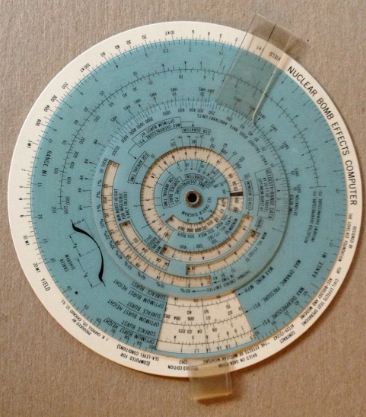
I can calculate the destructive power of nuclear explosions, too, with this handy tool from 1962.

Breathlessly calling today’s story an “AP Exclusive“, George Jahn sticks to his usual routine of depending on “diplomats” to leak information on Iran and then using David Albright to cast the information in a way calculated to make it look as though Iran has made new, major breakthroughs in efforts to develop a nuclear weapon. Today’s effort is more transparent than a pink tarp, with Jahn’s article itself finally getting around to noting that everything claimed to be an “exclusive” in the article was already noted in IAEA’s November, 2011 report.

Jahn’s opening:

The U.N. atomic agency has received new intelligence that Iran has moved further toward the ability to build a nuclear weapon by advancing its work on calculating the destructive power of an atomic warhead, diplomats tell The Associated Press.

And then, of course, we need Albright to add just the right spin:

“You want to have a theoretical understanding of the working of a nuclear weapon that is then related to the experiments you do on the various components,” said David Albright, whose Washington-based Institute for Science and International Security is a frequent go-to source on Iran for Congress and other U.S. government branches. “The two go hand-in-hand.”

Such computer mock-ups typically assess how high explosives compress fissile warhead material, setting off the chain reaction that results in a nuclear explosion. The yield is normally calculated in kilotons.

Now that we have been properly scared into believing there is new and damning evidence against Iran, let’s see what Jahn finds when he goes back to the November, 2011 IAEA report:

The IAEA first outlined suspicions in November that Iran was working on calculating the yield of a nuclear weapon, as part of a 13-page summary of Iran’s suspected nuclear weapons work that it said was based on more than 1,000 pages of research and intelligence from more than 10 member nations.

It said then that “the modeling studies alleged to have been conducted in 2008 and 2009 by Iran … (are) of particular concern,” adding that the purpose of such studies for calculating anything other than nuclear explosion yields is “unclear to the agency.”

Albright, of the Institute for Science and International Security, said such computer-run modeling is “critical to the development of a nuclear weapon.”

So Jahn admits that this “new” information is basically just a re-run of what was stated in November by the IAEA. I guess Jahn and his handlers decided that not enough attention had been paid to this particular nugget of information, and so a new “exclusive” was needed in order to focus more attention on it. That is a very brave move after being punked so badly by the pink tarps.

At least Jahn got one sentence correct:

Any new evidence of Iranian research into nuclear weapons is likely to strengthen the hand of hawks in Israel who advocate a military strike on Iran.

Next week, perhaps Jahn and Albright can provide analysis of all Google searches from Iran on “nuclear weapons”. I’m sure Jahn’s “diplomat” friends can provide those for us.


Albright Attempts to Deflect Neutron Activation Issue at Parchin

On May 15, I pointed out that the claims associated with the cartoon published by George Jahn of AP purporting to depict a high explosives chamber used by Iran at Parchin (this is a new link for the cartoon, the AP link in the May 15 post no longer works for me) and in a report by David Albright claiming that Iran has taken actions aimed at cleansing the Parchin site were rendered baseless by the likelihood that if the accused work on a neutron initiator for a nuclear weapon had indeed been carried out at Parchin, then the chamber would be rendered radioactive throughout the thickness of its steel by the process of neutron activation. Yesterday, Albright published even more photos of the Parchin site that he claims document further cleansing activity and in the discussion section of his report he finally addressed the issue of neutron activation. In order to make the issue of neutron activation go away, Albright is now proposing that  the uranium deuteride presumed to be present in the explosion would produce too low a flux of neutrons to produce appreciable neutron activation of the chamber’s steel, even though Jahn is claiming that the Iranians placed a neutron detector outside the chamber, presumably to measure the neutron flux that passed through its steel walls.

Here is the relevant portion of a 2009 report by Albright describing the neutron initiator:

If the data in this document are correct and the descriptions of the work are accurate, then this report appears to be describing a plan to further develop and test a critical component of a nuclear weapon, specifically a neutron initiator made out of uranium deuteride (UD3), which when finished (and subsequently manufactured) would most likely be placed at the center of a fission bomb made from weapon-grade uranium. This type of initiator works by the high explosives compressing the nuclear core and the initiator, producing a spurt of neutrons as a result of fusion in D-D reactions. The neutrons flood the core of weapon-grade uranium and initiate the chain reaction.

Albright goes on to describe the issue of producing neutrons and measuring their production:

The measurement of the neutrons emitted by this UD3 source would be the hardest measurement Iran would need to make in developing a nuclear weapon. This assumes that Iran believes it cannot do a full-scale nuclear test, although it would be expected to do a “cold test” of the full device as a way to gain confidence the nuclear weapon would perform as expected. . . The timing of the explosion and resulting shock waves would need to be perfect in order to get enough fusion to create a spurt of neutrons in a reliable manner at exactly the right instant. The experiment itself is very difficult to do. There are relatively few neutrons emitted in a brief period of time and there is a lot of noise from the electronics that interferes with the neutron measurements.

It should be noted here that although Albright is discussing a “cold test”, that means the test is carried out without the weapons grade uranium which the initiator sets off in the nuclear explosion. The uranium deuteride is still present as the primary part of the initiator and is producing the neutrons which are to be measured. Although Albright does claim that few neutrons are produced in the explosion in the latter part of the description, he refers to a “spurt” of neutrons that “flood” the weapons grade uranium in the earlier portion. The fact remains that in such an experiment, significant quantities of uranium are present and there would be neutrons released into the steel of the chamber the entire time the uranium is present, not just during the brief explosion.

As further support for the uranium deuteride initiator being the primary focus of the narrative promoted by Albright and Jahn, it should be kept in mind that Jahn mentions that the chamber is “equipped with” “a neutron detection system outside the explosion chamber to measure neutron emissions”. Jahn goes on to quote another expert who posits the use of uranium in the experiments with explosives: Continue reading


Iran’s Cat and Mouse Game at Parchin Continues; Albright Takes Bait Yet Again

After a disappointing ending to yesterday’s final session of the P5+1 talks in Moscow, we now must deal with even more of the cat and mouse game Iran is playing at Parchin. I have posted on this issue a number of times, so I won’t go back into the complete details of what is going on, but the primary issue here is that the West has accused Iran of carrying out work at the Parchin military site that is aimed toward developing a trigger for a nuclear bomb. Specifically, Iran is accused of using a high explosives chamber to research the use of uranium in high explosions to generate the neutrons needed to trigger a nuclear bomb. “Western diplomats”, aided by gullible reporters and especially by David Albright of the Institute for Science and International Security are now claiming that Iran is trying to scrub the site of evidence from this work.

The problem is that it is impossible to scrub evidence of this sort of work. As I showed in this post, if Iran actually carried out the work for which they are accused, the steel chamber where the explosions occurred and all of the structural steel in the surrounding building would be radioactive due to neutron activation. This would not be surface contamination of the steel but would be distributed throughout the entire thickness of the steel. Therefore, if Iran carried out the accused work, the only way to hide the evidence would be to destroy the steel tank and the building in which it is housed.

In a game of cat and mouse, Iran destroyed buildings nearby the building in which the steel tank is said to be housed and did extensive earthmoving work in outlying areas away from the building. Albright dutifully took that bait and said this work was evidence of cleansing activity and did not mention that the chamber and its surrounding building were still standing and should still carry all of the radioactive earmarks of the accused activity.

Today, Albright has taken the next round of bait offered up by Iran. More earthmoving activity is seen in new photos and there are even new puddles to go along with the first puddles Albright found.

Here is Albright’s description of the new activity: Continue reading


Parchin Game of Cat and Mouse Escalates: Razed Buildings, Earthmoving Probably Don’t Affect Controversial Chamber

For a brief period yesterday afternoon, initial news reports had me thinking that perhaps proof had finally emerged that Iran has indeed carried out work on a nuclear weapon and was taking actions in an attempt to hide the after-effects of that work. As new details emerged, however, it became more clear that an elaborate game of cat and mouse is being played out between Iran and those who accuse them of weapon development, but overall there still seems to be no conclusive proof that weapon development at the controversial Parchin site has been carried out.

That is a pattern that has played out several times now. “Diplomats” provide anonymous information to a reporter in Vienna on new accusations about nuclear weapon development work in Iran. The first version of the story put out by the reporter contains only a vague accusation but is delivered with a sensationalized headline suggesting that new and important evidence supports the conclusion that Iran is carrying out work at Parchin aimed at developing a neutron trigger device for a nuclear weapon . Subsequent expansion of the article reveals that the “evidence” is much weaker than initially portrayed and that technical details tend to contradict the accusations for the large part.

Until yesterday, that pattern had played itself out three times since March, each with George Jahn of AP playing the role of the reporter in Vienna. First, there was the claim in March that Iran was trying to clean the Parchin site to remove evidence of work on a trigger device. It took several weeks after the initial claim, but finally a satellite image purporting to show evidence of “washing” the building at Parchin was produced in early May when David Albright displayed satellite images showing puddles in the parking lot outside the suspect building. Of course, Albright’s claim of “washing” away the radioactivity is ludicrous, as traces would remain, especially if the wash water is simply allowed to pool in the parking lot of the building. Albright and Jahn did not give up, however, and Jahn subsequently came up with a cartoon depicting the chamber (it’s even the same color as the real chamber!). The huge hole in those accusations, though, is that if the accused neutron trigger work with uranium were indeed being carried out at Parchin, then the process of neutron activation would have resulted in both the structural steel of the chamber itself and most likely the structural steel of the building housing the chamber being radioactive throughout the thicknesses of the steel. This would mean that Albright’s claims that Iran could “cleanse” the chamber and the building by grinding and washing surfaces were impossible. Instead, in order to clean the site:

The only way that Iran would be able to hide evidence of work on a neutron trigger device at Parchin would be to dismantle and remove the entire chamber. It most likely would be necessary to raze the entire building as well, since the structural steel in the building surrounding the chamber also likely would have been made radioactive by the neutrons.

Jahn’s third sensational headline followed by less sensational details related to the finding of traces of uranium enriched to 27% rather than 20% at the enrichment site at Qom instead of at Parchin, but this still fits the overall pattern.

Another aspect of attempts to clean evidence of work with radioactivity is removal of the upper layers of soil.

Yesterday, Fredrik Dahl of Reuters took over George Jahn’s role as the reporter in Vienna to release a sensational headline only for the real story to fall short of the accusations (apologies to Jahn for my initial–now deleted–tweets on this revelation, which I attributed to him when I reacted first to the headline and only later noticed the story was from Dahl and not Jahn). I have counted at least five versions of Dahl’s story as it was updated through the day yesterday and this morning. Here is complete article as it appeared in its initial form: Continue reading


Separating Truth from Fiction at Parchin: Neutron Activation Can’t Be Scrubbed Away

Neutrons passing through steel would occasionally collide with a cobalt-59 nucleus, producing easily detectable cobalt-60 if trigger experiments were carried out in the steel chamber at Parchin. (From a Wikimedia Commons illustration of the 1911 Rutherford experiment where alpha particles were sent through a thin gold foil.)

Both Marcy, here,  and b, over at Moon of Alabama, have roundly criticized the cartoon released on Sunday by AP’s George Jahn purporting to depict a chamber at Iran’s Parchin site where various groups accuse Iran of carrying out work aimed at an explosive trigger device for a nuclear weapon. David Albright, working through his Institute for Science and International Security, has been near the forefront in most of these accusations, with one of his accusations coming out in December of 2009 (pdf). As described in his 2009 piece, Albright accuses Iran of attempting to replicate A.Q. Khan’s uranium deuteride (UD3) initiator for a bomb, which “works by the high explosives compressing the nuclear core and the initiator, producing a spurt of neutrons as a result of fusion in D-D reactions. The neutrons flood the core of weapon-grade uranium and initiate the chain reaction.”

Prior to the release of the cartoon, Albright had claimed on May 8 that he had detected activity aimed at “cleansing” the Parchin site.  I debunked that claim the next day, by pointing out that all traces of radioactivity cannot be washed away and that Albright’s claims would mean that the waste water carrying the radioactivity was allowed to drain freely onto the grounds surrounding the building, where the radioactivity could be found without much effort. Albright repeats those claims in Jahn’s article accompanying the cartoon, and he brings in another expert to support his claims that residue from testing a trigger device could be scrubbed:

A cleanup “could involve grinding down the surfaces inside the building, collecting the dust and then washing the area thoroughly,” said David Albright, whose Institute for Science and International Security in Washington looks for signs of nuclear proliferation. “This could be followed with new building materials and paint.

“It could also involve removing any dirt around the building thought to contain contaminants,” Albright said in a statement emailed to selected recipients. “These types of activities could be effective in defeating environmental sampling.”

Fitzpatrick, the other nuclear nonproliferation expert, also said a cleanup could be effective.

“In the past, the IAEA has been able to catch out Iran by going to a building that Iran tried to clean and they still found traces of uranium,” he said. “And Iran learned from that and they learned that ‘boy you have to scrub everything really clean; get down into the drains and grind away any possible residue.”

Earlier in the article, Fitzpatrick (who is  Mark Fitzpatrick, director of the Non-Proliferation and Disarmament Program of the International Institute for Strategic Studies) mentions that Iran is specifically accused of using uranium in the explosives research. Also, the article claims that the equipment associated with the chamber includes “a neutron detection system outside the explosion chamber to measure neutron emissions”.

Albright and Fitzpatrick completely overlook a very important basic aspect of the nuclear physics involved here. If they really are going to claim that uranium is being used and that bursts of neutrons capable of initiating a nuclear reaction are the goal of the experiments, then the neutrons originating from the uranium and from the neutron bursts would result in neutron activation of the steel container itself. Continue reading


Albright Discovers Puddles in Parchin

Google Maps image of Parchin, showing the dry landscape at over 5000 feet elevation. Note the extensive erosion patterns.

In March, Gareth Porter and I debunked claims that “diplomats” had fed to AP’s George Jahn. The diplomats asserted to Jahn that they had seen satellite photos depicting activity interpreted as attempts to clean the site at Parchin where they believe Iran has carried out work aimed at developing an explosive trigger device for a nuclear weapon.

Perhaps the biggest problem with the depiction of these activities as being aimed at cleaning the site is that, as I pointed out in the post linked above, it is virtually impossible to remove all traces of radioactive materials from a site where they have been used. The Iranians were very quick to point this out as well. No amount of cleaning will remove all of the residual radioactivity from the building or surrounding soil. I also pointed out in my post that no satellite photos purporting to show this cleaning activity had yet been made public.

Yesterday, David Albright and his Institute for Science and International Security dutifully stepped up to deliver what was intended as photographic proof. From Albright’s description:

 The new activity seen in the satellite image occurred outside a building suspected to contain an explosive chamber used to carry out nuclear weapons related experiments (see figure 1).  The April 9, 2012 satellite image shows items lined up outside the building.  It is not clear what these items are.  The image also shows what appears to be a stream of water that emanates from or near the building.  Based on new information that the IAEA received, the Agency asked Iran to visit this building at the Parchin site, but Iran has not allowed a visit.  IAEA Director General Yukiya Amano noted recently that the IAEA has “information that some activity is ongoing” at the Parchin site 1.  When asked if he was concerned that these activities could be associated with cleansing the site, Amano replied, “That possibility is not excluded…We cannot say for sure because we are not there.”  The items visible outside the building could be associated with the removal of equipment from the building or with cleansing it.  The stream of water that appears to emanate from the building raises concerns that Iran may have been washing inside the building, or perhaps washing the items outside the building.

The idea that Iran would want to wash the building or its contents, presumably in order to remove radioactive contamination from trigger-building experiments, and then just allow the wash water to run onto the ground surrounding the building is laughable on its face. As I noted in my March post, the Iranians pointed out that radioactive contamination can’t be eliminated from a site where such work has been carried out. Of course they would know that merely rinsing some of the radioactive material into the ground surrounding the building would do nothing to hide it from the sensitive detection equipment IAEA would bring to an inspection.

There are two potential explanations for the water seen in the photo labeled April 9, 2012. Continue reading


Albright Rushes to CNN With New Satellite Imagery Claims on Parchin After Debunking

Yesterday, in a post titled Rumored Satellite Imagery of Parchin “Clean-Up” Fails to Materialize, Claim Debunked, I pointed out both Gareth Porter’s debunking of the “Parchin is being cleaned up” claim and added further evidence against the claims that Parchin was being cleaned of evidence from work to develop a neutron trigger device.

It appears that David Albright of the Institute for Science and International Security was unable to remain silent in the face of my statement that satellite imagery to back up the claims that Parchin is being cleaned has not been produced for inspection. My post went up before 10 am yesterday, and at 6:05 pm, CNN’s Security Clearance blog put up a post with “new” claims from Albright about satellite imagery from Parchin. Albright’s news is that he claims to have identified the building where work on a high-explosives-based trigger for a nuclear weapon is alleged to be taking place.

Albright is now trying to move the story back to trigger device research being high-explosives based, while the AP’s George Jahn’s claims that Porter was debunking relate to a possible neutron trigger. As I pointed out in yesterday’s post, the concept of “cleaning” away evidence from work with a radioactive trigger device is nonsense, as traces of the radioactivity would still be left behind. The Iranians were also quick to point this out, as cited in the post.

CNN’s “scoop” from Albright:

In an exclusive interview with Security Clearance, David Albright, president of the Institute for Science and International Security, said commercial satellite imagery shows a building on the sprawling Parchin military complex just south of Tehran that may be the location of a high-explosive test chamber.

 Albright, who is a former U.N. weapons inspector, and his colleague Paul Brannan said in an analysis provided to Security Clearance that the building is notable because it “is located on a relatively small and isolated compound within the Parchin military site and has its own perimeter security wall or fencing.  A berm can be seen between this building and a neighboring building.”

The CNN blog post then goes on to note that although Albright and ISIS have been scouring all the satellite images they can find, they can’t confirm the claims of cleaning activity at Parchin.

Over at Moon of Alabama, b has noted that the IAEA visited Parchin twice in 2005, but CNN cuts that down to one visit: “The IAEA has had only one, limited tour of Parchin. That was in 2005.”

Also, more importantly, CNN is back to ignoring the fact that the high explosives work at Parchin is truly dual use technology. It was also pointed out by b that creation of nanodiamonds is actually the specialty of the expert the Iranians have employed in their high explosives work. CNN allows an unnamed US official to ignore the nanodiamond application and lie outright that the high explosives work can only be weapons-related:

The senior U.S. official also said the evidence is clear from this site that Iran had pursued a weapons program. “There is no other reason to conduct explosion compression in the context of Iran other than nuclear testing. There is only one thing they could be trying to simulate and that is a nuclear explosion,” the official said.

It’s so nice that CNN will allow a “senior U.S. official who would not speak for attribution because of the sensitivity of the information” to promote lies that have already been disproven.