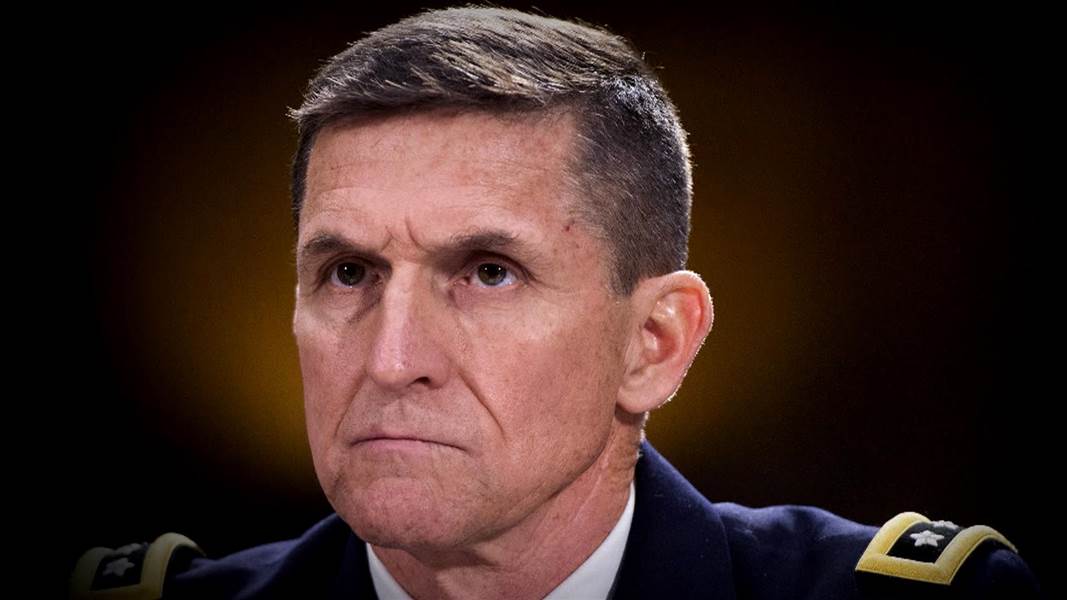
Graham and Grassley Are Seeing Christopher Steele’s Ghost Where Mike Flynn Lurks

I get it. Trump is making us all crazy. But Chuck “Ethanol flipflop” Grassley and Lindsey “Trump’s best golfing buddy” Graham are going nuts not because of Trump but because of Christopher Steele. They’ve just written a letter to Susan Rice asking her why she emailed herself a letter, memorializing a January 5, 2017 meeting about the Russian hack, just before she left the White House.

In this email to yourself, you purport to document a meeting that had taken place more than two weeks before, on January 5, 2017. You wrote:

On January 5, following a briefing by IC leadership on Russian hacking during the 2016 Presidential election, President Obama had a brief follow-on conversation with FBI Director Jim Comey and Deputy Attorney General Sally Yates in the Oval Office. Vice President Biden and I were also present.

That meeting reportedly included a discussion of the Steele dossier and the FBI’ s investigation of its claims. 1 Your email continued:

President Obama began the conversation by stressing his continued commitment to ensuring that every aspect of this issue is handled by the Intelligence and law enforcement communities “by the book”. The President stressed that he is not asking about, initiating or instructing anything from a law enforcement perspective. He reiterated that our law enforcement team needs to proceed as it normally would by the book. From a national security perspective, however, President Obama said he wants to be sure that, as we engage with the incoming team, we are mindful to ascertain if there is any reason that we cannot share information fully as it relates to Russia.

The next part of your email remains classified. After that, you wrote:

The President asked Comey to inform him if anything changes in the next few weeks that should affect how we share classified information with the incoming team. Comey said he would.

It strikes us as odd that, among your activities in the final moments on the final day of the Obama administration, you would feel the need to send yourself such an unusual email purporting to document a conversation involving President Obama and his interactions with the FBI regarding the Trump/Russia investigation. In addition, despite your claim that President Obama repeatedly told Mr. Comey to proceed “by the book,” substantial questions have arisen about whether officials at the FBI, as well as at the Justice Department and the State Department, actually did proceed “by the book.”

It pains me that two top Republicans on the Senate Judiciary Committee are too fucking stupid to see that, in fact, the FBI proceeded quite cautiously with the Russia investigation, not inappropriately, as they suggest. It pains me still more that they think this is all about the dossier.

7. During the meeting, did Mr. Comey or Ms. Yates mention potential press coverage of the Steele dossier? If so, what did they say?

8. During the meeting, did Mr. Comey describe the status of the FBI’s relationship with Mr. Steele, or the basis for that status?

9. When and how did you first become-aware of the allegations made by Christopher Steele?

10. When and how did you first become aware that the Clinton Campaign and the Democratic National Committee funded Mr. Steele’s efforts?

It’s certainly possible, given what I laid out here, that DOJ was prepping the second FISA application for Carter Page (though if the reauthorization were dated January 9, the application would have had to have been submitted by January 2).

But there are other reasons why you’d expect to have this meeting on January 5 and why Rice would want a record of it for posterity (the meeting generally probably relates to this story about the way Obama protected information on the investigation in the last days of the Administration).

As reporting on the discovery of Mike Flynn’s conversations about Russian sanctions with Sergey Kislyak make clear, the conversation wasn’t discovered in real time. Rather, after Putin didn’t respond to the December sanctions against Russia, analysts sought to figure out why. Only after that did they discover the conversation and Flynn’s role in it.

For Yates and other officials, concerns about the communications peaked in the days after the Obama administration on Dec. 29 announced measures to punish Russia for what it said was the Kremlin’s interference in the election in an attempt to help Trump.

After the sanctions were rolled out, the Obama administration braced itself for the Russian retaliation. To the surprise of many U.S. officials, Russian President Vladimir Putin announced on Dec. 30 that there would be no response. Trump praised the decision on Twitter.

Intelligence analysts began to search for clues that could help explain Putin’s move. The search turned up Kislyak’s communications, which the FBI routinely monitors, and the phone call in question with Flynn, a retired Army lieutenant general with years of intelligence experience.

So it would be right around this time when law enforcement concerns about the incoming National Security Advisor would have arisen.

Update: This story confirms that the January 5 meeting was partly about the Flynn phone call.

On Jan. 5, FBI Director James B. Comey, CIA Director John Brennan and Director of National Intelligence James R. Clapper Jr. briefed Obama and a small group of his top White House advisers on the contents of a classified intelligence report showing that Russia intervened in the 2016 election to help Trump. That’s when White House officials learned that the FBI was investigating the Flynn-Kislyak calls. “The Flynn-Kislyak relationship was highlighted,” a former senior U.S. official said, adding that the bureau made clear “that there was an actual investigation” underway.

And, in a very significant way, the investigation did not proceed by the book, almost certainly because of Mike Flynn’s (and possibly even Jeff Sessions’) potential compromise. Back in March, Jim Comey admitted to Elise Stefanik that the FBI had delayed briefing Congress about the counterintelligence investigation into Trump because it had, in turn, delayed telling the Executive Branch until February.

Stefanik returned to her original point, when Congress gets briefed on CI investigations. Comey’s response was remarkable.

Stefanik: It seems to me, in my first line of questioning, the more serious a counterintelligence investigation is, that would seem to trigger the need to update not just the White House, the DNI, but also senior congressional leadership. And you stated it was due to the severity. I think moving forward, it seems the most severe and serious investigations should be notified to senior congressional leadership. And with that thanks for your lenience, Mr. Chairman, I yield back.

Comey could have been done with Stefanik yielding back. But instead, he interrupted, and suggested part of the delay had to do with the practice of briefing within the Executive Branch NSC before briefing Congress.

Comey: That’s good feedback, Ms. Stefanik, the challenge for is, sometimes we want to keep it tight within the executive branch, and if we’re going to go brief congressional leaders, the practice has been then we brief inside the executive branch, and so we have to try to figure out how to navigate that in a good way.

Which seems to suggest one reason why the FBI delayed briefing the Gang of Four (presumably, this is the Gang of Eight) is because they couldn’t brief all Executive Branch people the White House, and so couldn’t brief Congress without first having briefed the White House.

Which would suggest Mike Flynn may be a very central figure in this investigation.

Because the National Security Advisor was suspected of being compromised (and because the Attorney General had at least a conflict), the FBI couldn’t and didn’t proceed normally.

Plus, there’s one other issue about which Obama should have discussed normal procedure with Yates and Comey on January 5. Two days earlier, Loretta Lynch signed an order permitting, for the first time, the sharing of EO 12333 data in bulk. Among the first things I’m sure FBI would have asked for would have been EO 12333 data to support their Russian investigation. Yet doing so would expose Trump’s people. That’s all the more true given that the rules permit the retention of entirely domestic communications if they have significant counterintelligence value.

So one of the first things that would have happened, after signing data sharing rules the government had been working to implement since Stellar Wind, would have been the prospect that the very first Americans directly affected weren’t going to be some powerless Muslims or relatively powerless Chinese-Americans, but instead the President’s closest associates. Given what we’ve seen from the George Papadopoulos case, the FBI likely bent over backwards to insulate Trump aides (indeed, it’s hard to understand how they wouldn’t have known of Ivan Timofeev’s outreach to Papadopoulos before his interviews if they hadn’t).

Just before this meeting, FBI and DOJ had discovered that Trump’s most important national security aide had had surprising conversations with Russia. That clearly raised the prospect of necessary deviations from normal practices with regards to intelligence sharing.

Yet Grassley and Graham are seeing Christopher Steele’s ghost behind every single solitary action. Rather than the real challenges posed when top officials pose real counterintelligence concerns.

Update: Kathryn Ruemmler, representing Rice, pretty much confirms Grassley and Graham have gone on a wild Steele chase.

“There is nothing ‘unusual’ about the National Security Advisor memorializing an important discussion for the record,” Kathryn Ruemmler, a counsel for Rice, said in a statement. “The Obama White House was justifiably concerned about how comprehensive they should be in their briefings regarding Russia to members of the Trump transition team, particularly Lt. General Michael Flynn, given the concerning communications between him and Russian officials.”
Ruemmler added: “The discussion that Ambassador Rice documented did not involve the so-called Steele dossier. Any insinuation that Ambassador Rice’s actions in this matter were inappropriate is yet another attempt to distract and deflect from the importance of the ongoing investigations into Russian meddling in America’s democracy.”
Share this entry

Media Criticism: The Press Needs to Get Far More Rigorous about Reporting on Cybersecurity

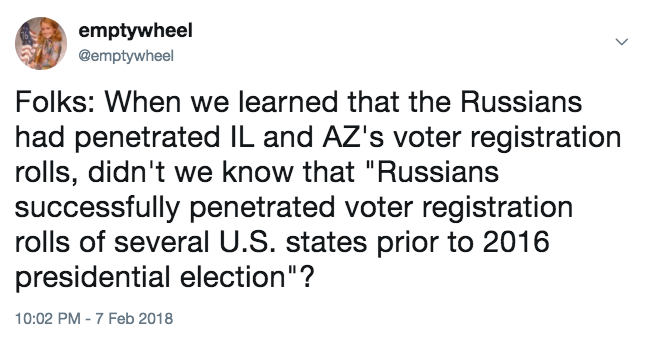
Four days ago, NBC reported, as BREAKING news, that in an exclusive interview, Jeanette Manfra had confirmed that the voter rolls of 21 states were targeted in 2016.

Russians penetrated U.S. voter systems, top U.S. official says

The U.S. official in charge of protecting American elections from hacking says the Russians successfully penetrated the voter registration rolls of several U.S. states prior to the 2016 presidential election.

In an exclusive interview with NBC News, Jeanette Manfra, the head of cybersecurity at the Department of Homeland Security, said she couldn’t talk about classified information publicly, but in 2016, “We saw a targeting of 21 states and an exceptionally small number of them were actually successfully penetrated.”

The headline stated and this video (which has been viewed online by 50,000 people) stated explicitly that 21 states were “penetrated.”

I criticized all the breathless retweeting of the report in a subtweet.

Today, DHS did more than subtweet the report and the irresponsible sharing of it. It released a scathing complaint, in Jeanette Manfra’s (the woman NBC interviewed) name, about NBC’s reporting, specifically complaining that NBC reported the number as “breaking” news.

Recent NBC reporting has misrepresented facts and confused the public with regard to Department of Homeland Security and state and local government efforts to combat election hacking. First off, let me be clear: we have no evidence – old or new – that any votes in the 2016 elections were manipulated by Russian hackers. NBC News continues to falsely report my recent comments on attempted election hacking – which clearly mirror my testimony before the Senate Intelligence Committee last summer – as some kind of “breaking news,” incorrectly claiming a shift in the administration’s position on cyber threats. As I said eight months ago, a number of states were the target of Russian government cyber actors seeking vulnerabilities and access to U.S. election infrastructure. In the majority of cases, only preparatory activity like scanning was observed, while in a small number of cases, actors were able to access the system but we have no evidence votes were changed or otherwise impacted.

NBC’s irresponsible reporting, which is being roundly criticized elsewhere in the media and by security experts alike, undermines the ability of the Department of Homeland Security, our partners at the Election Assistance Commission, and state and local officials across the nation to do our incredibly important jobs. While we’ll continue our part to educate NBC and others on the threat, more importantly, the Department of Homeland Security and our state and local partners will continue our mission to secure the nation’s election systems.

To our state and local partners in the election community: there’s no question we’re making real and meaningful progress together. States will do their part in how they responsibly manage and implement secure voting processes. For our part, we’re going to continue to support with risk and vulnerability assessments, offer cyber hygiene scans, provide real-time threat intel feeds, issue security clearances to state officials, partner on incident response planning, and deliver cybersecurity training. The list goes on of how we’re leaning forward and helping our partners in the election community. We will not stop, and will stand by our partners to protect our nation’s election infrastructure and ensure that all Americans can have confidence in our democratic elections.

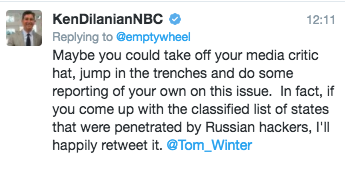
In response to my observation that NBC should never have presented it as “breaking” news and my subsequent suggestion that it’d be far more useful to educate people about what “compromise” can mean, Ken Dilanian got pissy, suggesting I don’t do reporting.

When I retweeted the video above (h/t K), suggesting maybe Dilanian could educate viewers about what both “compromise” and “penetrate” mean, he responded “Or you could focus on your own reporting.”

Only, we don’t need NBC to do that. We can go back to Manfra’s testimony from June, where she distinguished between “compromise,” unsuccessful compromise,” and “scanning.”

One comprehensive intelligence report published by the Office of Intelligence and Analysis in early October, cataloged suspicious activity we observed on state government networks across the country. This initial look, largely based on suspected malicious tactics and infrastructure, helped inform a body of reporting directly related to election infrastructure. While not a definitive source in identifying individual activity attributed to Russian government cyber actors, it established that Internet-connected election-related networks, including websites, in 21 states were potentially targeted by Russian government cyber actors. Although we’ve refined our understanding of individual targeted networks, supported by classified reporting, the scale and scope noted in that October 2016 report still generally characterizes our observations: a small number of networks were successfully compromised, there were a larger number of states where attempts to compromise networks were unsuccessful, and there were an even greater number of states where only preparatory activity like scanning was observed.

Admittedly, we’d all be better served if Manfra had provided more detail about precisely what these terms mean.

But absent that, the press should be far more cautious reporting on various degrees of hacking, as most people don’t understand the difference between a scan, a compromise, and damage from such compromise.

And lest Dilanian think I wrote this up just to document what a horse’s ass he was in response to well-earned criticism, I should note I’m supposed to be working on this issue in conjunction with a fellowship I’ve got — it turns out I’ve got a meeting this week where this example will come in very handy, thus the value of documenting it.

The explanation for Russia’s 2016 election-related hacking that everyone will agree on is that they did it to sow distrust in democracy. But shitty reporting on attempts to hack our democracy does that just as well.

Share this entry

George Papadopoulos’ Social Media Call Records Were Not Subpoenaed Until After His Interviews

I’ve been tracking questions about how aggressively (or not) the FBI investigated George Papadopoulos after receiving a tip, in July 2016, that he had heard the Russians bragging about having dirt in the form of emails from Hillary Clinton in April 2016. In this post, I showed that, given that they didn’t know about Ivan Timofeev until after his interviews, they could not even have started pursuing a warrant until after the first interview, at best (and didn’t know about the existence communications over a Section 702 provider with Timofeev until after both). In this post, I suggested that it looked like the FBI first obtained a preservation order for the device GSA had on him on March 9, 21 days after his second interview.

Since then two details have come out. First, this Peter Strzok/Lisa Page SMS text highlighted by Matt Tait suggests that as late as June 6, 2017, the Special Counsel’s office was still debating whether searching Section 702 presented a litigation risk (meaning Trump’s buddies are getting far more protection than the rest of us might be).

Then there’s a point that Eric Swalwell made in Monday’s hearing debating whether or not to reveal the Schiff memo. In response to Michael Turner’s suggestion that there was no evidence of “collusion” between Trump and Russia, Swalwell pointed out that only after the FBI challenged Trump aide claims did the Bureau find evidence to support a conspiracy.

George Papadopoulos I think is the canary in the coal mine. He was interviewed January 27, 2017, by FBI. He lied about his contacts over in London with the professor. He was interviewed again in February, and he lied. Only when the FBI showed the willingness to subpoena his Skype and Facebook logs did he come around 6 months later.

This makes it clear that the FBI had not even obtained call records from Papadopoulos (via an NSL or a subpoena) before the second interview, the standard for which is really low.

Again, this shows that, at least during that phase of the investigation, the FBI was moving very conservatively. The GOP keep complaining that Carter Page, who had been a suspected foreign agent for years, was targeted under FISA. But they’re not acknowledging that the FBI appears to have treated the other Trump aides with kid gloves. for nine months after the period when they obtained a real tip about their involvement.

Share this entry

What Journalist(s) Told Rinat Akhmetshin about the Steele Dossier?

I’ll eventually do a post on the substance of the Grassley-Graham referral of Christopher Steele to the FBI for (as I predicted) lying about his contacts with journalists. It will surprise none of you to know that I think the commentary so far, from both right and left, is garbage.

But I do want to look at one footnote from the letter that is news for other reasons. The disclosure that, in testimony to the Senate Judiciary Committee, Rinat Akhmetshin said

Unsurprisingly, during the summer of 2016, reports of at least some of the dossier allegations began circulating among reporters and people involved in Russian issues.19

19 (U) Akhmetshin Transcript, On File with the Sen. Comm. on the Judiciary (Mr. Akhmetshin informed the Committee that he began hearing from journalists about the dossier before it was published, and thought it was the summer of 2016).

They raise this for the same reasons I’ve worried about the briefings to journalists, the likelihood that as journalists started chasing the story, they might alert people who could, in turn, alert the Russians, making it easier to insert disinformation into Steele’s reporting channels.

As always with these partisan releases, precisely what Akhmetshin said matters. Did he really say he knew about the dossier, or only the allegations about a pee tape and (this is critical) that Russians were preparing to deal kompromat on Hillary? If he knew about the dossier, did he know the folks at Fusion — with whom he enjoyed booze lubricated dinners — were involved?

It’s always possible, of course, that Akhmetshin (who almost certainly has spoken with Mueller’s team at least twice) is lying, admitting he knew of the dossier but attributing it to a reporting channel that shifts blame.

But if it’s true, then there are journalists in DC who, enjoying the same kind of chatty relationships with Akhmetshin I understand a lot of journalists have long enjoyed, know that they told him about the dossier or the underlying intelligence. I think the precise date of such conversations probably needs to remain secret — particularly given the discrepancy between when Akhmetshin says he first heard about the dossier and when Steele and Glenn Simpson say they first started briefing it.

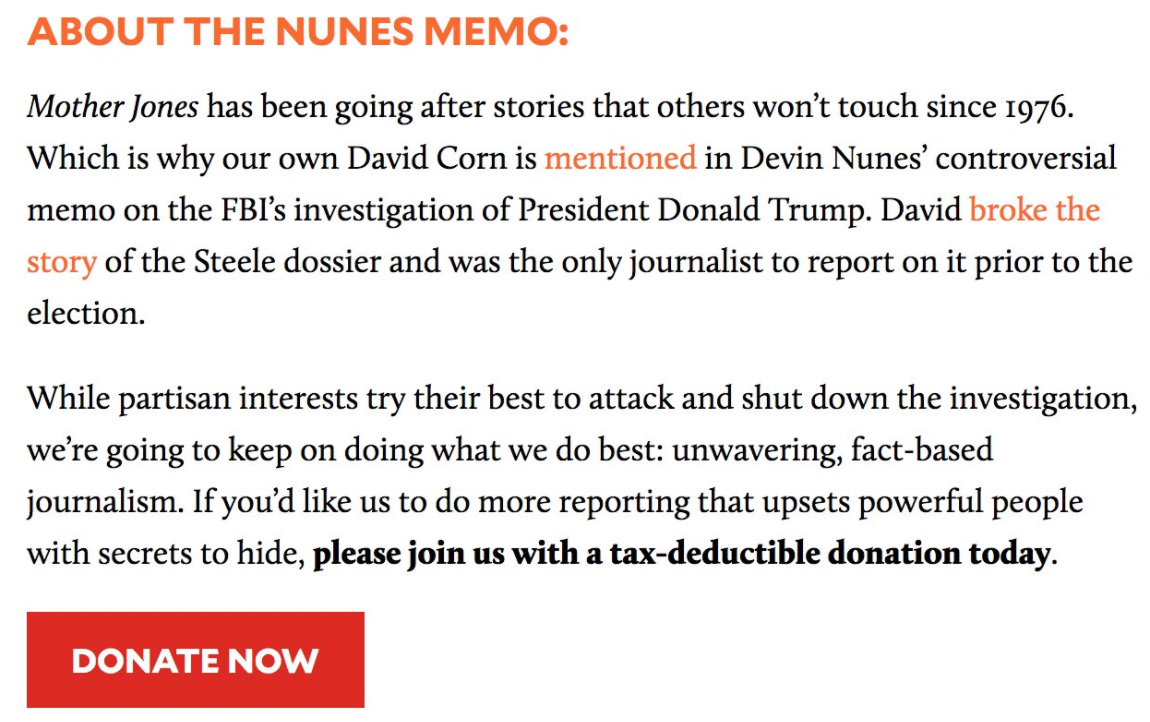
But that a journalist or journalists shared the information might be worth admitting, for the clarity it would give to the story. Two of the journalists at the center of this — David Corn and Michael Isikoff — have been all over the news. Mother Jones is even fundraising off of it.

Surely confirming Akhmetshin’s story, if possible, would be newsworthy?

Share this entry

Recently Released Mueller Emails Show How Conservative He Was, Not How Aggressive

CNN has a piece, based off widely released FOIA documents, claiming, “New documents show how Mueller quickly expanded investigation.”

Special counsel Robert Mueller asked a government agency last June to preserve documents relating to Donald Trump’s transition to the presidency, according to records obtained by CNN — an indication of how he expanded the investigation soon after his appointment.

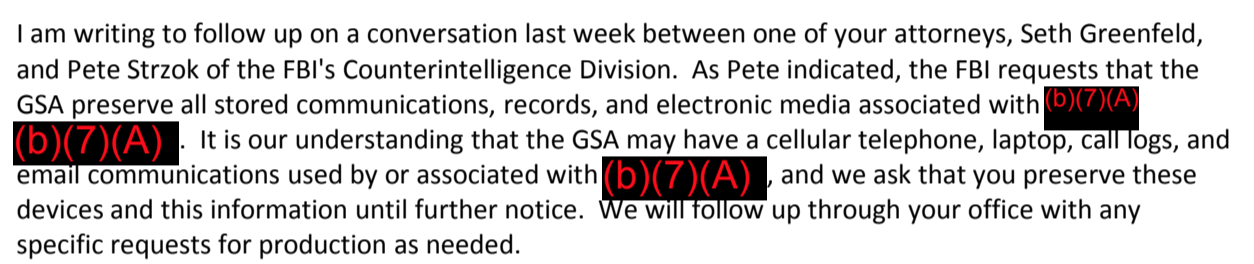
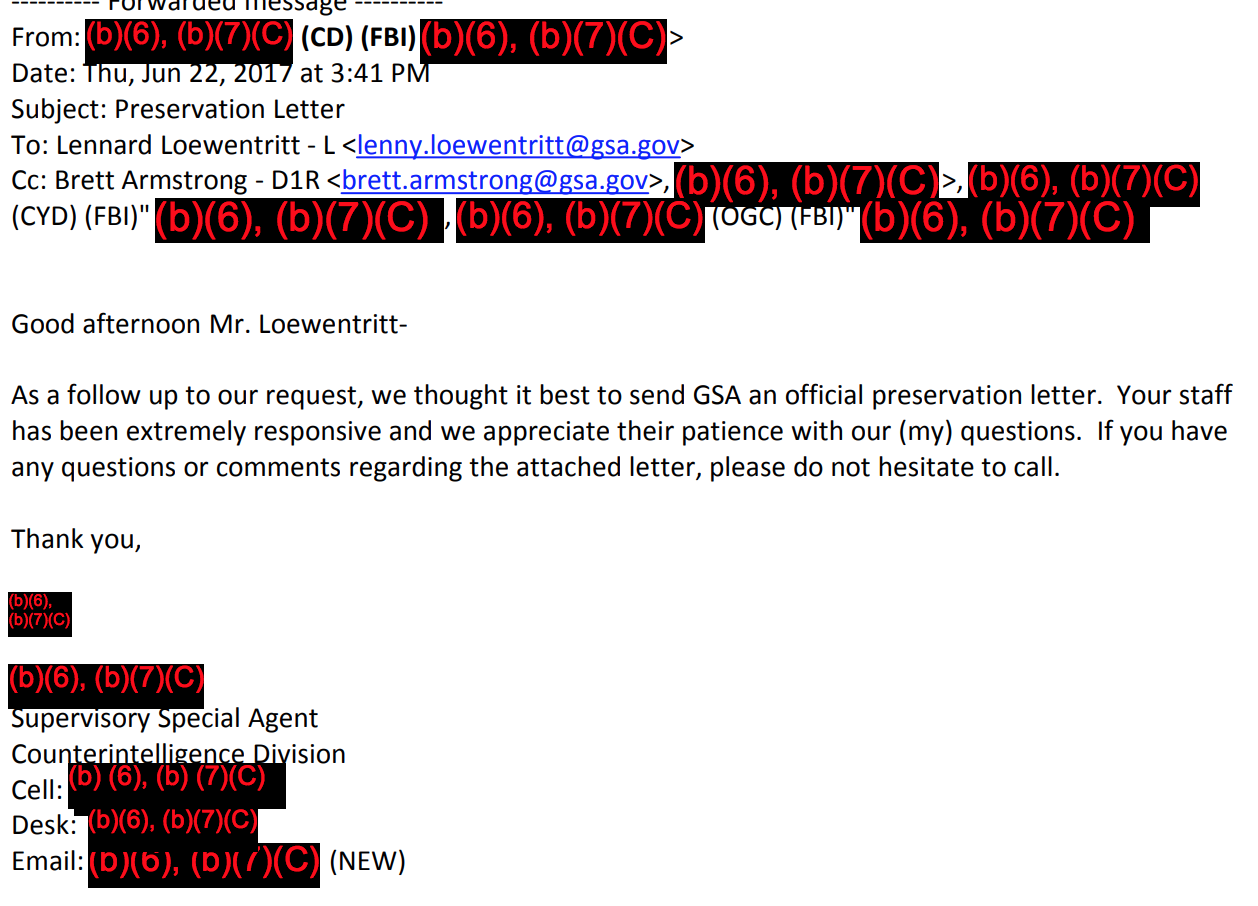
The formal preservation request to the General Services Administration, the agency that supports presidential transitions, was sent on June 22, about a month after Mueller was named special counsel.

An email from March 2017 between the FBI and GSA — months before Mueller was appointed — suggests FBI investigators’ interests at that time were narrower. Then the FBI asked GSA to consult with lawmakers before disposing of other transition documents.

An email from March 2017 between the FBI and GSA — months before Mueller was appointed — suggests FBI investigators’ interests at that time were narrower. Then the FBI asked GSA to consult with lawmakers before disposing of other transition documents.

The more expansive request came when an agent in the FBI’s counterintelligence division emailed the deputy general counsel at GSA to preserve documents, electronics and communications from the Trump transition team, according to documents CNN obtained through a Freedom of Information Act request.

[snip]

The FBI request to the GSA appears to confirm a fear that the President’s friends warned him about last spring. They worried that a special counsel, which comes with broad authority to investigate any matters deemed relevant, could lead to an expansive investigation beyond what the FBI had in its initial inquiry.

In fact, the documents almost certainly show the opposite: that the FBI moved very conservatively as it investigated the Trump camp.

The release consists of two email chains. One, which starts on March 9, 2017, which asks GSA to preserve one person’s data. 

Given the length of the redaction, it appears likely this request pertains to George Papadopoulos, who was a transition team member and who had been interviewed for the second time on February 16. If that’s right, it means the FBI didn’t get a preservation order on Papadopoulos’ communications until eight months after they opened a full investigation tied, in significant part, to the Australian report he had been offered “dirt” in the form of Hillary emails almost a full year earlier. That’s just a preservation order! It means the FBI came back and obtained full legal process to obtain government communications in a predicated counterintelligence investigation.

Then there’s the second request, dated June 22, 2017, which CNN probably correctly ties to some shenanigans the transition team was engaging in. It shows a Supervisory Special Agent from the FBI sending a general official preservation letter to Lennard Loewentritt at GSA.

This request came a week after some shenanigans wherein the transition tried to assert ownership of public emails. Here’s how the transition described the events in a very self-serving complaint to Congress (a complaint they seem to have dropped).

After Inauguration Day on January 20, 2017, TFA wound down the bulk of its activities, vacated the premises provided by the GSA, and returned to the GSA the computer and telephone equipment that TFA had used during the transition period. Shortly thereafter, the GSA asked TFA for direction on the disposition of PTT data. TFA directed the GSA to handle PTT data in a manner consistent with the MOU and the reported disposition of data from President Obama’s presidential transition in 2008; computing devices were to be restored to original settings and reissued to federal personnel and, to the extent that PTT records were not required for the winding down of TFA’s affairs, the PTT email archives were no longer to be preserved.

Approximately two months later, TFA became aware of certain requests concerning PTT records. TFA promptly instructed the GSA, as the custodian of certain TFA records including PTT emails hosted on GSA servers, and others to preserve PTT records. Because of TFA’s prompt reaction, all PTT emails have been preserved.

In order to comply with congressional document production requests, TFA ordered from the GSA electronic copies of all PTT emails and other data. Career GSA staff initially expressed concern that providing copies of PTT emails to TFA might violate a document preservation request that the GSA had received from the Special Counsel’s Office. This issue was resolved decisively on June 15, 2017 after a series of emails and telephone calls between TFA’s legal counsel and Richard Beckler and Lenny Loewentritt, the newly appointed General Counsel for the GSA and the career Deputy General Counsel for the GSA, respectively. After discussion and consideration of the issue, Mr. Beckler acknowledged unequivocally to TFA’s legal counsel, in the presence of Mr. Loewentritt, that TFA owned and controlled the PTT emails and data pursuant to the Presidential Transition Act, and that the GSA had no right to access or control the records but was simply serving as TFA’s records custodian. Mr. Beckler assured legal counsel for TFA, again in the presence of Mr. Loewentritt, that any requests for the production of PTT records would therefore be routed to legal counsel for TFA. In the meantime, Mr. Beckler agreed to maintain all computer equipment in a secure, locked space within GSA facilities. There are multiple surviving witnesses to this conversation, including me. Additionally, we understand that the following day, June 16, 2017, Mr. Beckler personally informed the Special Counsel’s Office that PTT records are not owned or controlled by the GSA, and that the Special Counsel’s Office should communicate with TFA if it desired to obtain PTT records.

It is our understanding that Mr. Beckler was hospitalized and incapacitated in August 2017. Notwithstanding Mr. Beckler’s June 16, 2017 instruction to the Special Counsel’s Office concerning the ownership and control of PTT records, the Special Counsel’s Office, through the Federal Bureau of Investigation (“FBI”), sent to the GSA two requests for the production of PTT materials while Mr. Beckler was hospitalized and unable to supervise legal matters for the GSA. Specifically, on August 23, 2017, the FBI sent a letter (i.e., not a subpoena) to career GSA staff requesting copies of the emails, laptops, cell phones, and other materials associated with nine PTT members responsible for national security and policy matters. On August 30, 2017, the FBI sent a letter (again, not a subpoena) to career GSA staff requesting such materials for four additional senior PTT members. [my emphasis]

Here’s what Loewentritt, named in this email, told Buzzfeed really governed the Trump camp’s use of government resources.

Loewentritt said, “in using our devices,” transition team members were informed that materials “would not be held back in any law enforcement” actions.

Loewentritt read to BuzzFeed News a series of agreements that anyone had to agree to when using GSA materials during the transition, including that there could be monitoring and auditing of devices and that, “Therefore, no expectation of privacy can be assumed.”

Loewentritt told BuzzFeed News that the GSA initially “suggested a warrant or subpoena” for the materials, but that the Special Counsel’s Office determined the letter route was sufficient.

As to whether the Trump campaign should have been informed of the request, Loewentritt said, “That’s between the Special Counsel and the transition team.”

Which seems to suggest that after Mueller’s team learned that the transition was trying to get their own copy of the emails, they obtained a preservation request for everything a week later.

If these two interpretations are correct, then what we’re seeing is the exact opposite of what CNN claims. Rather than showing a fast expansion of the investigation, it instead shows a remarkable delay in investigating Papadopoulos, and then, as the investigation got started, after Trump people tried to intervene, Mueller’s team took the prudent step of issuing a preservation request (followed, months later, by a legal request for the content).

If the two suppositions here are correct, then there’s just one other thing that might change the analysis. Transition Counsel Kory Langhofer described the transition becoming “aware of certain requests concerning PTT records” two months after they preserved everything in January. Requests, plural.

One of those is surely the one we’re looking at, which I guess is Papadopoulos. The other, obvious one, would be Mike Flynn. But if there were more requests than that, then that would be news.

Update: There’s one more person who might obviously be included in a March request: Rick Gates.

Share this entry

Are There Other Emails about the June 9 Meeting?

Something has been bugging me about this NYT story from last week reporting that, in a conference call with Mark Corallo on July 9, 2017 (see the timeline of events below), Hope Hicks told him emails on the June 9, 2016 Trump Tower meeting between Don Jr, Paul Manafort, and Jared Kushner and Natalia Veselnitskaya, Rinat Akhmetshin, Ike Kaveladze, and Rob Goldstone would never come out.

Corallo is planning to tell Mr. Mueller about a previously undisclosed conference call with Mr. Trump and Hope Hicks, the White House communications director, according to the three people. Mr. Corallo planned to tell investigators that Ms. Hicks said during the call that emails written by Donald Trump Jr. before the Trump Tower meeting — in which the younger Mr. Trump said he was eager to receive political dirt about Mrs. Clinton from the Russians — “will never get out.” That left Mr. Corallo with concerns that Ms. Hicks could be contemplating obstructing justice, the people said.

[snip]

In Mr. Corallo’s account — which he provided contemporaneously to three colleagues who later gave it to The Times — he told both Mr. Trump and Ms. Hicks that the statement drafted aboard Air Force One would backfire because documents would eventually surface showing that the meeting had been set up for the Trump campaign to get political dirt about Mrs. Clinton from the Russians.

According to his account, Ms. Hicks responded that the emails “will never get out” because only a few people had access to them.

As the story describes, the emails in question were already prepped (by the lawyers with whom Corallo worked on a day to day basis) to send to Congress, which would have made it really hard for anyone to withhold the emails.

Congress had requested records from Paul Manafort, Mr. Trump’s campaign chairman; Mr. Kushner; and other Trump campaign officials about meetings with Russians. And lawyers had already copied and stamped the emails for delivery to Capitol Hill.

But elsewhere in the story, the NYT admits that even as (or shortly after) that meeting transpired it already had the emails Don Jr released that day and was going to publish them itself.

The younger Mr. Trump ultimately released the emails after being told The Times was about to publish them.

The original story (as well as the second one) described that the meeting was discovered when Kushner disclosed it on one of his many revisions to his security clearance application and in a response from Paul Manafort to congressional inquiries.

The Trump Tower meeting was not disclosed to government officials until recently, when Mr. Kushner, who is also a senior White House aide, filed a revised version of a form required to obtain a security clearance.

[snip]

Manafort, the former campaign chairman, also recently disclosed the meeting, and Donald Trump Jr.’s role in organizing it, to congressional investigators who had questions about his foreign contacts, according to people familiar with the events.

But nothing in that description would mean Congress would have gotten the emails yet, which is where investigative materials normally get leaked to the press (though it’s possible Manafort had already turned them over).

Michael Wolff’s book reports the Bannon suspicion that a Jared aide (presumably Josh Raffel), who was in the initial meeting where Trump forced everyone else to say the June 9 meeting dealt primarily with adoptions, leaked the emails to the NYT.

Indeed, the best guess by many in the West Wing was that the details of the meeting had been leaked by the Kushner side, thus sacrificing Don Jr. in an attempt to deflect responsibility away from themselves.

[snip]

The lawyers, and spokesperson Mark Corallo, had been working to manage this news. But while in Hamburg, the president’s staff learned that the Times was developing a story that had far more details about the meeting—quite possibly supplied by the Kushner side—which it would publish on Saturday, July 8.

But it describes the Jared team as leaking details, not the emails themselves. Plus, it’s hard to see how the emails don’t also implicate Jared, unless he’s going to bank on having left the meeting as his means to defend himself even in light of all the other damning evidence he was willing to chat up Russians later in the year.

Furthermore, given that Jared was an active player in that first meeting, it’s hard to understand how Hicks wouldn’t have known that Jared would have to disclose any emails that involved him personally.

There’s one other detail of note. The NYT makes it clear that the lawyers (and Corallo) in DC were kept out of the loop on the panic on Air Force One and that they didn’t know the NYT was working on a story. Though it’s unclear where the Circa story that those lawyers (and Corallo) did contribute to came from, then, as it feels like an effort to pre-empt the NYT with a friendly outlet.

Significantly, the Circa story is the source of the claim that Trump didn’t know about the meeting that I noted here (which the lawyers are said to have believed, which is why the Trump and his family weren’t consulting with the lawyers).

President Trump was not aware of the meeting and did not attend it, according to the lawyers.

It’s also significant, though, because it adopts the line Paul Manafort seems to have convinced Reince Priebus to adopt, pointing to problems with the dossier and Fusion GPS as a way to discredit the entire investigation.

“We have learned from both our own investigation and public reports that the participants in the meeting misrepresented who they were and who they worked for,” said Mark Corallo, a spokesman for President Trump’s legal team. “Specifically, we have learned that the person who sought the meeting is associated with Fusion GPS, a firm which according to public reports, was retained by Democratic operatives to develop opposition research on the President and which commissioned the phony Steele dossier. ”

“These developments raise serious issues as to exactly who authorized and participated in any effort by Russian nationals to influence our election in any manner,” Corallo said.

I raise all this to highlight two possibilities: that the emails are all that exist, but that they were leaked by someone — Manafort? Bannon? Corallo? — to punish the White House for its first misleading lies about the meeting. Perhaps Gorelick leaked them, which might explain why she stopped representing Jared days later?

But there’s another possibility: that more emails exist, between Don Jr and Rob Goldstone (indeed, we know Goldstone sent follow-up emails involving Vkontakte). Or that there are communications between other players. In which case the release of the current emails might serve to distract from a fuller set that Hicks did succeed in burying.

In any case, not only is Corallo prepping his meeting with Mueller’s team, but Steve Bannon seems intent on meeting with Mueller before HPSCI has an opportunity to run interference with him.

A source familiar with the matter added that Bannon would instead answer all of special counsel Robert Mueller’s questions as part of his investigation.

So whatever particular complaints the Corallo/Kasowitz/Bannon/Priebus crowd has about the way things went down may soon be shared with Mueller.


Early July 7: NYT approaches WH officials and lawyers; WH schedules a conference call w/NYT for next morning.

July 7: Trump chats up Putin at dinner. (Note, whenever Melania decides it’s time to get revenge on Trump for treating her like shit, she can go tell Mueller what she overheard of this conversation.)

July 8, morning: Conference call doesn’t happen. NYT submits 14 questions about the meeting to the WH and lawyers of Trump campaign aides who attended the meeting (do these aides include all of Don Jr, Kushner, and Manafort?); Trump and his aides develop a response on Air Force One, with Hicks coordinating with Don Jr and his lawyer Alan Garten, who were both in NY, via text message.

July 8, afternoon: Jamie Gorelick provides a statement describing his revisions to his security clearance forms.

He has since submitted this information, including that during the campaign and transition, he had over 100 calls or meetings with representatives of more than 20 countries, most of which were during transition. Mr. Kushner has submitted additional updates and included, out of an abundance of caution, this meeting with a Russian person, which he briefly attended at the request of his brother-in-law Donald Trump Jr. As Mr. Kushner has consistently stated, he is eager to cooperate and share what he knows.

July 8, evening: Garten issues a statement in Don Jr’s name stating,

It was a short introductory meeting. I asked Jared and Paul to stop by. We primarily discussed a program about the adoption of Russian children that was active and popular with American families years ago and was since ended by the Russian government, but it was not a campaign issue at that time and there was no follow up. I was asked to attend the meeting by an acquaintance, but was not told the name of the person I would be meeting with beforehand.

July 8, 5PM: NYT publishes story.

July 8, slightly later: Circa publishes different story based on Mark Corallo’s statement, admitting Magnitsky Act discussion.

July 9, morning: Hope Hicks calls Corallo, with Trump in the room, accusing him of trafficking in conspiracy theories. It is this call, according to the NYT, where Hicks said the emails would never come out.

July 9: Don Jr issues a new statement.

After pleasantries were exchanged, the woman stated that she had information that individuals connected to Russia were funding the Democratic National Committee and supporting Mrs. Clinton. Her statements were vague, ambiguous and made no sense. No details or supporting information was provided or even offered. It quickly became clear that she had no meaningful information.

July 14: Jamie Gorelick quits representing Kushner on Russian issues.

July 20: Mark Corallo quits.

July 21: Marc Kasowitz quits.


Some lawyers and witnesses who have sat in or been briefed on the interviews have puzzled over Mr. Mueller’s interest in the episode. Lying to federal investigators is a crime; lying to the news media is not. For that reason, some of Mr. Trump’s advisers argue that Mr. Mueller has no grounds to ask the president about the statement and say he should refuse to discuss it.

Share this entry

Trump Has Told Friends and Aides that Paul Manafort Can Incriminate Him

This Howard Fineman piece is getting a lot of attention because it reveals that Trump plans to beat Mueller by forcing Jeff Sessions to investigate him and his team.

Sources say that Trump has adopted a two-track strategy to deal with the Mueller investigation.

One is an un-Trumpian passivity and trust. He keeps telling some in his circle that Mueller — any day now — will tell him he is off the hook for any charge of collusion with the Russians or obstruction of justice.

But Trump — who trusts no one, or at least no one for long — has now decided that he must have an alternative strategy that does not involve having Justice Department officials fire Mueller.

“I think he’s been convinced that firing Mueller would not only create a firestorm, it would play right into Mueller’s hands,” said another friend, “because it would give Mueller the moral high ground.”

Instead, as is now becoming plain, the Trump strategy is to discredit the investigation and the FBI without officially removing the leadership. Trump is even talking to friends about the possibility of asking Attorney General Jeff Sessions to consider prosecuting Mueller and his team.

“Here’s how it would work: ‘We’re sorry, Mr. Mueller, you won’t be able to run the federal grand jury today because he has to go testify to another federal grand jury,'” said one Trump adviser.

But the real eye-popping detail comes much earlier, where multiple sources (one source for this story is the omnipresent Chris Ruddy) anonymously tell Fineman that Trump has taken comfort in the fact that Paul Manafort isn’t going to flip on him.

He’s decided that a key witness in the Russia probe, Paul Manafort, isn’t going to “flip” and sell him out, friends and aides say.

Of course, the suggestion that Manafort could get a cooperation deal by flipping on Trump is admission that Manafort — one of the attendees at the June 9 meeting, among other things — could flip on him, that he has proof that Trump was part of the conspiracy with the Russians to tamper in the election.

Never mind that this admission exposes the lie Trump has been telling — that Manafort’s indictment only pertains to consulting he did for Ukraine years ago and therefore doesn’t pose a risk to Trump. Never mind that Trump’s confidence, given the signs that Rick Gates may be prepping to flip, may be premature.

Former Trump campaign aide Rick Gates has quietly added a prominent white-collar attorney, Tom Green, to his defense team, signaling that Gates’ approach to his not-guilty plea could be changing behind the scenes.

Green, a well-known Washington defense lawyer, was seen at special counsel Robert Mueller’s office twice last week. CNN is told by a source familiar with the matter that Green has joined Gates’ team.

Green isn’t listed in the court record as a lawyer in the case and works for a large law firm separate from Gates’ primary lawyers.

Green’s involvement suggests that there is an ongoing negotiation between the defendant’s team and the prosecutors.

[snip]

Superseding indictments, which would add or replace charges against both Gates and Manafort, have been prepared, according to a source close to the investigation. No additional charges have been filed so far. When there is a delay in filing charges after they’ve been prepared, it can indicate that negotiations of some nature are ongoing.

Most of all, I’m simply amazed at how stupid Trump is to be telling multiple people that Manafort could incriminate him.

I mean, sure, Mueller already knew that. But now he can start asking witnesses — including Steve Bannon, who recently doubled down on his suggestion that Manafort was a traitor, even if that young kid Don Jr is not, and who already has a date scheduled with Mueller’s team — whether Trump has told them this himself.

Share this entry

Carter Page Did Not Need to be a Spy to be Targeted Under FISA

The NYT has a story that explains something I was wondering about over the weekend: how the Nunes memo could be used — as it reportedly is being used — to justify a Trump bid to fire Rod Rosenstein. Shortly after he was confirmed, NYT reveals, Rosenstein approved the renewal application for the FISA order targeting Carter Page.

A secret, highly contentious Republican memo reveals that Deputy Attorney General Rod J. Rosenstein approved an application to extend surveillance of a former Trump campaign associate shortly after taking office last spring, according to three people familiar with it.

[snip]

[I]n their efforts to discredit the inquiry, Republicans could potentially use Mr. Rosenstein’s decision to approve the renewal to suggest that he failed to properly vet a highly sensitive application for a warrant to spy on Mr. Page, who served as a Trump foreign policy adviser until September 2016.

The news is interesting for several reasons. First, it provides more granularity for the timing of the surveillance targeted at Page.

American law enforcement officials began conducting surveillance on him in the fall of 2016, shortly after he left the campaign. It is unclear what they learned about Mr. Page between then and when they sought the order’s renewal roughly six months later. It is also unknown whether the surveillance court granted the extension.

The renewal effort came in the late spring, sometime after the Senate confirmed Mr. Rosenstein as the Justice Department’s No. 2 official in late April. Around that time, following Mr. Trump’s firing of James B. Comey as F.B.I. director in May, Mr. Rosenstein appointed Mr. Mueller, a former head of the bureau, to take over the department’s Russia investigation.

Rosenstein was sworn in on April 26. He appointed Mueller on May 17. If we take that window as the timeframe for the reapplication date, it would date the prior authorization (orders targeting US persons last 90 days) to roughly January 26 through February 17, and the fall one to October 26 to November 17 time frame. The later you get in that initial time period, the closer you get to the time when Page would have been planning a follow-up visit to Russia in December.

Glenn Simpson describes Christopher Steele’s second meeting with the FBI, in Rome, about his dossier as occurring sometime in September. So there was perhaps a month between the time Steele provided information on Page and the time the FBI obtained the new order targeting Page.

On top of what the NYT says about Democratic complaints about this memo, there are other reasons to believe this is bogus. Even on 702 — but especially on FISA — the retasking process requires the government to show it obtained new information during the prior surveillance period, meaning the application Rosenstein signed would have been the second to do so.

Plus, there’s one more point.

To be targeted FBI had to provide proof that Page was an agent of a foreign power.

The renewal shows that the Justice Department under President Trump saw reason to believe that the associate, Carter Page, was acting as a Russian agent.

[snip]

To obtain the warrant involving Mr. Page, the government needed to show probable cause that he was acting as an agent of Russia.

But that does not actually entail proving that he, himself, is spying on the US. An American may be targeted as an agent of a foreign power if he knowingly aids or abets someone involved in clandestine intelligence gathering that may involve a violation of criminal statutes.

(A) knowingly engages in clandestine intelligence gathering activities for or on behalf of a foreign power, which activities involve or may involve a violation of the criminal statutes of the United States;

(B) pursuant to the direction of an intelligence service or network of a foreign power, knowingly engages in any other clandestine intelligence activities for or on behalf of such foreign power, which activities involve or are about to involve a violation of the criminal statutes of the United States;

[snip]

(E) knowingly aids or abets any person in the conduct of activities described in subparagraph (A), (B), or (C) or knowingly conspires with any person to engage in activities described in subparagraph (A), (B), or (C).

That’s the standard that — given that Page had been warned by FBI in 2013 that he was being recruited — might be fairly easily within reach for Page. I suspect we’ll eventually learn (after whatever brouhaha ensues) that FBI claimed Page was either aiding or abetting Russian spies, or conspiring with them, not that he was a spy himself. But that’s a distinction that may be lost on Republicans trying to politicize this.

There’s one more thing (one I don’t expect applies here but is worth pointing out in any case). The government can target any facility an agent of a foreign power uses, whether or not the agent owns it.

(B) each of the facilities or places at which the electronic surveillance is directed is being used, or is about to be used, by a foreign power or an agent of a foreign power

This is how the government got to do a scan of all Yahoo’s users, because the targeted foreign power was using Yahoo mail, generally, and the specific signature searched on identified the people as targets.

Two more points. Trey Gowdy reviewed the underlying intelligence to the memo  that is now being used to target Rosenstein, he’s telling colleagues to stop pressuring Mueller in part because Mueller is pursuing a counterintelligence component (precisely the kind of thing targeted with FISA!) that will explain what really happened in 2016.

Gowdy said there are “two components” to the purview of Mueller’s investigation.

“There is a criminal component. But there’s also a counterintelligence component that no one ever talks about because it’s not sexy and interesting. But he’s also going to tell us definitively what Russia tried to do in 2016,” Gowdy said. “So the last time you and I were together, I told my Republican colleagues, leave him the hell alone, and that’s still my advice.”

Gowdy is one of about six members of Congress who has seen the most sensitive materials in Mueller’s case. It’s really bizarre that he’s saying the GOP needs to back off Mueller because of his CI focus when they’re likely misunderstanding how FISA is used in CI.

Finally, remember that nothing that Mueller is known to have done is identifiably fruit from this Carter Page order. Even with Manafort — who was also reportedly targeted in a FISA order — Mueller has not given FISA notice to suggest he’s relying on anything derived from FISA (though such notice is always suspect).

So even if he dossier is dodgy, it may be that Mueller is pursuing his case such that he avoids any taint from it.

Update: I keep forgetting, but something that happened with Carter Page may well have been abusive, but it’s not what the Republicans are (as far as the public reporting goes) focusing on. It’s a sign that they’re dummies who don’t understand what they purportedly oversee that they haven’t figured this out. I’m not going to lay it out here — because those leading this hoax just reauthorized the practice in any case — but I have written it up elsewhere.

Share this entry

Dear JD Gordon [and Jared]: Mueller Has 17 Prosecutors; White House Obstruction Accounts for Just One

The WaPo has a piece reporting (with details about John Kelly’s “collusion” with Attorney General Jeff Sessions, who is supposed to be recused) what I noted here: Trump wants the Devin Nunes memo to come out, even in spite of the warnings about how releasing it will damage national security.

It rather absurdly claims that Mueller is “narrowing” his probe.

As Mueller narrows his probe — homing in on the ways Trump may have tried to impede the Russia investigation — a common thread ties many of the incidents together: a president accustomed to functioning as the executive of a private family business who does not seem to understand that his subordinates have sworn an oath to the Constitution rather than to him.

More amusing is this anonymous quote from JD Gordon.

A person who has spoken with Mueller’s team said investigators’ questions seemed at least partially designed to probe potential obstruction from Trump.

“The questions are about who was where in every meeting, what happened before and after, what the president was saying as he made decisions,” this person said, speaking on the condition of anonymity to recount a private session.

This person added that while it seemed unlikely Mueller’s team would yield any evidence of a coordinated effort to aid the Russians — “If you were on the campaign, you know we couldn’t even collude with ourselves,” he said — the investigators might find more details to support obstruction of justice. [my emphasis]

We know it was JD Gordon because he said precisely the same thing in an op-ed just after the George Papadopoulos plea made it clear Gordon and his buddies might be in a heap of trouble.

Trump camp too disorganized to collude

Criminalization of policy differences has descended upon America once again. The viciousness towards a sitting president and his team evokes memories of Bill Clinton’s 1998 impeachment. In the “witch hunt” Clinton was impeached for something unrelated to the Arkansas real estate deal which sparked the Whitewater investigation years earlier. Like a Soviet secret police chief once said: “Show me the man and I’ll find you the crime.” Indeed.

We’re seeing the same thing today. The Trump-Russia collusion story is a hoax and “witch hunt” of this century.

Like typical conspiracy theories, usually the simplest explanation is correct. The campaign was chaotic, understaffed and underpaid, if paid at all. We couldn’t collude amongst ourselves. [my emphasis]

Since JD Gordon is — by his own account — incompetent, I’m going to repeat the substance of this post I did even as he first rolled out this line, just to help him out.

Update: I’ve been informed that Jared Kushner has also used this “we couldn’t collude because we’re too incompetent” line, so perhaps he’s the one who believes he’s not at risk for engaging in a quid pro quo with Russians and others. 

Robert Mueller has 17 prosecutors. We’ve only seen what 10 of them are doing. And just one of them — Watergate prosecutor James Quarles — is known to be working on the White House obstruction case.

Here’s a census of Mueller’s prosecutors who’ve thus far shown what they’re working on:

Manafort docket:

  • Andrew Weismann (1)
  • Greg Andres (2)
  • Kyle Freeny (3)

Adam Jed (4), an appellate specialist, has appeared with these lawyers in grand jury appearances.

Papadopoulos docket:

  • Jeannie Rhee (5)
  • Andrew Goldstein (6)
  • Aaron Zelinsky (7)

Flynn docket:

  • Brandon L. Van Grack (8)
  • Zainab Ahmad (9)

Obstruction docket:

Even in these dockets, it’s clear Mueller is nowhere near done.

Flynn may have a status hearing scheduled for Thursday (though it’s not formally noted in the docket). I suspect, instead, we’ll get a joint status report like was submitted in Papadopoulos’ case on January 17, which basically said, “we’re very busy cooperating, don’t bug us until April 23.”

And CNN just reported that Mueller’s team has drafted superseding indictments against Paul Manafort and Rick Gates, and Gates appears to be prepping to flip.

Former Trump campaign aide Rick Gates has quietly added a prominent white-collar attorney, Tom Green, to his defense team, signaling that Gates’ approach to his not-guilty plea could be changing behind the scenes.

Green, a well-known Washington defense lawyer, was seen at special counsel Robert Mueller’s office twice last week. CNN is told by a source familiar with the matter that Green has joined Gates’ team.

Green isn’t listed in the court record as a lawyer in the case and works for a large law firm separate from Gates’ primary lawyers.

Green’s involvement suggests that there is an ongoing negotiation between the defendant’s team and the prosecutors.

[snip]

Superseding indictments, which would add or replace charges against both Gates and Manafort, have been prepared, according to a source close to the investigation. No additional charges have been filed so far. When there is a delay in filing charges after they’ve been prepared, it can indicate that negotiations of some nature are ongoing.

So even where we have some visibility, that visibility suggests there is plenty of work trying to see if there was any conspiracy tied to the election.

That leaves the following prosecutors, listed with their specialities:

  • Aaron Zebley (11): probably working on coordination
  • Michael Dreeben (12): appellate wizard
  • Elizabeth Prelogar (13): appellate specialist and Russian speaker
  • Scott Meisler (14): appellate specialist
  • Rush Atkinson (15): fraud prosecutor
  • Ryan Dickey (16): Cybersecurity (just added in November)
  • Mystery prosecutor (17)

I mean, Mueller hasn’t even revealed all his prosecutors yet, much less what they’re all working on.

But JD Gordon would have you believe the prosecutors’ attention to what meetings he and his buddies were in means Mueller is only investigating obstruction.

Share this entry

Feinstein’s Homework Assignments

While Devin Nunes has been getting all the headlines for trying to muck up the Mueller investigation, Chuck Grassley and Dianne Feinstein are increasingly at odds, as well. First there was the Grassley-Lindsey Graham bogus referral of Christopher Steele (I say it’s bogus not because I doubt his sworn statements have been inconsistent — they have been — but because FBI doesn’t need a referral for statements made to FBI itself). Then Feinstein released, and then apologized for, releasing the Glenn Simpson transcript. Grassley used that to invent the story that Jared Kushner was spooked and so wouldn’t sit for an interview with the Senate Judiciary Committee (we know that’s bullshit because Kushner released his own statement before giving it to the Senate Intelligence Committee, which “spooked” Richard Burr). Still, in response to a Sheldon Whitehouse and Richard Blumenthal request that Don Jr’s transcript be shared with FBI (because he likely lied in it), Grassley suggested he’d release the transcripts of all the interviews pertaining to the June 9 meeting.

So now both are continuing to collect evidence on their own, at least in part to generate headlines rather than investigative leads. But the most recent requests, both sent out yesterday, provide some insight into what they believe might have happened and what they know (or still don’t know).

In this post, I’ll look at whom Feinstein is requesting information from. In a follow-up I’ll comment on Grassley’s latest request.

Who Feinstein wants to talk to and who represents them

Some of Feinstein’s requests are immediately understandable, including the following people (thoughout this post, I’ve noted the lawyer’s name if the letter was sent to one):

As for the others, the explanation for why the Committee is seeking information explains any connection understood to the investigation. Most of this is open source information to footnoted reporting (click through to see those sources). Where that’s not the case, I’ve bolded it, as that presumably reflects still classified information the Committee received.

Michael Caputo (Dennis Vacco):

You joined the presidential campaign of Donald Trump as a communications advisor upon the recommendation of Paul Manafort, and it has been reported you have close ties to campaign advisor Roger Stone. It also has been reported that you have deep ties to Russia, including having worked for the Kremlin and Russian energy conglomerate Gazprom.

Paul Erickson (sent to him directly):

In May 2016, you were involved in efforts to broker a meeting between Alexander Torshin — someone you described as “President Putin’s emissary” — and top officials for the Trump campaign. In your communications with the Trump campaign about this meeting, you said that you had been “cultivating a back-channel to President Putin’s Kremlin” and that the “Kremlin believes htat the only possibility of a true reset in this relationship would be with a new Republican White House.”

Robert Foresman (sent to him directly):

As a long-time investment banker in Russia, you have developed relationships with senior Kremlin officials and have expressed your passion for private diplomacy to help foster improved U.S.-Russia relations. The Committee has reason to believe you sought to engage the Trump campaign in discussions concerning outreach from senior Kremlin officials.

Rhona Graff (Alan Futerfas, who is also representing Don Jr):

As a senior vice president in the Trump Organization and longtime assistant to Donald Trump, you are likely familiar with the President’s communications and schedule, particularly during the 2016 presidential campaign. For example, Roger Stone and Paul Manafort, [sic] have said they contact you to get access to President Trump. And when Rob Goldstone emailed Donald Trump Jr. about setting up the June 9, 2016 meeting between the Trump campaign and a Russian lawyer, he noted, “I can also send this info to your father via Rhona, but it is ultra sensitive so wanted to send to you first.”

Philip Griffin (sent directly to his email):

You have been a longstanding associate of former Trump campaign manager Paul Manafort and served, reportedly at his request, as an advisor to the Trump campaign during the Republican National Convention in Cleveland in July 2016.

[snip]

You have been a longtime of [sic] associate of Manafort, and you hired Konstantin Kiliminik [sic] to work with you and Manafort in Ukraine. In 2014, you were named in a lawsuit filed by Russian oligarch Oleg Deripaska as a “ley” partner, along with Manafort, Gates, and Kilimnik, in an investment fund that Deripaska contends stole nearly $19 million from him. In 2016, while Manafort was serving as the Trump campaign manager, Kilimnik reportedly emailed Manafort about reporting on Manafort’s role in the campaign with Deripaska, which Manafort suggested might be used to “get whole.”

David Keene (sent directly to him):

In spring 2016, Russian banker Alexander Torshin and Russian national Maria Butina were reportedly involved in efforts to arrange a meeting between Mr. Torshin and then-candidate Donald Trump or his campaign. Mr. Torshin is a “senior Russian official who claimed to be acting at the behest of President Vladimir V. Putin of Russia.” Ms. Butina is the founder of the Russian group known as the Right to Bear Arms and has described herself as a “representative of the Russian Federation” and a “connection between Team Trump and Russia.” You reportedly were introduced to Mr. Torshin in 2011, and were invited by Mr. Torshin and Ms. Butina to speak at the 2013 annual meeting in Moscow for the Right to Bear Arms. Ms. Butina was your guest at the NRA’s 2014 annual meeting, and you traveled along with Trump campaign surrogate Sheriff David Clarke to Moscow in December 2015 for another meeting with Ms. Butina’s organization.

Joseph Keith Kellogg, Jr. (sent directly to him):

As a member of the Trump campaign’s foreign policy team, you worked alongside George Papadopoulos and Carter Page, both of whom had multiple contacts with Russian officials (or their surrogates) that they reported back to the campaign. You also worked on the Trump transition team before joining the National Security Council and served as Chief of Staff under Lt. General Michael Flynn until his removal.

[snip]

You served as Chief of Staff on the National Security Council during the period when General Flynn lied to administration officials about his Russian contacts. It has been reported that, once the White House learned of those lies from Acting Attorney General Sally Yates, you started participating in the President’s daily security briefings, and — once General Flynn was removed — you served as the President’s interim national security advisor.

John Mashburn (sent to him at the White House):

As the Trump campaign policy director, you worked alongside members of the foreign policy team who had multiple contacts with Russian officials (or their surrogates). For example, Rick Dearborn, another senior policy aide, who reportedly shared a May 2016 request from Alexander Torshin, a senior Russian official with close ties to Vladimir Putin, to meet then-candidate Trump or other top campaign officials at the National Rifle Association’s 2016 annual convention. It also has been reported that JD Gordon informed you about pro-Russian changes to the Republican party platform that were championed by the Trump campaign. You role as senior advisor on the transition team, and now White House Deputy Cabinet Secretary, also has given you a firsthand look at other significant events affecting the Trump administration, including the removals of National Security Advisor Michael Flynn and FBI Director James Comey.

Frank Mermoud (sent via email directly to him):

You served as an advisor to the Trump campaign during the Republican National Convention in Cleveland in July 2016, running the program for ambassadors and foreign delegations — a post that you reportedly held at the recommendation of former Trump campaign manager Paul Manafort. Because of your role at the convention, longstanding relationship with Mr. Manafort, and deep business ties to Ukraine,

Amanda Miller (Alan Futerfas, who also represents Don Jr):

As a vice president for marketing at the Trump Organization, you are likely intimately familiar with President Donald Trump and the inner workings of the Trump Organization. For example, you have made public statements on behalf of the Trump Organization regarding the Trump Organization’s efforts to build a Trump Tower in Moscow. In addition, the Committee has reason to believe that you may have information on other Trump business ties to Russia.

Feinstein wants to know who lied to David Ignatius

In general, the items requested are not the surprising. I am, however, interested that Kellogg, Miller, and Spicer were asked about,

All communications concerning the story written by David Ignatius that appeared in the Washington Post on January 12, 2017, titled, “Why did Obama dawdle on Russia’s hacking?

Note, before the story, the transition team did not comment, but after it revealed that Flynn had phoned Sergei Kislyak several times on December 29, two aides called Ignatius and told what we now know are lies.

The Trump transition team did not respond Thursday night to a request for comment. But two team members called with information Friday morning. A first Trump official confirmed that Flynn had spoken with Kislyak by phone, but said the calls were before sanctions were announced and didn’t cover that topic. This official later added that Flynn’s initial call was to express condolences to Kislyak after the terrorist killing of the Russian ambassador to Ankara Dec. 19, and that Flynn made a second call Dec. 28 to express condolences for the shoot-down of a Russian plane carrying a choir to Syria. In that second call, Flynn also discussed plans for a Trump-Putin conversation sometime after the inauguration. In addition, a second Trump official said the Dec. 28 call included an invitation from Kislyak for a Trump administration official to visit Kazakhstan for a conference in late January.

Burck’s clients get different treatment

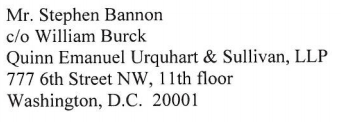
Also as I noted above, Feinstein staff treated the letter to the two William Burck clients differently. Bannon’s was sent to him, but care of Burck.

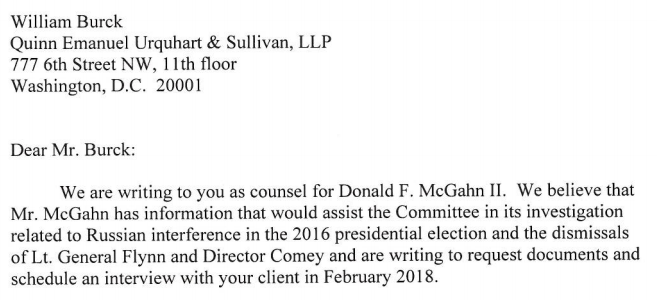
But McGahn’s was addressed to Burck.

Unless I missed it, McGahn’s is the only letter treated this way. Which is one reason I suspect the blizzard of stories about what a hero McGahn was in June after he had done clearly obstructive things in May and earlier may have more to do with McGahn’s legal jeopardy than Trump’s.

Update: This Politico piece (h/t PINC) says that McGahn hired Burck last May, right after he had done some really stupid things with respect to the Jim Comey firing.

McGahn came calling in May amid the fallout from Trump’s decision to fire Comey from his post as FBI director — an explosive move that prompted Mueller’s appointment.

Share this entry