Bill Barr Testifies He’s Unfamiliar with the Obstruction Portion of the Mueller Report

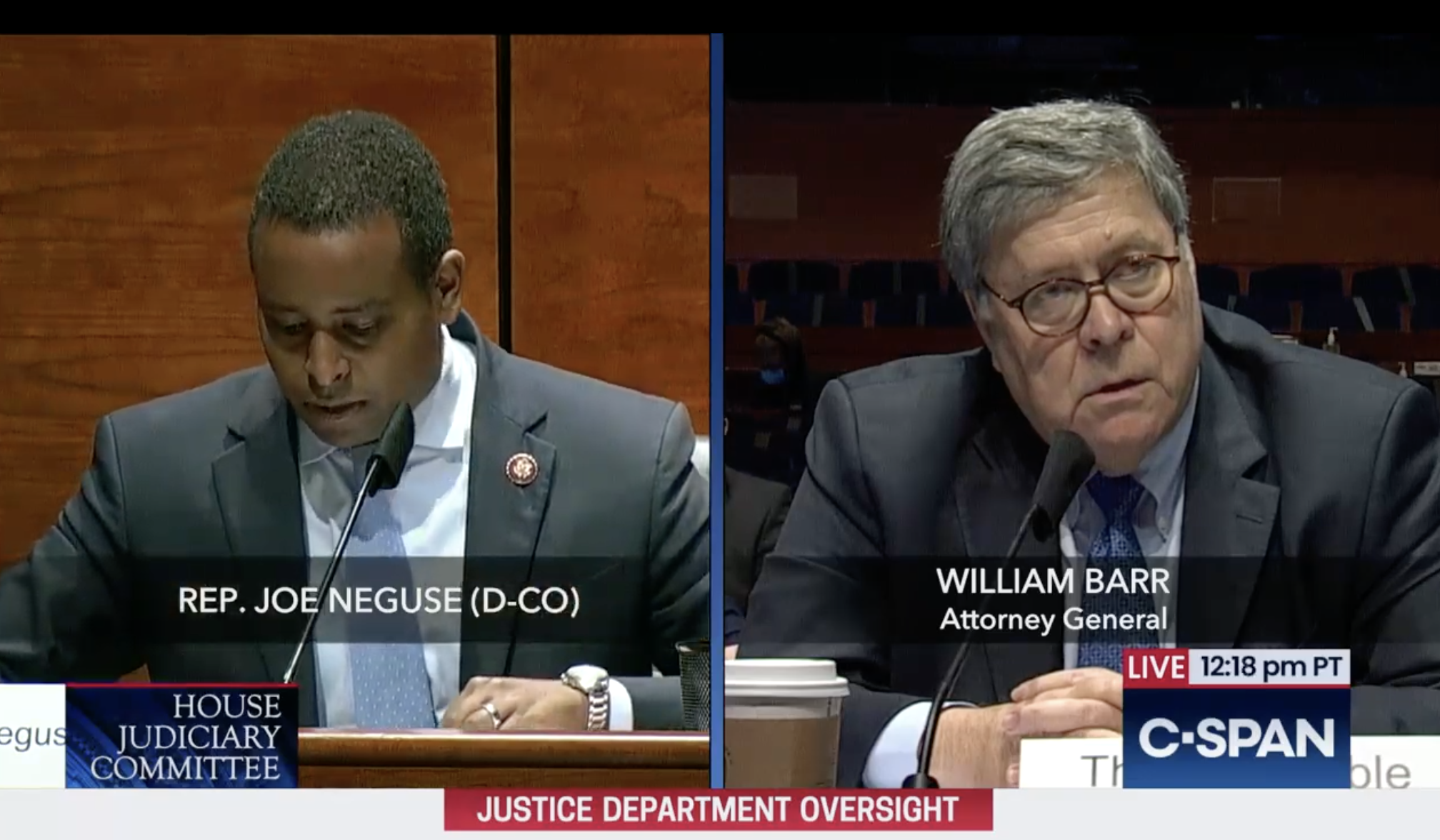
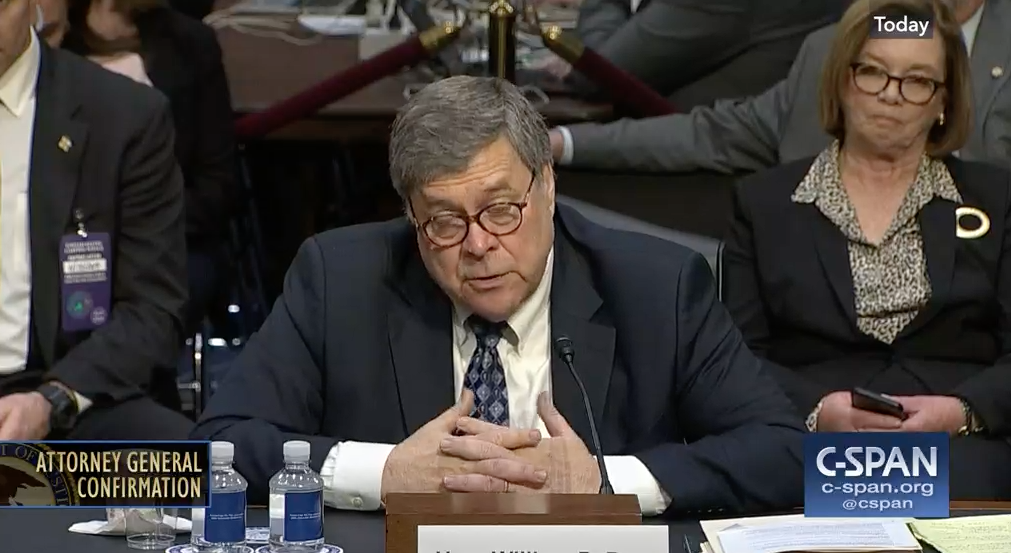
I’m just finishing up the Bill Barr testimony before the House Judiciary Committee. While it wasn’t useful at eliciting new information, Barr did not succeed at filibustering over questions he wanted to ignore. Jim Jordan, whose favorite tactic is to scream and refuse to let witnesses answer questions, four times complained that Democrats had insisted on reclaiming their time when Barr tried to filibuster.

Democrats didn’t nail Barr on some of his key lies. For example, as he did in his written testimony, he complained that protestors were endangering federal judges; yet Democrats let him get away with the lie — which he yelled over and over — that Amy Berman Jackson agreed with his view on the Stone sentencing. The reality is ABJ very pointedly disagreed with Barr’s decision that Stone should not be punished for threatening her.

The headline of the hearing, though, should be that, now that he’s finally testifying under oath, Barr backed off his claim — made when releasing the Mueller Report — that the White House fully cooperated with the Mueller investigation. [This is about 45 minutes before the end.]

Joe Neguse: I want to go through a couple of your prior statements. On April 19–or, excuse me, April 18 of 2019, you stated that the White House fully cooperated with the Special Counsel’s investigation. You’re aware of that?

Barr: Umm hmm.

Neguse: Today, yes or no Mr. Barr with the penalty of perjury, do you testify that that statement was true at the time you made it?

Barr: I thought it to be true at the time I made it. Why isn’t it true–

Neguse: I’ll get to that Mr. Barr.

Barr: Does it have to do with quibbling over–

Neguse: Mr. Barr, I’ll get to that, reclaiming my time, you answered the question. I have another question for you. On June 19, of 2020,

Barr: Actually, I have to answer that question.

Neguse: Mr. Barr, you did answer that question.

Barr: No, you said under penalty of perjury. I’m going to answer the damn question.

Neguse: You said the answer was yes. Are you saying no?

Barr: I think what I was referring to — and I’d have to see the context of it — was the supplying of documents.

Neguse: No, Mr. Attorney General, the statement was not limited to the supply of documents. You stated it at a press — Mr. Attorney General —

Barr: I think that’s that I was talking about —

Neguse: Reclaiming my time —

Barr: I think that’s what I was talking about —

Neguse: Reclaiming my time. You stated at a press conference on April 19, 2019 that the White House fully cooperated with the Special Counsel’s investigation. You knew, when you made that statement, that the President had not agreed to be interviewed by the Special Counsel.

Barr: I think that was subsequently —

Neguse: Now on June 18th of this year —

Barr: I was referring to —

Neguse: Mr. Attorney General, I was referring to

Barr: The production of documents —

Neguse: Mr. Attorney General, on June 18th of this year, the Department of Justice issued a statement saying that Mr. Berman, the former US Attorney for the Southern District of New York, had quote, “stepped down.” You’re aware of that statement being released by the department, correct?

Barr: Yes.

Neguse: And do you testify today that that statement was true, at the time the Department issued it?

Barr: Um, he may not have known it, but he was stepping down.

Neguse: He may not have known that he was stepping down? That’s your testimony today?

Barr: He was being removed.

Neguse: Mr. Attorney General. The statement did not say he was being removed. It did not say he was being fired. It said that he was stepping down.

But I think the far more damning testimony from the Attorney General is that he is not familiar with the obstruction part of the Mueller Report.

Eric Swalwell had this exchange with Barr:

Swalwell: Mr. Barr, have you ever intervened other than to help the President’s friend get a reduced prison sentence for any other case where a prosecutor had filed a sentencing recommendation with a court?

Barr: A sentencing recommendation?

Swalwell: Yeah. Have you ever intervened, other than that case with the President’s friend?

Barr: Not that I recall–

Swalwell: Does that seem like something you’d recall? Where you would–

Barr: Well, I’m saying I can’t really remember my first — if you let me finish the question, I can’t remember thirty years ago I was Attorney General.

Swalwell: As Attorney General now?

Barr: Uh, no, I didn’t. But that’s because issues come up to the Attorney General in a dispute and I’ve never [starts yelling] I’VE NEVER HEARD OF A DISPUTE … I’VE NEVER HARD OF A DISPUTE WHERE LINE PROSECUTORS–

Swalwell: Mr. Attorney– Mr. Attorney–

Barr: [still yelling] THREATEN TO QUIT —

Swalwell: Well it’s a pretty big deal–

Barr: Because of a discussion over sentencing–

Swalwell: Mr. Barr, Americans from both parties are concerned that in Donald Trump’s America there are two systems of justice. One for Mr. Trump and his cronies. And another for the rest of us. But that can only happen if you enable it. At your confirmation hearing, you were asked, “Do you believe a President could lawfully issue a pardon in exchange for the recipient’s promise to not incriminate him?

Barr: Not to what?

Swalwell: You said, “That would be a crime.” You were asked, could a President issue a pardon in exchange for the recipient’s promise to not incriminate him, and you responded, “no, that would be a crime.” Is that right?

Barr: Yes, I said that.

Swalwell: You said “a crime.” You didn’t say, “it’d be wrong,” you didn’t say, “it’d be unlawful.” You said, “it’d be a crime.” And when you said that, that a President swapping a pardon to silence a witness would be a crime, you were promising the American people that if you saw that, you would do something about that, is that right?

Barr: That’s right.

Swalwell: Now, Mr. Barr, are you investigating Donald Trump for commuting the prison sentence of his long-time friend and political advisor Roger Stone?

Barr: No.

Swalwell: Why not?

Barr: Why should I?

Swalwell: Well, let’s talk about that. Mr. Stone was convicted by a jury on 7 counts of lying on the Russian investigation. He bragged that he lied to save Trump’s butt. But why would he lie? Your prosecutors, Mr. Barr, told a jury that Stone lied because the truth looked bad for Donald Trump. And what truth is that? Well, Donald Trump denied in written answers to the Russia investigators that he talked to Roger Stone during the time that Roger Stone with in contact with Agents of a Russian influence operation. There’s evidence that Trump and Stone indeed did talk during that time. You would agree that it’s a federal crime to lie under oath, is that right?

Barr: Yes.

Swalwell: It’s a crime for you, it’s a crime for me, and it’s certainly a crime for the President of the United States. Is that right?

Barr: Yes.

Swalwell: So if Donald Trump lied to the Mueller investigators, which you agree would be a crime, then Roger Stone was in a position to expose Donald Trump’s lies. Are you familiar with the December 3rd, 2018 tweet, where Donald Trump said Stone had showed “guts” by not testifying against him?

Barr: No, I’m not familiar with that.

Swalwell: You don’t read the President’s tweets?

Barr: No!

Swalwell: Well, there’s a lot of evidence in the President’s tweets, Mr. Attorney General, I think you should start reading them, because he said Mr. Stone, “showed guts,” but on July 10 of this year, Roger Stone declared to a reporter, “I had 29 or 30 conversations with Trump during the campaign period. Trump knows I was under enormous pressure to turn on him. It would have eased my situation considerably. But I didn’t. The prosecutors wanted me to play Judas, I refused.” Are you familiar with that Stone statement?

Barr: Actually I’m not.

Swalwell: So how can you sit here and tell us, why should I investigate the President of the United States,” if you’re not even aware of the facts concerning the President using the pardon or commutation power to swap the silence of a witness?

Barr: Because we require, you know, a reliable predicate before we open a criminal investigation.

Swalwell: And I just gave you, sir–

Barr: I don’t consider it, I consider it a very Rube, uh, Goldberg theory that you have —

Swalwell: Well it sounds like you’re hearing this theory for the first time.

Barr: And by the way if apply this standard it’d be a lot, it’d be a lot more people under investigation.

Swalwell: Mr. Attorney General, the very same day that Roger Stone said that Donald Trump — no surprise — commuted his

Barr: The two tiered standards of justice were really during the tail end of the Obama Administration.

Barr may well be unfamiliar with Trump’s December 3, 2018 tweet.

Let’s take his testimony as truth.

If that’s true, than Barr is also unfamiliar with the Obstruction portion of the Mueller Report. In passages just recently declassified by Billy Barr’s DOJ, the Mueller Report laid out how the back-and-forth between Stone and Trump might be evidence of obstruction.

As described above, in an interview on November 28, 2018, one week after submitting his written answers, the President criticized “flipping” and said that Stone (along with Manafort and Corsi) was “very brave” in indicating he would not cooperate with prosecutors.897 On December 2, 2018, Stone told the press that there was “no circumstance” under which he would “testify against the president.”898 He also said he had had no discussions about a pardon.899 On December 3, 2018, the President tweeted, “‘I will never testify against Trump.’ This statement was recently made by Roger Stone, essentially stating that he will not be forced by a rogue and out of control prosecutor to make up lies and stories about ‘President Trump.’ Nice to know that some people still have ‘guts!’”900

On January 24, 2019, a grand jury indicted Stone on charges of obstruction, witness tampering, and making false statements.901 One of the counts charged Stone with violating 18 U.S.C. § 1001 for testifying falsely in Congress that he had never told anyone involved in the Trump Campaign about discussions he was having during the campaign with an individual who acted as an intermediary between him and Assange.902 After making an initial court appearance on January 25, 2019, Stone told reporters, “There is no circumstance whatsoever under which I will bear false witness against the president, nor will I make up lies to ease the pressure on myself. . . . I will not testify against the President, because I would have to bear false witness.”903

That evening, Stone appeared on Fox News and indicated he had knowledge of the President’s answers to this Office’s written questions. When asked if he had spoken to the President about the allegation that he had lied to Congress, Stone said, “I have not” and added, “When the President answered the written interrogatories, he correctly and honestly said Roger Stone and I never discussed this and we never did.”904

[snip]

Finally, there is evidence that the President’s actions towards Stone had the potential to affect a decision about cooperating with the government. After Stone publicly announced that he would never provide evidence against the President’s interests, the President called Stone “very brave” and said he had “guts!” for not “testify[ing] against Trump.”

[snip]

With regard to the President’s conduct towards Stone, there is evidence that the President intended to reinforce Stone’s public statements that he would not cooperate with the government when the President likely understood that Stone could potentially provide evidence that would be adverse to the President. By late November 2018, the President had provided written answers to the Special Counsel’s Office in which the President said he did not recall “the specifics of any call [he] had” with Stone during the campaign period and did not recall discussing WikiLeaks with Stone. Witnesses have stated, however, that candidate Trump discussed WikiLeaks with Stone, that Trump knew that Manafort and Gates had asked Stone to find out what other damaging information about Clinton WikiLeaks possessed, and that Stone’s claimed connection to WikiLeaks was common knowledge within the Campaign. It is possible that, by the time the President submitted his written answers two years after the relevant events had occurred, he no longer had clear recollections of his discussions with Stone or his knowledge of Stone’s asserted communications with WikiLeaks. But the President’s conduct could also be viewed as reflecting his awareness that Stone could provide evidence that would run counter to the President’s denials and would link the President to Stone’s efforts to reach out to WikiLeaks. On November 28, 2018, eight days after the President submitted his written answers to the Special Counsel, the President criticized “flipping” and said that Stone was “very brave” for not cooperating with prosecutors. Five days later, on December 3, 2018, the President applauded Stone for having the “guts” not to testify against him. These statements, as well as those complimenting Stone and Manafort while disparaging Michael Cohen once Cohen chose to cooperate, support the inference that the President intended to communicate a message that witnesses could be rewarded for refusing to provide testimony adverse to the President and disparaged if they chose to cooperate.

The December 3, 2018 tweet was a key part of Mueller’s case that Trump’s discussion of pardons for Roger Stone were an effort to get him to be silent about the fact that Trump had lied (not just about talking about WikiLeaks, but also about a pardon for Julian Assange).

This was a key part of the Mueller Report’s analysis of the obstruction case against Trump.

And Billy Barr testified today, under oath, he’s not familiar with it.

It’s not just that Barr disclaims familiarity about Trump’s tweets (though his testimony was inconsistent about whether he saw the one claiming Stone’s sentence was unfair). It seems to be the case that Barr testified that he’s not familiar with the obstruction portion of the Mueller investigation.

And yet, the Attorney General claims to have reviewed that and concluded — for reasons that have nothing to do with DOJ’s policy that a President can’t be indicted — Trump did not commit obstruction.

In other words, the Attorney General’s sworn testimony as of today is that he’s not familiar with the obstruction case against Trump and — arguably — never read it, or at least is unfamiliar with the case it lays out about why, if Trump gave Stone clemency, it would be a crime.

Share this entry

Billy Barr Admits, for the Third and Fourth Time, that He Intervenes without Knowing the Facts

Billy Barr’s statement for his testimony today is here. It is as cynical and dishonest as you might imagine.

In his first paragraph, he pays tribute to John Lewis, without mentioning the ways he personally is trying to roll back the ability for every citizen to vote (most notably, of late, by falsely suggesting that the only safe way to vote during a pandemic is susceptible to fraud).

In his second paragraph, he suggests only politicians are political, and then suggests “mobs” are among those pressuring DOJ to take political decisions.

We are in a time when the political discourse in Washington often reflects the politically divided nation in which we live, and too often drives that divide even deeper. Political rhetoric is inherent in our democratic system, and politics is to be expected by politicians, especially in an election year. While that may be appropriate here on Capitol Hill or on cable news, it is not acceptable at the Department of Justice. At the Department, decisions must be made with no regard to political pressure—pressure from either end of Pennsylvania Avenue, or from the media or mobs.

Then he spends five paragraphs addressing what he calls “Russiagate,” a term used exclusively by those who like to diminish the seriousness of an attack on our country.

Ever since I made it clear that I was going to do everything I could to get to the bottom of the grave abuses involved in the bogus “Russiagate” scandal, many of the Democrats on this Committee have attempted to discredit me by conjuring up a narrative that I am simply the President’s factotum who disposes of criminal cases according to his instructions. Judging from the letter inviting me to this hearing, that appears to be your agenda today.

Four paragraphs later, Billy Barr admits that the sole reason he returned to government was to avenge what he believed — as an admitted outsider!! — to be two systems of justice.

But as an outsider I became deeply troubled by what I perceived as the increasing use of the criminal justice process as a political weapon and the emergence of two separate standards of justice. The Department had been drawn into the political maelstrom and was being buffeted on all sides. When asked to consider returning, I did so because I revere the Department and believed my independence would allow me to help steer her back to her core mission of applying one standard of justice for everyone and enforcing the law even-handedly, without partisan considerations. Since returning to the Department, I have done precisely that. My decisions on criminal matters before the Department have been my own, and they have been made because I believed they were right under the law and principles of justice.

Remember: Billy Barr has repeatedly stated that the investigation into Trump’s associates (not Trump himself) was unprecedented, proving he’s either unaware of or uninterested in the two investigations into Hillary, both of which involved abuses (the ostensible reason for the firing of both Jim Comey and Andrew McCabe) and leaks. The only evidence that a biased FBI Agent was running an informant on a candidate during the election involved the Clinton Foundation investigation which — unlike the Russian investigation — is understood to be entirely predicated on dodgy opposition research. Clinton did sit for an interview in the investigation into her actions; Trump refused.

In other words, every complaint floated about the Russian investigation actually applies more readily to the two Clinton ones, the treatment of investigations which had some effect, however unmeasured, on the election.

Yet the Attorney General of the United States has now admitted that he came into office planning to avenge what he sees as the opposite. Importantly, he admits he formed this conclusion an outsider! That means he formed the conclusion in spite of — by his own repeated admission — not knowing the facts of the investigation. “I realize I am in the dark about many facts,” he admitted in his memo on what he believed Mueller was doing on obstruction. As part of his confirmation process, he told both Dianne Feinstein and the Senate Judiciary that, “As I explained in a recent letter to Ranking Member Feinstein, my memo was narrow in scope, explaining my thinking on a specific obstruction-of-justice theory under a single statute that I thought, based on media reports, the Special Counsel might be considering.”

Billy Barr decided to become Attorney General based off what he admitted then and has proven since to be badly mistaken understanding of what the Russian investigation entailed. That’s it. That’s why he agreed to become Attorney General.

Barr may think he’s working from an independent standpoint (a laughable claim in any case given his outspoken hatred for anything progressive), but he keeps admitting that he’s doing something worse, working from an understanding based off media portrayals rather than an understanding based off the public, much less the investigative, record.

No wonder Reggie Walton ruled that Attorney General Barr had spun the real outcome of the investigation. Barr, by his own admission, formed conclusions when he was “in the dark about many facts.” There’s no evidence he has revisited those conclusions since.

Billy Barr performs his own toxic bias in numerous other ways in his opening statement, for example by focusing on Antifa’s potential threat to law enforcement rather than Boogaloo’s much greater threat.

Most cynical, though, is the way he explains the storm troopers in Portland as an effort to defend not just Federal property (which it is, if counterproductively heavy-handed), but Article III judges.

Inside the courthouse are a relatively small number of federal law enforcement personnel charged with a defensive mission: to protect the courthouse, home to Article III federal judges, from being overrun and destroyed.

Barr has demonstrated his disdain for Article III judges over and over: by overriding the decisions of Emmet Sullivan on the Mike Flynn case, by lying to courts on census cases, by ignoring Supreme Court orders on DACA.

Most importantly, however, on issues pertaining to Trump’s flunkies — even the Roger Stone case that he has twice said was righteous — Barr completely dismissed the seriousness of an actual threat to a Federal judge. As I have noted, contrary to Barr’s repeated claims that Amy Berman Jackson agreed with the sentencing recommendation DOJ made after he made an unprecedented intervention to override a guidelines sentencing recommendation, she did not agree that his revised sentencing included the appropriate enhancements. Not only did Barr dismiss the seriousness of making a violent threat against a witness, but Barr’s revised sentencing memo eliminated the sentencing enhancement for threatening a judge, opining (as Barr has a habit of doing) that DOJ wasn’t sure whether Stone’s actions had obstructed his prosecution and trial under ABJ.

Moreover, it is unclear to what extent the defendant’s obstructive conduct actually prejudiced the government at trial.

This is why we have judges: to decide matters like this! Indeed, that’s the justification for recommending guidelines sentences in the first place — so the actual judge who presided over the case, rather than an Attorney General who has admitted to repeatedly forming opinions without consulting the actual record, makes the decisions based off the broadest understanding of the record. Even in this, his most egregious action, Billy Barr’s DOJ weighed in while admitting it didn’t have the knowledge to do so. And did so in such a way that minimized the danger of threats against Article III judges.

Billy Barr thinks the moms defending protestors in Portland are a threat to judges. But his repeated, acknowledged intervention on matters he knows fuckall about is a bigger threat to the rule of law, up to and including when that record includes threats against judges.

Share this entry

HJC Should Ask Bill Barr Why It Would Do Irreparable Harm if He Had to Explain His Actions in the Flynn Case

Unless he comes up with some new excuse, tomorrow Billy Barr will finally show up for an oversight hearing in the House Judiciary Committee.

There are a number of sets of questions that commentators have suggested for the hearing (a strategic set of four topics that will show how Barr is hurting the US, an updated set from JustSecurity, some questions about Geoffrey Berman’s firing).

I could come up with similar lists. They’d be long and — by the time anyone executed them competently on the Democratic side — the big media outlets would have already filed their story on the hearing.

One thing that should be included, however, is the letter that Sidney Powell sent Barr and Jeffrey Rosen in June 2019 and Bill Barr’s actions to deliver on her demands in the subsequent year, actions that DOJ itself admits would do irreparable harm if DOJ had to explain.

The letter was effectively a road map of demands, many of them based off hoaxes, almost all of them unrelated to Flynn’s prosecution or false. It later became the Brady demand that Judge Emmet Sullivan rejected in a meticulous opinion last December. In it, Powell demanded that DOJ conduct a review of the prosecution and then dismiss the prosecution.

At the end of this internal review, we believe there will be ample justification for the Department to follow the precedent of the Ted Stevens case and move to dismiss the prosecution in the interest of justice — whether it be we ink a simple joint motion or sua sponte by the Department.

NYT wrote about this letter in June, calling it “little noticed” but predictably not crediting me, who did noticed it and wrote about it repeatedly.

HJC should raise this letter with Billy Barr for several reasons. First, little in the letter turned out to be true. Indeed, DOJ has asserted in court filings that even where documents Powell asked for existed, none of it was Brady material (and in fact, in spite of Timothy Shea’s claim that these materials were new, that was false, meaning DOJ has no justification for flip-flopping on its call for prison time for Flynn from earlier this year). Powell should have gotten none of it, and yet Barr invented an unprecedented process to give it to her and then use it to self-sabotage the case.

More importantly, the way in which Barr has rolled out the release of these documents has served, in part, to hide the shoddiness of Timothy Shea’s motion to dismiss. Based off a misrepresentation of Bill Priestap’s notes, Shea pretended that the interview with Flynn focused exclusively on the Logan Act. That wasn’t even an accurate reading of Priestap’s own notes. Since then, DOJ has released several more documents that make it clear FBI’s focus was on whether Flynn was a foreign agent (and also provide more evidence that the Flynn 302s track the Agents’ description of the interview), documents that undermine their own motion to dismiss. They’ve either withheld a Bill Priestap 302 explaining what happened or Powell has decided it doesn’t help her. And there are more records that they are sitting on that undermine the claims in their motion to dismiss.

Importantly, while DOJ was making claims that Flynn’s lies were not material, John Ratcliffe was releasing documents that explained why they were.  Of particular note, on February 14, 2017 — weeks after all the meetings DOJ has been focused on, Peter Strzok, in an annotation that made it clear he did not have it in for Trump or his flunkies, also made it clear that FBI didn’t have any phone records yet.

We have very few call logs. NSLs have been issued for Manafort, Page, and Flynn, many of which have not yet been returned.

On February 25, notes from Tashina Gauhar make clear, Strzok and Joe Pientka believed Flynn didn’t believe he had been lying. They also judged — not having phone records or much else yet — that they did not think he was an agent, but they needed to verify that.

That got translated into a later draft summary into a conclusion that Flynn wasn’t a foreign agent.

But as FBI would get first call logs (which would reveal Flynn had also lied about being in contact with Mar-a-Lag0) and then his texts (which would make it clear Flynn knew well about the sanctions Obama had imposed), that would dramatically change the import of his lies. By the time he started cooperating, Flynn made it clear that he and KT McFarland had immediately set about trying to cover up the response Sergey Kislyak gave to Flynn’s request.

After the briefing, Flynn and McFarland spoke over the phone. 1258 Flynn reported on the substance of his call with Kislyak, including their discussion of the sanctions. 1259 According to McFarland, Flynn mentioned that the Russian response to the sanctions was not going to be escalatory because they wanted a good relationship with the incoming Administration.1260 McFarland also gave Flynn a summary of her recent briefing with President-Elect Trump. 1261

The next day, December 30, 2016, Russian Foreign Minister Sergey Lavrov remarked that Russia would respond in kind to the sanctions. 1262 Putin superseded that comment two hours later, releasing a statement that Russia would not take retaliatory measures in response to the sanctions at that time. 1263 Hours later President-Elect Trump tweeted, “Great move on delay (by V. Putin).” 1264 Shortly thereafter, Flynn sent a text message to McFarland summarizing his call with Kislyak from the day before, which she emailed to Kushner, Bannon, Priebus, and other Transition Team members. 1265 The text message and email did not include sanctions as one of the topics discussed with Kislyak. 1266 Flynn told the Office that he did not document his discussion of sanctions because it could be perceived as getting in the way of the Obama Administration’s foreign policy.1267 [my emphasis]

KT McFarland’s 302s would show she told the same untruths that Flynn had told, even after he got fired for telling them. More recently, it became clear that the White House scripted Bannon to deny discussing sanctions as well.

Meanwhile, the government is still withholding the first (known) post-election transcript between Flynn and Kislyak, where he first started this game of deal-making with the country that just attacked us.

All these details may not amount to Flynn acting as an Agent of Russia.

Rather, they amount to a concerted cover-up of the White House role in this sanction discussion. That’s a topic that a sentencing memorandum approved by top people in Bill Barr’s DOJ argued was significant and material, because a concerted effort to undermine sanctions on Russia, “could have been evidence of links or coordination between the Trump Campaign and Russia.”

The defendant’s false statements to the FBI were significant. When it interviewed the defendant, the FBI did not know the totality of what had occurred between the defendant and the Russians. Any effort to undermine the recently imposed sanctions, which were enacted to punish the Russian government for interfering in the 2016 election, could have been evidence of links or coordination between the Trump Campaign and Russia.

The concerted effort to hide the extensive coordination on sanctions — involving at least Flynn, McFarland, and Bannon — was designed hide whether the Trump response to Obama’s sanctions amounted to the kind of quid pro quo Mueller was appointed to investigate. A question on sanctions relief is the single one that Trump totally blew off in his responses to Mueller.

DOJ wants to claim that Flynn’s conversations with Sergey Kislyak were totally normal. But not only are they still hiding at least one of them, but they were utterly material to the Mueller investigation.

But then there’s the final reason why HJC should question Barr about the letter from Sidney Powell that he apparently delivered on a year after she demanded: DOJ itself admitted that explaining DOJ’s actions here would do irreparable harm.

The more interesting argument came from Wall. He argued, repeatedly, that DOJ will be irreparably harmed if Sullivan is permitted to hold a hearing on DOJ’s motion to dismiss. In particular, he seemed horrified that Sullivan might require sworn declarations of affidavits.

As Beth Wilkinson, arguing for Sullivan, mentioned, neither Sullivan nor Amicus John Gleeson has called for such a thing. Both are simply moving towards a hearing scheduled for July 16. Wilkinson also noted that District courts hold such hearings all the time. (And they predictably will have to in another case where DOJ has moved to end a prosecution recently, in which — unlike this case — there appears to have been prosecutorial misconduct, Ali Sadr Hashemi Nejad, which I’ll return to).

Wall is literally arguing that DOJ will be permanently damaged if it has to show up and answer for its actions in this case (in particular, to explain why the prosecutors in this case didn’t sign the motion to dismiss).

That Wall argued so forcibly as to the injury that DOJ would suffer if it had to show up and defend its motion to dismiss is all the crazier given that they didn’t file the petition. The only harm that matters here procedurally is any harm to Flynn, not DOJ, and Powell really made no such case.

Indeed, that’s the reason why the DC Circuit granted mandamus in the Flynn case — not because of any injury that Flynn might face from having Sullivan scrutinize the case, but because having to answer for what Barr did here would — simply having to show up to the kind of hearing that DOJ shows up to every day and answer questions under oath — would do grave damage to DOJ.

HJC should take DOJ at its word. DOJ has confessed their actions can’t withstand the least amount of scrutiny. HJC should demand to know why.

Share this entry

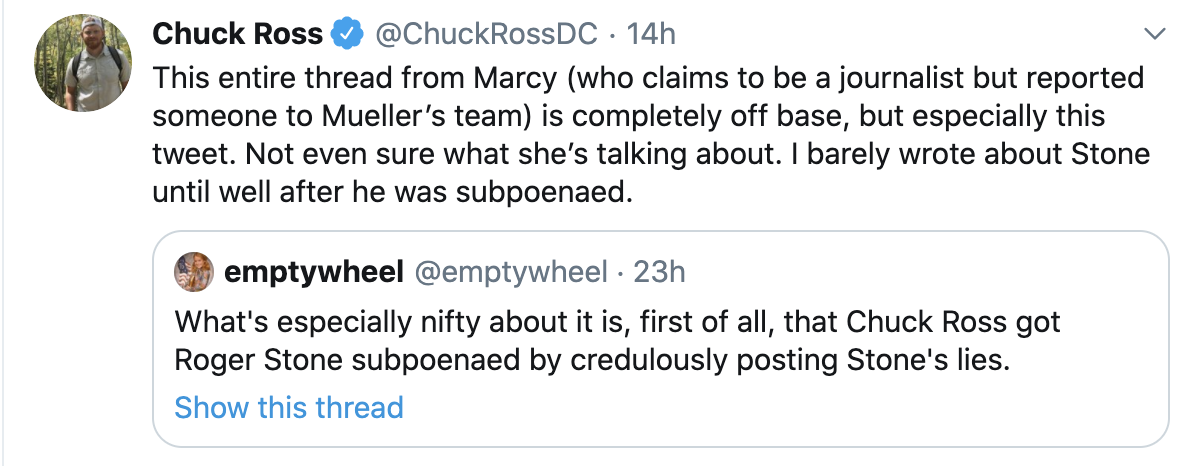
How Chuck Ross Helped Make Roger Stone a Felon

Last night, Chuck Ross all but admitted he doesn’t know what he’s talking about with respect to to the Roger Stone case.

I tweeted several things in response to this Ross coverage of the exposure of Igor Danchenko as Christopher Steele’s primary subsource. Ross got sloppy with a lot of details in his story, including everything in this paragraph:

The special counsel’s report debunked the claim about Cohen, saying that he did not visit Prague. It also said that no Trump associates conspired with Russia or helped release emails through WikiLeaks.

My tweet thread started by noting that Mueller did not say no Trump associates conspired with Russia. It specifically said that when the report said the investigation did not establish something — presumably including any such conspiracy — that didn’t mean there wasn’t any evidence. Indeed, there was evidence they may have, but the investigation was thwarted by the obstruction of Trump, Paul Manafort, Erik Prince, and others, including Roger Stone.

I then noted that both of Ross’ claims about the WikiLeaks finding were overstated (note, Ross also falsely claimed the report said Cohen didn’t go to Prague; Mueller’s congressional testimony did).

As noted, the report states clearly that the investigation was never able to determine whether Stone — who had a slew of suspicious calls in the lead-up to the Podesta email release — had a role in their timely release.

The investigation was unable to resolve whether Stone played a role in WikiLeaks’s release of the stolen Podesta emails on October 7, 2016, the same day a video from years earlier was published of Trump using graphic language about women.

I further noted that when a bunch of Stone-related warrants were released in April, a bunch that focused on a new strand of the investigation, investigating Foreign Agent (18 USC 951) charges on top of the conspiracy one that had long been listed in warrants, remained heavily redacted as part of an ongoing investigation. One of those affidavits made clear that Stone was one of the subjects of the investigation they were hiding that Foreign Agent prong of the investigation from.

It does not appear that Stone is currently aware of the full nature and scope of the ongoing FBI investigation.

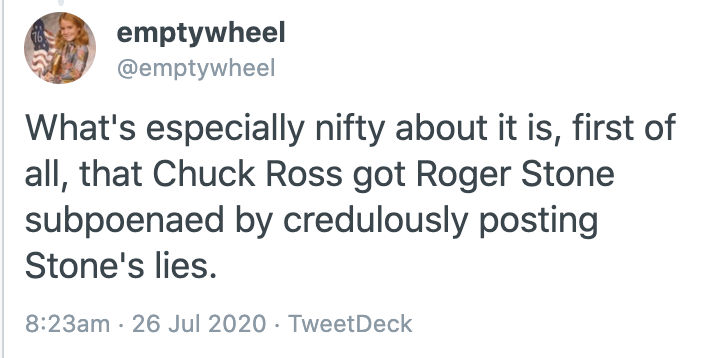
The thing that appears to have really set Ross off, however, was my observation that he got Stone subpoenaed by credulously reporting his lies.

To add to the fun, Ross claimed (after admitting he didn’t know what I was talking about) that he barely wrote about Stone until after he was subpoenaed.

Stone was never subpoenaed by the House Intelligence Committee (that was one reason the government was able to show he obstructed that investigation; by claiming he had no communications to subpoena, he made it more likely he wouldn’t be subpoenaed). He was subpoenaed by the Mueller team.

It’s not clear precisely what date Stone was subpoenaed, but he complied in November 2018. A warrant explaining the subpoena reveals that the government learned Stone had texts involving Randy Credico from media accounts. Later in the affidavit, it specifically cites this story from Chuck Ross. The government used Ross’ attribution to Stone as his source to justify searching Stone’s houses for the old phone.

“Julian Assange has kryptonite on Hillary,” Randy Credico wrote to Stone on Aug. 27, 2016, according to text messages that Stone provided to The Daily Caller News Foundation.

[snip]

Pointing to the text messages, Stone asserts that Credico “lied to the grand jury” if he indeed denied being Stone’s contact to Assange.

“These messages prove that Credico was the source who told me about the significance of the material that Assange announced he had on Hillary. It proves that Randy’s source was a woman lawyer,” Stone told TheDCNF.

Stone, who is the men’s fashion editor for The Daily Caller, had struggled for months to provide evidence to back up his claims about Credico. The former friends had engaged in a he said-he said battle through various media outlets for months.

But Stone finally obtained the text messages, which he says is smoking gun evidence supporting his claims, after his lawyers were able to extract the communications from a cell phone he stopped using in 2016.

It is unclear whether Mueller’s team has also obtained the messages.

It turns out Mueller had obtained some of these texts from Stone’s iCloud and from Randy Credico. But there were a set that Credico no longer had, and so Ross’ credulous reporting of an obviously cherry picked set of texts provided some of the key justification for the subpoena and warrant. An initial version of the government’s exhibit list appears to source a series of texts between Credico and Stone from August and September 2016 to Stone’s return. Those texts included some showing the circumstances of Credico’s August 2016 interview with Julian Assange, which were part of the proof that Credico couldn’t have been the guy Stone was claiming as his go-between in early August 2016.

I’ve noted repeatedly that, by sharing his comms with Credico and Corsi in an attempt to rebut public claims, Stone proved two of the charges against him, that he lied when he claimed he had no such communications (and, indeed, provided proof that he knew of those texts). All that said, given that Trump commuted his sentence and that Ross and other frothers continue to lie about what Mueller found, telling lies to journalists that ended up getting him subpoenaed probably was a good trade-off for Stone.

Unless, of course, there was something more interesting on that phone that Ross’ credulous reporting helped prosecutors get a warrant for.

Share this entry

MMT on International Trade

Posts in this series
The Deficit Myth By Stephanie Kelton: Introduction And Index
Debunking The Deficit Myth
MMT On Inflation
Reflections On The Deficit Myth
The National Debt Is Soooooo Big
The Wonkish Myth Of Crowding Out

Chapter 5 of Stephanie Kelton’s The Deficit Myth takes up international trade. Trump thinks the US is losing at trade simply because we import a lot more than we export. He promised to bring manufacturing jobs back to the US. This won him votes in many states where corporations closed US operations and moved production offshore. But it’s a lot more complicated than just the dollars. I’m only going to address a few of the points Kelton raises.

1. Trade has good and bad results

It’s true that for a number of years the US has run a trade deficit with the rest of the world. We import more than we export. This means we send other people dollars and they send us stuff we want, like oil, computers, cars and cars with computers in them that run on oil. That seems like a good trade.

Many poorer countries do not produce enough food, drugs and advanced equipment to meet their needs. [1] Their currencies are weak, so they need dollars to pay for those shortfalls. Giving them dollars for their goods is a partial fix. Also, it means their workers have jobs and can hope for better lives.

It’s a fact that we have lost a lot of good jobs, those with benefits and middle-class pay, and replaced them with poor jobs. Supposedly we get lower prices as a result, though people buying iPhones might wonder. However, most of the benefits from trade go to the richest among us, corporations and their top executives and the lawyers, accountants, and consultants hired to minimize their costs, taxes, personnel, and unions. [2]

Maybe someday foreign holders of US dollars will want stuff themselves, instead of dollars. They might buy stuff from us. If that means increasing our exports of goods and services, then it seems good. If they buy up our land, buildings and equipment, that might not be so good. If they buy our oil and export it to their countries, we might not like that. Its complicated.

2. What about the money?

This seems to bother Trump a lot. He seems to think sending dollars abroad is bad, even if we get useful stuff in exchange, which sounds stupid when you write it down. One real problem is that money spent abroad doesn’t circulate in the US. Your spending is someone else’s income. If American Airlines buys jets from AirBus, that’s money not spent in the US, and less money for Boeing employees to spend here. The result is lowered economic activity here. Kelton has an answer for this.

Let’s start with the two-bucket accounting system from the previous post. Deficit spending by the Federal Government creates a surplus in the hands of Everybody Else. So, if the FG spends $100 and taxes back $90, then FG has a negative balance of $10. EE has a surplus of $10, which is available to increase demand for goods and services.

Let’s now split the EE bucket into two pieces: US and Other Countries. Now suppose people in the US spend $5 on goat cheese from France, part of OC, and French people spend $3 on US movies. The US surplus drops by $5, and increases by $3, for a loss of $2, leaving $8. Those 2 dollars won’t be available to buy stuff in the US, reducing economic activity.

Trump’s solution to this problem is tariffs on imports from OC. Tariffs are taxes. They put money in the FG bucket, and remove it from the funds available to support domestic demand. Suppose the FG imposes $1 in tariffs on imports. The US bucket drops by $1, to $7. If the problem was reduction of demand, that’s perverse.

The real solution is more deficit spending by the FG on US goods. If the FG spends another $2 buying US goods, those two dollars add to the US surplus, returning it to $10. Problem solved, especially for people who like Crottin de Chavignol. [3]

3. It’s the jobs, not the dollars.

The real problem is not the dollars, but the good jobs that disappeared. Kelton doesn’t say so, but in fact sending jobs overseas is the result of corporate decisions, made solely in search of profits. The federal government does not explicitly support this corporate decision, but its policies do not discourage shipping jobs overseas, and in many ways support offshoring of jobs. For example, modern trade treaties contain provisions designed to protect US businesses in foreign countries, and the government is often willing to use force to protect US assets abroad which can cost the lives of our military people to protect the interests of the rich.

Mainstream economists have always praised trade deals as benefiting Americans, despite the fact that the benefits of trade for the most part flow to the rich while the burdens fall mostly on the poor and the middle class. The middle class is shrinking. Part of that is due to the loss of well-paying jobs. The response of Congress has been worthlesss, mostly job retraining and minimal recompense. [2]

Kelton once again offers the job guarantee as a solution. The proposals for legislation contemplate that all jobs will pay at least $15 per hour with benefits, which will keep people reasonably safe. But these are not an adequate replacement for good middle-class jobs. We need more effort put into solving that problem.

I’ll offer one idea. The pharmaceutical business model is to raise the price of their drugs at least annually, so as to increase profits, and thus the price of the stock. As part of the jobs guarantee, the federal government could build plants to manufacture drugs and compete directly. There would be no problem doing this with generic drugs, but the government could also do it with other drugs bearing extortionate prices, like insulin and coronavirus treatments like Remdesivir. Also see this.

The expertise is out there, and the government can buy it. People can be trained to operate these plants, and make an enormous contribution to their fellow citizens. I see this an an illustration of one of Kelton’s normative policy assumptions: the point of the economy is to make our lives better. This is a political choice. It’s not a choice we should abandon to the rich and powerful.

=====
[Graphic via Grand Rapids Community Media Center under Creative Commons license-Attribution, No Derivatives]

[1]Kelton knows this is a problem. In short, it’s the result of a number of factors, including weak or corrupt governance. The Washington Consensus perpetuates this problem. With better governance and careful attention to some of the ideas in this book, that problem might be slowly corrected. See p.141 et seq.

[2] This entire problem was the result of a consensus among economists on the benefits of trade, a consensus that supported the desires of capitalists and giant corporations. Both liberal and conservative economists and politicians joined the chorus of assent. I discuss the impact of this disaster in four posts you can find here, beginning with The Problem Of The Liberal Elites. TL;dr: liberal elites squandered their influence pushing a bad economic theory. We have no reason to trust their judgment after the damage their advice created.

[3] Alternatively we could try to reduce the trade deficit. Kelton discusses this, but it raises several complicated issues, and I’ll just refer interested readers to pp. 135-6.

Share this entry

Joe Pientka Warned Trump to Be Worried about People on His Periphery While Flynn Was Signing a Deal with Turkey

Donald Trump continues to use the Office of Director of National Intelligence role to declassify information to feed to frothy journalists so they can misrepresent the investigation into his campaign. Yesterday, John Ratcliffe released the FBI part of the classified briefing given to Trump, Chris Christie, and Mike Flynn on August 17, 2016. Among the things Ratcliffe disclosed is the FBI case files for both Crossfire Hurricane and the Flynn investigation, the paltry content of defensive briefings for a Presidential candidate, and that the FBI believed there were more Russian spies working under official cover in 2016 than Chinese spies.

They just don’t give a fuck anymore. They will compromise whatever they need to to try to spin the investigation into Trump, even if most of what they release doesn’t back their story.

The briefing also demonstrates that Trump had no concept of how spies work. He asked a childish question about whether — because they have more spies under official cover — whether they are bad.

Trump asked the following question,”Joe, are the Russians bad because they have more numbers are they worse than the Chinese?” Writer responded by saying both countries are bad. The numbers of IOs present in the U.S. is not an indicator of the severity of the threat. Writer reminded Trump the Chinese asymmetrical presence in the U.S. [redacted]. In addition, the OCONUS cyber threat posed by []PLA would have to be considered when making comparisons.

Having just been briefed that the Russians use official cover while the Chinese use non-official cover, Trump then collapsed that very basic concept to address just diplomatic cover.

The only interesting comment from Trump or Flynn, from an investigative standpoint, was that Trump seemed to suggest that Russia could match the US counterterrorism resources, an inaccurate belief the genesis of which is actually really interesting.

Meanwhile, Flynn asked Joe Pientka something totally off topic — how many FBI Agents they had as compared to counterterrorism cases. Flynn also, later, bragged about having done SIGINT (he seems to have wanted to prove his expertise).

Nothing in this briefing — not even the role of Kevin Clinesmith and Peter Strzok in approving an anodyne report — supports the frenzied response to it, and most commentators are totally misrepresenting what the briefing as a whole was (the first intelligence briefing, as reflected by redacted references to who gave those briefings), and what the nature of the defensive briefing that Pientka gave.

The far more interesting details is that Pientka warned Trump (accurately, as it turned out) about Russia and others trying to get to Trump through peripheral people and businessmen,

In the classical sense, an IO will attempt to recruit an individual to tell him or her the things he or she wants to know. This is known as HUMINT. It is highly unlikely a Foreign Intelligence Service will attempt to recruit you, however you need to be mindful of the people on your periphery: your staff , domestic help, business associates, friends, etc. Those individuals may present more vulnerabilities or be more susceptible to an approach. Those individuals will also be targeted for recruitment due to their access to you. That does not mean IOs will not make a run at you . They will send their IOs in diplomatic cover, businessperson NOCs, as well as sources they have developed around you to elicit information and gain assessment on you.

At the time Pientka gave this briefing, Flynn was finalizing the details of a deal with Turkey, using a businessman the government has credibly accused of being an agent of Turkey to cover up the Turkish government’s direct role in the deal. In his grand jury testimony, Flynn described knowing almost nothing of Ekim Alptekin when he pursued this deal.

So even as the FBI was trying to explain to Trump that people like his coffee boy and his rat-fucker would be used to assess his intentions, the guy sitting in the room was pursuing a big payday with a frenemy government seeking to do just that.

Pientka’s briefing lasted 13 minutes out of a total of at least 1 hour 55 minutes, though it looks like Trump left the briefing before they had presented everything, to catch a plane.

Share this entry

DOJ Claims Some Ongoing Investigation Mueller Report Redactions Pertain to the the Assange Prosecution

DOJ just filed their answers to Judge Reggie Walton’s questions in the EPIC/BuzzFeed FOIA for the Mueller Report. While those are entirely sealed, a new declaration from Vanessa Brinkmann is available, albeit in heavily redacted form.

One thing that’s not redacted, however, is the list of pending prosecutions pertaining to which information remains redacted. One of those is US v. Assange.

Information that is withheld pursuant to (b)(7)(A) and included in Exhibit A pertains to a number of pending law enforcement proceedings, including [US v. Internet] Research Agency LLC (Case No. 1:18-cr-32 (D.D.C.)), United States v. Khusyaynova (Case No. 1:18-mj-464 (E.D. Va.)), United States v. Netyksho (Case No. 1:18-cr-215 (D.D.C.)), United States v. Morenets (Case No. 2:18-cr-00263 (W.D. Pa.)), United States v. Assange (Case No. 1:18-cr-00111-CMH (E.D. Va.)), United States v. Kilimnik (Case No. 1:17-cr-201-3 (D.D.C.)), or ongoing law enforcement investigations conducted by the Department and the FBI.1

The first two of these are prosecutions of Yevgeniy Prigozhin’s trolls, the third and fourth are GRU hackers (the second of those is the WADA hack).

Regarding Assange, it’s possible that this is as simple as a description of how the FBI accessed communications coming into or going out of the Ecuadorian Embassy (one example of this is footnote 262). Or it could mean redacted sections on charging decisions implicate not just Roger Stone, but also Assange. The Stone warrants released earlier this spring described an ongoing 951 (foreign agent)/conspiracy investigation that also necessitated ongoing redactions.

Seven pages of the filing (out of 17) pertain to ongoing investigations, almost all of them entirely redacted.

Share this entry

Task and Countertask: The Interview of Christopher Steele’s Primary Subsource

According to the interview report from Christopher Steele’s Primary Subsource, the PSS confirmed that he had two sources behind the reporting that Carter Page met with Igor Sechin. He said one of those two sources — whom he described having ties to FSB — told him that Russia was sitting on kompromat against Trump (and Hillary). He described that his source for all the Michael Cohen reporting came from an old friend whom he trusted 100%. Steele’s Primary Subsource even took credit for some of the specific phrases in the Steele dossier — such as the one describing Michael Cohen’s efforts to sweep the Carter Page and Paul Manafort scandals “under the carpet.”

Even the Primary Subsource’s interactions with a person he believed to be Sergei Millian tracked most of the report based off the call.

[PSS] recalls that this 10-15 minute conversation included a general discussion about Trump and the Kremlin, that there was “communication” between the parties, and that it was an ongoing relationship. [PSS] recalls that the individual believed to be [Millian] said that there was an “exchange of information” between Trump and the Kremlin, and that there was “nothing bad about it,” Millian said that some of the information exchange could be good for Russian, and some could be damaging to Trump, but deniable. The individual said that the Kremlin might be of help to get Trump elected, but [PSS] did not recall any discussion or mention of Wikileaks.

The passage shows how badly DOJ IG over-read the interview when it first published the report and affirmatively stated that PSS “had no discussion” or “made no mention at all of” WikiLeaks.

On pages xi, 242, 368, and 370, we changed the phrase “had no discussion” to “did not recall any discussion or mention.” On page 242, we also changed the phrase “made no mention at all of” to “did not recall any discussion or mention of.” On page 370, we also changed the word “assertion” to “statement,” and the words “and Person 1 had no discussion at all regarding WikiLeaks directly contradicted” to “did not recall any discussion or mention of WikiLeaks during the telephone call was inconsistent with.” In all instances, this phrase appears in connection with statements that Steele’s Primary Sub-source made to the FBI during a January 2017 interview about information he provided to Steele that appeared in Steele’s election reports. The corrected information appearing in this updated report reflects the accurate characterization of the Primary Sub-source’s account to the FBI that previously appeared, and still appears, on page 191, stating that “[the Primary SubSource] did not recall any discussion or mention of Wiki[L]eaks.”

To be sure, the provenance of that claimed Millian conversation is an utter shitshow — consisting of a call with someone the Primary Subsource believed, but had no way of confirming, was Millian. But Steele’s Primary Subsource did confirm that most of that report tracked the call, whoever it was from.

Still, you wouldn’t know that the Primary Subsource described the multiple sources behind key allegations in the dossier from the way the DOJ IG Report described what was a raw intelligence report. For example, this passage doesn’t reveal that the Primary Subsource heard details on Page’s trip from people with high level connections, including the meeting with Sechin (remember, the FBI had another source report that he had heard rumors about the Sechin meeting, which probably partly explains why Mueller concluded that Page’s whereabouts in Russia were still uncertain).

A second example provided by the Primary Sub-source was Report 134’s description of a meeting allegedly held between Carter Page and Igor Sechin, the President of Rosneft, a Russian energy conglomerate. 337 Report 134 stated that, according to a “close associate” of Sechin, Sechin offered “PAGE/ TRUMP’s associates the brokerage of up to a 19 percent (privatized) stake in Rosneft” in return for the lifting of sanctions against the company. 338 The Primary Sub-source told the FBI that one of his/her subsources furnished information for that part of Report 134 through a text message, but said that the sub-source never stated that Sechin had offered a brokerage interest to Page. 339 We reviewed the texts and did not find any discussion of a bribe, whether as an interest in Rosneft itself or a “brokerage. ” 340

The IG Report also repeats uncritically stuff from both the PSS and his sources that is pretty obviously bullshit, such as the claim from the PSS — who had been paid full time by Orbis for years to collect this intelligence — that he didn’t expect his reporting to show up in written reports.

The Primary Subsource also stated that he/she never expected Steele to put the Primary Subsource’s statements in reports or present them as facts. According to WFO Agent 1, the Primary Sub-source said he/she made it clear to Steele that he/she had no proof to support the statements from his/her sub-sources and that “it was just talk.” WFO Agent 1 said that the Primary Sub-source explained that his/her information came from “word of mouth and hearsay;” “conversation that [he/she] had with friends over beers;” and that some of the information, such as allegations about Trump’s sexual activities, were statements he/she heard made in “jest.”341 The Primary Sub-source also told WFO Agent 1 that he/she believed that the other sub-sources exaggerated their access to information and the relevance of that information to his/her requests.

Or the claim from a subsource who would be the key source of disinformation in the dossier if such disinformation exists that nothing in the dossier was attributable to her.

FBI documents reflect that another of Steele’s sub-sources who reviewed the election reporting told the FBI in August 2017 that whatever information in the Steele reports that was attributable to him/her had been “exaggerated” and that he/she did not recognize anything as originating specifically from him/her. 347

Nor would you know that from the reporting on the interview report of the Primary Subsource, released last night by Lindsey Graham.

Ultimately, the belated assessment of the Supervisory Intel Analyst probably appropriately attributes blame for problems with the dossier to multiple sources; a lot of the problems with this dossier stem from communication breakdowns and exaggerations from multiple people trying to make a buck.

According to the Supervisory Intel Analyst, the cause for the discrepancies between the election reporting and explanations later provided to the FBI by Steele’s Primary Sub-source and sub-sources about the reporting was difficult to discern and could be attributed to a number of factors. These included miscommunications between Steele and the Primary Sub-source, exaggerations or misrepresentations by Steele about the information he obtained, or misrepresentations by the Primary Sub-source and/or sub-sources when questioned by the FBI about the information they conveyed to Steele or the Primary Sub-source.

Let me be very clear: none of this means these allegations are true, nor does this excuse the failures to alert the FISA Court to key problems in the dossier. I was one of the first people to raise doubts about some of the problems with the allegations in the dossier, and I stand by that.

Operational security

What’s more interesting about the interview are the hints of all the ways the dossier could have gone so badly wrong. The interview report describes multiple ways that Russia’s spooks might have found out about the project and fed it with disinformation (the footnotes declassified earlier this year describes that several Russian spooks knew of the project after what would have been the PSS’ first trip to Russia to do the reporting).

Steele’s PSS was an analyst by training that Steele increasingly used in an operational role (including by getting him hired at some kind of consulting company that seems to have served as a kind of cover for his travel to Russia). The arrangement seems to have had spotty operational security. For better and worse, PSS said that he rarely took substantive notes.

[PSS] was asked if he takes notes on the information he is collecting from his sources, or if he keeps any kind of records. He was told by Steele that it is a security risk to take notes; he hasn’t kept notes or electronic records. He occasionally makes scribbles and/or chicken scratch notes here and there, but gives verbal debriefs in [redacted] following his trips [to Russia].

PSS would then share the information with Steele, whom he always briefed alone (making misunderstandings more likely). He had no communications with Steele while in Russia. PSS described that his debriefings with Steele were always at the Orbis office, which meant if Steele himself were surveilled, PSS’ ties to Steele would become obvious.

PSS was originally tasked to investigate Manafort (which he had little success on), at a time when Fusion was still being paid by Paul Singer, meaning this interview seems to confirm, once and for all, that not just Fusion’s reporting, but Steele’s, was initially paid for by a Republican. PSS specified for that reporting he did some of his reporting to Steele via an encrypted app.

But his communications with Steele included many insecure methods. He first met Steele in a Starbucks. Early on, he communicated with him via email and Skype, and Steele would task him, at least in part, via email. He described discussing Page’s trip to Russia with Source 3 on some kind of voice call, possibly a phone, while he was at a public swimming pool, though he also described talking in an opaque way about election interference. Likewise, the most problematic December 13 report was based on a conversation with the same source, which was also a phone call.

In short, while Steele and PSS and PSS’ sources made some efforts to protect their communications from the Russians that surely considered Steele a target, those efforts were inconsistent.

PSS described making three trips to Russia for his election year reporting. On the second trip, he got grilled suspiciously at the border. On his third, “nothing bad happened,” which made PSS suspicious about how perfectly everything had gone.

PSS repeatedly described being uncomfortable with the election year tasking, and he seems to have had suspicions in real time that Russia had taken note of it.

Ties to intelligence

Meanwhile, for all the reports that PSS was “truthful and cooperative,” the interview report describes that he “balked, meandered in the conversation, and did not really answer the question” about whether he used other sources for his election year reporting aside from the six he described to the FBI. And, as laid out in the interview report, it became increasingly clear over the three days of interviews that PSS was not entirely forthcoming about any interactions he had had with Russian intelligence.

This started with his lawyers’ careful caveat at the beginning of the process that PSS did not have any contacts with people he knew to be part of the Russian intelligence services (the interview as a whole was conducted under a proffer).

[PSS] indicated, to his knowledge, he has not had any contacts with the Russian intelligence or security services. [ANALYST NOTE: His attorney emphasized “to his knowledge” during this part of the discussion.]

PSS said he had contact with Russian government officials, but — “as far as he … knew,” not with anyone in SVR, GRU, or FSB.

On day three, however, PSS described a friend (whose experience he drew on for a report on how Russia coerces criminal hackers to work for the intelligence services) who had had been busted for involvement with online pornography and pressured to work with the FSB. The Senior Intel Analyst noted that conflicted with his earlier claim to have no known ties to Russian spooks.

[ANALYST NOTE: This is in contradiction to [PSS’s] statement the first day, at which time he indicated that he did not have any contacts associated with the Russian intelligence and security services.]

Later that same day, PSS seemed to acknowledge that a Russian official and a Russian journalist he interacted with were spooks. The FBI noted,

[ANALYST NOTE: This contradicted [PSS’s] earlier statements regarding having no contact with Russia’s intelligence and security services, and it also contradicted regarding not really knowing if [a Russian official] was actually connected to Russia’s intelligence and security services.]

The EC goes on to describe PSS “brush[ing] aside the idea of being approached by the intelligence and security services” while he was a student.

This squirreliness about his own ties with Russian spooks was probably just self-preservation, an effort to avoid any exposure on 18 USC 951, but it is probably the key issue where the FBI questioned his candor in real time.

Countertasking

Meanwhile, PSS described at least three of his sources — Source 1, Source 2, and Source 3 — in such a way that led the FBI to wonder whether PSS was being tasked by his own sources. S1, for example — who has a close relationship to a Russian intelligence officer (probably FSB) —  always asks PSS to do projects together.

[S1] is always trying to get [PSS] to start projects and make money together — [PSS] related how [S1], like others, is always asking questions like, “Can you get us some projects?” or “Can you get us financing?” or “Let’s do something together dealing with [redacted]!” [PSS] doesn’t consider this as his source “tasking him” but as simply the normal course and scope of networking in these circles. [PSS] did help [S1] with an academic book about [redacted].

And both Source 2 and Source 3 — the sources for some of the more problematic information in the Steele dossier — knew PSS brokered intelligence. Both also discussed brokering information in Russia.

[S3] is one of the individuals who knows that [PSS] works for due diligence and business intelligence. [As an aside at this point, [PSS] insisted that [S2] probably has a better idea about this than does [S3] because [S2] is always trying to monetize his relationship with [PSS]. [PSS] reiterated again to interviewers that [S2] will often pitch money-making ideas or projects — “Let’s work together. I [S2] can try and get [redacted] to answer a question, but I’ll need some money to do it.”] [S3] has an understanding that [PSS] is “connected.” In fact, either [redacted] morning or [redacted] morning, [S3] reached out to [PSS] and asked him for help in [redacted] on how [redacted] living in the United States are viewing the Trump administration. She is asking him [redacted] by the weekend, probably so she can sell it to a friend in Moscow.

And because PSS asked Orbis to help S1 — the guy with close ties to an FSB officer — get a scholarship for language study in the UK, S1 presumably knows what Orbis and who Steele is.

In addition to S1, Source 5 also has ties to Russian intelligence. This showed up in footnote 339, which was partly declassified earlier this year.

This is to be expected, of course. Indeed, the dossier prominently touts the intelligence sourcing of its allegations, as I noted the first day the dossier was published. If the person on whose source network Steele was relying didn’t have ties to spooks, it would be as problematic.

The thing, though, is that it’s certain now that many of the allegations in the dossier are not true or were rumor, particularly virtually all the allegations sourced to Source 3 (the source for all the Michael Cohen reporting), PSS’s childhood friend whom he trusts 100%. That’s true even though generally the reports were sourced to people with at least indirect access to senior level officials.

All the huffing and puffing aside, that should be the takeaway from this. Steele was definitely not collecting this intelligence in optimal fashion, and sharing it with the press made things far worse. But in January 2017, it looked like raw intelligence, of varying quality, which is precisely what it was billed at. Yet, well before any pitches Steele made to the press, it seems some really well-connected people in Russia were feeding Steele’s PSS information that distracted from the real events going on and focused it elsewhere.

Share this entry

Lindsey Graham Provides Yet More Proof that Peter Strzok Didn’t Have It In for Trump

Lindsey Graham just released two more documents that don’t show what [his personally implicated staffer Barbara Ledeen] claims they show.

The more important is the Electronic Communication memorializing FBI’s 3-day interview with Christopher Steele’s primary subsource for the dossier. It’ll take me much of tomorrow to write it up, but suffice it to say that, as an utterly committed Steele skeptic, the EC is actually far more supportive of the dossier than I thought it’d be or than the DOJ IG Report claimed it was. Though it also provides tons of details of how it might have gone haywire, if it did.

More briefly, Lindsey also released an annotation Peter Strzok did (probably as part of his job hunting down leaks) of the February 14, 2017 NYT story alleging Trump’s flunkies had close ties with Russian intelligence.

The annotation shows that Strozk found multiple problems with the NYT story. Strozk’s corrections explain that,

  • None of Trump’s flunkies were known to have ties directly with Russian intelligence but:
    • While Carter Page had extensive ties with SVR, that wasn’t during his time on the campaign
    • At least one of Paul Manafort’s contacts had contact with Russian intelligence
    • Sergey Kislyak had contact with three people — Mike Flynn, Jeff Sessions, and one other person (probably JD Gordon)
  • The FBI didn’t have intercepts on people; while it had given names — that explicitly include Manafort’s Ukrainian colleagues — to CIA and NSA, but did not ask for close scrutiny of them
  • The counterintelligence case in which Manafort was a subject was not opened until 2016, although FBI may have had an earlier kleptocracy investigation earlier
  • In February 2017, the FBI did not have an investigation into Roger Stone
  • While Christopher Steele might have credibility, he didn’t have much insight into the reliability of his subsources

Strzok also inadvertently revealed (by debunking claims in the story) that by February 2017, the FBI had sent out call log and credit report NSLs on Manafort, Page, and Flynn, but hadn’t gotten many of those back, and had not gotten detailed banking records. The investigation was barely begun in February 2017.

To be fair, these details were largely known, though the specificity about the NSLs is not only welcome, but unprecedented and unnecessary.

Ultimately, though, this is yet another piece of evidence — like Strzok’s observations that Flynn didn’t betray he was lying and his judgment that the Russian investigation would amount to little — that Strzok didn’t have it in for Trump or his flunkies, but instead assessed the case in real time.

Nevertheless, Strzok remains the big villain in this story.

Update: I inadvertently left off the Steele judgment above.

Update: Strzok’s Steele judgment actually shows up in the DOJ IG Report on Carter Page.

Following the January interview with the Primary Sub-source, on February 15, 2017, Strzok forwarded by email to Priestap and others a news article referencing the Steele election reporting; Strzok commented that “recent interviews and investigation, however, reveal [Steele] may not be in a position to judge the reliability of his sub-source network.”

The IG did not, however, note that this is one of several moments where Strzok clearly expressed skepticism, no matter his views about Trump, nor did it describe the other critiques he made.

Share this entry

“Hinky:” NPR Permitted Billy Barr to Lie More than Once

The other day, NPR’s public editor did a piece exploring how the NPR allowed itself to spread Billy Barr’s lies about vote by mail uncontested. It reviews the exchange, noting where Steve Inskeep did not ask obvious follow-ups.

Inskeep had 20 minutes to do the Barr interview, which was conducted at the Justice Department. In the portion of the interview on election security, Inskeep sounds, to my ear, off his game. His follow-up questions don’t reflect the facts that NPR had already reported, and are therefore ineffective at holding Barr accountable for his statements.

The transcript is available here. When Barr conflates the broad issue of foreign interference with the specific claim of ballot tampering, Inskeep does not call him out.

[snip]

When Barr compares the ballots to paper money, to suggest they can be easily duplicated, Inskeep asks: “Do they not also go through procedures like that with mail-in ballots?” Barr answers: “You’ve seen them. They’re pretty primitive.”

A journalist specializing in election security would have pressed Barr more firmly, by asking again whether intelligence of ballot tampering exists, and getting him to explain exactly how he imagines outsiders would attempt to circumvent the numerous safeguards in place, including barcodes, enumerated ballots, duplicating the specific paper stock and printing methods and signature verifications. Suggested question: How would a ballot counterfeiting scheme work at scale, to get around the well-established and tested controls, including the individual codes on each ballot and the signature comparisons?

It talks about the decision to include Barr’s lies (about vote-by-mail) rather than take more time and edit them out.

Inskeep worked with a show editor and producer to prepare the package. Together, they chose to air the bulk of Barr’s claims rather than truncate the statements to air only those not widely disputed as false. He could have decided to delay the air date of that particular segment in order to do more reporting and bring additional voices into the conversation, an internal or external expert to say that Barr is making a false statement.

Running an extensive portion of the exchange could only be a good option if Inskeep was willing to add more context, as you are about to see below.

And it described how NPR could have made it far clearer that Billy Barr lied to NPR.

There are many techniques to prepare listeners to hear false information. You can straight-up tell the audience the upcoming statements are inaccurate — while also explaining that part of our job is to sometimes allow public officials to make such statements so that the listener can hear it for herself. Stewart said he was grateful Inskeep got Barr on tape falsely claiming mail-in ballots will jeopardize the election. “This looks like pure, unadulterated Barr,” he said. “And I’m really glad the country got to hear that.”

I wish Inskeep would have spent a little air time making clear in the set-up that state election officials use several well-tested methods to ensure the integrity and security of mail-in ballots, and that transparency of those checks and balances is baked into the system.

Given that Barr primarily does interview with old friends from the Poppy Administration or propaganda outlet, I’m grateful that NPR reviewed this interview and laid out how Barr has successfully, relentlessly lied to the American people.

But they should have gone one step further, and noted all the other times Barr lied to Inskeep. And even before he lied about vote-by-mail, he falsely claimed that his interventions in both the Mike Flynn and Roger Stone case was proper. In the Stone case, for example, he explained his intervention in the sentencing recommendation because there was a dispute.

I was the decision maker in that case because there was a dispute. And usually what happens is, disputes, especially in high profile cases, come up to the attorney general.

To the extent there was a dispute, it was only because he had removed the Senate confirmed US Attorney and put in someone he told to dispute the sentencing guidelines. NPR also let Barr claim that his recommendation is what Amy Berman Jackson adopted, which is not at all true (she adopted most of the prosecutors’ guidelines sentence but gave Stone a lenient sentence on her own).

Worse still, NPR let Barr claim as fact that there was a lot hinky with Flynn’s case.

There was a lot of hinky stuff in the Flynn case. Everyone knew that. Everyone was wondering why was this case ever brought?

That’s not only false, but both DOJ Inspector General and Judge Emmet Sullivan had reviewed it and found nothing “hinky.” Effectively, Barr put in a flunkie to override the judgement of those people who are supposed to assess whether something is hinky.

Importantly, only people who haven’t consulted the public record believe that — which is why it is so dangerous for NPR to let the claim go unchallenged. So here, as with the vote-by-mail, Inskeep simply gave Barr the opportunity to provide false excuses for unprecedented abuse of power.

And the public editor should note that.

Share this entry