Trump’s First Amendment Defense of Mobilizing His Violent Mob

There’s a move in Trump’s motion for a stay pending appeal of the gag order Judge Tanya Chutkan imposed that deserves more attention.

Trump appealed the gag last Tuesday and requested the stay on Thursday, about which Judge Chutkan ordered additional briefing that same day; we’ll see more briefing about this all week.

MINUTE ORDER as to DONALD J. TRUMP: Upon consideration of Defendant’s opposed 110 Motion for Stay Pending Appeal, Request for Temporary Administrative Stay, and Memorandum in Support, it is hereby ORDERED that the court’s 105 Opinion and Order is administratively STAYED to permit the parties’ briefing and the court’s consideration of Defendant’s Motion. It is FURTHER ORDERED that the government shall file any opposition to Defendant’s Motion by October 25, 2023, and that Defendant shall file any Reply by October 28, 2023.

A substantial portion of the 33-page motion speaks for the First Amendment rights of his mob to hear, respond to, and amplify Trump’s speech. To defend this principle, Trump cites, among other things, the Missouri v. Biden that SCOTUS just agreed to review over the objections of Sam Alito, Clarence Thomas, and Neil Gorsuch.

Under the First Amendment, violating the rights of a speaker inflicts an equal and reciprocal constitutional injury on the listener. “Freedom of speech presupposes a willing speaker. But where a speaker exists, . . . the protection afforded is to the communication, to its source and to its recipients both.” Virginia State Bd. of Pharmacy v. Virginia Citizens Consumer Council, Inc., 425 U.S. 748, 756 (1976) (emphasis added) (collecting many cases); see also, e.g., Red Lion Broadcasting Co. v. F.C.C., 395 U.S. 367, 390 (1969) (“It is the right of the viewers and listeners, not the right of the broadcasters, which is paramount.”); Packingham v. North Carolina, 582 U.S. 98, 104 (2017) (recognizing the right to “speak and listen, and then … speak and listen once more,” as a “fundamental principle of the First Amendment”); Missouri v. Biden, — F.4th –, No. 23- 30445, 2023 WL 6425697, at *11 (5th Cir. Oct. 3, 2023) (holding that the “right to listen is ‘reciprocal’ to the … right to speak” and “constitutes an independent basis” for relief). Thus, injuring President Trump’s ability to speak injures the First Amendment rights of over 100 million Americans who listen to him, respond to him, and amplify his message.

The claim to have 100 million listeners is a bit like calling his NY penthouse 33,000 square feet, insofar as it relies on overlapping numbers, including the 87 million followers he has but does not tweet to on Xitter.

Trump necessarily dedicates a very long footnote to explaining how he has standing to appeal this gag on behalf of his mob.

3 President Trump unquestionably has third-party standing to defend the rights of his audiences in this context. The Supreme Court is “quite forgiving” of third-party standing requirements “[w]ithin the context of the First Amendment.” Kowalski v. Tesmer, 543 U.S. 125, 130 (2004). The First Amendment’s overbreadth doctrine, for example, relieves the third-party plaintiff of the burden to show the usual “close relationship” and “hindrance” required by the third-party standing doctrine, id.; instead, Article III injury is all that is required. See id.; United States v. Sineneng-Smith, 140 S. Ct. 1575, 1586 (2020) (Thomas, J., concurring) (“Litigants raising overbreadth challenges rarely satisfy either requirement [‘close relationship’ and ‘hindrance’], but the Court nevertheless allows third-party standing.”) (citing Dombroski v. Pfister, 380 U.S. 479, 487 (1965)); N.J. Bankers Ass’n v. Att’y Gen., 49 F.4th 849, 860 (3d Cir. 2022) (noting that “the requirement that an impediment exist to the third party asserting his . . . own rights” does not apply when the challenged government action “substantially abridges the First Amendment rights of other parties not before the court”). Further, as the Supreme Court held in Bantam Books Inc. v. Sullivan, it is particularly important to allow third-party standing to vindicate First Amendment interests because “freedoms of expression … are vulnerable to gravely damaging yet barely visible encroachments” and must be protected by “the most rigorous procedural safeguards.” 372 U.S. 58, 66 (1963); see also id. at 64 n.6 (upholding the third-party standing of book publishers to assert the rights of distributors because “[t]he distributor … is not likely to sustain sufficient economic injury to induce him to seek judicial vindication of his rights,” whereas the seller has a “greater . . . stake” in vindicating those rights). In addition, the doctrine of third-party standing applies “when enforcement of the challenged restriction against the litigant would result indirectly in the violation of third parties’ rights.” Kowalski, 543 U.S. at 130. Here, the interference and restriction of President Trump’s First Amendment rights “would result indirectly in the violation of third parties’ rights,” id.—i.e., the rights of his audiences to receive, respond to, and amplify his speech.

I think this footnote is suspect, legally and practically. I mean, the notion that Stephen Miller’s NGO for fascism couldn’t vindicate these rights is nonsense. But it is nevertheless telling.

Trump makes that argument even while complaining that Judge Chutkan had to rely on the potential actions of others — that very same mob riled up by the amplified false victimization of Trump — to justify the gag itself.

Unable to justify the Gag Order based on President Trump’s actions, the prosecution pivots to third parties, alleging that unnamed others, outside of President Trump’s control, acted improperly before this case began. Such concerns cannot justify the Gag Order. The Supreme Court has repeatedly explained that citizens of this country cannot be censored based on a fear of what others might do. Brandenburg v. Ohio, 395 U.S. 444, 447 (1969) (“[T]he constitutional guarantees of free speech and free press do not permit a State to forbid or proscribe advocacy . . . except where such advocacy is directed to inciting or producing imminent lawless action and is likely to incite or produce such action.”).

[snip]

In entering the Gag Order, the Court relied heavily on the anticipated reactions of unidentified, independent third parties to President Trump’s speech. The Court found that “when Defendant has publicly attacked individuals, including on matters related to this case, those individuals are consequently threatened and harassed.” Id. at 2. But the Court cited no evidence that President Trump’s statements—as distinct from the statements of millions of others—caused such alleged threats or harassment, let alone that the statements were directed to inciting imminent lawless action.

Remember, Trump has repeatedly denied that the indictment accuses him of mobilizing the mob against Congress. Even after DOJ disabused Trump of that fantasy, he is playing coy about the fact that the crime he is alleged to have committed significantly involves riling up a mob to use as a weapon.

Indeed, Trump admits this is the plan to get elected: to rile up the mob again, this time by using this prosecution as a trigger.

The prosecution filed the indictment in this matter on August 1, 2023. Doc. 1. As this case is pending, President Trump continues to campaign for President, and one of his core messages is that the prosecutions against him are part of an unconstitutional strategy to attack and silence the Biden Administration’s chief political rival. To advance this message, President Trump has made many public statements criticizing individuals he believes are wrongly prosecuting him, including President Biden, Attorney General Garland, and Special Prosecutor Jack Smith and his team. This viewpoint—that the prosecution is politically motivated—is one shared by countless Americans.

[snip]

President Trump’s speech in support of his re-election campaign—which is inextricably intertwined with this prosecution and his defense—lies “at the core of our electoral process of the First Amendment freedoms—an area . . . where protection of robust discussion is at its zenith.” Meyer v. Grant, 486 U.S. 414, 425 (1988) (citations and quotations omitted); see also Buckley v. Am. Const. Law Found., Inc., 525 U.S. 182, 186–87 (1999); McIntyre v. Ohio Elec. Comm’n, 514 U.S. 334, 347 (1995) (“[C]ore political speech” encompasses any “advocacy of a politically controversial viewpoint.” “No form of speech is entitled to greater constitutional protection than” core political speech.).

Some of this is just cynicism: by claiming all this is political speech, Trump does base his appeal on the most expansive First Amendment precedent. The legal arguments here, some of them, anyway, are not frivolous.

But he’s not wrong about his campaign strategy. The key to Trump’s political success since he was sworn in was to polarize the electorate based off false claims that any investigation of Trump’s crimes is an attack on him and his mob.

And at one point, Trump’s argument admits that this is all an argument about democracy.

The Gag Order’s carve-outs exacerbate the vagueness problems by imposing new layers of confusion upon the Order. Doc. 105, at 3. The carve-outs seem to authorize “criticizing the government generally, including the current administration or the Department of Justice,” but that does not seem to include criticizing the most relevant figure of the Department of Justice, i.e., Jack Smith. Id. The carve-outs supposedly allow President Trump to state “that his prosecution is politically motivated,” but the Gag Order prevents him from “targeting” the specific actors involved in his prosecution, so it prevents him from giving any specific or detailed justification for this claim. Id. Where claiming that the prosecution is politically motivated ends, and “targeting” the prosecutors against President Trump begins, is anyone’s guess. The carve-outs apparently authorize “statements criticizing the platforms or policies of . . . former Vice President Pence,” id., but the “platforms or policies” of candidates like Pence (and Biden) are deeply intertwined with their views on election integrity, with specific reference to the 2020 election. When does criticism of Mike Pence’s “platforms or policies” become a statement “that target[s] . . . the substance of [his] testimony,” id., when questions about the integrity of the 2020 election are “central” to the 2024 Presidential campaign?

Joe Biden (comments about whom this gag does not restrict) is running on democracy. Mike Pence is running on defending the Constitution.

Trump is running on a promise that none of that matters: no election outcome — not that of 2020, not that of 2024 — should be respected, unless he wins.

And the way to ensure that happens, Trump knows, is to guard the right of his mob to amplify and respond to his false claims of victimization.

Share this entry

As the GOP House Burns, James Comer Keeps Sniffing Dick Pics

As of yesterday, the House had gone for 17 days without a Speaker. Patrick McHenry, McCarthy’s temporary replacement, says he no authority to do anything but schedule yet more futile votes (and, apparently, evict Nancy Pelosi and Steny Hoyer).

The government has less than four weeks of funding.

It’s not clear anything set up by McCarthy before his deposition should be proceeding.

But all the while — this entire time that House Republicans have been struggling to fulfil the most basic function of government — James Comer and his staffers have been hunched in a dark room somewhere, feverishly pursuing the same delusions of dick pics and … personal loans!! … they’ve been frothing over since January.

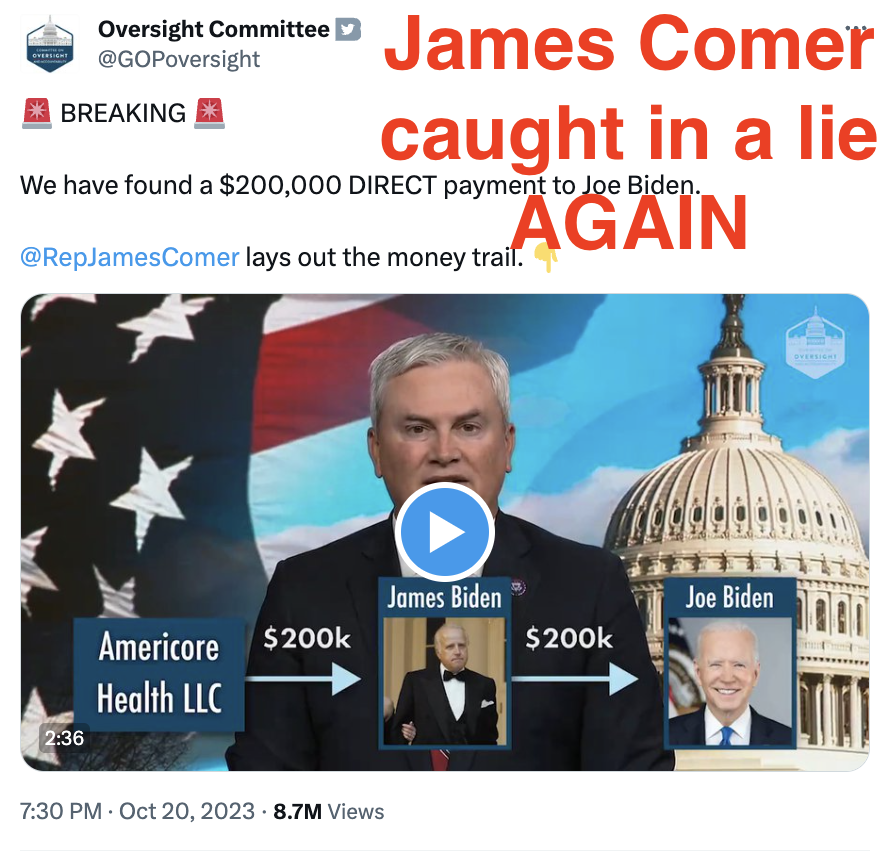
And so it was on Friday afternoon, after Jim Jordan’s third humiliating defeat in the House, that Comer ran out, like a child discovering a dead frog in a gutter, waving a check.

It was a check that James Biden — the President’s brother — used to pay off a personal loan on March 1, 2018, over a year after Joe Biden left the Naval Observatory, years before Joe Biden entered the White House, and six weeks after his brother gave him that loan.

As Democrats explained minutes after James Comer ran out waving his dead frog, after 3 million people had already poked around at Jamey’s dead frog, Joe Biden loaned his brother $200,000 six weeks earlier.

James Biden paid it off.

As of this moment, 8 million people have excited themselves with Comer’s transparent bullshit about that check, all the while Comer and Jim Jordan and Kevin McCarthy and Steve Scalise have proven themselves impotent to do the most basic things Nancy Pelosi did — in heels and backward — to keep the House running for years.

While millions of fragile-minded dupes glee over a check between brothers, Republicans haven’t managed to keep the House open or fund the Government.

Some guy from Kentucky fiddling while the House burns.

In the weeks since Comer got his stash of (as Democrats described) another 1,400 records payments for, “life insurance policies, doctor visits, holiday and birthday presents, groceries, vet visits and pet care, and plumbing repairs” and Matt Gaetz deposed the Speaker, the Trump Organization fraud trial in NYC has shown:

  • Eric Trump claimed he “pour[ed] concrete” rather than dealt with the appraiser who described that he had “lofty ideas” about valuation
  • Trump’s retired CFO and co-defendant Allen Weisselberg,
    • Professed to be unable to answer 90 questions
    • Claimed his $2 million severance had nothing to do with his criminal tax penalty, to say nothing of his forgetfulness
    • Was accused, by Forbes, of lying on the stand about his involvement in Trump’s three-times inflation of his penthouses square footage
  • Weisselberg’s son Jack was involved in key loans pertaining to Trump Tower and another NYC property
  • Mazars complained that Trump Organization, “were not getting us all the documents” they needed to do their work

Every one of these is a scandal worth a congressional hearing. Every one of these should raise questions about whether the guy engaging in so much adjudged fraud while claiming it didn’t matter because he could just find some “buyer from Saudi Arabia” to make him good should be anywhere in politics, much less in the White house.

But instead, James Comer is waving his dripping dead frog around — a personal check for a personal loan between brothers — like he just found a $2 billion bribe from Saudi Arabia.

This is … fucking insane.

Republicans can’t keep their own caucus together. They may not be able to keep government open.

And all the while, James Comer is there writhing around about about easily debunked conspiracy theories about a personal loan.

Share this entry

The Holding Pattern on the Non-Trump January 6 Charges

There were two reports yesterday that relate to something I’ve been thinking about: The likelihood that most, if not all, of any more Trump-related January 6 charges will be delayed, at least until after his trial next year.

The first is a WaPo report that Jack Smith’s office withdrew a subpoena for records and testimony relating to Save America PAC — the fundraising Trump did off of false claims about voter fraud, which he has since used to pay lawyers and other things unrelated to the claims he made in raising the money.

The withdrawal of the subpoena earlier this month indicates Smith is scaling back at least part of his inquiry into the political fundraising work that fed and benefited from unfounded claims that the election was stolen, said the people, who spoke on the condition of anonymity to discuss an ongoing criminal investigation.

Save America was still working to gather all of the records sought in the subpoena when it was notified by Smith’s office that the demand for information had been withdrawn, two of the people familiar with the matter said.

[snip]

Broadly, the subpoenas and related interviews by Smith’s investigators sought information about the post-election, pro-Trump fundraising, and what people inside Save America and other groups knew about the veracity of the claims they were making to raise money, the people familiar with the matter said.

[snip]

While interviewing potential witnesses associated with Trump, Smith’s prosecutors have asked pointed questions about who is paying for their lawyers and why, people familiar with the questions have said. Trump advisers have said the Save America PAC, which raises most of its money through small-dollar contributions by Trump supporters across the country, is footing the legal bills for almost anyone drawn into the Trump investigations who requests help from the former president and his advisers.

[snip]

Four people with knowledge of the investigation said prosecutors had not asked questions about fundraising in recent months, after several subpoenas and witness interviews on that topic earlier in 2023.

Relatedly, while Jack Smith’s team had raised Stan Woodward’s payment arrangement when they first raised his conflicts with Chief Judge James Boasberg in June, it has not come up in the conflict review before Judge Cannon in Florida (the follow-up hearing to which is scheduled for Friday).

It’s certainly possible that something about the stage of the election has led DOJ to back off this focus. It’s equally possible DOJ has reviewed the advice given by Trump’s campaign finance lawyers, Jones Day, in 2020 and decided that advice of counsel would make charges unsustainable.

Then there’s this fascinating Bloomberg discussion, featuring abundant quotes from Zach Terwilliger, the son of George Terwilliger, Mark Meadows’ lawyer, about frustration among defense attorneys in the case regarding Smith’s uncertain instructions regarding whether witnesses are just that — witnesses — or also subjects of the investigation.

Three defense lawyers representing people sought for voluntary interviews say they’re frustrated that special counsel Jack Smith’s team insists on labeling their clients subjects without providing additional detail as to where they fit in the case or whether they could become a target. They’ve asked to remain anonymous to discuss sensitive matters.

Justice Department guidance doesn’t define what a witness is and prosecutors prefer the flexibility of the broad subject label, which covers anyone within the scope of a grand jury investigation.

Yet Smith’s search for corroborating witnesses aimed at proving the 2020 election case against the former president pressures prosecutors to incentivize people to talk, but without exposing themselves to counterattacks from defense lawyers and Trump supporters. How they navigate that balancing act could help shape the legal fate of Trump and his allies.

“It is an exercise in understandable murkiness. And it’s more complicated here,” said Jim Walden, a former federal prosecutor who’s now a criminal defense attorney. “Anyone in the Trump administration has at least potential liability if they helped him form strategy about his election loss.”

By sticking strictly to the subject designation, Smith’s team retains the ability to charge individuals who appear innocent but later turn out to have liability, while protecting itself from accusations they baited people into talking. At the same time, they’d risk undercutting their mission of expediting the Trump trial, as defense lawyers insist on negotiating drawn-out immunity deals before an interview. [my emphasis]

While the Bloomberg piece referes to a “mission of expediting the Trump trial,” neither of these articles mentions something that, to me at least, seems obvious: Whether or not a jury convicts Trump next spring, if Trump wins the presidential election, none of this may matter. The criminal exposure of Trump’s associates won’t matter, because any that remained loyal would just be pardoned, as Paul Manafort and Roger Stone and Mike Flynn and George Papadopoulos and Steve Bannon were pardoned during Trump’s first term.

While I could imagine DOJ charging a handful of people who linked the crime scene to Trump before the election, most everything else would simply expose parts of the investigation that would otherwise be better kept quiet.

Which adds yet another reason why we can’t expect to understand the steps Jack Smith may still be taking: because on top of all the other reasons prosecuting a former and potentially future President is unprecedented, the likelihood that he would just pardon himself out of any further mess is part of it.

No one seems to care anymore: but there are a good many Trump associates — not just his unindicted co-conspirators — who bear some responsibility for what happened on January 6, 2021. But DOJ may have decided it makes not sense to prosecute any of them until there’s certainty, at the very least, about Trump’s fate.

Share this entry

Gary Shapley’s “Red Line” Tantrum Actually Started Two Weeks Earlier

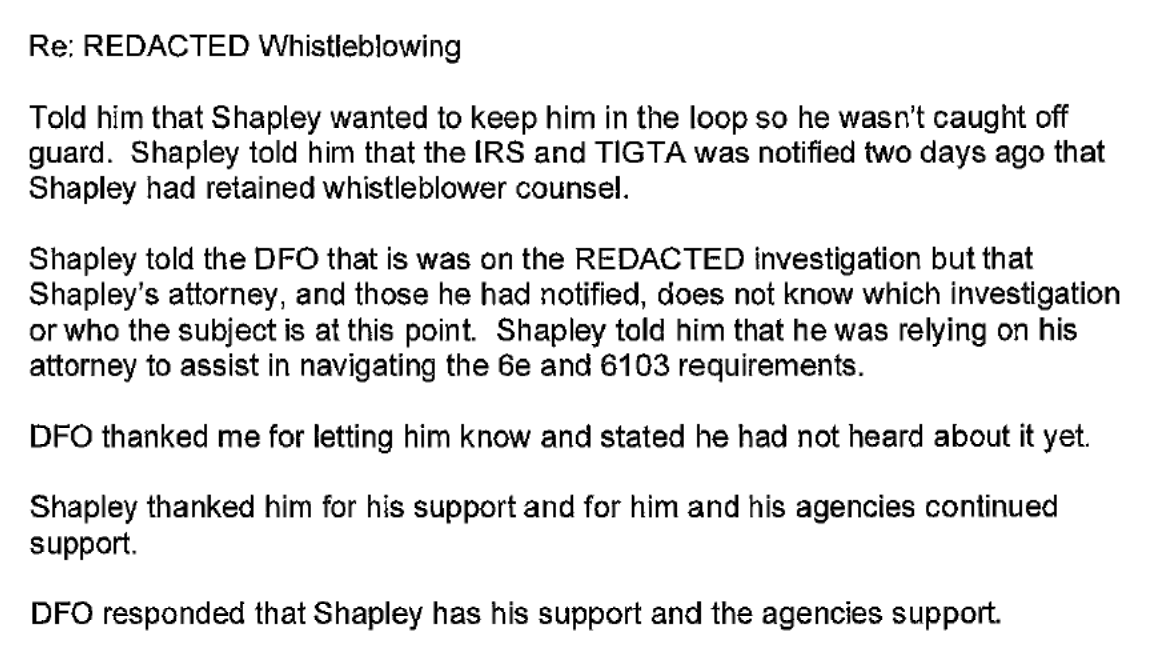
Days before an October 7, 2022 meeting at which, Gary Shapley has claimed for months, his “red line” was crossed, the thing he has used to excuse months of leaking as “whistleblowing,” he scripted the things — including a demand for a Special Counsel to make the decision that David Weiss announced having made in the meeting — that Shapley claimed to record in real time at the meeting.

Indeed, the documents House Ways and Means released last month purporting to support their complaints about the Hunter Biden prosecution show that Shapley’s tantrum had been going on for weeks and had started in significant part because the charges he was demanding wouldn’t be rolled out in advance of the 2022 election.

It has already been established that no other attendee at the October 7, 2022 meeting has backed Gary Shapley’s version of that meeting. No other attendee remembered David Weiss conveying that he didn’t have the authority to make this charging decision regarding Hunter Biden on his own. Most attendees have charitably explained that Shapley didn’t understand what he was hearing, particularly with regards to Special Attorney versus Special Counsel status. In his testimony to the House Judiciary Committee, Matthew Graves attributed Shapley’s claims to, “the garble that can happen when you layer hearsay on top of hearsay on top of hearsay. And when you look at a lot of this, it’s someone said that someone said that someone said.”

Even just Shapley’s own notes undermine his claim. As I have noted, between his hand-written contemporaneous notes and his emailed memorialization, Shapley reordered how things happened at the meeting, moving the reasons Weiss gave on October 7 for why he wouldn’t charge 2014 and 2015 — the charges against Hunter Biden that would have to be charged in DC — after Shapley’s own claim that David Weiss didn’t have the authority to make that prosecutorial decision.

Per his contemporaneous notes, the first thing discussed after the discussion about the leak was Weiss’ rationale for not charging 2014 and 2015, the two more substantive years that would have to be charged in DC. Once you’ve explained that, then whether or not Weiss got Special Attorney status for DC is significantly moot (2016 was only ever treated as a misdemeanor).

In his email to his boss, though, Shapley moved that discussion to after his argument, covering the DC charges, the LA charges, and the involvement of DOJ Tax Attorney, that Weiss didn’t have authority to charge. If Weiss had already explained his prosecutorial decision about the most problematic Burisma years — something Shapley’s hand-written notes record him has having done — then none of the other complaints about these years (that Weiss or Lesley Wolf let the Statutes of Limitation expire, that Weiss didn’t get Special Attorney authority in DC) matter. Shapely reorders his notes to hide the fact that the DC decision didn’t matter.

Shapley’s hand-written notes record Weiss sharing a prosecutorial decision — not to charge the 2014 and 2015 tax years. By making a decision not to charge in DC, Weiss was exercising the prosecutorial authority Shapley claimed Weiss said he didn’t have. Once you describe Weiss making a prosecutorial decision, then any claim that he didn’t have prosecutorial authority crumbles.

It crumbles even more given a few other details.

Shapley’s retroactive memorialization of the October 7, 2022 expresses great fury over Weiss’ decision not to charge the 2014 and 2015 years, as well as the delay of charges until after the election.

But Shapley learned of this weeks and even months earlier. 

On July 29, for example, Joseph Ziegler asked Lesley Wolf about timing. Per Shapley’s own memorialization, she said Weiss was aiming to indict before the end of September, but Wolf herself expressed doubt that would happen. That comment on timing, coupled with her stated disinclination to toll the 2014 tax year, was a pretty solid indication that she was disinclined to charge 2014.

Zeigler

Any dates or goals?

Wolf

David has indicated that the end of September would be his goal to charge. The is reflective of keeping everything on track. They do not want to get any closer to a mid-term. If doesn’t happen by end of September it would have to wait until November after the elections. She stated she does not think that is likely to by charged by September.

Sol on 2014 blows on November 8, 2022.

X Factor on timing will include any delay defense counsel has requested and that they would be amenable to toll statutes. She is not leaning toward tolling again…but it is possible.

Current plan is that the prosecution recommendation will be collaborative with DOJ Tax and USAO.

[snip]

They will communicate any decisions on specific tax years and decision to charge or not charge to the prosecution team in advance of any final document. [my emphasis]

On August 16, the IRS investigators had a meeting with David Weiss, one that Wolf happily arranged on August 8. Because Wolf and other DOJ personnel could’t attend, that would be a second meeting the IRS had with David Weiss alone.

On August 11, DOJ Tax tried to set up a meeting for the following day, an invitation which Ziegler accepted; Shapley was not invited. There’s no memorialization of this meeting, at which DOJ Tax probably explained why it viewed the 2014/2015 tax years as weaker charges.

On August 15, in advance of the meeting with Weiss, Shapley reminded  Darrell Waldon and Michael Batdorf about the forthcoming meeting with Weiss. Only Michael Batdorf, the second-level supervisor who testified that Shapley had a habit of, “a tendency to go to level like grade 7 five-alarm fire on everything,” responded. Shapley’s August 17 memorialization of the August 16 meeting, shared with those supervisors again, showed that Weiss was “leaning” towards only charging the CA charges, 2017 to 2019. Shapley recorded Weiss aiming to charge by the end of September, but said himself it’d be “October/November” (even though, in July, Wolf had said that if it wasn’t charged by September, it would be after November).

Here’s what Shapley said about 2014 and 2015 in that email:

We again pushed back on not charging 2014/2015. DOJ Tax continues the position that the defenses (load/taxes paid by another person on half the income) would make it too complex for the jury. I believe their position is unsupportable–both considering precedent and evidence. I made it clear that not only do we disagree with that position but that we could provide countless prosecution recommendations that included diverted income to nominees and various loan claims to support our position. The USA agrees with us but then talks to DOJ Tax and they convince him otherwise. This has happened a couple times. As a result, we will continue to communicate our position to ensure this moves forward consistent with how other tax cases would be treated with similar fact patterns.

I explained that 2014 is not charged how it would severely diminish of the overall conduct and would essentially sanitize some major issues to include the Burisma/Ukraine unreported income. I also explained that if 2014 is not charged and/or included in a statement of facts in a guilty plea, that the unreported income from Burisma that year would go untaxed. I believe leaving out 2014/2015 would deliver a message that is contrary to IRS’s efforts to promote voluntary compliance. [my emphasis]

Some of this is about getting taxes paid — the explanation Shapley would repeat in his memorialization of the October 7 meeting. But some of it is about tying Hunter’s tax crimes to Burisma.

Once again, Batdorf was the only who responded. He said he would escalate Shapley’s concerns still further, so the Chief and Deputy Chief of IRS could “at least show full support for the 2014/2015 years.” In Waldon’s testimony, he expressed being surprised at the October 7 meeting, because “I was not fully aware of a decision regarding some of the investigative years,” (49) a view that may stem from Shapley’s efforts in August to reverse this decision.

On August 18, Mark Daly from DOJ tax sent the investigative team (but not Shapley) an email that seems consistent with presenting to grand juries in both Delaware and Los Angeles in September — but not DC, once again consistent with a decision not to charge 2014 and 2015. Of note: this email was saved on June 27 of this year, before Ziegler and Shapley testified to the Oversight Committee on July 19 and Ziegler offered to go back to find more materials. Ziegler appears to have already taken steps to share information that he feigned was just a response to Congressional inquiries.

Shapley appears to have memorialized an August 25 email from Lesley Wolf asking a newly added FBI agent, along with Ziegler and Mark Daly, not to use email to coordinate between meetings. Shapley wasn’t a recipient of this particular email. It’s an example of the double set of books Shapley confessed to in his original deposition.

On September 20, 2022, over a week before the interview of James Biden (Hunter’s uncle and sometime business partner and Joe’s brother) and the day after Martin Estrada was confirmed as US Attorney for Los Angeles, Shapley emailed Weiss, cc’ing no one else, asking for a call in the following two days. The next day, September 21 at 1:23PM, Weiss said he would set up a meeting “in the near term,” including IRS and FBI, to provide an update. This email thread, which Shapley would pick up over a month later, would become the one where Shapley’s paranoia about Weiss cutting off communication with Shapley first expressed. As we’ll see, this Shapley request to Weiss was also the ultimate genesis of the October 7 meeting.

Just over two hours after Weiss promised an update shortly on September 21, Shawn Weede, Weiss’ Criminal Chief, wrote to set up the meeting Weiss had promised, proposing the meeting for September 28 (still one day before the interview of James Biden). Shapley responded 22 minutes later, noting that he would be in the Netherlands on the day of the proposed meeting, but would be willing to call in.

The next day, at 11:15AM, Weede wrote back to say a “sanitized” meeting was unworkable, and so proposed the meeting for the week of October 3, after Shapley got back.

Also on September 22, Shapley memorialized a meeting that started at 2:30PM noting that Lesley Wolf and DOJ Tax’s Mark Daly joined the meeting late, but without documenting anyone else who attended. The memorialization was closely focused on briefings of Estrada’s office on the case (though Shapley refers to Estrada as “her”). It also clearly records DOJ tax still conducting their review, as well as a decision not to charge either the gun charge and/or anything else until after the election — precisely the eventuality that Wolf had warned would happen almost two months earlier.

Gun charge will likely not be indicted in October.

[snip]

USAO and DOJ Tax made the decision not to charge until after the election. They said why should they shoot themselves in the foot by charging before.

Within an hour after the start of the call, Shapley was going ballistic about precisely that eventuality. Starting at 3:34PM, Shapley alerted Batdorf — but not his immediate supervisor, Waldon,

Big news on Sportsman. Joe Ziegler and I need to speak with you as soon as possible.

In a follow-up, Shapley explained that the “bad news” he had was precisely what he had been warned about in July, that the charges would be delayed until after the election.

Bad news. Continued inappropriate decisions affecting timing. i.e. Election. We can talk later if you are busy….I believe their actions are simply wrong and this is a huge risk to us right now.

Note: There was no risk to the IRS of delay after the election. It would mean the 2014 charges would toll (unless Hunter’s lawyers agreed to waive tolling, as they had before), but that’s another thing Shapley was warned about. A significant part of Shapley’s tantrum seems to stem from a personalized concern that charges would not come out before the election.

Batdorf ended the exchange by instructing, “Please ensure your ASAC and SAC are updated as well.”

Shapley did that, but not until almost two hours later, in a 5:28PM email to Darrell Waldon (his ASAC), Lola Watson (his SAC), and Michael Batdorf. Without noting that he had already bypassed chain of command, Shapley complained,

During todays SM call there was some information provided to the team concerning decisions made by the USAO and DOJ that need to be discussed. For example, the AUSA stated that they made a decision not to charge until after the election. In itself, the statement is inappropriate let alone the actual action of delaying as a result of the election. There are other items that should also be discussed that are equally inappropriate.

None of those other items “that should be discussed” were obviously reflected in his memorialization of that call.

At least on paper, this tantrum, made two weeks before a pre-election leak to the WaPo, was about something he had been warned of in July, not news at all, but one tied — explicitly in his mind — to the election, not timing per se.

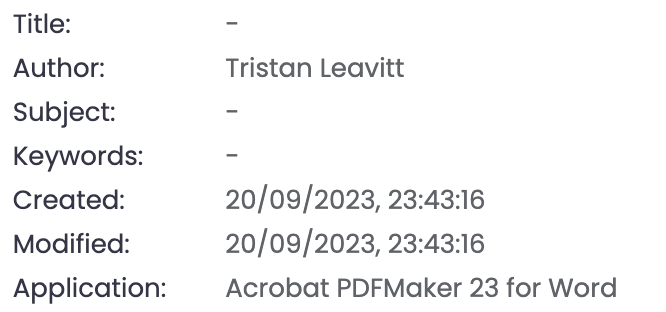
Side note: Unlike Ziegler’s, many of the documents Shapley shared are stripped of all metadata. Not this email, though. This email — which he shared twice (Attachment 5, Attachment 24) — both reflect a creation date of September 20 (this is European notation), over eight hours apart, with the second reflecting Tristan Leavitt as document author.

That would mean these documents were saved after Darrell Waldon (September 8) and Michael Batdorf (September 12) testified. There’s good reason to believe these documents were chosen with some knowledge of the IRS supervisors’ testimony.

To make it plain: For months, Gary Shapley claimed that his red line was crossed on October 7, 2022. But the emails he himself turned over show that’s not true. His red line was crossed on September 22, 2022, and the red line had a lot to do with making charges public in advance of the election.

Importantly, that means his red line was crossed before the leak to the WaPo, not afterwards.

The day after Shapley’s tantrum started — which no one at DE USAO or FBI would have known about — the FBI ASAC seconded the plan to wait until Shapley returned before holding the meeting that would become the October 7 one, noting that then Weiss could be present.

Meanwhile, on September 28, Waldon emailed Ziegler and all the other people Shapley had involved in his tantrum, noting that he was trying to arrange a meeting with Weiss and Poole. Ziegler responded to everyone, on the morning of September 29, promising any update from prosecutors in CA. Waldon responded asking Ziegler to call him. And Ziegler responded, suggesting they should do a pitch on the 2014 and 2015 years to DC prosecutors: “we also need to request the presentation of 2014 and 2015 to the criminal chief / US attorney in DC – similar to what we would do in California for 2017 2018 and 2019.” Again: Waldon seems to have been surprised when, at the October 7 meeting, Weiss announced that the decision had been made.

That was at 11:11AM on September 29. At 2:25PM, Ziegler went into the interview with James Biden, Hunter’s uncle. Lesley Wolf and two other prosecutors who, like Ziegler, would not be at the October 7 meeting, also participated in the interview. The interview focused largely on the 2017 to 2019 years (though also asked questions that might reflect a campaign finance investigation into Kevin Morris), but which Ziegler now points to as critical testimony supporting his argument for felony charges in 2018. Shapley was already a week into a tantrum about charges not being filed before the election before this interview.

Seven minutes after the James Biden interviewed finished — based on public records, at least, the last major investigative step in the investigation, Weede proposed and the ASAC confirmed a meeting for October 7 at 11AM. The FBI ASAC confirmed as well. Then the next day, a Friday, the ASAC followed up to confirm once again, management and investigators would be present. She followed up again at end of day Monday, October 3, confirming she and her boss, Thomas Sobocinski would attend. Weede confirmed. The ASAC touched base once again on Tuesday morning.

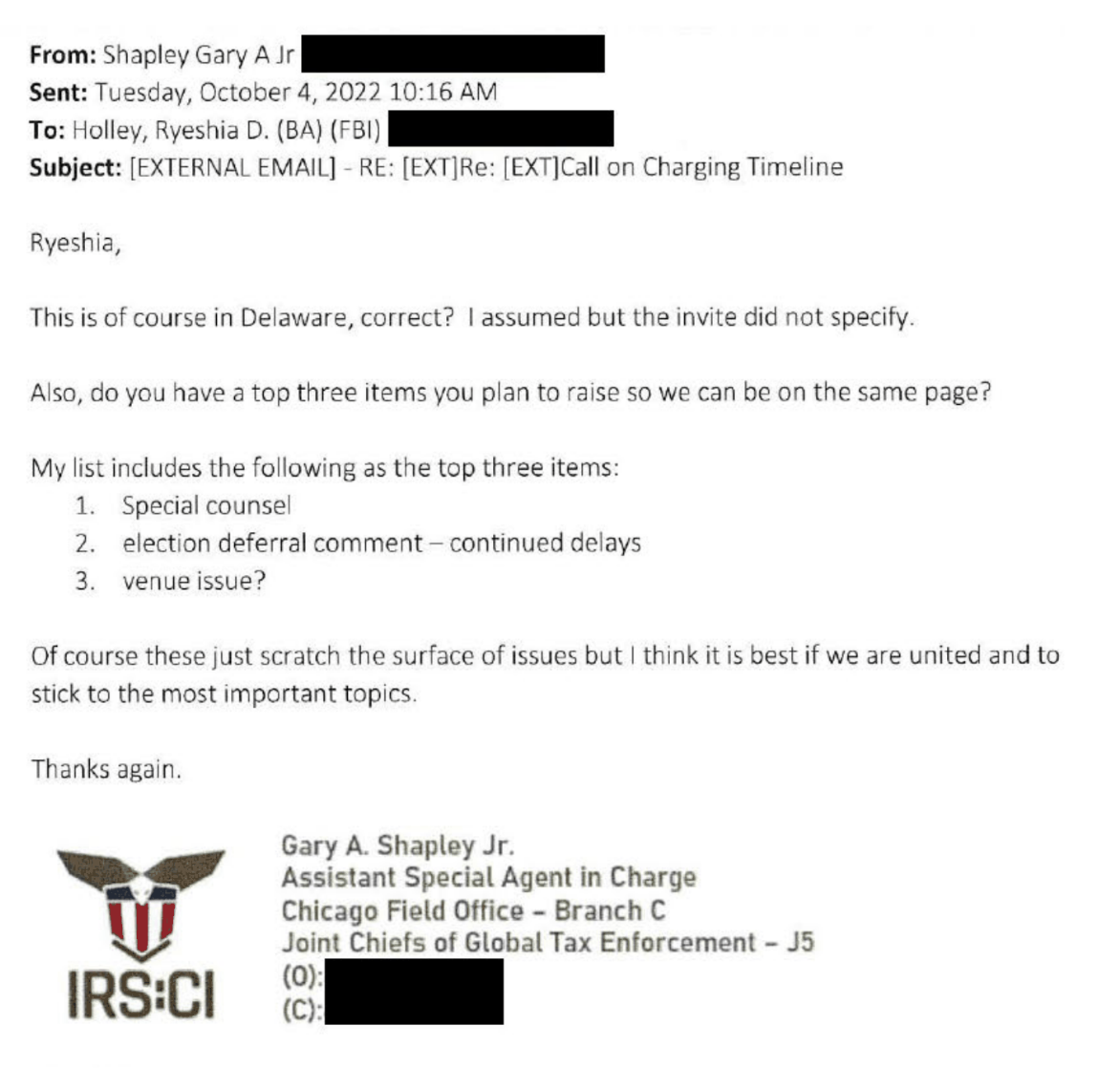
Only at that point, on October 4 — with no record in the thread that Shapley had told his own boss, Waldon, that this meeting was in the works, did he respond to the ASAC alone, asking for her top three items “so we can be on the same page.”

His own list might was effectively a first draft of the things he would record as having happened in notes and a memorialization email days later: Special Counsel, the delay until after the election, and venue.

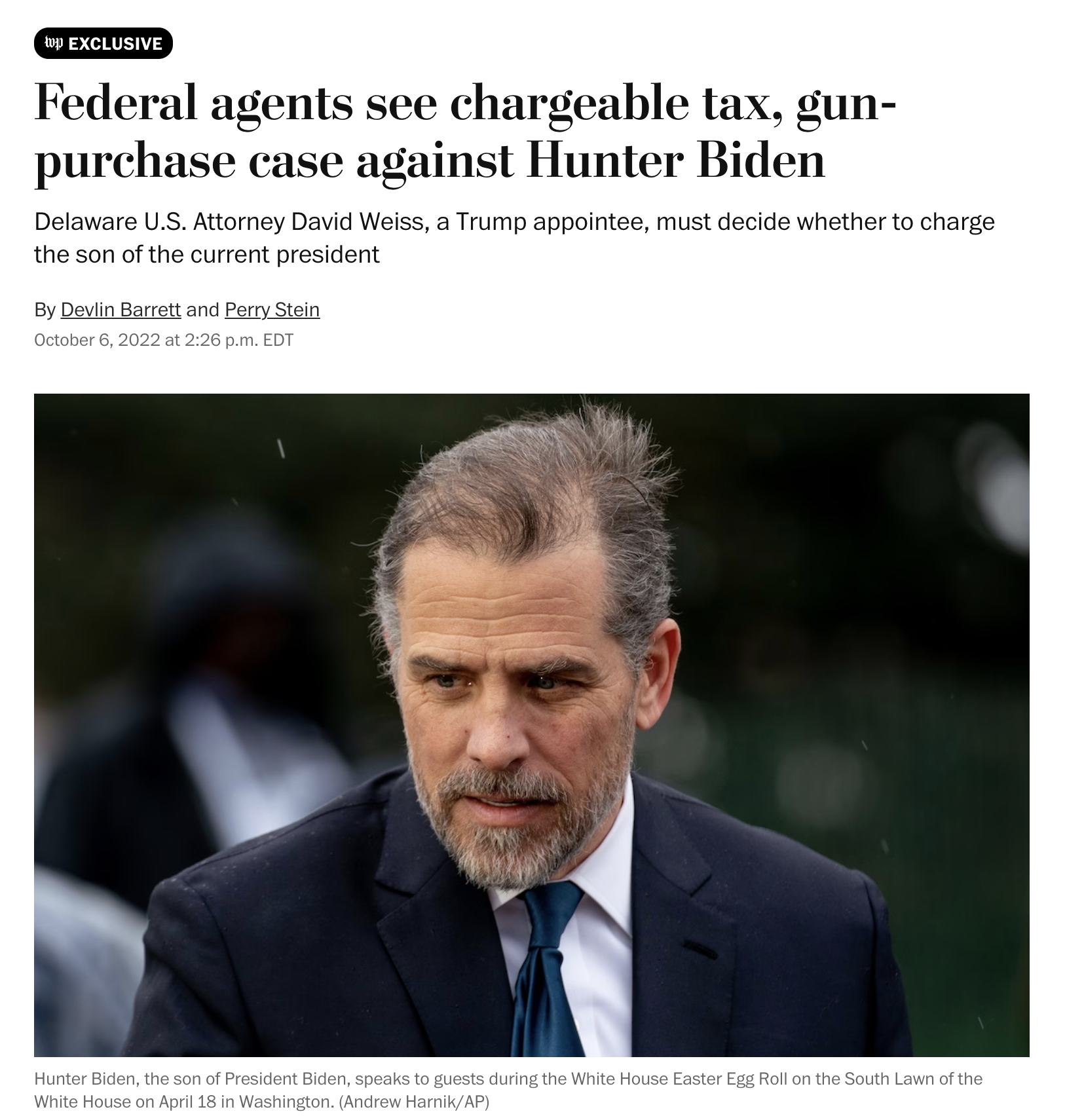
At 2:26PM, WaPo posted the story that preempted prosecutors’ decision to wait until after the election before charging — the decision Shapley first learned of in July but staged a tantrum about more recently.

At 4:34, the ASAC responded, asking if Shapley’s ASAC (Waldon) would attend, and describing her own agenda as:

  • Delays
  • Venue
  • Communication
  • Anything further that develops by tomorrow

Of course: that “anything further that develops” had already developed: the story in the WaPo.

Shapley responded a minute later, saying, he had just tried to call her, but that yes, both Shapley and his SAC would attend.

Nine minutes after that exchange occurred with no mention of the WaPo story, Shapley informed his bosses about it.

Just an FYI that there was a media leak today purportedly from the “agent” level on Sportsman. I imagine it will be a topic of discussion at tomorrows meeting in Delaware. I spoke with Justin Cole about this to provide anything he may need.

I have no additional insight that is anything but a rumor.

Federal agents see chargeable tax, gun-purchase case against Hunter Biden – Espotting.com

Just keeping you informed.

[Link to original WaPo story, but note that Shapley shared an Espotting link]

As I’ve noted, Shapley’s reference to rumors is inconsistent with his past statements about the leak.

As all that was going on, the other DE AUSA besides Wolf, Carly Hudson, wrote Ziegler at 10:07AM on October 6, asking him what he was supposed to remind her about — something he heard immediately after the James Biden interview on September 29.

David asked me to remind him what you [s]aid “regarding the call you received from management after the James Biden meeting.”  I’m not 100% sure what he means.  Would you mind reminding me about that call so I can remind him?

Ziegler didn’t respond until 6:51PM, well after the WaPo had published the story. Ziegler explained that IRS management had been informed that DOJ Tax didn’t anticipate charging until 2023; they weren’t done with the approval process.

They heard from DOJ-Tax that they don’t expect the case to be indicted until 2023 as they still have various levels of approval. I think this is what you are asking about.

There’s no documentary record of it, but it would be inconceivable that Ziegler hadn’t shared this with Shapley when he heard it, on September 29. Which is to say that Shapley knew there were reasons — beyond the fact that James Biden wasn’t interviewed until September 29 and beyond the election — why Hunter wasn’t going to be charged until after the election.

Nevertheless, going into a meeting he would much later pitch as his “red line,” a meeting that ended up significantly focused on a pre-election leak promising charges, Shapley would claim the election was what was causing the delay.

Share this entry

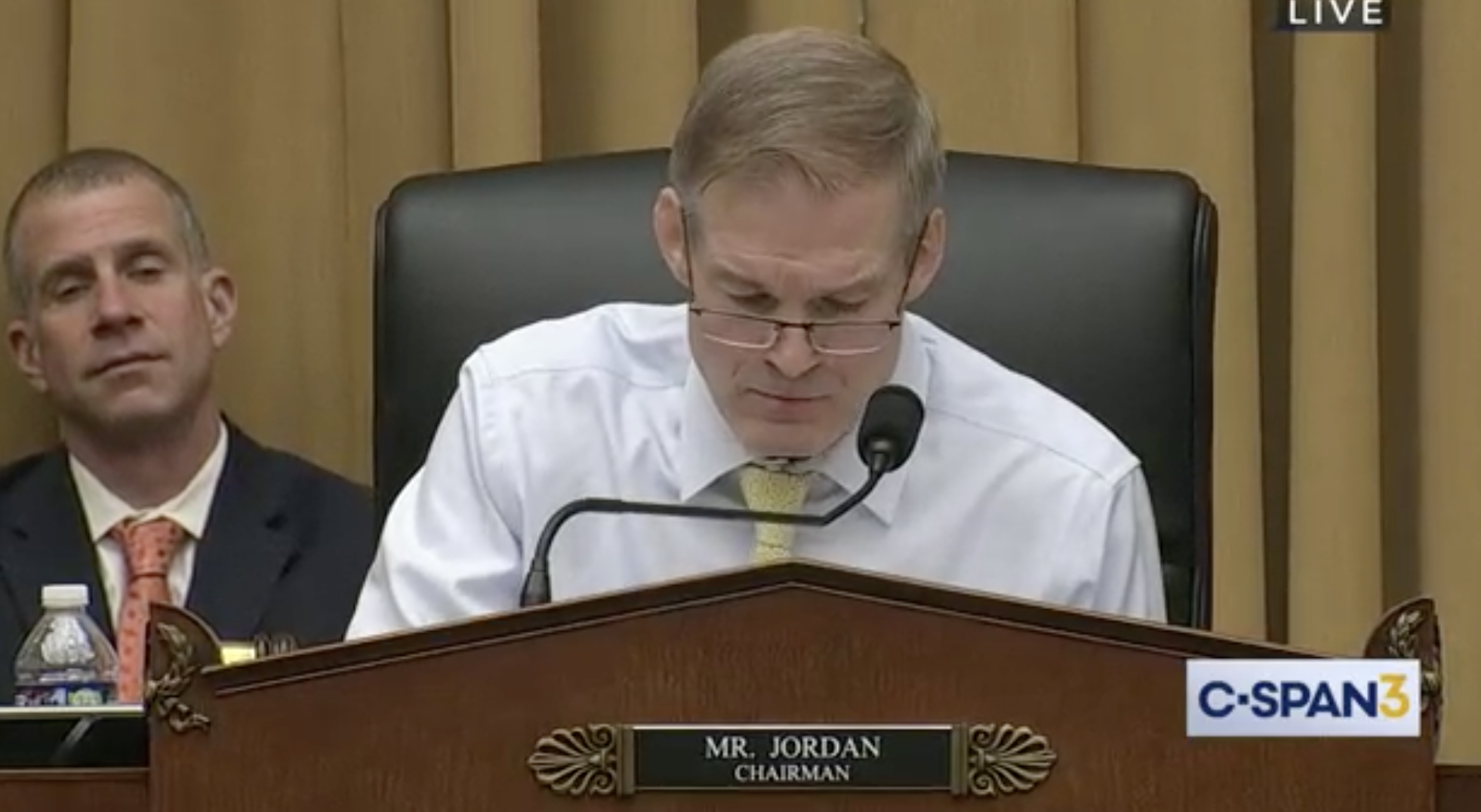
“JIM IS COMING FOR YOU:” Aspiring Speaker Jordan’s Stochastic Lynching as Oversight

[GRAPHIC CONTENT WARNING]

Because the way Capitol Hill beats work, the prospect of a vote that could put Jim Jordan second in line to the Presidency has focused on horserace.

To be sure, given the narrow margins and the historic incapability of Republican men to count votes, the horserace will be determinative. For example, to succeed, Jordan would not only have to win the support of most of the 55 people who voted against him last week in a secret ballot where he had no challenger, but if only 205 Republicans vote — as reportedly happened in that poll — then Hakeem Jeffries would be elected Speaker with the 212 Democrats expected to show up and vote for him.

But almost no reporting has focused on how catastrophic a Jordan Speakership would be — the earliest death knells of democracy that the election of Trump, which a Jordan Speakership would primarily serve, would guarantee.

What reporting there has been has focused on Jordan’s role, 30 months ago, in Trump’s attempted coup, which the January 6 Committee summarized this way:

Representative Jordan was a significant player in President Trump’s efforts. He participated in numerous post-election meetings in which senior White House officials, Rudolph Giuliani, and others, discussed strategies for challenging the election, chief among them claims that the election had been tainted by fraud. On January 2, 2021, Representative Jordan led a conference call in which he, President Trump, and other Members of Congress discussed strategies for delaying the January 6th joint session. During that call, the group also discussed issuing social media posts encouraging President Trump’s supporters to “march to the Capitol” on the 6th.661 An hour and a half later, President Trump and Representative Jordan spoke by phone for 18 minutes.662 The day before January 6th, Representative Jordan texted Mark Meadows, passing along advice that Vice President Pence should “call out all the electoral votes that he believes are unconstitutional as no electoral votes at all.” 663 He spoke with President Trump by phone at least twice on January 6th, though he has provided inconsistent public statements about how many times they spoke and what they discussed.664 He also received five calls from Rudolph Giuliani that evening, and the two connected at least twice, at 7:33 p.m. and 7:49 p.m.665 During that time, Giuliani has testified, he was attempting to reach Members of Congress after the joint session resumed to encourage them to continue objecting to Joe Biden’s electoral votes.666 And, in the days followingJanuary 6th, Representative Jordan spoke with White House staff about the prospect of Presidential pardons for Members of Congress.667

To be sure, in his role in the attack, Jordan exhibited utter contempt for democracy.

But what has gotten less attention is the degree to which Jordan has used his position chairing the Judiciary Committee and Weaponization Committee to serve the longer slow-moving attack on democracy.

A Jordan Speakership would undoubtedly escalate Jordan’s assault on rule of law generally and any prosecution of Donald Trump specifically. It would likely directly (by platforming Russian disinformation) and indirectly (by undermining further US aid) help Russia’s invasion of Ukraine.

Both would make it more likely Trump would win the 2024 election.

Indeed, that’s a telling aspect of Matt Gaetz’ comments when he first announced his (ultimately successful) attempt to depose Kevin McCarthy. Gaetz repeatedly complained that the House hadn’t yet subpoenaed Hunter Biden, and demanded that Republicans use “the power of the purse” to,

zero out the salaries of the bureaucrats who have broken bad, targeted President Trump, or cut sweetheart deals for Hunter Biden.

[snip]

Joe Biden deserves impeachment for converting the Vice Presidency into an ATM machine for virtually his entire family.

At least for Gaetz (who might well be rewarded with a gavel in a key committee, were Jordan to succeed), this is about shutting down investigations into Trump and fabricating investigations into Biden from the fumes of five year old dick pics.

There’s a specific aspect of Jordan’s actions, however, that deserves more attention in advance of tomorrow’s scheduled public vote: The degree to which Jordan has used the power of his gavel to engage in the same kind of stochastic terrorism that Trump uses to enforce his will.

I’ve already noted how the Gary Shapley media tour (in which Jordan cooperated with James Comer and Jason Smith) ended up getting the team of investigators, including ones still pursuing indictments of Hunter Biden, targeted. As Thomas Sobocinski — who continues to oversee FBI agents investigating Hunter Biden — explained in testimony in early September, the family members of his own team have been followed and AUSA Lesley Wolf has faced specific threats.

[T]his is affecting my employees. I now have FBI employees that names are out there. I have FBI employees and former FBI retired agents who’ve served for 20plus years whose parents are getting phone calls, whose photos with their girlfriends, who their children who are being followed. That is not something that we were prepared for, and I was concerned about having that continue or expand to other one of my employees.

[snip]

[W]ithout going into specifics, my office and the FBI have done things and initiated things to ensure that [Lesley Wolf] remains safe.

Again, some of these people are currently trying to indict Hunter Biden, and they’re getting swarmed by a mob teed up by Republican efforts.

In the recent Matthew Graves testimony, Graves repeatedly refused to name the members of his team because he knew the transcript would be made public, resulting in threats against prosecutors, on top of the ones DC prosecutors have already faced.

What I can tell you is, I’ve unfortunately had way too many instances of documents getting into the public domain that have our prosecutors’ names in them and me receiving what we call urgent reports about security concerns because of threatening or harassing behavior that they’re receiving … and that we’ve had to take steps for a number of people in our office to mitigate the risk.

Nevertheless, Jordan persisted, to his very last question to include those names in this transcript (I assume he’ll send out letters under their names, as he has with others involved in these investigations).

In the Tim Thibault interview, in which it became clear over time that Republicans had ruined the career and reputation of the guy who had led investigations into two Democratic members of Congress and single-handedly opened an investigation, in 2016, into the Clinton Foundation off of Clinton Cash based off the unsubstantiated claims of others trying to get payback, Thibault described not just how he was targeted — for which he accepted a good deal of the blame on account of his social media posts — but how others were impugned by association.

[T]hose two agents that worked on the Tony Bobulinski EC, I’m aware that they received significant backlash for only doing their job. Why? Because of my social media conduct and Mr. Bobulinski thinking I was a bad agent, that put them in a bad spotlight. Those are the guys that are the victims, the true victims. And no one came and spoke on their behalf. Right? They — they’re just line agents doing their darn job.

As one Democratic staffer noted, though none of 18 sources for such claims to Jordan’s committees have offered any corroboration for the claims, Jordan and his staffers nevertheless continued to push the claims to the media. “[T]he public push or allegations that were being sort of repeated by this committee never stopped.” Jordan is cultivating rumors about the FBI and other agencies to foster retaliation campaigns in the media.

His actions with Fani Willis are perhaps most telling. Jordan first started tampering in Willis’ investigation in August, though — perhaps having learned his lesson when he similarly tampered in Alvin Bragg’s case — he has chosen to send letters rather than subpoenas.

As is the norm for Jordan, his claims are based on conspiracy theories from biased sources. His most recent letter for example, dated to September 27, sources his claim that “there are credible reports” that Willis coordinated with Jack Smith to two articles, one ten months old.

Finally, there are credible reports that your investigation and indictment was coordinated with the Department of Justice and Special Counsel Jack Smith. 30

30 Josh Gerstein, Prosecutor in Trump documents case has history pursuing prominent politicians, POLITICO (June 13, 2023); Jerry Dunleavy, Trump special counsel Jack Smith was involved in Lois Lerner IRS scandal, WASHINGTON EXAMINER (Nov. 25, 2022). [links added]

Not even the propaganda outlet, Washington Examiner, supports Jordan’s claim. Neither of those stories even mention either Willis or Georgia.

Notably, Jordan doesn’t note that in his September 12 interview — an interview conducted just over two weeks before he sent this letter — Thibault denied interacting with Willis’ team four times: “No, ma’am. … Never. … Never. … No, ma’am.” Jordan doesn’t note that this particular conspiracy theory — which, even if true, would be squarely within the expectation that state and federal law enforcement can cooperate and share information — has not been substantiated by a guy who would have had firsthand visibility (though, because of the delay in predicating an investigation against the fake electors, only on the earliest parts of the DC investigation; Jordan did not, publicly at least, ask Steve D’Antuono this question during his June interview).

A far more important detail from these letters is in Willis’ first reply, dated September 7 (which she resent as part of her recent response). After laying out constitutional reasons why Jordan shouldn’t get involved and referring him, as a non-member of the bar, to where he could information on Georgia’s RICO law, she provides ways that the House Judiciary Committee could more usefully spend their time, such as on funding for victim-witness advocates.

She then notes that Jordan should show more concern about the safety of people involved in the criminal justice system — precisely the kind of people that Jordan has instead sown threats against.

As it seems you have a personal interest in the Fulton County District Attorney’s Office, you should consider directing the USDOJ to investigate the racist threats that have come to my staff and me because of this investigation. For your information, I am attaching ten examples of threats this office has received. See Exhibits F through O. I am providing these examples to give you a window into what has happened to my staff and me as I keep the promise of my oath to the United States and Georgia Constitutions and do not allow myself to be bullied and threatened by Members of Congress, local elected officials, or others who believe lady justice should not be blind and that America has different laws for different citizens.

As noted, she included a number of the threats she and her office have received. We always hear about such threats, but only get to see what they include if they get charged.

The dripping racism of many of these threats is breathtaking.

Of particular interest are the two threats sent on the same day that Jordan first targeted Willis, on August 24, especially the one that echoes things Jordan included in his letter — such as the paragraph in which Jordan argues Willis should have charged this in 2021 and since she didn’t was obviously just trying to impact the election. Even more notably, this threat appears to invoke Jordan’s campaign against Willis explicitly.

To the Biggest liar of A DA ever, WE ARE COMING FOR YOU FANI….. YOU TOUCH ANYONE ATTACHED TO TRUMP AND WE WILL BURN YOUR CITY TO THE GROUND WITH YOU IN IT. YOU ARE GOING TO GET REMOVED FROM OFFICE. IF THIS WAS REALLY A CRIME YOU WOULDVE DONE IT IN 2021. YOU ARE FAKE AS HELL. A DEMOCRATS PUPPET. YOU ARE ONLY DOING THIS TO KEEP HIM FROM RUNNING FOR PRESIDENT. WELL WE ARE GOING TO FUCK YOU U P. DON’T GO OUT AT NIGHT YOU BLACK BITCH, WE ARE GOING TO SEPARATE YOU FROM YOUR CAR & DRIVER. JIM IS COMING FOR YOU. HALLELUJAH!!!!, BUT HE’S ONLY GOING TO FIND A BODY …. [bold mine, all caps and other punctuation original]

This is, quite simply, the language of the lynch mob.

And if the taunt, “Jim is coming for you,” is, indeed, indication that the person who sent this threat had read Jordan’s earlier letter to Willis, it means it took just hours for Jordan’s threats, posing as oversight, to translate into violent racist threats against Willis, her daughter (in the other threat sent that day), and the entire city of Atlanta.

This is not new. Jordan has been sowing threats against Donald Trump’s enemies for years, since the focus on Peter Strzok and Lisa Page.

But even in his current position, Jordan is using his gavel as a means to tee up threats based on conspiracy theories, threats designed to make every single imagined opponent of Donald Trump worry about their careers, their safety, their life.

This week, Jordan will and already has been mobilizing similar mobs against his fellow Republican members of Congress in order to pursue even more power, an even bigger gavel.

Which is why all the stochastic threats Jordan has already mobilized deserve more attention.

Share this entry

Five Years Ago Today, Hunter Biden Bought a Gun

Yesterday, Judge Maryanne Noreika dismissed the gun-related Information against Hunter Biden, signed by Baltimore AUSA Leo Wise, that was filed on June 20, an Information tied to a diversion agreement that Leo Wise also signed.

At the arraignment on Hunter’s new charges — three charges replaced one — Magistrate Judge Christopher Burke reminded the Special Counsel’s team (Derek Hines had the speaking role at the arraignment, not Leo Wise) about the Information still on the docket.

Mr. Hines, one question on my end. The Indictment now obviously has been filed on the docket and that still has the prior felony information that was filed with regard to the prior gun charge back at the point where it was thought that there might be a plea. Did the Government intend to dismiss that charge?

MR. HINES: Yes, consistent with local practice, we intend to file a written motion within the next day.

THE COURT: Okay. And that will go to Judge Noreika and she will review that.

It took Leo Wise two tries — he forgot to sign the first motion to dismiss — but Weiss’ team did indeed move to dismiss the Information, and the docket identified the motion to dismiss that Noreika granted as the amended one, the one Leo Wise actually signed.

And so it was that on the last day off the fifth year after Hunter Biden purchased a gun, Judge Noreika dismissed one charge against him for doing so. Weiss’ team moved to dismiss the Information without prejudice to refiling it. But as of today, the statutes of limitation begin to expire on both that Information — charged under 18 USC 922(g)(3) and 18 USC 924(a)(2) — and the charges in the Indictment — which added charges under 18 USC 924(a)(1)(A) and 18 USC 922(a)(6) and 18 USC 924(a)(2), something Leo Wise noted at the failed plea hearing in July. Any charge tied to unlawful possession of that gun, as opposed to unlawful statements made during the purchase of the gun, will expire on October 23.

So, 9 days into the 30-day period during which Judge Burke gave Hunter’s team to file motions, things may begin to get interesting,

Since the failed plea, the two sides have been involved in a dance regarding whether the diversion agreement — which, as noted, Leo Wise signed on July 26 — remains binding on the government. Over and over, the government, with its evolving titles, has claimed it does not remain binding. Over and over, Hunter’s team preserves the record, insisting it does.

For example, when the government moved to vacate Judge Noreika’s briefing order with an August 11 filing — a motion signed by Leo Wise — claiming that, “there is no longer a plea agreement or diversion agreement,” Hunter’s lawyers responded two days later countering, “the parties have a valid and binding bilateral Diversion Agreement.” On August 15, DOJ filed a reply — signed by newly promoted Assistant Special Counsel Leo Wise — disputing Hunter’s claims, focusing not on whether Wise signed the diversion, but whether Judge Noreika approved the plea or Probation signed the diversion.

On September 6, in response to an order from Judge Noreika, DOJ filed a status update — once again signed by Leo Wise — stating (among other things) that the diversion had not been executed because, while it had been signed by Leo Wise, it had not been signed by Probation. Lowell responded — again, protecting the record — that the court had been provided an executed copy of the diversion agreement, the one signed by Leo Wise.

I don’t know who will win this dispute. I know that DOJ — in filings signed by Leo Wise — keeps saying that where the diversion agreement says “approval” in ¶¶ 1 and 2, it means approval by Probation, not the parties mentioned in ¶¶1 and 2. But from the moment DOJ first opened this docket — with a letter signed by Leo Wise — they referred to executed agreements that were signed that day.

I also know that DOJ keeps speaking of a plea agreement as it existed on July 26, not the agreement that DOJ entered into on some unspecified date in June before that, between which time and July 26, Leo Wise took over from Lesley Wolf and the scope of the immunity agreement started shrinking, one of two things that led the plea to fail on July 26.

At the arraignment last week, Lowell warned that several things were going to happen by or before November 3, when motions are due.

MR. LOWELL: Yes, a couple of things, Judge. First, I understand that Judge Noreika did advise the Government of their Brady obligations. I would want to talk to the Government about the overall discovery issues, especially with the thirty-day motions schedule. We would like to get discovery in the case obviously before we file the motions. We will talk to them. I don’t know that we’ll have any problems that we will need to bring for the Court’s attention, but we will see.

And second of all on those motions, I appreciate the date, I think we can conform to that based on the discovery perhaps, but I think there will be a number of motions which won’t be a surprise to Your Honor or to Judge Noreika, including motions to dismiss which we discussed during the last proceeding which would focus on our view that there was an agreement in effect which would prevent this charge from being filed as well as questioning the constitutionality of the statutes that have been cited and others depending on what happens. So that thirty days seems right, but we’ll talk to the Government.

[snip]

MR. LOWELL: The only other thing that would maybe not change the schedule but would add to the schedule, is that at least one of those motions, I think given what we all know about this case, we will be making a request for an evidentiary hearing. [my emphasis]

Lowell said he:

  1. Wanted Brady and other discovery before he filed motions
  2. Would make a request for an evidentiary hearing
  3. Would file motions (plural) to dismiss, arguing:
    • The diversion agreement prohibits these charges
    • The gun charges are unconstitutional
    • “others depending on what happens”

As a threshold mattter, Lowell seems to believe he had not, by last Tuesday, received all the Brady discovery, even though Chris Clark agreed he had received it back in July. That is, Lowell believes the government has evidence that either exculpates Hunter (which is unlikely) or impeaches the investigation or prosecution that DOJ has not yet turned over.

It’s not a mystery what some of this is. In an August 13 appearance on CBS, Lowell described that if Weiss decided to file charges other than what got filed in June, something must have “infected” the process.

LOWELL: But you asked me whether or not that has been part of the investigation and after five years and what we know happened in the grand jury, of course that had to be part of what the prosecutor has already looked at, as well as every other false allegation made by the right wing media and others, whether it’s corruption or FARA, or money laundering. That was part of what this prosecutor’s office had to have been looking over for five years. I can assure you that five years concluded that the only two charges that made sense were two misdemeanors for failing to file like millions of Americans do, and a diverted gun charge for the 11 days that Hunter possessed a gun. Everything else had been thoroughly looked at. So is that possible that they’re going to revisit it? Let me answer it one way. If the now Special Counsel decides not to go by the deal, then it will mean that he or they decided that something other than the facts and the law are coming into play.

[snip]

LOWELL: –Because I know we were a little rushed. So to answer your question squarely. People should keep in mind that while Mr. Weiss’ title changed last week, he’s the same person he’s been for the last five years. He’s a Republican U.S. attorney appointed by a Republican president and attorney general, who had career prosecutors working this case for five years, looking at every transaction that Hunter was involved in. So whether it was tax or the gun, or possible any other charge, if anything changes from his conclusion, which was two tax misdemeanors, and a diverted gun charge. The question should be asked: what infected the process that was not the facts and the law?

MARGARET BRENNAN: Or new evidence? I mean, are you confident your client won’t face new criminal charges?

LOWELL: I’m confident that if this prosecutor does what has been done for the last five years, look at the facts, the evidence and the law, then the only conclusion can be what the conclusion was on July 26. It’s new evidence, there’s no new evidence to be found. Some of these transactions are years old. They’ve had people in the Grand Jury, they’ve had data that was provided to them. I don’t know the possibility exists after this kind of painstaking investigation for them to be “oh, my gosh, there’s a new piece of evidence which changes.” The only thing that will change is the scrutiny on some of the charges, for example, the gun charge.

More spectacularly, in a September 14 appearance on CNN, after the gun charges were filed, Lowell casually mentioned that prosecutors, “don’t share their emails with me, at least as of yet.”

LOWELL: And that the only thing that changed, Erin, was not the facts and not the law, which has only gotten worse for law enforcement but the application of politics. If it turns out that they continue to escalate the charges, then that is an issue that should be explored.

BURNETT: Okay. So but you are saying that they would be doing that because they are under political pressure from Republicans, MAGA Republicans as you referred to them, in Congress.

LOWELL: Well, they don’t talk to me about their motives.

BURNETT: Yeah.

LOWELL: They don’t share their emails with me, at least as of yet. All can I do, as you as a good reporter does, is make connections. So, if they thought after five years this was appropriate and then the political pressure came and now they think this is appropriate and if it’s no change in the facts and no change in the law, then let me ask you as a journalist would ask, what changed? And I’m telling you, the only thing that’s changed is the politics.

That is, Lowell insinuated that he would demand emails from the prosecution team to understand what led them to (to use the phrase used in the first Hunter filing signed by Lowell) renege on a plea deal.

I have said repeatedly when covering this case and I’ll repeat again, defense attorneys make the kinds of claims that Lowell is making — raising selective prosecution claims and insisting they haven’t gotten Brady discovery, for example — all the time. Such claims usually don’t work. Mind you, you would always need to take those claims more seriously when dealing with someone like Lowell; he’s a formidable lawyer. But even still, selective prosecution claims almost never reach the bar required to get an evidentiary hearing and DOJ has a great deal of flexibility in how they fulfill their discovery obligations. Lowell is making incredibly aggressive claims here, especially the casual suggestion he might get prosecutors’ emails.

The Hunter Biden case is different though. It’s different because Gary Shapley and Joseph Ziegler have spent months making easily debunked claims about politicization in favor of Hunter Biden, even while disclosing the existence of evidence showing the opposite, improper political influence to investigate Hunter. And it’s different because James Comer and Jim Jordan and Jason Smith and the chief investigative counsel they all keep swapping between committees like a cheap date, Steve Castor, keep forcing one after another investigative witness to go on the record about this investigation.

Take just one example: the emails that Gary Shapley belatedly claimed he was a whistleblower to try to explain away because David Weiss’ team demanded them in discovery. Michael Batdorf — the Director of IRS-CI Field Operations who described that Shapley uniquely escalated things to him because he has, “a tendency to go to level like grade 7 five-alarm fire on everything,” also described that Shapley wasn’t a mere supervisor on this team, he was playing an investigative role.

He was taking investigative steps with the special agents. I mean, he was one of the team.

So it wasn’t just an agent involvement. It was the supervisor involvement. He was, again, taking those actions as if he was a working case agent. (97)

Batdorf provided this description to explain why it was reasonable to remove the entire IRS investigative team (which Batdorf also repeatedly said was not retaliation, undercutting yet more of Shapley’s claims). But it would also serve to explain why it was totally reasonable for Weiss to demand Shapley’s emails in discovery, first in March 2022 and then, after Shapley refused to turn them over, again in October 2022. Batdorf also revealed that Weiss had to and did go over his head to get Shapley’s emails. If it was reasonable to obtain Shapley’s emails for discovery — and Batdorf has explained why it was — then it would be reasonable for Hunter Biden to expect to get them.

Republicans’ frenzied dick pic sniffing has also provided clear evidence, both in the form of testimony about whether Shapley’s notes accurately reflect what happened on October 7, which multiple witnesses say they do not, and in notes that clearly conflict with what he typed up and sent in emails, to demand Shapley’s hand-written notes, in addition to his more formal memorializations.

Normally, evidence that Shapley has been biased or dishonest would only matter for any tax case Weiss attempts to charge down the road. Weiss has time yet under the statute of limitations for tax charges, allowing him to see how this gun charge will go down, and possibly allowing him to delay responding to precisely this kind of discovery request until after the gun charges are resolved.

Except that thanks to frothy Republicans, there is already evidence showing that Shapley’s media tour “infected” Weiss’ prosecutorial team before they made the decision to “renege” on a plea agreement and add additional felony gun charges against Hunter.

When asked by Steve Castor in an interview on September 7 how Shapley’s media tour was affecting the ongoing investigation (which Thomas Sobocinski continues to oversee), the FBI Special Agent in Charge of the Baltimore office described that the media tour, “is affecting my employees,” so much so that the children of retired FBI agents “are being followed.”

Castor later asked a question I’m sure Abbe Lowell would love to know the answer to: Why Lesley Wolf was taken off court filings. Sobocinski balked at answering, even questioning whether Castor’s premise was “factually correct.” But Democratic staffers followed up to ask whether Wolf has faced threats. Sobocinski responded that “my office and the FBI have done things and initiated things to ensure that she remains safe.”

In other words, Shapley made himself relevant to not just the tax charges but also to all charges from David Weiss’ office by setting off a media frenzy that led to credible threats that — Hunter’s attorneys can and undoubtedly will argue — may have led prosecutors to ratchet up the charges against Hunter.

It turns out, though, that it wasn’t just the threats Shapley elicited that affected Lesley Wolf’s involvement in the case. Just five days after Sobocinski’s interview, Batdorf was willing to answer that question.

Q And looking at the individuals who were working on the case outside of IRS, so looking at the AUSA, for instance, to your knowledge, was there any change in the personnel of the AUSA from when it started in 2018 to now? Has there been a change, or has it been generally the same career people working the case the entire time?

A It’s my understanding that there had been a change in the AUSA, the prosecution team.

Q And when was the change made? Do you know?

A I believe that it was made in roughly — I think it was May or June of this year when we decided to move forward with the investigation. (99)

According to Politico, Wolf remained involved in the plea negotiations at least as late as June 7. According to Batdorf, Weiss did ultimately remove her.

The process by which Weiss removed his own AUSAs from the prosecution team appears to have taken two steps. First, between June 7 and June 20, Leo Wise started signing things, including things that Lesley Wolf negotiated. While Wolf was never on the Hunter Biden docket, Delaware AUSA Benjamin Wallace was on early filings (and has not withdrawn from it). According to reports from the day, a number of Weiss’ prosecutors attended the scotched plea deal as well.

But since Weiss was named Special Counsel, just Wise and Hines have appeared on filings, using their new title, Assistant Special Counsel. In other words, it seems that Weiss may have belatedly — very, very belatedly — tried to create a prosecutorial clean team that might sustain charges against the President’s son.

Along the way, Wise made preposterous claims — such as that he was not aware of any leaked grand jury information — that suggest that on top of removing Wolf from the process, Weiss is serially attempting to sheep-dip the prosecution, to create a team unaffected by the bullshit that has gone on for five years, so as to create the illusion of apolitical, neutral prosecutorial decisions.

On a July 31, 2023, call, Assistant United States Atiomey Wise stated he was “not aware” of any leak of grand jury information by the Government during the courseof the Government’s investigation of our client. Such a statement was surprising given that Mr. Biden’s counsel have discussed such leaks with the Government on multiple occasions over the past two years and addressed these leaks in at least four prior letters and countless telephone calls with your Office.1 We incorporate by reference counsels’ prior correspondence on these issues, enclosed herewith as Exhibits A – D.

Not only does that ignore the press blitz Republicans have created, to which both Wise and jurors would have been exposed.

But at least in June, Leo Wise signed things negotiated by Lesley Wolf. You can’t claim that Wise represents a team isolated from the original investigative team if he was signing documents negotiated by Wolf.

That transition, from Wolf to Wise, is a central factual issue that would determine whether DOJ reneged on the terms of the plea agreement, as Hunter’s team insists DOJ did. That transition, from Wolf to Wise, will significantly determine whether that diversion agreement really does remain binding — meaning the indictment already charged would need to be dismissed, with statutes of limitation expired even for an Information to backstop any diversion agreement that remained in place.

Again, normally defendants would never get access to such details. Normally defendants would never contemplate, as Lowell did publicly, getting prosecutors’ emails.

But Jim Jordan and James Comer and Steve Castor have been jumping through hoops providing Lowell cause to do just that.

And so, on the fifth anniversary of the day when Hunter Biden purchased a gun, things may start to get interesting.

Update: Hunter’s attorneys have filed a consent motion to extend deadlines, with Hunter’s initial motions deadline extended to December 11 (provided Judge Noreika approves).

The parties in the above-captioned case have conferred, and respectfully submit the following proposed modified briefing schedule for all pretrial motions: (a) the defendant’s pretrial motions to be filed by December 11, 2023; (b) the government’s oppositions/responses to be filed by January 16, 2024; and (c) the defendant’s replies to be filed by January 30, 2024. The parties will be prepared to argue the motions, if the Court so directs, following completion of all briefing. This proposed schedule excludes deadlines for motions regarding jury selection, discovery, and motions in limine (which can be scheduled at a later time once a trial date is determined).

Share this entry

The Utility of the Tim Thibault Smear for Insurrectionists

Back on September 12, when Matt Gaetz’ plan to depose Kevin McCarthy was a seeming fantasy, he appeared on CNN to complain that McCarthy’s concession to open an impeachment inquiry wasn’t enough.

Even as Abby Phillip repeatedly (and laudably) noted that there was no evidence to support an impeachment, Gaetz claimed he had been “deposing” retired FBI Agent Timothy Thibault that day and further claimed that, as part of a cover-up, the Foreign Influence Task Force had “designate[d] any derogatory information about the Bidens as foreign disinformation.”

GAETZ: I mean, come on, he was — wait, hold on. Can you just acknowledge it calls into the business deals, he’s involved? When he calls dinners, you don’t think that’s involvement?

PHILLIP: First of all, this is not about innuendo. It’s not about what I believe. It’s a question, do you have evidence? If you had evidence that Joe Biden was linked to Hunter Biden’s business deals in a way that is illegal, we wouldn’t be having this conversation. You would probably have the votes for an impeachment inquiry, but you don’t, because of people like [K]en [B]uck, and people like Don Bacon, and many others in your conference.

GAETZ: Yes. But on the substance, look, you want to talk about how long we’ve had the evidence, the FBI had Hunter Biden’s laptops in 2019. So, this inquiry isn’t just going to be into the Bidens and the bad things they’ve done, it’s also going to be into the cover-up, and we do have that evidence.

I was deposing Tim Thibault today. Today, I was asking questions about the roles of foreign interference task force to go and designate any derogatory information about the Bidens as foreign disinformation when that was part of a cover up.

PHILLIP: Congressman, let me just move on here because I’m going to reiterate to the audience, because we need to be clear, there is not evidence linking President Biden to anything illegal having to do with Hunter Biden.

It’s true that Gaetz was in the deposition of Thibault that day. But unlike Jim Jordan, who was the only other member of Congress recorded as having attended the deposition, Gaetz doesn’t appear to have asked a single question.

Jordan asked over 70 questions. The aspiring Speaker asked about:

  • Thibault’s efforts to predicate an investigation against the Clinton Foundation based on Peter Schweizer’s Clinton Cash in 2016
  • Two separate warnings the Washington Field Office got against using Schweizer — and the copy of “the laptop” he offered them — as a source in the Hunter Biden investigation in 2020
  • Thibault’s role, also in 2020, in fielding an effort by Tony Bobulinski to share his phones but not any personal content from his phones
  • Questions from Baltimore to DC about a new prong of the Hunter Biden investigation in 2022 (possibly a campaign finance investigation into Kevin Morris’ donations to Hunter Biden)

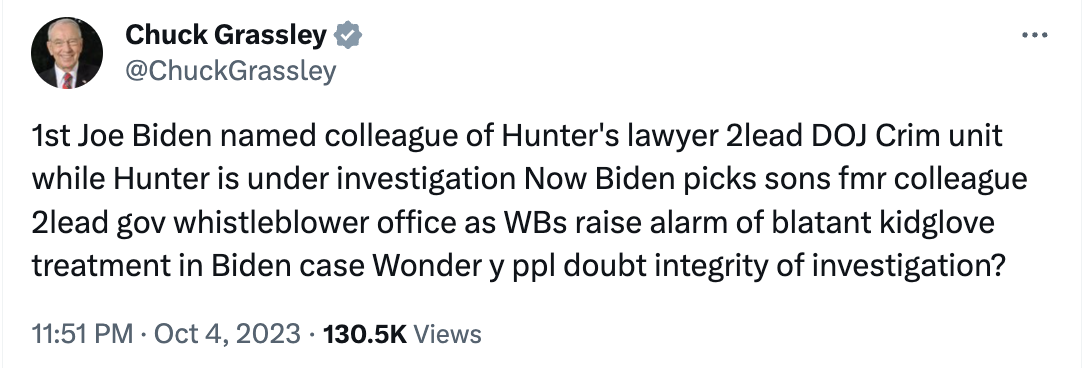
The deposition arose out of the same stream of right wing complaints to Chuck Grassley (one, two) that lie at the core of the Republican campaign against Hunter Biden. The only thing that rationalizes the campaign is that in 2020 Thibault liked a number of Randall Eliason columns critical of Bill Barr’s corruption and even criticized Dick Cheney:

Of course, Grassley’s known and likely sources say far more partisan things online all the time.

Nevertheless Chris Wray has, per his norm, let Thibault weather the attack campaign alone, treating him as the legitimate subject of scrutiny as they have Peter Strzok and Lisa Page and Brian Auten and Jim Baker — every FBI agent except those (like John Durham’s cherished Cyber agents) who help sustain conspiracy theories favored by Trump and his allies.

What I wanted was someone from the FBI — because they know the truth — was someone to defend me after 26 years. I understand they can’t defend every allegation that’s made, so — I wish they would have. Right? I didn’t have that. And so that’s how I felt was I just wanted a defense. And I’m not blaming the FBI, because if they would respond to accusations against FBI agents from the media, they would be doing that a lot. So I’m not special.

But, when those accusations were made against me in July, I was, like, outraged. Why — no FBI agent that I know would put their reputation and honor on the line just to square up. They wouldn’t do that.

From there, Grassley and Jim Jordan have built entire pyramids of conspiracy theories, claiming that the guy who opened the investigations against William Jefferson and Jesse Jackson Jr and who rushed to open an investigation based solely off Schweizer’s Clinton Cash in 2016 abusively intervened to shut down — all of it! — the Hunter Biden investigation in 2020. All because, after several warnings about Schweizer, Thibault didn’t ignore warnings that Steve Bannon’s close associate, Schweizer, could discredit the Hutner Biden investigation (at a time when Bannon himself was coordinating with Guo Wengui).

Over the course of most of a day, Thibault addressed one after another of these conspiracy theories. One reason why Thibault ordered two agents to shut down an informant — Schweizer has since confirmed it was him — was because Schweizer was a less defensible source for allegations against Hunter Biden at trial than whatever means by which — including, undoubtedly, the laptop passed on by John Paul Mac Isaac — Delaware had already gotten materials on Hunter Biden. Using Schweizer rather than the sources Delaware already had, “could harm a case. It could cause problems when you get to prosecution,” Thibault explained that the Supervisory Special Agent, Joe Gordon had informed him in early October 2020, “and to open doors for defense attorneys.”

Within days of Gordon’s warning that Schweizer was an unwelcome source, the head of the Public Corruption Unit contacted Thibault to raise other concerns about Schweizer. In an October 21, 2020 classified briefing, members of the Foreign Intelligence Task Force provided more context, not just on Schweizer. The two warnings, together, led Thibault to instruct two agents to shut down Schweizer, someone less credible than Christopher Steele.

That’s probably what led to the complaints to Grassley.

One of the agents, Thomas Olohan, wrote a long memo claiming that Thibault was biased against Trump, before he left the FBI to join the Heritage Foundation. The other, whom Thibault had earlier mentored and considered a friend, would do more than that, as we’ll see.

It would have been three and four days after that when Thibault exchanged calls with Stefan Passantino regarding whether they could selectively image Tony Bobulinksi’s phones, which Jordan found suspect because, in an attempt to shield the investigation, the FBI had Bobulinski speak to the Washington Field Office rather than Baltimore. Jordan repeatedly invented conspiracy theories about of efforts to protect the investigation into Joe Biden’s son.

Jordan’s staffers also focused on Thibault’s role, like that of everyone else in the DC area, in investigating January 6. Except for his minor role in drafting the memo opening the investigation into the fake electors in 2022, Thibault’s role in investigating the attack on the Capitol was limited to freeing up his agents to help deal with the initial surge. Again, Jordan recycled Grassley’s conspiracy theories to treat any FBI agent who didn’t focus primarily on Trump’s enemies as suspect.

Tellingly, however, Jordan and his staffers asked no question about how the same agent who tried to open Schweizer as a source bypassed Thibault, who considered her a friend, to try to chase down the Italygate conspiracy theory months after Richard Donoghue’s judgement that it was “pure insanity” was published.

[I]t first came to my attention when I got a call from — a call from this supervisor, Special Agent from CR-15, and he said: Look, my agents are trying to do an interview of a subject with regard to election fraud, and the subject is in Italy. And he told me that they had tried to get the Legal Attache Office in Rome to do the interview and that they had declined.

Then they had tried to get funding through FBI Headquarters, Public Corruption Unit, to travel over to Italy to do the interview of this person, a potential witness who was in jail. And so I just got briefed on that.

[snip]

So I got off the phone with them, and my next call was to the Public Corruption Unit chief at headquarters, and I said: Hey, what’s the problem with funding?

And he goes: Are you kidding me, basically.

And I go: No.

And he goes: Do you know that this is to support an opening of a case that’s been sent to the Public Corruption Unit as a draft?

I said: I don’t know about that.

[snip]

He’s assuming at the time that I would have seen this because … Because of the gravity of the allegation and what it meant, he couldn’t believe that I hadn’t been briefed on it. He actually thought, I think, that I was approving it —

[snip]

So the head of the Public Corruption Unit tells me that he has received an email forwarded to him from Public Integrity, and it contains a draft opening language, and he was shocked that I didn’t know about this. Because of the type of case it was, you would expect that the ASAC would be in the loop.

[snip]

[S]o I’m trying to do due diligence. And, look, this isn’t the ASAC’s job. But, at this point, I was sort of losing some confidence.

[snip]

Because I wasn’t told about this, and even in my — I wasn’t told about it, number one. But, number two, when I was having conversations with people about this, no one told me — they didn’t raise Italygate. I wasn’t told about what — the allegation that this had previously been reviewed by, like, the Deputy Attorney General had made that comment. I wasn’t provided situational awareness. Right?

[snip]

6 months later, people want to travel halfway around the world to talk to someone who’s in prison. Any FBI agents knows, number one, first of all, an argument can be raised — and it was raised by people when we were discussing this at the squad level: Well, Tim, we talk to people all the time that appear to have kind of whacky theories.

And I was, like: Yeah, we might. We might go down the road to Manassas and talk to someone about some whacky theory. On a low-level case, we do do that.

But I think, you know, the situational awareness that I was gaining as an ASAC and working consistently with headquarters and learning, that Public Corruption Unit chief was unbelievable in terms of his knowledge of foreign influence. I had the benefit of that information. The case agents here did not.

[snip]

[T]here’s a term in the Bureau I learned a long time ago. You’re either working a source, or they’re working you. I was concerned that there wasn’t an element of 267 savviness here on the agent’s behalf, that maybe this source was working her. Q In what way? A It just seemed to me that, you know, you’re going and you’re trying to open a case, but you haven’t asked the very basic questions, like who — I couldn’t understand how they were trying to work a case without — we’ve got all the resources in the Federal Government to find out if a breach of information or a breach of data had occurred. We’ve got CISA. We’ve got the NSA.

[snip]

I was concerned that there was a lack of investigative rigor and the judgment issue, yes, because I wasn’t allowed to intervene, you know, where an ASAC is there for to help guide. This isn’t how CR-15 works cases. I was on that squad. We’re the flagship public corruption squad in the country. This isn’t how it’s done.

Jordan and his staffers expressed no interest or concern that the Public Corruption team at FBI was chasing already discredited conspiracy theories halfway around the world.

In the aftermath of this incident, Thibault asked the supervisor of the squad what was going on. The response was that supervisors were raising concerns about uncharacteristic partisan discussions.

And he said that senior members of CR-15, he didn’t tell me who, but had raised concerns to him that there was uncharacteristically partisan discussions happening on the squad floor.

This is the DC public corruption group — as Thibault described it, “the flagship public corruption squad in the country.” And Thibault discovered the hard way that even agents he believed to be friends were going behind his back to chase the conspiracy theories Trump wanted to chase.

For Jordan, who could be second in line to the Presidency within days, this was all an exercise of finding something within attempts at revenge that would substantiate his belief that the guy who took down two Democratic members of Congress was biased against Republicans.

But for Gaetz — the guy whose coup creates the opportunity for Jordan to become Speaker — it was something else: an opportunity to sit silently so that he could spin a refusal to accept foreign dirt on Hunter Biden as cause to impeach his father.

With the exception of a detailed NYT report in May, the attack against Thibault has passed largely unnoticed in the mainstream press, even as frothy right wingers have continued to impugn yet another stuff lifetime Feeb as a partisan simply because he treated Trump just like he treated the Democratic members of Congress he pursued.

But this Grassley-to-Jordan conveyor belt of bullshit continues to churn away, turning disgruntled hacks with allegations but no evidence into the enforcement wing of their effort to weaponize government.

Share this entry

“Nefarious”: Chuck Grassley Panics at Possibility that Gary Shapley’s Allegations Might Be Scrutinized

Chuck Grassley continues,with the desperation and recklessness that may come from being the oldest member of Congress, to try to find something scandalous in the Hunter Biden investigation that won’t fizzle upon closer scrutiny.

I’m not sure precisely what the first complaint is about. Since Kenneth Polite resigned as Assistant Attorney General for the Criminal Division in July, Nicole Argentieri has been Acting Assistant Attorney General at the Criminal Division. Before that she had been Polite’s Principal Deputy. Prior to returning to DOJ (she worked for a time as an AUSA in EDNY), she was a partner at O’Melveny & Myers in New York. I’m not sure if that’s what Grassley is complaining about. In any case, since David Weiss is Special Counsel, it wouldn’t matter, as AAG CRM would have little to no involvement.

Grassley’s other complaint is that Hampton Dellinger, current AAG for Legal Policy, just got nominated to be the other kind of Special Counsel, the guy in charge of Whistleblower Protection Act and Hatch Act violations. Almost a decade ago, both Dellinger and Hunter Biden had ties to Boies Schiller. Dellinger and Hunter attended the same dinner in March 2014.

The Office of Special Counsel would have even less role in overseeing Special Counsel David Weiss’ activities than Argentieri would. He would, however, have a role in deciding whether Gary Shapely was really a whistleblower or was, instead, a partisan leaker, leaking protected IRS and grand jury information. He would have a role in reviewing whatever it is that Shapley was hiding when he refused to turn over his emails in March 2022 and tried to hide in October 2022, as concerns about leaks accelerated. He would have a role in deciding whether those things undercut his claims, now, to be a whistleblower using the proper channels.

That is, Grassley isn’t worried about the prosecution of Hunter Biden with his latest complaint. He’s worried about any scrutiny of Gary Shapley (and Joseph Ziegler).

And that’s why I find the following details interesting.

In a September 3, 2020 email, Joseph Ziegler included the investigation into Hunter Biden — pursued by Chuck Grassley and Ron Johnson — in his agenda for a meeting that day.

A memo that may have been written by Gary Shapley in December 2020 complains that investigators were not sharing details of the investigation with members of Congress.

The USAO and FBI received congressional inquiries concerning this investigation and have repeatedly ignored their requests, openly mocking the members of Congress who made the requests.

Chuck Grassley was one of those members of Congress. That December 2020 memo is also where the claim that a leak that month came from DOJ rather than investigators.

Another monthly memo Shapley submitted, this one from May 2021, again complained that investigators weren’t compromising the investigation so as to share details with members of Congress.

The USAO and FBI received congressional inquiries concerning this investigation and it’s believed they have ignored their requests.

Chuck Grassley was one of those members of Congress.

In April 2022, Bill Haggerty asked Merrick Garland about the Hunter Biden investigation, to which he responded that Weiss was supervising the investigation and “he is in charge of that investigation; there will not be interference of any political or improper kind.”

In September 2022, Chuck Grassley claimed to have whistleblower information that Tim Thibault shut down an investigative lead on the Hunter Biden investigation. Reports of Thibault’s own testimony, among other details, reveal that this pertained to using Peter Schweitzer as an FBI informant — a more problematic choice to be an FBI informant than using Christopher Steele (since Steele was not a known partisan propagandist), and therefore a wild backflip on Grassley’s earlier concerns about dodgy informants. And Thibault had actually approved keeping Schweitzer as a source, until an FBI agent closer to the case alerted him to problems with doing so. Thibault was retaliated against as a result, in significant part because of Grassley’s misrepresentation of what happened.

I’ll return to the way that Shapley ignored warnings going back months before October 2022 that David Weiss wouldn’t charge Hunter for 2014 and 2015. I’ll return to the way that Shapley ignored warnings that the case would not be charged until after November 2022, and possibly not even until 2023.

What we now know is that the key detail in his otherwise unreliable report from the October 7 meeting — that David Weiss said he “is not the deciding person” on whether to charge Hunter Biden — is not corroborated by any other witness who attended that meeting. Darren Waldon, his supervisor, described that what Weiss actually said pertained to a description of process, “the process in order to get the case indicted and subsequently prosecuted.”

Shapley made claims that were not backed even by his own handwritten notes.

And yet that is the core of his claim to be a whistleblower: That’s the basis of Gary Shapley’s first publicly claimed reason for coming to Congress — the October 7, 2022 meeting, which Shapley’s attorney Mark Lytle publicly released (in such a way that journalists all knew it pertained to Hunter Biden) in April: the claim that what David Weiss said on October 7 conflicted with what Merrick Garland had told Bill Haggerty in April 2022.

Shapley’s October 7 memorialization, which doesn’t match his own notes and hasn’t been corroborated by other witnesses, is the basis of Gary Shapley’s claim to be a whistleblower, a claim that might be reviewed by Office of Special Counsel.

We also know that Gary Shapley only claims — in a really weird memorialization, provided in lieu of original notes, that writes out “REDACTED” — to have formally become a whistleblower on January 4, 2023, the day Republicans took over the House.

In that memorialization, Shapley clearly states that his lawyer has already “participated in calls and/or meetings” with “the Congressional Judiciary committees.”

In the memorialization (again, provided in lieu of Shapley’s notes, which have shown discrepancies in the past), Shapley predicted that,

there may be allegations against him, that he believes will be nefarious, from DOJ/USAO and that he hoped the agency would support him during that. [Michael Batdorf] stated that he had not heard of an any allegations made against Shapley.

We also know that on January 25, Shapley asked to take leave so he could — among other things — meet with congressional committees and Inspectors General, a request Michael Batdorf said should not come out of his paid leave. By the time of Shapley’s first (known) testimony in May, he had not yet personally met with any Inspectors General investigators; rather, his attorneys had made disclosures to them. And, as noted, the first formal outreach to Congress was on April 19.

In that letter on April 19, Mark Lytle made absolutely not mention of earlier outreach to the Judiciary Committees.

Despite serious risks of retaliation, my client is offering to provide you with information necessary to exercise your constitutional oversight function and wishes to make the disclosures in a non-partisan manner to the leadership of the relevant committees on both sides of the political aisle.

My client has already made legally protected disclosures at the IRS, through counsel to the U.S. Treasury Inspector General for Tax Administration, and to the Department of Justice, Office of Inspector General.

That is, the claims that Lytle made in that April 19 letter seem to conflict with what Shapely wrote on January 6.

In any case, what was Shapley doing in the two months he was taking leave when he was not yet known to have formally reached out to Congress?

In July, immediately after testimony from Ziegler — who was attending to Congress’ interest in this investigation in 2020 — and Shapley — who was furious that investigators weren’t compromising the investigation to meet the interests of Congress that same year, Chuck Grassley burned what Republicans all claim had been a credible FBI informant in order to feed the conspiracy theories.

Chuck Grassley is worried that a guy who had dinner with Hunter Biden nine years ago might become Special Counsel. He’s worried about that, but not that one of his former staffers went from OSC to the Merit System Protection Board to serving as Gary Shapley’s PR person months after (per Shapley’s own memorialization) he was already reachng out to Congress.

Leavitt began his investigative career working on the Senate Judiciary Committee staff of Senator Chuck Grassley (R-Iowa), where he helped whistleblowers expose schemes like Operation Fast and Furious, the gunwalking scandal that armed the murderers of a U.S. Border Patrol Agent. He also served as Senator Grassley’s chief whistleblower policy advisor, leading the introduction of the first Senate resolutions recognizing National Whistleblower Appreciation Day and the establishment of the Senate Whistleblower Protection Caucus.

In 2015 Leavitt joined the House Oversight and Government Reform Committee staff of Chairman Jason Chaffetz (R-Utah). There he worked with dozens of whistleblowers from the U.S. Secret Service to break news of high-profile misconduct and security breaches. He also investigated Hillary Clinton’s use of a private email server while Secretary of State, the FBI’s failure to hold her accountable, and politicization at the FBI. He negotiated the passage of the FBI Whistleblower Protection Act of 2016.

In 2017 Leavitt was appointed as Principal Deputy Special Counsel at the Office of Special Counsel, where he helped reform OSC’s whistleblower disclosure program and directed a reorganization of OSC’s intake and investigative process. He also served as Acting Special Counsel. In late 2018 Leavitt was appointed as the General Counsel of the Merit Systems Protection Board, and for three years served as the acting head of that agency. In 2022 the U.S. Senate confirmed him with bipartisan support as the Republican Member of the Board, a position he held for one year.

Chuck Grassley seems to be panicked that a very carefully orchestrated effort to retroactively pitch Shapley as a whistleblower using formal channels might face real scrutiny.

Given that both Zeigler and Shapley seemed to have more concern about Congress’ efforts than the formal investigation starting before Joe Biden became President, that’s not all that surprising.

Share this entry

Elon Musk’s Machine for Fascism: A Tale of Three Elections

Since the spring (when I first started writing this post), I’ve been trying to express what I think Elon Musk intended to do with his $44 billion purchase of Twitter, to turn it into a Machine for Fascism.

Ben Collins wrote a piece — which he has been working on even longer than I have on this post — that led me to return to it.

Collins returns to some texts sent to Elmo in April 2022, just before he bought Twitter, which referenced an unsigned post published at Revolver News laying out a plan for Twitter.

On the day that public records revealed that Elon Musk had become Twitter’s biggest shareholder, an unknown sender texted the billionaire and recommended an article imploring him to acquire the social network outright.

Musk’s purchase of Twitter, the 3,000-word anonymous article said, would amount to a “declaration of war against the Globalist American Empire.” The sender of the texts was offering Musk, the Tesla and SpaceX CEO, a playbook for the takeover and transformation of Twitter. As the anniversary of Musk’s purchase approaches, the identity of the sender remains unknown.

The text messages described a series of actions Musk should take after he gained full control of the social media platform: “Step 1: Blame the platform for its users; Step 2: Coordinated pressure campaign; Step 3: Exodus of the Bluechecks; Step 4: Deplatforming.”

The messages from the unknown sender were revealed in a court filing last year as evidence in a lawsuit Twitter brought against Musk after he tried to back out of buying it. The redacted documents were unearthed by The Chancery Daily, an independent legal publication covering proceedings before the Delaware Court of Chancery.

The wording of the texts matches the subtitles of the article, “The Battle of the Century: Here’s What Happens if Elon Musk Buys Twitter,” which had been published three days earlier on the right-wing website revolver.news.

Collins lays out that the post significantly predicted what has happened since, including an attack on the Anti-Defamation League.

The article on Beattie’s site begins with a baseless claim that censorship on Twitter cost President Donald Trump the 2020 election. “Free speech online is what enabled the Trump revolution in 2016,” the anonymous author wrote. “If the Internet had been as free in 2020 as it was four years before, Trump would have cruised to reelection.”

The author said that “Step 1” after a Musk takeover would be: “Blame the platform for its users.” He or she predicted that “Twitter would be blamed for every so-called act of ‘racism’ ‘sexism’ and ‘transphobia’ occurring on its platform.”

After Musk’s purchase of Twitter was finalized in October 2022, he allowed previously suspended accounts to return. Among them, he restored the account of Trump, whom Twitter had banned after the Jan. 6 Capitol insurrection, as well as the personal accounts of far-right Rep. Marjorie Taylor Greene, R-Ga., and the founder of a neo-Nazi website, Andrew Anglin.

The article predicted that “Step 2” would involve a “Coordinated pressure campaign” by the ADL and other nonprofit groups to get Musk to reinstate the banned accounts. “A vast constellation of activists and non-profits” will lurch into action to “put more and more pressure on the company to change its ways,” the article reads.

The next step, the revolver.news article predicted, would be the “Exodus of the bluechecks.” The term “bluechecks” refers to a former identity verification system on Twitter that confirmed the authenticity of the accounts of celebrities, public figures and journalists.

Musk experimented with and ultimately eliminated Twitter’s verification system of “bluechecks.” As the article predicted, the removal resulted in a public backlash and an exponential drop in advertisers and revenue. Other developments, including Musk’s drastically reducing the number of staffers who monitor tweets and a rise in hate speech, also contributed to the dynamic.

The article predicted that a final step, “Step 4,” would be the “deplatforming” of Twitter itself. He said a Musk-owned Twitter would face the same fate as Parler, a platform that presented itself as a “free speech” home for the right. After numerous calls for violence on Jan. 6 were posted on Parler, Google and Apple removed it from their app stores on the grounds that it had allowed too many posts that promoted violence, crime and misinformation.

Collins notes that the identity of the person who wrote the post on Revolver and sent the texts to Elmo has never been revealed. He seems to think it is Darren Beattie, the publisher of Revolver, whose white supremacist sympathies got him fired from Trump’s White House.

I’m not convinced the post was from Beattie. Others made a case that the person who texted Elmo was Stephen Miller (not least because there’s a redaction where his name might appear elsewhere in the court filing).

But I think Collins’ argument — that Elmo adopted a plan to use Twitter as a Machine for Fascism from the start, guided in part by that post, a post that has some tie to Russophile propagandist Beattie — persuasive.

Then again, I’ve already been thinking about the way that Elmo was trying to perfect a Machine for Fascism.

2016: Professionalizing Trolling

One thing that got me thinking about Elmo’s goals for Twitter came from reading the chatlogs from several Twitter listservs that far right trolls used to coordinate during the 2016 election, introduced as exhibits in Douglass Mackey’s trial for attempting to convince Hillary voters to text their votes rather than casting them at polling places.

The trolls believed, in real time, that their efforts were historic.

On the day Trump sealed his primary win in 2016, for example, Daily Stormer webmaster Andrew “Weev” Auernheimer boasted on a Fed Free Hate Chat that, “it’s fucking astonishing how much reach our little group here has between us, and it’ll solidify and grow after the general.” “This is where it all started,” Douglass Mackey replied, according to exhibits introduced at his trial. “We did it.”

After Trump’s November win became clear, Microchip — a key part of professionalizing this effort — declared, “We are making history,” before he immediately started pitching the idea of flipping a European election (as far right trolls attempted with Emmanuel Macron’s race in 2017) and winning the 2020 election.
By that point, the trolls had been working on–and fine tuning–this effort for at least a year.

Most chilling in the back-story presented in exhibits submitted at trial is the description of how Weev almost groomed Mackey, starting in 2015. “Thanks to weev I am inproving my rhetoric. People love it,” Mackey said in the Fed Free Hate Chat in November 2015. He boasted that his “exploding” twitter account was averaging 300,000 impressions every day, before he mused, “I just hope all this shitlording goes real life.” Two days later Weev admired that, “ricky’s audience expands rapidly, he’s now a leading polemicist” [Mackey did all this under the pseudonym Ricky Vaughn].

Weev and Mackey explained their ideological goals. “The goal is to give people simple lines they can share with family or around the water cooler,” Mackey described to Bidenshairplugs in September 2015. When Weev proposed in January 2016 that he and Mackey write a guide to trolling, he described the project as “ideological disruption” and “psychological loldongs terrorism.” The Daily Stormer webmaster boasted, “i am absolutely sure we can get anyone to do or believe anything as long as we come up with the right rhetorical formula and have people actually try to apply it consistently.” And so they explained the objectives to others. “[R]eally good memes go viral,” Mackey explained to AmericanMex067 on May 10, 2016. “really really good memes become embedded in our consciousness.”

One method they used was “highjacking hashtags,” either infecting the pro-Hillary hashtags pushed by Hillary or filling anti-Trump hashtags with positive content.

Another was repetition. “repitition is key. \’Crooked Hillary created ISIS with Obama\’ repeat it again and again.” Trump hasn’t been repeating the same stupid attacks for 8 years because he’s uncreative or stupid. He’s doing it to intentionally troll America’s psyche.

A third was playing to the irrationality of people. HalleyBorderCol as she pitched the text to vote meme: people aren’t rational. a significant proportion of people who hear the rumour will NOT hear that the rumour has been debunked.”

One explicit goal was to use virality to get the mainstream press to pick up far right lines. Anthime “Baked Alaska” Gionet described that they needed some tabloid to pick up their false claims about celebrities supporting Trump. “We gotta orchestrate it so good that some shitty tabloid even picks it up.” As they were trying to get the Podesta emails to trend in October 2016, P0TUSTrump argued, “we need CNN wnd [sic] liberal news forced to cover it.”

Microchip testified to the methodology at trial.

Q What does it mean to hijack a hashtag?

A So I guess I can give you an example, is the easiest way. It’s like if you have a hashtag — back then like a Hillary Clinton hashtag called “I’m with her,” then what that would be is I would say, okay, let’s take “I’m with her” hashtag, because that’s what Hillary Clinton voters are going to be looking at, because that’s their hashtag, and then I would tweet out thousands of — of tweets of — well, for example, old videos of Hillary Clinton or Bill Clinton talking about, you know, immigration policy for back in the ’90s where they said: You know, we should shut down borders, kick out people from the USA. Anything that was disparaging of Hillary Clinton would be injected into that — into those tweets with that hashtag, so that would overflow to her voters and they’d see it and be shocked by it.

Q Is it safe to say that most of your followers were Trump supporters?

A Oh, yeah.

Q And so by hijacking, in the example you just gave a Hillary Clinton hashtag, “I am with her,” you’re getting your message out of your silo and in front of other people who might not ordinarily see it if you just posted the tweet?

A Yeah, I wanted to infect everything.

Q Was there a certain time of day that you believed tweeting would have a maximum impact?

A Yeah, so I had figured out that early morning eastern time that — well, it first started out with New York Times. I would see that they would — they would publish stories in the morning, so the people could catch that when they woke up. And some of the stories were absolutely ridiculous — sorry. Some of the stories were absolutely ridiculous that they would post that, you know, had really no relevance to what was going on in the world, but they would still end up on trending hashtags, right? And so, I thought about that and thought, you know, is there a way that I could do the same thing.

And so what I would do is before the New York Times would publish their — their information, I would spend the very early morning or evening seeding information into random hashtags, or a hashtag we created, so that by the time the morning came around, we had already had thousands of tweets in that tag that people would see because there wasn’t much activity on Twitter, so you could easily create a hashtag that would end up on the trending list by the time morning came around.

In the 2016 election, this methodology served to take memes directly from the Daily Stormer, launder them through 4Chan, then use Twitter to inject them into mainstream discourse. That’s the methodology the far right still uses, including Trump when he baits people to make his Truth Social tweets go viral on Twitter. Use Twitter to break out of far right silos and into those of Hillary supporters to recodify meaning, and ensure it all goes viral so lazy reporters at traditional outlets republish it for free, using such tweets to supplant rational discussion of other news.

And as Microchip testified, in trolling meaning and rational arguments don’t matter. Controversy does.

Q What was it about Podesta’s emails that you were sharing?

A That’s a good question.

So Podesta ‘s emails didn’t, in my opinion, have anything in particularly weird or strange about them, but my talent is to make things weird and strange so that there is a controversy. So I would take those emails and spin off other stories about the emails for the sole purpose of disparaging Hillary Clinton.

T[y]ing John Podesta to those emails, coming up with stories that had nothing to do with the emails but, you know, maybe had something to do with conspiracies of the day, and then his reputation would bleed over to Hillary Clinton, and then, because he was working for a campaign, Hillary Clinton would be disparaged.

Q So you’re essentially creating the appearance of some controversy or conspiracy associated with his emails and sharing that far and wide.

A That’s right.

Q Did you believe that what you were tweeting was true?

A No, and I didn’t care.

Q Did you fact-check any of it?

A No.

Q And so what was the ultimate purpose of that? What was your goal?

A To cause as much chaos as possible so that that would bleed over to Hillary Clinton and diminish her chance of winning.

The far right is still using this methodology to make the corrupt but not exceptional behavior of Hunter Biden into a topic that convinces half the electorate that Joe Biden is as corrupt as Donald Trump. They’ve used this methodology to get the vast majority of media outlets to chase Hunter Biden’s dick pics like six year old chasing soccer balls.

Back in 2016, the trolls had a good sense of how their efforts helped to support Trump’s electoral goals. In April 2016, for example, Baked Alaska pitched peeling off about a quarter of Bernie Sanders’ votes. “Imagine if we got even 25% of bernie supporters to ragevote for trump.” On November 2, 2016, the same day he posted the meme that got him prosecuted, Mackey explained that the key to winning PA was “to drive up turnout with non-college whites, and limit black turnout.” One user, 1080p, seemed to have special skills — if not sources — to adopt the look and feel of both campaigns.

And this effort worked in close parallel to Trump’s efforts. As early as April, Baked Alaska invited Mackey to join a campaign slack “for more coordinated efforts.”
And there are several participants in the troll chatrooms whose actions or efforts to shield their true identities suggest they may be closely coordinating efforts as well.

Even in the unfettered world of 2016, Twitter’s anemic efforts to limit the trolls’ manipulation of Twitter was a common point of discussion.

For example, as the trolls were trying to get Podesta’s emails trending, HalleyBorderCol complained, “we haven’t been able to get anything to trend for aaaages … unless they changed their algorithms, they must be watching what we’re doing.” Later in October as they were launching two of their last meme campaigns, ImmigrationX complained,”I see Jack in full force today suppressing hashtags.”

Both Mackey and Microchip were banned multiple times. “Microchip get banned again??” was a common refrain. “glad to be back,” Microchip claimed on September 24. “they just banned me two times in 3 mins.” He warned others to follow-back slowly to evade an auto-detect for newly created accounts. “some folks are being banned right now, apparently, so if I’m banned for some reason, I’ll be right back,” Microchip warned on October 30. “Be good till nov 9th brother! We need your ass!” another troll said on the day Mackey was banned; at the time Microchip was trending better than Trump himself. Mackey’s third ban in this period, in response to the tweets a jury has now deemed to be criminal, came with involvement from Jack Dorsey personally.

Both testified at trial about the techniques they used to thwart the bans (including using a gifted account to return quickly, in Mackey’s case). Microchip built banning, and bot-based restoration and magnification, into his automation process.

2020: Insurrection

The far right trolls succeeded in helping Donald Trump hijack American consciousness in 2016 to get elected.

By the time the trolls — some of whom moved into far more powerful positions with Trump’s election — tried again in 2020, the social media companies had put far more controls on the kinds of viral disinformation that trolls had used with such success in 2016.

As Yoel Roth explained during this year’s Twitter hearing, the social media companies expanded their moderation efforts with the support of a bipartisan consensus formulated in response to Russia’s (far less successful than the far right troll efforts) 2016 interference efforts.

Rep. Shontel Brown

So Mr. Roth, in a recent interview you stated, and I quote, beginning in 2017, every platform Twitter included, started to invest really heavily in building out an election integrity function. So I ask, were those investments driven in part by bipartisan concerns raised by Congress and the US government after the Russian influence operation in the 2016 presidential election?

Yoel Roth:

Thank you for the question. Yes. Those concerns were fundamentally bipartisan. The Senate’s investigation of Russian active measures was a bipartisan effort. The report was bipartisan, and I think we all share concerns with what Russia is doing to meddle in our elections.

But in advance of the election, Trump ratcheted up his attacks on moderation, personalizing that with a bullying attack on Roth himself.

In the spring of 2020, after years of internal debate, my team decided that Twitter should apply a label to a tweet of then-President Trump’s that asserted that voting by mail is fraud-prone, and that the coming election would be “rigged.” “Get the facts about mail-in ballots,” the label read.

On May 27, the morning after the label went up, the White House senior adviser Kellyanne Conway publicly identified me as the head of Twitter’s site integrity team. The next day, The New York Post put several of my tweets making fun of Mr. Trump and other Republicans on its cover. I had posted them years earlier, when I was a student and had a tiny social media following of mostly my friends and family. Now, they were front-page news. Later that day, Mr. Trump tweeted that I was a “hater.”

Legions of Twitter users, most of whom days prior had no idea who I was or what my job entailed, began a campaign of online harassment that lasted months, calling for me to be fired, jailed or killed. The volume of Twitter notifications crashed my phone. Friends I hadn’t heard from in years expressed their concern. On Instagram, old vacation photos and pictures of my dog were flooded with threatening comments and insults.

In reality, though, efforts to moderate disinformation did little to diminish the import of social media to right wing political efforts. During the election, the most effective trolls were mostly overt top associates of Donald Trump, or Trump himself, as this table I keep posting shows.
The table, which appears in a Stanford University’s Election Integrity Project report on the election, does not reflect use of disinformation (as the far right complains when they see it). Rather, it measures efficacy. Of a set of false narratives — some good faith mistakes, some intentional propaganda — that circulated on Twitter in advance of the election, this table shows who disseminated the false narratives that achieved the most reach. The false narratives disseminated most broadly were disseminated by Donald Trump, his two adult sons, Tom Fitton, Jack Posobiec, Gateway Pundit, Charlie Kirk, and Catturd. The least recognized name on this list, Mike Roman, was among the 19 people indicted by Fani Willis for efforts to steal the election in Georgia. Trump’s Acting Director of National Intelligence, Ric Grenell, even got into the game (which is unsurprising, given that before he was made Ambassador to Germany, he was mostly just a far right troll).

This is a measure of how central social media was to Trump’s efforts to discredit, both before and after the election, the well-run election that he lost.

The far right also likes to claim (nonsensically, on its face, because these numbers reflect measurements taken after the election) that these narratives were censored. At most, and in significant part because Twitter refused to apply its own rules about disinformation to high profile accounts including but not limited to Trump, this disinformation was labeled.

As the Draft January 6 Social Media Report described, they had some success at labeling disinformation, albeit with millions of impressions before Twitter could slap on a label.

Twitter’s response to violent rhetoric is the most relevant affect it had on January 6th, but the company’s larger civic integrity efforts relied heavily on labeling and downranking. In June of 2019, Twitter announced that it would label tweets from world leaders that violate its policies “but are in the public interest” with an “interstitial,” or a click-through warning users must bypass before viewing the content.71 In October of 2020, the company introduced an emergency form of this interstitial for high-profile tweets in violation of its civic integrity policy.” According to information provided by Twitter, the company applied this interstitial to 456 tweets between October 27″ and November 7″, when the election was called for then-President-Elect Joe Biden. After the election was called, Twitter stopped applying this interstitial.”* From the information provided by Twitter, it appears these interstitials had a measurable effect on exposure to harmful content—but that effect ceased in the crucial weeks before January 6th.

The speed with which Twitter labels a tweet obviously impacts how many users see the unlabeled (mis)information and how many see the label. For PIIs applied to high-profile violations of the civic integrity policy, about 45% of the 456 labeled tweets were treated within an hour of publication, and half the impressions on those tweets occurred after Twitter applied the interstitial. This number rose to more than eighty percent during election week, when staffing resources for civic issues were at their highest; after the election, staff were reassigned to broader enforcement work.” In answers to Select Committee questions during a briefing on the company’s civic integrity policy, Twitter staff estimates that PIIs prevented more than 304 million impressions on violative content. But at an 80% success rate, this still leaves millions of impressions.

But this labeling effort stopped after the election.

According to unreliable testimony from Brandon Straka the Stop the Steal effort started on Twitter. According to equally unreliable testimony from Ali Alexander, he primarily used Twitter to publicize and fundraise for the effort.

It was, per the Election Integrity Project, the second most successful disinformation after the Dominion propaganda.
And the January 6 Social Media Report describes that STS grew organically on Facebook after being launched on Twitter, with Facebook playing a losing game of whack-a-mole against new STS groups.

But as Alexander described, after Trump started promoting the effort on December 19, the role he would place became much easier.

Twitter wasn’t the only thing that brought a mob of people to DC and inspired many to attack the Capitol. There were right wing social media sites that may have been more important for organizing. But Twitter was an irreplaceable part of what happened.

The lesson of the 2020 election and January 6, if you care about democracy, is that Twitter and other social media companies never did enough moderation of violent speech and disinformation, and halted much of what they were doing after the election, laying the ground work for January 6.

The lesson of the 2020 election for trolls is that inadequate efforts to moderate disinformation during the election — including the Hunter Biden “laptop” operation — prevented Trump from pulling off a repeat of 2016. The lesson of January 6, for far right trolls, is that unfettered exploitation of social media might allow them to pull off a violent coup.

That’s the critical background leading up to Elmo’s purchase of Twitter.

2024: Boosting Nazis

The first thing Elmo did after purchasing Twitter was to let the far right back on.
More recently, he has started paying them money that ads don’t cover to subsidize their propaganda.

The second thing he did, with the Twitter Files, was to sow false claims about the effect and value of the moderation put into place in the wake of 2016 — an effort Republicans in Congress subsequently joined. The third thing Elmo did was to ratchet up the cost for the API, thereby making visibility into how Twitter works asymmetric, available to rich corporations and (reportedly) his Saudi investors, but newly unavailable to academic researchers working transparently. He has also reversed throttling for state-owned media, resulting in an immediate increase in propaganda.
He has done that while making it easier for authoritarian countries to take down content.

Elmo attempted, unsuccessfully, to monetize the site in ways that would insulate it from concerns about far right views or violence.
For months, Elmo, his favored trolls, and Republicans in Congress have demonized the work of NGOs that make the exploitation of Twitter by the far right visible. More recently, Elmo has started suing them, raising the cost of tracking fascism on Twitter yet more.

Roth recently wrote a NYT column that, in addition to describing the serial, dangerous bullying — first from Trump, then from Elmo — that this pressure campaign includes, laid out the stakes.

Bit by bit, hearing by hearing, these campaigns are systematically eroding hard-won improvements in the safety and integrity of online platforms — with the individuals doing this work bearing the most direct costs.

Tech platforms are retreating from their efforts to protect election security and slow the spread of online disinformation. Amid a broader climate of belt-tightening, companies have pulled back especially hard on their trust and safety efforts. As they face mounting pressure from a hostile Congress, these choices are as rational as they are dangerous.

In 2016, far right trolls helped to give Donald Trump the presidency. In 2020, their efforts to do again were thwarted — barely — by attempts to limit the impact of disinformation and violence.

But in advance of 2024, Elmo has reversed all that. Xitter has preferentially valued far right speech, starting with Elmo’s increasingly radicalized rants. More importantly, Xitter has preferentially valued speech that totally undercuts rational thought.

Elmo has made Xitter a Machine for irrational far right hate speech.

The one thing that may save us is that this Machine for Fascism has destroyed Xitter’s core value to aspiring fascists: it has destroyed Xitter’s role as a public square, from which normal people might find valuable news. In the process, Elmo has destroyed Twitter’s key role in bridging from the far right to mainstream readers.

But it’s not for lack of trying to make Xitter a Machine for Fascism.

Share this entry

DOJ’s Theory of Trump’s Mob

DOJ’s reply on its bid for a gag on Donald Trump has a number of the things you’d expect.

It has a list of the seven people Trump has threatened since the last filing on this, including Trump’s vicious attack on Mark Milley.

With each filing, DOJ just keeps adding to the list of people Trump either incited or targeted.

The government also notes that Trump may have broken the law — or claimed he did, for political benefit — when he claimed to have purchased a Glock.

9 The defendant recently was caught potentially violating his conditions of release, and tried to walk that back in similar fashion. In particular, on September 25, the defendant’s campaign spokesman posted a video of the defendant in the Palmetto State Armory, a Federal Firearms Licensee in Summerville, South Carolina. The video posted by the spokesman showed the defendant holding a Glock pistol with the defendant’s likeness etched into it. The defendant stated, “I’ve got to buy one,” and posed for pictures with the FFL owners. The defendant’s spokesman captioned the video Tweet with the representation that the defendant had purchased the pistol, exclaiming, “President Trump purchases a @GLOCKInc in South Carolina!” The spokesman subsequently deleted the post and retracted his statement, saying that the defendant “did not purchase or take possession of the firearm” (a claim directly contradicted by the video showing the defendant possessing the pistol). See Fox News, Trump campaign walks back claim former president purchased Glock amid questions about legality (Sept. 25, 2023), https://www.foxnews.com/politics/trump-campaign-walks-back-claim-former-presidentpurchased-glock-amid-questions-about-legality (accessed Sept. 26, 2023). Despite his spokesperson’s retraction, the Defendant then re-posted a video of the incident posted by one of his followers with the caption, “MY PRESIDENT Trump just bought a Golden Glock before his rally in South Carolina after being arrested 4 TIMES in a year.”

The defendant either purchased a gun in violation of the law and his conditions of release, or seeks to benefit from his supporters’ mistaken belief that he did so. It would be a separate federal crime, and thus a violation of the defendant’s conditions of release, for him to purchase a gun while this felony indictment is pending. See 18 U.S.C. § 922(n).

Notably, the government points to 18 USC 922 as its basis to claim it would be illegal for Trump to purchase a gun. His release conditions don’t prohibit him from owning a gun.

Trump won’t be charged on this. Which means it’ll be another thing Hunter Biden will use to show selective prosecution.

But I’m most interested DOJ’s rebuttal to Trump’s claim that Jack Smith improperly connected Trump to January 6 in his press conference announcing the indictment when he said Trump had, “fueled . . . an unprecedented assault on the seat of American democracy.”

The defendant seeks to deflect responsibility for his own prejudicial statements by claiming that the indictment in this case was “false and derogatory” and that the Special Counsel’s brief statement upon its unsealing was prejudicial because it ascribed to the defendant responsibility for the events of January 6, 2021—which, according to the defendant’s opposition, the indictment does not allege. ECF No. 60 at 19-20. The defendant is wrong.

[snip]

[T]he indictment does in fact clearly link the defendant and his actions to the events of January 6. It alleges—and at trial, the Government will prove—the following:

  • The defendant’s criminal conspiracies targeted, in part, the January 6 certification and capitalized “on the widespread mistrust the [d]efendant was creating through pervasive and destabilizing lies about election fraud,” ECF No. 1 at ¶4.
  • In advance of January 6, the defendant “urged his supporters to travel to Washington on the day of the certification proceeding, tweeting, ‘Big protest in D.C. on January 6th. Be there, will be wild!,’” id. at ¶87. He then “set the false expectation that the Vice President had the authority to and might use his ceremonial role at the certification proceeding to reverse the election outcome in [his] favor, id. at ¶96.
  • Then, despite his awareness “that the crowd [ ] on January 6 was going to be ‘angry,’” id. at ¶98, on the morning of January 6, the defendant “decided to single out the Vice President in public remarks,” id. at ¶102, and “repeated knowingly false claims of election fraud to gathered supporters, falsely told them that the Vice President had the authority to and might alter the election results, and directed them to the Capitol to obstruct the certification proceeding and exert pressure on the Vice President to take the fraudulent actions he had previously refused,” id. at ¶10d.
  • Finally, on the afternoon of January 6, after “a large and angry crowd—including many individuals whom the [d]efendant had deceived into believing the Vice President could and might change the election results—violently attacked the Capitol and halted the proceeding,” the defendant exploited the disruption in furtherance of his efforts to obstruct the certification, id. at ¶10e.

In short, the indictment alleges that the defendant’s actions, including his campaign of knowingly false claims of election fraud, led to the events of January 6.

This is a very neat formula of the things Trump did to stoke the violence. The lies provided foundation for the rally which provided an opportunity to target Pence which provided the cause to send mobs to the Capitol. DOJ has been working on laying out this formula for 26 months. Here they lay it out in a few short paragraphs, one way to read a complex indictment.

More remarkably, it comes as part of a gag request that — while it mentioned Trump’s attacks on Pence after the fact — didn’t focus on Trump’s dangerous targeting of Pence to gin up the mob. The initial gag request looked at all the other lives Trump ruined by targeting them. But it didn’t focus on Pence.

Here, once again in the response to an invitation by Trump to do so, DOJ neatly lays out how Trump’s attacks on Pence were a key tool he used to direct the mob.

Share this entry