Winter™ — Property of The Weather Channel®

(photo: Blizzard 2010 by *Low* via Flickr)

With a lot of self-justifying, back-patting hoopla today, The Weather Channel announced it’s decided unilaterally to assign names to winter storms.

During the upcoming 2012-13 winter season The Weather Channel will name noteworthy winter storms. Our goal is to better communicate the threat and the timing of the significant impacts that accompany these events. The fact is, a storm with a name is easier to follow, which will mean fewer surprises and more preparation.

Yes, fewer surprises. Just the one about winter’s natural disasters being branded by The Weather Channel.

There’s no indication that any federal government entity, including NOAA, has sanctioned this scheme let alone the names.

…until now, there has been no organized naming system for these storms before they impact population centers.

One of the reasons this may be true is that there is no national center, such as the National Hurricane Center, to coordinate and communicate information on a multi-state scale to cover such big events. The National Centers for Environmental Prediction’s Hydrologic Prediction Center (HPC) does issue discussions and snowfall forecasts on a national scale but it does not fill the same role as the NHC in naming storms. …

At this point The Weather Channel’s management breaks their arms with back-patting, lauding their efforts while calling it a bunch of euphemisms for team-playing:

…it would be a great benefit for a partner in the weather industry to take on the responsibility of developing a new concept.

This is where a world-class organization such as The Weather Channel will play a significant role. We have the meteorological ability, support and technology to provide the same level of reporting for winter storms that we have done for years with tropical weather systems. …

In the absence of any government inputs, the selected storm names for this season appear to be intellectual property of The Weather Channel.

Bet you didn’t think that natural disasters could be co-opted, branded, and marketed!  Read more

Share this entry

Obama, Stuck in the 9/11 Era as Much as Mitt Is Stuck in the Cold War Era

Working on another post, I went back and read all three Obama DNC speeches. (200420082012) Aside from the biographical details, several things remained constant through all three: the Hope theme (though it has evolved in interesting ways, which is what I was looking at), the inclusion of some version of “We don’t think the government can solve all our problems,” and a call for energy independence.

2004

In 2004, that call came in a list of things John Kerry planned to accomplish.

John Kerry believes in energy independence, so we aren’t held hostage to the profits of oil companies or the sabotage of foreign oil fields.

2008

In 2008, the call came with a specific goal: to end dependence on the Middle East by 2019.

And for the sake of our economy, our security, and the future of our planet, I will set a clear goal as President: in ten years, we will finally end our dependence on oil from the Middle East. [my emphasis]

Obama embodied the refusal of DC to address energy independence in John McCain’s career, and in the “Drill Baby Drill” chant that was the rage in political circles in 2008.

Washington’s been talking about our oil addiction for the last thirty years, and John McCain has been there for twenty-six of them. In that time, he’s said no to higher fuel-efficiency standards for cars, no to investments in renewable energy, no to renewable fuels. And today, we import triple the amount of oil as the day that Senator McCain took office.

Now is the time to end this addiction, and to understand that drilling is a stop-gap measure, not a long-term solution. Not even close.

And he made several promises–several of which he has made progress on, several of which he has thankfully not achieved, one of which–nukes–he has at least rhetorically dropped from his convention speech.

As President, I will tap our natural gas reserves, invest in clean coal technology, and find ways to safely harness nuclear power. I’ll help our auto companies re-tool, so that the fuel-efficient cars of the future are built right here in America. I’ll make it easier for the American people to afford these new cars. And I’ll invest 150 billion dollars over the next decade in affordable, renewable sources of energy – wind power and solar power and the next generation of biofuels; an investment that will lead to new industries and five million new jobs that pay well and can’t ever be outsourced.

2012

And last week he, correctly, argued that Mitt would not continue this commitment to an energy independence that relies on a range of sources (Mitt would certainly keep drilling, would expand traditional coal mining, and would keep paying Iowa farmers to pour corn into cars, but would probably not continued subsidies for clean technologies).

OBAMA: You can choose the path where we control more of our own energy. After thirty years of inaction, we raised fuel standards so that by the middle of the next decade, cars and trucks will go twice as far on a gallon of gas.

(APPLAUSE)

In this section, Obama quietly–too quietly–bragged about the jobs he created in battery and turbine plants.

We’ve doubled our use of renewable energy, and thousands of Americans have jobs today building wind turbines, and long-lasting batteries.

And he accurately claimed that these policies (plus the recession, plus a warm winter, though he doesn’t mention them) have made a difference.

In the last year alone, we cut oil imports by one million barrels a day, more than any administration in recent history. And today, the United States of America is less dependent on foreign oil than at any time in the last two decades.

(APPLAUSE)

So, now you have a choice – between a strategy that reverses this progress, or one that builds on it.

What I’m interested in, though, is the emphasis he places on the energy and the unconvincing nod he makes to climate change. In 2004, Obama had listed “the future of our planet” as the third of three reasons for his commitment to energy independence; the other two were “our economy” and “our security.” Here, an explicit admission that “climate change is not a hoax” comes among promises to “drill baby drill.”

We’ve opened millions of new acres for oil and gas exploration in the last three years, and we’ll open more. But unlike my opponent, I will not let oil companies write this country’s energy plan, or endanger our coastlines, or collect another $4 billion in corporate welfare from our taxpayers. We’re offering a better path. [my emphasis]

Even when I listened to this passage the other night, I was offended by his promise not to let oil companies endanger our coastlines. Oil from the BP spill came onshore with Hurricaine Isaac. Just a week before he delivered these lines, Obama approved Shell drilling in the Chukchi Sea which presents predictable dangers to coastlines and species, particularly given how Shell has already failed to take necessary precautions. And even the Saudis recognize that fracking presents a real threat to our groundwater. So not only is Obama not subordinating the sanctity of our coastlines to his commitment to drill, neither is he making adequate efforts to protect our drinking water.

(APPLAUSE)

We’re offering a better path, a future where we keep investing in wind and solar and clean coal; where farmers and scientists harness new biofuels to power our cars and trucks; where construction workers build homes and factories that waste less energy; where — where we develop a hundred year supply of natural gas that’s right beneath our feet.

If you choose this path, we can cut our oil imports in half by 2020 and support more than 600,000 new jobs in natural gas alone.

(APPLAUSE) [my emphasis]

Then, after what, given the brevity of the speech, is a very long section on drilling, Obama immediately nods to climate change.

And yes, my plan will continue to reduce the carbon pollution that is heating our planet because climate change is not a hoax. Read more

Share this entry

Fat Al Gore Shuts Down Highways the Terrorists Couldn’t

Remember some years back when one of the big fears was that terrorists would take out one or several of the critical rail or road bridges that cross the Mississippi River?

While attacks against [famous] landmarks would cause massive traffic problems–and give terrorists a major psychological victory–some of the most lucrative bridge targets are located in the nation’s heartland, at rail crossings over the Mississippi River. Forty percent of the nation’s freight rides the rails, and much of it crosses the Mississippi at one point or another.
Since the mid-1800s, scores of rail bridges have been built across the river, but today, the majority of freight trains pass at seven major crossings: Little Falls, Minnesota; LaCrosse, Wisconsin; Clinton, Fort Madison, and Burlington, Iowa; Thebes, Illinois, and Memphis, Tennessee. Collectively, at least 680 million gross tons of freight cross these bridges each year.

Yet while we were worrying about the terrorists, Fat Al Gore struck at the single highway that carries 500 million tons of trade under those bridges every year. For the last 9 days, Fat Al Gore has been closing an 11-mile stretch of the Midwest’s most important highway, the Mississippi, holding up 97 vessels.

As the CNBC report calculates, here’s the trade that Fat Al Gore is holding up.

This really is the giant super highway of the American Midwest. $180 billion of goods up and down this river. 60% of US grain is shipped on this river. 22% of oil and gas. 20% of coal.

And this post describes more of the costs, including presenting problems for the drinking water

Maybe it’s time we started devoting some of the billions we spend on counterterrorism and start trying to do something about Fat Al Gore?

Share this entry

John Brennan Vows to Combat the “Bad Guys” Attacking Our Critical Infrastructure

John Brennan just gave a speech, purportedly about our policy in Yemen. But it ended up being largely about infrastructure, That’s partly because his speech focused on how, rather than spending 75% of our Yemen funds on bombs, we’re now spending just 50% (having bumped up the total to include an equal amount development assistance). So a good part of his talk focused on whether or not Yemen would be able to do the critical work of rebuilding its infrastructure sufficient to combat AQAP which, in some areas, has done a better job of building infrastructure.

Of course as I noted while he spoke, a number of the infrastructure challenges Brennan confidently assured we could help rebuild–things like access to water–are challenges we are increasingly failing in our own country.

And then, because the DC attention span had had enough of Yemen, moderator Margaret Warner asked Brennan what the Administration will do now that their cybersecurity bills have been defeated. To justify his talk of using Executive Orders to address some of the infrastructure problems, Brennan talked about the “bad guys” who posed a cyberthreat to our critical infrastructure.

Nowhere did Brennan acknowledge the much more immediate threat to our critical infrastructure: in the corporations and politics that let it decline. PG&E and Enbridge, failing to invest the money to fix known defects in their pipelines. Fracking companies, depleting and degrading our water supply. Verizon, eliminating choice for Internet access for rural customers. Republicans who want to gut our Postal Service and passenger rail. And heck, even Fat Al Gore and climate change, which is not only depleting our water supply but stalling key water transport routes.

Brennan promises to help rebuild Yemen’s infrastructure. But not only can’t he implement his plan against the bogeyman “bad buys” threatening our infrastructure, he seems completely unaware that those “bad guys” aren’t anywhere near the biggest threat to our infrastructure.

Don’t get me wrong. I applaud the Administration’s decision to dedicate money to Yemen’s infrastructure, even if I think a 50/50 split, aid to bombs, is still woefully inadequate. But until we begin to see what “bad guys” pose the biggest threat to our own infrastructure, I’m skeptical our efforts in Yemen will be any more successful than they were in Iraq or Afghanistan.

Share this entry

The Only Terrifying Math That Gets Any Attention Is Defense Spending

Bill McKibben had a long piece on climate change this week, “Global Warming’s Terrifying New Math,” that has justifiably gotten a lot of attention. The terrifying math of the title is this:

  • Almost the entire world agreed in 2009 that we must keep global temperature increases below 2°C
  • Since then, the 0.8°C increase in temperature we’ve hit has brought far more damage than scientists expected
  • Humans can introduce no more than 565 gigatons of carbon into the atmosphere if they want to keep the temperature from rising that 2°C which now seems too high
  • Fossil fuel companies already have in reserve–and plan to develop–2,795 gigatons of carbon fuels

The math means, McKibben explains, that to keep global warming within the consensus but already too high limit of 2°C, we’ve got to find some way to force the fossil fuel companies not to develop their existing reserves.

At this point, effective action would require actually keeping most of the carbon the fossil-fuel industry wants to burn safely in the soil, not just changing slightly the speed at which it’s burned.

[snip]

According to the Carbon Tracker report, if Exxon burns its current reserves, it would use up more than seven percent of the available atmospheric space between us and the risk of two degrees. BP is just behind, followed by the Russian firm Gazprom, then Chevron, ConocoPhillips and Shell, each of which would fill between three and four percent. Taken together, just these six firms, of the 200 listed in the Carbon Tracker report, would use up more than a quarter of the remaining two-degree budget. Severstal, the Russian mining giant, leads the list of coal companies, followed by firms like BHP Billiton and Peabody. The numbers are simply staggering – this industry, and this industry alone, holds the power to change the physics and chemistry of our planet, and they’re planning to use it.

From this McKibben proposes a solution: Tax carbon to make it cost prohibitive to develop these reserves. To tax carbon you’ve got to undercut the fossil fuel industry’s power, and to do that you’ve got to villainize them, but heck that’s easy because they really are villains, since their business model will kill the planet. And so a movement like the South African divestment campaign can make it toxic to own fossil fuel stocks.

That’s a gross oversimplification–please do read the full article for a nuanced version.

Now, there’s nothing in the article that I disagree with. I’m all for making fossil fuel companies pay for the waste their industry creates. I’m all in favor of villainizing them to make that more likely.

But I’ll note that McKibben doesn’t utter the words that would both make it easier to villainize the fossil fuel industry and explains some of the underlying reasons why that’s not going to be enough.

“National security.” Or even “security.”

In that silence, McKibben is a mirror image of the same fault in Obama’s own strategy and discussions more generally about threats to this country, even fairly realistic ones.

Sure, all the details McKibben cites about evident and likely effects of climate change imply this is a security issue: 356 homes gone in Colorado Springs, spiking food prices, even entire countries disappearing.

But until we start using the language of national security, we won’t properly demonstrate the treachery of those who refuse to deal with this. Read more

Share this entry

Fat Al Gore Colludes with Banksters in the Midwest

There’s an ominous storm brewing in flyover country that may amount to little more than higher food and fuel prices, or may amount to something else.

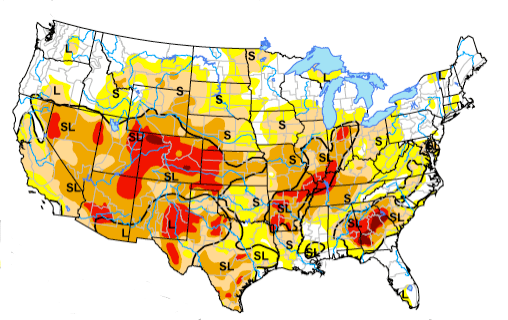
First there’s the drought. Last week’s heat wave and the last month’s dry weather hit just as much of America’s corn crop was set to pollinate. And if the corn doesn’t pollinate, it never grows kernels. Even as I’ve been writing this post, USDA sharply cut forecasts for the corn harvest.

As a result, corn prices (soy prices too) are rising sharply. Which will, for better and worse, have repercussions on all the aspects of our super-processed life that relies on corn.

“The drought of 2012 will be one for the records,” said Peter Meyer, the senior director for agricultural commodities at PIRA Energy Group in New York, who forecasts a drop in output to 11 billion bushels if the hot, dry spell lasts another three weeks. “Whether it’s ethanol or livestock, no one is immune from this impending disaster. The ramifications will be widespread, affecting everything from your food to your gasoline.”

And all that’s before any follow-on effects, if the drought continues. Even in Grand Rapids, we’ve had some unusual fires. Rivers that were experiencing historic floods last year are approaching record lows this year; traffic on the Mississippi has already slowed.

Yet all that–even with our country’s industrialized reliance on corn–might be no more concerning than other droughts, such last year’s drought in Texas.

Meanwhile, banksters keep stealing farmers’ money–first via MF Global and now with Peregrine.

The U.S. futures industry reeled as regulators accused Iowa-based PFGBest of misappropriating more than $200 million in customer funds for more than two years, a new blow to trader trust just months after MF Global’s collapse.

Read more

Share this entry

Fat Al Gore Determined to Strike in US

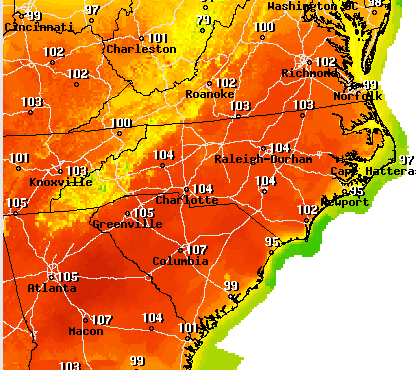
Already, at least ten people were killed in yesterday’s “derecho”–the massive, violent thunderstorm that traveled from Illinois to DC. That’s before the 3 million people who lost power now trying to cope with today’s 100+ degree weather. Reported gas shortages may exacerbate the challenges.

And a slew of all-time high temperature records were broken just in the last few days

109° Nashville, TN (old record 107° 7/28/1952
109° Columbia, SC (old record 107° on two previous occasions)
109° Cairo, IL (old record 106° on 8/9/1930)
108° Paducah, KY (ties same on 7/17/1942
106° Chattanooga, TN (ties same on 7/28/1952)
105° Raleigh, NC (ties same on 8/21/2007 and 8/18/1988)
105° Greenville, SC (old record 104° 8/10/2007 although 106° was recorded by the Signal Service in July 1887)
104° Charlotte, NC (ties same on 8/9 and 10/2007 and 9/6/1954)
102° Bristol, TN (ties same on 7/28/1952-this site now known as `Tri-State Airport’)
109° Athens, GA. This is just 1° shy of the Georgia state record for June of 110° set at Warrenton in 1959.

We haven’t seen this many records broken since 1936 brought the Dust Bowl.

Then, of course, there’s Colorado burning, where high heat and winds have turned normal summer fires into a catastrophe.

I joke with my use of “Fat Al Gore” to personify the growing evidence of climate change that conservatives mock by calling the former Vice President fat. But this is getting to a point where the terror industry and the homeland security industry, generally, needs to come to grips with the fact that the biggest immediate threat to the “homeland” is not terrorism or drugs or even hackers, but climate change.

Last summer we lost around 400 people and several towns to tornadoes. This weekend, our nation’s capital and the states surrounding it are facing the same kind of challenges they might be in case of a terrorist attack or utility hack, along with dangerous heat as an immediate threat.

And yet our country is still treating this urgent threat by dismissing those calling for immediate action. “You’ve covered your ass now, let me go back to drumming up other threats.”

Share this entry

Clear and Present Climate Blindness

This Micah Zenko and Michael Cohen essay, attacking the “threat inflation” in foreign affairs, is generating a lot of buzz. DDay wrote about it here, and Paul Pillar has a worthwhile addition here. At one level, I’m positively thrilled that this sentiment is being expressed in the bible of the foreign policy establishment, Foreign Affairs.

Within the foreign policy elite, there exists a pervasive belief that the post–Cold War world is a treacherous place, full of great uncertainty and grave risks. A 2009 survey conducted by the Pew Research Center for the People and the Press found that 69 percent of members of the Council on Foreign Relations believed that for the United States at that moment, the world was either as dangerous as or more dangerous than it was during the Cold War. Similarly, in 2008, the Center for American Progress surveyed more than 100 foreign policy experts and found that 70 percent of them believed that the world was becoming more dangerous. Perhaps more than any other idea, this belief shapes debates on U.S. foreign policy and frames the public’s understanding of international affairs.

There is just one problem. It is simply wrong. The world that the United States inhabits today is a remarkably safe and secure place. It is a world with fewer violent conflicts and greater political freedom than at virtually any other point in human history. All over the world, people enjoy longer life expectancy and greater economic opportunity than ever before. The United States faces no plausible existential threats, no great-power rival, and no near-term competition for the role of global hegemon. The U.S. military is the world’s most powerful, and even in the middle of a sustained downturn, the U.S. economy remains among one of the world’s most vibrant and adaptive. Although the United States faces a host of international challenges, they pose little risk to the overwhelming majority of American citizens and can be managed with existing diplomatic, economic, and, to a much lesser extent, military tools.

But there’s just one problem with their argument. “It is simply wrong.”

This is an over 5,000-word article, 16 pages long.

And while Zenko and Cohen discuss non-military threats–primarily health and economics and cybersecurity–they [update (see below)–almost] never discuss climate change.

That’s largely a reflection of the paradigm of foreign policy. After all, climate change doesn’t pose a unique, comparative threat to the US. It’s a real, pressing threat to the entire globe at once.

But that doesn’t mean the US–and every other country–is as safe as Zenko and Cohen claim. It just means the risk–one that transcends boundaries and nationalities, though is exacerbated by the latter–doesn’t fit the framework foreign policy wonks work under. And until the foreign policy community gets that climate change should be today’s key foreign policy issue–one that will disrupt the current paradigm of international relations, sure, but as such (particularly given all the very legitimate points Zenko and Cohen make about other threats) really ought to represent an opportunity as well as an imperative.

Update: I apologize to Zenko and Cohen: They do too mention climate change: once, in the following passage.

Indeed, the most lamentable cost of unceasing threat exaggeration and a focus on military force is that the main global challenges facing the United States today are poorly resourced and given far less attention than “sexier” problems, such as war and terrorism. These include climate change, pandemic diseases, global economic instability, and transnational criminal networks—all of which could serve as catalysts to severe and direct challenges to U.S. security interests. But these concerns are less visceral than alleged threats from terrorism and rogue nuclear states. They require long-term planning and occasionally painful solutions, and they are not constantly hyped by well-financed interest groups. As a result, they are given short shrift in national security discourse and policymaking. [my emphasis]

My point still stands though: Climate change is not a catalyst to severe challenges, it is in fact, itself, a challenge (and also contributes to instability and migration and food insecurity which will be catalysts to insecurity).

So I apologize to Zenko and Cohen for accusing them of being “blind,” though I still think the claim that no real threats face the US to be “simply wrong.” And thanks to Cohen for alerting me of my initial error.

Share this entry

True “Resilience” Would Help Prevent the Next 3,420 Climate-Related Deaths, Too

This article–showing how many stupid projects have been funded in the name of homeland security in the last decade–has been making the rounds. Everyone has been pointing to its details on how few people have died in terrorist attacks.

“The number of people worldwide who are killed by Muslim-type terrorists, Al Qaeda wannabes, is maybe a few hundred outside of war zones. It’s basically the same number of people who die drowning in the bathtub each year,” said John Mueller, an Ohio State University professor who has written extensively about the balance between threat and expenditures in fighting terrorism.

“So if your chance of being killed by a terrorist in the United States is 1 in 3.5 million, the question is, how much do you want to spend to get that down to 1 in 4.5 million?” he said.

[snip]

Only 14 Americans have died in about three dozen instances of Islamic extremist terrorist plots targeted at the U.S. outside war zones since 2001 — most of them involving one or two home-grown plotters.

Returning to the National Climatic Data Center data I was looking at the other day, 3,420 people have died since 9/11 in big weather disasters:

2002: 28
2003:131
2004: 168
2005: 2,002
2006: 95
2007: 22
2008: 296
2009: 26
2010: 46
2011 634 (counting 40 thus far in Irene)
Total: 3,420

Now I raise this not just to make the obvious point that we would be better off dumping some of this money into dealing with climate change, but also to make a point about the theme Obama is pushing for this year’s commemoration of 9/11: resilience.

The White House has issued detailed guidelines to government officials on how to commemorate the 10th anniversary of the Sept. 11 attacks, with instructions to honor the memory of those who died on American soil but also to recall that Al Qaeda and other extremist groups have since carried out attacks elsewhere in the world, from Mumbai to Manila.

The White House in recent days has quietly disseminated two sets of documents. One is framed for overseas allies and their citizens and was sent to American embassies and consulates around the globe. The other includes themes for Americans here and underscores the importance of national service and what the government has done to prevent another major attack in the United States.

[snip]

One significant new theme is in both sets of documents: Government officials are to warn that Americans must be prepared for another attack — and must, in response, be resilient in recovering from the loss.

“Resilience takes many forms, including the dedication and courage to move forward,” according to the guidelines for foreign audiences. “While we must never forget those who we lost, we must do more than simply remember them —we must sustain our resilience and remain united to prevent new attacks and new victims.”

Read more

Share this entry