DOJ Corporate Settlement Dealer Takes Over at FinCEN

In February, here’s what Jennifer Shasky Calvery said in testimony before a House Subcommittee.

These staggering amounts of money in the hands of some of the worst criminal elements create a terrifyingly vicious cycle – money enables [the crooks] to corrupt the economic and political systems in which they operate, thereby allowing them to consolidate and expand their power and influence, which gives rise to more opportunity to commit crime and generate revenue.

Mind you, I’m cherry picking a quote from testimony about Transnational Crime Organizations. But it shows the blindness DOJ (and the Administration generally) have had as they try to repurpose their counter-terrorism tools to combat transnational crime: to some extent, what’s true of drug cartels is also true of the banks that have escaped prosecution even while doing as much damage as the drug cartels.

And yet we never get around to prosecuting our own transnational criminal organizations, the banks.

It’s worth keeping in mind, now that Shasky Calvery takes over at Treasury’s FinCEN, the part of the Agency that makes sure corporations are complying with reporting requirements of suspected financial crimes.

Read more

Share this entry

The Gray Lady Falls Off the Balance Beam

Granted, it pertains to my right-wing governor, so it’s personal. But this NYT profile of Rick Snyder is a remarkable example of the perverse journalistic fetish for “balance” gone so badly awry it amounts to disinformation.

Let’s start with this summarized claim.

Republicans and business leaders here widely praise Mr. Snyder, crediting him with balancing the state’s once-troubled budget, dumping a state business tax and presiding over an employment rebound in a state that not long ago had the highest jobless rate in the nation. [my emphasis]

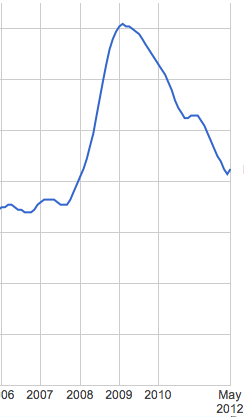
You’d think a newspaper might want to point out that MI’s unemployment actually turned around in August 2009–well before Snyder’s election in 2010 and not coincidentally the month after GM came out of bankruptcy. Unemployment dropped 3.3% before Snyder took over, dropped a further 2.6% after he did. But more significantly, unemployment in MI has started to creep up again–it’s up .7% since its recent low in April, to 9%.

Setting that record straight is critical to the rest of the article, since it repeatedly gushes about Rick Snyder refusing to deny Obama credit for MI’s turnaround.

Just before the Republican primary in Michigan in February, Mr. Snyder was asked in an interview whether Mr. Obama ought to be given credit for the state’s economic improvements. “I don’t worry about blame or credit,” he said. “It’s more about solving the problem.”

Nowhere in the article does “reporter” Monica Davey consider the possibility that Obama–and, in fact, Jennifer Granholm–have more to do with the turnaround than Snyder. Yet even many Republicans in this state would grant that the successful bailout of Chrysler and GM had a lot to do with the turnaround (though Republicans almost universally ignore the energy jobs Obama focused on MI).

So maybe Snyder refuses to deny Obama credit because such a claim would not be credible? It’s not a possibility the NYT article–which is supposed to be a celebration of a lack of ideology–even considers.

Which brings me to the other area where NYT’s idea of what constitutes balance is completely whacked: its treatment of the right to organize.

Read more

Share this entry

Another Week, Another Bankster with Impunity

This week, the bankster who will avoid all legal accountability is MF Global and its CEO Jon Corzine. So says the NYT.

While I’m disgusted by that news, I’m not shocked. I’ve grown used to the guarantee that top banksters are immune from all laws.

What I’m interested in is how NYT conveys their news.

First, note what crime they claim MF Global might have committed: fraud. Not theft.

After 10 months of stitching together evidence on the firm’s demise, criminal investigators are concluding that chaos and porous risk controls at the firm, rather than fraud, allowed the money to disappear, according to people involved in the case.

I guess if you said “theft” then you couldn’t suggest the money just disappeared–poof!–rather than got taken to pay off the company’s own obligations.

Plus it’d be a lot harder to accomplish the article’s other main objective, besides reporting yet another Get Out of Jail Free card. While the story seems to have been seeded by people in Preet Bharara’s neighborhood to set the expectation that he would once again fail to bring charges against a bankster, the NYT seems intent on rehabilitating Corzine’s reputation. Consider that they dedicate paragraphs 6 and 7 portraying the tragic plight of a multi-millionaire with a cloud hanging over him.

While the government’s findings would remove the darkest cloud looming over Mr. Corzine — the threat of criminal charges — the former Goldman Sachs chief is not yet in the clear. Read more

Share this entry

John Brennan Vows to Combat the “Bad Guys” Attacking Our Critical Infrastructure

John Brennan just gave a speech, purportedly about our policy in Yemen. But it ended up being largely about infrastructure, That’s partly because his speech focused on how, rather than spending 75% of our Yemen funds on bombs, we’re now spending just 50% (having bumped up the total to include an equal amount development assistance). So a good part of his talk focused on whether or not Yemen would be able to do the critical work of rebuilding its infrastructure sufficient to combat AQAP which, in some areas, has done a better job of building infrastructure.

Of course as I noted while he spoke, a number of the infrastructure challenges Brennan confidently assured we could help rebuild–things like access to water–are challenges we are increasingly failing in our own country.

And then, because the DC attention span had had enough of Yemen, moderator Margaret Warner asked Brennan what the Administration will do now that their cybersecurity bills have been defeated. To justify his talk of using Executive Orders to address some of the infrastructure problems, Brennan talked about the “bad guys” who posed a cyberthreat to our critical infrastructure.

Nowhere did Brennan acknowledge the much more immediate threat to our critical infrastructure: in the corporations and politics that let it decline. PG&E and Enbridge, failing to invest the money to fix known defects in their pipelines. Fracking companies, depleting and degrading our water supply. Verizon, eliminating choice for Internet access for rural customers. Republicans who want to gut our Postal Service and passenger rail. And heck, even Fat Al Gore and climate change, which is not only depleting our water supply but stalling key water transport routes.

Brennan promises to help rebuild Yemen’s infrastructure. But not only can’t he implement his plan against the bogeyman “bad buys” threatening our infrastructure, he seems completely unaware that those “bad guys” aren’t anywhere near the biggest threat to our infrastructure.

Don’t get me wrong. I applaud the Administration’s decision to dedicate money to Yemen’s infrastructure, even if I think a 50/50 split, aid to bombs, is still woefully inadequate. But until we begin to see what “bad guys” pose the biggest threat to our own infrastructure, I’m skeptical our efforts in Yemen will be any more successful than they were in Iraq or Afghanistan.

Share this entry

Big US Banks Have Gained Market Share in the Looter Assistance Business

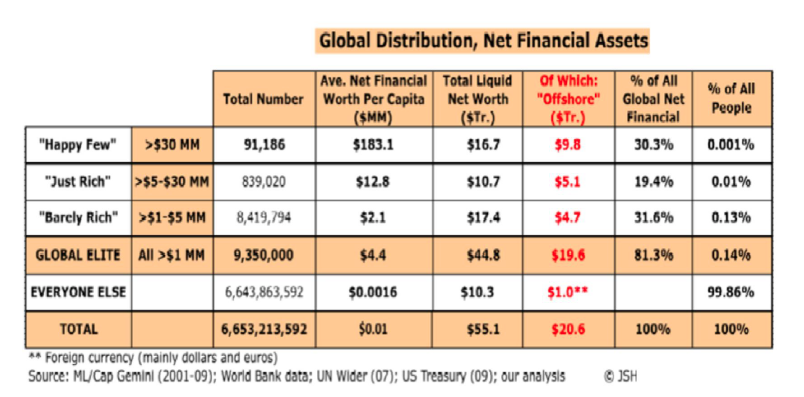
As I noted earlier, the Tax Justice Network just released a study showing that there is somewhere between $21 and 32$ Trillion that tax cheats have hidden in tax havens. Really obscenely rich people like Mitt Romney make up for $9.8 trillion of that–or about 18% of the total liquid net worth in the world, hidden away in tax havens.

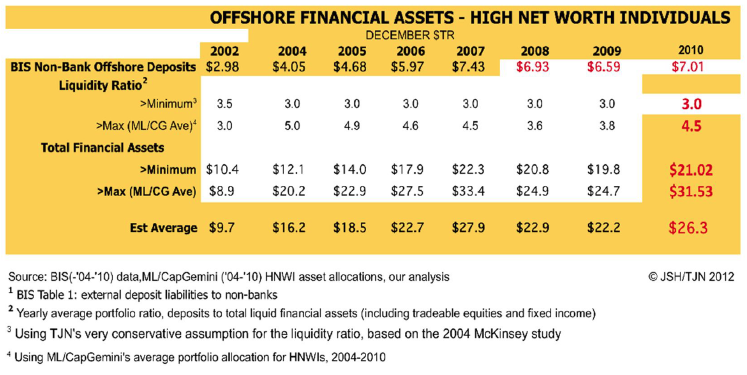
But there are two other tables from the study that bear notice. The study suggests that the money stashed in tax havens has been growing steadily at a rate of 16% a year.

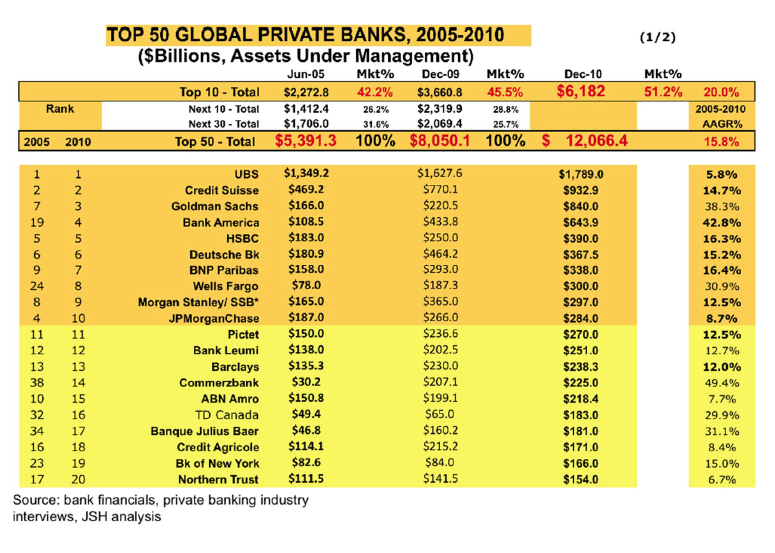
Our analysis finds that at the end of 2010 the Top 50 private banks alone collectively managed more than $12.1 trillion in cross-­‐border invested assets for private clients, including their trusts and foundations. This is up from $5.4 trillion in 2005, representing an average annual growth rate of more than 16%.

But that’s sort of misleading. As the table above makes clear, the amount in tax havens grew by 67% between 2002 and 2004, then grew by 40% in the following two years, then by another 23% in the last year of the bubble. Then it crashed, basically losing that 23% and plateauing for a year. And then it started growing again, 18% between 2009 and 2010. And who knows how much in the last year?

The banksters paid a price for 2 years, but the looting has begun again.

What I find particularly interesting–though I’m not sure what to make of it–is the changing share of looter service the big banks are doing. While UBS’ tax shelter dollars continued to grow, they lost market share among tax cheats. Meanwhile Goldman Sachs’ tax shelter dollars almost quadrupled in that time. Bank of America and Wells Fargo made big gains too (though Morgan Stanley’s tax cheat business shrank and JP Morgan’s was somewhat flat.

Like I said, I don’t know what to make of it. But it sure seems like since the crash at least some of the banks have decided to recover by catering to tax cheats.

Lovely. Some of the same banks that are still in business because tax payers bailed them out are increasingly some of the biggest players in facilitating the looting of our own–and every other–country.

Update: This Title was changed.

Share this entry

Mitt and His Buddies Looted Almost $10 Trillion from Real Economy

The Tax Justice Network just released an updated version of a report showing how much money gets siphoned out of the real economy into tax shelters: conservatively, $21 Trillion, and possibly as much as $32 Trillion.

I’ll have more to say about what the report says about the how the super wealthy have done in the last decade and which banks have been helping to loot the real economy.

But for now, consider where Mitt Romney fits into this picture. TJN shows that it’s really just the richest of the rich–those 91,186 people who make up the top .001%–that account for the biggest chunk ($9.8 Trillion) of this looting.

Not only is Mitt a member of that tiny club. But his net worth–commonly reported to be $250 Million but, given all the secrecy, possibly much more–puts him well above the mean $183 Million that members of this club enjoy.

And Mitt and his buddies in this very elite club have stashed 18% of the total liquid net worth of the world in places where not only can’t potential presidential voters know about it, but it also remains outside the kind of circulation that would really contribute to real economic growth.

Last week, Obama released an ad that said Mitt is the problem. TJN shows just what a big problem Mitt and his buddies really are.

Share this entry

Trained in America; Clothed in China

When ABC reported last week that the $1,400-$1,900+ uniforms Ralph Lauren won the contract to provide to Olympic athletes were made in China, Sherrod Brown not only pushed the US Olympic Committee to try to rectify the issue by the Winter 2014 Olympics, but he introduced a bill to require Federal uniforms to be made in the US (currently, they must be 51% US made).

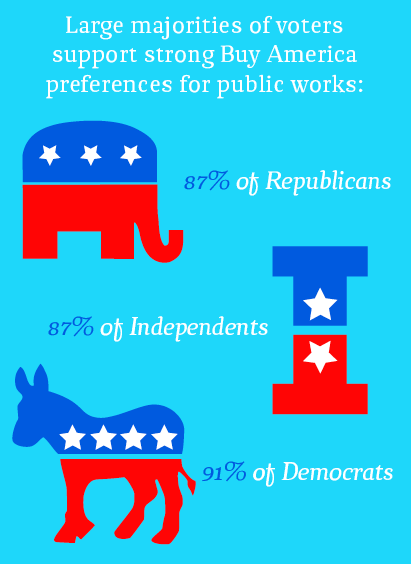
But the news–which came out just before the Alliance for American Manufacturers released their yearly poll showing near unanimous support for what could be called an industrial policy to support US manufacturing–had a more interesting public relations effect.

For example, after CNN posted a list of US manufactured clothes in response to the uniform news, the sales of Lawson Nickol’s Ohio company, All American Clothing Company, skyrocketed to 14 times what they normally would be.

Brown had a conference call with Nickols (whose company is located outside of Dayton) and Youngstown native Nanette LePore (whose clothes are manufactured in the US, though of foreign–usually Italian–cloth) to talk about efforts to bring back clothing manufacture to the US.

Both make a profit–though not the same margins they’d make if they outsourced to China. LePore noted that Ralph Lauren spends his money on advertising rather than manufacturing. Nickols claimed his jeans last longer, which helps to offset the somewhat four times higher costs. But ultimately they were both sacrificing some profit to keep manufacturing close. For Nickols, it seems like a quality and patriotic issue. It’s patriotic for LePore, too, but manufacturing in midtown Manhattan also gives her much more direct control over her line.

And both mentioned things that would help bring clothing manufacturing back to the US–much of it pertaining to sourcing for lower cost runs.

At this point, we’re largely talking about symbolic gestures: Olympic uniforms, Federal uniforms, jeans made 6 hours away. But the underlying message seems to be (and AAM’s poll backs this up abstractly) that people will seek out things made in the US.

Share this entry

No Banksters Were Harmed in the Production of This Anti-Crime Video

[YouTube]nV2cYC9IfNc[/youtube]

The United Nations Office on Drugs and Crime has rolled out a campaign to raise awareness of Transnational Crime.

$870 billion dollars a year. Including $250 billion on counterfeit goods. $320 billion on drugs. $32 billion on human trafficking. $250B on illegal arms.

But nowhere did the UNODC include the crimes of multinational banks.

Not the gaming of a key market measure, LIBOR. Not the theft of customer money. Not the theft of millions of homes through foreclosure fraud, or the massive fraud involved in the inflating of the housing bubble. It’s not even clear the UNODC includes the banks’ stake in all this illicit trade.

In short, while the UNODC laudably wants to draw attention to how much of our transnational trade benefits gangsters and thugs, it left an entire category–perhaps the most insidious–of thugs out of its reporting (the same blind spot the US government had when it rolled out sanctions against TCOs).

At this point, there’s no getting around it, no matter how much polite society would like to deny this fact. If we want to go after TCOs–and we should–we need to go after the cornerstone of transnational crime, which is increasingly the banks the government and international community has been propping up for the last 5 years.

Share this entry

Yesterday’s Some-Sayers Have Become Today’s Fact-Checkers

Paul Krugman makes a very good argument why the Bain attacks on Mitt Romney are necessary.

There is, predictably, a mini-backlash against the Obama campaign’s focus on Bain. Some of it is coming from the Very Serious People, who think that we should be discussing their usual preoccupations. But some of it is coming from progressives, some of whom are apparently uncomfortable with the notion of going after Romney the man and wish that the White House would focus solely on Romney’s policy proposals.

This is remarkably naive. I agree that the awfulness of Romney’s policy proposals is the main argument against his candidacy. But the Bain focus isn’t a diversion from that issue, it’s complementary. Given the realities of politics — and of the news media, as I’ll explain in a minute — any critique of Romney’s policies has to make use of his biography.

The first point is that voters are not policy wonks. They do not go to the Tax Policy Center website to check out distribution tables. And if a politician cites those distribution tables in his speeches, well, politicians say all kinds of things.

Nor, alas, can we rely on the news media to get the essentials of the policy debate across to the public — and not just because so many people get their news in quick snatches via TV. The sad truth is that the cult of balance still rules. If a Republican candidate announced a plan that in effect sells children into indentured servitude, the news reports would be that “Democrats say” that the plan sells children into indentured servitude, with each quote to that effect matched by a quote from a Republican saying the opposite.

He’s right. While I alluded to this in my post on Glenn Kessler’s changing belief in the seriousness of SEC filings, it deserves exposition directly. Glenn Kessler, back in the days when it was time to distinguish Gore’s economic plans from Bush’s, back in the days when it was time to consider whether Bush’s huge tax cuts would serve the interest of the country, committed just that kind of journalistic sin.

I pointed to this May 3, 2001 story, titled, “Some See Deficiencies in Bush’s Budget Math,” as just one example. It cited Rudolph Penner as the only expert speaking in any way supportively of Bush’s tax cut.

This fiscal situation, despite the uncertainties, is extraordinarily good.

But of course, Penner doesn’t actually say the tax cut is a good idea, just that Bush effectively inherited a good fiscal situation from Clinton.

Kessler then goes on to provide a bunch of anonymous quotes from Bush officials about the tax cuts–many admitting they’re not providing a full picture of the cuts and budget increases–as well as Ari Fleischer providing an excuse for why Bush didn’t include the cost to privatize social security in his estimates.

Which leaves this as the only non-Administration quote in support of the tax cuts.

“Look, [the spending ceiling is] going to hold because you have a different team,” said Sen. Pete V. Domenici (R-N.M.). “We’ve got the president in town.”

Compare that to evidence like this:

“The president is proving his critics right,” said William G. Gale, a budget expert at the Brookings Institution. “The ink isn’t even dry on the tax cut, and he’s already moving ahead on Social Security and defense. The president’s budget adds up only if you think the government will not do anything other than it has been doing.”

[snip]

One budget expert calculated that just the $100 billion in tax refunds will result in $73 billion in additional interest payments over the next 11 years. The entire tax cut would increase interest costs by about $400 billion, thus reducing the surplus by $1.75 trillion.

The budget agreement would increase spending on annually funded federal programs in fiscal 2002 by 4.9 percent, or about $667 billion, slightly higher than the 4 percent sought by the president. The rest of the nearly $2 trillion federal budget goes to pay for programs whose costs can’t be easily reduced — Social Security and Medicare, and interest payments on the national debt.

And while Kessler likely didn’t stamp that case with the “Some Say” headline, he failed to do what a journalist presenting such evidence should have: said clearly that Bush’s budget numbers didn’t add up, even before you accounted for the increases in defense and social security spending Bush planned (to say nothing of unexpected expenses like post-9/11 Homeland Security and two wars).

Mind you, that wasn’t the only version of such a story Kessler wrote. He also wrote the following “Some Say” stories:

May 3, 2000: Candidates Duel Over Tax Cuts; Gore and Bush Trade Analytical Shots, Seeking an Imprimatur of Fiscal Responsibility

Read more

Share this entry

BREAKING! Importers Get Cost-Benefit Consideration, But You Don’t

The Department of Homeland Security just blew off a deadline, last Thursday, to scan all US-bound shipping containers.

The Department of Homeland Security was given until this month to ensure that 100 percent of inbound shipping containers are screened at foreign ports.

But the department’s secretary, Janet Napolitano, informed Congress in May that she was extending a two-year blanket exemption to foreign ports because the screening is proving too costly and cumbersome. She said it would cost $16 billion to implement scanning measures at the nearly 700 ports worldwide that ship to the United States.

Instead, the DHS relies on intelligence-gathering and analysis to identify “high-risk” containers, which are checked before being loaded onto ships. Under this system, fewer than half a percent of the roughly 10 million containers arriving at U.S. ports last year were scanned before departure. The DHS says that those checks turned up narcotics and other contraband but that there have been no public reports of smuggled nuclear material.

You’ll see discussions about this measuring the relative danger of shipping containers: the possibility terrorists could ship a nuke or weapons to the US using a shipping container. You’ll see Janet Napolitano’s purportedly prohibitive cost–$16B–as rationale not to implement 100% scanning.

But what you won’t see is a discussion of why you have to be scanned not only every time you return to the US from another country, but every time you get on a plane, while cheap plastic goods from China don’t have to be.

The underlying message, though, after spending $360B implementing security measures that inconvenience you, many of which have no real effect on security, $16B is suddenly too much to spend on security measures on shipping.

Of course that’s not the cost Napolitano’s concerned about. She’s concerned about the cost the time delay of scanning shipping containers has on imports. She’s worried that implementing security measures will raise the price of cheap plastic goods from China.

Perhaps that might make US-manufactured goods more competitive against imports?

Of course, the $360B Homeland Security has paid on security infrastructure–including things like $170,000 backscatter machines at every airport, for example–doesn’t pay for the extra time it takes you to get through an airport, the extra time it takes you to drive rather than fly on closer trips, the decline in airline travel because flying is a pain in the ass., the actual fees the airlines charge you for the privilege of undergoing security theater before you get on a plane.

You are being asked to pay the security costs of your plane travel, but importers are not asked to pay the security externalities of shipping cheap goods to the US that undercut American manufactured goods. If something does blow up at a port, we’ll all be paying that price because Napolitano and her predecessors refused to ask shippers to pay their fair share.

This is a good time to talk about scanning shipping containers for security reasons. But it’s also a good time to ask why you’re treated with less respect than importers are.

One more point: scanning shipping containers would not just help prevent terrorism. It would help fight the war on drugs, counterfeits, illegal immigration, all of which use shipping containers to violate the borders of the US too. Precisely the same “wars” the Administration has fought so ruthlessly elsewhere would benefit from scanning shipping containers too.

But still the importers’ concerns win out.

Share this entry