Why Is the Superintendent of Financial Services Policing our Iran Sanctions?

NY’s Superintendent of Financial Services, Benjamin Lawsky, yesterday dropped the hammer on the UK’s Standard Chartered Bank, accusing it of doctoring financial documents to facilitate the laundering of Iranian money through its US banks.

Like Yves, I think one of the most striking details about this story is that SFS–and not Treasury’s Office of Foreign Assets Controls–is making the accusation.

But it also appears that Lawsky has end run, as in embarrassed, the Treasury and the New York Fed. As part of its defense, SCB contends it was already cooperating with Federal regulators:

In January 2010, the Group voluntarily approached all relevant US agencies, including the DFS, and informed them that we had initiated a review of historical US dollar transactions and their compliance with US sanctions…The Group waived its attorney-client and work product privileges to ensure that all the US agencies would receive all relevant information.

The agencies in question are “DFS, the Department of Justice, the Office of Foreign Assets Control, the Federal Reserve Group of New York and the District Attorney of New York.”

[snip]

The lack of action by everyone ex the lowly New York banking supervisor is mighty troubling. The evidence presented in Lawsky’s filing is compelling; he clearly has not gone off half cocked. Why has he pressed forward and announced this on his own? The Treasury Department’s Office of Terrorism and Financial Intelligence has supposedly been all over terrorist finance; the consultants to that effort typically have very high level security clearances and top level access (one colleague who worked on this effort in the Paulson Treasury could get the former ECB chief Trichet on the phone). For them not to have pursued it anywhere as aggressively as a vastly less well resourced state banking regulator, particularly when Iran is now the designated Foreign Enemy #1, does not pass the smell test.

Normally, we’d see accusations like SFS released today from Treasury’s OFAC, perhaps (for charges as scandalous as these) in conjunction with the NY DA and/or a US Attorney. And yet OFAC has had these materials in hand for 2 years, and has done nothing.

In fact, we have a pretty good idea what OFAC’s action would look like, because earlier this year it sanctioned ING for actions that were similar in type, albeit larger in number (20,000 versus 60,000) and far larger in dollar amount ($1.6 billion involving Cuba versus $250 billion involving Iran). Both banks were doctoring fields in SWIFT forms to hide the source or destination of their transfers.

ING:

Beginning in 2001, ING Curacao increasingly used MT 202 cover payments to send Cuba-related payments to unaffiliated U.S. banks, which would not have to include originator or beneficiary information related to Cuban parties. For serial payments, up until the beginning of 2003, NCB populated field 50 of the outgoing SWIFT MT 103 message with its own name or Bank Identifier Code, Beginning in the second quarter of 2003, NCB populated field 50 with its customer’s name, but omitted address information. ING Curacao also included its customer’s name, but no address information, in field 50 of outgoing SWIFT messages.

SCB:

Rather than institute  [a required to ensure the funds didn’t come from Iran], SCB instead conspired with Iranian Clients to transmit misinformation to the New York branch by removing and otherwise misrepresenting wire transfer data that could identify Iranian parties. For example, regarding necessary wire transfer documentation, SCB instructed CBI/Markazi to “send in their MT 202‟s with a [SCB London‟s business identifier code] as this is what we required them to do in the initial set up of the account. Therefore, the payments going to NY do not appear to NY to have come from an Iranian Bank.” (emphasis added). SCB also accomplished this subterfuge by: (a) inserting special characters (such as “.”) in electronic message fields used to identify transacting parties; Read more

Share this entry

“They Were Suspending My Credit Line”

[youtube]pf7Cxj5BZw8[/youtube]

So Mitt is still trying to dig himself out of the hole he created when he declared, “Let Detroit go bankrupt”?

I suspect most of the commentary on this ad will focus on the irony that, had Mitt had his way, all of GM’s dealers would have gone under, and without the buyout deals they ultimately got.

Me, I’m a bit surprised that Mitt didn’t choose an IN Chrysler dealer. Not only did Chrysler offer its dealers a much stingier package, but some dealers from IN fought losing their franchises all the way to SCOTUS, and some are still suing over “takings.”

But I’m most surprised by the sparse language used here to portray a dealer closure: “I received a letter from General Motors: they were suspending my credit line.”

Credit lines?!?!? Mitt wants to tug at heart strings and hit Obama with an attack akin to the Bain attacks that are working so well in swing states by invoking credit lines?!?!? Really?

Yes, it is true that at the heart of any car dealer is a credit line. But by including that in this ad, it seems to me, Mitt does several things. It reminds everyone who knows what role a credit line plays in a car dealer that the precipitating cause of the auto crash was the credit crash. It reminds viewers that the banksters, in killing their own industry, also killed the car industry. And not just any banksters, either. In GM’s case, the bankster in question was 51% owned by Cerberus Capital, a bunch of high profile Republicans (Dan Quayle and John Snow, among others) who were trying to do what Mitt got rich off: looting companies (in Cerberus’ case, including Chrysler) while profiting from the financialization that such looting offered. Only they were so bad at it, they effectively had to be bailed out by the taxpayers along with GM and Chrysler.

Thus, the villain in this ad–at least as described by the dealer–is someone just like Mitt, only stupider. The villain in the ad is not Obama–not to people who know how the auto industry works. It’s Mitt’s stupid Republican friends.

Share this entry

Big US Banks Have Gained Market Share in the Looter Assistance Business

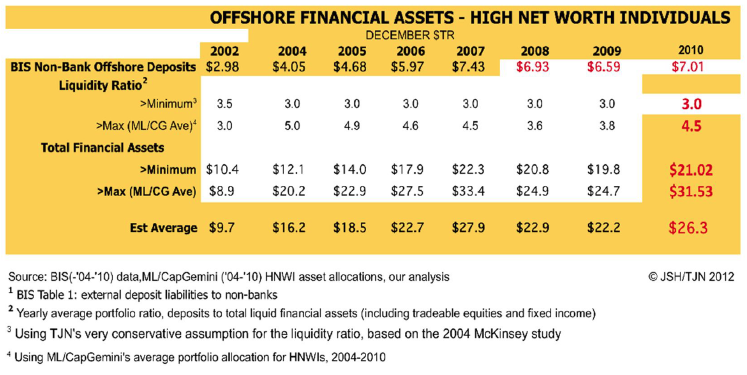
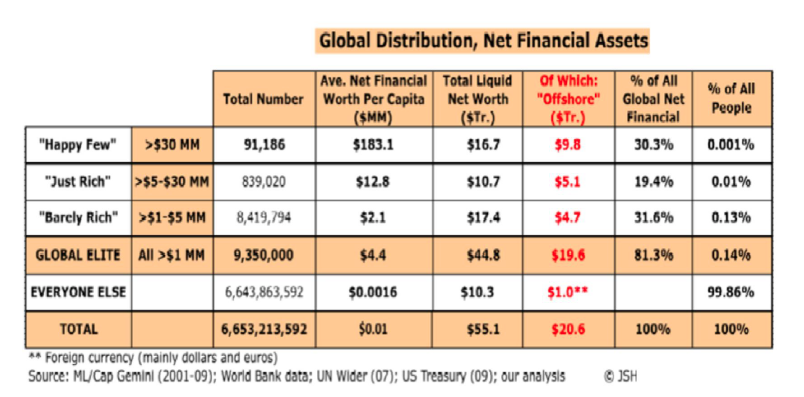
As I noted earlier, the Tax Justice Network just released a study showing that there is somewhere between $21 and 32$ Trillion that tax cheats have hidden in tax havens. Really obscenely rich people like Mitt Romney make up for $9.8 trillion of that–or about 18% of the total liquid net worth in the world, hidden away in tax havens.

But there are two other tables from the study that bear notice. The study suggests that the money stashed in tax havens has been growing steadily at a rate of 16% a year.

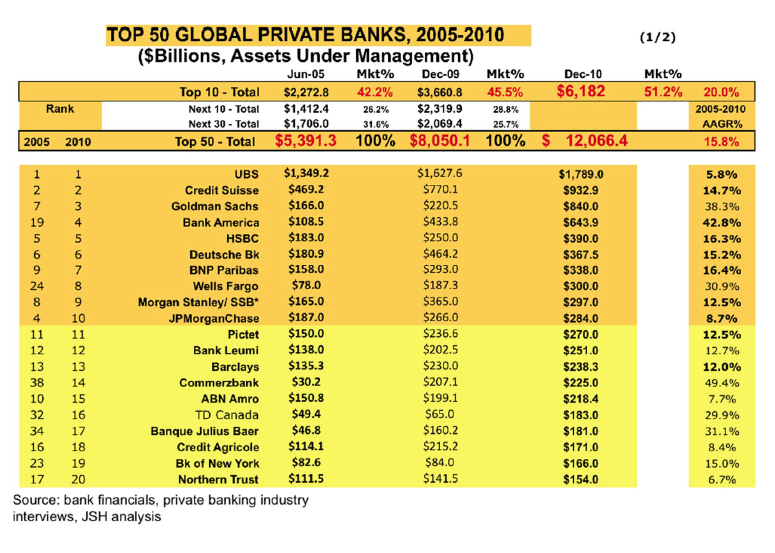
Our analysis finds that at the end of 2010 the Top 50 private banks alone collectively managed more than $12.1 trillion in cross-­‐border invested assets for private clients, including their trusts and foundations. This is up from $5.4 trillion in 2005, representing an average annual growth rate of more than 16%.

But that’s sort of misleading. As the table above makes clear, the amount in tax havens grew by 67% between 2002 and 2004, then grew by 40% in the following two years, then by another 23% in the last year of the bubble. Then it crashed, basically losing that 23% and plateauing for a year. And then it started growing again, 18% between 2009 and 2010. And who knows how much in the last year?

The banksters paid a price for 2 years, but the looting has begun again.

What I find particularly interesting–though I’m not sure what to make of it–is the changing share of looter service the big banks are doing. While UBS’ tax shelter dollars continued to grow, they lost market share among tax cheats. Meanwhile Goldman Sachs’ tax shelter dollars almost quadrupled in that time. Bank of America and Wells Fargo made big gains too (though Morgan Stanley’s tax cheat business shrank and JP Morgan’s was somewhat flat.

Like I said, I don’t know what to make of it. But it sure seems like since the crash at least some of the banks have decided to recover by catering to tax cheats.

Lovely. Some of the same banks that are still in business because tax payers bailed them out are increasingly some of the biggest players in facilitating the looting of our own–and every other–country.

Update: This Title was changed.

Share this entry

Mitt and His Buddies Looted Almost $10 Trillion from Real Economy

The Tax Justice Network just released an updated version of a report showing how much money gets siphoned out of the real economy into tax shelters: conservatively, $21 Trillion, and possibly as much as $32 Trillion.

I’ll have more to say about what the report says about the how the super wealthy have done in the last decade and which banks have been helping to loot the real economy.

But for now, consider where Mitt Romney fits into this picture. TJN shows that it’s really just the richest of the rich–those 91,186 people who make up the top .001%–that account for the biggest chunk ($9.8 Trillion) of this looting.

Not only is Mitt a member of that tiny club. But his net worth–commonly reported to be $250 Million but, given all the secrecy, possibly much more–puts him well above the mean $183 Million that members of this club enjoy.

And Mitt and his buddies in this very elite club have stashed 18% of the total liquid net worth of the world in places where not only can’t potential presidential voters know about it, but it also remains outside the kind of circulation that would really contribute to real economic growth.

Last week, Obama released an ad that said Mitt is the problem. TJN shows just what a big problem Mitt and his buddies really are.

Share this entry

No Banksters Were Harmed in the Production of This Anti-Crime Video

[YouTube]nV2cYC9IfNc[/youtube]

The United Nations Office on Drugs and Crime has rolled out a campaign to raise awareness of Transnational Crime.

$870 billion dollars a year. Including $250 billion on counterfeit goods. $320 billion on drugs. $32 billion on human trafficking. $250B on illegal arms.

But nowhere did the UNODC include the crimes of multinational banks.

Not the gaming of a key market measure, LIBOR. Not the theft of customer money. Not the theft of millions of homes through foreclosure fraud, or the massive fraud involved in the inflating of the housing bubble. It’s not even clear the UNODC includes the banks’ stake in all this illicit trade.

In short, while the UNODC laudably wants to draw attention to how much of our transnational trade benefits gangsters and thugs, it left an entire category–perhaps the most insidious–of thugs out of its reporting (the same blind spot the US government had when it rolled out sanctions against TCOs).

At this point, there’s no getting around it, no matter how much polite society would like to deny this fact. If we want to go after TCOs–and we should–we need to go after the cornerstone of transnational crime, which is increasingly the banks the government and international community has been propping up for the last 5 years.

Share this entry

Glenn Kessler Didn’t USED to Treat SEC Filings as Boilerplate

As gobsmacked as I am that no one can seem to find the people running Bain Capital from 1999 to 2002, when Mitt Romney was officially listed as its CEO, Chairman, and President, I’m equally shocked by Glenn Kessler’s claims that SEC documents are not to be trusted.

Kessler’s scarequoted SEC documents

On Thursday, Kessler suggested SEC filings don’t mean what they say.

There appears to be some confusion about how partnerships are structured and managed, or what SEC documents mean. (Just because you are listed as an owner of shares does not mean you have a managerial role.)

Then on Friday, he mocked the journalistic convention that treated “SEC documents” (his scarequotes) as factual.

There is a journalistic convention that appears to place great weight on “SEC documents.” But these are public filings by companies, which usually means there are not great secrets hidden in them. The Fact Checker, in an earlier life covering Wall Street, spent many hours looking for jewels in SEC filings.

[snip]

We had examined many SEC documents related to Romney and Bain in January, and concluded that much of the language saying Romney was “sole stockholder, chairman of the board, chief executive officer, and president” was boilerplate that did not reveal whether he was actually managing Bain at the time. (For instance, there is no standard definition of a “chief executive,” securities law experts say, and there is no requirement for anyone to have any responsibilities even if they have that title.)

Trillions of dollars are traded based on what these documents say, but a purportedly respectable journalist who used to cover Wall Street says they’re just boilerplate.

Only, he didn’t used to say that.

As Kessler reminds his readers, he used to cover finance. So to see how he, as a finance reporter, treated SEC documents, I thought I’d review what he wrote during precisely the period Mitt’s corporate whereabouts are in such dispute, 1999 to 2002. Kessler covered finance at the WaPo from the time he moved there in 1998 until about May 2, 2002, when he started covering foreign affairs. Thus, Kessler stopped covering finance just weeks after the time Mitt resigned from the boards of Marriott and Staples (presumably Mitt’s severance deal with Bain was around the same time).

SEC filings, more SEC filings, and no boilerplate

It was an interesting time to cover finance, too. In addition to a slew of articles engaged in one-side, other-side journalism citing experts warning that Bush’s tax cuts might bring back deficit spending but Pete Domenici and Ari Flesicher saying they wouldn’t so he couldn’t really be sure, Kessler covered growing awareness about tax havens, the end of the Dot-Com bubble, the AOL Time-Warner merger, and Enron. And in a number of those stories he treated earnings reports and other SEC documents as transparent truth.

Kessler pointed to corporate earnings reports for a January 29,1999 story predicting the economy would begin to slow.

Corporate earnings are closely watched on Wall Street because, in a world of dreams, deals and wild bets, earnings are real; they are the equivalent of batting averages for baseball addicts. Corporate earnings also provide hints on the general direction of the economy, which is why some analysts remain downbeat about the economy in the coming year despite the string of positive earnings reports. [my emphasis]

And he looked at them in very close detail.

Individual corporate earnings reports also turn up nuggets of how companies have boosted their profits. Compaq Computer Corp., the world’s number two computer maker, said Wednesday that fourth-quarter earnings rose a better-than-expected 2.2 percent. Profits rose to 43 cents a share, compared with 42 cents in the same period of 1997. But tax credits from Compaq’s purchase of Digital Equipment Corp. last year significantly cut the company’s tax rate, boosting net income about 5 cents a share.

In a January 13, 2000 story explaining different estimates for the value of the AOL Time-Warner deal, Kessler reveals the WaPo was the only paper to look beyond stock price in its calculations; it included Time-Warner’s debt, presumably gleaned from SEC documents.

Read more

Share this entry

Fat Al Gore Colludes with Banksters in the Midwest

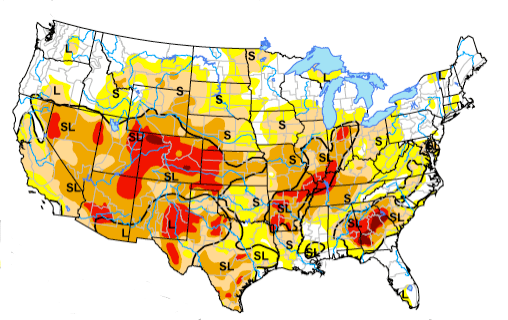
There’s an ominous storm brewing in flyover country that may amount to little more than higher food and fuel prices, or may amount to something else.

First there’s the drought. Last week’s heat wave and the last month’s dry weather hit just as much of America’s corn crop was set to pollinate. And if the corn doesn’t pollinate, it never grows kernels. Even as I’ve been writing this post, USDA sharply cut forecasts for the corn harvest.

As a result, corn prices (soy prices too) are rising sharply. Which will, for better and worse, have repercussions on all the aspects of our super-processed life that relies on corn.

“The drought of 2012 will be one for the records,” said Peter Meyer, the senior director for agricultural commodities at PIRA Energy Group in New York, who forecasts a drop in output to 11 billion bushels if the hot, dry spell lasts another three weeks. “Whether it’s ethanol or livestock, no one is immune from this impending disaster. The ramifications will be widespread, affecting everything from your food to your gasoline.”

And all that’s before any follow-on effects, if the drought continues. Even in Grand Rapids, we’ve had some unusual fires. Rivers that were experiencing historic floods last year are approaching record lows this year; traffic on the Mississippi has already slowed.

Yet all that–even with our country’s industrialized reliance on corn–might be no more concerning than other droughts, such last year’s drought in Texas.

Meanwhile, banksters keep stealing farmers’ money–first via MF Global and now with Peregrine.

The U.S. futures industry reeled as regulators accused Iowa-based PFGBest of misappropriating more than $200 million in customer funds for more than two years, a new blow to trader trust just months after MF Global’s collapse.

Read more

Share this entry

First They Came for WikiLeaks … Then They Came for Pot Dispensaries … Then Online Sharing

Remember when Visa and PayPal cut off services to WikiLeaks as a result of what was clearly Administration pressure? The Administration never explicitly revealed it had pressured the financial services companies to cut off WikiLeaks. It never offered any due process. Just–poof! WikiLeaks was no longer welcome to use a public service other corporate-people were able to.

And almost no one blinked at that abuse of due process.

Then Visa and MasterCard cut off pot dispensaries in California.

Your credit is no longer any good at California medical marijuana dispensaries, whose accounts with credit card processors have been canceled, thanks to pressure from the federal government.
Merchant services providers — the intermediaries between retailers and credit card companies who process customers’ payments — began informing their medical marijuana dealing clients that cannabis credit card transactions would not be processed after July 1, according to Stephen DeAngelo, Executive Director of Oakland’s Harborside Health Center.
No government agency is taking credit for making marijuana a cash-only business. But the “factual pattern” is as follows, DeAngelo said: Officials from the Treasury Department flexed on credit card companies, who then informed merchant services providers that they’d be “dropped from Visa and MasterCard forever” unless they stopped processing medical marijuana payments.

And PayPal has imposed new terms of services on file-sharing sites that will allow it to monitor sites for content.

According to TorrentFreak, PayPal has recently changed its terms of service, making requirements for file-sharing and newsgroup services far tighter than before.

The payment service, owned by eBay, now requires that “merchants must prohibit users from uploading files involving illegal content and indicate that users involved in such file transfers will be permanently removed from their service,” and that “merchants must provide PayPal with free access to their service, so PayPal’s Acceptable Use Policy department can monitor the content.”

The pot dispensary move is really heartless: as the article points out, it means customers have to walk around with wads of cash. And since a lot of medical marijuana customers are on disability, it means poor people can’t afford themselves the flexibility offered by credit cards.

And in addition to the specific injustice of undermining otherwise legal businesses, there’s the general issue. As it does with international financial exchange, so the Government is now doing with corporate entities in the US, picking and choosing which ones will have access to modern financial services and which won’t.

It’s an arbitrary exercise of power against entities the government can’t or won’t make a legal, due process entailing case against.

Maybe you’ll arbitrarily lose your credit card privileges next!

Share this entry

The Banksters Know They’re Banksters

The headline news from this survey is that almost a quarter of 500 bankster executives surveyed responded they need to engage in ethical or legal wrongdoing to succeed, and a sixth said they’d definitely engage in insider trading to make $10M if they knew they could get away with it.

In a survey of 500 senior executives in the United States and the UK, 26 percent of respondents said they had observed or had firsthand knowledge of wrongdoing in the workplace, while 24 percent said they believed financial services professionals may need to engage in unethical or illegal conduct to be successful.

Sixteen percent of respondents said they would commit insider trading if they could get away with it, according to Labaton Sucharow.

Couple those findings, though, with these responses from the survey showing that fewer than a third of those polled believe regulators are effective.

Only 30% of all respondents felt that the SEC/SFO effectively deters, investigates and prosecutes securities violations.

[snip]

With respect to FINRA and the FSA, only 29% of all respondents felt these agencies effectively deter, investigate and prosecute securities violations.

And those numbers are lower for American respondents than British ones.

The two details, together, are more important than in isolation. Not only do a significant proportion of finance execs admit they’d engage in wrongdoing if they wouldn’t get caught, but they also say the SEC and FINRA aren’t going to stop them.

No wonder the banksters keep crashing the economy.

Share this entry

Rupert Murdoch and the Invisible Hand Job of Capitalism

Someone let Rupert Murdoch free on Twitter again.

Libor ” scandal” very suspicious. 2008/9 huge crisis and Brown should defend pressure to keep rates down and prevent meltdown.

Don’t know, but suspect Diamond scapegoat used by old establishment who did not like energetic competitor.

So one of the richest and most powerful businessmen in the world–and the owner of America’s premiere business newspaper–considers the way the banks gamed a key market measure a scare-quote “scandal.” This newsman appears to suggest Gordon Brown (a man who has been trashing Murdoch relentlessly of late) should get out there and defend having his government tell Barclays to lie about how healthy it was, all to prevent a meltdown.

Nevermind the municipalities who got robbed in the process. Nevermind that the practice of gaming LIBOR started before the crash and reportedly continued after the danger had passed.

Rupert Murdoch appears to want to defend what Simon Johnson, cataloging the business press acknowledging what a big deal lying about LIBOR is, calls “Lie-More as a Business Model.”

I guess it shouldn’t surprise me. After all, some of Murdoch’s most important properties, starting with Fox, thrive on lying as a business model. But at a time when even the (British, at least) business community is finally awakening to what happens when the banksters reveal the “market” is just a bunch of really rich white guys operating behind a curtain, Rupert Murdoch is doubling down on lies.

Share this entry