
James Clapper’s Tip for Avoiding Lies: Don’t Do Talking Points

[youtube]QwiUVUJmGjs[/youtube]

For a guy who warned for years about an abuse of the FISA Amendments Act and Section 215 of the PATRIOT Act, I have to admit Ron Wyden was pretty circumspect  yesterday. He issued a statement, partly to reiterate his call to make this public, partly to suggest the program isn’t worth much.

The administration has an obligation to give a substantive and timely response to the American people and I hope this story will force a real debate about the government’s domestic surveillance authorities. The American people have a right to know whether their government thinks that the sweeping, dragnet surveillance that has been alleged in this story is allowed under the law and whether it is actually being conducted. Furthermore, they have a right to know whether the program that has been described is actually of value in preventing attacks. Based on several years of oversight, I believe that its value and effectiveness remain unclear.

And he sent out three tweets:

Of course, it’s the second tweet — showing the Director of National Intelligence lying in testimony to Congress about whether the NSA collects “any data at all on millions or hundreds of millions of Americans” — I found most interesting.

Wyden always has had a knack for exposing people as liars.

By the end of the day the National Journal had contacted Clapper to provide him an opportunity to explain why this lie to Congress wasn’t a lie. He offered a nonsensical explanation.

Director of National Intelligence James Clapper said Thursday that he stood by what he told Sen. Ron Wyden, D-Ore., in March when he said that the National Security Agency does not “wittingly” collect data on millions of Americans.

What I said was, the NSA does not voyeuristically pore through U.S. citizens’ e-mails. I stand by that,” Clapper told National Journal in a telephone interview.

On March 12, at a hearing of the Senate Intelligence Committee, Wyden asked Clapper: “Does the NSA collect any type of data at all on millions or hundreds of millions of Americans?” Clapper responded: “No, sir.” When Wyden followed up by asking, “It does not?” Clapper said: “Not wittingly. There are cases where they could, inadvertently perhaps, collect—but not wittingly.” Clapper did not specify at the time that he was referring to e-mail. [my emphasis]

Clapper’s lie — that he took Wyden’s “collected any type of data at all” to mean “voyeuristically pore through emails” — is all the worse for how bad a non-sequitur it is. Caught in a lie, the head of our Intelligence Community responded with word salad.

Given that abysmal attempt to explain away his lie, I find it all the more curious the Administration decided Clapper, newly exposed as a liar, would be the guy to head pushback to the revelations of the last few days. Late in the day Clapper issued first one, then another “statement” on the revelations.

Both, of course, issued stern condemnations of leaks revealing that he had lied (and that Americans have no privacy).

The unauthorized disclosure of a top secret U.S. court document threatens potentially long-lasting and irreversible harm to our ability to identify and respond to the many threats facing our nation.

[snip]

The unauthorized disclosure of information about this important and entirely legal program is reprehensible and risks important protections for the security of Americans.

Those are hollow warnings, of course, for the reasons I laid out here.

Clapper then goes on to claim that both stories misrepresent the programs.

The article omits key information regarding how a classified intelligence collection program is used to prevent terrorist attacks and the numerous safeguards that protect privacy and civil liberties.

[snip]

The Guardian and The Washington Post articles refer to collection of communications pursuant to Section 702 of the Foreign Intelligence Surveillance Act.  They contain numerous inaccuracies.

Worlds tiniest violin! After refusing urgent requests from members of Congress who had been briefed on this to be transparent for years, the Intelligence Community has lost its ability to spin this!

Perhaps the most interesting part of Clapper’s two statements, however, is the way Clapper purportedly clarified a detail about the WaPo/Guardian stories on PRISM.

Clapper — and an anonymous statement from a Senior Administration Official issued minutes before Clapper’s — made explicitly clear PRISM operates under Section 702 of the FISA Amendments Act.

Section 702 is a provision of FISA that is designed to facilitate the acquisition of foreign intelligence information concerning non-U.S. persons located outside the United States. It cannot be used to intentionally target any U.S. citizen, any other U.S. person, or anyone located within the United States.

Activities authorized by Section 702 are subject to oversight by the Foreign Intelligence Surveillance Court, the Executive Branch, and Congress. They involve extensive procedures, specifically approved by the court, to ensure that only non-U.S. persons outside the U.S. are targeted, and that minimize the acquisition, retention and dissemination of incidentally acquired information about U.S. persons.

Section 702 was recently reauthorized by Congress after extensive hearings and debate.

Section 702, Section 702, Section 702.

This claim had only been implicit in the reporting in the WaPo and Guardian.
Read more

Share this entry

Jim Sensenbrenner’s Horseshit Claims of Innocence

The reaction from members of Congress to the revelation that the Section 215 surveillance was just as bad as some of us have been warning has varied, with Dianne Feinstein and Saxby Chambliss reiterating claims about the value and oversight of the program (though not having any idea, according to DiFi, whether it has prevented any attacks), and Ron Wyden and Mark Udall effectively saying “I told you so.” John Boehner dodged aggressively, suggesting even though he had approved this surveillance President Obama had to explain it.

Asked whether lawmakers should answer for an order that fell under the Patriot Act they passed, Boehner disagreed. “The tools were given to the administration, and it’s the administration’s responsibility to explain how these tools are used,” he said. ”I’ll leave it to them to explain.”

By far the most disingenuous, however, was Jim Sensenbrenner, who (as he has emphasized to the credulous journalists who served as his stenographers today) wrote the PATRIOT Act, who has remained in a senior position on House Judiciary Committee since that day, and who now claims to be shocked — shocked! — there is dragnet collection going on in the casino he built.

Predictably, he wrote a letter demanding to know how a law he has fought to retain its current form could be used to do what the law authorizes.

In the letter, Sensenbrenner de-emphasizes the role of the relevance standard to the collection.

To obtain a business records order from the court, the Patriot Act requires the government to show that: (1) it is seeking the information in certain authorized national security investigations pursuant to guidelines approved by the Attorney General; (2) if the investigative target is a U.S. person, the investigation is not based solely on activities protected by the First Amendment; and (3) the information sought is relevant to the authorized investigation.

Compare that to the letter of the law, which requires the government to show,

(A) a statement of facts showing that there are reasonable grounds to believe that the tangible things sought are relevant to an authorized investigation (other than a threat assessment) conducted in accordance with subsection (a)(2) to obtain foreign intelligence information not concerning a United States person or to protect against international terrorism or clandestine intelligence activities, such things being presumptively relevant to an authorized investigation if the applicant shows in the statement of the facts that they pertain to—

(i) a foreign power or an agent of a foreign power;

(ii) the activities of a suspected agent of a foreign power who is the subject of such authorized investigation; or

(iii) an individual in contact with, or known to, a suspected agent of a foreign power who is the subject of such authorized investigation;

That is, the emphasis is not on the investigation, as Sensenbrenner’s interpretation would have it, but on the relevance of the information sought, which Sensenbrenner adds third. More importantly, Sensenbrenner omits all mention of the presumptively relevant conditions — basically something pertaining to a foreign power.

With his interpretation, Sensenbrenner has omitted something baked into Section 215, which is that so long as the government says this pertains to foreign spies or terrorists, the judge has almost no discretion on whether information is relevant to an investigation.

Then Sensenbrenner points to 2011 testimony from Acting Assistant Attorney General Todd Hinnen, who he claims said the following:

Section 215 has been used to obtain driver’s license records, hotel records, car rental records, apartment leasing records, credit card records, and the like. It has never been used against a library to obtain circulation records. . . On average, we seek and obtain section 215 ordersless than 40 times per year

Which Sensenbrenner uses to claim the Department never told the Committee about this dragnet.

The Department’s testimony left the Committee with the impression that the Administration was using the business records provision sparingly and for specific materials. The recently released FISA order, however, could not have been drafted more broadly.

As it happens, Hinnen has been testifying since at least 2009 that Section 215 authorizes other secret programs. So I checked Sensenbrenner’s work. Here’s what that precise passage of Hinnen’s testimony says, without the deceitful ellipsis.

Section 215 has been used to obtain driver’s license records, hotel records, car rental records, apartment leasing records, credit card records, and the like. It has never been used against a library to obtain circulation records. Some orders have also been used to support important and highly sensitive intelligence collection operations, on which this committee and others have been separately briefed. On average, we seek and obtain section 215 ordersless than 40 times per year. [my emphasis]

In other words, Sensenbrenner points to doctored proof he has been briefed on this secret program, but doctors it in such a way as to support his claim he never knew about this.

Not to mention that a series of DOJ Inspector General reports included classified appendices describing these secret collection operations.

Read more

Share this entry

Section 215: The White House’s Bullshit Talking Points

Here’s what the White House has offered as talking points to defend collecting (DiFi has confirmed) all the call data from all Americans since 2006. Interspersed is my commentary.

The article discusses what purports to be an order issued by the Foreign Intelligence Surveillance Court under a provision of the Foreign Intelligence Surveillance Act that authorizes the production of business records. Orders of the FISA Court are classified.

As they’ve done with drone strikes and, especially, WikiLeaks cables before, the Administration refuses to confirm that this is, in fact, what several members of Congress have made it clear it is: an authentic FISA Order that (as Dianne Feinstein revealed) is just the quarterly renewal of a program that goes back to the PATRIOT Act renewal in March 2006.

In other words, with its “talking points,” the Administration is recommitting to keeping this program legally secret, even though it’s not secret.

Everything that say after they set up that information asymmetry should be regarded with the knowledge that the White House refuses to permit you to check its claims.

The talking points go on.

On its face, the order reprinted in the article does not allow the Government to listen in on anyone’s telephone calls. The information acquired does not include the content of any communications or the name of any subscriber. It relates exclusively to metadata, such as a telephone number or the length of a call.

Here, the White House does two things. With its “exclusively metadata” comment, it tries to minimize how much metadata really provides. Here’s how Shane Harris, in a superb explainer, describes what metadata can really provide.

What can you learn with metadata but no content?

A lot. In fact, telephone metadata can be more useful than the words spoken on the phone call. Starting with just one target’s phone number, analysts construct a social network. They can see who the target talks to most often. They can discern if he’s trying to obscure who he knows in the way he makes a call; the target calls one number, say, hangs up, and then within second someone calls the target from a different number. With metadata, you can also determine someone’s location, both through physical landlines or, more often, by collecting cell phone tower data to locate and track him. Metadata is also useful for trying to track suspects that use multiple phones or disposable phones. For more on how instructive metadata can be, read this.

Note the White House fails to mention the forms of some metadata, such as geolocation, that are particularly invasive.

But the other thing this White House bullshit talking point does is precisely the same thing the Bush White House did when, in 2005 after James Risen and Eric Lichtblau exposed the illegal wiretap program, it dubbed a subpart of the program the Terrorist Surveillance Program and talked about how innocuous it was taken in solitary. The White House is segregating one part of the government’s interdependent surveillance system and preening about how harmless that isolated part is in isolation.

What the White House doesn’t mention is how the government uses this data, among other ways, to identify possible terrorists who they can conduct more investigation of, including accessing their content using this data mining to establish probable cause.

What the White House is trying to hide, in other words, is that this collection is part of a massive collection program that uses algorithms and other data analysis to invent people to investigate as terrorists.

And then the bullshit White House talking points contradict themselves.

Information of the sort described in the Guardian article has been a critical tool in protecting the nation from terrorist threats to the United States, as it allows counterterrorism personnel to discover whether known or suspected terrorists have been in contact with other persons who may be engaged in terrorist activities, particularly people located inside the United States.

Wait, what? Just one talking point ago, the White House told us that, “The information acquired does not include the content of any communications or the name of any subscriber.” But here we are, a mere talking point later, and the White House is claiming that it is used to discover whether known terrorists are in contact with other persons? Uh, so it does involve the known identities of both existing suspects and those gleaned from this massive collection of data, huh?

But don’t worry. Because a court has rubber stamped this.

As we have publicly stated before, all three branches of government are involved in reviewing and authorizing intelligence collection under the Foreign Intelligence Surveillance Act. Congress passed that act and is regularly and fully briefed on how it is used, and the Foreign Intelligence Surveillance Court authorizes such collection.

How does the separation of powers work again? Congress passes the law, the Executive enforces the law, and Courts review the law?

Only, in its bold claim that all three branches of government support this, the Court’s role is to “authorize such collection.” There’s a reason for that word, authorize. The only thing the courts are permitted to review are whether the government has provided,

(A) a statement of facts showing that there are reasonable grounds to believe that the tangible things sought are relevant to an authorized investigation (other than a threat assessment) conducted in accordance with subsection (a)(2) to obtain foreign intelligence information not concerning a United States person or to protect against international terrorism or clandestine intelligence activities, such things being presumptively relevant to an authorized investigation if the applicant shows in the statement of the facts that they pertain to—
(i) a foreign power or an agent of a foreign power;

(ii) the activities of a suspected agent of a foreign power who is the subject of such authorized investigation; or

(iii) an individual in contact with, or known to, a suspected agent of a foreign power who is the subject of such authorized investigation; and

(B) an enumeration of the minimization procedures adopted by the Attorney General under subsection (g) that are applicable to the retention and dissemination by the Federal Bureau of Investigation of any tangible things to be made available to the Federal Bureau of Investigation based on the order requested in such application.

That is, the government just has to make a “reasonable” argument that this stuff is “relevant” to an investigation geared toward protecting against international terror or foreign clandestine activities. And if they can point to any number of foreign types (a foreign power, a suspected agent of a foreign power, or someone in contact with a suspected agent of a foreign power), the judge is instructed to presume it is related even if that seems like a stretch.

This is not a robust review of the claims the government is making. On the contrary, it is designed not to be a robust review of those claims.

Which brings us to Congress, that other branch the White House touts. It is utterly and embarrassingly true that they have repeatedly bought off on this, even if James Sensenbrenner, among others, is suckering journalists claiming that he didn’t. Indeed, oversight committees shot down efforts to limit Section 215 orders to people who actually had a tie to a suspected terrorist or foreign spy in 2006, 2009, and 2011. Such language was shot down each time. So, too, were efforts in 2011 and 2012 to reveal what was really going on in Section 215 collection; oversight committees shot that down too.

So here, in a rarity for national security overreach, the White House is absolutely right. Congress repeatedly bought off on this program, including its unbelievably broad standard for “relevance.”

Except … except … when Ron Wyden tried to get the government to tell him how many Americans’ records had been reviewed (by using this front-end collection to identify the back-end collection) the Inspectors General in question professed to be helpless to do that (later hints suggested they had done that study, but refused to share it with the Intelligence Committees).

So while it is true that Congress, with a few exceptions, have been completely complicit in this, it is also true that the Executive Branch has withheld the information Congress needs to understand what is happening with US person data.

I wonder why?

Never you worry, though, because it’s all constitutional.

There is a robust legal regime in place governing all activities conducted pursuant to the Foreign Intelligence Surveillance Act. That regime has been briefed to and approved by the Court.

Activities authorized under the Act are subject to strict controls and procedures under oversight of the Department of Justice, the Office of the Director of National Intelligence and the FISA Court, to ensure that they comply with the Constitution and laws of the United States and appropriately protect privacy and civil liberties.

Don’t worry, the White House concludes. The legal review designed not to be robust is robust.

And to be fair, the FISA Court has, on at least one occasion, told the Administration they were violating the Fourth Amendment. Though apparently DOJ and ODNI thought this Fourth Amendment violative collection was kosher, as they had to be slapped down by the court, so I’m not sure what purpose their purported oversight serves.

But as I pointed out this morning, there’s a flaw to this argument that is grounded in the Administration’s refusal to admit this is a real FISA Court order.

Standing.

The government, over and over and over and over, assures us this is all very Constitutional. Even while the government, over and over and over and over, goes to great lengths to ensure citizens don’t learn how they’re being surveilled, which would (in addition to pissing them off) give them the ability to sue.

Until the Americans who have been surveilled are permitted to challenge this in a court — precisely what the government has gone to great lengths to prevent — White House claims to constitutionality ring hollow.

The government doesn’t have the confidence to let us test these claims in court. That ought to tell you what they really think about its constitutionality.

Share this entry

Ron Wyden Calls Bullshit on Mike Rogers’ Claims

Mike Rogers, in an effort to defend his efforts to approve and hide dragnet collection on all Americans for years, claimed today that the dragnet prevented a terrorist attack.

“Within the last few years, this program was used to stop a terrorist attack in the United States. We know that. It’s important. It fills in a little seam that we have,” Rogers told reporters Thursday. ”And it’s used to make sure that there is not an international nexus to any terrorism event if there may be one ongoing. So in that regard, it is a very valuable thing,” Rogers said.

When pressed later for more details, Rogers said the committee is “working on trying to get this declassified in a way that we can provide more information. We’re not there yet. But it was a significant case that happened within the last few years.”

Get this: Rogers’ defense argues it makes sense to conduct dragnet surveillance of 310 million Americans for 7 years (plus the 5 years Bush did so illegally), all to thwart one terrorist plot.

One. Plot.

21 million person-years of call data collected since 2006.

One plot.

In his statement, Ron Wyden is a lot more skeptical that this program is so valuable.

The American people have a right to know whether their government thinks that the sweeping, dragnet surveillance that has been alleged in this story is allowed under the law and whether it is actually being conducted. Furthermore, they have a right to know whether the program that has been described is actually of value in preventing attacks. Based on several years of oversight, I believe that its value and effectiveness remain unclear.

Hey, I’d say that one plot over 7 years — especially when you consider how many banksters have done trillions of damage while FBI and NSA have been fiddling with the call records of innocent people — is the definition of a waste of time and resources.

Share this entry

Section 215 Order Reveals Secrecy Only Serves to Prevent Court Challenge

Last March, when Hank Johnson asked him a poorly worded question about what NSA was doing with its data center in Utah, NSA head Keith Alexander kept saying the NSA had no power to collect in the US.

Johnson: “NSA’s signals intercepts include eavesdropping on domestic phone calls and inspection of domestic emails.” Is that true?

Alexander: No, not in that context. I think what he’s trying to raise is are we gathering all the information on the United States? No, that is not correct.

Johnson: What judicial consent is required for NSA to intercept communications and information involving American citizens?

Alexander: Within the United States, that would be the FBI lead.  If it was foreign actor in the United States the FBI would still have the lead and could work that with the NSA or other intelligence agencies as authorized. But to conduct that kind of collection in the United States it would have to go through a court order and a court would have to authorize it. We’re not authorized to do it nor do we do it.

As I noted at the time, Alexander didn’t actually deny it happens. He just said the FBI would have that authority in the US.

Alexander never denies that such capabilities exist. Rather, he says that FBI would intercept communications–with a court order–and FBI would search for certain content–with a warrant.

I even pointed to the great deal of circumstantial evidence that the FBI uses Section 215 to do bulk collection.

We know several things about the government’s collection in the US. First, the telecoms own the equipment–they’re the ones that do the intercepts, not FBI or NSA. Second, the FBI can and does get bulk data information from telecoms and other businesses using Section 215 of the PATRIOT Act.

I will have more to say about this later–until then, read this post and this post as background.

There is a great deal of circumstantial information to suggest that after the 2004 hospital confrontation–which was in part a response to Congress prohibiting any DOD use of data mining on Americans–chunks of the illegal wiretap program came to be authorized under Section 215 of the PATRIOT Act, which authorizes FBI data collection.

There’s nothing General Alexander said in this non-denial denial that would conflict with the notion that FBI collects data the telecoms intercept using Section 215 of the PATRIOT Act.

The Guardian’s publication of a 215 Order collecting metadata from all of Verizon Network Business Services customers proves that I was correct. It proves that Alexander’s obviously false non-denial was just that: a dodge of the truth.

Indeed, the order also shows that FBI’s role is simply to provide legal cover by submitting the 215 request, but NSA gets the data.

The (anonymous, of course) Administration response to last night’s disclosure is to claim it is no big deal.

An administration official called the phone data a “critical tool in protecting the nation from terrorist threats to the United States.”

“It allows counter terrorism personnel to discover whether known or suspected terrorists have been in contact with other persons who may be engaged in terrorist activities, particularly people located inside the United States,” the official added.

[snip]

“The order reprinted in the article does not allow the Government to listen in on anyone’s telephone calls, said the administration official Thursday defending the decision. “The information acquired does not include the content of any communications or the name of any subscriber. It relates exclusively to metadata, such as a telephone number or the length of a call.”

Note: congratulations to The Hill’s Meghashyam Mali, who actually repeated this anonymous person’s claim that 1) the program allows the government to ID terrorists but 2) the 215 Order does not return the ID of any subscriber, as if doing so constituted journalism. (Note: Marc Ambinder just posts the talking points, without noting how internally contradictory they are–I’ll return to them shortly.)

Here’s the question, though: if this program is no big deal, as the Administration and some members of Congress are already claiming in damage control, then why has the Administration been making thin non-denial denials about it for years? If it is so uncontroversial, why is it secret?

Is there anything about the order that tips people off to whom, precisely, is being targeted? Does it explain how good (or bad) NSA’s data analysis tools are?

No. The collection is so broad, it could never provide hints of who is being investigated.

The WaPo suggests this order is just regular, routine collection, that quarterly 215 order sent to Verizon NBS. But even if, as I wondered last night, it’s triggered to a specific investigation, is there anything in there that tells people what or who is being investigated?

No.

There is nothing operational about this Section 215 order that needs to be secret. Nothing. A TS/SCI classification for zero operational reason.

The secrecy has been entirely about preventing American citizens from knowing how their privacy had been violated. It serves the same purpose as Alexander’s obviously dishonest answer.

And the most important reason to keep this secret comes from this claim, from the Administration’s LOL talking points.

As we have publicly stated before, all three branches of government are involved in reviewing and authorizing intelligence collection under the Foreign Intelligence Surveillance Act. Congress passed that act and is regularly and fully briefed on how it is used, and the Foreign Intelligence Surveillance Court authorizes such collection.

The Administration wants you to believe that “all three branches” of government have signed off on this program (never mind that last year FISC did find part of this 215 collection illegal — that’s secret too).

But our court system is set up to be an antagonistic one, with both sides represented before a judge. The government has managed to avoid such antagonistic scrutiny of its data collection and mining programs — even in the al-Haramain case, where the charity had proof they had been the target of illegal, unwarranted surveillance — by ensuring no one could ever get standing to challenge the program in court. Most recently in Clapper v. Amnesty, SCOTUS held that the plaintiffs were just speculating when they argued they had changed their habits out of the assumption that they had been wiretapped.

This order might just provide someone standing. Any of Verizon’s business customers can now prove that their call data is, as we speak, being collected and turned over to the NSA. (Though I expect lots of bogus language about the difference between “collection” and “analysis.”)

That is what all the secrecy has been about. Undercutting separation of powers to ensure that the constitutionality of this program can never be challenged by American citizens.

It’s no big deal, says the Administration. But it’s sufficiently big of a deal that they have to short-circuit the most basic principle of our Constitution.

Share this entry

What an Overbroad Section 215 Order Looks Like

Screen shot 2013-06-05 at 10.02.05 PMGlenn Greenwald has a tremendous scoop, for the first time I know of publishing a Section 215 warrant — in this case one asking for all US-based traffic metadata from Verizon Business Services from April until July.

Now, I think that this actually affects just a subset of all Verizon traffic: the business-focused traffic rather than Verizon Wireless or similar consumer products most people subscribe to (and if that’s so, the shitstorm that is about to break out will be all the more interesting given that rich businessmen will be concerned about their privacy for once).

Also, this does not ask for call content. It asks only for metadata, independent of any identifying data.

In other words, they’re using this not to wiretap the conversations of Occupy Wall Street activists but to do pattern analysis on the telecom traffic of (I think) larger businesses.

The request does, however, ask for location data (and Verizon does offer bundles that would include both cell and cloud computing). So maybe the FBI is analyzing where all Verizon’s business customers are meeting for lunch.

My extremely wildarsed guess is that this is part of hacking investigation, possibly even the alleged Iranian hacking of power companies in the US (those stories were first reported in early May).

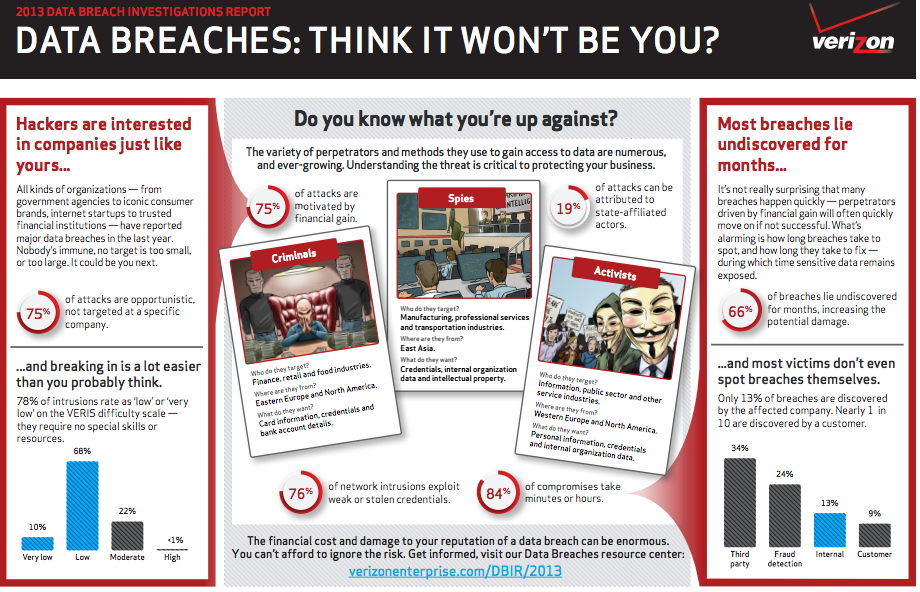
I say that because cybersecurity is a big part of what Verizon Enterprise (as I believe they now go by) sells to its business customers; the infographic above, warning of data breaches when you least expect it (heh), is part of one they use to fear-monger its customers. Energy consumers are one of its target customer bases. And the case studies it describes involve several Smart Grid projects. Precisely the kind of thing the government is most freaked out about right now.

After all, aside from Medicare fraud, the government simply doesn’t investigate businesses, ever. Certainly not the kind of bankster businesses we’d like them to investigate. One of the few things they investigate business activities for is to see if they’ve been compromised. Moreover, the Section 215 order requires either a counterintelligence or a counterterrorist nexus, and the government has gone to great lengths to protect large businesses, like HSBC or Chiquita, that have materially supported terrorists.

Anyway, that’s all a wildarsed guess, as I said.

Ah well. If the government can use Section 215 orders to investigate all the Muslims in Aurora, CO who were buying haircare products in 2009, I’m sure big business won’t mind if the government collects evidence of their crimes in search of Iran or someone similar.

Update: Note, this order seems to show a really interesting organizational detail. This is clearly an FBI order (I’m not sure who, besides the FBI, uses Section 215 anyway). But the FISA Court orders Verizon to turn the data over to the NSC. This seems to suggest that FBI has NSA store and, presumably, do the data analysis, for at least their big telecom collections in investigations. That also means the FBI, which can operate domestically, is getting this for DOD, which has limits on domestic law enforcement.

Share this entry

Michael Hayden, Troll Extraordinaire

“Intelligence agencies often act on the edges of executive prerogative and move forward based on a narrow base of lawfulness and limited congressional notification,” says Michael Hayden, the guy who oversaw Bush’s illegal wiretap for 2.5 years before the full Gang of Eight first got adequately briefed, and who never briefed Congress on CIA’s assassination program.

In the same piece, Hayden hails media editors who ceded to his requests to hold or adjust a story.

So, how do we limit the damage? Well, journalists will have to expand the kind of sensitivities to the national welfare that some already show. In those calls I made to slow, scotch or amend a pending story, most on the other end of the line were open to reasonable arguments. In one case a writer willingly changed a reference that had read “based on intercepts” to “based on intelligence reports,” somewhat amazed that that change made much of a difference. (It did.)

But then insists the UndieBomb 2.0 story — for which AP editors had made precisely those kinds of concessions — was right to be investigated because John Brennan’s push back to it exposed a mole.

The two prominent cases being debated were indeed serious leaks, because they touched upon sources, not just information.

In the case of the Associated Press report on a Yemen-based bomb plot, the source had apparently penetrated an al Qaeda network and there were hopes that he could continue to be exploited.

[snip]

And, since the Yemen source appears to have actually been recruited by a liaison partner, the impact of a leak goes far beyond our own service. In that same talk with bureau chiefs, I pointed out that several years before 9/11, one chief of station reported that a press leak of liaison intelligence had “put us out of the (Osama) bin Laden reporting business”.

In both stories, investigations were in order. Journalists, of all people, should understand the need to protect sources and relationships.

As the LAT story Hayden links to says clearly, “The AP did not mention the informant in its report.” And, as I laid out some weeks back, to believe our mole was going to return, the former head of the CIA would have to believe that AQAP shows great tolerance for recruits who fuck up and then return right after high ranking operatives get drone killed.

Because to maintain that claim, you’d have to explain how an AQAP operative who had been entrusted with the latest version of Ibrahim al-Asiri’s UndieBomb sometime in early April, had left (at least as far as Sanaa), had not apparently succeeded in his mission (which was, after all, meant to be a suicide bombing), could return to AQAP without the UndieBomb and infiltrate even further than he had the first time.

“Oh, hi, AQAP gatekeeper” — their story must imagine the mole saying as he returned to AQAP — “I’ve both failed in my mission and somehow lost the bomb you gave me, but based on that would you be willing to let me spend some quality time with even higher-ranking AQAP operatives?”

In short, Hayden appears to have decided it’d be a good idea to ignore the facts, good sense, and his own history so as to suggest that the Obama Administration is worse than the reasonable old Bush Administration.

But the investigations have been very aggressive and the acquisition of journalists’ communications records has been broad, invasive, secret and—one suspects—unnecessary.

A quick survey of former Bush administration colleagues confirmed my belief that a proposal to sweep up a trove of AP phone records or James Rosen’s e-mails would have had a half-life of about 30 seconds in that administration.

Just ignore the fact that the government was asking people questions about James Risen‘s phone contacts — indicating they had probably doing just what the Obama Administration did to the AP reporters, only without telling him — before Obama took over.

But here’s my favorite part:

The government may also want to adjust its approach to enforcement. The current tsunami of leak prosecutions is based largely on the Espionage Act, a blunt World War I statute designed to punish aiding the enemy. It’s sometimes a tough fit. The leak case against former National Security Agency employee Thomas Drake collapsed of its own overreach in 2011.

Perhaps in many of these cases the best approach is not through the courts or the Department of Justice.

Remember, Drake was investigated for telling a journalist about Hayden’s own boondoggle that cost many times what NSA’s existing better solution cost. There is virtually no way the investigation against him didn’t rely, in part, on Hayden’s own testimony.

And now, 6 years after the investigation into Drake started in earnest, Hayden suggests Drake shouldn’t have been criminally investigated at all.

Hayden can afford that very belated generosity, of course. He’s been profiting off the same kind of boondoggles Drake tried to expose for years now.

I mean, sure, the main jist of what Hayden says is true: the Administration is pursuing leaks far too aggressively. But coming from a guy who has long benefitted from the Executive Branch asymmetric abuse of secrecy, he’s not exactly the right person to be making the point.

Share this entry

The Latest Ploy to Avoid Federal and Presidential Records Act, FOIA

As if the AP and the Administration weren’t already enjoying a contentious relationship, today it details the Administration’s use of second, secret emails.

Some of President Barack Obama’s political appointees, including the secretary for Health and Human Services, are using secret government email accounts they say are necessary to prevent their inboxes from being overwhelmed with unwanted messages, according to a review by The Associated Press.

The scope of using the secret accounts across government remains a mystery: Most U.S. agencies have failed to turn over lists of political appointees’ email addresses, which the AP sought under the Freedom of Information Act more than three months ago. The Labor Department initially asked the AP to pay more than $1 million for its email addresses.

[snip]

Google can’t find any reference on the Internet to the secret address for HHS Secretary Kathleen Sebelius. Congressional oversight committees told the AP they were unfamiliar with the non-public government addresses identified so far by the AP.

Ten agencies have not yet turned over lists of email addresses, including the Environmental Protection Agency; the Pentagon; and the departments of Veterans Affairs, Transportation, Treasury, Justice, Housing and Urban Development, Homeland Security, Commerce and Agriculture. All have said they are working on a response to the AP.

Now, the Administration claims people are doing this just to cut down on clutter in their email boxes. But thus far, it appears that the second emails aren’t being turned over under FOIAs or, if they are, aren’t being identified as belonging to the principal.

And so we move into another chapter of the Executive Branch hiding or deleting emails to avoid transparency, which of course goes back to Poppy Bush’s efforts to hide PROFS notes as part of the Iran-Contra coverup. The National Security Archive’s timeline, of course, misses the several efforts under the Bush Administration to either delete massive amounts of emails, particularly those from sensitive days of the CIA Leak Investigation, and the political staff’s use of RNC email addresses to take emails entirely out of Presidential Records Act retention.

This is getting tiresome: we’re going on 5 presidential administrations now that have played games with emails, a tedious series of efforts to avoid transparency.

Maybe it’s time for Congress to put some real teeth onto laws requiring the President to retain such records?

Share this entry

Navy v. Egan, not Just Branzburg v. Hayes, Needs Fixed

Today, 340 new journalists will join the 10 or so who have been covering the Bradley Manning prosecution closely for the last several years; his trial starts today at Fort Meade.

Expect to see a bunch of essays on secrecy to mark the beginning of the trial.

This one, in which Steven Coll calls for the Supreme Court to revisit the Branzburg v. Hayes decision that established a spirit but not a law protecting press sources, has already generated a lot of attention.

In the long run, to rebalance the national-security state and to otherwise revitalize American democracy, the United States requires a Supreme Court willing to deepen protections for investigative reporters, as the majority in Branzburg would not.

Among some other minor factual inaccuracies (including what the AP UndieBomb 2.0 leak was originally about), it includes this claim.

[Obama’s] longest-serving advisers are disciplined and insular to a fault; press leaks offend their aesthetic of power.

While I agree Obama’s advisors are insular to a fault, and agree they revel in an aesthetic of power, they do not despise all press leaks. Even aside from the typical policy debate leaks of classified information, the White House has long reveled in “leaking” classified information to selected members of the press, to get the information out there on its own terms. The tactic is not new — it is precisely the A1 cut-out approach the Bush Administration used to get us into the Iraq War. But the Obama Administration may have expanded its use (that is actually the reason Republicans in Congress were demanding investigations of the leaks that followed the AP story, the ones that, unlike the AP, exposed our mole).

Which is why Coll proposes an inadequate solution to what I agree is the key problem.

Obama inherited a bloated national-security state. It contains far too many official secrets and far too many secret-keepers—more than a million people now hold top-secret clearances. Under a thirty-year-old executive order issued by the White House, the intelligence agencies must inform the Justice Department whenever they believe that classified information has been disclosed illegally to the press. These referrals operate on a kind of automatic pilot, and the system is unbalanced. Prosecutors in Justice’s national-security division initially decide on whether to make a criminal case or to defer to the First Amendment. The record shows that in recent years the division has been bent on action.

I’m not opposed to establishing clearer laws about when a journalist’s sources may be protected. But that can be used — as Dick Cheney tried to use it — as a screen for his exposure of Valerie Plame. Protecting journalists’ sources will not only protect real whistleblowers, but it will also protect the system of official leaks that both Bush and Obama have used to accrue power and avoid accountability.

So not only is fixing Branzburg v. Hayes not enough to fix our “unbalanced … bloated national security state,” it doesn’t get at the underlying problem

As a threshold measure, journalists should be calling for the limitation or repeal of the Espionage Act, which is the real stick Obama is using to cut down on unsanctioned leaks. It’s bad enough for whistleblowers to risk losing their clearance, and with it, a well-compensated livelihood. But as soon as you start talking extended prison sentences, as soon as you start accusing whistleblowers of being worse than an enemy’s spy because they shared damning information with the public generally, that’s going to silence unsanctioned leaks.

Just as importantly, this entire structure of abuse of power rests on a different SCOTUS decision, Navy v. Egan, which gives the Executive absolute control over security clearances (and therefore the less powerful leverage usually wielded against whistleblowers, the ability to strip their clearance), but which has been interpreted by Bush and Obama to give the Executive unfettered authority to determine what is secret and what is not. This decision — which is precisely what David Addington told Scooter Libby he could rely on to justify outing Plame on Cheney’s order — is also what the Obama Administration cited when it refused to litigate al-Haramain and in so doing granted the Bush Administration impunity for illegal wiretapping. The Executive’s claim to have unlimited authority to decide what is secret and not is also what prevents the Senate Intelligence Committee from declassifying the torture report on its own authority. It is also the basis for the authority to stall releasing video of US helicopters gunning down a Reuters team to Reuters under FOIA, which led to Manning leaking it to WikiLeaks himself.

The Obama and Bush Administrations have claimed that no one — not Congress, not the Courts — has the authority to review their arbitrary use of secrecy to accrue more power. That claim is an expansive reading of Navy v. Egan, but thus far not one anyone has challenged before SCOTUS. And that is what has enabled them (with the limited exception of the Plame outing) to avoid all consequences for their asymmetric use of leaks.

So, yes, it would be useful if SCOTUS decided that journalists and others engaging in legitimate investigation can protect sources, especially when investigating national security. But until the underlying system — the Executive’s claim that it can abuse secrecy to protect itself — is changed, secrecy will remain a cancer rotting our democracy.

Share this entry

When NYT Accused Jim Comey of Approving Torture

[youtube]hxHjWYA50Ds[/youtube]

As you’ve likely heard already, NPR and others have reported that President Obama will nominate Jim Comey to lead the FBI.

I think Comey is a decent choice.

Much of the attention since this news broke has focused on Comey’s role in the hospital confrontation, where he threatened to resign unless the Bush Administration fixed the illegal wiretap program. That will clearly be a highlight of Comey’s confirmation discussion.

But just as much as Comey’s unsent resignation letter, I’m curious how these emails will play in his confirmation process.

They were similar Comey CYA, from the period in May 2005 when Dick Cheney was pushing Alberto Gonzales to reauthorize all the torture CIA had been doing since Jack Goldsmith had withdrawn the Bybee Two memo in 2004. While Comey did buy off on approving the waterboarding that had already been done (he unsuccessfully tried to limit it to one detainee whose treatment occurred after the Bybee Two memo was withdrawn), he also pushed hard — and failed — to get Alberto Gonzales to refuse to approve the techniques in combination, as they had reportedly always been used.

In the emails, he talks about when news of what was being approved broke (details of what freaked Comey out so much still haven’t become public), those pushing for torture would be gone. He regretted how much weaker Gonzales was than John Ashcroft, recalling that hospital bed scene.

I told him the people who were applying pressure now would not be there when the shit hit the fan. Rather they would simply say they had only asked for an opinion.

[snip]

It leaves me feeling sad for the Department and the AG.

[snip]

I just hope that when this all comes out, this institution doesn’t take the hit, but rather the hit is taken by those individuals who occupied positions at OLC and OAG and were too weak to stand up for the principles that undergird the rest of this great institution.

[snip]

People may think it strange to hear me say I miss John Ashcroft, but as intimidated as he could be by the WH, when it came to crunch-time, he stood up, even from an intensive care hospital bed. That backbone is gone.

Comey even tried to scare the torturers with warnings that the torture videos would one day become public — just six months before the torturers destroyed those videos.

There’s far more, which I laid out in this post and this post.

But what’s just as interesting as the actual content of the emails is the spin that NYT reporters Scott Shane and David Johnston gave it, presumably at the behest of the torturers who leaked it to them. They chose to ignore all the details about people like Cheney and Condi Rice pushing for more more more, immediately, and instead to focus on Comey’s assent to the memo effectively approving of the torture — including waterboarding — that had already been done.

Previously undisclosed Justice Department e-mail messages, interviews and newly declassified documents show that some of the lawyers, including James B. Comey, the deputy attorney general who argued repeatedly that the United States would regret using harsh methods, went along with a 2005 legal opinion asserting that the techniques used by the Central Intelligence Agency were lawful.

That opinion, giving the green light for the C.I.A. to use all 13 methods in interrogating terrorism suspects, including waterboarding and up to 180 hours of sleep deprivation, “was ready to go out and I concurred,” Mr. Comey wrote to a colleague in an April 27, 2005, e-mail message obtained by The New York Times.

It’s true. Comey did buy off on that memo. He did buy off on a memo approving 7.5 days of sleep deprivation and waterboarding (though not, as Cheney was pushing so hard to do, together).

During John Brennan’s confirmation hearing, Saxby Chambliss made sure to get John Brennan’s much more complacent involvement in torture into the record. He made sure to get Brennan to admit to having submitted FISA warrant applications that relied on tortured information. Those efforts, I suspect, were designed to make it a lot harder for Brennan to separate the CIA from torture going forward.

The evidence in these emails is in some ways more damning, but in most ways far, far less, than what we know of Brennan’s role in torture.

But I expect the same people who leaked these emails to NYT’s remarkably obedient reporters will try the line again.

And why not? At least one of those credulous reporters is still parroting his sources’ spin.

Share this entry