
The Wiretap Jury on the Iran War

At a moment when the Obama Administration is still aggresively pursuing James Risen’s testimony on sources for an Iran story he wrote 7 years ago, on Saturday he published a new story summarizing the uncertainty surround intelligence on Iran right now.

In the story, Risen reveals that both the 2007 and the 2010 NIEs on Iran’s nuke program got held up and rethought because of intercepts collected during the writing process.

The draft version [of the 2007 NIE] had concluded that the Iranians were still trying to build a bomb, the same finding of a 2005 assessment. But as they scrutinized the new intelligence from several sources, including intercepted communications in which Iranian officials were heard complaining to one another about stopping the program, the American intelligence officials decided they had to change course, officials said. While enrichment activities continued, the evidence that Iran had halted its weapons program in 2003 at the direction of the supreme leader, Ayatollah Ali Khamenei, was too strong to ignore, they said.

[snip]

Intercepted communications of Iranian officials discussing their nuclear program raised concerns that the country’s leaders had decided to revive efforts to develop a weapon, intelligence officials said.

That, along with a stream of other information, set off an intensive review and delayed publication of the 2010 National Intelligence Estimate, a classified report reflecting the consensus of analysts from 16 agencies. But in the end, they deemed the intercepts and other evidence unpersuasive, and they stuck to their longstanding conclusion.

Risen goes on to lay out all the other intelligence we’ve got on Iran, as well as the significant failures that have set intelligence efforts back: we’ve got radar and satellite imagery of suspected nuke sites, clandestine electromagnetic and radiation sensors, and information from IAEA inspectors. We don’t have much HUMINT, in part because of an email error in 2004 that exposed our assets, in part because of aborted defection of Shahram Amiri in 2009, and in part because we don’t have an embassy to house people working under official cover. We’re trying hard, Risen said, to avoid relying on information from MEK via the Israelis, having learned our lesson from Ahmed Chalabi in the Iraq war.

But our key tool, it seems, is the wiretapping. In particular, the eavesdropping on just 12 or so top officials who know the program.

American intelligence officials said that the conversations of only a dozen or so top Iranian officials and scientists would be worth monitoring in order to determine whether the weapons program had been restarted, because decision-making on nuclear matters is so highly compartmentalized in Iran.

I wonder how the assassination of at least 4 Iranian nuclear scientists has circumscribed the intelligence we can gather from wiretaps?

In any case, that seems to be what the decision to go to war or not comes down to: these 12 Iranians speaking into our wiretaps.
Share this entry

Spooky AssadLeaks: The Provenance of the Emails

As I wrote in this post, I got interested in the provenance of a set of leaked Bashar al-Assad emails largely because of the way in which two of them were used to suggest, dubiously, Nir Rosen was an Assad agent.

The Guardian and Al Arabiya have both offered posts describing, in part, how they came by the emails, with the Guardian’s offering more details. The short version is:

March 15, 2011: Uprising escalates in Daraa.

Late March: “a young government worker in Damascus” handed off a slip of paper to a friend. The paper had four codes (plus or including the two email addresses, the Guardian is not clear) that would provide access to personal email accounts of Bashar al-Assad and his wife Asma. The friend was apparently supposed to pass them onto “a small group of exiled Syrians who would know what to do with them.”

June: “Two Syrian professionals in a Gulf state” obtain the emails. The Guardian doesn’t explain whether they were the original intended recipients, nor does it explain the delay. Though it does include a blurb describing their sudden awakening to politics that makes it clear the Guardian has spoken to at least one of the activists and replicated their self-narrative uncritically.

The uprising in the southern Syrian city of Deraa on 15 March had empowered them, as it had hundreds of thousands of others in the totalitarian state. They were now determined to do what they could to bring an end to more than four decades of rule by the Assad clan.

“It was clear who we were dealing with,” said one of the activists. “This was the president and his wife. There was no doubt.”

August 6: Sabu solicits Syrian MOD hacker to “disrupt govt communication systems.”

June to December: The emails are used with increasing frequency over time; Assad appears to build a PR strategy using them.

January: Anonymous (which had been infiltrated by the FBI since at least June, the same month the Syrian activists purportedly got the email codes) hacks Bashar al-Assad’s servers, accessing 78 different email accounts.

February 7: Anonymous releases the Assad emails which were published by Ha-aretz, claims the password was 12345. These are, at least in part, the very same emails being released today. Assad’s brother-in-law Firas al-Akhras emails him to tell him the inbox of the Ministry of Presidential Affairs had been leaked. All the emails are shut down.

March 15, 2012: The emails published.

In their narratives, neither the Guardian nor al Arabiya note that the FBI had been running Sabu since last June, precisely the same month the “activists” reportedly got the “secret codes” (12345?) that would allow them to access the Assad emails.

Now there are plenty of questions I have about this: Who was the mole, how did he or she get this information, who was the friend, what caused the 3-month delay. All of those questions, of course, are particularly interesting giving the coincidence of timing with the Sabu recruitment.

And why release these emails now? Just because of the one-year anniversary of Daraa, and the other events planned for the day?

Suffice it to say it feels a lot like outside entities–aside from whatever professionals-turned-activists purportedly monitored these accounts–were involved.

With that feeling in mind, two more details worth noting. First, al Arabiya’s story on how they got the emails focuses instead on what they didn’t publish: a bunch of “scandalous emails.”

Hundreds of “scandalous” emails were accordingly deleted by Al Arabiya.

By comparison, the Guardian said only it didn’t publish personal emails. Both sources, however, want people–perhaps including Assad?–to know that there were more emails that may be out there.

The other thing I find interesting is the detail the Guardian pays to Assad’s email habits.

[The Syrian activists in the Gulf state] soon noticed differences in the way the couple used their email accounts. “We had to be quick with Bashar’s emails,” one of the activists said. “He would delete most as soon as they arrived in his inbox, whereas his wife wouldn’t. So as soon as they went from unread to read we had to get them fast.”

Deleting emails as soon as they arrive shows a degree of awareness of web security. So too did the fact that Assad never attached his name or initials to any of the emails he sent. However, many of the emails that arrived in his inbox are addressed to him as president and contain intimate details of events and discussions that were not known outside of the inner sanctum and would have been very difficult to manipulate.

Even before I remembered that the same guy the Guardian claims was showing some web security used “12345” as his password, this entire passage sounded bogus, more like a way to provide cover for some other means to collect these emails that don’t involve more sophisticated wiretapping of packets, as opposed to email in-boxes.

But once you remember this is a guy who reportedly used “12345” as his password, then the entire claim Assad was practicing good security becomes laughable. Which makes this entire passage suspect.

There are two stories of how Bashar al-Assad got his emails hacked in the last year. In one version, Syrian activists managed to spy on their dictator in real time and are presumably releasing emails that lack a smoking gun (but did include “scandalous” emails) as a sort of anniversary present for Assad. The other story involves the FBI flipping at least one hacker and having him continue to hack at their command.

Or maybe there’s just one, far more intriguing story.

Share this entry

The Secret PATRIOT FOIA

To cap off Sunshine week, there was a slew of FOIA news today. For now, I’m just going to look at the response the ACLU got on its request for “OLC legal opinions and memoranda concerning or interpreting Section 215 of the USA Patriot Act.”

Josh Gerstein noted one interesting aspect of this response: the government has withheld two documents on Exemption 5–or deliberative privilege grounds. Now, the government usually claims deliberative privilege on these memos, arguing that the memos are just interpretation for whatever Executive Branch client who makes the final decision.

But this also suggests they may not be claiming these memos are classified.

Except the DOJ response does note they’ve referred one of two documents to OLC for further review.

… the Office of Information Policy has referred one document to OLC for direct response to ACLU. The document is the same as one of the two documents described above.

I wonder whether they have referred this document for full classification review.

And then there is DOJ’s all but admission that they’ve carved out the most sensitive documents on this topic–which we believe to be the use of phone GPS to get geolocation in the US. They say,

the ACLU has stipulated in ACLU v. FBI, 11 Civ. 7562 (S.D.N.Y.) that the request is limited to OLC legal opinions and memoranda concerning or interpreting Section 215 of the USA Patriot Act.

As Gerstein notes, the documents that really explain Secret PATRIOT are FISA Court opinions.

It is possible is that the OLC documents in question are not the holy grail senators, the ACLU and the Times have been seeking, but some more mundane interpretations of Section 215. Wyden and Udall suggested in their letter that the key documents amounting to “secret law” are actually classified opinions of the Foreign Intelligence Surveillance Court. Any administration legal interpretations of those opinions may also not have come from OLC, but from lawyers at the FBI or elsewhere in the intelligence community. The government is withholding other documents in the FOIA litigation as classified.

Like I say, this is a nice cap to Sunshine week–yet more obfuscation.

Share this entry

The NYPD’s Surveillance of Muslims and Occupy Wall Street Converges

I started my morning reading with this AP Q&A on the significance of their series on the NYPD’s spying on Muslims. There are several things missing: why does the NYPD profile only businesses they believe to be owned by Muslims, and not the American chains at which recent immigrants also congregate? Why doesn’t the Q&A discuss how the NYPD-on-the-Hudson got close to, but missed the two most significant plots of recent years; what does that say about the efficacy of all this spying? And why doesn’t the Q&A discuss the many informants the NYPD has deployed?

That said, the AP does get to the core reason why the NYPD’s program abuses the First Amendment:

Bloomberg and his aides have not addressed, however, why police kept intelligence files on innocuous mosque sermons and plans for peaceful protests. They’ve not explained why police noted which restaurants served “devout” Muslims, why police maintained lists of Muslims who changed their names or why innocent people attending Friday prayer services were photographed and videotaped.

Those activities, many Muslims said, make them feel like they’re under scrutiny just because of their religion.

After reading that Q&A, I then read this NYT article, talking about how the NYPD’s intelligence division–the CIA-on-the-Hudson again–has preemptively arrested some Occupy Wall Street protestors before they engaged in protest.

On Nov. 17, Kira Moyer-Sims was near the Manhattan Bridge, buying coffee while three friends waited nearby in a car. More than a dozen blocks away, protesters gathered for an Occupy Wall Street “day of action,” which organizers had described as an attempt to block the streets around the New York Stock Exchange.

Then, Ms. Moyer-Sims said, about 30 police officers surrounded her and the people in the car.

All four were arrested, said Vik Pawar, a lawyer for Ms. Moyer-Sims and two of the others, and taken to a police facility in the East Village. He said officers strip-searched them and ignored their requests for a lawyer.

These are the same tactics–or worse–as used when the NYPD targeted Muslims planning a peaceful protest of cartoons deemed blasphemous. But most troubling is the last anecdote the NYT reports (which the NYT might have known to contextualize if they had been reporting on the NYPD spying on Muslims). In one case, they NYPD and the FBI are targeting an Occupy activist who, as someone who appears to have changed his name from his birth name, would have been targeted closely under the NYPD program. And they appear to be insinuating a tie with Islamic terrorism.

Mark Adams, a 32-year-old engineer from Virginia, said he was arrested in November at an Occupy Wall Street protest in Midtown and was questioned by a police detective and an agent from the Federal Bureau of Investigation, who asked about his involvement with Occupy Wall Street, requested his e-mail address and inquired whether he had ever been to Yemen or met anyone connected to Al Qaeda.

Mr. Adams, a naturalized United States citizen who was born in Pakistan, said he was arrested during another protest in January and questioned by intelligence division detectives. In that instance, he said, the detectives asked him about specific names and addresses, asked about his work history, education and family, and questioned him about a trip he had made to Ireland.

Mr. Adams said he was disturbed that anyone would consider him a threat because of his ethnicity or political views. “It’s scary,” he said. [my emphasis]

As the AP reported last October, the NYPD conducts extensive checks and keeps records on those within the city who change their names from Arabic or Muslim-sounding names to something Americanized.

The NYPD monitors everyone in the city who changes his or her name, according to internal police documents and interviews. For those whose names sound Arabic or might be from Muslim countries, police run comprehensive background checks that include reviewing travel records, criminal histories, business licenses and immigration documents. Read more

Share this entry

First They Came for Russ Feingold, Then They Came for CATO

As I’ve followed all the really interesting commentary on the Koch Brothers’ efforts to take over Cato (Dave Weigel, Jonathan Adler, Jane Mayer, Brad DeLong) I keep thinking back to this Adam Serwer post last year, pointing out one of the most anti-libertarian moves they made: dumping $25,000 to beat the biggest defender of civil liberties in the Senate.

Another way to put this is that the Kochs will happily put their money behind candidates who agree with their economic agenda but disagree with their social agenda. They will never put their money behind candidates of whom the reverse is true.

The best example of this I can think of is the Senate’s lost liberaltarian Russ Feingold. Feingold was the only senator to vote against the PATRIOT Act. He was one of the first senators to endorse marriage equality. He voted against the war in Iraq, against TARP and financial reform, and has consistently sought to rein in the surveillance state. He was, however, also one of the architects of campaign-finance reform along with John McCain and a supporter of the health-care bill and the stimulus.

When Feingold’s candidacy was in danger, the Koch’s poured their money into the coffers of Feingold’s opponent, Ron Johnson. According to the FEC, the Koch brothers each gave him individual contributions of $2,400, while KochPAC gave him $10,000. Charles Koch’s son Chase Koch gave Johnson $5,800, while David’s* wife Julia Koch gave another $2,400. An Elizabeth Koch from the same zip code in Wichita as Charles and Julia gave an additional $2,400. All in all, the Koch family gave Johnson more than $25,000 to send Russ Feingold home. What type of candidate were they supporting?

Johnson is anti-marriage equality, anti-choice, has no problem with open-ended military engagements and he supports the PATRIOT Act with some caveats, but only because “you have Barack Obama in power versus George Bush. I wasn’t overly concerned with George Bush in power.”

[snip]

In other words, faced with one candidate who shares their views on social issues and national security and another who shares their views on economic issues, the Kochs chose the latter.

Libertarianism, which was fostered to offer ideological cover for laissez faire capitalism, is now being actively replaced by its biggest patrons with a TeaParty ideology that has been co-opted over the last three years to offer populist cover for unrestrained capitalism.

So while I am fascinated by Corey Robin’s critique of Julian Sanchez’ presignation,

When the Kochs wield their money at Cato, that’s hegemony. But when they do it in Wisconsin, that’s democracy.

I think Robin’s comments on this year’s Ron Paul debate among the left is far more important.

Our problem—and again by “our” I mean a left that’s social democratic (or welfare state liberal or economically progressive or whatever the hell you want to call it) and anti-imperial—is that we don’t really have a vigorous national spokesperson for the issues of war and peace, an end to empire, a challenge to Israel, and so forth, that Paul has in fact been articulating.  The source of Paul’s positions on these issues are not the same as ours (again more reason not to give him our support).  But he is talking about these issues, often in surprisingly blunt and challenging terms. Would that we had someone on our side who could make the case against an American empire, or American supremacy, in such a pungent way.

This, it’s clear, is why people like Glenn Greenwald say that Paul’s voice needs to be heard.  Not, Greenwald makes clear, because he supports Paul, but because it is a terrible comment—a shanda for the left—that we don’t have anyone on our side of comparable visibility launching an attack on American imperialism and warfare. (Recalling what I said in the context of the death of Christopher Hitchens, I suspect this has something to do with our normalization and acceptance of war as a way of life.) In other words, we need to listen to Paul, not because he’s worthy of our support, and certainly not because the reasons that underlie his positions on foreign policy are ours, but because he reveals what’s not being said, or not being said enough, on our side.

[snip]

Ron Paul is unacceptable, and it’s unacceptable that we don’t have someone on the left who is raising the issues of imperialism, war and peace, and civil liberties in as visible and forceful a way.

Russ Feingold is gone from the Senate. As of last night, Dennis Kucinich will be gone
from the House next year. For what it’s worth, Ron Paul, too, will be gone from the House. In my own neighborhood, we hope Justin Amash, who hopes to assume Paul’s mantle, is gone from the House too.

There are other voices stepping up. But even Ron Wyden, who is a lonely voice criticizing the Obama Administration’s most egregious civil liberties abuses, offered somewhat tempered criticism of Attorney General Holder’s speech on Monday.

Attorney General Holder’s speech today is a welcome step in the right direction, but further steps need to be taken, and they need to be taken soon.

The government–both Republican and Democratic–has spent billions to create a climate of fear. It has succeeded in leading people to accept the assault on civil liberties without even questioning efficacy, much less constitutionality or abuse.

Meanwhile, even more money is being dumped into a reframed ideology of unrestrained capitalism, one with a populist face unembarrassed by its own inconsistency.

So I’ll go even further than Alex Pareene, who lists all the reasons we should care about the Koch takeover attempt on Cato. There is a case to be made for the Constitution and for executive restraint. We on the left need to get more effective at making it. Because the capitalist case is in the process of being bought out.

Share this entry

How Good Are DOJ’s Reasons for Burying Its Case against Anwar al-Awlaki?

Today’s the day Eric Holder explains how his Department decided it was okay to kill a US citizen with no independent legal review, even while he says we should use civilian courts to, uh, give terrorists due process.

Now, at least as of late January, the Administration still planned not to include any real information about its case against Anwar al-Awlaki in Holder’s speech.

As currently written, the speech makes no overt mention of the Awlaki operation, and reveals none of the intelligence the administration relied on in carrying out his killing.

Since much of the evidence that has been used to implicate Awlaki came from Umar Farouk Abdulmutallab, I’m going to return to a question I first raised several weeks ago, why DOJ sat on the information it got from Abdulmutallab implicating Awlaki so long.

In this post, I considered why DOJ published a narrative explicitly describing Anwar al-Awlaki’s role in Umar Farouk Abdulmutallab’s terror plot last month, rather than when it learned the information from Abdulmutallab sometime in 2010. The reason is likely evidentiary. It appears the government never persuaded Abdulmutallab to testify against Awlaki even while he was implicating Awlaki during “plea negotiations,” meaning it’s unclear Abdulmutallab would have repeated the information implicating Awlaki in court. Note, since that post, Abdulmutallab prosecutor Jonathan Tukel confirmed in court that the UndieBomber was offered–but did not accept–a plea agreement.

In this post, I will consider other reasons why DOJ may have buried (and presumably will continue to bury) their case against Awlaki: a desire to hide its signals intelligence, its informants, as well as a desire to win legal cases.

Read more

Share this entry

According to DOD Inspector General Definition, Bradley Manning Did Not “Leak”

The unclassified version of the DOD Inspector General report on leaks within DOD over the last three years (that is, during the Obama Administration) defines “leak” this way.

Unauthorized disclosure of SCI [Secure Compartmented Information] to the public which is defined as: “A communication or physical transfer of [SCI]information to an unauthorized recipient.” DoDD 5210.50, Section 3.2, “Unauthorized Disclosure of Classified Information to the Public,” dated July 22, 2005. [second bracket original]

A leak is a leak of Secure Compartmented Information, not just classified information.

To be sure, the report’s own insertion of that second bracket makes it clear this definition applies to this report. Congress focused on SCI information when it ordered the IG to do the report in a classified annex of this fiscal year’s Defense Appropriation:

The investigation shall contain the following: an inventory of the leaks of SCI data including those attributed to a “senior administration official” from the past three calendar years; the actions taken to investigation each of the events; which of the investigations were referred to the Department of Justice; and what additional actions were taken after the Department of Justice investigation.

The House Appropriations Committee didn’t require the IG to inventory all classified leaks, just the SCI ones.

Nevertheless, as defined, Bradley Manning’s alleged leaks are classified, not SCI.

Whereas this report shows that people from Obama’s Administration, including at least one senior administration official, have been leaking SCI.

We confirmed with DoD components that some unauthorized disclosures of SCI to the public did occur within DoD between December 23, 2008 and December 23, 2011. Among the unauthorized SCI disclosures to the public reported, a DoD Senior Official was directly attributed as a source of unauthorized SCI disclosures to the public. DoD components also reported that they followed established DoD guidance and procedures for forwarding unauthorized disclosure cases to the Department of Justice for action when appropriate.

Now, again, this report is the unclassified version; I’m sure the report provided more detail in the classified version sent to the Chair and Ranking Member of 10 different committees and subcommittees.

But note what this results paragraph doesn’t say. While it confirms at least one of the leaks from a senior administration official was unauthorized, it only cataloged the unauthorized leaks, suggesting there may be more SCI leaks that were authorized (consider, for example, the leaks of a range of compartment names to Bob Woodward, which John Rizzo suggested were part of “one big authorized disclosure,” or reported cooperation between DOD and CIA and Hollywood on the movie about Osama bin Laden’s killing, itself the subject of a different investigation).

Further, while Congress mandated the IG do so, this unclassified report does not explain what happened to these SCI leak referrals at DOJ. Has DOJ been pursuing the SCI leaks by senior administration officials as diligently as it has pursued people like Thomas Drake, who was charged with retaining information, much of it of disputed classification?

One thing’s clear: whether to make political hay or out of genuine concern about the Administration leaks, Congress is honing in on how many of these leaks were authorized and whether DOJ investigated the unauthorized ones. Granted, the most interesting results here remain classified (let’s see whether the 10 committees and subcommittees can withstand the temptation of leaking a classified report on leaking).

But it does begin to show that the Administration that has accused more leakers of “espionage” than all others combined itself leaks far more sensitive information.

(h/t Steven Aftergood who first reported on the IG Report)

Share this entry

Djibouti’s Cable News

Remember back in 2008, when a mysterious cluster of intercontinental cables were cut, knocking parts of the Middle East and South Asia (notably Egypt and Pakistan) off telecom networks?

Well, we’ve got another cluster of cut cables again, this time off of Djibouti, where one of our currently most critical bases is (we operate into Yemen and Somalia from there).

Undersea data cables linking East Africa to the Middle East and Europe were severed in two separate shipping accidents this month, causing telecommunications outages in at least nine countries and affecting millions of Internet and phone users, telecom executives and government officials said.

A ship dragging its anchor off the coast of the Kenyan port city of Mombasa severed a crucial Internet and phone link for the region Saturday, crippling electronic communications from Zimbabwe to Djibouti, according to a public-private consortium that owns the undersea cable.

The Indian Ocean fiber-optic cable, known as The East African Marine Systems, or Teams, is owned by a group of telecom companies and the Kenyan government. It was the fourth cable to be severed in the region since Feb. 17.

The Teams cable had been rerouting data from three other cables severed 10 days ago in the Red Sea between Djibouti and the Middle East. Together, the four fiber-optic cables channel thousands of gigabytes of information per second and form the backbone of East Africa’s telecom infrastructure.

There are, undoubtedly, a number of interesting conversations that would be transiting those telecom lines, not least those between AQAP and al-Shabaab. Not to mention the conversations within East Africa.

But those conversations won’t be traveling by most easily accessible telecommunication channels, at least not until those cables are restored.

And while we’re discussing Internet cables, note that these Djibouti cables, like those off of Egypt that were taken out in 2008, do not appear on State’s cable–classified just Secret–of critical infrastructure around the globe.


Share this entry

Jeh Johnson on the “Military’s Domestic Legal Authority”

In addition to suggesting that the 16 year old American citizen Abdulrahman al-Awlaki was a legitimate military target, Jeh Johnson spoke yesterday about the “military’s domestic legal authority.” Now, rest assured, Johnson said the Administration does not rely on aggressive interpretations of such authority.

Against an unconventional enemy that observes no borders and does not play by the rules, we must guard against aggressive interpretations of our authorities that will discredit our efforts, provoke controversy and invite challenge.

He acknowledges that posse comitatus requires express authorization from Congress before extending the reach of the military onto US soil.

As I told the Heritage Foundation last October, over-reaching with military power can result in national security setbacks, not gains.  Particularly when we attempt to extend the reach of the military on to U.S. soil, the courts resist, consistent with our core values and our American heritage – reflected, no less, in places such as the Declaration of Independence, the Federalist Papers, the Third Amendment, and in the 1878 federal criminal statute, still on the books today, which prohibits willfully using the military as a posse comitatus unless expressly authorized by Congress or the Constitution. [my emphasis]

Then he proceeds directly from describing the express authorization required from Congress to a discussion of the AUMF–as the basis for the “military’s domestic legal authority.”

Second: in the conflict against al Qaeda and associated forces, the bedrock of the military’s domestic legal authority continues to be the Authorization for the Use of Military Force passed by the Congress one week after 9/11.[2]  “The AUMF,” as it is often called, is Congress’ authorization to the President to:

use all necessary and appropriate force against those nations, organizations, or persons he determines planned, authorized, committed, or aided the terrorist attacks that occurred on September 11, 2001, or harbored such organizations or persons, in order to prevent any future acts of international terrorism against the United States by such nations, organizations or persons.

Ten years later, the AUMF remains on the books, and it is still a viable authorization today. [my emphasis]

Then Johnson describes how the Administration–with no express authority from Congress until the NDAA–stretched an authorization limited to those people and groups with ties to 9/11 to include those “associated with” such groups. And, again with no express authorization from Congress, expanded it to include those who “engaged in hostilities” with coalition partners.

In the detention context, we in the Obama Administration have interpreted this authority to include:

those persons who were part of, or substantially supported, Taliban or al-Qaeda forces or associated forces that are engaged in hostilities against the United States or its coalition partners.[3]

This interpretation of our statutory authority has been adopted by the courts in the habeas cases brought by Guantanamo detainees,[4] and in 2011 Congress joined the Executive and Judicial branches of government in embracing this interpretation when it codified it almost word-for-word in Section 1021 of this year’s National Defense Authorization Act, 10 years after enactment of the original AUMF.[5]  (A point worth noting here: contrary to some reports, neither Section 1021 nor any other detainee-related provision in this year’s Defense Authorization Act creates or expands upon the authority for the military to detain a U.S. citizen.)

Johnson doesn’t mention, of course, that the government is using the same interpretation to extend the military’s domestic legal authority to non-detention areas. Those applications are secret, you see.

Note, in this passage, how Johnson gracefully re-specifies that he’s talking about the 2001 AUMF, and not the 2002 AUMF, which also remains in effect?

But, the AUMF, the statutory authorization from 2001, is not open-ended.  It does not authorize military force against anyone the Executive labels a “terrorist.”  Rather, it encompasses only those groups or people with a link to the terrorist attacks on 9/11, or associated forces.

That’s important because the government at least used to–and presumably still does (otherwise they wouldn’t have panicked when Congress considered repealing the AUMF authorizing a war that is supposed to be over)–rely on the Iraq AUMF to target “anyone the Executive labels a ‘terrorist.'”

Given that the Iraq AUMF has been used to go beyond the definitions in the 2001 AUMF, I’ll skip the paragraphs were Johnson talks about how narrow the government’s interpretation of “associated forces” is.

Particularly because this paragraph is my very favorite bit in this entirely disingenuous speech.

Third: there is nothing in the wording of the 2001 AUMF or its legislative history that restricts this statutory authority to the “hot” battlefields of Afghanistan.  Afghanistan was plainly the focus when the authorization was enacted in September 2001, but the AUMF authorized the use of necessary and appropriate force against the organizations and persons connected to the September 11th attacks – al Qaeda and the Taliban — without a geographic limitation.

Pretty comprehensive, huh, Jeh? Neither the wording of the AUMF or the legislative history limits the AUMF, right?

Read more

Share this entry

Will SCOTUS Invent a “Database-and-Mining” Exception to the Fourth Amendment?

As I noted yesterday, the Administration appealed the 2nd Circuit Decision granting review of the FISA Amendments Act to the Supreme Court last week. I wanted to talk about their argument in more detail here.

Over at Lawfare, Steve Vladeck noted that this case would likely decide whether and what the “foreign intelligence surveillance” exception to the Fourth Amendment, akin to “special needs” exceptions like border searches and drug testing.

Third, if the Court affirms (or denies certiorari), this case could very well finally settle the question whether the Fourth Amendment’s Warrant Clause includes a “foreign intelligence surveillance exception,” as the FISA Court of Review held in the In re Directives decision in 2008. That’s because on the merits, 50 U.S.C. § 1881a(b)(5) mandates that the authorized surveillance “shall be conducted in a manner consistent with the fourth amendment to the Constitution of the United States.” Thus, although it is hard to see how surveillance under § 1881a could violate the Fourth Amendment, explication of the (as yet unclear) Fourth Amendment principles that govern in such cases would necessarily circumscribe the government’s authority under this provision going forward (especially if In re Directives is not followed…).

I would go further and say that this case will determine whether there is what I’ll call a database-and-mining exception allowing the government to collect domestic data to which no reasonable suspicion attaches, store it, data mine it, and based on the results of that data mining use the data itself to establish cause for further surveillance. Thus, it will have an impact not just for this warrantless wiretapping application, but also for things like Secret PATRIOT, in which the government is collecting US person geolocation data in an effort to be able to pinpoint the locations of alleged terrorists, not to mention the more general databases collecting things like who buys hydrogen peroxide.

I make a distinction between foreign intelligence surveillance and “database-and-mining” exceptions because the government is, in fact, conducting domestic surveillance under these programs and using it to collect intelligence on US persons (indeed, when asked about Secret PATRIOT earlier this month, James Clapper invoked “foreign or domestic” intelligence in the context of Secret PATRIOT). The government has managed to hide that fact thus far by blatantly misleading the FISA Court of Review in In re Directives and doing so (to a lesser degree) here.

In In re Directives, the government misled the court in two ways. First, according to Russ Feingold, the government didn’t reveal (and the company challenging the order didn’t have access to) information about how the targeting is used. The amendments he tried to pass–and which Mike McConnell and Michael Mukasey issued veto threats in response to–suggest some of the problems Feingold foresaw and the intelligence community refused to fix: reverse targeting, inclusion of US person data in larger data mining samples, and the retention and use of improperly collected information.

The government even more blatantly misled the FISCR with regards to what it did with US person data.

The petitioner’s concern with incidental collections is overblown. It is settled beyond peradventure that incidental collections occurring as a result of constitutionally permissible acquisitions to not render those acquisitions unlawful.9 [citations omitted] The government assures us that it does not maintain a database of incidentally collected information from non-targeted United States persons, and there is no evidence to the contrary. On these facts, incidentally collected communications of non-targeted United States persons do not violate the Fourth Amendment.

9 The petitioner has not charged that the Executive Branch is surveilling overseas persons in order intentionally to surveil persons in the United States. Because the issue is not before us, we do not pass on the legitimacy vel non of such a practice.

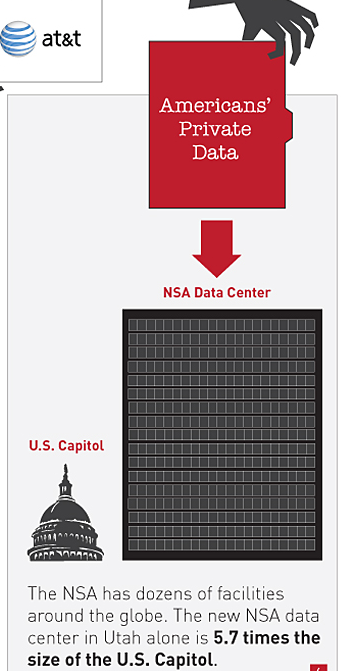
The notion that the government doesn’t have this US person data in a database is farcical at this point, as the graphic above showing the relative size of the NSA’s data center in UT–which I snipped from this larger ACLU graphic–makes clear (though the government’s unwillingness to be legally bound to segregate US person data made that clear, as well). Read more

Share this entry