Target of New Year’s Day Firebombing Also Target of NYPD Intelligence Collection

The latest Goldman and Apuzzo report on the CIA-on-the-Hudson provides proof that Ray Kelly and Mike Bloomberg’s claims that religious institutions are not profiled are false.

The New York Police Department recommended increasing surveillance of thousands of Shiite Muslims and their mosques, based solely on their religion, as a way to sweep the Northeast for signs of Iranian terrorists, according to interviews and a newly obtained secret police document.

[snip]

The secret document stands in contrast to statements by Mayor Michael Bloomberg, who said the NYPD never considers religion in its policing. Kelly has said police go only where investigative leads take them, but the document described no leads to justify expanded surveillance at Shiite mosques.

The 2006 intelligence document they obtained shows not just affirmative spying on Shiites as Shiites, but also a really muddled sense of the religious faiths of Iranians, Lebanese, and other Middle Eastern groups in this country.

But I’m particularly interested in one target of intelligence collection, according to the intelligence document: the Al-Khoei Islamic Center. That’s the mosque Ray Lazier Lengend firebombed on New Year’s Day.

The intelligence report includes the following on the mosque:

Source reporting indicates that members of Alavi Foundation are worshipping and conducting business at the Al-Khoei Islamic Center located in Jamaica, Queens,

[snip]

Expand and focus intelligence collection at the Al-Khoei Islamic Center.

[snip]

Hassan Fares [alleged to be a Hezbollah member or sympathizer and accused of extorting money for the mosque] has been observed in attendance at the Al-Khoei Center and has close ties to Fadhel al-Sahlani, the Imam of Al-Khoei. The Iraqi-born al-Sahlani is alleged to be the highest Shi’a religious authority in North America. On January 13, 2006, al-Sahlani was quoted by media sources stating that the Holocaust “has been exaggerated,” that “the numbers which have been mentioned are too much.” Al-Sahlani added that the “killing of innocent Jews during the war was an injustice,” but that the extent of Nazi persecution needed further examination. This was in support of statements made [sic] the Iranian President in regard to Holocaust. The Al-Khoei Center and al-Sahlani have been the subjects of law enforcement investigations by NYPD, JTTF, and the FBI. Al-Sahlani is the subject of a JTTF investigation for “attempting to depart the country with excess funds” and in late 2003, he was the subject of a lead investigation conducted by the Queens Case Team that alleged al-Sahlani was providing funds to a terrorist organization overseas. In January 2004, the case was closed as “unfounded.”

Open source research suggests that the UK-based Al-Khoei Benevolent Foundation, of which Al-Khoei Islamic Center is part, is the largest Shi’a organization in the world. Treasury Enforcement Communication System (TECS) inquiries reveal the Al-Khoei Benevolent Foundation allegedly imported Islamic books from Lebanon into the US. In addition, according to the California-based Islamic Education Center’s (IEC) newsletter, an “Al-Khoei Center” in New York was identified as an organization where IEC members (in this case, California State prison inmates) can obtain books and other similar resources.

[The intelligence report includes an additional allegation about the UK parent organization’s potential ties to purchasing information about chemical propulsion in violation of sanctions against Iran.]

To be clear, there is much that merits investigation–and it looks like appropriate authorities have done so and in at least some of the cases, proved the allegations to be unfounded. There is much that doesn’t merit investigation, such as the provision of religious materials to prisoners.

But in this instance, the stated reason to conduct this heightened investigation of Al-Khoei (as well as other Shiite, Iranian, and Palestinian) institutions is because,

The present diplomatic conflict between the US and Iran over Iran’s nuclear proliferation has the potential to evolve into armed confrontation between the two nations.

The report, dated May 15, 2006, preceded the Israeli attack on Lebanon by just a few months.

So maybe the NYPD claims it only profiles religious institutions if the US is drumming up war against them? And is it the NYPD’s stance, then, at times of increased Iranian-US tensions (like, say, now), the Al-Khoei Islamic Center is a fair target?
Share this entry

Ron Wyden Suggests Secret PATRIOT GPS Tracking May Be Illegal Under Jones

As I’ve suggested in my posts on US v Jones, the Justices seemed opposed to the kind of tracking we believe the government is doing under Section 215 of the PATRIOT Act. Yet of the three opinions ruling the warrantless use of GPS tracking in the case improper, only Sonia Sotomayor spoke broadly enough to make it clear that the Secret PATRIOT application is unconstitutional.

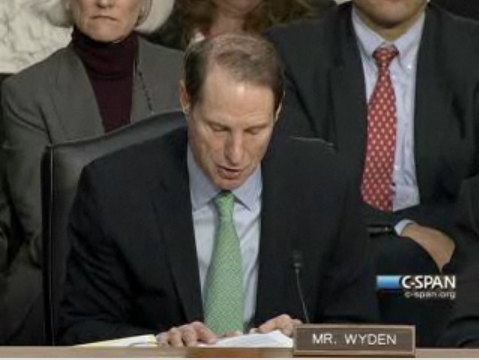
Ron Wyden (who, remember, wrote a column on Jones’ application to Secret PATRIOT) used yesterday’s Threat Assessment hearing to try to get James Clapper to commit to whether US v Jones makes Secret PATRIOT illegal. (2:25)

Wyden: Director Clapper, as you know the Supreme Court ruled last week that it was unconstitutional for federal agents to attach a GPS tracking device to an individual’s car and monitor their movements 24/7 without a warrant. Because the Chair was being very gracious, I want to do this briefly. Can you tell me as of now what you believe this means for the intelligence community, number 1, and 2, would you be willing to commit this morning to giving me an unclassified response with respect to what you believe the law authorizes. This goes to the point that you and I have talked, Sir, about in the past, the question of secret law, I strongly feel that the laws and their interpretations must be public. And then of course the important work that all of you’re doing we very often have to keep that classified in order to protect secrets and the well-being of your capable staff. So just two parts, 1, what you think the law means as of now, and will you commit to giving me an unclassified answer on the point of what you believe the law actually authorizes.

Clapper: Sir, the judgment rendered was, as you stated, was in a law enforcement context. We are now examining, and the lawyers are, what are the potential implications for intelligence, you know, foreign or domestic. So, that reading is of great interest to us. And I’m sure we can share it with you. [looks around for confirmation] One more point I need to make, though. In all of this, we will–we have and will continue to abide by the Fourth Amendment.

Given Clapper’s quick invocation of the law enforcement context, I suspect the Intelligence Community’s lawyers are planning to use the language in Samuel Alito’s concurring opinion addressing “extraordinary offenses”…

We also need not consider whether prolonged GPS monitoring in the context of investigations involving extraordinary offenses would similarly intrude on a constitutionally protected sphere of privacy. In such cases, long-term tracking might have been mounted using previously available techniques.

…To claim that their intelligence application–“foreign or domestic”–would still permit the tracking of innocent citizens using their cell phones.

In any case, if Clapper is good on his word (though note, he said he’d give this interpretation to Wyden, not release it publicly), the government may finally tip its hand regarding its cell phone tracking of Americans.

Share this entry

Michael Hayden’s Risky and Edgy Schadenfreude

I’ve long suspected the reason Republicans have pursued Fast and Furious so relentlessly–and more importantly, have tried to implicate Eric Holder in it personally–is to exact revenge on the Attorney General because he deigned to investigate torture.

This disgusting bit of dick-wagging from Michael Hayden only reinforces that suspicion.

Schadenfreude — joy at the misfortune of others — is a bad thing.

So I’ve been trying to resist temptation these past months as I watch Attorney General Eric Holder deal with public and congressional reaction to the “Fast and Furious” scheme, the failed attempt by the Bureau of Alcohol, Tobacco, Firearms and Explosives to seed and then track U.S. firearms to Mexican drug cartels.

[snip]

But any personal instinct toward some common “executive branch” empathy for Holder is muted not only by the dubious character of Fast and Furious, but by some of the attorney general’s other actions, as well. While out of office, for example, he famously called for a “reckoning” for CIA officers and other officials who authorized and conducted operations that were edgy and risky and intended to deal with difficult circumstances.

Once in office, he launched a “reckoning” of CIA renditions, detentions and interrogations of terrorists by directing the Justice Department to reopen investigations closed years before by career prosecutors. This decision was opposed by then-CIA Director Leon Panetta and seven of his predecessors, and Holder reportedly made the decision without reading detailed memos prepared by those career prosecutors declining to pursue further proceedings.

[snip]

As I said, schadenfreude is a bad thing. But it is sometimes hard to avoid, especially when life seems to come full circle.

Attorney General Eric Holder has made it clear that he thinks he has been subjected to a heavily politicized process over Fast and Furious.

If he has — and that’s still an if — I suspect that some folks at CIA know exactly how he feels.

Hayden ought to be grateful that DOJ has helped cover up the Bush Administration’s illegal wiretap program, not to mention their unsuccessful efforts to prosecute Thomas Drake for exposing that when implementing that program, Hayden deliberately chose more expensive plans that offered less privacy.

But instead he seems to be suggesting that it would be right to retaliate politically against the Attorney General for doing his job–prosecuting crime.

Ah well, in his spiteful glee, Hayden finally admits that the torture program was unsuccessful.

After the congressional elections of 2006, the CIA was forced to defend edgy (often controversial and sometimes unsuccessful) actions in a tough political environment.

But I guess we citizens have to put up with such unsuccessful and illegal programs otherwise, or risk political retribution?

Share this entry

Dianne Feinstein Calls James Clapper a Polyanna on Afghanistan

The takeaway the stenographers have gotten from yesterday’s intelligence threat assessment is that the Scary Iran Plot means Iran wants to target us in this country.

They reported that even as Dianne Feinstein made it clear James Clapper was bullshitting us on another front.

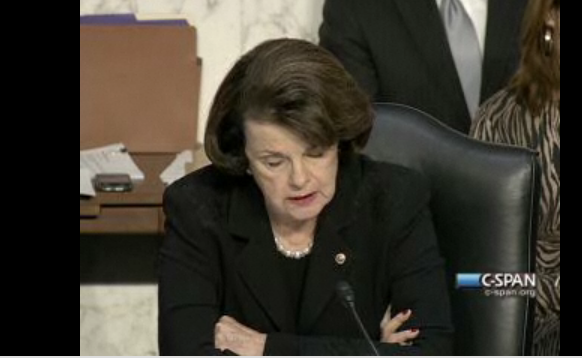
In her statement, she  noted that James Clapper’s assessment of our Afghanistan war is more optimistic than what the still-classified NIE says. (starting after 7:50)

I’m also concerned by what appears to the the disparity between the discussion of Afghanistan in Director Clapper’s statement for the record and the bleaker description in the December 2011 NIE. The Director’s statement notes modest improvements in the challenges that remain. While I’m unable to describe the NIE, as it remains a classified document, news reports of the NIE describe it as “sobering” and “dire” (those words in quotes, include phrases like, “mired in stalemate” (end quote). So I would like to ask the witnesses how they assess how stable Afghanistan will be in 2012 as well as in 2014 and beyond.

Here’s some of the public reporting on the NIE she’s talking about:

The U.S. intelligence community says in a secret new assessment that the war in Afghanistan is mired in stalemate, and warns that security gains from an increase in American troops have been undercut by pervasive corruption, incompetent governance and Taliban fighters operating from neighboring Pakistan, according to U.S. officials.

[snip]

In a section looking at future scenarios, the NIE also asserts that the Afghan government in Kabul may not be able to survive as the U.S. steadily pulls out its troops and reduces military and civilian assistance.
“Its viability is tenuous,” said one official, citing the report.

Clapper’s statement, however, says the following:

In terms of security, we judge that the Afghan police and Army will continue to depend on ISAF support. ISAF partnering and mentoring have begun to show signs of sustainable progress at the tactical and ministerial levels; however, corruption as well as poor leadership and management will threaten Afghan National Security Forces’ (ANSF) operational effectiveness.

[snip]

The Karzai government did achieve some success in 2011. The first phase of the process to transition security to Afghan leadership proceeded smoothly, and the second tranche of the transition is progressing as scheduled. The Karzai administration successfully convened a Loya Jirga in November to socialize the strategic partnership with the United States. Now that the fall 2010 electoral crisis is resolved, the Wolesi Jirga will likely regroup during the current winter recess and return its focus to limiting President Karzai’s authority, likely using the parliamentary approval process for ministerial appointees as a way to highlight the Parliament’s independence.

I find several things interesting about this: first, Clapper’s statement does admit that the ANSF isn’t ready to defend the country. The area where Clapper seems to most deviate from the reported details of the NIE is on Karzai’s government. Clapper would have us think it is improving, the NIE doesn’t agree.

But I’m also amused. After DiFi made it clear that Clapper’s statement had been spun, why did reporters (note, an exception is Josh Gerstein, who pointed out these comments as well) believe the other things he said, notably about Scary Iran?


Share this entry

Dianne Feinstein Complains about Executive Branch Blabbing

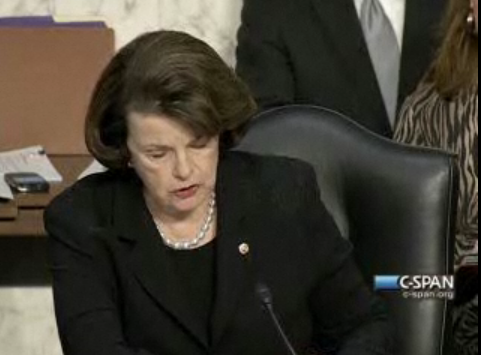
In her statement at the beginning of the Threat Intelligence Assessment hearing today, Dianne Feinstein complained that the Executive Branch continues to blab about things that are supposed to be secret (this starts around 11:00).

I’d also like to say that once again this committee has been put in a difficult position of trying to avoid any mention of classified matters when various parts of the executive branch may be doing somewhat the opposite. I ask members to be careful in their questions and statements and to remember that public discussion of some intelligence programs and assets can lead to them being compromised.

On the particular issue of drone strikes, I will only say that I was cleared to say in our joint hearing with the House Intelligence Committee last September “And there’s no issue that receives more attention and oversight from this Committee than the United States Counterterrorism efforts going on along the Afghanistan-Pakistan border. These efforts are extremely precise and carefully executed and are the most effective tools we have. Non-combatant casualties are kept to an absolute minimum.”

Given the timing, given her references to both assets and programs, and given her comments about the drone strikes on the Pakistani border, I assume she’s complaining about Leon Panetta’s blabbing to 60 Minutes the other night. (Plus, DiFi and Panetta have had their difficulties in the past.)

You see? It’s not just me that is fed up with this double standard on secrecy.

Update: Josh Gerstein talked to DiFi after the hearing, and she made it clear she was not criticizing the President.

Feinstein insisted after Tuesday’s hearing that her remarks were not aimed at Obama.

“I was not criticizing the president.  I was reminding the committee about protecting classified information,” she said in a statement e-mailed to POLITICO. She did not elaborate on what “parts of the executive branch” she was referring to in her public comments earlier in the day. A spokesman had no immediate response to a request for clarification.

Share this entry

CIA’s Drone Cowboys Complaining about “General Betrayus”

Remember when it was verboten to criticize David Petraeus, particularly in anticipation of his testimony to Congress?

Apparently it’s okay to do so if you run a secret killer drones program. While couched in anonymous sources, this story provides a forum for members of CIA’s counterterrorism center and their congressional backers to insinuate that David Petraeus has betrayed the CIA’s ability to wantonly kill Pakistanis.

The CIA is infamous for challenging outsiders, especially from the Pentagon, and Petraeus has won plaudits for not bringing his former military aides to his new job. Some officials close to the agency praise major espionage operations he has approved but say he has clashed with senior officers at the counter-terrorism center, a powerful fiefdom inside the agency that helps run the covert drone war.

Those officers are frustrated by the drop-off in drone strikes in Pakistan, including an undeclared two-month moratorium that ended Jan. 11, according to several current and former U.S. officials. In interviews, one member of Congress and four senior aides from the House and Senate committees said they were upset as well.

I guess the CIA considers trying to keep our relationship with a nuclear armed Pakistan intact a character flaw.

Now there is actually a complaint in here of concern.

Several aides on the House and Senate committees, however, say Petraeus has not always accommodated lawmakers’ schedules when he plans classified briefings and has limited the briefings’ duration so some questions go unanswered.

The aides, who asked for anonymity while discussing classified briefings, said he also has balked at providing some classified information that members have requested. They declined to provide details.

Mind you, Dianne Feinstein–in the article as well as her statement at the hearing (which you can watch here)–refuted the statement. Which I take to suggest that Petraeus is making ample use of the Gang of Four, briefing DiFi and Saxby Chambliss, but not other members of the committee.

Share this entry

Dennis Ross’ Red Phone

Ha’aretz reported today that, as part of an ongoing unpaid consulting gig with the Administration, Dennis Ross has a secure phone that allows him to discuss classified issues with the White House.

Apparently, a short while after Ross left his position in the Obama administration, the White House made an unusual request to install a secure phone line in Ross’ office at the Washington Institute. The secure line is known in Israel as a “red phone”, which could be used to discuss confidential information without the risk of wiretapping.

[snip]

During his visit to Israel last week, Ross met secretly with Prime Minister Benjamin Netanyahu as well as with his advisor Yitzhak Molho. American officials estimated that Ross’ talks with Netanyahu are on behalf of President Obama, and part of a channel of communication that bypasses the government.

Here’s what State Department spokeswoman had to say about the arrangement on Friday.

QUESTION:And one more. Are you aware of discussions that former advisor to President Obama, Dennis Ross, is having in Israel with Prime Minister Netanyahu and his advisor Yitzhak Molcho on possible ways out of this – the current stalemate?

MS. NULAND: I’ve heard about this, but I can’t speak to the mission. You know Dennis Ross is now a private citizen, but he also has an association with the White House as an unpaid advisor. So I’m going to send you to the White House in terms of how this might —

QUESTION: There’s been allegations —

MS. NULAND: Yeah.

QUESTION: — that there’s been – some people are claiming – the claim has been made that Mr. Ross, in coordination with the White House, is bypassing the State Department in these separate – could you comment on that?

MS. NULAND: Well, start with the fact that the White House and the State Department are in lockstep on these policies, and have been from the beginning. And Dennis Ross has been an advisor in this process. He’s now an unpaid advisor. So we don’t see it that way, but I’m going to send you to the White House with regard to his specific mission. [my emphasis]

Now, I’m actually more alarmed by the way Nuland kept repeating that Ross was unpaid than by claims that he’s being used by the White House as a side-channel for negotiations, though both concern me. Having Ross conduct negotiations as a private citizen seems designed to sidestep oversight and/or the involvement of career professionals who might advocate sane positions.

I’m particularly interested in the story given the Adam Werritty scandal in the UK, in which the Defense Secretary Liam Fox resigned after it was shown he had given Werritty undue access, including meetings in Israel, deemed private, attended by the British Ambassador to Israel, Matthew Gould, and Mossad.

Read more

Share this entry

Iran Repeats Claim Research Reactor Fuel Plates Object of Enrichment as IAEA Visit Could Be Extended

It has generally been viewed as a positive development that Iran has agreed to new visits from the IAEA to help ease the tension surrounding its nuclear program. Especially encouraging is a report in the New York Times this morning that Iran has asked the IAEA to extend the current visit that is underway:

Iran’s foreign minister was reported on Monday to have offered to extend a three-day visit to his country by United Nations inspectors in what seemed a further attempt to lower the strident tone of a crisis with the West over Tehran’s nuclear program following the imposition of new economic sanctions.

But the Times moved quickly to caveats on this potential good news. The next paragraph:

But it was not clear whether the offer was part of what European officials have termed efforts by Tehran to buy time while continuing uranium enrichment. Iran says the nuclear program is for peaceful purposes while Western leaders say Tehran is seeking to build nuclear weapons.

One key development the Times misses in this coverage is an announcement relating to the use of the uranium enriched to 20%, which has been at the heart of the current disagreements. Fars News reports today that Iran is putting the finishing touches on nuclear fuel plates for a research reactor that produces medical isotopes. Iran has claimed all along that the 20% enriched uranium was needed to produce new fuel plates for this reactor. Fabrication and installation of these plates would preclude the uranium in those plates being further enriched to weapons grade. From Fars News:

Iranian Foreign Minister Ali Akbar Salehi stressed the country’s ability to convert enriched uranium into fuel plates to supply fuel for the Tehran research reactor, saying the first consignment of 20-percent enriched fuel for the reactor will be ready in the coming months. Read more

Share this entry

Leon Panetta and the Pakistani Doctor: Yet More Double Standards on Classified Information

As the Bill Gertz article I reexamined the other day made clear, Leon Panetta became personally involved in the CIA’s efforts to investigate detainee lawyers who were trying to track down their clients’ torturers.

CIA Director Leon E. Panetta and his chief of staff, Jeremy Bash, a former chief counsel for the House intelligence committee, at first were unaware of both the scope and seriousness of the case.

However, both officials began addressing the matter after inquiries were made from members of Congress. Since then, Mr. Panetta and Mr. Bash are getting regular updates on the dispute, said the officials.

As a result of that investigation, former CIA officer John Kiriakou was charged last week.

Consider the damage Kiriakou is alleged to have done:

  • Some lawyers with Top Secret clearance submitted a sealed filing naming a covert officer involved in the torture of 9/11 defendants. The lawyers pointedly did not photograph this officer in an effort to shield his identity. And his name was never made public.
  • Using information gained from Kiriakou and around 23 other sources (including former CIA Executive Director Buzzy Krongard), Scott Shane wrote an article detailing Deuce Martinez’ role in the interrogation of Khalid Sheikh Mohammed and others. And while Martinez’ association with the torture program was classified, his identity was not. Furthermore, by the time of the article, Martinez was working for Bruce Jessen and James Mitchell’s contracting firm, making it a pretty safe bet that he was involved in interrogation, even interrogations involving torture.
  • Subsequent to this article based on information from Kiriakou and 23 other people, the 9/11 detainees saw pictures of Martinez; assuming Shane’s article is accurate, they had already interacted with Martinez personally.
  • In that article, Shane included details about the “magic box” technology used to locate Abu Zubaydah. Information on that “magic box” technology and similar ones has been publicly available for decades, meaning the only secret here is that CIA uses it (!) and called it something as stupid as “magic box.”

That’s it. That’s the reported outcome of John Kiriakou’s leaks. And for that he faces prison time of up to 20 years.

Meanwhile, tomorrow the above clip will be shown on 60 Minutes, showing Panetta confirming that the Pakistani doctor who conducted fake vaccinations in Abbottabad, Pakistan in order to get a glimpse into Osama bin Laden’s compound was, in fact, working for the CIA.

Panetta also acknowledged that Shikal Afridi, the Pakistani doctor conducting health tests in the village in an effort to collect DNA and verify bin Laden’s presence, was in fact working for the U.S. Afridi was arrested and charged with treason by the government of Pakistan. “I’m very concerned about what the Pakistanis did with this individual…who in fact helped provide intelligence that was very helpful with regards to this operation,” says Panetta. “He was not in any way treasonous towards Pakistan…Pakistan and the United States have a common cause here against terrorism…and for them to take this kind of action against somebody who was helping to go after terrorism, I just think is a real mistake on their part,” he tells Pelley.

Not only does this presumably put more pressure on Pakistan to convict Afridi of treason (he remains in custody), but it exacerbates the problem of having used a vaccination campaign as cover in the first place, confirming on the record that similar campaigns in poor countries might be no more than a CIA front.

I presume someone in the White House gave Panetta permission to go blab this on 60 Minutes; I assume he’s in no more legal jeopardy than Dick Cheney was when he insta-declassified Valerie Plame’s identity.

But shit like this discredits every single claim national security experts make about the need for secrecy. I mean, how are CIA officers ever going to recruit any more assets when the assets know that the CIA director may, at some time in the future that’s politically convenient, go on 60 Minutes and confirm the relationship?

Share this entry

The Evolution of Patrick Fitzgerald’s Investigation into Torturer Disclosures

Back in the CIA Leak Investigation days, we learned some interesting things from the changes in Patrick Fitzgerald’s authority to serve as Special Counsel. So when the Jon Kiriakou complaint the other day mentioned that Fitzgerald’s authority for that investigation had been changed twice…

By letter dated March 8, 2010, Patrick J. Fitzgerald, the United States Attorney for the Northern District of Illinois, was appointed Special Attorney to supervise the investigation pursuant to Title 28, United States Code, Section 515, subject to the supervision of the Deputy Attorney General.

The March 8, 2010 letter, as supplemented and amended on July 14, 2010 and clarified by letter dated May 27, 2011, delegates authority to conduct an investigation and any related prosecutions in connection with any matter arising out of the Department of Defense seizures of certain photographs from Guantanamo Bay detainees.

…It made me wonder whether those authorization letters would explain how this investigation moved from targeting detainee lawyers to targeting a former CIA officer, Jon Kiriakou. I also wondered whether it would tell us anything about whether Fitzgerald used the new DIOG guidelines to get reporter contacts with National Security Letters.

Alas, the letters–March 8, 2010; July 14, 2010; May 27, 2011–don’t answer the latter question. But they do show an interesting evolution over time.

As a reminder of where this all started, it’s worth reading this March 15, 2010 Bill Gertz article which was, AFAIK, the first public report of the investigation into the John Adams Project. It describes a March 9, 2010 meeting between Fitzgerald and the CIA.

The dispute prompted a meeting Tuesday at CIA headquarters between U.S. Attorney Patrick J. Fitzgerald and senior CIA counterintelligence officials. It is the latest battle between the agency and the department over detainees and interrogations of terrorists.

[snip]

According to U.S. officials familiar with the issue, the current dispute involves Justice Department officials who support an effort led by the American Civil Liberties Union to provide legal aid to military lawyers for the Guantanamo inmates. CIA counterintelligence officials oppose the effort and say giving terrorists photographs of interrogators has exposed CIA personnel and their families to possible terrorist attacks.

[snip]

According to the officials, the dispute centered on discussions for a interagency memorandum that was to be used in briefing President Obama and senior administration officials on the photographs found in Cuba.Justice officials did not share the CIA’s security concerns about the risks posed to CIA interrogators and opposed language on the matter that was contained in the draft memorandum. The memo was being prepared for White House National Security Council aide John Brennan, who was to use it to brief the president.

The CIA insisted on keeping its language describing the case and wanted the memorandum sent forward in that form.

That meeting, of course, would have taken place the day after Fitzgerald was appointed. So immediately after Fitzgerald got put in charge of this investigation, he presumably moderated a fight between DOJ, which didn’t think detainee lawyers pursuing their clients’ torturers via independent means threatened to expose the torturers’ identity directly, and CIA, which apparently claimed to be worried.

At that point in the investigation, Fitzgerald’s mandate was very preliminary.

You are hereby appointed as a Special Attorney to the United States Attorney General pursuant to 28 U.S.C. § 515. In this capacity, you will investigate and determine whether criminal charges are appropriate in connection with any matter arising out of the Department of Defense seizures of certain photographs from Guantanamo Bay detainees.

By July 14, however, it appears that Fitzgerald determined there might be something worth prosecuting.

This letter supplements and amends your appointment as Special Attorney to the United States Attorney General and specifically authorizes you to conduct in the District of Columbia or any other judicial district of the United States any kind of legal proceeding, civil or criminal, including grand jury proceedings and proceedings before committing magistrates, which United States Attorneys are authorized to conduct.

This supplement, note, was issued slightly more than 18 months ago (some grand jury terms are 18 months long).

So Fitzgerald identified a potential crime 18 months ago and only now is charging (but not yet indicting) someone? That might suggest, by the way, that Fitzgerald got this authority to use a grand jury to force people–perhaps the detainee investigators–to cooperate.

Read more

Share this entry