Posts

No One Could Have Anticipated, Venezuelan Edition

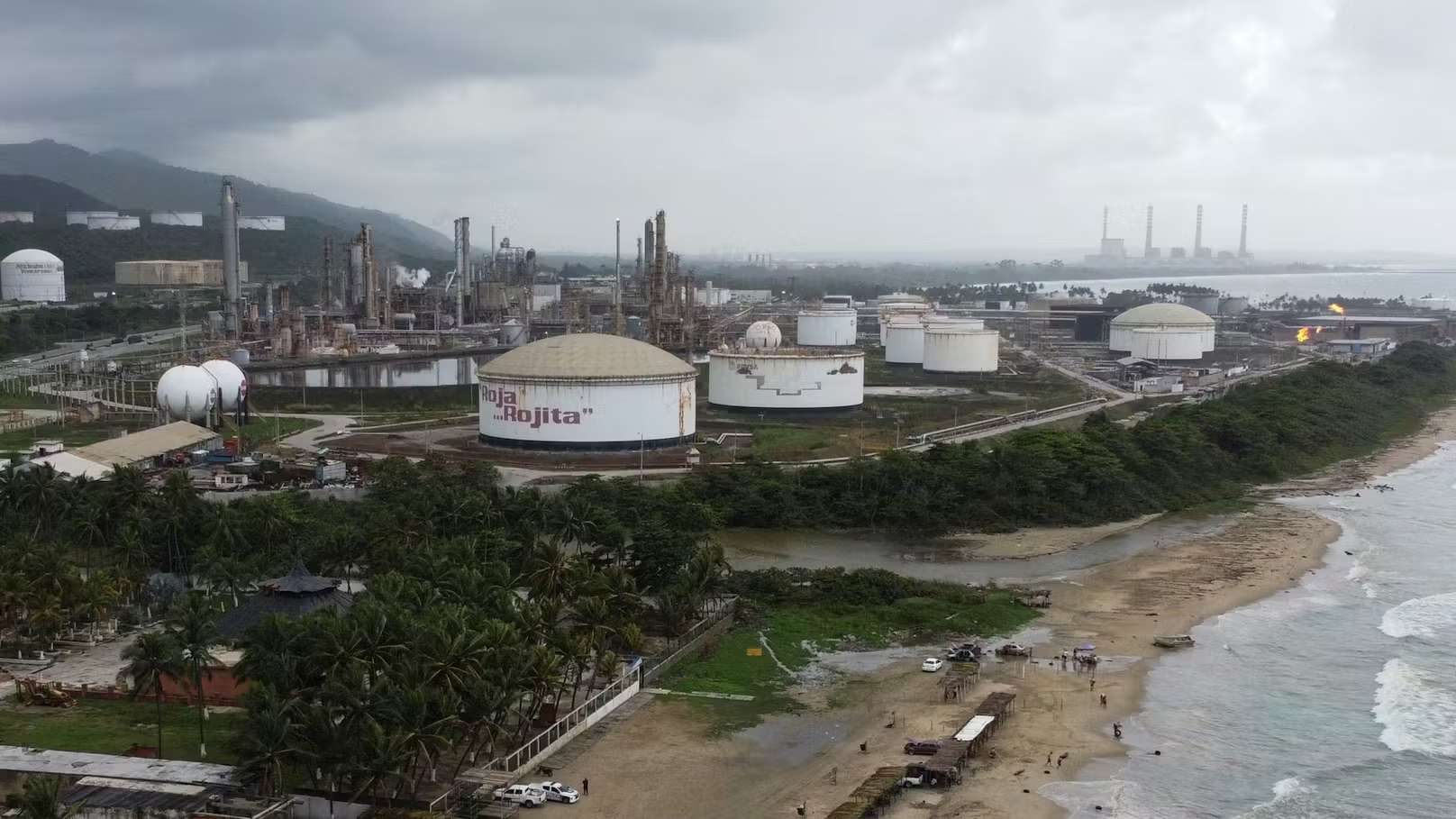
The scenic Venezuela Refinery in Puerto Cabello, ready to welcome the legions of American oil company employees

No one could have anticipated . . . 

The United States has urged its citizens to leave Venezuela immediately amid reports that armed paramilitaries are trying to track down US citizens, one week after the capture of the South American country’s president, Nicolás Maduro.

In a security alert sent out on Saturday, the state department said there were reports of armed members of pro-regime militias, known as colectivos, setting up roadblocks and searching vehicles for evidence that the occupants were US citizens or supporters of the country.

“US citizens in Venezuela should remain vigilant and exercise caution when traveling by road,” the alert added, urging citizens to depart immediately now that some international flights from Venezuela have restarted.

You don’t say.

The US closed its embassy in Venezuela back in 2019, so it’s not like this kind of warning is entirely new. But this ought to be a flashing red light and blaring siren to all who think that after the abduction of Maduro, everything is just peachy-keen for American oil companies to send hundreds of civilian employees into the country to start extracting oil.

I await Trump’s triumphant visit to Venezuela to receive the accolades of a grateful Central American nation.


Fridays with Nicole Sandler

Listen on Spotify (transcripts available)

Listen on Apple (transcripts available)

Update: We’re going to do some house cleaning around here, with a refresh of the site in the next bit. One thing I’m trying to do is put up resource pages on particular topics, which will be available from the front page. You’ve seen me do this with the Hunter Biden and Jim Comey cases, as well as DOGE debunkings. Some will be more formal, some will serve to capture links and try to understand what we’re seeing.

Have a look!

Trump Corruption

Stephen Miller resources

Immigration resources

Stephen Miller Has Similar Plans for Colombia and Columbia

Laura Jedeed wonders whether Trump is testing out a new kind of colonialism, where you basically issued orders to the corrupt illegitimate authorities, rather than installing the opposition.

Trump and Rubio’s talking points combine into a message intended not for the people of America, but for the heads of state in Cuba, Columbia, [sic] and worldwide. The message itself is simple, elegant, and ugly: do exactly what we say or America will destroy you—not your country, or your economy, or your people, but you, personally. This strategy doesn’t just let America “run” Venezuela. It allows this administration to “run” any country unable to attack us on our home turf: extract their resources, dictate their domestic policy, force their leaders to resign. All by credibly threatening extreme personal violence against any head of state who pushes back.

Credit where credit is due: it’s an entirely new approach to colonialism. Here’s how it’s worked since Britain perfected the art: you invade the country, then place the opposition party in power. That party requires your support to maintain control (if they had enough force to do it themselves they’d already be in charge). In exchange for military backup, their leader will do anything you ask.

Trump, on the other hand, has endorsed Maduro’s Vice President, Delcy Rodríguez, allegedly because the opposition party “doesn’t have the support within, or the respect within the country.” This assertion is aggressive nonsense. Opposition party weakness is a feature, not a bug, for the reasons stated above. It’s also patently untrue in this case. Election monitors from several countries agree that candidate Edmundo González Urrutia beat Maduro in a landslide two years ago by as much as 51 percent. Trump and his allies know this—they’ve used Maduro’s election theft to justify invasion. It’s kind of perfect: the party doesn’t have the power to gain power by themselves, but they’re popular enough to minimize the danger of revolt. It’s the dream situation—so why isn’t the Trump administration going for it?

Most people seem to think Trump’s endorsement of the unpopular and hostile Rodríguez stems from bitterness towards María Corina Machado, the opposition party leader who received the Nobel Peace Prize that Trump wanted so badly last year. Machado seems to think so too; she’s offered to give the prize to Trump and spent ten minutes abasing herself before the Peace President on Hannity yesterday. It won’t help. Trump is petty to the core, it’s true, but Stephen Miller and the other ghouls actually running this country would never set the entire colonial playbook on fire just to appease some old queen’s ego.

The real reason, I suspect, is this: leaving Rodríguez in charge is the only move that does not require a full-scale invasion.

Unlike Machado, Rodríguez possesses a military and police force capable of holding Venezuela together. Under the old model, that force would have threatened our hegemony, but under Colonialism 2.0, she has a strong incentive to do exactly as she’s told regardless; she is, after all, one surgical strike away from losing her freedom or possibly her life. As long as she doesn’t call Trump’s bluff or get coup’d herself, it’s foolproof.

[snip]

And the administration was right: Rodríguez is already rolling over. “We consider it a priority to move towards a balanced and respectful relationship between the US and Venezuela,” she wrote on Telegram late Sunday. “We extend an invitation to the US government to work together on an agenda for cooperation that is aimed towards shared development.” So far, so good.

That’s certainly what Trump is trying to do.

But it’s wildly premature to assess whether it’ll work.

Before I explain how it may backfire, let me observe that this plan is precisely the same plan Trump (Stephen Miller, really) is attempting with the US.

What Trump plans for Colombia is little different than what he succeeded in doing with Columbia University: Make demands on the elected leader, extract tribute, change the rules to benefit the authoritarian state. Whether it will work long term has yet to be seen, but the lesson of New College in Florida shows where things may head in the medium term: with dramatically increased costs and noticeably decreased utility. Once DeSantis is out of power, the effort is likely to be abandoned, turning New College into a bigger shell than it is already is. Columbia might take longer to collapse, unless Stephen Miller doubles down on his demands.

Now consider what makes Venezuela (or Colombia) different from Columbia, starting with the guns, guns which might come from at least three different places.

First, there are Russia, China, and some other Venezuelan patron states that are under assault as well. Trump has ordered Venezuela to expel them, stop doing business with them, and sell oil only to the US.

The Trump administration has told Venezuela’s interim president Delcy Rodriguez that the regime must meet the White House’s demands before being allowed to pump more oil, according to three people familiar with the administration’s plan.

First, the country must kick out China, Russia, Iran, and Cuba and sever economic ties, the sources said. Second, Venezuela must agree to partner exclusively with the U.S. on oil production and favor America when selling heavy crude oil, they added.

According to one person, Secretary of State Marco Rubio told lawmakers in a private briefing on Monday that he believes the U.S. can force Venezuela’s hand because its existing oil tankers are full. Rubio also told lawmakers that the U.S. estimates that Caracas has only a couple of weeks before it will become financially insolvent without the sale of its oil reserves.

As we speak, the Trump Administration is carrying out a replay of the OJ White Bronco chase, but with an empty oil tanker headed for Russia.

Russia has sent a submarine and other naval assets to escort an empty, rusting oil tanker that has become a new flashpoint in U.S.-Russia relations, according to a U.S. official.

The tanker, formerly known as the Bella 1, has been trying to evade the U.S. blockade of sanctioned oil tankers near Venezuela for more than two weeks. The vessel failed to dock in Venezuela and load with oil. Although the ship is empty, the U.S. Coast Guard has pursued it into the Atlantic in a bid to crack down on a fleet of tankers that ferry illicit oil around the world, including black-market oil sold by Russia.

The vessel’s crew repelled an effort by the U.S. to board the vessel in December and steamed into the Atlantic. As the Coast Guard followed it, the crew sloppily painted a Russian flag on its side, changed its name to the Marinera and switched its registration to Russia.

Russia has been concerned by U.S. seizures of tankers that ferry its illicit oil around the world and power its economy, and it has made the unusual move of allowing the tanker to register in Russia without an inspection or other formalities, experts say.

Update: The US has now seized the tanker.

Will this lead to some kind of direct conflict? I have no fucking clue and neither do you, because both Trump and Putin are fucking nuts. If Trump were rational, he’d retaliate not with direct confrontation in the North Sea, but by arming Ukraine and giving them the green light to up its attacks on Russia, but he’s not rational. Russia’s economy is actually close to collapse, and it wouldn’t take much to get it there. Russia, of course, has other means it might use to retaliate against Trump.

We shall see.

China is another matter though. China not only is rational, but China kicked the shit out of Trump in his last attempt to demand obeisance, the tariffs. Trump thought he could achieve with tariffs what he is trying to achieve with Venezuela: obeisance and personal tribute. Not only have all the tariffs harmed the US, spiking small business bankruptcies and inflation (and in the process making Trump’s political support far weaker), but China used its near-monopoly on rare earths and ability to replace US soybeans to bring Trump to his knees instead.

In fact, the Venezuelan coup might be partly a response to China’s success at wielding the rare earth weapon. While there’s much I disagree with in it, this post argues the Venezuela invasion was not about oil, but about the rare earth China currently extracts.

Investigative reporting documented Chinese buyers operating directly at mining sites in Bolívar state. The Venezuelan government established official collection centers in Los Pijiguaos and Morichalito in 2023 specifically for cassiterite, coltan, nickel, rhodium, and titanium. The Maduro regime designated these as strategic resources for commercialization, meaning state control over extraction and export, with Chinese buyers integrated into official operations from the start.

The supply chain from Venezuelan mines to Chinese refineries operates through both formal and informal channels, with Chinese buyers exercising operational control at the extraction source. Minerals extracted in the Orinoco Arc move by river and air transport to Colombian border towns, then to Bogotá for smelting into refined bars. These materials are relabeled under incorrect tariff codes, transforming raw ore into processed ferro-tantalum or other classifications that obscure origin. Final export occurs through Colombian ports at Santa Marta and Buenaventura, destined for Chinese processing facilities.

Once Venezuelan minerals blend with Colombian or Brazilian ore in these intermediary steps, tracing origin becomes effectively impossible. This laundering mechanism allows Venezuelan minerals to enter legitimate global supply chains, including those feeding US defense contractors. The result is Pentagon weapons systems potentially incorporating materials extracted under Chinese buyer supervision in Venezuelan territory, then processed in Chinese refineries controlled by Beijing.

Chinese buyers do not operate at arm’s length through market transactions. They coordinate directly at the mining sites with both Colombian guerrilla groups (ELN, FARC dissidents) who control physical security and Venezuelan state security (SEBIN) who facilitate transport using official government vehicles. One miner described seeing Chinese operatives and ELN commanders “eating together, buying material together, and getting off the helicopter together.” This is not commercial activity. This is integrated operational control where Chinese buyers work directly with armed groups and state officials to extract strategic minerals.

Trump doesn’t need — indeed, the oil companies probably don’t want — Venezuela’s oil, at least not in the short term.

He does need rare earth deposits (which is also the stated purpose of usurping Greenlands).

It took us some months to understand how China responded to Trump’s threat of tariffs. It took less time to recognize China’s advance preparation for them (based on Trump’s trade war from the first term).

A lot of the coverage of the coup views it as a profound humiliation for China, not least because China’s Latin American envoy met with Nicolás Maduro the day before the coup. That didn’t stop China (and Russia and Iran) from attending Rodríguez’ signing in, so there’s a distinct possibility they’re in at least as close coordination with Rodríguez right now as Marco Rubio.

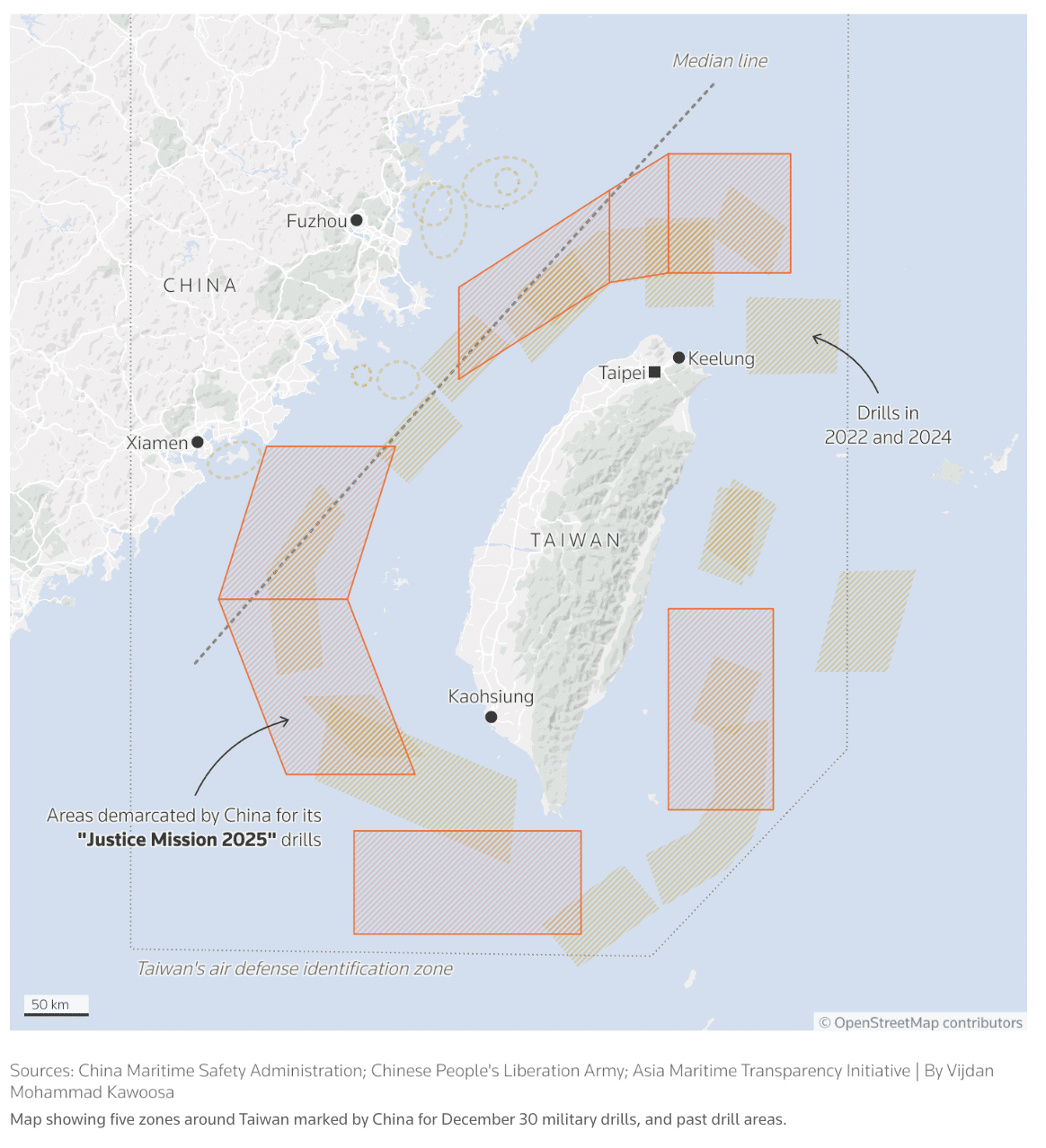
But the most belligerent thing — the thing people expect — is that China will take Taiwan, as it was practicing to do even as Trump had a fifth of deployed assets in the Caribbean preparing to invade.
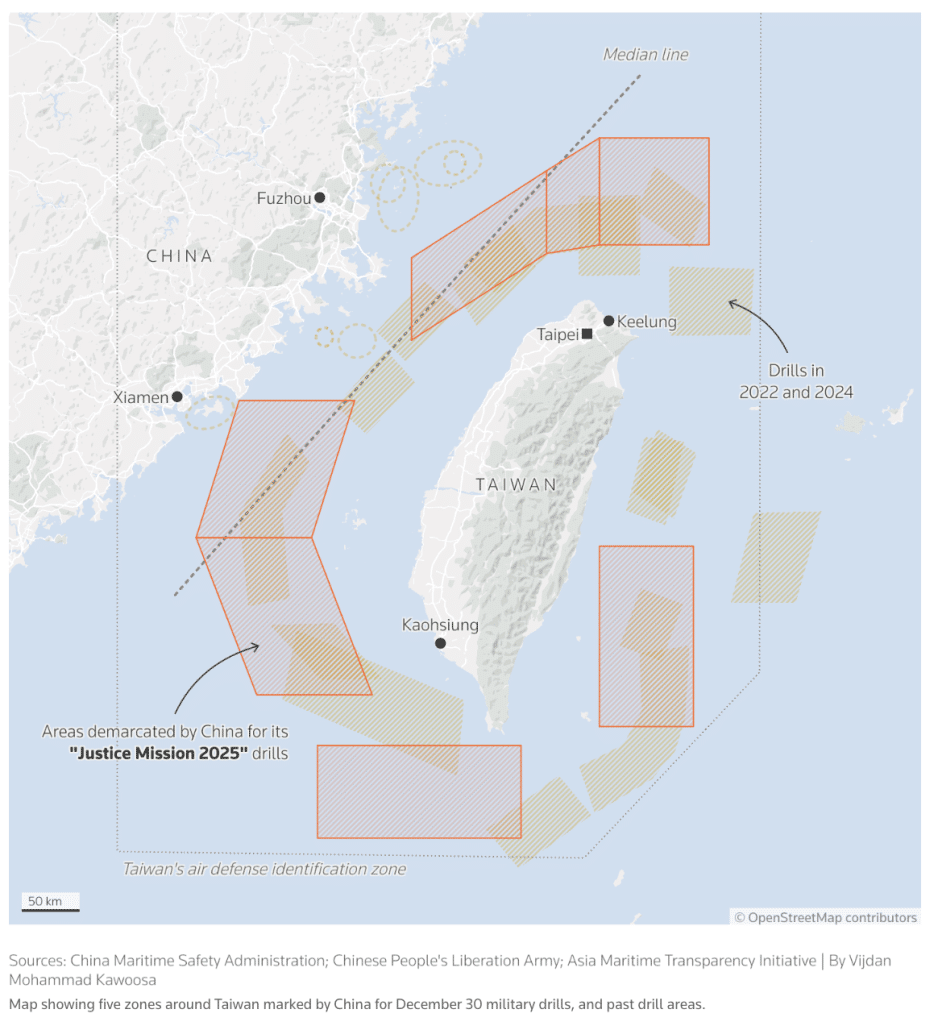
With all the attention on Venezuela, there has been too little attention on vacuums created with this extended deployment off the coast of Venezuela (the most immediate of which is probably in the Middle East). But it is clear that Trump keeps launching little wars with resources most of Congress believes should be used to counter China’s expansionary plans.

But as China showed with the tariffs, they likely have ways to respond that are less direct and at least as devastating.

But China and Russia aren’t the only ones who have guns here.

So does, just as one example, Interior Minister Diosdado Cabello, who has been indicted in SDNY alongside Maduro since 2020. Reuters describes that the US already threatened Cabello.

In the meantime, they have communicated to Cabello via intermediaries that if he is defiant, he could face a similar fate to Maduro, the authoritarian leader captured in a U.S. raid on Saturday and whisked away to New York to face prosecution on “narco-terrorism” charges, or could see his life in danger, the source said.

But taking out Cabello could be risky, possibly motivating pro-government motorcycle groups, known as colectivos, to take to the streets, unleashing the chaos Washington wants to avoid. Their reaction may depend on whether they feel protected by other officials, however.

In one of her first decisions as acting president, Rodríguez appointed General Gustavo González López as new head of the Presidential Honor Guard and the Directorate General of Military Counterintelligence (DGCIM), state TV said late on Tuesday.

González López, who has been sanctioned by the U.S. and EU along with at least half a dozen other high-ranking officials for rights violations and corruption, served as Venezuela’s intelligence director until mid-2024, when he was replaced by Maduro in a reshuffle of his cabinet and security team.

Later that year, he began working with Rodríguez as head of strategic affairs and control at state oil company PDVSA.

González López was considered close to Cabello, but it was not immediately clear whether his appointment was a gesture of support from Rodríguez to the man considered the strongman of the ruling party, or, on the contrary, a sign of a rift.

The officer replaces General Javier Marcano, whose performance came under scrutiny after Maduro’s capture, according to analysts.

One thing I’ve seen no coverage of is why the US thinks Rodríguez will be secure within Venezuela now that Trump killed the 40 Cubans who were protecting Maduro. And the militias via which Cabello exercises some of his repression could carry out a deniable kind of violence.

But Cabello isn’t even the only one with guns in question. The purported purpose of this operation is about stopping drug trafficking. But unless Trump is doing what every other caudillo does — manage the trade while extracting tribute — there will, eventually, be a counter response from the cartels, which don’t take kindly to losing their markets and have the ability to exercise violence both on site — in Venezuela — but also closer to home, including in the United States. Stephen Miller has so much of US law enforcement snatching workers at Home Depot that certain kinds of crime are likely far easier to pull off. Update: About which the NYT has another story today.

Finally, there are the Venezuelan people. Maduro only remained in power with a great deal of repression, and Trump is tinkering with that system of repression. Meanwhile, Trump’s plans to expel much of the Chinese may exacerbate already dire economic conditions for Venezuelans, because Trump won’t subsidize soft power in the way China has been willing to (to say nothing of the expulsion of Cubans who were providing medical care). Where Stephen Miller’s authoritarianism has failed most dramatically in the US is the way the counter reaction to his goons has revitalized civil society in cities that stand up to the goons. And there’s already a practiced opposition in Venezuela that, as in the US, dramatically outnumbers the goons in charge.

It’s only day four. We have no fucking idea how this will turn out. While Delta Force and the CIA performed spectacularly, there’s really just a handful of people in charge, and most — like Stephen Miller, who thinks of Venezuela as an island surrounded by a US armada and therefore is likely forgetting about a porous border with Colombia — are utterly ignorant about Venezuela and childish about power.

Columbia University was easy to subjugate, because no one had guns. But even there it only happened by damaging the host. There are a lot of people with guns with an interest in Venezuela.

It’s just as likely, in my opinion, that this precipitates World War III as that it succeeds in Venezuela much less produces the treasure Trump is demanding.

Update: CEO of the Human Rights Foundation, Venezuelan Thor Halvorssen, predicts Delcy Rodríguez’ quick demise.

Reports indicate the Trump administration has struck a deal with Delcy Rodríguez, Mr. Maduro’s iron-fisted vice president, positioning her as a transitional leader. She has, it seems, convinced U.S. officials that she can dismantle the Maduro dictatorship, which would have to include demobilizing the armed militias, disbanding the dreaded secret police and ending the regime’s drug empire. But this is a fantasy. Ms. Rodríguez will fail spectacularly, leading to the final unraveling.

Venezuela isn’t like Mexico, where a state coexists uneasily with cartels. Here, the cartel is the state. Factions—enriched generals, intelligence chiefs and narco-traffickers—won’t surrender power in a Washington-brokered deal. Ms. Rodríguez herself faces insurmountable obstacles, beginning with her utter lack of legitimacy. Never elected vice president, she has less authority than Mr. Maduro, the usurper who appointed her.

I think he wildly overestimates the extent that Trump would even permit any lapse in repression.

Update: Meanwhile on Xitter, I take this as confession that Stephen Miller knows fuckall about the oil market, especially the discount at which Venezuelan oil must be sold and the price at which it is worth drilling.
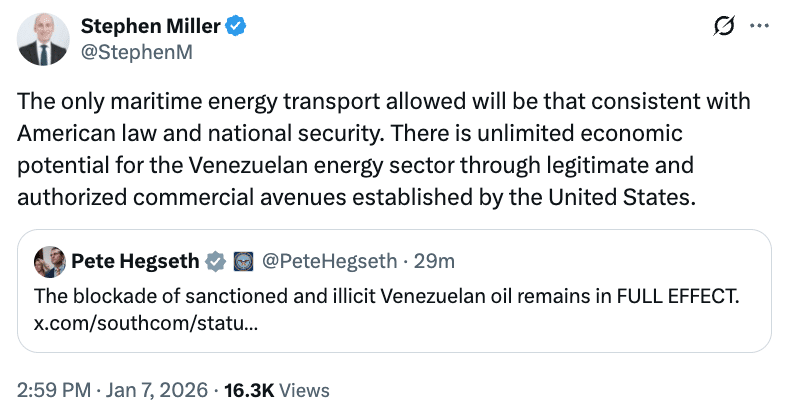
Paul Krugman’s column today is on how Trump’s oil math doesn’t add up.

[W]hatever it is we’re doing in Venezuela isn’t really a war for oil. It is, instead, a war for oil fantasies. The vast wealth Trump imagines is waiting there to be taken doesn’t exist.

Update: WSJ goes into more depth about the challenges Cabello may pose to Trump’s plans.

Fond of swinging a spiked club while spouting conspiracy theories on his hourslong weekly show on state television called “Bringing Down the Hammer,” now on its 556th episode, Cabello is hard to predict.

Cabello, a 62-year-old whose official title is minister of interior, justice and peace, has so far signaled unity, taking part in Rodriguez’s swearing-in ceremony on Monday, where various factions of Venezuela’s ruling socialist party were present.

But that night, Cabello was toting a rifle and riling up black-uniformed security forces before they patrolled Caracas to prevent citizens from protesting.

“Doubting is treason!” he said, before telling the armed group, “Now, off to battle in the streets for victory.”

Under a state of emergency that the government declared after Maduro’s capture, security forces were ordered to hunt down U.S. sympathizers, according to the Official Gazette, where the Venezuelan government publishes new laws and decrees. Residents in the capital reported new roadblocks around the city where armed, masked men checked the phones of ordinary Venezuelans for antigovernment messages.

Update: This offers a good explanation of all the people with guns who would make things difficult even if Delcy Rodríguez did want to cooperate with the US.

Update, January 9: This analysis lays out the difficulties of Delcy Rodriguez’ position better than I did.

For her part, Rodríguez confronts an unprecedented challenge for a Venezuelan leader: She must satisfy Washington’s demands while maintaining sufficient Chavista coalition support to prevent an internal fracture or a military coup. The Trump administration demands sufficient cooperation to enable US oil company operations, likely including transparent property contracts and regulatory stability—precisely the institutional environment that Chavismo systematically dismantled. Rodríguez making such an agreement with Trump would alienate the regime’s hardliners, who would view her accommodation as a betrayal. Thus, Rodríguez may be unable to guarantee the stability required for the business operations Trump wants to run in Venezuela.

Her public contradictions reflect this impossible position. In her first televised addresses as interim president, she demanded Maduro’s immediate release to demonstrate loyalty to domestic audiences. Less than twenty-four hours later, however, she declared it a priority to move toward a “balanced and respectful” economic cooperation between the United States and Venezuela.

This double game cannot persist indefinitely. Rodríguez must choose between accommodating Trump’s demands or preserving Chavista unity. Trump’s threat that if Rodríguez “doesn’t do what’s right, she is going to pay a very big price, probably bigger than Maduro” makes clear that there will be consequences of noncompliance. Purging the hardliners may be Rodríguez’s best option.

Perhaps Rodríguez’s most complex challenge is managing Venezuela’s deep entanglements with China, Russia, Iran, and Cuba while simultaneously partnering with the Trump administration. This is especially the case after the Trump administration demanded that Venezuela immediately cut ties and cease intelligence cooperation with Russia, China, Iran, and Cuba. These relationships represent more than diplomatic alignments—they constitute binding financial obligations, operational dependencies, and strategic commitments that cannot simply be abandoned without triggering massive economic and security consequences.

China presents the most significant financial exposure. Venezuela owes Beijing around twenty billion dollars in loans. These debts are secured through oil-for-loan arrangements that require repayment through crude deliveries, with China currently absorbing more than half of Venezuela’s oil exports (approximately 746,000 barrels per day in November 2025).

Beyond petroleum, Chinese state enterprises control critical Venezuelan infrastructure.

How the Deep State Taught Stephen Miller to Love Socialism

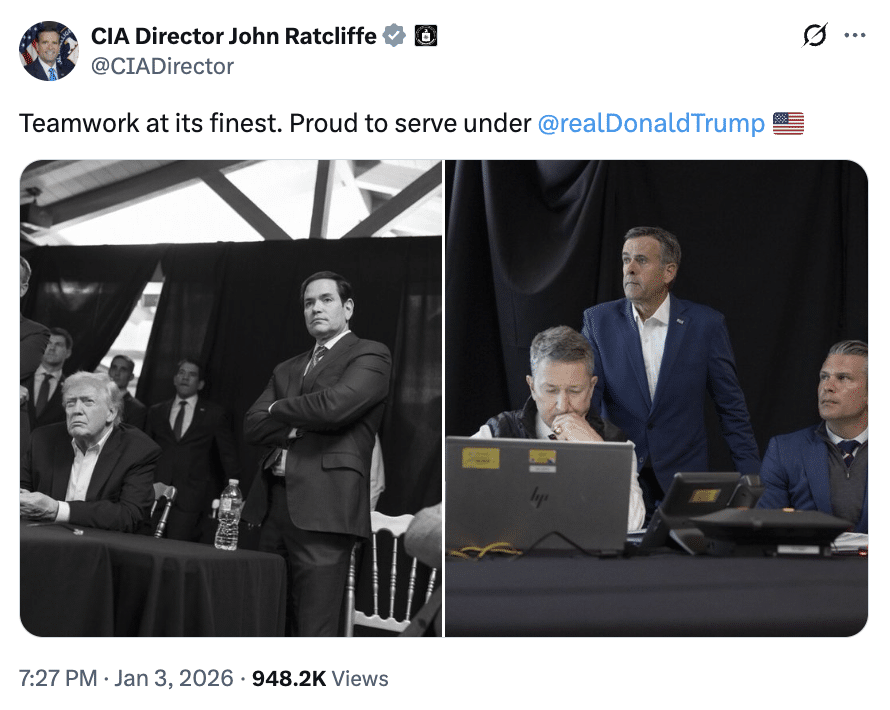
Recent reporting suggests that the CIA — more than Trump’s other top intelligence advisors — continues to give the President unvarnished advice. And by yoking that advice to spectacular covert operative success (and probably a good deal of boasting to the press), the CIA seems to be building value with Trump and his stupider advisors (with the exception of the deliberately stupidest, Steve Witkoff).

Remain in Ukraine

Take Ukraine. A recent profile of how the US betrayed Ukraine describes the CIA has remained there fighting.

But there was a counternarrative, spooled out largely in secret. At its center was the C.I.A.

Where Mr. Hegseth had marginalized his Ukraine-supporting generals, the C.I.A. director, Mr. Ratcliffe, had consistently protected his own officers’ efforts for Ukraine. He kept the agency’s presence in the country at full strength; funding for its programs there even increased. When Mr. Trump ordered the March aid freeze, the U.S. military rushed to shut down all intelligence sharing. But when Mr. Ratcliffe explained the risk facing C.I.A. officers in Ukraine, the White House allowed the agency to keep sharing intelligence about Russian threats inside Ukraine.

CIA didn’t just remain in Ukraine collecting intelligence. They’ve played a role in Ukraine’s spectacular success in using drone attacks to degrade Russia’s security.

In June, beleaguered U.S. military officers met with their C.I.A. counterparts to help craft a more concerted Ukrainian campaign. It would focus exclusively on oil refineries and, instead of supply tanks, would target the refineries’ Achilles’ heel: A C.I.A. expert had identified a type of coupler that was so hard to replace or repair that a refinery would remain offline for weeks. (To avoid backlash, they would not supply weapons and other equipment that Mr. Vance’s allies wanted for other priorities.)

Russia no doubt understands the CIA remains intelligent (heh) and focused on its original adversary. When they recruited Witkoff to manage Trump’s capitulation, they specifically ordered him not to bring CIA.

Steve Witkoff, a billionaire real-estate developer and longtime golfing partner of Donald Trump, was just days into his job as the new president’s special envoy to the Middle East when he received a tantalizing message from the crown prince of Saudi Arabia.

Vladimir Putin was interested in meeting Witkoff—so interested that he might consider releasing an American prisoner to him. The invitation came from a Kremlin moneyman named Kirill Dmitriev, using the de facto Saudi ruler, Mohammed bin Salman, as an intermediary.

There was just one thing: Witkoff would be expected to come alone, without any CIA handlers, diplomats or even an interpreter, a person familiar with the outreach said.

And Witkoff, obedient to Putin’s demands, continues to refuse CIA briefings.

Witkoff has declined multiple offers from the CIA for a briefing on Russia.

[snip]

Ahead of his trip, the CIA offered to brief Witkoff; he declined. Nor was he accompanied by an interpreter: He had been told that Russia’s president wouldn’t allow him to bring another person into the meeting.

A White House official said he participated in multiple briefings before his first trip to Russia, including Trump’s intelligence briefing. The CIA regularly briefs him on other issues like Gaza—but not Russia.

Inform Trump that Ukraine did not strike Russia

The thing is, the ability to provide accurate intelligence and (I assume this was more important) really cool attacks that make the attacker look strong appears to be increasing the CIA’s value to Trump.

Not only did CIA conclude (unsurprisingly) that Putin was lying when he recently claimed that Ukraine had attempted to target his residence,

The CIA has assessed Ukraine was not targeting a residence used by Russian President Vladimir Putin in a recent drone attack in the north of his country, according to US officials, undercutting an assertion the Russian leader had made to President Donald Trump in a Monday phone call.

The CIA’s director John Ratcliffe briefed Trump on the assessment Wednesday, the officials said.

Russia had publicly raised allegations Ukraine attempted to hit Putin’s home Monday, and Trump told reporters Putin had told him of it over the phone. At the time, the president said he was troubled by the reported action, seeming to believe the Russian leader even as Ukraine strenuously denied it was behind any such attack.

“I don’t like it. It’s not good,” Trump said, describing himself as “very angry” upon hearing the claim.

But in the wake of Ratcliffe’s briefing, Trump has repeated that conclusion.

President Donald Trump on Sunday told reporters that U.S. officials have determined that Ukraine did not target a residence belonging to Russian President Vladimir Putin in a drone attack last week, disputing Kremlin claims that Trump had initially greeted with deep concern.

Russian Foreign Minister Sergey Lavrov last week said Ukraine launched a wave of drones at Putin’s state residence in the northwestern Novgorod region that the Russian defense systems were able to defeat. Lavrov also criticized Kyiv for launching the attack at a moment of intensive negotiations to end the war.

The allegation came just a day after Ukrainian President Volodymyr Zelenskyy had traveled to Florida for talks with Trump on the U.S. administration’s still-evolving 20-point plan aimed at ending the war. Zelenskyy quickly denied the Kremlin allegation.

Trump said that “something happened nearby” Putin’s residence but that Americans officials didn’t find the Russian president’s residence was targeted.

“I don’t believe that strike happened,” Trump told reporters as he traveled back to Washington on Sunday after spending two weeks at his home in Florida. “We don’t believe that happened, now that we’ve been able to check.”

Sure, this is just one instance, one single time when Trump believed his own spooks over Putin. But given that Trump first started to parrot obviously bullshit Russian claims eight years ago, in Helsinki, the fact that Trump would accept CIA’s judgment and in the process withstand an obvious attempt to pull Trump back towards capitulation, the instance feels momentous.

Venezuela central to success of operation

And given the CIA’s role in delivering one of the most sadistic thrills of this term, Trump may have no way back.

NYT dedicated an an entire story to describing how CIA (probably assisted by the $50 million reward the FBI offered) recruited someone within Maduro’s government who shared details of the dictators pattern of life.

The American spy agency, the people said, produced the intelligence that led to the capture of Mr. Maduro, monitoring his position and movements with a fleet of stealth drones that provided near constant monitoring over Venezuela, in addition to the information provided by its Venezuelan sources.

The C.I.A. had a group of officers on the ground in Venezuela working clandestinely beginning in August, according to a person familiar with the agency’s work. The officers gathered information about Mr. Maduro’s “pattern of life” and movements.

It is not clear how the C.I.A. recruited the Venezuelan source who informed the Americans of Mr. Maduro’s location. But former officials said the agency was clearly aided by the $50 million reward the U.S. government offered for information leading to Mr. Maduro’s capture.

Given how volatile things are in Venezuela, the CIA may not be able to sustain this person’s loyalty (or life, not least because Trump has made it a lot harder to support assets in various ways).

But for now, the CIA is taking credit for a key role in one of Trump’s only successes — and Trump is boasting of their work (again, in ways that may get assets in the field killed).

Advise Trump to keep regime members

Even before that success, though, CIA advised — and Trump heeded their advice — to stick with a Maduro loyalist to govern after his snatching. WSJ reports that senior Trump officials asked for this analysis weeks before the snatch.

Senior Trump administration officials commissioned the CIA to undertake the analytical assessment and debated it during discussions about day-after plans for Venezuela, the people said. The people familiar with the assessment said they were unsure of the precise date it was produced.

The report was briefed to Trump in recent weeks, according to two of the people.

The assessment didn’t describe how Maduro could lose power, or advocate for removing him, but attempted to gauge the domestic situation in Venezuela in the event that he did, people familiar with it said.

The intelligence report, the people said, cited Rodríguez and two other top Venezuelan regime figures as possible interim rulers who could keep order. The people familiar with the assessment didn’t identify the other two officials, but besides Rodríguez, the two most influential power brokers are Interior Minister Diosdado Cabello and Defense Minister Vladimir Padrino.

This advice may well backfire in the near term. It is undoubtedly the case that a Chavista will have far more ability to sustain order. But particularly given Trump’s belated realization that the oil won’t pay for itself — and the US government will have to subsidize oil development, it will very quickly sour at least some of the people most excited by this invasion, the Cuban-American community.

And ultimately, the Administration has gone all in with Chavistas who rule through brutal repression, as Stephen Miller said in that batshit interview with Jake Tapper where he also repeatedly said that Venezuela is an island.

For those who may be indicted, the best choice they can possibly make is to be part of a constructive decision-making process for the future of Venezuela. The best decision they can make is to cooperate fully and completely with the United States to be part of building this brighter future for Venezuela.

When Miller envisions cooperating with the other people who were indicted, he’s stating that he’s happy to cooperate with Diosdado Cabello, who has been far more involved in the day-to-day trafficking than Maduro, and who is very much an ideological Chavista.

Stephen Miller went on TV — around the same time as Trump said he was going to give welfare to oil companies so they could benefit Venezuela — and bragged about working with precisely the socialists he has defined his entire existence in opposition to.

John Ratcliffe’s CIA, the Deep State! after building Donald Trump’s trust over a year, convinced Stephen Miller to love socialists.

Ratcliffe bypassed the DNI gatekeeper

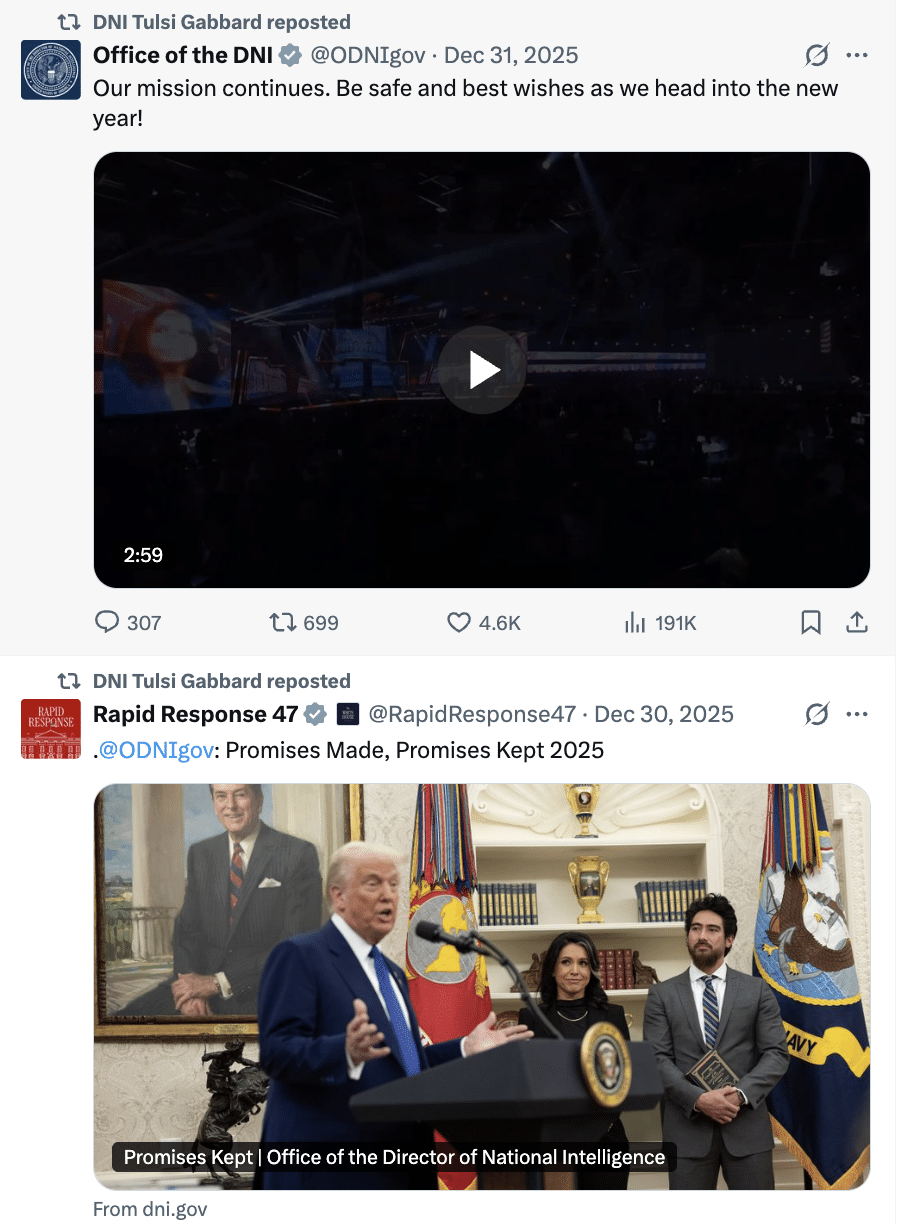
Meanwhile, Tulsi has remained silent since the snatch.

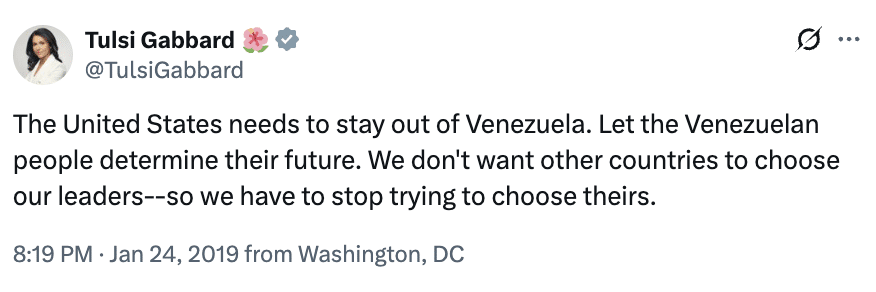
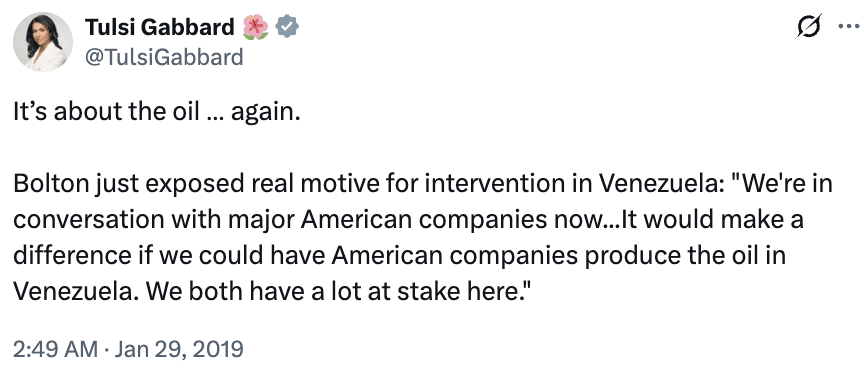
Leaving people to mock her past statements predicting precisely what is happening in Venezuela.

Tulsi almost lost her job in advance of the Iran strikes after posting a video warning of World War III.

It’s not necessarily a good thing that Tulsi’s skepticism is being supplanted with Ratcliffe’s willingness to go big on covert operations. Both of them suck. Neither can offer wise counsel to Trump (but both likely know Venezuela is not an island).

But at least some reality has begun to seep into Trump’s thinking.

Update, January 8: Sure enough, Bloomberg reports that Tulsi was systematically excluded from the planning for Venezuela.

The White House excluded Director of National Intelligence Tulsi Gabbard from months of planning to oust Nicolas Maduro because her previous opposition to military action in Venezuela cast doubt on her willingness to support the operation, people familiar with the matter said.

The move to cut Gabbard out of the meetings was so well-known that some White House aides joked that the acronym of her title, DNI, stood for “Do Not Invite,” according to three of the people. They asked not to be identified discussing private conversations. A White House official denied there was any such joke.

As a Democratic congresswoman in 2019, Gabbard said the US needs to “stay out” of Venezuela, and as recently as last month she railed against “warmongers” pushing the US into conflict.

The exclusion was the latest evidence of long-running tension over Gabbard’s role in the Donald Trump administration, and has underscored how the president’s decision to oust Maduro — despite campaigning against starting new wars — has widened fissures not only among his MAGA supporters but also within his team.

Tulsi’s people even pointed to that hilarious tweet to push back on this story.

A senior intelligence official pushed back against the characterization that Gabbard had been excluded, saying she provided intelligence that helped the overall mission, even if it was less operational and more analytical. An ODNI spokeswoman referred Bloomberg to a social media post Gabbard wrote Tuesday lauding servicemembers for the operation’s “flawless execution” of the move to capture Maduro.

“President Trump promised the American people he would secure our borders, confront narcoterrorism, dangerous drug cartels, and drug traffickers,” she wrote. The post broke a days-long silence after other top national security officials cheered the operation in press conferences, TV interviews and on social media.

DOJ’s Politically Illegitimate Basis for Political Illegitimacy in Nicolás Maduro Indictment

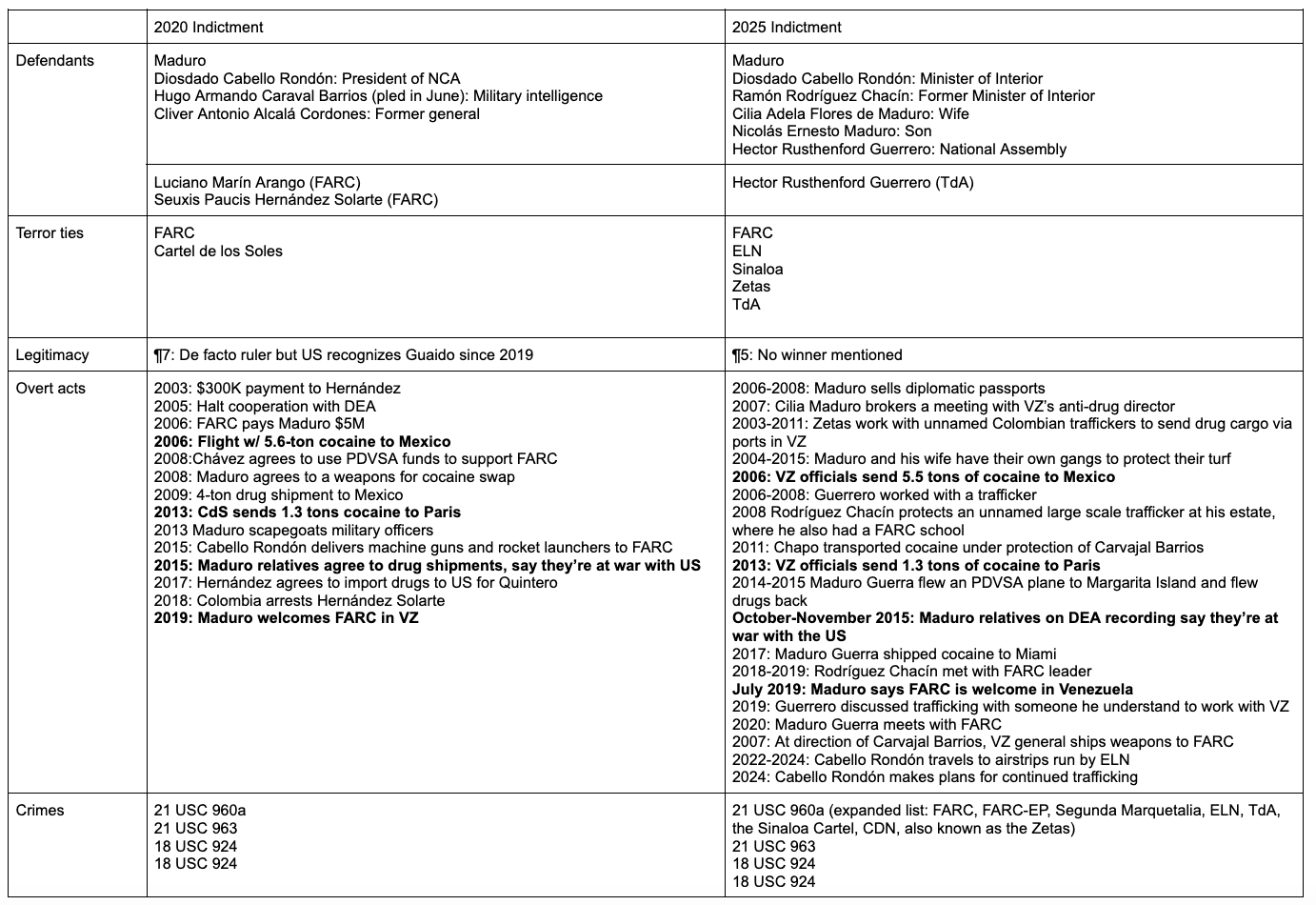
As I’ll explain below (and mapped in this table), the superseding indictment against Nicolás Maduro and his wife unsealed yesterday is a more political document than the one that first charged Maduro in 2020. One important difference lies in how DOJ attempted to claim Maduro is not the leader of Venezuela, which will be a key element required to overcome any immunity claim Maduro will surely invoke.

Before I explain the differences between these indictments, let me stress that both are real indictments, documenting decades of corruption and cooperation with drug traffickers and terrorists. Prosecutors worked hard to pull them together and investigators (in the US and around Latin America) and sources no doubt risked their lives to make it possible.

The charges remain the same as in 2020

Both indictments charge the same four crimes:

  • Narco-Terrorism Conspiracy (21 USC 960a)
  • Cocaine Importation Conspiracy (21 USC 963)
  • Two counts of use of machine guns or destructive devices in furtherance of the conspiracies (18 USC 924)

The latter charges, charging Maduro for possessing machine guns, have attracted some mockery, including from me. DOJ is at the same time arguing that DC must allow semi-automatic weapons and at the same time charging a foreign leader with possessing machine guns. The charges are there (and were put there years ago) because they’re a way to get significant sentencing enhancements for other crimes. The presentencing memo for Hugo Armando Caraval-Barrio, who was charged with Maduro in 2020 and pled guilty in June, added so many sentencing enhancements they’re having a multi-day hearing later this month to fight about which ones apply. But given the evolution of gun prohibitions in the US since Bruen (issued in 2022), Maduro may try to challenge this charge, though Caraval-Barrio pled to those same charges in June.

DOJ includes Sinaloa, los Zetas, and Tred de Aragua for reasons that likely have to do with Stephen Miller’s fever dreams

In addition to adding overt acts that happened since 2020, the Narco-Terrorism Conspiracy charged in the newly unsealed indictment is interesting — and may have further significance — because it added several new cartels that have been deemed terrorist organizations last year. The 2020 indictment focused on FARC, the left wing Colombian terrorist organization that trafficked drugs, and Cartel de Soles (the vague name used for Maduro’s corruption). But in the last year, the Trump Administration has, for the first time (and controversially), designated drug cartels that engage in extreme violence as terrorist organizations. So the new indictment names not just FARC and ELN — Colombian terrorists whom Maduro gave shelter — but Sinaloa and the Zetas, along with Tren de Aragua.

24. It was a part and an object of the conspiracy that NICOLAS MADURO MOROS, DIOSDADO CABELLO RONDON, and RAMON RODRIGUEZ CHACIN, the defendants, and others known and unknown, would and did engage in conduct that would be punishable under Title 21 , United States Code, Section 841 ( a), if committed within the jurisdiction of the United States, to wit, the distribution of, and possession with the intent to distribute, five kilograms and more of mixtures and substances containing a detectable amount of cocaine, knowing and intending to provide, directly and indirectly, something of pecuniary value to a person and organization that has engaged and engages in terrorism and terrorist activity (as defined in Title 8, United States Code, Section 1182(a)(2)(B)), or terrorism (as defined in Title 22, United States Code, Section 2656f(d)(2)), to wit, the following organizations that have been designated by the United States Secretary of State as FTOs pursuant to Section 219 of the INA, during times relevant to this Superseding Indictment: FARC, FARC-EP, Segunda Marquetalia, ELN, TdA, the Sinaloa Cartel, CDN, also known as the Zetas, and each organization’s members, operatives, and associates, having knowledge that such organizations and persons have engaged and engage in terrorist activity and terrorism, in violation of Title 21, United States Code, Section 960a. [my emphasis]

This is one of the things I view as political. There’s far more substance behind the FARC allegations than the Sinaloa and Zetas ones. The Zetas allegation relies on the Zetas’, working with unnamed Columbian traffickers, use of Venezuelan ports from 2003 to 2011. The Sinaloa allegation relies on Caraval-Barrio’s protection of Chapo Guzmán in 2011. Both those allegations took place long before Marco Rubio included the Mexican cartels in his new designations. But by including them in this indictment, DOJ makes this application of such crimes applicable in Mexico, an ominous inclusion given Trump’s overt threats to pull the same kind of invasion in Mexico next.

The Tren de Aragua is likewise thin. In the 2020 indictment, two FARC leaders were included as co-conspirators, but that reflected a sustained relationship with Maduro as laid out in the overt acts. The TdA inclusion here relies on a similar move, including its leader, Hector Ruthsenford Guerrero Flores as a co-conspirator. But his inclusion relies on two overt acts that don’t involve Maduro: Guerrero’s actual trafficking with someone not alleged to be part of this conspiracy, and comments made in a Venezuelan prison in 2019. (These may be the comments that US intelligence services have deemed to be unreliable.)

f. Between approximately 2006 and 2008, HECTOR RUSTHENFORD GUERRERO FLORES, a/k/a “Nifio Guerrero,” the defendant, worked with one of the largest drug traffickers in Venezuela, Walid Makled. Members of the Venezuelan regime helped protect Makled’s cocaine shipments that were transported from San Fernando de Apure, Venezuela, to Valencia, Venezuela, and were then sent by plane from the Valencia international airport to Mexico and other locations in Central America for eventual distribution to the United States. Between in or about 2008 and in or about 2009, GUERRERO FLORES also provided another major Venezuelan drug trafficker with protection for cocaine shipments moving through Venezuela, including by providing armed men who carried, among other automatic weapons, AK47s, MP5s, and AR-15s, as well as grenades. At times, GUERRERO FLORES personally accompanied large cocaine loads as they were guarded by the teams of armed men, en route to airports or airstrips for transport north and eventual distribution to the United States. GUERRERO FLORES was paid a fee per kilogram of cocaine transported or received and he sometimes received an interest in portions of these massive cocaine shipments in lieu of payment. The traffickers that GUERRERO FLORES worked with moved thousands of kilograms per shipment, multiple times per month, resulting in the distribution of hundreds of tons of cocaine to the United States. In or about 2009, Makled was charged with narcotics offenses in this District and is a fugitive.

[snip]

o. In or about 2019, TdA’s leader, GUERRERO FLORES, discussed drug trafficking with an individual he understood to be working with the Venezuelan regime. Over multiple calls, GUERRERO FLORES offered to provide escort services for drug loads, explaining that GUERRERO FLORES and TdA had control of the coastlines of Venezuela’s Aragua State. GUERRERO FLORES, speaking from TdA’s base of operations in Tocor6n Prison, explained that TdA could handle the logistics of every aspect of the drug trade, including the use of storage compartments that GUERRERO FLORES called “cradles” located on a beach in Aragua State. In doing so, GUERRERO FLORES confirmed TdA’s ability to protect over one ton of cocaine.

That is, neither is TdA necessary to substantiate the narco-trafficking charges, which are well-substantiated based on protection of FARC, nor is the substance of TdA’s inclusion all that convincing.

At all.

But no doubt Stephen Miller will use this — a grand jury finding probable cause tying TdA to Maduro — to attempt to renew his Alien Enemies Act deportations.

Adding the family, leaving behind the key co-conspirator

On top of swapping FARC co-conspirators for a TdA one, the newly unsealed indictment adds Maduro’s wife and son as co-conspirators.

The inclusion of Maduro’s son is better substantiated. The indictment alleges that his plane was used to ship drugs, he shipped drugs to Miami, and he met with FARC (though neither he nor his mother are included in the narco-trafficking charge).

The inclusion of Cilia Maduro — who was shipped to SDNY along with her husband — rests on her allegedly accepting a bribe in 2007 to broker a meeting between a trafficker and Venezuela’s corrupt top anti-drug cop.

b. In approximately 2007, CILIA ADELA FLORES DE MADURO, the defendant, attended a meeting in which FLORES DE MADURO accepted hundreds of thousands of dollars in bribes to broker a meeting between a large-scale drug trafficker and the director of Venezuela’s National Anti-Drug Office, Nestor Reverol Torres. The drug trafficker later arranged to pay a monthly bribe to Reverol Torres, in addition to approximately $100,000 for each flight that was transporting cocaine to ensure the flight’s safe passage, a portion of which was then paid to FLORES DE MADURO. In or about 2015, Reverol Torres was charged with narcotics offenses in the Eastern District of New York and is a fugitive.

But prosecutors likely included Maduro’s family — and snatched Cilia along with her spouse — to acquire leverage against him.

One more point about alleged co-conspirators. In the wake of yesterday’s invasion, Diosdado Cabello Rondón, who is incorporated into the narco-trafficking charge and was already in 2020, was the first person to call for calm, calling the Americans terrorists.

At the crack of dawn, Diosdado Cabello, the regime’s second-in-command, appeared on state-run Venezolana de Televisión, clad in tactical vest and helmet and surrounded by members of the political police. Cabello called the U.S. attack “treacherous and vile” and urged his supporters “not to lose their composure, to avoid despair.” “Avoid situations that favor the invading enemy,” he said. Cabello questioned the role of “international organizations” in this crisis, accusing them of being “complicit in a massacre of civilians.” The leader addressed his men on camera with the two central slogans of the regime’s security forces: “Always loyal, never traitors” and “To doubt is treason.”

This analysis of the aftermath notes that you’d have to take out more of Maduro’s aides, including Cabello, to defeat his government.

For more than a decade, real power in Venezuela has been held by a small circle of senior officials. Analysts and officials say though that the system depends on a sprawling web of loyalists and security organs, fueled by corruption and surveillance.

Within the inner circle, a civilian-military balance reigns. Each member has their own interests and patronage networks. Currently Rodriguez and her brother represent the civilian side. Padrino and Cabello represent the military side.

This power structure makes dismantling Venezuela’s current government more complex than removing Maduro, according to interviews with current and former U.S. officials, Venezuelan and U.S. military analysts and security consultants to Venezuela’s opposition.

“You can remove as many pieces of the Venezuelan government as you like, but it would have to be multiple actors at different levels to move the needle,” said a former U.S. official involved in criminal investigations in Venezuela.

A big question mark surrounds Cabello, who exerts influence over the country’s military and civilian counterintelligence agencies, which conduct widespread domestic espionage.

“The focus is now on Diosdado Cabello,” said Venezuelan military strategist Jose Garcia. “Because he is the most ideological, violent and unpredictable element of the Venezuelan regime.”

Donald Trump conducted a months-long operation to carry out an arrest, he claims. But somehow they left behind someone alleged to be just as culpable in the headline charges of the indictment, Cabello.

Disavowing democracy in attempting to negate Maduro’s immunity claim

Yesterday, Trump and Marco Rubio claimed that Maduro’s Vice President, Delcy Rodriguez, would do as she was told. Then she went on TV and said Maduro was still the president and Venezuela would never again be the colony of an empire. It’s unclear whether she’s misleading Marco Rubio or the Venezuelan people, or simply trying to find middle ground.

But her claim to authority only comes through Maduro.

And that’s important because, as Oona Hathaway explained this in an interview with Isaac Chotiner, whether or not Maduro is and was a head of state is central to what will surely be an attempt to claim he is immune from all this.

What do you mean, exactly, about his “seizure and indictment”? Venezuela had an election. It was not a free election. He declared himself President, and he’s broadly recognized as the President of Venezuela, but, again, he was not freely elected by the people of Venezuela. That could justify his indictment in an American court?

I should back up. As part of this military operation, at least one of the key goals seems to have been the capture of Maduro and his wife, who have been indicted for criminal charges in the Southern District of New York. The only way they can do that is if they’re claiming that he’s not a head of state, because heads of state get immunity and heads of state are not subject to criminal prosecution in the domestic courts of other states. That’s just a basic rule of international law. The United States has long recognized it.

So you were not saying that the fact that he stole an election per se means you can grab him and try him in an American court but, rather, that if he were not a head of state, that would at least allow for trying him in an American court, which normally would not be the case?

Right. So if he’s not actually a head of state, then head-of-state immunity doesn’t apply. And it’s connected to this broader question of the use of military force in that it may be that they would make a claim—although I haven’t yet seen this—that because he’s not the legitimate head of state that somehow they have a legal authority to use force to grab him. But, again, the two don’t connect. So the problem is that merely saying that he’s not head of state doesn’t then justify the use of military force in Venezuela.

[snip]

So if Maduro goes to trial in an American court, is this going to be a contested legal issue about whether he can even be tried based on whether he is the head of state of Venezuela? Is that something that American courts are going to have to weigh in on?

Yes, it is something that the American courts are going to have to weigh in on. It definitely is the case that his lawyers will make the argument that he’s a sitting head of state at the time that he was seized and that he remains the sitting head of state and therefore, under international law and under U.S. law, he should be given immunity, which means that he’s not subject to the jurisdiction of U.S. courts and can’t be criminally charged. This has come up once before with the criminal indictment of Manuel Noriega, the former leader of Panama, when the U.S. invaded Panama in 1989 and seized Noriega and then brought him back to the United States and indicted him for drug smuggling and money laundering.

Back then, Noriega argued that he enjoyed head-of-state immunity, and the executive branch argued that he didn’t because the United States had not recognized him as a legitimate leader of Panama. That gives us a hint as to what is likely to happen in this case. My guess is that the United States will argue that it’s never recognized Maduro as a legitimate leader of Venezuela and therefore he doesn’t receive immunity. And the courts are going to be in the position of having to decide whether they defer to the executive branch’s determination that he’s not head of state or whether they make an independent assessment of his legitimacy as a leader of Venezuela.

How did the Noriega case play out?

In the Noriega case, the courts deferred to the executive branch. They said they were going to accept that the executive branch said that he’s not a constitutional head of state, and therefore he can, in fact, be prosecuted.

Seems quite possible they will do so again now.

It seems likely they’re going to do the same thing. I mean, this is a weaker argument on the part of the executive branch.

Both indictments attempt to deal with this issue. The 2020 one does so by pointing to the US’ 2019 endorsement of Juan Guaidó.

In or about 2018, MADURO MOROS declared victory in a presidential election in Venezuela. In or about 2019, the National Assembly of Venezuela invoked the Venezuelan constitution and declared that MADURO MOROS had usurped power and was not the president of Venezuela. Since in or about 2019, more than 50 countries, including the United States, have refused to recognize MADURO MOROS as Venezuela’s head of state and instead recognized Juan Guaidó as the interim president of Venezuela. In or about January 2020, the United States Department of State certified the authority of Guaidó, as the interim president of Venezuela, to receive and control property in accounts at the United States Federal Reserve maintained by the Venezuelan government and the Central Bank of Venezuela.

The Trump Administration went all-in on declaring Guaidó interim president and … that went nowhere.

This equivalent paragraph in the newly unsealed indictment doesn’t say who runs Venezuela.

5. NICOLAS MADURO MOROS, the defendant, a Venezuelan citizen, was previously the President of Venezuela, and is now, having remained in power despite losses in recent elections, the de facto but illegitimate ruler of the country. MADURO MOROS also previously held a seat in Venezuela’s National Assembly between in or about 2000 and in or about 2006, acted as the Venezuelan Minister of Foreign Affairs between in or about 2006 and in or about 2013, and acted as the Vice President of Venezuela in or about 2013. MADURO MOROS succeeded to the Venezuelan presidency after former President Hugo Chavez died in or about 2013 and, during MADURO MOROS’s own presidency, continued to participate in cocaine trafficking with drug dealers and narco-terrorist groups. In or about 2018, MADURO MOROS declared victory in a disputed and internationally condemned presidential election in Venezuela. In or about 2019, Venezuela’s National Assembly invoked the Venezuelan constitution and declared that MADURO MOROS had usurped power and was not the legitimate President of Venezuela. Nonetheless, MADURO MOROS continued to exercise the powers of the Venezuelan presidency, causing more than 50 countries, including the United States, to refuse to recognize MADURO MOROS as Venezuela’s head of state. In or about 2024, Venezuela held another presidential election that was again widely criticized by the international community, in which MADURO MOROS declared himself the winner despite widespread condemnation.

Most independent observers believe Edmundo González won last year’s election. María Corina Machado just won a Nobel Prize as the leader of the opposition (though she claims González is the rightly elected President).

Yet not only doesn’t this indictment name either of them, yesterday Trump said of Machado, “She’s a very nice woman, but she doesn’t have the respect.”

I’ll leave it to experts like Hathaway to unpack whether Trump’s explicit denial of those with a real democratic claim to power has any impact on an immunity claim that Maduro is sure to mount. Her observation that SCOTUS, especially this SCOTUS, will likely defer to the Administration.

I’m simply observing that this indictment was designed, from the start, to rely on illegitimate claims about the lawful president in Venezuela. It had puppet power built into it.

Again, none of this says that the guts of this indictment are suspect. They’re not.

But it’s the packaging of it — a shift that occurred since Trump last indicted Maduro in 2020 — that could have significantly broader repercussions.

Trump’s Selective Drug Enforcement in Latin America

Donald Trump conducted a military invasion of Venezuela purportedly in service of arresting Nicolás Maduro to stand trial in the US.

The indictment against him (I assume it has been superseded since he was added in March of 2020) alleges that he personally was involved in negotiating FARC-sourced cocaine shipments.

5. While pursuing these and other objectives, NICOLÁS MADURO MOROS, the defendant, negotiated multi-ton shipments of FARC-produced cocaine; directed that the Cártel the Los Soles provide military-grade weapons to the FARC; coordinated foreign affairs with Honduras and other countries to facilitate large-scale drug trafficking; and solicited assistance from FARC leadership in training an unsanctioned militia group that functioned, in essence, as an armed forces unit for the Cártel de Los Soles.

Maduro’s former military intelligence head, Hugo Armando Carvajal Barrios, pled guilty in June. There’s no sign, at least not public, that Carvajal Barrios is cooperating (they’re holding a hearing this month before Judge Alvin Hellerstein because he claims not to have pled to the individual elements of the offense from which SDNY crafted an onerous sentence).

Meanwhile, I have already pointed to this excellent Bloomberg piece on the similar efforts SDNY made to bring former. President of Honduras Juan Orlando Hernández to justice. It describes how JOH’s family pitched Trump on a pardon in part by promising that with his pardon (and the return of his party to power, as has happened), Honduras would return the autonomous zones Trump allies like Peter Thiel have championed.

By July, the family and their lawyers had written an 18-page draft outlining some of the ways they might appeal to Trump’s pardon czar, Alice Marie Johnson. From Trump, they’d learned the language of modern political grievance: “Just like President Trump, President Hernández is a victim of lawfare, waged by the Biden administration.” If pardoned, Hernández would return to Honduras and dedicate himself to building a political movement in Latin America aligned with Trump’s foreign policy ambitions. The memo noted that Hondurans would go to the polls on Nov. 30 to elect a new president, and it suggested a timely pardon could energize conservatives in a region threatened by “radical left” regimes, including China and Venezuela. (Johnson didn’t respond to a request for comment.)

But it wasn’t only Trump who could benefit from a pardon. Castro, Hernández’s successor, repealed the legal framework that had established the country’s semi-autonomous economic development zones, including Próspera. That led the Honduran supreme court to declare those zones unconstitutional, triggering still-unresolved lawsuits from their investors. (Próspera continues to operate.) The memo asserted that Castro’s administration “has effectively stolen billions” from the financial backers of Próspera. The memo named Peter Thiel (“a longtime collaborator of Vice President J.D. Vance”) and Marc Andreessen (“who also donated millions to ensure that Trump’s policy goals could be achieved”).

A timely pardon—especially one delivered before the election—might remedy all that. It could also give Trump one more regional ally against the “narco-dicatorship” in Venezuela, where the Trump administration in September would begin launching military strikes against boats suspected of carrying drugs.

This kidnapping of Maduro is not about drug trafficking, though the indictment against him is real.

It’s about getting a piece of the action.

Update: Here’s the final paragraphs of a 1989 OLC opinion that then OLC head and future AG when Maduro was first indicted Bill Barr signed to rationalize the Panama invasion, on which this was surely modeled.

IV. Conclusion This Office concludes that at the direction of the President or the Attorney General the FBI may use its statutory authority under 28 U.S.C. § 533(1) and 18 U.S.C. § 3052 to investigate and arrest individuals for violations of applicable United States law, even if those actions depart from customary international law or unexecuted treaties. Moreover, we conclude that the President, acting through the Attorney General, has inherent constitutional authority to deploy the FBI to investigate and arrest individuals for violations of United States law, even if those actions contravene international law. Finally, we conclude that an arrest that is inconsistent with international or foreign law does not violate the Fourth Amendment.

35 There is some doubt whether the Fourth Amendment standard includes a requirement o f domestic law authority to arrest. The 1980 Opinion concluded that it does 4B Op O L C at 553-54. That Opinion relied principally on United States v. D i Re, 332 U S 581, 589-92 (1948), a case involving exclusion o f evidence obtained incident to an unauthorized arrest by federal officials. But it is not clear that Di Re was a Fourth Amendment decision, and it is also unclear that the-Constitution requires statutory or other authonty to arrest. See 1 Wayne R. LaFave, Search- and Seizure § 1 5(b) at 107 (2d ed. 1987) (concluding that D i Re is not a Fourth Amendment case but “simply an instance of the court utilizing its supervisory power to exclude from a federal prosecution evidence obtained pursuant to an illegal but constitutional federal arrest”). Cf George E Dix, Fourth Amendment Federalism: The Potential Requirement of State Law Authorization for Law Enforcement Activity, 14 Am J. Crim L. 1, 10 (1987) ( “There is considerable doubt. as to whether the Court has . . committed itself to the position that the fourth amendment reasonableness o f an arrest depends upon the existence o f state Jaw and the arrest’s validity under that law.”). In any event, as we have previously stated, we believe that authority exists for the Executive to authorize the FBI to make arrests in foreign countnes 3r’As to an arrest in a non-public place, there are circumstances in which an arrest warrant is required. Payton v New York., 445 U S 573, 576 (1980). While presumably an arrest warrant often could be obtained, there are limitations to the extraterritonal junsdiction o f the magistrate’s writ See 18 U.S C §§ 3041-3042 Commentators have questioned, however, whether the warrant requirements o f Payton and other cases should apply overseas. See Saltzburg, supra, 20 Va J Int’l L. at 762; Stephan, supra, 20 Va. J Int’l L at 792 n.44 37 We note that fear that our agents will be extradited for violations of foreign law during an enforcement operation authonzed by the President or the Attorney General is not a warranted concern The Secretary o f State always has discretion to refuse to extradite, even if the offense is covered by an extradition treaty entered into with another country See 18 U S C. § 3186 (Secretary of State “may” extradite the person committed under section 3184); Stndona v Grant, 619 F.2d 167 (2d Cir 1980), Wacker v. Bisson, 348 F.2d 602, 606 (5th Cir 1965). 183

WILLIAM P. BARR

Assistant Attorney General

Office of Legal Counsel

Update: Here’s the superseding indictment.The machine gun allegations are far sillier than I imagined.

“Border security is the primary element of national security.”

That sentence — “Border security is the primary element of national security” — comes from page 11 of the National Security Strategy.

Border security is the primary element of national security. Not one important element. The primary one.

That’s an insane assertion, of course. The military, the economy, real terrorism (including far right terrorism), cybersecurity, sovereign democracy all take a back seat to whatever Stephen Miller flunky had final control over the edit of the NSS, who wrote down something insane, prioritizing the border over all else.

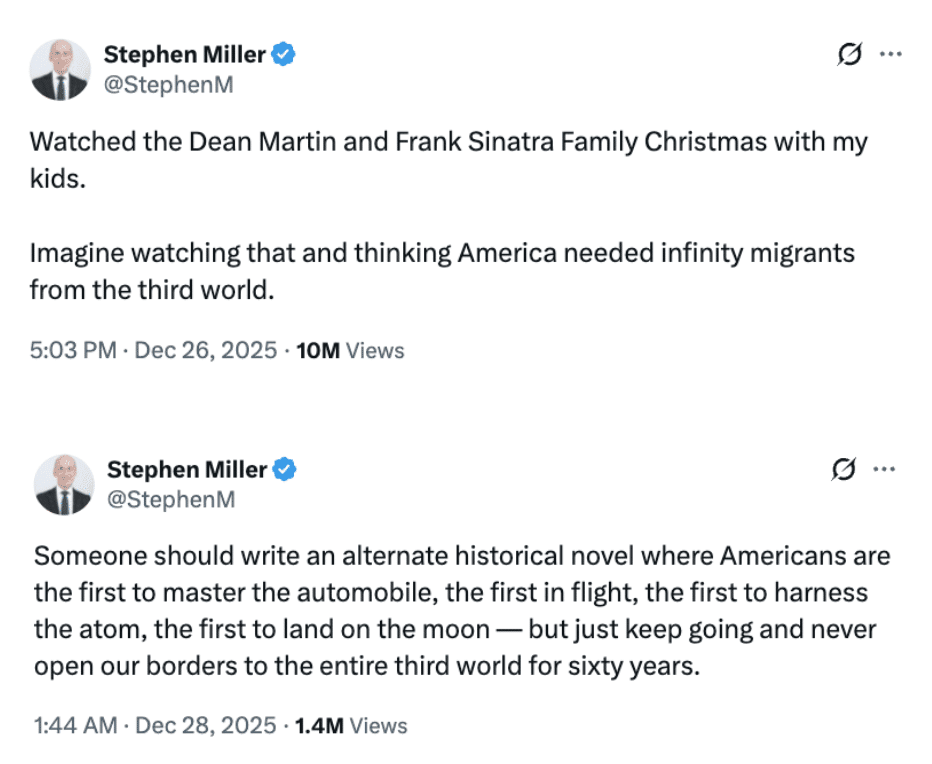
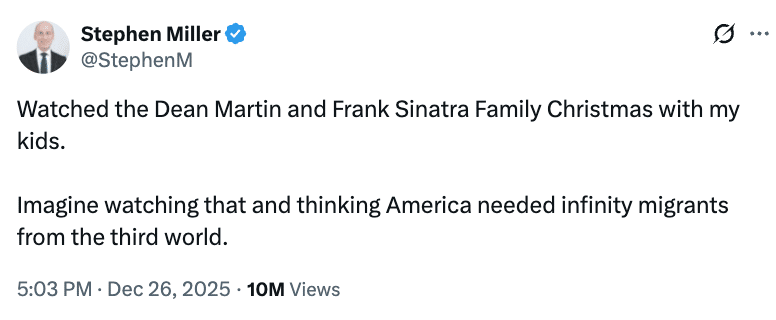
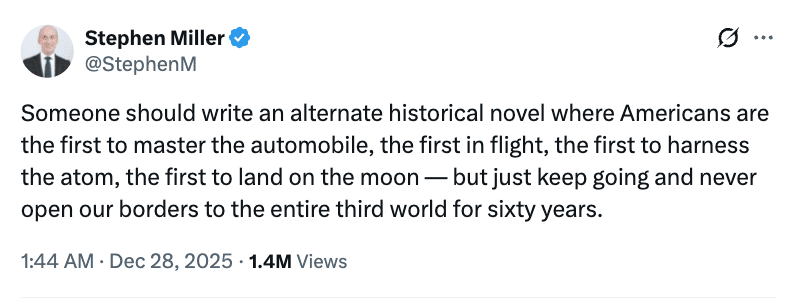
I’ve been obsessing about that comment ever since I read it, and kept thinking of it as I read this long NYT article that purports to explain Trump’s “policy” to target Venezuela. The article came out after I wrote this post attempting to understand Stephen Miller’s most prominent reversal over the last year, and in-between these two Tweets that make it very clear Miller’s entire conception about immigration to the US — even his own family’s immigration to the US — is based off his historically ignorant fantasies.

The story might be better staged as a Coen Brothers buddy movie featuring Stephen Miller, channeling Dr. Strangelove, looking for any opportunity to push harder against immigration, preferably in the form of bombing, even if it contributes to the root cause of drug trafficking and immigration, while Marco Rubio pursues the most stale kind of Cuban-American politics.

The story is so rambling, presumably because the subject and the insanity requires it, that I will attempt to map it.

NYT claims the current focus on Venezuela started when Marco Rubio signed a deal with Nayib Bukele to deport 300 people to his concentration camp.

The seeds of militarizing the approach to Mr. Maduro and Venezuelans were planted in February, when Mr. Rubio struck a deal with Nayib Bukele, the authoritarian leader of El Salvador, at his lakeside villa: The United States would pay nearly $5 million to send about 300 Venezuelans accused of being gang members to El Salvador’s Terrorism Confinement Center, or CECOT.

Soon after his visit with Mr. Bukele, Mr. Rubio designated eight Latin American criminal groups as foreign terrorist organizations. Tren de Aragua, a Venezuelan gang, topped the list.

Mr. Miller had already landed on a legal tool to bypass due process: the Alien Enemies Act, an 18th-century law that permits immediate detention and deportations of citizens of a country that has invaded the United States or is at war with it.

Mr. Trump signed an executive order in March invoking the act, with a title warning of “the invasion of the United States by Tren de Aragua.” In retrospect, the order was an important opening salvo against Mr. Maduro: It was the administration’s first formal framing of Mr. Maduro and the United States as being in a type of war. Contrary to a secret U.S. intelligence assessment, it said Tren de Aragua was an instrument of Mr. Maduro.

In this story, NYT is silent about Bukele’s goal with this deal — to obtain the return of MS-13 members who were testifying to his own ties to the gang (it is also silent about Trump’s pardon of Juan Orlando Hernández). It nods to the multiple lies Trump’s Administration told to claim the men it was sending to CECOT were gang members or even criminals (something covered at more length in this story, which it links). But it doesn’t describe how by misrepresenting the men, the Trump Administration failed to fulfill the terms of the deal made with Bukele.

Stephen Miller’s lies were a problem even for Nayib Bukele.

But NYT also doesn’t explain a temporal problem with this story: As the next major section of the story explains, at the beginning of the Administration, Ric Grenell had gotten Nicolás Maduro to accept deportation flights.

It began when Cuban American lawmakers pressed Mr. Trump early this year to end Chevron’s Biden-era confidential license. After Mr. Trump and Mr. Rubio announced in late February that they would do so, Mr. Maduro stopped accepting deportation flights of Venezuelans. Mr. Maduro had agreed to them on Jan. 31 with Richard Grenell, a special envoy for Mr. Trump.

One point of sending the men Stephen Miller falsely claimed were TdA members to CECOT was that Maduro was refusing to accept them. But Maduro had earlier agreed to accept them. So to understand the need to send planes full of men falsely claimed to be TdA members to Bukele’s concentration camp, you have to review Trump’s flip-flops on Chevron’s license to export Venezuelan oil.

That Chevron section goes like this:

  • January 31: Maduro makes a deal with Grenell.
  • February: Cuban-American Members of Congress (CAMC) pressure Trump to pull the Chevron license, which he does in late February (possibly between the time Rubio signs the deal with Bukele and the day 200 mostly-innocent men are loaded on planes?).
  • Chevron CEO Mike Wirth notes that if Chevron can’t export Venezuela’s oil, China will do so.
  • CAMC learn that Trump might reverse his decision, so threaten to vote against the Big Ugly Bill.
  • Stephen Miller pitches Trump on murderboats.
  • Trump lets Chevron license expire on May 27.
  • CAMC vote to pass Big Ugly.
  • Around the same time Trump considers a pardon for convicted drug kingpin Hernández, Marco Rubio sells Trump on a claim that Maduro is a drug kingpin.
  • July: Based in part on Wirth’s China argument, Trump reverses course, again, on Chevron license, Maduro accepts the CECOT prisoners and releases 10 Americans, including a triple murderer.

So while Trump was helping Nayib Bukele bury his ties with a dangerous gang and weighing a pitch to free convicted drug kingpin Juan Orlando Hernández, he began entertaining the idea of using the claim that Maduro is a drug kingpin so he can satisfy Stephen Miller’s need to bomb something and Marco Rubio’s Cuban-American fantasies.

Meanwhile, for reasons NYT doesn’t fully explain (though it suggests this was about SCOTUS’ decisions against the Alien Enemies Act), Stephen Miller was searching for things to bomb.

At the same time, Mr. Miller was exploring policies unrelated to Venezuela that, like the deportations, had their roots in the so-called U.S. war on terror. He looked at the idea of bombing fentanyl labs in Mexico. But it became clear that Mexican leaders would not consent, and the administration feared losing their cooperation on drug and migrant issues. The Washington Post reported earlier on Mr. Miller’s discussions about striking cartels in Mexico.

By early May, Mr. Miller’s team began asking for further options for using force against drug cartels.

White House officials and others bandied around relatively more constrained ideas, including using the C.I.A. to carry out covert strikes on docked boats that did not have people in them. But Mr. Miller’s team wanted to publicize the strikes. Officials also discussed blowing up fake drug boats to instill fear in traffickers. But Mr. Miller’s aides wanted the real thing, officials said.

This passage adds to what The Atlantic reported — that Miller wanted to murderbomb people “to paint immigrants as a dangerous menace.” But Miller demanded that he get real dead people, not just fake drug boats (and to be fair, given the degree to which various nations are tracking the specific people being murderboated, Miller was right that he needed real dead people for whatever purpose he believes this serves, even if his claim it serves that purpose is probably baseless).

Then Trump or Miller or Marco came up with a list of drug gangs they wanted to target, some of which have little relation to the danger the gangs represent, some of which are (like many of the claims about Tren de Aragua beforehand) invented.

On July 25, [Trump] signed a secret order telling the Pentagon to take action against drug-trafficking groups, putting in motion the targeting of Venezuelans.

[snip]

The two-page order contained a previously unreported written proposal for boat strikes. It directed Mr. Hegseth to target vessels in international waters carrying drugs for any of 24 Latin American “narco-terrorist” groups. The attached list included ones from Venezuela.

[snip]

The secret list of 24 groups included major cartels and groups that the Trump administration had formally designated as terrorists, along with numerous relatively obscure Mexican gangs. The same day Mr. Trump signed the directive, the Treasury Department announced sanctions against “Cartel de los Soles,” a slang term for drug corruption in Venezuela’s military, declaring it a terrorist organization led by Mr. Maduro. The name was at the bottom of Mr. Trump’s secret list.

And that’s where Trump’s flunkies turned to cutting and pasting legal rulings from the war on terror to be used in Stephen Miller’s campaign to create dead bodies that he can spin as evidence of the danger of immigrants.

Only, in their rush to brainlessly cut-and-paste from a WOT policy that was unsuccessful in its original incarnation, these geniuses failed to consider that drone strikes on the sea are different, legally, from drone strikes on land.

Around the same time, a Trump appointee with little national security law experience was drafting a Justice Department memo saying boat strikes would be lawful based on Mr. Trump’s wartime powers. The legal blessing was already developed by late July, when the Senate confirmed the top two lawyers responsible for reviewing such an operation — T. Elliot Gaiser, head of the department’s Office of Legal Counsel, and Earl G. Matthews, Pentagon general counsel. They were essentially presented with a done deal.

[snip]

Mr. Hegseth signed an execute order that created the operational framework for the attacks. Dated Aug. 5 and written without input from many career Pentagon officials, it lifted language from previous orders developed for drone strikes against Al Qaeda targets in places like rural Yemen.

It lacked elements crucial to maritime operations — including any mention of what to do with shipwrecked survivors of an attack, officials said.

[snip]

The Pentagon also bypassed a process called the Maritime Operational Threat Response, used to get input from various agencies when proposing a maritime action with international implications, said William D. Baumgartner, a retired Coast Guard rear admiral and lawyer who oversaw Caribbean operations.

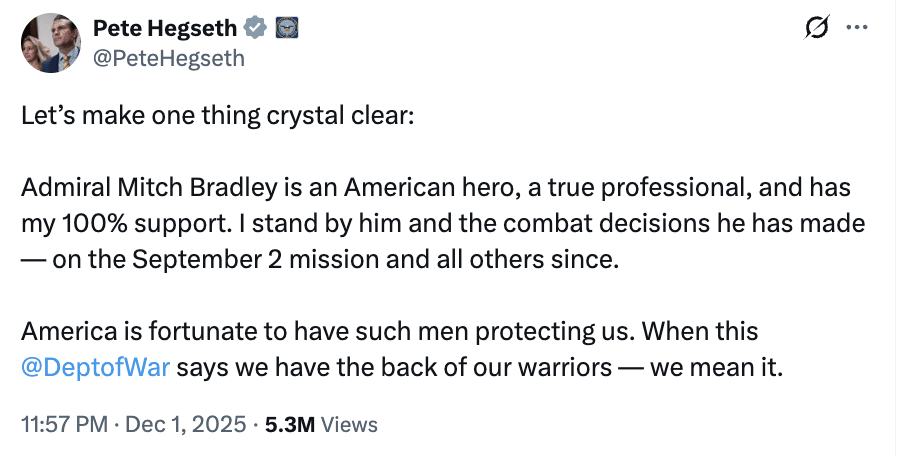
Which is how Miller, Rubio, and Whiskey Pete Hegseth got themselves in trouble for even worse murder, that of survivors of the initial drone strike.

But that wasn’t yet good enough for Strangelove Miller. One of his top aides then loosened the standards from what they were in the WOT.

During the planning, an aide to Mr. Miller, Anthony Salisbury, pushed the Pentagon for ways to expand the scope of the operations, including loosening standards — like the level of confidence military officials would need that a target meets the criteria. Gen. Dan Caine, the chairman of the Joint Chiefs of Staff, advised that the military establish targeting criteria using lessons learned from the post-Sept. 11 wars. Ms. Kelly, the White House spokeswoman, said the account of Mr. Salisbury’s role was “made up.”

The NYT story ends with the unresolved problem posed by murderboats — what to do with survivors.

On the same day, WaPo described what happened when one of the only survivors — a known drug trafficker — was returned to Ecuador.

The police arrived at the airport prepared to arrest a drug trafficker — a mariner whose crewmates the U.S. military had just killed.

Andrés Fernando Tufiño Chila was one of only two people known to have survived a U.S. strike on a vessel that the Trump administration alleged was smuggling drugs from South America. President Donald Trump had described the Ecuadorian and a fellow survivor of the Oct. 16 strike in the Atlantic Ocean as “terrorists” who would be returned to their countries of origin “for detention and prosecution.”

[snip]

Tufiño, then 41, stepped off the U.S. military plane at the Quito airport on the morning of Oct. 18 in shackles, cut and bruised from the attack but walking on his own, according to Col. Carlos Ortega, then the director of anti-narcotics for Ecuador’s national police. He was already a known trafficker: He had pleaded guilty in U.S. federal court to cocaine distribution conspiracy in 2021 and served more than three years in a U.S. prison before he was deported home to Ecuador last year. Now the U.S. military had picked him up amid the wreckage of a semisubmersible vessel — a “narco sub.”

In his gang-controlled hometown, Tufiño was known as Fresco Solo, neighbors said, a skilled navigator who they alleged was recruited by criminals to smuggle drugs north.

But in transferring him to Ecuadorian custody, three officials here said, U.S. forces didn’t provide any evidence that could be used to detain him — no seized drugs, no phone or GPS records, no videos, none of the intelligence that led them to target his vessel.

On landing in Quito, U.S. officials told the Ecuadorians that the transfer was a “humanitarian” repatriation, Ortega said.

Within hours, Tufiño was let go.

There’s very little discussion in the NYT about what happens if Marco and his Cuban-American cheerleaders get their wish, a collapse of the Maduro and Cuban Communist regimes. As noted, they ignore the degree to which this policy has led to three drug traffickers — Hernández, Bukele, and Tufiño — going free. There actually is an interesting question about what will happen to the drug trade if the US makes sea trafficking less lucrative after having shut down the US-Mexico border to illegal entries. Drug markets don’t disappear; they morph, and such shifts can bring really serious unintended consequences.

After all, one of Miller’s blind spots are the American citizens who play a key role in all this trafficking. And by treating drug trafficking as an immigrant problem, he surely makes it easier for citizens to go undetected — the kind of detail real drug criminals tend not to miss.

Meanwhile “China” is mentioned just twice in NYT’s 3,400-word article laying out how a rather senseless “policy” on Latin America has developed. But then these are the same geniuses who started a trade war with China that gave China a great deal of new leverage over the United States based, in part, on claims of fentanyl trafficking.

As noted, this NYT story really would be better as a humorous buddy flick, because it is so full of idiocy.

Update: Trump is murderboating off invented intelligence not just against Latin America; it appears he did the same in Nigeria.

On Eve of Illegal Venezuelan Invasion, Pete Hegseth Utterly Destroys His Ability to Lead It

I think the trajectory of the last few weeks has been lost in the serial disclosures, so I want to summarize them here.

Mark Kelly and five other Democrats made a video reminding service members they can refuse illegal orders

On November 18, Elissa Slotkin released a video in which she and five other former military or intelligence officers — Mark Kelly, Chris DeLuzio, Maggie Goodlander, Chrissy Houlahan, and Jason Crow — reminding that they can refuse illegal orders.

One of the tactics Republicans chose to use in response was to demand that the members of Congress describe what illegal orders had been given.

An even stupider tactic was to move to prosecute the six, in Kelly’s case (because his retirement makes him susceptible to such a thing), threatening to withdrawn him from retirement to courtmartial him.

Trump and Pete Hegseth chose to give Kelly, a genuine hero, likely presidential candidate, and far more of a man than either of them, a bigger platform and fundraising draw.

WaPo publishes the first double tap story

The video from the six Democrats was likely focused on orders to target Americans, not Venezuelans (or Colombians or Trinis, all of whom have been targeted in the murderboat strikes); it specifically describes that the Trump Administration is pitting the military and intelligence community against American citizens.

But then WaPo described Pete Hegseth — verbally — giving the quintessential illegal order.

The longer the U.S. surveillance aircraft followed the boat, the more confident intelligence analysts watching from command centers became that the 11 people on board were ferrying drugs.

Defense Secretary Pete Hegseth gave a spoken directive, according to two people with direct knowledge of the operation. “The order was to kill everybody,” one of them said.

A missile screamed off the Trinidad coast, striking the vessel and igniting a blaze from bow to stern. For minutes, commanders watched the boat burning on a live drone feed. As the smoke cleared, they got a jolt: Two survivors were clinging to the smoldering wreck.

The Special Operations commander overseeing the Sept. 2 attack — the opening salvo in the Trump administration’s war on suspected drug traffickers in the Western Hemisphere — ordered a second strike to comply with Hegseth’s instructions, two people familiar with the matter said. The two men were blown apart in the water.

The initial response to this was the same tactic that has gotten Trump where he is: to attack the press, claiming it was fake.

Trump promises to pardon Juan Orlando Hernández, destroying pretext for war

Meanwhile, Trump totally undercut the premise behind over a year of targeting Venezuela.

There were always problems with Trump’s pretense for the murderboats and planned Venezuelan invasion, which is that Venezuela’s government leads a cartel of narcotraffickers that amounts to an invasion of the United States.

At first, Stephen Miller’s bullshit about Venezuela was rooted in false claims about Tren de Aragua. Perhaps because the Intelligence Community publicly debunked those claims (but not before Miller relied on his bullshit to send 200 mostly-innocent men to a concentration camp, where they were tortured), Miller moved onto a new predicate. Nicolás Maduro wasn’t in charge of Tren de Aragua, Miller decided; he was in charge of Cartel de los Soles.

Tren de Aragua at least exists, albeit not in anywhere near the numbers of slumlord residents as Miller has claimed. It’s not at all clear CdlS does. Plus, if it does exist, it traffics in cocaine, not fentanyl, the claimed invading drug that justifies treating drug trafficking as war (almost no right wing Senators understand this problem, which would be hilarious if it weren’t about to become the new Yellowcake).

But then Trump promised to pardon former Honduran President Juan Orlando Hernández, who actually did what Trump claims Maduro is doing, who was convicted of it, who was sentenced to decades in prison.

You cannot credibly claim to give a fuck about drug trafficking when you’re freeing major traffickers. I mean, Trump doesn’t care, but the men and women risk their lives and their liberty have to attend to the likelihood they’ll be left holding the bag for Trump’s crimes.

White House concedes the double tap but defends Hegseth

Then, as Congress — led by Senate Armed Services Committee Chair Roger Wicker — begins to investigate the operation, demanding the full video of the strike and testimony from those involved, and as legal experts made it clear that this was not just a war crime, but murder, the White House changed tack. Trump knew nothing, wouldn’t have wanted it to happen, but in fact it did happen but Pete Hegseth didn’t give the order.

While NYT was publishing a story laundering Hegseth’s claims (that he did not specifically order the murder), WaPo was back with quotes from service members recognizing that Hegseth had begun underbussing his subordinates, especially Admiral Frank Bradley.

“This is ‘protect Pete’ bulls—,” one military official, who, like others, spoke on the condition of anonymity to discuss internal conversations, told The Post.

Leavitt’s statement “left it up to interpretation” who was responsible for the second strike that killed the two survivors, a separate military official said, imploring the White House to provide clarity on the issue.

One official said of Leavitt’s statement, “It’s throwing us, the service members, under the bus.” Another person said some of Hegseth’s top civilian staff appeared deeply alarmed about the revelations and were contemplating whether to leave the administration.

Hegseth, writing on social media Monday night, said he stands by the admiral “and the combat decisions he has made — on the September 2 mission and all others since.” His statement is likely to deepen the sense of furor among military officials who suspect Hegseth is attempting to insulate himself from any legal recourse and leave Bradley — whom the secretary called “an American hero, a true professional” — to account for the fallout alone.

Whiskey Pete even posted a tweet claiming to have Bradley’s back while emphasizing that Bradley made the decision.

CIA’s disavowal of Rahmanullah Lakanwal

This comes amid several reports that Rahmanullah Lakanwal, the accused killer of two National Guard members last week, had done terrible things for the CIA, but then was abandoned by John Ratcliffe’s CIA before declining into bouts of depression in advance of the attack.

The struggles to start over, leave the war behind, and find work were ever present. Lakanwal was fired from his job at a laundromat because he lacked a work authorization card despite being approved for asylum and authorized to work by the Trump administration, according to his former unit mate, who fought alongside him for more than a decade.

[snip]

About a month ago, Lakanwal told his unit mate that his inability to work due to missing immigration paperwork meant his family couldn’t afford rent or food. He resorted to borrowing money from friends and former unit members, and during the conversation, he broke down in tears from frustration and desperation, his unit mate said.

“Every time, like looking [for] somebody [to] help for documents, somebody [to] help for pay the rent, he’s not going to work,” the Afghan unit mate said.

His unit mate said Lakanwal sought help in June from a CIA program designed to aid Zero Unit veterans with immigration issues. Rolling Stone reviewed a screenshot of the group chat in June where Zero Unit veterans shared information with a CIA representative about ongoing issues. Lakanwal posted messages asking for help. His last post went unanswered and was deleted by the chat’s administrator.

None of this excuses the killing. It just makes clear that Lakanwal is one of thousands of men damaged by America’s war on terror who needs — in this case, needed — help before something terrible happens. Nigel Edge, the former Marine sniper who shot up a club from his boat in Cape Fear in September, is another one.

Mark Kelly models leadership

Meanwhile, precisely because Trump and Hegseth chose to attack Kelly, he was able to stage a press conference for little other reason than to attack Trump and Hegseth’s leadership failures.

That included addressing the double tap, in which he mostly deferred to investigations, but still upheld the import of international law.

We don’t know how all this will end.

What we do know is that, in advance of a likely demand that service members do something patently illegal, Pete Hegseth has made it clear he’ll sacrifice everyone to save himself.

BREAKING: Venezuela Has Worse Human Rights Problems than Saudi Arabia … ?

President Obama imposed sanctions on a number of Venezuelans yesterday, including — among others — the woman prosecuting Caracas MayorAntonio Ledezma Diaz, Katherine Nayarith Haringhton Padron. Apparent intelligence officers seized Ledezma on February 20, and since then, Nicolas Maduro, has been tying Ledezma’s seizure to a purported coup plan launched by exiles in the US, but also using the tools of American hegemony.

President Maduro played the audio of a conversation held between Carlos Manuel Osuna Saraco, a former Venezuelan politician living in New York, and a soldier, in which Osuna dictates the statement that the rebel soldiers should read out during the coup.

The Venezuelan leader informed viewers that he would soon call upon the United States to extradite the suspect Osuna for trial in his home country.

Maduro also noted that in addition to the call from Osuna’s base in New York, there was a second phone call from Miami.

Ledezma was in constant coordination with Osuna in New York via telephone.

[snip]

Maduro also showed a copy of a new “100-day Plan for Transition”, designed by the coup plotters and the opposition, which stipulated a series of measures which would be implemented by the planned governing junta.

The plan would take effect immediately after the coup, calling for early elections and the privatization of all public services.

The transitional government would request all of the current Venezuelan officials to turn themselves into the police within a period of 180 days. It also requested every Cuban worker within the government to turn themselves in unarmed to their local police station.

The plan also contemplated a role for the IMF, the World Bank and the Inter-American Development Bank to intervene in the Venezuelan economy.

In response, the US has been saying Maduro is making this whole coup thing up, even accusing him of making up some of the intelligence he was showing to make his case.

And then, even while claiming Maduro was making shit up about the US engaging in economic war and using its tools of hegemony to conduct regime change in Venezuela, President Obama used its dominant financial position to undermine Maduro’s regime.

The order imposing sanctions, like all such orders, makes a convoluted explanation for why the US has to use its purported capitalistic tools against foreigners. First, because Venezuela poses a threat to US national security.

I, BARACK OBAMA, President of the United States of America, find that the situation in Venezuela, including the Government of Venezuela’s erosion of human rights guarantees, persecution of political opponents, curtailment of press freedoms, use of violence and human rights violations and abuses in response to antigovernment protests, and arbitrary arrest and detention of antigovernment protestors, as well as the exacerbating presence of significant public corruption, constitutes an unusual and extraordinary threat to the national security and foreign policy of the United States, and I hereby declare a national emergency to deal with that threat.

It then defines sanction targets as those who undermine democratic processes, engage in violence or human rights abuses (including — though purportedly not limited to those involved in anti-government protests), those that limit freedom of expression, and those involved in public corruption.

(ii) any person determined by the Secretary of the Treasury, in consultation with the Secretary of State: (A) to be responsible for or complicit in, or responsible for ordering, controlling, or otherwise directing, or to have participated in, directly or indirectly, any of the following in or in relation to Venezuela: (1) actions or policies that undermine democratic processes or institutions; (2) significant acts of violence or conduct that constitutes a serious abuse or violation of human rights, including against persons involved in antigovernment protests in Venezuela in or since February 2014; (3) actions that prohibit, limit, or penalize the exercise of freedom of expression or peaceful assembly; or (4) public corruption by senior officials within the Government of Venezuela;

The fact sheet on these sanctions also argues Venezuela is the among the most corrupt countries in the world (but doesn’t mention that it ties with Yemen, and beats out Libya, Iraq, and Afghanistan, as well as allies like Uzbekistan — all of also which rank much worse for human rights abuses than Venezuela.

In other words, the Administration is claiming that Venezuela’s corruption and human rights abuses present a much bigger threat to the US than a string of countries we’ve already destabilized that are worse in terms of corruption and human rights, as well as (in the latter category) Egypt and Saudi Arabia’s more severe human rights abuses.

All of which is receiving more scrutiny than it normally would, not least because the claim that Venezuela is a threat to US national security is so obviously bullshit.

As an official whose identity couldn’t be revealed because Obama’s is the Most Transparent Evah™ explained the other day, it’s actually normal for the government to claim that sanction targets are a threat to this country.

So I can start off and say in terms of how unusual this is, most of our sanctions programs began with the declaration by the President of a national emergency that results — that’s a threat to the national security, foreign policy, or economy of the United States.  And so most of the sanctions programs that we have, from Iran to Syria, Burma, across the board, rely on these same types of national emergency declarations.

So in that sense, it’s a usual part of the process.  And we have somewhere between 20 and 30 sanctions programs, depending on the way you measure them, that are based on these same types of national emergency declarations.

Either the same or another SAO insisted that this is not about the US bigfooting in Venezuela.

Can I just also — let me just say that there’s been a lot of commentary about interference in internal affairs of other countries by the Venezuelan government.  The actions we take today are clearly sovereign actions by a country about its own financial system.  These actions we take are sovereign decisions about who comes into the United States.  They’re not actions taken to involve ourselves in another country.

Other countries — notably Russia and China — are both affirmatively rolling out measures to counter our dominance in the financial world, in ways that could significantly undermine our obviously selective choice for sanctions targets. Whatever else these Venezuela sanctions do, they will also likely elicit more scrutiny of just how illegitimate our use of sanctions is (and to a significant extent, has long been).

Edward Snowden’s Extradition Request

Screen shot 2013-07-06 at 9.31.58 AMAs I noted last night, Venezuelan President Nicolás Maduro offered Edward Snowden asylum last night. (The Spanish was “hemos decidido” and “he decidido ofrecerle asilio” which included none of the sense of hypothetical that Nicaragua’s President Daniel Ortega used.)

The government has released the extradition request they’ve sent to the Venezuelan government.

Perhaps the most interesting detail is the date: July 3. Way back when Maduro was (unless I’ve lost track of his chronology), still in Russia or Belarus, and when Bolivian President Evo Morales was making a big stink about being “kidnapped” in Vienna.

Since that time, Maduro finished his visit in Belarus. Flew (presumably with a refueling stop somewhere and possibly a stop at home) to Cochabamba, Bolivia, where at least 6 South American leaders either were personally or had sent a representative (in addition to Morales and Maduro, the Presidents of Ecuador, Suriname, Argentina, and Uruguay were present, Brazils Dilma Rousseff had sent a representative, as had, according to some reports, Peru and Chile).

Then Maduro returned home in time for Venezuela’s Independence Day celebration, where he issued his statement offering asylum.

It appears that after the US issued the extradition request to Venezuela, they issued an arrest warrant to Ireland.

Now, perhaps the US has real intelligence saying that Snowden remains in Russia. But these are the people who were sure he was on Morales’ plane just a few days ago. And they don’t really seem all too sure about where Snowden is.

Update: This is one of the few stories I’ve seen that affirmatively said Snowden was still in Russia after Maduro’s departure, based on a single Russian security source.

Update: And this has more Russian sources stating he remains stuck in Russia.