How Does a Competent Jihadi Act after 21 Months of Solitary Confinement?

I would be shocked if, after today’s appeal hearing in Umar Farouk Abdulmutallab’s trial, he were granted a new trial on competency grounds. On the panel, David McKeague seemed completely skeptical on legal grounds, Jane Branstetter Stranch seemed skeptical on the central competency issue, leaving Curtis Collier (a District Judge on loan from E TN) with the only apparent sympathy for the argument at hand in the least.

As I explained back in May, The central question was whether Abdulmutallab was competent to defend himself. He had fired his federal defenders in September 2010 and the court named a standby counsel, Anthony Chambers, for him. In August of the next year, Chambers submitted a sealed motion arguing Abdulmutallab was not competent. Judge Nancy Edmunds had a hearing on August 17, 2011 and while she addressed several questions to Abdulmutallab, she did not have him evaluated for competency. When he plead guilty on October 12, 2012, she asked standby counsel if he thought Abdulmutallab was competent to plead guilt and after he assented, she accepted the guilty plea.

Both Judge McKeague, to a lesser degree Stranch, and prosecutor Jonathan Tukel emphasized that last point in their discussion: given that the same standby counsel who had submitted the motion on competence did not re-raise it at the plea, they argued, it suggests the counsel agreed with Edmunds’ determination that Adbulmutallab was competent. Abdulmutallab’s attorney Travis Rossman argued that the Chambers could not, at that point, argue his client was totally crazy. Moreover, he argued, the standard for a defendant representing himself was higher and must be concurrent determination (meaning if he were crazy in August 2012 but competent in October 2012, it would still be an issue for a defendant representing himself). But that detail will almost certainly be the one the judges point to to reject this appeal.

Judges McKeague and Stranch also examined a different question. Some of the most obviously crazy things Abdulmutallab did (though this wasn’t and couldn’t have been Chambers’ original argument) came leading up to trial, most notably his bid to wear a Yemeni dagger to his trial. Abdulmutallab intended to martyr himself, Stranch noted, couldn’t these actions be interpreted as an effort to use the trial to make a point of his faith? McKeague pointed out that Abdulmutallab had done some pretty “well thought out logical things” leading up to his attack. He later asked whether his conduct at trial wasn’t consistent with what you’d expect a jihadi to do, to use the trial as a platform to present his views?

Rossman contested that point — noting that had Abdulmutallab let the trial play out, he would have had many more opportunities to parade his jihadi views. McKeague responded that refusing counsel left Abdulmutallab more empowered to make jihadi statements rather than mount a defense. Rossman correctly pointed out this was all getting into speculation about how a competent jihadi would act.

While it didn’t come up in the hearing, remember that the statement Abdulmutallab ultimately made was remarkably muted and took up less than 15 minutes, so by measure of his exploitation of his soapbox, the UndieBomber failed.

All that’s a way of saying that much of the hearing focused on how a competent jihadi would use his decision to represent himself to further his goals of jihad.

There is, however, a significant weakness in the government’s case, one Tukel made obvious with the central ploy he made in his argument.

Read more

Share this entry

When Susan Rice Is Right, She’s Right!

gps31From the No Kidding Files, courtesy of Jason Leopold, comes this gem from vaunted National Security Advisor Susan Rice:

“Let’s be honest: at times we do business with govts that do not respect the rights we hold most dear”

Well, hello there Susan, I couldn’t agree more. Especially on days when I see things like this from the Glenn Greenwald and Pierre Omidyar Snowden file monopoly err, Barton Gellman at the Washington Post:

The National Security Agency is gathering nearly 5 billion records a day on the whereabouts of cellphones around the world, according to top-secret documents and interviews with U.S. intelligence officials, enabling the agency to track the movements of individuals — and map their relationships — in ways that would have been previously unimaginable.
….
The number of Americans whose locations are tracked as part of the NSA’s collection of data overseas is impossible to determine from the Snowden documents alone, and senior intelligence officials declined to offer an estimate. “It’s awkward for us to try to provide any specific numbers,” one intelligence official said in a telephone interview. An NSA spokeswoman who took part in the call cut in to say the agency has no way to calculate such a figure.

It is thoroughly loathsome that Americans must do business with a government that does this, and insane that it is their own government.

It is “awkward” to determine how many innocent Americans are rolled up in the latest out of control security state dragnet the United States government is running globally. Actually, that is not awkward, it is damning and telling. Therefore the American citizenry must not know, at any cost.

Susan Rice is quite right, we are forced to “do business” with a government that does “not respect the rights we hold most dear”

[Here is the full text of the Susan Rice speech today that the above quote was taken from. It is a great speech, or would be if the morals of the United States under Barack Obama matched the lofty rhetoric]

Share this entry

“Bandar is now clearly the tip of the spear”

Back in October, in response to the Saudis taking their toys and going home from the UN, I warned, “I worry they disengaged from the UN because they are considering alternative means of pursuing their interests, means that would be loudly condemned in that body.”

Yesterday, Dick Cheney lackey John Hannah wrote a remarkable screed about Saudi complaints. It starts by warning that Obama’s Iran deal’s “greatest impact is not ensuring that Iran doesn’t get the bomb, but that the Saudis will.” In part to support this, he describes Mr. Tip of the Spear’s close consultations with the Pakistanis (who not only have the bomb but have thousands of our troops held hostage to supply lines through Pakistan).

Bandar is now clearly the tip of the spear in King Abdullah’s efforts to combat the Iranian threat around the region — not to mention the principal point of contact in the kingdom’s thick relationship with Pakistan’s military and intelligence establishment.

Then after laying out the Saudi complaints (basically, that the US is not serving as meat in its efforts to extend its hegemony over the region), and after condemning John Kerry with a mix of emasculation and Saudi distrust, Hannah issues the threat Bandar likely suggested he issue:

An atmosphere this poisonous is dangerous, to say the least. The incentive for the Saudis to engage in all kinds of self-help that Washington would find less than beneficial, even destructive, is significant and rising. Driven into a corner, feeling largely abandoned by their traditional superpower patron, no one should doubt that the Saudis will do what they believe is necessary to ensure their survival. It would be a mistake to underestimate their capacity to deliver some very unpleasant surprises: from the groups they feel compelled to support in their escalating proxy war with Iran, to the price of oil, to their sponsorship (and bankrolling) of a much expanded regional role for Russia and China at America’s expense.

Ultimately, Hannah is warning that the Saudis will get — and, the suggestion is, with his language about “a very, very high price in blood, treasure, and U.S. interests,” use — the bomb.

But I can’t help but return to his focus on Bandar bin Sultan, who had financial ties (via donations to charities) and potential foreknowledge of Saudi ties to the 9/11 attacks. Former Senator Bob Graham has renewed his effort to bring attention to the Saudi role in the attack, though that never seems to go anywhere. And whether you consider ops like Iran-Contra terrorism or not, Bandar is clearly the master of covert ops.

What kind of self-help has Bandar insinuated to Hannah he plans to pursue?

Share this entry

Express Tribune Office in Karachi Attacked; Second Time in Four Months

After a first attack by gunmen on August 16, the office of the Express Tribune in Karachi was attacked yesterday by men with guns and small improvised explosives made from tennis balls. In response, journalists in the Karachi area are calling for a rapid response from police and have threatened massive demonstrations if the culprits are not caught within 72 hours.

Police responses to both the August attack and yesterday’s appeared to be very slow. From the August story:

The police reached the site 40 minutes after the incident even though both the Defence and Baloch Colony police stations were at a stone’s throw from the media office.

In response to that attack, the same story noted that a “permanent” police presence was being put into place at the office:

A police mobile has been deputed outside the Express Media office permanently to avoid any untoward incident.

Except that the presence was not permanent. From the story on yesterday’s attack:

The attack follows an earlier attempt by terrorists against the Express Media Group on August 16, when unknown gunmen opened fire at the building. Following the first attack, a police van was stationed at the Express Media Group’s building to provide security. However, the police van had suddenly disappeared around two weeks back without intimation.

With the police van gone, and even though police stations are nearby, the response was once again slow:

Following the attack, which lasted for about 15 minutes, a contingent of police reached the scene of the crime almost 10 minutes after the attackers had fled.

Private security for the Express Tribune managed to turn back the attackers:

According to eyewitness accounts, the attackers hurled a tennis-ball bomb towards the main entrance of the building from an overhead bridge running perpendicular to the Express Media Group building. The first bomb attack was followed by another within 30 seconds, and was accompanied by a hail of intermittent gunfire, both between and after the two attacks.

Following retaliatory fire by security guards stationed at the entrance, the assailants fled the scene of the attack towards Korangi Road.

The response by journalists appears strong and united: Read more

Share this entry

“Journalists” Still Parroting DiFi’s Fear-Mongering

Excuse me for a little post holiday crabbiness.

But people who write stories like this are really not doing their jobs.

Appearing on CNN’s “State of the Union,” Sen. Dianne Feinstein, D-CA said there was “huge malevolence” against the United States, and warned that the terrorism threat against the country is on the rise.  “I think terror is up worldwide,” she said. “The numbers are way up.”

[snip]

Both lawmakers admitted that the more diffuse nature of today’s terrorist groups has made it harder to counter potential threats. Rogers pointed out that the rise in al-Qaeda affiliates spread around the globe raises the risk of a smaller scale attack and makes it “exponentially harder” for U.S. intelligence to keep track of them all.

It has been clear for two weeks that this fearmongering is part of an attempt to justify the dragnet. But the premise and the response are so illogical they should never be presented as “news.”

If we’re less safe, then what thousands of experts will be fired for screwing up the war on terror?

If we’re less safe, then why aren’t our overseers scrambling to understand why massive dragnets haven’t kept us safe?

If we’re less safe, than why isn’t the press asking why both Dianne Feinsein and Mike Rogers be fired for their failures?

If we’re less safe (and the real numbers don’t support these fear-mongers), then the response should be far more aggressive than simply repeating the claims that show a massive failure on the part of our security establishment.

But, if the claims are transparently bullshit, then reporters should not report them as fact.

Share this entry

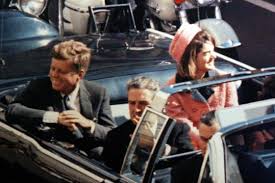
50 Years: That Day, JFK and Today

UnknownWhere were you fifty years ago today? If you were old enough to remember at all, then you undoubtedly remember where you were on Friday November 22, 1963 at 12:30 pm central standard time.

I was at a desk, two from the rear, in the left most row, in Mrs. Hollingshead’s first grade class. Each kid had their own desk, and they were big, made out of solid wood and heavy. They had to be heavy, of course, because they were going to protect us when we ducked and covered from a Soviet nuclear strike. There were, as there were in most elementary school classrooms of the day, a large clock and a big speaker on the wall up above the teacher’s desk.

I can’t remember what subject we were working on, but the principal’s voice suddenly came over the loudspeaker. This alone meant there was something important up, because that only usually occurred for morning announcements at the start of the school day and for special occasions. The voice of Mr. Flake, the principal, was somber, halting and different; perhaps detached is the word. There was a prelude to the effect that this was a serious moment and that the teachers should make sure that all students were at their desks and that all, both young and old, were to pay attention.

There had occurred a tragic and shocking event that we all needed to know about. Our attention was required.

Then the hammer fell and our little world literally caved in.

President John Fitzgerald Kennedy had been assassinated. Shot and killed in Dallas Texas. Then without a moment’s pause, we were told that the nation was safe, Vice-President Johnson was in charge, the government was functioning and that we need not have any concerns about our own safety. We were not at war.

Twenty four some odd little hearts stopped, plus one from Mrs. Hollingshead. You could literally feel the life being sucked out of the room like air lost to a vacuum. Many of us began looking out the window, because no matter what Mr. Flake said, if our President was dead, we were at war and the warheads were coming. They had to be in the sky. They were going to be there.

Unlike the hokey color coded terror alerts, ginned up fear mongering of Bush/Cheney, Ashcroft and Ridge, and today the terroristic fearmongering of Keith Alexander, James Clapper, Mike Rogers and Dianne Feinstein, things were dead nuts serious at the height of the cold war. If President Kennedy had been killed, we were at war; the missiles were on their way. Had to be. Looking back, the school officials and teachers had to have been as devastated and afraid as we were, yet they were remarkable. They kept themselves in one piece, held us together, talked and comforted us into calm.

We had not been back in class from lunch break for long; it was still early afternoon in the west. Before the announcement was made, the decision by the school officials had been made to send us home. The busses would be lined up and ready to go in twenty minutes. Until then there would be a brief quiet period and then the teachers would talk to us and further calm the situation. Then off we would go to try to forge a path with our families, who would need us as much as we Read more

Share this entry

Where Is the Moral Rectitude When Political Retaliation Drone Strike Hits Settled Area, Misses Target?

Early this morning, just hours after the US had assured Pakistan that drone strikes would be curtailed if Pakistan is able to restart peace talks with the Taliban (after the US disrupted them with a drone strike), John Brennan lashed out with one of his signature rage drone strikes that seems more calculated as political retaliation than careful targeting. Earlier documentation of political retaliation strikes can be seen here and here.

Here is how Dawn described the assurance from the US late on Wednesday:

The United States has promised that it will not carry out any drone strikes in Pakistan during any peace talks with Taliban militants in the future, the Prime Minister’s Special Advisor on Foreign Affairs Sartaj Aziz said Wednesday.

Briefing a session of the Senate’s Standing Committee on Foreign Affairs in Islamabad, Aziz said a team of government negotiators was prepared to hold talks with former Tehrik-i-Taliban Pakistan (TTP) chief Hakimullah Mehsud on Nov 2, the day after he was killed in a US drone strike in North Waziristan.

/snip/

Interior Minister Chaudhry Nisar Ali Khan had told reporters last week that the process of peace talks could not be taken forward unless drone attacks on Pakistani soil are halted.

Nisar had said that the drone attack that killed Mehsud ‘sabotaged’ the government’s efforts to strike peace with anti-state militants.

Bill Roggio, writing in Long War Journal, is convinced that the Haqqani network’s leader was the target of today’s strike:

The US launched a drone strike at a seminary in Pakistan’s settled district of Hangu, killing eight people in what appears to have been an attempt to kill Sirajuddin Haqqani, the operations commander of the Taliban and al Qaeda-linked Haqqani Network.

But see that bit about the strike being in “Pakistan’s settled district”? One of the many unwritten “rules” of US drone strikes in Pakistan is that they are restricted to the FATA, or Federally Administered Tribal Area, of Pakistan where Pakistani security or military personnel have little to no freedom of movement. In fact, the ability of drones to enter these otherwise forbidden territories is touted as one of their main justifications for use.

Just over a week ago, the chief fundraiser for the Haqqani network was killed near Islamabad. That killing involved a gunman, though, not a drone. If Nasiruddin Haqqani could be taken out by a gunman near Islamabad, why couldn’t Sirajuddin also have been taken out by a gunman in Hangu rather than missed in a drone strike?

Various reports on this drone strike place the death toll at anywhere from three to eight and say that either three or four missiles were fired into the seminary. The seminary appeared to be frequented by Haqqani network fighters. From the Express Tribune:

Another Haqqani source said the seminary was an important rest point for members fighting in Afghanistan’s restive Khost province.

“The seminary served as a base for the network where militants fighting across the border came to stay and rest, as the Haqqani seminaries in the tribal areas were targeted by drones,” the source told AFP on condition of anonymity.

An intelligence source told Reuters separately that Sirajuddin Haqqani, the leader of Taliban-linked Haqqani network, was spotted at the seminary two days earlier.

It appears that there have been no other drone strikes outside the tribal areas since March of 2009. Roggio notes that all three of the others were in the Bannu district.

Khyber Pakhtunkhwa province now is governed by former cricket star Imran Khan’s PTI party. Khan already was highly agitated by the drone killing of Hakimullah Mehsud and its impact on the planned peace talks with the TTP. It seems entirely possible that striking in Khan’s province was a deliberate act by Brennan in retaliation for Khan’s rhetoric after the Hakimullah Mehsud killing. But by striking out with such rage, and especially by missing his target in a strike in a highly populated area, Brennan seems to have set himself up for a huge blowback.  Khan is now ratcheting up his rhetoric considerably: Read more

Share this entry

US Failures in Afghanistan Multiplying: Negotiation Impasse, Bomb at Jirga Site and Increasing Violence

It is difficult to imagine how the situation could be any worse for the US ahead of Thursday’s opening of the loya jirga that was meant to give a stamp of approval to the Bilateral Security Agreement that would govern US troops remaining in Afghanistan after 2014. Both the New York Times and Reuters are reporting a sticking point (the issue is not a new one) in the negotiations that threatens to prevent an agreement being reached. Furthermore, a suicide bomber struck on Saturday at the site where the jirga is planned. The Taliban has claimed responsibility. Finally, the UN is reporting that despite as many as 12,000 Taliban fighters being killed, wounded or captured in the last year, violence in Afghanistan is at its highest point since the US surge.

The latest sticking point in the Bilateral Security Agreement (immunity for US troops also is a sticking point that is just as likely to derail approval by the jirga) addresses US troops entering Afghan homes without permission. This is at the heart of the operations of US death squads as Special Operations forces carry out night raids. From the Times:

Offstage, however, American raids continued to be a point of deadlock, according to the Afghan officials, who spoke on the condition of anonymity because the negotiations were continuing. In recent days, the talks have been led on the Afghan side by Mr. Karzai, and on the American side by Ambassador James B. Cunningham and the military coalition commander, Gen. Joseph F. Dunford Jr.

The Afghan officials said Mr. Karzai would not change his position before Thursday’s loya jirga, to which 3,000 officials, elders and notables from around the country have been invited to ratify or reject the security agreement.

So even though these negotiations are being carried out at the highest level, it appears that a serious disagreement persists, just a few days short of the critical jirga. The article notes that some on the US side feel that this is a last-minute ploy by the Afghans, but considering that Karzai has opposed the raids from the beginning, it is hard to see how that argument has any merit. The article continues to show how this disagreement could scuttle the entire deal: Read more

Share this entry

Like Obi Wan, Osama bin Laden Has Come Back More Powerful Than Ever Before

In a piece that serves only to claim we need even more invasive online surveillance because we’ve made al Qaeda more insidious than before Osama bin Laden died, Michael Hirsh tries to make Abu Musab al-Suri the new boogeyman (who, as J.M. Berger notes, may not even be alive!).

The truth is much grimmer. Intelligence officials and terrorism experts today believe that the death of bin Laden and the decimation of the Qaida “core” in Pakistan only set the stage for a rebirth of al-Qaida as a global threat. Its tactics have morphed into something more insidious and increasingly dangerous as safe havens multiply in war-torn or failed states—at exactly the moment we are talking about curtailing the National Security Agency’s monitoring capability. And the jihadist who many terrorism experts believe is al-Qaida’s new strategic mastermind, Abu Musab al-Suri (a nom de guerre that means “the Syrian”), has a diametrically different approach that emphasizes quantity over quality. The red-haired, blue-eyed former mechanical engineer was born in Aleppo in 1958 as Mustafa Setmariam Nasar; he has lived in France and Spain. Al-Suri is believed to have helped plan the 2004 train bombings in Madrid and the 2005 bombings in London—and has been called the “Clausewitz” of the new al-Qaida.

[snip]

But the agency’s opponents may not realize that the practice they most hope to stop—its seemingly indiscriminate scouring of phone data and emails—is precisely what intelligence officials say they need to detect the kinds of plots al-Suri favors.

[snip]

And the consensus of senior defense and intelligence officials in the U.S. government is that NSA surveillance may well be the only thing that can stop the next terrorist from blowing apart innocent Americans, as happened in Boston last April. “Al-Qaida is far more a problem a dozen years after 9/11 than it was back then,” [Navy Postgraduate School expert John] Arquilla says.

[snip]

Officials also say they need more intelligence than ever to determine which of the multifarious new jihadist groups is a true threat. “The really difficult strategic question for us is which one of these groups do we take on,” [Michael] Hayden says. “If you jump too quickly and you put too much of a generic American face on it, then you may make them mad at us when they weren’t before. So we are going to need a pretty nuanced and sophisticated understanding of where there these new groups are going and where we need to step up and intervene.”

Some officials suggest that to do that—to discriminate carefully between the terrorists who are directly targeting U.S. interests and those who aren’t—the United States needs to step up, not slow down, the NSA’s monitoring of potential targets. [my emphasis]

Hirsh doesn’t seem to notice it, but even while he quotes former and current architects of our counterterrorism strategy like Michael Hayden and Mike Rogers, if his tale is to be believed, you have to also believe those former and current counterterrorism leaders committed these grave counterterrorism failures:

  • Allowing no fewer than 25 failed states to flourish, especially in Yemen, Somalia, Syria, Libya, and Iraq
  • Failing to win or even establish governance in Afghanistan
  • Rendering al-Suri to Syria where he may or may not have been let free
  • Taking on Bashar al-Assad (who the article admits provided us counterterrorism support, including presumably proxy torturing al-Suri) even while not backing dictators who provide counterterrorism support during the Arab Spring
  • Abandoning Syrian rebels to Assad

Then Hirsh goes on to recite the debunked claims about how useful the Section 215 dragnet is (though curiously, he doesn’t mention Basaaly Moalin, perhaps because elsewhere Harold Koh admits that even most members of al-Shabaab aren’t members of al Qaeda, much less those who materially support al-Shabaab), how that would have (and, the implication is) and is the only thing that might have prevented 9/11.

Hirsh doesn’t even seem to notice that he repeats the claim that only NSA dragnets can prevent a Boston Marathon attack, yet NSA dragnets didn’t prevent the Boston Marathon attack.

Obviously, the whole thing is just as Mike Rogers/Michael Hayden sponsored advertisement to pass DiFi’s Fake FISA Fix (the article doesn’t address why she doesn’t just accept the status quo).

But in the process, Hirsh has instead laid out solid evidence we should never trust the people who’ve been running our war on terror for the last 12 years, because, if even a fraction of what he claims is true, they’ve actually made us far less safe.

Share this entry

Fat Al Gore Menaces the Homeland and Homeland Security Experts Don’t Care

Six days ago, Fat Al Gore (my shorthand for climate change) attacked the Philippines, killing as many 10,000 and leaving 250,000 homeless.

It was Fat Al Gore’s most successful attack thus far.

With Fat Al Gore’s growing success in mind, consider these data points.

Senate Homeland Security Committee doesn’t recognize Fat Al Gore as a threat

The Senate Homeland Security Committee is holding a hearing on “Threats to the Homeland.” It is focused almost entirely on what witnesses describe a dispersed Al Qaeda threat (which doesn’t have the ability to attack in the US), self-radicalized extremists who don’t have the ability to conduct large-scale attacks, and cybersecurity (though Carl Levin did bring up corporate anonymity as a threat, and Republicans brought up Benghazi, which isn’t the “Homeland” at all; also, Ron Johnson leaked that Secret Service officers have proven unable to keep their dick in their pants in 17 countries).

None of the three witnesses even mentioned climate change in their testimony.

Obama’s Chief of Staff threatened to “kill” Steven Chu for admitting islands would disappear because of climate change

Meanwhile, the lead anecdote of this mostly interesting (but in parts obviously bullshit) profile of how Obama disempowered his cabinet ministers tells how Rahm went ballistic because Steven Chu (whose energy initiative created a bunch of jobs) publicly admitted that some islands will disappear because of climate change.

In April 2009, Chu joined Obama’s entourage for one of the administration’s first overseas trips, to Trinidad and Tobago for a Summit of the Americas focused on economic development. Chu was not scheduled to address the media, but reporters kept bugging Josh Earnest, a young staffer, who sheepishly approached his boss, White House press secretary Robert Gibbs, with the ask. “No way,” Gibbs told him.

“Come on,” Earnest said. “The guy came all the way down here. Why don’t we just have him talk about all the stuff he’s doing?”

Gibbs reluctantly assented. Then Chu took the podium to tell the tiny island nation that it might soon, sorry to say, be underwater—which not only insulted the good people of Trinidad and Tobago but also raised the climate issue at a time when the White House wanted the economy, and the economy only, on the front burner. “I think the Caribbean countries face rising oceans, and they face increase in the severity of hurricanes,” Chu said. “This is something that is very, very scary to all of us. … The island states … some of them will disappear.”

Earnest slunk backstage. “OK, we’ll never do that again,” he said as Gibbs glared. A phone rang. It was White House chief of staff Rahm Emanuel calling Messina to snarl, “If you don’t kill [Chu], I’m going to.”

Much later the story notes that Heather Zichal is on her way out too.

Even blue-chip West Wingers such as economic adviser Gene Sperling and climate czar Heather Zichal are heading for the exits.

Washington insiders applaud fracking while ignoring climate change

Meanwhile, also as part of its big new magazine spread, Politico has two related pieces on DC insiders views.

There’s this “Real Game Changers” piece capturing the “big forces they see shaking up U.S. politics.” David Petraeus talks about “the ongoing energy revolution in the U.S.” Jeb Bush promises, “With natural gas as an exponentially growing source, we can re-industrialize.” And while several thinkers describe the problem of economic inequality, only Al Gore talks about Fat Al Gore.

Carbon pollution from burning fossil fuels is changing our climate and transforming our world. From more destructive and more frequent climate-related extreme weather events, floods and droughts, melting ice and rising sea levels, to climate refugees, crop failure, higher asthma rates and water scarcity, the consequences are profound. As citizens, we’re already paying the high costs. Billions of dollars to clean up after extreme weather events. Rising insurance bills. Lives lost.

Meanwhile, former respectable energy historian turned shill Daniel Yergin congratulates America on being almost energy independent.

Here’s his only mention of the word “climate.”

In a major climate speech this past June, he declared, “We should strengthen our position as the top natural gas producer because, in the medium term at least, it not only can provide safe, cheap power, but it can also help reduce our carbon emissions.”

Yes, we’re going to fight climate change by burning carbon (gas) instead of carbon (coal).

To be fair to the DC elite, the reason we’re embracing fracking is to give ourselves space to ditch the terrorist funding Saudis. So there is a real national security purpose to it.

But of course, it’s a purpose that addresses a far less urgent threat than that terrorist Fat Al Gore, who just killed 10,000 people.

Share this entry