
Where Are They Now? Dozens of Prisoners Unaccounted For With Closure of US Bagram Prison

Both NBC and Reuters are reporting that the US has closed its prison at the Bagram air base that was used to house non-Afghan prisoners. After many fits and starts, the US had ceded control of (mostly?) all Afghan prisoners to Afghanistan last year. As far as I can tell, the last time we had an accounting of the foreign prisoners held at Bagram was in February, when the number sat at 49, although Adam Goldman noted that the US was busy trying to reduce that number.

There was a report of two Yemenis being transferred out of the facility back in August and Russian prisoner Irek Ilgiz Hamidullin was brought to the US for trial in November, but even as recently as earlier this week, when Latif Mehsud and two of his guards were repatriated to Pakistan, Dawn still reported that conventional wisdom put the number of foreign prisoners held at Bagram in the dozens. The Dawn report relayed a statement from the US embassy that the population was being reduced:

The US Embassy in Kabul said the three prisoners had been held at a detention centre near Bagram airfield.

The facility is believed to house several dozen foreign prisoners who the United States will no longer be allowed to keep in Afghanistan when the mission for the US-led force there ends later this month.

“We’re actually just going through and returning all the third-country nationals detained in Afghanistan to resolve that issue,” a US embassy spokeswoman said.

Note especially that the spokeswoman said “all the third-country nationals”. That stands out because Hamidullin was not the only prisoner held at Bagram who was expected to be brought to trial. Goldman’s report in February said that the “number of people being looked at for prosecution is in the single digits”. Are more of these prisoners already being held in the US in preparation for the filing of charges? Are they held elsewhere? Or were they repatriated instead?

But there were also some prisoners who can’t be tried but are still deemed “too dangerous to release”:

And bringing some of them to the United States for trial in a military commission, an option being considered by the Obama administration, could run into political opposition or may be stymied by a lack of court-ready evidence.

What happened to the prisoners whom the US deemed too dangerous to release but who lacked “court-ready evidence”?

The US prison at Bagram and Defense Department operated prisons throughout both Afghanistan and Iraq have a long, checkered history of lies and misdirection about facilities and their population. Further, this facility at Bagram has been used to house prisoners who were tortured. It seems likely that most of the 49 foreign prisoners known to be there in February have been repatriated without public announcements, but what about those who had been slated for indefinite detention? We now have a number of prisoners who were deemed dangerous and have disappeared in the last several months. Will their status ever be clarified? Will we be forced to concoct more crazy theories on where they went?

Update: It should be noted that both of the stories linked at the beginning of this post state that the last two prisoners transferred out of the US facility at Bagram were handed over to Afghan authorities. This represents a huge change in policy for Afghanistan. Under Hamid Karzai, Afghanistan was adamant that no foreign prisoners would be held in Afghan jails. With this move, it is clear that Ashraf Ghani has changed the policy. So perhaps Afghan prisons are where we will find all of the prisoners the US had slated for indefinite detention without charges?

Share this entry

Emergency Fundraising Succeeds: World Food Programme Restarts Suspended Aid for Syrian Refugees

A week ago today, I pointed out the moral depravity of a situation in which the US never hesitates to find funding to increase air strikes and the flow of weapons into Syria and other fronts in the battle against ISIS while the UN World Food Programme was forced to suspend emergency food aid to 1.7 million Syrian refugees due to a funding shortfall. There is a rare bit of good news on that front, as the WFP announced today that the emergency appeal for funds has made up for the shortfall and food aid is restarting. In fact, more than $80 million has been raised, so some funding will carry over into January.

It appears that private donations made up only a small part of this influx of funds:

Among individuals contributing online through wfp.org, the third largest number by nationality were Syrians, after Americans (first) and Canadians (second). The online campaign featured Aloe Blacc’s song “I Need A Dollar” as the soundtrack for the #ADollarALifeline video which launched on social media channels. Almost 14,000 individuals and private sector donors in 158 countries contributed US$1.8 million dollars.

It is indeed heartwarming to see so many individuals step up to do what they can. However, considering how many US amoral contractors are making outrageous amounts of money shipping weapons into the region, I find it repulsive they didn’t make up the funding shortfall entirely on their own. Just their lobbying funds alone could have taken that hit without affecting their other funds. We have not yet gotten the list of countries that stepped up for the bulk of the emergency funds nor how much each gave, but we can only hope that the countries doing the most meddling in the region are also providing the most funding for the residents they have displaced.

Sadly, this stopgap funding is merely the beginning. The New York Times reports this morning that the UN’s budget request for 2015 for all humanitarian assistance will go up 27% over the amount needed in 2014:

The appeal, a barometer of the global impact of wars and disasters, calls for 27 percent more funding in 2015 than the amount requested a year ago for 2014 and is intended to aid more than 57 million people in 22 countries.

The number of people affected by conflict “has reached record levels” for the post-World War II era, Valerie Amos, the United Nations emergency aid chief, told a news conference in Geneva. She said that aid agencies had assessed that 78 million people were in need of assistance, but the appeal targeted only the most vulnerable.

Nearly three-quarters of the funds were designated for just four crises: in Syria, Iraq, South Sudan and the protracted but little-reported conflict in Sudan. Other priorities included the Central African Republic, Somalia, the Democratic Republic of Congo and Yemen.

The number of people displaced by conflict reached the highest level since World War II at the end of 2013 but is still rising “exponentially,” António Guterres, the United Nations refugee chief, told the news conference, climbing to 32,000 a day last year from 14,000 a day in 2011. In 2014, he said, the figure would certainly have increased further.

Given the US role in those countries leading the way in terms of number of refugees, it is fitting that a large portion of the costs of caring for the refugees should fall to us as well. And of course, those first two are problem areas very much because of our meddling. We broke Iraq and have continued to feed its dysfunction ever since. We helped start the unrest in Syria, too. In fact, as the torture report drops today, don’t forget that we relied on Bashar al-Assad as an “ally” for outsourcing of torture early in that program, so getting rid of him is needed to help hide what we did.

However, I still long for the day when the US response to a crisis gets out of the “which group do we fund” approach and instead looks to “how can we help the people” as the approach that will work. As we see from the record numbers of displaced people, our approach now spreads hunger and death. What would happen if instead of sending in weapons, we sent in food, housing construction materials and medical assistance? What if we even actively excluded weapons from these areas?

Of course, that has little chance of happening in our lifetimes. In the meantime, your donations for assistance to Syrian refugees can be made here and the WFP provides updates here.

Share this entry

US Pretends to End Combat Mission in Afghanistan

And then we can pretend that we won, too!

Lt. General Joseph Anderson, head of ISAF Joint Command, left, and Royal Army Maj. Gen. Richard Nugee, ISAF Chief of Staff, right, fold the ISAF Joint Command flag at a ceremony December 8 in Kabul commemorating the “end” of the combat mission in Afghanistan. U.S. Air Force photo by Staff Sgt. Perry Aston.

We need no other indicator of just how bad the situation in Afghanistan really is than that, with no previous announcement of the schedule that I am aware of, the US staged a ceremonial “end of combat operations” in Kabul today, more than three weeks before the December 31 scheduled end of the current NATO mission. The NATO mission is supposed to transition from a stated combat operation to one of support (as noted in its name: Resolute Support). We can only conclude that the date of the ceremony wasn’t announced because it would become an obvious target for the increased number of Taliban attacks in Kabul and throughout Afghanistan.

But like most of what the US says and does in Afghanistan, this was all really just bullshit. In a visit to Kabul on Saturday, which, like today’s ceremony also was unannounced due to the horrid security situation in Afghanistan, outgoing Defense Secretary Chuck Hagel admitted that the non-combat designation for US troops in Afghanistan from 2015 onward is in name only. First, the claim of support:

“As planned, Resolute Support will focus here in Kabul and Bagram with a limited regional presence,” he said. “As part of this mission, the United States is prepared to provide limited combat enabler support to Afghan forces.

See? Right there, he says we only are there to enable Afghan troops to take part in combat.

Oops. Hang on, Hagel wasn’t finished:

Hagel said U.S. forces in Afghanistan would “always” have the right and the capacity to defend themselves against attacks.

“We’re committed to preventing al Qaeda from using Afghanistan as a safe haven,” Hagel said, to threaten the United States, the Afghan people, and other U.S. allies and partners.

Also, the United States will take appropriate measures against Taliban members who directly threaten U.S. and coalition forces in Afghanistan or provide direct support to al Qaeda, he added.

Oh. So we are “only” combat support, unless we decide we aren’t and that there are targets we need to hit because they pose a threat to us.

And why are our troops there threatened? Simply by being there:

Yet Obama’s decision to allow American forces to remain behind in a more active role suggests the U.S. remains concerned about the Afghan government’s ability to fight. Chances of Ghani restarting peace talks with the Taliban also appear slim as he signed agreements with NATO and the U.S. to allow the foreign troops to remain behind — a red line for the militants.

Taliban spokesman Zabihullah Mujahid told the AP that the group would continue to fight “until all foreign troops have left Afghanistan.”

“The Americans want to extend their mission in Afghanistan, the motive being to keep the war going for as long as possible,” Mujahid said. “And for as long as they do, the Taliban will continue their fight against the foreign and (Afghan) government forces.”

And there we have it. The Taliban and US troops continue their sick cycle of co-dependency. The Taliban will fight us as long as we are there, and we refuse to leave while they still want to fight us.

Share this entry

Stealth Boots in Iraq: Now With Special Bonus Immunity!

Remember when Barack Obama used the magic of semantics in 2010 to turn our boots on the ground in Iraq into non-combat soldiers? Those “non-combat” troops remained for another year or so, with the last troops leaving in December of 2011. But now that Obama wants to return to fighting in Iraq, he has been forced to resort to a much larger array of deceptions than simple semantics to get his boots on the ground for the battle against ISIS. [And we have to fight ISIS because our wonderfully “trained” Iraqi security forces dissolved against them].

Among others, one of the voices for “boots on the grounds” is Max Boot:

Lift the prohibition on U.S. “boots on the ground.” President Obama has not allowed U.S. Special Forces and forward air controllers to embed themselves in the Free Syrian Army, Iraqi security forces, Kurdish peshmerga, or in Sunni tribes when they go into combat as he did with the Northern Alliance in Afghanistan. This lack of eyes on the ground makes it harder to call in air strikes and to improve the combat capacity of U.S. proxies. Experience shows that “combat advisors” fighting alongside indigenous troops are far more effective than trainers confined to large bases.

And Max loves him some Special Forces, as they return on his to-do list for Obama:

Send in the Joint Special Operations Command (JSOC). Between 2003 and 2010, JSOC—composed of units such as SEAL Team Six and Delta Force—became skilled at targeting the networks of al-Qaeda in Iraq. Its success was largely due to its ability to gather intelligence by interrogating prisoners and scooping up computers and documents—something that bombing alone cannot accomplish. JSOC squadrons should once again be moved to the region (they could be stationed in Iraq proper, the Kurdistan Regional Government, Turkey, and/or Jordan) to target high-level ISIS organizers.

So Boot pines for the return of Special Forces to Iraq, not just for embedding to target air strikes, but for a full-fledged return to Petraeus’ death squads in Iraq. But stealthy Obama very likely is already there, according to this Marc Ambinder piece back in September. After first stating his distaste for the “boots on the ground” meme, Ambinder tells us that covert operators are almost certainly already there, citing a Daily Beast report by Ford Sypher: Read more

Share this entry

Kerry Convenes Meeting to Line Up Global Victims to Die for US Mistakes

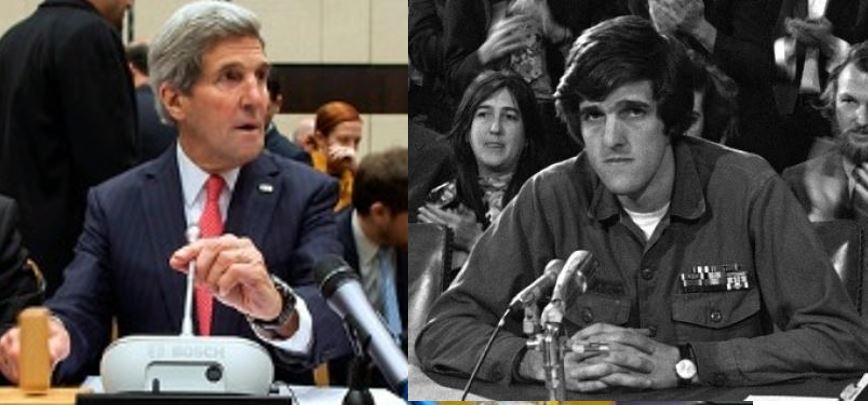
Does 2014 John Kerry ever look back on 1971 John Kerry?

The John Kerry of 2014 wears the suit of a diplomat while advocating forever war. Does he ever look back on the John Kerry of 1971, who wore the uniform of a soldier to advocate for peace?

On April 23, 1971, John Kerry, speaking as a member of Vietnam Veterans Against the War, appeared before the Senate Foreign Relations Committee and famously posed the question “How do you ask a man to be the last man to die for a mistake?”. On December 2, 2014, Kerry, in his capacity as US Secretary of State, convened a meeting of Foreign Ministers of countries allied against ISIS. Sadly, the wisdom of 1971 John Kerry was completely lost on 2014 John Kerry, as the meeting in Brussels was aimed entirely at making war on ISIS without regard for the residents of the region who will bear the brunt of the new violence and who have faced severe hardships for years as a result of US meddling in the region. Kerry’s plan shows no regard for the hard evidence that exists showing that the approach being taken by the US has failed many times over since the failure in Vietnam which he so forcefully described.

Kerry’s description of the shortcomings of the approach in Vietnam resonates with the current failed approach by the US in Iraq, Afghanistan, Syria and beyond:

We found that not only was it a civil war, an effort by a people who had for years been seeking their liberation from any colonial influence whatsoever, but also we found that the Vietnamese whom we had enthusiastically molded after our own image were hard put to take up the fight against the threat we were supposedly saving them from.

We found most people didn’t even know the difference between communism and democracy. They only wanted to work in rice paddies without helicopters strafing them and bombs with napalm burning their villages and tearing their country apart. They wanted everything to do with the war, particularly with this foreign presence of the United States of America, to leave them alone in peace, and they practiced the art of survival by siding with whichever military force was present at a particular time, be it Viet Cong, North Vietnamese or American.

Kerry pointed out in 1971 that residents of an area under siege by invaders often choose to side with whatever force is there in order to survive. But in 2014, Kerry is pushing the US effort to “vet“, train and equip “moderate” fighters to take on ISIS while the US provides air support. How long will these fighters be on “our” side?

And, of course, a very distorted view of the effort gets presented at home, then as now:

We saw Vietnam ravaged equally by American bombs and search and destroy missions, as well as by Viet Cong terrorism – and yet we listened while this country tried to blame all of the havoc on the Viet Cong.

If we look just at Syria, it is clear that those outside the US see US meddling behind the “uprising” against al-Assad. From a 2012 Christian Science Monitor article:

In an empty coffee house in Antakya, local tradesman Ahmet Sari’s face crumples in anger as he speaks about Syria.

“What’s happening in Syria is all part of America’s great project to reshape the borders of the Middle East. America and its allies don’t care about bringing democracy to the Syrian people. Look at what happened to Iraq!” he fumes. “The imperialist countries are only after oil and mineral resources.”

/snip/

And many say that all of these problems can be traced back to the US, who they are convinced got involved with, and perhaps even fomented, the Syrian unrest to loosen up regional powers’ grip on oil, enlisting Turkey as a pawn in the process. It had little to do with support for democracy, they believe.

People in Turkey, who already were dealing with the influx of refugees two years ago, clearly saw a very similar situation in Syria as Kerry saw in Vietnam in 1971. And now, the problems in Turkey are much worse, as the needs of refugees have completely overwhelmed the capacity of relief organizations to help.

We know for a fact that funding and arming rebels almost never works, as the CIA found when reviewing its own efforts on that front. Rather than taking that clear piece of information and trying a new approach based on directly helping the people of the region rather than destabilizing it, the US chose instead to grasp at the last straw from the CIA study that said those few times arming rebels works it has been with “direct American support on the ground”. So rather than accept that their approach is a failure, the warmongers in Washington now think that US air support for the anti-ISIS efforts is a bare minimum and that “boots on the ground” will be needed for a “win”.

And when it comes to “training”, of course the US has failed miserably on that front every time it has tried. But we will just keep on doing it, because that’s all Washington can come up with.

And even if we should “win”, holding onto ground gained is impossible, as Lt. Col. Daniel L. Davis has so devastatingly noted in his piercing of the myth of US superiority in its counterinsurgency program.

The contrast of 2014 John Kerry with 1971 John Kerry is brought into clear view with this part of Kerry’s opening statement to his war council yesterday: Read more

Share this entry

Obama Uninterested in Lame Duck AUMF

Bob Menendez seems surprised that the President is not rushing witnesses to his Committee so it can get to work on revising and cleaning up AUMFs.

Sen. Bob Menendez (D-N.J.), chairman of the Senate Foreign Relations Committee, said the White House was being uncooperative by not sending over an official who could testify on what kind of a measure they would want.

“The administration is not producing witnesses, which makes such an important issue very difficult to formulate,” said Menendez, whose committee would be responsible for working on an authorization for use of military force (AUMF) bill.  

“You would think that they would want to work with us, so that we can fashion an AUMF that would give the president the wherewithal to fight ISIL successfully but by the same token, tailor it enough so we don’t end up in an open-ended conflict as we have seen under the 2001 AUMF,” Menendez said, using an alternate name for the terrorist group.

Not me. It looks more and more like my initial guess was correct: that Obama will wait for the Republicans who will “force” him to accept a far broader AUMF, one that will both interpret executive authority broadly, but also one that will place the blame for escalation on the GOP.

Obama sure looks to be making the most of losing the Senate.

Share this entry

Moral Depravity of US Syria Policy: Unlimited Funds for Fighting, UN Suspends Refugee Food Aid

There is no way that the United States and its allies can say that they didn’t see this coming. They had a very clearly stated warning in September. Nevertheless, while the US continues throwing virtually unlimited funds at training “moderatefighters for Syria and even contemplating a modified “no-fly zone” that is virtually certain to lead to deeper direct US involvement in the fighting, the United Nations’ World Food Programme was forced to announce yesterday that financial assistance to feed 1.7 million Syrian refugees is being suspended immediately because the international community has provided insufficient funding for the program. The funding gap could not have come at a worse time for the refugees:

Under this programme, poor Syrian refugees in Jordan, Lebanon, Turkey, Iraq and Egypt have used vouchers to buy food in local shops. Without WFP vouchers, many families will go hungry. For refugees already struggling to survive the harsh winter, the consequences of halting this assistance will be devastating.

“A suspension of WFP food assistance will endanger the health and safety of these refugees and will potentially cause further tensions, instability and insecurity in the neighbouring host countries,” said WFP Executive Director Ertharin Cousin, in an appeal to donors. “The suspension of WFP food assistance will be disastrous for many already suffering families.

Syrian refugees in camps and informal settlements throughout the region are ill prepared for yet another harsh winter, especially in Lebanon and Jordan, where many children are bare foot and without proper clothing. Many tents are drenched in mud and hygiene conditions are growing extremely precarious.

Cousin said that WFP’s Syria emergency operations are now in critical need of funding. Many donor commitments remain unfulfilled. WFP requires a total of US$64 million immediately to support Syrian refugees in neighbouring countries during the month of December.

The funding gap for WFP was over $350 million in the September announcement. That figure was for funding through the end of the year, putting the monthly cost at just over $115 million. The gap for December still stands at $64 million, meaning that the WFP has gotten less than half the funds that it sought in September.

Recall that back in late September, the announcement of the three month need came on the same day the Senate approved $500 million for training “moderate” rebels to send into Syria. Once again, just as word of the cutoff has come out, the US is openly discussing committing more funds to escalating the Syrian civil war:

The Obama administration is weighing the opening of a new front in the air war against the Islamic State in Syria, part of an offensive to push back militants along the western part of Syria’s border with Turkey and create a relatively safe zone for U.S.-backed Syrian rebel forces to move in.

Under the plan, U.S. aircraft flying from Turkey’s Incirlik air base would target positions the militants currently hold along the border north of Aleppo, eastward toward the besieged town of Kobane. Turkish special forces would move into the area to assist the targeting and help Syrian opposition fighters consolidate their hold on the territory.

Of course, this will require lots more money and is likely to drag us much deeper into the conflict:

If implemented, the plan would require significantly more U.S. resources than are now devoted to the fight against the Islamic State in Syria, including more planes and more money. Congress is debating both the funding and the new authorization for operations in Syria and Iraq that have already been approved by the president.

Although officials said the proposal is not intended to establish a traditional no-fly zone, requiring constant patrols against other aircraft entering the area — potentially up to 100 miles long and 20 miles deep inside Syria — its proponents recognize the potential for a “slippery slope” into a far more major operation.

Once more, the US cares only about putting more arms and more bombs into the conflict while families starve and go without adequate shelter or cold weather clothing. The Washington Post talked to one family that will be hit hard by the end of the voucher program:

For Syrians such as Mouhanad Mouree, there was shock that he, his wife and their six children may no longer receive their World Food Program vouchers. They fled their home town of Homs seven months ago for Tripoli, a city in northern Lebanon, where they live in a garage for $200 a month. Mouree is especially concerned about his 2-year-old son.

“I can hardly afford diapers and milk for my youngest son, and we freeze in the cold weather because we cannot afford heating with electricity,” he said by telephone. “I don’t know what we’ll do.”

In a war that has cost over 200,000 lives, the US still chooses to put its resources into escalation of the war while ignoring the needs of those who will die of exposure and neglect.

But they hate us for our freedoms.

Share this entry

Over $80 Billion Wasted in “Training” Iraqi, Afghan Forces: No Lessons Learned

There simply is no level of duplicity that Iraqi or Afghan military leaders can engage in that will lead to the US re-examining the failed assumption that “training” armed forces in those countries will stabilize them. Between the two efforts, the US has now wasted over $80 billion and more than a decade of time just on training and equipping, and yet neither force can withstand even a fraction of the forces they now face.

The latest revelations of just how failed the training effort has been are stunning, and yet we can rest assured that they will be completely disregarded as decision-makers in Washington continue to pour even more money into a cause that has long ago been proven hopeless.

Consider the latest revelations.

We learned yesterday that a cursory investigation in Iraq has already revealed at least 50,000 “ghost soldiers”:

The Iraqi army has been paying salaries to at least 50,000 soldiers who don’t exist, Iraqi Prime Minister Haider al-Abadi said Sunday, an indication of the level of corruption that permeates an institution that the United States has spent billions equipping and arming.

A preliminary investigation into “ghost soldiers” — whose salaries are being drawn but who are not in military service — revealed the tens of thousands of false names on Defense Ministry rolls, Abadi told parliament Sunday. Follow-up investigations are expected to uncover “more and more,” he added.

We can only imagine how much larger the total will become should Iraq actually follow through with a more thorough investigation, but already one Iraqi official quoted in the article hinted the monetary loss could be at least three times what is now known. But that isn’t even the worst condemnation of US practices in this report. Consider this quote that the Post seems to consider a throw-away since it is buried deep within the article:

“The problems are wide, and it’s an extremely difficult task which is going to involve some strong will,” said Iraqi security analyst Saeed al-Jayashi. “Training is weak and unprofessional.”

So the glorious training program in Iraq, which was proudly under the leadership of ass-kissing little chickenshit David Petraeus when it was being heralded, is now finally exposed as “weak and unprofessional”. And the US will do exactly diddly squat about these revelations. Recall that last week we learned that the Defense Department does not consider reducing corruption to be part of their role as advisors in Iraq. I’ll go out on a limb here and predict that when confirmation hearings are held for a new Secretary of Defense, there won’t be a single question aimed at asking how our current training program will be improved to avoid the failures that have been so clearly demonstrated in the previous attempts.

The situation in Afghanistan, although it is receiving less attention, is no better. Reuters reported yesterday on how poorly equipped Afghan forces are for dealing with the Taliban, despite over $60 billion that the US has spent to train and equip those forces:

Afghan district police chief Ahmadullah Anwari only has enough grenades to hand out three to each checkpoint in an area of Helmand province swarming with Taliban insurgents who launch almost daily attacks on security forces.

“Sometimes up to 200 Taliban attack our checkpoints and if there are no army reinforcements, we lose the fight,” said Anwari, in charge of one of Afghanistan’s most volatile districts, Sangin.

“It shames me to say that we don’t have enough weapons and equipment. But this is a bitter reality.”

The article goes on to utterly destroy the ridiculous statements from Joseph Anderson, commander of ISAF Joint Command, back on November 5. Despite Anderson claiming that Afghan forces “are winning”, Reuters points out that claims that the ANSF remains in control of most of the country are grossly overstated:

And while the coalition says Afghan forces control most of the country, the reality on the ground can be very different.

Graeme Smith, senior Kabul analyst for the International Crisis Group, says that in many remote districts, the government controls a few administrative buildings “but the influence of Afghan forces may not extend far beyond that point”.

And yet, despite this clear history of failed efforts to train and equip forces, the US now plans to spend more than another $5 billion fighting ISIS. If it weren’t for the carbon dioxide that would be released, it would probably be better for all of us if that money were simply incinerated.

Share this entry

As Obama Embraces Multi-Fronted War, He Fires Chuck Hagel

In recent days, the press has reported that President Obama signed an order (or on second thought, maybe it’s just an unsigned decision that can’t be FOIAed, so don’t start anything, Jason Leopold) basically halting and partly reversing his plans for withdrawal.

President Obama decided in recent weeks to authorize a more expansive mission for the military in Afghanistan in 2015 than originally planned, a move that ensures American troops will have a direct role in fighting in the war-ravaged country for at least another year.

Mr. Obama’s order allows American forces to carry out missions against the Taliban and other militant groups threatening American troops or the Afghan government, a broader mission than the president described to the public earlier this year, according to several administration, military and congressional officials with knowledge of the decision. The new authorization also allows American jets, bombers and drones to support Afghan troops on combat missions.

Virtually simultaneously with the decision to permit American forces to be more involved with the Afghan government, Afghan President Ashraf Ghani has reversed Hamid Karzai’s ban on night raids — and also renamed them “night operations.”

The government of the new Afghan president, Ashraf Ghani, has quietly lifted the ban on night raids by special forces troops that his predecessor had imposed.

Afghan National Army Special Forces units are planning to resume the raids in 2015, and in some cases the raids will include members of American Special Operations units in an advisory role, according to Afghan military officials as well as officials with the American-led military coalition.

That news comes after published accounts of an order by President Obama to allow the American military to continue some limited combat operations in 2015. That order allows for the sort of air support necessary for successful night raids.

Night raids were banned for the most part in 2013 by President Hamid Karzai. Their resumption is likely to be controversial among Afghans, for whom any intrusion into private homes is considered offensive. Mindful of the bad name that night raids have, the American military has renamed them “night operations.”

Night operations …. sort of like the tooth fairy?

And now that Obama has made it clear he will spend his Lame Duck continuing — escalating, even — both forever wars he got elected to end, he has fired forced the resignation of the Secretary of Defense he hired to make peace.

Defense Secretary Chuck Hagel is stepping down under pressure, the first cabinet-level casualty of the collapse ofPresident Obama’s Democratic majority in the Senate and a beleaguered national security team that has struggled to stay ahead of an onslaught of global crises.

The president, who is expected to announce Mr. Hagel’s resignation in a Rose Garden appearance on Monday, made the decision to ask his defense secretary — the sole Republican on his national security team — to step down last Friday after a series of meetings over the past two weeks, senior administration officials said.

The officials described Mr. Obama’s decision to remove Mr. Hagel, 68, as a recognition that the threat from the Islamic State would require a different kind of skills than those that Mr. Hagel was brought on to employ. A Republican with military experience who was skeptical about the Iraq war, Mr. Hagel came in to manage the Afghanistan combat withdrawal and the shrinking Pentagon budget in the era of budget sequestration.

But now “the next couple of years will demand a different kind of focus,” one administration official said, speaking on the condition of anonymity. He insisted that Mr. Hagel was not fired, saying that he initiated discussions about his future two weeks ago with the president, and that the two men mutually agreed that it was time for him to leave.

But Mr. Hagel’s aides had maintained in recent weeks that he expected to serve the full four years as defense secretary.

Some great reporting from the NYT, getting all three scoops about Obama’s pivot to war.

I’m just hoping someone is reporting out the really important questions: who will be paying for the resumption of the forever war, and how it will be any more successful than the last 13 years?

Share this entry

Another Iraq Failure by Petraeus: Graft-Ridden Military

Back when the Bush Administration and their neocon operators were most proud of their “accomplishments” in Iraq, their poster boy for this success most often was my favorite ass-kissing little chickenshit, David Petraeus. As the public finally became aware of what a disaster Iraq really was and as Obama moved his focus to the “good war” in Afghanistan, I noted that Petraeus’ name was no longer associated with Iraq once it, and especially Petraeus’ multiple attempts to train Iraq’s military, had failed. Today we have further news on how Iraq’s military came to be in such sad shape that many units simply disappeared when it came time to confront ISIS. It turns out that while he was gaining accolades for training Iraqi troops, Petraeus was in reality creating a system in which Iraqi officers were able to siphon off the billions of dollars the US wasted on the whole training operation:

The Iraqi military and police forces had been so thoroughly pillaged by their own corrupt leadership that they all but collapsed this spring in the face of the advancing militants of the Islamic State — despite roughly $25 billion worth of American training and equipment over the past 10 years and far more from the Iraqi treasury.

/snip/

The United States has insisted that the Iraqi military act as the conduit for any new aid and armaments being supplied for a counteroffensive, including money and weapons intended for tribal fighters willing to push out the Islamic State. In its 2015 budget, the Pentagon has requested $1.3 billion to provide weapons for the government forces and $24.1 million intended for the tribes.

But some of the weaponry recently supplied by the army has already ended up on the black market and in the hands of Islamic State fighters, according to Iraqi officers and lawmakers. American officials directed questions to the Iraqi government.

“I told the Americans, don’t give any weapons through the army — not even one piece — because corruption is everywhere, and you will not see any of it,” said Col. Shaaban al-Obeidi of the internal security forces, also a Sunni tribal leader in Anbar Province. “Our people will steal it.”

But don’t look for any of the new billions being spent to put controls on graft into place:

American officials say working with the tribes, and military corruption, is beyond the scope of their mission. “Reducing corruption is not part of the advisers’ role,” said one American official involved in the effort, “and there is no reason to believe that advisers’ presence will reduce corruption.”

Isn’t that just peachy? We know without a doubt that giving weapons or financial support to the Iraqi military is guaranteed to wind up helping ISIS instead of fighting them. And yet Washington insists on throwing another $1.3 billion going down the same shithole.

Part of the reason that this can’t be stopped is that the US side of the graft is so organized and institutionalized. Moving out from just the efforts within Iraq to the entire campaign against ISIS, we see who really benefits:

President Obama is asking Congress for an additional $5.6 billion to fight the militant group. A large share of the money, if approved, would be given to the Pentagon to train and equip Iraqi forces, while a smaller portion would be reserved for the State Department.

/snip/

The big defense companies that manufacture weapons are likely to receive orders to help the military replenish its stocks, analysts said.

That includes Falls Church giants Northrop Grumman and General Dynamics, as well as Raytheon and Boeing, said Roman Schweizer, a defense policy analyst with Guggenheim Securities.

/snip/

More broadly however, the budget includes funding requests for operations and maintenance of military bases, as well as classified operations and research and development.

That could potentially boost business for services companies such as Arlington’s DRS Technologies, or contractors that work in the field of intelligence, said James McAleese, founder of Sterling-based McAleese & Associates, a government contracts consultancy.

Ah, but the big goose keeps producing golden eggs for the folks who train Iraq’s military. The article continues:

In the long term, the biggest procurement for services contractors could stem from the $1.6 billion requested for the Iraq Train and Equip Fund, Schweizer said.

The fund would be used to provide training at multiple sites throughout Iraq for approximately 12 Iraqi brigades, according to the White House.

Although the Pentagon has yet to state if it plans to use contractors for training, “history would suggest that when the Army goes somewhere, contractor support follows,” Schweizer said.

So, while Ashraf Ghani and Abdullah Abdullah continue their tussles over who owns what in Afghanistan’s graft-sharing arrangement, graft-sharing here in the US is politely played out in the Washington process of contracting. And in Washington, we know that the company that makes the biggest investment in congressmembers wins fair and square.

Share this entry