
Obama to Congress: Oh, By the Way, You Just Funded the Iraq War

A number of people have closely scrutinized the latest entry in Obama’s epistolary war — the one informing Congress he had escalated the war into Syria.

I especially like the way he doesn’t even mention the strikes on Jabhat al-Nusra (aka Khorasan) explicitly, lumping them in instead with “these terrorists” who have invaded Iraq.

I have ordered implementation of a new comprehensive and sustained counterterrorism strategy to degrade, and ultimately defeat, ISIL. As part of this strategy, I have directed the deployment of 475 additional U.S. Armed Forces personnel to Iraq, and I have determined that it is necessary and appropriate to use the U.S. Armed Forces to conduct coordination with Iraqi forces and to provide training, communications support, intelligence support, and other support, to select elements of the Iraqi security forces, including Kurdish Peshmerga forces. I have also ordered the U.S. Armed Forces to conduct a systematic campaign of airstrikes and other necessary actions against these terrorists in Iraq and Syria. [my emphasis]

The antecedent to “these terrorists” is ISIL. Yet he effectively lumps his attack on Nusra — which really pissed off the “moderates” in Syria we claim to be fighting with and for — in with ISIL, even though they are totally different groups. As I said, I believe one reason he struck Nusra is to be able to invoke the 2001 AUMF marginally credibly.

I’m also interested in the timing of something noted by Josh Gerstein.

For the first time in his epistolary series of self-authorizations, Obama invoked AUMFs — both of them — to justify his war.

I have directed these actions, which are in the national security and foreign policy interests of the United States, pursuant to my constitutional and statutory authority as Commander in Chief (including the authority to carry out Public Law 107-40 [the Afghan AUMF] and Public Law 107-243 [the Iraq AUMF]) and as Chief Executive, as well as my constitutional and statutory authority to conduct the foreign relations of the United States.

I was afraid it would come to this.

I’m particularly struck by the timing of this move. Obama waited until Congress authorized funding for this escalation before he told them he considers the escalation to already have been authorized by them — at a time when most of them weren’t even in Congress (neither was Obama, of course).

I guess that’s the easier route to take, in a democracy, to blame your war on people who’ve long ago retired.

This way, if Congress decides to do nothing to authorize this new war during the lame duck session, Obama can keep on operating with the “sanction” of Congress without anyone having to pay a political price for it.


For shits and giggles, here’s a list of all the Senators who were not in the Senate (some were in the House) for the 2002 Iraq War vote. Just the AL, CA, IA, MI, and WA delegations remain the same as they were for the Iraq AUMF.
Read more

Share this entry

The Covert Operation Undermining US Credibility against ISIS

Over the weekend, the NYT had a story reporting the “conspiracy theory” popular among Iraqis that the US is behind ISIS.

The United States has conducted an escalating campaign of deadly airstrikes against the extremists of the Islamic State for more than a month. But that appears to have done little to tamp down the conspiracy theories still circulating from the streets of Baghdad to the highest levels of Iraqi government that the C.I.A. is secretly behind the same extremists that it is now attacking.

“We know about who made Daesh,” said Bahaa al-Araji, a deputy prime minister, using an Arabic shorthand for the Islamic State on Saturday at a demonstration called by the Shiite cleric Moktada al-Sadr to warn against the possible deployment of American ground troops. Mr. Sadr publicly blamed the C.I.A. for creating the Islamic State in a speech last week, and interviews suggested that most of the few thousand people at the demonstration, including dozens of members of Parliament, subscribed to the same theory.

[snip]

The prevalence of the theory in the streets underscored the deep suspicions of the American military’s return to Iraq more than a decade after its invasion, in 2003. The casual endorsement by a senior official, though, was also a pointed reminder that the new Iraqi government may be an awkward partner for the American-led campaign to drive out the extremists.

It suggests the theory arises from lingering suspicions tied to our occupation of Iraq.

But, given the publicly available facts, is the theory so crazy?

Let me clear: I am not saying the US currently backs ISIS, as the NYT’s headline but not story suggests is the conspiracy theory. Nor am I saying the US willingly built a terrorist state that would go on to found a caliphate in Iraq.

But it is a fact that the US has had a covert op since at least June 2013 funding Syrian opposition groups, many of them foreign fighters, in an effort to overthrow Bashar al-Assad. Chuck Hagel confirmed as much in Senate testimony on September 3, 2013 (the NYT subsequently reported that President Obama signed the finding authorizing the op in April 2013, but did not implement it right away). We relied on our Saudi and Qatari partners as go-betweens in that op and therefore relied on them to vet the recipient groups.

At least as Steve Clemons tells it, in addition to the more “moderate” liver-eaters in the Free Syrian Army, the Qataris were (are?) funding Jabhat al-Nusra, whereas Saudi prince Bandar bin Sultan gets credit for empowering ISIS — which is one of the reasons King Abdullah took the Syria portfolio away from him.

McCain was praising Prince Bandar bin Sultan, then the head of Saudi Arabia’s intelligence services and a former ambassador to the United States, for supporting forces fighting Bashar al-Assad’s regime in Syria. McCain and Senator Lindsey Graham had previously met with Bandar to encourage the Saudis to arm Syrian rebel forces.

But shortly after McCain’s Munich comments, Saudi Arabia’s King Abdullah relieved Bandar of his Syrian covert-action portfolio, which was then transferred to Saudi Interior Minister Prince Mohammed bin Nayef. By mid-April, just two weeks after President Obama met with King Abdullah on March 28, Bandar had also been removed from his position as head of Saudi intelligence—according to official government statements, at “his own request.” Sources close to the royal court told me that, in fact, the king fired Bandar over his handling of the kingdom’s Syria policy and other simmering tensions, after initially refusing to accept Bandar’s offers to resign.

[snip]

ISIS, in fact, may have been a major part of Bandar’s covert-ops strategy in Syria. The Saudi government, for its part, has denied allegations, including claims made by Iraqi Prime Minister Nouri al-Maliki, that it has directly supported ISIS. But there are also signs that the kingdom recently shifted its assistance—whether direct or indirect—away from extremist factions in Syria and toward more moderate opposition groups.

[snip]

The worry at the time, punctuated by a February meeting between U.S. National Security Adviser Susan Rice and the intelligence chiefs of Turkey, Qatar, Jordan, and others in the region, was that ISIS and al-Qaeda-affiliated Jabhat al-Nusra had emerged as the preeminent rebel forces in Syria. The governments who took part reportedly committed to cut off ISIS and Jabhat al-Nusra, and support the FSA instead. But while official support from Qatar and Saudi Arabia appears to have dried up, non-governmental military and financial support may still be flowing from these countries to Islamist groups.

Thus, to the extent that we worked with Bandar on a covert op to create an opposition force to overthrow Assad, we may well have had an indirect hand in its creation. That doesn’t mean we wanted to create ISIS. It means we are led by the nose by the Saudis generally and were by Bandar specifically, in part because we are so reliant on them for our HUMINT in such matters. Particularly given Saudi support for Sunnis during our Iraq occupation, can you fault Iraqis for finding our tendency to get snookered by the Saudis suspect?

Moreover, our ongoing actions feed such suspicions. Consider the way the Administration is asking for Congressional sanction (at least in the form of funding) for an escalated engagement in the region, without first briefing Congress on the stupid things it has been doing covertly for the last 18 months?

Read more

Share this entry

On Day Senate Approved $500 Million for War in Syria, UN Announced $352 Million Funding Shortfall for Feeding Syrian Refugees

A recent theme of mine has been that most of the time, the only response the US can come up with for a crisis anywhere in the world is to ask “Which group should we arm?” Despite ample evidence that this inane desire to train and equip various groups around the world always comes back to bite us in the ass, the US is intent, once again, on training and arming “moderate” rebels in Syria. Never mind that it has been shown, repeatedly, that the so-called “moderates” in Syria are anything but, as they have demonstrated by eating an opponent’s heart and carrying out multiple beheadings.

The one time the US avoided this approach and instead relied on diplomacy was a huge success. Syria’s declared chemical weapons have been removed from the country and destroyed despite the difficulty of this process taking place while the civil war raged. Choosing to ignore that clear success, the US is determined to make the situation in Syria infinitely worse by pouring this renewed effort into training and arming rebels. It is very easy to predict that this effort will result in radicalizing a whole new generation of fighters determined to attack the US precisely because of how it is getting involved in the Syrian civil war.

The flip side to the question of “Which group should we arm?” should be “What can we do to make the lives of the citizens of this region better?” In Syria and the surrounding countries affected by the masses of citizens who have fled the war, that answer is very clear. These refugees need food. They need shelter. They need basic medical care. Their students need schools, as estimates now say close to three million Syrian children are not in school.

Sadly, last Thursday, on the very day that the US Senate went along with the vote the previous day in the House to make $500 million available for this doomed effort to train and arm rebels, the United Nations’ World Food Programme announced that due to funding shortfalls, food allocations for Syrian refugees will be cut drastically in October and November and may not be available at all in December:

“We have reached a critical point in our humanitarian response in Syria and in neighbouring countries and unless we manage to secure significant funding in the next few days, I am afraid we will have no choice but to scale back our operation,” said Muhannad Hadi, WFP’s Regional Emergency Coordinator for the Syrian crisis.

/snip/

In Syria from October, WFP will continue to provide food to more than 4 million people, but the food parcel will be smaller, providing less than 60 percent of the nutritional value recommended in emergencies in October and cutting even more in November. For December, WFP has no funding available for programmes in Syria.

The group faces similarly catastrophic shortfalls in the countries surrounding Syria where citizens have fled the violence.

The total funding shortfall is staggering:

WFP requires US$352 million for its operations as a whole until the end of the year, including US$95 million for its work inside Syria and US$257 million to support refugees in neighbouring countries.

So the US is throwing away more money than is needed to feed Syrian refugees through the end of the year on a plan that will increase violence and likely lead to the deaths of many of these same refugees from starvation, exposure to harsh winter conditions and “collateral damage” from poorly targeted missiles.

Consider the current plight of Syrian families. Their country is ripped apart by fighting that has raged for years. The bulk of the citizens have merely tried to avoid the violence, but it has rained down on them from all sides of a war that has countless groups taking part. Now, on the very day that the largest relief agency in the world announces that it will have to cut back on its already inadequate assistance, the US moves forward with a plan to waste more money than the World Food Programme needs in a way that will make their lives measurably worse.

The question is not whether starving Syrian refugees will be radicalized when poorly targeted US missiles kill innocent family members, as that is guaranteed. The only question is just how many of these newly radicalized enemies this latest clusterfuck of a plan will generate.

Share this entry

Funding Hapless Mission to Train Syrian Rebels Increases Value of Saudi Terror Hedge Fund

The cycle time for the US wiping its collective memory and re-starting a training program for troops aimed against the enemy du jour seems to be getting shorter. While the covert CIA plan to train “moderate” rebels to fight in Syria has not even ended, the new $500 million Obama just got approved by Congress for the military to train rebels is being described almost as if it is the only program around:

Even if the training goes as planned, the rebels will be outnumbered. While the United States has proposed to train and equip 5,000 rebels, the Central Intelligence Agency has said it believes that the Islamic State has between 20,000 and 31,500 fighters in Iraq and Syria.

Elsewhere in that article we do see “This scaled-up training program would be overseen by the Defense Department, unlike the current covert program here and a similar program in Jordan, both overseen by the C.I.A.”, but since the number of fighters trained by the CIA isn’t added to those we plan to train using the military, it would appear that those “fighters” are in the process of fading into the sunset.

With David Petraeus still unavailable to run this PR training program, we are actually seeing hints this time that at least a few of our Congresscritters may be learning that our history of training isn’t exactly stellar and could bode poorly for this effort:

Some lawmakers who voted against Wednesday’s measure argued the administration was moving too fast and did not yet have a feasible plan to arm the Syrian rebels. Rep. Loretta Sanchez (D-Calif.) said it was “pretty disturbing” that Thursday’s hearing was occurring after the House had voted.

“I don’t think the plan that I have seen was detailed enough to make me believe that your plan will work,” Sanchez said. “I hope I am wrong. I hoped the same thing when I voted against the Iraq war that I was wrong, but I don’t believe I was wrong on that.”

Still, the larger focus of Thursday’s hearing shifted from the push for Congress to approve arming and training the Syrian rebels to the future of the U.S. military campaign against ISIL.

Rep. Jackie Walorski (R-Ind.) said she had doubts about the plan and asked Hagel to explain the endgame against ISIL. Rep. Colleen Hanabusa (D-Hawaii) asked about the vetting of forces in Iraq — and not just Syria. And Rep. John Kline (R-Minn.) wanted more details about potential airstrikes in Syria.

Remarkably, the press also is noticing that this effort is ill-fated. From the same NYTimes article linked above:

While the House approved an aid package for the rebels on Wednesday and the Senate followed on Thursday, at present the rebels are a beleaguered lot, far from becoming a force that can take on the fanatical and seasoned fighters of the Islamic State.

What’s more, the Times acknowledges that the “moderates” have different priorities from US goals in Syria:

Short of arms, they are struggling to hold their own against both the military of President Bashar al-Assad and the jihadists of the Islamic State. Their leaders have been the targets of assassination attempts. And some acknowledge that battlefield necessity has put them in the trenches with the Nusra Front, Al Qaeda’s Syrian affiliate, an issue of obvious concern for the United States.

While they long for greater international support and hate the Islamic State, sometimes called ISIS or ISIL, ousting Mr. Assad remains their primary goal, putting them at odds with their American patrons.

As Marcy noted earlier this week, small amounts of recognition of the perverse role of Saudi Arabia in funding global terrorism is also finally creeping into general awareness. Former Florida Governor and Senator Bob Graham has been quite active lately in pushing on that front. In addition to the quote Marcy presented from a Tampa news outlet, there is this from a Patrick Cockburn interview:

Senator Graham, a distinguished elder statesmen who was twice Democratic governor of Florida before spending 18 years in the US Senate, believes that ignoring what Saudi Arabia was doing and treating it as a reliable American ally contributed to the US intelligence services’ failure to identify Isis as a rising power until after it captured Mosul on 10 June. He says that “one reason I think that our intelligence has been less than stellar” is that not enough attention was given to Saudi Arabia’s fostering of al-Qaeda-type jihadi movements, of which Isis is the most notorious and successful. So far the CIA and other intelligence services have faced little criticism in the US for their apparent failure to foresee the explosive expansion of Isis, which now controls an area larger than Great Britain in northern Iraq and eastern Syria.

/snip/

Senator Graham does not suggest that the Saudis are directly running Isis, but that their support for Sunni extremists in Iraq and Syria opened the door to jihadis including Isis. Similar points were made by Sir Richard Dearlove, the former head of the British Secret Intelligence Service, and MI6, who said in a lecture at the Royal United Services Institute in London in July that the Saudi government is “deeply attracted towards any militancy which effectively challenges Shiadom”. He said that rulers of the Kingdom tended to oppose jihadis at home as enemies of the House of Saud, but promote them abroad in the interests of Saudi foreign policy. Anti-Shi’ism has always been at the centre of the Saudi world view, and he quoted Prince Bandar, the ambassador in Washington at the time of 9/11 and later head of Saudi intelligence, as saying to him: “The time is not far off in the Middle East, Richard, when it will be literally ‘God help the Shia’. More than a billion Sunni have simply had enough of them.”

So the long-term position of the Saudis is to promote Sunni jihadists against Shia forces globally. But part of how they avoid US ire is that they play both sides. From the Times article:

So far, the program has focused on a small number of vetted rebel groups from the hundreds that are fighting across Syria, providing them with military and financial help, according to rebel commanders who have received support.

The process is run by intelligence officials from a number of countries. The United States provides overall guidance, while Turkey manages the border, and Persian Gulf states like Saudi Arabia provide much of the funding.

Despite fostering the conditions that led to the formation of ISIS, the Saudis also are helping to fund what can only be described as a doomed before it starts effort to combat ISIS. In the world of terrorism, the Saudis are behaving like a hedge fund, betting on both sides of the ISIS issue. Despite their small position against ISIS in the short term, there is no doubt their long term position is one of radical Sunni jihadism. In fact, since the training is doomed, by helping to fund it, the Saudis are increasing the overall stature of their long term jihadist investment. No matter how much money the US throws at this effort or how many “moderate rebels” it trains, only a fool would believe the Saudis would allow the Syrian rebels and Iraq to defeat a Sunni jihadist movement.

Share this entry

Afghan Vote Audit Farce Nears Conclusion

Reuters carries a hopeful headline this morning, “Afghan rivals said close to ending feud on how to share power“, where they inform us that the elusive power sharing agreement between Ashraf Ghani and Abdullah Abdullah may finally be reached tonight:

Afghanistan’s rival presidential candidates may reach a deal on how to share power late on Tuesday, according to Afghan and Western officials, potentially ending months of tension over the outcome of a run-off election held in June.

The struggle to find a successor to President Hamid Karzai, who has held power since the Islamist Taliban were ousted in 2001, has destabilized Afghanistan and paralyzed its economy just as most foreign troops withdraw.

There clearly is a push to say that a resolution of the crisis is close. ToloNews claims that a meeting last night between the candidates hosted by Hamid Karzai “went well, and both men were said to have reaffirmed their commitments to resolving their differences and reaching an agreement soon”. However, reading further in the article, we see that fundamental differences remain:

Both teams have confirmed that the candidates have discussed a new plan for the national unity government they agreed to form back in August following meetings with U.S. Secretary of State John Kerry. According to Abdullah’s camp, the two campaigns have agreed that the Chief Executive will serve as the Chairman of the Council of Ministers.

“An agreement has been made on one of the disputed points regarding whether the Chief Executive will also serve as Chairman of Council of Ministers,” Abdullah spokesman Syed Aqa Fazel Sancharaki said Monday.

Meanwhile, the Ghani campaign has maintained that the elected president will serve as head of government and Chairman of the Council of Ministers. “The presidential order will certify the job descriptions of the Chief Executive and his vices and the elected president will be head of the government and Chairman of Council of Ministers,” Ghani spokesman Faizullah Zaki said on Monday.

To underline just how farcical the entire process of “auditing” the runoff vote ballots became, another ToloNews article this morning is stunning in its open admission of how widespread fraud was in the election. The Independent Election Commission announced that results from 1028 polling places have been rejected in the audit process:

During the announcement, IEC acknowledged the fact that the June 14 run-off elections witnessed massive frauds.

“There was wide-scale fraud by security forces, governors and IEC employees,” a commissioner for the IEC, Azizullah Bakhtyari, admitted. “Clearly, most of the fraud happened in coordination with IEC employees.”

Bakhtyari hopes that the audit process will re-establish people’s trust in the election process.

“The audit helped us recognize the employees responsible for the fraud that took place at the 1,028 polling sites,” he said. “Clearly, we will take action against them for harming the public’s trust in the electoral institution.”

Wow. So security forces, governors and IEC employees all took part in the fraud? Those are the very people who were supposed to assure voters that the process would be fair and impartial. But don’t get the impression that this admission and the tossing of results from 1028 polling stations will change anything. Although that sounds like a lot of votes being tossed, keep in mind that there were around 22,000 polling stations, so this move will have very little impact on the final vote tally.

What is clear is that this final adjusted vote tally will have to be announced soon. What is not clear is whether Abdullah will accept the result that is certain to say that he lost. Just how he and his supporters react to the final announcement will be the most important decision in Afghanistan’s fate over the next few years.

Share this entry

Pakistan’s Punjabi Taliban to Cease Internal Attacks, Continue Them in Afghanistan

Although their first press release announcing their change in plans earlier this month got little fanfare, now that they have followed it up with a video (fortunately, there are no beheadings in the video), the Punjabi Taliban’s decision to cease violent attacks within Pakistan is being hailed as a “Watershed Event“:

“We have decided to give up militancy in Pakistan. I’ve taken the decision in the best interests of Islam and the nation. I also appeal to all other armed groups to stop violent activities in Pakistan,” Asmatullah Muaweya, the chief of the Punjabi Taliban, said in a three-minute video message released to the media on Saturday. He added that his group would now focus on Dawah (Islamic preaching) for the “supremacy of Islam and protection of the system.”

“I’ve taken the decision after consulting religious scholars and tribal leaders,” said Muaweya whose group had been blamed for several deadly attacks in the country, especially in Punjab. He also called upon other militant groups to renounce violence and come to the negotiating table as the country was passing through a critical juncture.

Nearly lost in this fanfare about renouncing violence inside Pakistan is that we learned, even in the earlier announcement, that violence by the group inside Afghanistan would continue:

“We will confine our practical jihadist role to Afghanistan in view of deteriorating situation in the region and internal situation of Pakistani jihadist movement,” Punjabi Taliban chief Ismatullah Muawiya said in a pamphlet faxed to the media, without clarifying further.

That part of the change in plans was not overlooked by Afghanistan:

“Pakistani Charge d’Affaires Syed Muazzam Shah was summoned to the Foreign Ministry on Sunday, and a strong protest was lodged over the declaration of war made by the Punjabi Taliban on the Afghan side of the Durand Line,” a Ministry’s statement said. The Dari-language statement was also emailed to The Express Tribune.

Abdul Samad Samad, head of political affairs in the Afghan foreign ministry, condemned the threats made by Muaweya, and described his remarks as “clear conspiracies against the stability and security of Afghanistan.”

“Such statements are against international laws and principles of good neighbourly relations,” the statement quoted the Afghan official as telling the Pakistani envoy.

The language gets even stronger from Afghanistan’s military:

In response to the assertions of the Punjabi Taliban, officials of the Afghan Ministry of Defense (MoD) have warned that any attacks on Afghanistan would face harsh response from the Afghan National Security Forces (ANSF).

“We have a death message for those who want to attack Afghanistan,” MoD spokesman Gen. Zahir Azimi said. “Afghanistan would be a cemetery for those who want to attack it.”

Further, Afghan politicians believe that they see the hand of ISI behind the move: Read more

Share this entry

After Spectacular Failures in Iraq and Afghanistan, US to Throw More Money at Training for Syrian Rebels

This image is from June, but it could apply to just about any day US policy and "accomplishments" from Afghanistan to Iraq and beyond is discussed.

This image is from June, but it could apply to just about any day US policy and “accomplishments” from Afghanistan to Iraq and beyond are discussed.

A central part of Barack Obama’s prime-time disclosure that he is authorizing air strikes in Syria was his call for half a billion dollars to train and equip “moderate” rebels in Syria. Proving that bipartisanism in Washington is not dead, John Boehner was quick to show his support for this nifty plan:

Congressional leaders rallied behind President Obama’s call to combat the Islamic State, vowing Thursday to back his request for funding to arm Syrian rebels as early as next week.

Speaker John Boehner, R-Ohio, said he expects the House to pass Obama’s $500 million funding request to train and equip Syrian rebels who are fighting the militant group, also known as ISIL or ISIS.

/snip/

“We only have one commander in chief,” Boehner said. “At this point in time, it is important to give the president what he is asking for.”

Remarkably, though, even this USA Today article notes that there might be a slight problem or two with this brilliant plan to stop ISIS, otherwise known as “the personification of evil in the modern world“:

Sen. Mark Begich of Alaska, another endangered Democrat, said he was opposed to arming Syrian rebels. “We must have greater assurance that we aren’t arming extremists who will eventually use the weapons against us,” he said.

House Republicans are divided into two camps, according to Rep. John Fleming of Louisiana. He told the Associated Press after a closed-door caucus meeting that one side hopes to hold Obama “accountable for doing the right thing.” The other group — that includes himself, Fleming said — believes Obama’s plans amount to an “insane strategy to go out there and depend on people that are proven undependable” to take down the Islamic State.

Wow. I think I just became a big fan of a Republican congressman from Louisiana.

So where could Begich have gotten the idea that if we arm extremists they might eventually use those arms on us? I mean, besides folks like Osama bin Laden and the death squads we have armed in Iraq and Afghanistan? And how could Fleming think the groups we plan to train and arm might be undependable? That is, besides the Iraqi troops we trained who then abandoned their posts and US-supplied weapons as soon as ISIS entered the picture or the Afghan troops that routinely give territory back to the Taliban as soon as US forces withdraw?

And about that half billion dollar budget. Note that back in June, SIGAR’s latest figures (pdf) showed that the US has already disbursed over $48 billion to the Afghan Security Forces Fund which provides funding for the training and support of Afghanistan’s troops. Despite those billions, of course, no one doubts that these forces will be completely unable to function once US troops and US funding are gone, just as we saw when Iraqi forces faded away in the face of ISIS.

So yes, we are still stuck in that version of the movie Groundhog Day where we just end up training and equipping groups to take on our latest enemy, only to have the effort fail. But who should lead this august effort? Our most accomplished failure on this front, hands down, is David Petraeus. How could we possibly not use the author of this brilliant prose, penned in September, 2004, claiming that his second attempt at training troops in Iraq was a smashing success: Read more

Share this entry

“Let’s Bomb Syria” Version 2 Is Working; Why Did Version 1 Fail?

Polls taken almost exactly one year apart show a remarkable reversal in US opinion regarding the prospect of air strikes on Syria. Last year, in a poll conducted September 6-8, (pdf) there were a number of questions regarding action in Syria. By a margin of 59% to 39%, Americans overwhelmingly said they thought Congress should not pass the then pending resolution authorizing “military action for 60 to 90 days” that also banned use of US troops in a combat role. Further, 55% of those polled stated that even if Congress passed the resolution, they opposed US air strikes in Syria while only 43% favored them. In the hypothetical of no Congressional authorization, opposition to the air strikes rose to 71% with only 27% favoring them. Just one year later, those numbers have reversed. In a poll conducted September 4-7, 65% of Americans now say they support expanding US air strikes against the Sunni insurgents into Syria, while only 28% oppose them. Checking the crosstabs, support for the strikes jumps to 74% for Republicans but still is 60% for Democrats.

So why is this year’s Drum-Up-War week working, when last year’s failed?

Despite the heinous nature of last year’s sarin attack, it seems to me that most Americans did a good job of recognizing that what is underway in Syria is a civil war in which the US has no vital interest other than humanitarian concern for widespread death and displacement of citizens. Having failed to paint Bashar al-Assad as an evil-doer on the level of Saddam Hussein (or perhaps after Americans rejected such an obvious campaign to do so) Obama and his fellow war hawks now consider ISIS “the focus of evil in the modern world“.

The beheading of US journalists in Syria got huge play in the press. And yet, if we drill down a bit, the rate of journalists being killed in Syria is going down from its peak in 2012.

Somehow, Obama’s war gang has managed to convince ordinary Americans that ISIS represents a real threat to the US. That same poll that favors attacks on ISIS in Syria found that a staggering 91% of Americans find ISIS to be a serious threat to the US (59% said “very serious” and 31% said “somewhat serious”). Sadly, there is no reality behind this fear on the part of Americans. Even Time, in doing its best to support the hysteria, winds up undercutting the concept in a story today. In a piece creatively titled “Understanding the ISIS Threat to Americans at Home“, we learn:

On the one hand, Attorney General Eric Holder has said western fighters joining ISIS and returning home radicalized are the national security danger he worries about most. “We are seeing, I would say, an alarming rise in the number of American and European Union nationals who have been going to Syria to help extremist groups,” Holder told TIME last month. “This represents a grave threat to our security,” he said.

But in a thorough presentation on Sept. 3 at the Brookings Institution, outgoing director of the National Counterterrorism Center, Matthew Olsen, presented a less scary picture. ISIS has no cells in the U.S., Olsen said, “full stop.” Further, Olsen said, “we have no credible information” that the group “is planning to attack the U.S.” ISIS, Olsen said “is not al Qaeda pre-9/11.”

At most, the article concludes, quoting Obama in his “exclusive” with Chuck Todd, he needed “to launch air strikes to ensure that towns like Erbil were not overrun, critical infrastructure, like the Mosul Dam was protected, and that we were able to engage in key humanitarian assistance programs that have saved thousands of lives.”

The links Holder is hyping about ISIS and AQAP simply do not exist:

Holder says the danger comes from the combination of westerners joining ISIS and the expert bomb-makers working for the al Qaeda affiliate in Yemen, Al Qaeda in the Arabian Peninsula (AQAP). It is not clear what if any evidence exists of such collaboration yet. On the one hand, AQAP has issued statements in support of ISIS, and both groups are active in Syria and Iraq; on the other, al Qaeda and ISIS split in the last year after a debate over tactics and territory.

Several senior administration officials tell TIME they have seen no evidence of direct contact between individual members of AQAP and ISIS.

In the end, the article concludes, Obama’s war team has deduced that we must attack ISIS because at some point in the future, they will turn their sights on us. Never mind that in this case, attacking ISIS in Syria winds up helping Assad, whom we wanted to attack last year:

Jane Harman, the president of the Woodrow Wilson Center, said that while the Assad government was a major topic of discussion, she and other participants told Mr. Obama that he could order military action in Syria without fear of helping Mr. Assad, since ISIS was occupying ungoverned territory that his forces were unlikely to reconquer.

I guess that Harman and Obama know that Assad won’t be able to reconquer those once ISIS is gone because of the bang-up job we will do training and equipping our famousmoderate” rebels, but hey, what could go wrong on any of this?

In the end, though, the apparent support for this version of strikes on Syria seems to me to have come about because of the shift in focus on the “enemy” from a president oppressing the citizens of his country to an international terror group that we must fear and that represents true evil. As far as the average American is concerned, meddling in another country’s civil war is out of bounds, but when it comes to protecting the homeland against evil-doers, anything goes.

And it doesn’t even need Congressional approval.


Share this entry

Rand Paul and I Told You So

At least according to this snippet from WaPo, Jane Harman reported out after discussing war over “d’anjou pear salad and Chilean sea bass” that the President thinks he can rely on both his epistolary War Power Resolution letters and … the Iraq AUMF to wage war against ISIS. (h/t Lemon Slayer)

The president “thinks he has the legal authority he needs” to increase U.S. military engagement in both Iraq and Syria, said Jane Harman, president of the Woodrow Wilson International Center for Scholars, who attended the dinner with Obama. The White House’s belief that it has authority to act is based on the reports Obama has filed with Congress under the War Powers Act and the earlier congressional authorization for the war in Iraq. [my emphasis]

Back in 2011, Rand Paul had the batshit crazy idea that, since we were ending the war in Iraq, we ought to repeal the AUMF that authorized the war. You never know, after all, when someone might pull that cobwebby AUMF out of a drawer and start using it again.

Not many of Paul’s colleagues agreed with him about this basic matter of AUMF hygiene.

From time to time over the last several years, I’ve reminded people about that dusty old AUMF lying around like Chekhov’s gun.

In 2012, when Obama officially told Congress the, “responsible withdrawal … in accordance with the 2008 Agreement Between the United States of America and the Republic of Iraq on the Withdrawal of United States Forces from Iraq and the Organization of Their Activities during Their Temporary Presence in Iraq,” had been completed, I suggested maybe that marked a good time to repeal that AUMF.

When, last year, Obama said — referring exclusively to the 2001 Afghanistan AUMF —

–mindful of James Madison’s warning that “No nation could preserve its freedom in the midst of continual warfare.”

[snip]

I intend to engage Congress … in efforts to refine, and ultimately repeal, the AUMF’s mandate. 

I suggested maybe we could do a twofer and actually repeal both the Afghan and Iraq AUMFs at once.

Earlier this year, people started catching on, and Caitlin Hayden even claimed to Yahoo that they wanted to repeal the Iraq War.

It looked, for a brief period, like Obama might prove Paul and I wrong.

Nope.

Chekhov knew a fair bit about narrative. And you just can’t leave a loaded AUMF lying around before some tragic person picks it up and shoots it.

Share this entry

Did Afghan and Pakistani ISIS Recruits Really Expect to Travel Length of Iran?

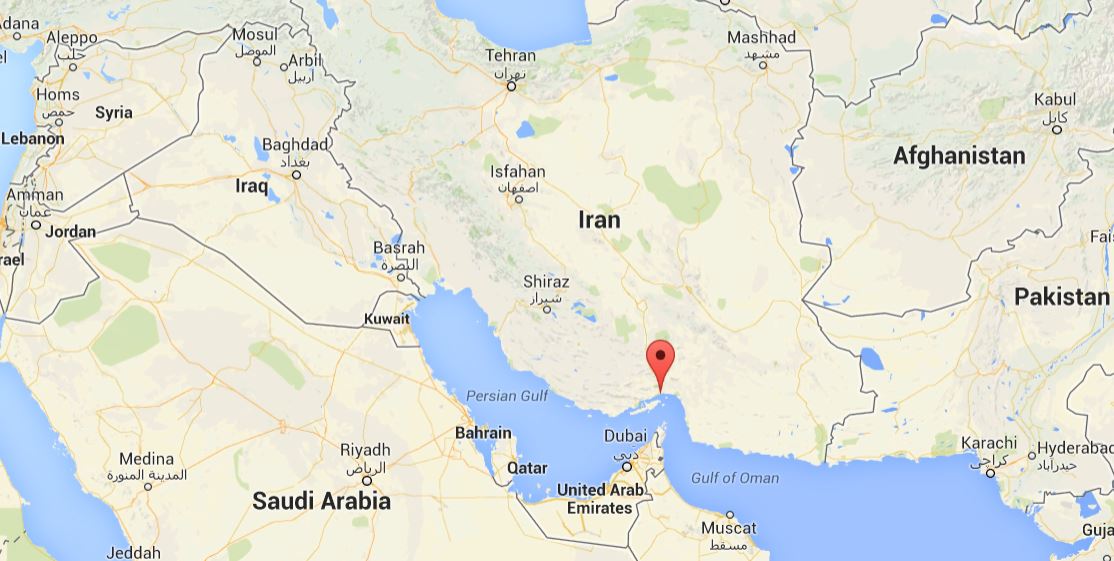
The red marker for Bandar Abbas falls close to a projected flight path, and more than halfway from Bagram (Kabul) to Dubai. Note that travelers entering Iran along the Pakistan border would need to traverse entire country to reach Iraq.

The red marker for Bandar Abbas falls close to a projected flight path, and more than halfway from Bagram (Kabul) to Dubai. Note that travelers entering Iran along the Pakistan border would need to traverse entire country to reach Iraq.

Disclaimer: There is a very good chance that my thinking here is so off-target as to make it total bullshit, but it is still a fun exercise in trying to make sense of recent events. –JW

Long-time readers will be familiar with my strange hobby of noting interesting events taking place along the border between Pakistan and Iran. We have a new entry in that category, and this time the information we have is quite cryptic. The initial report came from IRNA, dated September 8:

Minister of the Interior Abdolreza Rahmani Fazli said here on Monday Afghan and Pakistan nationals, who were trying to cross Iranian borderlines to join the Islamic State of Iraq and the Levant (also known as Daesh) terrorists in Iraq, have been arrested.

Speaking in a local gathering, Rahmani Fazli underscored that the Iranian military forces and residents of the border areas are fully vigilant against Daesh plots to counter potential threats.

He added that Iranian forces are on full alert, as the Daesh terrorist group is failing in Iraq.

Note that Fazli does not state where or when these arrests took place. Mehr News expanded slightly on the IRNA story:

Iran’s Interior Minister Abdolreza Rahmani Fazli in a meeting of the country’s deputy governors for political, social and security affairs said that a number of Afghans and Pakistanis who were passing through Iran seeking to join ISIL in Iraq were arrested.

Rahmani Fazli added that the country had already prevented some other Afghans and Pakistanis to enter Iran.

“ISIL terrorists have not succeeded in recruitment of fans inside the country; however, this is not to deny they promote their ideology, since they are active in the cyberspace, connecting to the possible candidates for recruitment,” the minister said.

He asserted that there is no fear of any danger of this terrorist group for the country because the residents of Iranian border provinces are smart enough and the security forces are completely dominant over the borders.

Hmm. Last October those security forces weren’t exactly “completely dominant” when fourteen Iranian border guards were killed. But mostly, it does seem to me that Sunni fighters wishing to make their way to the front lines to aid ISIS in Iraq or Syria would be ill-advised to try to make their way across the longest part of Shia-controlled Iran from Pakistan.

News outlets in both Pakistan and Afghanistan have noted Iran’s announcement of the arrests but add no new information on how many militants were arrested or the loacation or date of the arrests.

This event stood out to me because I had been intrigued by Friday’s strange episode where a plane transporting coalition military contractors from Kabul to Dubai made an unscheduled landing in Iran: Read more

Share this entry